
Poor John objects to buying a city map wherever we go. Pay for a tourist map? No way! So unless the map is free, we blunder around until we find our bearings.
We were in Brussels to catch up with Jean-Mi, our very first exchange student in 2000. Although I know the city fairly well, I had only a vague idea how to find his and Sali’s new flat. I had an address and I’d checked Google maps, but it’s still nice to have a printed map in hand. The tourist office wanted a blackmailing price of 50 cents for one of their maps. But then Poor John spied a ‘discarded’ map. I didn’t see him pick it up, but he swears he didn’t haul it out of the poubelle (French for rubbish bin). However, I got the impression it might have been left unattended for a moment, and he grabbed it. At least no one chased us for it.
But it’s turned out to be one of the funnest (I have wanted to use that non-word for a long time) maps we’ve ever had. The cover says it is a ‘Free Map for Young Travellers Made by Locals’. It’s a treasure chest of information. It has excellent and legible (even I can read the street names) maps of the inner city as well as the surrounding city (yep, Jean Mi’s flat was easy to find). It shows the underground Metro lines and describes various touristic walks. It makes you want to spend months in Brussels just exploring the city. Here are some of the explanations.
‘Exotic Street—Each year up to 800 sea containers full of olives, olive oil, dried fruit and vegetables, spices and rare ingredients arrive in this street.’
‘Crossroads Station—When you arrive in Brussels North, your idea of Brussels will depend on the exit you take out of the station.’ One direction takes you to the red light district, another to a huge shopping area.
‘Old-fashioned Brussels—In the middle ages, the Marolle neighbourhood was a leprosy colony, where sick people were sent to die outside of the city walls.’
There’s plenty of other detail about trains, taxis, buses, trams, bike rentals, restaurants, bikes and a whole bunch of tips on how to ‘act like a local’.
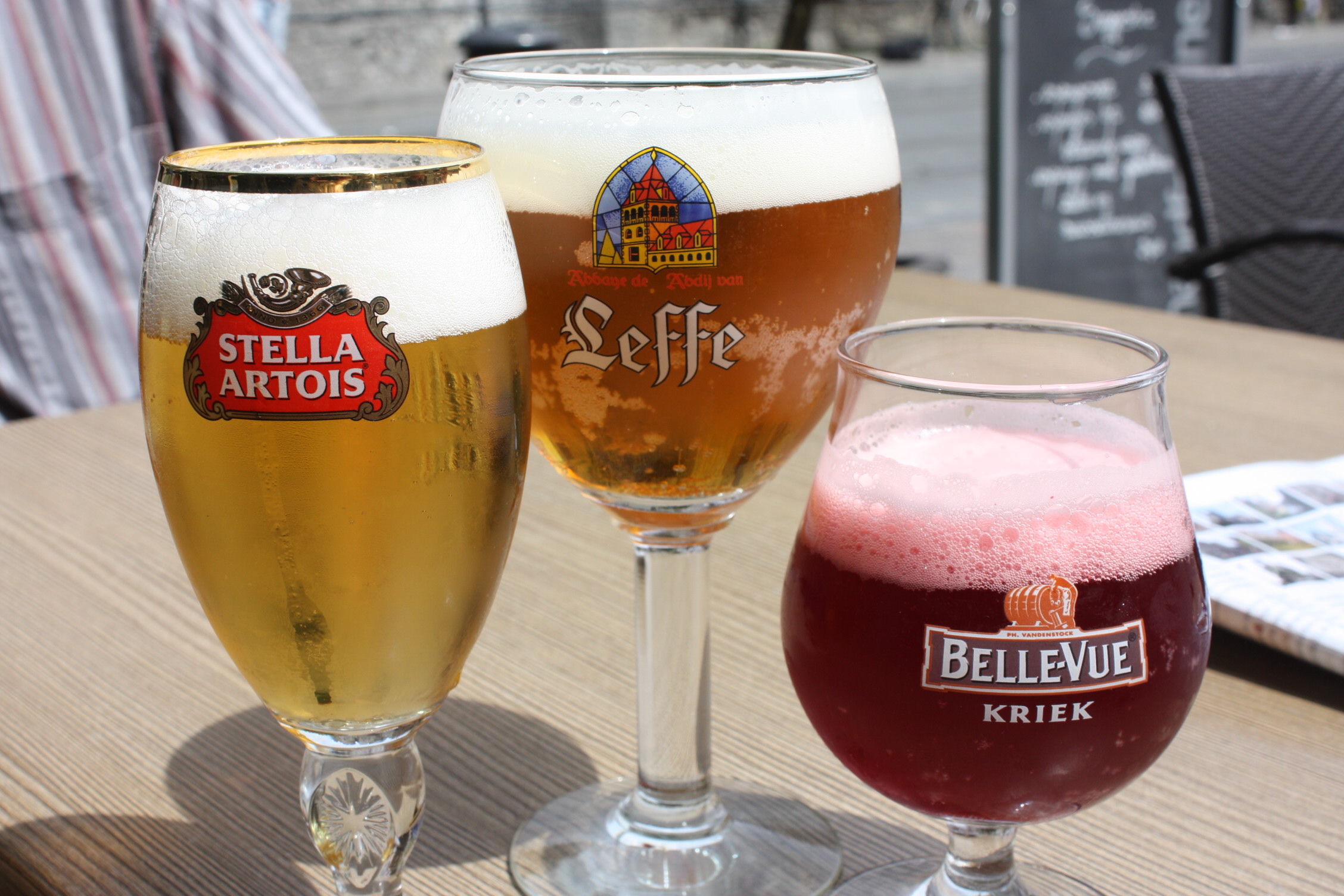
Stelle Artois, Leffe and Kriek beers in Belgium.
Beer gets several entries—advice to drink the real sour gueuze beer, a reminder to choose the right beer for the right occasion, where to buy beer (the supermarket because it is cheaper) and a plea to ‘stop stealing our beer glasses’.
I understand their concern about the beer glasses. Every beer has its own special glass which I assume is produced by the brewer. They are truly amazing and supposed to bring out the best in each beer. I’ll write more about beer soon, but here’s a look at three beers in their respective glasses. And no, they weren’t all for me.
Poor John hasn’t seen much of Brussels. I’ve been lucky enough to have been here four times since 2000, but this is his first visit that’s been longer than 24 hours (he was here briefly in 2009 on our way to Africa).
So today was our see-the-centre-of-town expedition.
Weather-wise, it was one of our first really crappy days. The early morning had been sunny, but it was raining hard by the time we got to Rue Trone (our almost direct path to the city).
At the intersection, Poor John turned right to walk to town (I swear the man is crazy sometimes). After about 20 metres, I suggested that we back-track to catch the Anneessens bus. Wisdom won out and we huddled in the doorway of a bakery until the bus arrived. Poor John popped into the bakery and bought a strawberry tart as a gesture of gratitude to the baker.
We paid for the tart, but we didn’t pay for the bus ride. We are stupid tourists who don’t know how to work the machines or figure out the fares. Yeah, right! Besides we were only going three stops (to the Trone underground station) and hoped an inspector wouldn’t catch us.

Blowing bubbles in the Grand Place, Brussels.
We then took the underground and didn’t pay for it either. This is not a habit I recommend for travellers to Belgium or Germany, but on a rainy day you can hope the bus and underground are so full that an inspector can’t make their way through the crowd to check.
We finally reached the Grand Place which, in my opinion, is the most stylish and beautiful central plaza in all of Europe, to encounter bubble-mania—and I don’t mean champagne bubbles. Everyone seemed to have a bottle of kiddie bubbles (no idea how/where they got them), but very few kids had any bubbles. I took a lot of photos, but the bubbles are hard to see. I include one here—of a dad letting his kid blow the bubbles. That happened only once. Dad had about 15 ‘blows’, and the kid had one (and I have the photos to prove it). As Poor John pointed out, ‘It’s a classic example of a dad having a lot more fun than the kid’.
Reminder—you can click on the small photo to see a larger version.
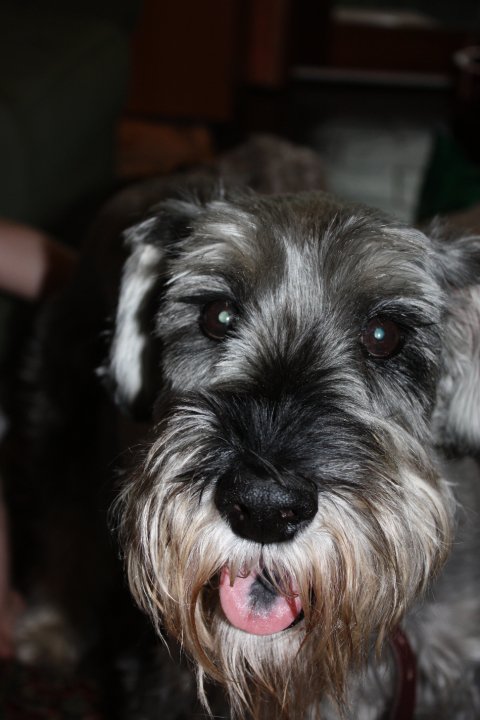
Aggie (Agadore Spartacus) with the birthmark on his tongue
Aggie, our standard schnauzer, has always been proud of his German heritage. For starters, he loves sausages and regularly steals any unattended sausages from the dining table or kitchen bench. He loves chocolate and ice cream too. It once cost me $166.70 at the vet’s to get a 300-gram of dark Lindt chocolate bar out of his gut. He had broken into Poor John’s office, and then desk, to sink his teeth into a chocolate block purchased duty-free at the border between Syria and Jordan.
Punctuality is also a priority. He wants breakfast, dinner and walkies on time. He loves having his head out the car window (see the banner on this blog), but I suppose that’s not a particularly German trait.
But I guess I’m going to have to break it to him that he probably isn’t German after all. While books on dog breeds claim the schnauzer originated in Germany (Bavaria) about the 15th century, they are wrong. The breed name may be German, but there aren’t any (well hardly any) schnauzers in the country. We’d spent a whole month—travelling all over the country including Bavaria—before we finally saw a single mini schnauzer in Münster.
Of course, there is no shortage of dogs in Germany. They are everywhere—on trains and subways, in department stores, in restaurants, even in parks. And way too many people leave their dog’s poop to be trodden on by unsuspecting passersby. I had a close call recently, but a nice local woman frantically warned me to avoid the Hund’s **INSERT whatever the German word is for dog poop**. As I said in an earlier post—what’s a language barrier.
But for all the dog poop in Germany, there doesn’t seem to be any that belongs to a schnauzer. Spaniels and dachshunds (or sausage dogs as Poor John calls them) are especially common. Jack Russell terriers and westies are abundant too, as are shitzus and bichon frisés. I haven’t seen many poodles, but they must hang out in France.
As for truth in advertising, the Belgians do much better at actually having dogs that are Belgian. I’ve been in the country for less than a week and have already seen three Belgian barge dogs, and heard of two Belgian Bouviers and two breeders of Belgian shepherds.
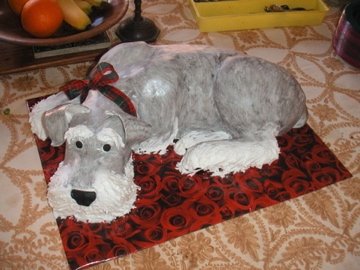
Schnauzer birthday cake
And a bit of an aside. For those who haven’t seen it before, here’s a pic of the schnauzer birthday cake that was made for me by the amazingly talented Rachael Szczerbiak. The cake was the size of a mini schnauzer and I was absolutely gobsmacked when it appeared. Thanks again Rachael.
A sad footnote: Our dear Aggie, who was 15, had to be put down not long ago. I still miss him and always will.
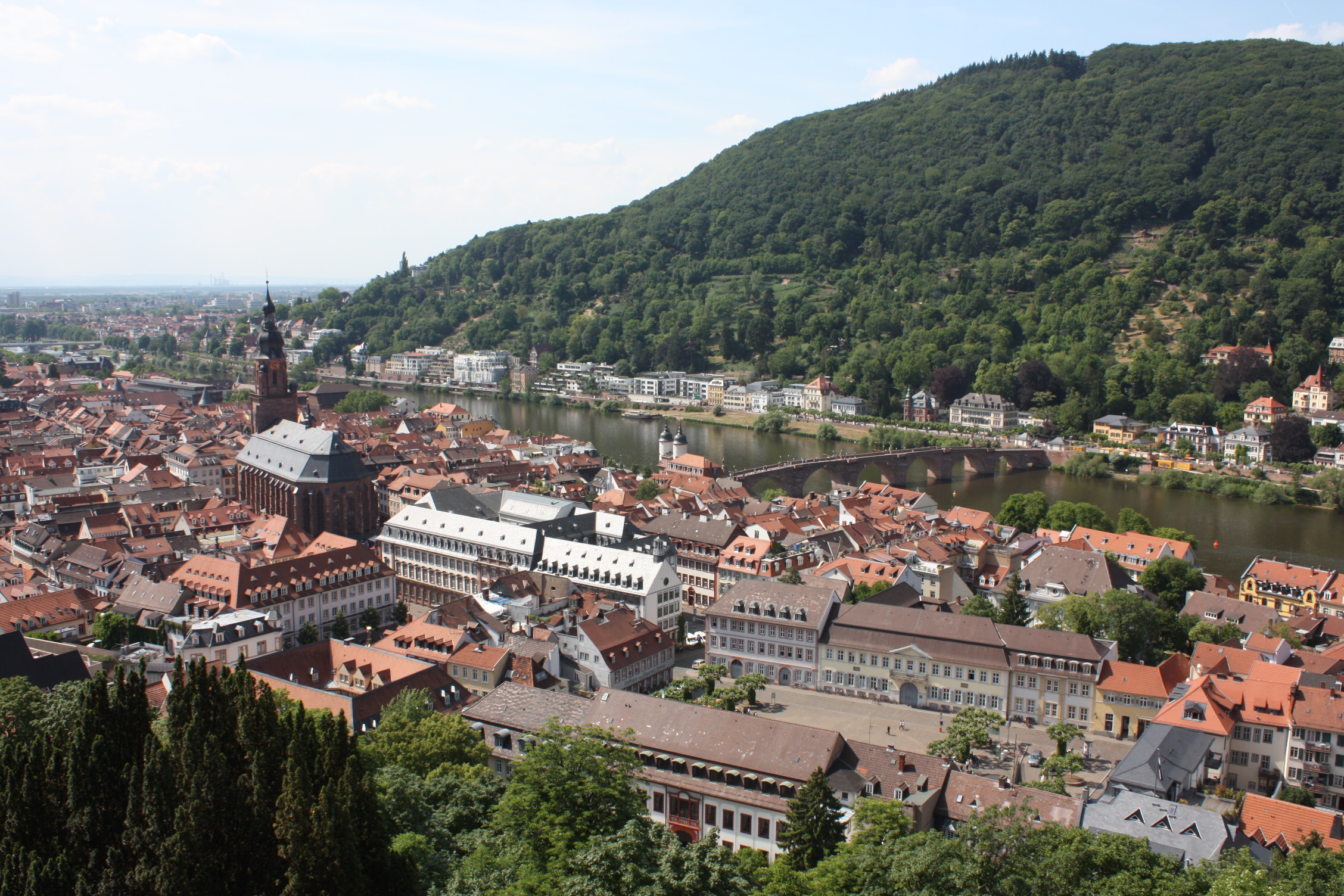
Heidelberg's cathedral, the Heiliggeistkirche.
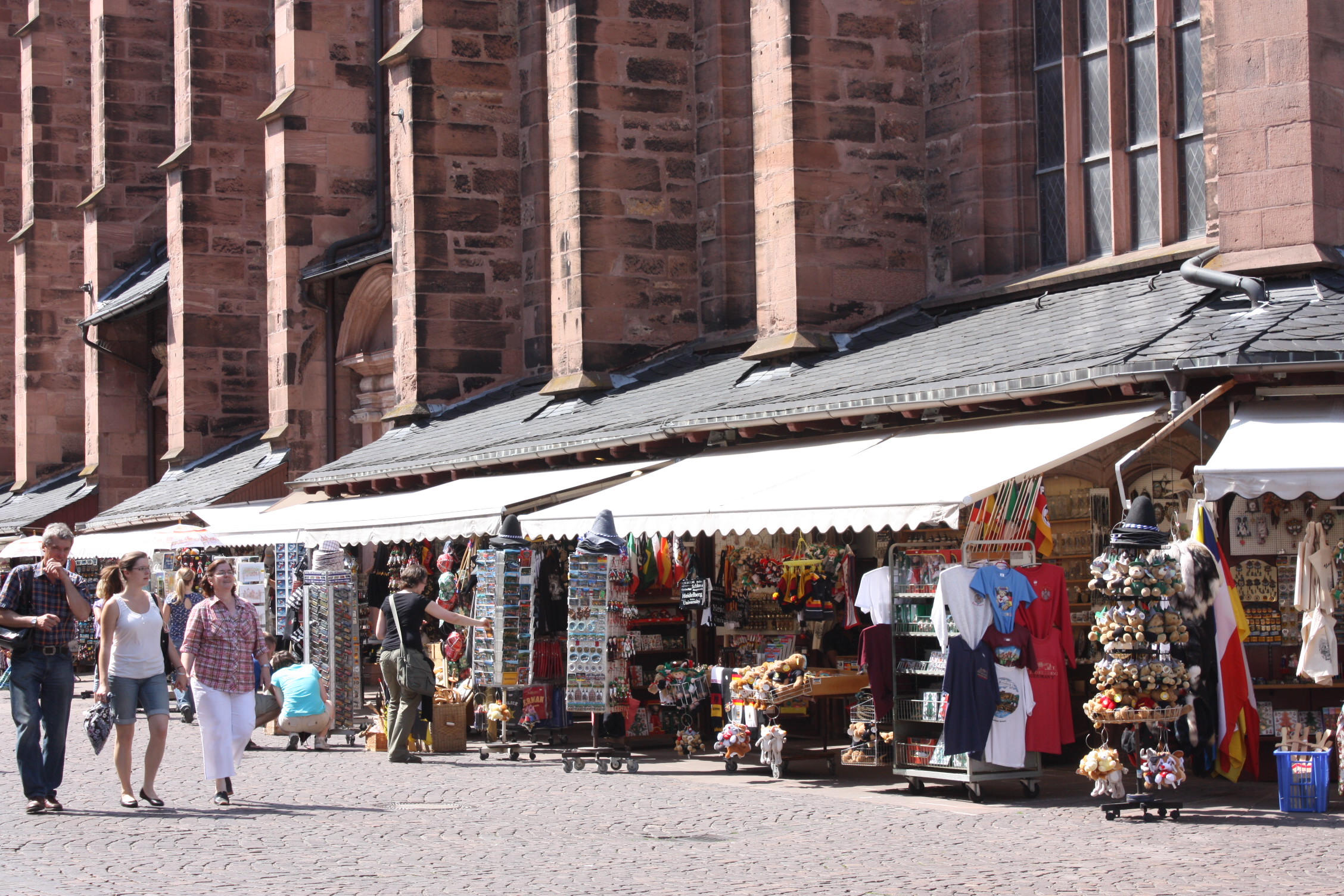
Market stalls at the cathedral in Heidelberg.
Heidelberg has an enormous Gothic cathedral, the Heiliggeistkirche, built between 1398-1441. It’s the very tall building you see in the centre-left of the picture. Today it is used as a Protestant church, but in the past it was divided internally and half each was used by Protestants and Catholics.
Apparently there are 204 steps to the top of the church spire, and I’m still wondering why Poor John didn’t insist that we climb them. We’ve tackled every other church spire and belfry we’ve seen. Maybe it was because it was such a few steps (we did 533 in Cologne) or because we got such a great view from the castle.
The cathedral is located on the Markt (old town square) and is surrounded by market stalls, most of which seemed to be selling touristic trinkets. We have seen this union of religion and commerce in several German towns, although only in Heidelberg is it described as ‘a tradition’.
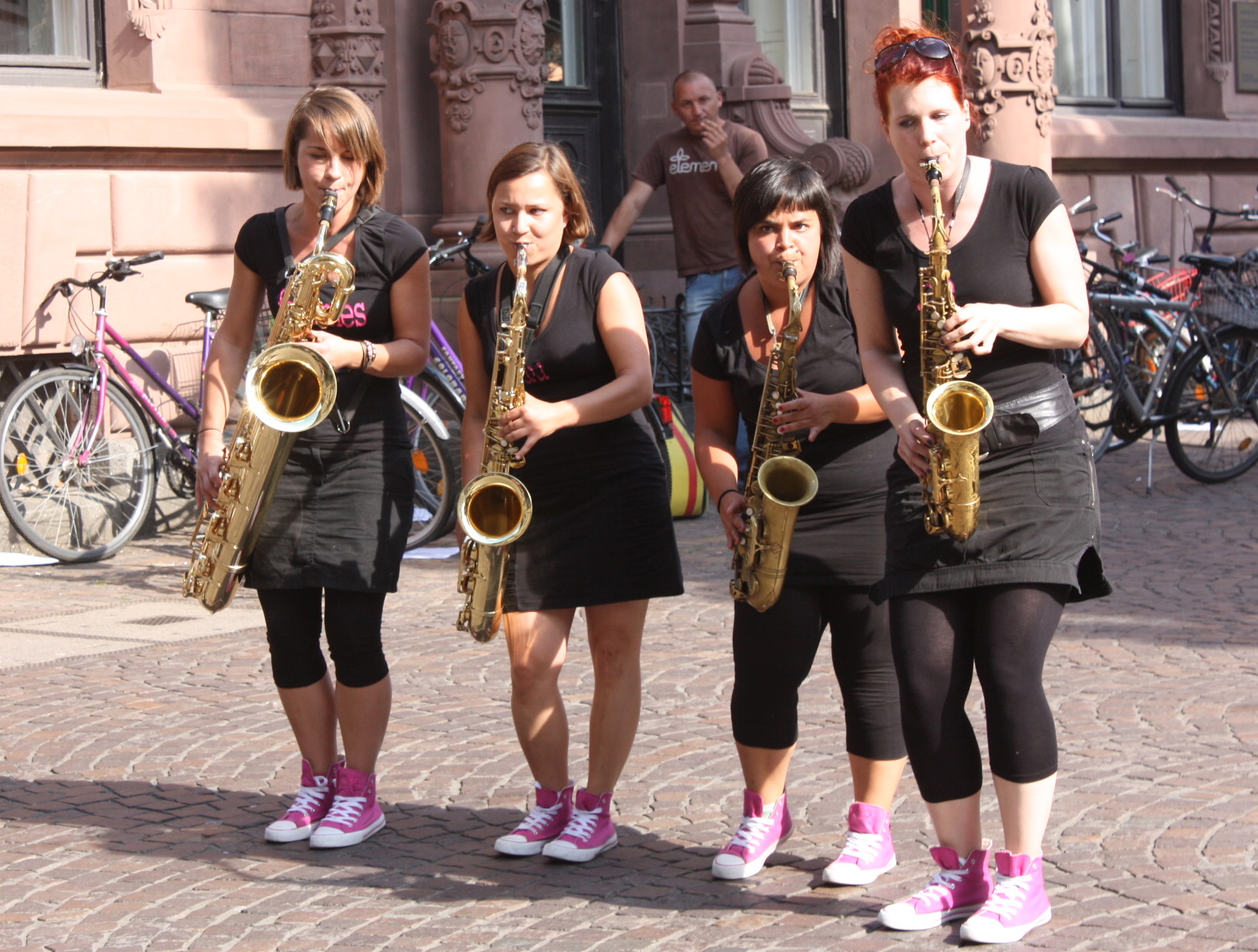
Femmes du Sax
German and Belgian streets, stations and trains are filled with buskers of all types—some better than others.
Two days in a row, a fellow with a trumpet hopped on our underground train in Berlin and played a dodgy rendition of When the Saints Go Marching In. Both days, he boarded at one stop, played, passed the hat (a few contributed) and left at the next stop to hop on another train. His playing wasn’t so bad that he had to escape, but I’m guessing he knows only that one tune. We’re back in Berlin next week, so I’ll let you know if we see him again.
We’ve been entertained (or tortured) by guitarists, pianists, harpsichordists, accordionists, orators, human statues, a fellow with a huge homemade xylophone, various strolling minstrels and an organ grinder (I saw him in the exact same spot in Bruges in 2003 when he still had a monkey).
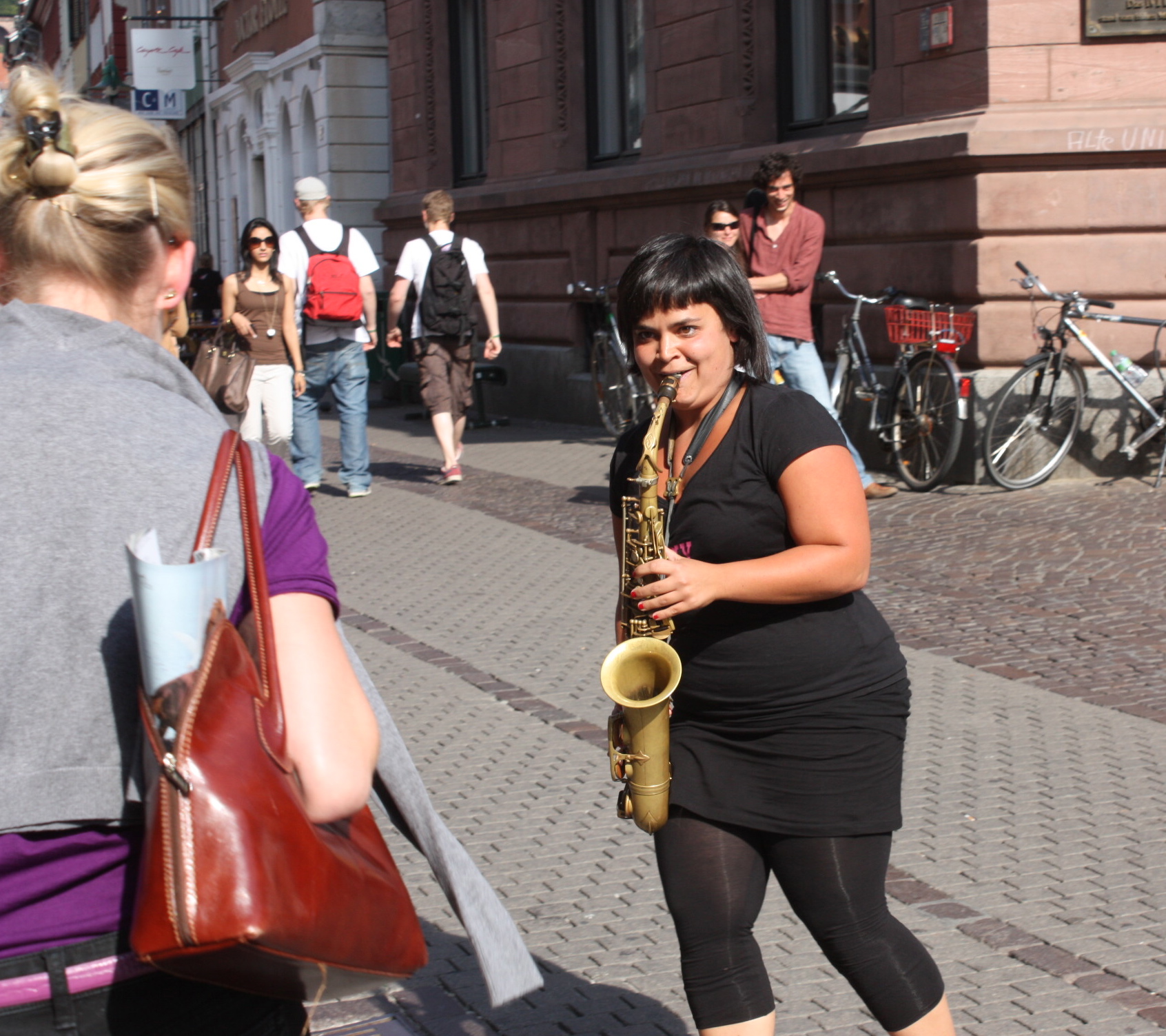
A femme du sax
But the best by far, have been the Femmes du Sax. These four gals were sensational, playing on the main tourist street in Heidelberg. They dazzled the crowd with tune after tune—I recognised every piece, but can’t name any of them now (brain drain).
The Femmes du Sax are true entertainers—with personality plus. They don’t just stand there, but boogie and dance among the audience. Children in prams seem to get special attention. Don’t know if they’ve released a CD. They didn’t appear to have one on sale. Pity, as I’d have bought one, even though we are travelling light.
I know I’ve already written about Heidelberg (see the spiel about prescriptions and the pharmacy in the castle there), but it is such a lovely city that it’s definitely worth more than one entry—maybe even three or four.
So this time, welcome to the famous Philosophenweg (Philosopher’s Walk) on the north side of the Neckar River. Poor John and I are trying to get in a decent walk at least once a day, and this uphill jaunt was a must-do.
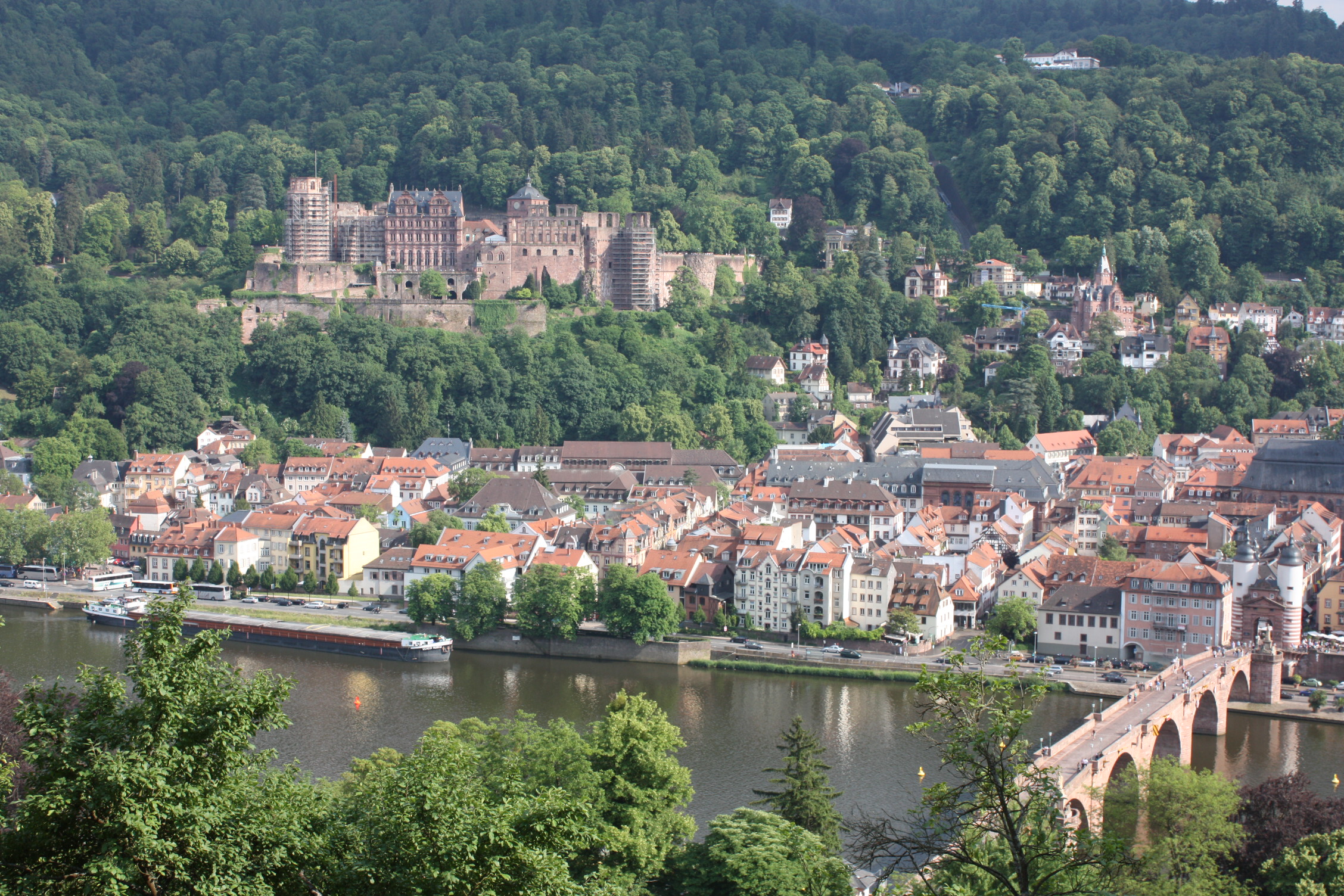
View over Heidelberg from the Philosopher's Walk.
Heidelberg claims to have Germany’s oldest university. Established in 1386, the Ruprecht-Karl-Universtät originally had four faculties—philosphy, law, medicine and theology. The institution drew many famous philosophers. This walk was popular with them—no doubt offering them a great chance to ponder why they had tackled this near-vertical (yes I am exaggerating) climb. But it does give you amazing views over the Aldstadt (Old City) and the 13th century schloss (castle).
After we descended, we crossed the bridge back to the Old City to see the statue of a brass monkey holding a mirror and surrounded by mice. The mirror brings wealth and the mice are supposed to ensure you have plenty of children. I told Poor John he’d better leave the mice alone. But maybe the theory applies to exchange students, too, which is okay because we have oodles of them.
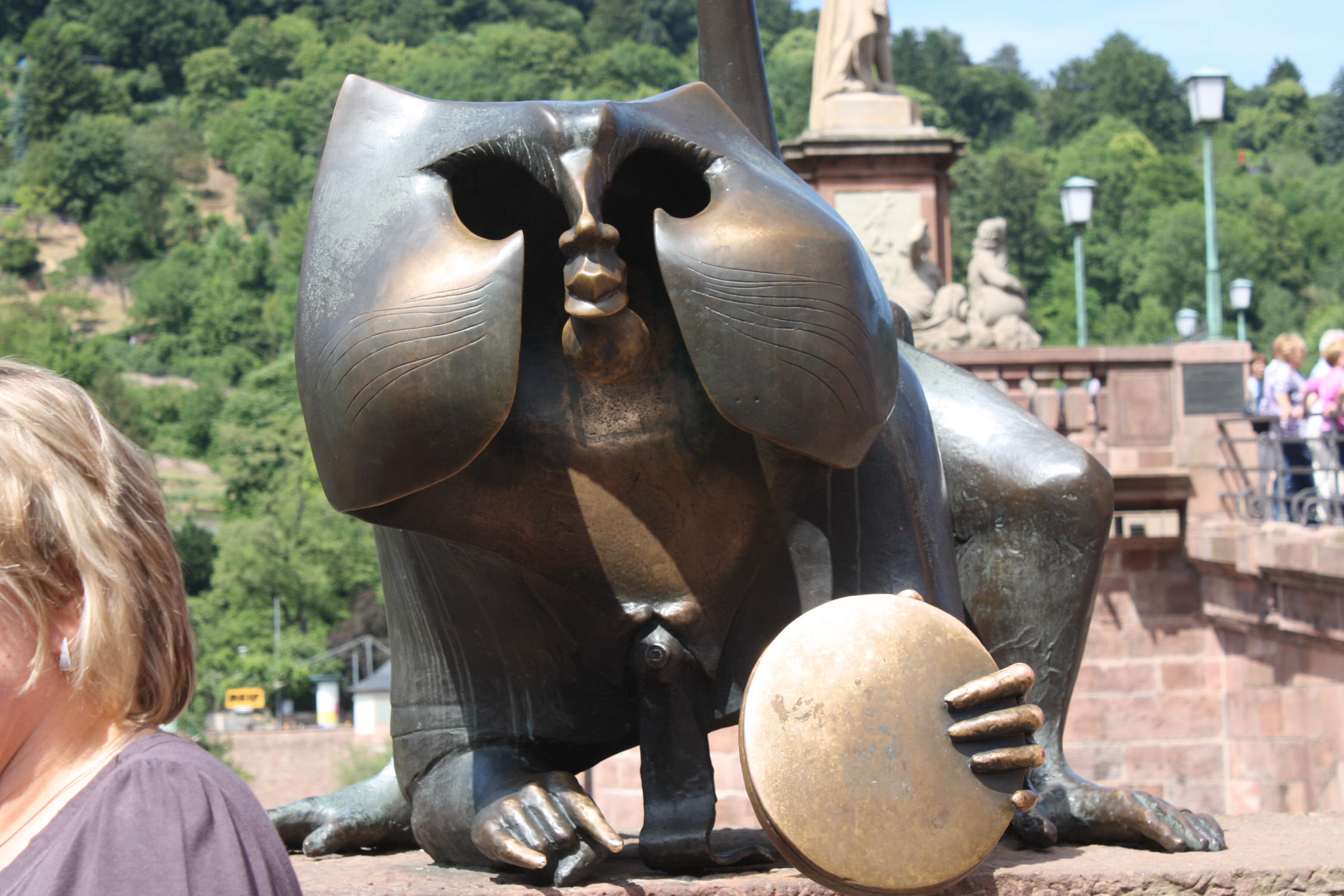
The brass monkey of Heidelberg.
I love the cheek of advertising. Opposite the bridge and the monkey is a hotel with a sign that reads ‘Goethe almost slept here’. Apparently the receptionist wouldn’t let him in, so he stayed elsewhere. A lot of Heidelberg hotels could display a sign reading ‘Poor John and Leggy Peggy almost slept here’, but that’s because they were too expensive for our needs or budget. Imagine spending 130 euros a night for a place to sleep! We searched the town and finally found a place for 85, and we thought that was too dear. No wonder we take tent holidays.
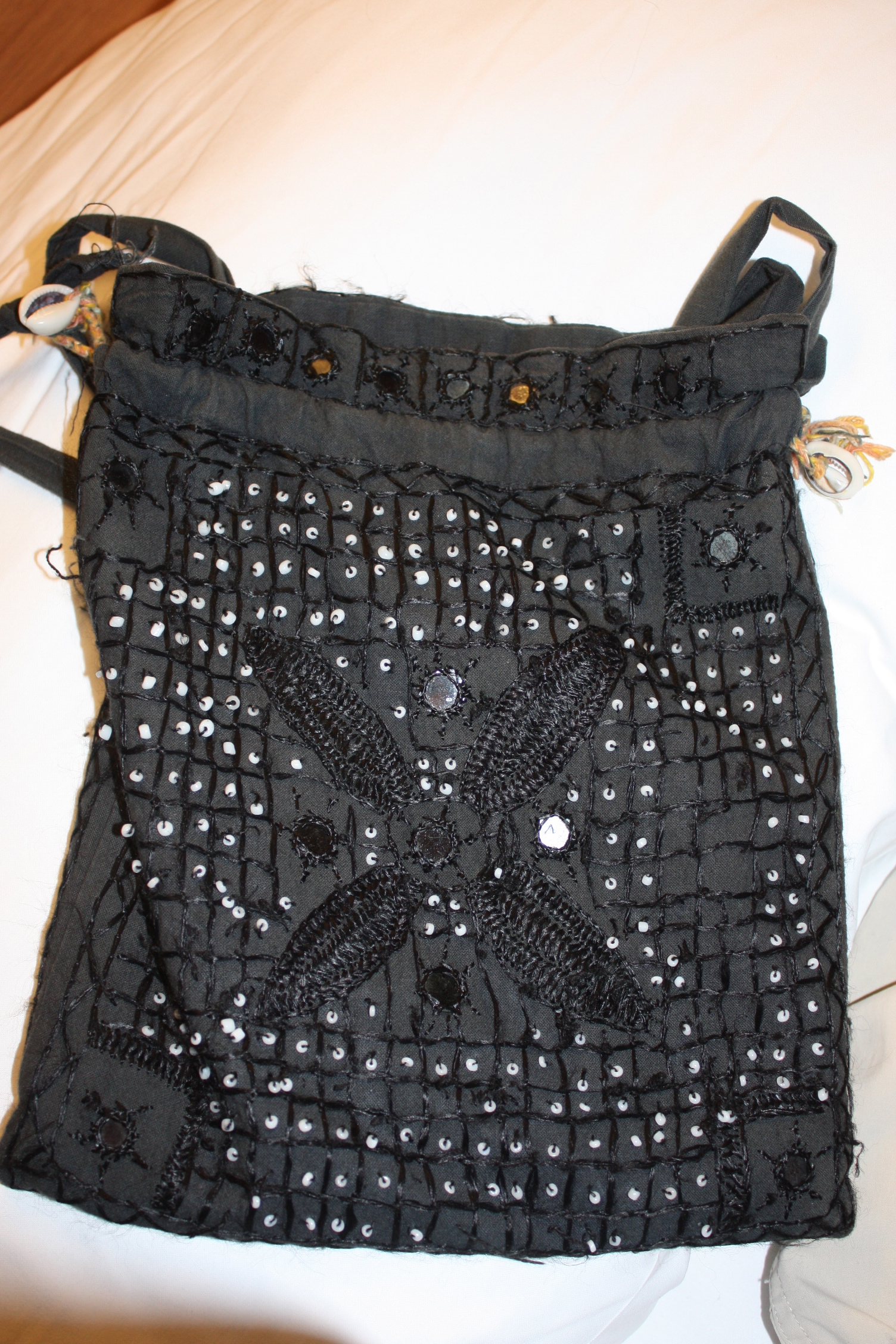
Technology bag
Who owns this bag? I found it in the playroom, and ‘appropriated’ it for personal use. It’s on holiday—filled with bits of essential technology. Life was easier when I first travelled abroad. In addition to the passport, clothes and money, I took a toothbrush, a pen and paper, a camera and some film.
But this little black bag is loaded with tricks for Poor John and me—two hard disk drives, electric toothbrush charger, camera battery charger, iPod connection, mobile phone charger, e-reader connection. No doubt there are other weird bits at the bottom.
So my question is—What do I do with the bag when it falls apart? Should I bring the ‘body parts’ home for repair? Or can I ditch the bag and get a new one?
That’s not bad grammar — it’s the slogan on one of the pamphlets for the German town of Worms (pronounce vorms and rhymes with forms). We had a day-trip to Worms while we were staying in Mainz, and it really was worthwhile.
Worms is one of the major sites where the events of the ancient German Nibelungenlied took place. The Nibelungenlied, translated as The Song of the Nibelungs, is an epic poem in Middle High German. It tells of Siegfried, a dragon-slayer at the court of the Burgundians, how he was murdered, and of his wife revenge. Gosh they did revenge well in days gone by.
Along with Cologne and Trier, Worms claims to be the oldest town in all of Germany.

It also has strong links with Martin Luther. In 1517, Luther, an Augustinian monk, nailed his 95 theses to the doors of All Saints’ church in Wittenberg. In the following years, he published several writings which were considered to be heretical. In these writings, he rejected the church dogmas and practices that diverged from the Gospels. He was excommunicated by Rome, but in 1521, Emperor Charles V summoned Luther to the Diet of Worms. He asked Luther to recant his theses. Luther refused to do so. Although the Emperor outlawed him, Luther was protected and ‘shielded’ by his sovereign, Frederick, the Elector of Saxony. A combination of theologic and Reformist claims and political interests eventually resulted in the Reformation. Luther’s ideas spread like wildfire. His conscientious decision had a tremendous and worldwide effect on both religion and politics. Worms has constructed a memorial to Luther. The museum at Worms has a room dedicated to him.

Roman glass in the Worms museum.
The museum is beautifully set out. It has one of Europe’s largest collections of Roman glass, as well as an impressive collection of pottery. They use life-size cutouts to show how people wore jewellery and garments.
Worms’ St Peter’s Cathedral is built upon the foundations of Bishop Burchard’s cathedral (1000–25). It is one of the three imperial cathedrals on the Rhine. The others being in Mainz and Speyer.
Worms also has a large Jewish quarter and the oldest preserved Jewish cemetery in Europe. More than 2000 gravestones have been preserved, including those of Jewish scholar and martyr, Rabbi Meir of Rothenburg (who was born in Worms), and his pupil, Alexander ben Salomon Wimpfen Süßkind.
On a last note, we can all be grateful that Worms brought us the original Liebfraumilch wine.
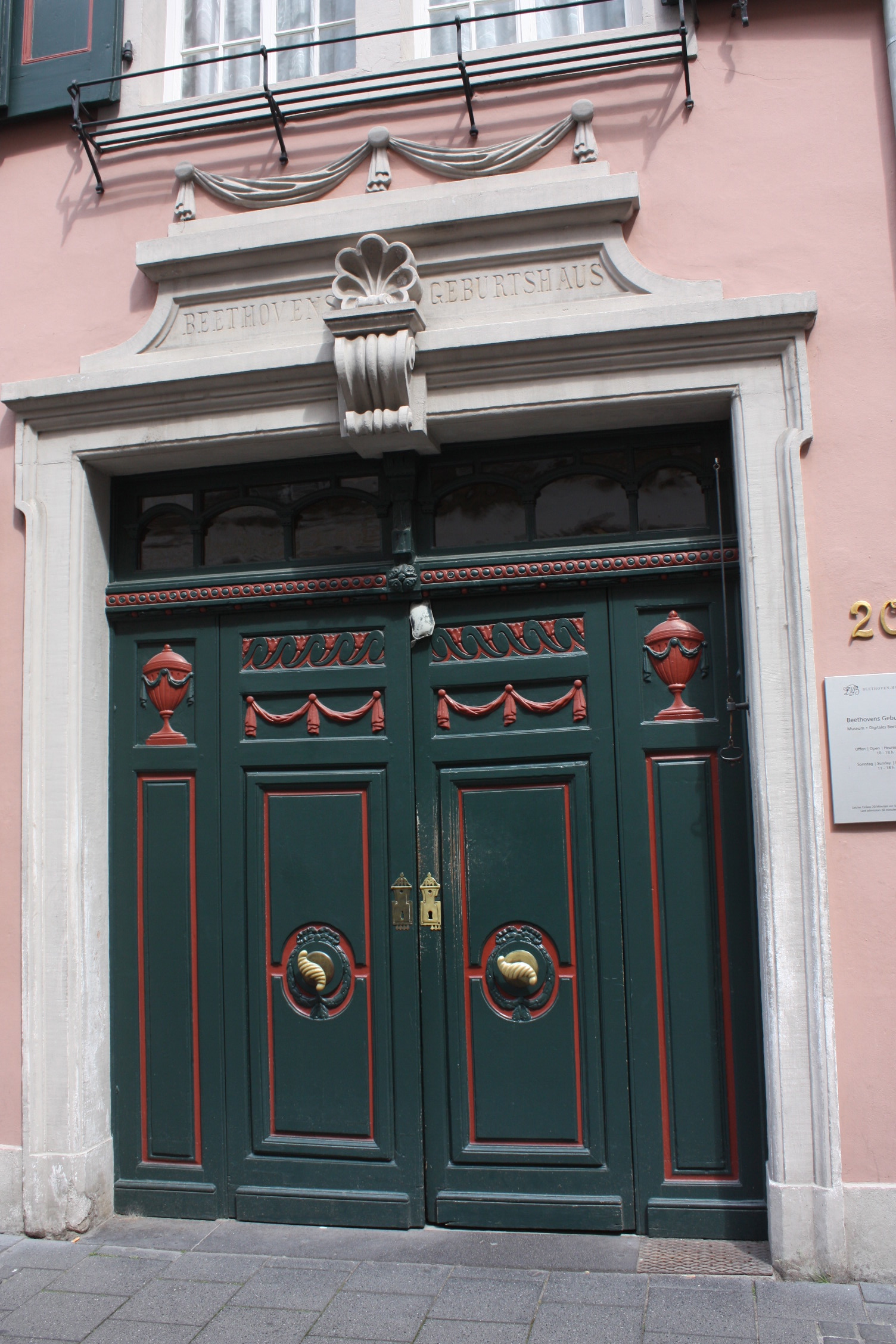
The door to Beethoven's birthplace.
We made a surprise visit to Bonn. Our day-trip rail pass was good for all of the North Rhine–Westphalia state, so after having a good look at Cologne, we decided to go on to Bonn for a few hours.
Situated on the Rhine River, Bonn was a surprise choice to become Germany’s temporary capital in 1949. About 40 years later, when Berlin reclaimed that role, many people predicted that Bonn would become a ghost town. Gosh were they wrong. The federal government ingested 1.7 million euros to ensure than Bonn didn’t revert to some lonely and neglected backwater. Now it is home to many international organisations and companies, as well as about a dozen arms of the United Nations. There’s a great university atmosphere too.
I was also surprised to come across various tributes to Ludwig van Beethoven, who was born in Bonn in 1770. We found his house, a statue and some wall paintings too.
Beethoven always reminds me of my elderly cousin, Lilian Conybeare. Many years ago, Lilian was given a record player for Christmas. She loved classical music and was keen to purchase some records. So she visited one of the music shops in Omaha, Nebraska and asked for ‘something by Beethoven’. The teenaged salesgirl disappeared for quite some time before returning to say, ‘I can’t find anything. It would help me a lot if you could tell me what group he plays with!’
Lilian was gobsmacked (although she didn’t know that great Australian word for ‘stunned’). She also thought it was funny, and submitted the story to the Reader’s Digest. She was surprised and disappointed that it was rejected, until it dawned on her that the magazine probably decided many of its readers might not ‘get’ the humour.
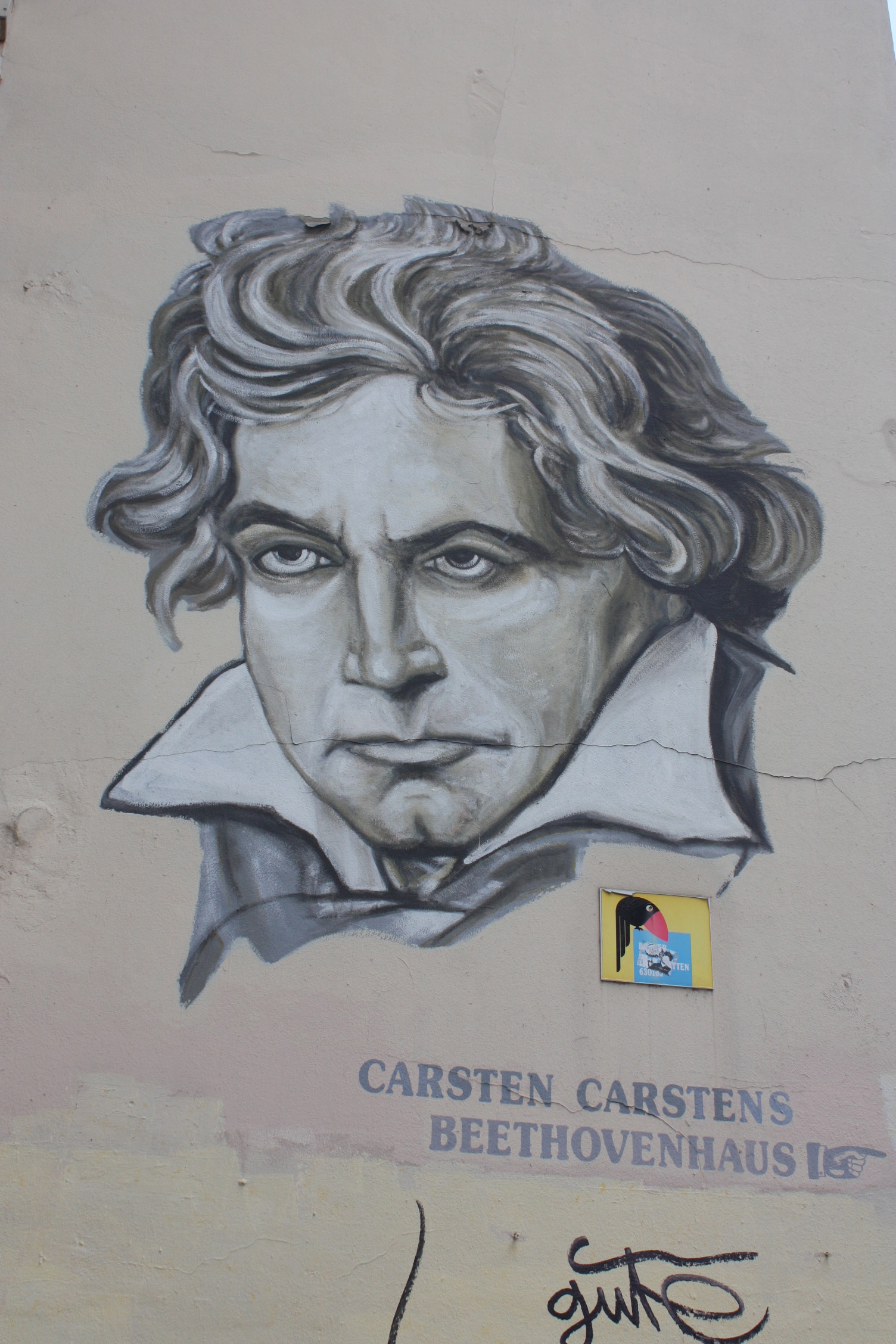
Beethoven -- not looking all that amused.
Sorry to be missing. We’ve been goofing off in Ghent Belgium for the last few days, but the internet has been goofing off too. It meant that I could not get online since Saturday. But we are in Brussels now and everything is back in order. I hope to post three or four new items ASAP, but first I’m going to track down the giant mosquito I just saw—it’s a whopper.
 Where to next?