

Dad in his 20s
Today marks a sad anniversary—50 years ago today my father was killed in a car accident in Omaha Nebraska. He was 45 years old and on his way to pick up my mother at the hairdresser’s.
There was freezing rain and he hit a tree in Elmwood Park. Workmen in the park thought they saw him try to miss hitting a dog. Maybe he had a heart attack. We’ll never know. I no longer remember how we knew the police officer at the scene, but he was stunned to learn that dad had died on the way to the hospital. He had seemed alert and stable at the scene.
If rescue squads (as they were then called in the US) had been as sophisticated and well equipped as they are now, the outcome might have been different. Essentially dad died of shock and a ruptured pancreas or spleen. Unbelievable that I can’t remember which organ it was.
The hairdresser’s place was only a few blocks from the scene of the accident. When my mother heard the sirens, she said, ‘I hope that’s not why he’s late.’
Dad left behind a wife and four daughters, and whole life ahead.
The day had been full of promise.
It was the first day of his last semester of university to earn a degree in engineering. He’d been studying part-time for seven or eight years, and doing that around his full-time job as the civilian pilot for the US Army Corps of Engineers and later as the private pilot for the Central National Insurance Company of Omaha.
It was also the day he would take delivery of a new plane (a Queen Air 88) for the company—a plane he’d chosen after months of research, testing and deliberation.
While I’ve written this post to mark the half century since his death, I also wanted to share, especially with my sisters who are all younger than me, a bit of history about dad and airplanes.
On the evening of Thursday, 18 December 1952, dad crashed a DC-3 at Stapleton Airport in Denver Colorado.
Not surprisingly, it made front-page news in the next day’s The Denver Post. Here’s the article.
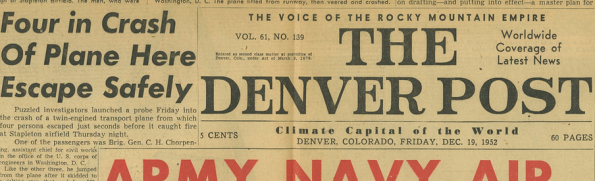
The Denver Post’s front page, 19 December 1952
Four in crash of plane here escape safely
Puzzled investigators launched a probe Friday into the crash of a twin-engined transport plane from which four persons escaped just seconds before it caught fire at Stapleton airfield Thursday night.
One of the passengers was Brig. Gen. C.H. Chorpening, assistant chief for civil works in the office of the U.S. corps of engineers in Washington D.C.
Like the other three, he jumped from the plane after it skidded to a jolting stop that ended a 100-mile-an-hour takeoff attempt. None of the four was seriously injured.
The others were civilian employees of the corps of engineers—Pilot J.H. Austin of Omaha, Neb.; Copilot N.H. Hansen, also of Omaha; and George Beard, an engineer from Washington.
Treated for bruises
Chorpening and the two crew members were treated for minor cuts and bruises at Fitzsimons Army hospital and released. Beard did not require medical treatment.
The plane, a DC-3 owned by the corps of engineers, was sent here from Omaha Thursday afternoon to pick up Chorpening, who was on a routine inspection of civil engineer projects.
Chorpening said the craft was only a few feet off the runway when it suddenly went out of control and piled up in a wheat field on airport property. The time was 6:32 p.m.
The plane went up in flames shortly after the four got out.
The pilot could not explain the accident. He said the plane reached a ground speed of about 100 miles an hour when it veered sharply and crashed at the south end of the field.
Inquiry ordered
The investigation was ordered by the civil aeronautics administration. AC Goddard, CAA safety agent, said Friday the cause of the crash was ‘a total mystery.’
‘The pilot doesn’t know, which means that a physical inspection of the wreckage will have to determine what happened,’ he said.
Both engines were torn from the plane and thrown twenty feet in front of the fuselage. The pilot’s compartment was caved in and the entire plane swept by flames.
Six companies of firemen from the Stapleton fire department had the blaze under control in about fifteen minutes.
Less than two hours after the crash. Chorpening and his crew left Denver on a commercial flight to Omaha. The general had come here from the west coast by commercial plane.

The plane was destroyed
—
The 19 December evening edition of the Omaha World Herald also carried an item, which had additional details.
Plane burns but 4 escape: Army engineer general shaken in crash
Four men, one a high ranking general in Army Engineers, narrowly escaped death Thursday night when a plane from Omaha crashed and burst into flames at the Denver municipal airport.
Brig. Gen. Claude H. Chorpening of Washington, assistant chief of engineers in charge of civil works, escaped with a wrenched left shoulder, bruises and cuts.
George L. Beard of Washington, chief of the planning and development division in the office of the Chief of Army Engineers, came out of the flaming plane almost unscathed. He is a civilian.
On inspection trip
The pilot, Jules Austin, 5118 Leavenworth Street, and the acting co-pilot, Norman Hansen, 1811 North Forty-eighth Avenue, also got out safely. Mr Hansen normally is the plane’s engineer, but as a licensed pilot fills in as co-pilot on occasion.
The plane, a C-47 transport assigned to the Missouri River Division of the Army Engineers here, had gone to Denver to take General Chorpening on an inspection trip of the Army Engineers projects in South Dakota. He had come from the Pacific Northwest, where he had toured projects under construction in that area.
The accident occurred about 7 o’clock just after take-off when the plane was about 10 feet in the air.
Looped on ground
General Chorpening said the plane shuddered violently, then dropped its left wing sharply. The wing tripped on the ground, he said, and the impact flung the plane over to the right side. It looped on the ground and came to rest off the runway.
The outside of the plane started burning, and flames broke out in the compartment that separated the cabin from the pilot’s compartment.
General Chorpening’s seat to which he was bound by his safety belt, was broken from its fastenings and flung the length of the cabin.
General Chorpening and Mr Beard freed themselves and felt their way in the darkness to the rear door, where they jumped to safety.
Continues trip
‘When we hit the ground we started pedaling as fast as we could go,’ he said. ‘The tanks were what we were afraid of. It was a miracle they didn’t explode.’
Mr Austin and Mr Hansen climbed out through escape hatches in the pilot’s compartment.
General Chorpening, who was given emergency treatment at Fitzsimons General Hospital, came to Omaha by commercial airline Friday and left on his inspection trip north by rail. Mr Beard returned to Washington.
Cause of the crash was being studied Friday at Denver.
—
And a bit more of the story
Norm, the co-pilot on that trip, had more stories about that day and the aftermath.
For starters, he said General Chorpening and Beard actually managed to lower the stairs so managed to walk from the plane rather than jump. I know this is true because in one of the photos, you can see the stairs are down.
Once back to earth, the general asked dad and Norm if they would go back into the then burning plane to retrieve his dress hat which he’d forgotten to grab. They declined.
I can’t find the outcome of the investigation online, but my best recollection from Norm and my mother was that much of the blame was placed on an air traffic controller who had allowed a plane to takeoff across and in front of dad just moments before he took off. The officials surmised that had created a wind squall that hit dad’s plane.
Norm had a different view. He said General Chorpening thought the world of my dad and that Chorpening’s take on the cause of the accident was that ‘the earth swung out of its orbit and hit the plane.’
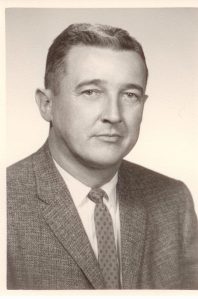
Not long after, the Army Corps of Engineers bought the shell of another DC-3.
Dad, Norm and Harry Hildeburn, dad’s usual co-pilot, refurbished the interior of that plane to make it an executive aircraft, which seated 21 and had a galley kitchen, sofas, easy chairs, card tables, curtains, pot plants and magazine racks. Oh how, I remember that plane. One day I’ll do a post on it.
Footnote: When the Army Corps of Engineers sold that DC-3 in 1960–61, Harry retired to his home state of Oregon. Norm went on to fly for others, and Dad went to work for Central National. Harry died in 1977, and Norm died in 2011 at age 87. We corresponded for years. What a trio they were. I’ll try to share more stories about them.
Another footnote: Remember I said dad died on the first day of his last semester in university? In a wonderful and heartwarming gesture, the University of Nebraska at Omaha (then called Omaha University) awarded dad’s degree posthumously to my mother.

The sign welcomes people to the Canberra Theatre
The word ‘cornucopia’ has always reminded me of an American Thanksgiving with its groaning tables of food, sincere goodwill and heartfelt hospitality being extended to all. My mother taught us that no one is to be left out at Thanksgiving.
Sadly, this week delivered a different kind of ‘cornucopia’ in both America and Australia. This particular show of ‘bounty’ was marked by bigotry, threats and intolerance.
I admit that I was not surprised by President Trump’s announcement today to restrict access to the US for refugees and some visa holders from seven mostly Muslim nations: Iraq, Iran, Libya, Somalia, Sudan, Syria and Yemen.
While it’s not a necessarily a sign of intolerance, it is what he threatened to do. I now wonder how it might affect our elder daughter, who was born in Syria in the 1980s. Luckily she has an Australian passport and no Syrian passport—a daughter of a diplomat.
For now, I won’t go into further comments about the days ahead in the USA.
But I digress.
What concerns me most this week is the bad behaviour being shown by a small group of Australians that have objected to a billboard that promotes Australia Day.
The bad behaviour started last week when a billboard went up in Melbourne. It depicted two Muslim girls celebrating Australia Day and waving Australia flags. The problem seemed to be that they were wearing headscarves (hijabs).
Such hypocrisy. Good grief, nuns wear headscarves.
That said, some Australians complained that people/migrants don’t assimilate when they arrive here. Of course, when migrants try super-hard to fit in (such as the billboard image above), the complainers say it’s not enough.
Of course, no one checks whether the ‘targets of criticism’ are migrants or people who are third or fourth generation in Australia (which is often the case). It really doesn’t matter. I embraced Australia from the day I arrived. I suppose that my good fortune is that, until I speak in my American accent, I look to be a typical white Australian. Even after I speak, I am accepted as ‘belonging’ here. I wonder how it would be if I were black?
The agency that erected the billboard shown above was so bombarded with threats (including death and bomb) that they removed the sign. That prompted a groundswell of public support (yay Australia!). Crowd funding raised $130,000 in a couple of days and that has been spent on posting even more of the same billboard in other major cities.
I live in the ACT—Australian Capital Territory—which decided to post the image (using their own funds) on the neon sign over the government-owned Canberra Theatre (see above). They announced this on their Facebook page.
The reaction (although small) was vicious, threatening and downright illegal. There were suggestions that the theatre be bombed, blown up or set on fire. Most of the comments came from a splinter group of radicals. But the comments were enough for the government to remove the post from Facebook. This is so wrong. Thankfully, they have not removed the sign.
I don’t think I’ve ever shared a politician’s comments, but I was impressed by what Andrew Barr, our Chief Minister, had to say. He called the complainers racists and rednecks. He got it in one. Here’s a link to a main article.
Tomorrow is Australia Day—26 January. Many issues surround this day. It marks when white folks landed on the continent or, as many Indigenous people rightly say, when the white folks invaded. There is discussion, even arguments, about a best day to celebrate Australia Day. I’ll try to keep you posted and hope that bigotry dies down here.
In the meantime, Happy Australia Day!

We’ve visited India three times in three years—mostly in search of wildlife—but the elephants have often managed to elude us.
I have to admit that on our first two trips, we saw elephants in a couple of national parks, but they were almost always specks on the horizon or shrouded by jungle. Should I say I’ve seen an elephant in the wild if all I’ve seen is a grey rump or a waving trunk or a flicking tail? I think not.
Of course, I’m not counting the working elephants we saw. These weren’t tourist elephants, but part of India’s parks and forestry department. The first ones we saw were on a mission to guide a roaming tiger back into its national park. The bottom line was to save the tiger’s life and the lives of any citizens who might get in the way.
We also saw a lone tusker in the distance in Rajaji National Park on the same day we saw three leopards. He moved so quickly I couldn’t get a photo, but he was huge.

Mother with young tusker and baby
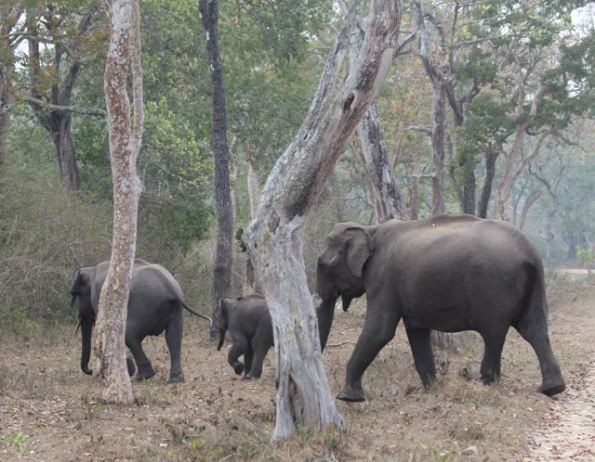
Time to go
While I think of it, I’ll mention that most of India’s national parks no longer offer elephant rides as a way to let tourists look for tigers. And even when such rides were offered, we didn’t take them.
So I was pleased that this trip delivered elephants, elephants and more elephants, and virtually all of them in the wild.
Frankly, it was to be expected. Elephants seem to be more common in the south, and this trip focused on the south—from Bhopal in the middle to Kanyakumari, on the country’s most southern tip.
Our first encounter was in Tadoba National Park, where we saw two adults and a baby. But that was only just the beginning because the farther south we travelled the more elephants we saw.
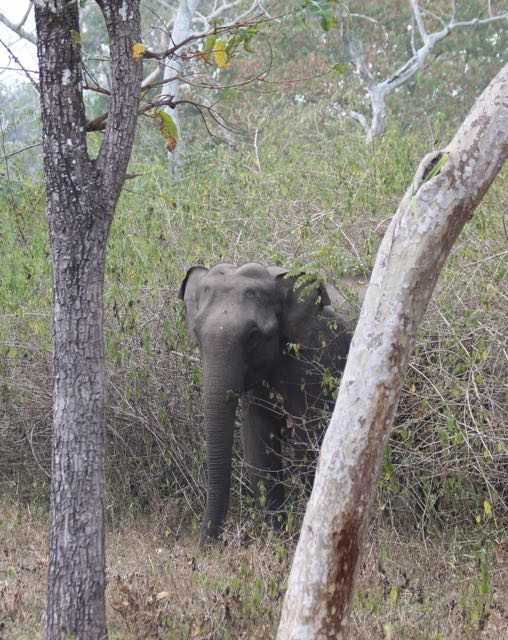
Every sighting was reassuring, especially when we saw the babies. These amazing beasts are considered endangered. Surveys indicate there are 35,000–40,000 Asian elephants left in the wild. About three-quarters of these are in India, with other populations spread across the many countries of southeast Asia and the subcontinent (although there aren’t any known to be in Pakistan).
Asian elephants are generally smaller than African elephants. They reach a shoulder height of 2 to 3.5 metres and weigh between 2000 to 5000 kilograms (up to 11,000 pounds). Females are usually smaller than males and have no or only small tusks.
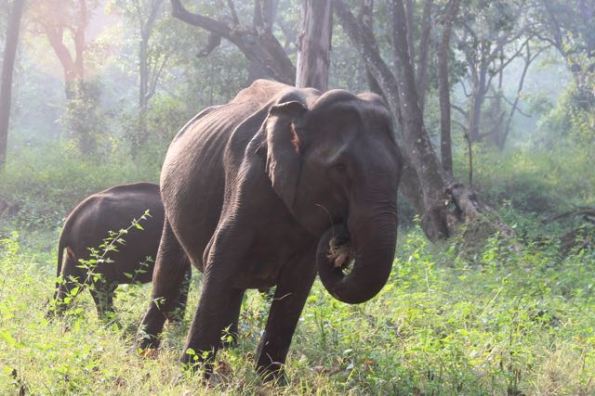
Grabbing a quick snack
Their appetites are huge. Adult elephants eat up to 150 kilograms of grasses, plants and trees per day. And they poop throughout the day. Anand always says the only way to know how old elephant dung is, is to stick your finger in. We didn’t need to know that much, but when we were walking, we saw what looked like a lot of fresh dung.
After Tadoba, our next elephant encounter was almost two weeks later in Nagarhole National Park. Then over the next two weeks we saw probably 50 elephants of all ages and in different settings. We saw an especially large herd in Periyar National Park, but I’ll write a separate post about all the wildlife there.
We even saw elephants on the side of the road (not in a national park) as we travelled from the state of Karnataka to Kerala. We stopped and watched them for quite some time and then some knuckleheads came up behind us and got out of their vehicle. Needless to say, the elephants skedaddled and the knuckleheads were lucky they weren’t attacked.
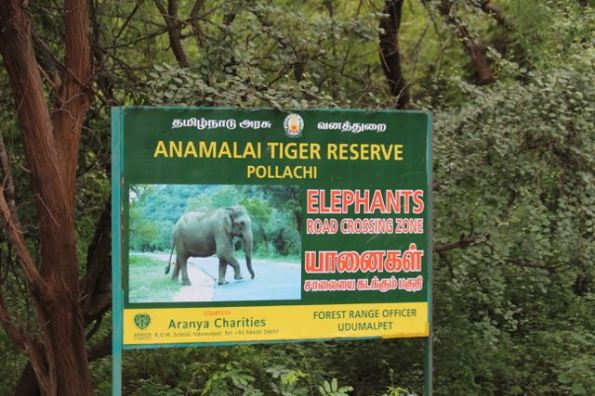
Elephants have right of way.
I felt bad about a young French couple we later met at the state border. They had taken a taxi from their hotel in Kerala and hoped to cross into Karnataka, where elephants are quite common. Turned out their taxi driver didn’t have an all-India travel permit, so could not cross the state line, and no other taxis were around.
So if you’re ever travelling by road in India, be sure the vehicle is allowed to cross state borders (although there is a plan to scrap the border regulations).
Update on the guy illegally parking in a disabled space
You may remember my rant about the guy who was parking in a disabled space at the gym. Once I had photographic evidence (of him striding away) I called the city’s hotline to report him, but a few weeks later he was still parking there.
So I called the hotline again and said I’d be calling every time I saw him. Haven’t seen him again. 🙂 But if I do, I’ll get an elephant to sit on his car. Maybe one of the fellows below.
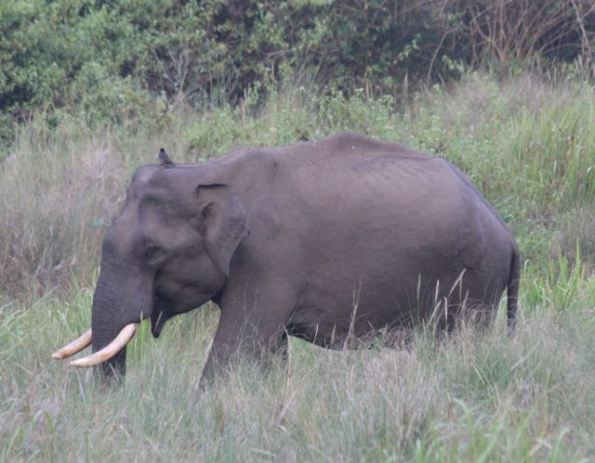
A tusker with a resident bird on his head

Notice how much longer the tusks are on this fellow than the tusker just above

Pink and orange in overdrive


When I was a young teenager, I was desperate to decorate my bedroom in pink and orange, with a splash of white. My mother was not even slightly impressed or cooperative. Not a chance, she said, or something like that.
I can’t remember what my sister, with whom I shared a room, said. I also can’t remember whether I wanted to do the job by painting the walls or by seeking out fabric to make bedspreads and pillow cases. Maybe I had a combo in mind. I do remember feeling very hard done by because I wasn’t allowed to do it.
News flash: My roommate/sister, Susan, has replied to this post. She said exactly what I hoped she’d say. Namely, that she’d have been happy with a pink and orange colour scheme in our bedroom. She’s a champ—as always. Thanks Suse.

A great colour combo for a sari—just saying
Sadly, Poor John is a fan of off-white paint, so most of the colour in our house is provided by furniture, curtains, rugs and artworks.
But when Libby wanted to paint her room blu-ple (blue purple), I said sure. I also said okay to her request for lemon yellow curtains, and then I bought her a doona cover that had both colours, plus a bit of green and white. The room looks great.
Funnily enough, this whole colour history came to mind this year as we travelled south through India.
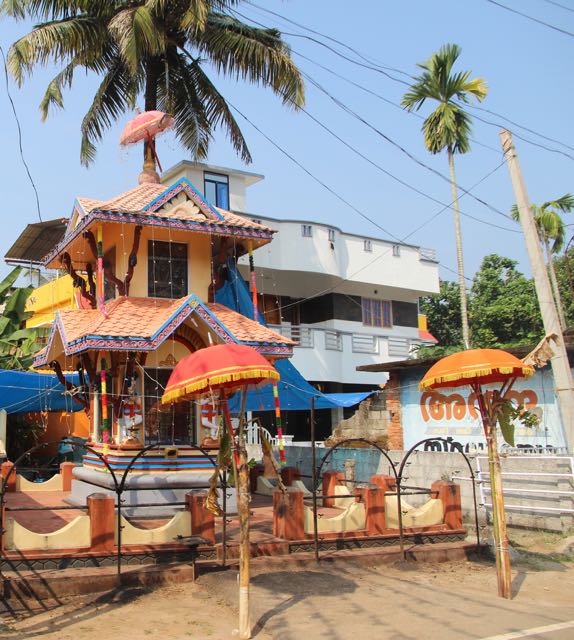
Plenty of colours, including pink and orange
India has colour in overdrive. Your eyes are assaulted by colour. It’s in the clothes (especially the saris), the shoes, the jewellery, the billboards, the vehicles, the temples, the paint jobs on houses, and more.
And I have to say that the combination of pink and orange is everywhere.
I started to seek out pictures of this colour scheme about five days before the end of our seven-week trip. And while I have a sizeable collection of photos, I’m still cross with myself for all the pics I missed.
That said, I’m sharing some of the compelling evidence here that my mother should have seen so that she would caved in and said, of course, you can have a pink and orange room!
So which one is your favourite pic? And do you have a different favourite colour combination?
Cooking
If you’re a fan of orange, you might also be a fan of carrots. Here’s a tasty roast carrot recipe on my cooking blog.

Mother Nature seems to like the colour combination

Mother Nature’s handiwork

So what do you call this sweet sugary treat?
Geez, this has been a rough week with too many tragic deaths. In just a few days, we’ve said sad farewells to George Michael, Carrie Fisher and Debbie Reynolds. They’ve all been a big part of my life.
This year has been cruel. Some of you will have lost a special person in 2016 or perhaps a loved one’s life is still touch-and-go. They may not be famous, but their loss can be no less devastating. I send my condolences.
We can only hope that 2017 will be kinder to all of us. The other day, our local newspaper, The Canberra Times, had an appropriate editorial cartoon that summed up the year. It showed Santa and the Grim Reaper in the locker room. Santa is saying something along the lines of ‘You’ve had a busy year. Plan on taking any time off?’
With all this sadness, I thought a little levity might be in order before we say good riddance to 2016.
In India, it is common to see street vendors selling cotton candy or fairy floss—the name depends on where you live in the English-speaking world.
But I was delighted to learn that this sugary sweet has more interesting names in other cultures. In French, it’s called Father’s Beard. India goes one better and calls it Old Lady’s Hair. If you’ve seen a recent photo of me, you’ll agree the Indian name is the most accurate.
Do you know yet another clever name for this treat?
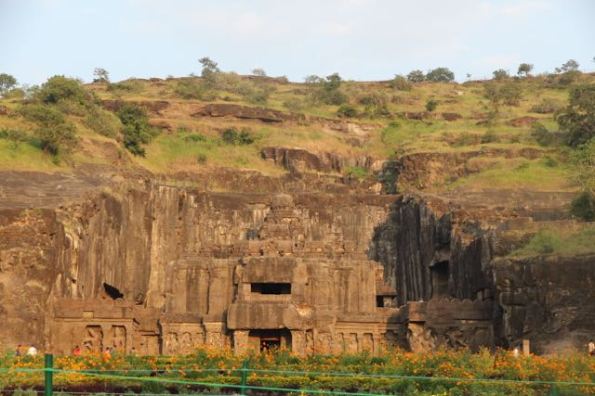
Kailasha Temple carved from a single piece of basalt

Ground level at Kailasha Temple. Note the overhang of rock
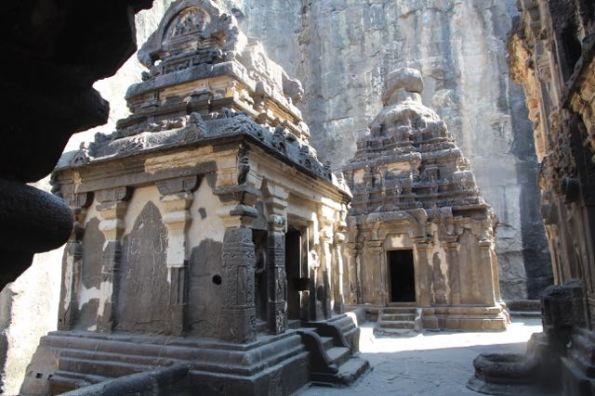
Two shrines at Kailasha, still carved from that single piece of rock
As we approached Aurangabad in the Indian state of Maharashtra, Anand and Deepti reminded us that one of the highlights of our stay would be a visit to the nearby Ellora Caves.
The Ellora Caves? They sounded familiar, but I had to admit I didn’t know much about them. I’d looked them up briefly when we first received the trip itinerary, but the scope of these amazing caves didn’t sink in then.
But this collection of remarkable caves is gobsmackingly impressive. The UN thinks so too because the caves, which showcase monuments, temples, reliefs and sculptures from three religions, are designated a UNESCO World Heritage Site.
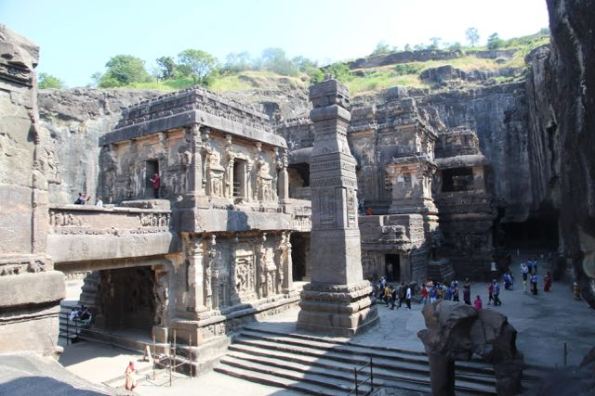
Near the entrance, more carved from that single piece of rock
So let me tell you about them.
The caves were excavated out of vertical basalt cliffs in the Charanandri hills. No one is completely sure which caves were carved first (or in what order), but the work occurred between 600–1000 AD (the Early Middle Ages).
There are more than 100 caves, but only 34 of them are open to the public. They are beside one another and are numbered 1 to 34 from right to left, as you look at them.
The caves open to the public are grouped by religion. Caves 1 to 12 are Buddhist, caves 13 to 29 are Hindu, and caves 30 to 34 are Jain. We visited them all (it took us most of the day), and were surprised to learn that most people visit only one or two. I think they are grouped simply because they were built at (or around) the same time. No idea where all the other caves are.
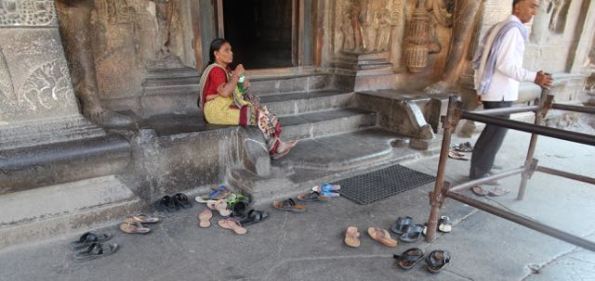
Shoes off at some parts of the temple
The biggest, most popular and most impressive is cave 16, which has been carved out of a single piece of rock. Known as the Kailasha Temple, it is the biggest single monolithic rock excavation in the world.
I have to admit that I was gobsmacked a few years back when we saw the excavated churches at Lalibela in northern Ethiopia (more about them one day), but nothing prepared me for the sheer size and detail of cave 16 at Ellora.
It is huge, exquisite and breathtaking.
I am not alone. Kailasha Temple is considered to be one of the most remarkable cave temples in India (probably the world) because of its size, architecture and having been entirely carved out of a single hill of rock.
We spent at least an hour (maybe it was two) wandering around the courtyards, assembly hall, shrines and many galleries that make up cave 16.


We were not alone. There were heaps of other tourists (the vast majority were from India), including several school groups. I think it’s great that Indian children are actually getting out and seeing the important monuments in their own country.
Confession: I admit that I would have followed along behind any one of the school groups but the teachers were speaking a language I didn’t know.
That didn’t keep me from being photographed with many groups, and probably a lot of sly pics taken without my knowledge. Indians love have foreigners in their pictures. Deepti says that some people will make up elaborate stories about how they met/entertained the foreigners in the pictures. I wonder how many dinners and overnights I had with people I don’t know! 🙂
But I digress. Given that the Kailasha Temple is so magnificent (and because I took 100 photos of it), I’m going to devote this entire post to it. We’ll drop by the other caves in another post.
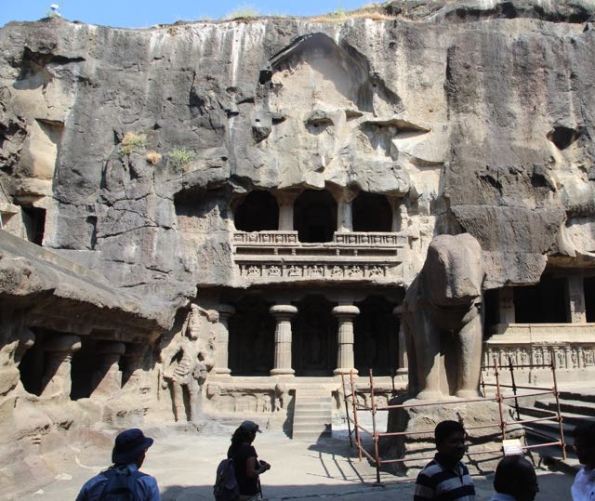
A gallery at the temple. Good grief, it’s bigger than my house


The Kailasha Temple is dedicated to Shiva, one of Hinduism’s major deities, and is modelled like other Hindu temples. It is a freestanding, multi-storeyed complex that covers an area almost twice as large at the Parthenon in Athens, Greece. That doesn’t make a lot of sense to me, but I’m guessing it covers close to two acres.
It is estimated that the carvers removed three million cubic feet of stone to create and shape the temple, or about 200,000 tonnes of basalt rock.
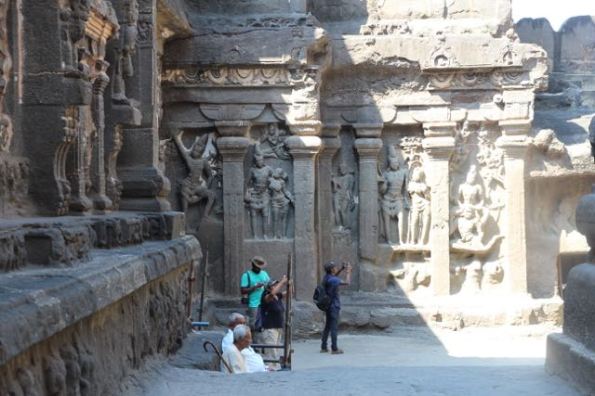
Walking around Kailasha Temple,
It’s designed so that you can/should walk around it.
That gave us of plenty of chance to look at the shrines dedicated to deities such as Vishnu, Ganesha, Annapurna, Durga, Ganga, Yamuna, Saraswati, Indra, Agni, Vayu, Surya, Usha and many more.
I have to admit that my head gets lost when in comes to Hindu deities. There are thousands of them, and people can choose which ones they want to worship. My pick would probably be Ganesha. He is the god of travel. He has an elephant face, is very fat and loves to eat. My kind of deity.
No one is sure when the Kailasha Temple was built, but it is often attributed to the Rashtrakuta king, Krishna I, who reigned in the 700s. It’s estimated that it took 100 years to complete. At one time, it was painted and plastered, and some signs of that still remain. It’s hard to imagine how impressive it would have been fully decorated.
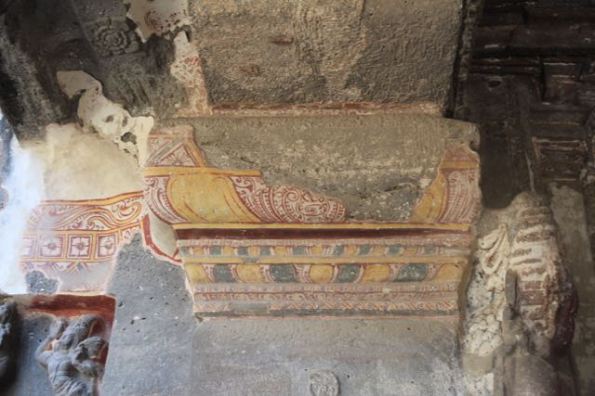
Remnants of the paint and plastering job at Kailasha Temple
In researching for this, I read a blog that said Kailasha Temple was blocky, crude, and just a little boring. I was pleased to read on and find that on closer inspection, the blogger decided it was a Wonder of the World. I’d have to agree.
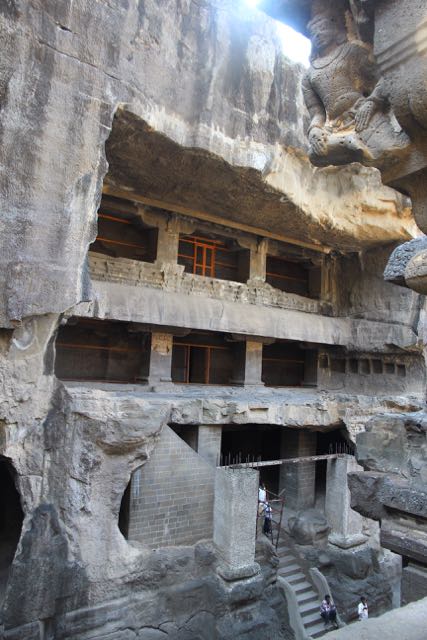
Three levels of the temple all carved from a single (and very large) rock. See how small the people are
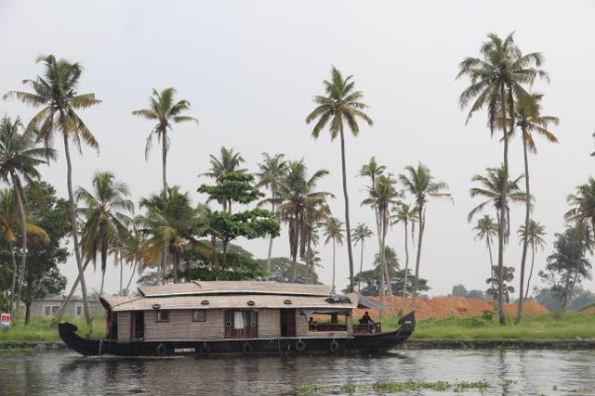
A picturesque view of a Kerala houseboat
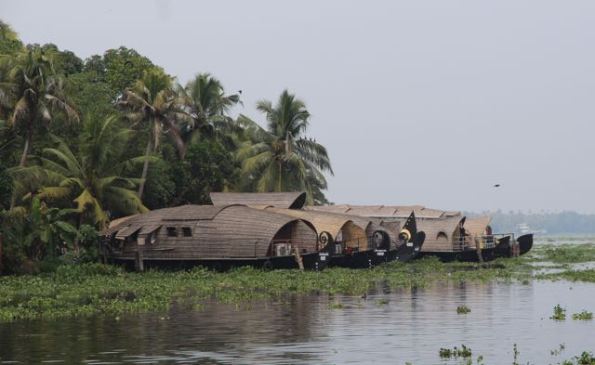
A group of houseboats anchored at the bank
If you’ve read Kenneth Grahame’s delightful book, The Wind in the Willows, you might remember Water Rat’s comment to Mole. ‘Believe me, my young friend, there is nothing—absolutely nothing—half so much worth doing as simply messing about in boats.’
I can’t argue with his words, especially after several fantastic boat rides we’ve had on this trip in India.
We kayaked twice in Thattekad Bird Sanctuary (didn’t see many birds, but didn’t capsize either), had three boat cruises in the Periyar National Park (more soon about the animals we saw), and lazed away most of a day on a houseboat on Punnamada Lake in Alappuzha (Alleppey) in Kerala.
From the time we started this trip back in October, Deepti said we might be able to spend a day (or even a night) on a houseboat in Alappuzha.


Little did we know that houseboats (and boats in general) are a big industry in the community.
In the past, large boats plied the backwaters of Kerala, carrying people and cargo. They played an important part in trade, making a three-day journey to take rice and spices to the port of Cochin. But as road, rail and air transport improved, the boats, known as kettuvallams, fell into disuse.
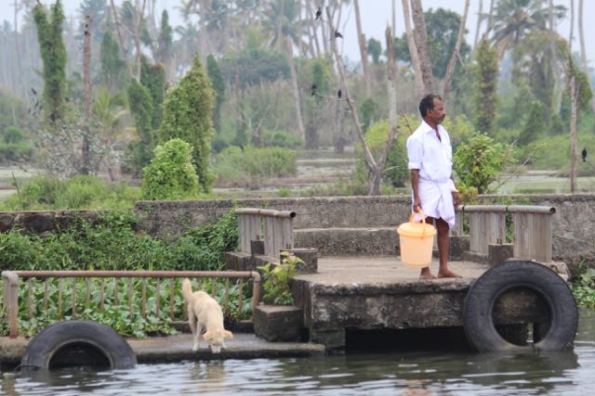
Everyone is after some water
Then about 25 years ago, the community realised the boats could be used for tourism. Today the houseboats and allied occupations provide one of Alappuzha’s main sources of employment. About 10,000 families benefit directly from the houseboats, and another 100,000 are indirectly dependent on it.
I was stunned to read that the city reckons 1600 tourists arrive everyday to go cruising on one of the 1200 houseboats on the water.


Not surprisingly, we were keen to be among the cruisers. We had a choice of going for five hours in the afternoon, including lunch, or an overnight stay, with meals and a comfy bedroom.
The backwaters are very calm and there’s not much in the way of birdlife. Plus houseboats are obliged to anchor at a bank overnight and only cruise for an additional hour in the morning. So we opted for the afternoon excursion.
It was amazing to see all the houseboats set out about noon. Every direction we looked, we could see scores of boats chugging along with waving tourists, the vast majority from India.


It tickled me to see that our three crew seemed to juggle interchangeable jobs. They took turns cooking, serving and steering. And they kindly let me invade the kitchen for a few pictures.
It was also fun to see village life being played out on the water and the banks.
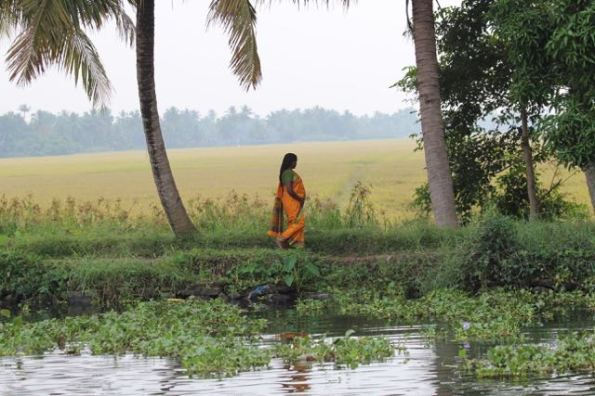
Along the shore of Punnamada Lake
About the boats
As we cruised along we saw a couple of boats being built. Our crew explained that all the houseboats are constructed using ancient principles and techniques, and take about six months to complete.
The materials are eco-friendly, including bamboo poles and mats, ropes and thatch. The hull is made of wooden planks (they use a timber called Anjili) that are cut long and carved. These are tied together using coir, with coconut fibres packed in between. The framework is coated in a black resin extracted from boiled cashew kernels.


Tourist boats are fully furnished and typically include a sitting–dining room, an outdoor deck (sometimes on the roof), one to four guest bedrooms with modern toilets and a kitchen. We even saw a couple of two-storey ones.
Once completed, a boat lasts for several generations. I was interested to learn that no one is allowed to live on their houseboat.
A tragedy
With all these boats in one place, there’s bound to be a disaster. In early 2013, four people died when a houseboat capsized as passengers were being transferred from one boat to another. The boat tipped as the whole group of passengers moved to one side. Those who died were trapped in a room. Another 60 were rescued.
As far as I can determine, measures to increase safety have been recommended, but not implemented.
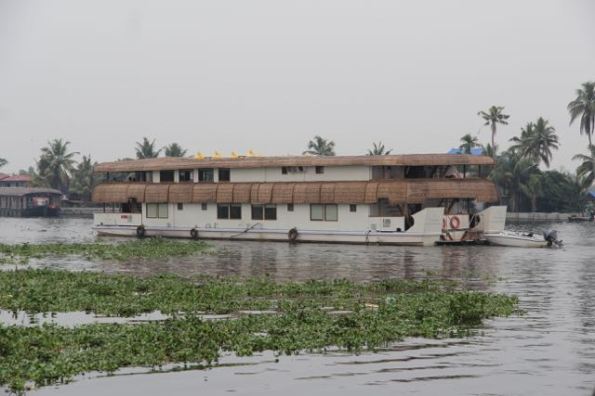
Our captain said a bedroom for two on this boat is almost A$4000 a night! Most normal boats cost under A$200 a night for two. We paid A$50 each for an afternoon. Bargain!
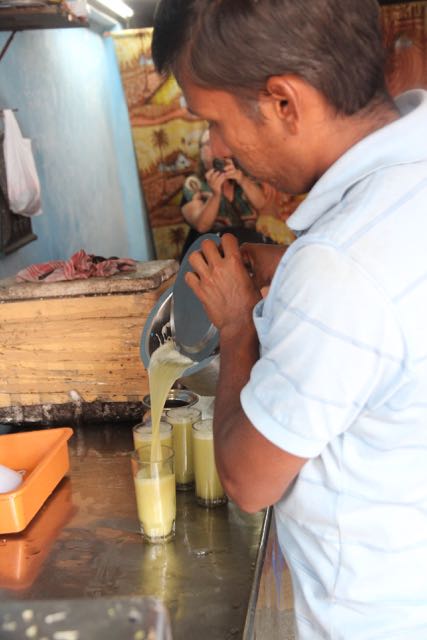
Pouring sugar cane juice
Street food is common across India, especially in the north, and so are street drinks.
The two most common drinks are fresh crushed sugar cane and fresh lime soda and, of course, we’ve had both.
Our first one this trip was in a restaurant in Khan Market in New Delhi. Poor John noticed a sign that said 100 rupees for a fresh lime soda. It was blisteringly hot, so we went in and ordered two sweet–salted sodas, which were delicious. But imagine our surprise when the bill was for 333 rupees (almost A$7) instead of 200!
Turns out the posted price applies only to takeaway. The same drink inside the restaurant is 120 rupees and then there are all sorts of taxes in the big city. Sure reminded us that Khan Market is very upmarket!
Last week in Munnar we had lunch at Rapsy, a family-style restaurant, with one of the best sweet–salted fresh lime sodas we’ve ever had. Cost: 40 rupees each.
So what’s this sweet–salted business?
Your drink can be made just sweet, with several tablespoons of sugar syrup, or just salted, with a teaspoon or so of salt. Or you can order what we do, and have a combination of the two.
Our other best sweet–salted sodas were in Malvan near Tarkarli Beach. A woman had a tent set up on the sand and was making sodas to order. I noticed her when we were on our way to the island fort, and suggested we get drinks on the way back.
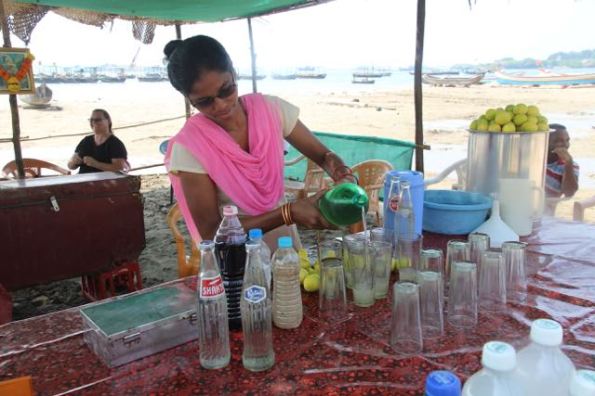
Adding pre-made sugar syrup
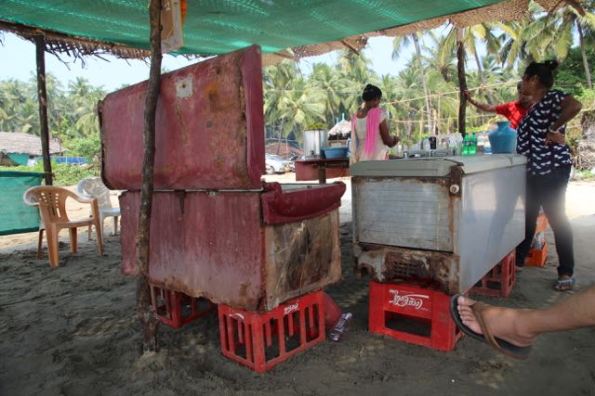
Derelict chest freezers keep the ice cold
We did exactly that, and I watched her process. First she shook salt into the base of the glass, then she squeezed in the juice of a lime, then she added sugar syrup and chunks of ice, and finally topped up the glass with soda water.
She stored huge ice blocks in two derelict chest freezers that most likely hadn’t worked for many years, and chipped off bits as she needed them.
I no longer remember the exact price but I think each drink was no more than 20 rupees (or about 40 Australian cents). Bargain!
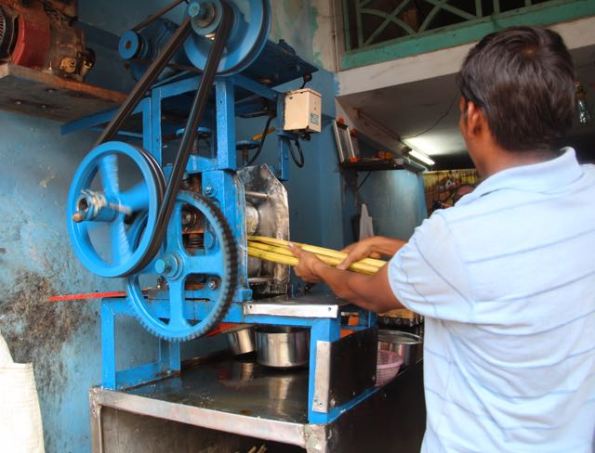
Crushing sugar cane
We had similar luck with crushed sugar cane drinks.
We bought those next from a small shop in Malvan.
The fellow ran the sugar cane stalks through a crusher about eight times—each time squeezing out more juice. Geez, that was nerve-wracking to watch, because his fingers often came dangerously close to the crushing teeth.
He then strained the juice through a fine sieve and poured the result into glasses. This was another bargain at about 15 rupees a serving.
We’ll be heading home to Australia soon, and I’ll definitely start trying to perfect the fresh lime soda (hope limes aren’t too expensive) but I have no idea when the next sugar cane juice might come our way.
If you love juices, check out my cooking blog for a recipe for a Brazilian berry juice—colourful and delicious.


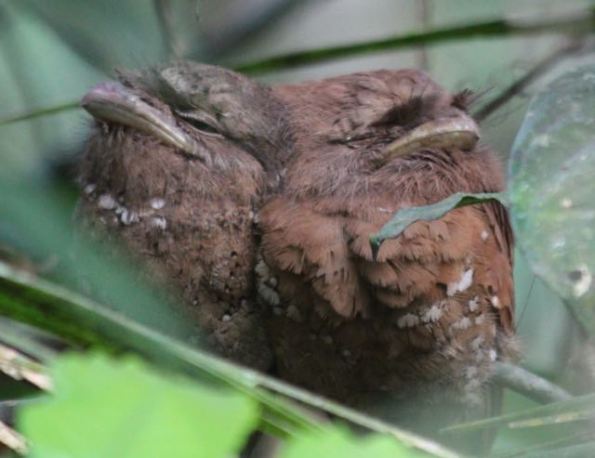
Sri Lanka frogmouths—the female is on the right
Today was Thanksgiving in the United States (wishing everyone a happy one) and we certainly had a lot to be thankful for in terms of our activities, food and wildlife sightings in India.
It began with our second kayaking trip on the Periyar River in Kerala, followed by a splendid breakfast at our lodge, the Soma Birds Lagoon Resort. The rest of the morning gave us time to get caught up on photos and emails (this was one of the best internet connections we’d had in a month, even though it kept dropping out regularly).
Lunch was another feast (and the lodge staff didn’t even know it was Thanksgiving in the US).
But the best was still to come, and it had nothing to do with food.
Anand and Deepti arranged an afternoon bird-watching tour in the Thattekkad Bird Sanctuary. We arrived about 3:30pm and paid the entry fee. Then Deepti inquired about getting a guide.
Yes, yes, a guide is available for 1000 rupees (or $20 across five people). So the guide, Vinod, was booked.
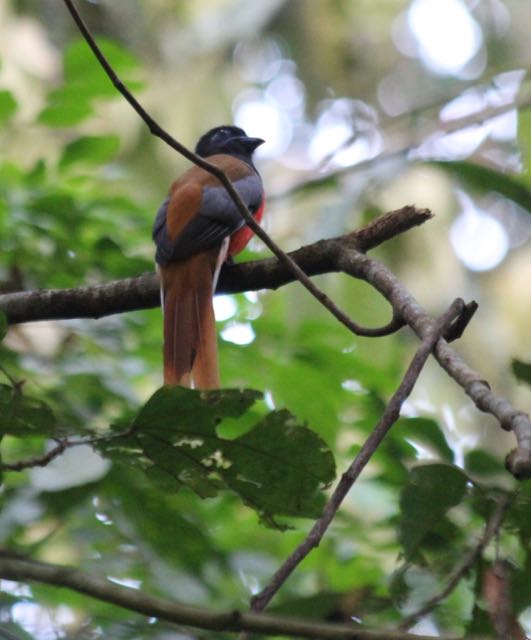
A Malabar trogon shows off his colourful back
As soon as Vinod arrived, we set out on foot and he pointed out various kingfishers and cormorants. Marian wisely interrupted and explained that we’d seen plenty of both species. What we really want to see is the Sir Lanka frogmouth and Malabar trogon, she said.
Vinod eyes brightened and he said We need to go in your van. These species aren’t here. We need to travel to the other side of the sanctuary.
So we hopped in the van and raced (as much as you can race on narrow and bumpy roads) the 8 kilometres to the other side of the sanctuary.
We paid a second admission to the place and set out on foot.
Within 15 minutes, Vinod had led us to a roosting pair of Sri Lanka frogmouths.
Turns out it wasn’t quite as challenging a search as we thought. He’d been in the area earlier in the morning and had spotted the pair (and had also been confronted by a baby and mother elephant at the same time!).
According to Vinod, if these frogmouths are not unduly disturbed (especially by humans) they will nest in the same place/area for months at a time. so he pretty much knew where to look.
The Malabar trogons were a different matter. These birds are not endangered, per se, but they are extremely elusive. They live in dense forests and are hard, if not impossible, to spot.
Vinod wandered along the path and, from time to time, disappeared into the dense scrub. All the while he was mimicking the trogon’s cry or playing it on his phone.
Suddenly he motioned us to follow him. Then with whispering, pointing and waving, he managed to show us one trogon perched high on a limb.
So two magnificent sightings within an hour. What a gift of thanksgiving.
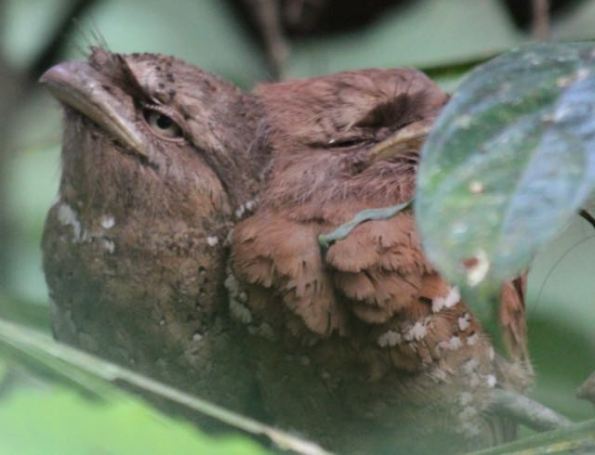
I can see you, but I’ll ignore you—Sri Lanka frogmouths
How clever science is helping frogmouths survive and multiply
According to Vinod, almost 20 years ago, the park rangers in Thattekkad saw frogmouth numbers declining. In the late 1990s, they reckoned only four to six breeding pairs still existed.
Research showed that the women who were collecting wood for cooking were using the bark from a certain branch to tie up their bundles of twigs. These happened to be the branches that frogmouths liked to sit on. This major disturbance affected roosting, mating and more.
So the rangers went to work explaining the situation and handing out strings to women gathering wood. It worked—sort of—but the best solution is that no most people cook with gas (so no need for wood). Frogmouths pairs in the area now number about 80.
A bit more about frogmouths and trogons
The Sri Lanka frogmouth occurs in Sri Lanka (obviously) and the Western Ghats of southern India. They usually live in pairs and grow to about 9 inches in height. They have great camouflage and resemble a bunch of dried leaves, which makes them extremely difficult to spot in the wild.
The Malabar trogons are more widespread in that they occur in Sri Lanka and Western Ghats, as well as parts of central India and the Eastern Ghats. They are brightly coloured, although their front is more colourful than their back (which is all that I managed to photograph). Their populations are declining because of forest fragmentation.
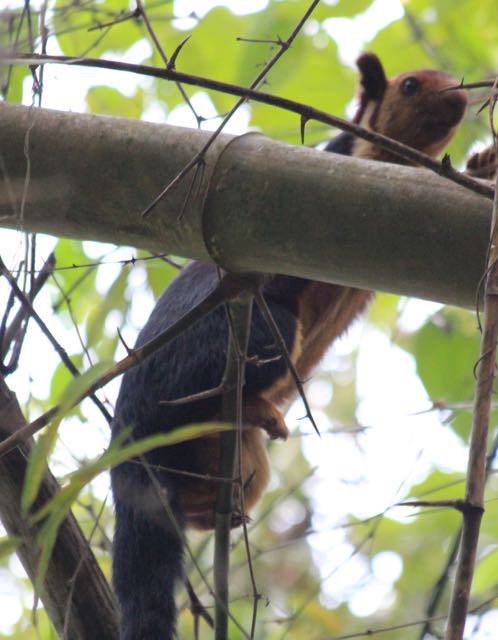
Malabar giant squirrel


Other beasties
We saw quite a few other wild things, including kingfishers, cormorants, Malabar giant squirrels (and one being approached by a macaque monkey), interesting mushrooms, a millipede, a scorpion being consumed by ants and a green imperial pigeon.

Collar Valley has reared 25 cubs. She was pregnant in this pic
Collar Valley
Collar Valley of Pench Tiger Reserve is going to make it into the next edition of the Guinness Book of World Records. This grand old lady has successfully reared 22 cubs to adulthood (she’s only ever lost one). Earlier this month, she gave birth to another three, bringing her live total to 25. This is a world record for Bengal tigers.
We spent quite a bit of time following Collar Valley last year when we were in Pench. We came upon her in the morning and watched as she padded through the forest. She wasn’t all that happy to see us because our vehicles blocked where she wanted to go. If I recall correctly, she was pregnant at the time with her previous litter.
She got her name from the fact that she was one of Pench’s collared tigers. Her old collar stopped sending signals quite a few years ago, and Anand says it fell off in the last year. Bet she’s pleased about that.
You can read about our time with Collar Valley here.
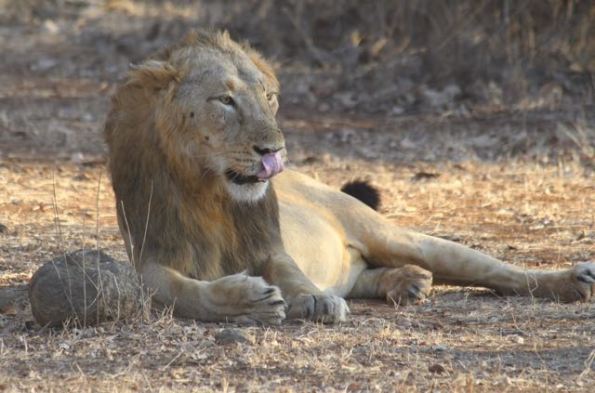
Could this be Maulana?
Maulana
We were saddened to learn that Maulana, an iconic lion in India’s Gir sanctuary, died last week. At age 16, he was one of Gir’s oldest surviving lions. For many years, he and his brother, Tapu, reigned over a pride of 39 lionesses and cubs. He had been under treatment for the 10 days before his death.
We visited the sanctuary in Gujarat last year and were lucky enough to see numerous lions, including one adult male and some juveniles. Our group was travelled in two Gypsy (open 4-wheel drives) and the other group saw three different males: one older and two young ones. I wonder if any of us saw Maulana. The post about our visit to Gir is here.
P.S. There have been several other major losses in India’s animal kingdom since we arrived in early October. Ram, another lion of Gir, died earlier this month. He was also 16. A male, Kingfisher, died in Pench after a territorial fight with another male, Umarrani. But human behaviour takes the biggest toll. Across India, tigers are poached, poisoned and displaced by urban development. I saw a newspaper report that said a tiger is lost every 10 days. 😦
P.P.S. On a lighter note. Given that this post covers births and deaths, I thought you might get a kick out of the fact that Australians have an amusing slang expressions for births, deaths and marriages—hatch, match and dispatch.
P.S.S We’ve seen a new tiger on this visit. I’ll be posting about Prince of Bandipur National Park soon.

