

Concentration, 1st realistic, single block, by James Duggan and Eric Costic, USA
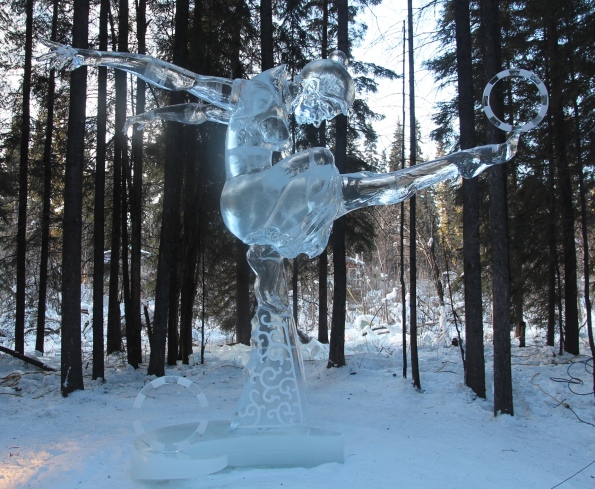
Concentration, in daylight
If you aren’t in Alaska now—and I mean right now—you aren’t likely to make it in time to see the 2016 World Ice Art Championships, which close Sunday in Fairbanks.
We were lucky enough to visit the displays in early March when the single-block entries were done and the multiple-block entries were still being sculpted. Our two weeks in Alaska (most of it as part of a Road Scholar program) included stays in Fairbanks and Coldfoot, a camp about 10-hours drive north of Fairbanks.
I’ve written a few posts about our activities, and it’s time to introduce the sculptures before they all melt and fall over—a few already had when we visited.
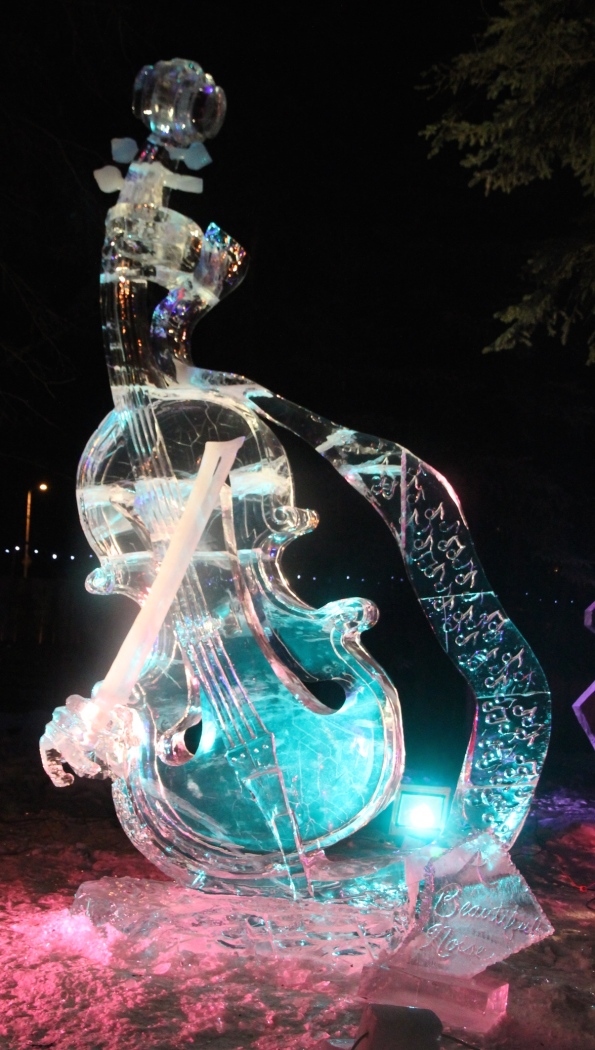
A beautiful noise, realistic, by Brian Connors and Jason Paul, USA
The competition, which is now sponsored by BP, began as a week-long event back in 1990. Now it lasts a full month and attracts more than 100 competitors and almost 50,000 visitors. I read that in 2014, 1500 tons of ice were use with most harvested from ponds near the ice park. It seems that two kinds of ice are harvested. One is crystal clear while the other is rather cloudy or opaque. Together they give sculptures a two-tone effect.
This year, competitors came from the United States, Mexico, Thailand, Japan, China, Mongolia, Russia, Croatia, Monaco, the Philippines, the United Kingdom, Iceland and France. Hope I didn’t miss anyone.
We managed to visit three times—twice at night and once during the day. It’s amazing how different the sculptures look at different times of day. At night, all exhibits are lit with colour. I don’t know if colours are chosen by the artists or the organisers.
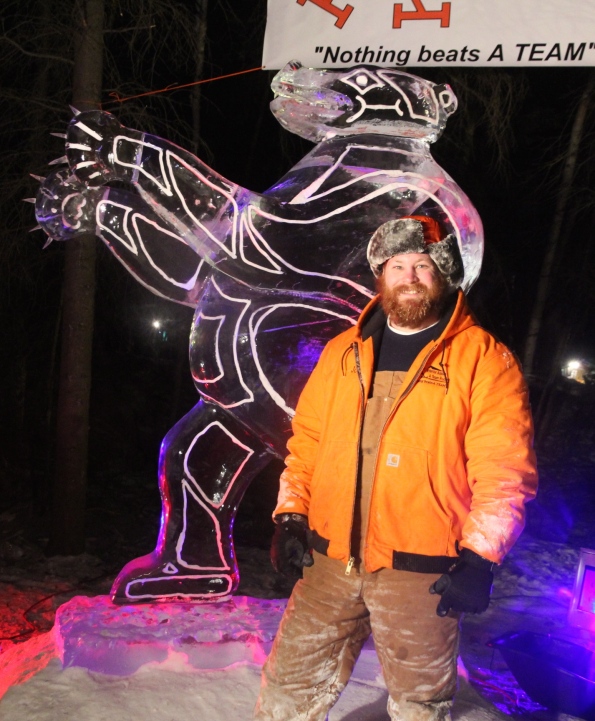
Joel Ratchford with Renewed Embodiment
We chatted to Joel Ratchford, one of the sculptors, and he said the event has grown so much that it’s getting hard for all the competitors to create their artworks. There are limited display places in the Alaska Ice Park and also limited electricity.
Sculptors use all manner of tools that can require power such as drills, blow torches, chain saws and more. Then there are the lights needed to work by—many artists were ‘chiselling’ away in the dark—and the lights needed for each display.
I have to comment that we saw light units, electrical cords and power boards all over the place.
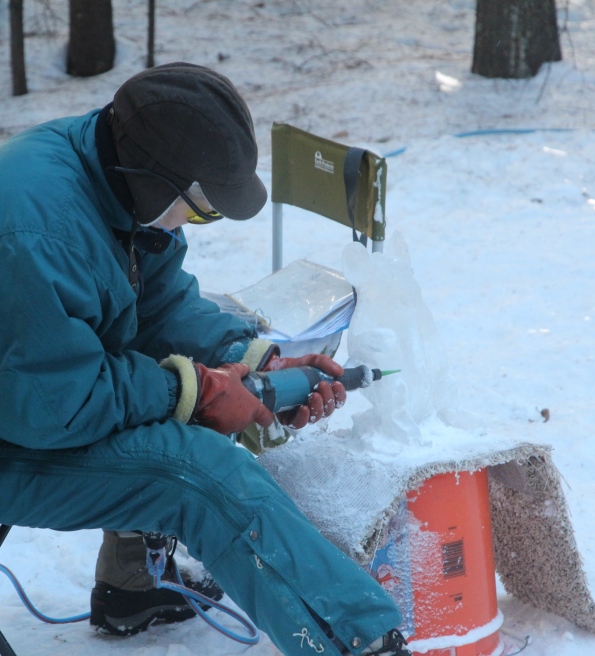
Carol DeMar, USA, ice sculptor at work
The first time we visited was in daylight. The single-block sculptures were done and work on the multiple-block exhibits was just beginning.
I took pictures of almost everything. Some turned out better than others and I can now report on the results.
I didn’t manage to get good shots of all the winners (never mind), but I got decent shots of most of the ones I liked. Every category (in addition to single and multi-block, there were amateur and youth exhibits) included entries classed as abstract or realistic. Prizes were awarded to both.
Because I didn’t get pics of all the winners, you should visit the event’s comprehensive website for more photos and details. I visited it tonight and found it really entertaining.
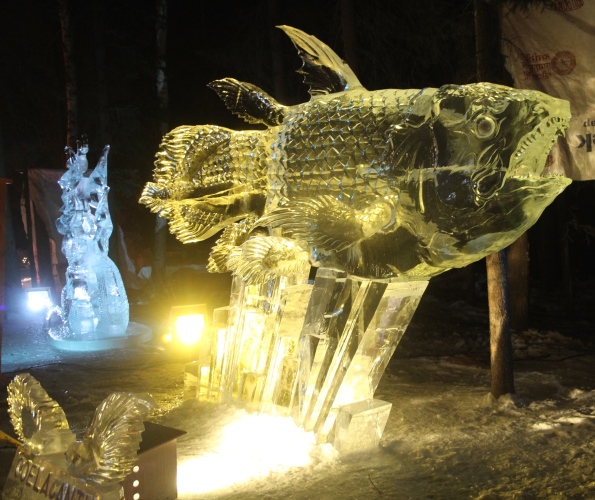
Coelacanth, by Junichi Nakamura and Jeff Moehlin, Japan and USA
As an aside, I would love to hear what sculptures you like best. Two of my favourites are above and below. I’m rather partial to the mysterious coelacanth (fish above) and especially love how the one below is lit.
P.S. I haven’t yet had a chance to download the pics of multiple-block sculptures (hey, we’re on the go), so will come back with a post on them. But if you’re looking for easier things to do with blocks of ice, why not try the Bloody Mary mix on my cooking blog. 🙂
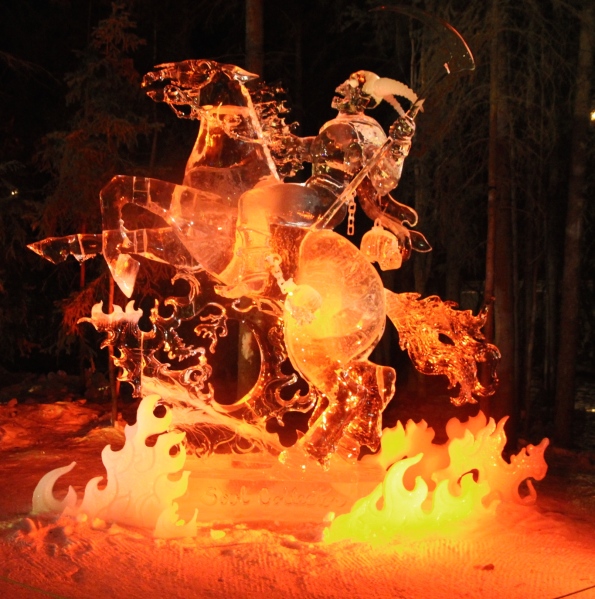
Soul Collector, Artist’s Choice, realistic, by Chris Foltz and Heather Brice

Dick and Milly and me and Poor John at Coldfoot Camp
One of the best things about travel is the people you meet. Over the years, our overland and other remote trips have connected us with scores of people from around the world.
Many of those connections have resulted in wonderful friendships that last on and on. There’s something unifying about pitching tents in the desert, cooking over an open fire, not showering for 13 days, eating food you can’t identify and being eaten alive by mosquitos, that bring people together.
As a result, loads of people have visited us in Australia (the welcome mat is always out when we’re home) and we’ve travelled with quite a few people more than once.
Our trip to Papua New Guinea was no exception. That’s when we met Dick and Milly from California. We had such a fun-filled time travelling together that, in June last year, when Milly suggested Alaska, Poor John went straight to work to find the perfect trip.
Milly suggested the World Ice Sculpture Competition in Fairbanks and Poor John went on to find the Road Scholar option that included the ice sculptures as well as a journey into the Arctic Circle to Coldfoot.
Fred, another Papua New Guinea travelling companion, and his wife, Zee, were to come too, but Fred’s health hasn’t been cooperating. They stayed home and were greatly missed.
But the four of us had a wonderful time, sharing experiences in Fairbanks (including the Mecca Bar) and Coldfoot (including dog sledding and one of Milly’s landmark birthdays).

Milly and Dick ‘going to the dogs’
Just so you know, the differences between Papua New Guinea and Alaska are huge. PNG temperatures are scorching, while Alaskan temperatures are freezing. We survived them both, and are looking forward to planning another trip—somewhere. Any suggestions?
Would love to hear about any great friendships you’ve made while travelling.
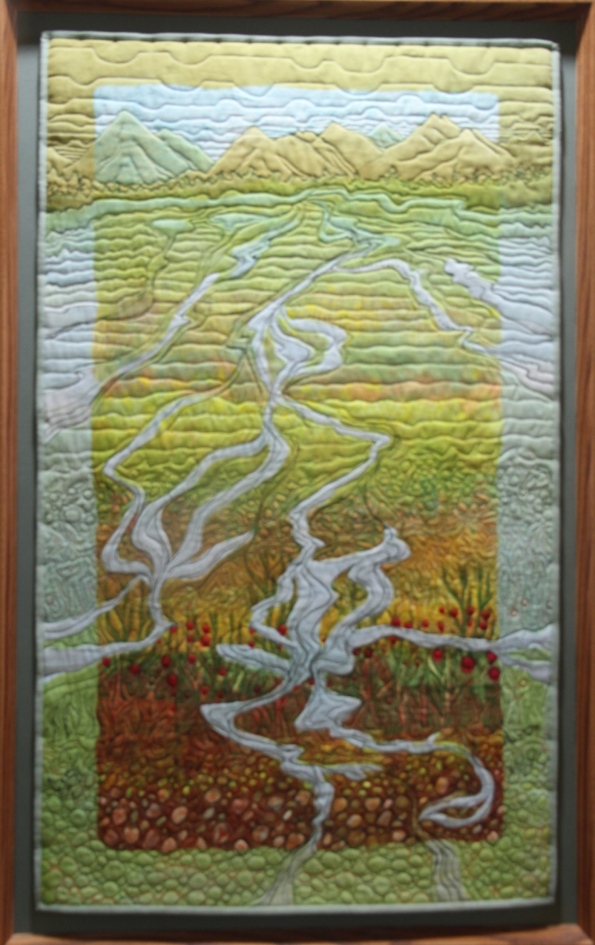
1. ‘Glacial run-off’ by Lee Nancarrow
Our first day in Alaska started with a RoadScholar educational session at the Morris Thompson Cultural and Visitors Centre in Fairbanks.
Over several days, we had many fascinating sessions at the center, but I still remember that first day and seeing the incredible quilts and textile creations by people who had been artists-in-residence over the years in Fairbanks.
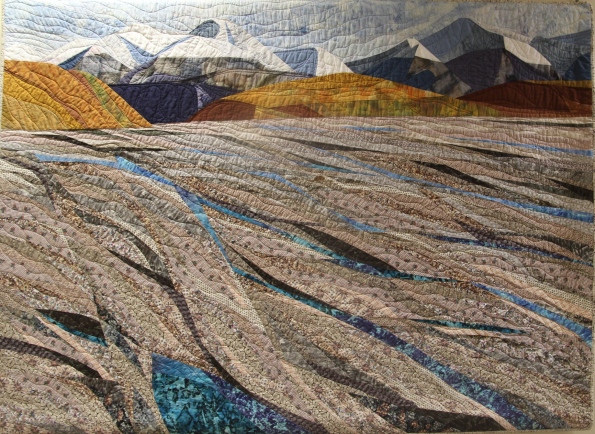
2. ‘Threading through the gravel bars’ by Linda Beach
It’s wonderful that the works are prominently displayed and acknowledged.
I know a lot of people who quilt or work with other textiles, so this post is a way share these images with them and anyone else who is interested.
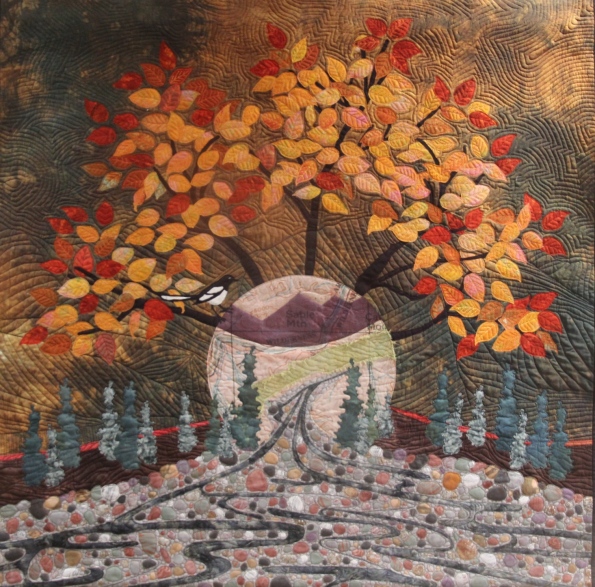
3. ‘Quiet Magic: East Fork’ by Charlotte Bird
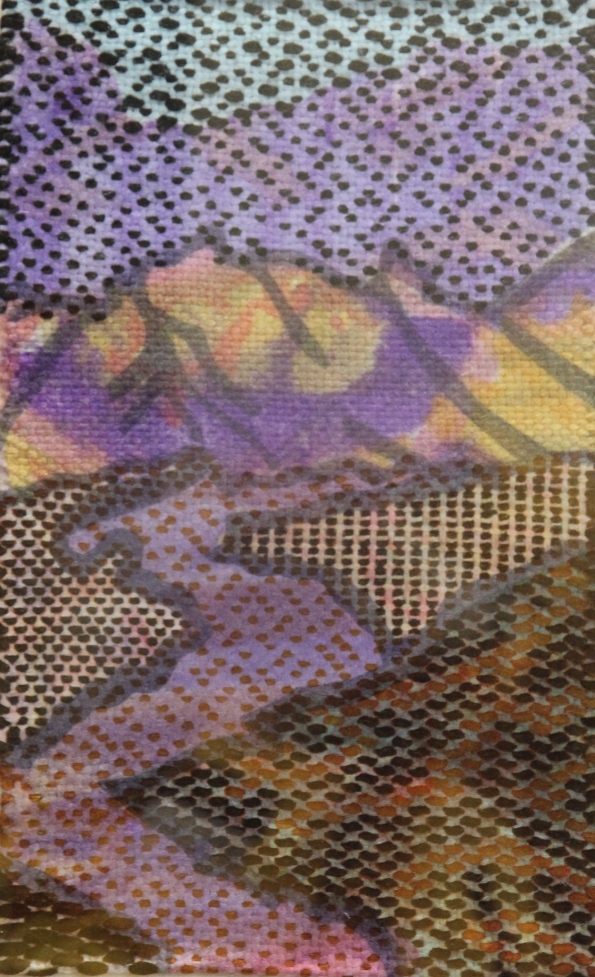
4. ‘East Fork Toklat River #2’ by Rebecca Voris
A tiny bit more about each image and artist
1. Lee Nancarrow has lived in the Denali Park area since 1965 and was an artist-in-residence 2006.
2. Linda Beach spent 10 days, mostly on the East Fork of the Toklat River. She was artist-in-residence in 2005.
3. Charlotte Bird especially appreciated living without a timetable. She was artist-in-residence on the East Fork in 2014.
4. Rebecca Voris was artist-in-residence in 2003. Her piece is of woven yarn. She says colour is added after the piece is woven.
5. Karin Franzin’s fiber piece depicts eagles nesting in Denali Park. She was an artist-in-residence in 2009.
But wait, there’s more!
If quilting and textiles aren’t your thing, please feel free to check out my cooking blog. Lots of yummy things there.
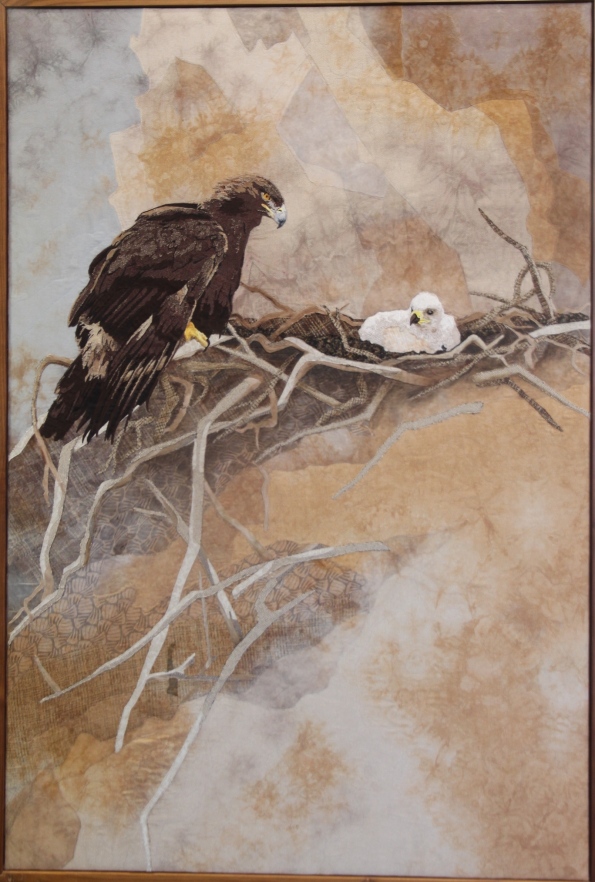
5. ‘At Home in High Places’ by Karin Franzen
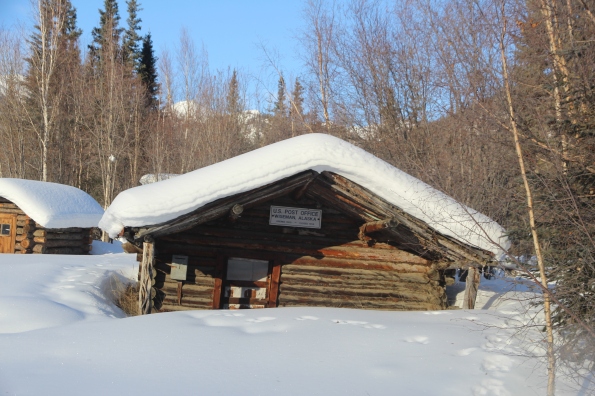
Post office

Yes, that’s us under the parkas!
Wiseman Alaska is 63 miles north of the Arctic Circle. It was originally settled in 1919 as a mining community. History indicates that when gold ‘ran out’ around Slate Creek (now Coldfoot), the miners moved on to create Wiseman.
Even though the current population is a mere 13, Wiseman is thriving. That’s most likely because it’s Alaska’s only place north of the Arctic Circle where a person can actually own property.
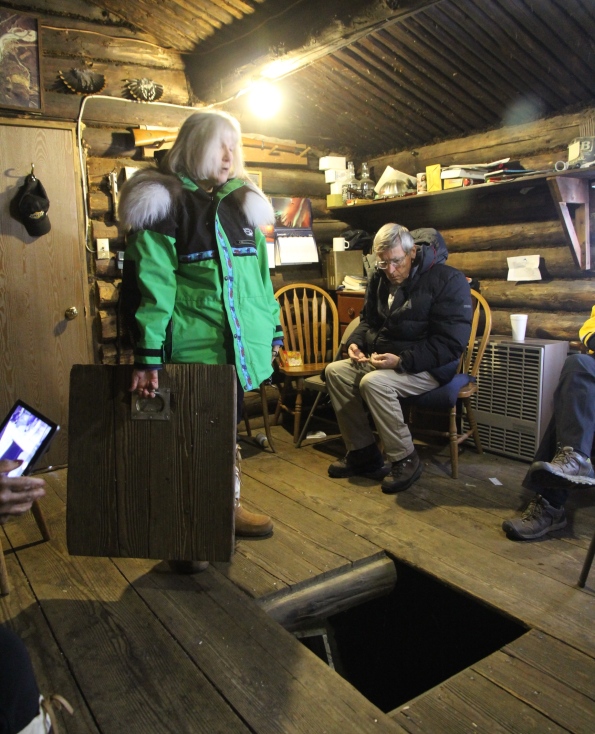
Jackie lifts the lid on the root cellar for food storage
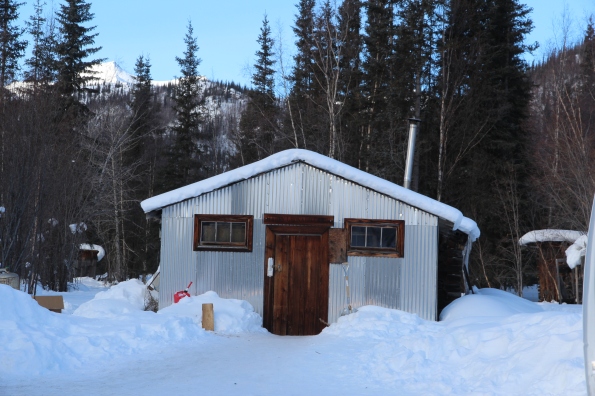
Harry Leonard’s cabin
Jackie, our guide for the day, has even purchased a dry (meaning no running water) cabin there. Ten years ago she visited Coldfoot and Wiseman as part of a RoadScholar tour (the same program we were on this year), and fell in love with life in the Arctic Circle. Now she spends about 75 per cent of her time there. She and her husband have plans to fix up their ‘handyman’s dream’.
They are looking forward to the renovations because someone found a hidden gold nugget in this cabin some years back.
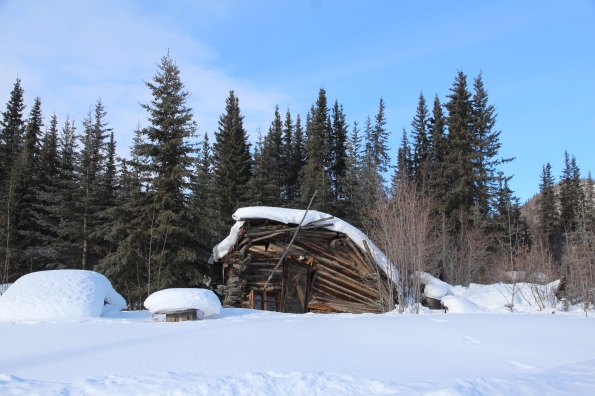
This handyman’s dream may be beyond repair
Many cabins in Wiseman look like handyman’s dreams, but others have been modernised and new ones have been built.
Today Wiseman has a post office, museum (some exhibits shown below) and chapel, as well as a bed and breakfast.
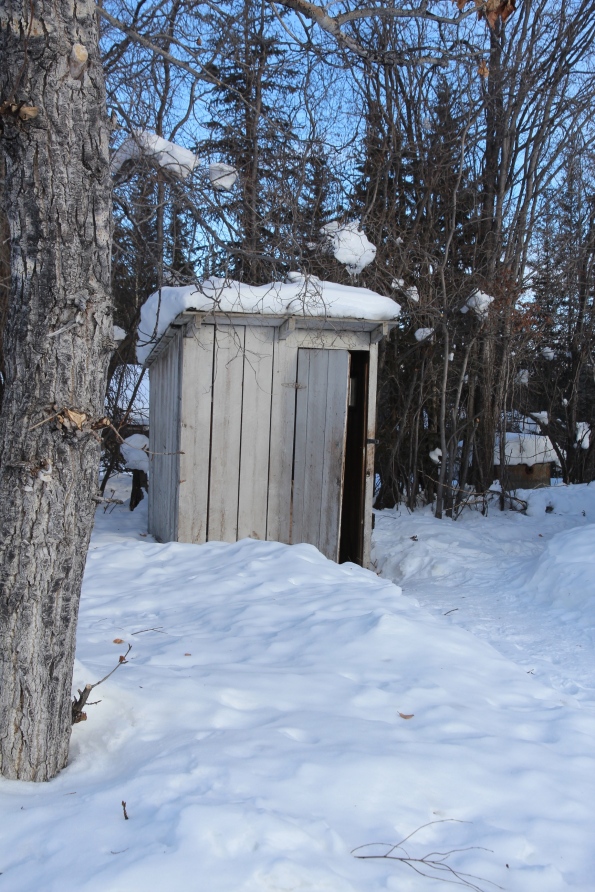
Historic outhouse
There’s even a community outhouse with a short history (compiled by Jacqui) posted inside. In a nutshell, carpenter and woodsman Ernie Johnson built it in 1945. Clutch Lounsbury moved it from Fairbanks to Wiseman in 1983.


Wiseman’s resident guru is Jack Reakoff. He was born and reared in Wiseman. He was in Anchorage for meetings when we visited, but we ‘saw’ him several times on documentaries on Wiseman, Coldfoot, the Trans-Alaskan Pipleine and more.
Wiseman is also where we got our best views of the aurora borealis (the Northern Lights. That night we ‘camped out’ in the cabin that belonged to the late Harry Leonard, an earlier authority on Wiseman.
P.S. If this post makes you feel cold, why not try out one of the stew recipes on my cooking blog. Especially good options are lamb stew and coq au vin.
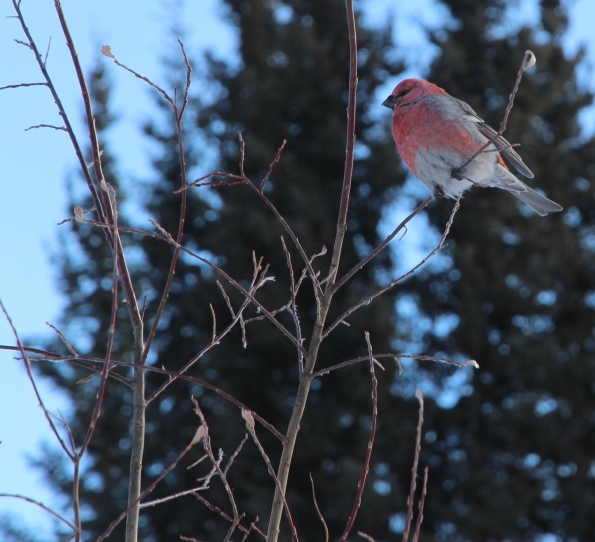
Wiseman wildlife—a red crossbill
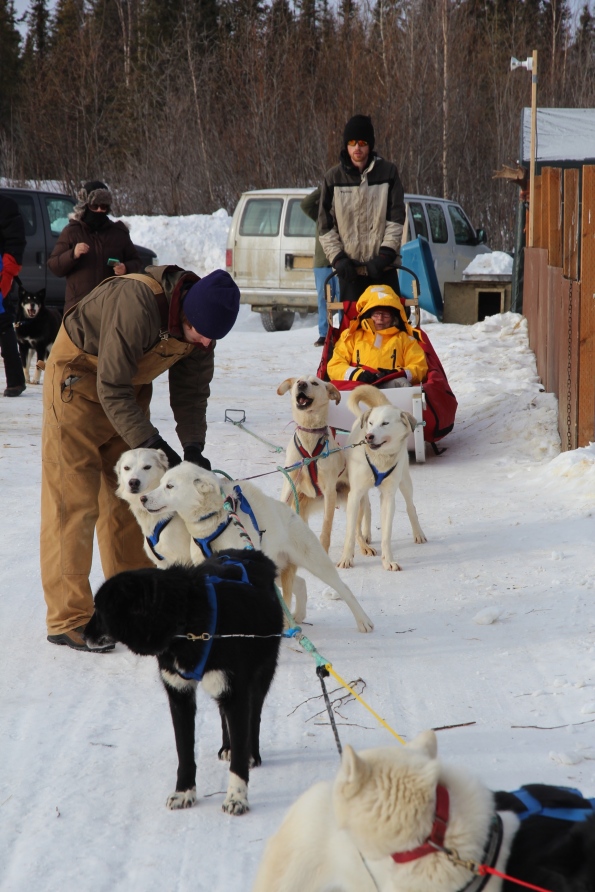
Steve harnessing the dogs for a spin on the Chandalar trail with Josh mushing. Photo by Dick Guiliani

We’re off
If you’ve followed this blog, you probably know that I’m crazy about dogs. I like cats, too, but I tend to own dogs that think cats are on the menu.
We’re lucky enough to have someone mind our dog when we travel, but that doesn’t mean I don’t miss my furry companion. That said, I tend to avoid dogs in many countries. Years ago in Burma, I was bitten by a dog that became rabid and ‘enjoyed’ getting all the anti-rabies injections.
But we were lucky on this trip. Alaska is probably the dog mushing capital of the world and Coldfoot, where we spent six days, is a great place to try out the sport.
Jason has been looking after the dogs at Coldfoot for several years now, but he’s had foot surgery and is planning to move to Anchorage to be with his girlfriend, so Josh and Steve are working with the dogs now.
I didn’t do a full head count, but I think Jason said there are 23 dogs at Coldfoot, including five 18-month old ‘puppies’ from an unexpected pregnancy.
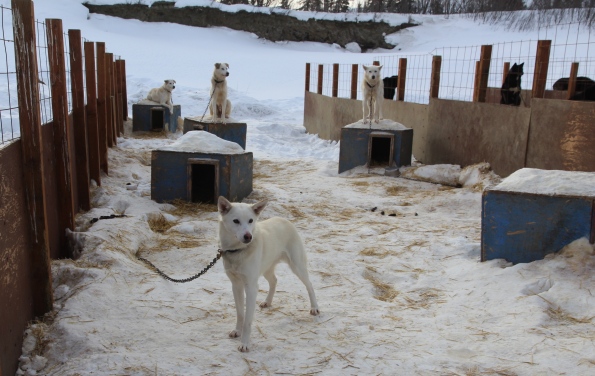
Four of the five ‘puppies’
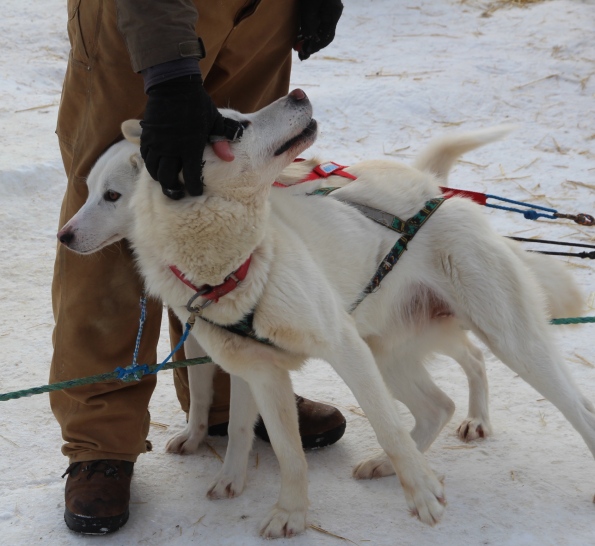
The dogs are friendly and love attention
We had the chance to go dog mushing one morning in Coldfoot—and could visit and pet the dogs as often as we liked—they’re all friendly and calm.
I suppose it’s not quite mushing if we ride and someone else drives, but we had a blast anyway.
Josh and Steve got the dogs in harnesses and bundled us into sleds complete with covers and sleeping bags if you got really cold—we didn’t need those. It was easy to see that all the dogs wanted to go for a run. One in particular howled at length to signal her displeasure at being left behind.
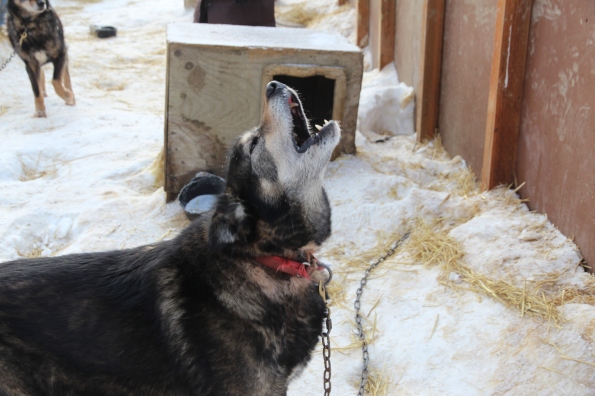
Don’t leave me behind! This is the grand old dame of the mushing team
The ride lasted about 20 minutes and we got a good laugh out of the fact that most of the dogs had to stop for their morning crap. Of course they didn’t all stop at the same time, so the beginning of trip was a bit of stop–start affair.
Four groups had rides that day and everyone experienced the crap stops. Nothing like morning ablutions. I resisted taking photos. No need to embarrass the dogs. 🙂
A bit of dog mushing history in Fairbanks and Alaska
In the late 1920s and early 1930s, Fairbanks was often called the ‘Dog Mushing Capital of the World’. This followed a 1927 race organised there in an attempt to revive mushing.
Jeff Studdert, known as the ‘Grand Old Man’ of dog mushing in Fairbanks, was instrumental in organising that race. He also helped to organise the Alaska Dog Mushers’ Association and founded the Jeff Studdert Invitational Race (more about that in another post).
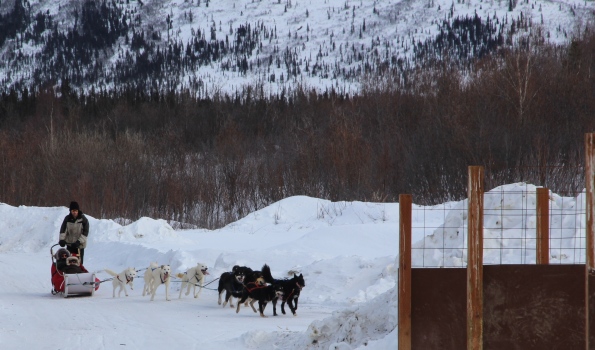
Milly and Dick returning from a run
One of the most-publicised events in dog mushing history was the ‘Mercy Race to Nome’ in the winter of 1925. That’s when diptheria broke out and there wasn’t anough antitoxin (serum) to treat those who were ill.
The ‘race against death’ took one week to cover a 674-mile trail, which ordinarily took 15 to 25 days. Temperatures fells as low as -64°F (-53°C) and the serum arrived in Nome frozen but useable.
This story inspired the 1995 Disney movie, Balto.
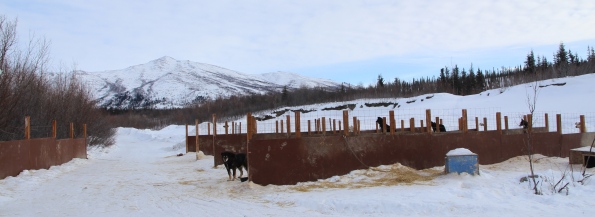
Outdoor kennels for the sled dogs. They are too furry to live inside
Found innocent
I love a 1948 dog-related quote,by a Buck Landru. It was posted in one of Fairbanks’ museums.
‘Nowhere else in the world has a jury of twelve men sat in judgement on a sled dog accused of sheep killing, pronounced the dog innocent, and heard the judge, native of the Kentucky Bluegrass region, proclaim that in Nome sheep must look out for themselves—“This aims to be dog country”!’
Mary Shields—the first woman to finish the Itidarod
We also had the good fortunate to visit Mary Shields at her home in Fairbanks. I’ll be doing a post on that soon. Remarkable woman.
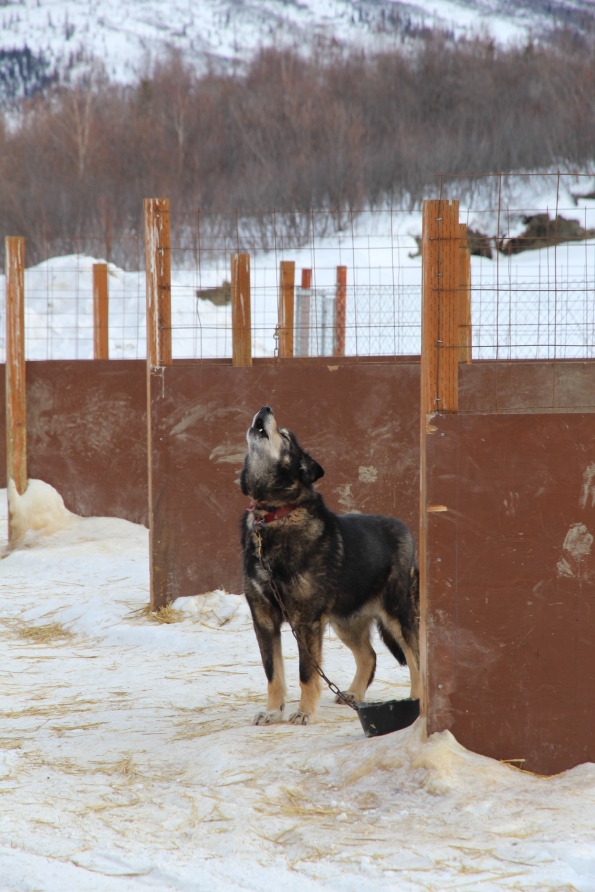
‘I still want to go!’
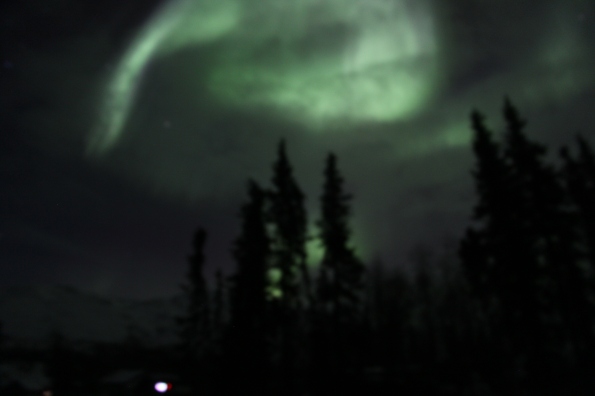
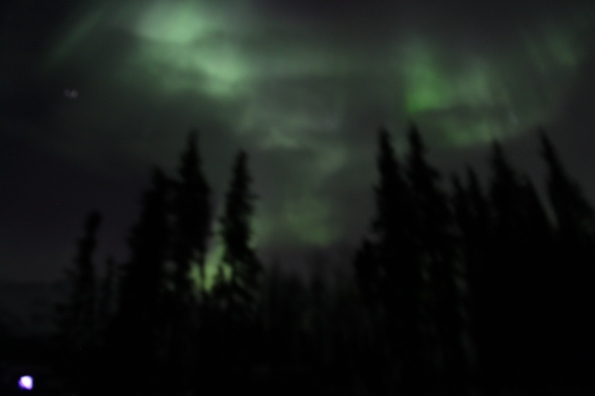
We drove north to Coldfoot—into the Arctic Circle—and then farther on to a village called Wiseman.
A small mining community, Wiseman was founded by gold miners who abandoned Slate Creek (later renamed Coldfoot) in 1919 to try their luck there.
Today it is one of the best light-free places in Alaska to view the Northern Lights, or aurora borealis. It’s three miles from the Dalton Highway and with only 13 residents, it’s easy enough to tell everyone to turn off their lights at night.
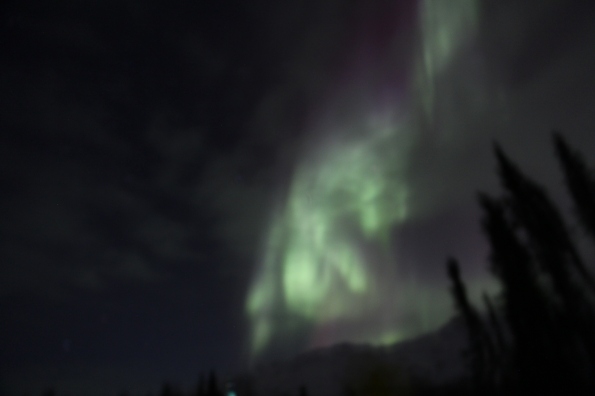


We headed up to Wiseman on Thursday at 10:30pm. We were supposed to go on Wednesday but it was so cloudy we negotiated to wait it out until Thursday and hope for better weather. We were blessed with perfect conditions.
So all we had to do was wait for the aurora to turn on the show.
Actually we could see the aurora gearing up while we were still in Coldfoot, so we were confident of seeing at least some activity.
I’m not going to go into all the science of the aurora. Even today there isn’t a full understanding of how it’s formed, but it has to do with the interaction between solar winds and the earth’s magnetosphere.
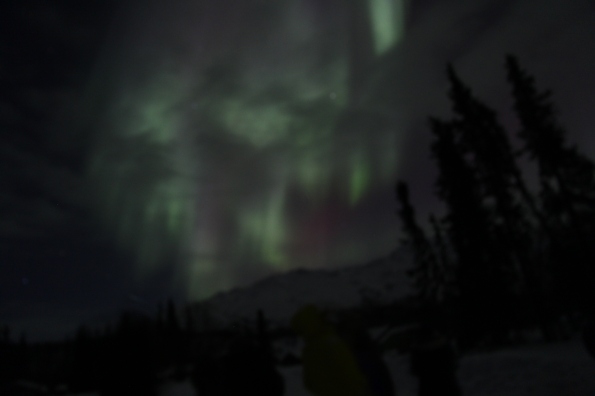
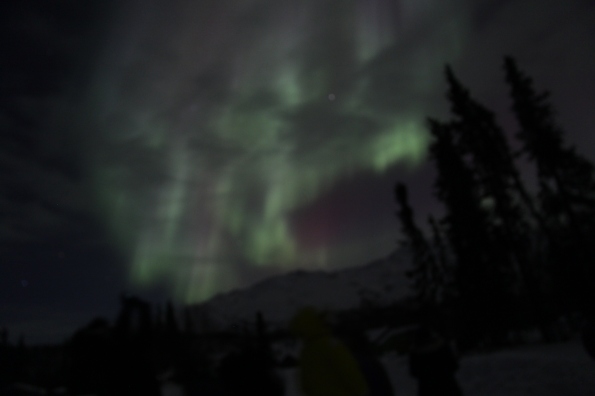
This is what a sign in the Fairbanks cultural centre said. ‘The aurora receives its power from the sun. When sunspots flare on the sun’s surface, charged particles radiate out across the galaxy on the solar wind. About three days later some of these charged particles—protons and electrons—reach earth. The earth’s magnetic field pushed these particles toward the poles. Like a neon sign, these ‘charged particles “light up” gases in the upper atmosphere 60 to 500 miles above the earth, producing a colourful array of light swirling and rippling throughout the sky.’
We saw a 40-minute film at the cultural centre that said severe aurora displays can and do interfere with public utilities. Apparently a whole electrical network in Canada was knocked out in 1989.


But in Wiseman we didn’t worry much about the science. We were there for the show—and a show we got.
It took me several goes to figure out the best camera settings and I still don’t know if I found the very best ones. I was using a Canon 600D with an EFS 15–85mm lens.
My settings were an f-stop of 3.5 (couldn’t get as low as 2.8), a shutter speed of 15 seconds (10 wasn’t enough) and an ISO of 800. I set the camera to manual focus and put that on infinity. Here are the results.
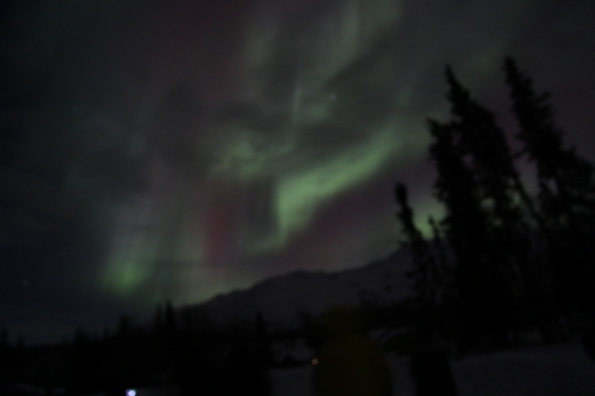

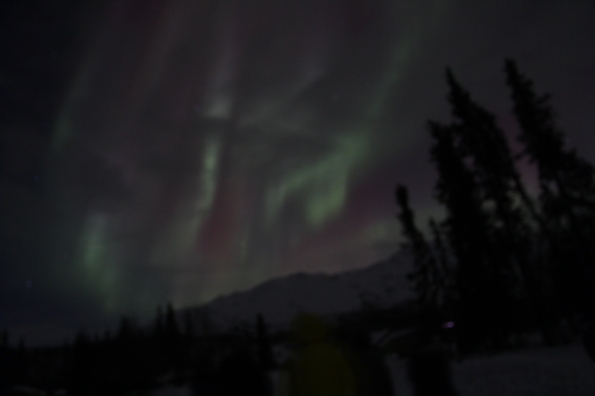
The show started to die down and we were going to head home about 1:30am. We voted to wait a while to see if another display materialised. Wow, we were glad we waited. Most of the pics here are from a display performing, off and on, for about 10 minutes just after 1:35am.
About the colour
The most common auroral colour is yellow-green. It is produced by oxygen atoms about 60 miles above the earth. High altitude oxygen atoms (about 200 miles up) glow a rare red, while nitrogen molecules emit a purple tinged with red. But keep in mind that the camera sees these better than the naked eye. That said, I could see the colour in these.
P.S. I decided that these didn’t need captions.


The long bar with scads of vodka choices—nine flavours of Smirnoff alone
A visit to the Mecca Bar was on our to-do list when we returned to Fairbanks after five nights in the Arctic Circle.
While the bar was across the street from our Fairbanks hotel, we were also ‘introduced’ to it through a documentary we saw on the coach trip north to Coldfoot. That film showed the making of the 800-mile-long trans-Alaska oil pipeline, along with some of the night life the crews enjoyed.
Mecca Bar was the only pub featured so four of us headed there after a trip to the ice sculpture competition (more about that soon).
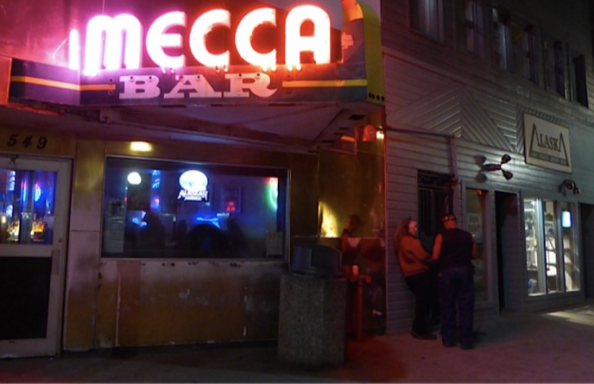
No missing the sign at the Mecca Bar
The Mecca Bar was everything we could have hoped for. A friendly and knowledgeable barmaid, a long bar displaying countless varieties of spirits, a pool table, an array of locals and an ambulance pulled up out the front (for someone who’d overdone the booze).
Taylor, the barmaid, filled our orders and stopped for a bit of a chat. We stood for a short time, but soon a couple of patrons offered us bar stools. Once perched, it wasn’t long before I spotted a bottle of smoked salmon flavoured vodka.
Of course, how could I resist finding out more? Taylor said the vodka didn’t so much taste of smoked salmon, but that there was a distinctive after taste. She also said it was great in a Bloody Mary.
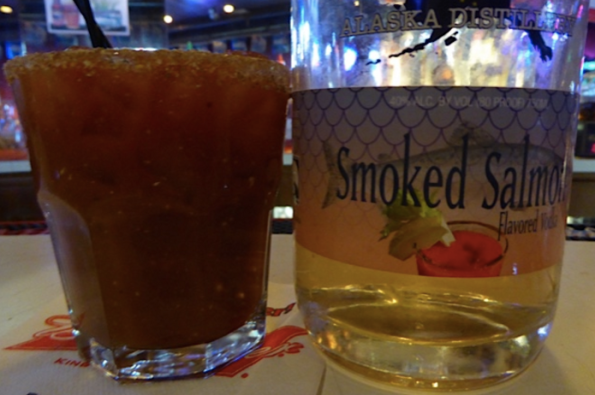
Bloody Mary made with smoked salmon vodka—an Alaskan speciality
Obviously, us being from Australia and me being so intrigued was too much for Taylor’s hospitality, and before long she presented me with a Bloody Mary to try. She even crusted the rim with salt and pepper. What a champ. And what a drink!
If I wasn’t going to be travelling for the next two months, I’d be buying a bottle of this vodka, if for no other reason than to share it with adventuresome friends.
Thanks, Taylor, for such a warm welcome to a pub in Fairbanks and for your kind generosity. And your advice too. There is a slight after taste of smoked salmon.
If you’re ever in Fairbanks, stop by the Mecca Bar on Second Avenue and say hi to Taylor, and be sure to try a Bloody Mary.
P.S. If you’re feeling cold, stop by my cooking blog and read about a Brazilian drink—caipiriniha.
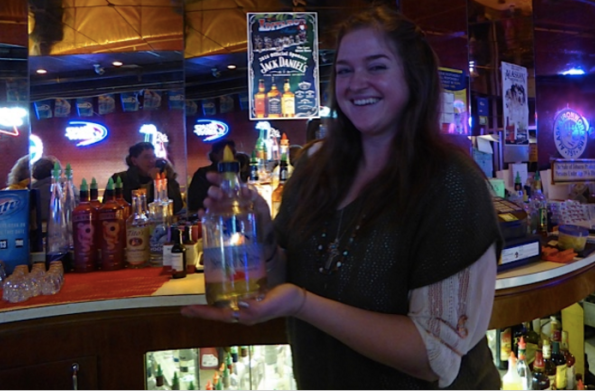
Taylor showing off the salmon flavoured vodka at the Mecca Bar
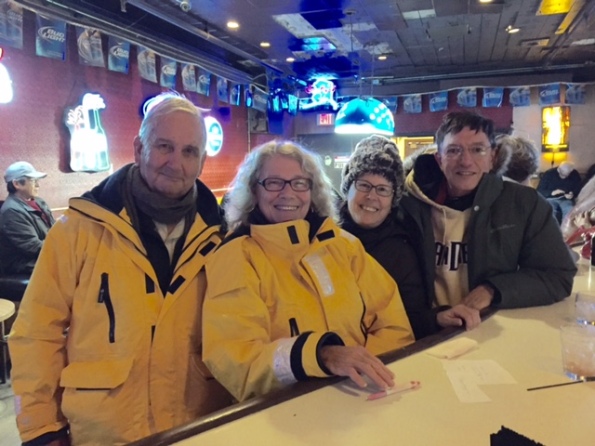
Poor John, me, Milly and Dick at Mecca Bar. We all travelled together in 2014 in Papua New Guinea. Photo by Taylor (thanks Taylor)

Northern Lights in Wiseman
We’ve had more than a week of amazing nights in northern Alaska, but only one that delivered incredible views of the aurora borealis (Northern Lights).
I’m still reeling from the experience, which was in Coldfoot, about 250 miles north of Fairbanks. There really aren’t any words to describe the aurora—only photos. And even they don’t do it justice.
Interestingly, to the naked eye, the aurora looks mostly white. For the most part, it’s hard to see the depth and variety of colours. Only the camera picks up the nuances and, even then, not always.
I’m sharing two pics here and will post more as soon as I have had a chance to go through what I have. I’m still gobsmacked by the whole experience.
These pics are from a place called Wiseman, Alaska. They aren’t in focus (none of my pics are), but they give you an idea of what we saw.

Northern Lights out of focus
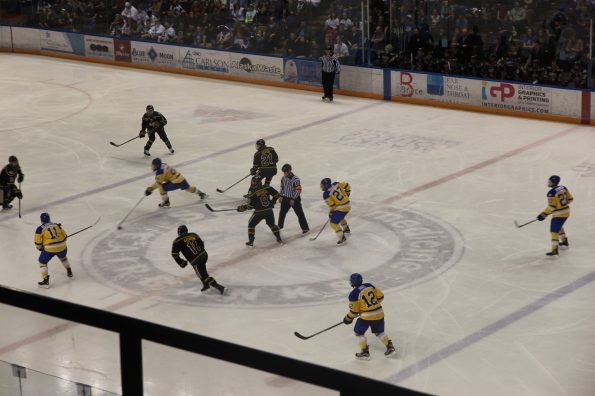
Fairbanks is in the blue and gold
We’re heading north tomorrow. And I mean way north into the Arctic Circle and about 250 miles north of Fairbanks. Our destination is Coldfoot and the prospect of seeing the Northern Lights.
Our 48 hours in Fairbanks have been a whirlwind and I’ve barely had a chance to go through my photos, let alone piece together a post.
Plus, we don’t expect to have internet for the five nights we are in Coldfoot.

Fairbanks leads
So to tide everyone over, I thought I’d show a few glimpses of the ice hockey game we saw last night. It was our first time to see a live game and we saw the University of Alaska–Fairbanks face off against the University of Alaska–Anchorage.
I bet you can imagine the rivalry between these two teams.
They were playing for the Governor’s Cup (I think) and for a slot in other play-offs. If my information is right, both teams are near the bottom of the ladder (sorry if I have that wrong), and they were playing four matches.
Two games were played last week in Anchorage with each team winning one. They played again in Fairbanks last night and the night before. Fairbanks won Friday night 3–2 with a nail-biter finish. We missed that because we were still on our 36-hour, long-haul flights to Alaska.
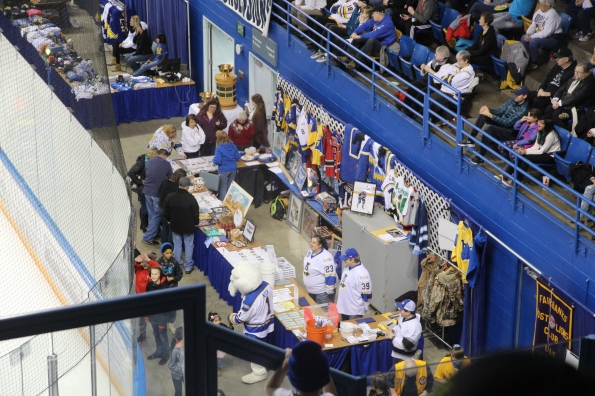
The Governor’s Cup was displayed at the souvenir stand. It’s in the upper middle between the two white doors
But we were in time for last night’s nail-biter, and four of us rolled up to buy tickets at the door—$17 each.
We opted for seats in the wet versus dry area. Wet doesn’t mean you’re going to get covered in snow and ice. It simply means you’re allowed to purchase a cup of beer, cider or wine.
There’s a boom-gate at the entrance to the wet area. As I approached, the guard promptly asked to see my ID to prove I was over 21—I bet he thrills a lot of women with that line—and then decorated my hand with an ‘over 21’ stamp. He wasn’t surprised to see my Australian Capital Territory driver’s license as evidence. ‘Oh, the ACT’, he said, ‘I used to live there.’

Banners for teams in the league and for top players of the past
Our seats were in the last rows, hence the faraway pics, but the sports centre is small enough that any seat is pretty good.
Fairbanks shot to an early lead, but by the last third of the game (each segment is 20 minutes), the scores were level at two all. Then Fairbanks scored again and Anchorage put on all the pressure they could muster in the hopes of gaining a tie.
But Fairbanks held their ground and were triumphant. But not before the mandatory scuffle broke out on the ice. As Milly said at the end of the evening, ‘We went to a fight, but a hockey game broke out.’
P.S. We had a tasty beer—a Canadian Molson—and a great introduction to ice hockey. But I have to say, it’s not easy keeping your eye on the puck.
P.P.S. Back in six days. Please no scuffling in my absence.

A referee tries to break-up the scuffle at the end of the game
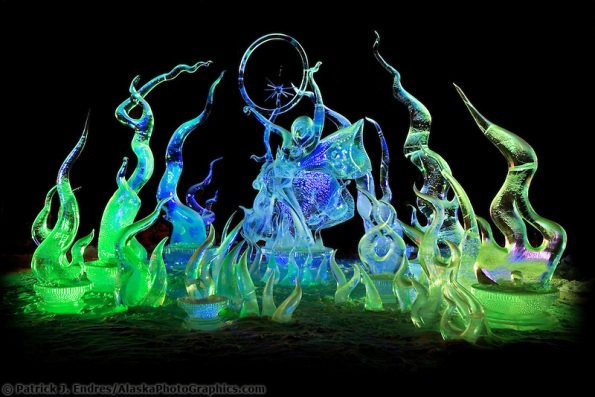
Sweet Motion of the Northern Lights, by Don Lowing, Peter Slavin, Jeffrey Meyers, Dean DeMarais. 2007 World Ice Art Championships, Multi block sculpture, second place, realistic.
There’s been a heat wave in Canberra over the last week and another week of heat is predicted. With temperatures running about 35°C (95°F), Poor John and I have decided to go to extremes to beat the extremes.
We’re on the way to the annual World Ice Art Championships in Fairbanks Alaska. Our plane boards in about 20 minutes (thank goodness for Sydney airport’s wifi). After the ice competition and in the hopes of seeing the aurora borealis, we drive 10 hours further north, to a place called Coldfoot (I hear you say, Cold? My Foot!).
So in the short-term I’ll be offline for at least a day, and gearing up to take plenty of photos to share. In the longer term, after Alaska we’ll do Seattle, Tampa, the Caribbean, Cuba and then a bit of South America with a repositioning cruise, of all things, back to Los Angeles.
Stay tuned for more like these from earlier championships.
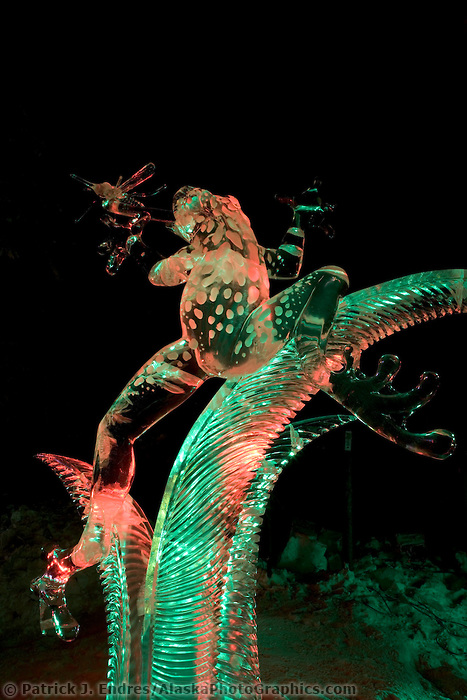
“Leap” 2005 Ice Art Championships, Fairbanks, Alaska. First place single block competition by Steve Brice and Aaron Costic

