

Onion domes of St Nicholas Cathedral
If I was my grandmother, I would have said, I’m so mad I could spit nails.
Grandma had a colourful way with words and I learned most of the not-quite-toe-curling swear words I know from her.
In fact, most of them came in a single ‘crash course’ on the winter night she fell off the toilet and broke her arm (another long story). Anyway, she dumped a blizzard of swear words on the ambulance men after they accidentally tipped her off the stretcher into the deep snow in the front yard.
But I digress. Actually I’ll digress again briefly. The first time grandma delivered the spit nails comment within my earshot was when she wanted my mother (her daughter-in-law) to be absolutely certain that she was not at all happy about the Christmas present mix-up.
By mistake, mum sent grandma the parcel with the flannel men’s pyjamas meant for mum’s father. Grandpa got the beaded sweater instead. Oops! Harley was sweet about it, but hot-headed Zula was, in my opinion, unnecessarily crabby about an honest mistake.
But honest mistakes had nothing to do with my irritation today.

Church interior
I have two prime targets—Lonely Planet’s Central Asia guidebook and its error-riddled map of central Almaty in Kazakhstan and a bitchy old hag who was offended because Poor John and I turned up to her church in the wrong outfits.
Poor John and I set out this morning to find St Nicholas Cathedral. We walked several kilometres along Zhibek Zholy to the T-junction and then turned left onto what ought to have been Baytursynuly (isn’t that a great spelling!).
The map showed the cathedral was seven blocks straight up Baytursynuly. But dead ends and obstacles (including a major hospital) not shown on the map meant we zigzagged around blocks and did our best to stay on course. By the time we reached an intersection displaying street names, we were six or seven blocks off track. Poor John has a great sense of direction, so the map had to be (and was, we later confirmed) the problem.
In spite of the map, we found St Nicholas Cathedral with its turquoise exterior and ornate golden onion domes.
On the way in through the front gate I noticed a woman putting on a scarf. Oh hey, I said to Poor John, I’d better not go in because my top is sleeveless, but then I remembered my long-sleeved black merino top was tied around my waist for just such occasions.
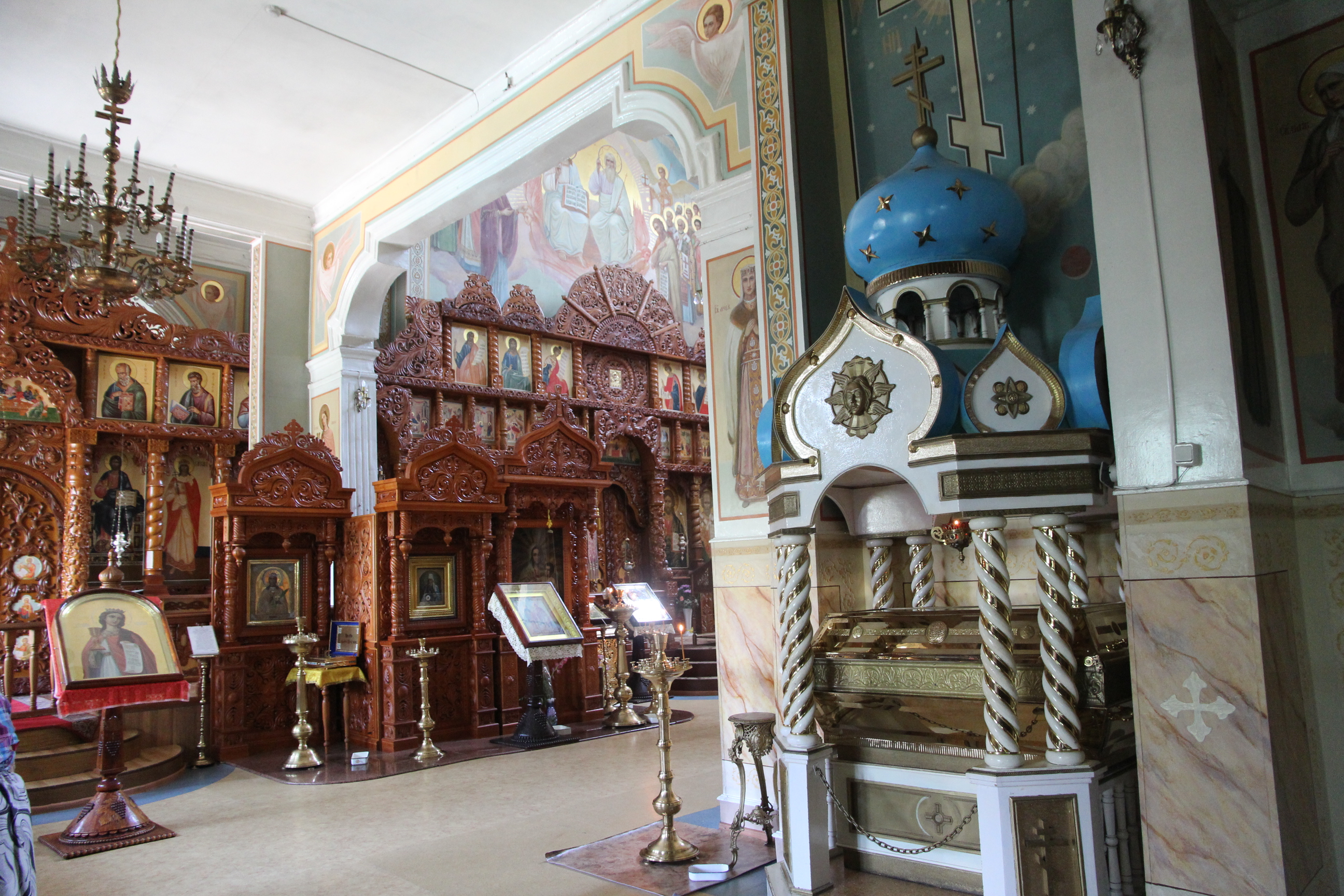
More interior
So standing almost in front of the woman donning the scarf, I put on my black top as well as Poor John’s hat. Men must take off their hats and women are to have their heads covered.
And in we went. It was the middle of a Tuesday afternoon. There were maybe 10 people in the church, including tourists. Although photos were allowed, I hung back and took pictures only when it wouldn’t disturb someone’s prayers.
Afterwards we strolled outside and took a seat on a timber bench in the cathedral’s driveway. The woman of the scarf made a beeline for us. She was angry and on a mission—that was easy to see—and she was going to swoop.
In Russian or Kazakh (I’ll never know) she thoroughly told us off, pointing to our shorts. She scowled, snarled, raised her voice, chastised, criticised, harped and finger wagged, all the while pointing back and forth at our offending shorts. And I have to add here that these are almost knee-length shorts.

Domes from a distance—after we’d been run off the place
Anyway I smiled and nodded and said, Yes, yes, thank you, thank you for letting us know about a rule that isn’t posted anywhere on the door like the church in Georgia.
Which was a signal for her to start her tirade over again.
But I stood up and cut her short. I raised my hand, smiled and said something along the lines of, It’s clear the only solution is for us to leave, so we’ll be on our way, but I will always remember you as the most un-Christian of people.
Of course, if I’d been my grandmother Zula, I have said You bloody cow. You are a childish and rude person who has almost spoiled a trip to a lovely cathedral. I’m so mad I could spit nails.
But we still had a good time and I didn’t want to behave as badly as she had.


Meeting nice people on the way home
Our trip back to the hostel provided a welcome change.
We chatted with a man and his son who were standing outside the Kazakh–British Technical University (the son was being enrolled to study petroleum engineering). Dad told us about the building, which used to be Kazakhstan’s Parliament, and about the nation’s oil industry (dad is a petroleum engineer in the western part of the country).
A short time later, Aeda, a lovely young woman in a bookstore, helped us find a Russian–English phrasebook. Her English was excellent but she was stumped trying to find me a cookbook written in Kazakh or Russian as well as English. But in her quest to introduce us to more about Kazakh cuisine, customs and culture, Aeda invited us to her home. Sadly, we had to decline because we’re heading off tomorrow. I have her phone number, so maybe next time. 🙂
I wonder how the old bat ended her day?

St Nicholas Cathedral
And a bit about the cathedral
St Nicholas Cathedral was built in 1909. Later the Bolshevik cavalry used it as a stable. It wasn’t reopened as a place of worship until 1980.
The interior is filled with gold leaf, icons, candles and dramatic paintings. It was too dark to get a pic of the painting of Judas slipping away from the Last Supper to collect his bag of sliver.
Oh, and stay tuned to read about our trip to Almaty’s main cathedral and what happened when I wasn’t supposed to take photos.
And if you’re hungry
Don’t forget to check out my cooking blog. There aren’t any recipes for sour grapes for crabby women, but here’s an easy one for lime cheesecake.
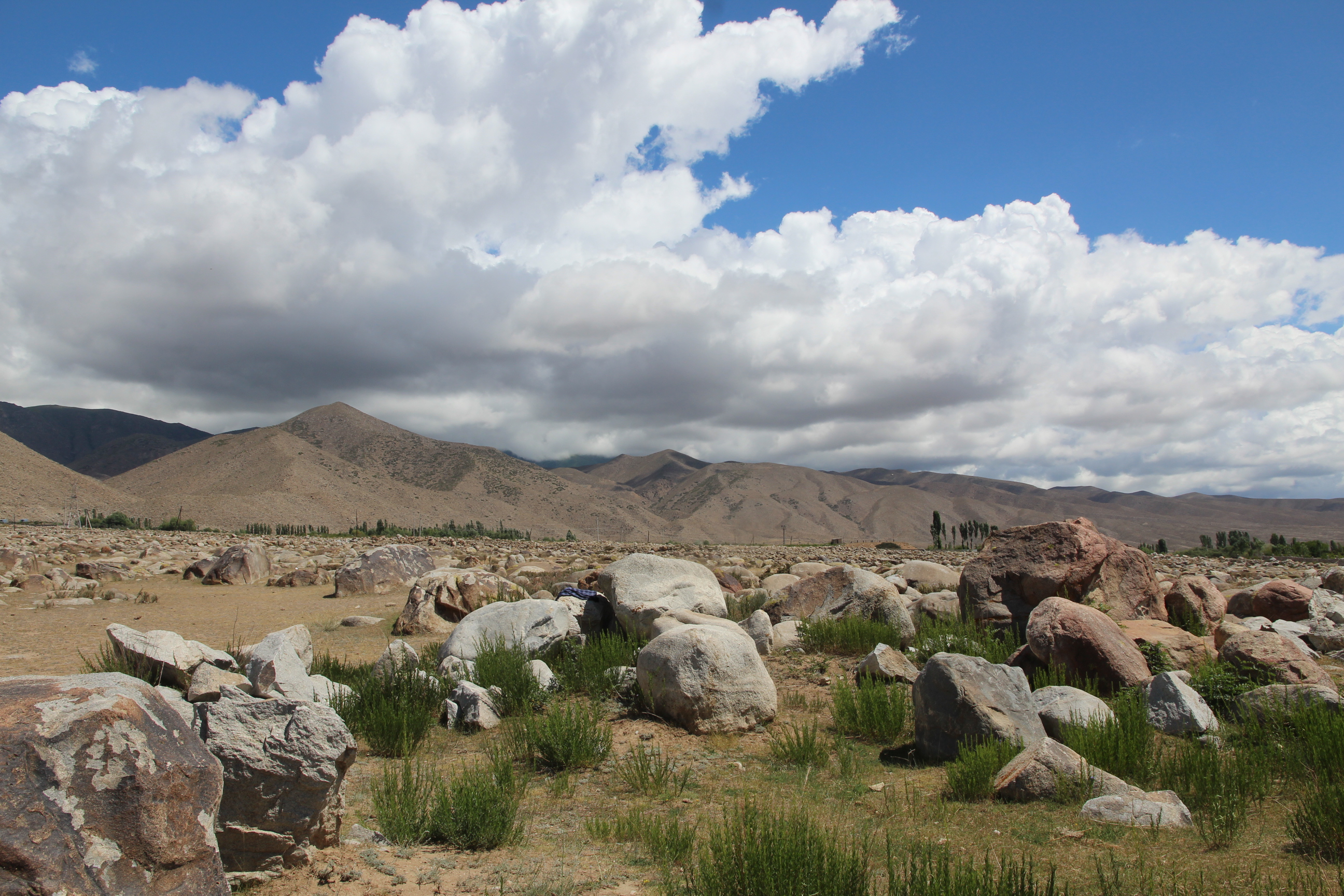
A field of petroglyphs
With its great position on the north shore of Lake Issyk-Kul, Cholpon-Ata is a well-known holiday destination for Central Asian families. To cater for the glut of summer visitors, almost every shop sells an array of beach toys and swimming gear.
But because Australia is blessed with some of the world’s finest beaches, we’re rarely in search of a swimming hole. So instead five of us set out to find Cholpon-Ata’s other famous attraction—the ancient petroglyphs (rock engravings).
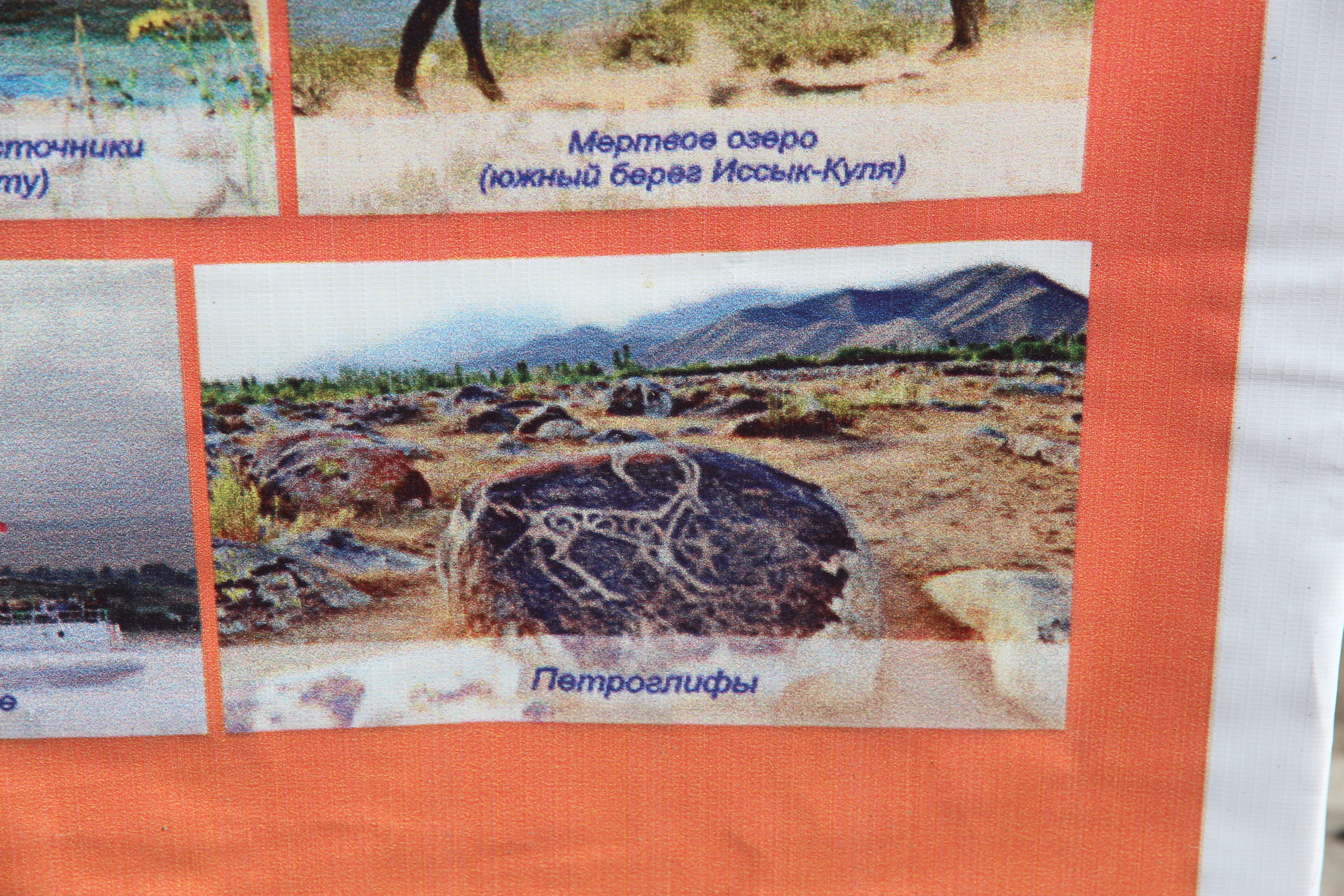
A poster to use as a clue
Famous? Well that was the rub.
We asked and asked and asked for directions. I even had a photo of the poster advertising the petroglyphs with the word written underneath in Russian (or Kyrgyz)!
Hmm, nope, never heard of them—or words to that effect—was the most common response, accompanied by a shrug of the shoulders or a certain amount of head scratching. At first I wondered if we were asking only tourists who simply didn’t know, but I reckon the people running shops must be locals.
A fellow running a tour company pulled out a map and showed us the way, which included a walk up a ‘road’ that seemed to start and end in the middle of nowhere. That, of course, was because the road is really a disused airport runway.

Goat?
We optimistically trudged in the general direction of the runway and kept asking where to turn to get to the petroglyphs. Either nobody knew or they gave distances that ranged from half a kilometre to three or four. We’d already walked three or four!
There was one exception. A little girl at a crowded bus stop had a general idea of where they were. No doubt she had visited on a school excursion. But she had no English, nor did any of the others. So her spiel and hand waving weren’t of much use.
At last we turned up a likely road (just past a petrol station someone had mentioned) and a fellow directed us to the actual road/runway in the middle of a field of dirt.
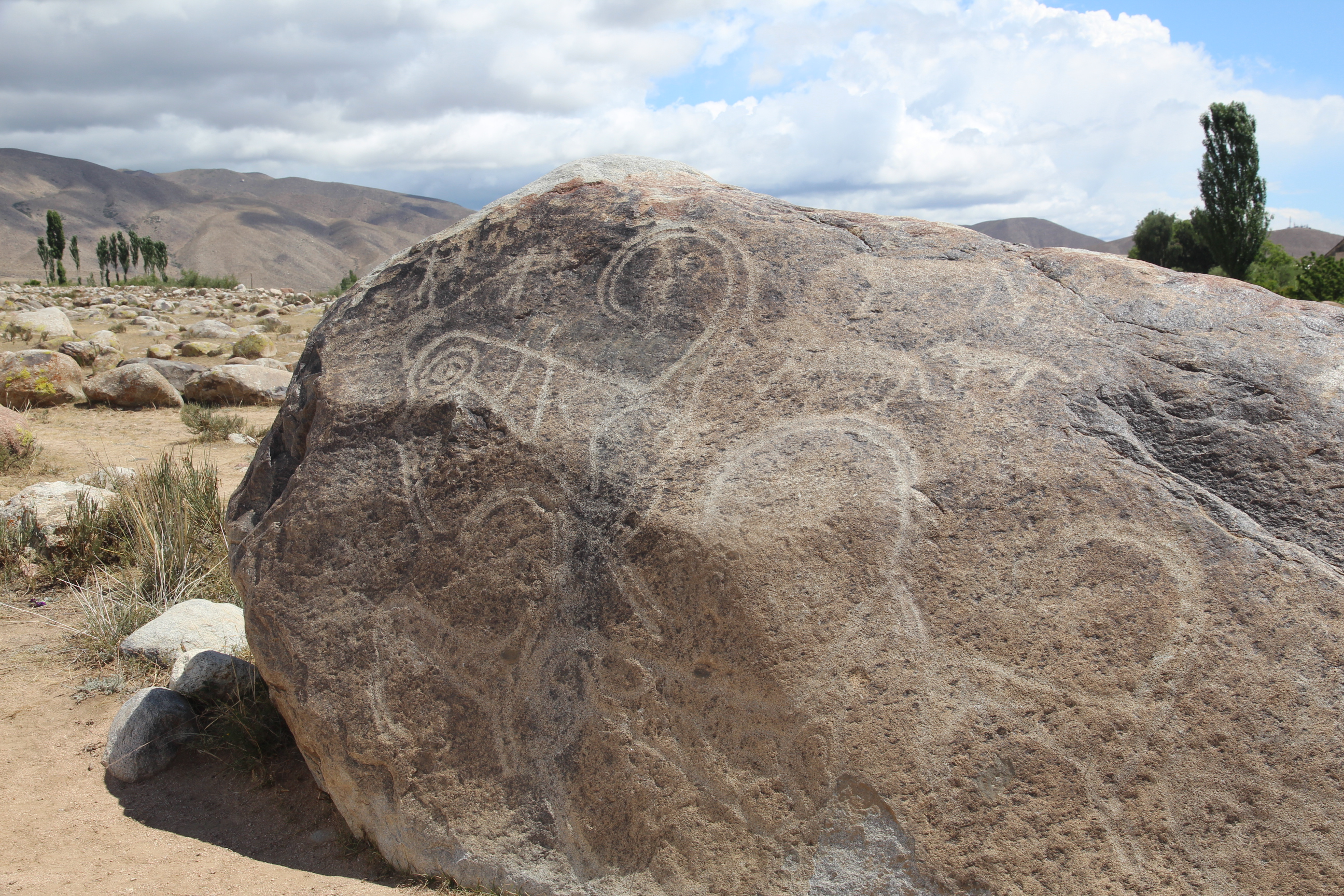
The largest petroglyph. The photo doesn’t it show it very clearly, but the two animals in the top right are supposedly snow leopards trained to hunt!
So much for feeling like you’re getting close. Do you know how long a runway is?
When we finally arrived at the gate we were surprised to find most of the rest of our group already there—or already come and gone! Obviously they had asked the right questions in their quest for the location. Now that I think of it, I suspect they also had the group’s Russian speaker with them.
One of our fellow travellers warned us that admission was high—somewhere between 250 and 350 som (or $5 to $7)—but that was a miscommunication. We got in for $1 each.


We spent about an hour wandering among the rocks with their age-old artworks. The guidebook says this open-air ‘museum’ has about 2000 images dating from 800BC to 1200AD. Many of the animals depicted are now extinct or extremely rare in the area. We found 10 or 12 rocks with etchings, some with multiple pictures.
Supposedly there is a track leading through the rocks, but we had as much luck following it as we did finding the actual site.
P.S. I got a kick out of the fact that most of the site is fenced. Do they think the rocks are going to escape?
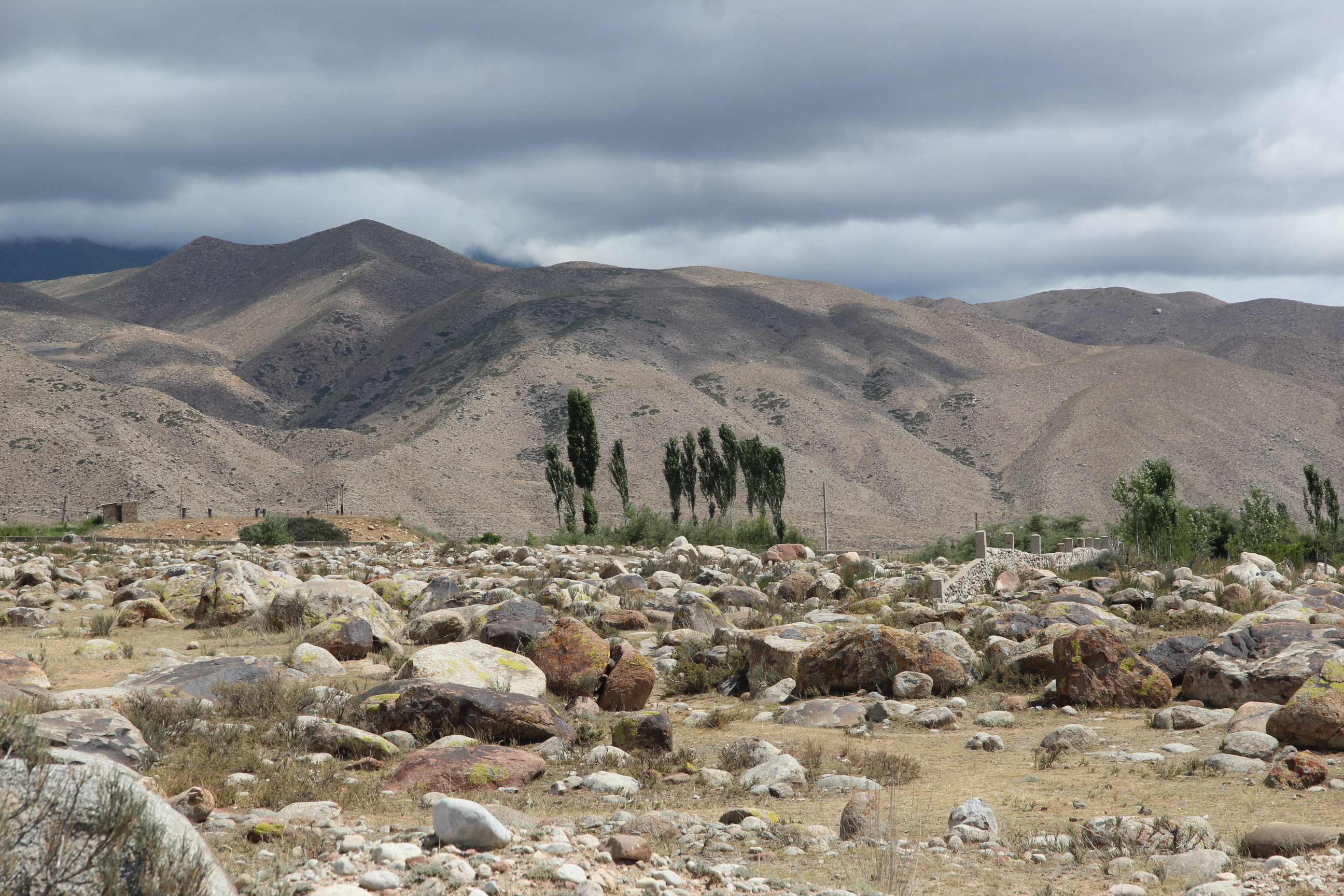
Stampeding rocks?
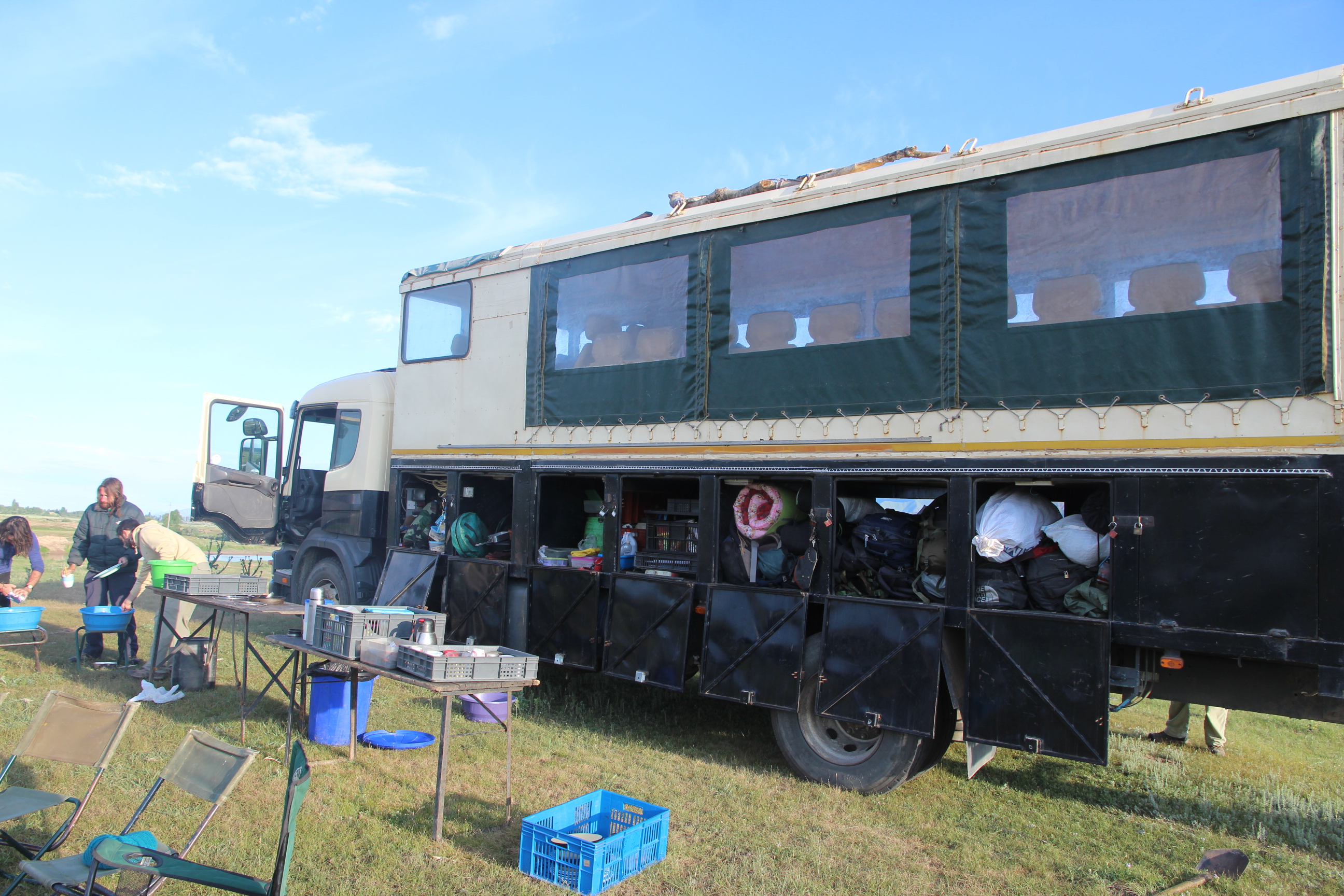
Setting up to cook
Lots of people wonder how we afford to travel so much. Most don’t believe me when I say it’s usually cheaper to travel than it is to stay at home.
So how do we do it? The trick, of course, is to do budget overland trips. We’re currently on our seventh—with trips eight and nine coming soon.
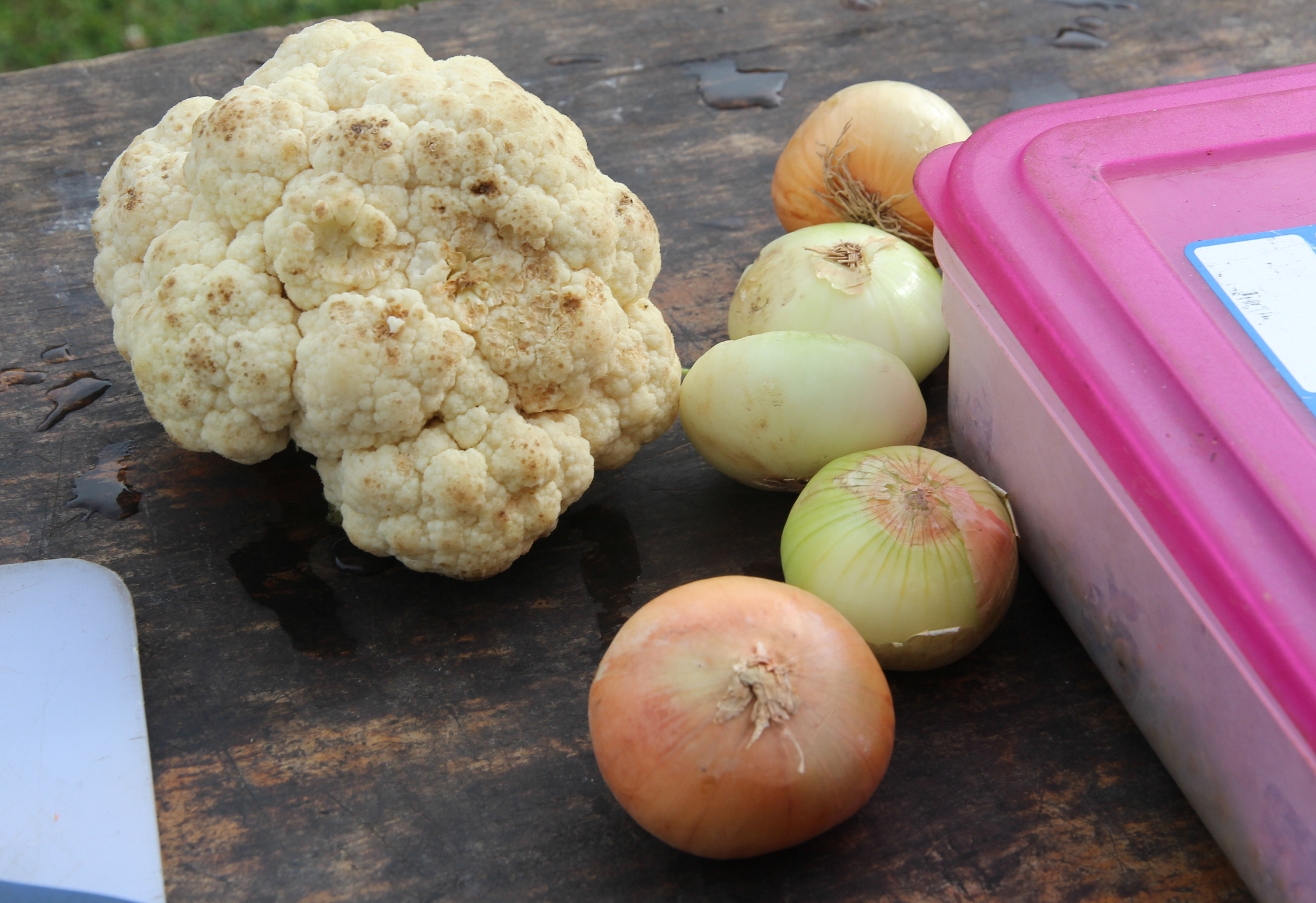
Cauliflower and onions

Cooked corn and tomato paste
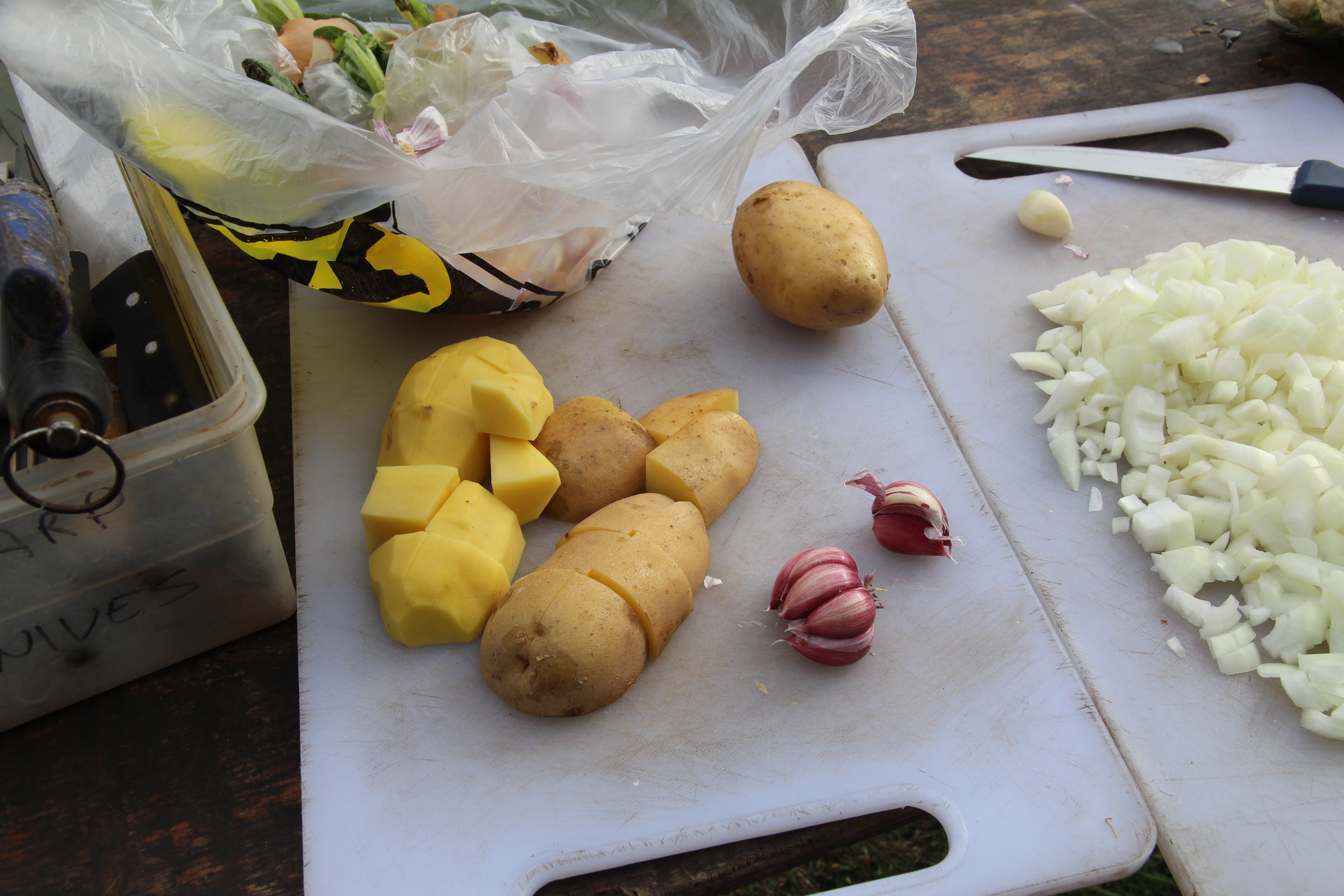
Chopping potatoes
Over the years, we’ve travelled with five different companies. While the definition of ‘budget’ has varied across them, it’s always meant camping when it’s available (usually bush camping) and cheap hostels or hotels when it’s not.
When we camp, we cook! When we cook, we shop! That means trips to local markets for the ingredients needed to make dinner that night and breakfast the following morning. The truck has a supply of staples and condiments, so we stick to buying mostly fresh.
Our current group of 14 (and just recently 15) is divided into four cook groups. My group’s most recent turn was in Karakol, Kyrgyzstan, home of the huge livestock market every Sunday.
We did our cook shop shortly after ogling all the livestock.
Hmm, what to buy? Hmm, what could we afford? Our team of three had 1000 som to buy enough ingredients to feed 14 people. That’s about $20.
We’d cooked a succession of primarily vegetarian meals (a big batch of lentils was already soaking), but after seeing all that meat on the hoof, our first stop had to be at the butcher’s. All cuts of beef were 330 som a kilo—the mince was coarsely ground and the t-bones were almost two inches thick. Chicken breast was 220. I didn’t ask the price of the solid lumps of fat on offer.
But are those duck breasts on the side of the freezer?
Yep.
How much?
They’re 140 som.
For one?
No, for a kilo!
Surely he was kidding. I hadn’t seen or heard chickens or ducks in the livestock markets, and here was this fellow telling me that duck breasts were 140 som a kilo. That’s less than $3 a kilo, less than $1.50 a pound.
I could have fainted, instead I bought two kilos. That left me with 680 som (about $13) to buy everything else.
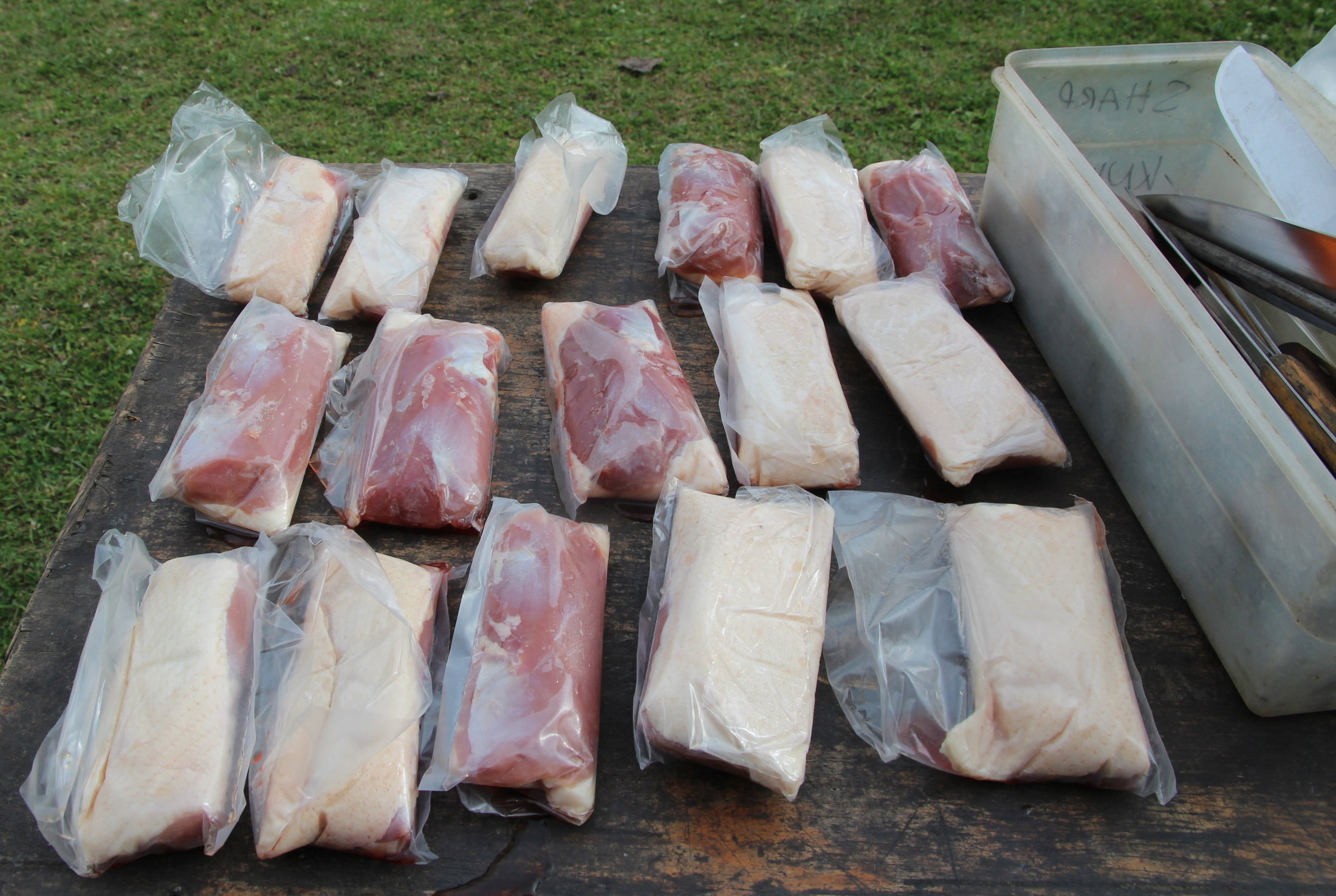
Sixteen duck breasts for about 50 cents each
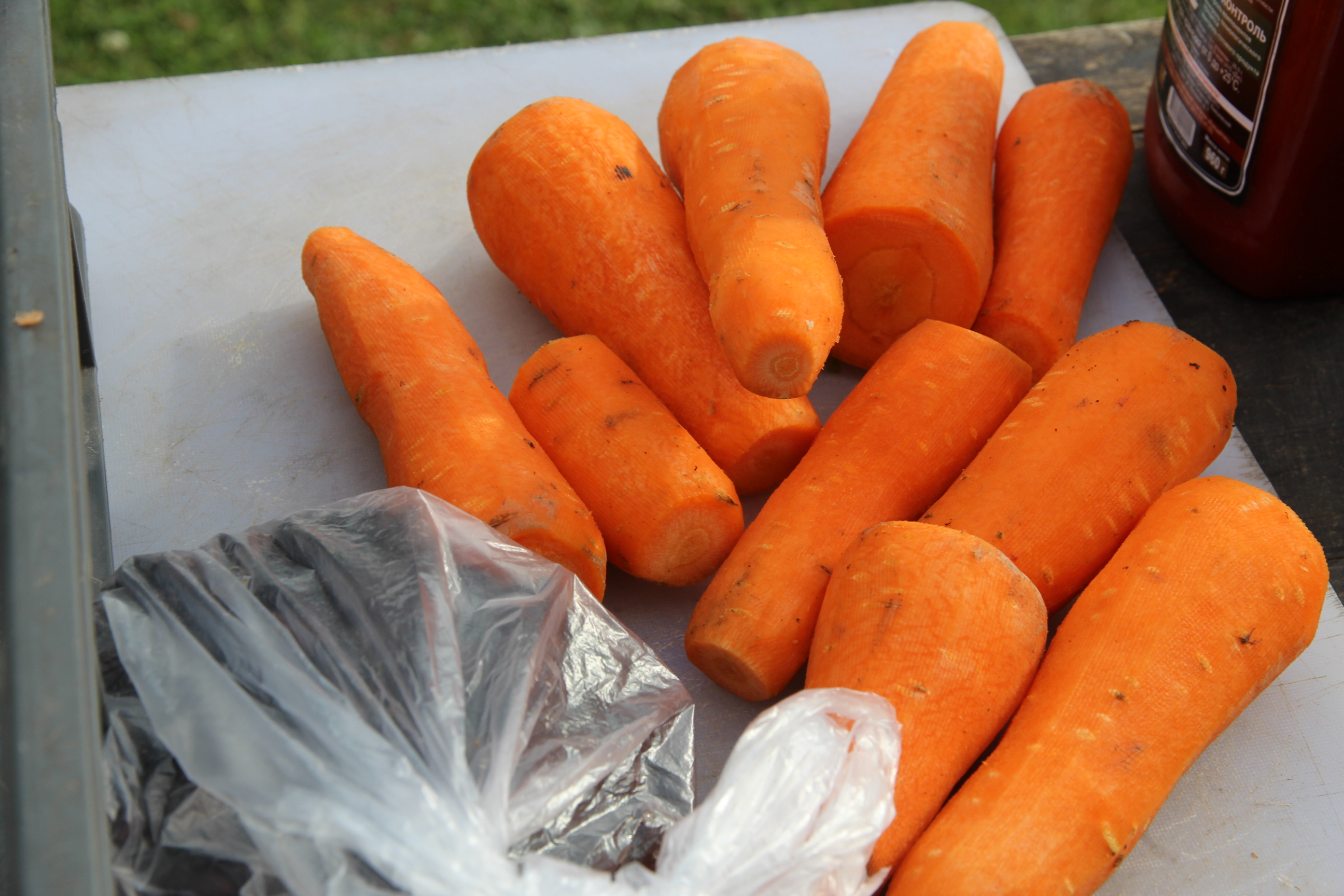
Carrots and a bag of sultanas
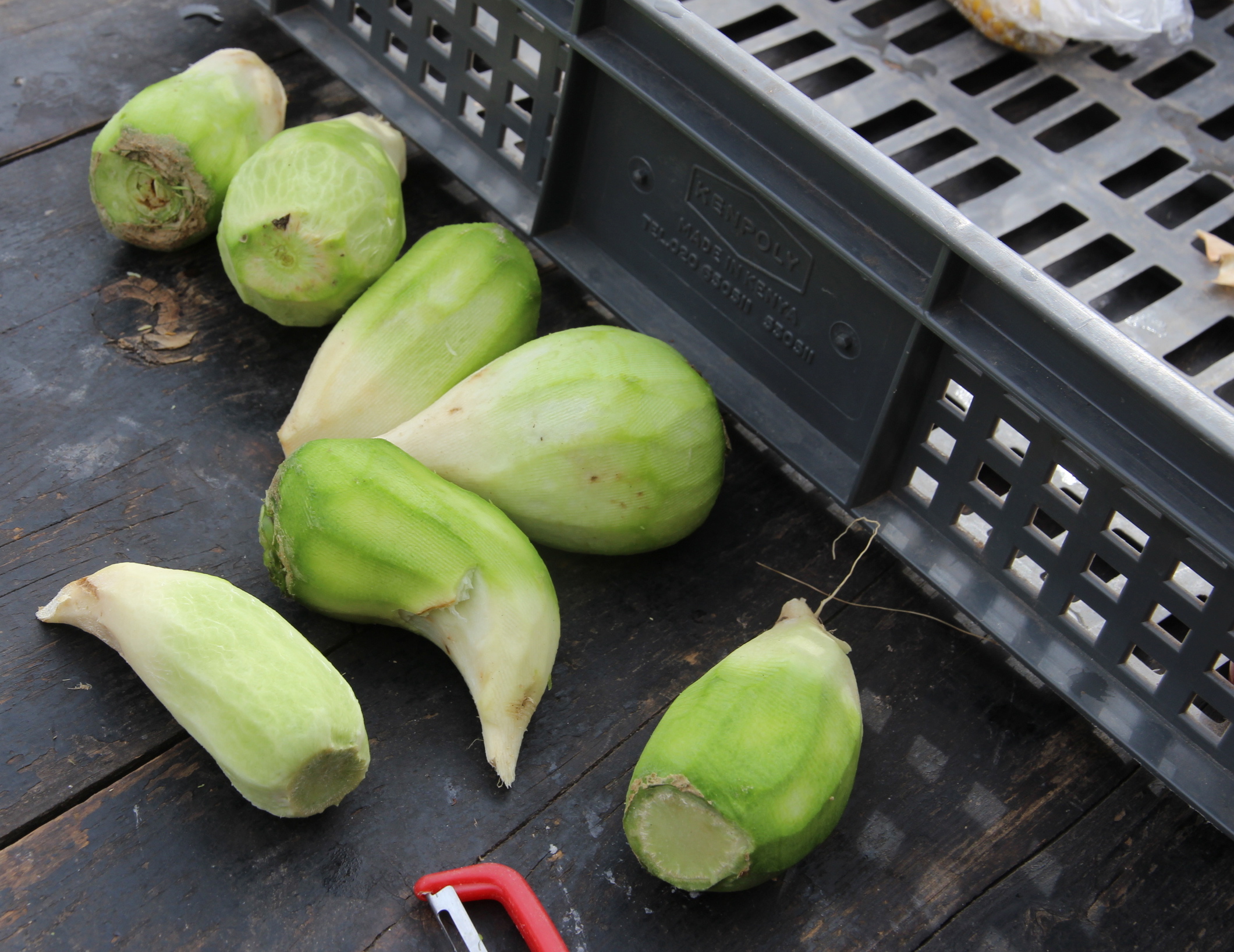
Turnips or summer radishes
We tried hard to squander it all.
It stretched to two kilos of potatoes, a kilo of carrots, a kilo of onions, a kilo of what we thought were turnips but the locals seem to call summer radishes, a largish cauliflower, a half-kilo jar of tomato paste, two ears of cooked corn (pricey at more than a dollar for the two) and finally 250 grams of hugely expensive dried sultanas (raisins) for the equivalent of $1.35.
We weren’t worried about breakfast. The weather was chilly so we’d make porridge (from oats already on the truck) laced with the pricey sultanas soaked in water and cinnamon. Oh for a splash of rum!
When I checked my cook-group shopping pocket and found we still had 157 som to spend, there was only one thing for it—another kilo of duck breasts.
Everybody got roasted vegetables and a duck breast, and there were a couple extra breasts for the big eaters. You can be sure we didn’t waste the duck fat either. I rendered it down for future cook groups.
Oh, and remember those lentils that were soaking. We used some of the veg and made a lentil soup as a starter‚ so two courses for the hungry masses.
No doubt it will be the only time in my life when I buy 16 duck breasts for just over $8. I still can’t believe it. But on a budget trip, you have to swoop on such bargains when they come your way. I wonder what my next find will be?
Got a mega-bargain story? Oh, do share!
P.S. Vodka has been a popular purchase in Kyrgyzstan. It’s never on a cook group’s shopping list, but the vodka drinkers are loving prices that range from $1 to $8 a bottle.
P.P.S. If you’re a food lover, check out my cooking blog. Here’s a Brazilian recipe for the next time you find cheap berries.
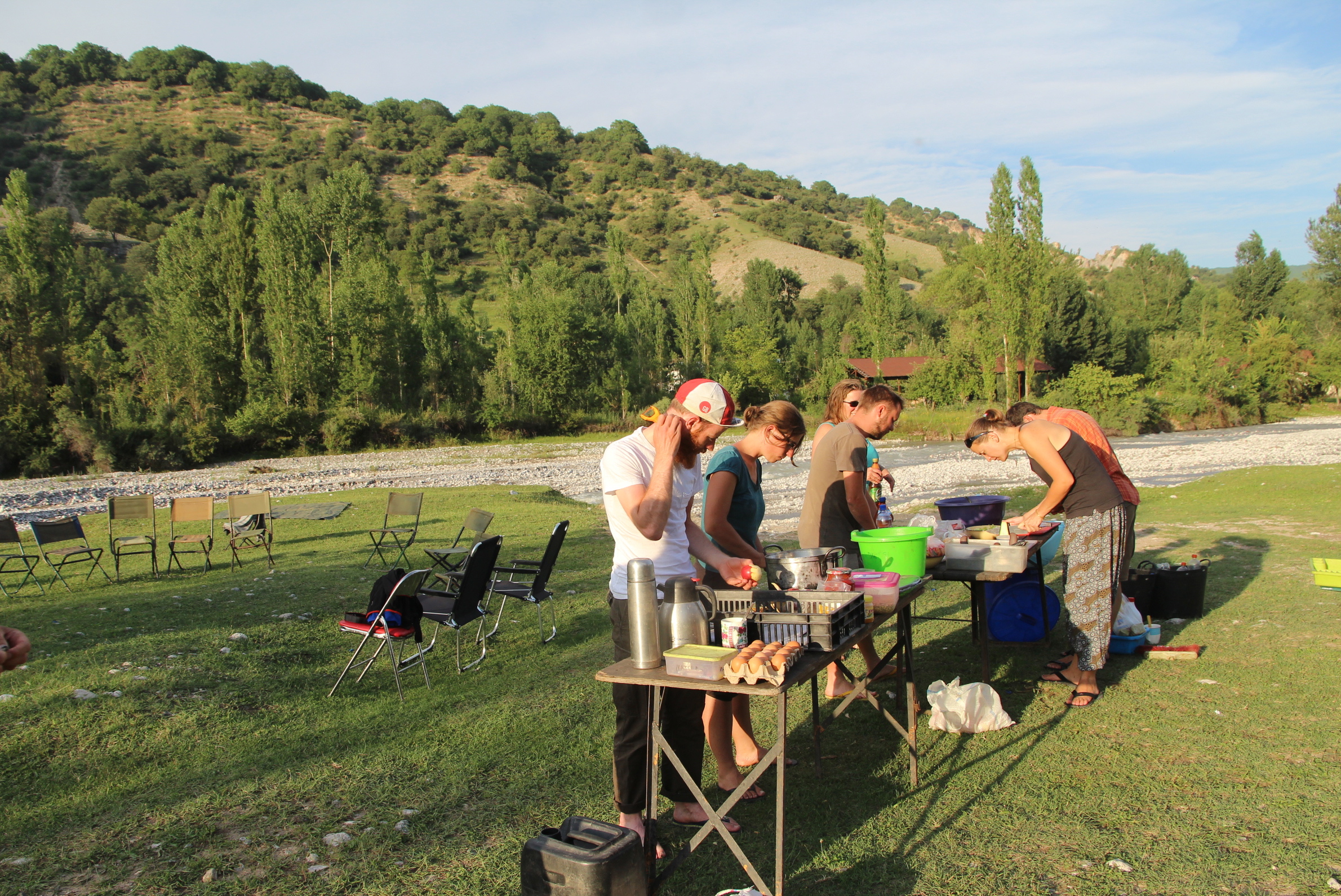
A cook group (not mine) at work with extra assistants and great Kyrgyz scenery

Waiting for a buyer
Karakol may be in eastern Kyrgyzstan, but it might as well be called the country’s Wild West.
We were heading that way last week, travelling along the shores of Issyk-Kul Lake. The plan was to camp about half-a-day’s drive short of Karakol.
But the fact the weekly livestock market would be on the next day changed all that. The market has an early start—opening at 5am—and five hours later it’s all over. So we camped much closer and hurried ourselves along in the morning, making it to the market well before 8.


Critters were everywhere—cows, bulls, calves, horses, foals, goats, sheep and more. The guidebook said pigs are also sold, but I didn’t see or smell any.
Based on the sights and smells, I could have been in Nebraska except that my home state doesn’t go in much for goats or sheep, especially fat-tail sheep.
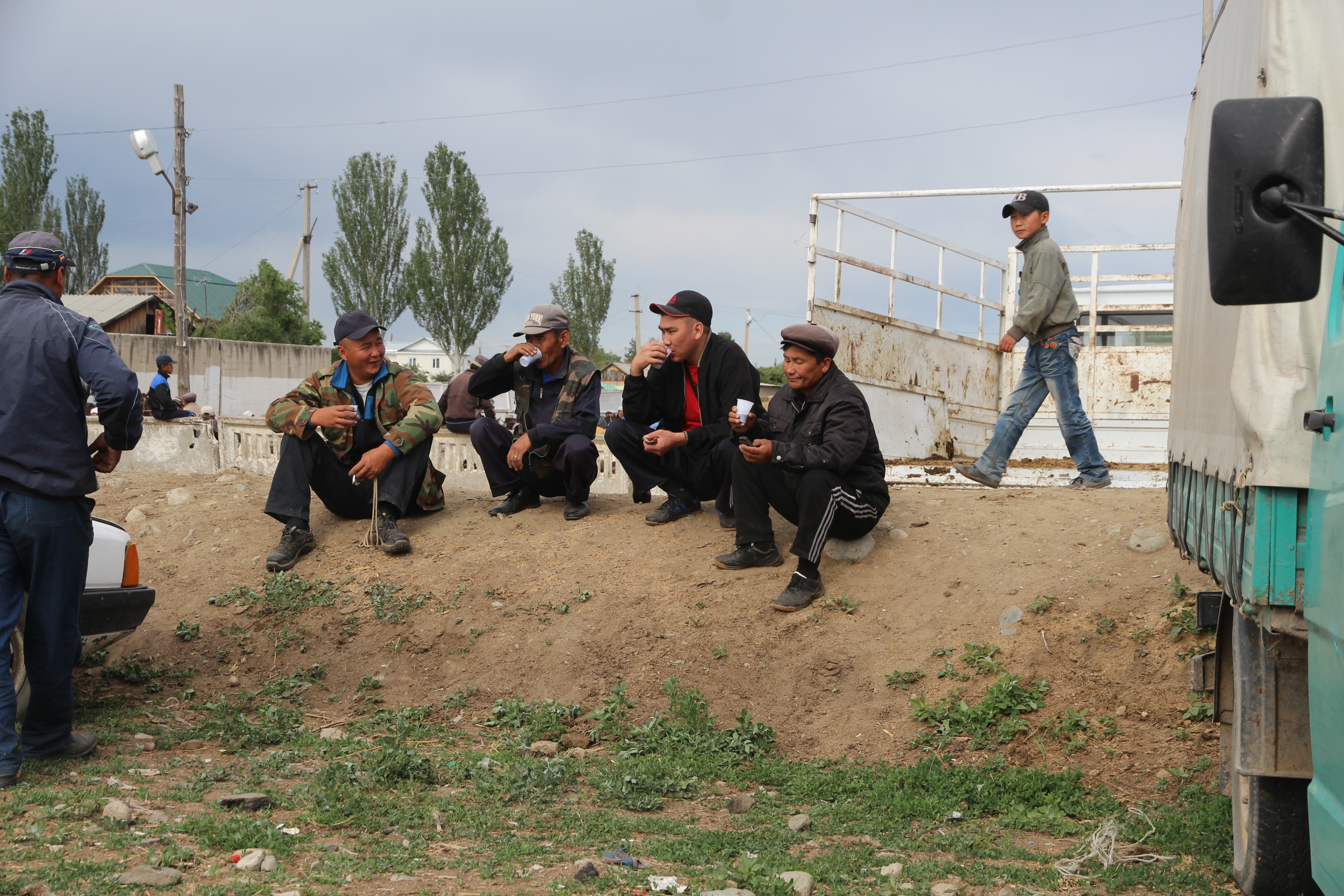
Karakol buyers
We wandered around for more than an hour and never really figured out the actual selling process. There definitely isn’t an auction. Instead people seem to stand around waiting for prospective customers to come by and inspect their offerings.
We noticed that the sellers were just as likely to be women as men, and that the amount of stock varied. Some people had a single animal. I saw a woman with just one snub-nosed calf (most cattle in Kyrgyzstan have short snouts, so it must be a breed characteristic). Others had many, but I didn’t see anyone with more than seven or eight animals.
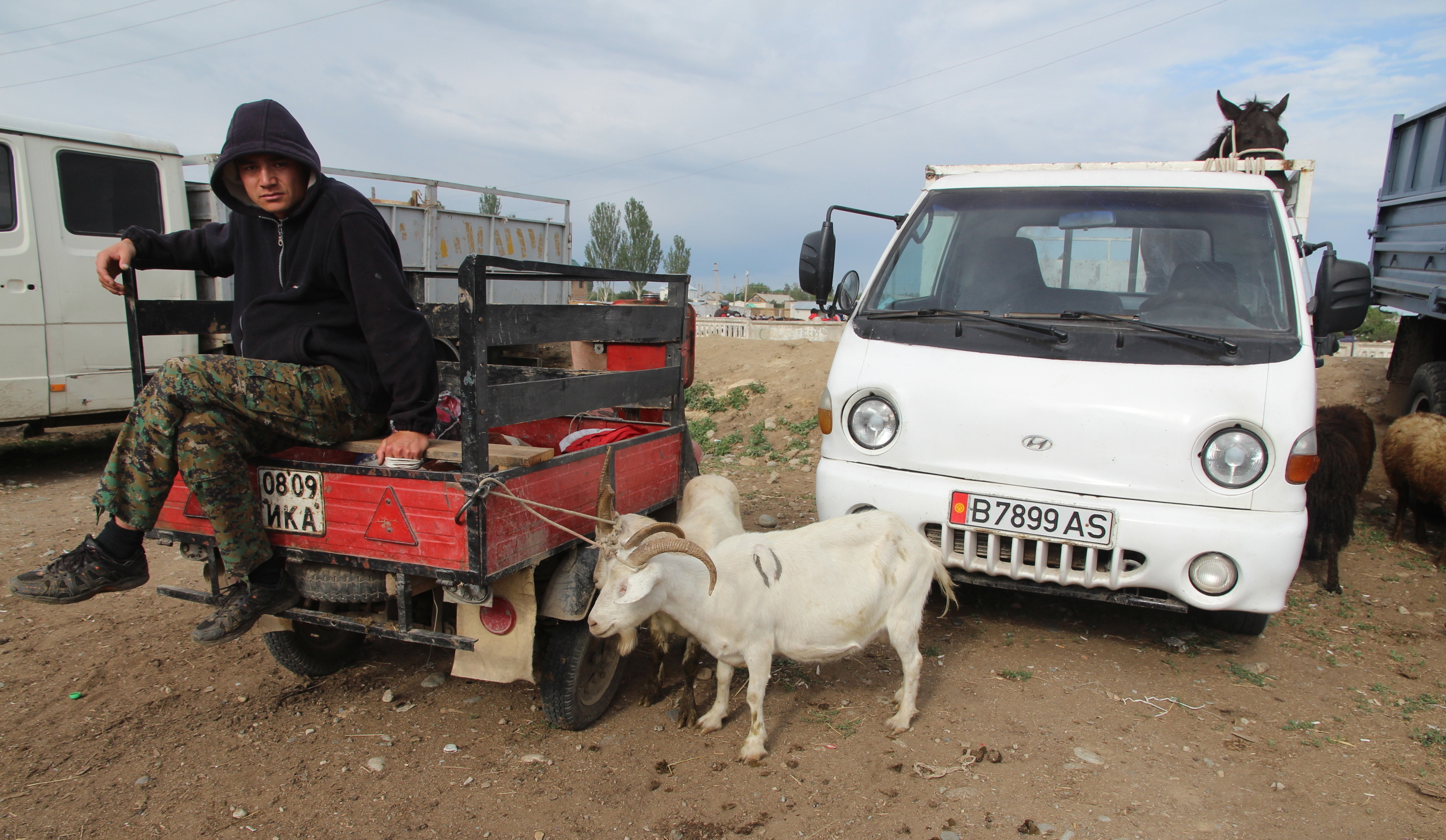
Hoping to sell
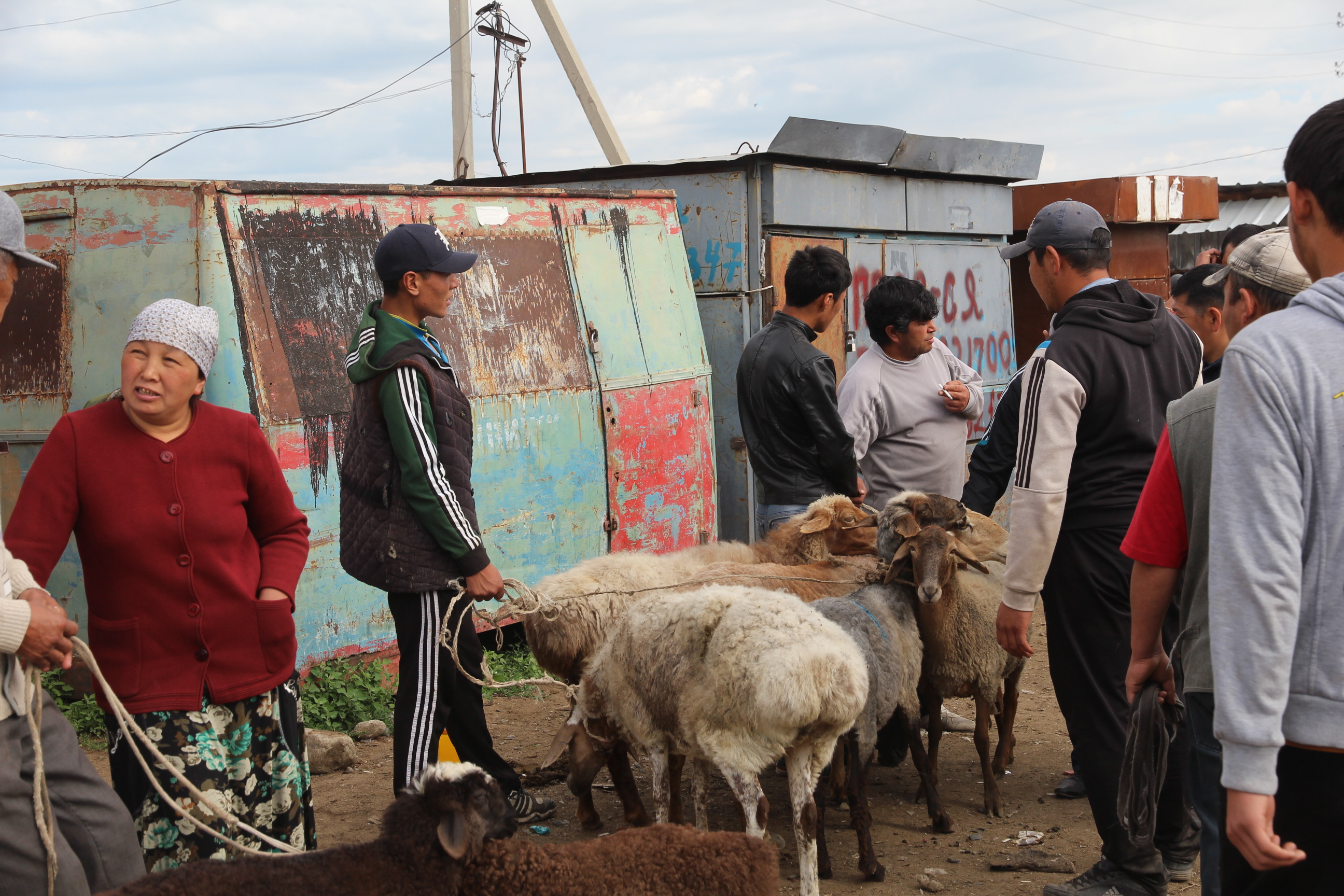
Having a chat
It was entertaining to see a couple of fellows trying to shepherd five or six uncooperative goats, on rope leads, through the crowds.
We saw a prospective buyer cantering a horse through the crowd seemingly on a test drive. We didn’t see him leave with the horse.

Available as a pair
Andy had a chance to chat with a seller who wanted 70,000 som (about US$1400) for his horse. He said lean horses were more expensive and sold for riding, while fat ones went for meat. And don’t think that meat is for dog food. The Kyrgyz people love their horsemeat, especially sausages. They love horse milk too. I’ve tried both and prefer the sausages.
The market had plenty of expected stalls. Saddles, ropes and tack were for sale, along with street food and drinks.


Talbot entered the strong-man competition. It’s more about being able to hold your own weight. It costs 100 som to enter. If you can hang from a metal bar for 1 minute and 55 seconds, you win 500 som. If you last another 35 seconds, you win 1000.
There’s a trick, of course. Talbot was doing so well when, at 1 minute and 15 seconds, he tried to adjust his grip. The bar rolls and Talbot was gone. The guy after Talbot lasted about five seconds, and the one after that made the same mistake as Talbot. So if you get there and enter, don’t move your hands. Just hang there until the time is up.


We didn’t have to pay to visit the market, but it seems that buyers have to pay to get out. At every gate, we saw buyers wanting to exit and being hit for 20 som per animal.
Buyers weren’t at all happy about this—it may be a weekly act—but the camouflage-clad money collectors acted rather mafia-ish and shooed me away when I tried to take a picture. Not to worry—I already had a few.
After the market, Poor John and I headed off to see two very elaborate religious houses—the Russian Orthodox Church and the Buddhist-styles mosque. I’ll be back soon to show you both.


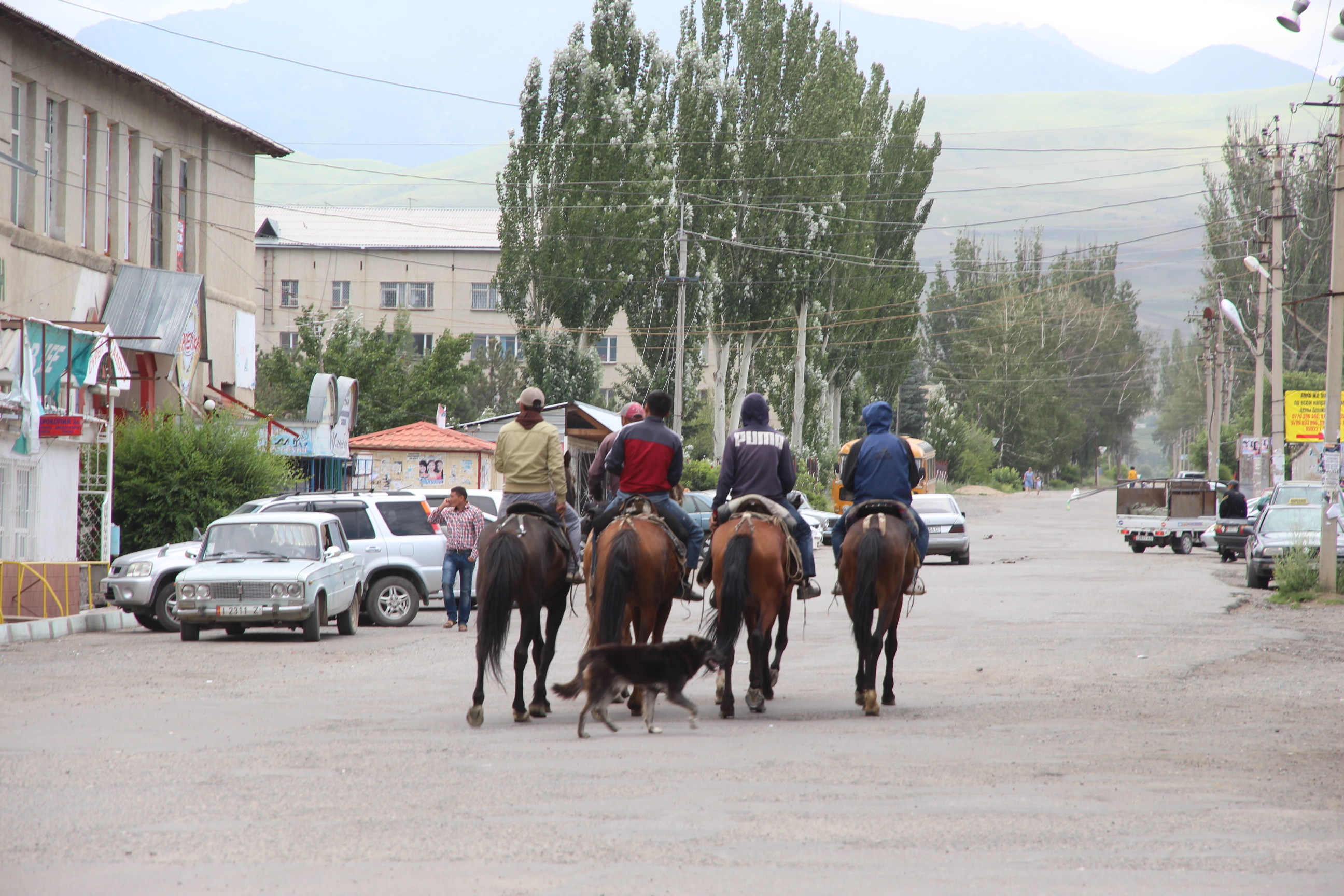
Heading home
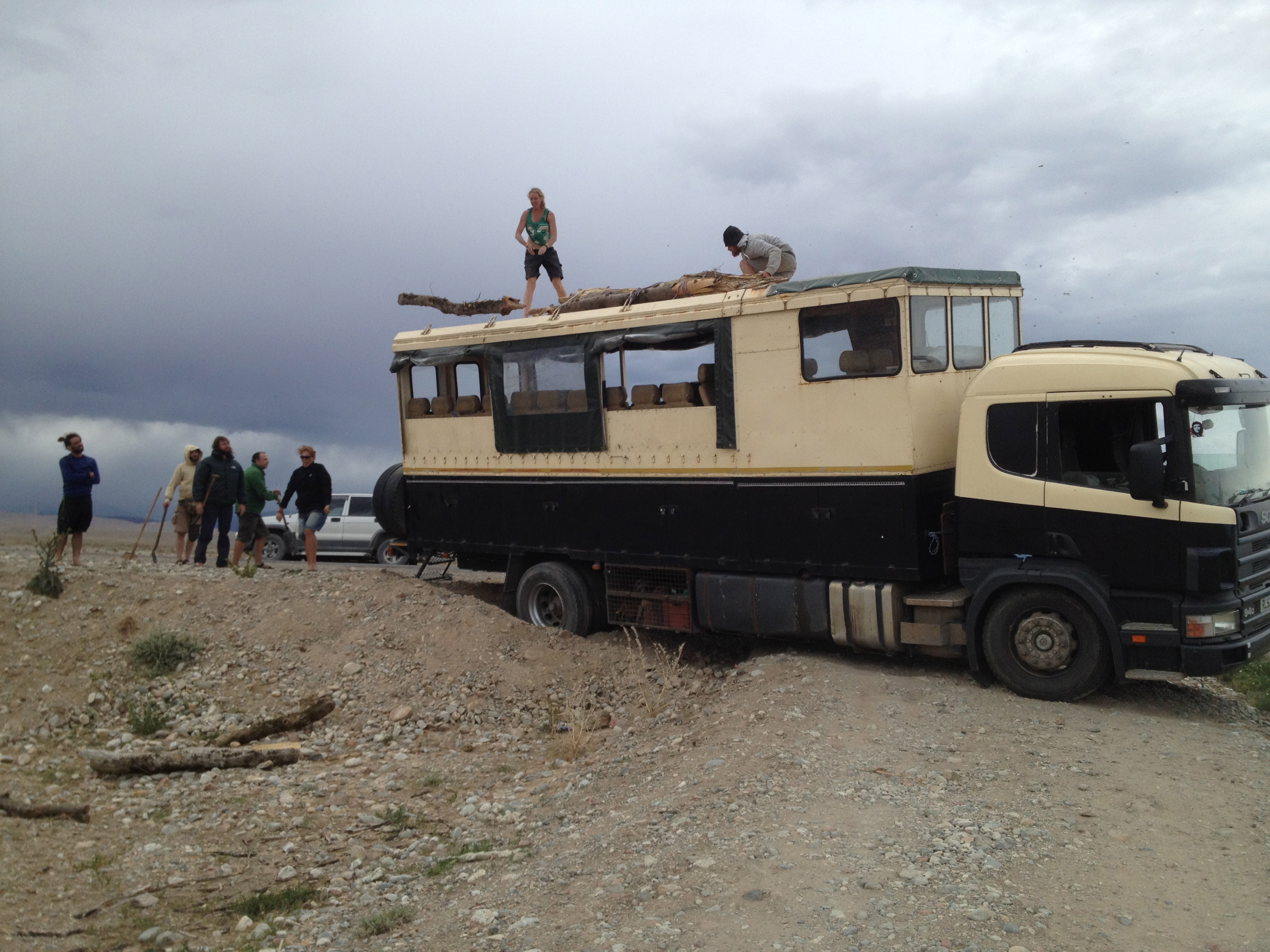
Throwing firewood off the truck
A couple of weeks back someone on the truck said—out loud—that we hadn’t had a flat tyre yet.
The big ‘Bang’ came about five minutes later as Suse inched the truck down a steep, rocky road to a likely camping spot beside a reservoir. The huge blowout produced an enormous gash in the side of the tyre.
So while the cook group got on with making dinner, some others got on with changing the tyre. These things aren’t easy. It takes about four people to lift and manoeuver a single tyre and at least 30 minutes to get the job done.
And there’s some important follow-up down the road, literally. About 100 kilometres on, it’s an important safety precaution to check and tighten all the wheel nuts.
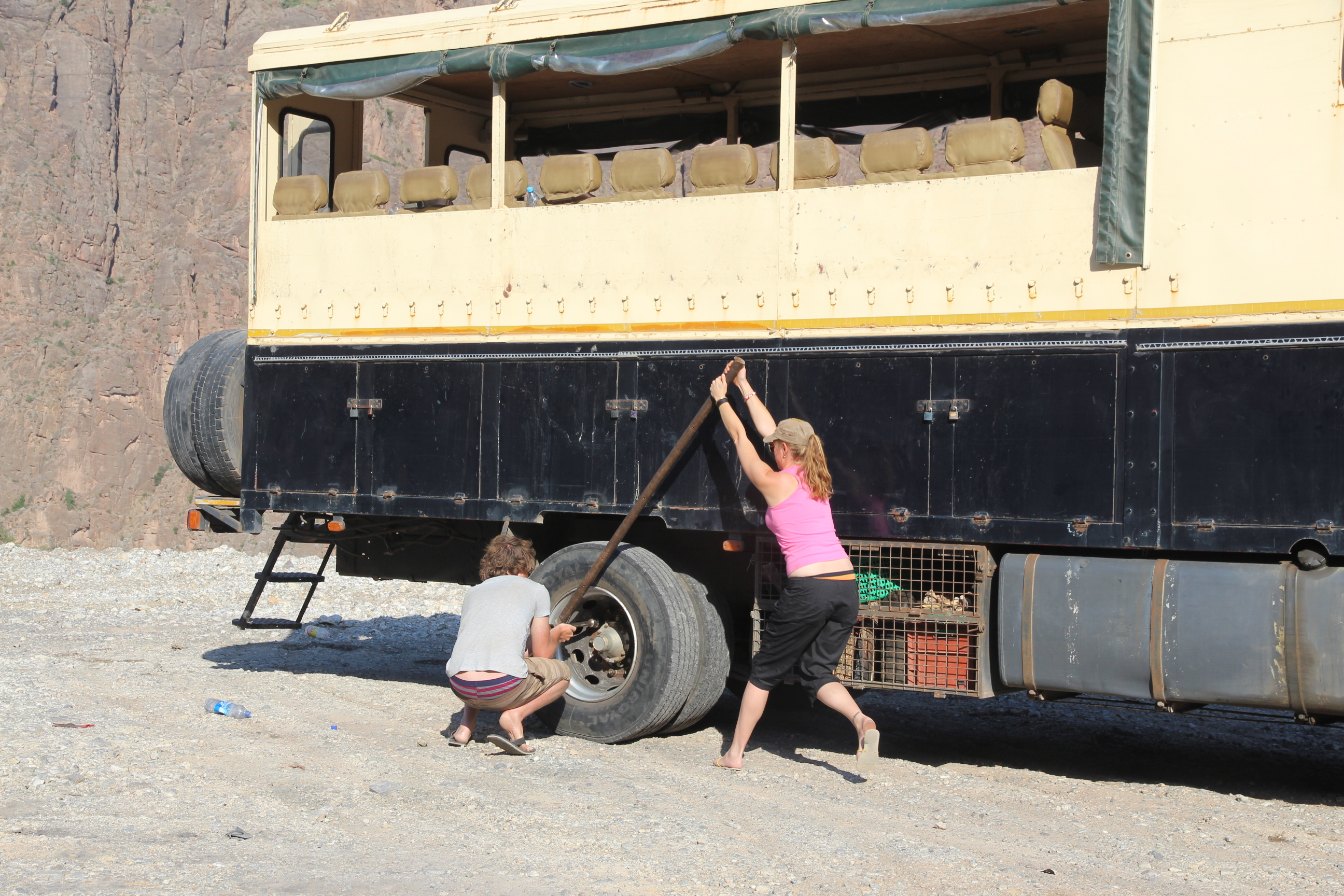
Quinn and Suse tend to the wheel nuts
Suse and Quinn did that job the next day.
As far as truck hiccups go, that was the first major one UNTIL a couple of days ago when someone else said almost out loud—I heard it and I have not dobbed in this person for fear it will come back to bite me on the bum—that we hadn’t been bogged yet.
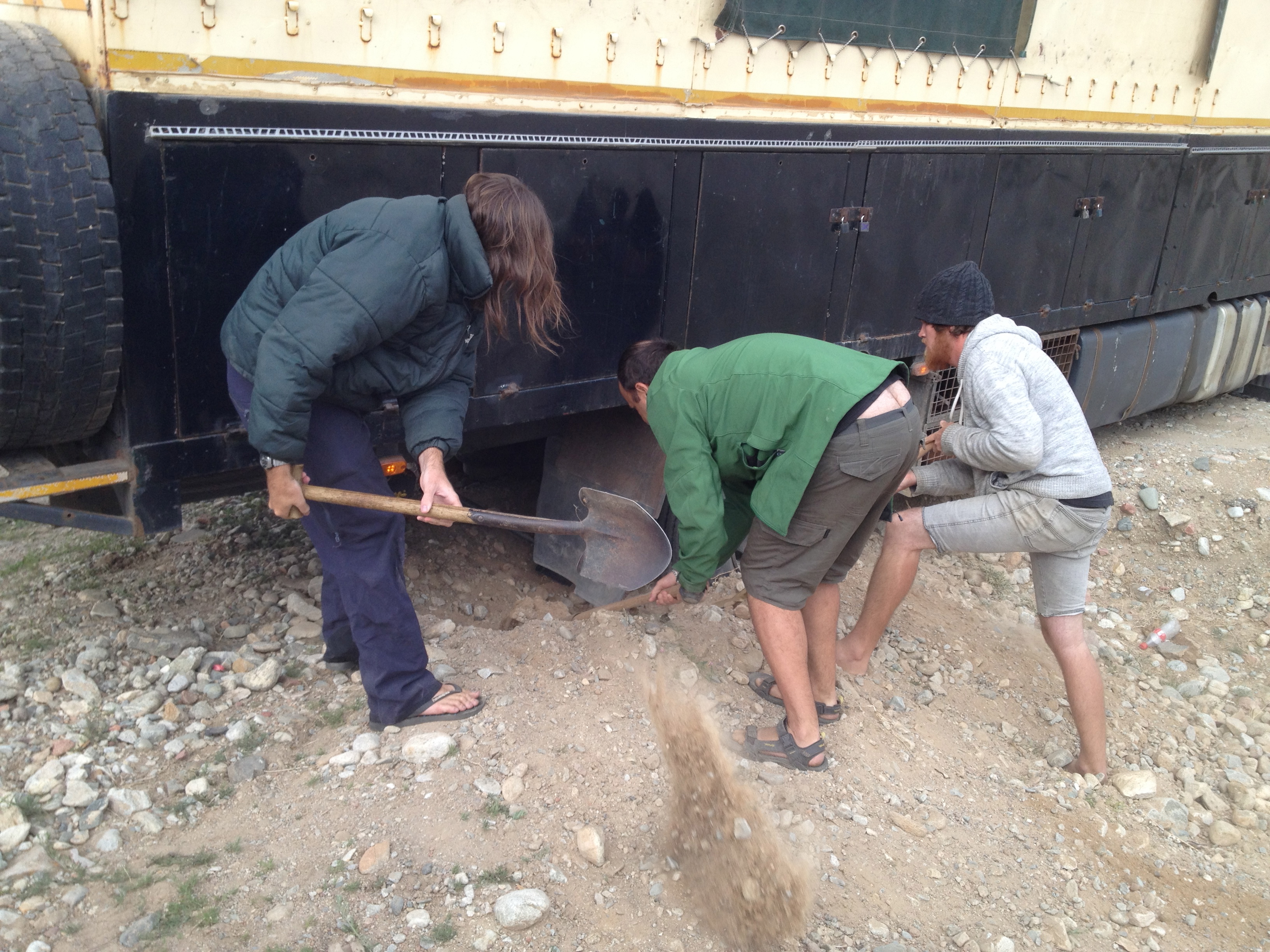
Scott, Nikolay and Quinn have a go at digging
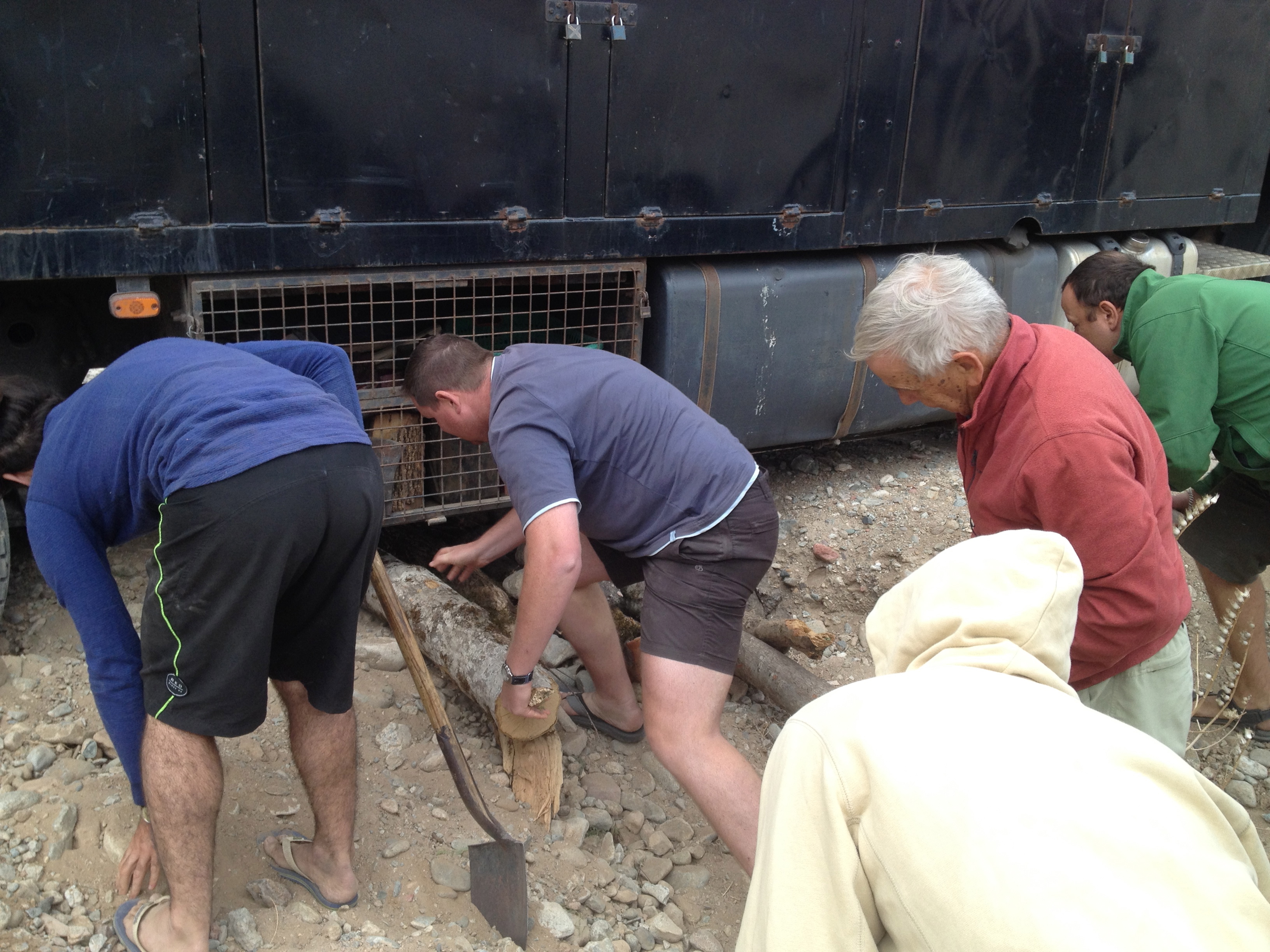
Talbot and Andy wedge in a log while Diego, Poor John and Nikolay look on
The big ‘kerthunk’ came about five minutes later as Suse turned the truck down a narrow track to another likely camping spot. This time by the scenic Issyk-Kul Lake.
A bit of ground gave way on the right and we were stuck. Not a little stuck, but really, really stuck.
The photos don’t really show how precarious the situation was. Suse couldn’t go forward or the truck would be high-centred or, even worse, tipped on its side. Even with a lot of us (not me, I photograph) doing a lot of digging, she still couldn’t get enough traction to go in reverse either.
This is when every passing male felt the urge to stop and offer advice. They saw a woman driver and assumed all was lost without their assistance. They stood around with arms folded across their chests. Unless they were spouting instructions, they kept their lips pursed. My dear friend, Maggie, calls this look ‘lips like string’.
One fellow kept waving his all-vehicle license under Suse’s nose, as he told her exactly what she should do. She kept explaining the importance of safety, and the need to move cautiously or the truck might tip over. Not to be deterred, this nitwit had the cheek to leap into the cab when Suse was near the back of the truck
She hauled him out pretty darn quick, which was a relief, because so many people were around the truck that someone would probably have been seriously hurt if he’d tried to drive forward or back.
In the end, Talbot and Suse devised a brilliant plan. Firewood was brought down from the roof of the truck and used, along with tons of stones we carried from nearby, to fill in the gaps that posed the greatest risks.

Suse drives out
After maybe an hour of labour, Suse deemed our handiwork satisfactory and drove successfully over the stone and timber bridge we had created.
As for the prophet of doom who caused all this? Well, I’ll never tell.
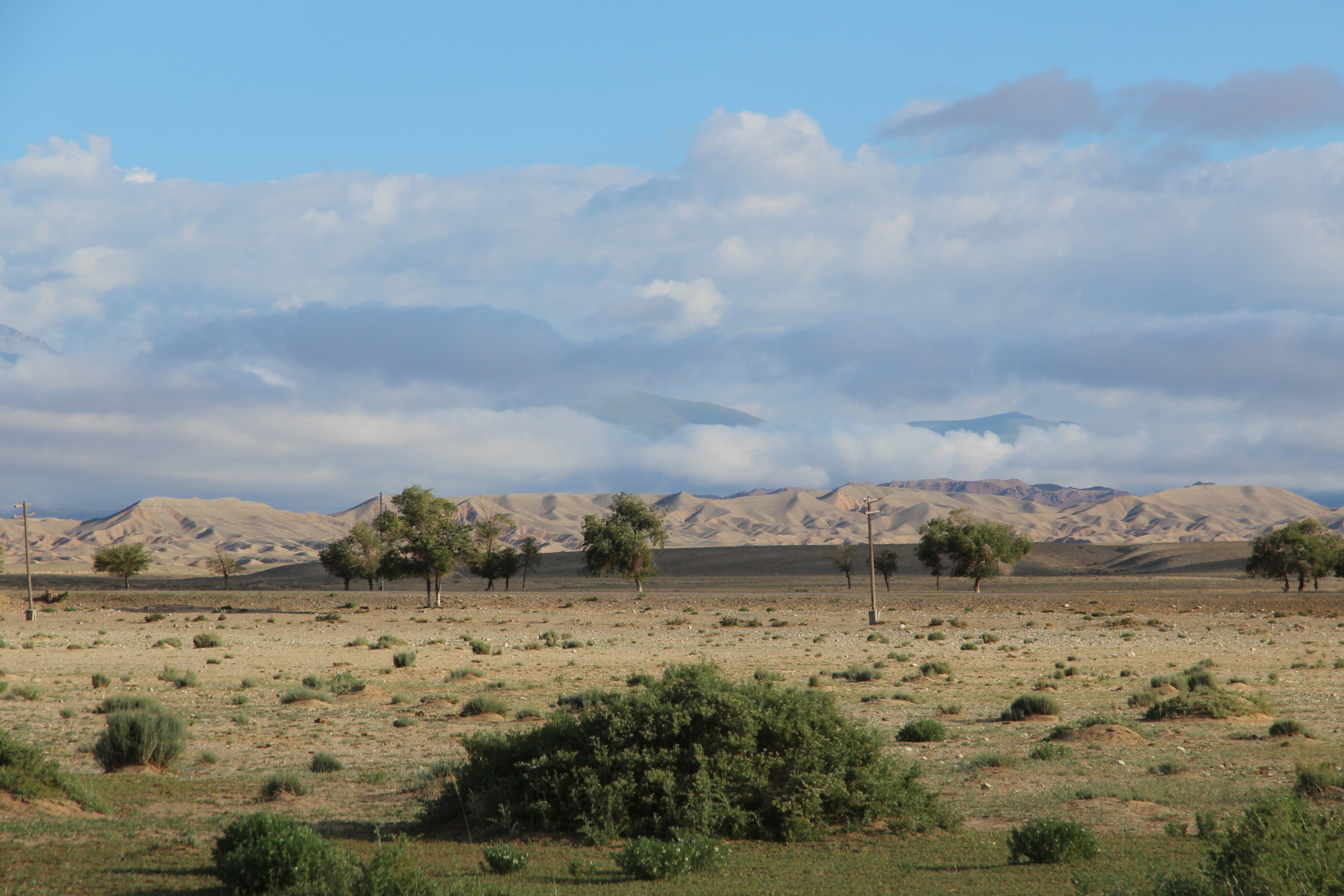
The view behind us
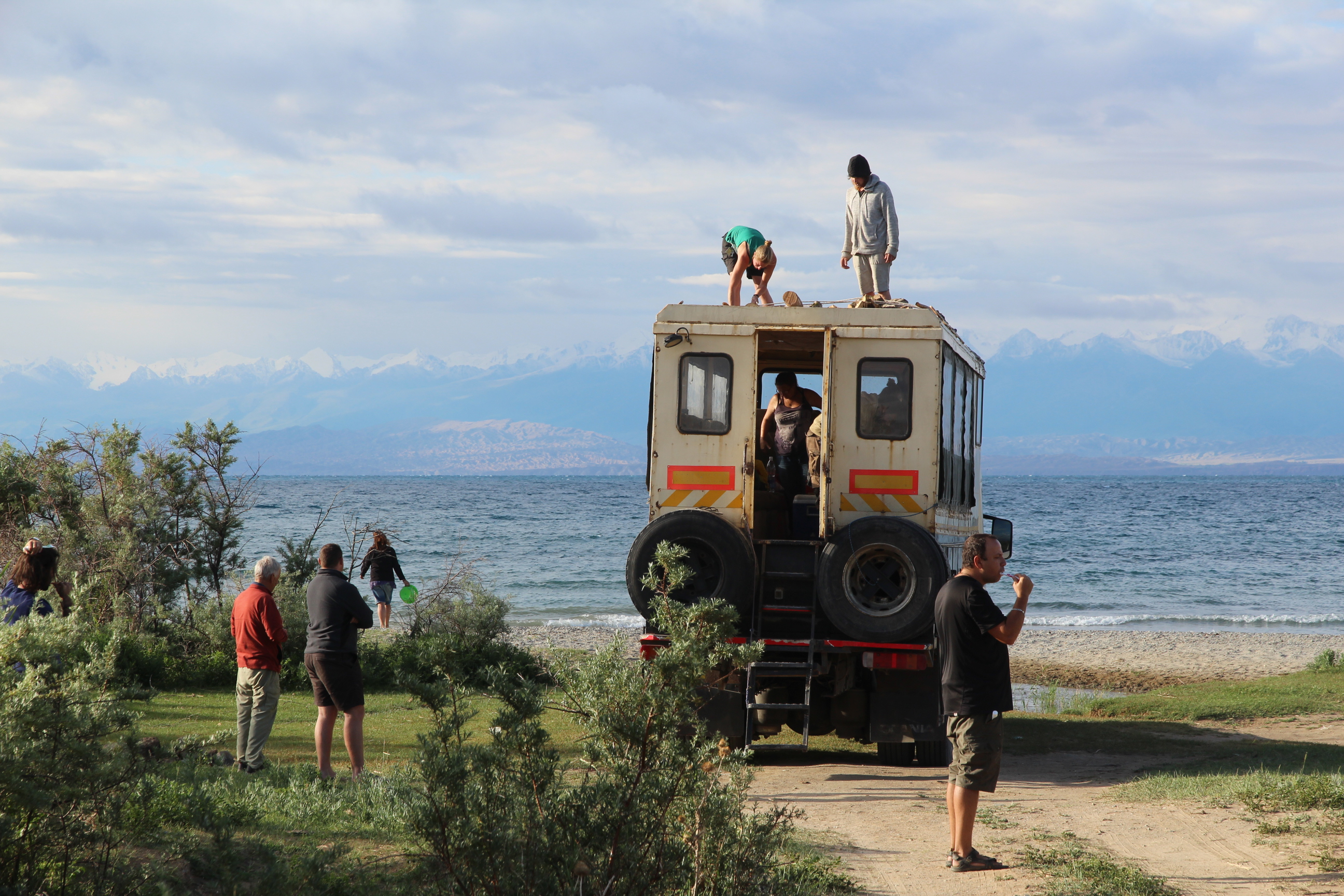
A campsite and view worth all the trouble
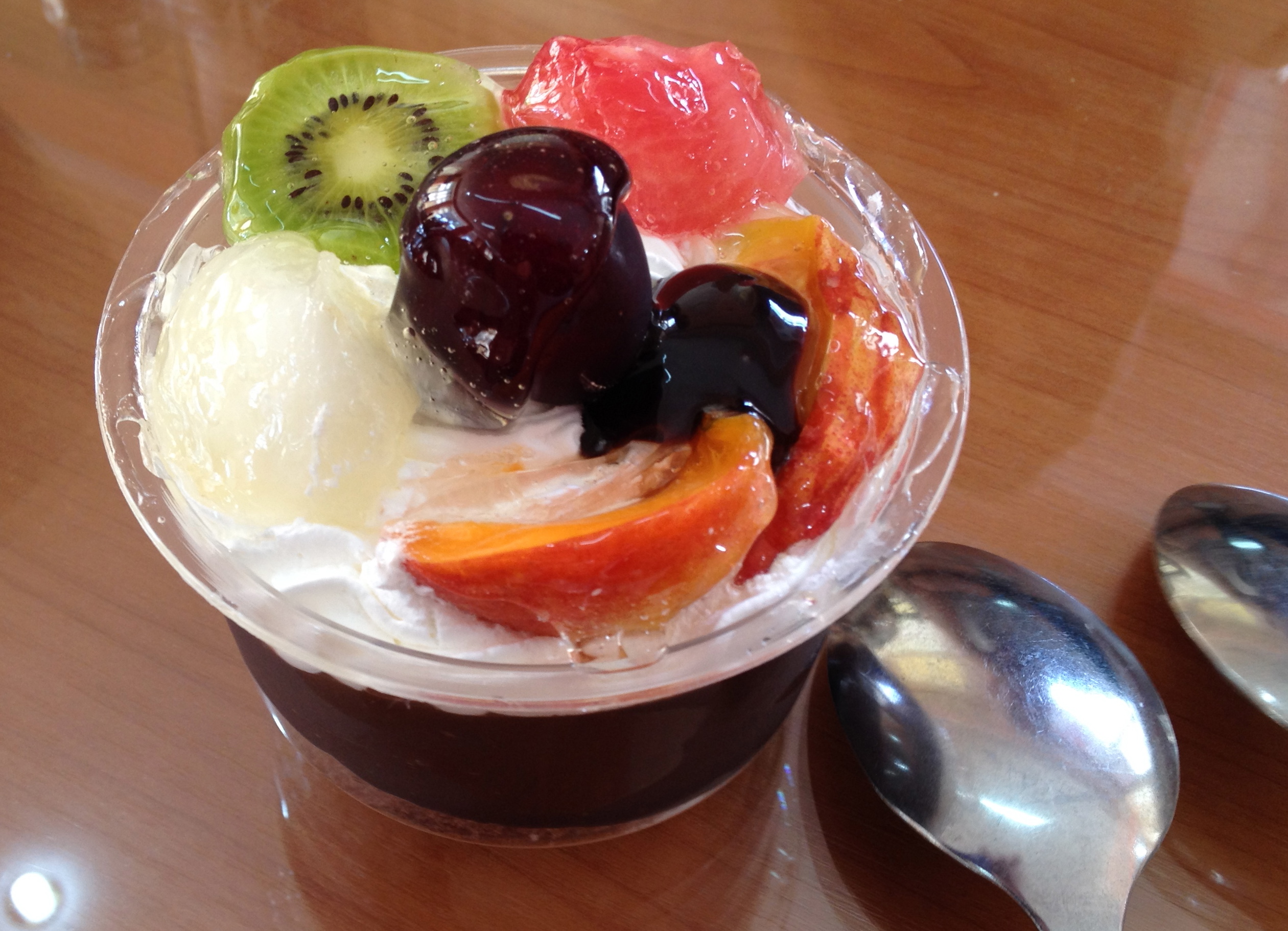
A birthday treat—just missing the birthday girl
Travellers often miss out on major events back home with family and friends.
Poor John and I are no exception.
Over the years, we’ve celebrated Christmases and birthdays in distant lands, or before and after a long journey. We’ve missed weddings and funerals, and met new grand nephews and nieces long after their birth.
Today we marked our daughter’s birthday with a special breakfast in a restaurant in Bishkek, Kyrgyzstan.
The only problem was—Libby wasn’t there. She was in Australia.
Luckily we were able to chat on Skype later in the day and tell Libby about the fantastic dessert that was delivered to the restaurant shortly before we were going to leave.
Two trays of something that looked like chocolate mousse topped with whipped cream and glazed fruit were brought in, and the temptation was too great. Libby loves her sweets so we figured she’d approve of the fact that we bought one to share. In fact, she might have urged us to buy one each.
The treat was truly delicious, with a bit of chocolate cake hidden beneath the mousse. And at a $1 each, we might have to go back this afternoon and buy another one.
Thanks for having a birthday, Libby! Otherwise we might not have been able to justify the expense!
P.S. We’ve bought her a few presents along the way, but nothing quite as elaborate as that great skirt we bought in South America.
P.P.S. If you love food too, and especially desserts, check out some of the offerings on my cooking blog. Here’s an amazing cake Libby and Daniel made for it.

Not much wifi out here
I would love to be able to post every day or so, but I am once again remembering how hard it is to run a blog from Central Asia.
Last time we came this way, in 2011, we didn’t visit Iran, so it was a surprise last month to discover that the country blocks almost everything from the outside world. No blogs, no social media sites, no news sites, no newspapers (although I found a couple they still don’t know about), no PayPal, no social justice sites and on and on and on.
When I tried to access a no-go page, the computer would display a page of Persian explaining, I suppose, that they ‘were sorry but this page is unavailable’.
So while I could view this blog for almost three weeks, I could never log-in to update it. My cooking blog, on the other hand, has ‘wordpress’ in its url, so it was a complete no-go page. Apparently that pesky word ‘press’ is what makes a food-related blog so suspicious.
We hurried through Turkmenistan so quickly—thanks to new rules at the border—that I didn’t even have a chance to find out if internet was available there. Three years ago I found it on the top floor of a shopping mall in Ashgabat, where I could pay for the privilege of trying, but it never worked.
Uzbekistan was a welcome surprise this time. In 2011, almost everything was blocked there, but this time I could access every site I tried. The main problems were that wifi wasn’t widely available, connections were super slow, and the power went out regularly.
The wifi service at our small hotel in Samarkand hadn’t worked for some time. But it wasn’t working at the upmarket hotel down the road either. After a couple of tries at the posh place, I convinced the waiter (I bought a beer to justify my attempt at wifi) to re-boot the router. When that didn’t work, I suggested they get someone in to fix it, but the waiter said the problem was outside not inside the hotel. Perhaps both hotels were affected by the same overall problem.

Driving beyond the world of wifi
We arrived in Kyrgyzstan last week and I’m still figuring out what is available and where. We’ve been in a couple of very small towns with no obvious internet, although some say they have it at home.
When we were last in Kyrgyzstan, nothing was blocked, but the only connection of any kind that we found was in an upmarket restaurant in Bishkek, the capital.
That restaurant has become a very expensive steakhouse with no wifi. But internet cafes are scattered around town, and our comfy hostel has reasonably decent wifi when I sit on the roof.
Starting tomorrow, we’ll be working our way around the country, camping most nights, and I probably won’t have a connection again for at least a week.
So in the meantime, thanks for following, for understanding the setbacks I face, and for coming back often to check. And apologies to those of you whose blogs I follow. Blogs are slow to load and often the ‘like’ and ‘comment’ buttons never load. Guess I’ll have a lot of catching up to do when I get home in August.
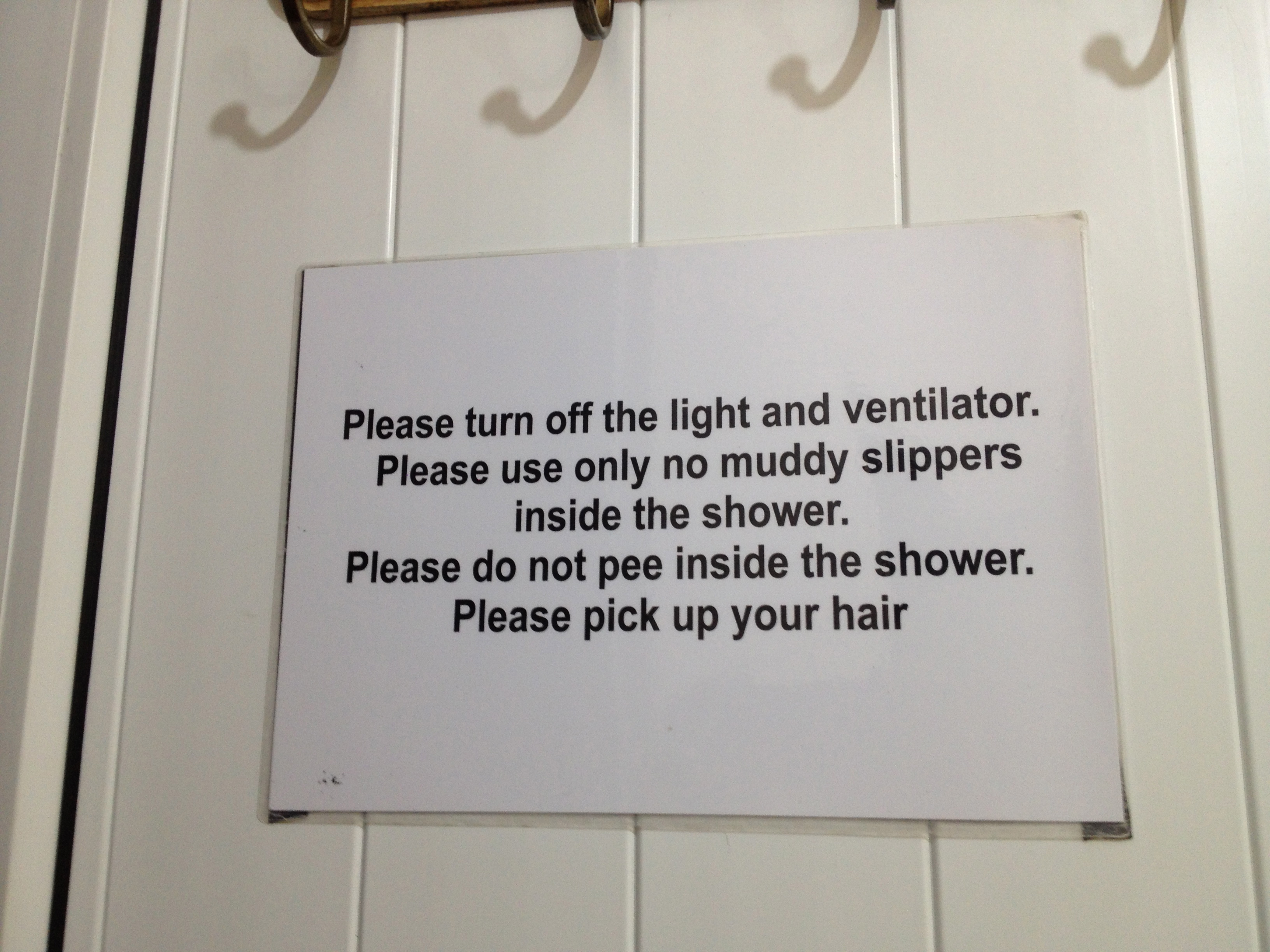
Not rocket science, just courtesy
English may be the universal language, but the likelihood of anyone of any nationality actually following the rules posted in a hostel is slim.
Last time we were in Bishkek in 2011, a gal was washing her clothes in the sink under the sign that said ‘don’t wash your clothes in the sink’.
Our current hostel has a signs asking people to not put toilet paper in the toilet bowl (the pipes can’t cope), turn out lights and exhaust fans in the showers and toilets, pick up their hair from the drain, not wear muddy footwear indoors and a range of other reasonable requests.
Last night, and in the space of about four minutes, I turned off lights in both toilets and showers. I also gave the (ahem) neglected toilet bowl a swipe with the toilet brush, but I didn’t pick up the gross hair on the floor.
So I’ll step on my soapbox and offer a few tips on hostel etiquette. They’re all really common sense, but I reckon that too many people leave their common sense at the border.
• If the sign says quiet after 11:45pm, don’t keep going at full volume until 12:30 when the hostel owner comes out to tell you off.
• If you must trim your hair or beard over the toilet bowl, at least do it when the seat is up. And toss the hair from your comb or brush in the bin.
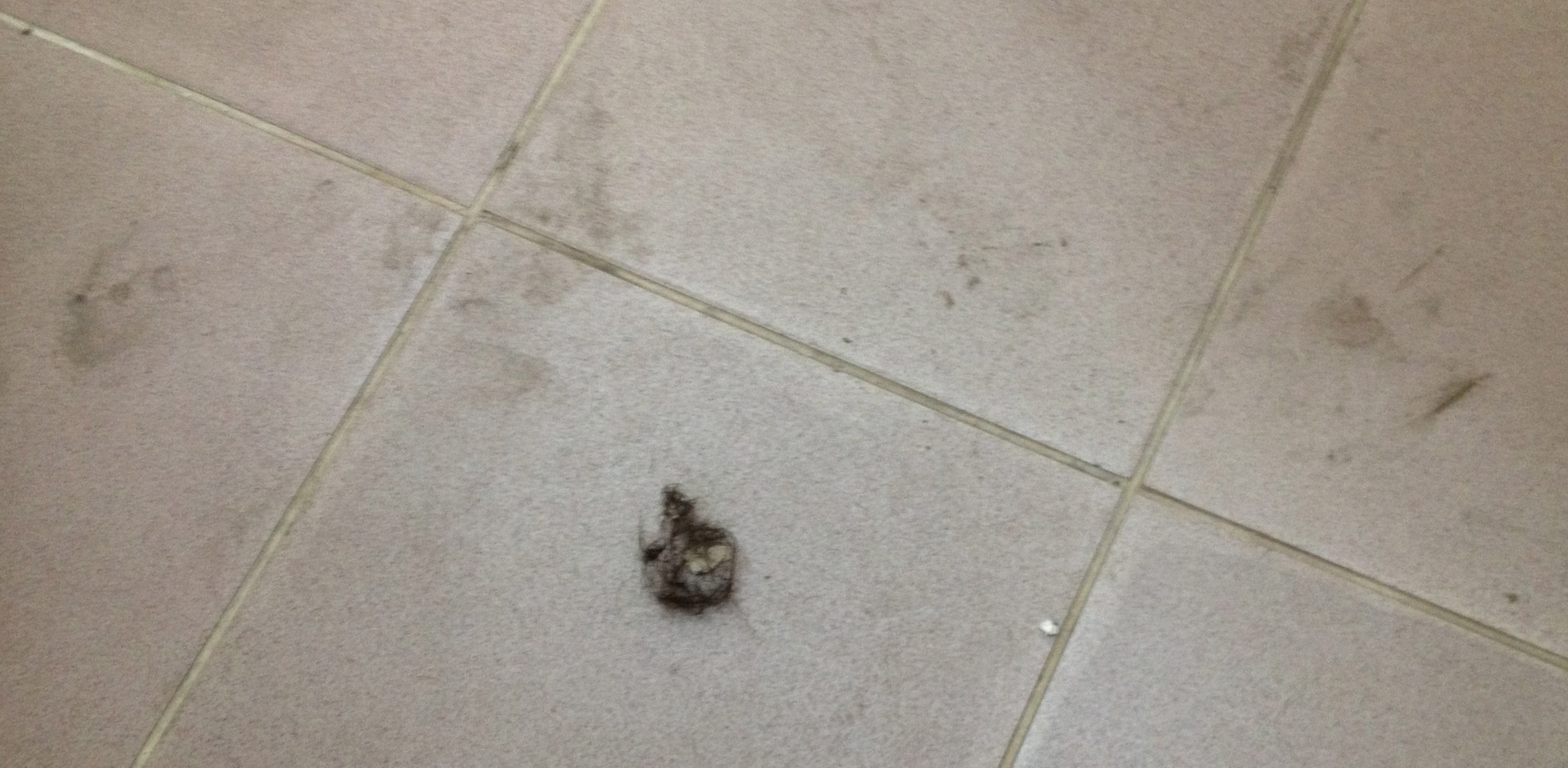
Hair and footprints left for others to clean up
• The toilet brush in the stand beside the toilet is not purely decorative.
• If you use dishes, cutlery and pots and pans, wash them. Don’t walk away and expect your mum to turn up to do the job. This morning, Neil cleared the communal tables of beer bottles and dishes and then washed up a sink full of dishes. Yesterday I washed up so I could have clean dishes and a cup for breakfast and coffee. What will the residents do tomorrow after we’ve left?
• Don’t help yourself to food that belongs to other people. Yesterday an Italian guy had a whole litre of milk taken.
• If the hostel supplies toilet paper (many don’t), it is not your right to steal it on departure.
And while I’m still on my soapbox, I’ll say more about the toilet paper of Eastern Europe and Central Asia.
If you are travelling in these parts, I suggest you bring your own supply from home. If you forget or run out, buy paper in Iran. It seems to have the best I’ve seen in eight countries.
Whatever you do, don’t buy toilet paper in Georgia. All the supplies bear an alarming resemblance to coarse sandpaper—in touch, texture and look. Or if you buy some, donate it to the person who leaves their hair on the toilet seat.
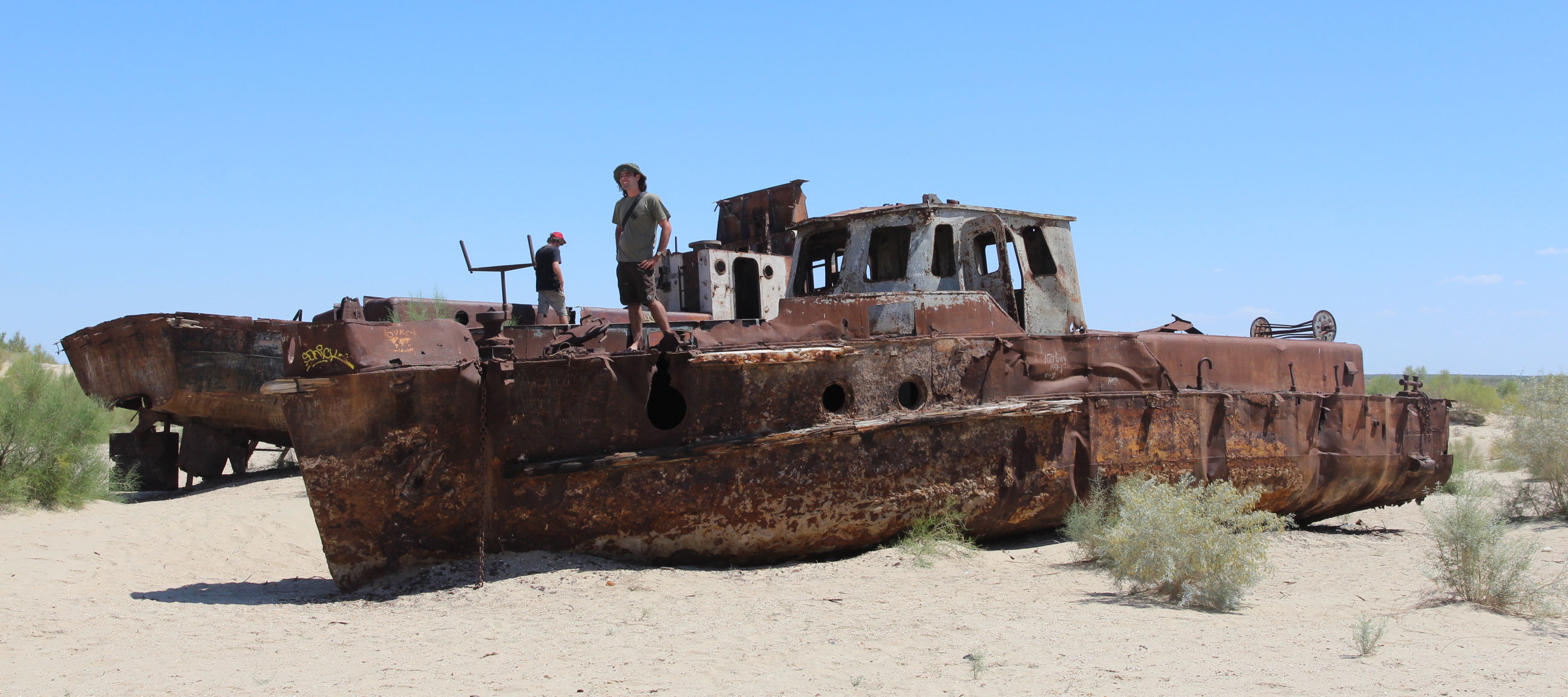
Talbot checks out the deck of a stranded ship
The Aral Sea appears frequently as an answer to clues in crossword puzzles. Sadly it barely makes a showing in real life.
Once the fourth largest sea in the world, the Aral hardly exists today. Its loss is often called one of the planet’s worst environmental disasters.


Its sad story began about 50 years ago when Soviet planners decided to tap the two rivers that fed the sea and build canals that would help them to irrigate new cotton fields in Turkmenistan and Uzbekistan.
The overall history is horrific. The sea’s thriving fishing industry died, tens of thousands of jobs were lost, the region’s climate has changed and staggering amounts of water are still wasted through poor conservation. The two main fishing ports, Aralsk in Kazakhstan and Moynak in Uzbekistan, have been left high—and very dry—since the 1980s.

Ghost ships in the Aral Sea


Much has been written about the sea’s demise, and I hope you’ll check out some details. But we took a trip from Khiva to Moynak and surrounds (staying overnight), and I thought some poignant photos might bring home the tragedy.
In the 1960s, Moynak was a thriving port. Today, nine rusted-out ghost ships lie mired in the hot sand. Some face Moynak and others point longingly towards the shore that is now 140 kilometres away.
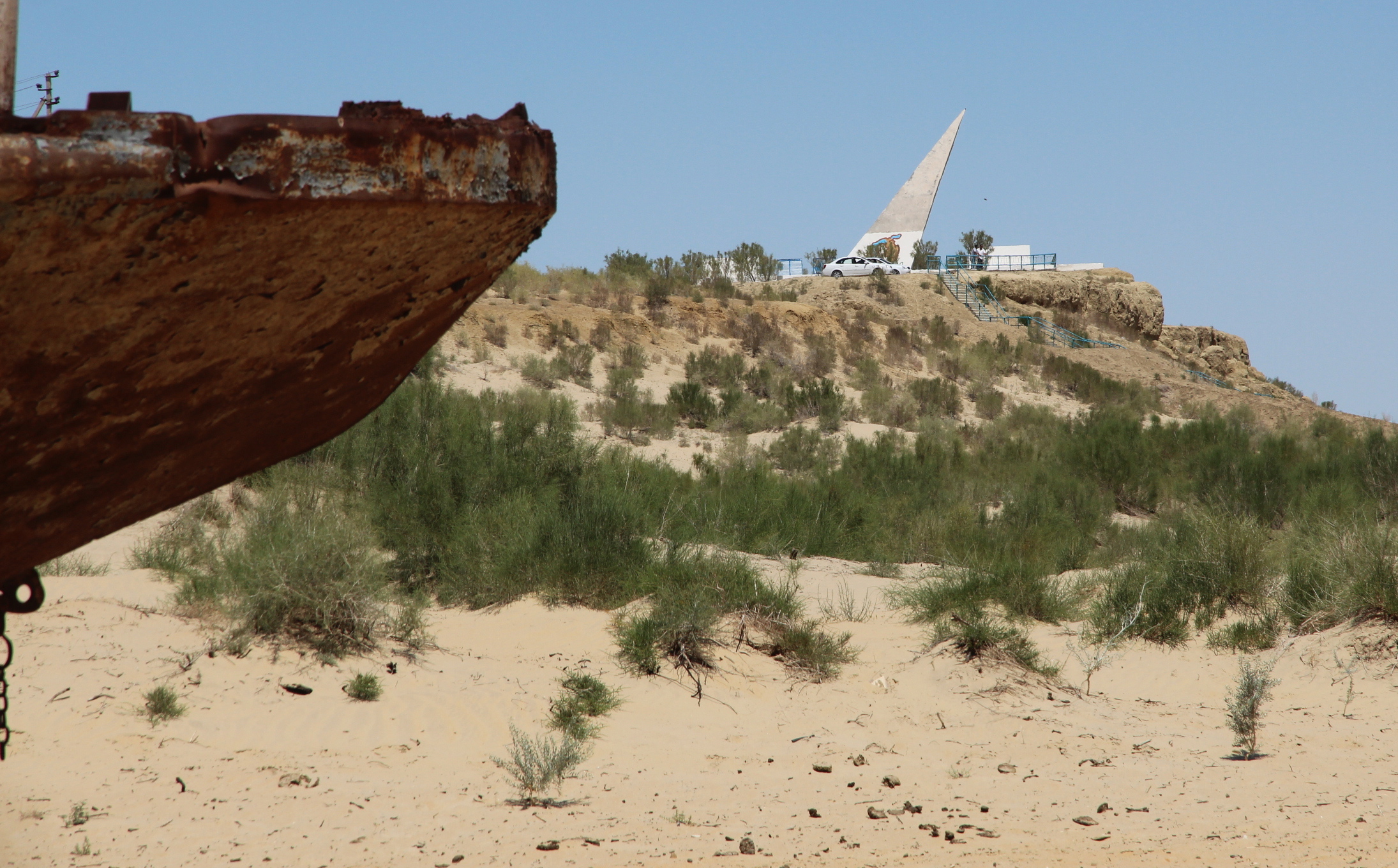
In the distance, a monument overlooks the ships and sand


Locals say that if every scientist who came to review the problem had brought a bucket of water instead, the sea might still lap at the shores of Moynak.
It might help too if the lavish fountains of Turkmenistan were turned off and the citizens of Uzbekistan were obliged to pay for the water they use.


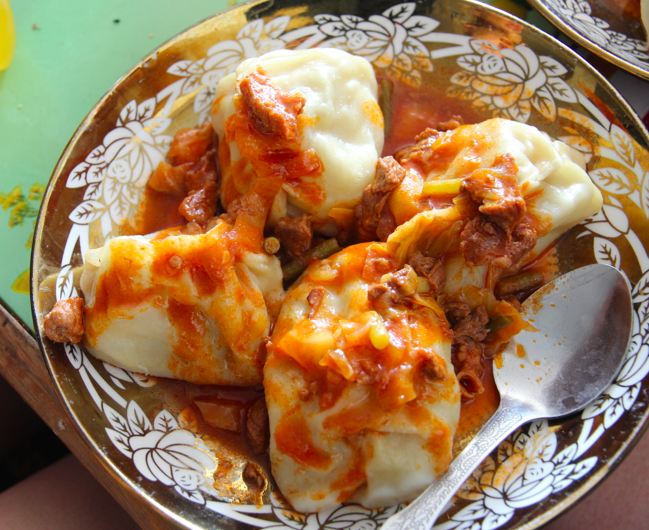
Manty with a good slosh of tomato sauce
Near the end of our walk in the hills behind Arslanbob, we asked our guide, Abdullah, where to have lunch in town.
We don’t mean the tourist places. We want to go where you eat.
I’ll take you there. And he did.


The restaurant, with a name I’ll never know, was tucked around a corner behind the bazaar. We filed past the kitchen and up some stairs. The dining area was filled with those day-bed structures that are common throughout Central Asia and big enough for a group. So 10 of us piled in, leaving Abdullah at the ‘head’ of the table.
He dashed downstairs, grabbed a menu, explained our options and took our orders.


First came green tea for everyone. It’s the staple drink in much of Central Asia. Russians drink black tea, but the Uzbeks and Kyrgyz drink green, so we follow their custom.
Then came the soup, plov (rice with meat and vegetables), manty (meat-stuffed steamed dumplings) and other main dishes.

From the top, the menu items are plov, soup, manty, goulash, dolmo, kuyrdak, kebab, bread and tea
Poor John and I shared and we had to agree that these were the best manty we’d ever eaten—doused in an exceptional tomato sauce—and the second best plov. The first best was in 2011 in Tashkent, Uzbekistan, but that’s another story.
Everyone loved their choices and it was great fun to people-watch as hungry diners came and went.
If you take a look at the menu, the dearest items were the dolmo and kyrdak (fifth and sixth items on the list) at $2 each. The last two items are bread (nan) and tea (chai) at 20 and 10 cents each, respectively.
Always interested in the source of the food, I asked permission to visit the kitchen. It’s a basic affair, with cauldrons of soups and sauces, and a no-nonsense chef who loves his job.
If I come across manty and plov recipes half as good as his, I promise to post them here.
And if you’re a food lover, be sure to check out my cooking blog.
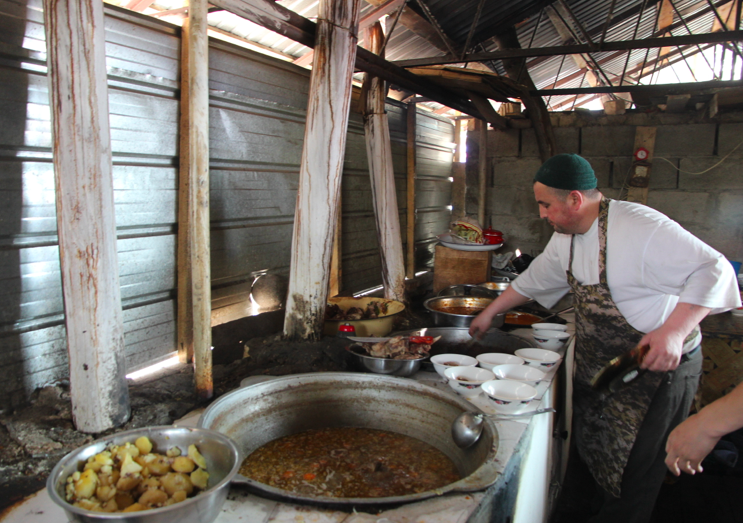
The chef ladles up meals

