
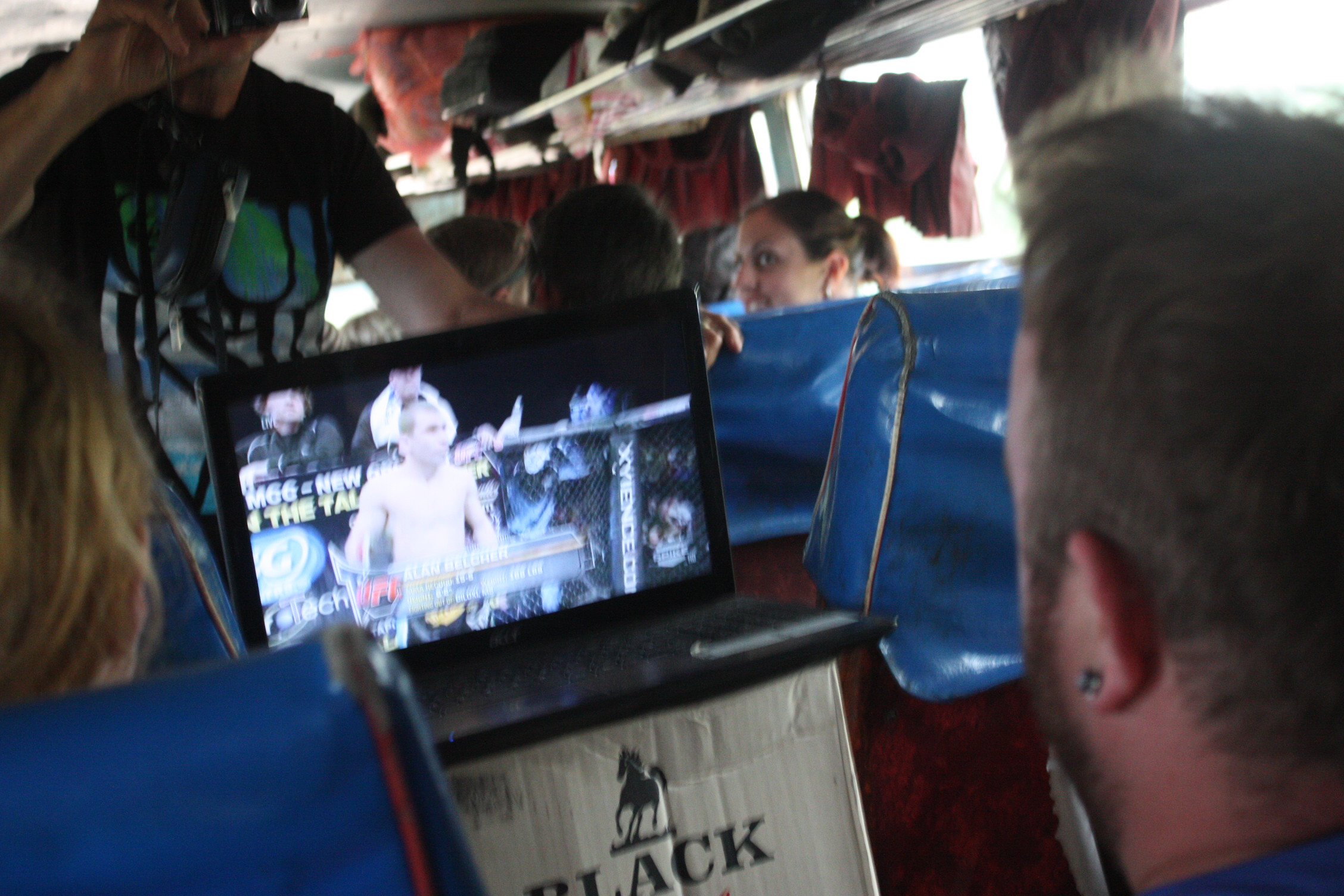
Terry watching the fight on his computer, which is sitting in the aisle on a stack of whiskey boxes.
Ever since we struggled up yet another Tibetan mountain pass, Will has been having trouble with the truck’s clutch. It’s not happy in 1st gear or something called crawler. It’s held together so far, but he’s been keen to get big orange beast to the Scania repair shop in Bangkok. So rather than drive us to the border between Laos and Vietnam, he decided to drop us in Savannakhet so we could take a bus the last 250 kilometres to the Lao Bao International Border Post.
We’ll be travelling without the truck for three weeks. Not because it’s being repaired, but because it can’t enter Vietnam easily and won’t be going to Cambodia either. So we’re carrying whatever we think we’ll need for the next 21 days and taking public transport—in it’s various forms—when we travel from place to place.
Now I’m not psychic (is anyone?) but I’d had a funny feeling about this particular border crossing for the last few days. Nothing specific, except that I sensed that things were going to go wrong. I even told Poor John that we’d be entering Vietnam a day late, and I wrote the same to our daughters. I didn’t think it would be another run-in with Svetlana (remember her?), but I thought it would be something.
So after a damp bush camp (and probably our last time to cook before reaching Australia, we set out for bus station at Savannakhet. Will dropped us there 11:30—giving us plenty of time to grab lunch before the next (and last) bus of the day to Danasvanh (on the Lao side of the border) left at noon. There was a spiffy-looking ‘international’ bus ready to set out for the Thai border—one with airline-type seats, curtains, air conditioning and the like—so there was a slight reason to think we might score decent transport.
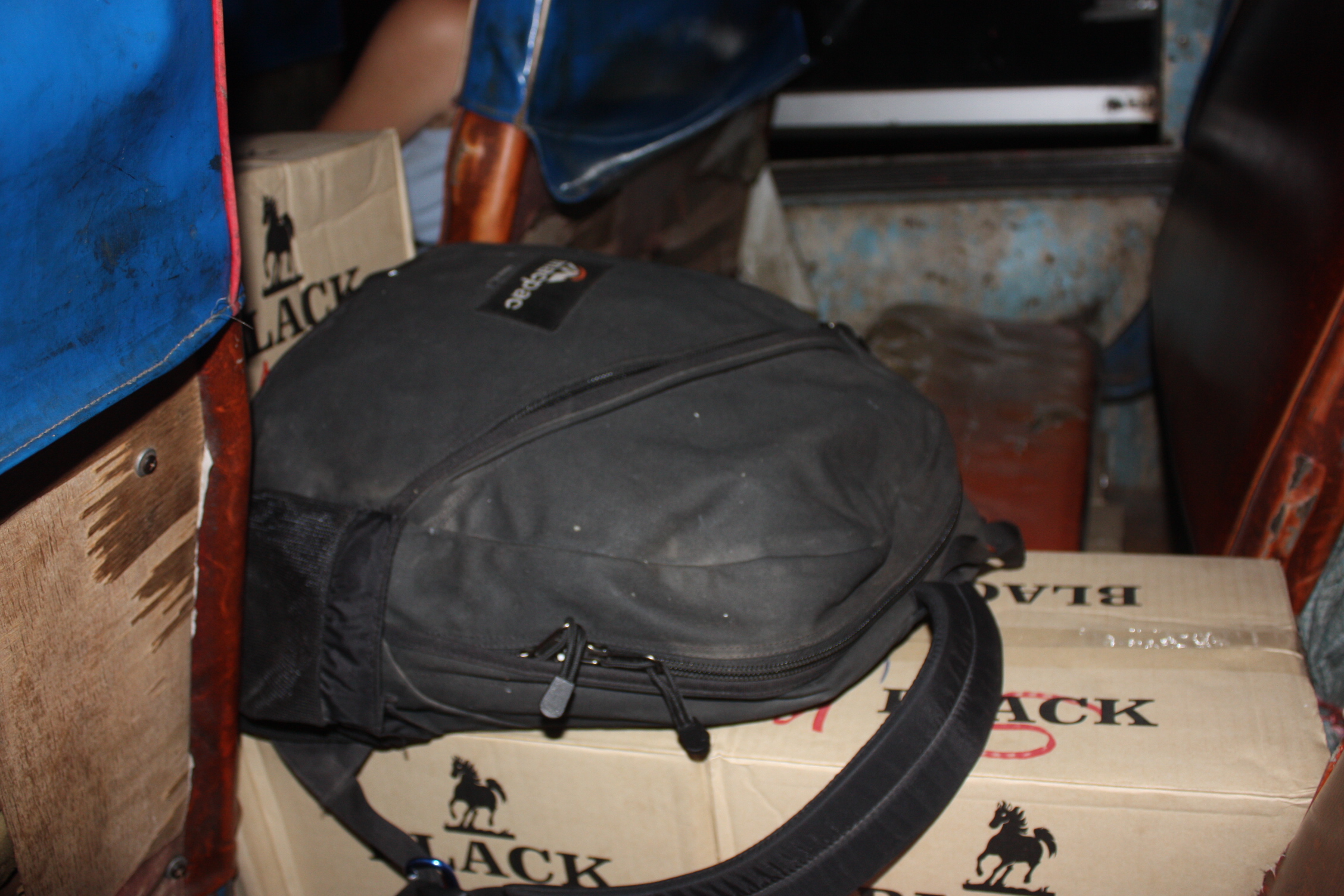
Whiskey in the aisle—helped to make sure we didn't fall out of our seats.
But as no other international bus was in sight, I was pretty sure our chariot would be one of the many ancient, dilapidated, blue-and-white local buses parked around the station. Close to noon, my suspicion was confirmed and our bags were handed over to be loaded into the back of the bus. Passengers (including a good number of locals) were instructed to board from the front and, as usual, Poor John and I hung back until almost the last. Big mistake. By the time we boarded there was only one empty bench at the back. We crawled down the aisle—stacked two-high with box after box of whiskey—only to find that our ’empty’ bench seat already had three cases of booze in the foot space. Obviously, the driver made his profit by ferrying great loads of grog (Aussie slang for alcohol) to the border.
So in we clambered and with our feet on the whiskey and our chins on our knees, we set out on a ‘five-hour’ jaunt to the border.
We weren’t the only uncomfortable ones. Most of the seats were missing most of their stuffing. Almost everyone was performing some sort of gymnastics just to stay on the bus. Terry sat in the aisle on boxes of whiskey (watching a pre-recorded fight on his computer), Lu was toward the front sitting on the engine and three locals were perched on our baggage and other freight at the back.
Because the bus was on its normal daily run, after we rolled out of the station we continued to stop and pick-up passengers and their belongings (yes there were two crates of chickens tied to the roof). From where we sat, it was hard to see the comings and goings, but I think the bus had 32 seats and close to 40 passengers. And, of course, about the same number of cases of whiskey.
After tootling along for three hours and before the half-way point, we stopped for a pee and snack break. Roadworks had slowed our progress, as had the continual stopping for passengers to get off or, more likely, get on.
Of course, time really shouldn’t have mattered EXCEPT that unlike most international borders—which are usually open 24 hours a day—the Lao Bao crossing closes at 7pm (or maybe 7:30). We had to beat the clock or we wouldn’t reach the border in time. The closer we got to the end of the line, more and more passengers wanted to get themselves and their gear off. The final disaster struck about 20 kilometres short of the border when the engine cut out. The driver hauled out his toolbox and went to work. Soon enough, we were underway again, but it was becoming ever more obvious that we were unlikely to make the deadline.

A basket of chickens gets unloaded from the roof of the bus.
Finally the bus came to its last halt—almost a kilometre short of the border. ‘Sorry folks, but this is where the bus stop is.’
So we hauled off our stuff and made a dash for passport control. Thankfully, the Lao side stamped us out quickly—except for me and John.
The short part of that story is that the border officials were confused that our visas had been issued in Canberra while everyone else’s had been issued in Laos. They dithered over what to do while we explained that Canberra was the capital of Australia. In the end, they called a superior for advice, but obviously they had trouble getting their story straight. In desperation, the guards passed the phone to Poor John who was suddenly explaining to the female superior that—NO, we weren’t trying to re-enter Laos on a single-entry visa, and that we were simply trying to leave!
With that, the superior told Poor John everything was fine and to pass the phone back to the border guard. It seemed as if she gave him (the guard) a bit of a talking-to for disturbing her with his garbled nonsense.
So we were promptly stamped out and headed for the Vietnamese side of the border, where we found most of our travelling companions sitting forlornly on the curb. The border was closed! We’d be entering Vietnam a day late! And I hadn’t thought to steal a single bottle of whiskey from the bus!
It was going to be a long night. Stay tuned for the next instalment.
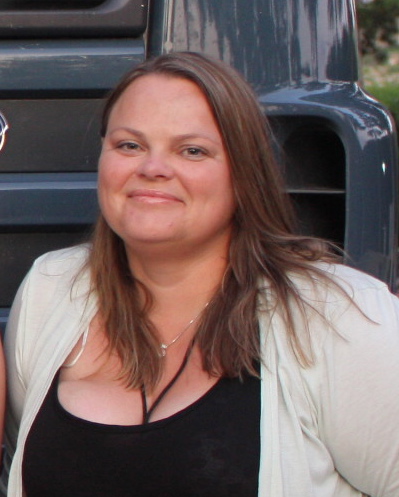
Sarah all done up for the Turkish night in Cappadocia.
For almost 16 years, Sarah has enjoyed playing the wench (and various other characters) in 17th century re-enactments in England. To be exact, she is in the Marquis of Newcastle’s Regiment, and attends at least three big functions each year. According to Sarah, it’s a great reason to get to dressed up in lots of finery and a fun way to meet people and learn more about British history.
Her interest in history doesn’t stop there. For the last seven years, she’s also been a keen volunteer for the National Trust, serving as a coordinator for week-long conservation projects around the country several times each year.
London-to-Sydney is her first long-term overland trip—in the past she’s done short overland jaunts around India, America, Central America and Australia. Obviously, she’s also traveled a lot in Europe.
Sarah is also treating this trip as an opportunity to make a big change in her life. She resigned from British Network Rail—after 20 years of service—and is still deciding what she’ll do next. We hope she’ll have time to pop down to Canberra for a few days. One thing is for sure, she’ll have to go home eventually to retrieve the cat that her mum and dad are looking after in her absence. As Sarah says, she’s a cat lover—with the scratches to prove it.
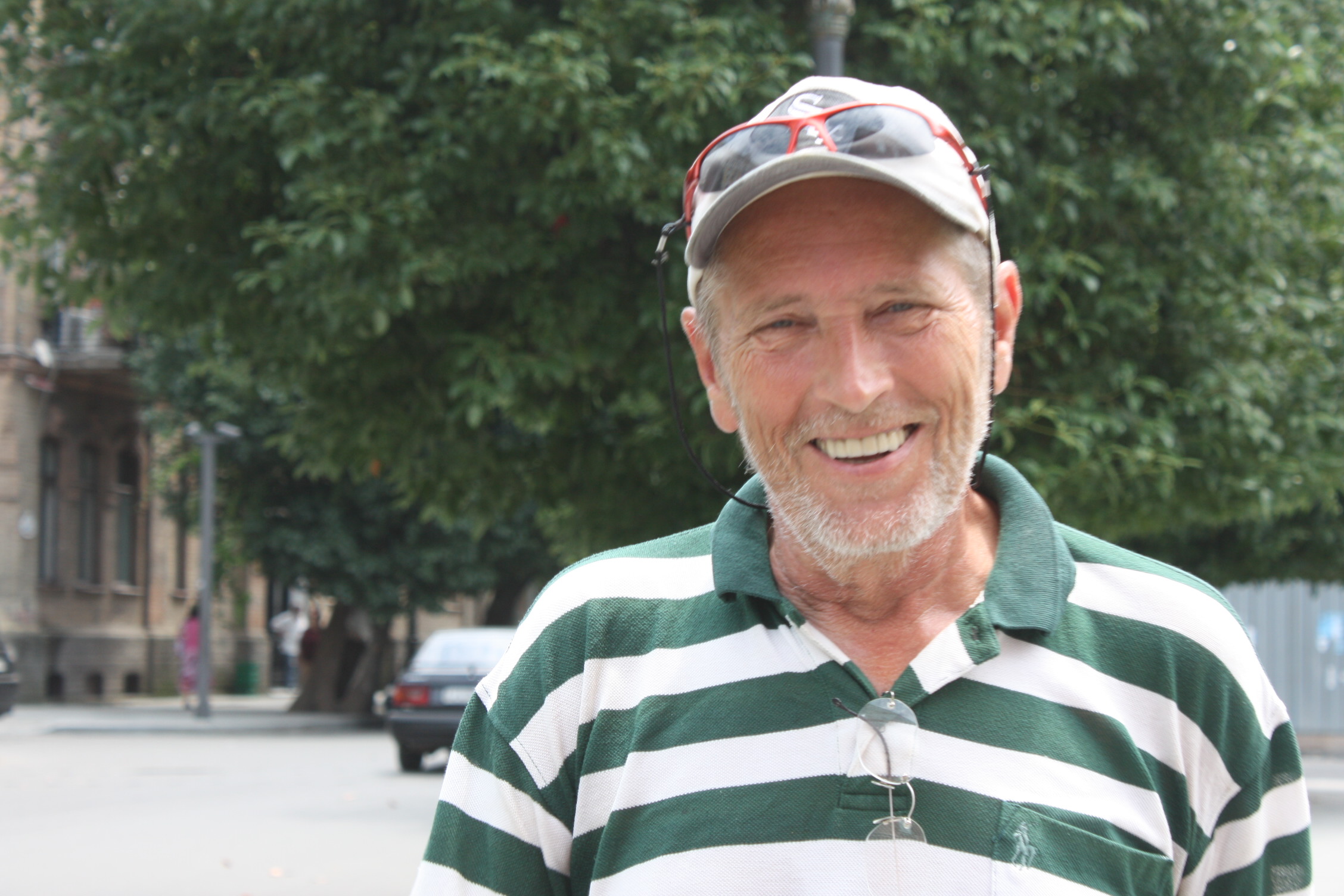
Toni looking pleased with himself after snapping a few clandestine photos at a tourist site.
We’ve teased Toni a lot—all friendly—about being our precise German on the trip. It’s true that he likes things to be just-so. It’s not surprising that in addition to being a stickler for order and life according to plan, Toni has also been a professor of physics at the University of Cologne.
He followed that profession for many years, until the mid-1990s when he was lured to Berlin to work in marketing for Deutsche Telecom. He’s lived in Berlin ever since and still does some consulting for the company, but mostly he indulges his love of travel.
In fact a few years back, Toni travelled with Lu (our tour leader) in Africa. On that trip, they were both passengers on another overland truck. They formed a lasting friendship, and it’s been quite common to see them heading off together to explore some tourist site.
Toni finished this overland trip yesterday in Luang Prabang, Laos. He’s done the rest of the stops in the past and he was ready to return home to his girlfriend. Poor John and I were lucky enough to meet Toni (and see his lovely penthouse apartment) prior to the beginning of the trip—while we were getting our visas in Berlin.
And in case you forgot, Toni murdered me in the Truck Cluedo game. That event wrapped up a few weeks ago with a three-way tie of those still alive—and Keiran as a clear winner for the kill-count.
It’s also worth noting that in spite of his penchant for the rules, don’t expect Toni to honour a no photos/no cameras sign.
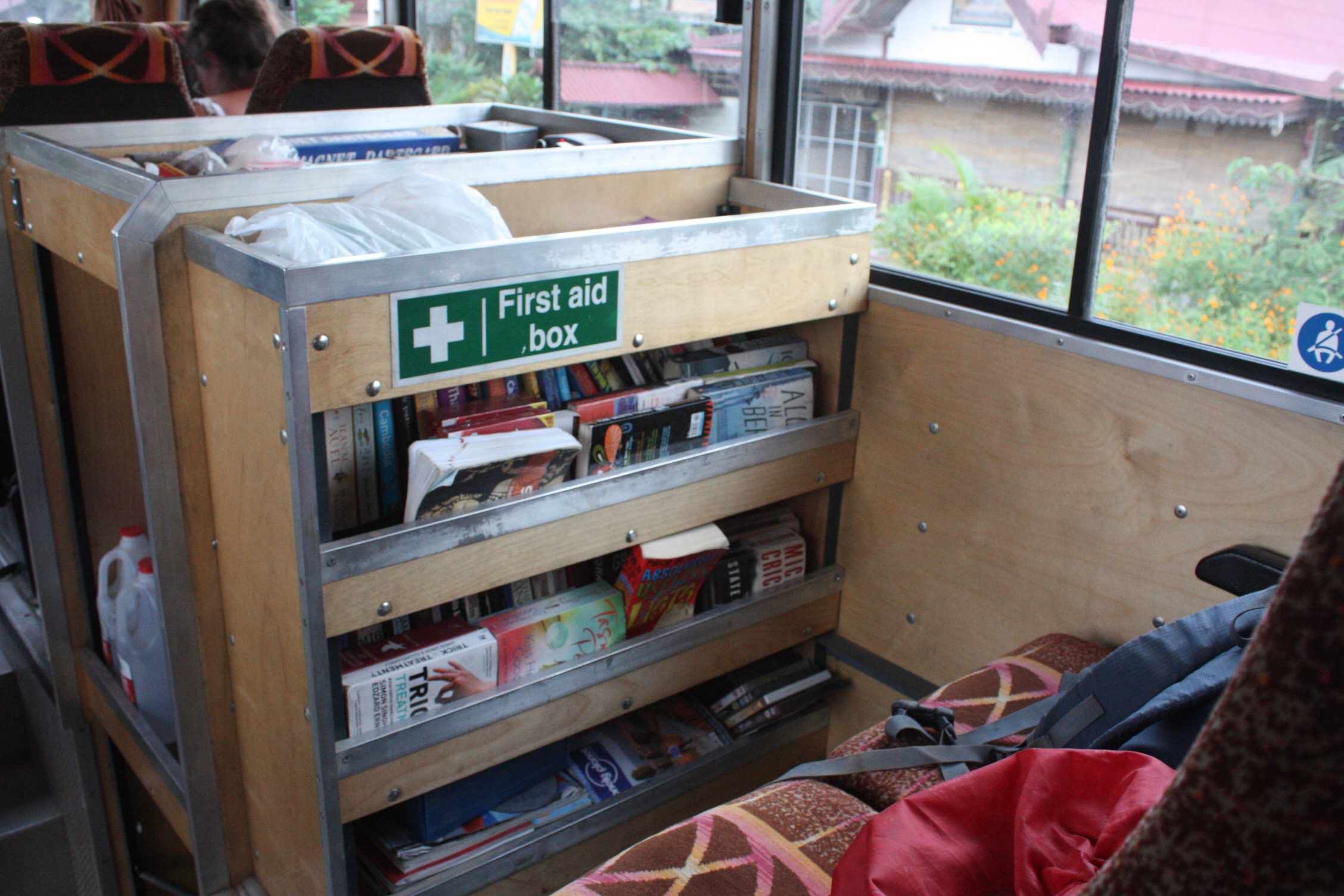
My favourite seat—beside the library.
The back of the truck has 40 forward-facing seats—10 rows, four seats across, with an aisle down the middle that creates 20 sets of two seats. Given that there are only 23 passengers, almost everyone can claim two seats on any given day. A lot of couples sit together, so there really is plenty of space.
The prime seats are forward, where the bumpiness is not so pronounced. Row 1 has lots of legroom, but is very hot on a sunny day. Row 3 is just behind the ‘library’ and also has plenty of legroom. All other rows are about the same, but the windows are sliding, so if you like to take photos, it’s important to grab a seat in a row where the window opens beside you.
Supposedly no one owns any particular seat/row. At the end of each day, we are supposed to collect our gear and take it to our tents or put it in the overhead racks. The theory is that all seats should be empty at the start of the day and be claimed on a first-come-first-served basis. Gosh, it would be nice if it worked that way. I’ve sat in Row 9 at least 80, if not 90, per cent of the time so far.
Most nights there are at least 12 pairs of seats with gear left on them. A while back, Lu reminded everyone to clear their seats daily, so for a few nights there were only nine rows with stuff left on them. But there is no shortage of offenders—last night there were 17 sets of seats with belongings left on them, which is why I’m so annoyed today.
I’m often tempted to throw this stuff out the window or put it all in the back row, but I don’t want to be accused of being childish and spiteful.
But fair is fair, or ought to be! I’ll let you know if/when I spin out.
NEWS FLASH: I wrote to above quite a few weeks ago and the problem has continued—until tomorrow. This afternoon, there was a blow-up on the truck about people hogging the forward seats. Sarah was swift to say that everyone should do what was advised at the very beginning on the trip. Namely, take ALL your gear off the truck tonight (or stow it overhead), so that all seats are empty in the morning and first-come, first-served is in force. I’ll let you know how long it lasts, but I’m looking forward to having a decent seat tomorrow.
SECOND NEWS FLASH: It’s been better than it was. Not perfect, but I manage to get the library seat (which is my all-time favourite) at least twice a week.
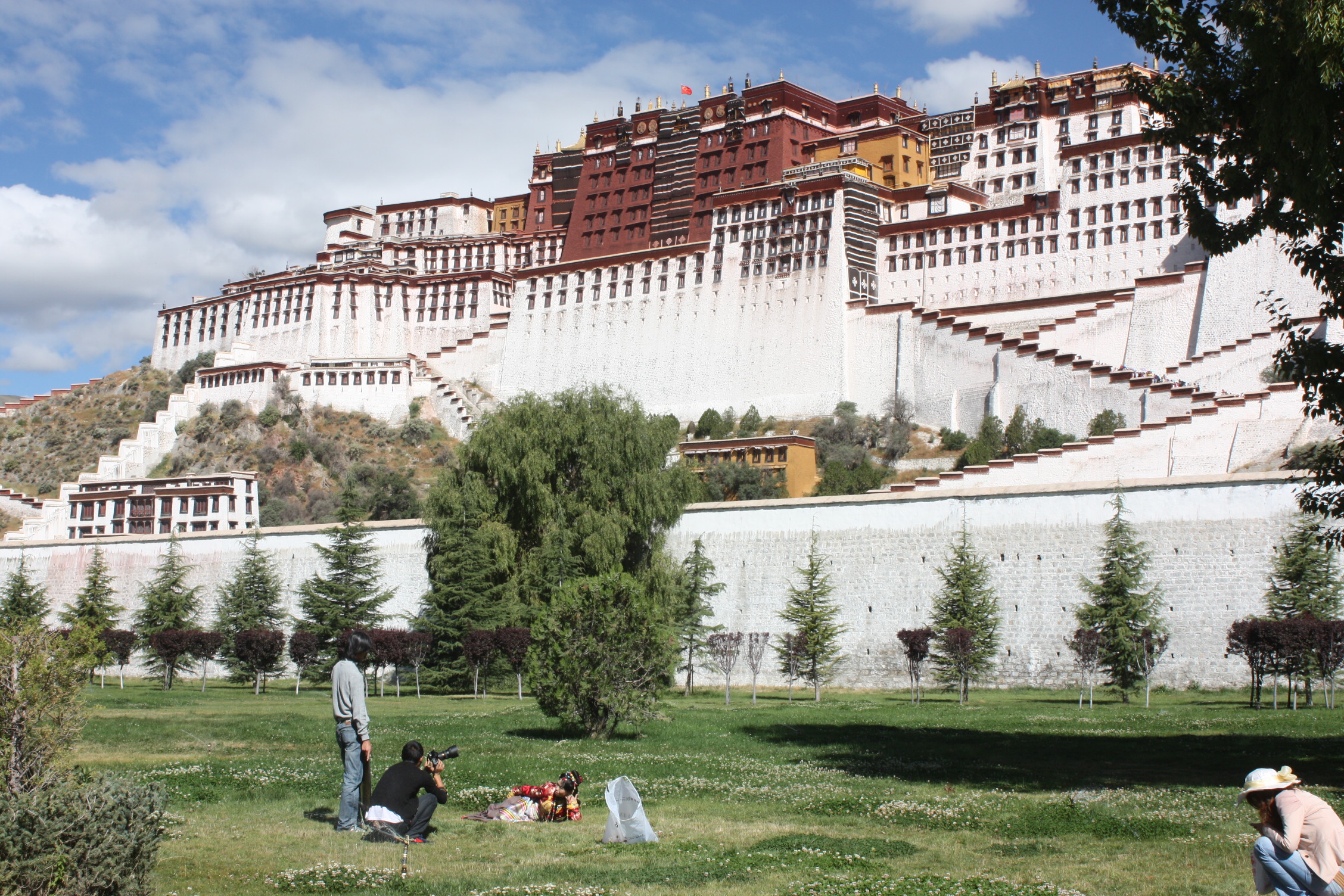
We'll never know what she's advertising.
The Potala Palace is the visual centrepiece of the old city in Lhasa, Tibet. For centuries it was the chief residence of the Dalai Lama until the 14th one fled to India, after an invasion and failed uprising in 1959.
Today the palace is a museum and I always think of it as an extremely holy place in Tibet. But that doesn’t keep it from being a backdrop for an advertising campaign. We saw this model and the photographers making the most of the setting on the grass just in front of the palace. The model struck numerous poses—sitting, standing, reclining—and I’ll always wonder which version made the cut.
Pity you can’t see the product she’s holding. Pity too that they couldn’t arrange to have the grass mown before the photo shoot, but maybe the clover contributes to the message.
I’m writing another couple of entries about the palace (it took us two days to get tickets to get in), but I couldn’t resist sharing this image on it’s own.
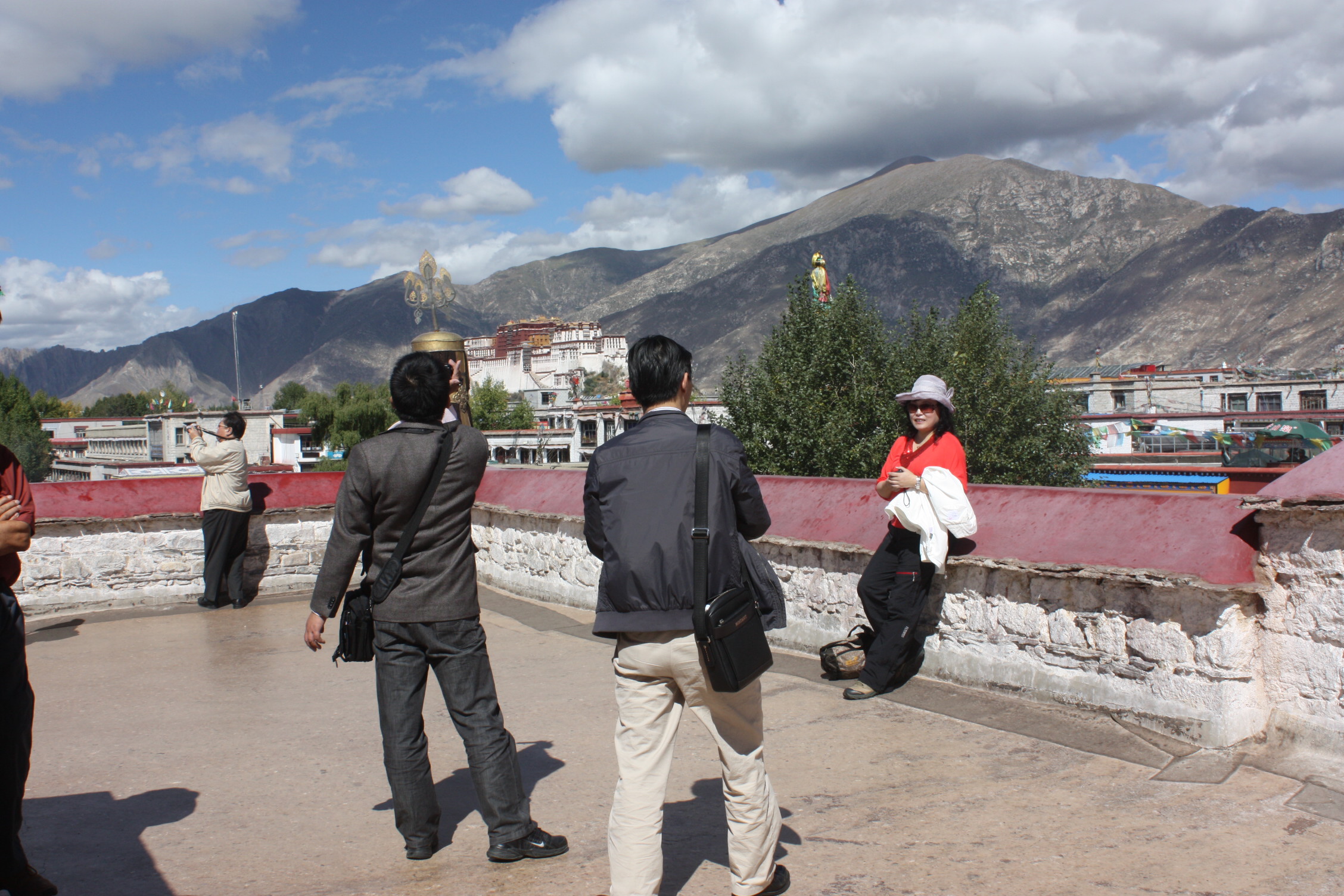
A mystery woman with her stable of photographers.
Several times in China, we saw women (yes, always women) travelling with an entourage of three or four photographers. We could only assume that the ‘ladies’ were famous somewhere in Asia and that if we stayed alert, we might see them smiling back at us from the cover of some magazine.
But we pay so little attention to the newsstands—everything is in Tibetan or Chinese or some other language we can’t read—so no magazine has ever caught our eye. But I thought I should share at least one photo with you, taken on the rooftop of the Jokhang Temple, with the Potala Palace in the background. This gal in the red top had four photographers faithfully recording her every move.
If you recognise her, please let us know who she is.
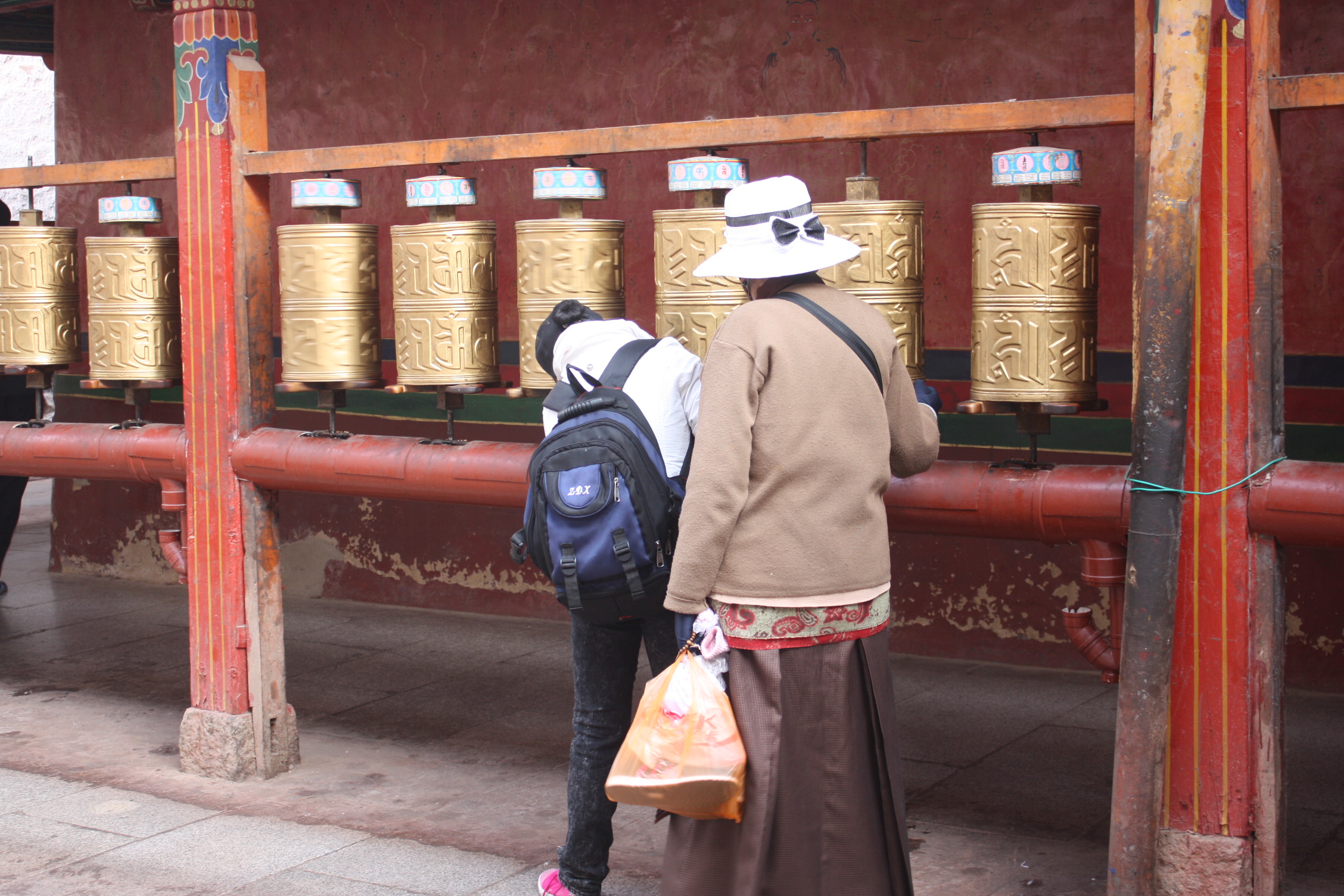
Pilgrims make a clockwise circle of the Ramoche Temple—both outside where they spin the prayer wheels and inside near the sacred objects.
The Ramoche Temple is another holy site in Lhasa, Tibet. Founded by Queen Wencheng in the mid-600s (at the same time at the Jokhang Temple), it is said to be her burial site. This temple was originally built to house Tibet’s most sacred image, the Jowo Rinpoche, but that is now situated at the nearby Jokhang Temple. As a replacement, it has a statue of the lord Mikyo Dorje in the bodily form of the teacher Shakyamuni at the age of eight.
The Jokhang Temple may be Tibet’s most important site for pilgrims, but the Ramoche still teems with worshippers. When we first entered the temple, we wanted to cross into the main hall, and it took quite a while to ‘break through’ the sea of pilgrims. We especially liked this temple because we could be among the people. Unlike the Jokhang, we were allowed to walk with the worshippers—following their clockwise path around the inner sanctum. I think they circle at least three times, possibly more.
The Ramoche was also the first temple where Poor John and I saw lots of monks. Of course the Jokhang and the Potala Palace have their share of monks, but the Ramoche seemed to be a true home for them. We saw more than 50 monks sitting and chatting along two long, low tables in the main hall. We also saw a huge room where prayer flags and other temple decorations were being made and/or repaired, but photos weren’t allowed so you’ll just have to see it in my mind’s eye.
Photos were allowed outside the inner parts of the temple. The slideshow covers the entrance, the main three-storey building, the prayer wheels and the lit prayer candles.
Also don’t forget to pick a number before 29 February 2012.
Two books have captured my attention lately, and a third was okay.
I’m in the middle of Arundhati Roy’s spectacular The God of small things, set in India. Wow, what a book, what a story, what a writer! It won the Booker Prize in 1997 and I can see why. In his review in The New Yorker, John Updike said ‘a novel of real ambition must invent its own language, and this one does…’ and it’s the language I love so much. Roy has a truly original, captivating and readable writing style. It is still her only novel. It took her four years to write, and I can imagine her agonising over every word. I regret taking so many years to get around to it. It is one of those rare books that I wish I could say I had written. Read it if you haven’t, read it again if you have.
Trick or treatment? Alternative medicine on trial by Simon Singh and Edzard Ernst is a passionate overview of the truth (the merits and more often the shortcomings) about many branches of alternative medicine. They cover four main therapies—acupuncture, homeopathy, chiropractic and herbal medicine—in great detail and about 30 other approaches in brief. To compile this book, they analysed the results of hundreds of clinical trials into these various practices. It’s eye-opening reading and should make you think twice before pursuing any of these various treatments—although I still swear by acupuncture for pain (and they give it a reserved okay for this too). The book is on the longish side, which is inevitable when people are on their soapbox, so don’t feel bad if you want to skip to some of the summaries. The main thing is to get the message. By the way, Singh is a talented science writer. I’ve read and enjoyed all four of his books.
I also read The White Tiger by Aravind Adiga. Also set in India, it won the Booker Prize in 2008. While I enjoyed it, I found it a bit contrived. For me, The God of small things is far superior.
I have no idea what I’m going to read next. The truck bookshelves are pretty well exhausted. Maybe we’ll find a decent book exchange place soon.
I’ve been pleasantly surprised by how well our group of travellers gets along. When you put 25 people in close quarters for about six months, there’s bound to be friction and annoyances, but the hostilities have been pretty low-key on this trip.
Sure, there have been some personality clashes, huffing and puffing, sharp exchanges and sword rattling. Couples have even been irked with one another from time to time, but overall it’s been quite tame. Others may disagree, but I am speaking from my own observations and point of view.
Of course, every overland trip and every group will be different.
Our group in Africa in 2009 was so dysfunctional that I thought it would be the perfect prototype for a new TV reality series—a sort of mobile Big Brother. I think lots of us wished we’d had the power to vote people off the truck. In the end, one couple was (in a very polite and round-about way) invited/urged/asked to leave the trip before the halfway point. They were bullies and it was amazing how much more settled the entire truck was after their departure.
One other passenger was asked to leave at the halfway point—the request coming from her own travelling companion. See, I told you it was dysfunctional.
That trip had more blow-ups, skirmishes and tribulations, but I guess the best policy is to say ‘what happens on the truck, stays on the truck’. And it also makes me extremely thankful that our current entourage is so congenial for the most part.
Poor John and his offences
I don’t think anyone ever gets annoyed with Poor John—except maybe me and the kids. He’s right up there for sainthood. It must be his diplomatic background.
But he commits two big offences, and I think I have to make these public.
1) His approach to walking drives me and the kids crazy. He’s like a Lebanese driver—he thinks if you never look back, you don’t have to worry about what’s happening behind you. He clasps his hands behind his back and strolls ever onwards (whether it’s a flat plain or a high hill) as if he’s exerting no energy at all. He makes diversions left and right without saying a word or signalling any intention. I’m constantly wondering where and how he has managed to dematerialise. Even shopkeepers find it hard to keep tabs on him. Meanwhile as I plod after him, I could be kidnapped and sold into slavery a couple of hours before he’d finally turn around and wonder where I’d got to?
It was the same when he took the kids shopping when they were little. He’d march on, weaving in and out of aisles and stores. Suddenly they’d realise their father had vanished into the shopping mall. They’d spend a frantic 20 minutes searching for him and be on the verge of calling home for help when he’d appear from nowhere.
I don’t suppose he’ll be a candidate for minding any grandchild who may appear in the future.
2) Now this second offence is even more annoying, especially for me. The reality is that about 98 per cent of the time Poor John is right. On any subject, any issue, any time—he’s right. It frustrates me, but has also made me slow to make definite pronouncements on many subjects. The only exception is when a matter involves food. In quite a few languages, I know my way around a marketplace, a wood stove, a menu and a supermarket—and the difference between a bitter melon and a sin qua.
P.S. I wrote a caption for the photo, but it got lost in cyberspace. That’s Poor John looking rather innocent in Azerbaijan.

Some of the elaborate and intricate decorative work at the Jokhang Temple in Lhasa, Tibet.
The guidebook has 16 pages of information about the Great Temple of Lhasa and its surrounds, so it’s a real challenge to give a brief summary of the most interesting highlights, but I’ll try.
Considered to be Tibet’s most sacred shrine, the Jokhang Temple is the focal point for pilgrims from all over the Tibetan plateau. Worshippers flock there in their thousands, and the temple and its surrounds are a constant sea of people. Every day we visited—three days in a row—the area around the outside of the temple was packed with pilgrims circling clockwise before and/or after going in to the temple to offer prayers, candles and money.
Located in the heart of Tibet’s old city, the temple was founded by Nepali Queen Bhrikuti, on a site chosen by Chinese Queen Wencheng (both were wives of King Songsten Gampo). The latter queen believed the site was the ‘geomantic power-place’ of Tibet. Before the main temple could be built, in the mid-600s), certain ‘obstacles’ had to be eliminated to ensure the temple’s longevity and sacredness. This included filling in Othang Lake (with earth carried by goats) and building 12 temples in rings around where the Great Temple would stand. Poor John read somewhere that these 12 temples were need to hold down an ogre that would cause mayhem if left uncontained.
When the main temple was completed in 647, it was formally named Rasa Trulnang (magical apparition of Rasa) and also Gazhi Trulnang (magical apparition endowed with four joys). At that time, the old city was called Rasa (Place of Goats) and the four joys related to the fact that construction of the temple was believed to have brought joy to the four classes of the populace.
The entire temple covers 2600 square metres. Today the name Jokhang refers to the three-storey inner sanctum of the temple, which forms a square (82.5 square metres) enclosing a main hall and the inner circumambulation pathway. It houses the Jowo Rinpoche image, Tibet’s holiest image. The complex has numerous other courtyards, walkways and structures—many of which are open to visitors.
The temple has been renovated many times over the last 1500 years. Much of the complex suffered major damage during the Cultural Revolution, and this was repaired between 1972–82. Some murals and partition walls were replaced during the 1990s. Murals in the outer courtyard are still being restored. The temple is a Unesco World Heritage site.
There’s an entrance for visitors and a separate entrance for pilgrims. There are also separate areas in which to walk, once you’re inside the temple. Pilgrims circle the inner sanctum and are closest (which is more than fair) to the elaborate murals decorating the labyrinth of walls. It seems that one courtyard is also reserved for pilgrims.
We visited on a brilliantly sunny day, and spent about two hours exploring the many areas open to the general public. We visited all three levels, and I took plenty pictures from too many angles. I wish I could explain more about the pics in the slideshow, but after wading through all 16 pages of guidebook descriptions, I can still only just tell up from down. I don’t know if we were in a ‘forbidden’ area, but I did get an unexpected shot of people (volunteers?) working on a roof.
This blog entry and its accompanying photos are about the temple interior only. Photos are allowed in the outdoor areas of the temple, but not allowed in the inner sanctum. I’m writing another two entires about this temple—one about its surrounds and one about a celebrity sighting.

