
We’ve been reading a lot, but not many books are standouts.
The truck has a library of books accumulated over many trips, plus the contributions the current passengers have brought. Sometimes you ask about a book and a fellow traveller will sing out—’don’t even bother with that one’. It’s good to get such helpful advice.
A thousand splendid suns by Khaled Hosseini was recommended unanimously. It is absolutely riveting and deserves all the praise it gets. It covers the poignant and heartbreaking lives of two women in Afghanistan. I finished all 400-plus pages in two days. Hands-down it is the best book I have read in a long time, and certainly the best I have read so far on the trip. Read it.
Otherwise we’ve read—and sometimes merely started—a range of titles. Poor John, who will read almost anything, had to give up on a Nora Roberts’ book a few weeks ago after the lead character became a vampire (or something like that) before page 10. Can’t tell you the title—the book belonged to the homestay house in Kazbegi, Georgia.
Halfway through another book, he realised he read it on the truck in Africa. He said it was bad then, too. Based on some marks he noticed in the book, he thinks it might be the exact same copy he read in Africa—traded across various hostels and overland trucks in the world.
I had a go at Ted Simon’s Dreaming of Jupiter. He motorcycled around the world in the early 1970s. Jupiter’s Travels stemmed from that journey. He had another shot at such a trip about 30 years later. The second book is a disappointment (can’t speak for the original). I was pretty much bored from the outset, but he completely lost me on page 68 when he wrote that he hadn’t included anything about Cairo in his first book. Not because it wasn’t interesting, he said, but because there was TOO much to tell. For heaven’s sake, he stayed there for 18 days and chose to write nothing about the place? Note to readers: don’t trust the praise on a book’s cover if it’s been provided by fellow authors. They usually share the same publisher and will happily write what they are told to write. Review comments from newspapers and magazines can normally be trusted.
Zeitoun by journalist Dave Eggers was rewarding. Probably longer than it needs to be, it tells the moving story of an Islamic, Syrian man who stays behind to protect his home after Hurricane Katrina hits New Orleans. He is an extremely kind man, who rescues and helps neighbourhood people and dogs, but who then gets caught up in the craziness of America’s police, security and legal systems. Read it and get angry. As an aside, there are eight pages of high praise at the beginning of the book—all from reliable sources and not fellow authors. It’s also won a heap of literary prizes.
I’m Nujood, age 10 and divorced—written by Nujood Ali with Delphine Minoui—is another eye-opener. In 2008, young Nujood turned the Arab world upside down when she mustered the courage to find her way to the courthouse in San’a, the capital of Yemen, and ask for a divorce from her husband. She was 10, he was three times her age. He beat her and never honoured his promise not to interfere with her until a year after she reached puberty. She’s a strong little girl who has managed to reclaim some of her childhood.
I also brought a couple of issues of Australia’s MasterChef magazine. I’m savouring every page of them and feel no need to share. Mostly because I’m the only person on the truck who is really passionate about cooking.
A plug for Red Dog
In April, Poor John saw a preview of the movie Red Dog, based on the book, with the same name, by Louis de Bernieres. We loved the book and he thoroughly enjoyed the movie. It’s supposed to be officially released in Australia in August 2011 and we urge everyone to see it. It’s corny—most successful Australia movies are corny—but it’s a great story and a lot of fun.
Poor John’s book woe
A few weeks back, Poor John had a terrible blow when his Kobo e-reader (with it’s 100-plus books) conked out. It didn’t exactly die, but the screen display began to deteriorate from the bottom up until the whole thing went poof! I’ll say this only once publicly—I suggested frequently that he buy a cover to protect the damn thing so it would survive the trip. My words were something along the line of—’Please buy a cover—it isn’t indestructible’.
Our cargo ship docked around noon and once we (Svetlana included) got through passport control in Turkmenbashi, we hoped to be on our way within a few hours. Our truck (The Monster) had been loaded first, followed by all other vehicles and then 17 sealed railway cars.
The Monster was on the main storage deck, wedged against the hull and to the right of the railway cars. We’d be free as soon as they were towed out. Another cargo ship was moored alongside, complete with its own set of railway cars. We needed two train engines and two drivers to complete the move. We waited AND waited AND waited AND waited. Good thing we were in the Waiting Room (more about that wretched place later).
By late afternoon, some activity began on the other ship. I confess that I didn’t pay a lot of attention, but I noticed that their railway cars (most were tankers) were being towed out (to keep a ship balanced, both rows of cars are pulled out at the same time). We optimistically and foolishly assumed that as soon as they finished with that ship, they’d start on ours.
But no. Hours went by and nothing happened. There were varied and ever-changing explanations. The port closes at 6 p.m. The engine drivers aren’t available. And on and on and on. So we sat—not on chairs but on the terrazzo floor of the Waiting Room. There were only a few metal benches and those had been quickly nabbed by a group of Azeri women who were waiting to board our ship and return to Baku.
So picture this. About 100 Westerners are filling up the waiting room, lying or sitting on a hard slab of a floor. Most of our companions are part of a London to Mongolia car rally. We and all our vehicles are cleared to go. We have no local currency. There is no money charger. Town is quite a few kilometres away. There’s a cafe behind the building and it accepts payment in US$1 notes—if you have them. There is just one sink and one toilet—again. The toilet door is quite sticky and sometime during the evening, Will, our driver, gets trapped. Martin hears his yells for help and soon the door is manhandled out of it’s jamb. By late evening, we realise it is hopeless and try to sleep stretched out on the terrazzo.
Come early morning we are fed another excuse. Those sneaky Azeris have loaded contraband cigarettes into at least one of the railway cars. Turkmenistan is having a real crackdown on smoking. No smoking is allowed outside, except in designated areas (we saw a lot of men in uniform smoking outside in undesignated spots, but our guide explained that’s only because they know where the cameras are). A few months ago, as part of the crackdown, the Turkmenistan government banned the import of all cigarettes.
Now if the latest excuse is at all true and if Azeris are indeed being sneaky, it’s not as if they are trying to hide or smuggle the smokes. We are told that the cigarettes are plainly listed on the manifest. My guess is that Turkmenistan—such an uber-closed society—decided to ban cigarette imports and then failed to tell any of the neighbouring countries.
We decided the cigarette story might have been an excuse they came up with to shut us up. Anyway, if it was true, this first-time appearance of contraband smokes was so alien to them that no one in customs knew what to do. The next step would set a precedent. Should they seize and burn the little sticks, or better still seize and sell them? Should they turn the ship back, along with our truck (worst option)? How would they be punished if they chose the wrong option? All we heard was that the bigwigs would meet at 9 a.m. to make a decision.
Quite a few bigwigs were milling around from about 8 a.m., Within 30 minutes and without any of them appearing to leave for a meeting, they all hopped into cars and were whisked away. Almost immediately, things began to happen and two engines appeared to start moving the railway cars. This was most welcome news, especially because about 6 a.m. a fellow had come along and locked the door to the toilet. He was most annoyed that the door jamb was broken. Luckily, there was a block of toilet behind the cafe. The ladies had a row of about eight stalls—all were squat toilets with walls about waist-height and not a single one with a door.
Fortunately, the truck was finally released and we piled in for a bumpy 11-hour ride to Ashgabat, the capital and most bizarre city I have ever seen.
P.S. sorry no photos. Ran out of time to downsize them.
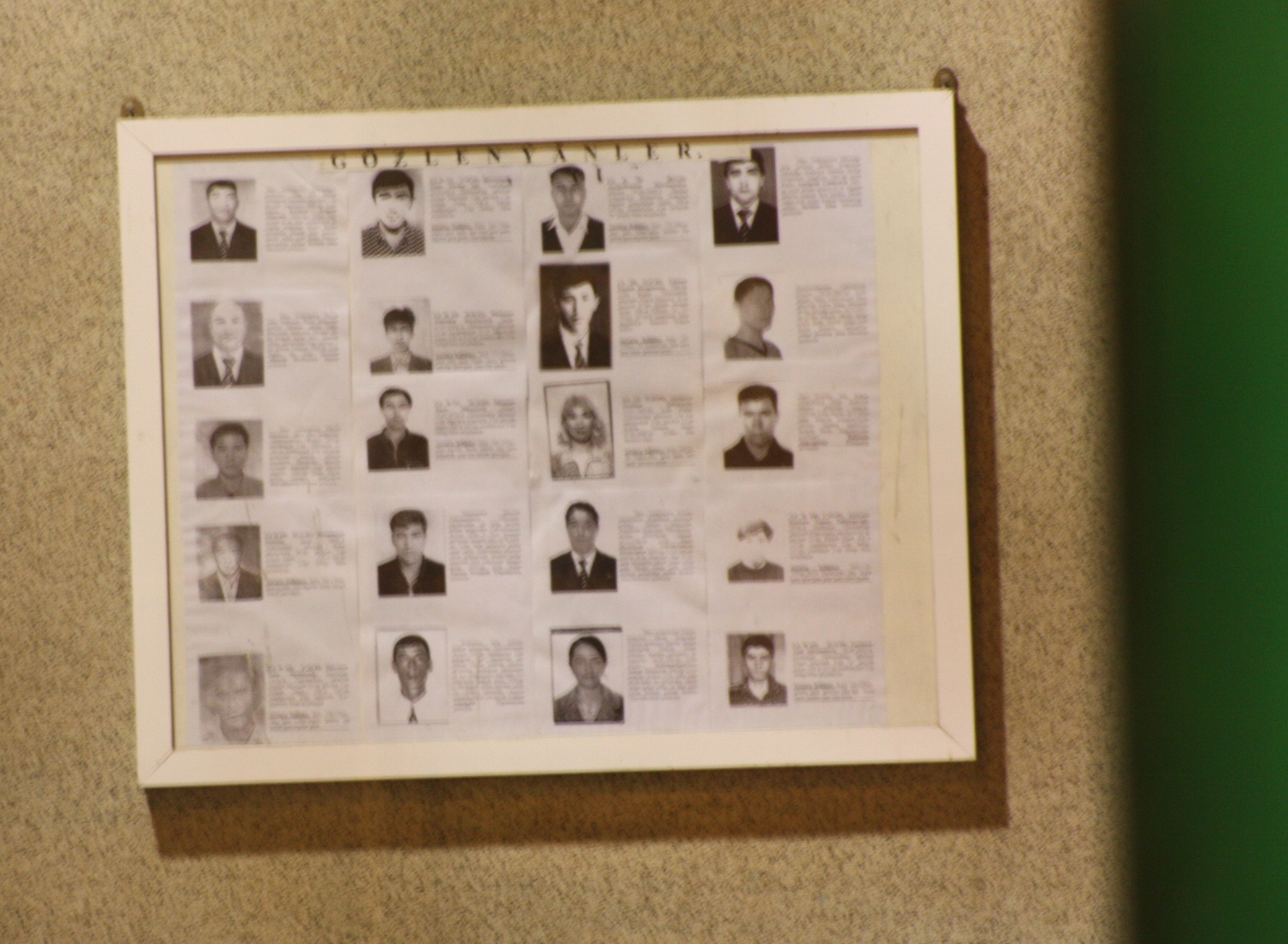
My nemesis—the lovely Svetlana in the third row, third column.
Getting through passport control in Turkmenistan was a little sticky for me. We arrived at the port, Turkmenbashi, about noon from Baku, Azerbaijan. We’d spent 16 hours on a huge rust bucket plying across 300-plus kilometres of Caspian Sea. We hung around on the boat for another three hours before being called inside to go through immigration. We were lucky to be summoned ahead of a group of about 30 people on a London to Mongolia charity rally.
Even though my name was at the bottom of the list, I was the first one to be motioned through. Within seconds it was obvious that ‘oops, we have a problem’ and the problem was me. As an aside, I was surprised to realise that the Turkmen word for problem is ‘problem’.
The two fellows who were checking my passport—these days it gets scanned on equipment that seems to be donated by the US Government and, for good measure, you step back from the window and they take your picture—started whispering anxiously, glancing at me, then my passport, then my photo and then the computer.
They said my name over and over again, and stared intently at me and then at the computer. They muttered ‘Hackensack’ a lot too and finally asked where it was. ‘It’s where I was born—in New Jersey.’ My mother would have been mortified. She wanted dad to drive her across the bridge so I would be born in New York City. Her words were, ‘I don’t want a child of mine growing up saying I was born in Hackensack, New Jersey’ and there I was doing exactly that in far off Turkmenistan. Sorry mum.
But back to the story. At last, the passport officials placed the first of many worried calls. The Turkmen guide who met us at the ferry—guides are compulsory here—is a retired school teacher and she trained her sensitive ears on their conversation to establish that they were pretty sure I was a Russian Svetlana Sultandowna who was wanted for some crime she had committed in Turkmenistan in 2009.
Before I go any further, let me tell you that if Svetlana is ever stupid enough to arrive in Turkmenistan through that border, she deserves to be caught. But I digress again.
I stood at the window through their many phone calls to some bosses in Ashgabat, the capital, trying to figure out what to do next. Although I assumed they would be delighted to have possibly captured one of their ‘most wanted’, it was clear that they were not thrilled to have ‘Svetlana’ on their hands. Our guide later told me they were terrified because they would be punished if they wrongly accused me.
As the dithering dragged on, I suggested they put me aside and process my travelling companions, but ‘no, no’ they would deal with me first. After about 30 minutes of phone calls and dismayed head scratching—and a decision that head office would send a better photo of Svetlana so they could digitally analyse my photo against hers—I was motioned to sit on the floor in the corner. About 18 of my group were processed before word came through that I was not Svetlana after all. What a relief.
Of course, I was not told any of this directly. All the detail was gleaned by our eavesdropping guide. As they handed over my stamped passport, the officials told the guide to apologise for the delay and asked her to tell me that they held me up because I ‘was so beautiful’. Oh, pleeze!
So I joined the others in the waiting room—where we all ended up waiting almost another 24 hours. Just outside, in the breezeway, is a poster of 20 people ‘of interest’ to Turkmenistan officials. Almost smack in the middle is a black and white photo of Svetlana, with the number of her special crime (no idea what it is). The only things we have in common are our height and messy blonde hair. Her hair is below shoulder length. She is heavily made-up. She has dark lipstick on her pouty lips, and looks sort of like Bernadette Peters. To top it off, she is 21 years younger than me!
I wanted to take a close-up of Svetlana the troublemaker, but they are very touchy about photographs in Turkmenistan and especially at a border crossing, so I had to settle for a fuzzy one taken surreptitiously from a distance with a telephoto lens. Surely you can see the strong resemblance!
And if this sounds like I wrote this just after it happened, I did, but I had to wait until I left Turkmenistan to post it. At first I thought I was playing it safe so I didn’t get me or the group into strife. But then I discovered that in this country, you can only access email accounts, so no Facebook, no blogs, no reference sites.
In the next few days, I’ll post an explanation of why we spent an extra 24 hours in the waiting room.
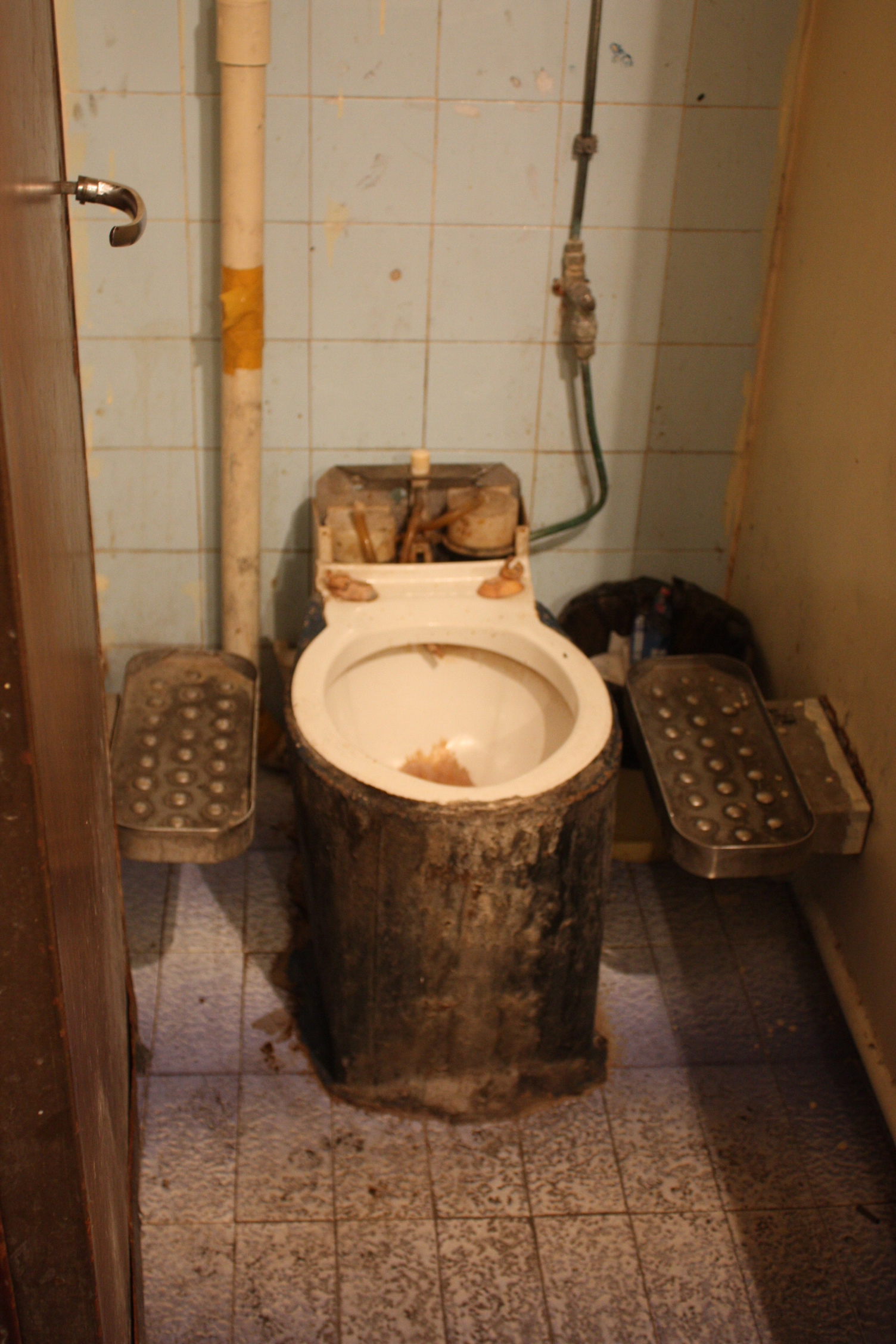
Our toilet—in a empty moment. It’s a cross between a Western and a squat toilet. Note the footpads either side, which let you elevate yourself so you can squat. On slightly rocking seas, I recommend the hover method. Girls—you know what I mean!
We had the mother of all toilet paper lectures tonight.
About 100 of us are travelling on a cargo ship from Azerbaijan to Turkmenistan, and THE toilet (yep, there’s only one for the guys and the gals) is blocked up to the rim. There are a few more toilets, but the doors are locked. I promise not to show you a pic of it at its worst—you might be permanently disturbed—but it certainly isn’t the worst toilet I’ve ever seen on my travels.
A few hours ago a woman, who has some responsibility on the boat, stormed through with an English-speaking fellow to remind us all in aggravated shouts and much waving of hands that we ‘are not to put paper or anything in the toilet’. Good grief, we’ve been in the region for many weeks now and we know. I told her so. She was still plenty annoyed and stalked off to confront other passengers.
Many of the other ‘foreigners’ are competing in an annual London to Mongolia charity car rally. Methinks they may not know/believe the toilet-paper routine.
Just recently we heard the toilet has been unblocked—and here’s a picture to prove it. I can’t help but wonder how long that will last. I can also only assume that Her Crabbiness is the one who had to do the surgery. That job would have made me cranky too.
Overall, the crossing has been less hassle than we expected. Windy weather kept us from going yesterday, but last night we heard a ship had arrived and would, most likely, be taking cargo and passengers today. Lu was at the port early this morning and organised tickets and cabins (if you could call them that). We got word (by the grapevine) to get ourselves to the port/truck ASAP after midday.
Poor John and I were the second last to arrive—at 12:30—and then we all played a waiting game that was shorter than expected. By 15:30 (I’ll be using the 24-hour clock, so subtract 12 hours if you need to), we all were through passport control and on the ship. Cargo was being loaded—slowly—and I predicted departure would be about 23:00. I was suitably wrong, in a good way. All cargo, including 17 sealed railway cars and nine of the London to Mongolia rally cars, was loaded by about 19:00. A bit before 18:00, I revised my prediction to 19:30 and that’s almost exactly the time we chugged out of Baku.
Toilet update: Having had two beers on the boat, I was up at 05:00 for a quick pee. The toilet is blocked again—fast approaching the rim—and three pieces of toilet paper are proudly floating in it. Some people never learn.
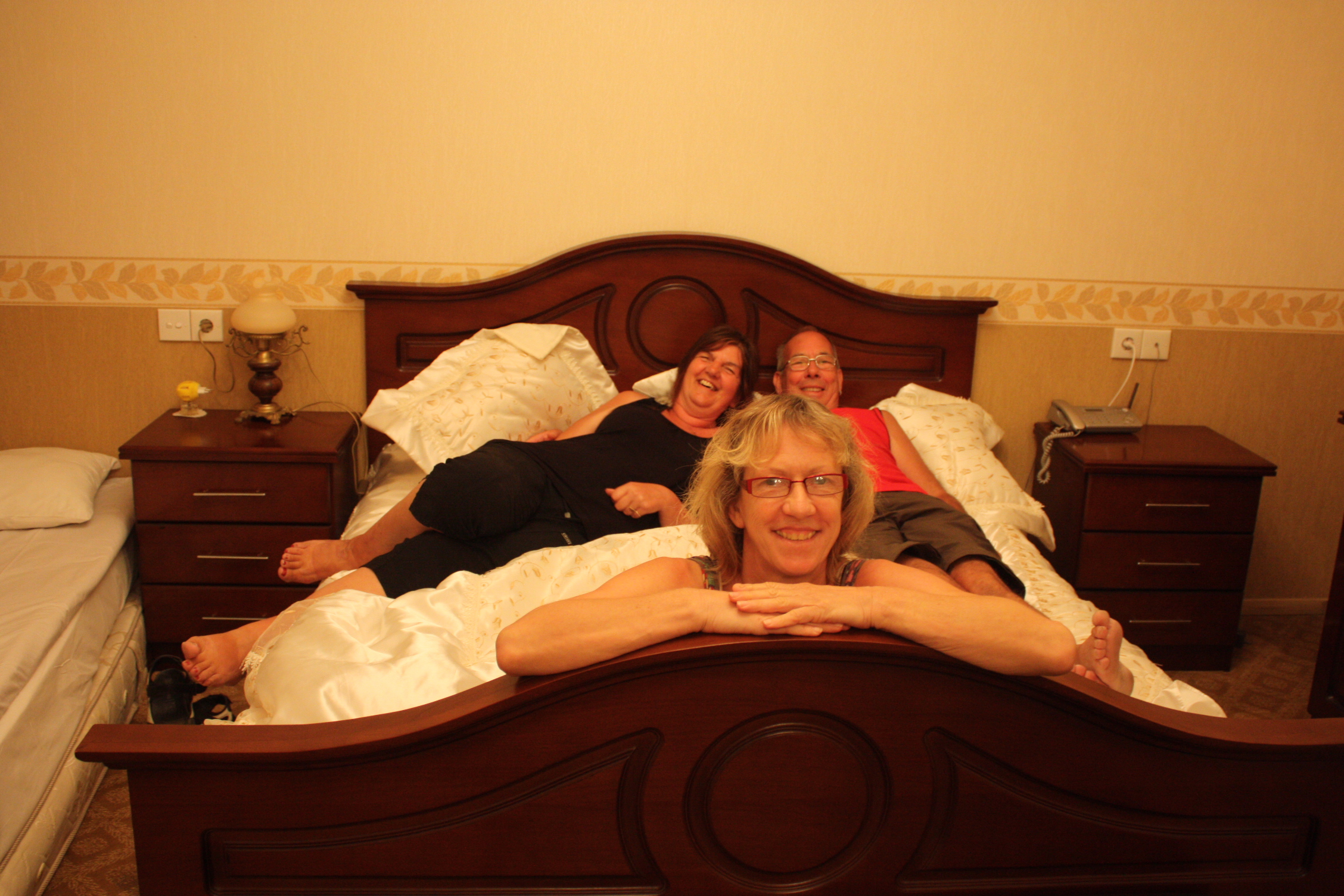
Lin and Norm getting a kick out of the antics of their 'love child' Lily.
We arrived in Baku expecting to bush camp a night or two and then board a cargo ship bound for Turkmenistan. But Mother Nature had other plans. I already mentioned that we had strong winds the night we camped by the mud volcanos (At a crossroads in the middle of nowhere). Those winds were blowing right across the Caspian Sea, disrupting all sailing traffic along with our schedule.
That wouldn’t have been so much of a problem. We could have camped until the winds died down and the ferries resumed service. But the truck had only a short-stay permit for Azerbaijan, so Will had to get it through customs and ‘checked out’ of the country. Oops! Then we were truckless, with none of our camping gear.
So Lu headed off to find a reasonably-priced hotel (no hostel in posh Baku) that could suddenly take 20-plus people. She had at least partial success at the Hotel Empire. They could take us all, but not at very reasonable prices. There were double and triple rooms, and everyone had to be willing to share if necessary. Lu dished out the keys randomly—she hadn’t seen any of the rooms—and then we heard about and saw the triple that Lin, Norman and Lily scored.
Oh wow, what a classic—with decor right out of the 1970s. There was a living room (with velour-covered furniture) and bedroom all done up in oranges, browns and golds. The huge bathroom included a jacuzzi, the sheets were satin, the TV was a flat screen, the clock chimed and there were robes and slippers all round. The trade-off, of course, was that there were three of them. No funny business. hahaha
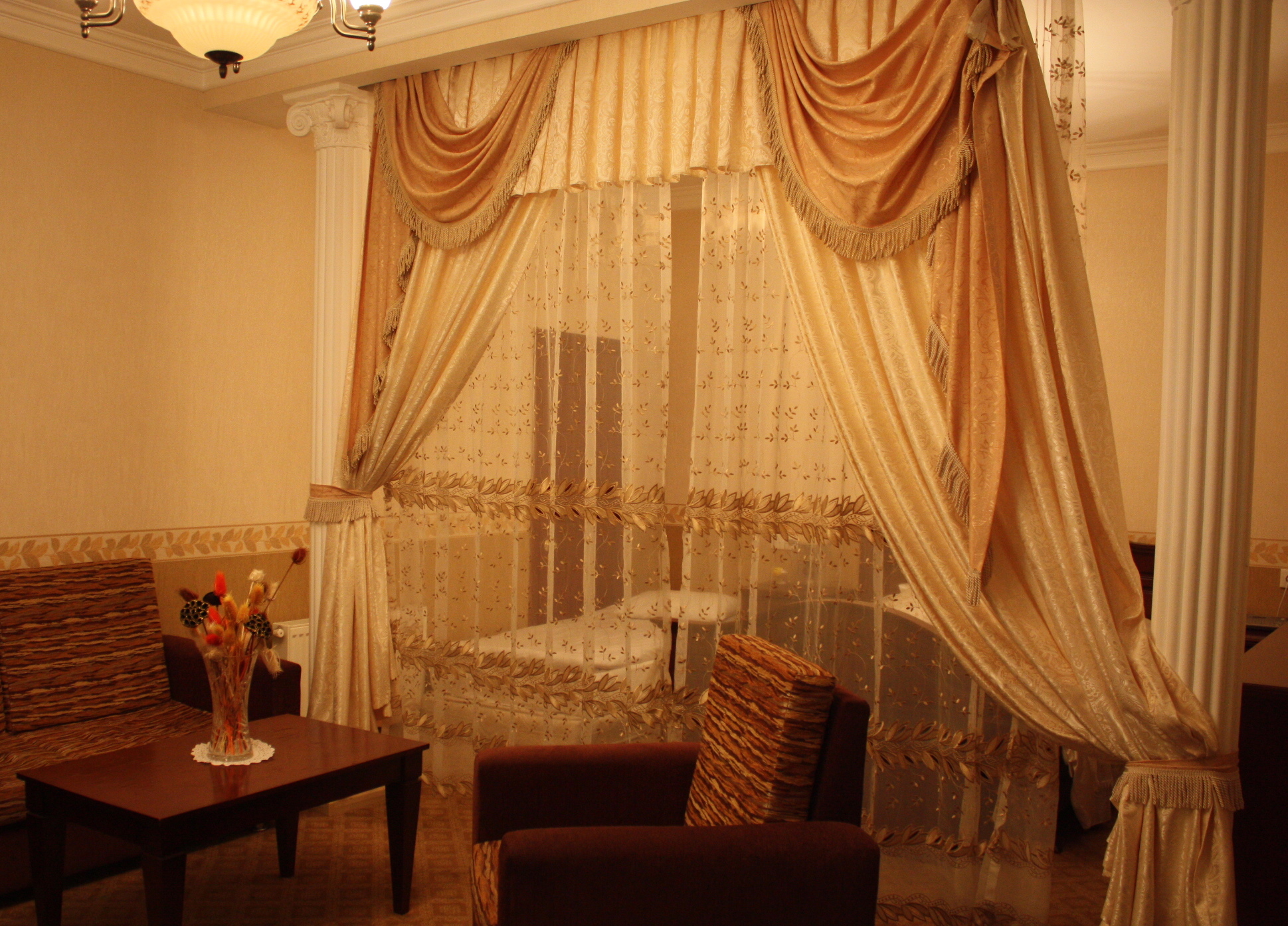
What a room—look at those tent poles!
We stayed a second night (the weather remained bad) and everyone got their same room back, so we’re now referring to Lin and Norm as mum and dad, and Lily as their unexpected love-child. Lily is playing her role to the hilt. She keeps begging for pocket money and asking ‘are we there yet?’.
Both Turkmenistan and Uzbekistan were write-offs for the internet, but Kazakhstan has come up trumps! It actually lets me get back into the blog. Yay!!!
I only have a few hours online in the capital, Almaty, and I’ll try to post as much as I can. There may be another dry spell for five to seven days and then we’ll see what China allows.

A baby mud volcano. Some reach 200 metres in height.
Azerbaijan is at the crossroads of Eurasia—straddling Western Asia and Eastern Europe. It’s the largest and richest country in the Caucasus region, with low unemployment and an almost non-existent crime rate.
The country has diverse landscapes. It’s lush and agricultural in the northwest where we entered from Georgia but, by the time we approached Baku in the east, parched rolling hills and desert conditions were the rule.
Water seems to be in much shorter supply than in Georgia or Armenia. While there are supposedly more than 8000 rivers, we noticed that most riverbeds are dry this time of year. Narrow streams run their course through wide and almost dry expanses of rock, stones and gravel—very few had enough water for any of us to do more than get our ankles wet.
Two nights ago we camped in an area that resembled a moonscape. We were just below a small collection of Azerbaijan’s belching, burping and blooping mud volcanos. Apparently the world has about 700 such volcanos and almost half of them are in Azerbaijan and the Caspian Sea. These are the visible signs of oil and gas reserves hidden far below the region. About 86% of the gas released from the volcanos is methane, with the rest being carbon dioxide and nitrogen.
We camped about 60 kilometres south of Baku, the capital, and near the Qubustan State Reserve. The volcanos look innocent enough, but about 10 years ago some other nearby mud volcanos spewed out flames almost 20 metres high. I think there was another ‘big mud burp’ in March of 2011, but I can’t find the details online right now.
Fortunately, our night was disturbed only by extremely high winds that had our tents ballooning, snapping and popping much like the mud, but without any fireworks. That’s our tent on the windy side of the truck.
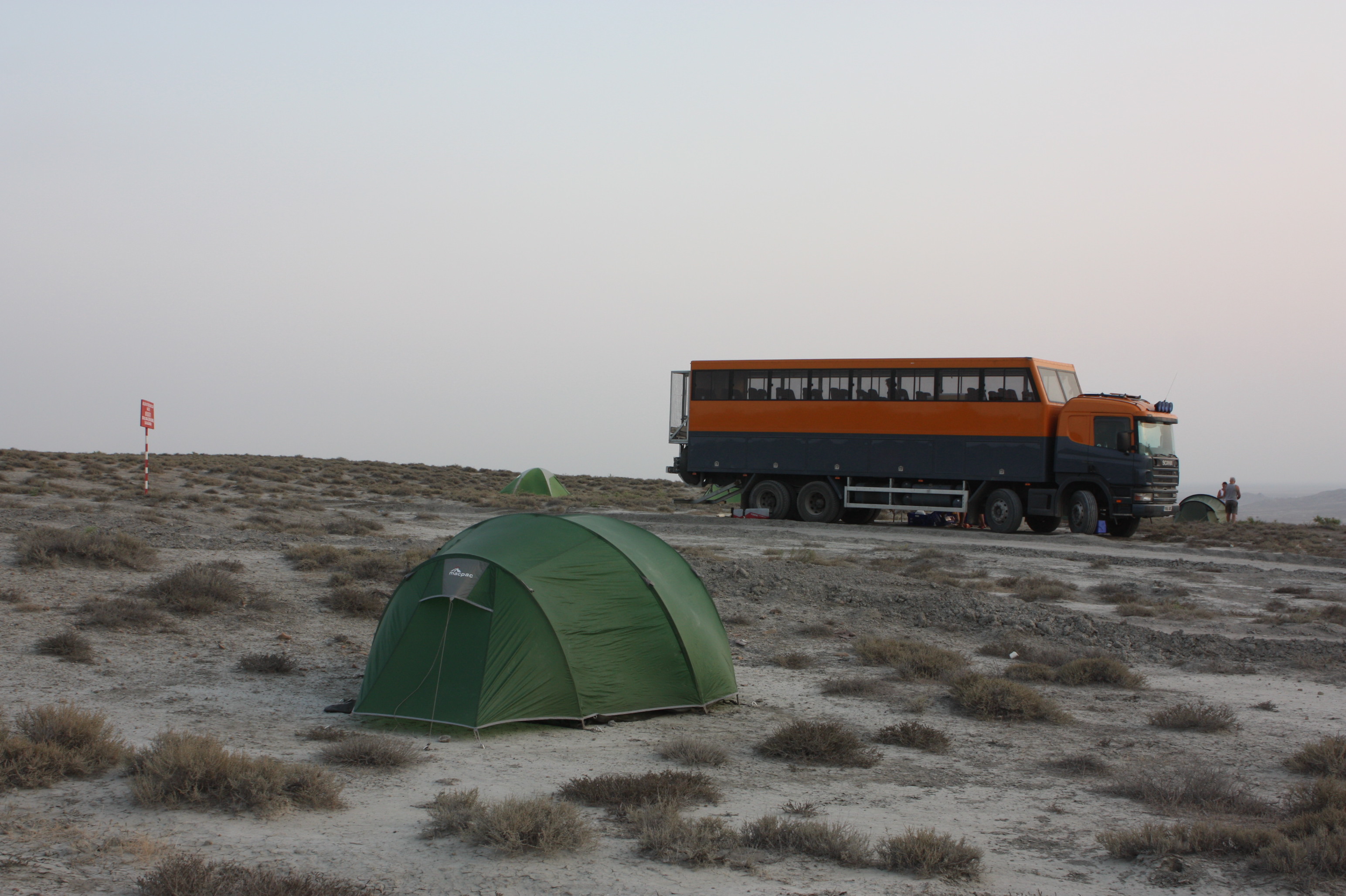
Camping below the mud volcanoes.
Apologies for the delay in posting, I am Peggy’s webmaster, but have recently had a few too many responsibilities working for the people who actually pay me to be their webmaster. Plus, I forgot how to get into this thing!
Just a note to let you know that Peggy is alive and well in Uzbekistan. She has travelled through Turkmenistan, is currently in Uzbekistan and is shortly moving on to Kazakhstan. She has many adventures to report, but at this stage will have to wait till a slightly more open society in order to post them.
She would also like you to know that she is not a Russian Svetlana and she did not commit whatever crime she is supposed to have done in 2009.
More in a few days hopefully.
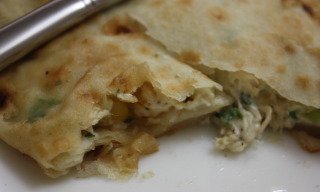
Is it really French?
We had a long look and walk around Baku yesterday. Come lunchtime, there were plenty of hole-in-the-wall, stand-up kebab shops to choose from, but I was at a point that I needed to sit for at least a bit. I spotted Vinni Kulinariya, with a pizza painted on the front window and a WiFi sign on the door.
We enjoy pizza, but don’t seek it out in the way that some other travellers do. But we hadn’t had pizza for a couple of months, so it seemed a good option. Plus, the WiFi gave me a good chance to update the blog.
As Poor John studied the menu on the wall, the fellow said, ‘Sorry no pizza today’. The easiest thing in such circumstances is to ask what they DO have. The choices were limited and we opted for a square of lavash filled with chicken, cheese, capsicum (bell pepper), corn and mayonnaise. These were then warmed, and I have to say they were superb. Just the right balance of flavours and just the right size.
After we ate, I tried the WiFi. It worked long enough for me to check a couple of emails and then pfffft. But the toilet worked and was clean. As we left, we learned that pizza isn’t served on the weekends, and that they call the lavash wrap a ‘burrito’. When the woman told me the name, she leaned forward and added, ‘it’s French, you know’. News to me.
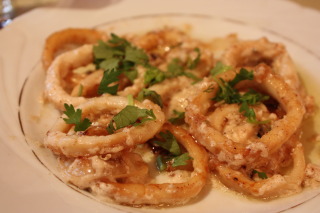
Poor John's squid dish.
Azerbaijan is not a country for dieters.
Last night Poor John and I went out in Baku to get an authentic Azeri meal. We didn’t have to go far before we came upon the Baki Restaurant. It looked a homely, family place, with gold and white curtains in the window and plenty of timber on the exterior.
After checking the lengthy menu—written in Azeri, Russian and English—we decided to stay. Poor John ordered an interesting sounding fish dish but our waiter, Rami, who had limited English, said he’d check with the chef. Nope, no fish. Too hot for fish. ‘It’s the weather,’ he said apologetically. We were both a bit puzzled by this announcement, but Poor John persevered on the seafood front. How about the squid with sour cream sauce (xamada kalmar)? Another trip to the kitchen and, yes, squid was okay.
Then I ordered the village chicken on an iron dish (sac toyuq). You’d have thought I offered him $100. His thumb went up. ‘Yes madam, this is a very good choice’, he said as he threw Poor John a friendly sneer to let him know his choice wasn’t anywhere near as good as mine. Poor John wavered—to go with the squid or? He stood his ground.
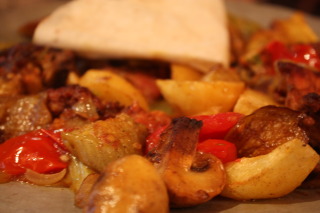
Village chicken up close.
How about salad or potatoes? We ordered a tomato and cucumber salad, but Rami said we needed two. Okay, we’ll have two.
Now what about drinks? ‘Water?’ Rami asked, nodding at both of us. Poor John ordered water with gas (the way you describe sparkling mineral water) and I ordered a beer. I thought Rami would faint. The man orders water and the woman orders beer! He was thrilled and gobsmacked. I can hear him telling his wife—’honey, you won’t believe what happened in the restaurant’.
Our drinks and salad arrived, followed by John’s squid—just a small plate of it. My dish was to be along in five minutes. And then it to appeared. Rami was beaming. It was a banquet. It was spread out on a wok-like iron dish perched over a platter and with a small dish of hot coals underneath to keep the chicken warm.
Except for the elevated presentation, my village chicken was the same dish we ordered a few nights earlier in Sheki. The waiter that night warned us the dish—which was inexplicably called ‘noodles’ on that menu—was for many people, not just one! But how could I have suspected? The dish in Sheki cost 14 manats while the one in Baku, which was only slightly smaller, cost only 4 manat (or about US$5).
Thankfully this platter of Azeri bounty was indeed delicious, but I could eat my way through only half of it. Poor John was recruited to deal with the rest. Later, as Rami cleared away the serving dishes, he took the last piece of lavash bread and dropped it on my plate, saying ‘You finish it madam, it’s yours.’
That’s the first time a waiter ever told me to clean my plate.
 Where to next?