
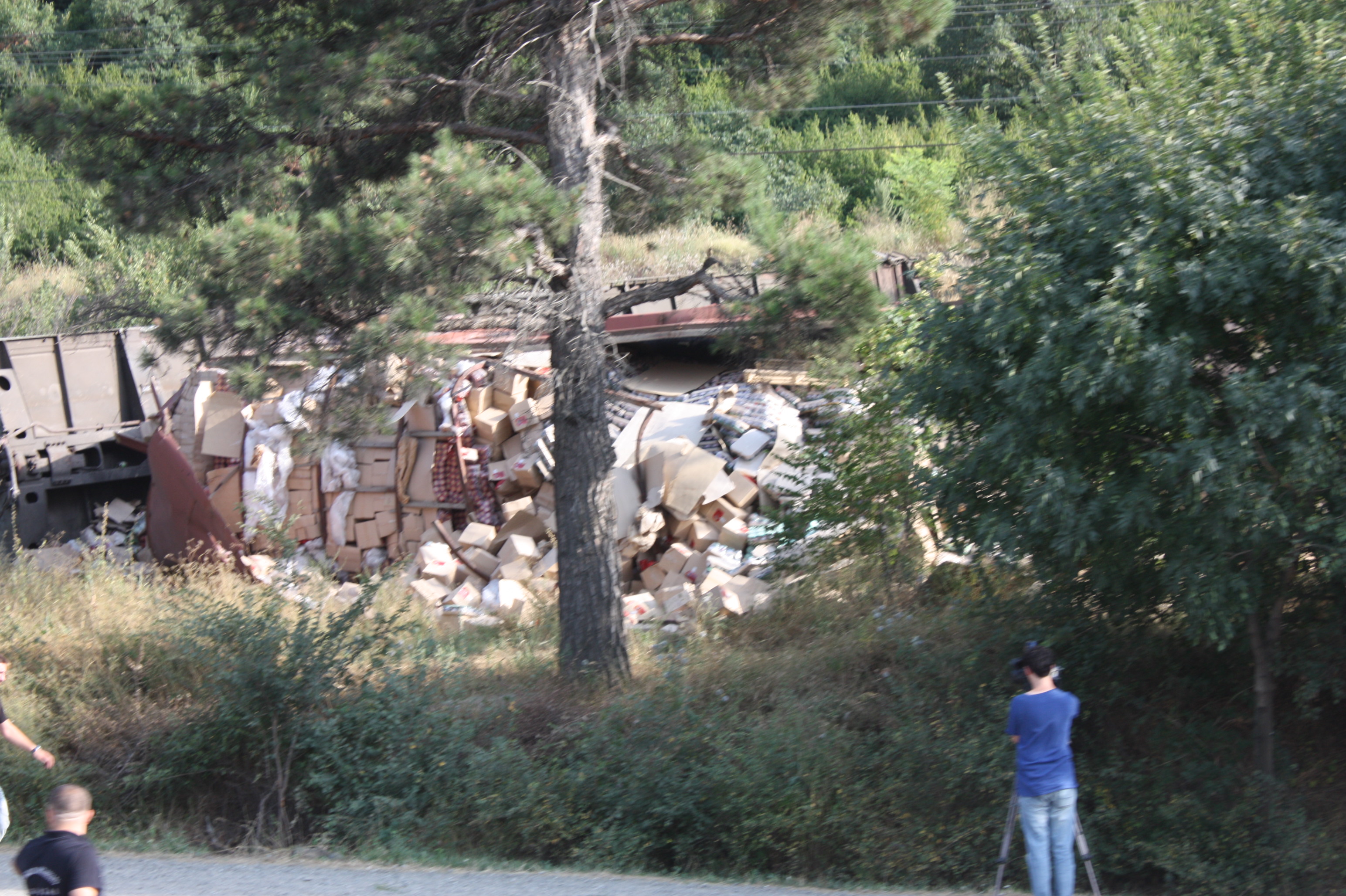
Spilled goods from Georgia, Azerbaijan and Kazakhstan.
There was more than a bit of a mess on the highway Saturday as we travelled from Armenia back to Georgia.
About 10 cars of a freight train, carrying fuel and other products, derailed not far from Mtskheta and Tbilisi, the national capital. The news said the accident occurred because one of the cars was ‘technically faulty’—whatever that means.
The highway, which runs along side the railway tracks, was closed for several hours while special crews cleaned up spilt fuel. Fortunately, nobody was hurt.
Our side of the road was open, so we weren’t held up for too long. I managed to get a few pictures of the mayhem as we passed by the centre of the action. The top pic is from Saturday (30 July) and the bottom pic is from Sunday when we returned from our bush camp outside of town.

Cleaning up—a day after the fact.
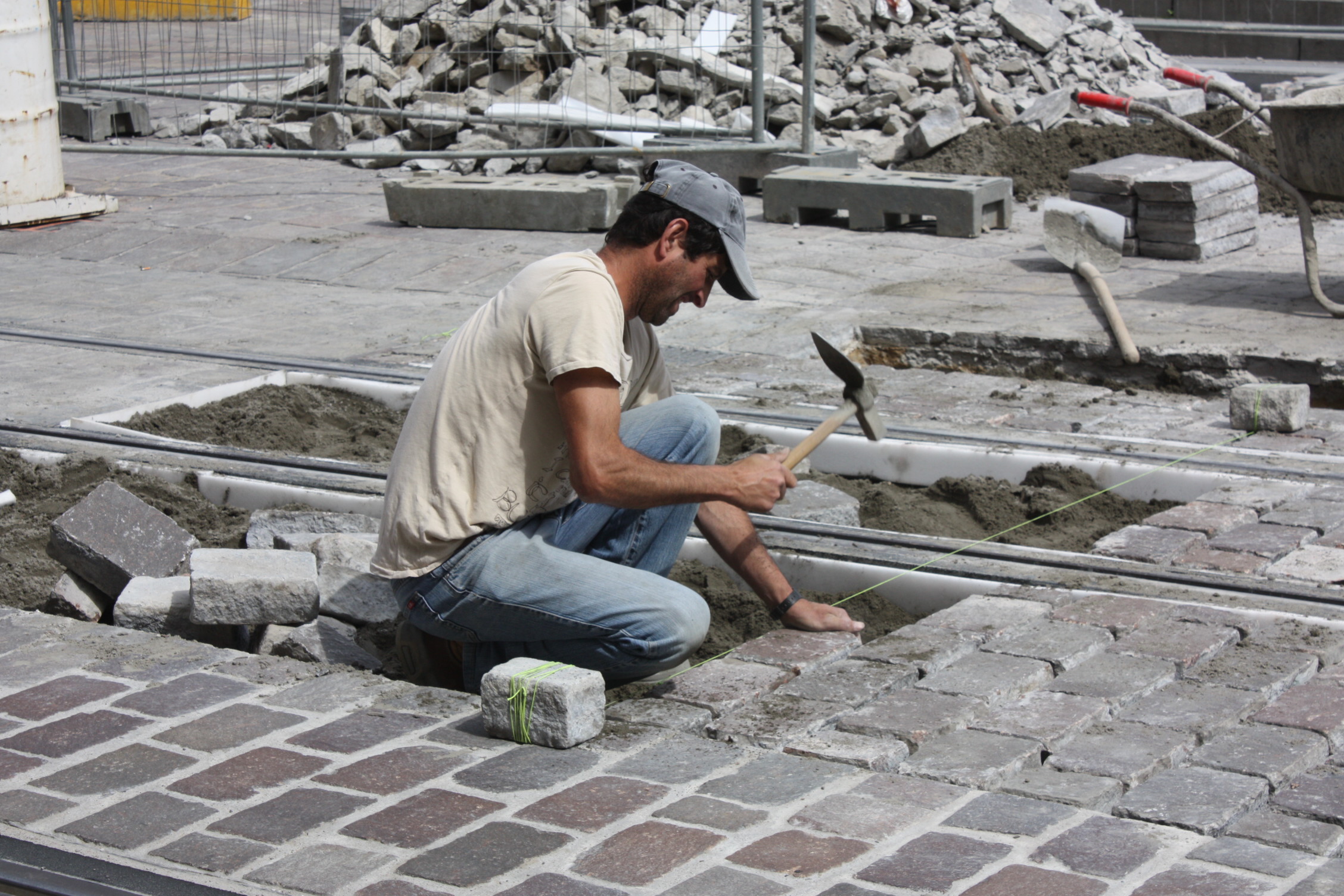
A smooth-ish trap being set for stiletto wearers.
How do these women do it? All across Europe and now in Central Asia, women—and not just the young’uns—are trundling along in the most incredibly high and spindly stilettos. It makes my feet and back hurt just to look at them.
It wouldn’t be so bad, but so many roads and footpaths (where they exist at all) are terrible. Pavers are broken or missing, manhole covers are never to be seen again, potholes are huge and dog turds are abundant.
Plus, many community’s have starting using even more cobblestones for roads and paths. They look quaint and stylish, but they are rugged and deadly. I have enough trouble navigating in tennis shoes or thongs (just so you know I’m not talking about skimpy underwear—in Australia we say thongs instead of flipflops).
Historical sites are just as bad. Their paving is usually a few hundred years old. Imagine trying to cruise through the various levels of stone slabs with surfaces and edges that are sharp and chipped or smooth and slippery. Or both at the same time.
In Germany, I saw a woman coming out of church after attending a wedding. She had a distinct hobble, swollen feet, a death-grip on her hubby’s arm and the regulation stilettos. Julia, one of our former German exchange students, said she was having a good whinge (complaint) to her hubby about the deplorable state of the road, as well as her shoes and her feet.
As I wobble my way back to Australia in my flat shoes, I keep chanting to myself—don’t break anything, don’t break anything! A broken ankle in a plaster cast would make it plenty hard to get on and off the truck.
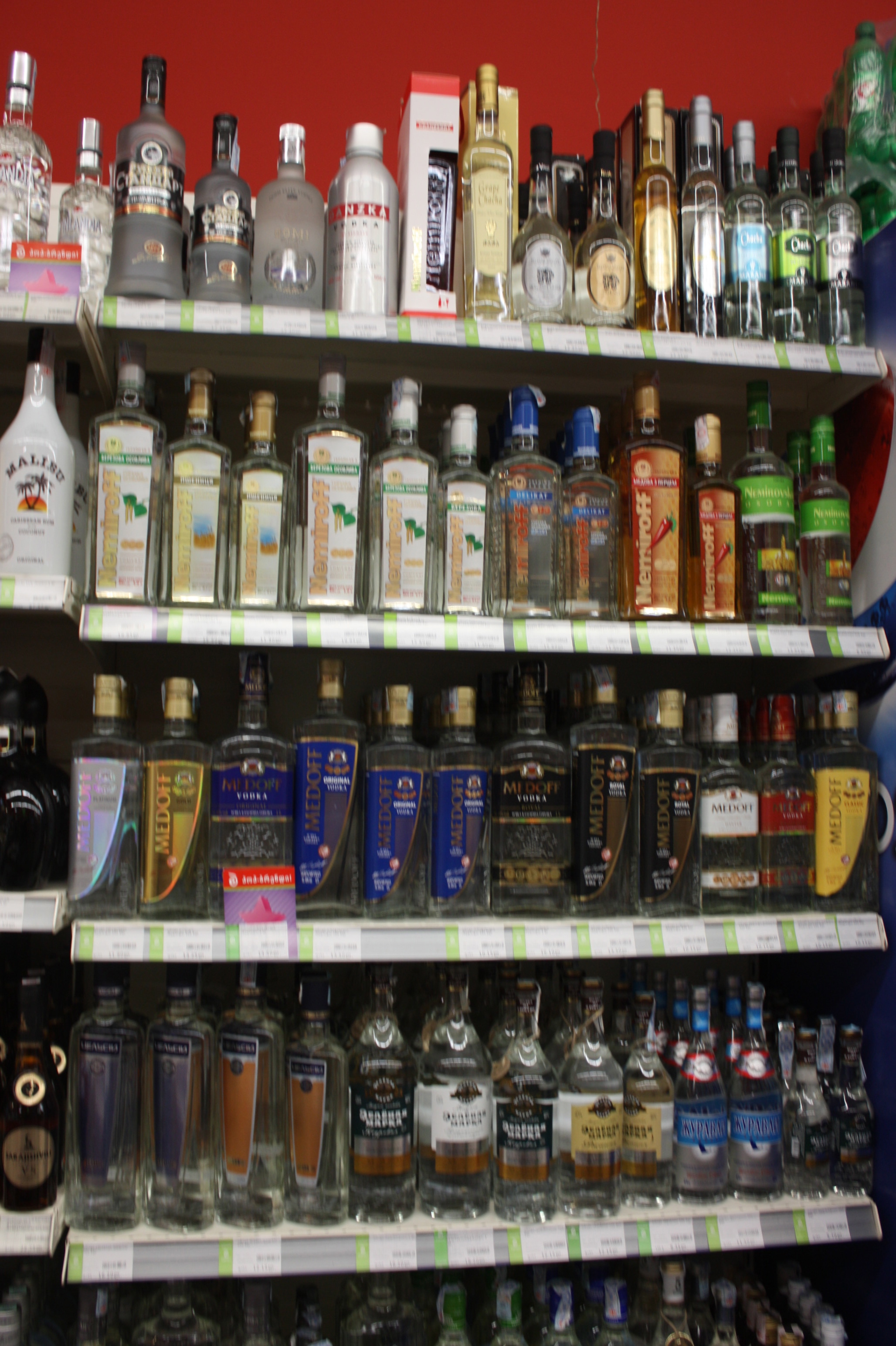
A mini Aisle of Vodka.
My dear friend, Potsie who lives in Dallas, is very fond of his vodka, especially the brand, Grey Goose. He’s not a big traveller and I’ve often wondered if that’s because he’s afraid he won’t be able to buy ‘the goose’ outside the USA.
Potsie, you can stop worrying and pack your bags. I’m in Georgia—the country, not the state—on the western edge of Central Asia, and there is absolutely no shortage of vodka, including ‘the goose’.
This morning in the capital, Tbilisi, Poor John and I wandered through the appropriately namely Goodwill Supermarket, and came upon the Aisle of Vodka. Six shelves high and 10 metres long, this wall displayed every conceivable brand and flavour of vodka.
The pic shows a portion of a much smaller Aisle of Vodka in a different shop. Most supermarket entrances have a sign saying ‘no cameras’, so I had to be quite sneaky to capture even this quick shot.
I’m not a vodka drinker, but Poor John tells me that chilli vodka is worthy of some attention, so if I have some leftover Georgian currency tomorrow—before we head to Azerbaijan—I might buy a bottle. Then again, I might not. Poor John says it’s best drunk ice-cold and I have no idea when I’ll see a freezer.
I’ve just returned from a girls’ night out in Tbilisi, Georgia—anyone who knows me will be stunned to know I was in the first contingent to come home and had only two beers for the entire night. At 40-plus degrees Centigrade, it’s too damn hot for wine.
I’m sitting in the kitchen of the hostel, surrounded by seven Georgian men and boys (who are all somehow part of the staff, ownership or family). They are watching some blood-and-guts action movie that I don’t recognise. It’s approaching midnight and they have just kindly offered to share their saucepan of baked beans with me. I’ve declined.
Heck, I just had a meal with the girls, plus I don’t recommend eating even a mouthful of baked beans if you’re staying in a 14-bed dorm room in a hostel. No doubt my roommates (all truck companions) will thank me for that.
The initial conversation with the Georgians tickled me. They had three questions.
Q. Where are you from?
A. Australia.
Q. How old are you?
A. Sixty-three.
Q. What’s your religion. (I knew they simply wondered whether I was Christian or Muslim because I wear a necklace that’s written in Arabic.)
Now I’m listening to a different conversation. An Irish fellow who joined the truck today is explaining to the manager/owner? that his camera seems to have disappeared from his room.
It’s definitely one of those touchy moments. You can’t accuse, but you can’t just forget about a camera. It may surface, it may not. It may have walked with a staff member or a hostel guest. I feel like a fly on the wall and the manager is taking it all very seriously. He’ll ask the police to come tomorrow. If they write a report, Eamon will be able to claim on his insurance.
Nevertheless, I’ll be taking my computer and camera into bed with me. And continue to carry both with me everywhere. Perhaps this tale of woe will shut Poor John up tomorrow when he asks ‘why do you insist on carrying those darn things with you everywhere?’.
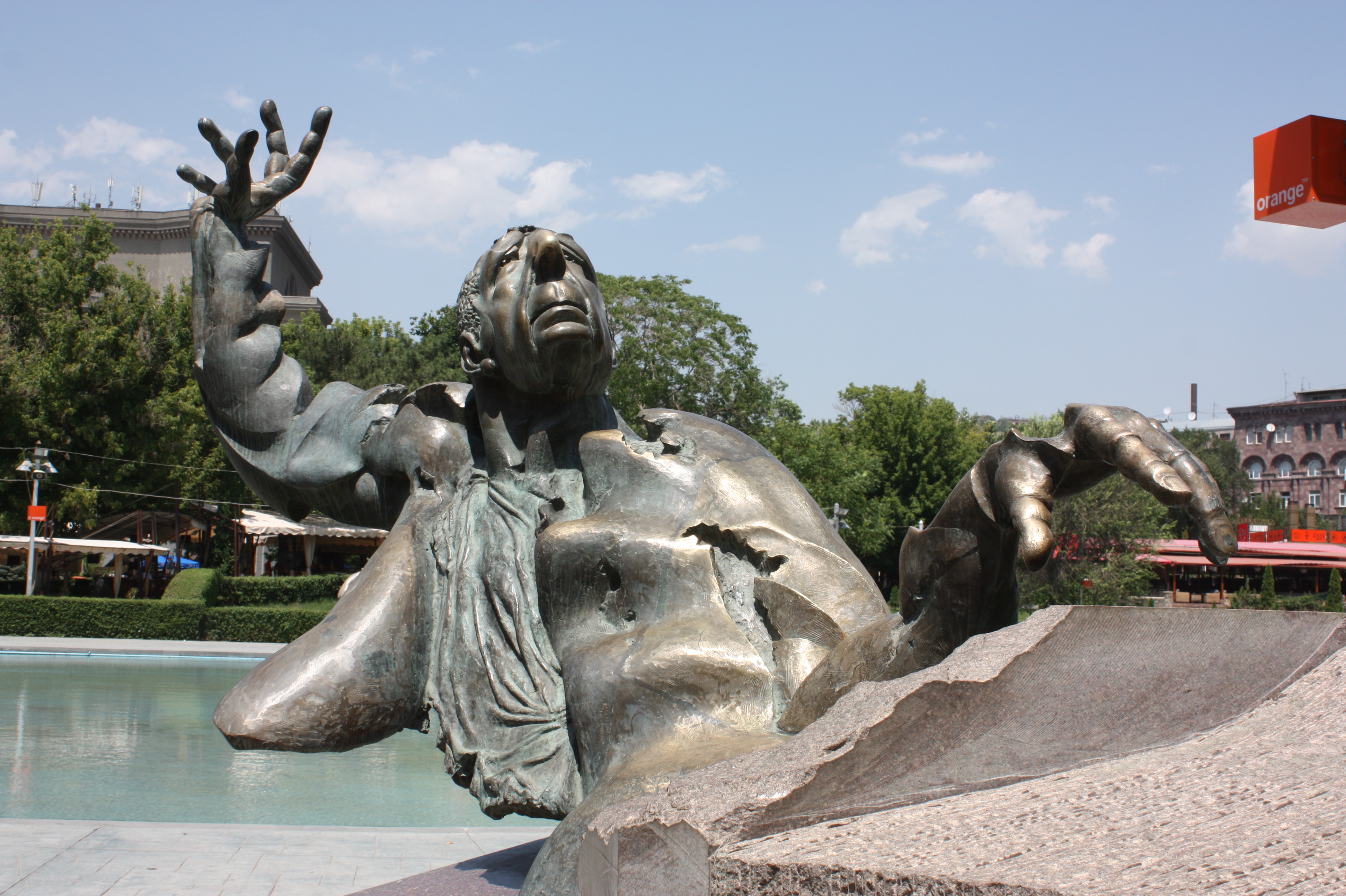
Arno Babajanian, Armenian composer and pianist.
All the favourite sons (and probably many of the daughters too) seem to have statues of themselves in Yerevan, the capital of Armenia. I’m especially partial to this one of Arno Babajanian. What a grand nose he had.
Born in Yerevan in 1921, Babajanian was probably the country’s most important composer and pianist. His extraordinary musical talent was evident by the time he was 5, and he entered the Yerevan State Musical Conservatory at the age of 7.
Babajanian was active in most genres and wrote many popular songs in collaboration with leading poets. Many of his compositions were also rooted in Armenian folk music and folklore. In 1956, he was named the People’s Artist of Armenia. The Soviet Union awarded him a similar title in 1971.
This statue is located in the gardens of the Opera House and beside what is called Swan Lake. It shows him playing, seated at a granite piano that extends for at least four metres.
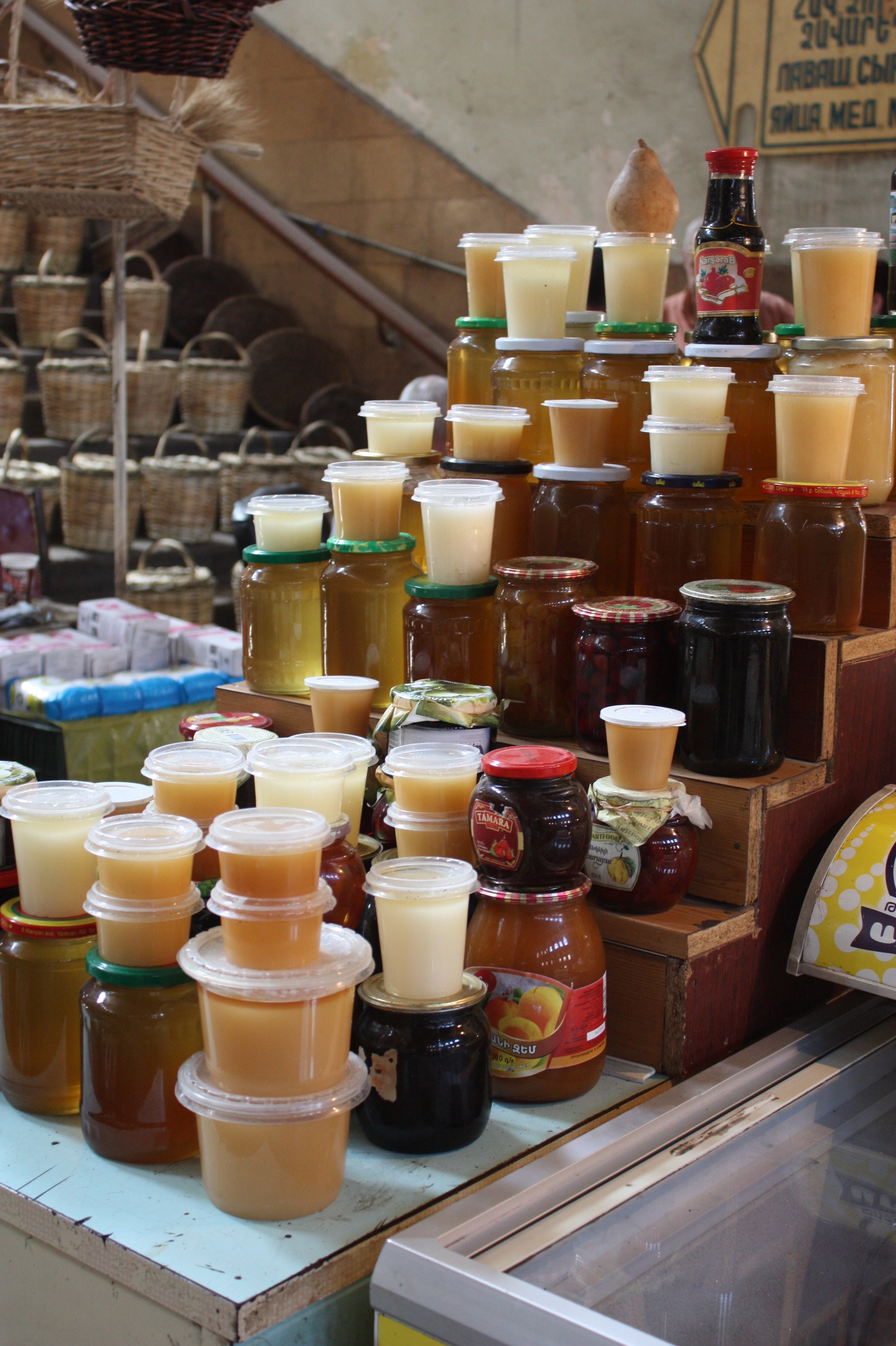
Plenty of honey in Armenia.
Local markets are one of my favourite haunts. I love the colour, the variety, the unexpected, the noise, the smells (even the not-so-nice ones) and the salesmanship.
Yesterday we visited the Central Bazaar in Yerevan, the capital of Armenia, and it was certainly up to standard. And more than a few sellers forced various bits of food and drink at us. This morning a fellow traveller had his fill of vodka at the market.
The range of honey was amazing. I’ve seen timber beehives all over the country, so I shouldn’t have been surprised. But the pic here shows the array of honeys—from light and thin to dark and thick to creamed and to honeycomb. And all displayed in containers originally made for something else.
The produce looked great and was varied, too.
On this trip, our tour leader, Lu, does most of the shopping in supermarkets. She plans the menu and each cook group takes turns helping to prepare an evening meal and breakfast the next morning.
It’s all very straightforward and the whole process is a complete breeze, but I do miss the need/opportunity to explore the markets for the best buys on fresh goods. In Africa, the cook group of the day usually visited the local market to purchase the ingredients for that night’s meal. Some people hated the job, but I loved it. It got me into the community, let me see what was plentiful, opened the way for me to take photos and forced me to make myself understood through hand signals or in some foreign language.
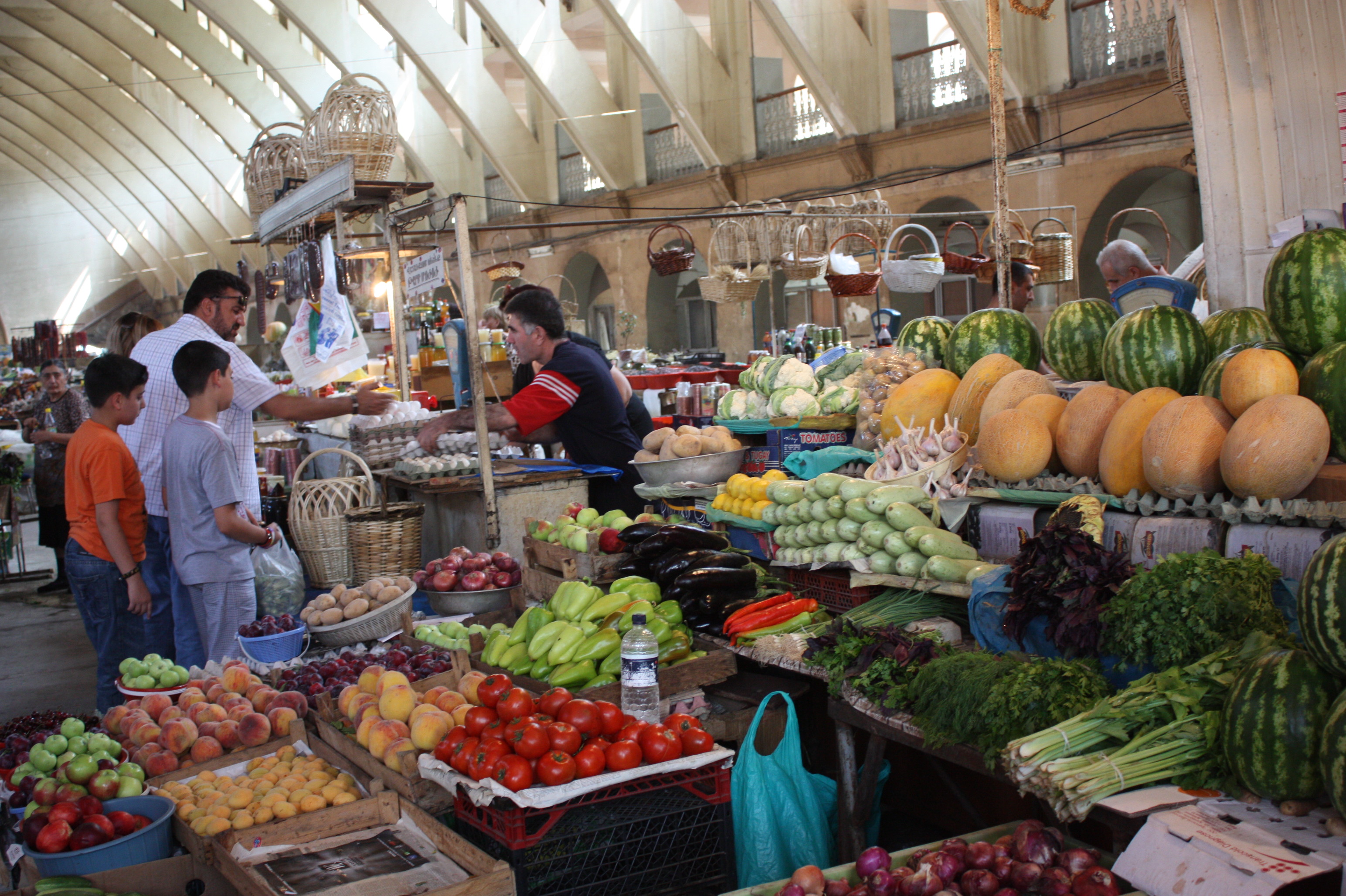
Making a sale in the Central Bazaar in Yerevan.
I’m looking forward to seeing how/if things change as we travel into Central Asia. Will there still be supermarkets or only local markets? Will food be abundant and varied or in short supply? Or will our choices be tempting or limited to onions, tomatoes and a lone goat shin, as happened once in Mauritania?
I’ll keep you posted.
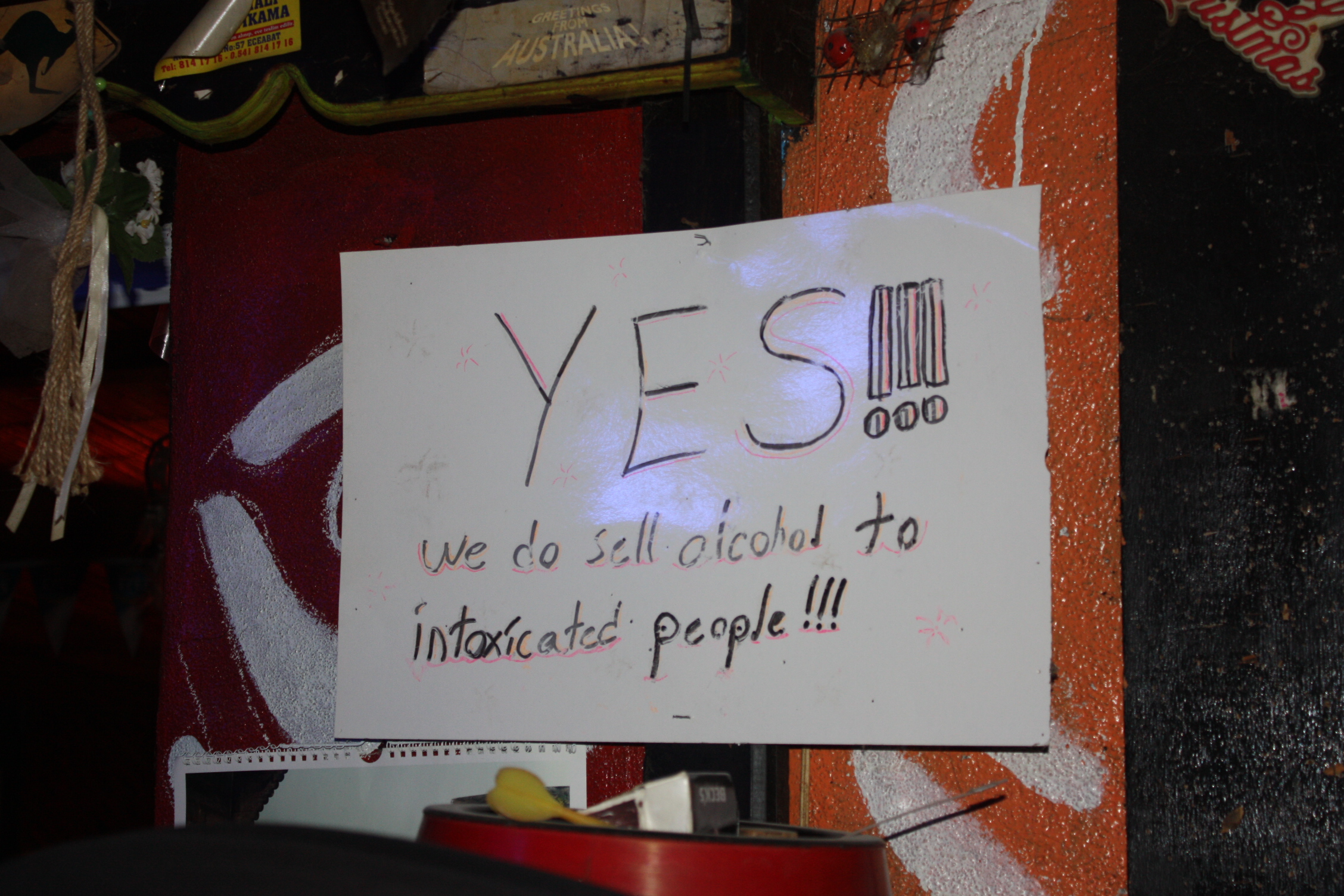
Bring your sense of humour—helps you to appreciate the weird and wonderful such as this sign in the Boomerang Cafe/Bar near Gallipoli.
It’s about time for a few more traveller’s tips.
These will seem like the bleeding obvious, but so many people forget to do/bring some of these essentials, so I think they’re worth mentioning.
1) Bring your chargers—all of them. If you can, bring both plug and cigarette-lighter versions. Our truck can charge two 240-volt plugs at a time (English plugs only, so you may need adaptors too) and eight cigarette-lighter items. The truck has enough battery reserve that we can usually charge overnight but, with more than 20 people and all their gear, outlets can be at a premium. And no charging is allowed when the truck sits for longer than just overnight. Otherwise we might have to push all 24 tons uphill to get it started.
2) Mark your stuff. Lots of suitcases and backpacks look the same. Lots of sleeping bags and mats do too. Poor John tied ribbons to our cases and put striped tape around our sleeping bag bags. Our roll mats are bright green. It’s so easy to spot everything of ours in the storage area. When we saw Belgian Emma, one of our past exchange students, in Brussels, she gave us two little souvenir toggles from Korea. Poor John wondered what we could do with them, until I suggested that he tie them to the bags that hold our camping chairs. Makes them also very easy to differentiate from everyone else’s.
3) Bring dental floss. Many people hate it, but dental floss is your friend. The dentist once told me that flossing is almost more important than brushing. I can’t verify that because I do both. But floss has more uses. While it’s not quite as versatile as duct tape, I have often used it in place of string. It’s thinner, lighter and usually just as tough.
4) Bring your sense of humour. This is absolutely critical. Travel is fun, tiring, challenging, frustrating and exhilarating. It’s all a lot easier and a lot more enjoyable if you can laugh at yourself, those around you and the quirky stuff you encounter.
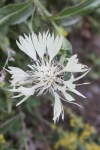
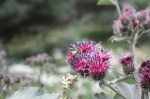
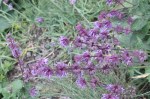
I’ve already written about our walk to visit the Tsminda Sameba Church, high above the village of Kazbegi. A big treat of the walk was seeing all the wildflowers in bloom. They don’t have a long growing season. It starts snowing again at the end of August.
Here are photos of just some of lovely flowers we saw today ( a few insects are included as well as the occasional weed).
Feel free to tell me the names of any of them.
Note: A stray picture got in by mistake—it’s a carving from the side of the Tsminda Sameba Church and is seemingly of two dinosaurs butting heads—and I can’t figure out how to delete it without going back to the beginning. Sorry! Enjoy the weirdness of it all.






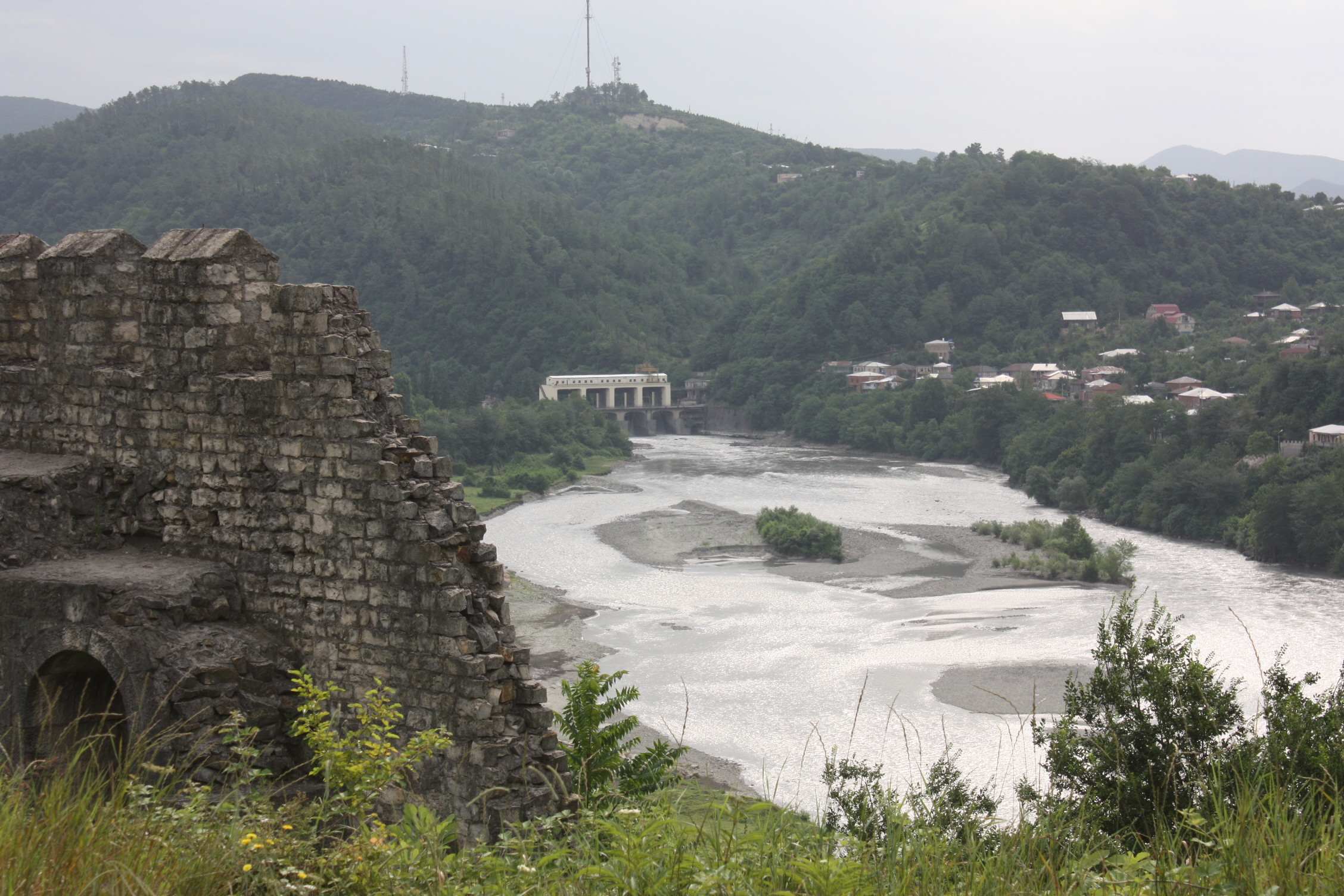
Not the river where I had a wash, but you get the idea. Hey, you don’t take your camera into the bath!
We’re ahead of schedule. The roads have been so good—much better than Will expected—that our itinerary is changing almost daily. We’ve had a bonus stop at the Sumela Monastery, not far from the Black Sea in Turkey, and already two extra stops in Georgia.
Because we don’t have any reservations with hostels or campgrounds, we’ve been bush camping as we go. That means no showers and no shortage of bugs. Every morning, before I get out of the tent, I apply a layer of bug repellent. I repeat this well before sundown. By my reckoning, I have at least eight layers of repellent that have not yet been washed off—although they probably have run off in the sweat.
In spite of repellent, the ever-persistent mozzies (mosquitos) always manage to find the ‘missed’ patches of skin behind a knee, at the back of the neck or on the ear. A few days ago, Toni got a doozie of a bite on his hand, which then swelled up impressively. It’s getting better—slowly—and he swears it doesn’t hurt or itch.
Anyway, no idea when the next shower will be, but today I changed into clean undies. Twice in Africa, we went 14–15 days without a shower. I like to think it won’t get to that extreme.
Update: Half way through day five and 10 layers of bug repellent, I got clean. It wasn’t a shower, but a great wash (including my hair) in the Aragvi River by our bush camp in Mtskheta (no I can’t pronounce it). Quite a few of us had the same idea. Thank goodness my wash was over before Will arrived with his laundry and noticed a snake in the water. Later in the evening, Gary and Lene headed across the bridge to the pub and spotted the snake’s parents—big burly things.
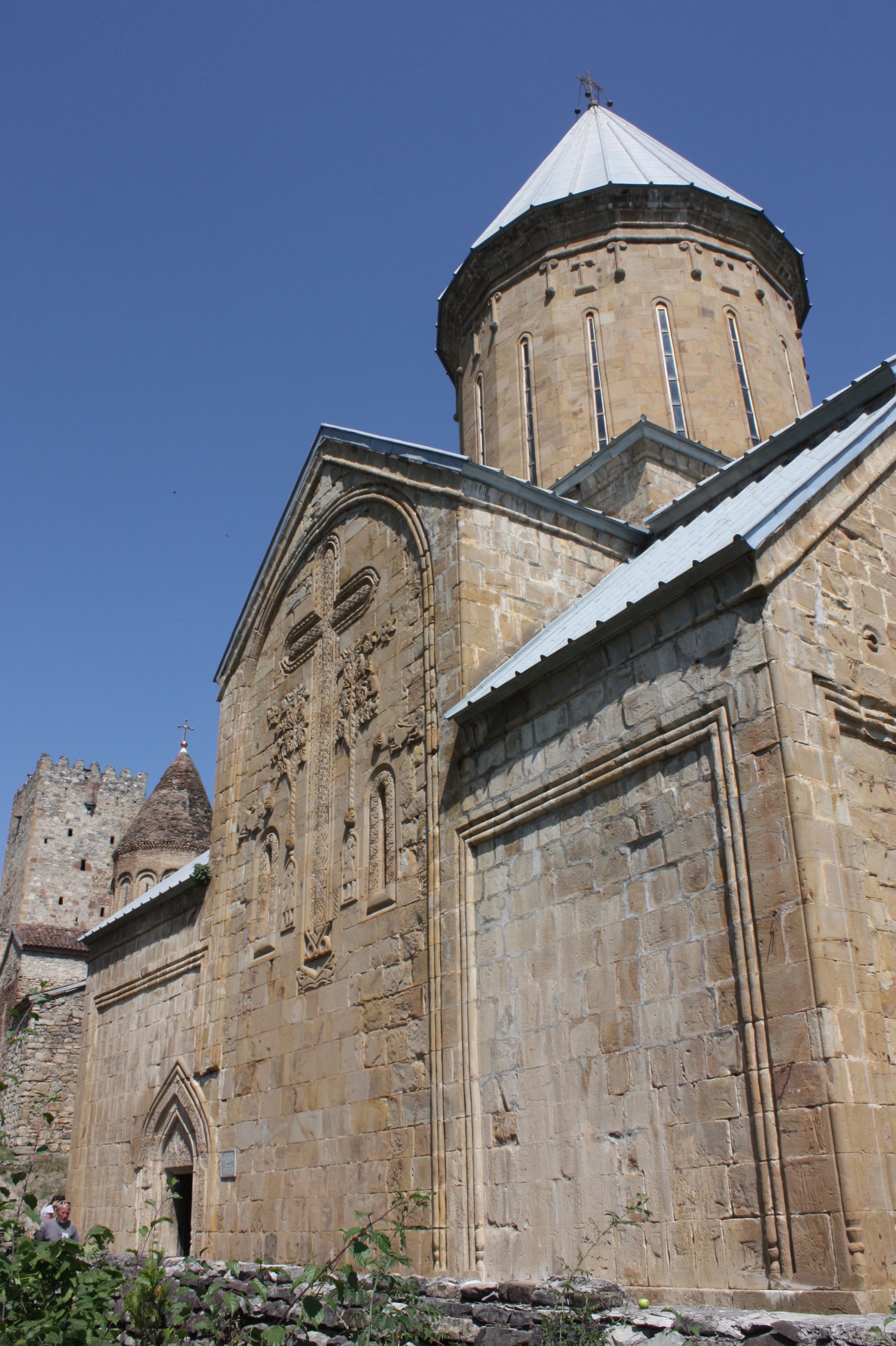
The church at Ananuri.
To get to Kazbegi, we drove about 140 kilometres along the Georgian Military HIghway, which connects Georgia to Russia. This important thoroughfare was a dirt track until the 19th century, when it was properly engineered.
It’s still a very bumpy ride, and we took almost four hours of bouncing to cover the distance.
The highway starts at Zhinvali, where there is a large reservoir fed by two rivers. The water is a surprising shade of green—a sort of garish Paddle Pop colour.
Along the way, we had a brief stop at the Ananuri fortress on the northwest end of the Zhinvali Reservoir. The fortress belonged to the dukes (eristavis) of Aragvi, who ruled the land as far as the Tergi Valley from the 13th century onwards. We visited the two churches within the fortress and I had to pay a lair (the currency of Georgia) to hire a skirt so I could go in. Methinks there’s a skirt racket.
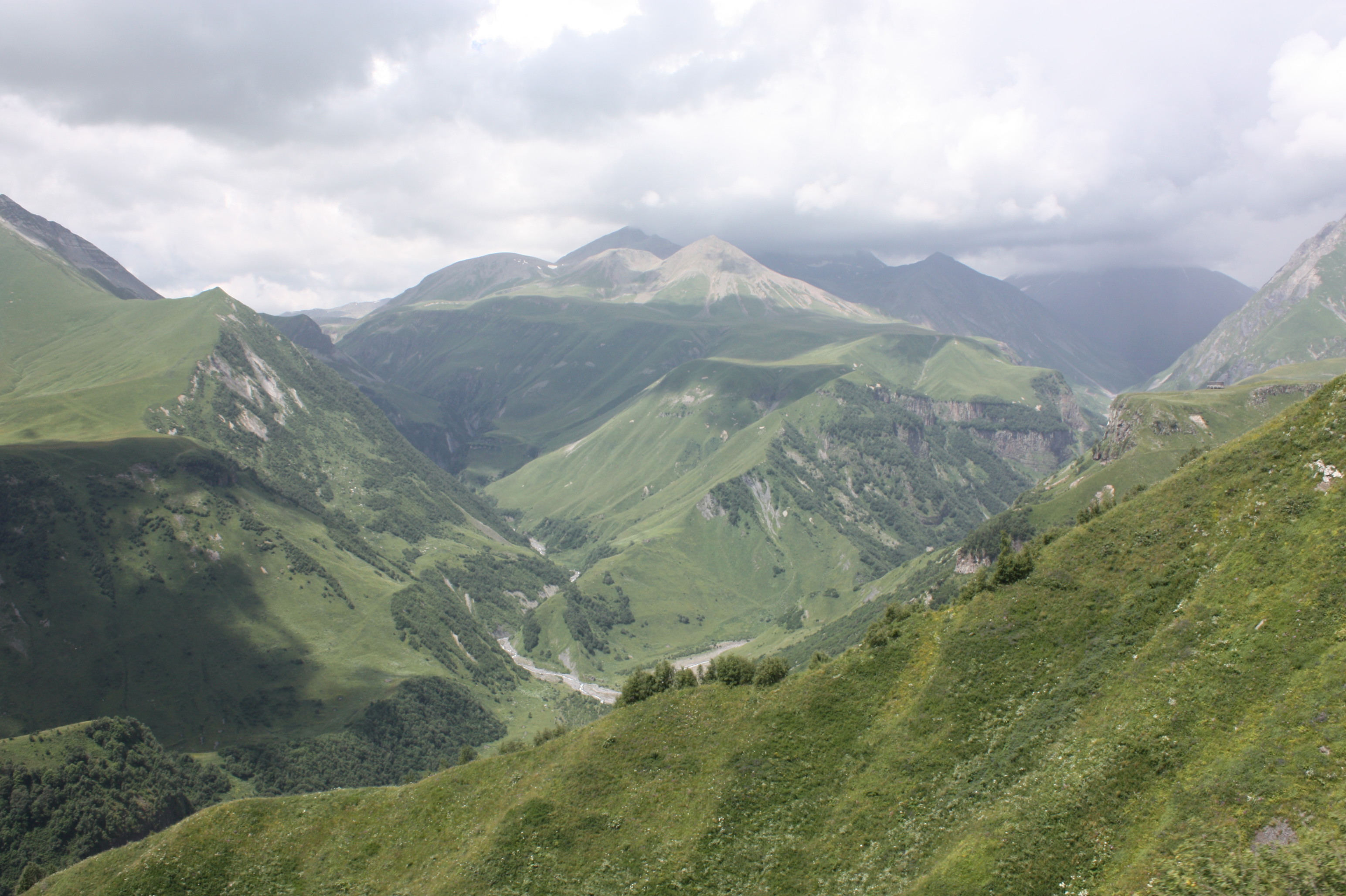
Views of the Georgian Military Highway.
After Ananuri, the scenery becomes breathtaking. We travelled through several villages, including Gudauri, which is Georgia’s ski resort—although I could never spot the reported ski lifts. Then a few kilometres on, we started through the Jvari Pass which is 2379 metres high. Part of the road is known for avalanches, but a series of concrete galleries have been built to protect traffic in winter. I plan to write a little item about those galleries, so stay tuned.
Beyond the pass, we descended into the picturesque Tergi Valley, with the Tergi River at our side, and then through four or five small villages to Kazbegi.

Peering out through one of the long concrete galleries.
We were surprised by the volume of traffic on our summer day, with a continuous stream of trucks, cars and 4WDs. Many were heading to Kazbegi, but others were undoubtedly destined for Russia.

