
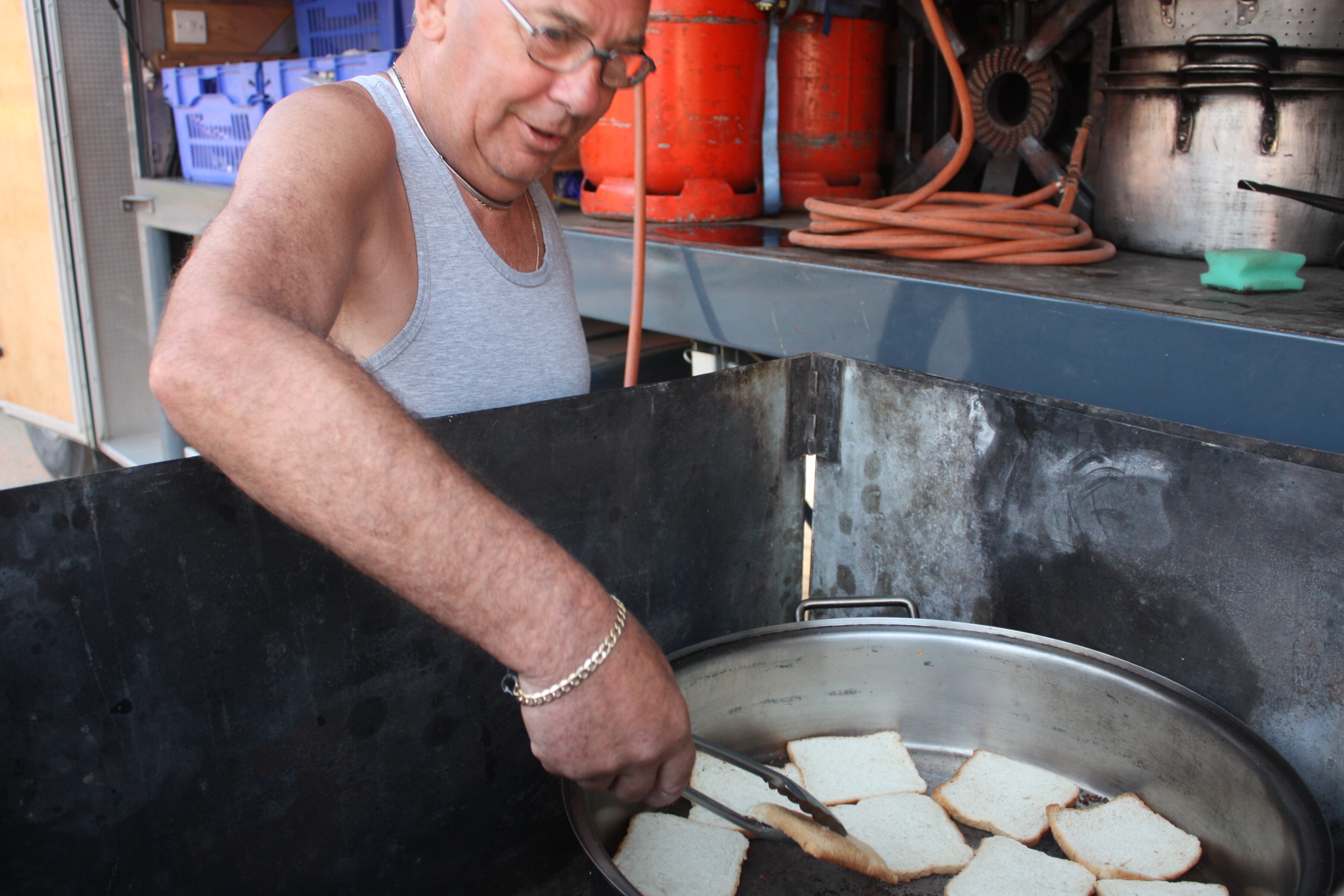
Norm cooking toast on a windy morning.
Cooking is a routine part of any overland package.
In all there will be 23 passengers on this journey. We have been divided into eight cook groups—seven groups of three and one of two. This means we’ll have a turn once every eight days (or less). We fend for ourselves when we stay in hostels, which will happen from time to time. This will usually be when there is no campground available or when the truck can’t get near enough to where we are supposed to stay (such as in Istanbul where the archways in the city wall are so low that the truck can’t get through). Not sure when the next hostel will be.
So far Poor John and I have cooked once (our fellow cook is Martin from Ireland). Lu, the tour leader, does the shopping, and we cook pretty much to her instruction, and the job isn’t too onerous. As usual, I am happy to chop onions—the task most other people hate. We cooked on gas and made a sausage/veggie stew (sorry no photos, too busy cooking). As of yesterday, the groups are cooking on wood and it will be interesting to see how long the current supply lasts. I’m sure we’ll be gathering wood as we go.
In addition to making dinner, the cook group gets breakfast ready the next morning. Other than making toast, this is a matter of boiling water for tea and coffee, making up some powdered milk, and getting out cereal and spreads.
As an aside, shopping gets done every day, or every second day. We don’t have a fridge on board—just a collection of ice chests (eskys). Sometimes Lu buys frozen items that defrost in time to be cooked. So far, I think all shopping has been done in supermarkets, which is a big change from Africa.
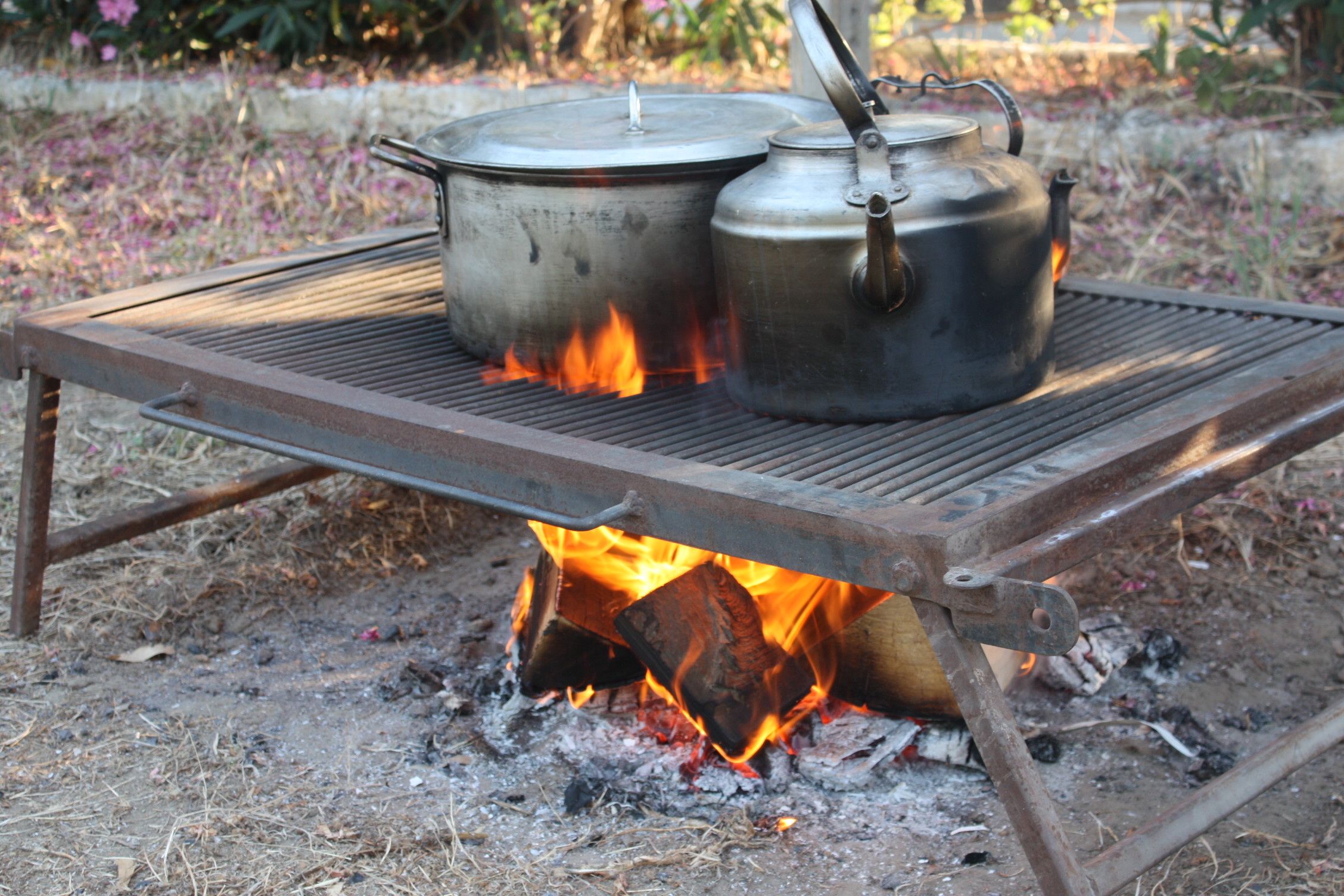
Lu builds a good fire.
Cooking was a bigger challenge there. We usually cooked over wood and the regular searches for timber made for some interesting stops. Each day, the cook group did its own shopping in the local market. Tomatoes and onions were the only items we could almost always get. We had a budget—which varied depending on the country we were in—and we were expected to stay within that budget. If we overspent, we had to pick up the tab ourselves. We did that sometimes as a treat or a mistake—not always easy to add up in your head.
I remember a lovely episode in Marrakech, although I’m no longer sure whether this purchase was within budget. A young fellow approached us selling gorgeous-looking macaroons. ‘Buy my macaroons,’ he whined. I hate whining kids so I said, ‘No, no, you mustn’t whine. You should say, “Please madam buy my delicious macaroons?”. Go on,’ I said. ‘Say it.’ He was skeptical but finally repeated what I suggested. So I replied, ‘Okay, I’ll have 28’. He nearly fainted, then he jumped for joy. I’d bought his entire stock. I often wonder if he’s still using his pleasant sales pitch or if he’s reverted to whining?
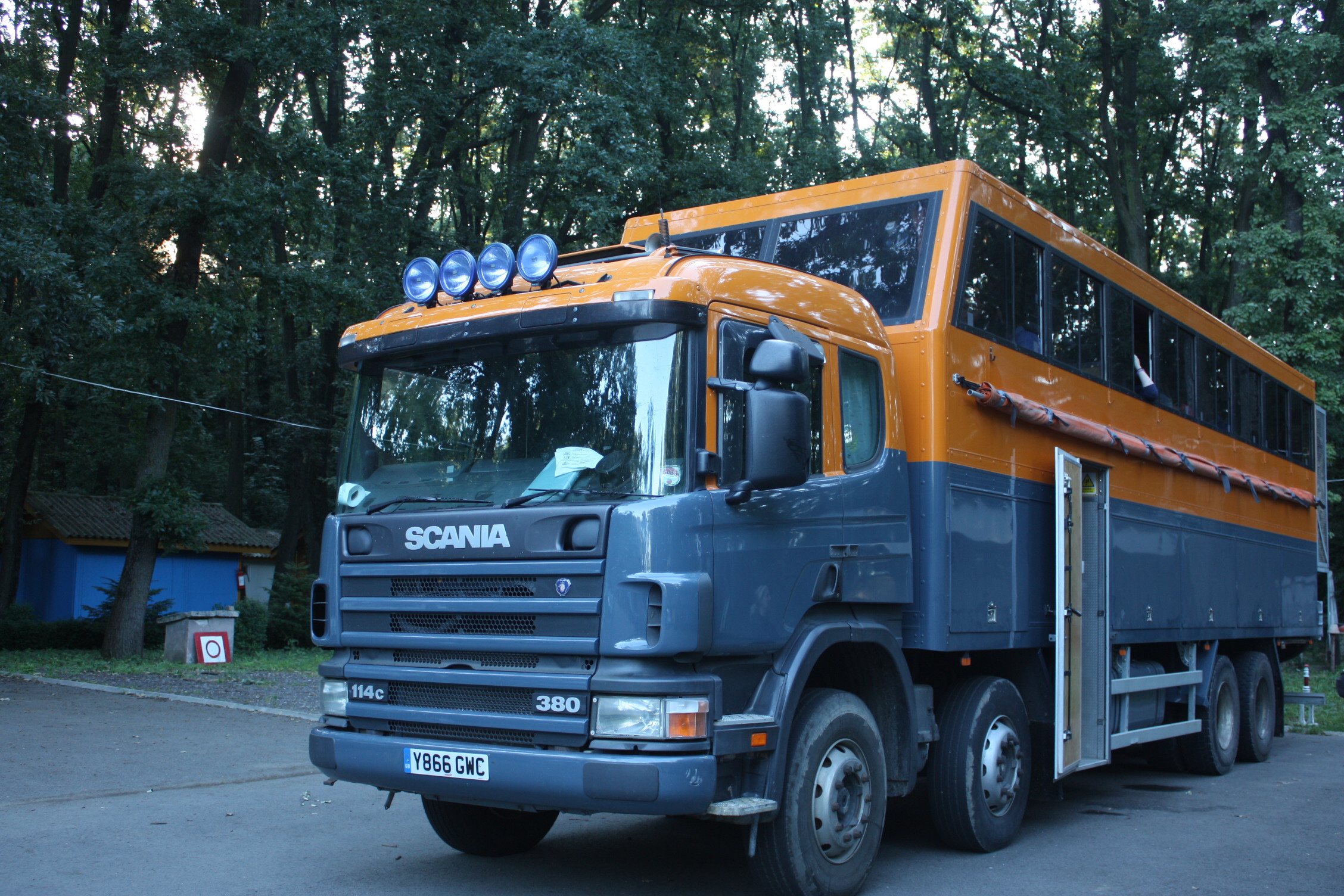
Our overland truck—the Monster.
Meet the Monster—our overland truck. She’s a 2001 Scania that started life with Hanson UK, the main supplier of heavy building materials to the UK’s construction industry. So after a complete makeover that was completed in 2010, she’s gone from hauling rocks and gravel to being a chariot for adventurous travellers.
She’s huge—12.5m long (including the cab) and 4m tall—and powerful with 380 horsepower. Believe me, she has no trouble going uphill. She is an 8×4, so we should be able to manage very well off-road. There are seats for 40 passengers (although we will only have 23 for most of this trip), with 10 large storage compartments below and small overhead luggage racks that go the length of the truck.
Some other detail. There are four axles, 12 tyres (plus two spares), two wood racks on the back, six sand mats (for traction), one 500-litre water tank and two 500-litre diesel tanks. Wil—please correct anything I got wrong.
This isn’t the Monster’s first overland, but it is the first time Wil, our driver and owner of the company, has taken her for a long spin. Not surprisingly, she draws a lot of stares whether we driving on the highway or through a small village. Our passenger seats ride so high that we look down into normal passenger busses and most lorries.
Off to visit Ephesus now. Will write more tonight.
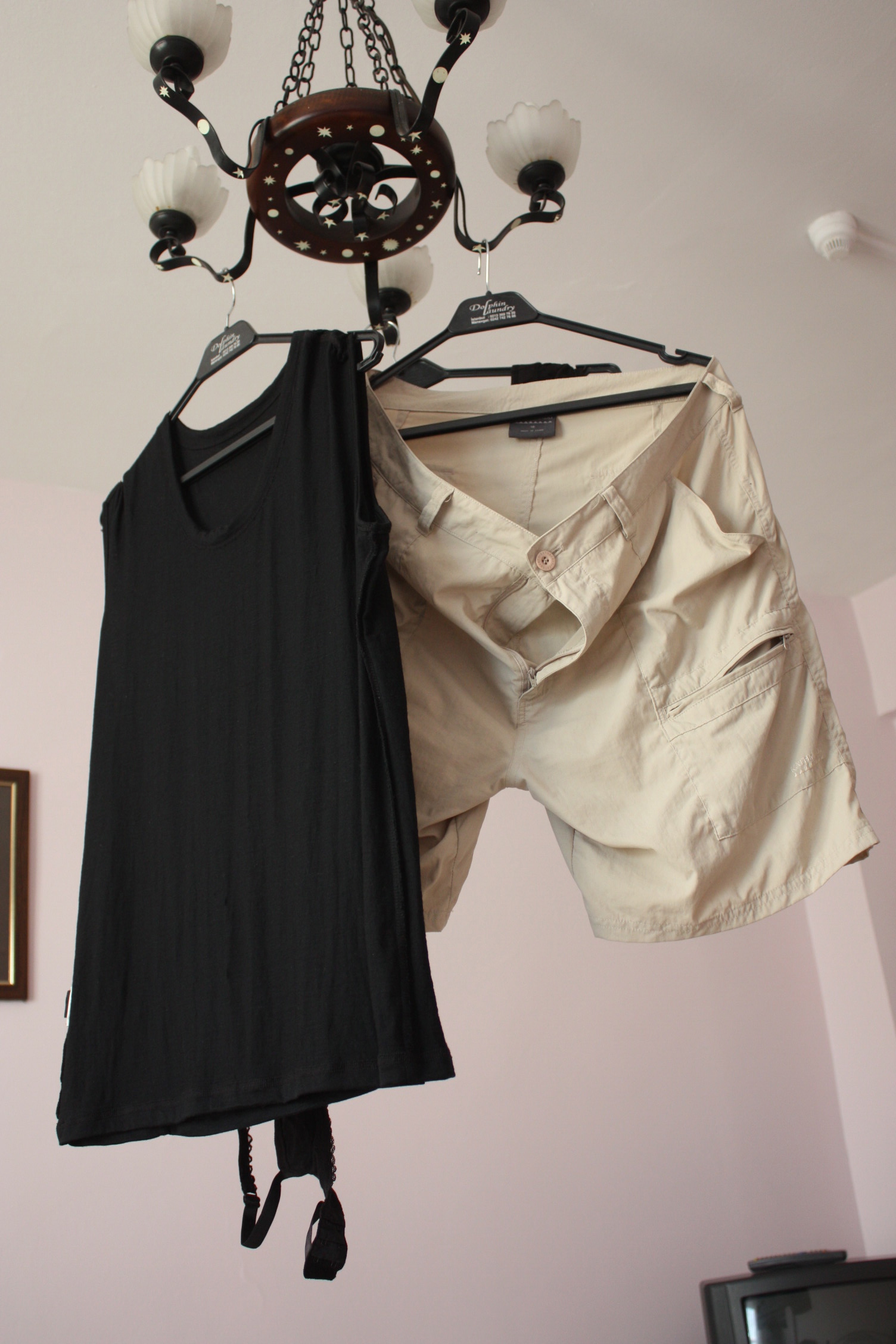
Drying clothes on a Turkish Hills Hoist?
I hate hand-washing. Give me a washing machine and a Hills Hoist (the fantastic Australian rotary clothesline) and I will do laundry for everyone in the neighbourhood—heck maybe even everyone on the truck. But I draw the line at hand-washing. It’s torturous busy work and I don’t have the patience needed to get everything even remotely clean. But I’ve been rather proud of myself in Istanbul.
It all started when we upgraded to a room in the hostel! I know, I know. A room is not roughing it. It’s not camping. But the truck can’t drive into the city centre of Istanbul, so it was a choice between a room or a spot in a 30-bed dorm room.
Fortunately, in this hostel—the Orient near the Blue Mosque—getting a room means getting a shower too. So I decided I’d multi-task and wash my clothes while I took a shower. In a rush of enthusiasm, I did this three days in a row. Istanbul was hot and we did plenty of outdoor sightseeing. So while my clothes weren’t really dirty, they were good and sweaty.
Easily remedied! I’d hop in the shower and strip off as I washed each item—rather like losing hands at strip poker but without the audience. And I cleverly used the soap dispenser in the shower as my ‘laundry soap’.
Having washed the clothes the challenge was to get them dry. Also easily solved. There were few hangers in the room and a handy ‘chandelier’, which I prefer to think of as a Turkish Hills Hoist.
This talk of laundry reminds me of doing washing in Ouagadougou (pronounced wa-ga-doo-goo), the capital of Burkina Faso in West Africa. That was another one of the rare times we took a room. I scrubbed everything furiously and hung it all out the back of the hotel—almost every hotel in Africa has a clothesline out the back.
Later that evening Poor John went to bring in the wash. He returned with most of it, but said my shorts and hat were still quite wet. I went to check—thinking they must have fallen off the line into the dirt, and that someone had rinsed them and re-hung them. While I was inspecting the two wet items, the hotel’s all-rounder popped around the corner. Earlier that day, I’d seen him mowing, pruning, trimming, sweeping and all sorts of odd jobs around the hotel. We had the following exchange in French.
Him: Your clothes, madam?
Me: Yes.
Him: I noticed they weren’t very clean, so I washed them again.
I’ll bring them to you when they are dry and after I have ironed them.
Me: (Hell’s bells! What could I say but ‘thanks’.)
Moral of the story: Not only do I hate hand-washing—I’m bad at it.
I’ve decided to compile a series of tips for international travellers. I have no idea yet how many tips there will be, but I’ll post as things come to mind—usually in batches of three. Here are the starters.
1) Take a head torch and spare batteries—and carry them with you. This is essential advice—that’s why I put it first. Trust me. Someday the power will go out in your tent, a hotel room, a restaurant. Or you’ll be blundering around in a taxi searching for a lost wallet, lighter or contact lens. Take the damn torch, even if you are travelling in your own country. You’ll thank me for it. Oh, and try not to shine it in everybody else’s eyes.
2) If you have a new-ish Australian passport, cover it in plastic wrap, put it in a plastic bag and dress it in a raincoat. You think I’m joking? Heck no. This is more essential advice. The new passports bleed. They bleed a lot and the ink runs all over your bad mug shot—making it even worse, if that’s possible. We learned this last year the hard way—in Indonesia—when we were caught in a sudden downpour which left us standing in ankle-deep water. Poor John’s passport was a mess. He wasn’t waving it around in the rain. It was in his pocket in his shorts, but what a disaster. Indonesian immigration wasn’t very impressed when we left the country, but Poor John promised them he’d get a new one. Imagine his surprise when he trundled into the Passport Office to ask for a replacement and to show them what a dodgy product they had, and THEY told him off for getting it wet! And then they charged him for a new one. Oh pleeze. These things happen when Australians travel. These things happen when anyone travels! I think it’s appalling that an Aussie passport cannot withstand a bit of rain, even a lot of rain. Just because we’ve had a drought for 10 years is no excuse for their lack of beta testing. My older passport survived that same storm just fine! Okay, I’ll get off my soapbox now.
3) Take a roll of duct tape—seriously. It took me about 40 years to figure out that duct tape (AKA electrician’s tape) is one of the most useful items on the planet. A few years back I came across an insightful and hilarious website on the uses of duct tape. I can’t find it now. Let me know if you do. And one of these days I’ll tell you about the university dance at which a mere six inches of duct tape might have kept me from being the spectacle of the night.
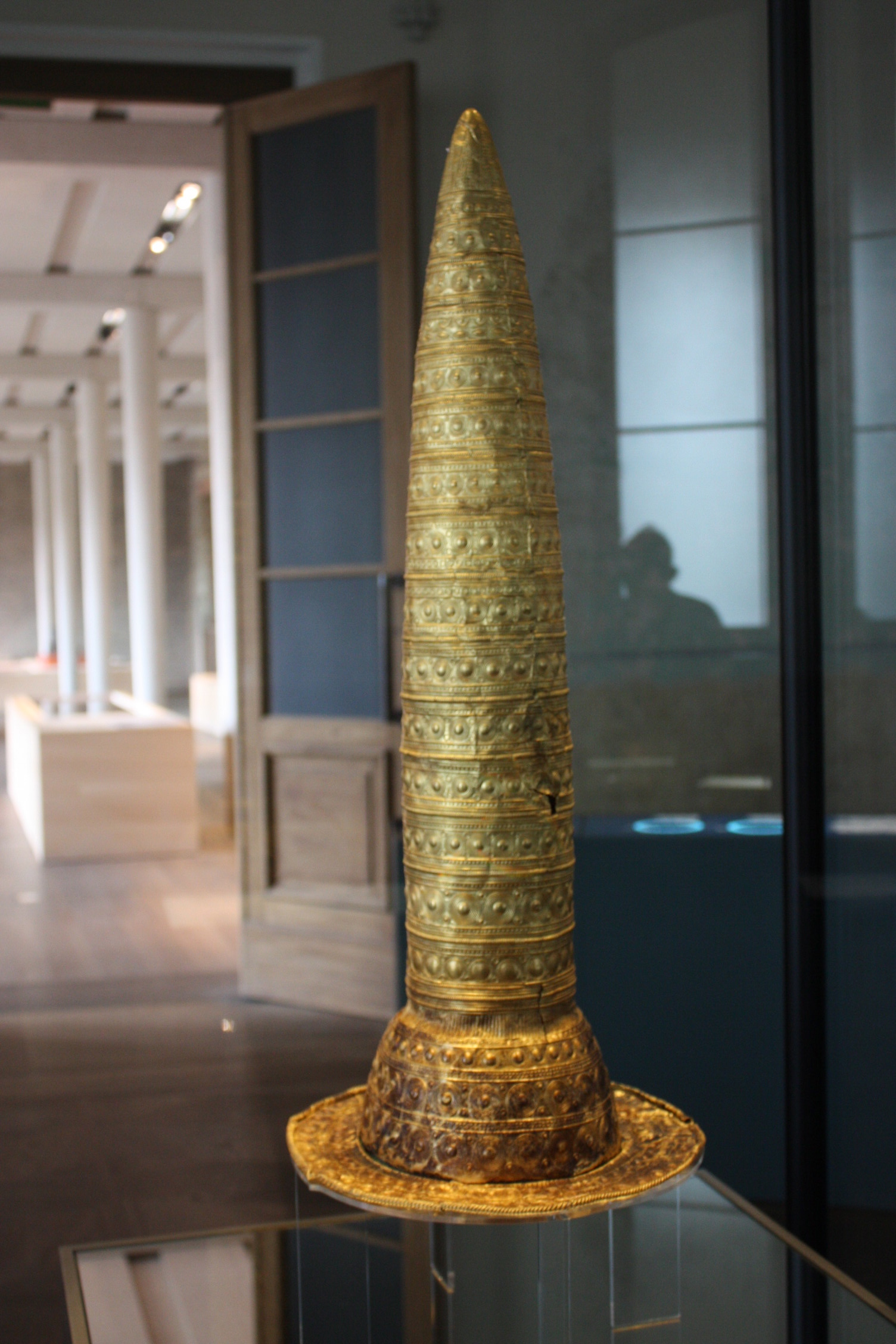
The Berlin Gold Hat in the Neues Museum.
Another Neues Museum treasure is the Berlin Gold Hat. This Late Bronze Age artefact is displayed in a room by itself (like Nefertiti) and is accompanied by an elaborate array of descriptions.
This is the best preserved specimen of the four known conical golden hats—all from Central Europe. This one was found in Germany. Hammered from a single piece of gold alloy (a mix of gold, silver, copper and tin), the hat stands 475mm high and weighs almost half a kilo (one pound). The average thickness is a mere 0.6mm. The amount of gold used would form a cube of only 3cm.
It is generally assumed that the hats served as the insignia of deities or priests. There is also a view that the hats had an astronomical and/or calendrical function.
Museum nuts should also see the entries on Nefertiti, the Neues Museum and eyes (all in the German category).
I was fascinated by the display of eyeballs at the Neues Museum in Berlin. Okay, it’s sort of creepy, but still intriguing.
The display—part of the Egyptian collection—says that the oldest examples of artificial eyes came from Mesopotamia in the 5th millennium BC. Those were just eyeballs, without irises or pupils. About 100 years later, the Egyptians perfected painted and inlaid eyes. The pictures show a variety of eyes and some of the tools. The museum explanations didn’t say how old any of the materials are.
I have to admit that I may be more interested in eyeballs because my gran (dad’s mum) had a glass eye. Can’t remember which eye—nor how she lost it, but I’ll never forget her collection.
She cared about her appearance and wanted everything ‘just so’. As a result she had a box of about 10 glass eyes, in varying shades of blue. She lived with us in the last years of her life and I well remember her coming out each morning, asking one of us kids to tell her which eye ‘best matched’ her good eye that day.
Museum nuts should also see the entries on Nefertiti, the Neues Museum and the old hat (all in the German category).
The Neues (New) Museum is on Berlin’s Museum Island and it isn’t really that new. Designed by Friedrich Stüler and built between 1843–55, it was severely damaged by bomb blasts during World War II. No steps to safeguard the structure were taken until the 1980s. An international architectural competition followed and in 1997 the British architect, David Chipperfield, was commissioned to re-create the building. Construction began in 2003 and, after 70 years, the museum finally reopened to the public in 2009.
It’s an impressive building—with a creative mix of old and new. It houses old items—such as the Egyptian Museum and Papyrus Collection (of which Nefertiti is a part) and the Museum of Prehistory and Early History with objects from the Collection of Antiquities.
The picture gallery shows a selection of exhibits and one of the window-washers.
Museum nuts should also see the entries on Nefertiti, the old hat and eyes (all in the German category).


Bet you didn’t know toilet paper is evil. It’s a troublemaker, just like our dogs, Aggie and Chiyo. It looks innocent enough but it can cause all sorts of mayhem.
You don’t believe me?! You say you’ve been taught to chuck that paper in the loo/dunny/toilet and flush it away to the sewerage system of the gods. Let me tell you that you’ll have to change your habits if you travel to Eastern Europe, Africa and much of Asia.
I’d forgotten the don’t-put-toilet-paper-in-the-toilet rule. The first time I learned it was in the 1970s in the Middle East. Over the years, I’ve been reminded of it many times—in Southeast Asia, in Africa and now again in Turkey. We’re staying in a hostel in Istanbul and here’s the sign posted in the loo next to the bar/restaurant.
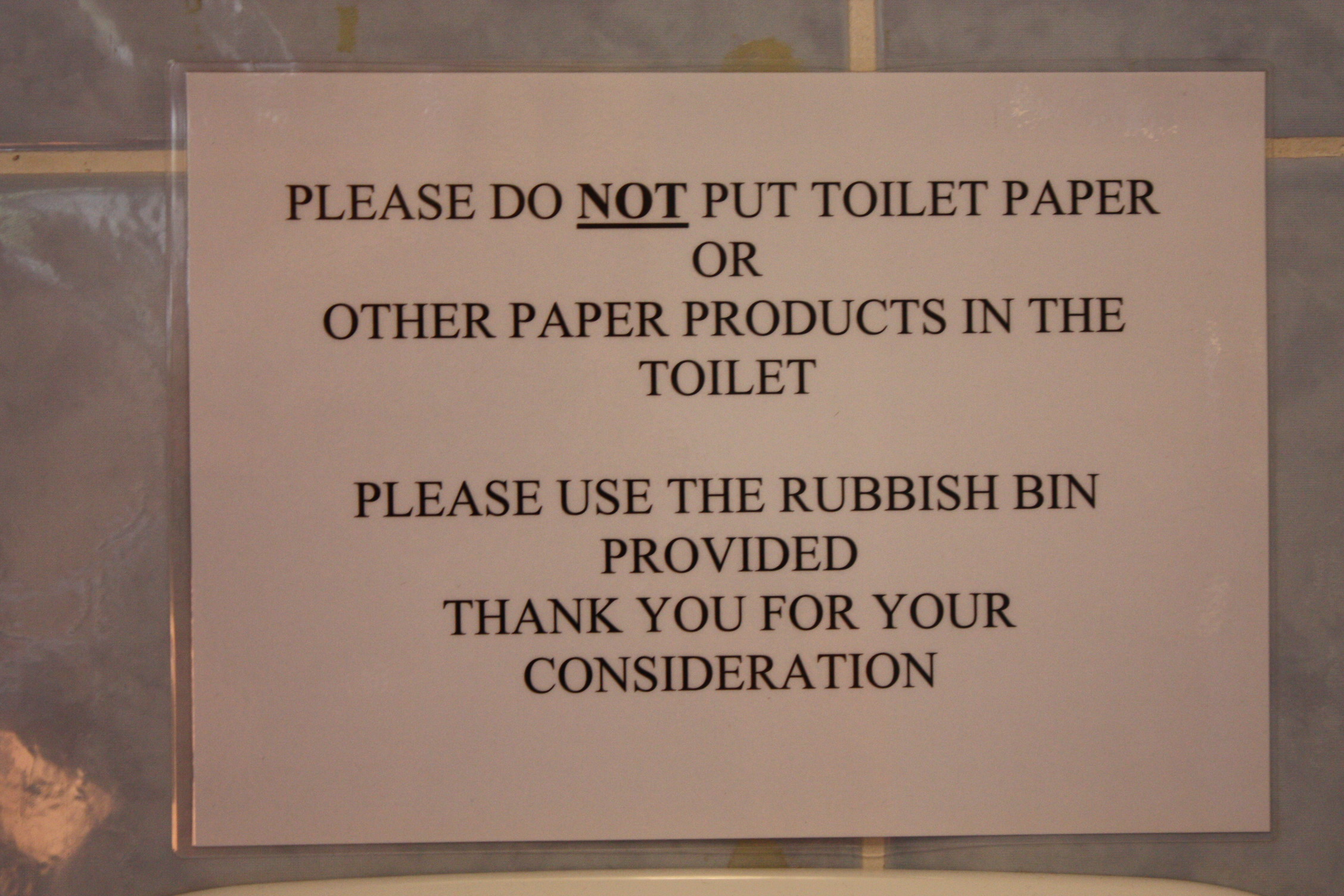
Instruction sign in Istanbul—don't throw toilet paper in the toilet.
So what’s the problem? The systems just aren’t able to cope with all that paper, or any paper for that matter. It clogs everything up and nobody can flush anything. It’s the worst possible outcome—a toilet that should flush but doesn’t.
But before you get all twitchy about disposing of that paper—whatever it may hide—in the bin, remember that in most places the bins are emptied regularly. So there’s no need to be embarrassed AND there’s even less need to ignore the signs. Or do so at your peril.
Think about it. If the three people who ‘go’ before you all ignore the signs and then you do too, you might just be the one to have your feet literally in the do-do.
Ahem—or should I say Amen.
Many of you have asked for more detail about the trip AND a map. Here’s both. Click on the map to see a larger version.
It’s the 24-week Explorer Overland Truck Trip offered by a company called UK to OZ. Next year the trip will be 26 weeks, but who’s counting. Here’s a link to their website—www.uktooz.com.
The map isn’t 100 per cent accurate. In addition to the countries noted, the truck went through Belgium and Luxembourg and will go through Kazakhstan (just north of Kyrgyzstan). As of 8 July we are in Istanbul, Turkey. We start heading further east in two days.

London to Sydney—map
The journey began with 18 on board, plus Will, our driver, and Lu, our tour leader. Poor John and I joined in Salzburg, Austria. As part of our search for visas, we were already halfway across Europe and realised it was silly and costly to backtrack to England. Toni (a German) joined us in Istanbul. Lene (a Norwegian) will join us in a few days and another fellow joins at the end of July.
The fact we are travelling ‘overland’ all the way to Australia raises a few eyebrows. Obviously we can’t drive ALL the way. We’ll take a ferry across the Caspian Sea from Azerbaijan to Turkmenistan. We’ll take another ferry from Singapore to Indonesia, and a flight from Bali to Darwin in Australia.
Over time I will give more detail about exactly how we are managing all this. I’ll also gradually introduce my travelling companions, but I am thrilled to say we make up a very congenial group.
I’ll be jumping around a bit to bring my travel entries up-to-date. It will be a real catch-up effort. Good grief, I’m in Turkey and still haven’t posted about many places in Germany, Belgium, Czech, Hungary, Romania and Bulgaria.
I have another day with a reliable internet connection (I hope) and then several days on the road and bush camping. So expect a flurry of items on a variety of places.
 Where to next?