
Bison—beefing up their numbers in Nebraska
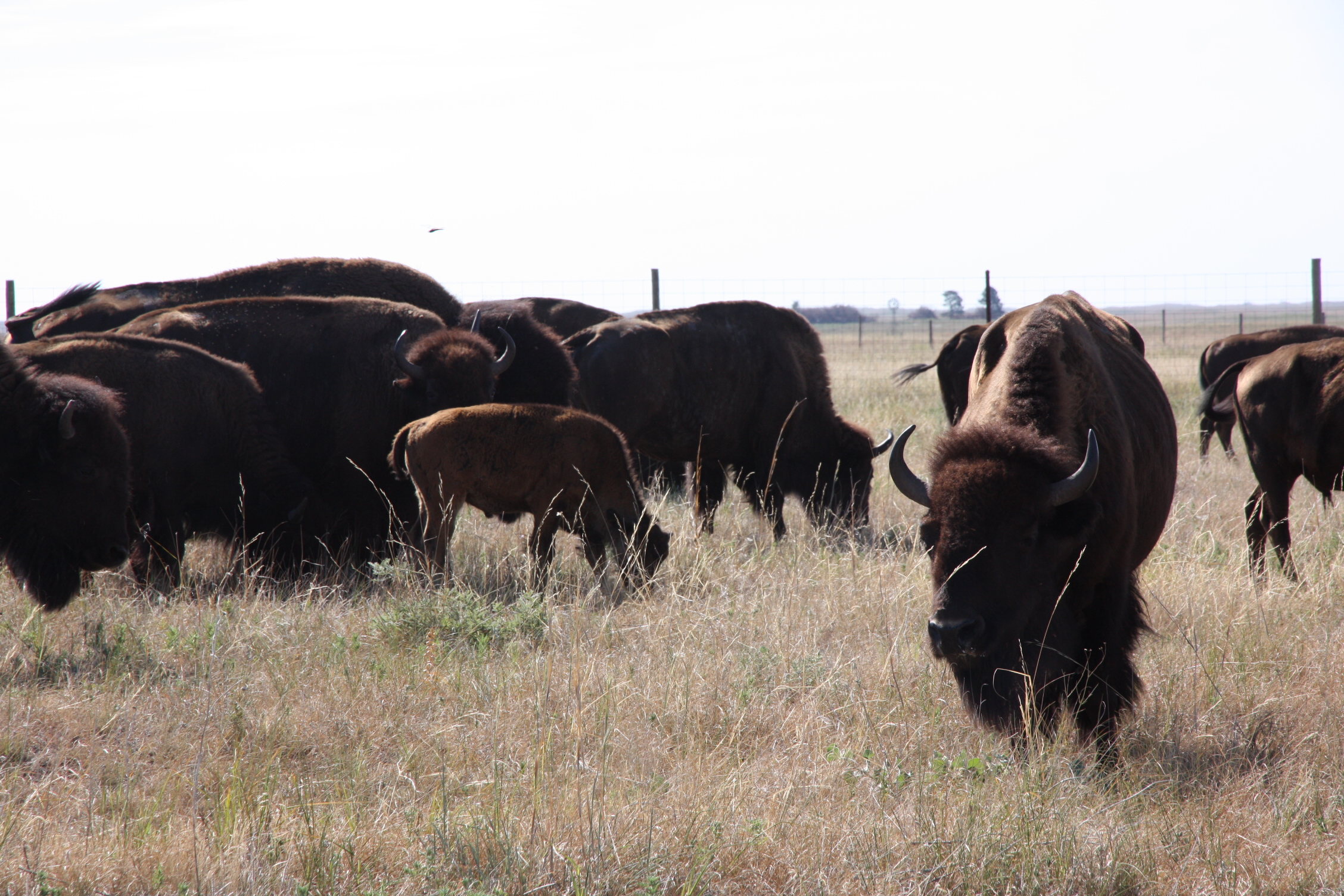
Bison at Fort Niobrara National Wildlife Refuge
Poor John and I were lucky enough to visit the Fort Niobrara National Wildlife Refuge when we travelled northwest across central Nebraska from Kearney to Valentine.
Established in 1912 by President Theodore Roosevelt, this 19,000-acre refuge is part of a national network of land set aside specifically for the preservation of birds, bison and elk. So far, more than 540 refuges have been established.

The Fort Niobrara refuge is doing its job. More than 230 species of bird are found there, along with 350 bison and about 100 elk. The Niobrara River runs through the refuge, bringing plenty of water and nourishment for all the ‘beasts’.
We saw a meandering herd of bison in the refuge. Based on what I’ve read, I think we were there in the mating season—June to August. The bulls weren’t showing signs of aggression, but they were with the herd. Apparently they are solitary during other months.
Bison were also featured at Woolaroc in Oklahoma. I’m pretty sure Woolaroc has some bison on site, but we didn’t see any on the hoof. But there’s an excellent display of information about the bison’s history and plight.


The bison info is heartbreaking. No one knows exactly how many bison there were before the main slaughter began in the 1800s, but estimates range from 30 to 200 million. Travellers in the Great Plains were always impressed by the numbers of bison they saw, and guesstimates reckon there were still 60 million in 1800 and 30 million in 1830.
Bison hides and bones were big business in the later 1800s and the biggest year was 1874, when more than seven million pounds of bones were shipped to eastern markets.
It makes me proud that Nebraska is doing its bit to keep bison on the planet. Oh, and we loved seeing the prairie dogs too.

Prairie dogs rule the Nebraska plains
 Where to next?
The amount of animals around before we stepped into the picture is astounding. In the 1980 I saw a Topi migration in South Sudan, there more that the wildebeest migration and around the same time there was a migration of small finches going north towards Egypt – the birds were a continual massive series of flocks overhead, all day. There must have been many millions of them
LikeLike
Oh Chris, you are so right. It’s impossible to imagine what the long-gone migration numbers must have been like.
LikeLike
My favorite part of prairie dog towns is the enhanced chances one will see burrowing owls standing on the rims of the prairie dog holes. Typically, these will be burrowing owl owlets waiting for a yummy grasshopper meal from the parents.
LikeLike
I’ve seen burrowing owls, but never in Nebraska. I’ll have to watch more closely the next time.
LikeLike
Another very nice story about Nebraska, Peggy! Great work as usual!
LikeLike
Thanks Dave. We were so pleased to see the bison.
LikeLike
I’m glad to see the bison back as well. Sounds like you had a great time.
LikeLike
I always like dragging Poor John to see something new!
LikeLike
It’s sad and shocking when you think about how many animals we have taken off this planet. Shame on humans! Good news for bison here, though 🙂
LikeLike
I was thinking of you as I wrote this. Your blog does such an excellent job of telling people about the plight of so many species.
LikeLike
Thank you so much, Peggy. I have linked your Bison article here to my American Bison post. It’s always good to be able to share good news. Love the title, BTW. ~ Amelia 🙂
LikeLike
Thanks Amelia.
LikeLike
FYI-
The Bronx Zoo within NYC played an important roll in the Bison’s recovery….In the early twentieth century, the American Bison Society—originally founded at the Bronx Zoo—reintroduced bison to reserves in the West. This saved the species from extinction.
http://tinyurl.com/m7msgt6
The Wildlife Conservation Society- In 1907, 15 Bronx Zoo bison boarded railway cars and wagon trains headed for Oklahoma’s Wichita Mountain Preserve. These early pioneers were charged with an historic mission: to help the American bison recover on the Western Plains.
SyS.
LikeLike
Oh wow, Sy, I had no idea about the society’s link with the Bronx Zoo. Thanks so much for sharing this info. I love the Bronx Zoo and remember going there for the first time as a very young child.
LikeLike
If you happen by there again check out nearby Smith Falls State Park, the largest waterfall in Nebraska (being used to Yosemite waterfalls it’s tiny, but nice to have something). And if you get to western North Dakota the bison there are numerous and seem to be in a very natural environment rather than a preserve.
LikeLike
Thanks for these tips. Poor John and I hope to spend a Northern Hemisphere summer touring national and state parks in the USA.
LikeLike
Very nice, Peggy! Still today tourists visiting Bison herds get too close for comfort, comfort for the Bison and ultimately the tourists as Bison are wild beasts and do attack always by attempting often succeeding goring tourists using their horns backed up by their considerable strength.
One interesting challenge to Bison preservation has been decades of inbreeding by these isolated herds along with purposeful and accidental cross-breeding with cattle. Today there is an effort underway whereby Bison exchanges between herds are taking place in order to as close as possible purify those remaining herds. These efforts by humans were unfortunately started too late resulting in possibly no pure bred Bison remaining from my understanding. Surviving Bison numbers after their 19th century slaughter were estimated to be 541 in all of North America, survivors were artificially bred by ranchers using cattle, I suspect Black Angus, in the late 19th/early 20th century to save the surviving species. Yellowstone National Park is home to the closest to pure bred herd remaining and is the largest herd at 4,000+.
Hard and so sad to imagine going from millions of these incredible animals to the brink of extinction. Today they are a tourist draw! Here in Denver there is a national wildlife refuge abutting Denver International Airport and it’s being studied whether a herd may safely be introduced to greet visitors as they arrive at a mile high. The last time this was considered was during the planning of the airport, then the proposed Bison herd was to roam on the 51 square mile airport grounds however the safety of departing/arriving jets was deemed more important!
LikeLiked by 1 person
Thanks so much for all that detail Dave. We saw bison in Oklahoma, too, and a heartbreak rundown of their slaughter.
LikeLike
I don’t know how I missed this post, way back when I was online more and following your posts, but thanks a lot for the post. I spent a week, now years back, camping in nearby Smith Falls State Park and definitely enjoyed visiting several of the refuges around Valentine. Thanks for the memories.
LikeLiked by 1 person
We’re back in bison country briefly, visiting family. Hoping to see bison tomorrow.
LikeLike