

Strolling up for a closer look at Bridalveil Fall
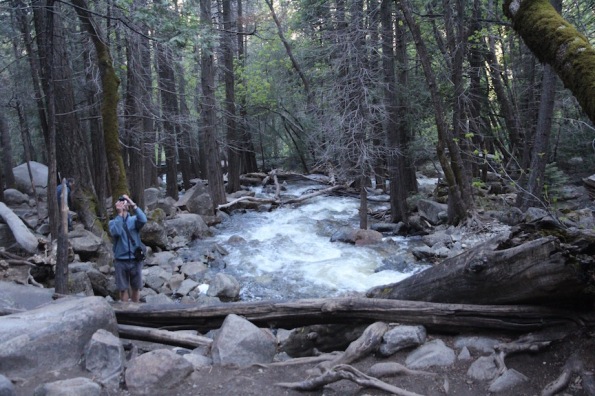
A river gushes below Bridalveil Fall
Our few days in Yosemite covered an array of activities, virtually all in the valley, which represents only about 1 per cent of the entire park.
After visiting the giant sequoias in the Tuolumne Grove, our next stop was Bridalveil Fall. This area is an important nesting site for black swifts and peregrine falcons. It’s also home to Mount Lyell salamanders. Of course, we didn’t see any of these. But we did have a lovely walk along the river created by the fall. Bridalveil is also slated for restoration, including new access paths, improved signage, upgrades to parking and restrooms, and improved viewing options.
From there, our next stop was the famous El Capitan, a prominent granite cliff that looms 3000 feet over Yosemite Valley. It is one of the most popular rock climbing destinations in the world because of its diverse range of climbing routes in addition to its year-round accessibility. Jordan, our guide and driver, pointed out a cluster of climbers who had most likely spent the night on the wall of El Capitan. Not my idea of comfy accommodation.

El Capitan, a granite cliff, looms 3000 feet over Yosemite Valley
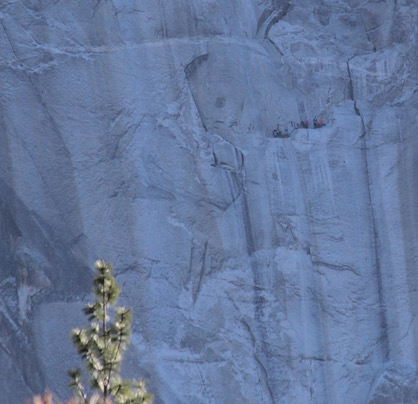
Can you see the climbers on the ledge in the upper right of the pic?
Many in the group were keen to hike the Half Dome, which proved impossible. The hiking cables weren’t out because of poor weather conditions. So they had to settle on hiking to Vernal and Nevada Falls. My hip said it would rather spend time at the visitor’s centre and doing some less strenuous walks.
I decided to save my energy for the next day with hikes around Cook’s Meadow Loop and to Mirror Lake (coming soon).

Although it looks like half the dome (on the right) fell off, it is virtually complete
How Yosemite came to be a park
There’s a small group of people we all should be thanking for getting the USA’s national park system going. Some were famous while others were doing their job or following their passions.
A few years after the first tourists first rode into Yosemite Valley, a group of concerned citizens lobbied to spare Yosemite, and especially the giant sequoias, from exploitation.
In response, California Senator John Conness introduced a bill to set aside the valley and the Mariposa Grove of sequoias for ‘public use, resort, and recreation…inalienable forever.’
That helped to kick things along and, in 1864 and in the midst of the Civil War, President Abraham Lincoln took time out to sign the Yosemite Grant into law. The concept of national parks was born.

President Roosevelt and John Muir
In 1890, Congress set aside more than 1500 square miles of ‘reserved forest lands’, which soon became known as Yosemite National Park. Yosemite Valley and the Mariposa Grove were added in 1906.
But creating a park was just the beginning. Someone had to look after it.
Galen Clark, who had explored Yosemite extensively, was appointed as the first guardian in 1866. He and his sub-guardian (I don’t know the name) worked tirelessly to protect, maintain and administer the grant, all on a combined annual salary of $500, which I learned was often not paid.
Revered as a host, guide and park protector, Clark was repeatedly appointed to this important position by different Boards of Commissioners. He was also a charter member of the Sierra Club.
Another figure was Frederick Law Olmsted. When the grant was sign in 1864, the governor of California appointed a volunteer board of directors to administer the park. Olmsted, a member of that board and a noted landscape architect, wrote a groundbreaking report setting out how the government should manage and protect the land for the benefit of the people. Considered too far ahead of its time, Olmsted’s report was quietly suppressed. Still today, his early guidelines serve as a model for national parks management and policy.
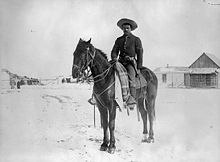
Buffalo Soldier, photo from Wikipedia
The Buffalo Soldiers played another important role. When Yosemite became a national park in 1890, there was no such thing as the National Park Service. Instead each summer from 1891 through 1913, the Presidio of San Francisco sent the US Cavalry to patrol three national parks—Yosemite, General Grant and Sequoia.
In the summers of 1899, 1903 and 1904, more than 400 Buffalo soldiers (African–Americans serving in the 24th Infantry and 9th Cavalry) were the sole protectors of these parks. They constructed the road to the top of Mt Whitney in Sequoia National Park and the park system’s first museum (an arboretum) in Yosemite.
Two other important figures were John Muir, a passionate advocate for national parks, and President Theodore Roosevelt. In 1903, Muir convinced President Roosevelt to visit and camp with him in Yosemite. At that time, Muir pushed to have control of Yosemite and the Mariposa Grove shifted from state to federal control. In 1906, President Roosevelt signed a bill that did exactly that.
Learn more
Yosemite has a much more diverse history than I can cover here. If you’re interested, use the internet or books to find out more about the geology of the region, how the indigenous natives (the Ahwahneechee) were displaced, the wildlife and habitats, management issues today, the affects of climate change and so on.
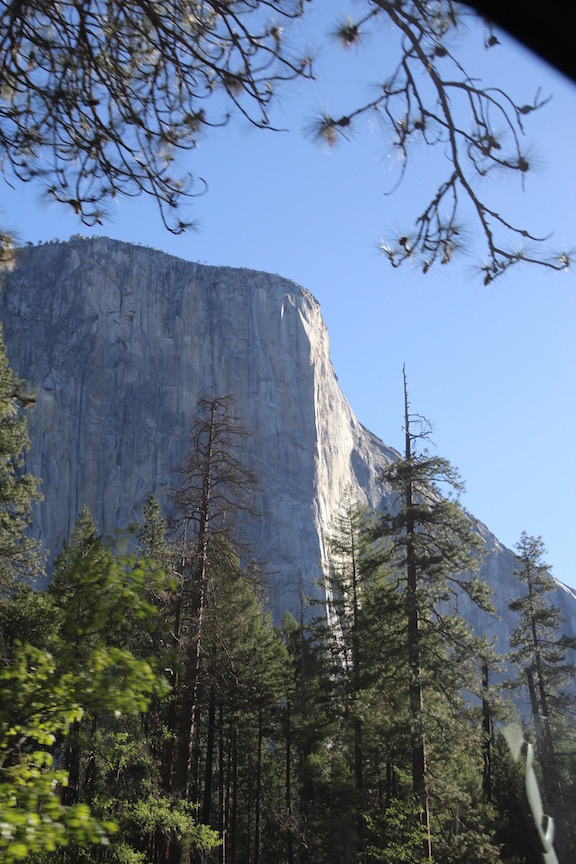
A more scenic view of El Capitan

One of about 25 mature trees in the Tuolumne Grove
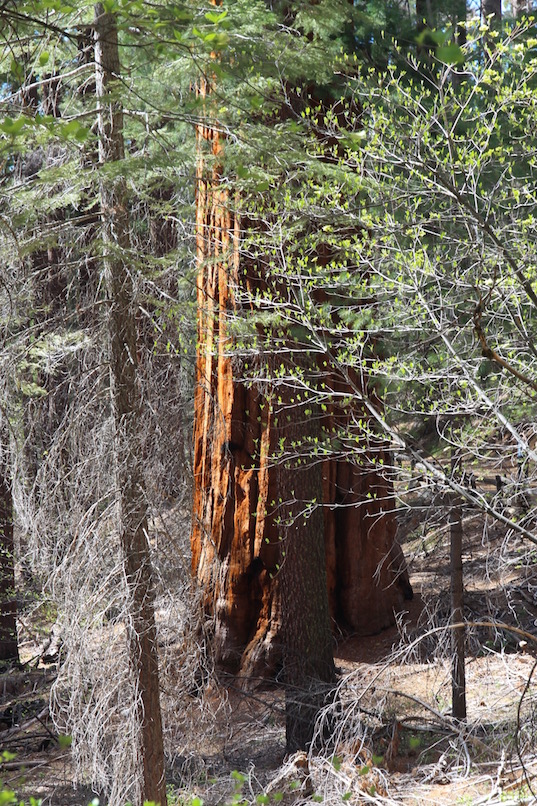
Sequoias can live to be thousands of years old
Jordan, our guide and driver for our 15-day tour of national parks, thought the giant sequoias of Tuolumne Grove were the perfect way to start out visit to Yosemite.
And he was right.
Toulumne is one of three sequoia groves in Yosemite, and has about 25 mature trees, all with their distinctive red wood. The other groves are Mariposa (closed for restoration work until June 2018) and Merced.
We checked out a slice of a huge sequoia that was cut down many decades ago. The timeline marked on the slice shows that the tree, when felled, was more than 2000 years ago, and the bark was more than one-foot thick.


We followed the path down what was the Big Oak Flat Road. It was one of the earliest tourist routes and, even though it was treacherous, it was popular with miners, ranchers and loggers.
Back then, sequoias covered an extensive range, but today they grow only in isolated groves on the western slopes of the Sierra Nevada mountains. To survive, the sequoias need moisture (mostly from winter snows) and periodic fires to reduce the number of competing species and open the forest canopy.


Jordan spotted two kinds of pine cones—one complete and one well munched by wildlife, probably squirrels. We even saw an ‘offending’ squirrel, as well as a deer in the distance.
We also had the chance to see the sequoia with a hole cut through the middle, and one that had fallen many decades ago.
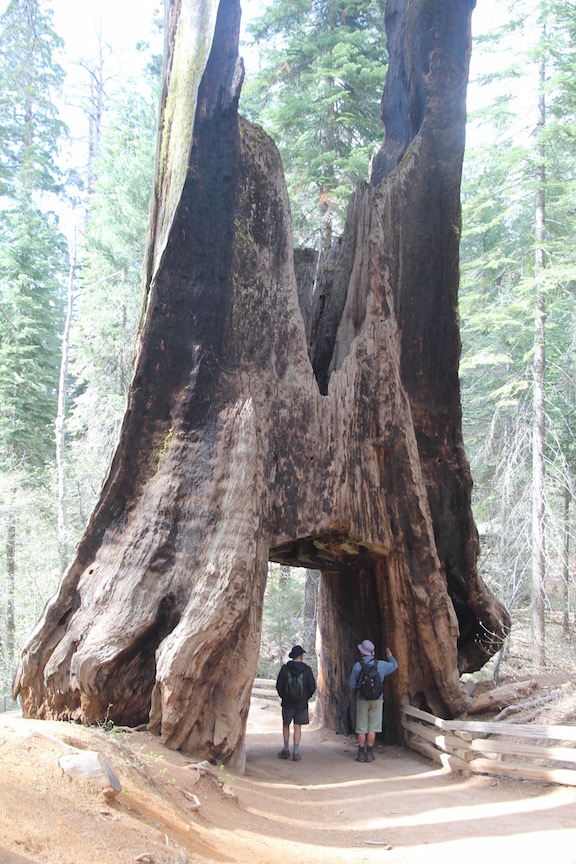
Poor John and one of three Peters on our trip stroll through the cut sequoia
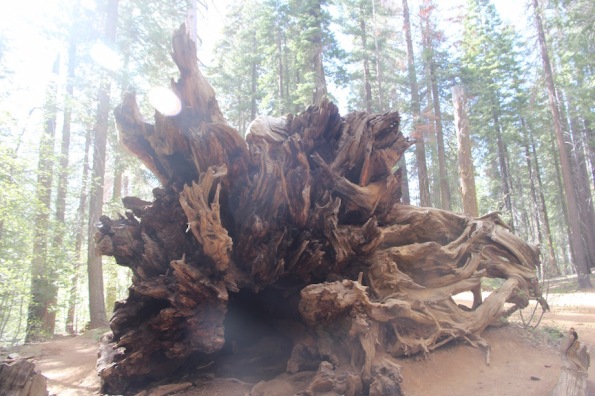
Felled sequoia. Photo by Peter Smith
In looking up information for this post, I discovered that the name sequoia was given to these trees by Austrian botanist Stephan Endlicher in 1847. He never explained why he chose that name, but the most common guess is that Endlicher, a linguist as well as a botanist, named the genus in honour of Sequoyah, the inventor of the first Cherokee writing system. I hope that’s true.
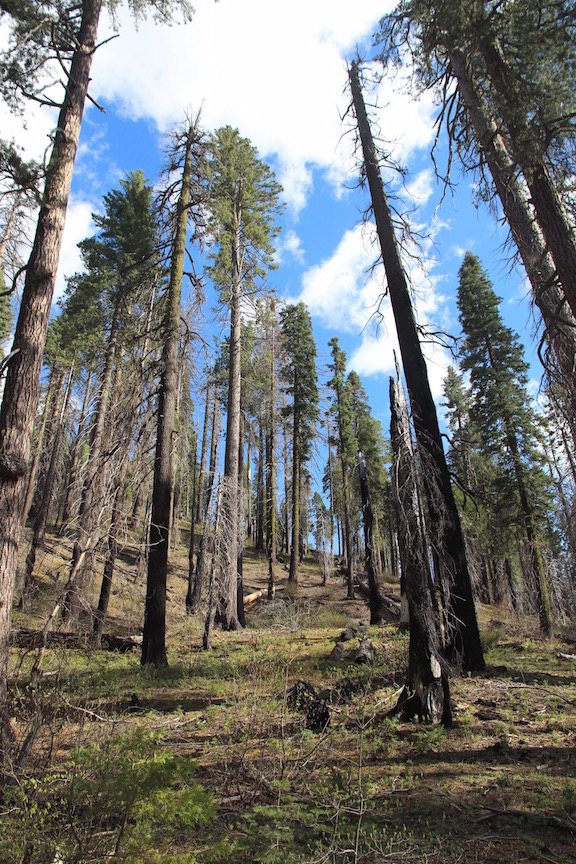
A variety of trees grow in the Tuolumne Grove.
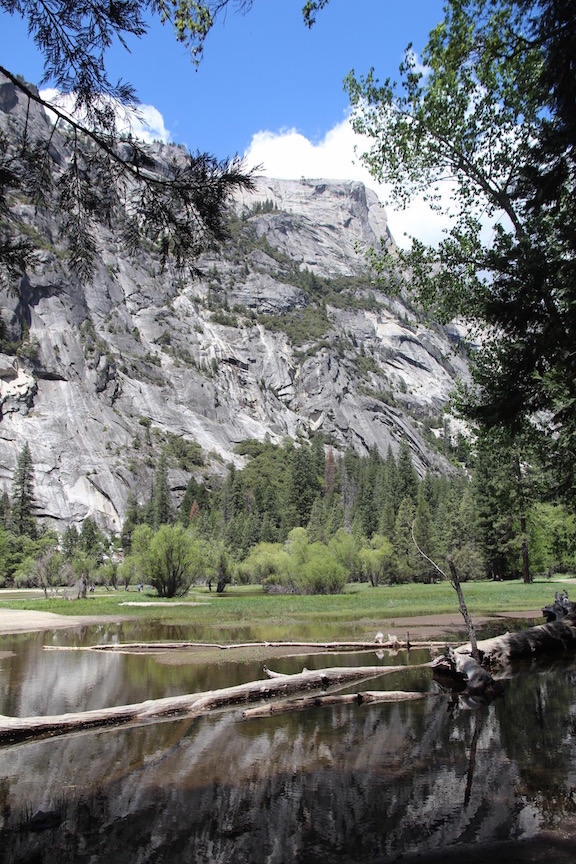
Mirror Lake is supposed to be a short, flat walk. We tried to do the entire loop, which is harder and longer, but found there was no way to get across the river, so we trekked back the way we came. Who cares when scenery is like this!
There’s hardly been time to catch our breath. We have had eight sensational days enjoying some of the USA’s most varied and stunning scenery and hospitality. We’ve hardly had a moment to spare, and certainly not a moment to write a decent blog post.
Sometimes we reach camp after dark. Then it’s set up tents and get dinner going. We’re taking it in turns to cook and wash up. Everyone puts up their own tent.
Mornings we’re sometimes up and piled in the van before 5:30am. Seriously, we’re afraid we might miss something.
So far we’ve visited an amazing collection of national parks in four states—Yosemite, Bryce, Zion and the Grand Canyon. There’s also been Death Valley, Glen Canyon National Recreation Area, Navajo National Monument and Monument Valley. Everything is gobsmackingly beautiful.
We’ve been on hikes galore, a 4WD road trip and a helicopter flight over the Grand Canyon. I’ve relished every minute, but I’m tired just thinking about it. Maybe you are too.
Tonight we’re in a motel (with wifi—yay!), so here are two pics from Yosemite to tide you over until I have the chance to write and share more.
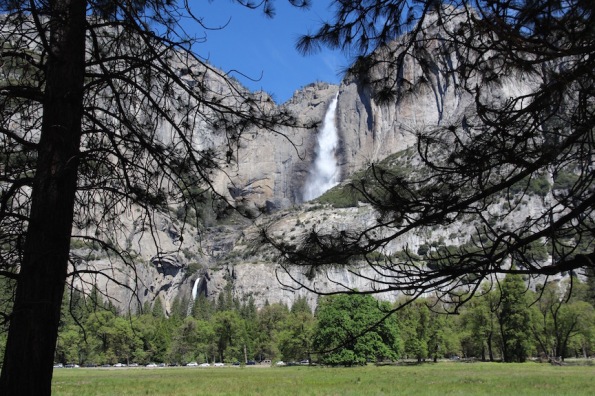
Yosemite Falls is North America’s longest waterfall (2425 feet). Lower Yosemite Fall is on the lower left.

The Cannery Row Monument was dedicated in 2014. Sculptures by Steven Whyte


Our tour of national parks doesn’t start until tomorrow, but that hasn’t kept us from sightseeing in northern California. We’ve had the good fortune to stay with our friends, Nona and Brad, in Mountain View, south of San Francisco.
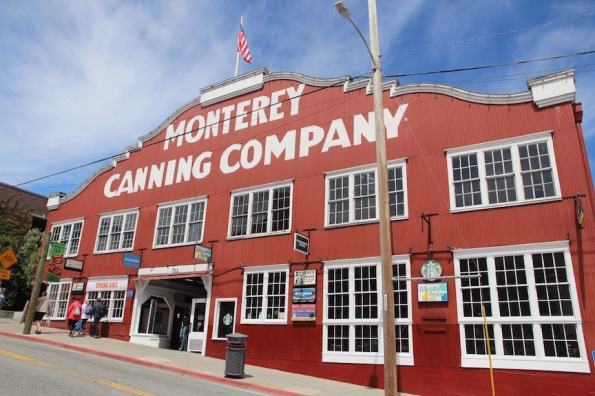
They love their slice of California and were keen to show us a couple of special spots we didn’t see the last time we visited them in 2009. Top of the list was Cannery Row in Monterey, almost 90 miles farther south. Another must-see was a roadside market that carries great artichokes when they are in season (like now).
Nona and I are both food nuts—we met many years ago through a cookery website—so it’s not surprising that our two stops would be food related.
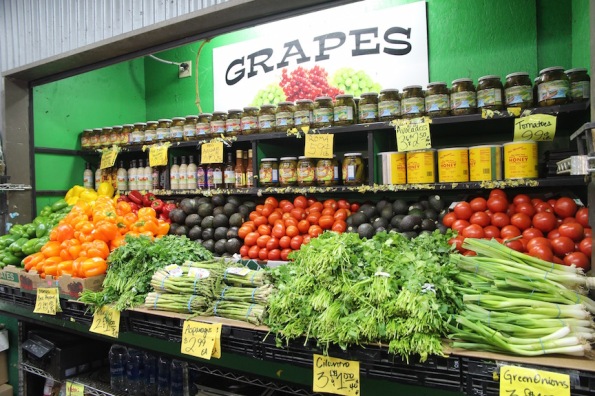
The market was first. I was delighted to see the wonderful range of produce—including the humorously named Shit items—and was especially impressed by the low prices.


Australians, are you ready for this? Two bags of carrots for $1, 10 artichokes for $1, three bunches of cilantro (coriander) for $1 and most chillies for $1.49 a pound. That makes the chillies just over $3 a kilo, which is incredible compared to the $18–$20 we sometimes pay in Australia. Strawberries were cheap and huge—two together were about the size of my fist.
We showed a little restraint and bought artichokes, strawberries and asparagus.

Then it was off to Monterey and the Cannery Row made famous in John Steinbeck’s classic novel, published in 1945.
It’s been years since I read the book. It’s set in Monterey during the Great Depression, on a street lined with sardine canneries. The story revolves around the people living there: Lee Chong, the local grocer; Doc, a marine biologist; and Mack, the leader of a group of derelicts. Steinbeck revisited the characters and location in 1954 in his novel, Sweet Thursday.
Cannery Row was originally called Ocean View Avenue, but was later renamed in honour of the book.


The Cannery Row monument
A large sculpture sits in a small park by the sea and commemorates Steinbeck and some of the people important to the history of Cannery Row.
Steinbeck sits at the top (sometimes with a seagull on his head). At the base is his good friend, Ed Ricketts, a father of marine biology who studied tide pools and sea life in Monterey Bay. Other figures represent Chinese fishermen, two ‘madams’ of the day and a group of entrepreneurs who helped to create Cannery Row as a tourist destination.
Steven Whyte made the sculptures. Closer views of Steinbeck (right) and Ricketts are below.
P.S. Along with some pizzas, we demolished the artichokes, asparagus and strawberries for dinner.
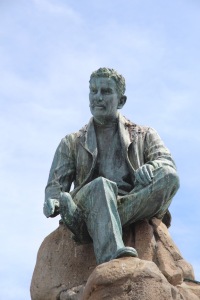
John Steinbeck
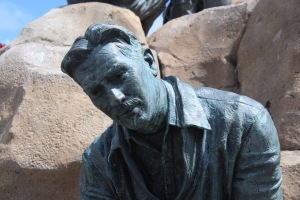
Ed Ricketts
 Once again, Poor John and I are sitting in Sydney’s international airport waiting for a flight to take us on our latest adventure. This time our destination is western and central USA, with a great program of national and state parks.
The first stop will be just south of San Francisco for a few days with friends and then off to Yosemite and 14 days of touring national parks in five western states. We have our sleeping bags and mats, and the tour company is providing the tents.
Then it’s off to Denver for another couple of weeks touring the parks in that beautiful state. We’re borrowing a friend’s Jeep, tent and other camping gear. We’ll finish off with a run to Nebraska to visit my family.
Not sure how much internet I’ll have, or when, but I’ll try to be around as much as possible. When I’m not here, you can be sure I’m photographing and collecting news for future blog posts.
Stay tuned.
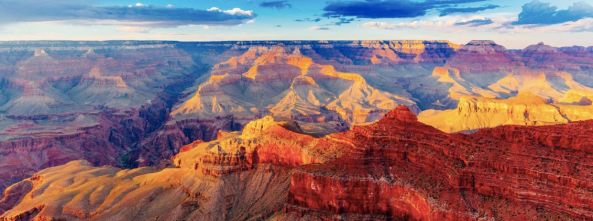
Thanks to GrandAmericanAdventures.com for the image.
Our growing season has ended, but it’s starting in the Northern Hemisphere. Time to get your bartering network organised.
A while back, Chloe brought me three wonderful chunks of quince paste that she’d made from fruit gathered from our venerable quince tree.
Quince always take me back to 1982 when I first arrived in Australia. There, in the middle of my new backyard, was a tree I’d never seen before. Turns out it was a quince and I suddenly had the challenge of figuring out how to use the fruit. In an effort to get on top of the abundance this tree delivered, I bought cookbooks only if they had a quince recipe.
About that time, I also enjoyed reading food-related newspaper columns written by Michael Boddy. One of his articles focused on quinces and gave me some local inspiration. I wrote him a letter about my quinces and more.
Imagine my surprise when he included that letter in the ‘Friends by Mail’ column in the first edition (July 1989) of his Kitchen Talk Newsletter. Actually I wasn’t that surprised, because he asked if he could use it.
Just so you know, I haven’t been thinking about that letter all this time. Yesterday, I was dusting one of our many bookcases and came across a ring-binder with all 20 issues of Kitchen Talk Newsletter. So I thumbed through and found the letter.
I decided share it here, because it covers a topic worth thinking about. Here goes.
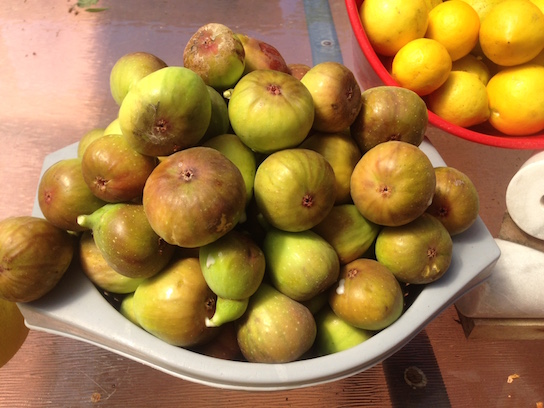
Ripe figs now cost almost $2 each. Ours are free.
———————————-
Australia’s balance of payment might look healthier if more of us returned to the barter system.
My first taste of Canberra bartering came a few months after we moved here in 1982, when we had the kitchen tiled. The tiler tore the sleeve of his coveralls and I stitched it up. A few days later, when it came time to pay him, he said, ‘Thanks for mending my coveralls. Better knock $10 off the bill’. I was stunned and thrilled. And it didn’t stop there. The tiler’s mum, who lives in Cooma, now gets some of our quinces every year.
Unfortunately, bartering is usually confined to the zucchini and tomato season. Anyone with a glut of fruit searches tirelessly to unload the bounty on others, who also usually have the same glut.
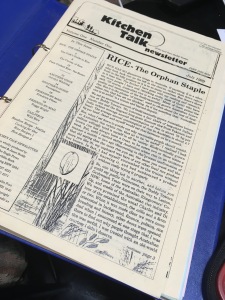
Kitchen Talk Newsletter, very first issue
To make the barter system work effectively, it’s important to widen your circle of friends to include anyone who’s got a glut different from yours. It’s even better if your garden produces some rare delicacy—the things that cost ninety cents each when you can find them at the market. In our corner of Canberra, we’ve combined both tactics with excellent results.
I must confess that our house came equipped with many rare desirables. The fig tree produces three abundant crops annually. They are the perfect variety for drying and make wonderful jam when combined with ginger and almonds.
In summer, friends cluster around this mammoth tree and eat the figs fresh. Sometimes I’ll arrive home to find a bag of tomatoes, capsicums (bell peppers), chilli peppers or zucchini plopped by the kitchen door and a note saying, ‘Thanks for the figs’. Once we gratefully received a lemongrass plant.
Quince lovers will trade almost anything for quinces off the tree. When our quinces travel to Cooma, jars of honey and quince jelly come back.
I’ve never tried making quince jelly. I stick to quince cheese. A rather Turkish Delight-type delicacy that takes forever to dry. Perhaps that’s because my batches, drying outside, are inevitably left out in the rain during at least one unexpected autumn downpour.
Nevertheless, the quinces and quince cheese have reaped wonderful returns of pears, kumquats, pumpkins, Jerusalem artichokes, tomatoes and zucchini.
I’m especially pleased about the Jerusalem artichokes. Never plant them in your own backyard—they’ll overrun the place.
And, by the way, never sit under a quince tree between January and April (Southern Hemisphere). Mature quinces are rather like coconuts, and I remember my husband once quoting some article that said falling coconuts were one of the major causes of death and injury in coconut-growing areas.
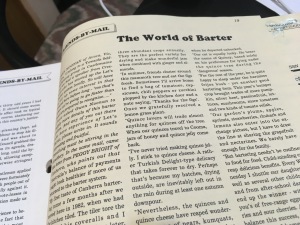
My article
We chanced luck this year by having a special luncheon under the quince tree in January. One guest was an ageing Australian literary figure. It was difficult to concentrate on the conversation while I envisaged a front-page newspaper article on this National Treasure being hospitalised after being bonked by a quince.
I willed the quinces to stay on the tree and nearly fainted with relief when he departed unbonked.
Our cat is equally lucky. He bears the name of Quincy, based solely on his preference for lying under the quince tree during the ‘dangerous’ season.
For the rest of the year, he is quite happy to sleep under the harmless feijoa bush—yet another good bartering item. This year’s bumper crops brought trades of more pumpkin, silver beet, passionfruit, lettuces, mushrooms, tomatoes and two kinds of tomato relish.
Our garden’s plums, apples, apricots, strawberries, rhubarb and lemons also enter into the exchange picture, but I have to draw the line at sharing grapefruit and nectarines. We barely have enough for the family.
But bartering needn’t been confined to food for food. Child-minding can reap delicious benefits. Every Wednesday I shuttle our daughters, as well as several other children, to and from after-school dancing. I end up the winner—with thank yous of free-range eggs, raspberries and sour cherries. And to help balance this success, I often send back a jar of homemade mayonnaise.
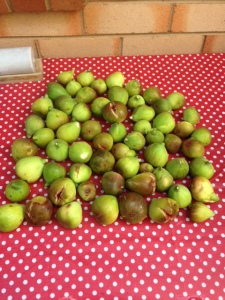
An abundance of figs
I guess that’s the key to happy, civilised bartering. No one ever really mentions money, or even suggests bartering. It just happens. Someone says, ‘I have this mountain of figs. Would you take some off my hands, please?’ A few weeks later, the happy recipient knows where to get rid of excess pears, or whatever.
A recent advertisement in The Canberra Times tickled me. Someone near Wamboin was advertising free firewood. Apparently there were a number of fallen trees, just waiting to be cut up and carted away. There was a phone number to call for directions and a footnote, which said, more or less, ‘Take as much wood as you like, just leave 10 percent of the take by the homestead’.
What style.
———————————
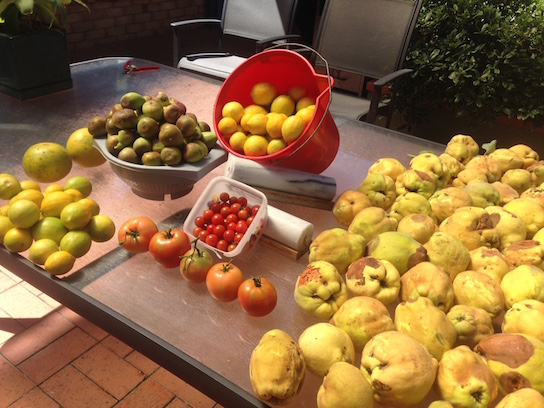
The pics here are from one of our bumper years. Graeme, who happened to be minding the house and dogs as we travelled, harvested the bounty and let everyone know to collect what they wanted from the picnic table in the backyard.
Over the years, we’ve lost a few bargaining trees. The apricot and apple went during some renovations, and the nectarine keeled over. There’s a replacement peach tree.
P.S. I’m decluttering. Does anyone in Australia want my collection of Kitchen Talk Newsletters? If I need to refer to them again, the National Library holds a full set.

Two sizes of tomatoes on offer. Damage on the quinces (at right) is caused by greedy cockatoos.
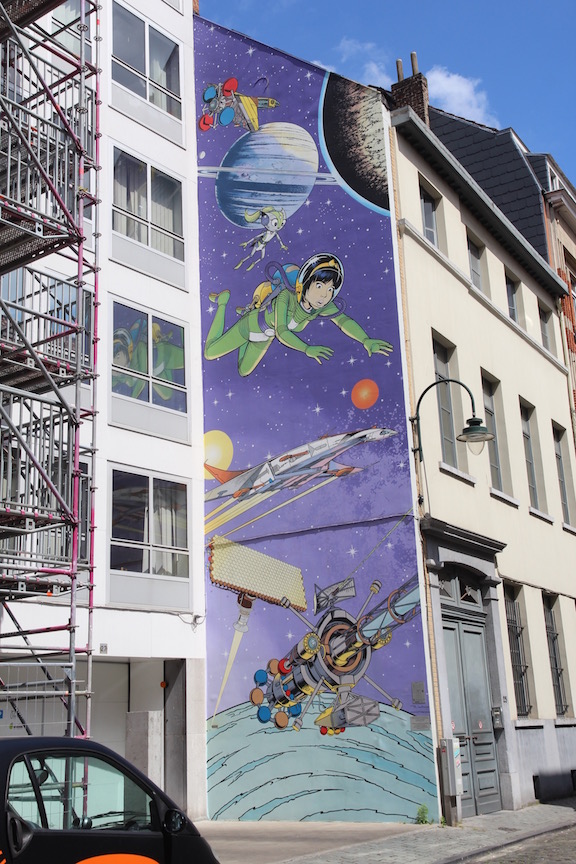
1. Yoko Tsuno by Roger Leloup
We visit Belgium regularly—it’s part of our family’s culture. Eighteen years ago, our daughter, Petra, spent 12 months as an exchange student in the Ardennes (in the south of the country). That same year we welcomed Jean-Mi from Brussels, the first student we ever hosted (the 30th student is with us now).
Jean-Mi has returned to Australia several times and we like to reciprocate. It’s great to visit him and his partner, Sali, as well as their children. Two visits ago, Poor John even taught Samuel how to walk with his hands behind his back.
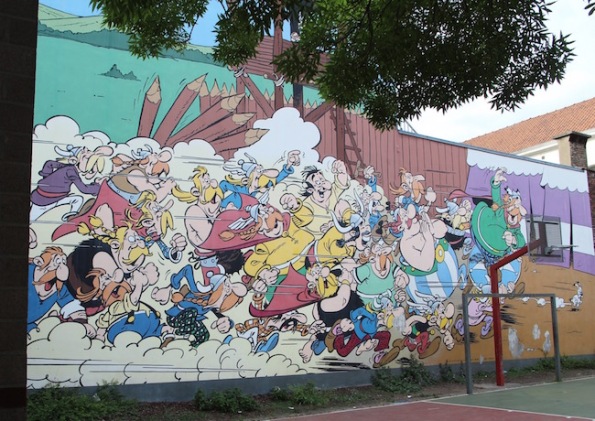
2. Asterix written by René Goscinny and illustrated by Albert Uderzo
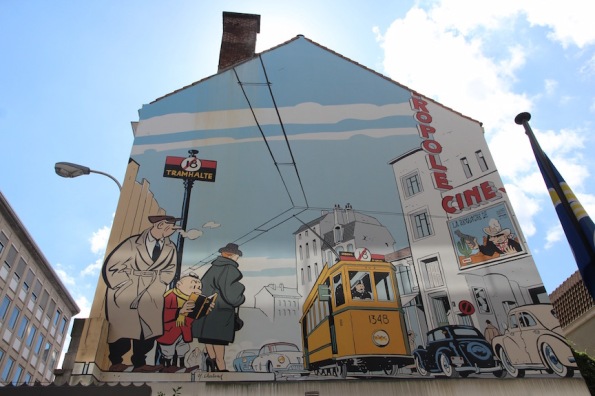
3. Young Albert by Yves Chaland
Every time we’ve been in Brussels, we’ve meant to visit some of the city’s wonderful comic strip heritage. In fact, Brussels often describes itself as the Capital City of the Comic Strip. Several museums, galleries, markets, festivals and specialist stores are dedicated to comic strips. And then there are the murals showcasing the characters and creators of famous comics.
It all started back in 1991, when the Belgian Comic Strip Centre (I’ll take you there in another post) collaborated with city authorities to begin a project in which blank walls within the city would be adorned with giant murals of comic book characters.
The goal was to showcase Belgium’s deep history with comic strips, including their famous Adventures of Tintin and Lucky Luke, and also feature work by other important international cartoonists.
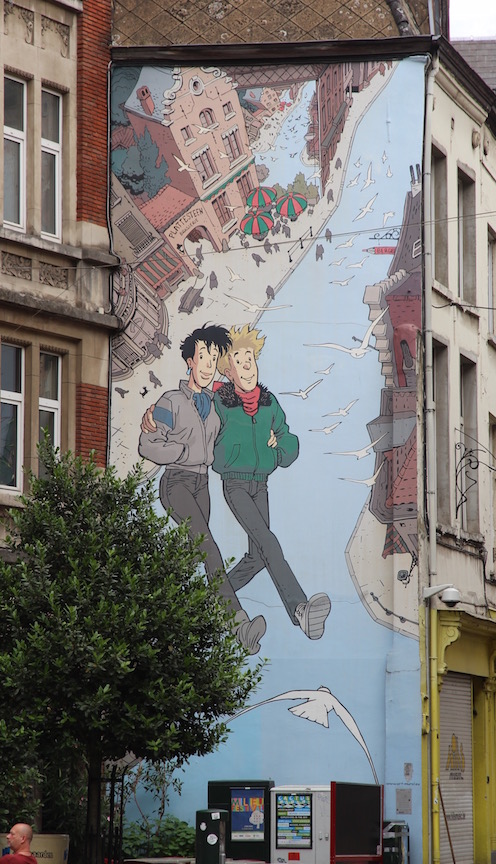
4. Broussaille by Frank Pé, the first mural painted in 1991
Broussaille was the first comic book wall to be painted. Based on an original project by Belgian comic book artist Frank Pé, the mural covers 35 square metres (380 square feet).The Belgian association «Art Mural» executed the painting, which was inaugurated in July 1991.
In the beginning, there was no plan for a walking tour. That came about because Brussels is fairly flat and easy to walk, and people loved the murals and wanted to see as many as possible.
I’d known about the comic art since our first visit to see Jean-Mi in late 2000. The walls of his Metro station at Stockel are decorated with life-size scenes from the Adventures of Tintin—and they aren’t even part of the street art.
Today more than 50 comic murals grace the walls and gables of the city centre, the regions of Sablon-Marolles and Laeken-Heysel, and beyond. There are some statues of comic characters too.

The Adventures of Tintin in the Stockel Metro station


So on our most recent visit to Brussels, Poor John and I popped into the tourist office and bought a comic strip map (1 euro) and set out to visit as many murals as we could on foot (plus we raced around to Stockel to get some pics of Tintin in the Metro station). On this trip, we saw 15 murals in all. I haven’t shared photos of all of them because some pics were fuzzy and two murals were spoiled by graffiti. 😦
By the way, I’ve read that «Art Mural» paints two to three new works per year, so I look forward to exploring more murals on our next visit.
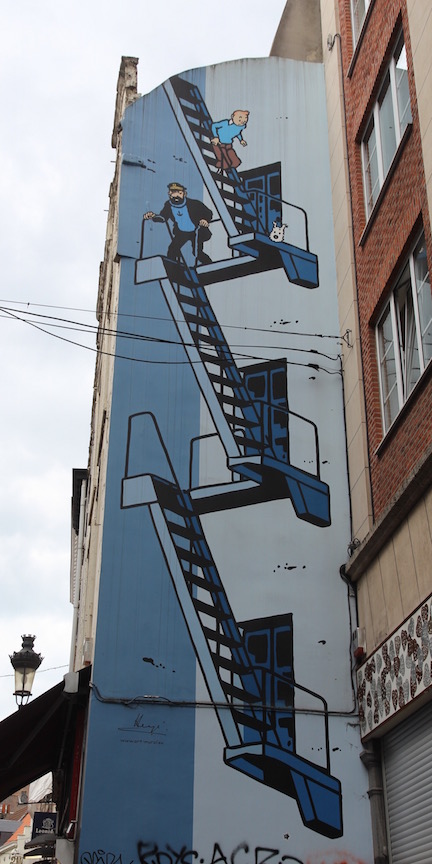
5. Tintin by Hergé

6. Lucky Luke by Morris
Below are captions for the photographs that are numbered. This blog template plays havoc with long captions and I really wanted to include the artists’ names and other detail.
Do you have a favourite comic strip character—from here or elsewhere?
1. Yoko Tsuno was one of the first comic strip women to have her own series in the early 1970s. The Japanese electrical engineer was as bold and brave as her male counterparts, and her adventures took place on Earth and in space. She was created by Belgian Roger Leloup for the weekly Spirou magazine.
2. Asterix, Obelix and their colourful villagers are among the world’s best known comic characters. Here, led by Dogmatix, they are attacking a Roman camp. It’s a scene familiar to readers in more than 70 countries. René Goscinny (writer) and Albert Uderzo (illustrator) created these memorable characters, which first appeared in the Franco-Belgian comics magazine Pilote in 1959.
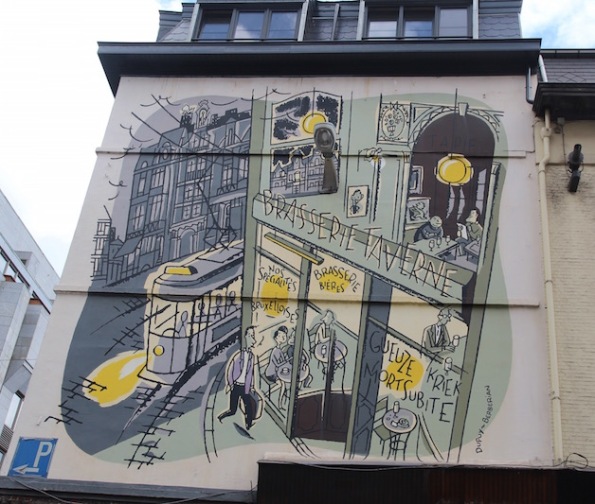
7. Monsieur Jean by Philippe Dupuy and Charles Berberian
3. Young Albert told about the sometimes cruel, boyish pranks of a kid (in red) in post-war Brussels. He was created by Frenchman Yves Chaland, who was barely 33 when he was killed in a traffic accident. There is hot competition for the small body of work he left behind, and famous cartoonists refer to him as their great role model.
4. Broussaille by Frank Pé was the first mural to be painted. Pé, a Belgian, started to create comics and illustrations for Spirou magazine, specialising in articles about animals. The fictional presenter of his stories, an adolescent named Broussaille, is often described as Pé’s alter ego. The two young men here (I’m not sure which one is Broussaille) are city folk and nature lovers.

8. Victor Sackville by Francis Carin
5. Tintin is probably the most famous Belgian comic hero. Hergé, the pen name of author Georges Prosper Remi, wrote 24 volumes about the adventures of Tintin and his dog, Snowy. The works have been published in more than 70 languages with sales of more than 200 million copies, and have been adapted for radio, television, theatre, and film. This mural depicts a scene from The calculus affair.
6. Lucky Luke and his intelligent horse, Jolly Jumper, galloped on to the scene in 1946. Created by Morris, a Belgian, some of the work was later drawn and written by others. Lucky Luke is a tribute to the mythic Old West and an affectionate parody (he shoots faster than his shadow). It was a challenge to photograph this mural—too much shadow.
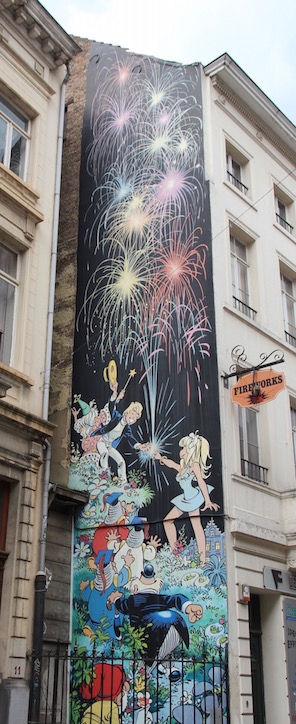
9. Olivier Rameau by artist Dany and writer Greg
7. Monsieur Jean is dogged by conflict in his relationships, depression and an endless battle against routine and the daily grind. His adventures are touchingly recognisable, and the tone is alternately light-hearted and melancholy. He is drawn and written by two Frenchmen, Philippe Dupuy and Charles Berberian.
8. Victor Sackville, by Belgian artist Francis Carin, travels the world as a spy for His Majesty the King of England during the First World War. When he can, the impeccably dressed gentleman does anything he can to disrupt the enemy’s plans. The people sitting at tables near the bottom of the mural give you an idea of just how big it is.
9. Olivier Rameau, the young and handsome hero, holds out his hand to the charming Colombe Tiredaile. In their parallel world, you don’t pay with money, but with joy, songs. laughter or a big kiss. Two Belgians, cartoonist Dany and writer Greg, produced this poetic fantasy series in the crazy days of the late 1960s.
10. Kinky et Cosy, the quirky twin sisters created by Belgian writer and cartoonist Nix, are always wreaking havoc on Brussels. Considered the most dangerous twin girls in the universe, these ‘enfants terribles’ are shown here waving a homemade peace flag tied to an old broom and laying waste to their bedroom. If you have kids, the scene below may look familiar.
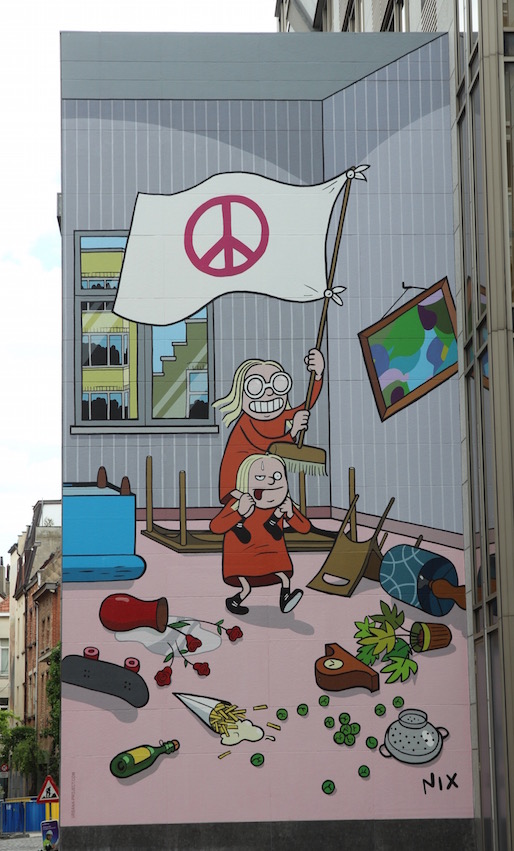
10. Kinky and Cosy by Nix
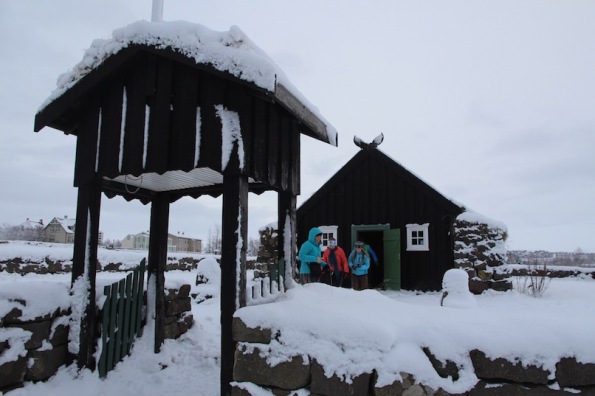
Visiting the church

Our guide talks about the history of the church. The pulpit is in the corner on the right
Parts of the United States and Canada are copping a battering this week with slow-moving storms generating record snowfall and low temperatures. Thousands are without power, air travellers are stranded, and icy conditions are making roads especially dangerous. Treacherous times.
Upper Michigan and Wisconsin are predicted to get as much as 18 inches (46 centimetres) of snow. It would be the perfect time to stay indoors, but braver souls make the most of it.
My nephew, Charlie, and his wife, Hannah, celebrated the arrival of ‘spring’ in Minneapolis by donning their bathers (swimsuits) and barbecuing on the roof of their snow-covered apartment building. I was delighted to see their sense of the ridiculous and chirpiness in the face of adversity (scroll down).


It also reminded me of our recent travels in Iceland and our willingness to tramp around in the snow to visit the Árbær Open Air Museum in Reykjavik.
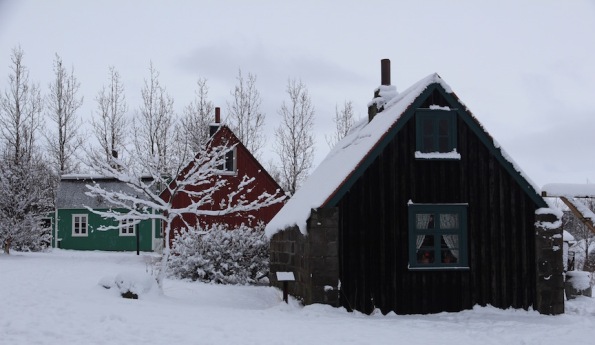
Originally an established farm, Árbær was opened to the public as a museum in 1957. It is one of five locations that make up the Reykjavik City Museum.

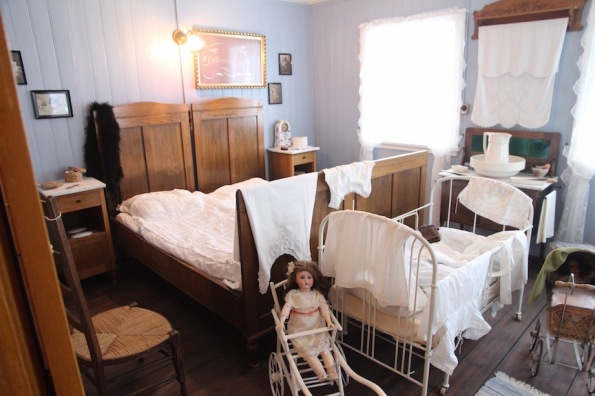
Today the museum has more than 20 traditional buildings that form a village with a town square, houses, a church, stables, a barn, a blacksmith and more. Most of the buildings were originally 19th century homes in central Reykjavik, and relocated to Árbær.
We arrived a bit before the museum opened (at 1pm September to May, otherwise 10am) and for a while I thought we’d be the only people on the tour, but in the end there were about 25 visitors, including several families.
Our guide (I’m embarrassed to admit that I don’t remember her name) gave an informative tour, explaining the different buildings, as well as the contents and histories of some of the residents of the past.
She gave us a real feel for life in earlier times in Iceland, and even demonstrated how to card wool. It was nice to see her in period dress. It also tickled me that she was also the person featured on the front of the museum’s brochure that we saw displayed around town.


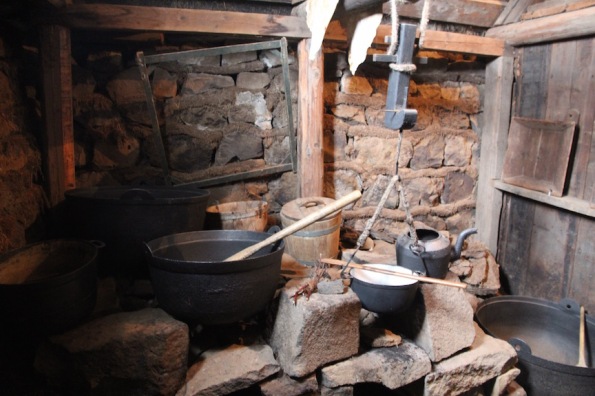
Being the avid cook that I am (check out my cooking blog), I’m always very interested in seeing the old kitchens and equipment. Every house in the museum had a wood stove. I’m pleased to say that I have one too—not as old as the one pictured above. Sadly, it doesn’t get used as much as it used to.
In summer months, the museum presents art-and-craft demonstrations including traditional handicrafts. Visitors can also see haymaking, vintage cars and livestock. There is also a cafe.
P.S. I didn’t add captions to all the photos because many are self-explanatory.
P.P.S. Aren’t Charlie and Hannah good sports!

Hannah and Charlie celebrating spring in Minnesota
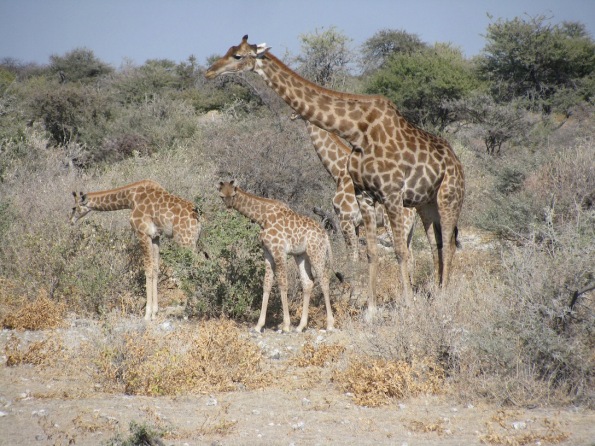
A sad and disturbing article appeared on one of my news feeds the other day. It’s not new news. In fact, the article was from the December 2015 Smithsonian magazine, but the problem it describes isn’t going away.
According to the latest ‘red list’ compiled by the International Union for the Conservation of Nature, the giraffe—the world’s tallest animal—is at risk of extinction after suffering a devastating decline in numbers over the last 30 years. Numbers have plummeted from 157,000 individuals in 1985 to 97,500 at last count, and the giraffe is now listed as vulnerable.
Giraffes face two main threats, cities and towns encroaching on their habitat and poaching. Poaching has become increasingly problematic. Hungry villagers sometimes kill the animals for food, and there are reports that many giraffes are slaughtered for just their tails. They are considered status symbols in some cultures and have been used as bracelets, fly whisks and even as a dowry when asking a bride’s father for his daughter’s hand in marriage.

The biggest problem for giraffes, though, may be the lack of attention over the years. ‘I am absolutely amazed that no one has a clue’ about the dwindling numbers, said Julian Fennessy, executive director of Giraffe Conservation Foundation. It’s a silent extinction with some populations numbering less than 400. ‘That is more endangered than any gorilla, or almost any large mammal in the world.’
Duke University conservation biologist Stuart Pimm said ‘There’s a strong tendency to think that familiar species (such as giraffes, chimps, etc.) must be OK because they are familiar and we see them in zoos.’ In fact over the last century, giraffes have silently been going extinct across Africa. They have already disappeared from seven countries—Burkina Faso, Eritrea, Guinea, Malawi, Mauritania, Nigeria and Senegal.
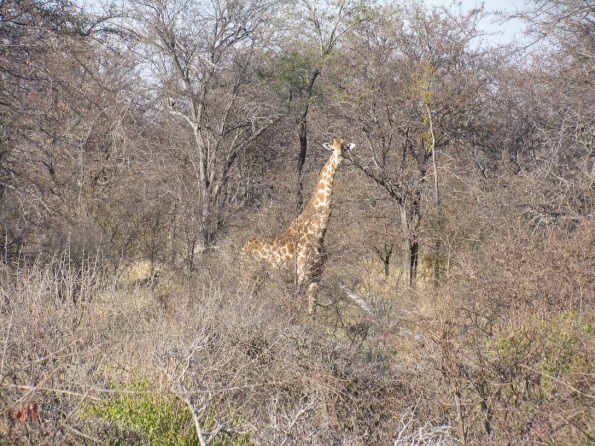
The first giraffe I saw in the wild
So why am I especially concerned about giraffes? Because they were some of the first big animals I saw in the wild during our overland truck trip in Africa. The first encounter was in Etosha national park in northwest Namibia.
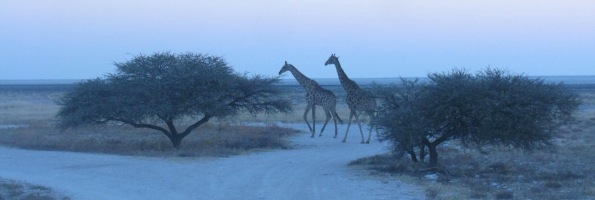
We arrived at the park in the afternoon and set up camp. We were old hands at this by now, so it wasn’t long before Chris, our driver, hustled everyone into the truck so we could go exploring. We saw Thomson’s gazelles first and then came the giraffes. Individuals and small groups, adults and juveniles, then larger groups. The collective noun for a group of giraffes is rather obvious—a tower.
I have more than 40 pics from that day that include giraffes—in the bush, nuzzling offspring, grazing, waiting for a turn at the watering hole, drinking, canoodling?

Giraffes—some details
They are magnificent creatures so here’s a bit more about them.
As I already mentioned, giraffes are the world tallest animals. Males grow up to 18 feet tall with females reaching 14 feet, (or 5.5 and 4.3 metres, respectively). Males weigh up to 3000 pounds (1360 kilograms) and females are about half that.
Their body parts are big too. The tongue is purple and about 21 inches (55 centimetres) long. The neck and legs are 6 feet long (and to think I call myself leggypeggy!) The measurement that really struck me was their lung capacity. Their lungs can hold 12 gallons (55 litres) of air—nine times more than human lungs.
This was another surprise. According to PBS Nature, giraffes sleep about 20 minutes or less per day. Staying awake allows them to be constantly on alert for predators. They usually get their sleep in quick power naps that last just a couple of minutes. I wouldn’t mind perfecting that.


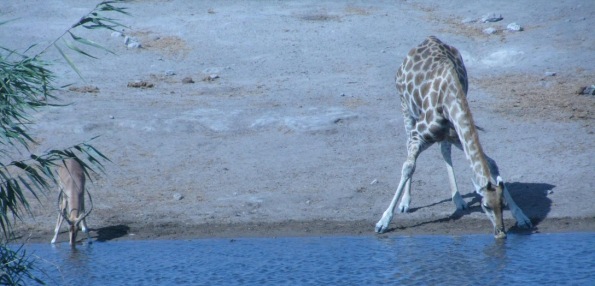
Giraffes are herbivores, which means they eat only plants. Their long necks allow them to reach leaves, seeds, fruits, buds and branches high up in mimosa and acacia trees. They can eat hundreds of pounds of leaves per week, but can go without drinking for weeks at a time because of the moisture in the vegetation they eat.
Just like our fingerprints and a zebra’s stripes, a giraffe’s coat pattern is unique to each animal. The pattern and the small hump on a giraffe’s back are similar to those of a leopard. Years ago, people thought the giraffe was a combination of a camel and a leopard, and called them ‘camel-leopards’.
And some final comments. I haven’t added captions to most of the pics here. They were all taken on the same day in Etosha national park. I’ll do more posts about Etosha, but I wanted to share the situation giraffes face in a post of its own.

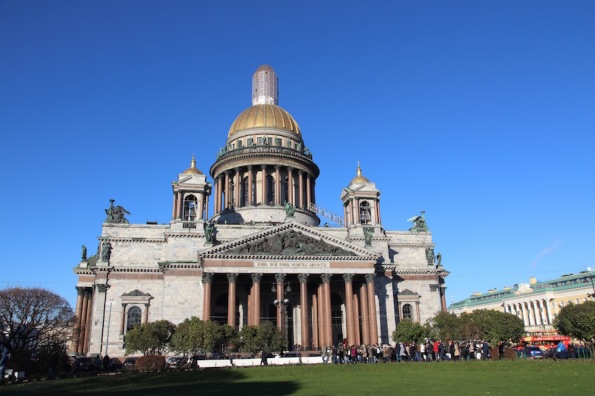
St Isaac’s Cathedral on the first day we saw it (sunny day)
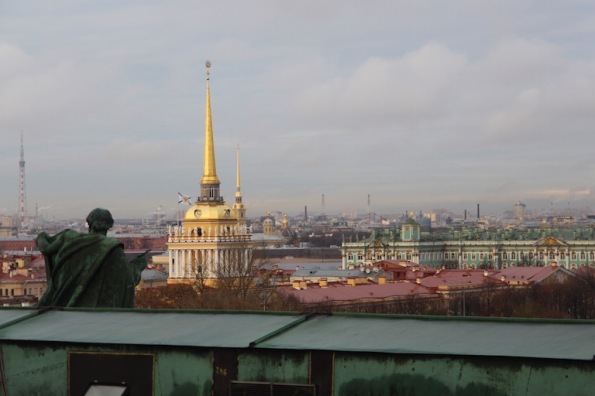
Looking out from the roof of St Isaac’s Cathedral (cloudy day)
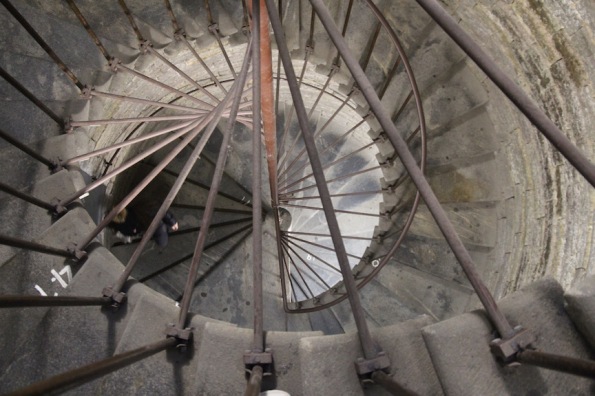
Maybe not a bazillion stairs, but still a lot
I thought about saving the fabulous Fabergé eggs until Easter, but I couldn’t resist doing a post about them a couple of weeks ago. So instead and to mark this important Christian holiday, I thought I’d bring you the remarkable Saint Isaac’s Cathedral in St Petersburg, Russia.
Poor John and I first encountered this church on our free walking tour of the city. We think walking tours are a great way to get your bearings in a new city and to discover some of the best places to visit on subsequent days .
When we returned the next day, Poor John, as usual, was keen to climb the church tower. So after a bazillion stairs (yes, I’m exaggerating) we had fantastic views of St Petersburg. Then it was back to earth to visit the actual church.
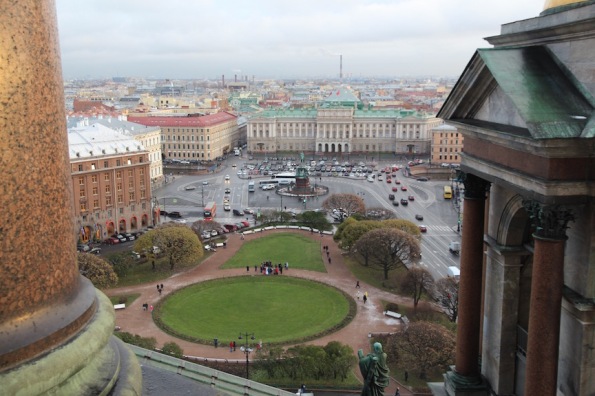
View from the top
St Issac’s breaks several records. It is the largest Russian Orthodox cathedral in St Petersburg. It’s also the largest orthodox basilica and the fourth largest (by the volume under the cupola) cathedral in the world. It’s dedicated to Saint Isaac of Dalmatia, a patron saint of Peter the Great, who was born on that saint’s feast day.
It is the fourth consecutive church to be built on its location and its construction was ordered by Tsar Alexander I. Designed by the French-born architect, Auguste de Montferrand, the cathedral took 40 years to build, starting in 1818. Overall cost was a million gold rubles.
The building sits on 10,000 tree trunks that were sunk by countless workers into the marshy banks upon which the cathedral sits.
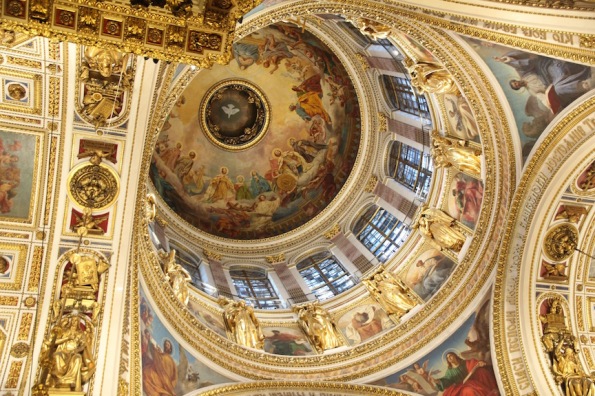
The Dome
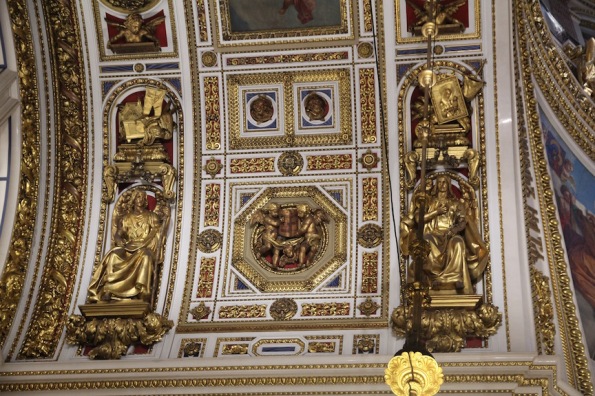
Ceiling
The main dome, which we saw from above and from inside the church, rises 101.5 metres (333 feet) and is plated with pure gold. Outside it’s decorated with twelve statues of angels by Josef Hermann. During World War II, the dome was painted grey to shield it from attack by enemy aircraft.
I was intrigued to learn that the design of the cathedral in general and the dome in particular later influenced the designs of the United States Capitol dome, the State Capitol in Wisconsin, and the Lutheran Cathedral in Helsinki (which we saw last year).
Under the Soviet government, the building was stripped of all religious furnishings. Then in 1931, it was turned into the Museum of the History of Religion and Atheism. Following the fall of communism, the museum was removed and regular worship resumed.
A bit more about the cathedral
The exterior is faced with grey and pink stone, and features a total of 112 red granite columns with Corinthian capitals. Some of the external doors are breathtaking.
These bronze doors (inside and out), covered in reliefs by Ivan Vitali, are patterned after the celebrated doors of the Battistero di San Giovanni in Florence, Italy, designed by Lorenzo Ghiberti. I saw a placard that said some of the doors weigh 20 tons.
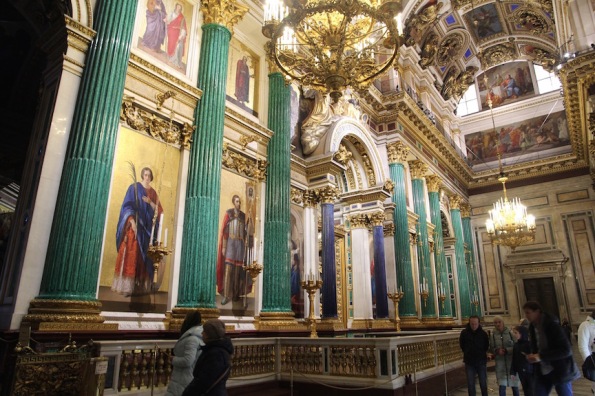
The iconostasis (wall of icons and religious paintings) has eight columns—six of malachite and two of lazurite.
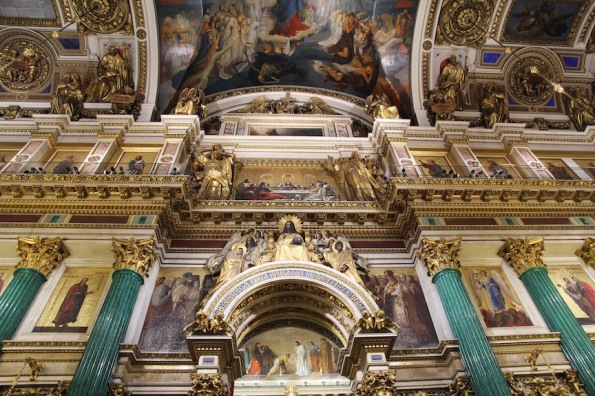
Looking up from the iconostatis
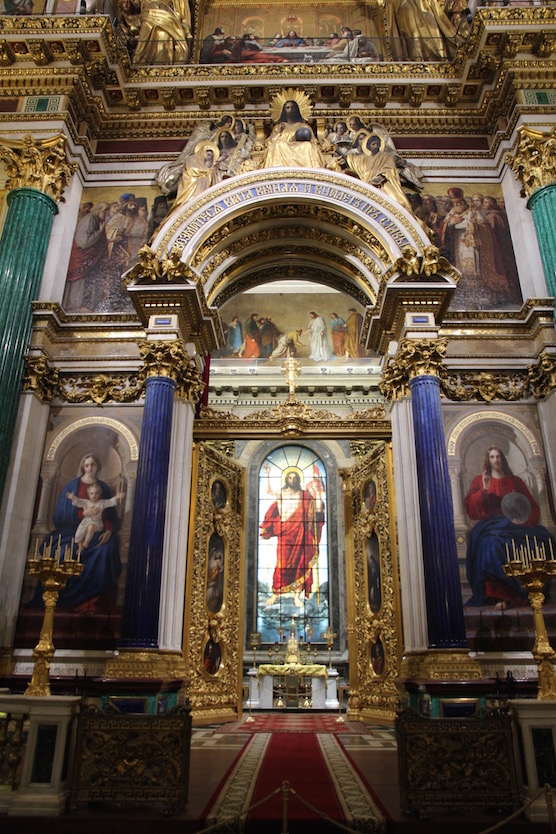
Centrepoint of the iconostatis
The iconostasis (a wall of icons and religious paintings) is framed by eight columns of semi-precious stone—six are made of malachite and two smaller ones are of lazurite.
The interior was originally decorated with many paintings by Karl Bryullov and other Russian masters of the day. When these paintings began to deteriorate due to the cold, damp conditions inside the cathedral, Montferrand (the architect) ordered them to be painstakingly reproduced as mosaics, a technique introduced in Russia by Mikhail Lomonosov. This work was never completed.
Our visit
We spent ages in the cathedral. I was gobsmacked when we entered. The exterior, while stylish, and the climb up to the roof, plenty of steps, don’t prepare you for the sheer size and magnificence of the interior.
I consider this to be a don’t-miss destination in St Petersburg.
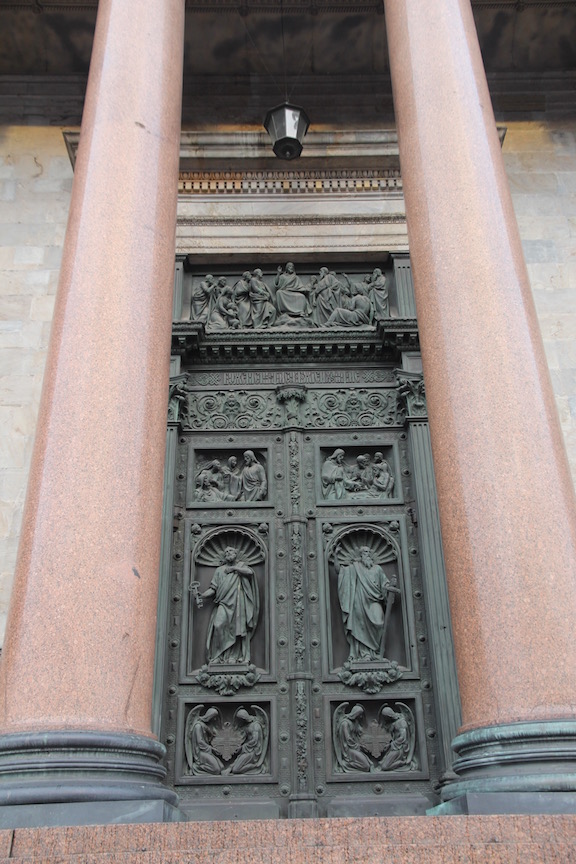
One of the bronze doors
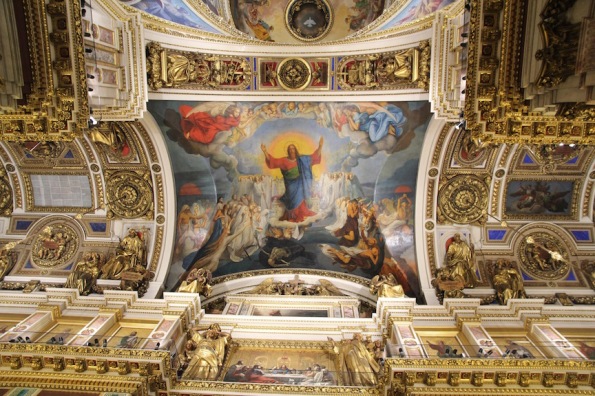
Overhead mosaic

Inside the cathedral
 Where to next?