

A lavish court ceremonial dress from the 1880s that belonged to Empress Maria Feodorovna

Two of Peter the Great’s full dress garments displayed in an elaborate hall
I spend most of my waking life in camping clothes. Black merino wool tops and khaki camping shorts or trousers (weather dictates length and weight). All the shorts and trousers, plus some of the tops, have zippered pockets. I carry a lightweight wallet, mobile phone and keys, but no handbag.
Our daughters badger me about always wearing black tops, so last time I shopped at the camping store, I bought two tops in dark charcoal grey. I told the salesperson I was trying to move away from black and she nodded sympathetically and said ‘ah, baby steps’.
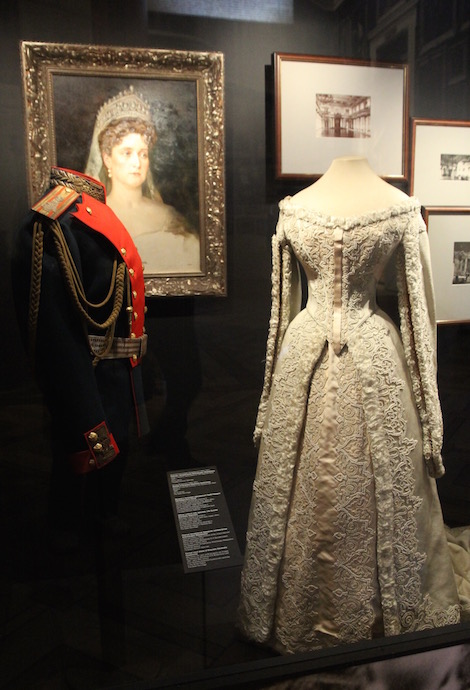
Formal court dress belonging to Empress Alexandra Fyodorovna
A couple of weeks ago I wore a skirt (green, black, white and grey) with a black merino top. My hand was forced. I was staying in Yass with my dear friend, Maggie, and we were dining at the rather posh golf club. I even wore shoes—not runners or thongs (yeah, Australians call THAT footwear thongs).
All this explanation is a lead-up to the fact that, even though I dress like a hobo, I appreciate fine clothing. And the dresses and uniforms on display in the Hermitage Museum (Winter Palace) in St Petersburg in Russia were divine.
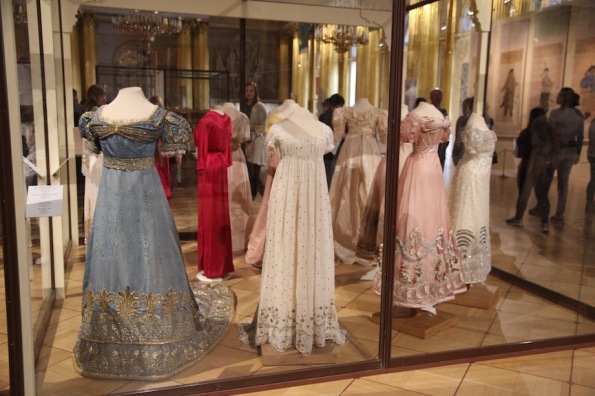
The blue gown on the left belonged to Empress Maria Feodorovna. The pink one to the right belonged to Princess Zinaida Yusupova
Not that you’ll catch me wearing any of them.
So let’s have a look at some of the finery.
The dress pictured at the very top belonged to Empress Maria Feodorovna. It’s a court ceremonial dress made by the Izambard Chanceau workshop in St Petersburg in the 1880s. It includes velvet, satin, lace, gold thread, spangles, bronze and much more. I wonder how much it weighs?
Directly below that dress is a pic of the elaborate room where some of the garments are displayed. In the centre is a case with two of Peter the Great’s full dress garments from the early 18th century. The light blue one was made in Berlin and the darker one was crafted by Russian and European makers. The latter is styled like the uniform of a Life Guards Preobrazhensky Regiment Officer.


There was an array of highly decorative liturgical vestments made of velvet, silk, satin, cotton and gold threads. The apricot one is sprinkled with pearls, silver, emeralds, rubies, spinel, beryls and crystals. Then there’s the armour and the glitzy saddles and harnesses for horses. I guess everyone had to dress up to step out.
I can’t really pick a favourite although I was especially intrigued by the shape of the dress directly below. Surely it’s for a child or perhaps for a cardboard cutout? Do you have a favourite?

Silk dress with a watteau pleat. Made in France in the mid-1700s
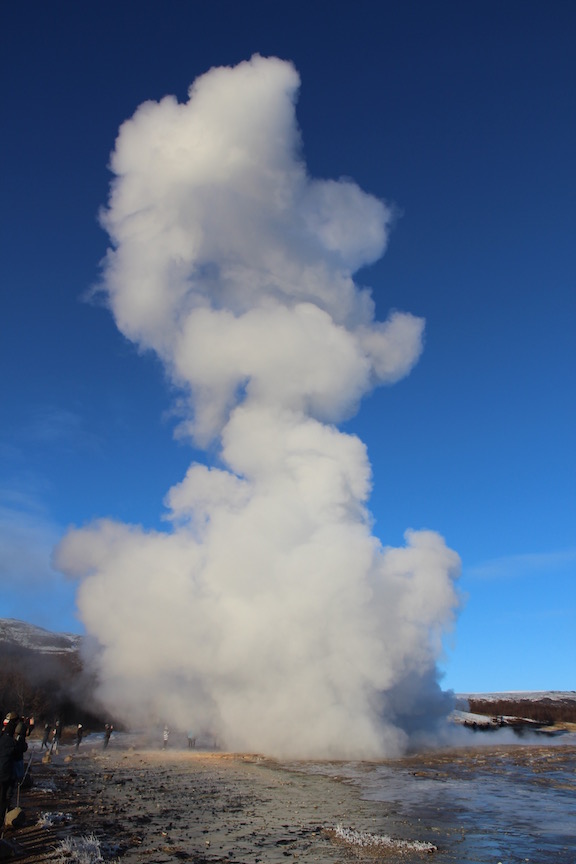
Strokkur—such a show-off
It’s winter in the Northern Hemisphere so it’s time to head back to our recent travels in Iceland. According to my weather oracle (an app on my mobile phone), it’s going to snow there this weekend, so that fits in with our snowy travels around Iceland’s famous Golden Circle.
We were super lucky to be able to stay with friends in Reykjavik—Mary Pat and Siggi—and even luckier that Siggi had four days off while we were there.
So he set aside one of those days to squire us around the 300-kilometre Golden Circle loop that starts and ends in Reykjavik. The circuit has three main stops.

Looking out over Þingvellir National Park. The buildings are part of a farm. We also stopped here the night we went chasing the Northern Lights
Þingvellir National Park
Our first stop was at Þingvellir National Park, Iceland’s first national park and a UNESCO World Heritage Site. This park is also a huge part of Iceland’s history and folklore, and the scene of unique geology.
Þingvellir is situated directly between the North American and Eurasian tectonic plates, in the rift valley that runs all the way through Iceland. This is the only country where this valley, called the Mid Atlantic Ridge, can be seen above sea level. And nowhere is it more visible than in Þingvellir.
But the UNESCO status has more to do with the park’s importance in Iceland’s human history. The country’s first permanent settlers came in the 800s and were mostly vagabond clans who refused to bow to the new High King of Norway.
Nevertheless, by 930 AD they decided some sort of collective government might help to resolve disputes on the island. So each of 30 or so groups in residence on the island sent someone to represent them. They called their meeting place ‘the fields of parliament’, which translates to Þingvellir.

Looking out over Þingvallavatn, Iceland’s largest natural lake


That first parliament was such a success that the tradition continued every summer for centuries. In fact, parliament didn’t move to Reykjavik until the mid-1800s.
We arrived at a high point in the park and looked out over just a fraction of the wintry landscape. The area has long stretches of lava rock, and many volcanoes surround the park, rising above Þingvallavatn, Iceland’s largest natural lake. There are regular earthquakes in Iceland, and volcanos perform too. You might remember that Bárðarbunga caused a lot of aviation problems when it erupted in 2015.
We walked down a busy tourist pathway and Siggi picked us up at the bottom. We sneaked down a side road he knew to have a look at a section of the rift.
Then back in the car to our next stop—the geysers, 50 kilometres away.
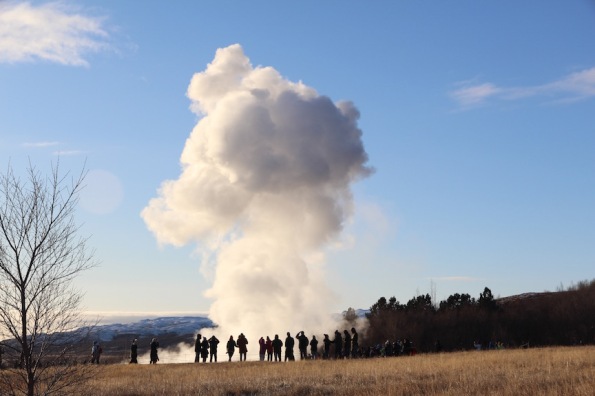
Strokkur belches every 10 minutes or so
Geyser geothermal area
Geothermal activity in the Haukadalur valley is visible long before you get there, with steam rising on the horizon in many places. The area is dotted with hot pools, clay pots and fumaroles, and the hills and soil are vividly coloured by the minerals of the earth. And then there are the two geysers that make the site famous.
Geysir (from which we get the word geyser) is the grand old geyser that is mostly dormant today. That’s because of the tectonic activity in the area, as well as intrusive human intervention. Studies show that it has existed for about 10,000 years and that it tends to erupt in cycles. Usually, a large earthquake will trigger it to start off, then it will slowly peter out. It’s last big blast was in 2000, when it shot water 122 metres (almost 400 feet) in the air.

Approaching the geothermal area

Waiting for Strokkur to perform
Strokkur is the star now. It goes off every five to 10 minutes, throwing steam and water from 20 to 40 metres (66 to 132 feet) into the air. We saw her (are geysers female?) perform four or five times while we were there. A word of warning: pay attention to the signs. The whole area is bubbling with activity. Don’t stray from the paths or you could get burned. The water temperature ranges from 80°–90°C (or 176°–194°F).
Our third and last stop was another place to take care—the Gullfoss waterfall.
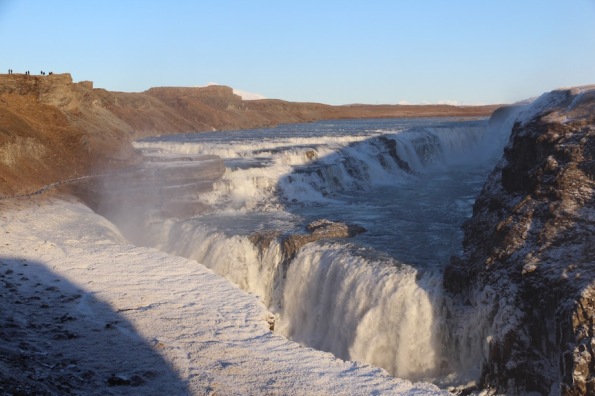
The impressive two-tiered Gullfoss waterfall is on the Hvita river. See the people up on the ridge at the left?
Gullfoss waterfall
Gullfoss, which means golden waterfall, is an amazing two-tiered waterfall on the Hvita River. It was our third and final stop of the day.
Gullfoss cascades down 32 metres (the first tier is an 11-metre drop and the second is 21). In summer at its heaviest flow, Gullfoss dumps an average of 140 cubic metres of water over the edge every second, which then spills into a 2.5-kilometre long crevasse. This crevasse was created at the end of the Ice Age by catastrophic floods. The constant bombardment of water means the crevasse lengthens each year by 25 centimetres (or almost 10 inches).
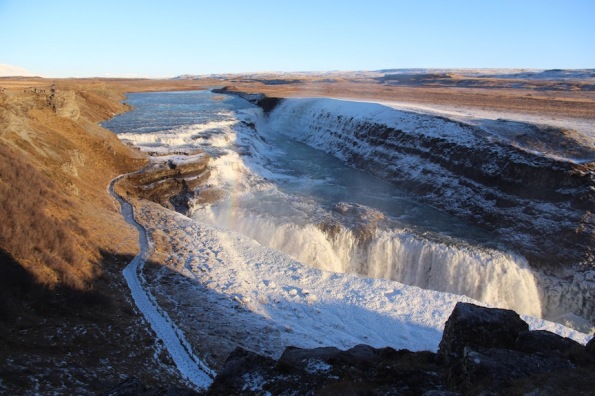
No one was silly enough to jump the fence and follow the path to the edge
There’s a walkway down to the edge of the falls, but wild weather meant it was closed the day we were there.
Now here’s an interesting aspect. Not long ago, when the walkway was closed, a couple of people jumped the fence and ended up being swept away. Yeah, they died. Perhaps people have paid attention to the news! The same do-not-enter sign was up the day we were there and not a single soul had ventured over the fence.
Sometimes common sense kicks in.

You get a hint of a rainbow from this angle. See the people on the ridge in the upper right and no one on the path
Iceland’s countryside and happy new year
This post is already long enough so I’ll do another post on some of the gorgeous countryside we saw as Siggi drove us around the Golden Circle.
Wishing you all a wonderful new year. Here’s hoping that 2018 is good for all of us.
P.S. It’s been crazy busy here, but I hope it’s calmed down and I can post more regularly. Also hope to tidy up the categories and tags. Fingers crossed.
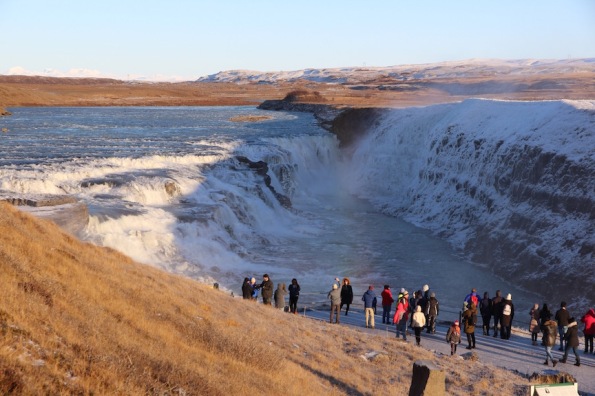
The viewing platform gave us a great look at the falls
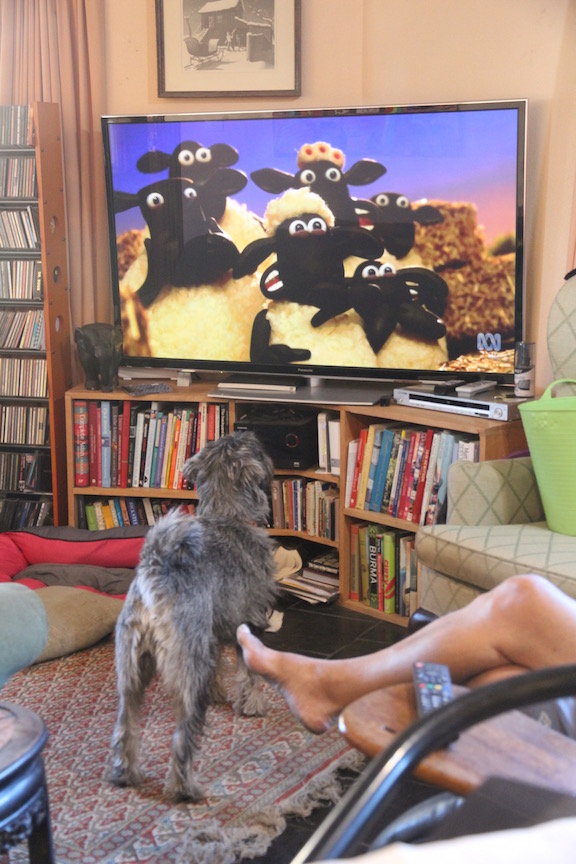
Cartoons are popular
After the glitz and glamour of some treasures at the Hermitage Museum in St Petersburg, Russia, I feel the need to add a bit of the ridiculous. Consider it holiday cheer.
My dog, Indi the standard schnauzer, watches television. She’s especially keen on watching animals of any kind (including cartoons). She even knows the music and voices for certain programs and advertisements. When an ad comes on for the RSPCA (Royal Society for the Prevention of Cruelty to Animals), she tears in to the family room so fast that you have to jump out of the way or get knocked over.
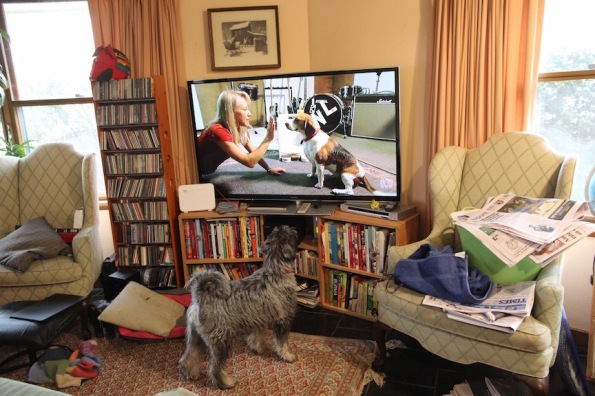
I wish Indi would learn more from the dog training programs
When she first started watching television, she was rather puzzled when the horse that trotted across (and off) the screen to the right didn’t appear behind the curtains and chair.
She’s branched out lately and now shows an interest in programs on gardening, science, the weather, cooking and more. David Attenborough is a favourite too.
Over the years, I’ve owned or minded more than 20 different dogs. Indi is the only one to have ever shown an interest in television. That said, I had a cat that liked to sit on top of the television (an old bulky one) and bat at the sportspeople who ran around the field—any field.
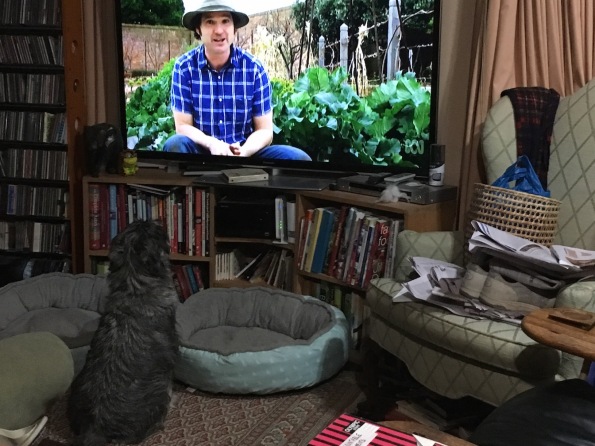
Gardening is popular too
So what quirks do your pets have?
P.S. Yes, our television screen is huge. It’s one of Poor John’s guilty pleasures. I can watch TV from the backyard if necessary. And all those books you see in the pics are cookbooks. They are about a tenth of the cookbooks I use for the other blog. Check it out if you like to cook.
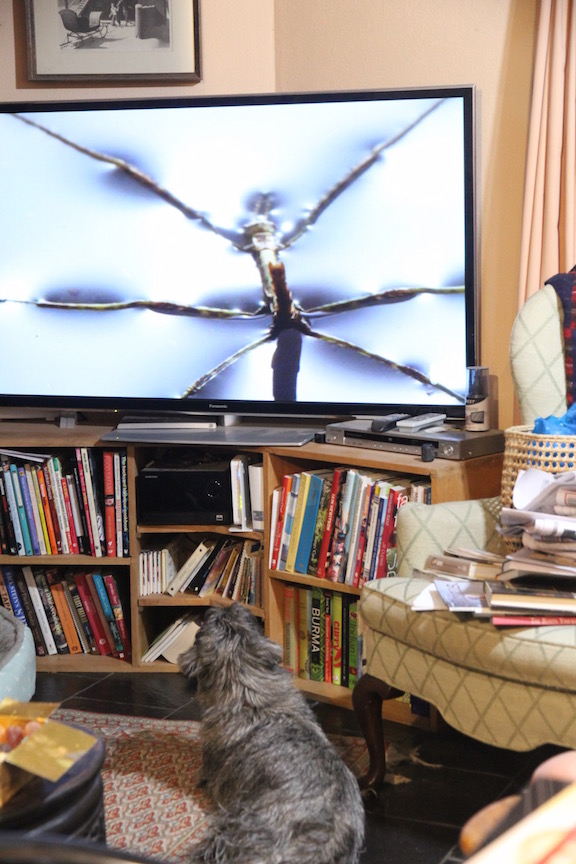
I don’t think she knows what a spider is
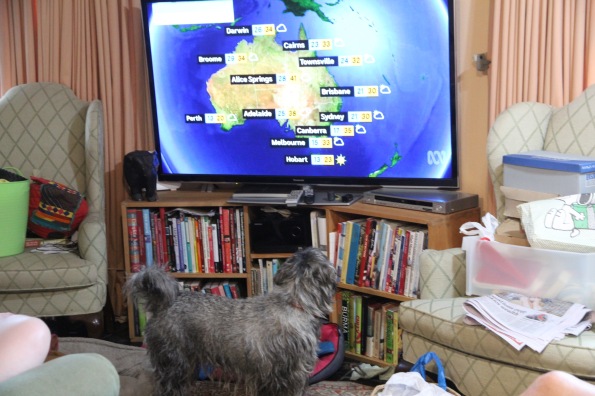
Now the weather report

Walking into the Great Church of the Winter Palace

Looking back at the entrance the Great Church of the Winter Palace in Saint Petersburg
The Hermitage Museum in St Petersburg, Russia, is mind-boggling. So much so, that I’ve been trying to figure out how to share it all with you.
The Peacock Clock has already had its own post and now I reckon I’ll share most of the rest by room or topic—one at a time. So you can look forward to posts on the church, the artwork, the malachite room, clothing and more.
Seriously, the museum is so vast and so varied that we found it hard to take it all in. We had only two half days there (anything more gives you museum overload). So not to overload you, I’ll be interspersing the posts with other destinations.
So given that it’s Christmas, let’s start with the church with three names.


In 1753, Empress Elizabeth ordered the construction of a new Winter Palace with a single-altar church dedicated to the Resurrection of Our Lord (the first name). The list of sculptors, gilders, model makers and painters is as long as your arm—I could name them, but you wouldn’t remember them—and included Russians, Italian and French craftsmen.
Oh wow, did they do amazing work. The church was consecrated in 1762, after Elizabeth had died. Pity she never saw the finished product.
The following year, Empress Catherine the Great ordered that the icon of Christ the Saviour on the Sudarium be moved from Moscow to the new Winter Palace. After that, the church was re-consecrated in the name of—are you ready for it—the Image of the Saviour Not Made by Hands (second name).
It acquired its third name—Court Cathedral—in 1807.
Thirty years later fire struck. The palace and church were greatly damaged in 1837, but some important items were saved.


In the last five years, the church has undergone massive restorations to recreate the original design of the Court Cathedral. To that end, many of the saved items—the icons, candelabra, lamps, pulpit, lamps and the altar canopy—have been returned to their original places.
As for us, we entered and just stood in awe of the amazing work and the amount of gold. We spent about 20 minutes in this room alone, so you can see why a day or two is not enough to see the Hermitage.
Wishing everyone happy holidays
People from all over the world visit my blog, and I appreciate you all. Regardless of what you do or don’t celebrate or believe, I hope your days ahead are filled with joy, and that 2018 is a rewarding year for you.
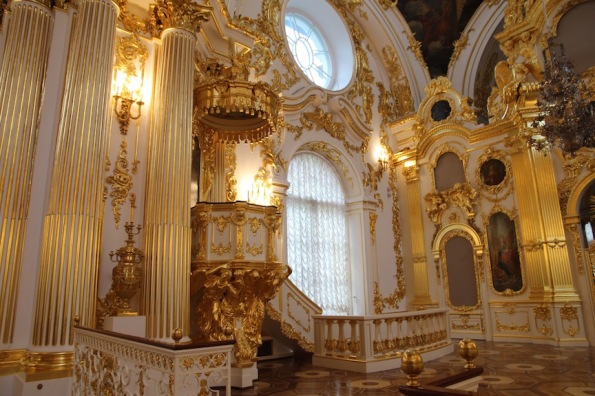
The pulpit
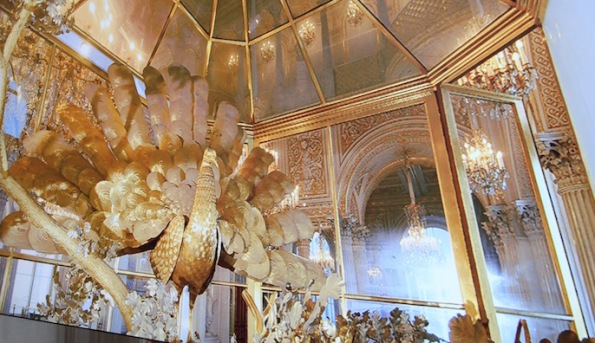
Peacock Clock with tail fully opened. Photo from museum video
Male peacocks are one of the world’s showiest birds. They love to show their colours, strut their stuff and display their magnificent tails.
And just when we thought we’d seen the flashiest and showiest of all peacocks in Australia and India, we toured the Hermitage Museum in St Petersburg, Russia, and encountered the Peacock Clock.
This magnificent bird takes clockwork, sculpture, gold work and innovation to a whole new level. Just after 1pm on the day we visited, I followed the museum’s map to find the larger-than-life bird sitting majestically in its glass case.
As the photos show, I examined this automaton from every angle and read all the information about it.
Here’s some of what I learned.

The main attraction—the peacock
A bit about the clock’s history
Although unsigned, the clock is believed to be the work of James Cox, English clock maker, mechanic, jeweller and the most celebrated manufacturer of curiosities of this sort. Recent research confirms this as being his work.
The clock originally belonged to Prince Potemkin, who bought it disassembled. In 1791, he asked a gifted Russian mechanic, Ivan Kulibin, to assemble it and put it in motion. The mechanic took a year to get around to the job (obviously you couldn’t get reliable help back then either). By then, Potemkin had died, and Empress Catherine II bought the clock. In turn, the mechanism passed to her son and successor, Emperor Paul I.
The clock had a major restoration in 1995.

The peacock in its cage
The challenge to restore
Back in 1995, this poor bird might as well have been on the chopping block for a holiday meal. The entire clock was filthy, rollers and gears were worn out, organ pipes couldn’t produce a sound, chains were torn, the pendulum suspension was broken, and many parts had been wrongly assembled on previous restorations.
Once they figured out the clock’s construction was based on modules, the restorers were able to focus on the independent parts. But the clock still presented a challenge, with many of the fixes requiring novel and unusual approaches.
Today the clock’s mechanism is regularly attended to and, if I read the slightly disjointed English right, it is wound weekly.

The control mushroom is in the middle of the pic. Look closely and you can just see the dragonfly


What the clock does
The movement of the clock is hidden inside the large mushroom in the centre of the setting. The mushroom has two dials—one shows the hour in Roman numerals and the other shows the minutes in Arabic numerals.
A dragonfly on top of the mushroom plays the part of the second hand. A carillon (a train of bells) chimes the hours and the quarters. Three coiled spring movements control the owl, the peacock and the cock.
The owl moves first, twitching its eyes and raising a wing (the English translation says it raises a ‘paw’). The bells on the cage around it tinkle. Then the peacock raises its head regally and opens its tail for a moment. Then the cock crows several times.

Cock on the Peacock Clock
What I saw
Cripes, I wish I could say I saw the clock perform its whole routine. I was there around 1pm and saw nothing. I figured I’d missed it, so I went back about 1:50pm and waited patiently. I even managed to get a great close-up position and some good close-up photos.
But 2pm came and went with nothing. Darn. I found a guide and used hand signals and raised eyebrows to ask about the clock. Her return hand signals (tapping the number 7 on my watch and holding up one finger) told me that the clock would perform once at 7pm (the museum was open until 9). I’m pretty sure she didn’t mean 2:35 or 1:07!
But I did see a video of what happens when the clock does its magic. It’s a looping video and I watched it several times. Completely magical and magnificent. One of the pics here is a still I took from the video. Maybe someday I’ll see the clock perform in real-time. Maybe someday you’ll see it too.
Stay tuned for a full post on this amazing museum.

The caged owl on the Peacock Clock (you can see the cock’s tail on the right)
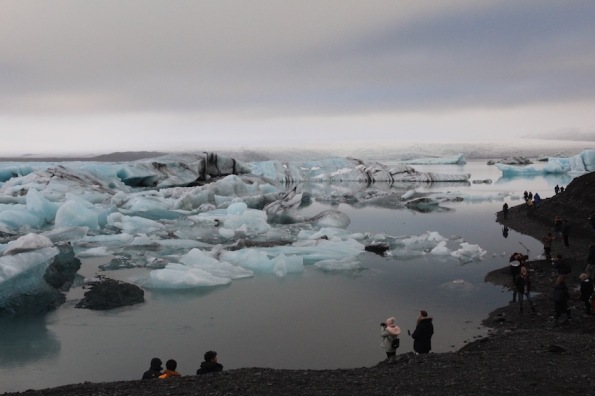
On the shores of Jökulsárlón lagoon
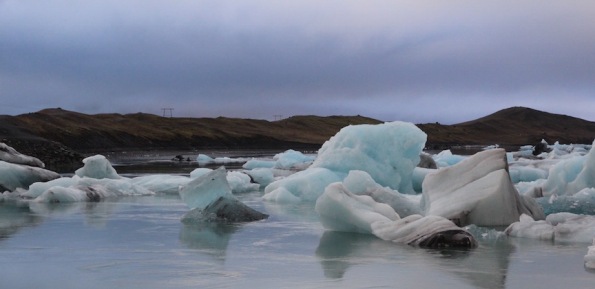
Icebergs in Jökulsárlón lagoon
This post is for Francesca, with many thanks for her delightful comment on my post about seeing the Northern Lights last month in Iceland. She said she thought my pics of the lights looked similar to hers and realised that we were on the same bus tour. (I have no idea where you’re from Francesca, but your comment made my day).
Our joint jaunt—all 14 hours of it—took us to the picturesque Jökulsárlón glacier lagoon in the southeastern part of Iceland and on the edge of the Vatnajökull National Park.
The lagoon (or lake as it is sometimes called) began to be created in the 1930s when the Breiðamerkurjökull glacier started to recede from the Atlantic Ocean.

The cruise boat heads out onto the lagoon
We arrived at the lagoon not too long after lunch. There were two options—take a 45-minute boat cruise around the lagoon, or walk along the shore and the shallow channel that connects the lagoon to the ocean.
Complaint (whinge) alert. As we boarded the bus in Reykjavik, passengers were told whether or not they had paid for the boat cruise. If you wanted to take the cruise, it was an extra A$63.50 per person (or A$127 for the two of us).
We booked our tour online and there was nothing on the website that said anything about a cruise being available and at what cost. I’ve rechecked the website and there’s still no mention of a cruise option. I think that’s a sneaky way to deliver a travel offering.
Not surprisingly, we decided that a last-minute charge of $127 was not value for money, so we opted to walk along the shore and admire the icebergs floating in the lagoon.

Icebergs heading to sea


There were plenty more bergs in the channel. Some were bobbing along on their way to the Atlantic and other, larger, ones were stranded in the shallow water. Still others had drifted onto the black sand.
I reckon the stranded ones won’t be moving this year. The lagoon freezes over in winter.
The guide on the bus said the bridge over the channel was often washed out. I’ve since read that the bridge’s pillars have been reinforced to protect them from icebergs, so I guess it’s only spring floods that cause damage.

Walking the shores

On the edge of the lagoon
A bit more about the Jökulsárlón glacier lagoon
At 248 metres (or 814 feet), this is Iceland’s deepest lake. Today the glacier is 1.5 kilometres from the ocean and the lagoon covers 18-square kilometres. Apparently it’s quadrupled in size since the 1970s.
The setting is popular. Jökulsárlón has been featured in two James Bond movies—A View to a Kill and Die Another Day—as well as Lara Croft: Tomb Raider and Batman Begins. It’s also been a destination for the reality TV series, The Amazing Race.
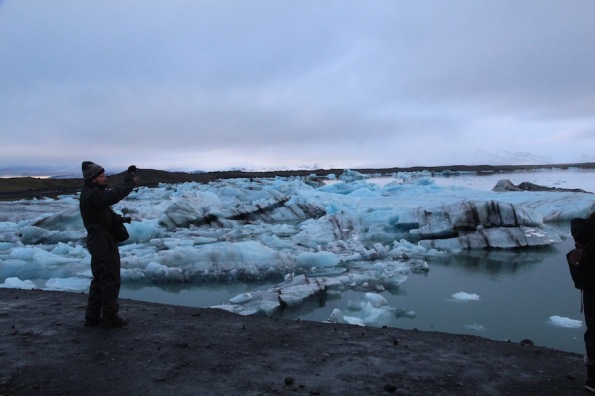

Icebergs from Jökulsárlón lagoon
A side comment on the bus trip
We enjoyed the bus trip, but a quick comment about the lunch stop. Several other buses arrived about the same time as ours. We were allowed 40 minutes or so for lunch and many of our passengers waited for ages in a huge line for the hot meal.
Poor John and I stood in that line for quite some time until we inched past the refrigerator cases and realised we could buy sandwiches. So we did.
That option didn’t dawn on everyone and quite a few people were shuffling along the line and then late returning to the bus.
The guide told them it wasn’t their fault that they were late. He said he’d called ahead to say we were arriving and was told everything was okay.
I reckon that if I’d been the guide and noticed three extra buses arriving about the same time as us that I would have suggested that everyone buy sandwiches from the fridge.
As an aside, we were in line with people from other buses (we had some nice chats) and their meal was included in their price, so no way they were getting out of line. Our meal was at our own expense.
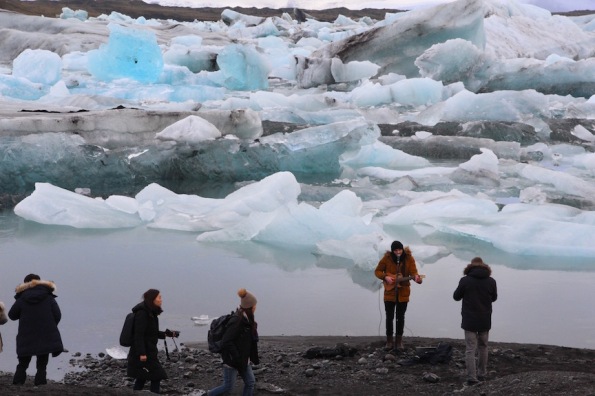
A musician performs at Jökulsárlón lagoon

Icebergs on the sand at Jökulsárlón lagoon
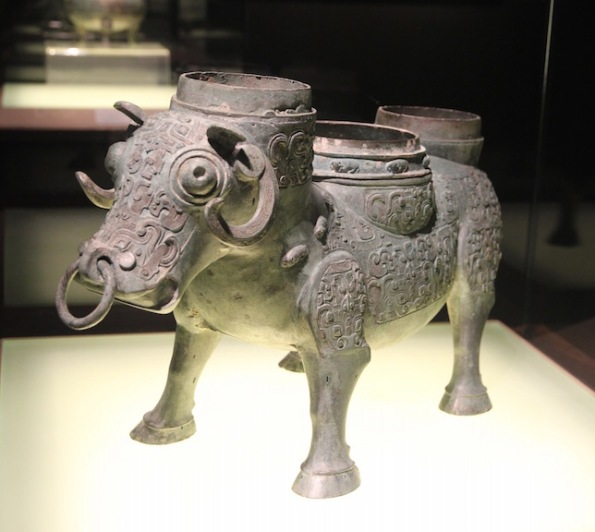
From about 500BC

Between 200BC and 8AD


Visiting the Shanghai Museum was one of the rewarding things we did during our short stay in that southern Chinese city.
Founded in 1952, the museum displays some of the country’s most magnificent ancient art.
We were absolutely gobsmacked by the bronzes. We’ve seen bronze all over the world, but the Chinese craftsmanship takes their pieces to new levels of creativity and detail.


Seriously, as we walked from piece to piece, Poor John and I kept commenting on how fine the work was. All the pics directly above this paragraph are of wine or food vessels. How’s that for style!
But the quality wasn’t limited to the bronzes. The museum has 11 permanent galleries and three set aside for temporary exhibitions. The permanent galleries feature items such as ceramics, furniture, sculptures, textiles, paintings, coins, calligraphy, seals and more.


We were intrigued to learn how the early collections were acquired.
During the civil war, the Communist 3rd Field Army gathered artefacts through accidental finds and confiscation of private property. These items came Shanghai when the Communists took the city. The local customs service confiscated other items. Finally, during political purges and under political pressure, private collectors sold some of their cherished possessions to the government.


Later acquisitions weren’t quite as dramatic. That said, the museum ‘rescued’ a lot of bronzeware that was due to be melted down after being confiscated or donated during a metal-gathering campaign in the late 1950s and early 1960s.
Before the Cultural Revolution, which began in 1966, wealthy Shanghai collectors had a tradition of making annual donations to the museum.


Today the collections continue to be enriched thorough donations, government purchases and important finds from archaeological excavations.
I’ve had a terrible time trying to decide which pictures to share. The works are so numerous and so amazing, that I have overdone it. Hope you enjoy it half as much as we did.
Do you have a favourite piece?


Mongol headdress of coral and silver

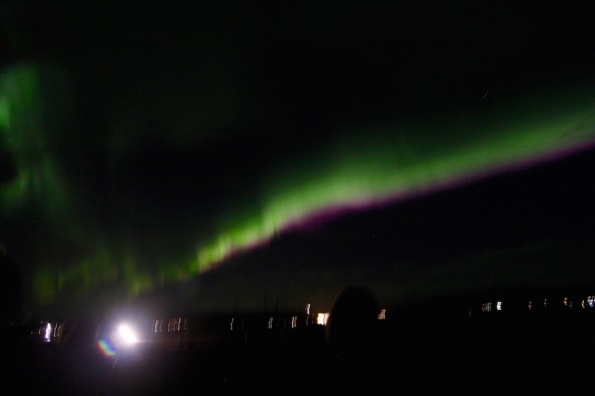
We’ve had only two really clear nights since we arrived in Iceland last week.
When the weather report looked good for the first of those two nights, we booked to go on a three-hour Northern Lights tour. Our first stop was at the Þingvellir (Thingvellir) National Park, east of Reykjavik.
We trudged through the snow and onto a viewing platform, but there was no activity in the sky. In fact, the garden around a farmhouse down to the left was well-lit so we didn’t really have the darkness that would make the Northern Lights stand out.
After 15 minutes or so, the guide suggested we reboard the bus and move on to a more likely spot. It was a wise decision, because the next site delivered a nice show of lights that lasted about 10 minutes. Unfortunately, I was having a brain meltdown and fumbling with my camera settings. I could enjoy watching the lights, but couldn’t get a single pic.

Not long after we reboarded the bus, I figured out what I had been doing wrong, but it was too late.
I decided the only answer was to book another tour on another clear night.
In the meantime, we booked a 14-hour bus tour along the south coast of Iceland to the Jökulsárlón glacial lagoon. It was a super cloudy day but that didn’t keep us from enjoying the scenery along the way as well as the lagoon (more about that trip soon).
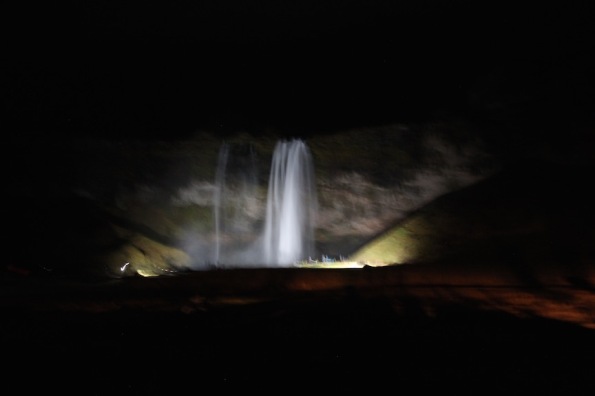
A waterfall at night
But the big bonuses came on the way home. We’d passed a large waterfall earlier in the day, and the guide promised that we’d stop briefly on the way back because the cascade was illuminated at night.
I hadn’t brought my tripod this night, so I couldn’t get a great, steady shot of the waterfall, but one pic turned out nice enough.
As we reboarded the bus, the skies started to clear and the guide urged us to keep our eyes focused towards the north. Luckily Poor John and I were on that side of the bus on the way home!

When we were about 45 minutes outside of Reykjavik, Mother Nature began her show.
I think the guide was as excited as all the passengers. He got the driver to pull over at a safe spot and we all piled out to watch the show.
What a joy, what a bonus! A tripod would have helped me to get sharper pics, but I was thrilled to get any and even more thrilled to see the lights—and without having to book yet another tour.
We were lucky enough to see the Northern Lights last year in Alaska and now again in Iceland. Woo-hoo! I’ve heard that people are seeing the Southern Lights in Tasmania, so we may have to try that next year.

On the way to the bakery about 8:30am
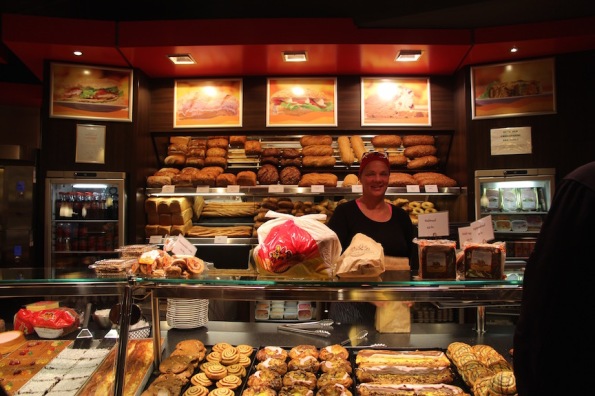
A good enough reason to go out in the snow
There’s so much more to share with you about China, Mongolia and Russia, but I feel compelled to jump ahead and show you a sneak peek at Iceland.
We’ve been here for just under a week—staying with Mary Pat and Siggi—and they have ever-so-kindly arranged for us to experience our first proper snowstorm of this wintry trip. (There was a little snow in Russia, but nothing remarkable.)
The flurries began Thursday night in Reykjavik, and by Friday morning there was a thick blanket of snow. It was amazing to view the world from their third-floor window, but even better to join Siggi on a run to the bakery.
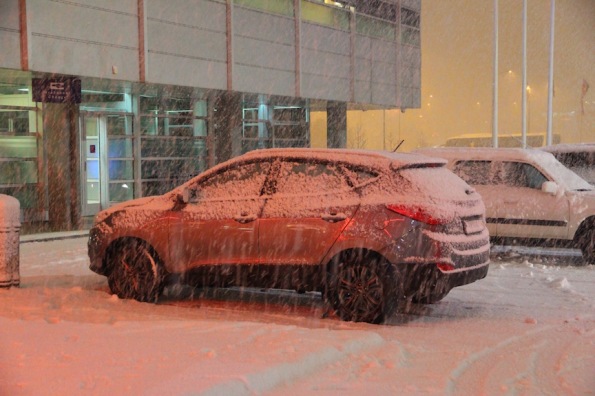
Siggi’s car after 10 minutes out of the garage
His car had been parked in the garage overnight so didn’t have a single snowflake on it when we set out, but 10 minutes later it had its own coating of big, fat flakes.
It has continued to snow off and on since then. In fact, tonight the wind is howling and the snow is falling horizontally. I’m glad our sightseeing is done for the day.
So what’s the weather like where you are?

An hour after going to the bakery
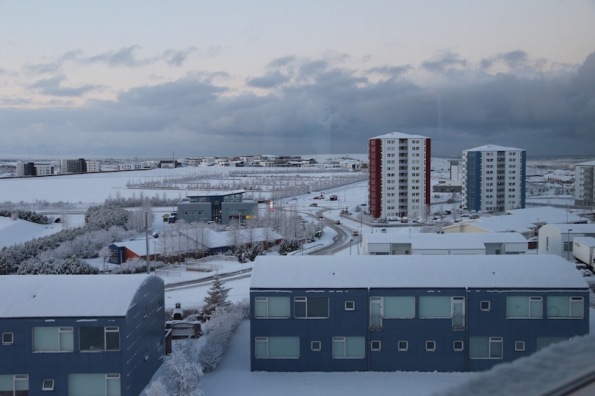
Looking southwest from Mary Pat’s and Siggi’s flat

A view to the west as the sun comes up

The sweeping view from Aryapala meditation temple
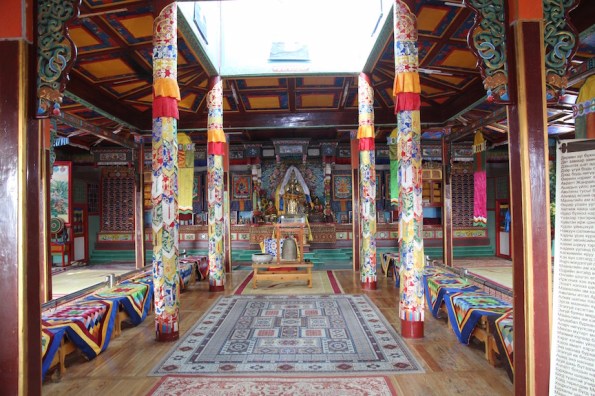
Inside the temple
Many of you have commented on how flat and barren the Mongolian landscape is, so I thought I’d share a different view.
On the way to our homestay, we drove along Turtle Rock Road to visit the beautiful and peaceful Aryapala meditation temple, in the Terelj National Park northeast of Ulaanbaatar. This temple is perched on a mountainside at the end of a picturesque valley, which is probably even more scenic in spring and summer.
The Buddhist temple is open to anyone who wants to mediate while being free from outside distractions. The long path up to the actual temple is bordered by 100s of signs with topics for mediation that give food for thought. You’ll probably agree that many of the sayings seem especially relevant these days. Click to enlarge images.


There are also signs and monuments relating to other aspects of Buddhism, such as ‘The Elder White’ or ‘White Grandpa’. In Mongolia, he is the protector deity of the nature that oversees Mother Earth.
There is also the Great Prayer Wheel of Kangyur. This prayer wheel is filled with a complete Kangyur (printed in Tibetan), the 108 volumes of works spoken by the Buddha himself.
When you reach the temple (after a long uphill trudge and a very rickety bridge), it’s not immediately obvious that the outline of the complex is supposed to resemble an elephant. The main building is the head, the 116 steps of staircase are the trunk and the walkways at the sides represent the ears.

Poor John on the rickety bridge to the temple
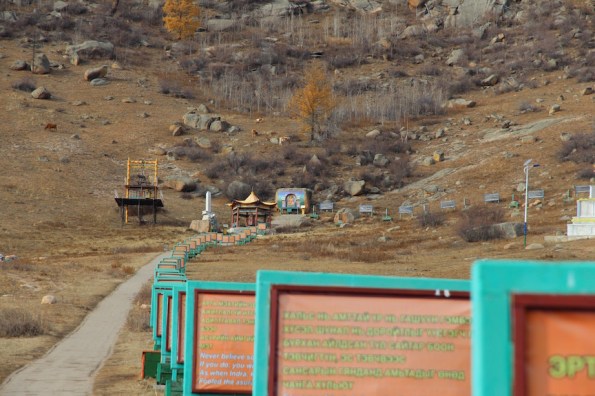
Path to the temple
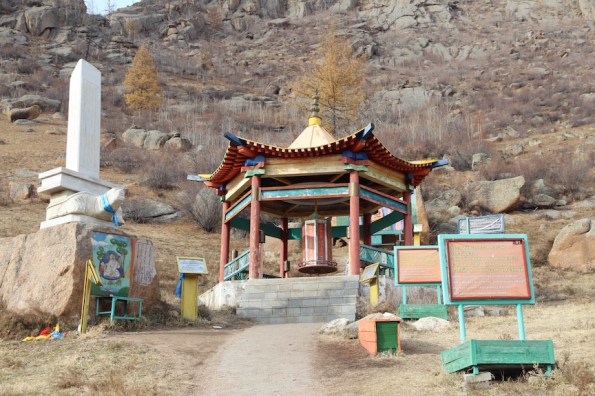
Great Prayer Wheel of Kangyur. The painting to the left is of ‘The Elder White’
There’s also a cave there with a statue and footprints of the Buddha inside. Whenever I see that, I am reminded of my mother’s comment years ago in Burma. She had flat feet and when she saw the Buddha’s footprints she said, No wonder he sat down all the time. He had flat feet.
The inside of the temple is stunningly beautiful and colourfully decorated. I was especially grateful that we were allowed to take pictures—something not always permitted. There’s a mantra—Om Mani Padme Hum—that is supposed to be repeated 108 times at the temple, and our guide, Nasaa, did exactly that.


While we were there Poor John walked all the way around the temple, but the rest of us decided it was too wet and icy. No need to break an arm.
But we wouldn’t have missed the view for anything. Fortunately we were there on a reasonably clear day and could see far into the distance.
We also enjoyed sharing the space with a group of school children. The young boy standing at the very back of the pic was wearing a set of Dracula teeth and having great fun growling as everyone.
I liked the Little Miss we saw by the exit. I think she’d had a great time.
P.S. Do you have a favourite from the topics for meditation?


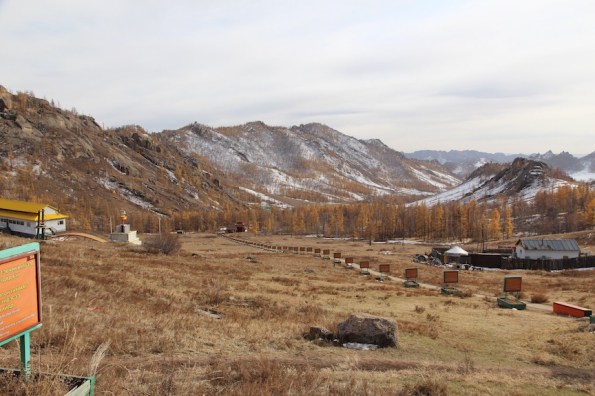
 Where to next?