

Adam and Eve of the Baiga tribe. Part of a display in Bhopal’s Ethnic Museum explaining how the earth came to be.
Today was an eye-opener for me.
So far, we’ve had four days in India. Twelve hours between flights were in New Delhi—a city we know fairly well—and three days have been in Bhopal—a city I first met in the news in the 1980s.
Too many people will remember Bhopal for the tragic chemical gas leak and explosion that happened 32 years ago, just after midnight in December 1984.
Almost 4000 people have died as a direct result of the disaster and more than half a million were affected. It’s often called the world’s worst-ever industrial disaster, and it never should have happened. Even today, there is a general view that Union Carbide has never really paid its dues on this matter.
Thankfully Bhopal has gone on to recover, grow and prosper.
But that hasn’t been my eye-opener.
After four days in India, I realised I haven’t shared anything with you.
I’ve looked, liked and/or commented on blogs I follow. I’ve plowed through several hundred emails and still have 50 unviewed and another 22 that need answers. I haven’t written to my kids except to say we arrived safely.
And most of all, I haven’t told you a darned thing about all the amazing things we’ve seen.
This is worrying, especially when the internet connection drops out regularly and each page takes several minutes to load.

Part of the Bada Gumbad Complex in New Delhi’s Lodi Garden
When I said I was heading to India, fellow blogger and excellent photographer, Vicki Alford, told me to ‘forget’ about dealing with all the online stuff and enjoy the travels.
So I’m taking Vicki’s advice seriously. I’ll try to post as often as I can about where we are and what we are doing. But just for the time being, I am going to stop worrying about liking, following or commenting on other blogs.
Internet connections in the big city have been slow and unreliable. In an hour we head into Satpura National Park and connections will get worse or non-existent. Hey, this post took about six hours to get loaded.
Hope you’ll understand that for now, I’m going focus my patchy internet time on sharing India with you.
P.S. In the last few days we seen vast gardens, multiple festival celebrations, two mosques, a fort, two museums (including the most amazing ethnic/tribal museum I have ever seen), two scenic lakes, traffic jams like you wouldn’t believe (because the Prime Minster was visiting Bhopal), and a hairdressing salon, where three of us gals got the works.
P.P.S. If you are interested in knowing more about the gas disaster in 1984, I can highly recommend the heartbreaking Five past midnight in Bhopal by Dominque Lapierre and Javier Moro.
P.P.S. Don’t forget to check out my cooking blog. Here’s a great Indian recipe for spinach and lentil dal.
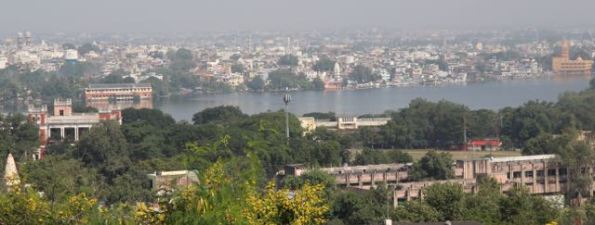
Overlooking Bhopal and one of its lakes
Poor John and I are about to board a flight to Singapore, with a final destination—many hours from now—of India.
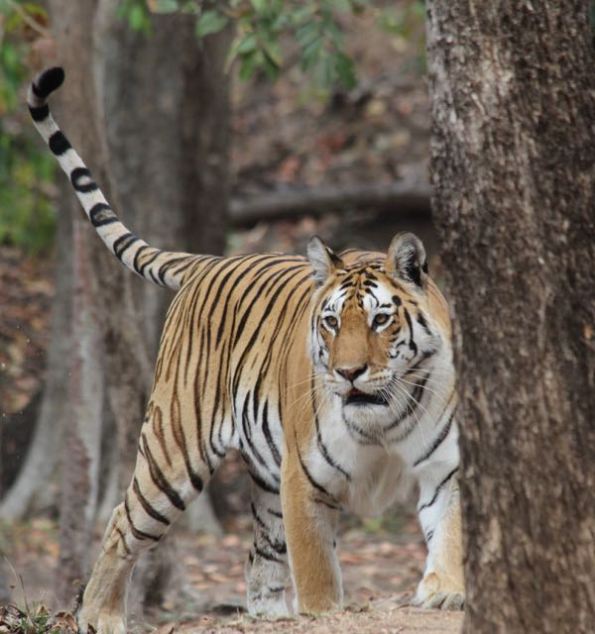
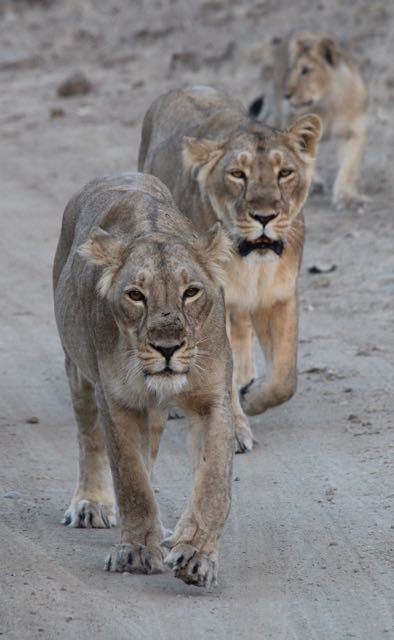
Looking forward to 45 days of road trip in India’s south with the young naturalists we have travelled with twice before. It’s mostly about the animals—lions and tigers and bears. Yes, India has all three—Asiatic lions, Bengal tigers and sloth bears. When we aren’t exploring, we’ll be enjoying the wonderful cuisines of India.
Obviously, I’ll have a lot less online time, so forgive me if I miss liking or commenting on your blog posts. I’ll do my best. We’ll be travelling remotely a lot of the time.
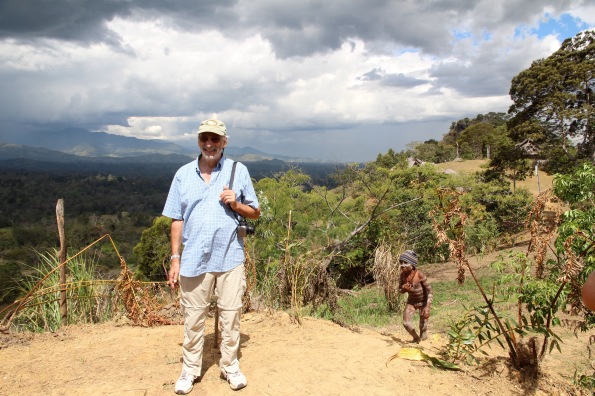
Fred in the Asaro village, Papua New Guinea
Over the last few days my thoughts have been consumed by Fred and Ze, Fred’s wife of many years. Let me tell you a bit about Fred.
Poor John and I met Fred about two years ago on our trip to Papua New Guinea. While there, we visited the Goroka Show, an Asaro village and a selection of coastal villages.
We loved Fred’s company. He was a gentleman, raconteur, radiologist and nuclear medicine doctor.
He had many wonderful stories. Without going into a lot of detail, some years ago Fred was one of the two people in the USA who was allowed to give a go-ahead for every American nuclear test. As a nuclear medicine doctor, Fred had the second last say. The meteorologist had the final say.
Fred gave meaning to my feet. My feet are so poorly constructed. I was born this way (mostly thanks to genetics), but most people think I have huge bunions. Fred even asked, Peggy, when are you going to get your bunions fixed.
I explained, Fred, I was born this way, and he replied, that’s the worst case of hallux valgus I’ve ever seen. I was stunned. Seriously, have you seen many cases? I asked. Yes plenty, remember I was a radiologist.
But enough about the state of my feet.
Over many years, Fred has suffered from ALS (amyotrophic lateral sclerosis) or Lou Gehrig’s disease. It was and wasn’t a big issue in Papua New Guinea. Fred managed well at the Goroka Show, but it was harder for him to reach the Asaro village.
We had to walk up a huge hill to get to the village. I walked with Fred. Mostly to keep him company and also to excuse the fact I was also walking slowly.
When we got to about the halfway point, Fred sat on a rock and said he couldn’t go farther. He said he was happy to stay there until we came back down for an excursion (later that afternoon). He said he’d figure out the next steps later.
As it turned out, the locals insisted on carrying Fred to the top. Two burly men clasped hands together to create a ‘chair’ he could sit in, and carried him to the top.
What an amazing service they provided for someone they didn’t know.
Once ‘up top’, Fred stayed put to enjoy the many activities offered by the Asaro villagers.
We hoped to travel with Fred again. He and Ze were to be part of our Alaskan trip earlier this year. But it wasn’t to be. Fred was too sick to go.
So why the tribute to him now?
As far as I know, Fred died on Sunday. He died with dignity.
His ALS had advanced at such a great rate that Fred took advantage of Washington State’s euthanasia legislation. He and Ze had discussed the matter and decided together, choosing Sunday as his ‘departure date’.
We respect and honour Fred’s choice. We’ll miss him.

Fred with Asaro mudmen
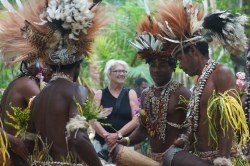
I’m really quite thrilled today to have been interviewed and featured on Roberta Pimentel’s amazing blog. Hope you can take a moment to check out her blog.
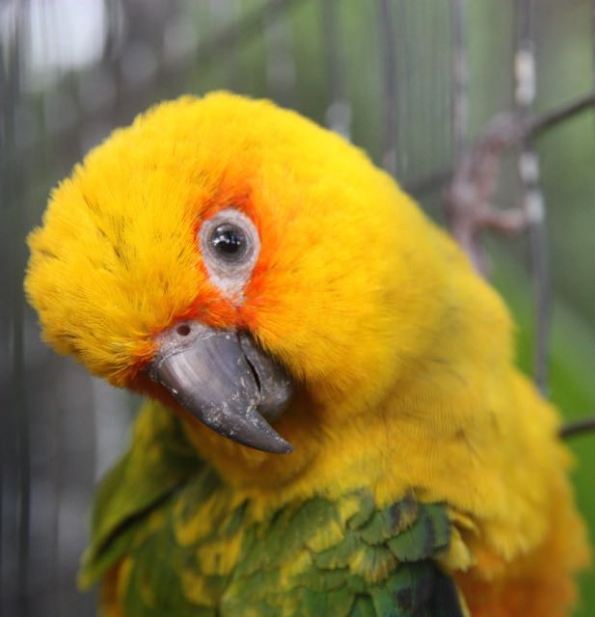
You looking at me? Not sure of the species but love the colours
I have mixed emotions about zoos and other wildlife parks. How are the animals cared for? Does the facility operate ethically? Does it have a mission beyond tourism and income?
I’m also a huge sucker for birds, so was keen to visit the Parque das Aves (or Bird Park) on the Brazilian side of the Iguazu Falls.
What an amazing and honourable bird sanctuary it is, and in such a beautiful setting.


I was gobsmacked by the number and variety of birds—there are more than 900 birds from 150 different species. I was also impressed by how the birds are housed. Most are in large aviaries, which allows the ‘residents’ to strut and fly about. There are water features and plenty of trees, too, for perches.
In addition to the magnificent birds, we also saw several species of snakes, lizards, caimans and butterflies.

A tree full of scarlet ibises
The sanctuary is privately owned and spreads over 40 acres of forest. It opened in 1994 and plays a conservation role as well.
In addition to all the visual evidence, I was impressed by park’s statement regarding its philosophy and approach. Here it is.
‘Parque das Aves is a conservation project in the Atlantic Rainforest near Foz do Iguassu, Brazil. We take in birds, which have been rescued from animal trafficking or are for some reason no longer able to survive in the wild. We give them a home in their beautiful native rainforest.
‘We love huge aviaries. We think birds should be able to fly, and have a great social life, and feed on the best, fresh, organic diet possible.


‘We then breed a new generation of birds, which are capable of being released back into the wild (and we have a number of projects that do exactly that.) We also support projects and research throughout Brazil. We plant thousands of trees a year, restoring degraded Atlantic Rainforest.
‘The Parque das Aves thinks that education is one of our most important tasks. Sometimes it’s as simple as giving people direct contact with these beautiful birds. It’s amazing what that can do. We also educate thousands of local schoolchildren a year in special programs. Thank you for supporting Parque das Aves. We couldn’t do it without you.’

Southern screamers
I’m not alone in my admiration for Parque das Aves. Reviews on TripAdvisor are highly complimentary. The sanctuary has almost 17,000 reviews in numerous languages. A remarkable 96 per cent of the reviews written in English rank the park as very good or excellent. Several reviews point out that the park is wheelchair friendly.
I have to confess that I don’t remember all the bird species, but here’s a collection of birds with a lot of black in their colouring.


Water spray and sunlight create a rainbow in the Devil’s Throat. See the catwalk coming in from the centre top
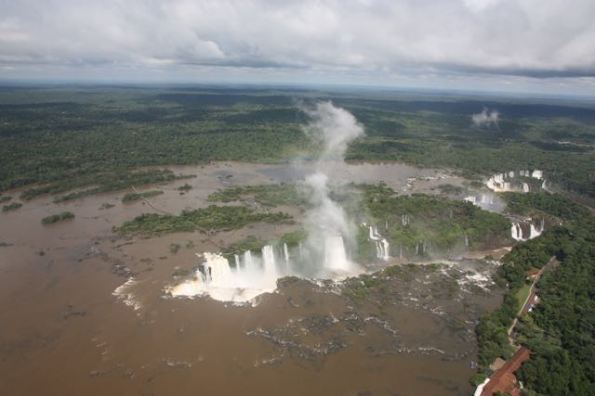
A wide view of the falls and the Devil’s Throat on the left

Approaching the falls. See the catwalk snaking out from the left
Depending on water levels, Iguazu Falls have anywhere from 150 and 300 separate waterfalls with heights ranging from 60 to 82 metres.
But the star act is the drop known as the Devil’s Throat (Garganta del Diablo in Spanish or Garganta do Diabo in Portuguese). About half of the river’s flow falls into this one long, narrow chasm.
So how big is it? The Devils’ Throat measures 82 by 150 x 700 metres (or 269 by 492 by 2297 feet).
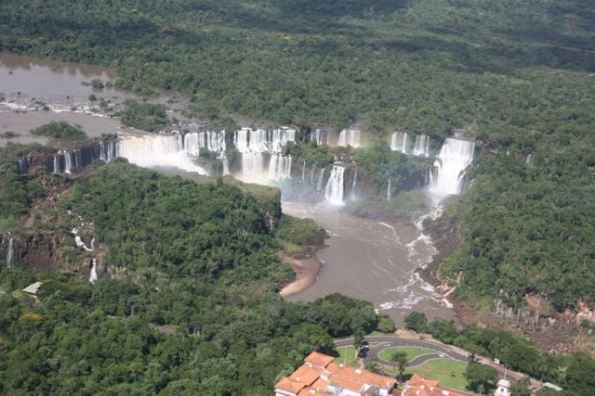
The Iguazu River tumbles over the falls

Another view of the stretch of falls
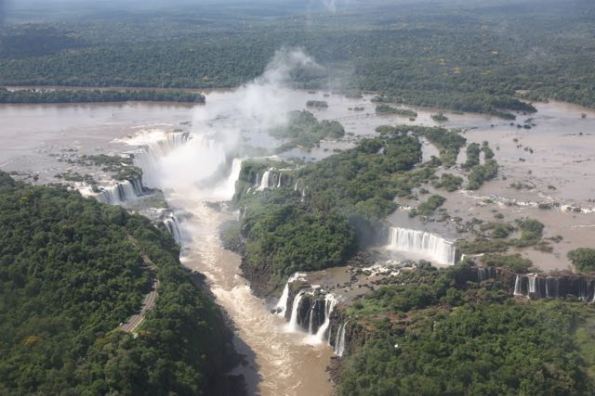
Looking up to the Iguazu River and Falls
Upon first seeing Iguazu, then US Frist Lady Eleanor Roosevelt reportedly said, Poor Niagara. Those falls, which are on the border between Canada and the United States, are one-third shorter than Iguazu.
A real bonus for me on our second visit to the falls was the chance to view this geographical wonder from the air. Poor John likes to egg me on, so urged me to take a 15-minute helicopter ride over the falls. At that time, such flights were available only from Brazil, but I think they are now offered on both sides.

How I got airborne
It was the perfect opportunity to see just how large the falls are and how they shape the border between Brazil and Argentina.
I hope you enjoy these views as much as I did. And I’ve pointed out the pics where you can clearly see the catwalks going out to the Devil’s Throat.

See the catwalk coming in from the lower left
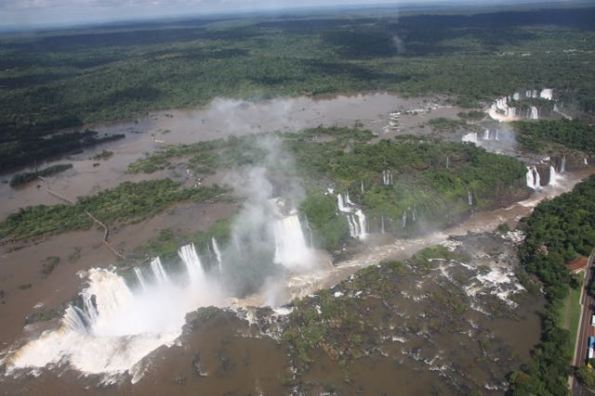
Most of the length of the falls. I felt lucky to capture this shot
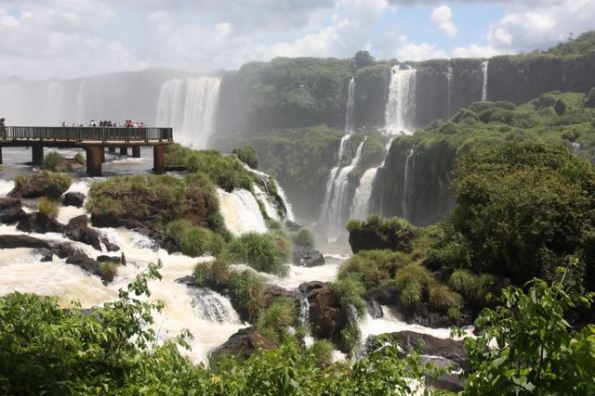
A catwalk out to the falls

A lot of water on the Brazilian side, even if it has the smaller flow
My mother travelled quite a bit in her later years. Cruises with her mother in the Caribbean and Mediterranean, trips to visit us in the Middle East and Southeast Asia, and a journey to South America.
With all those travels, she decided she had two most favourite tourist destinations—the places she thought the most scenic and rewarding. One was the impressive archaeological site of Ephesus in Turkey and the other was the magnificent Iguazu Falls that straddle Argentina and Brazil.
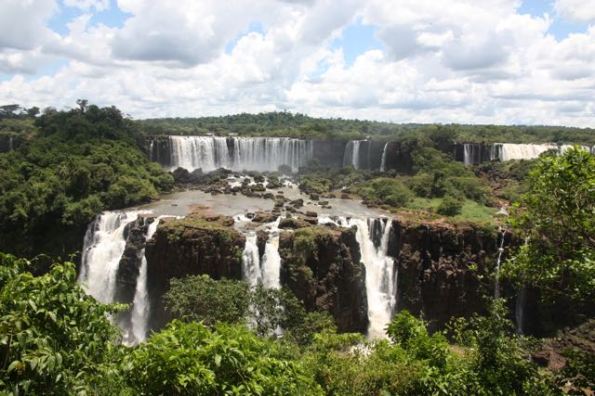
Looking at a stretch of the falls on the Argentine side
Mum saw the falls from the Argentine side, which I have already written about. We’ve been lucky enough to see them from both countries on our travels with Oasis Overland.
People still debate whether the view is more spectacular from Argentina or Brazil. I’m sort of on the fence.
Iguazu Falls are located where the Iguazu River tumbles over the edge of the Paraná Plateau. In terms of area, it is the largest waterfall system in the world. It is 2.7 kilometres long and arranged in a way that resembles a reversed letter ‘J’.
The border between Brazil and Argentina runs through the U-shaped Devil’s Throat, which is something like 1000 football fields in size (if I did the calculations right).
Most of falls (80 per cent) lie on the Argentine side. It’s easier to get up close and personal on that side. The catwalks are longer and get you closer to the famous Devil’s Throat and the San Martin Island. Plus there’s a boat that takes you near to the fall, where you can be guaranteed to get wet.
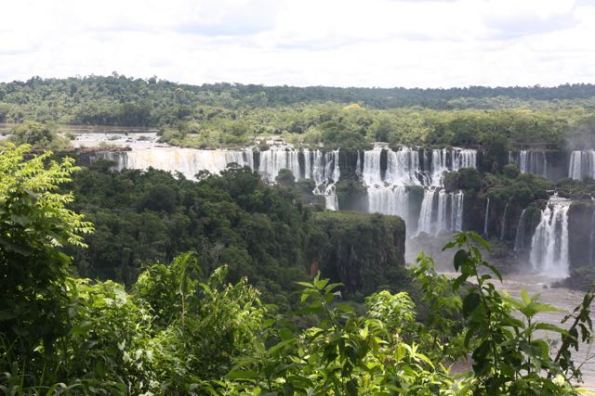
The falls stretch for 2.7 kilometres with 80 per cent in Argentina
But the Brazilian side has a lot going for it. That side, which we visited second, is more compact. But it gave us great views of the large expanse of Argentine falls and another catwalk that got us really close to the Devil’s Throat.
There was also an option for a helicopter ride over the falls. I suppose it’s not really environmentally sound, but I did it anyway (at Poor John’s urging). My dad was a pilot and I suppose he’d be cross if I passed up any opportunity to fly. I’ll post about that soon.
But overall, I’d have to say that the view from the Argentine side is probably marginally more spectacular, but I’d still do either again any time.
P.S. I’ll post the aerial pics soon because they have great views of the Devil’s Throat.
P.P.S. If all this water is making you thirsty, check out this typical Brazilian drink—caipirinha—on my cooking blog.
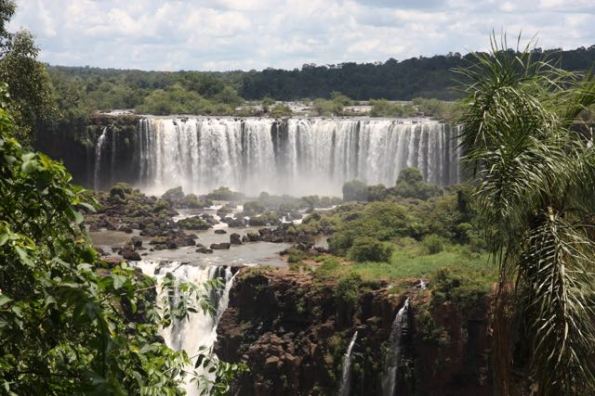
Parts of the falls are tiered

Trying to get a lizard’s eye view of the Olympics? Look hard, it’s 2600 kilometres to the east

Hey, Mr Caiman, you’re looking the wrong direction
All eyes are on Rio de Janeiro for the coming weeks, and rightly so with the Olympics 2016 currently underway.
One of our daughters is there for work, on the periphery of the Games. I’m pretty sure she’ll be run ragged over the next little while, and have little chance to see many events or Rio itself. She didn’t get to see the opening ceremony.
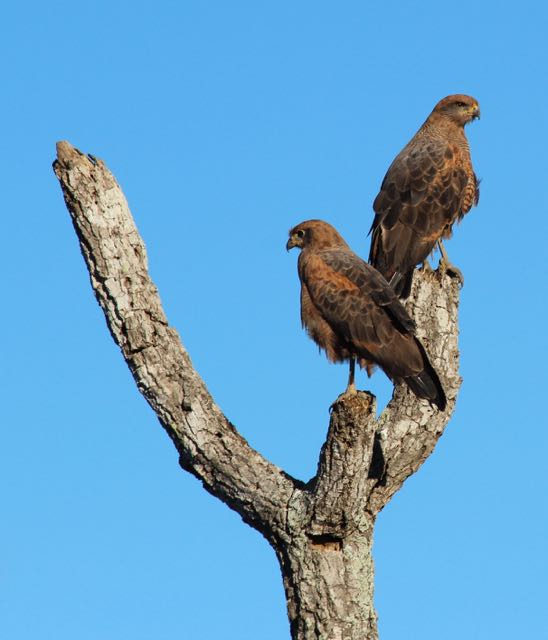
Two hawks watching over their domain
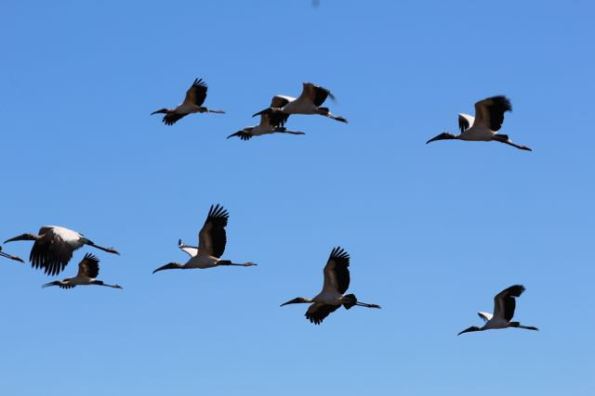
Jabirus or ibises (I think) racing to the Olympics. You’re going the wrong way
Fortunately she has a few extra days in Brazil after the Games end. To help her decide how to spend them, I’m going to add a few blog posts from our two recent trips to that vast and amazing country.
I’m going to start with the Pantanal, the world largest tropical wetland, which sprawls across two Brazilian states, as well as parts of Bolivia and Paraguay. It covers an area estimated to be up to 195,000 square kilometres (or 75,000 square miles).
During the rainy season (mostly November to March), water levels in parts of the Pantanal basin rise two to five metres, leaving about 80 per cent of the floodplains submerged.

Spoonbill wading


This wonderful inundation of water helps the Pantanal to support the largest concentration of wildlife in the Americas. The numbers are astounding. It is believed to have 1000 bird species, 400 fish species, 300 mammal species, 480 reptile species and more than 9000 different subspecies of invertebrates. The number of plant life is phenomenal too, with the ecosystem having about 3500 known plant species.
Poor John and I have been lucky enough to visit two parts of the Brazilian Pantanal—first in the south and then seven months later in the north. We reached the Pantanal by road, so had the chance to see many square kilometres of these wetlands. The two areas we visited are 14 hours and 1000+ kilometres (by road) apart.
Both times, the water levels didn’t interrupt our travels. In fact, on the first visit (for Christmas) the rains hadn’t yet arrived.

Having a look on horseback
That didn’t keep us from going piranha fishing and doing wildlife expeditions (including jabirus making whoopee) on foot and horseback, and by road and river.
On one stretch of road, we even rescued a tick-infested anaconda that was languishing in a mud puddle under a bridge. Our guide said the snake would have died had we not moved it to a pool that still held water. The rains were coming soon, so the guide was confident it would survive.
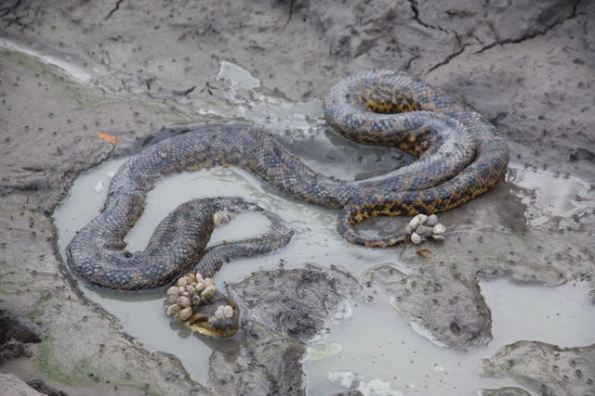
An anaconda in need of help. This snake usually lives under water
On our second visit, in July, the rivers were running a bit higher and we had more fabulous excursions on foot, on horseback and by boat.
Here is a link to another post on a boating expedition, and I’m adding even more new photos here simply because I think this magnificent wetland should be better known.
I’m sorry that I no longer remember the names of all the birds. Please fill me in, if you know any of them.
And if you need a drink after seeing the close-ups of the lizard, caimans and anaconda, check out my recipe for the amazing Brazilian drink caipirinha.
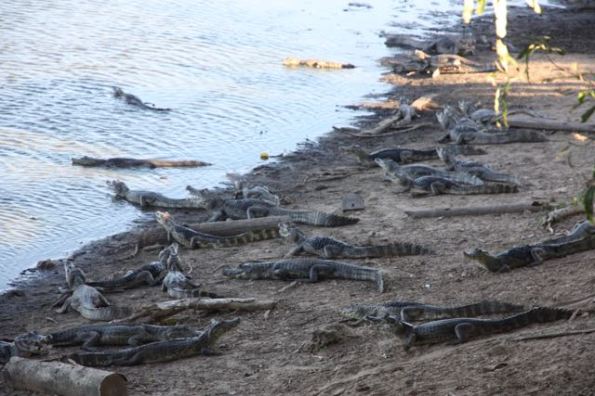
A ‘congregation’ of caimans?
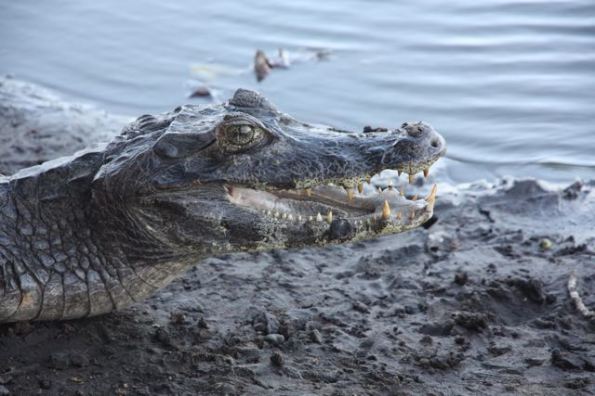
Close-up of a caiman. They are slow moving and we even managed to touch a few of them—at arm’s length and just the end of their tails
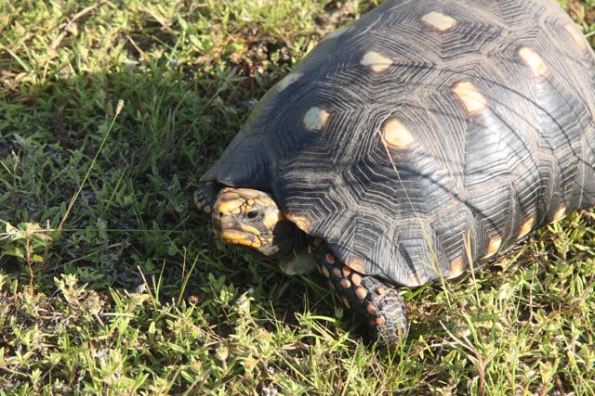
A red-footed tortoise
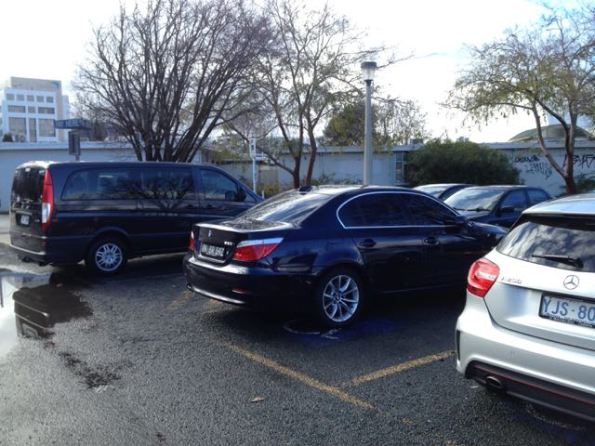
The offending car in the middle. The battle is in full swing
Have you ever pulled your car or motorcycle into the parking space designated disabled? I can imagine the scenario. It was the only Disabled space in the carpark and right in front of the pharmacy. You had to pick up a prescription and you’d be quick.
I’ve been aware of the sacredness of disabled parking spaces for many decades. My mother had great difficulty walking. Later in her life she relied on a wheelchair for longer outings. We even designed our house at the beach to accommodate someone in a wheelchair.
Then in early 2000, Poor John’s Aunt Esther came to live with us. She was 89 at the time. We built a granny flat for her and designed it to be wheelchair-friendly. About 2004, she qualified for a disabled parking permit. She didn’t drive, but I was her chauffeur, and the rules said I could use it only when she was in the car or when I was coming to pick her up.
Esther moved into demented aged care when she was 97. We kept the permit to use when we took her on outings. When she died 10 months later, the permit was returned to the city.
And now I’m getting to the point of this post. I have been stark-raving furious for the last few weeks as I have watched one person repeatedly abuse a disability permit.
Twice a week I drive Rhodanthe (and sometimes Elizabeth) to seniors’ gym class. Rhodanthe is 94 and Elizabeth is 95. Both use walking frames. The disabled parking spaces are about 100 metres from the entrance.
Three weeks ago, I pulled into one of the disabled spaces, and a dark blue BMW pulled in beside me and took the last disabled space.
The windows were tinted so I couldn’t see what the driver was doing, but he/she made no move to get out of the car. I wrangled the walkers out of the back end of the car, and still no driver appeared. We moseyed across the parking lot and up the footpath, and still no driver appeared.
I’m not normally suspicious, but I sensed that the driver didn’t want to be seen walking unaided away from the car. After we got in to the gym, I doubled back and, sure enough, I saw him get out of the car and stride across the carpark, with a briefcase in hand.
Two days later, he was there again. He was pulling into the last disabled space. We moved on a few rows and sat in the car and watched as he got out and strode off with his briefcase.
So I did my job. I didn’t run after him and I don’t leave passive aggressive note, but I did gather evidence.
Even though it was raining, I got a video of him walking away and photos of the car parked in front of the disabled signpost, the disabled permit number and the license plate number.
When I got home, I called the city’s traffic management office and reported all the details. I suggested that a city inspector wait in the carpark between 9:15 and 9:30 on a Tuesday or Thursday, and see for themselves.
Tuesday of last week the BMW wasn’t there, so I assumed success.
But nope. The car was there again on Thursday last week, and Tuesday and Thursday (today) of this week.
I’m going to the carpark tomorrow (Friday) to see if the car is there again. If it is, I will be swinging by the carpark daily and then calling traffic management daily until the behaviour stops. I suspect the permit has been ‘purchased’ on the black market
And if the city can’t/won’t solve the problem, I’ll get the seniors at the gym to beat him to a pulp with their canes. Hey, we’re a tough mob.
P.S. Scroll down through the comments for Derrick’s two stories (quite far apart) about what he saw happen in supermarket carparks. Hilarious, and oh so clever.
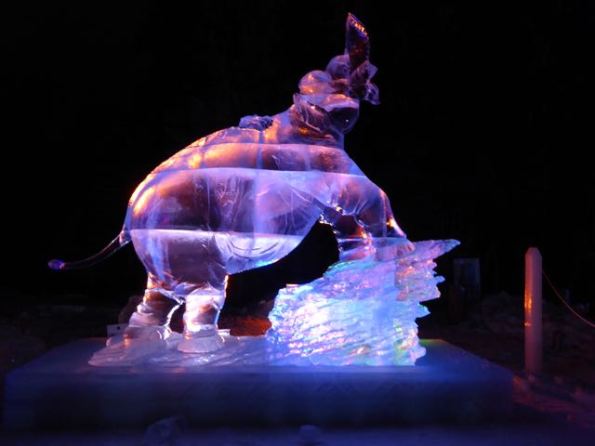
The multi-block construction is easy to see in this magnificent and huge elephant called Hero in Legend, created by artists from Thailand and Australia
Winter finally has its grip on southeast Australia—well to the extent that we have winter.
Tomorrow night the mercury will drop below 0°C (32°F), and it might snow. While that’s almost summery in my home state of Nebraska, in Australia it’s considered near rock bottom on the thermometer.

Alaska Tambourine, first-place abstract, included a dolphin, a wolf and a bird
The last time I experienced really frigid, below-zero temperatures was earlier this year in Alaska. Every time I looked at a thermometer in Fairbanks, the temperature was showing -6°C (21°F) or less.
But the Alaskans were hoping it would get even colder. For them, winter doesn’t seem right unless the temperature hits -50°F (-45°C) for a couple of days. This last northern winter the mercury there never dipped below -29°F. Alaskans know they are experiencing some sort of climate change.
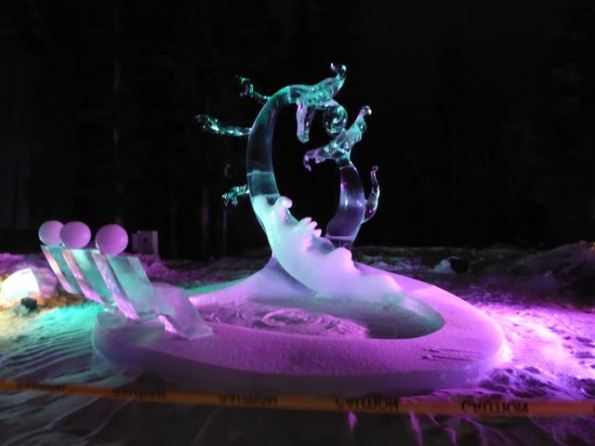
Morning of the Universe, second place in the abstract category
Another concern was the condition of the sculptures at the 2016 World Ice Art Championships put on by Ice Alaska. The annual competition ran for a few weeks with single-block ice sculptures being completed and judged first.
When we arrived in Fairbanks in the first week of March, the first round of judging had taken place and at least one work had melted enough to collapse.
At that time, the ice artists were already at work on their multi-block sculptures. We first saw those completed and judged works about a week later (after our trip to the Arctic Circle).
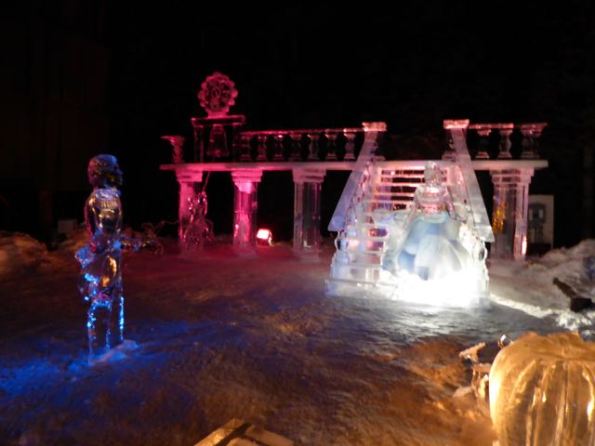
Cinderella comes down the stairs to meet her Prince Charming in A Fairy Tale Goodnight by artists from the United States and the Philippines. See the pumpkin in the right corner
Some of these pieces were huge, and the first-place winner in the realistic category was the size of a small house. It was a lovely scene of Cinderella descending the stairs to her Prince Charming. Second place went to Goddess of Determination done by artists from Mongolia.
First-place in the abstract category went to Alaskan Tambourine by artists from Russia and the United States. Second-place went to Morning of the Universe by artists from Russia and Mexico.
I was surprised to see how many artists came from countries with little or no snow and ice.
Perhaps they are among they many people who have found their way to Alaska to live.
In the supermarket, I met a fellow who had moved to Fairbanks from Jamaica. And one of our Road Scholar guides was originally from St Lucia in the Caribbean.

The Goddess of Determination looking pretty in pink, second place in realistic

