
Still no result for Australia’s federal election on Saturday. We may have an answer by the end of the week, but who knows. In the meantime, I thought you might enjoy a memory of a time when Poor John was almost comprised in Africa.

Our Sheraton campground
Over the years, I’ve had a lot of gripes about Sheraton Hotels. Don’t even ask about the night in 1977 when I tried to check in to an outlet near New York City’s JFK Airport (a freebie because of a delayed flight).
But the Abuja Sheraton changed my opinion forevermore—and in a positive way.
As we trundled through West Africa, we were repeatedly told that in Abuja, the capital of Nigeria, we would be able camp for free at the Sheraton Hotel. Yeah, right?
After 13 days of extremely remote overland travel with rough roads, no showers, little water, limited food and lots of bugs, it was hard for us to believe that the Sheraton in Abuja would let us stay. We were completely grubby and smelled even worse.
But welcome us they did. For many years, the Sheraton in Abuja has had a policy of letting overland trucks park ‘out the back’ and letting passengers camp in an area not seen by the paying public. I don’t know if this is still true, but I hope so.
Eighteen months before we arrived, camping ‘out the back’ at the Sheraton meant we’d stay where hotel vehicles were serviced and repaired. We saw that area and it was a real dump. Luckily, this time we were allowed to stay in the proper ‘backyard’.
Another smaller truck was there at the same time as us. They were a British family—mum, dad and three kids—travelling south down the west wide of Africa as far as they could go until it was time to return home for the school year. They were sleeping in and on top of their Bedford truck, which looked like a little brother to ours.

The Bedford to the left of our truck
Our actual camping spot for tents was well shielded and behind the toilet/shower block for the swimming pool. No paying guest would have found us unless they were completely bored (or drunk) and went on a complete inspection of the grounds.
So there we were—camping at the Sheraton—so surreal. A few people took up the offer to rent a room at half price, but $162 a night is not my idea of a bargain, so we stayed in our tent.
Those who camped had a lot of freedom. We could use the toilets and showers near the pool—cripes we could even use the pool. On the first day or two, some of our group hogged the pool recliners to the point that we were banned from using them at all. We could also mooch off our travelling companions who did rent rooms. I did a couple of loads of laundry in a bathtub.
The Elephant Bar was also open slather. Ah, the Elephant Bar. It was the main casual bar at the Sheraton. Every afternoon, Happy Hour was awash with cheap drinks, delicious nibbles and hordes of prostitutes.
I can still picture the spindly stilettos, ridiculously short skirts, plunging necklines, garish animal prints, liberal make-up and blatantly entertaining stalking techniques.
Even Poor John was in their sights. He told of the night that he headed out of the Elephant Bar on his way to our tent. A voluptuous prostitute clicked after him on her stilettoes.
His detour into the gents’ toilet by the pool didn’t put her off, and she waited patiently for him to re-emerge. But then, and I mean a big BUT THEN, he turned left out of the toilet and headed around to the tents.
‘Come back, sir,’ she sang out, ‘I am waiting for you.’
‘No,’ he replied, ‘I’m going to my tent.’
Tent life was never on her agenda. I can’t say ‘you should have seen the look of horror on her face’ because I didn’t see it either, but when Poor John tells the story he gets this sort of sheepish grin on his face that says it all. Mostly because he rescued himself.
But don’t ask me about the fellow who had a false eyelash stuck to his forehead the next morning.
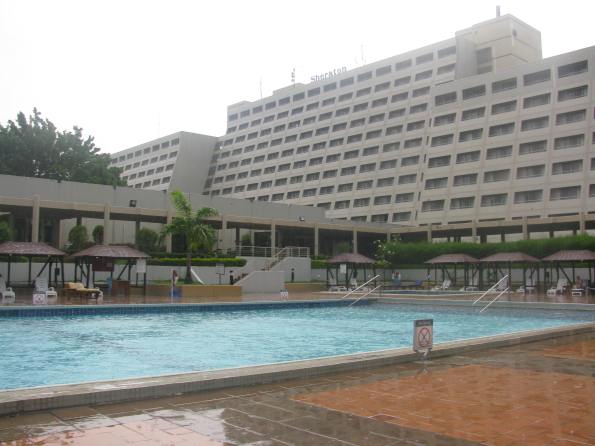
The pool, but no pic of the Elephant Bar. Sorry.
Unless you are Australian or living in Australia, you probably didn’t know that our country had its federal election today—sort of like voting for the USA president, yet totally different.
The biggest difference is that our campaign lasted for eight weeks. That was the longest campaign we’ve had in many decades. Most campaigns run for about three weeks.
As I write it is almost 11pm. We don’t yet know all the winners. The results are close. We don’t even know who will govern the country—Liberal or Labor or a hung Parliament (meaning a grouping of those willing to work together).
But we do know the outcome will be fair and a reasonable reflection of what the people want (or think they want).
Let me explain. And I’ll try to keep this simple. Pull me up if I make a mistake or if you have a differing opinion.
Australia has two main seats of government—the House of Representatives (the Lower House) and the Senate (the Upper House).
Australia operates on what is called the Westminster system. Put simply, it means every votes counts.
When I vote for the House of Representatives, I have to number all the candidates in the order of my preference for them. My electorate had four choices, so I numbered the candidates from 1 to 4.
For example, if the person I put at number 1 doesn’t get many votes—certainly not enough to be considered—my vote then spills over to the candidate who my first choice person likes best (so it pays to know who your first-choice person likes most). And so on. My vote might actually end up going to my 4th choice, but only after and because my three previous choices didn’t get enough votes to be considered. This rarely happens, but it can. (It’s more complicated than this, but I hope you get the idea).
An important addition
My friend Carol found a great explanation of how votes are distributed so here it is (it’s also in her comment below):
‘When it comes to the count, all the number “1” votes are added up first, and if any candidate has more the 50 per cent of the votes, they win straight away.
‘If no candidate has more than half of the votes, the candidate with the fewest votes is excluded, and all the ballot papers that had that candidate as “1” are transferred to the voters’ second preferences.
‘If there’s still no candidate with more than half the votes, the candidate who now has the fewest votes is excluded and the votes are transferred to the next preference shown.
‘This process continues until one candidate has more than half the total number of formal votes and is elected.
‘So if you voted “1” Greens, “2” Nick Xenophon Team, “3” Labor and “4” Coalition, your vote might flow to Labor if Greens and NXT were excluded before anyone had more than half the votes.’
The Senate is a little different. Every state elects 12 senators, while the two territories (the Northern Territory and the Australian Capital Territory) can elect only two.
Huge numbers of people run for the Senate. My ballot (in New South Wales) was the size of a table runner. Without going into huge detail, I had to number my choices from 1 to 6 above the line (or 1 to 12 below the line). If you are interested, you can look up the intricacies of above and below the line voting.
I won’t say how I voted.
But I will say that I vote in the seat of Gilmore. Poor John and I usually live in the seat of Fenner, but we have a beach house in the seat of Gilmore.
We could vote in Fenner, but it is a seat with such a predictable electoral outcome that we thought we’d put our vote where it might make more difference. Turns out it didn’t make a difference this time, but maybe in future.
But a few comments about Australia’s amazing voting system, and this is from the man who is America’s current ambassador to Australia. Our local radio stationed interviewed him earlier this week. He said there are three things he wants take back to America. They are:
• compulsory voting—Australians over the age of 18 are obliged to vote
• an independent body to draw the electoral boundaries
• a campaign of no more than 60 days.
If electoral practices ultimately change in the USA, maybe it started here.
So how would you change the voting system in your country?
Another important addition
I completely forgot to tell you about the cake stalls and sausage sizzles that are a major part of every Australian election.
Elections are always on a Saturday and most primary schools serve as polling stations. This provides a perfect chance for the P&C (Parents and Citizens) group at a school to fundraise. Mums and dads volunteer to make treats (ingredients have to be listed on the outside of the packaging), butter slices of bread, fry onions and sausages, and collect a fair whack of money for the school coffers.
I was vice president of our local P&C for two years in the late 1980s, which meant I was in charge of fundraising. I twisted a lot of arms those two years and we made a lot of money for frills at the school. I remember neighbour, Peter, taking the challenge to slice something like 10 kilos of onions. He wore goggles to do the job.
So if you’re ever ‘recruited’ to bake or slice or fry for a ‘cake stall’ event, here are two page-32 recipes that should make your task easier.
Apricot squares, which my daughter’s work colleagues call ‘apricot crack’.
and
Lamb, rosemary and apple sausage rolls, the most visited recipe on my cooking blog.
This is the first time I have ever reblogged a post, but I so very strongly support the sentiment in this one. We travelled extensively in Africa and India. Leopards live on the brink. I took the time to send a message and hope you will do the same.

So Cape Nature is at it again, threatening the life of a leopard. They are planning to remove a leopard for catching penguins in Betty’s Bay, Western Cape!
Please click on this link if you are not sure what or who CapeNature is…. http://www.capenature.co.za/about-us/
This is again a disgraceful action by this conservation agency! What is a leopard suppose to do?
I urge you to please send in your objections to romar@capenature.co.za
You don’t even need to be a South African citizen to make a difference. Just simply the numbers are needed to illustrate to CapeNature what they are doing is not ethical.
We have been agitating since last week to prevent the demise or removal of a leopard in Betty’s Bay. A flurry of press releases by CapeNature have been aimed at damage control and to deny them wanting to remove the leopard. We had three people connected to…
View original post 1,070 more words
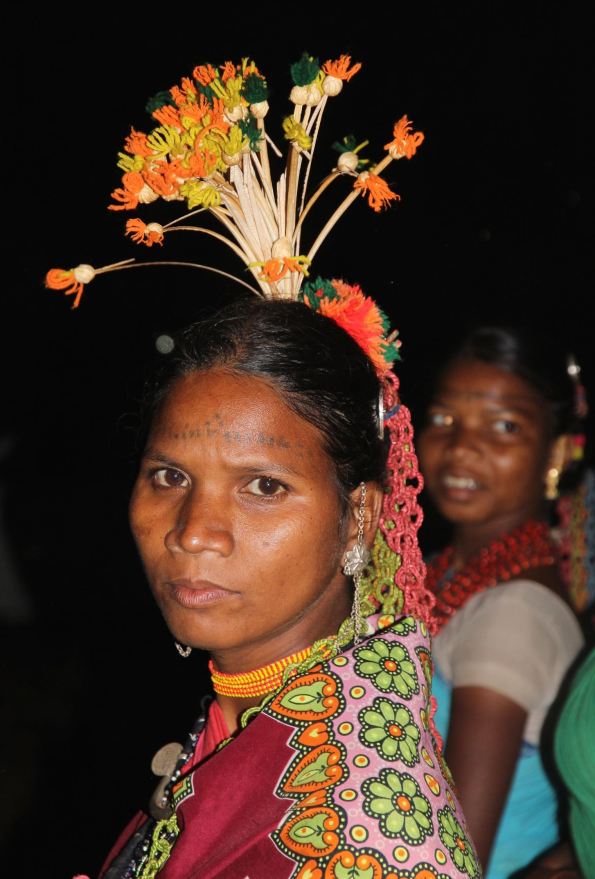
I love this pic of a Baiga dancer with her wonderful headdress and tattoos
How am I going to make dinner over the next three or four weeks?
Let’s get this straight. If you cook dinner for your family every night, you might do the same as me. I switch on the TV about 4:30pm for some distraction, company and entertainment.
For the last three or four weeks, I’ve been watching the 2013 edition of India’s Dancing Superstar. It’s been sensational.
I’ve watched all the auditions (there were hundreds), the narrowing down to 60, and then the further narrowing down to 12. I’ve watched as the judges nurtured and encouraged each and every performer who progressed. For example, there was a dwarf, Vikas Kumar, who has since gone on to make a name for himself in India’s entertainment world.
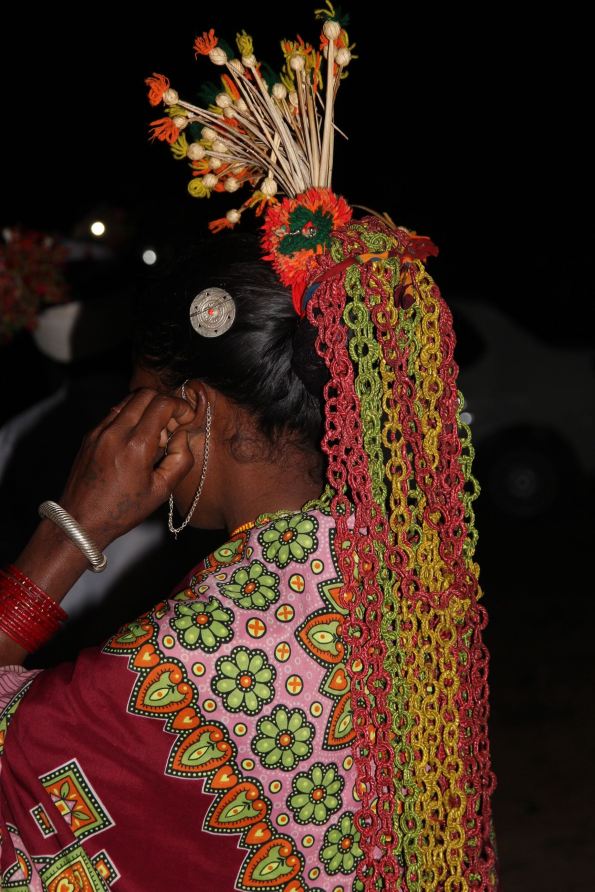
A colourful Baiga headdress from the back
Then there was the Loyola Dream Team, a group of young men from a private school in Chennai. They got into the top five. One of the judges, the stylish Geeta Kapoor, was especially partial to them, and so was I. They didn’t win, but have since gone on to perform widely in India.
In the end, MJ5 took out the honours, winning the most phoned-in votes from across India. They did a great job and specialised in moon walking, a dance style made popular by Michael Jackson (hence their name of MJ5). They were amazing and innovative, and represented just a small slice of the many dance styles that are practised in India.
In fact, the range of dance styles shown in the competition amazed me because, until the superstar event, my knowledge of Indian dance was limited to traditional and Bollywood productions. By the way, Geeta Kapoor is a Bollywood choreographer.
Luckily, our travels in India have given us the chance to see other styles of traditional dance.


Dancers in India—the Baiga
The first time we saw dancers was near Kanha’s national park, in Madhya Pradesh, and this group was from the Baiga tribe.
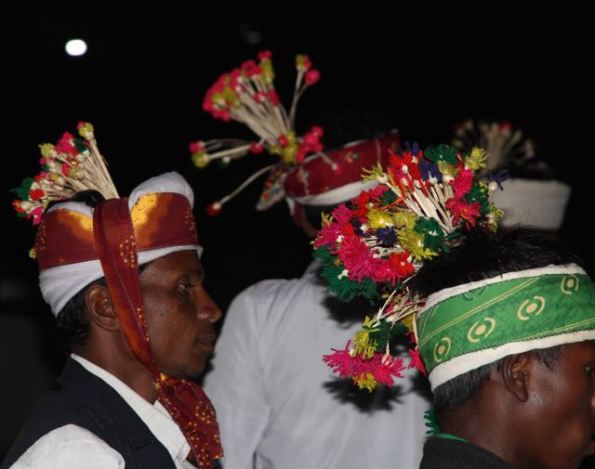
We felt lucky to see them: so full of life, colour and movement. While the women and men performed together, they filled different roles. The women danced in a circle or in a line, while the men, for the most part, played the instruments.
I was sad to learn more about the Baiga. They are forest dwellers living mostly in Madhya Pradesh, Uttar Pradesh, Chhattisgarh and Jhaekhand. They live a semi-nomadic life, and are hunters and woodsmen. They strive to survive on the produce of the forest, and say they don’t plough the earth because it would be like scratching their mother’s breast.
Over the last 50 years and in the name of conservation, many Baiga have been forcefully evicted from their forests. The government has officially ‘reclaimed’ the land to protect tigers and expand national wildlife parks.
Obviously this has been great for the animals and those of us who want to see them in the wild, but I believe it has been problematic for the Baiga communities.
I don’t know if ‘our dancers’ were displaced, but we sure appreciated their performance. Our little group of six was the only audience and we loved every minute.
Oh, and some groups of Baiga women are tattoo experts. I wonder if the group we saw are among the artistes?
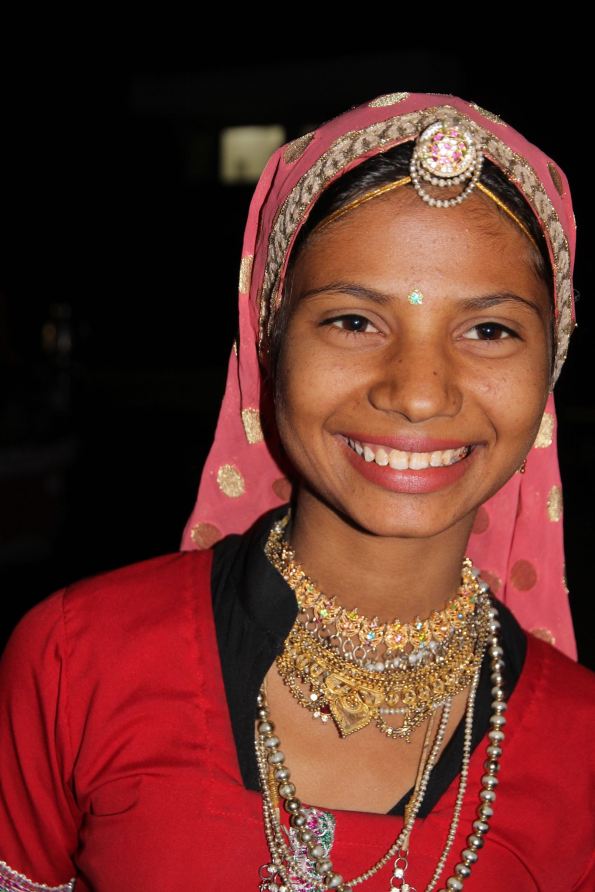
A wonderful smile. Isn’t she cute!
Dancers in India—Rajasthan
Our next dance extravaganza came a week later in Rajasthan, near Ranthambore National Park. This performance was organised by the hotel/campground where we were staying, and was performed in the garden near our tents. I think it must be a routine offering, and many hotel guests attended.
There were four musicians and one dancer performing the bhavai style of dance. This style involves a female balancing earthenware or bronze pots on her head as she twists, turns and dances. Our girl balanced a stack of metal pots (aluminium or stainless steel, I think). She was such a sweet thing with a wonderful smile.
It had the feel of a family affair, with dad and sons playing the instruments, and daughter fleshing out the performance with her dancing.
We were happy to support them.


Our next adventures
India seems to be in our blood. The dancing might be too, but don’t expect Poor John to ever admit that he has any interest in dance.
We’re planning another trip to India: this time in the south and starting in early October 2016. It’s for 45 days and has a focus on wildlife—lots of tigers and bears (the lions are further north and west, and we saw them here).
If you’re interested and are good travelling companions (eat anything and okay with budget accommodation), you are most welcome to join this adventure. Two seats left. Let me know and I will send details.
P.S. The trip will travel with 2, but there is room for 4. Oh, and if you love Indian food as much as we do, check out this great recipe for fish in tomato gravy.
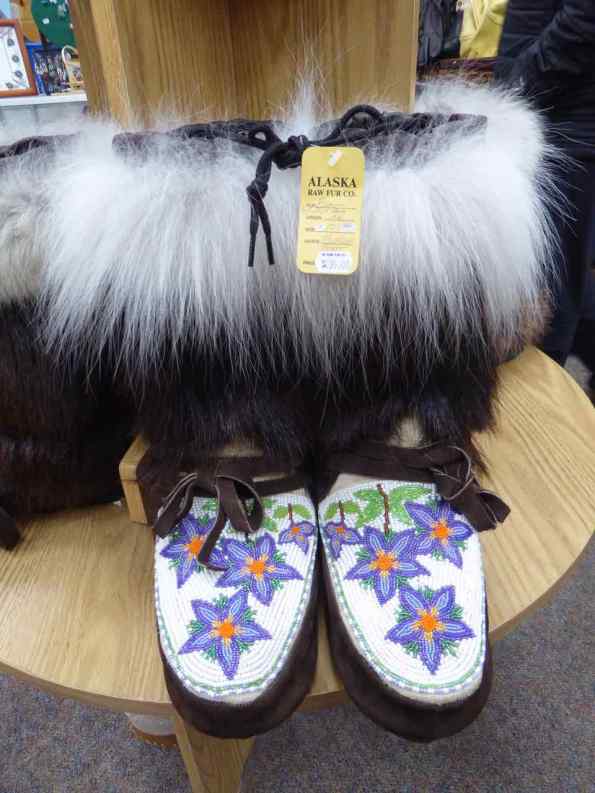
Beaver and beaded boots, priced at $595 a pair
My mother had a rabbit fur coat and Poor John’s Aunt Esther had a mink stole, but these days wearing fur is considered politically incorrect in many parts of the world.
I’m not a fur-wearer, but after two weeks in wintry Alaska, I have a better understanding of and appreciation for that state’s long history and heavily regulated industry of trapping.
As part of our Road Scholar program, we even had a talk presented by a long-time Alaskan trapper. He told us about the kinds of animals that can be trapped, how trappers go about their work, the array of rules and regulations they must follow, and the licenses they need.
Some animals are in abundance, including arctic foxes and martens. Others are valued for their meat, especially squirrels and marmots. There are strict bag limits for others, such as wolverines and wolves. The lynx is likely to be added to the limited list.
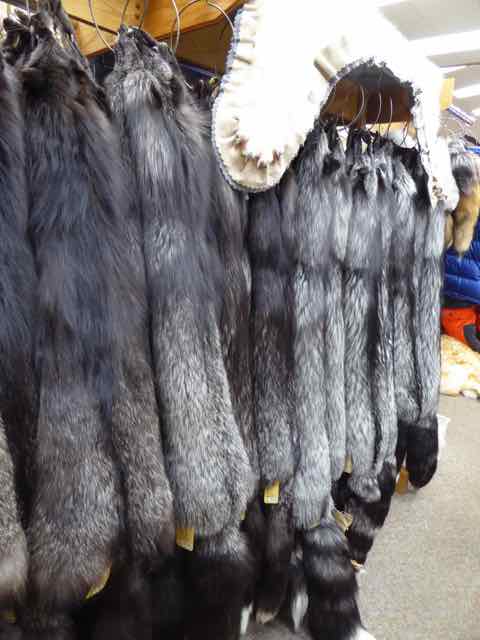
An array of silver fox
I found the beaver to be the most surprising. It’s highly valued for its warmth in winter clothing. In fact, we visited the Alaska Raw Fur Company in Fairbanks and they were selling beaver gloves and beaver fabric that could be made into gloves. A young couple was buying fabric while we were there. His job meant he stood outside in frigid conditions for long hours.
Having stood outside to see the Northern Lights on a freezing night in Coldfoot Alaska, I can understand why warm clothing is so important. It was bone-chilling, and even those nifty things called hand and toe warmers couldn’t keep me warm.
The only thing I could do was to escape inside from time to time to warm up by the fire.
We visited the Alaska Raw Fur Company after our six days in Coldfoot, and I was fascinated to see the range and sheer volume of furs. All so beautiful, all so soft and, yet, all still so sad.
The company’s website says that every year they travel by small ski plane from one remote cabin or village to the next to collect the winter’s ‘harvest’. For the trappers, it is a source of food or source of income or both. It’s still hard to think of the loss.
That said, the sheer volume of furs in the shop is an indication of how common trapping is in Alaska, and how great demand must be.


We didn’t buy anything, but I was rather tempted by some of their other products. I have lots of friends who are keen on quilting and beading, and the shop had fabulous arrays of fabrics and beads. I hope they don’t hold it against me that I didn’t bring back any of the amazing Alaskan prints.
Two comments about wearing furs
I spent much of December 2000 in Europe. It was freezing and I was plenty cold. We (the daughters and I) went from Belgium to Luxembourg for the day, and every second woman was wearing a fur coat.
Not many of the coats actually fitted the person wearing them (some even dragged on the ground), which led me to believe they were wearing their grandmother’s gear. That said, it reminded me how important it is to stay warm in cold climes.
Oh, and I mentioned my mother at the beginning. Even though we lived in cold, cold Nebraska, Mum didn’t wear her rabbit coat very often, but when she did our dogs (a boxer and a cocker spaniel) wouldn’t leave her alone. They’d nuzzle in against her legs and walk round and round her. I can still see it in my mind’s eye and it is a wonderful memory of my mother and those two dogs.

This red fox coat has a price tag of $3295. The style is similar to my mother’s coat

Mary chains one of her dogs to its kennel for the night
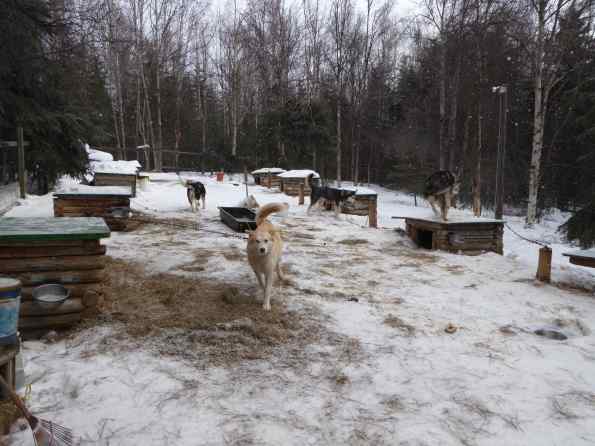
The dog yard behind Mary’s house
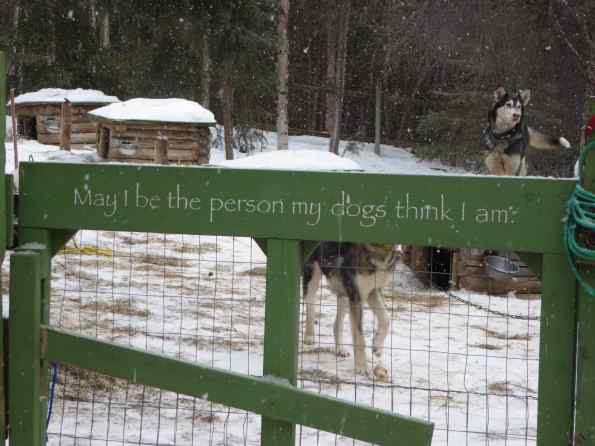
The gate says ‘May I be the person my dogs think I am’
It’s winter in Australia and we’ve had wonderful soaking rain yesterday, with more drenching us today.
The weather got me thinking that if our winters were much, much colder we’d be completely blanketed with snow by now. And that got me thinking about our snowy time in Alaska in March.
I’ve already written about our first visit to the world ice art championships in Fairbanks, but I haven’t told you about our amazing afternoon with Mary Shields. In 1974, she was the first woman to finish the famous 1000-mile Alaskan dog sled race, the Iditarod.
Mary welcomed us into her log cabin on the outskirts of Fairbanks. She and her then husband designed and, for the most part, built the house. It’s a simple design with two floors (ground floor and basement) and a large kitchen with a wonderful wood stove/cooker (I still love my wood stove and should write more about it).
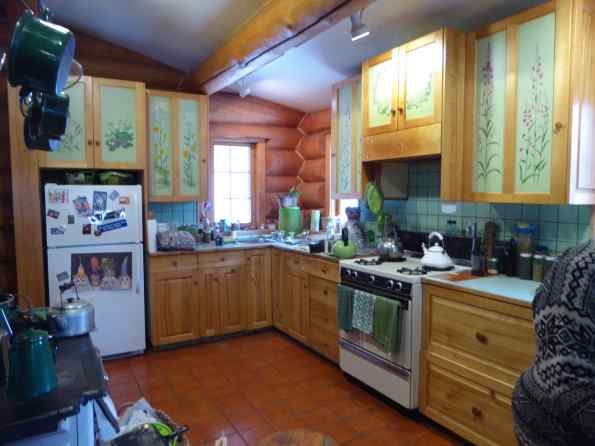
A wonderful kitchen
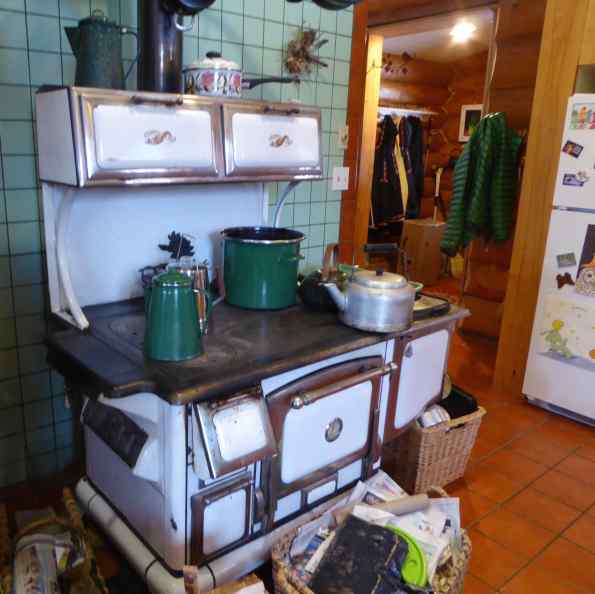
Mary’s wood stove in action. Mine isn’t nearly as beautiful
After a tour of the house, Mary led us outside to her largish backyard where her team of huskies is corralled. The dogs were overjoyed to see her, and happy enough to see us too.
We had the chance to meet and pet the dogs, and see the range of sleds she keeps on hand. Mary still does a run most days and can range for 20–30 miles on any given expedition. She says the dogs love to run, and it’s pretty obvious that she loves to hang on the back.
Mary makes sure each dog changes their kennel every day so they don’t become possessive about one place. She also keeps them chained to the kennel of the day, so that fights don’t break out while she’s inside or away.
Each kennel is low, square and filled with straw for warmth. If I recall correctly, there are eight kennels for six dogs.
Mary brings the dogs inside regularly, but they don’t stay for long. Their coats are long and they are bred for living outdoors, so they overheat when they are inside for too long.
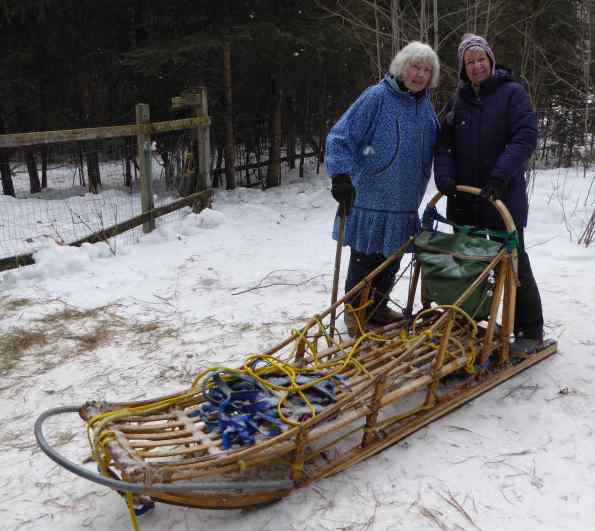
Mary with one of her sleds
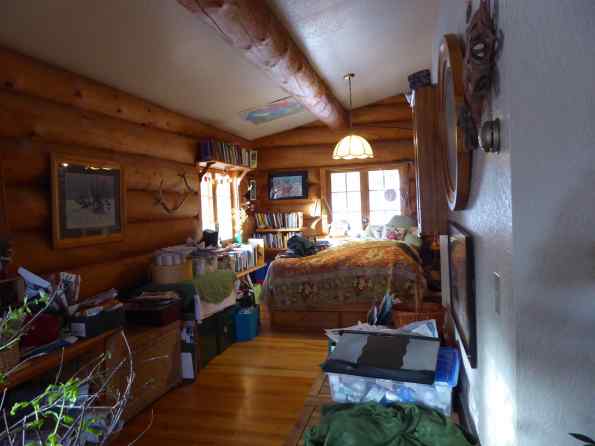
Looking down to the bedroom
Eventually, we retreated to the house and got comfortable in Mary’s warm and cosy living room and kitchen. That’s when she told us of her experiences in the Iditarod as well as her runs in the Yukon Quest International Sled Dog Race and the Hope Race from Alaska to Siberia.
She told us how she came to love mushing and how it still gives her so much joy. And, as I said before, she still runs (hope I’m using the right terminology) them regularly. In between, she’s had time to write five books.
For our visit, Mary wore what I think is called a kuspuk, a traditional garment for Alaskan women (and now men, too). Even though they appear to be lightweight, they must be lined and super warm because Mary showed no signs of being cold. Maybe she was warmed to the bone by her gorgeous wood stove, which also produced the lovely hot drinks and biscuits we enjoyed for afternoon tea.
If you make it to Fairbanks, we can highly recommend a stop at Mary’s for a Tails of the Trail experience.
Oh, and if you’re interested in reading a wonderful story about dog sled racing, I can highly recommend Gary Paulsen’s book Winterdance: The fine madness of running the Iditarod.
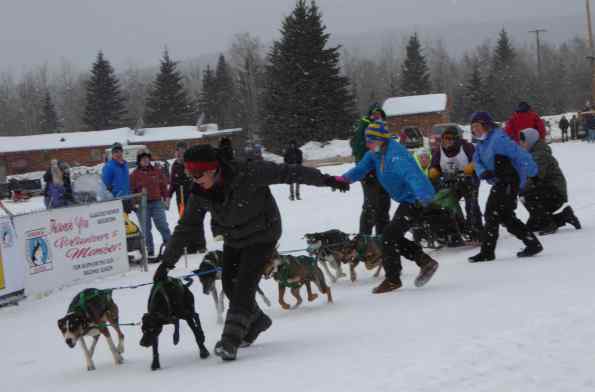
Sprint dogs are raring to go. Notice how lean they are
Our first mushing of the day
Before we visited Mary, we stopped at a dog sled racing competition. It was an important international competition, but I can’t remember what it was called.
It helps to know there are three kinds of sled races that require different kinds of dogs.
The competition we saw was for sprints only. These races range from four to 100 miles. Then there are mid-distance races, 100 to 300 miles, and long-distance races that can exceed 1000 miles.
We watched 15 or 20 race starts, but the great bonus was to meet Leonie Tetzner. At age five, Leonie won the Montana Creek World Championship, making her the youngest dog racing champ in the world.
It was fascinating to watch her. Remarkable confidence. Keep an eye on her.
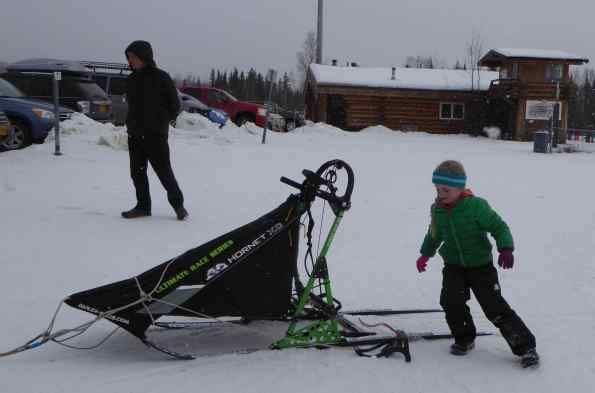
Leonie Tetzner, junior champion at dog sled racing
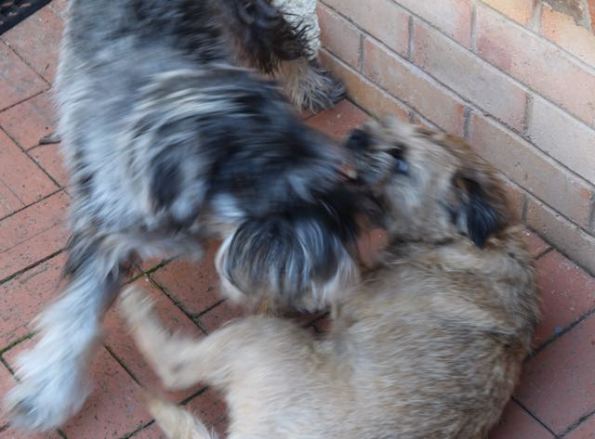
Indi and a very clean Scout roughhousing
Remember the whodunit at my house a couple of weeks ago? Two dogs and a missing leg of lamb—bone and all.
Indi and Scout were the obvious culprits, and now we know where the bone ended up.
Here’s how the discovery came about.
Scout and his mum, Caroline, came for dinner last night (we minded him while Caroline was on holiday.) Soon after they arrived, Caroline said Scout had spent the previous morning at the vet’s.
He was suffering from a severely impacted bowel.

Indi demonstrates her upside-down sit
Caroline explained, The vet said it was the worst case he’d ever seen. He gave him a laxative on Friday, but that did nothing, so back we went on Saturday. So the vet took an x-ray to see what was going on. You should have seen the x-ray! The blockage was huge. And what really surprised me was that the vet said it was caused by bones. I hardly ever give Scout bones, so I don’t know how this happened.
By then, I’m choking with laughter. Oh Caroline, you forgot all about the whodunit and the missing lamb bone!
Geez, we all had the best belly laugh at Scout’s pain and Caroline depleted wallet—$620—and then what the vet had to say as they were leaving. Caroline, he’s all sorted now. We’ve hosed down the surgery and cleaned up Scout as well as we can, but give him a bath when you get him home.
Oh my, the vision that conjures.

Scout looking perfectly innocent
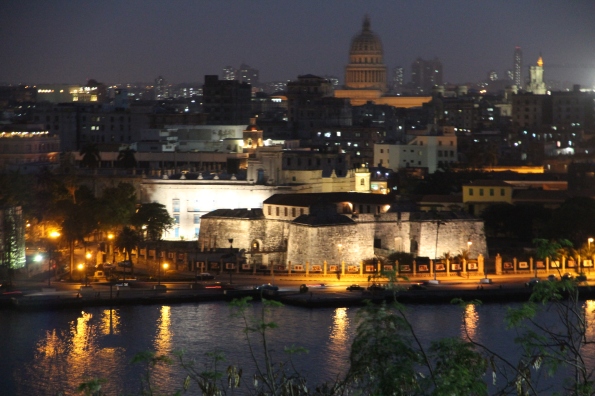
Havana at night
Walking tours are a great way to get to know a foreign city, and Poor John and I have done many around the world.
This year, we were lucky enough to have almost three days to stroll around Cuba’s Old Havana, also known as La Habana Vieja.
Darbel, a young Cuban who teaches English part-time, guided us on the first day, and we managed to blunder around by ourselves for two more.
I thought his name was unusual and he said his mum made it up. Darbel knows his city well and is very proud of its history, architecture, museums, galleries and plazas. So this post covers our day with Darbel.
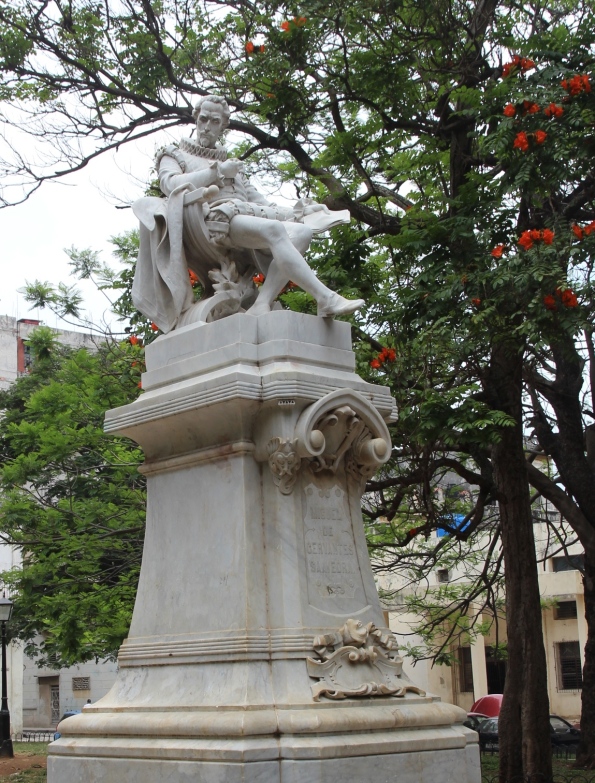
Statue of Cervantes in the park that’s named after him
We started with a visit to the statue of Spanish novelist, poet and playwright, Miguel de Cervantes, in a park that bears his name. His works had so much influence on the Spanish language that it is sometimes called la lengua de Cervantes (the language of Cervantes). This statue, by Italian sculptor Carlos Nicoli, was unveiled in 1908. It’s thought to be the first monument to Cervantes erected in the Americas.

Havana Cathedral


Next stop was the Plaza de la Catedral with its magnificent Catedral de San Cristóbal or Cathedral of the Virgin May of the Immaculate Conception. This plaza used to be a swamp. It was drained and used as a naval dockyard until the cathedral was started in 1748. The cathedral was closed when we were there, so we didn’t get to snoop inside, but we could admire the Baroque facade.
Most of the church is built from coral blocks cut from the floor of the Gulf of Mexico. Marine fossils can be seen in the walls, but I learned about that too late to photograph any.
The exterior is interesting other ways. The right bell tower is wider than the left, and holds two bells that were cast with gold and silver mixed into bronze, which supposedly makes the sound sweeter. The cathedral supposedly has the only Baroque façade with such a distinctive asymmetrical feature.
I was stunned to learn that the cathedral once held the remains of Christopher Columbus. Apparently in 1796, after the Peace of Basel was signed and Spain ceded most of the island, Hispaniola, to France, Columbus’ remains were moved to the cathedral’s Altar of the Gospel. His remains were returned to Spain in 1898.


Not far from the plaza is the legendary bar, La Bodeguita del Medio, one of Ernest Hemingway’s favourite watering holes and a popular stop for tourists.
Next stop was the Plaza de Armas, built in the 1600s and used for military exercises (hence the name) until the mid-1700s. Today it’s lush with palm trees and other tropical plants, and popular as a place for Cubans to relax.
A popular second-hand book market operates next to the plaza. It’s open Tuesdays to Sundays and has all sorts of classic Cuban books, many out of print. I couldn’t find any cookbooks, but about a week later we saw the books and stands being packed up at the end of the day. Seems they have a storage building on the edge of the plaza. That was also the day we saw the dancers bringing zing to the plaza.
But for now I’m sticking to our day with Darbel.
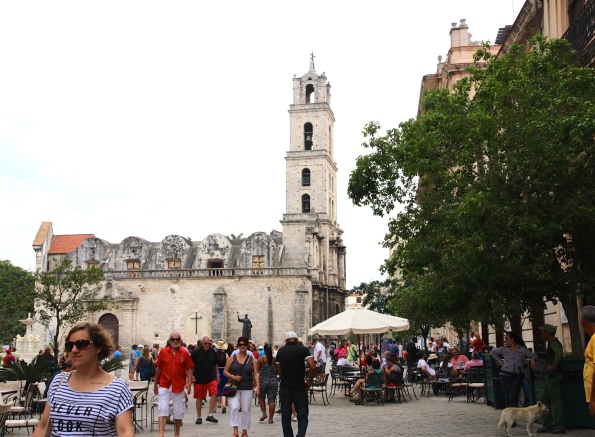
Plaza de San Francisco


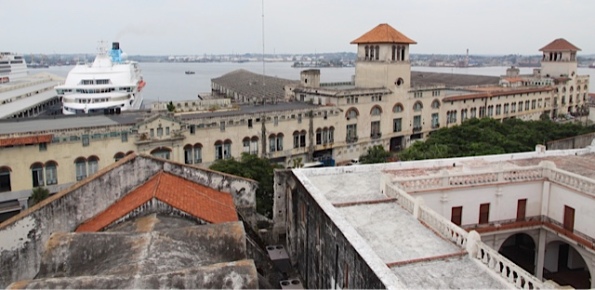
Overlooking the harbour, a cruise ship and the vacant Customs House.
So on to the Plaza de San Francisco directly across from the port. The Basilica Menor de San Francisco de Asis is the most important building in the square. Built between 1580–91, it has a 42-metre high bell tower that Poor John and I climbed. That gave us a great view of the plaza, as well as the harbour and the old Customs building, which is now closed but will probably be turned in to a luxury hotel one day.
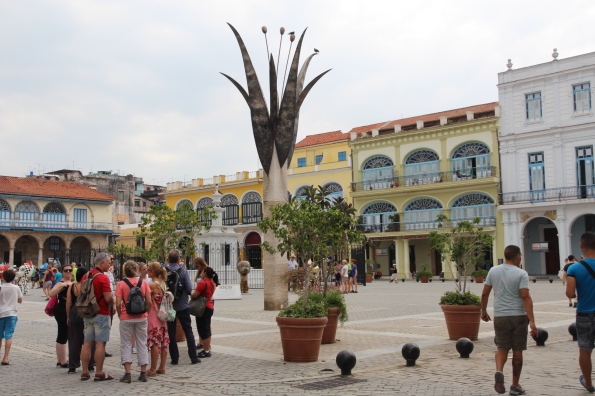
Vieja Plaza or Old Square


Our final stop was the Plaza Vieja (Old Plaza). In days gone by, it was the scene of executions, processions, bullfights and fiestas. In recent years, the plaza has been restored to its old elegance. The fabulous buildings that border the square include the elegant Casa del Conde Jaruco, now a venue for art exhibits. The upper floor has wonderful half-moon stained-glass windows.
But wait—as the pushy TV sellers say—there’s more.
Darbel was supposed to spend an entire day with us, but we had an air-conditioning flood in the room at our homestay, so we were off to a very late start. As a result, we had only four or five hours with him. Luckily, he kindly offered to return to give us a night expedition. Yes please, we said.

Fort during the day


The main aim of our evening excursion was to experience the cannon-firing ceremony at the Fort of Saint Charles (or Fortaleza de San Carlos de la Cabaña), which we had seen during our daytime outing. The nightly firing dates back to colonial times and signals the closing of the city gate.
The fort, also known as la Cabaña, is on a peninsula. We could have taken a taxi around to it, but it was much faster and much cheaper to go by local ferry (about 10 cents a person). If you ever need to cross the harbour in Havana, use the local ferry and give them the smallest coin you have.
After we crossed, we walked up to the fort. There was some time before the cannon-firing at 9pm, so we visited the statue of Christ and enjoyed views over to the harbour. What a great view of Havana at night. Especially great to see the
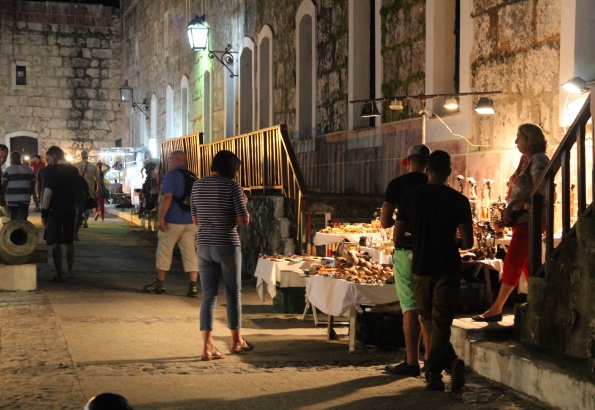
Souvenirs galore
Once you get in the fort, there are souvenir sellers everywhere, so it’s true—you must enter and exit by the souvenir shop! Not surprisingly, the firing itself is surrounded by ceremony, uniforms, drums and pomp.
Overall a great day, and I’ll be back soon with new views of our other two days of strolling in Havana.
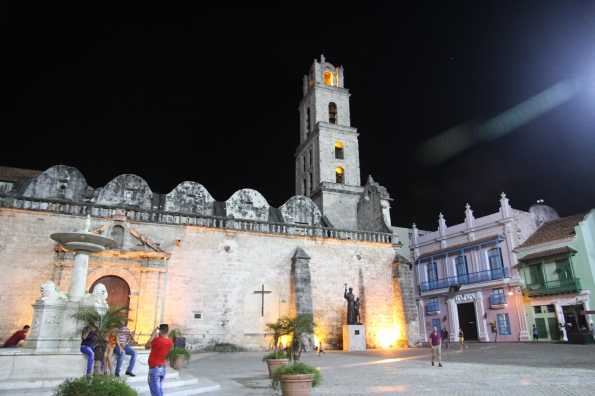
San Francisco square at night
What a frustrating couple of weeks it’s been. We’re back from our travels in North, South and Central America. While we were away, our Australian internet and landline conked out (on April 15 to be exact). Both are still out, and I’m in the midst of the great ‘run-around’ from the provider.
I’m in the process of writing a long and scathing report about the whole issue (the provider is the problem, I think). Just so you know, we’ve been customers for almost 14 years and it seems that they can’t cater for our problem. I promise to share more of the episode as it plays out.
In trying to sort this out, I’ve been on the receiving end of silence, lies, ducking and weaving, smoke and mirrors, lack of service, lip service, and a bubbly case manager. Gosh she sounds young.
Luckily I have a mobile phone (cell) and a dongle (small device that gives an independent and wireless internet connection) that costs a bomb ($180 per 12 gigabtyes), but keeps me online.
It reminds me of paying quite a few dollars to be online in places such as:
- Morocco and never making a connection
- Congo and never making a connection, and
- Kenya and never making a connection
But it also reminds me of getting fast and easier connections in far-flung places in West Africa and Central Asia.
For the moment, I’m in a temper about not being able to get wifi in my own westernised country. In another couple of days, I’m going to name names and tell the whole story.
You need to know I am about as grumpy as I can get.
So how hard is it for you to get online?
P.S. Sorry, but no pics. There is nothing to show except my crabby face.

Poor John gets a personalised shoe shine in Santa Clara


Street life fascinates me. Everywhere we travel, I love seeing locals at work and play. Usually I’m thankful I don’t have to do the job I’m photographing, and often I wish I could join in on the play.
Cuba was no exception.
Last month, we had two weeks there, starting with two nights of homestay in Havana. Then we travelled by bus for stays in Playa Giron (Bay of Pigs), Cienfuegos, Trinidad and Santa Clara. If you keep up with this blog, you’ll know we didn’t have our luggage for any of these stops.
Luckily every homestay included a clothesline so we could do our laundry almost every day. Poor John was pretty lucky my daypack had an extra pair of shorts and, who knows why, a pair of bike pants.
Every destination also included a special activity or two, such as a walking tour (more about those soon) or a salsa lesson (for me, not Poor John). So we had plenty of chances to enjoy Cuba’s colours, sounds, smells, energy, architecture, people, friendliness and, of course, cars.
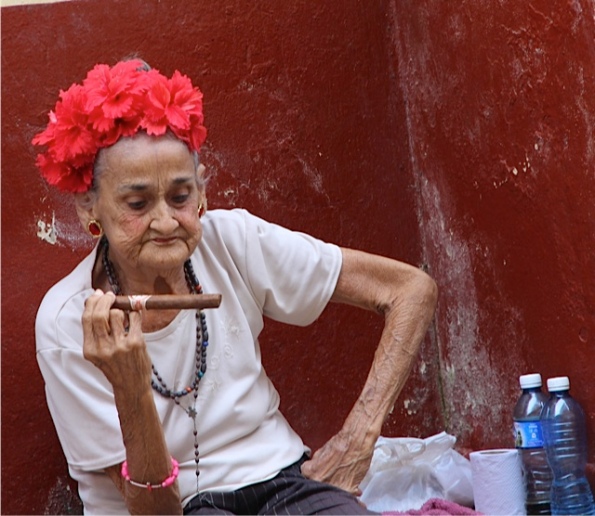


In addition to the amazing cars, we saw plenty of important monuments and an extraordinary number of souvenir shops. That said, I couldn’t find a single pair of knickers (underpants) and Poor John couldn’t find a place that would sell him a disposable razor.
There were plenty of restaurants. We dined at a couple of hole-in-the-wall eateries and our meals cost next to nothing. Something like $2 for two individual pizzas and two drinks.
The price was directly related to the CUC versus CUP. Let me explain.
Cuba has two currencies—the CUC and the CUP.
The CUP is for Cubans. Tourists use CUCs. The latter is a convertible currency and can be exchanged at the airport on the way out. CUPs stay only in Cuba. One CUC is worth about US$1 and about 25 times (I think I’m right) what a CUP is worth.


Some touristy-type places accept CUCs only, which means a Cuban can’t buy in those places unless they’ve somehow managed to acquire CUCs.
The CUC versus CUP issue makes Cuba a somewhat expensive place for a tourist to visit, because except at hole-in-the-wall restaurants, we were always charged at the CUC rate.
On our walking tour in Cienfuegos, I bought our homestay hostess an ice cream in one of the local hotels. The gesture was prompted by the fact that she said she could never buy one in that place.
But don’t get me wrong. Cuba is still fairly cheap to visit, but the CUC makes it more expensive than countries with similar economies.
But I digress on a boring subject—money. Sorry.


Back to street life.
We were lucky to see a whole range of interesting activities.
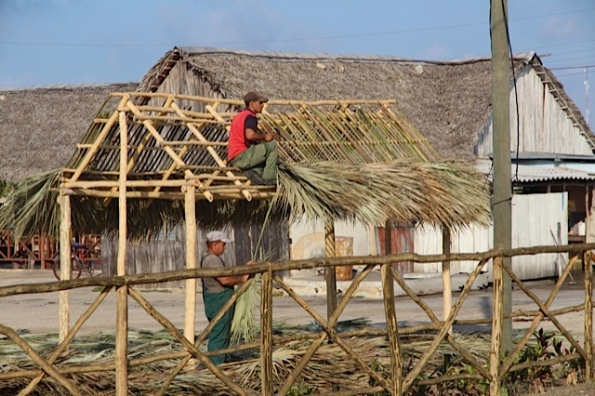
There was the fellow walking his pig somewhere, and the lass across the road painting her house. She finished the front in one day. Bands were playing in some parks and people were dancing. One fellow danced on his own for more than an hour.
I’m a sucker for the fruit and veg sellers, and the produce in Cuba looked wonderful, if a little limited in variety. Poor John is always on the lookout for an el-cheapo haircut or shoe shine. He got the latter in Cuba, having decided that his hair wasn’t quite long enough yet for a cut.
In Havana, we saw a group of people in wheelchairs. All of them were selling sunglasses. I had to run an errand and left Poor John sitting nearby with his book. He noticed that one of the sellers got up, stretched his legs, swapped places with another person (perhaps a daughter) and walk away. Things are not always as they appear.
Anyway, I hope you enjoy some of the many views we saw. Most pics don’t have captions, because they are self-explanatory.
I’m wondering if you can guess which pic is my favourite. Which one is yours?
P.S. I have two Cuban cookbooks and I’ll be making recipes from them soon. In the meantime, check out this delicious prawn and avocado salad recipe that uses ingredients that are plentiful in Cuba.


 Where to next?