
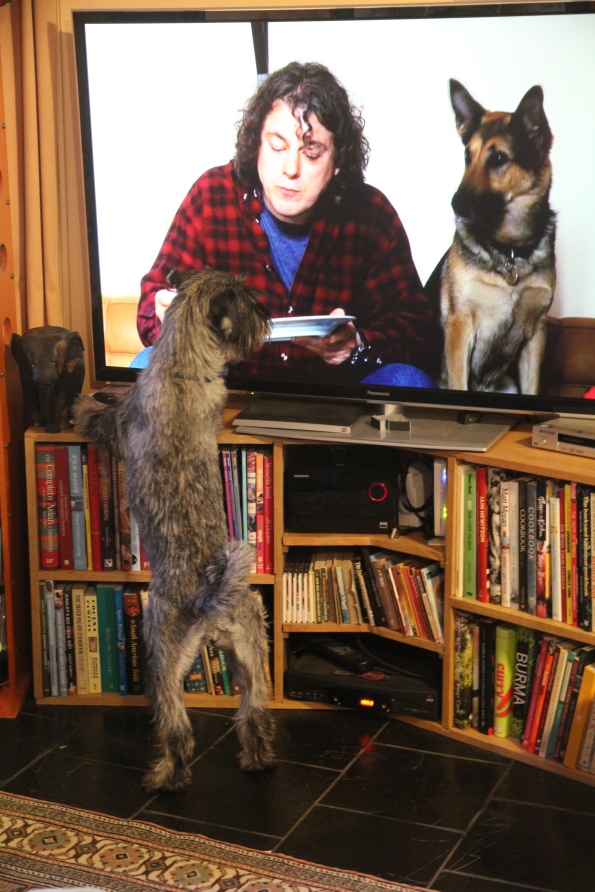
Indi and an unknown dog watch Alan Davies eat his own meal on TV
The scents of garlic, rosemary and lamb still waft through the house, almost 24 hours after I put the roast in the oven.
But the smells are all that’s left.
When I walked into the kitchen/family room this morning, the first thing Poor John said was, Did you put away the lamb roast last night?
Er, no. Why?
Because I found the platter and the carving knife on the dining room floor this morning. I thought it was on the kitchen counter last night?
As two dogs (Indi and Scout) bounced around me begging for breakfast, I said, Yes it was in the kitchen and now I suspect it’s in one or both of these dogs.
Now we’re faced with a bunch of unanswered questions.
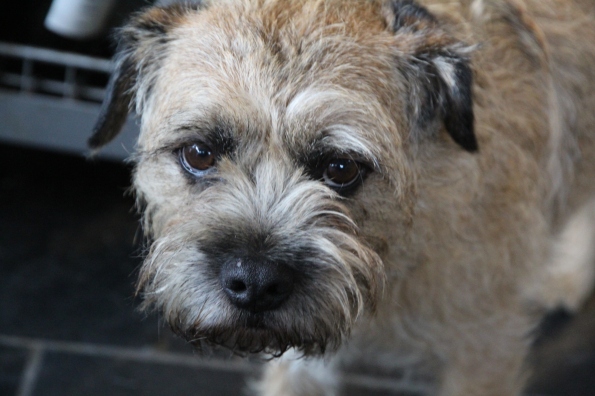
Scout tries to look innocent or apologetic
Which dog started it? Indi is taller. Scout is older and perhaps wiser. Were both involved?
The kitchen floor is slate and the platter is ceramic. How did the platter fall and not break? How did we not hear the kerfuffle? Our bedroom isn’t that far away.
How did the carving knife travel with the platter, and yet there’s no sign of blood on either dog or on the floor?
Where’s the bone? Where’s any sign of meat juice on the kitchen floor OR the carpeted dining room floor?
Why did the dogs keep hounding me for breakfast and why did they crank up the hounding at dinnertime?
Will the many sprigs of rosemary and six cloves of garlic studded in the lamb have any adverse affect on the dogs?
They’ve come to my side as I type this. Are they begging for more food, trying to apologise or claiming innocence?
What do you think?
P.S. I am reminded of Aggie’s food forays, including his assault on Poor John’s desk to grab a 300-gram block of dark chocolate ($166.70 at the vets).
P.P.S. Happy Mother’s Day to all those mums out there. If you like lamb or just like stew, you should check out this recipe on my cooking blog. It’s called Mum’s lamb stew.
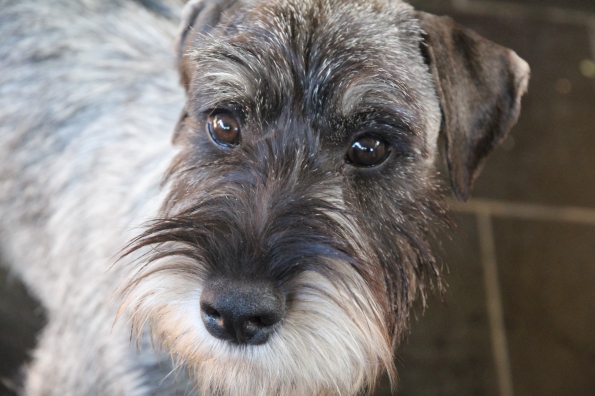
Indi says ‘Who me?’

The emergency room had bed for about four people
We’re back in Australia for a bit, so Poor John went to the doctor yesterday to make sure all is okay with his right foot.
Just a few days ago, he thought everything was fine but, on the flight home from the Americas, he felt some unusual twinges in the ‘offending’ foot, so booked a follow-up appointment (more about those results below).
If you follow this blog, you’ll know that about a month ago, his foot was hit with excruciating pain. He managed to limp to the bus station in Playa Giron, and we set out for Cienfuegos, where he was urged to get it checked out.
The person who egged him on (besides me) was the hostess at our homestay. Elodia is an endocrinologist and works at the main hospital in Cienfuegos.
After inspecting his foot, she said, It’s gout. Go to the International Clinic and get them to check it out. They’ll be able to help. So after breakfast we flagged down one of those fancy taxis and headed to the clinic.
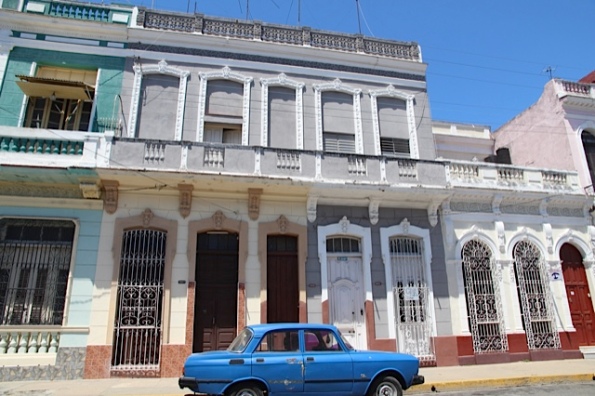
Sights we saw on the way to the clinic
Over our many years of travel, we’ve had some experience with medical clinics and this was probably one of the most basic. For starters, the entire office was being renovated (lots of ladders and workmen) and we snaked our way through the mess to the exam room.
The news wasn’t good.
Yes, it seemed like it might be gout, but they couldn’t/wouldn’t diagnose without a blood test. A test could be booked for the next morning, and results might take awhile because the sample would have to be sent to the hospital. And even if it was diagnosed as gout, the clinic didn’t have the medicine on hand. That would have to come from the hospital, too.
Such a lot of to-ing and fro-ing. While we could have returned the next day for a blood test, we couldn’t afford to wait for an unknown number of days for results and medication. Never mind, we said, we’ll figure it out as we go along.
After this not very promising news, we headed back our homestay.
We didn’t see our hostess again until the next morning at breakfast. She was most dismayed to learn the clinic couldn’t help. She inspected Poor John’s foot again and said, You must go to emergency. I’ll meet you there later. First finish your breakfast. And she whizzed out the door.
Elodia has excellent English, but her husband speaks only Spanish. So when it came time for us to catch transport to the hospital, we recruited him for assistance. Sadly, no fancy taxis were cruising the area, so he flagged down a passing horse cart.

Ambulance Cuban-style
My Spanish isn’t very good, but I knew he negotiated a trip to the hospital for 2 CUCs (or about US$1 each). So off we clipped and clopped. When we arrived at the hospital, the fellow wanted an extra CUC because the horse had had to go uphill the last two blocks.
Okay, I’ll be honest here. I think that’s what he said, but I can’t be sure.
I countered with—in English—you made a deal at the outset and knew where we were going. The horse might not have known there were two blocks uphill, but you did. And gave him just 2 CUCS and he didn’t argue.
And then we (well Poor John) hobbled into the hospital. The place was packed and I couldn’t see a single sign pointing to emergency. I started asking about emergencia, but no one reacted.
Then a teenager hobbled in with her mum. She obviously needs emergency, I said to Poor John, let’s follow them. The girl hobbled to the elevator, which wasn’t working, and then struggled up the stairs. Poor John did the same.
On the next floor, everyone seemed to hover around one window, so I told Poor John to stay put while I investigated.
Sometimes it helps being a ditzy-looking, non-Spanish speaking, wild-haired woman. I muscled my way up to the glass window where a woman seemed to be taking requests.
After a few minutes, she acknowledged me, and I think I said in broken Spanish, my husband is sick. She asked a question, which I didn’t understand, but I said Si anyway.
We were ushered straight into a room with a vat for mixing plaster of paris. That’s when it dawned on us that we were in the Broken Bone Department.
Oh crap, I said elegantly and, about that time, Elodia appeared, scolding us for not coming to emergency (urgencia) at the back of the hospital. Geez, I never once thought of urgent or urgencia as the word to look for. And if our horse cart driver had been told to take us to the back entrance, he ignored the request because it would have been yet another block uphill.
It turned out that emergency was waiting for us. Doctors and nurses (one gal spoke English) set upon Poor John almost immediately. In the end, he answered heaps of questions, had various blood tests and an x-ray.
Cuba is known for the high quality of their doctors. The country may suffer huge sanctions by the USA, but they send their hugely qualified doctors all over the world.
At the hospital, Poor John had excellent care and dedicated attention. The emergency room was amongst the most basic I’ve ever seen, but it was also spotless. The doctors, who were often accompanied by students (the sign of a teaching hospital), were conscientious and professional. The students were attentive.


After some hours, the results came back. His uric acid levels were okay, so no gout.
The questions continued. When did you break your foot? Never. So it’s got to be an infection and here are scripts for powerful antibiotics. Take them for eight days.
We were definitely puzzled. There was no break in the skin, so how could he have an infection. Nevertheless, we paid the bill (165 CUCs) and headed out with the prescriptions.
I can’t remember how we got back to the homestay, but Poor John decided to rest his foot while I did a city walk with Elodia. You can see some of the highlights here.
The end result
Poor John took two kinds of antibiotics for eight days. Over time and after leaving Cuba, the ‘infection’ subsided, but we both wondered why the antibiotics were so slow to make a difference. He had a few more twinges during our 19 days on a cruise, but mostly everything was fine.
So what about his appointment yesterday?
Many people consider Dr Kingston to be one of Canberra’s best GP diagnosticians. Her opinion, and I think she’s right, was—It was gout. Just because your uric acid levels are normal doesn’t mean a thing. You can still have gout.
The big downside in all this was that he got the wrong meds from the outset. No wonder it took so long for the antibiotics to ‘kick in’.
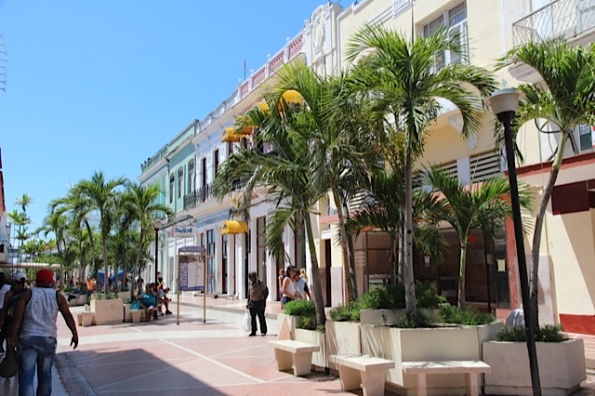
The pedestrian shopping street in Cienfuegos

Poor John, me, Marian and Steve with our smiles and our winnings
Sorry but I can’t resist being a bit of a braggart here.
For the last 18 days, we’ve been on a ship in the Pacific Ocean, travelling from Valparaiso, Chile (near Santiago) to Los Angeles.
I have to admit that cruising is kind of a weird way to travel. At least it’s weird for Poor John and me, who are used to overland trucks, camping or hostels, cooking for a group and never knowing where our next roll of toilet paper is coming from.
On the ship we’ve done nothing but eat, go on excursions, eat, visit the gym, eat, look at menus for the next meal, eat, change clothes for dinner, eat, watch endless cycles of news on the BBC, eat, walk up and down the stairs (usually seven flights from our deck UP to the food trough), eat, lie in the sun for a few minutes, eat, do laundry in our tiny bathroom sink, eat AND participate in the daily rounds of activities.
Activities are meant to keep us busy and entertained, especially on sea days when no port is in sight. I haven’t done most of these activites, but the choices have been constant and diverse.
Think art auctions (who goes on a ship to buy art?), cake decorating, towel folding, ring tossing (I performed rather well today but didn’t win), bean bag tossing, best leg competitions (I didn’t enter), shuffleboard contests, karaoke, bingo, arts and crafts, dance lessons (no thanks, said Poor John) and more.
And then there’s been the trivia—several times a day. Most sessions cover general knowledge, but there have been forays into super heroes, Disney characters, airports of the world, gems, name that tune, name that dance genre, movie posters, monuments of the world, geographical features of the world, flags, and on and on and on.
The trivia obsession (especially for me) began on Day 1 or 2 of the cruise. Poor John and I rocked into Dazzles (the scene of most trivia events) and were waved to by a group of four people—Marian , Steve, Anja and Jana.
‘Where are you from?’, they asked, and our answer of ‘Australia’ was enough for them to recruit us part as of their team. Teams can have up to six people and as Marian said, ‘it’s always good to have a mix of nationalities.’ Together we covered the USA, Germany, Canada, Ukraine and Australia.
We did quite well on the day-to-day trivia questions, which bode well for the progressive trivia (six sessions held on six of the seven days solely at sea). The scores were cumulative and while Poor John was excused from all other trivia events (sometimes as many as three others in a day), he had to turn up at 5:15pm for the Main Event.
Frankly, everyone contributed their best knowledge to the competitions—I mean no one had all the answers—but Poor John was our true brain’s trust.
We dock in Los Angeles tomorrow, so tonight was the sixth and final progressive trivia. We were down to four players. Jana had found a fella and Anya had jumped ship in Mexico. So it was down to an American (Marian), a Canadian (Steve), an Australian (Poor John) and an dual national (me).
There were 25 questions tonight, instead of the normal 20. Daria (trivia mistress) announced that only 1.5 points separated the first and second-place teams. So far the crowd had voted against knowing who was in the lead but, based on our scores, we figured we were in first or second place.
And the questions began.
What’s the most common colour on world flags?
How many millimetres in a kilometre?
What’s the traditional colour a bride wears in India?
What’s the collective noun for cats (not lions)?
In Nintendo, who is Mario’s brother?
What is the largest waterfall in the USA?
and so many more!
And miraculously, WE WON.
We got 19.5 points tonight and won with an overall score of 104. Turns out the second place team got 17 points tonight and an overall score of 100. So we started the night in the lead and finished with victory. Poor John gets a gold star for knowing the answers to the trickiest (most obscure) questions.
And our prizes—a cup, a pen and a key chain—and the honour of saying
We Are the Champions—of the Ship.
P.S. Feel free to answer any of the above questions. I’ll let you know if you’re right.
P.P.S. More coming soon on all our other travels, but I just had to interrupt with our victory tonight.
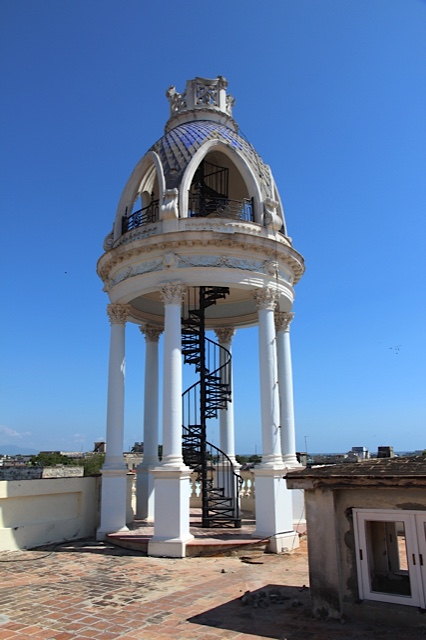
Lookout on the roof of the Ferrer Palace
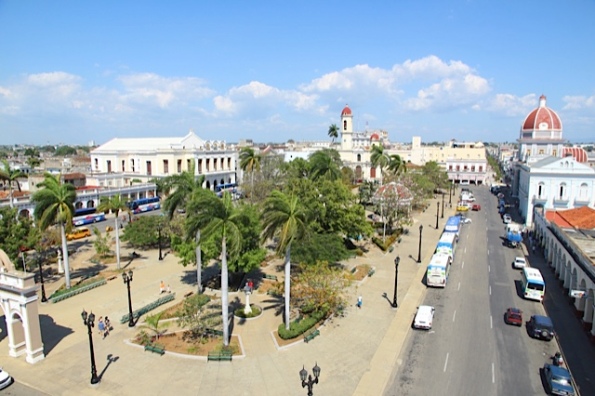
Park in front of Ferrer Palace. Teatro Tomas Terry is the light-coloured building on the left
Whenever a building or a town captures my imagination, I try to find out something interesting about it so I can share it here.
Together the Ferrer Palace and Teatro Tomas Terry in Cienfuegos created the perfect setting for an interesting slice of history.
Almost 100 years ago, Enrico Caruso, the famous Italian operatic tenor, came to Cienfuegos to perform in the theatre. The weather was blisteringly hot and, before the evening performance, Caruso spent the afternoon resting in one of the palace’s elegant and spacious rooms.
There’s no record of his opinion of the recently completed Ferrer Palace (finished in 1918), but he stayed only one night in Cienfuegos before returning to Havana to give a final performance in Cuba.
History says he was paid 90,000 pesos for his concerts in Cuba, which were, at the time, the most ever paid to an artist performing in Cuban theatres.
Sadly, after his time in Cuba, Caruso would perform only once again—at the Metropolitan in New York City—before retiring from theatre completely. He contracted pneumonia, which developed into pleurisy, and died in 1921.
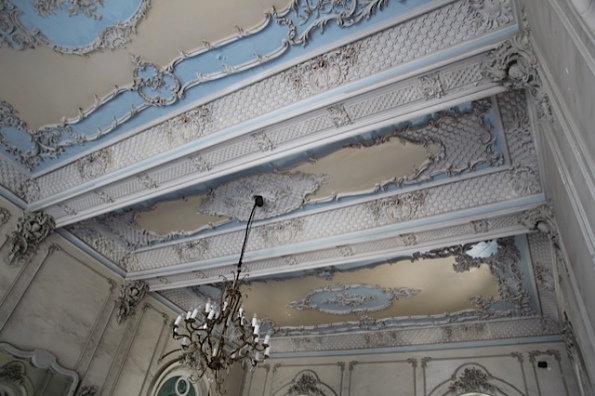
Ornate ceiling with chandelier


Ferrer Palace
The interior of this gorgeous powder-blue palace is being renovated, but it is still well worth paying 1 CUC (about US$1) to go inside for a long look.
Our homestay hostess took me there as part of our city walk (which Poor John missed because of his swollen foot, but more about that later).
She (our guide, Elodia) said this palace was one of her favourite buildings in Cienfuegos, and it is easy to see why.
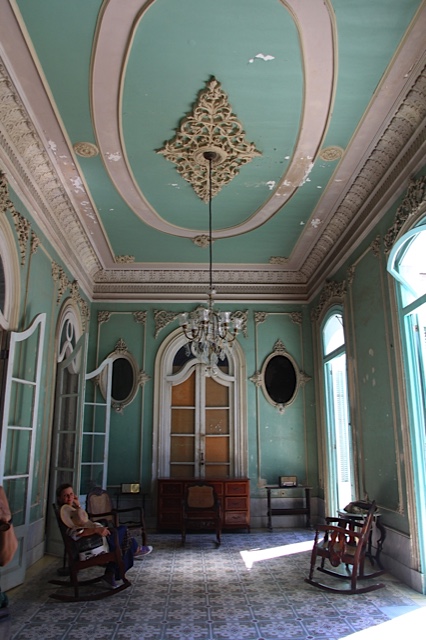
A sitting room, complete with smoker
Designed by local architect, Donato Pablo Carbonell, the palace was started in 1917 for landowner and merchant, José Ferrer Spanish Sires. It was completed within a year, but the family moved on to Havana in 1920.
The two-storey palace has a Catalan design with the ground floor originally being plain and used to store goods, and the upper floor being lavish in design, materials and space.
There’s also an elegant dome-shaped vantage point on the roof. I climbed up for the view (Elodia stayed on the roof because she doesn’t like heights) and was nearly blown off. The view is sweeping and takes in the park in front of the palace, as well as the harbour in the other direction.
One thing disturbed me greatly on the visit. A woman, who I think had some responsible role in the renovations or running of the palace, was sitting in a rocking chair on the upper floor—smoking.
Guess it will be awhile before the no-smoking-in-public-places policy reaches Cuba.
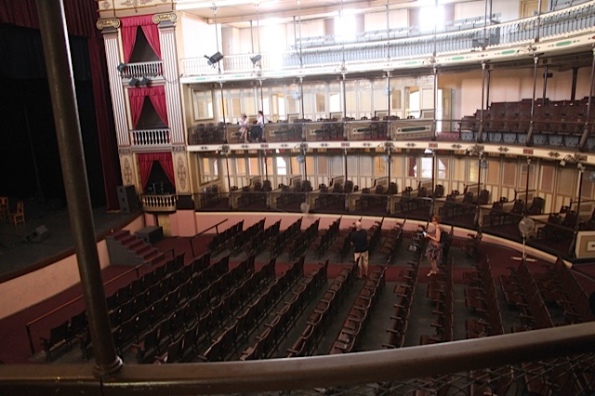
Four floors of seating. Top floor is standing room only
Teatro Tomas Terry
This 950-seat auditorium was built in the late 1880s to honour a Venezuelan industrialist, Tomas Terry.
Terry had always wanted a luxury theatre that hosted famous entertainers, and this elegant structure has filled the bill.
In addition to Caruso, the theatre hosted actress, Sarah Bernhardt of France, ballerina, Anna Pavlova of Russia and many other stars well-known in the Latin world. Framed posters of the theatre’s most famous performers are hung in the ground floor hallways.
Showing French and Italian influences, the theatre is decorated with Carrara marble, hand-carved Cuban hardwoods and whimsical ceiling frescoes. The façade has three gold-leafed mosaics representing the muses of tragedy, comedy and music.
I thought it was a bargain to go in for 2 CUCs (about US$2) but was gobsmacked to see a sign that said an extra 5 CUCs for cameras. Of course you know I breezed nonchalantly past the cashier with my camera slung behind my back. I was a little restrained taking pictures (so I didn’t get caught).
P.S. About US dollars in Cuba. First off, most ATMs do not work in Cuba. They work for the Cubans, but not for anyone with a credit or debit card that has any connection to a US bank (so most other banks in the world). US dollars can be changed in Cuba, but they charge a 10 per cent service fee, so it’s best to take euros, British pounds or Canadian dollars.
P.P.S. It’s been a while since I reminded people to stop by my cooking blog. We had quite a few dinners in Cuba featuring shellfish so this garlicky recipe might tempt you.


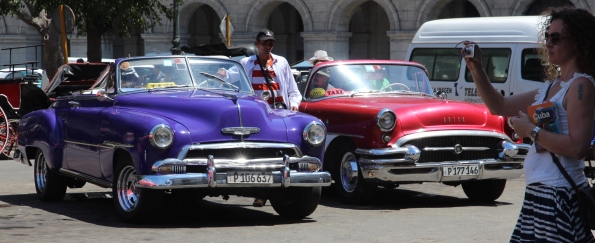

Cuba’s roads are filled with vintage cars
Virtually everything you read about tourism in Cuba mentions the wealth of vintage cars cruising the streets of this Caribbean island.
Guess what? It’s true!
We arrived in the middle of the night, so didn’t notice much on the road until the next day, and then every second vehicle seemed to be a classic American car from the 1930s, 40s or 50s.
They come in every colour and size, and in all sorts of condition. Some appear to have rolled right off the factory floor, while others have dents and bumps and are in varying stages of being repainted.
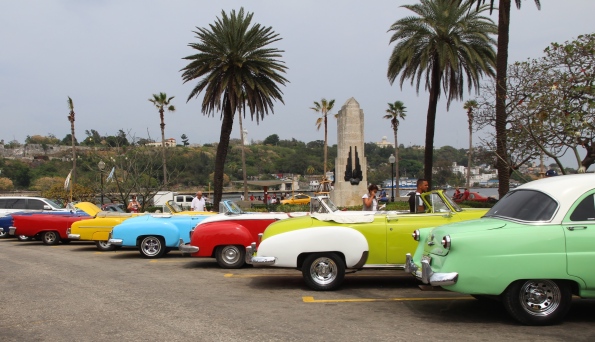
Waiting for passengers


So how has this time warp on wheels come about?
It has to do with the long-running, and now-subsiding, feud between Cuba and the USA. In 1962, the US imposed an embargo on American companies doing business with Cuba. This meant Cubans couldn’t buy new American cars or parts.
This ‘speed bump’ became an even bigger problem when Fidel Castro stopped allowing Cubans to buy cars. They could only be given them by the government. But the government never had enough money to import bulk orders of cars.
During the Soviet era, the Russians sent Ladas, but these didn’t last as long as the old American cars. That said, we rode in a few dilapidated Ladas.
But the inability to get parts has led to a strange breed of cobbled-together classic car. For example, the body may be a pristine 1940s American classic car, but the engine might be a Peugeot diesel.
The innovations have been a matter of need—keep the vehicles rolling. Today it seems that most of them cruise the streets as taxis especially for tourists.


One of our guides explained that these vintage cars can cost a fortune in Cuba. Even a car with 300,000 miles on it can sell for up to $15,000 CUCs. The CUC is the Cuban tourist currency and is worth a little more than US$1.
As relations improve between the two countries, you might expect US car collectors to be rushing to Cuba to make big purchases, but this probably won’t happen. As our guide said, the cars may look the part of a vintage model but the extent of ad-hoc replacements mean they will never fetch a high price from collectors.
I’m thinking that’s probably a good thing. Maybe it means these wonderful old cars will continue to rule the roads of Cuba.
P.S. Looking back, I can’t believe I took so few photos of the vintage cars. Bad me. And I’m gobsmacked that so many of the pics I took are from the same direction. Time to go back for another visit. Never mind the luggage debacle. 🙂
P.P.S. I haven’t captioned most of these pics because I’m not always sure of the make of car and because, come on, these are all just eye-candy. So enjoy!


Vintage cars and a bicycle taxi

Cuban dancers move to the music on Obispo Street
Did you know that Cuba gave the world two famous dances—the Cha Cha and the Mambo? Or that these two dances helped to inspire the Salsa, that hit the scene in the 1970s in New York City?
Yeah, I didn’t know either.
But on our last night in Cuba, a group of Havana’s young and energetic dancers treated us to an amazing display of their moves and talent.

Yes, he tossed her up and twirled her around. Glad it wasn’t me
It started in the late afternoon when Poor John and I were having a leisurely stroll around Old Havana. You have to soak up the culture whenever and wherever you can!
We came upon a plaza we’d visited several times before and noticed a crowd gathering in anticipation. But it wasn’t just the crowds. There were amplifiers, microphones, band instruments and the makings of a dance floor (made out of taped-together pieces of cardboard).
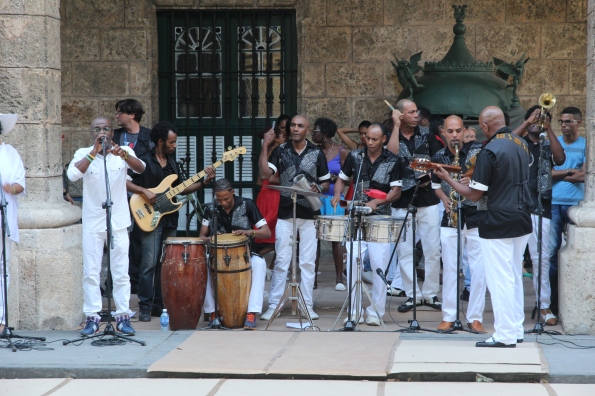
The street band

The singers
This is when you just have to stop and wait to see what’s going to happen. As it turned out, we waited almost an hour before anything happened. I was impressed that the crowd remained so placid and patient—not necessarily a Latin characteristic! 🙂 Although one little girl burst into tears after 20 minutes and her mum left to take her home.
But when the action started, the dancers, singers and musicians hardly took a breath—and never missed a beat or a note or a step. Or if they did, we never noticed.
I have to admit that I don’t know what dances they performed, or in what order, but they made me grin and tap my toe and want the whole experience to never end.
They even changed costumes a couple of times, which floored me because the pace was so fast I still have no idea how they managed that.

Check out these dancing moves
Even Poor John, who cringes when the word ‘dance’ is mentioned, loved the whole production. And, of course, he was mightily relieved when they didn’t drag anyone (meaning him) out of the audience to perform with them. 🙂
I don’t know if this dance extravaganza is repeated every night of the week (I sure hope so). But if you are ever in Havana in the late afternoon, head down to the far end of Obispo Street and wait for the action to begin.
P.S. Cuba’s national dance is the Danzón, and I have no idea whether it was part of this display. I presume it was. No matter, we loved every minute of this performance. What a great last night in Cuba.

Cuban dancers in overdrive

Setting out to sail in Trinidad—fully dressed
If you’ve been following our trip to Cuba, you’ll know our bags were missing—although you probably didn’t know this situation lasted for nine days. ARGH!
The good news is we have our luggage back. The bad news is a very important item is missing.
In the interest of sparing you (or anyone else) similar grief regarding belongings in Cuba, here’s the story of what happened to us. Plus advice on how to avoid similar things happening to you.
For starters, from the time we left Mexico, we were pretty sure our bags wouldn’t arrive in Havana. Our flight from Cancun to Mexico City left 80 minutes late, cutting the time we had to change flights to about 10 minutes.
We were able to run between planes, but our bags couldn’t do the same. So while we were disappointed not to see our bags trundling around on the carousel in Cuba, we were not surprised.
The lost luggage window was directly opposite the carousel and the two women there spoke good English. They asked for all our paperwork and spent quite a long time recording our home address, local address and contact details, bag descriptions and such.
They then presented us with a claim receipt that included a file reference number and two airport phone numbers to call if we wanted to find out the status of our bags.
They also said the bags would come sometime the next day, the 29th.
This was encouraging, but given that our flight arrived well after 11pm, we wondered whether they might come on an earlier flight. We were leaving Havana in the early morning of the 30th, and would need the bags to be at to our homestay address (362 O’Reilly) by the end of the day on the 29th.
More problems arose as soon as we reached our homestay. The address was 309 (not 362) O’Reilly. It’s now close to 1:30am and we’ve awakened the homestay family to let us in.
The only thing to do was go to bed and hope to sort things out in the morning.
Now it’s hard to make this story short, but I’m going to try.
Turns out that 309 O’Reilly is overflow for 362. Fine. But we needed to let the airport know of the change of address or let 362 know about our bags.
Even though we had four phone numbers (two for 362 and two for the airport), not one answered. I called, the homestay family called, the homestay family friends called. In the end we got through to a fifth number (the brother of 362 and the person who seemed to be dealing with things).
Although I didn’t speak to him (Leandro), he went to great lengths to promise our homestay people that he would call and call and call the airport, and do everything in his power to sort out our luggage problems that day.
I have no idea what Leandro did that day. We went on a lengthy walking tour of Havana, and our homestay family kept trying the airport numbers.
Evening came but the bags didn’t, so we left the next morning on our pre-paid tour—with our minimally loaded daypacks and two spare white t-shirts given to us by the folks at 362.
From Havana we stayed in Playa Giron, Cienfuegos, Trinidad and Santa Clara. Every homestay family called the airport numbers (no answer ever) and Leandro (who was still knocking himself out to get our bags back).
Up to this point, my only complaints were with AeroMexico, which may or may not have gotten our bags to Havana, and the airport, which never answered the assistance lines.

Which crocheted dress would suit me?
Replacing clothes hardly an option
Oh, clothes were another problem. We had the clothes on our backs, the two t-shirts, one spare pair of slacks and a pair of bike pants.
Playa Giron was tiny and sold no clothes at all. Cienfuegos was bigger and where Poor John’s foot flared up. Most of our time there was spent at the hospital (I’ll do a post on that and have to say the service and care were excellent).
My homestay hostess gave me a brief walking tour of downtown Cienfuegos, but only tourist clothes seemed to be available. There were sarongs, t-shirts, and crocheted dresses and tops. No one had undies in our sizes.
By then I’d developed a fairly good routine for washing clothes at night—in the sink with bath soap. It was windy and hot, and laundry dried in a couple of hours. That said, I hadn’t planned to accompany Poor John to the hospital wearing no bra and a cheap white t-shirt that said a relative went to New York City and bought me this t-shirt. You know the ones I mean.
We were in Trinidad on a Sunday so only tourist clothing was displayed, including bathing suits in sizes for Barbie and Ken.
Santa Clara seemed like our best bet clothes-wise. Our guide had great English and was very fashionably dressed. Turns out her sisters send her clothes from the USA. We did try a few shops for undies, but the sales people always said there was nothing in my size.
The reunion
So nine days later we returned to Havana. A nice taxi driver took us from the bus back to 309 O’Reilly. He gave us his phone number and said he’d take us to the airport later in the evening if we wanted to go.
We trotted over to 362 (no one at 309 spoke English) and found no luggage. The airport numbers didn’t answer either, so we booked the taxi for 7:30pm.
After running around the airport for a bit, we were led to the lost luggage cage. Our claim receipt us got us into the cage (then they locked us in) where about 12 other people were waiting to claim bags. Three gals from Germany said they had been waiting a couple of hours to be served. Their taxi driver had even delivered them to the cage entrance. He knew all about lost luggage issues.
Clearly lost luggage is not a surprise in Cuba.
After about an hour, the officials started calling people to come inside to see if their bag was the one that had been hauled out of the bowels of the building.
The first success came to the German girls. Oh my, the squeals of delight could be heard across town. They were two or three days into their 18-day trip, so they were overjoyed.
Then a few local parcels were handed out—large bundles wrapped in plastic.
And finally Poor John’s bag appeared. They had him sign off all the paperwork and tried to send us on our way. I kept tapping the claim receipt to show them two bags were involved. In the end, they let me into the bowels of the building to search for my bag. Surprisingly, there were only about eight bags still on shelves and mine was one of them.
So the reunion was complete and we hopped in a taxi to 309. By then it was approaching 10pm. Our homestay family was entertaining guests and they bounded down the stairs to carry up our bags.
Leandro still alive
Now there’s more long story here, which I’ll tell in time, but the very short version is that the next morning we finally met Leandro and told him about our trip to the airport for the bags.
He said, more or less, oh yes, that would be right. The airport doesn’t deliver bags. You have to go get them yourself. And they certainly wouldn’t have let me go get them.
And he expects me to believe he knocked himself out to get our bags? We have no idea when they arrived, but we might have been able to have retrieve them if we’d gone to the airport late on the 29th.
Leandro is still alive, but only just. And I have an even longer list of why I’d like to choke him. Stay tuned for more episodes.
A last comment about baggage
Don’t pack anything in a checked bag that you are not prepared to lose. When we were leaving Cuba, we checked in at the airport about 3 1/2 hours early.
The next day in Chile, when Poor John opened his bag, which had been locked, he found the contents had been ransacked. Only his iPad was missing, but the contents were in disarray. The coffee set he carries (two stainless plunger cups and a packet of ground coffee) was out of its carry bag. His monocular was out of its case and had been tampered with. And his clothes were strewn about. It was obvious that someone had had plenty of time to scrounge through his bag. And that could have happened only in the baggage handling area in Havana.
We’ll be writing to Lan Chile to let them know about this.
Don’t let something like this happen to you.
No matter where I’m travelling, I carry all my precious items in my backpack. I don’t travel with jewellery, so that means cameras, chargers, cords, spare batteries, a little laptop, and usually a change of clothes. No idea how I managed to forget that this time.
P.S. I have plenty of good tales to tell about Cuba. We’re glad we went. Stay tuned for more.
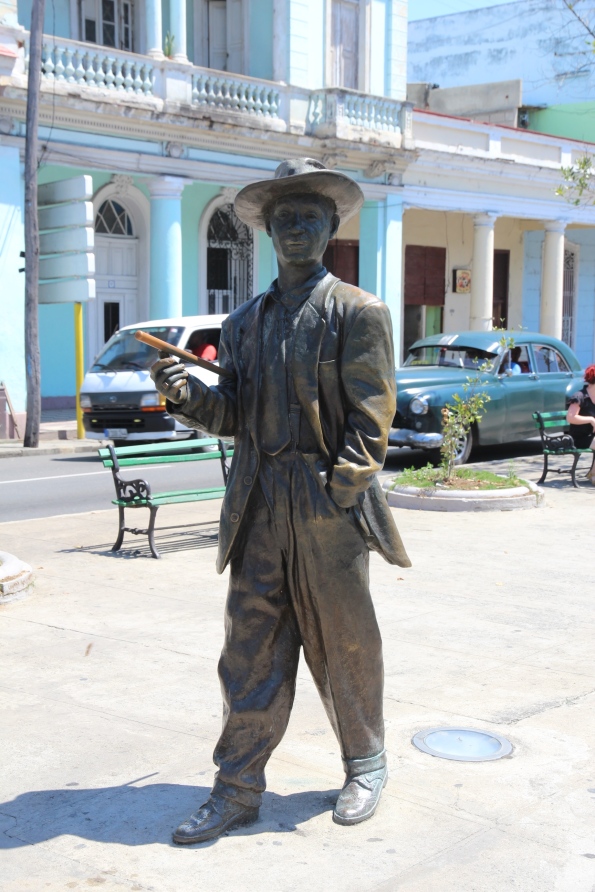
I wonder where he got his clothes?

It’s true, Havana is the home of vintage cars. They’re everywhere.
Poor John and I are pretty tough travellers—hearty even.
Cuba is doing it’s best to throw everything at us, but we are still smiling and still wearing the same clothes we arrived in six days ago.
Here’s the deal.
We still have no luggage and the response number at the airport doesn’t answer. My blood pressure tablets are in the luggage and no one here seems willing or able to sell me a replacement or substitute.
The air conditioning flooded in our first hostel and saturated most of our paperwork including both my passports—luckily all dry now. And no one seems remotely phased by the sorted technicolour hues of our bus and accommodation vouchers etc.
Not sure about our onward tickets, which languish in our luggage.
Poor John is poor for the first time ever on our travels. He’s been to hospital for suspected gout which turned out to be an infection in his foot. He’s on nine tablets a day.
Wifi has been very limited so don’t expect to hear from me again until we reach Santiago Chile on 9 April. That’s when we board another cruise with, perhaps, only the clothes on our back.
Nevertheless, seeing the sights and getting some pics. No swimming! Bathers in the luggage! Rolling eyes a lot!
Hasta luego!
P.S. Am posting the same on the cooking blog.
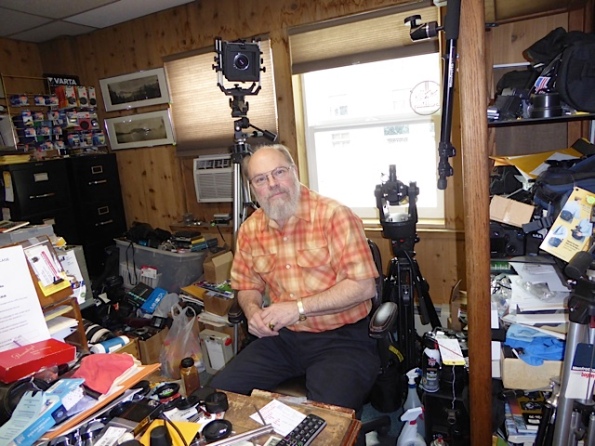
Ric Thompson, my hero of 2016
I found a new hero in Fairbanks. But before you go thinking I’ve ditched Poor John, you need to know that Poor John found this hero for me. He even egged me on.
Here’s what happened.
My camera, actually the lens, had a meltdown on our last morning in Coldfoot. The victim was my deluxe EFS 15–85mm Canon lens—the only lens I brought on this trip.
In reality, the meltdown was inevitable. The lens had been playing up for at least six months, but I had been able to work around its quirks, so thought I could continue to get by on this trip.
Besides it can cost a fortune to send a lens off for repair. And sometimes you get charged $100 for them to open it up and then say Sorry it’s dead, really dead.
But that last day in Coldfoot, I went to photograph the amazing buffet set-up in the camp restaurant, and the lens would only focus on infinity. Same problem when I tried auto or manual focus.
Infinity is fine if you want to photograph the Northern Lights or something two blocks away, but it’s never going to be good for anything closer.
Now this blow wasn’t a complete end of the world. I brought a second camera, a small, new Lumix that I am still getting used to. But the Canon is my workhorse: a lens I really know and a camera body that feels right in my hands.
When we returned to Fairbanks, Poor John asked at the visitor’s centre if there was a camera repair place in town, and the gal thought there was but that it had moved. She wasn’t sure where and had no idea what it was called.
The next day as we walked in downtown Fairbanks, there is was. Poor John spotted it first—a sign for a camera repair shop and it was almost directly opposite our hotel.
I was sceptical. After all, this was Alaska. But Poor John insisted that we check it out. So up the stairs we went and met Ric Thompson, surrounded by camera equipment.
We learned that Ric has a long and amazing camera history, working in a first-class repair shop in Portland Oregon and rising to head technician. Some years ago he decided to move to Fairbanks and be a sole operator.
When we walked in, he put down the lens he was working on and took a quick look at mine. After a brief chat, he said Come back tomorrow about lunchtime.
Suddenly it dawned on me that photographers from around the world come to Alaska to photograph the snow and, more importantly, the Northern Lights. Of course, this place needs someone talented who repaired cameras. And there he was sitting in front of me.
Bet you can already guess how it turned out.
The next day Ric said one screw in the lens was completely out of place. Two more were loose. He fixed them all and charged me about half of what Canon in Australia would have charged. Plus he did it overnight.
Last time I sent a lens away for repair in Australia, I begged for it to be done within eight weeks so I could take it to Papua New Guinea. It arrived two weeks after I left the country—so 10 weeks in all.
Ric, you are my hero of 2016. The lens is working perfectly. My heartfelt thanks. And I’d still like to know if you have a clone in Australia. Two more of my lenses need attention.
And if anyone out there ever needs to find Ric, here’s how.
Ric Thompson
Tel. 907 452 8819
551 2nd Ave., Room 221
Fairbanks, Alaska 99707

Casting off from Honduras
Okay folks, are you sitting down?
Poor John and I finish our first-ever cruise tomorrow morning in Florida. Later in the day we fly to Cancun, Mexico for two nights. But wait, there’s more.
I know, it’s hard to keep track of us.
We were in Alaska for a couple of weeks. Then we had two nights with my cousin, Jo, in Seattle. From there we flew to Tampa to join a seven-night cruise that would warm us up and keep us busy until we headed to Cancun, on our way to Cuba.
Whew!
I’ll get around to all those flittings soon (assuming I can get wifi in Cuba). I still have lots more to tell about Alaska and Seattle, but for now I’ll interrupt programming with an introduction to cruising.

Song and dance routine
My mother’s first cruise
My mother took her first of many cruises with her mother a couple of years after my dad died. I’ve always loved mom’s story about the Greek guy she met during a stopover on a Mediterranean cruise.
He took a real shine to mom and urged her to join him on his yacht. Mom declined graciously, saying she couldn’t possibly abandon her own mother. Back on ship later that afternoon, mom and grandma saw the guy sail by on his seriously huge yacht. He waved furiously at mom and she waved back.
Mom then told grandma about the invitation to cruise with him. My grandmother—and I have to say I had no idea she had such a sense of humour—said ‘Shall I push you overboard now?’
But I digress.
Our first cruise
We’ve been wary of cruises. Seriously we aren’t the cruising type. I know we went to the Antarctic by ship, but that was an expedition, not a cruise. All of us were bundled up in parkas, boots, scarves and mittens. There was one dining room, no 24-hour service, no formal night and plenty of exercise walking on the snow.
This has been totally different.
For starters, I felt the need to pack a dress and two skirts. The last time I packed a dress was to go to a nephew’s wedding in the USA. The good thing about that is that I brought the same dress on this trip.
We’ve had two ‘formal’ nights on this trip, so I’ve worn the dress and one of the skirts. I wear a dress about twice a year, and now I’ve worn dressy clothes twice in a week!
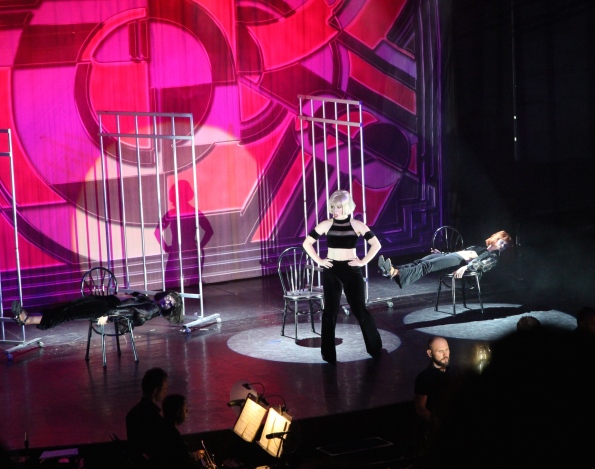
Song from ‘Chicago’—one of the top performances
But it gets weirder. Poor John has worn a dressy shirt twice in a week, although he drew the line at a tie and he did not get kicked out of the dining room.
He was reluctant on other fronts too. He did not enter the men’s belly-flop competition, the sexiest-man competition, the battle of the sexes, the scavenger hunt, the want-to-feel-like-a-millionaire competition or the 1970s dance-a-thon.
I have been just as bad. I didn’t buy a massage, a $19.95 watch, a cheap tanzanite, two t-shirts for $20 or diamonds discounted by 20 per cent.
We have, however, turned up to quite a few of the trivia quizzes and won one. Poor John really does bring his genius and memory to these events, and our fellow quiz mates have been delighted to have him on their team.
Pity we weren’t at the one quiz that asked ‘what is the capital of Australia?’. We are from Canberra, but for that quiz, no one knew the answer.
We’ve had daytime stops at four ports—one each in Honduras and Belize and two in Mexico. You can’t see much in a day, but the ports have been fairly small and I’ll write more about the highlights.
When you disembark, the main sights are acres and acres of duty-free shops, so we’ve bypassed them and headed straight to town on foot. The first stop was so rainy that it took two full days for my shoes to dry out. Luckily we had umbrellas to cover most of the rest of us.
But that’s enough intro for now. I need to get this posted and then get to bed. It’s after midnight and they are kicking us off the ship in the morning.
And in case you’re wondering, internet on ship is not cheap at $20 a day for an often slow and intermittent service. But, hey, it has kept me in touch with you!
More soon, I hope!

Another song
 Where to next?