
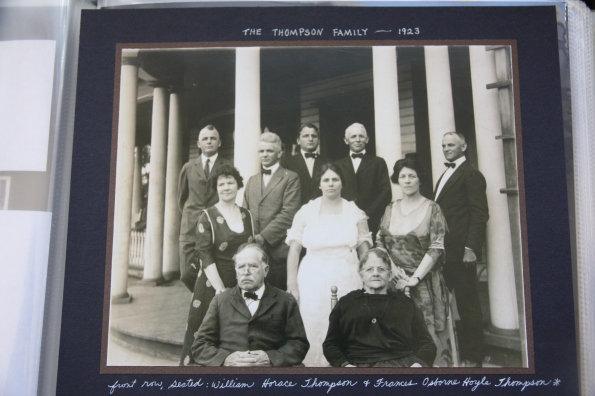
The William Thompson Family
If my grandmother was still alive she’d be celebrating her 137th year, but would still be three years off celebrating her 34rd birthday.
Zula, yes that was her name, was born on 29 February 1880 in Shelby North Carolina. Now if you’re counting things up on your fingers, you’re thinking she would already have turned 34. But nope, she’d still be three years away from that milestone.
That’s because February 29 isn’t always a Leap Day and years that can be divided by 4 aren’t always a Leap Year. The exceptions are years that can’t be divided by 400. So 1900 wasn’t a Leap Year but 2000 was.
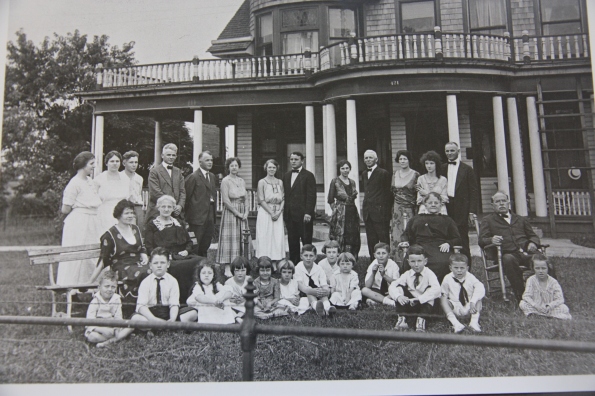
Extended Thompson family in North Carolina
Zula suited her birth date. She was almost one-of-a-kind and lived according to her own rules.
To mark her birth date, I’ll share some of her escapades. I can’t verify the truth in all of them, but those who tell the stories believe them.
- Her mother named her children after characters in books. The Thompson parents, brothers and sisters are pictured above. Front row: William and Frances, parents; middle row: Leola Eulalia, Frances Madge, Zula Elizabeth, sisters; back row: Carl Shurz, Emmet Tyre, Rush Clarence, Zolliecoffer Jenks and Chivis, brothers (last two boys on right are twins).
- Zula attended Duke University in the late 1890s and was expelled for popping corn in a basket in a fireplace.
- She eloped with a lumberjack, but he later ran off without her. She later married my grandfather, who was also from North Carolina. They met in Washington State.
- Relatives say she was a great cook, but dad said he taught himself to cook at age 7 so he was sure to get a meal. Apparently she was too busy socialising (grandpa was a state senator) to worry about meals.
- Grandpa also ran a general store and Zula sold liquor to the native Americans through her bedroom window. My folks discovered this on a visit when Zula gave them her bedroom and the Indians came knocking on the window in the middle of the night.
- She was tireless. Until she fell down the basement stairs and broke her hip (and came to live with us) she ran horses and looked after 40 acres of strawberries.
- When she came to live with us, she taught my sisters to cheat at cards and made clothes for all of us but never tied off the seams so sometimes we ‘unravelled’.
- She had a glass eye. In fact she had a collection of glass eyes. Most mornings, she’d hold the box of eyes up to her face and ask which one matched best.
- She loved whiskey, ice cream and pizza, in that order. She dyed her hair with indigo.
- We threw a huge party to celebrate her 88th year (and 21st birthday). She made and wore red satin toreador capri pants and a red satin Ben Casey blouse. She added a red feather in her hair and wore those gold glittery shoes with fake gems on the toes. She asked for an electric guitar. My mum bought her an electric look-alike and Zula taught herself to play it on her lap. When she played it, dad said it sounded like a Japanese whorehouse.
- She outlived all her children and died in her sleep.
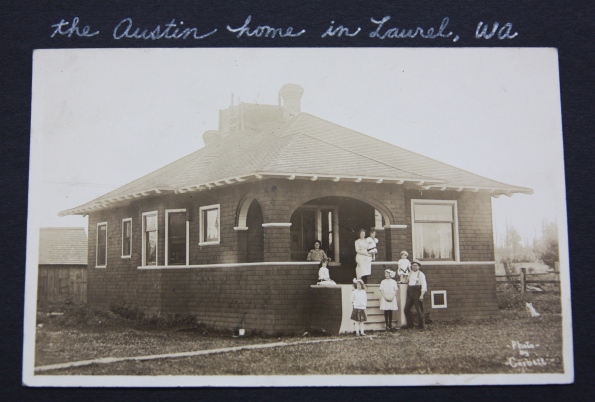
The house where grandma fell, in Laurel Washington. The general store was to the left. I wonder if it’s still there?
So grandma, happy birthday and rest in peace.
I have to get this posted before your birthday is over.
P.S. Many thanks to my wonderful cousin, Jo Jury, for sharing these photos the last time I visited her in Seattle. Very excited that we’ll be there again in a couple of weeks. Update: Jo has added some more stories, so scroll down the comments (far down) for more antics. Thanks Jo! 🙂
P.S.S. My food blog—Cooking on page 32—was named to mark Zula’s age when that blog was started.
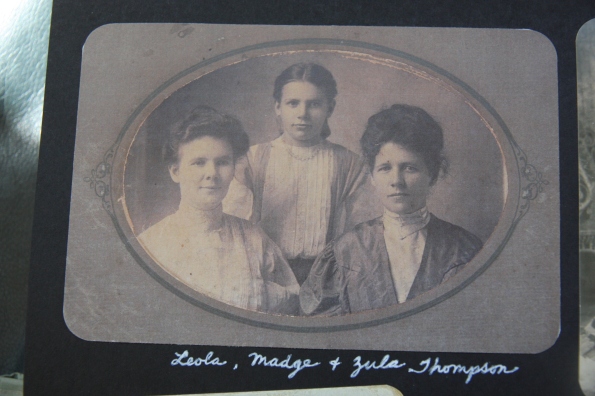
Leola, Madge and Zula
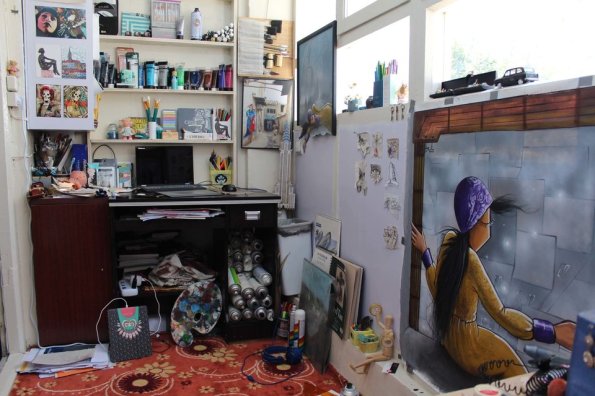
Afghan artist’s studio
A few minutes ago, Poor John announced that he’d been privy to important news today. After he recounted the three events, I nearly choked on my glass of wine.
But before I share the ‘riveting’ tibdits, I’ll report that he got his hair cut today at the local hairdressing school. He had to wait his turn and filled in the time by reading a couple of celebrity-focused magazines.
Those of you who follow this blog will know that Poor John takes special pride in getting a cheap haircut. His best deal ever was $2 in Abuja, Nigeria. His most expensive (from the aspect of price-gouging) was the $16 he was charged in Kashgar, western China. His biggest grumbling occurred at the hairdressing school in Denver Colorado when the cut cost $4 and I made him tip $1. Geez, how could I take the shine off the price with a tip?
Today was a shock for him. The hairdressing school’s price has jumped from $12 to $17. I know he’ll be back because he can’t find a cheaper deal anywhere in town.
That said, we’ll be in Cuba later on in March and in South and Central America in April, and I’m sure he’ll seek out another cheapie.
And now to the celebrity news:
• Nicole is pregnant
• Kate and Wills are thinking of adopting a disadvantaged child
• Bindi’s boyfriend is going to propose.
Of course, I knew that Nicole is Nicole Kidman and Bindi is the daughter of the late Steve Irwin. But I had to confirm that Kate and Wills are the British royals.
Poor John groaned and said, ‘They aren’t called royals—they’re just Kate and Wills’.
The fallout from this is that I hope we’re invited to a trivia night soon. Poor John is terrible at celebrity questions, but every now and then he’s read something, somewhere that makes it look like he’s an expert.
And on a completely different note, I saw an amazing item today about a Afghan woman who is doing street art in Kabul. I’ve used her art to illustrate this post.
In my opinion, she is the true celebrity. Please click through to the article (link above) and see what a hero and great artist she really is.

Could be Poor John’s hair if he hangs out too long for a cheap cut.


After five posts on the devastation in Syria, I figured it was time for a slightly cheerier item. I thought I could do this because negotiations today in relation to Syria indicate that the civil war might calm down. Fingers crossed for the days ahead.
What better relief than toilet humour, well at least toilet news?
Over the years of this blog, I’ve written a few pieces on far-flung toilets. You can’t travel the places we do without encountering some rather unsavoury and ramshackle toilets. One of my favourite (or maybe least favourite) recollections were on the boat from Azerbaijan to Turkmenistan and toilets that would make your hair curl!
That said, I never expected to call my own amenities ramshackle, but they’ve earned the title after being in service for almost 60 years.
The offending amenities involve the laundry and the kids’ bathroom and toilet. Aussie homes often have the toilet separate from the room housing the vanity, bathtub and shower. So that makes three rooms for us to address.
The shower has been leaking for several years and has made a mess of two walls—one in the corridor and one in a daughter’s bedroom. That didn’t matter so much after the kids moved out because the shower was rarely used.

The laundry tiles were very cooperative. They just fell off—long before we thought about renovating
But then, while we were on an extended overseas trip, someone staying in the house accidently left a bathroom tap running for part of an evening. The tap got turned off and the floor got mopped up, but no one thought to look inside the vanity. Several weeks later, when we returned home, all I could smell was mould.
The inside of the vanity still had pools of water and both shelves and all three drawers were home to a mould farm.
I scrubbed and scrubbed, but could never get rid of the discolouration or the smell. It’s too late to suggest ways to tackle the problem—the vanity is long gone. But go ahead and offer advice if you think it might help someone else.
And then there were the tiles. It was quite startling when, in the middle of the night, the tiles on the laundry walls started falling off.
Of course these are first world problems, and if I was in wilds of Africa or Central Asia I’d probably start peeing under the lemon tree in the backyard and showering with the hose.
But the kids still come home for visits and guests come to stay, and I desperately wanted to get all the crap on the laundry floor up and out of the way.
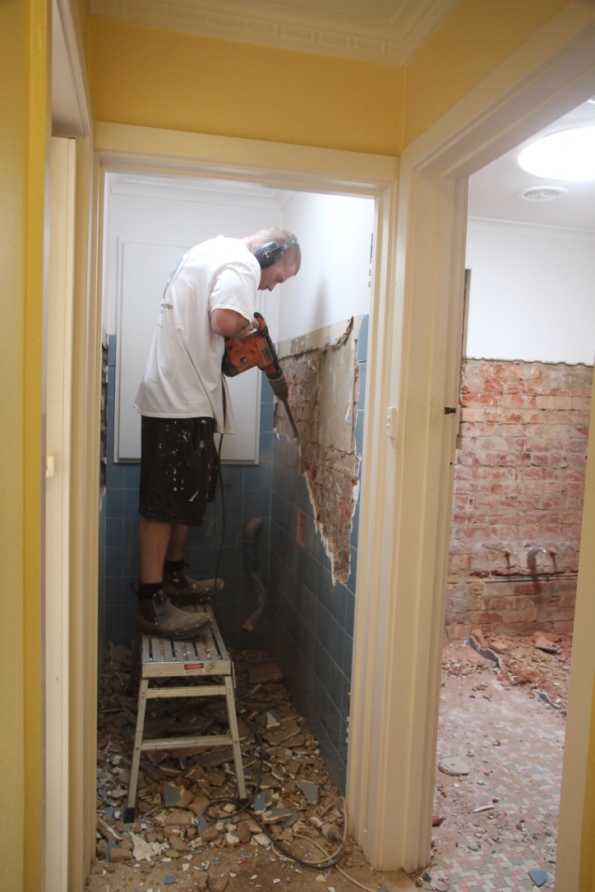
Cory jackhammers the toilet wall
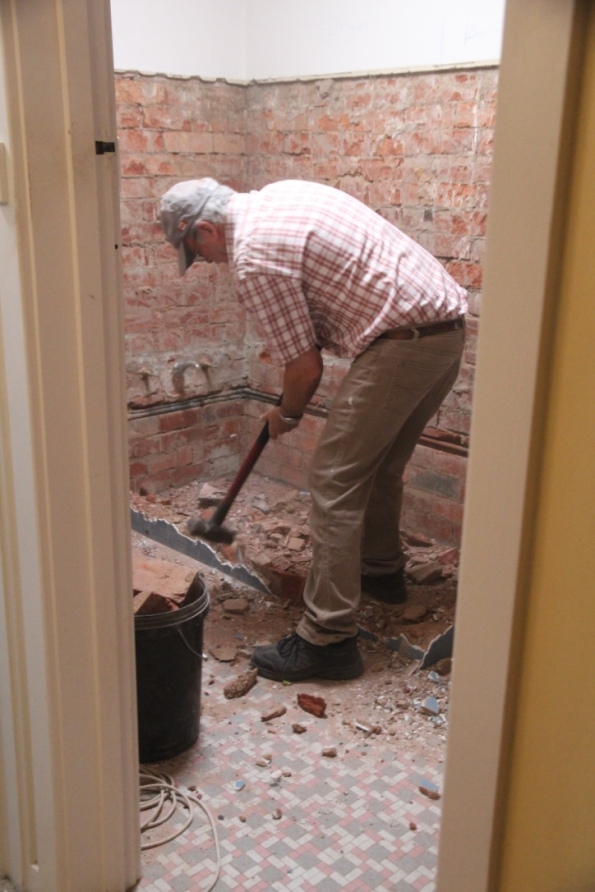
Graham tackles the pink bath
Time to renovate
So I informed Poor John that the time for renovations had come and he knew better than to argue. It’s summer in Australia and we were going to be home long enough for the work to get done.
Of course the first challenge was to find someone to do the work. I hopped on Google and searched for +Canberra +bathroom +renovations +reviews. Plenty of results came up, with almost equal shares of whingeing (complaining) and praise.
Most of the praise was for one-off operations—namely someone did a single successful job (or maybe more that weren’t commented on). But I couldn’t find any trace of these people online or in the whitepages. But ‘Ziggy and the boys” came up many times in positive reviews between 2011 and 2015.
Good grief, we know Ziggy! Why didn’t I think of Ziggy? We’d done business with Ziggy in 2000, when we did renovations for Aunt Esther’s flat and an extension at the beach house.
So we headed out to his place AND he remembered us.
With a no-nonsense approach, Ziggy showed me which tiles I ought to have. I started to resist but couldn’t find anything I liked more, so had to admit his choice was perfect.
Then this was where ‘the boys’ came in. Ziggy only does tiling, but his network includes ‘the boys’ who do the structural stuff.
So now the boys—Graham and Cory—are busy destroying my laundry, toilet and bathroom.
The backyard and a kid’s bedroom is full of the stuff dragged out of the three rooms. The garage is full of several thousand dollars worth of new cupboards, tiles, and vanity and sink, as well as the laundry fridge and washing machine.
And with all that precious stuff in there and ‘exposed’ to the outside world, the garage door stopped working today. Luckily it’s stuck open. Even better, the repairman comes Monday.
The saga continues, so stay tuned.
More coming on Syria too.

Fish on holiday in our ancient pink bathtub
P.S. The new bathroom won’t have a bathtub. The current pink one is never used and the interior designer said the lack of a tub is not a deal breaker for a house sale. Whew! Gives us great new space in the renovated bathroom.
That said, the pink tub was a very popular item with our daughters and their friends who stayed overnight. When I told them the bathroom was being renovated they all said, ‘Oh no, what’s happening to the pink tub?’ They loved the memories of it, but nobody wanted it. I offered. Besides Graham and Cory reckoned it weighed about 90 kilograms and had to break it into small pieces to get it out.
By the way, the tub was last used in 2008 when the backyard pond sprung a leak, and the fish and plants had to live inside for 10 days while Poor John resealed the pond and waited for the work to dry.

The fish and plants loved the bath

Massive walls at the Krak

Large open area at the Krak des Chevaliers (see the person standing slightly left of centre)
The Krak des Chevaliers, a Crusader castle and one of the world’s finest medieval castles, is one of many victims of Syria’s civil war.
Almost two years ago, the BBC did a story (with pics) about the Krak being damaged, but no one knows the full extent of destruction.
It makes me so sad. This castle is one of my favourite touristic sites in the whole world—someday I’ll do a post on my top 10 favourites. Poor John and I visited frequently when we lived in Syria in the early 1980s.

This wall has since been damaged (see the link to the BBC story)
I was keen to visit again in 2009 when we were on our year-long overland trek through Africa, as well as some of the Middle East and Europe.
It was at the Krak, back in the 1980s, when Poor John first explained the intricacies of medieval castle construction.
I’ll start from the beginning. As you enter the Krak there are several hard and upward turns to the left.

Entering the Krak
So imagine this. You are an invader and most probably right-handed. Your sword sits on your left thigh. Your horse is climbing and turning left against a wall. Your sword is trapped, but the castle residents are descending with their swords already drawn. Heck, they saw you coming.
If you were there and new to Poor John’s insights (he’s got lots of them), he’d probably go on to explain why Australia, the UK and other parts of the world drive on the left side of the road.
But you aren’t there and he doesn’t have a blog, so I’ll share the details here.

Surrounded by stone walls
Driving on the left
Let’s start with the fact that the vast majority of people are right-handed. So centuries ago you’re riding along on your horse with your sword resting on your left thigh. It’s close to hand and easy for you to draw if the oncoming horseman or pedestrian is a threat or an enemy.
You mounted your horse from the left (as is the custom to this day) because your critter isn’t all that keen to have you to swing a sword-laden left leg over his right side.
Hope all this makes sense so far. But what might not make sense is why traffic in many countries now travels on the right side of the road.
That’s mostly down to Napoleon. He decided that the countries he conquered should change the side of the road on which they travelled—bringing on a move from left to right.

Tractors drive in the middle. See the two people on the tower?
Napoleon never conquered the UK. He also never conquered the USA, but they changed sides—perhaps to show they were breaking away from the UK’s control.
Burma (Myanmar), where we lived for several years in the mid-1980s, wasn’t ever conquered by Napoleon, but they switched sides of the road many decades ago to defy the English. And that made for a real mess of Burma’s road system and a lot of blind corners and driveways.
Such a lot of bother about today’s driving rules.
But I started this post to talk about the Krak des Chevaliers. So on with the show.

Inner and outer walls with a partial moat in between
A bit more about the Krak itself
As part of the Crusades, the Hospitaller Order of Saint John of Jerusalem built the Krak between 1142 and 1271. About 30 years after construction began, an earthquake ruined parts of it. In its heyday, the Krak housed about 2000 people.
By 1250, the Hospitaller knights were falling on hard times, and the Mamluks captured the Krak in 1271. The new ‘owners’ did more construction in the late 13th century.
This amazing collection of buildings sits on a 650-metre (2130-foot) high ridge and covers 2.5 hectares (6 acres). It commands a key defensive position in Syria’s west, between the city of Homs and the Mediterranean Sea.


It showcases the best and most advanced ideas about fortification in the early 13th century. As one of the first fully concentric castles (with two or more inner and outer walls for defence), it had a massive influence on subsequent castle design.
For starters, the Krak’s concentric design allowed defenders to protect themselves equally on all sides. The outer wall is overlooked at all points by inner walls, and the space between the two walls was within easy and accurate bowshot.

Enormous stone walls
In addition to its sophisticated design, the Krak has great physical and visual strength, with its enormous stone walls, top-notch construction and innovative defensive systems. Many would-be conquerors, such as Salah al-Din, gave up all thought of taking on the castle when they saw it. Instead they moved on to easier prey.
As a castle/fortress, the Krak has been a remarkable success. I read that ‘Any fortification that can deter a potential attacker by its appearance alone must be counted a success, and in this respect Krak is supreme.’
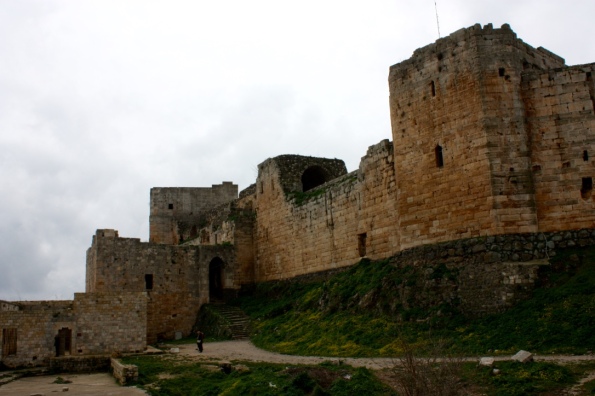
The Krak’s outer wall

The Krak from a distance with the village below
The Krak has also been home to many locals over the years. Our guide in 2009 remembered living at the Krak as a child, and even pointed out blackened ceilings in ‘rooms’ in which his mother cooked meals.
I can no longer remember why he and his family were living there, but have read that some of the Krak’s former ‘residents’ established the village of al-Husn at the foot of the Krak.
After visiting the castle, we had a meal in small restaurant nearby. The food was amazing—some of the nicest dishes we had on this visit to Syria. The restaurant owner said most of the recipes were from his mum.
I wonder if the restaurant is still there? I’m guessing that in spite of the damage the Krak has suffered during the civil war, it probably still ranks among the best examples of a Crusader castle.
Such wonderful memories, even if they are scarred today. Here’s hoping we can visit it again one day, and revisit the restaurant too.
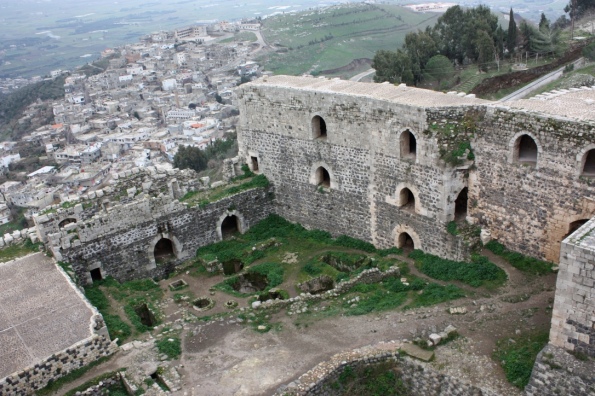
Overlooking Al-Husn
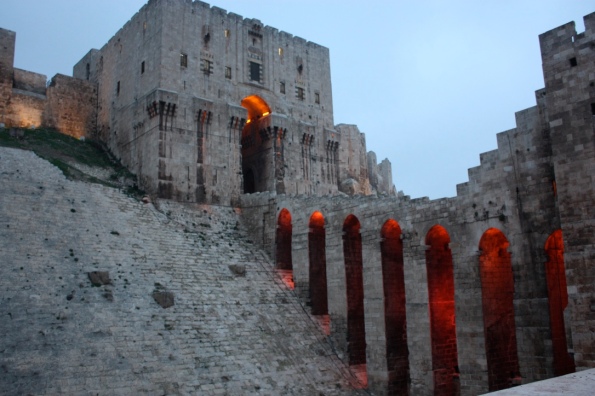
Aleppo citadel entrance at night

See how small the people look crossing the bridge
The citadel in Aleppo, Syria, has copped a battering. The current thugs of Syria (both government and rebels) have made a mess of the place.
I suppose I should be philosophical about it. Parts of this medieval structure were already a mess when I’ve visited in the past. But that was the result of historic crumbling and warfare. This latest devastation is the result of civil war and outright thuggery.
Aleppo’s fortified citadel dominates the city and is thought to be one of the world’s oldest and largest castles still in existence.
I first visited Aleppo in 1977 and then again in the early 1980s.
My memory of my first visit in 1981 always makes me smile. We had Poor John’s parents in tow. I had written a letter to book two rooms in Aleppo’s Grand Hotel.
When we arrived at the reception desk, they claimed to have no knowledge of my letter or our reservation—and no room in the inn either. Bugger.

Entrance to Aleppo citadel
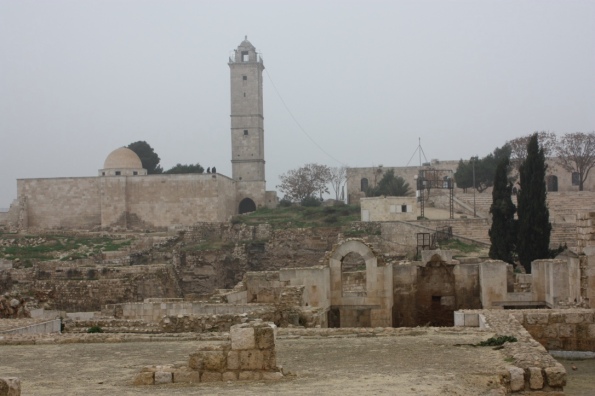
Aleppo citadel interior with tower
So we headed out to find a suitable alternative.
I knew it wasn’t going to have a happy ending and I was right. We ended up flopping at a small, seedy hotel that had a room for five available. Hotel staff were most shocked to learn that we were happy to pay for all five beds and only use four. The reason is a no brainer. We needed to control the whole room.
Good heavens, Betty (Poor John’s mum) would have fainted dead away if a newcomer had joined our room in the middle of the night. And I can’t say that I’d have blamed her. So we took the whole room, swatted the cockroaches and mosquitoes as needed, and used the shared bathroom down the hall.
But I started this post to tell a bit about Aleppo’s citadel, so I’d better get back to the topic at hand.

Looking up to the Aleppo citadel
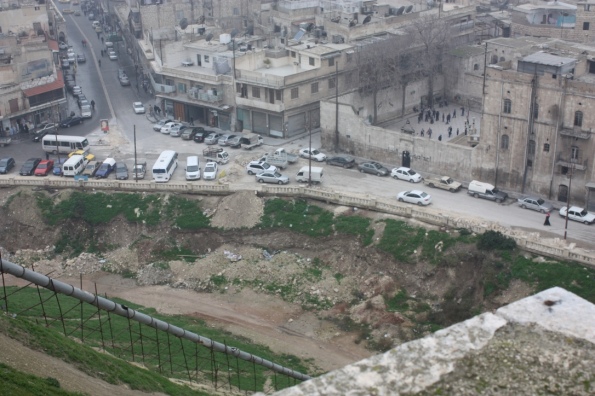
Looking down from the Aleppo citadel
The citadel has size going for it. It sits on an elliptical mound that is 450 by 325 metres (or 1480 by 1066 feet). The mound is surrounded by a moat that is 22 metres (72 feet) deep and 30 metres (98 feet) wide.
Over the centuries, the citadel has seen a variety of residents including Greeks, Byzantines, Ayyubids and Mamluks. More than 500 years ago, a Venetian traveller said 2000 people lived within the citadel.
Conservationists think most of the current construction is from the Ayyubid period. Most of that work was organised by al Zahir al-Ghazi, who ruled Aleppo between 1193 and 1215. His most impressive addition was the tall bridge-cum-viaduct, which still (I hope) serves as the citadel’s main entrance.
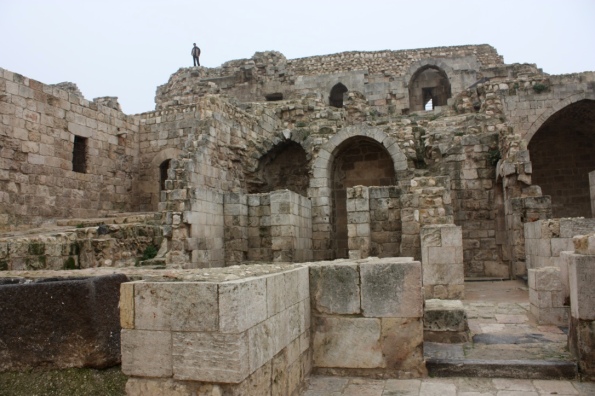
Aleppo citadel—see the fellow on the wall for an idea of size


Listed as a UNESCO World Heritage site, the citadel has suffered untold damage since the civil war began. News reports say the main gate was shelled in 2012. Last year, it seems a bomb was set off in a tunnel under one of the outer walls. I assume the reference to ‘main gate’ means that wonderful bridge-cum-viaduct.
At this stage, no one is exactly sure how extensive the wreckage is and an accurate assessment is unlikely to be made until the war ends.
So I’m keen to share some pics of how the citadel (and some of it surrounds) looked when I visited in December 2009. The ones that are immediately below are from the throne room (I think).


Also sharing a pic of the hotel where we stayed, as well as a pic of the Aleppo souk (market). I can’t believe I didn’t take more when I had the chance. It’s been damaged too. Especially heartbreaking because I always thought it was one of the most beautiful souks in the world.
I wanted to share a recipe that the waiter gave me for a wonderful appetiser dip that was served in the restaurant where we ate on our first night in Aleppo. You’ll have to wait for that. It’s written on a scrap of paper and tucked into a cookbook I can’t find tonight (almost midnight).
But if you’re needing a dip sometime soon, check out this Turkish one on my cooking blog.
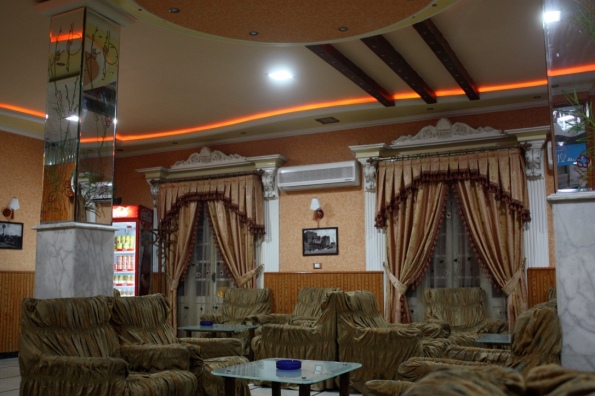
Aleppo hotel common area

Aleppo souk ceiling with Poor John
Tonight’s news included a report that people in Syria are dying of starvation. With all the carry on by warring factions in that country, food isn’t getting through to people. It probably isn’t even being grown locally.
The video footage was horrifying and heartbreaking. An emaciated young boy said he hadn’t eaten for seven days. A skeletal crying baby hadn’t had milk for seven days and was being fed water mixed with salt. While the news report said the videos couldn’t be confirmed, the heroic Doctors without Borders (Médecins Sans Frontières) thought it was genuine.
And this same week, I got a shallow, childish and simpering reply from a Nebraska senator. Deb Fischer was replying to my request that she have more compassion about welcoming Syrian refugees. Nebraska is a welcoming state and should be stepping up to help..
Here’s her mealy-mouthed reply and I’m glad to ‘out’ her for her callousness.
‘Dear Peg
‘Thank you for taking the time to contact me about the admission of refugees displaced by the conflict in Syria. I appreciate receiving your comments.
‘I strongly support our nation’s proud tradition of providing humanitarian assistance and offering a safe haven to those who are fleeing violence and persecution. Indeed, many of those fleeing Syria are doing so to escape the same terrorism that was witnessed on the streets of Paris. The United States has responded and, since the conflict began in 2011, it has donated over $4 billion to assist those suffering as a result of the ongoing violence in the Middle East. As of the end of October 2015, approximately 1,800 refugees from Syria have been permanently resettled in the United States.
‘Nevertheless, I am concerned that the normal screening process that refugees must go through prior to resettlement in the United States may not be adequate. Everyone agrees that the conflict in Syria poses a number of unique challenges to the resettlement of refugees. For this reason, I believe it is appropriate to temporarily pause the resettlement of refugees from Syria. Rather than focusing on resettling an arbitrary number of people, I believe the administration should carefully review and strengthen its vetting process to meet these exigent circumstances. The safety and security of Americans is my top priority.
‘The international community must address this refugee crisis, as well as its causes, and I believe the United States must display the leadership expected of the sole remaining superpower. Please know that I will keep your comments in mind during the weeks and months ahead.
‘Thanks again for contacting me. Please continue to keep me apprised of the issues that are important to you by visiting my website: www.fischer.senate.gov. I look forward to staying in touch.
‘Sincerely,
‘Deb Fischer, United States Senator’
P.S. This woman will never, ever get my vote. Especially because I know how stringent US refugee screening is. Sure, one or two might be missed, but that’s most unlikely.
P.P.S. If you are in the USA (or an ex-pat with voting rights) let your representative or senator know how you feel.
P.P.P.S. Wherever you are, please try to help a Syrian refugee to settle into your community.
P.P.P.P.S. Sorry about no photos. Doesn’t seem right.

Omayyad Mosque with the Dome of the Treasury on the left and Minaret of the Bride in the centre background (2009)
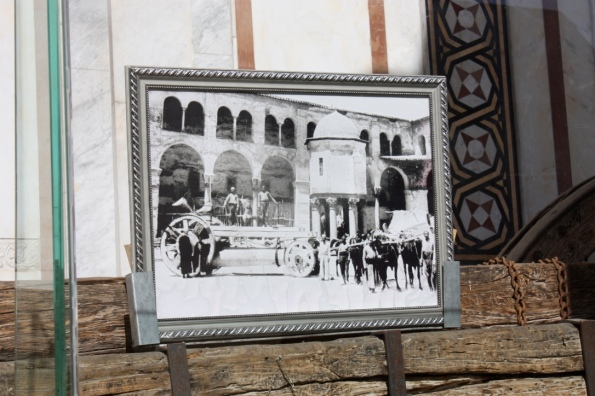
An early view of the Treasury Dome
Last week I introduced my connection to Syria and promised to write more about this country that was my home for several years in the early 1980s and where our first daughter, Libby, was born (and that’s another story worth telling).
I could recount all the tragedies and horrors Syria has seen over the last few years, but I’d rather start on a positive note.
Not everything in Syria is gone. While much of the north is in ruins, as far as I can determine, the Omayyad (Umayyad) Mosque, in the heart of old Damascus, stands undamaged.
I first saw this magnificent structure on a hot day in 1977. I was visiting from Egypt, where I was studying at the University of Cairo. Back then, I spent most of an afternoon enjoying the mosque’s architecture, its fine mosaic detail, the coolness of its surfaces and the sense of community that surged through the place.
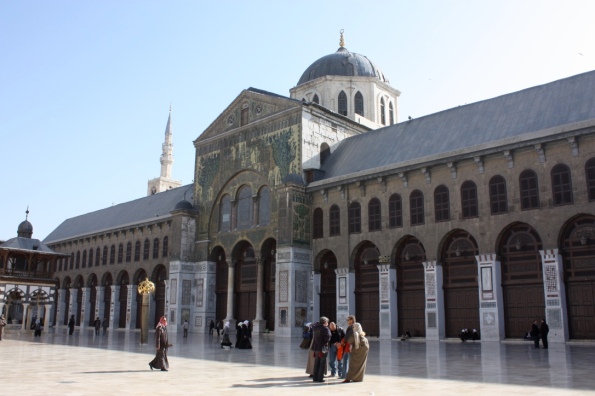
An arcade with lots of space for kids to run and study
By the time I travelled to Syria, I’d already had a year in Cairo and had visited many of its mosques. But this Great Mosque of Damascus, as it is sometimes known, was the first time I saw so many children running around so joyously. And for every child I saw running, there was one lying on the cool marble floors studying and doing homework.
The only other times I’ve seen such relaxed and casual enjoyment in a house of worship were in pagodas in Burma (but more about them another time).
So, not surprisingly, the Omayyad Mosque stuck in my memory. I was lucky enough to return to Syria (and Damascus) in 1980 after I married Poor John (yeah, someday I will write about our unexpected and unconventional wedding in Jordan).
One of my first touristic adventures in Damascus in 1980 was to return to the souk/bazaar that leads to the mosque.
I went again not long after Libby was born in 1981.
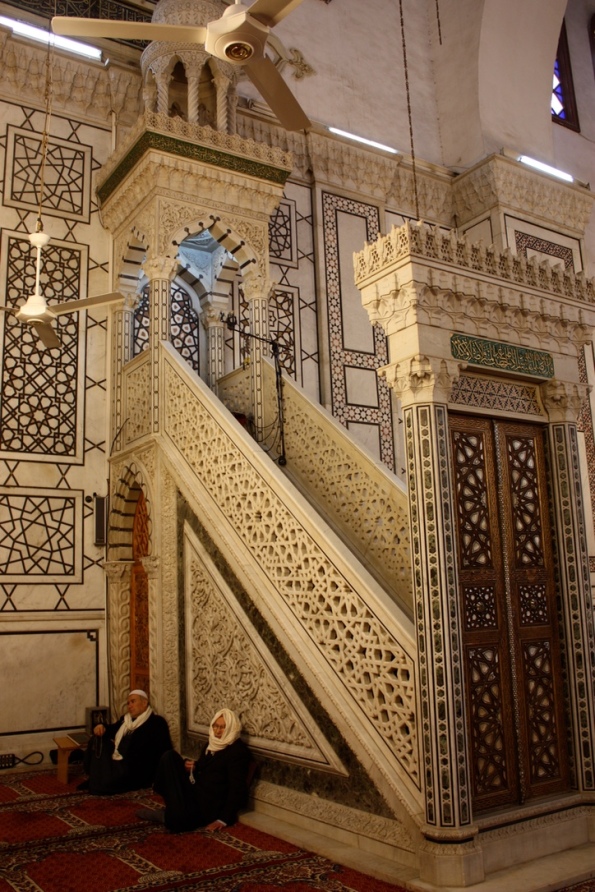
Omayyad Mosque—stairway to pulpit

Omayyad Mosque alcove
Interestingly, I have absolutely no recollection of needing to don a hijab (black cloak and headdress) to enter the mosque in 1977 or in the 1980s. I needed to when I revisited in 2009, but the garments were offered to all women and at no charge.
What I do remember about that 1981 outing with Libby is the many women who rushed up me to inspect the baby. I had her in a sack on my chest and everyone lifted the little blanket I used to shield her from the sun.
They were keen to know, how old is the baby? My answer of two weeks shocked every single one of them. Then I got the well-meaning lessons. Babies aren’t supposed to leave the house until they are 40 days old.

Stained glass windows
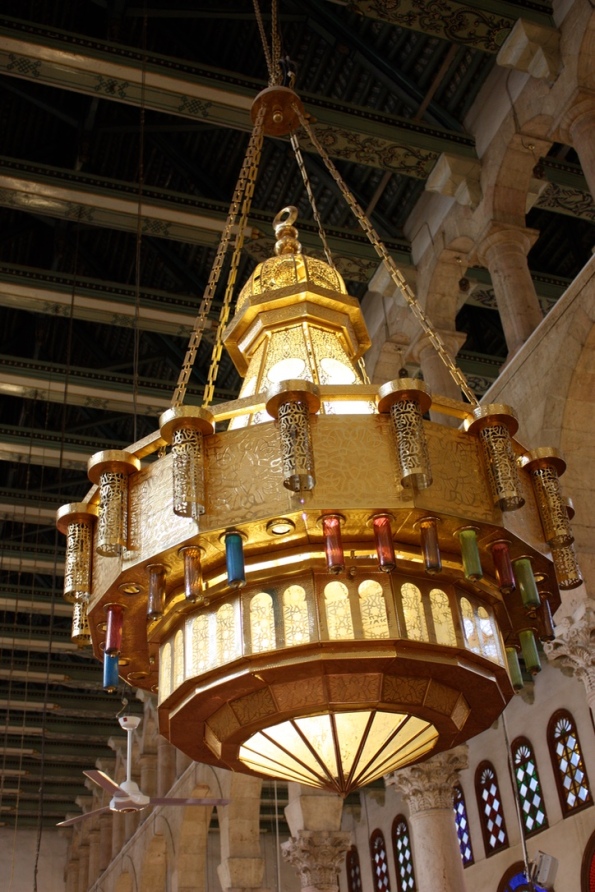
Chandelier
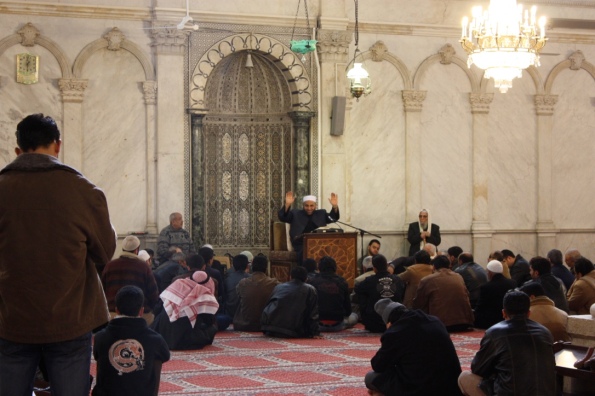
Friday teachings
I wonder what they would have said if I’d told them she was four days old when she attended the Australian Club’s first Happy Hour (another story which includes the sweepstake betting on when she’d be born). Oh, yeah, and she was 42 days old when she rode a horse, in a sack on my chest, down the chasm (siq) to the Nabatean village of Petra in Jordan.
So many more stories to tell about that part of the world.
In the meantime, here’s a bit more about the Omayyad Mosque in Damascus.
The Great Mosque of Damascus
The Omayyad Mosque is one of the oldest and largest mosques in the world. Some Muslims considered it to be Islam’s fourth most holy place.
Damascus is thought to be the longest continually surviving city in the world and construction on this important mosque is thought to have begun in 634 with completion in 712. It was built on the site of a Christian basilica dedicated to John the Baptist, who is honoured as a prophet by both Christians and Muslims. The mosque still has a shrine to him.
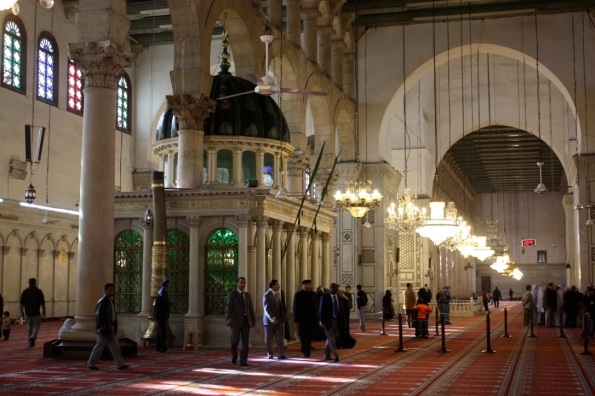
Shrine to John the Baptist
The mosque has seen a lot of change over the centuries. If you want a lot of detail, check out the entry on Wikipedia.
In a nutshell, it has seen fire, strife and many rulers. It’s been controlled by the Umayyads, Abbasids, Seljuk Turks, Mamluks, Ottomans, French and more.
The mosque is rectangular in shape, measuring 97 by 156 metres. There are three arcades (which is where I saw kids studying), a prayer room (with John the Baptist’s shrine), various domes (including the clock and the treasury domes) and three minarets.
The minarets are called the Minaret of the Bride, the Minaret of Jesus and the Western Minaret or Minaret of Qaitbay.
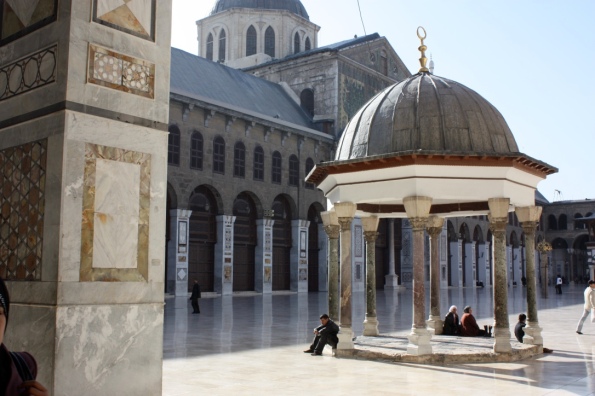
Dome of the Clock
If you’ve travelled widely, you might be interested to know that the Omayyad’s floor plan has been used for many other mosques. These include al-Azhar and Baybars Mosques in Cairo, the Great Mosque of Cordoba in Spain and the Bursa Grand and Selimiye Mosques in Turkey.
As for spelling, I use Omayyad while many others use Umayyad.
As for the future, I hope I am able to revisit this wonderful mosque. More importantly, I hope Libby is able to revisit the land of her birth.
By the way, if you have an interest in Middle Eastern food, you might like the recipe for flat bread on my cooking blog.

Christmas around a campfire in a tent in Damascus, 2009
Christmas always makes me think of Syria, and this year the thoughts are stronger than ever.
Today my heart is breaking for Syria and her citizens, but it wasn’t always that way.
I first visited Damascus in 1977, and then moved there in 1980 after Poor John and I married in Jordan (must tell that story one day). Our first daughter, Libby (who lives in Paris now), was born in Damascus in 1981 and had her first Christmas in that once beautiful city.
That year I bought an artificial Christmas tree and a variety of simple decorations at the small shop that was around the corner from our flat. I still have all the decorations but, a few years ago, I gave the tree to my dear friend, Maggie.
We were back in Syria for Christmas in 2009. That was the year we spent travelling through Africa on the back of an overland truck. We had some of December in Egypt, but moved on to Jordan and then Syria.
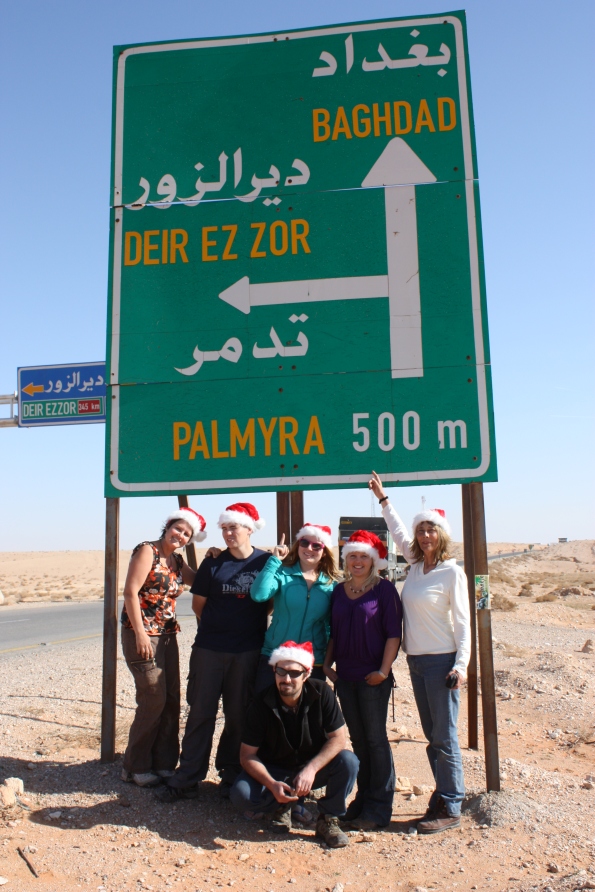
Some of our travelling companions
Christmas Eve was in a large tent in a campground in Damascus. Christmas Day we drove on to Palmyra, that glorious city that has been ravaged by ISIL (or whatever name you use to call these mongrels).
This year has been especially devastating for Palmyra. ISIL destroyed the Lion of Al-lat and other statues, the Temple of Baalshamin, the Temple of Bel, three tower tombs and some non-religious structures including the monumental arch.
In August, the savages brutally murdered 82-year-old Khaled al-Asaad, a renowned antiquities scholar, because he refused to reveal where valuable artefacts had been moved for safekeeping.
Amidst all this tragedy and the flight of so many Syrians from their beloved homeland, I am stunned by the heartless reactions of so many people in the Western world. The cries of ‘no Muslims in our country’ and ‘stop the boats’ leave me feeling the world has lost its bearings and its sense of community.
I can only hope that 2016 brings a greater sense of reason and compassion.

Christmas lunch in Palmyra
A few obscure things you probably don’t know about Syria
A friend of ours looks after refugees in Barcelona. He says, without exception, that the Syrians he looks after only want to return home when there is peace. They love their country. He says that’s rarely the case with other refugees.
When we lived in Syria only two people were authorised to hold gold ingots—an Arab (Christian or Muslim) and a Jew.
I’m not sure of the exact year, but Assad senior allowed 50 Jewish girls to migrate to Israel because there weren’t enough young Jewish men for them to marry in Syria.
In spite of his flaws, Assad is a member of a minority. Over the years, the Assads have, for the most part, tried to protect the minorities. Of course, there are exceptions.
More about Syria soon
I’ll be doing a few more blog posts about Syria in the coming weeks. I want Libby, who may never see the country of her birth, to know more about a once wonderful and beautiful country.
And I want to share pictures of how Syria once was.
The two links below show some of the devastation that has hit Syria. Perhaps they’ll help you to understand how this country is suffering and why people flee.
Cooking some Arabic bread
If you’re an enthusiastic cook, or even an novice, you can enjoy Arabic bread with this simple recipe.
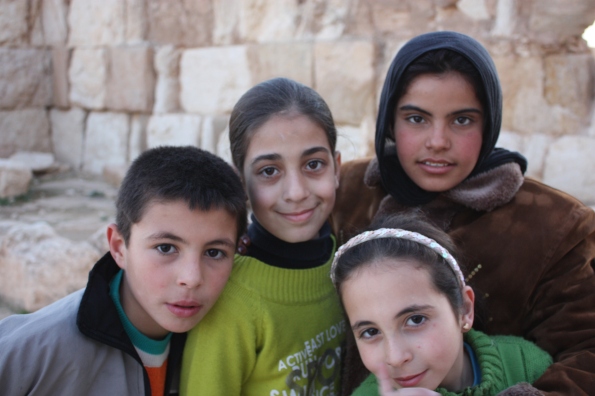
I wonder where and how these lovely Syrian children are now

A mon seul désir—The Lady and the Unicorn
Poor John’s Aunt Esther lived with us for eight years—from when she was 89 until she went into demented aged care at age 97. In her younger years, she’d been a teacher, school principal, school inspector, avid traveller, art lover and fussy eater.
We won’t discuss the fussy eating now (because it carried on into her old age) and instead focus on her love of art and travelling.
The other day, I was rummaging through her art books (many collected on her travels) and came upon her magnificent copy of La dame à la licorne or The lady and the unicorn.
The book’s copyright date is 1989 and I’m sure she bought it in Paris when she visited the Musée de Cluny, which is now known as Musée National du Moyen Age or Museum of the Middle Ages.
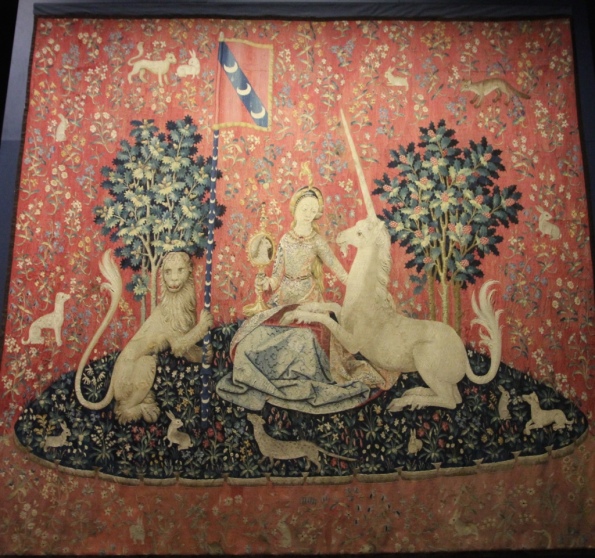
Sight—The Lady and the Unicorn
The lady and the unicorn is a set of six tapestries woven, probably in Flanders, from wool and silk. The collection is often considered Europe’s greatest works of art from the Middle Ages.
I have to agree.
This museum was one of the last places we visited when we were in France in October, and we stayed for most of a day.
These amazing tapestries are something you can gaze at for hours on end. I circled around the room they are displayed in four or five times before someone was bored/courteous/fulfilled enough to leave a seat open for me. So I sat until I felt obliged to offer my seat to someone who was equally spellbound.
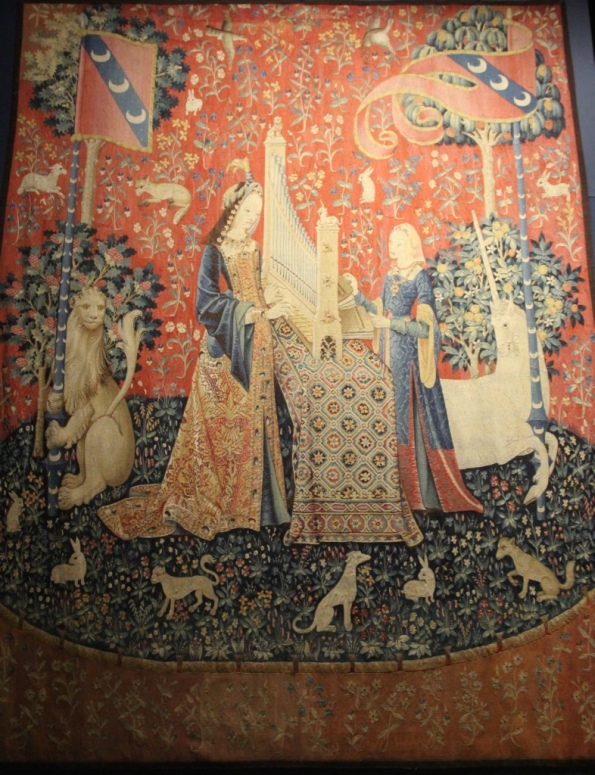
Hearing—The Lady and the Unicorn
Esther’s book explains that five of the six tapestries are attributed to the five senses of sight, hearing, taste, smell and touch. The sixth one displays the words ‘À mon seul désir’ or ‘my only desire’. That tapestry’s core meaning is unknown, but it’s often thought to represent love or understanding.
The tapestries are made in the style of mille-fleurs, or a thousand flowers. The models for the works are thought to have been the work of a Parisian artist who was considered the master of a Christian devotional book of Queen Anne of Brittany.
Each tapestry shows a noble woman, wearing a different gown in each. A handmaiden appears in four panels. In each panel, a unicorn is on the noble woman’s left and a lion on her right. Other animals, such as monkeys, rabbits, dogs and foxes, appear in various panels. Each piece is heavily decorated with leaves, flowers and trees.

Taste—The Lady and the Unicorn
The coat of arms shown in the tapestries enabled historians to attribute the commissioning of the works to the Le Viste family, some of whom were key figures in the Paris parliament.
We’re lucky the pieces still exist today. They were located as early as 1814 in Boussac Castle and were slowly deteriorating thanks to damp and mould. They were rediscovered, still in the castle, in 1841 by the French writer Prosper Mérimée, who was also Inspector General of Historic Monuments. Novelist George Sand was the first to bring the tapestries to public attention after she saw them in 1844. She even wrote about them in her novel, Jeanne. Sand was also the first to date them, using the women’s clothing for reference.
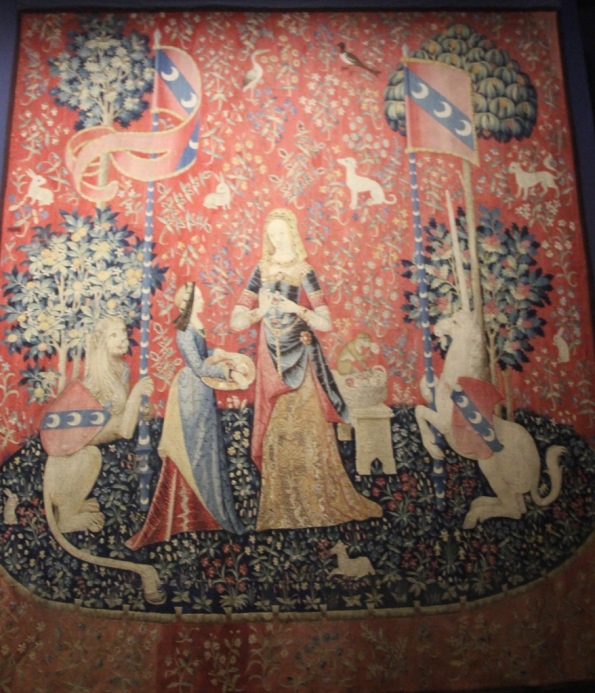
Smell—The Lady and the Unicorn
The pieces continued to decline for almost another 40 years until the then Cluny Museum acquired them and brought them to Paris for conservation and display.
Today the pieces hang in a round room, which allows the tapestries to encircle visitors. I wish my photos were sharper and brighter, but you can find plenty of better images online.

Touch—The Lady and the Unicorn
The theme of each tapestry
Sight—The noble woman holds a mirror which reflects the face of the unicorn.
Hearing—The noble woman plays a portable organ while her handmaiden operates the bellows.
Taste—At the bottom of the tapestry a monkey puts a sweet into its mouth.
Smell—A monkey sits on a bench and sniffs carnation.
Touch—The noble woman holds the unicorn’s horn in her left hand and a spear in her right.
À mon seul désir—The exact theme of this panel remains unknown.
P.S. I’ll write about the rest of the museum in another post. In the meantime, please feel free to check out some of the tastes and smells on my cooking blog. 🙂

À mon seul desir detail—The Lady and the Unicorn

Approaching the Arc de Triomphe in Paris
After the devastating terrorist attacks in Paris last month, I’ve been trying to figure out how to re-introduce all the wonders of this magnificent city and show people that Paris is still a top tourist destination.
I shouldn’t have agonised because I suddenly realised that the Arc de Triomphe is the perfect place to start.
This impressive monument, located at the end of the city’s famous Champs-Élysées, is a symbol of strength and resolve. Completed in the 1830s, the arch honours those who fought and died in the French Revolution and the Napoleonic wars.
Its full name is Arc de Triomphe de l’Étoile (or Triumphal Arch of the Star). Twelve roads converge on this arch, creating a star-shaped intersection. Over the years, it has been a popular gathering point for marches, rallies, protests and ceremonies, especially annual events to honour the Unknown Soldier, who is buried at the base. It’s also a great place for a traffic jam.

Arc de Triomphe intersection of 12 roads. Photo from geocaching.com
I remember my first ‘intimate’ encounter with the Arch. It wasn’t in 1975 when I first saw the Arch, but in 2003 when my dear friend, Maggie, and I travelled around the world together (that’s worth quite a few amusing posts).
Back then, Maggie and I were visiting Paris from Belgium and riding in a car with our first exchange student, Jean-Mi, and his mum, Milou, and sister. Aurélie. Milou was driving.
That woman has nerves of steel. You’d think she’d trained for the event. Milou approached the arch’s vast roundabout with white-knuckled resolve (but it was my knuckles that were white). We did go round more than once and then popped out on the right road to continue our journey. I was so impressed—and relieved.
Just so you know, we were on our way to a small hotel on Rue de Bitche. I think we chose it just so we could say we’d stayed on Bitch Street.


A bit more about the arch
Jean Chalgrin designed the arch in 1806. At 50 metres in height, it was the tallest triumphal arch in the world until a taller one was built in Mexico in 1938.
The exterior is covered in battle scenes, some showing nude French youths taking on bearded Germanic warriors. The names of French victories and generals are inscribed on the walls, and the Tomb of the Unknown Soldier from World War I lies at the base.
If you’re interested in even more detail, you can find it here.

Rosettes on the ceiling

Inscriptions the Arc de Triomphe
Two little challenges
We found two challenges when we visited the arch this year.
As I said before, the monument is in the centre of a huge roundabout—12 roads feed into it. You can drive round and round the arch, but it’s a little hard to get to the centre when you are on foot.
I’m still not sure how many times we walked around the perimeter, searching for one of the two underground passages that could take us to the centre. At last, we noticed that one intersection had a staircase (and a directional sign) down to the underpass to the monument.
The second challenge was to NOT be tempted by the promotion to join a queue (line) to see the monument.

You can go up to the top if you pay
Once you find your way underground, the advertising is very clever. ‘Join the queue and see the monument,’
Poor John and I wavered. Oh cripes, do you need to pay to see the Arc de Triomphe? That wasn’t the case when Maggie and I were there in 2003.
As it turns out, it’s still not the case. The pay-to-see option is for those who want to visit the top of the arch and look out over the city. But I have to say the promo is very compelling, and we very nearly bought tickets and asked questions later.
So if you get to the underground bit of the arch (and don’t want to go to the top), just keep walking around the circuit until you get to the sign that says to go upstairs here.
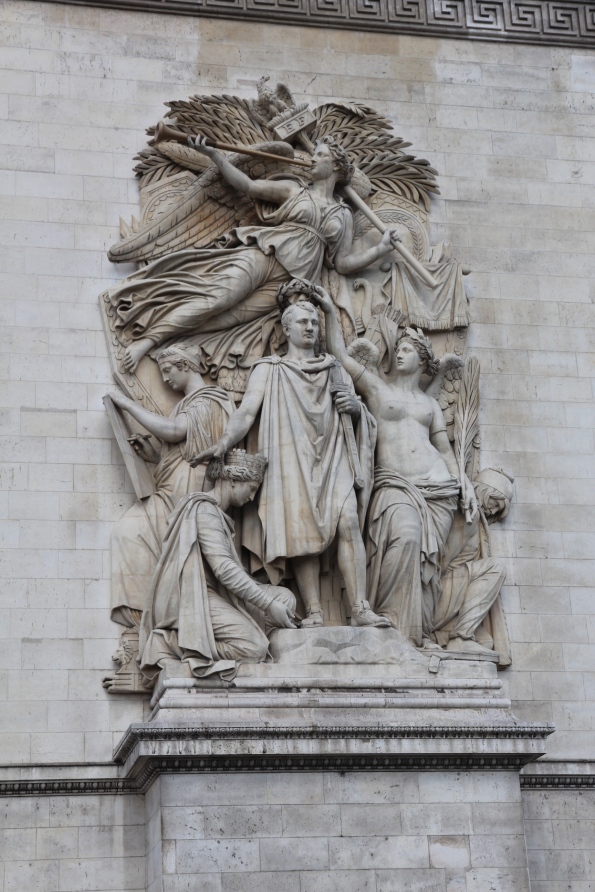
Arc de Triomphe sculptures
And a reminder
Don’t live your life in fear. Get out and do things. Travel and live. Use common sense about where you go (that applies anywhere in the world).
Don’t be afraid of Muslims you see. They aren’t the extremists. They want what you want—enough money to live, jobs, a roof over their heads, food on the table, education for their children and to live peacefully with their neighbours.
It’s true in Paris and true almost everywhere else in the world. Sure there are exceptions, but they are few.
 Where to next?