
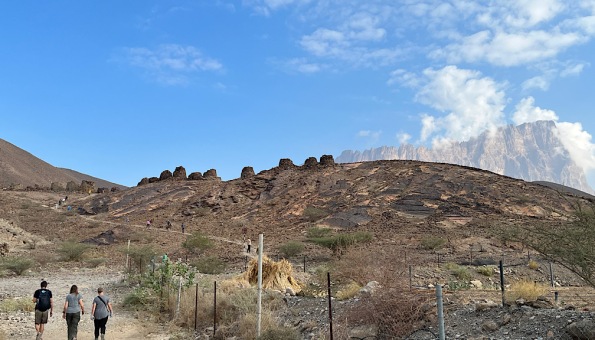
Appraching the tombs with Jabal al Misht in background
Cemeteries always make for an interesting stop on an overland trip, but the beehive tombs in Oman set a whole new benchmark for fascinating.
Together the three archaeological sites of Bat, Al-Khutm and Al-Ayn form the world’s most complete and best preserved collection of settlements and cemeteries (also called necropolises) from the 3rd millennium BCE.
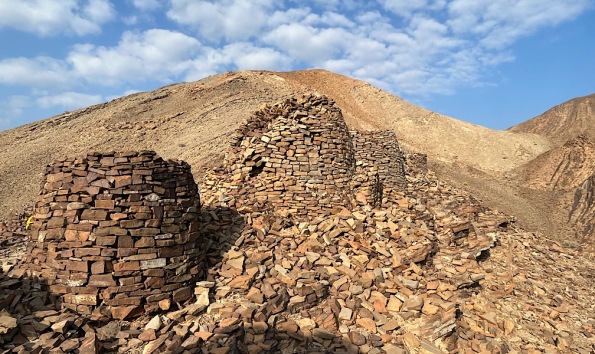
They are so important that UNESCO designated them as a World Heritage Site in 1988.
We were lucky enough to visit the tombs at Al-Ayn. While it is the smallest of the three necropolises, it is the most accessible and most scenic, and in the best condition.
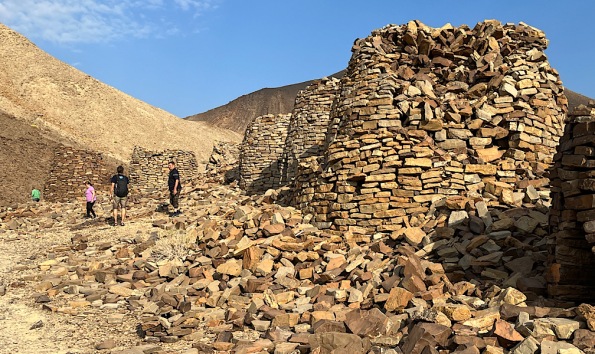
Plenty of stuff as building materials
That, in itself, is remarkable. Since being designated world heritage, the sites have not been restored or had any other type of conservation. Their isolation has been their only protection. One of the greatest dangers comes from locals who take pieces to use as building material.
Al-Ayn has 21 ‘beehives’ with 19 still standing. These structures are strung out on a hill near Jabal al Misht (Comb Mountain).
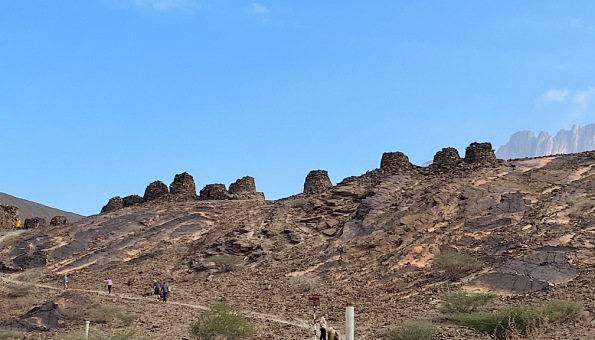
String of tombs at Al Ayn, Jamal al Misht in the background
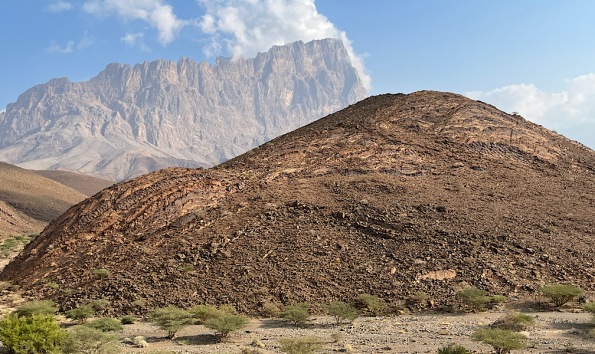
Jabal al Misht in the distance
I say structures because it is assumed they are tombs. No remains of animals or humans have ever been found in any of the ‘tombs’.
I’ve found websites that say you can enter some of the monuments, but I never noticed any openings. However the surrounding landscapes are breathtaking.
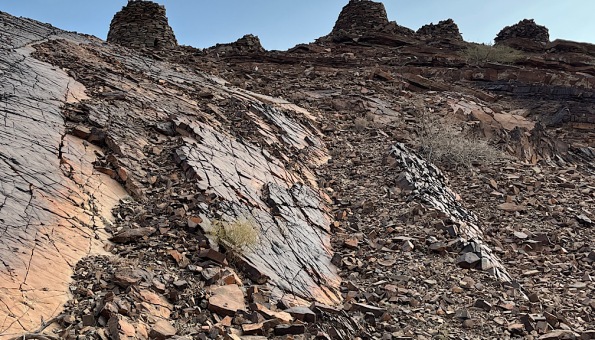
Looking up at tombs
We could see the row of beehives from quite a distance and the walk up to them wasn’t too steep. On the way, we crossed what is probably a dry river bed. Note to self: don’t visit in the rainy season.
Once there we scrambled around the uneven rocks and enjoyed the views. Highly recommended and free!
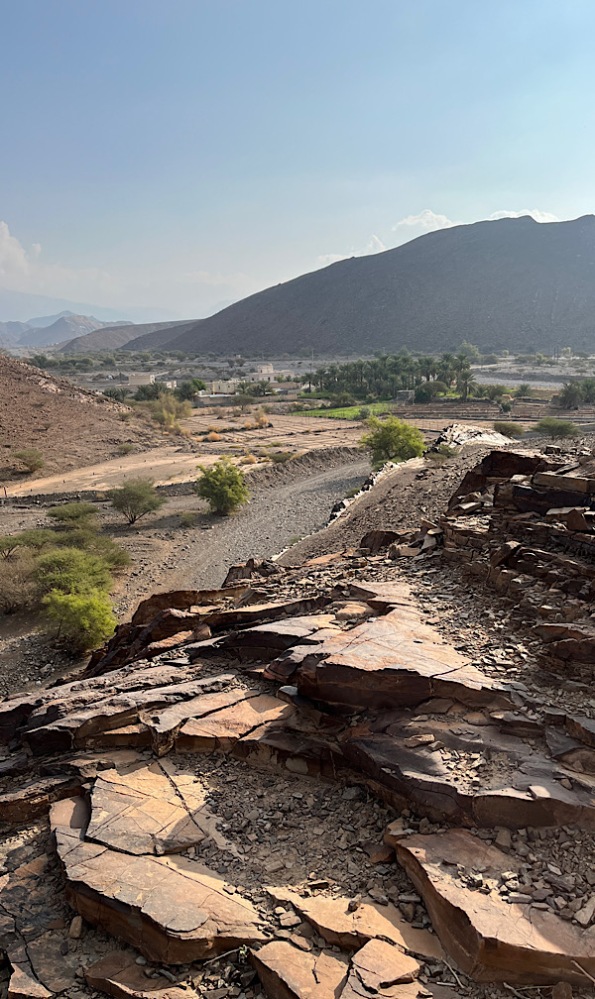
Looking out over the countryside
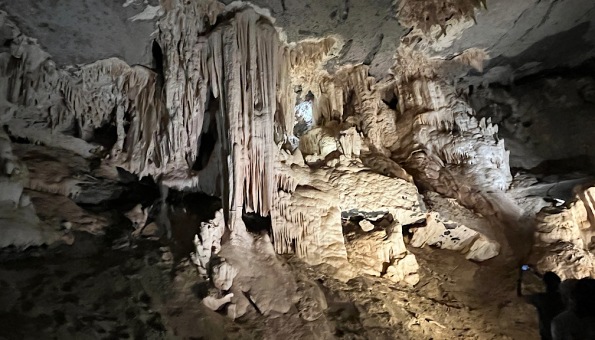
Stalactities galore
A few months back, Poor John and I attended a fascinating U3A lecture on Oman. We were keen to know more about the country we’d be visiting later in the year. While the talk was excellent, it didn’t quite prepare us for the diversity that is Oman.
I’ve already introduced you to our first bush camp and the picturesque Wadi al Shab, so now let’s head underground to the ancient Al Hoota Cave.
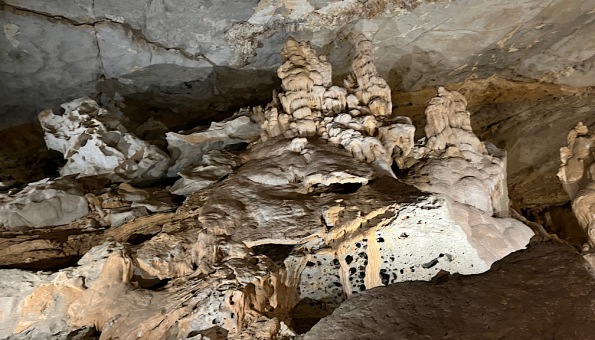
Al Hoota Cave
Located at the foot of Jabal Shams, Oman’s tallest mountain, Al Hoota is estimated to be more than 2 million years old. It is the only cave on the Arabian Peninsula that is open to the public. Even then, just 500 metres of its 4.8 kilometres of length can be visited.
According to an official story, a shepherd lost his goat and stumbled across the cave in 1960. However, legend says it has been used for centuries as an escape route and hiding spot for people fleeing trouble. I vote for the latter.
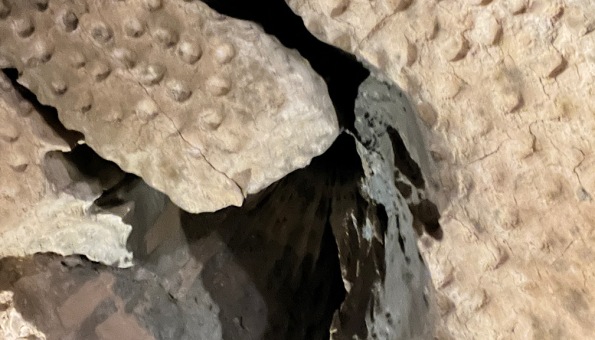
Ceiling ‘sculpture’
Sadly, the electric train that usually carries people from the visitors’ centre to the mouth of the cave was not working, so we all trudged along the tracks in the blazing sun.
The cave was a welcome relief from the heat, but we didn’t dawdle. Our guide whizzed us along, up and down metal staircases that protect much of the cave floor. Someone said there were 277 steps, but that was a gross under-exaggeration. The mathematician in me gave up counting after 400.
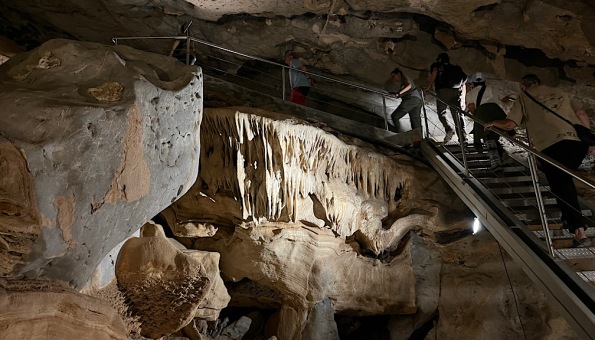
One of the steepest staircases
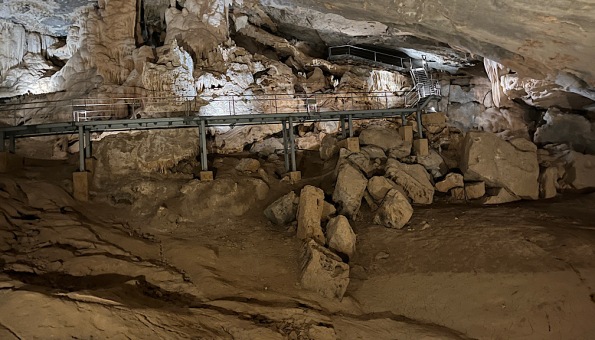
Stil more steps
The cave has four lakes, but only the largest can be visited by the public. It is home to a population of rare fish, Garra Barreimiae. The fish were discovered in 1980. Known by locals as Bu Naseh, these fish have adapted to conditions within the cave—the lack of light in this case—and are completely blind. They have also lost their pigmentation and are transparent. Other species in the cave include bats, arthropods, mollusks, spiders, snails and water beetles.
The stalactites and stalagmites aren’t huge. The guide said that water no longer drips from the ceiling, but he couldn’t understand our question of how long ago it stopped.


I especially enjoy the geological exhibition at the visitors’ centre. There were explanations of how caves form and samples of many different kinds of rocks and other features.
To be honest, Al Hoota is not remarkable as caves go, but it was a welcome break from the bus and yet another surprise in Oman.
Stay tuned for more of the country’s unexpected gems such as the beehive tombs. Heading into the desert tomorrow for camping, so will be out of touch.

So much texture

The start of the walk at Wadi al Shab
We spend a lot to time on the bus for this overland, so it’s always great to get out for a stretch and a hike. A couple of days ago, on the way to Muscat in Oman, we stopped at Wadi al Shab.
This picturesque valley is super popular with locals and tourists—the parking lot was packed. The adventure starts with a 5-minute boat ride across the narrow river that runs through the wadi.
I have to admire the people who set up the boat trip. It costs 1 Omani rial for a return trip. That’s about A$4. A lifejacket (totally unnecessary) costs another rial. The boats vary in size, but given that there were 18 people on the boat back, I reckon they’re making a killing.
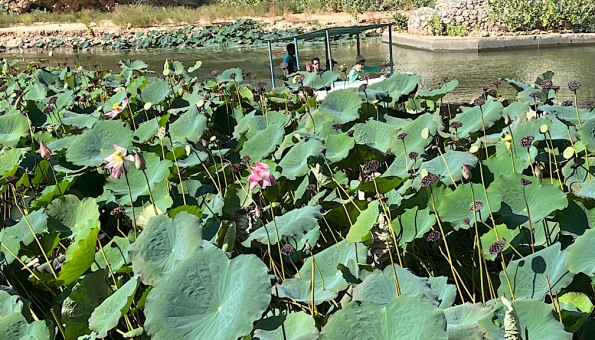
A small boat is chugging along behind the lotuses
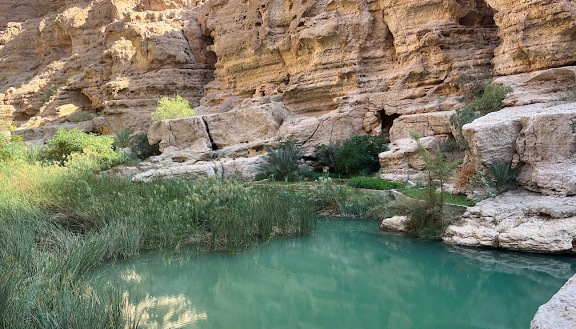
The clear waters of Wadi al Shab
Anyway, the wadi has swimming holes and a cave with a waterfall at the end of the trail, but to get there you have to walk about 50 minutes over a rocky path, through lush greenery and between towering cliffs.
I gave up at about the 40-minute point. We had been warned that, towards the end of the valley, the path becomes wet and slippery. That was true, and I don’t need to ‘enjoy’ Arabia with a broken leg or ankle. Of course, Poor John and almost everyone on the bus went the whole way.

This is where i stopped. Notice the overhang, the narrowness of the path and the black tubes
Some went swimming, ignoring the advice that women should remain fully clothed. That’s not swimming. That’s what you wear when you fall overboard.
Before hiking, Poor John and I stopped for lunch at the café near the boats. Because of the prime location, we expected the place to be expensive and have mediocre food. Wrong on both counts. The sandwiches were cheap and delicious.
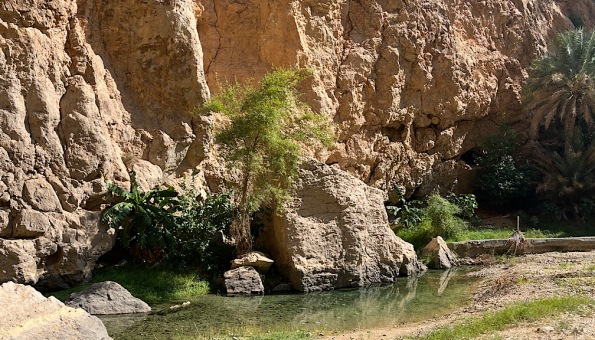
A great place for a hike
I rather wished I’d bought a non-alcoholic beer, but later was glad I hadn’t. Nothing like seeing another woman traipse off the path trying, unsuccessfully, to find a secluded spot to have a piddle. She should have used the free public toilets near the entrance. I can hear my mother say, ‘never miss an opportunity’.

Lovely views in the wadi
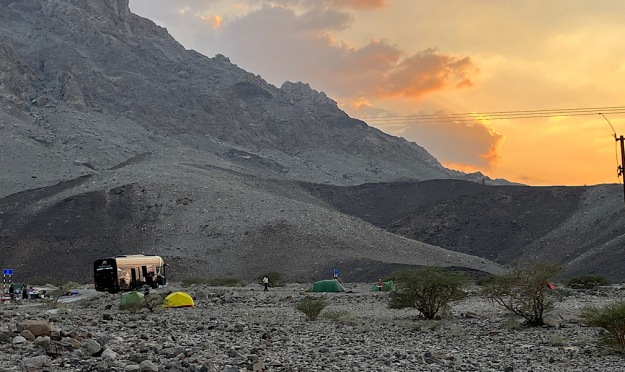
Camping on a rocky landscape. Our tent is to the left of the yellow one.
Sometimes it’s hard to find a decent place to camp. Our transit from the United Arab Emirates to northwestern Oman meant trading an outlook of sand to one of rocks.

Welcome to a bush camp in Oman! Poor John and I managed to kick away most of the larger rocks and set up our tent not far from the bus. Yes, this overland trip is on bus, which I keep calling a truck.
Our tent is the green one just to the left of the bright yellow one. In spite of the terrain, we got a decent night’s sleep. In fact, it was a good spot. And I picked up a couple of small rocks to give to my friend, Maggie. She collects rocks from our travels.
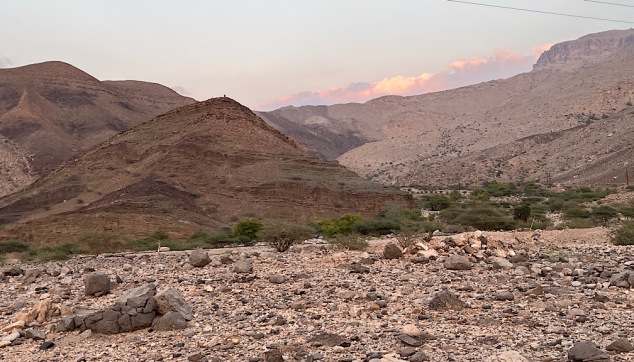
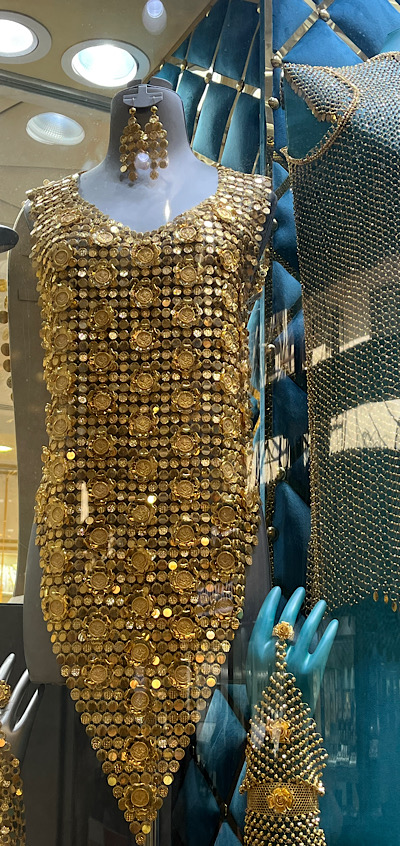
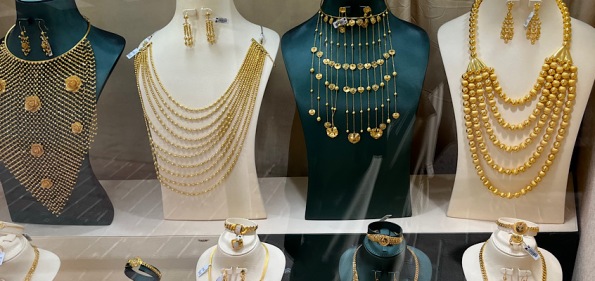
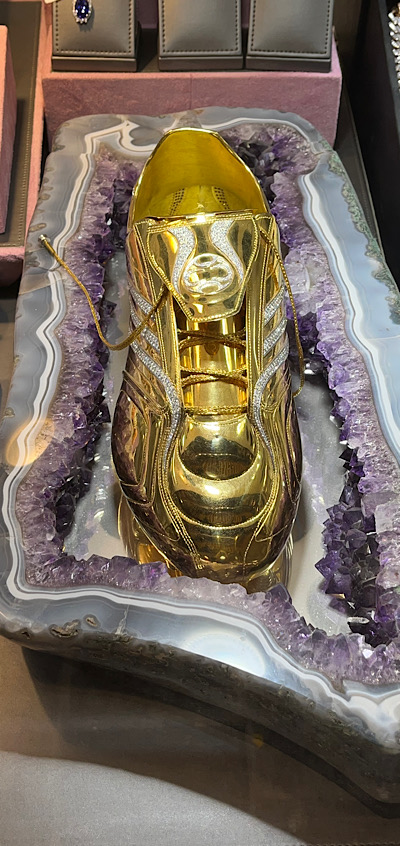
Can you believe it? There we were in Dubai during the annual Diwali celebrations—the Hindu festival of lights. The gold souk was filled with the finest in gold craftsmanship—and Poor John wouldn’t buy me a single piece.
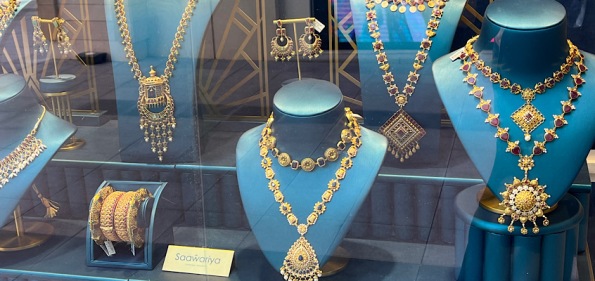
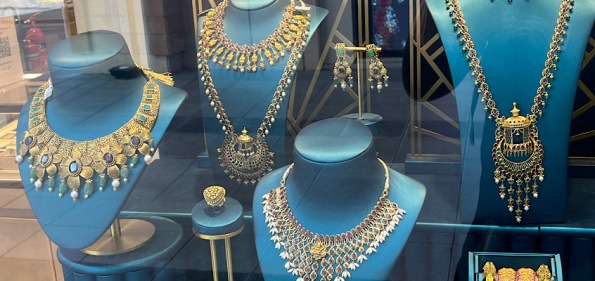
Does any piece strike your fancy? I’m rather partial to the shoe. So practical in so many ways.

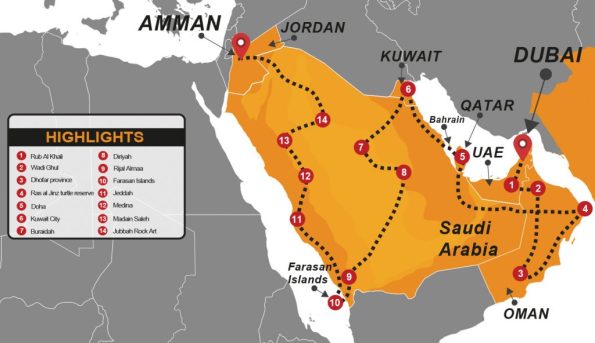
We’ll be zigzagging through Arabia during the next two months
After a couple of years of virtually no travel, Poor John and I have hit the road again—literally—for another overland trip. This time it’s 54 days in Arabia with Madventure, including 22 days of camping.
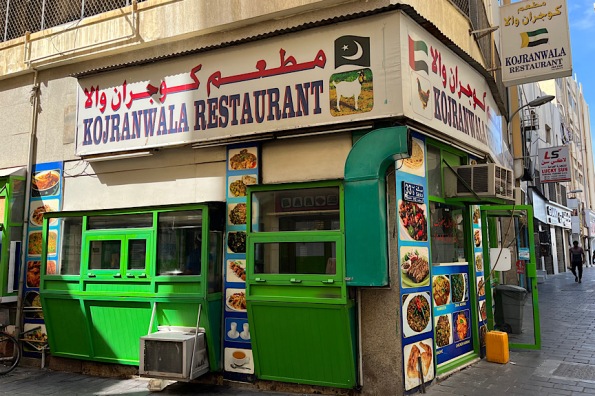
We arrived in Dubai early yesterday (Sunday) and spent the day exploring. The gold souk is bigger than ever (more about that soon). At the edge of the souk, we found a great local place to eat. Lunch was Indian—korma, dahl and roti. Can’t believe I forgot to snap the food, but did get the restaurant. It was almost empty when we arrived at 11:15am, but packed by the time we left just after noon. I was the only woman in the place.
The metro–tram system here is a fabulous way to get around. A day-long pass costs less that A$10 per person. We’ll recharge our passes today.
Our overland starts tomorrow (Tuesday). I’ll post as often as I can, and hope you’ll come along for the ride. Apologies in advance for not always being able to visit, like and comment on your posts. Camping in the desert is not the best way to pick up an internet signal.
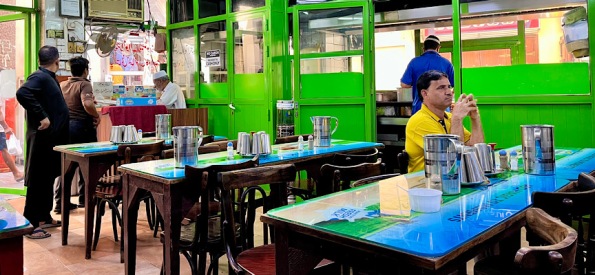
A simple restaurant on the edge of the gold souk
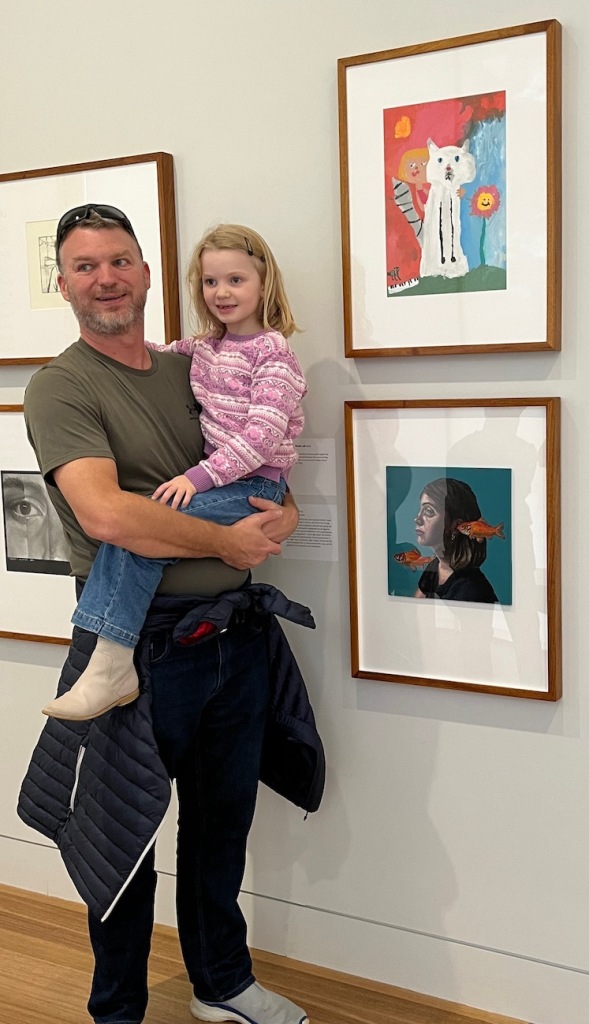
Claire De Fries and the portrait of her dream cat
As Australia’s national capital, Canberra has a great collection of museums, galleries and important national institutions.
The National Portrait Gallery is a popular one, and it’s not far from our home. I visited recently as a cultural outing for book club (check out our club’s visit to Bill the Bastard).
I was pleased to find many new displays (more about two exhibits soon), including one by young masters of portraiture.
This was the Little Darlings Youth Portrait Prize 2023. The competition was open to primary to secondary students from across the country. There were 190 entries across four age categories, Kindergarten to Year 12, but the summaries about the winning portraits did not specify the artist’s age.
This year’s theme was ‘Me and my place’ and exhibitors could enter a drawing, painting, photograph, print or a combination. Twelve winners were chosen and we had the good fortune to meet one of them.
Claire De Fries, age 6, was there from Sydney with her parents and siblings. Her work, Me and my dream cat, features some of the things she loves—a sunset, a chameleon, a piano and a flower. What a delight to meet her and her family.
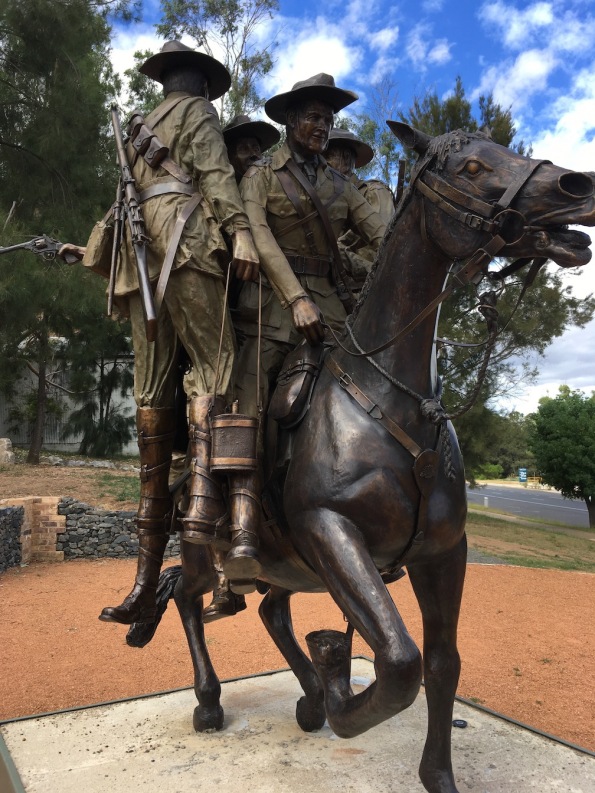
Last year my book club decided to do different things on alternate months—a book one month and an outing the next. Our first outing was to Jugiong for lunch at the Long Track Pantry and a stop at the twin towns of Harden/Murrumburrah on the way back.
First off, I’m super fussy about reuben sandwiches and the Long Track Pantry served up one of the best ones I’ve ever had. But the stop at Harden was equally rewarding.
That’s where we saw the statue of Bill the Bastard—an amazing and clever horse from World War I. His fame stemmed from a fearless rescue during the Battle of Romani in Egypt in August 1916.
The billboard in Harden says Bill had the heart and lungs of an elephant. It goes on the say:
‘He had the power, intelligence and unmatched courage that stood above all the 200,000 Australian horses sent to the middle east in The Great War. He was a big 17.1 hh with a long back and big rump. Chestnut in colour; and a Waler—named after New South Wales. The first person who tried to ride him was a young lad called Ben Towers—a questionable 17 years of age. He came from Cootamundra. Young Ben claimed to be a capable rider—but Bill had other ideas.
‘After several attempts it seemed that Bill would allow only one person to ride him—Major Michael Shanahan.
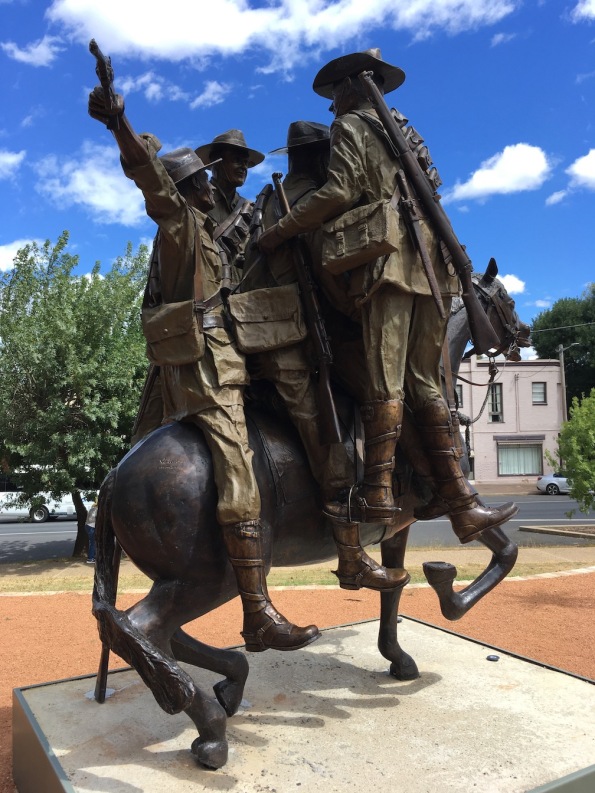
‘Shanahan managed to persuade his Captain “Banjo Patterson” to take Bill into battle. He felt sure that Bill would be the ideal horse for the job. In the thick of The Battle of Romani, with four soldiers down, Shanahan rode Bill under heavy Turkish fire and with super strength, got the four soldiers on—making it five in total on Bill—and returned them to safety.
‘After Bill had a big drink, Shanahan said to the horse, “It’s time to get back, Bill, you’re a bloody marvel!” and so they rode back into the thick of raging war.
‘It was soon after that Shanahan was shot in the thigh and Bill was shot twice. Still they continued to fight until Shanahan collapsed into the saddle. Bill was aware of the seriousness of the situation and took Shanahan three kilometres through the fighting, straight to the vet.’
I love the fact that Bill knew to go straight to the vet. Shanahan was soon taken to the medic. Sadly, he lost his leg, but he and Bill both became heroes.

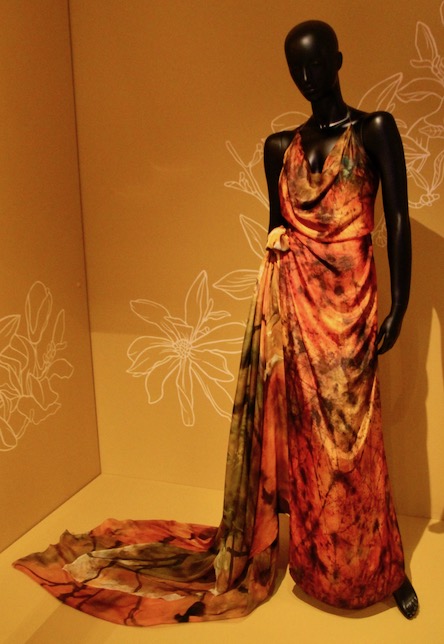
Towera (Fire) 2020 by Lyn-Al Young, made of silk and cord
NAIDOC Week is one of Australia’s most important celebrations of the year because it showcases the history, culture and achievements of the country’s Aboriginal and Torres Strait Islander peoples.

Seedpods top and pants (2019) by Grace Rosendale
Australia has a sad history in terms of how it has treated its First Nations peoples. I won’t go into those shameful actions because you can search for the details. NAIDOC started in 1938 as a Day of Mourning, and became a week-long event only in 1975.
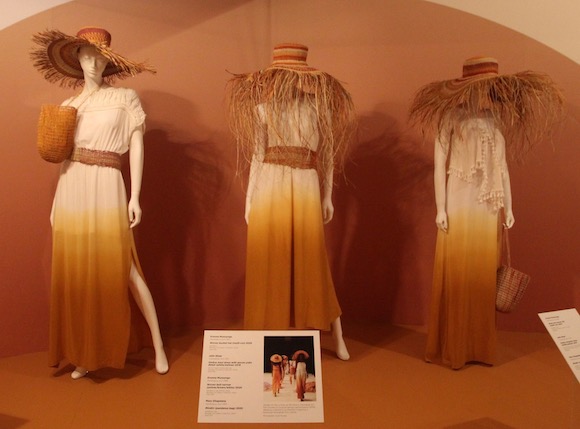
Dresses by Julie Shaw (2019). Accessories by Margaret Djarrbalabal, Evonne Munuyngu and Mary Dhapalany
These days, First Nations people are beginning to receive the honour, recognition and attention they deserve. This last week has served up a feast of their accomplishments, stories, art, performances, recipes and more.

Legacy dress and accessories by Peggy and Delany Griffiths, Anita Churchill, Kelly Anne-Drill and Cathy Ward
Today I want to share some of the magnificent fashions and textiles that made up Piinpi: Contemporary Indigenous Fashion. The display was curated by Bendigo Art Gallery’s First Nations Curator, Kaantju woman Shonae Hobson, and featured about 60 works.
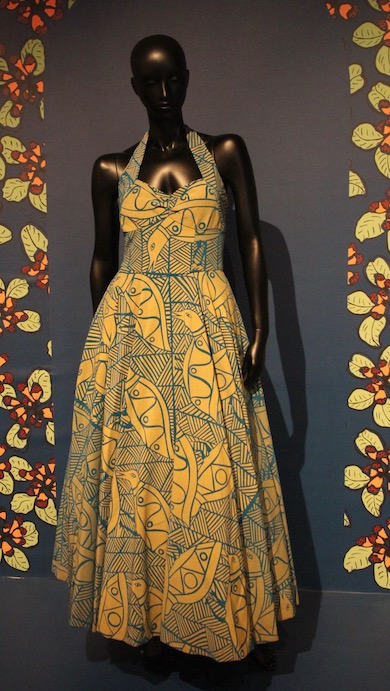
Wedding dress worn by Miranda Tapsell in the movie Top End Wedding. Created by Bede Tungatalum, Heather Wallace and Robyn Trott
I saw it last year at the National Museum of Australia. Shame on me for not sharing it then, but I couldn’t let NAIDOC pass without bringing it to you now.
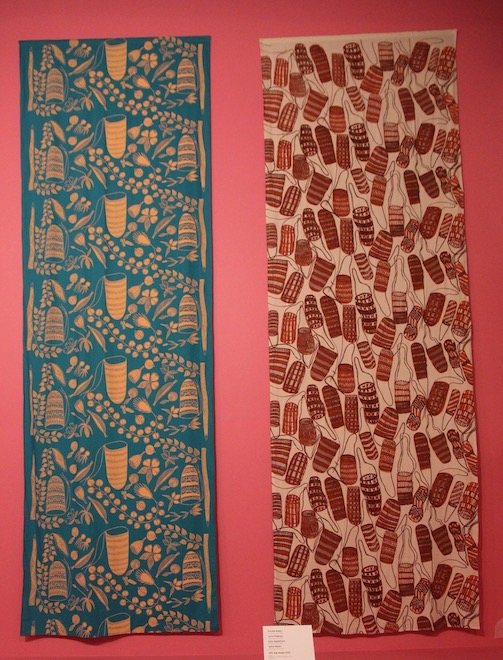
Dilly bag textiles. Selina Nadjowh on left. Priscilla and Sylvia Badari, Lynne Nadjowh and Katra Ngabjmirra
I totally loved this exhibition and I so wish that it had or will travel more widely than Bendigo and Canberra. It’s simply breathtaking. The colours, textures, designs and so much more are so indicative of First Nations creativity. I struggled to add captions to the pics below. Thanks WordPress for changing things. Both dresses are by Shannon Brett.
As a complete aside, if you are ever interested in viewing and/or purchasing Indigenous products, please check out this website. Lots of great products.


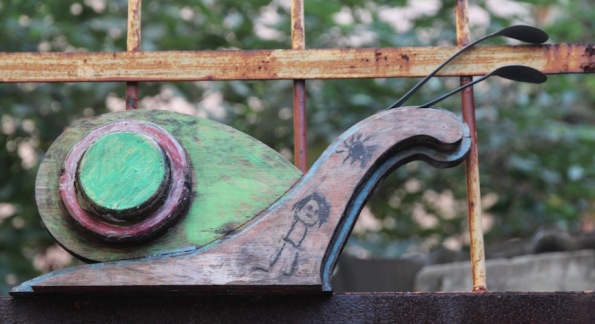
Thanks to Covid-19, most of life has moved at a snail’s pace for the last two-plus years. This blog has been almost as slow moving. So it seems fitting to share a post about Snail Lane in Tainan, Taiwan.
We encountered this creative and colourful lane almost daily in late 2019 and early 2020, when the whole family gathered in Taiwan for Christmas. Little did we know that we wouldn’t be able to regroup again for almost two years.
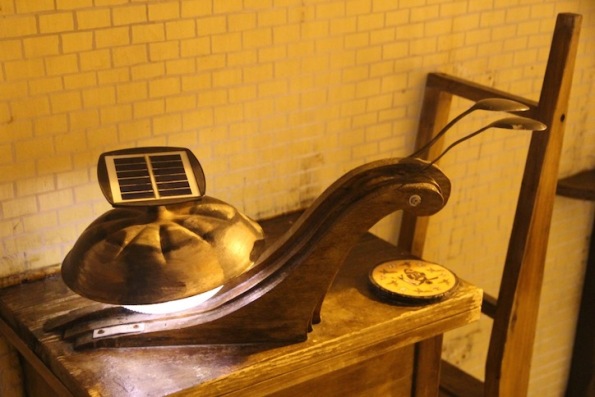

The name Snail Lane stems from the writings of Yeh Shih-tao. a pioneering author and historian, who focused on the literary history of Taiwan and the lives of ordinary Taiwanese people.
Some years ago, he and his family moved into a small house near the centre of Snail Lane. Back then it had no name and was simply a collection of narrow streets, alleys and old housing communities.


Yeh Shih-tao brought the name Snail Lane to life in some of his writings. After the name started to stick, the local residents were inspired to clean their laneways and the surrounds of their homes, and add snail sculptures and artworks throughout the area. There are also sentences selected from Yeh’s novels and poetry.
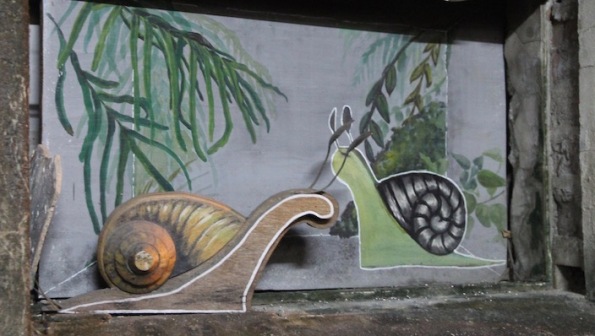
We walked through several times because the lane was so engaging. I haven’t added any captions—didn’t think they were necessary—but I hope that you notice how all the snails have spoons for antennae. And the one on the table has a solar lamp.
If you’re interested in knowing more about Yeh Shih-tao’s life, check out this article in the Taipei Times.
 Where to next?