

A little diversion tonight to pay my respects to Omar Sharif who died earlier today at the age of 83. He was a handsome man, remarkable actor, excellent bridge player and an Egyptian.
I was privileged to have met him when I lived in Cairo in the 1970s. My dear friend, Vassily, knew him well. In fact, Vassily’s brother was Sharif’s main bridge partner whenever he, Sharif, was in Egypt.
The first time I met Sharif was in the Sheraton Hotel in Cairo. I met him a couple more times, but the first meeting remains in my memory. That was almost 40 years ago, and he was as handsome and charming as he looked in all his movies.
But I have a funny story to tell in relation to this meeting.
When I won my scholarship to go to Egypt, I was dating a very handsome Palestinian. We dated for many years, but the relationship was going nowhere. His mum didn’t want him to marry a foreigner.
How it all turned out is another long and funny story for another time.
But we’re talking about me meeting Omar Sharif and a comment from way back then.
That Palestinian boyfriend was rather annoyed that I was going off to Egypt on a scholarship.
Why are you going? he asked. If you’re hoping to meet an Omar Sharif, you need to know that guys with those looks are a dime a dozen in Egypt.
He was wrong. There aren’t that many. Sharif, you will be missed. Glad I met you.
And later I married an Australian I met in Cairo.
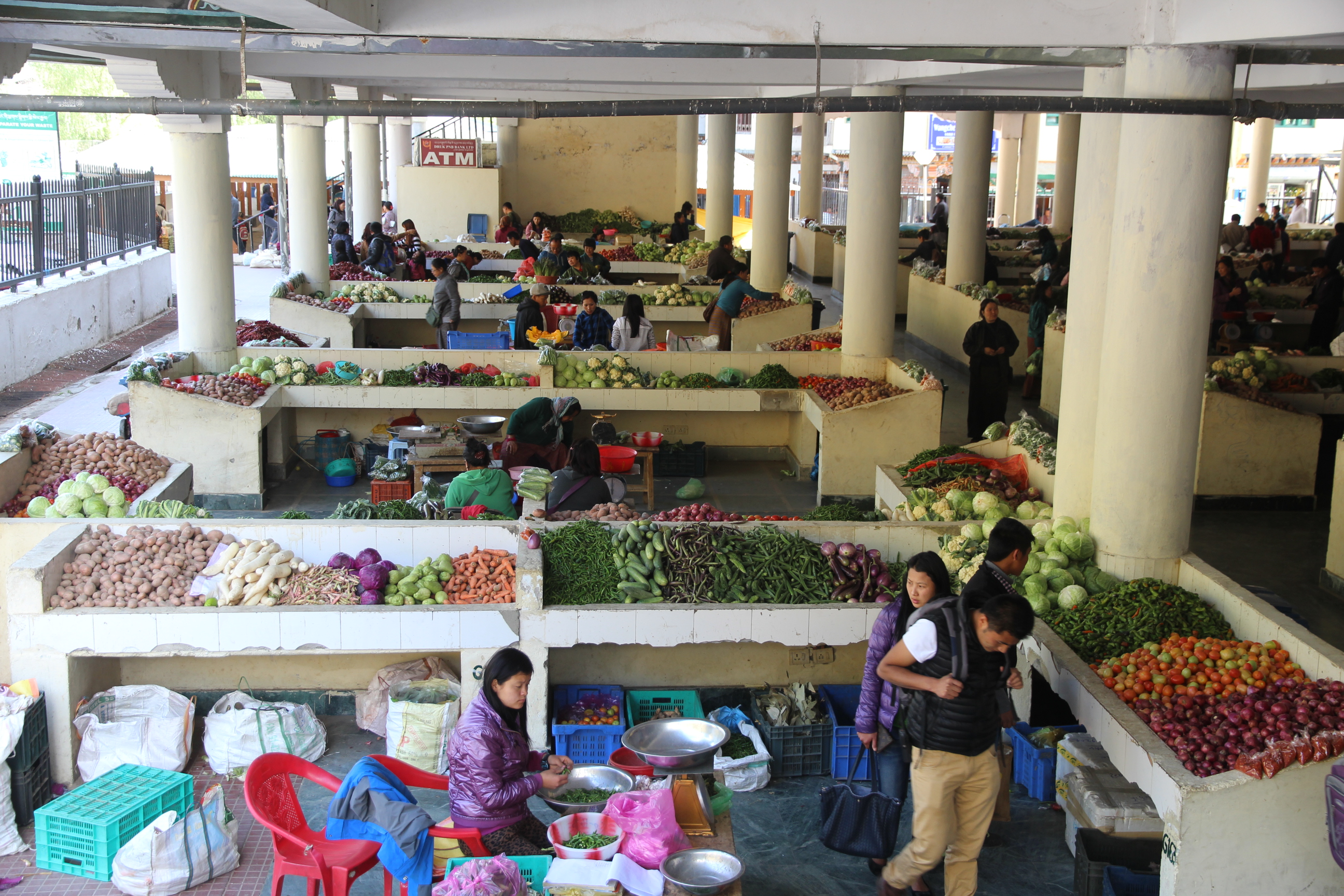
A birdseye view of the Thimphu farmers’ market
We didn’t have the chance to visit many food markets while we were in Bhutan, but the weekend farmers’ market in Thimphu (the capital) helped to tide me over until my next ‘fix’.
This amazing market draws vendors from all over the country and nearby India too, I think, as there was an entire section of Indian food items. Farmers start arriving from Thursday and stay until late Sunday, unless they sell out.
The market has two parts—food and craft— and is located on the edge of town, near the Wangchhu River. We focussed on the food section and were rewarded with new ingredients and new takes on some known ingredients.
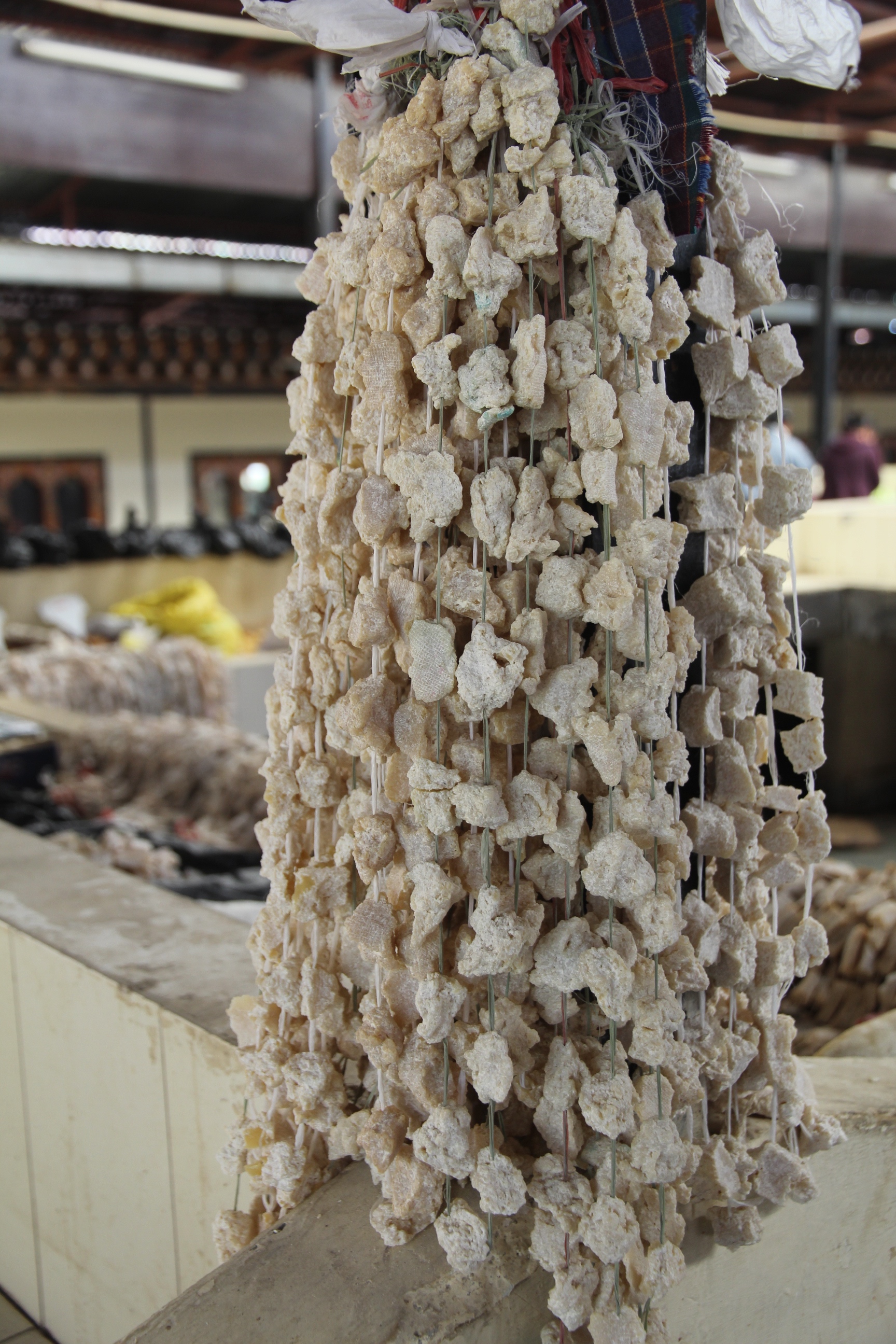
Ropes of dried cheese


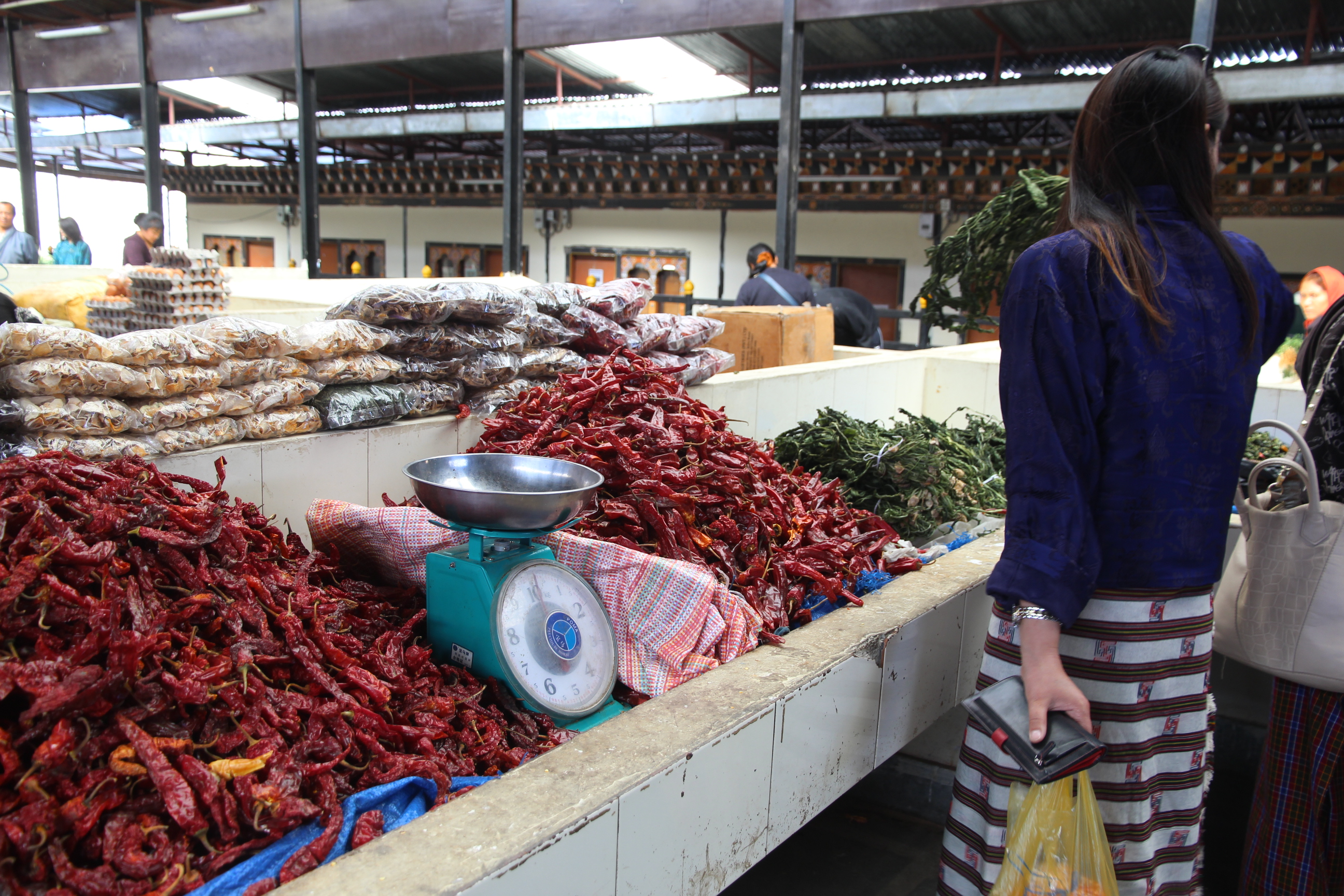
Chillies galore


After eating just a few meals in Bhutan, we figured out that cheese and chillies are the national ingredients. They’re in virtually every dish and served at every meal—even breakfast. Not surprisingly, the market had hefty supplies of these national ingredients.
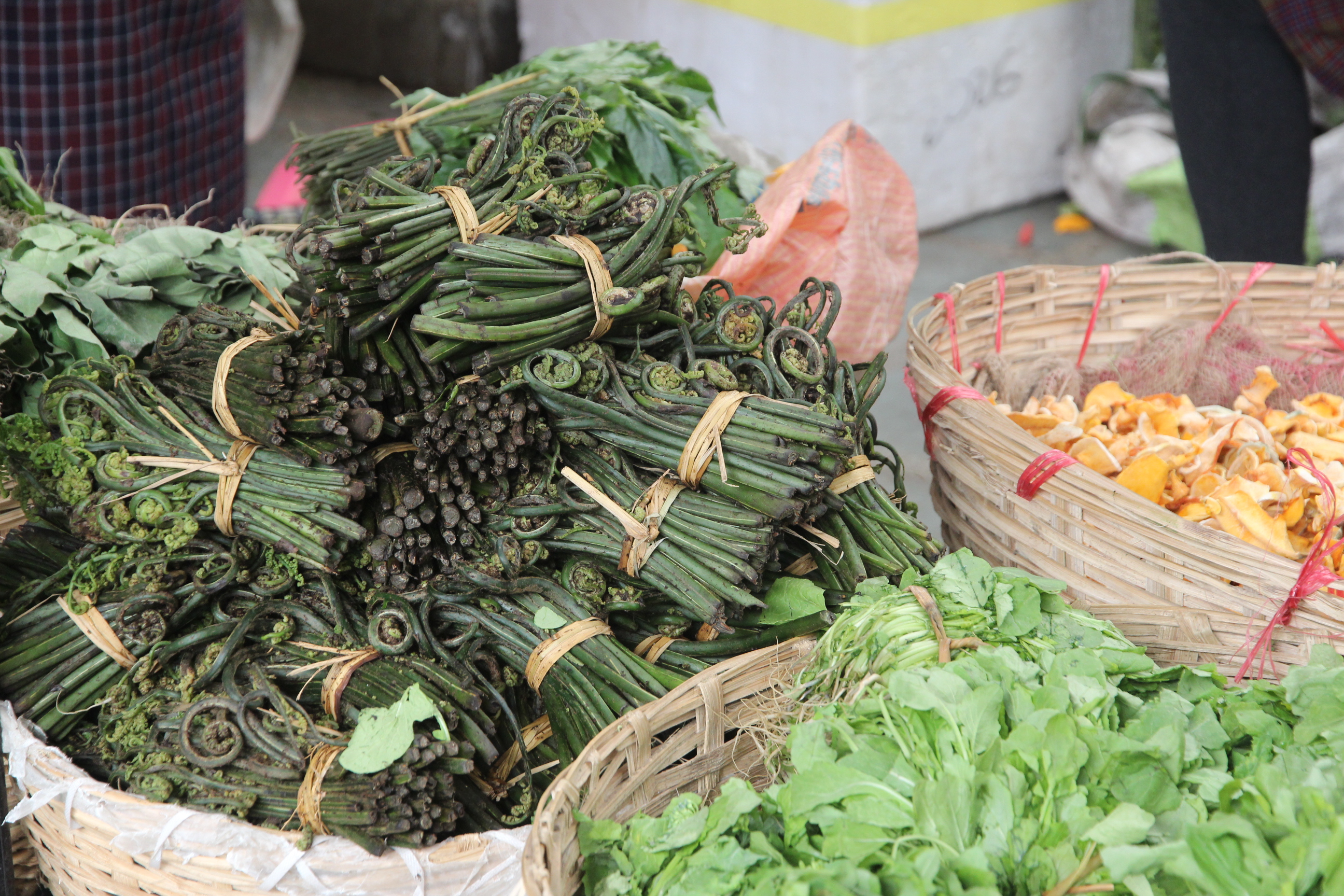
Fiddlehead ferns
Fiddlehead ferns are another popular item. I’ve known about these ferns for years and always thought of them as being native to Canada. Let me tell you, they grow wild all over Bhutan too. We had several meals featuring ferns—they are delicious—but the first time I saw them for sale fresh was in the Thimphu market.

Incense stall
Although not a food, incense was another common item on display. It’s important in the home and in monasteries. I don’t think religious rituals can take place without dozens of incense sticks burning.
A completely new-to-me ingredient were crow’s beaks. These bright green vegetable pods are hollow inside and a little bigger than a thumb. We never ate any, but they smell a bit like cucumbers and I’m told they taste a lot like green beans. Common names used in Bhutan for this plant include slippery gourd or olochoto and kichipoktho. I’ve now discovered that crow’s beaks are also grown in South America (although I never saw it there) and that, in tropical climates, the plant can grow to 40 feet.


I’ve seen plenty of bitter melon in markets around the world, but Thimphu was the first place I ever saw it pre-sliced. Nice idea.
I was surprised to see banana pods, tamarillos and other fruits that I think need a warmer climate to grow. But Bhutan has better weather than I imagined. In fact, the southern part of the country, that borders India, is quite mild for a good part of the year.


The market was well-supplied with all sorts of produce that is designed to keep well. This especially makes sense in a place where remote and rural households might not have refrigerators or reliable sources of power. So there were vast arrays of honeys, pulses, dried vegetables, dried mushrooms, dried fish, tea, pickles, and herbs and spices. They were selling the biggest bay leaves I’ve ever seen.
Of course, one of the best things about visiting markets is the people-watching. It’s a chance to see how and what people buy and sell, what they wear and how they work.
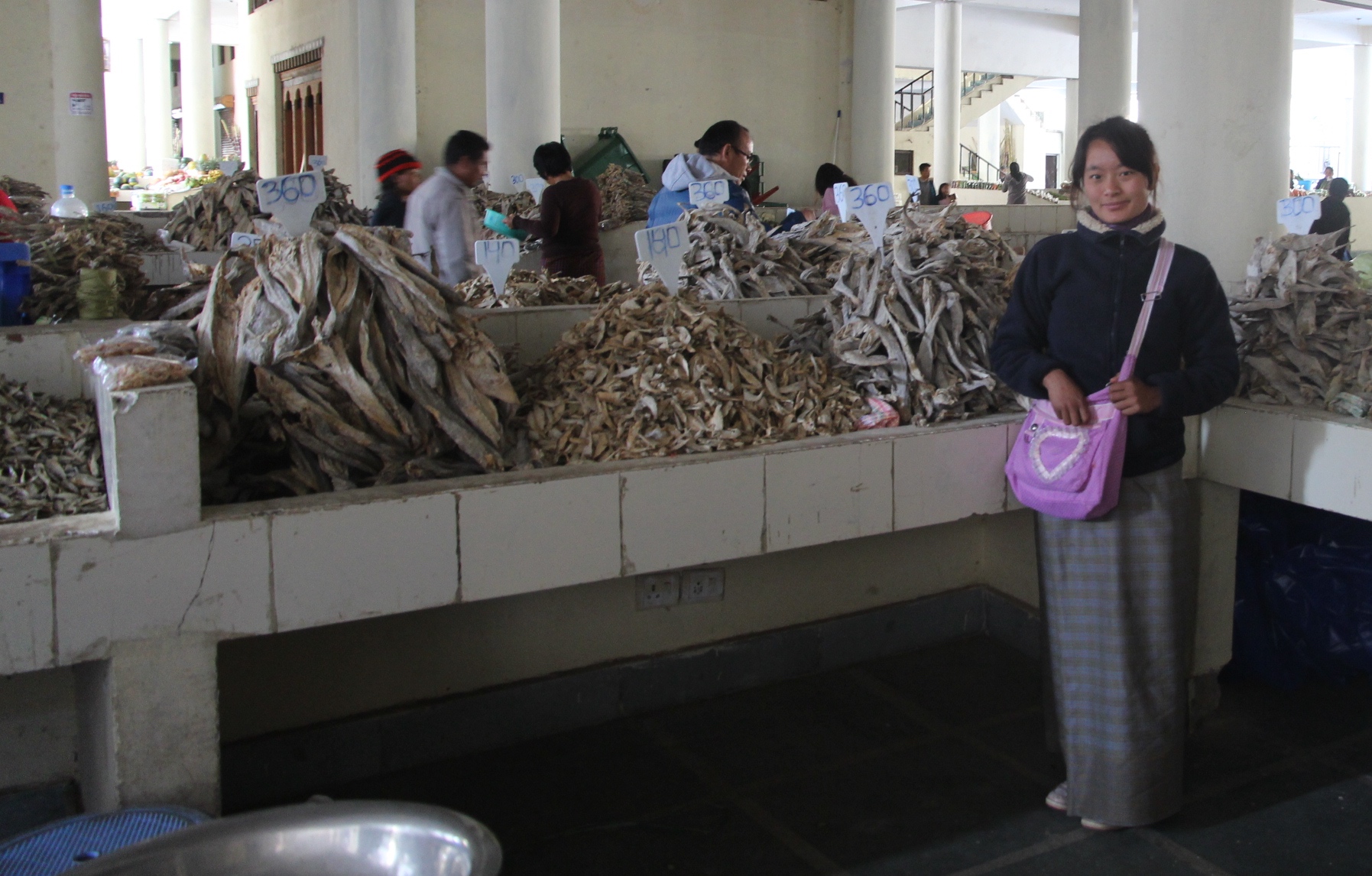
Selling dried fish


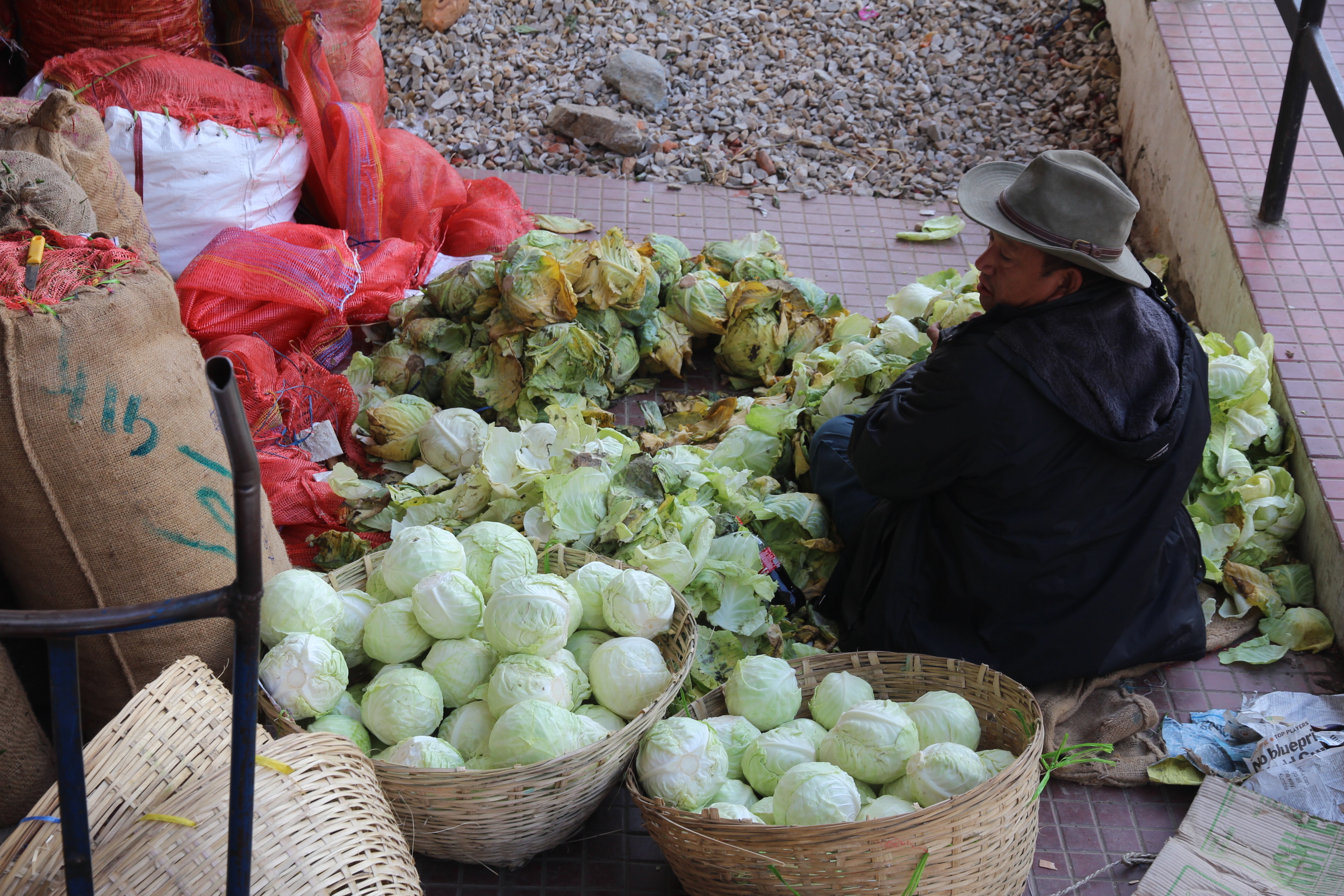
Preparing cabbages
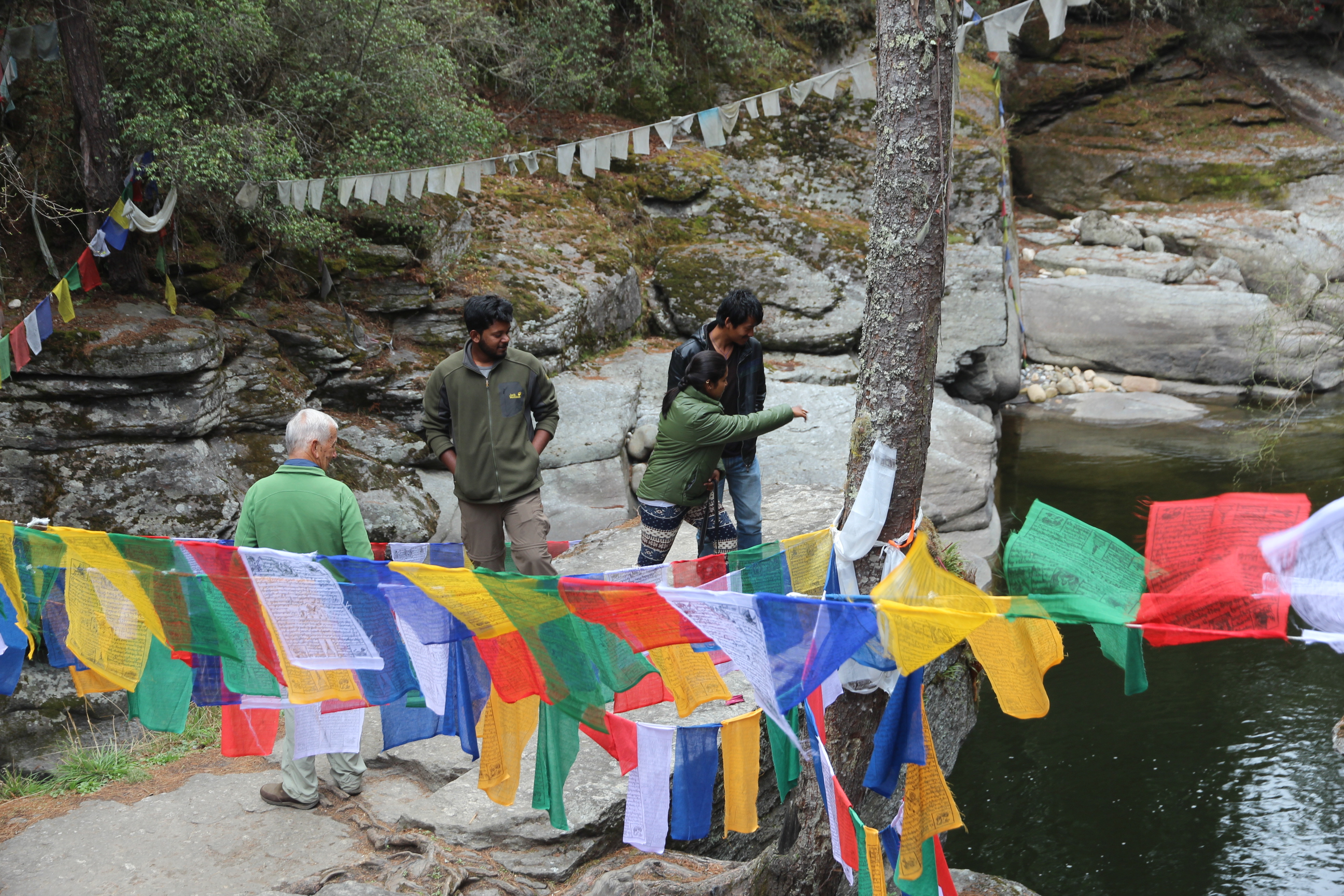
Poor John, Anand, Deepti and Tek see where Pema Lingpa jumped into the Burning Lake
From the time we arrived in Bhutan, our guide, Tek, talked about having us visit the Burning Lake—a very sacred site.
While this remote destination is plenty watery, it is neither burning or a lake—it’s a widening in a river. Nevertheless, it is an important part of Bhutanese legend.
In the later 1400s, a Buddhist saint named Terton Pema Lingpa told villagers of his vision that a guru had hidden sacred treasures in their nearby ‘lake’.
Not surprisingly, the locals weren’t convinced and the local governor was especially suspicious. He assembled a large group of people to watch Pema Lingpa retrieve the treasures.

Prayer flags decorate a bridge across the river/lake
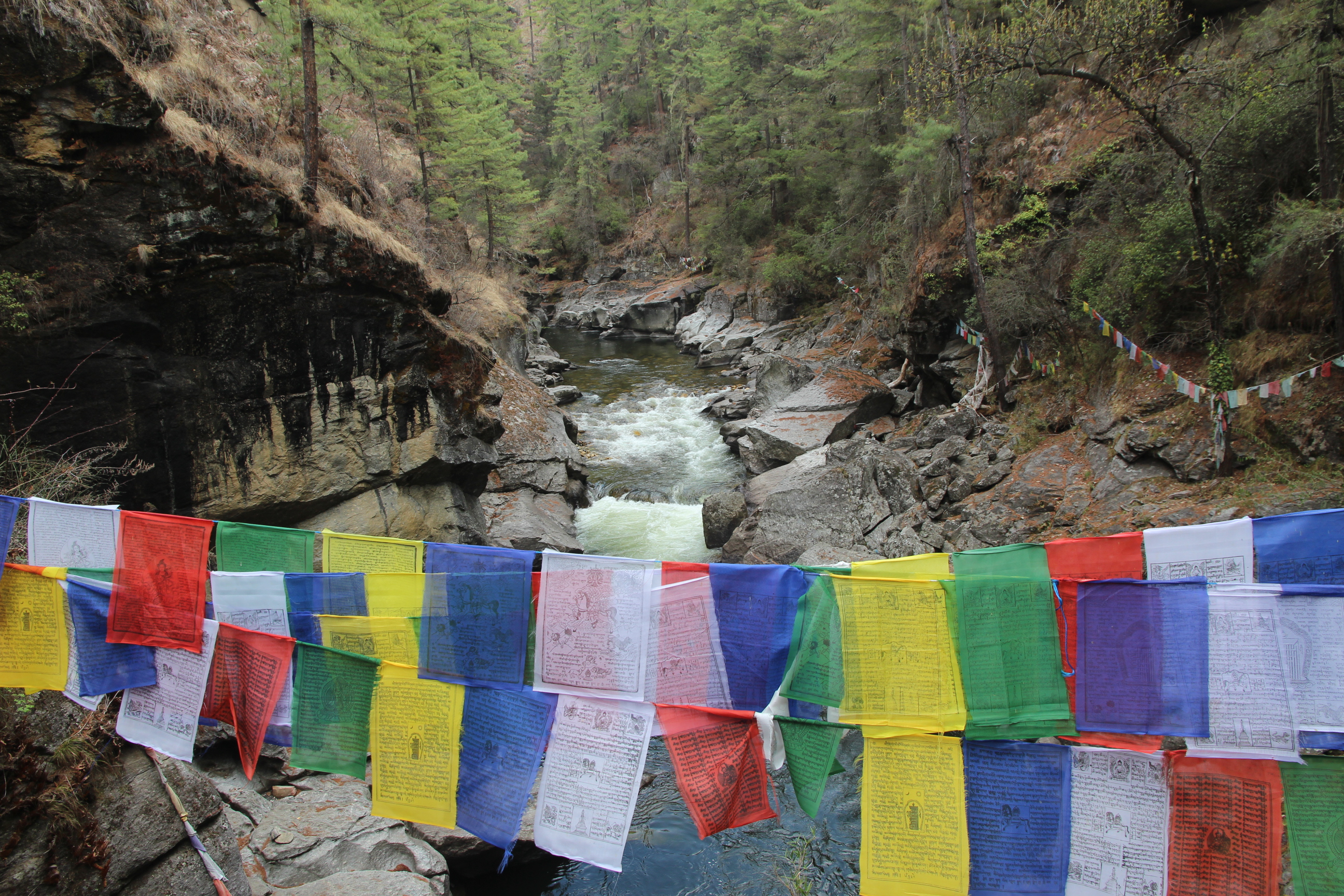
The river flows towards the Burning Lake
The governor told Pema Lingpa that if he successfully got a treasure, he would support him. If he failed, he would punish him for disrupting his district.
Pema LIngpa is said to have grabbed a burning butter lamp and proclaimed, If I am genuine, let me bring back the treasure with this lamp still burning. If I am a fraud, let me die in the waters below.
Obviously, he popped up with the goods or he and the lake wouldn’t be famous.
The story goes that after quite some time, Pema Lingpa resurfaced with the still-lit butter lamp, as well as a small box crafted of joined skulls and a small sculpture.
According to tradition, this miraculous occurrence caused all those present to become followers and patrons of Pema Lingpa. The event also gave the lake its name of Mebar Tsho, or the Burning Lake.
The path down to the ‘lake’ is festooned with brilliantly coloured prayer flags, other devotional items and a small altar dedicated to Pema Lingpa.


Pilgrims are still drawn to the site and on auspicious days they will offer butter lamps at the water’s edge. According to Tek, the guru who is currently resident at the Burning Lake is a great character. He’s in his final year of a stint that will last three years, three months and three days.
The guru was coming down to ‘do his job’ as we were leaving and he stopped to speak to Anand, who was our driver for this journey. He was full of gorgeous smiles and hearty hellos, and offered to show Anand the way to enlightenment. Anand graciously declined, explaining that he was Hindu. I wasn’t quick enough to get a photo of them together, but I did get a pic of the guru descending to his ‘workplace’.

A guru on his way to work
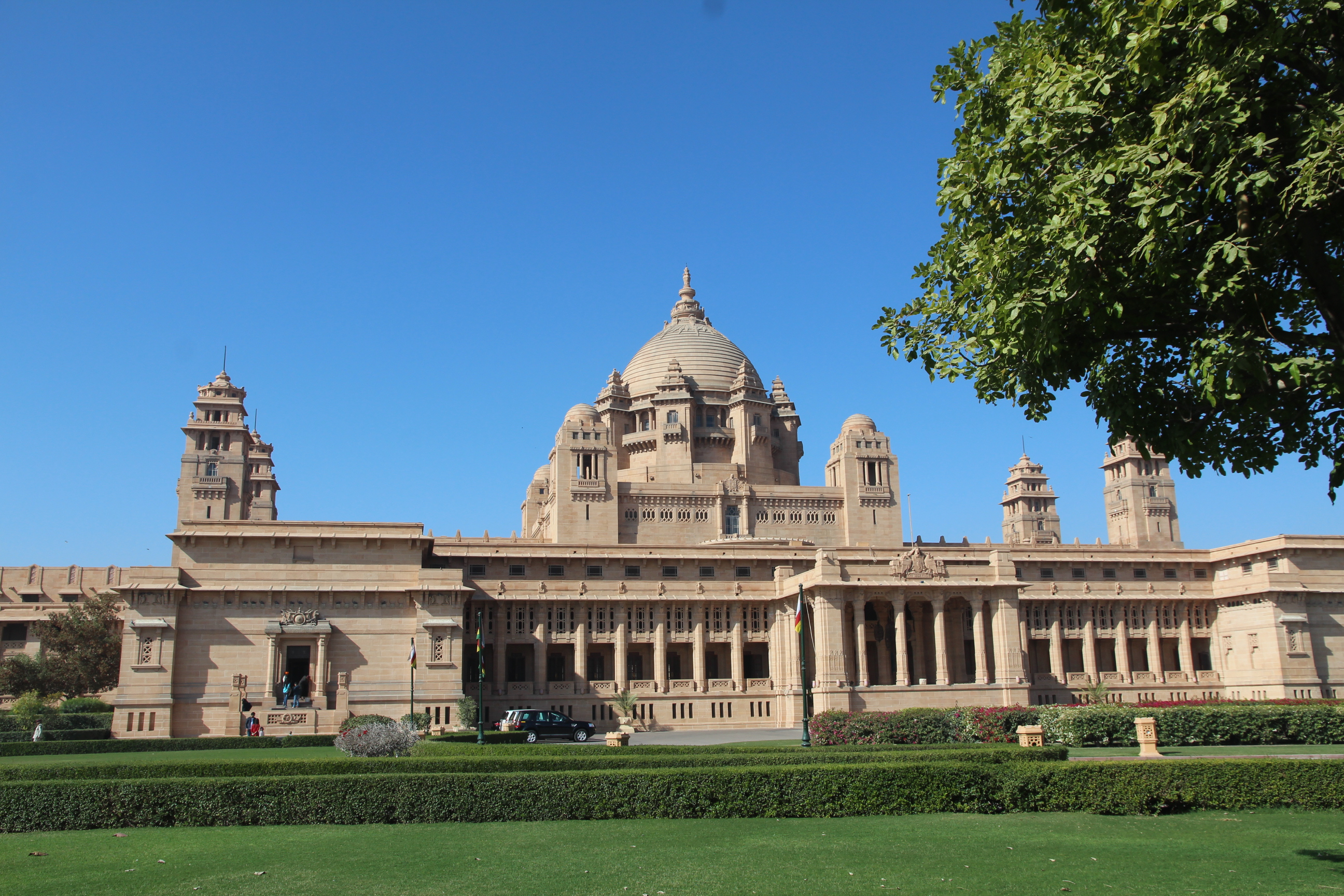

Recently I posted our visit to Jodphur’s spectacular Mehrangarh Fort, and now it’s time to check out the city’s other jewel—the Umaid Bhawan Palace.
Poor John and I are equal-opportunity tourists so we spent half a day at the fort and the other half at the palace. Confession—a half-day at the palace was enough but we should have spent a day at the fort.
That said, the palace, like the fort, is breathtaking and important in Indian history.
In 1923, His Royal Highness Maharaja Umaid Singh Ji (grandfather of Jodhpur’s current Maharaja) commissioned the building of this enormous palace. It was going to be his 347-room residence, but it was also his way of providing employment for his people during a lengthy period of droughts and famines.


The employment plan worked a treat. Along with several other community projects, it kept 3000 labourers busy for 15 years—from 1928 to 1943. I wonder if it took so long because they used an interlocking system that required no mortar.
Interestingly, the structure was originally known as Chittar Palace, after the local yellow-gold sandstone used in its construction. But ultimately, the art-deco structure was renamed after its instigator. That said, I don’t know how the word Bhawan fits into the name.
Today the palace has three roles—it’s part museum, part residence for Jodhpur’s current royal family, and part luxurious hotel for tourists. I’ve read that rooms go for about $500 a night. Yikes!
Obviously Poor John and I didn’t stay there. We stayed in the Zostel Hostel. That’s where our travelling companion, Gary, had his hiking boots stolen in the first 15 minutes we were there. Traveller’s tip: Don’t leave your shoes in the hallway outside a hostel—even if a sign tells you to do so. Take them off, pick them up, take them inside with you and put them in your locker.


But back to the palace, which was designed by Henry Vaughan Lanchester, a renowned Edwardian architect. His designs combined eastern, western and art deco influences.
There’s a sad story about the original furniture and fittings. They were of an art deco design by Maples of London, but were lost in 1942 when the ship carrying them was sunk by the Germans.
Luckily, artist Stephan Norblin came to the rescue. A Polish refugee, Norblin was an accomplished artist, an amateur interior designer and familiar with art deco styles. Sadly, almost all of his palace work (especially some elaborate murals) appears in areas that are not for public viewing. I saw some photos of them and was sorry we couldn’t see them in person.


But two museum collections caught my eye—a whole lot of ancient clocks, and porcelain washbowl and pitcher sets.
Oh and there was a collection of old cars that were impossible to photograph. The best I could do was get a reflection of the palace/hotel on the front of one of the cars.
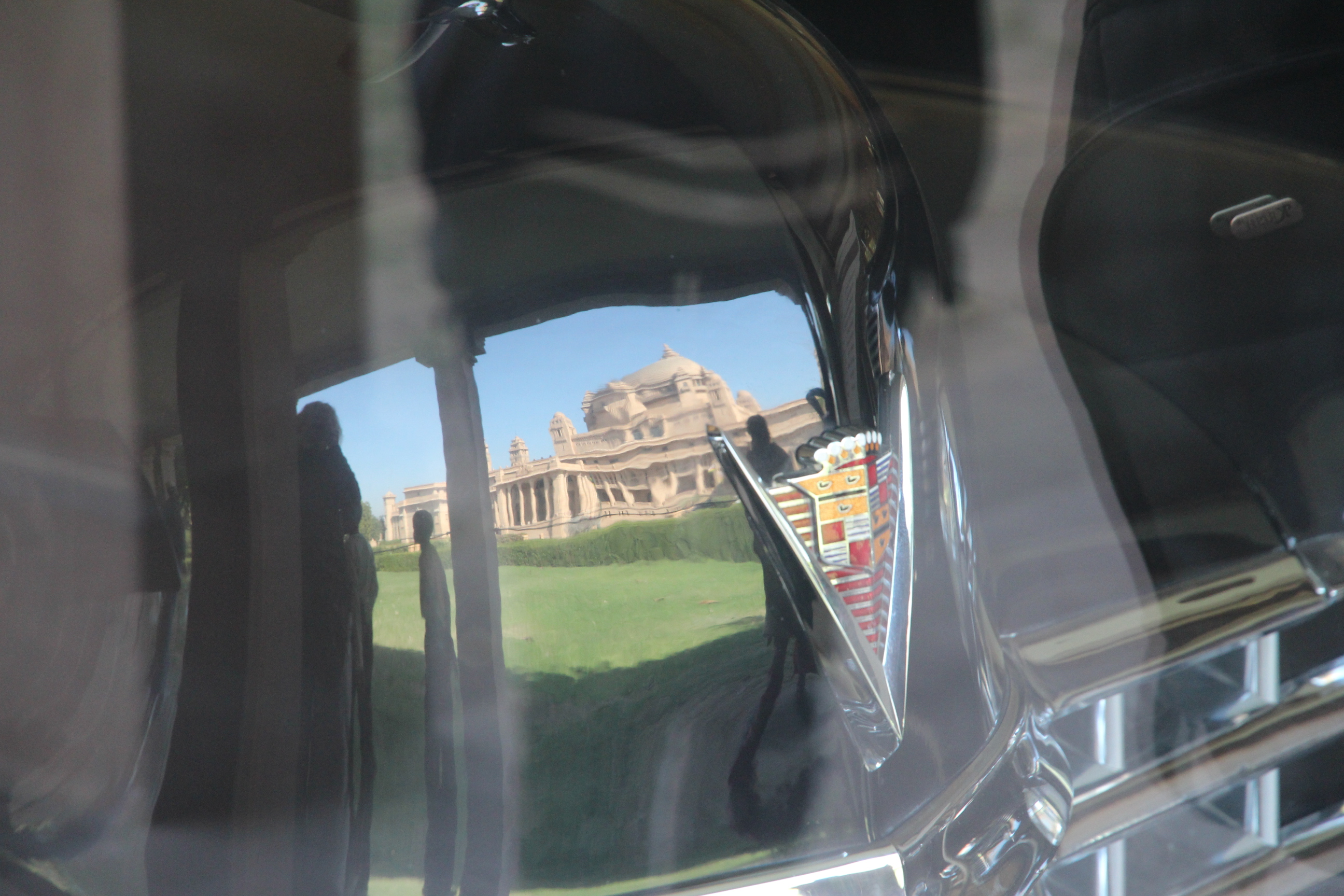
The palace reflected in a museum Cadillac

Mehrangarh Fort wall

Mehrangarh Fort
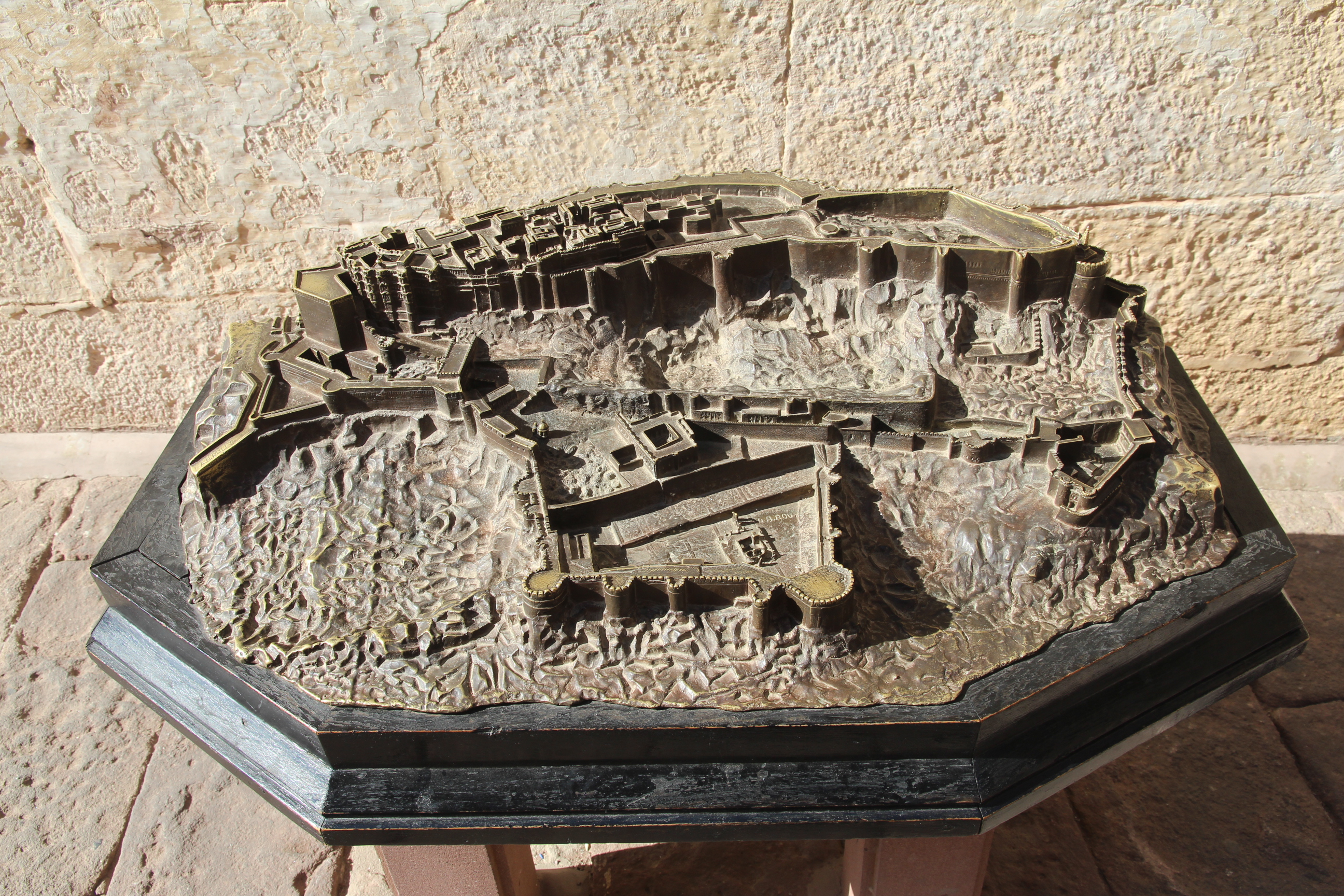
Model of Mehrangarh Fort
It’s so massive that Rudyard Kipling called it the ‘work of giants’ and it’s easy to see why. Mehrangarh Fort in India’s Rajasthan spreads more than 81,000 square metres across a 400-foot perpendicular cliff that overlooks the city of Jodhpur.
The dimensions are so huge that even though it is officially called a fort, Mehrangarh is sometimes described as the second largest castle in the world.
It has seven entry gates and walls that are 36 metres high and 21 metres wide.


I was gobsmacked to look up at it as we approached and even more overwhelmed to actually go through it. We spent a whole afternoon and could easily have spent a whole day.
Mehrangarh was started in 1459 when the city’s founder, Rao Jodha, moved his capital from Mandore to Jodhpur, but most of today’s fort dates from the 17th century.
Most of the fort’s seven gates were built to mark victories in various battles.

A cannonball scarred fort wall
One still shows scars from cannonballs fired in 1808. That was when the maharaja of Jaipur had his army attack Jodhpur. The city was under siege and the fort was surrounded by the enemy. A plaque recounts the battle saying, ‘A tough fight took place where numerous heroes layed down their lives on both the sides. The Jodhpur forces fought gallantly and the Jaipur army ultimately fled.’
To commemorate this victory, Jodhpur’s Maharaja Man Singh Ji built the first entrance jaipol (victory gate) and added a new fort wall in front of the cannonball scarred one.
Another gateway has handprints from ranis (queens) who burned themselves to death on the funeral pyre of their husband, Maharajah Man Singh. Yep, one guy with many wives.

Phool Mahal, the flower palace


There are several beautifully crafted and decorated palaces, including Moti Mahal (the Pearl Palace), Phool Mahal (the Flower Palace), Sheesha Mahal (the Mirror Palace), Sileh Khana and Daulat Khana (a gallery of fine and applied arts). These are true showpieces featuring mirrors, intricate paintings, stained glass, portraits, furniture and more.
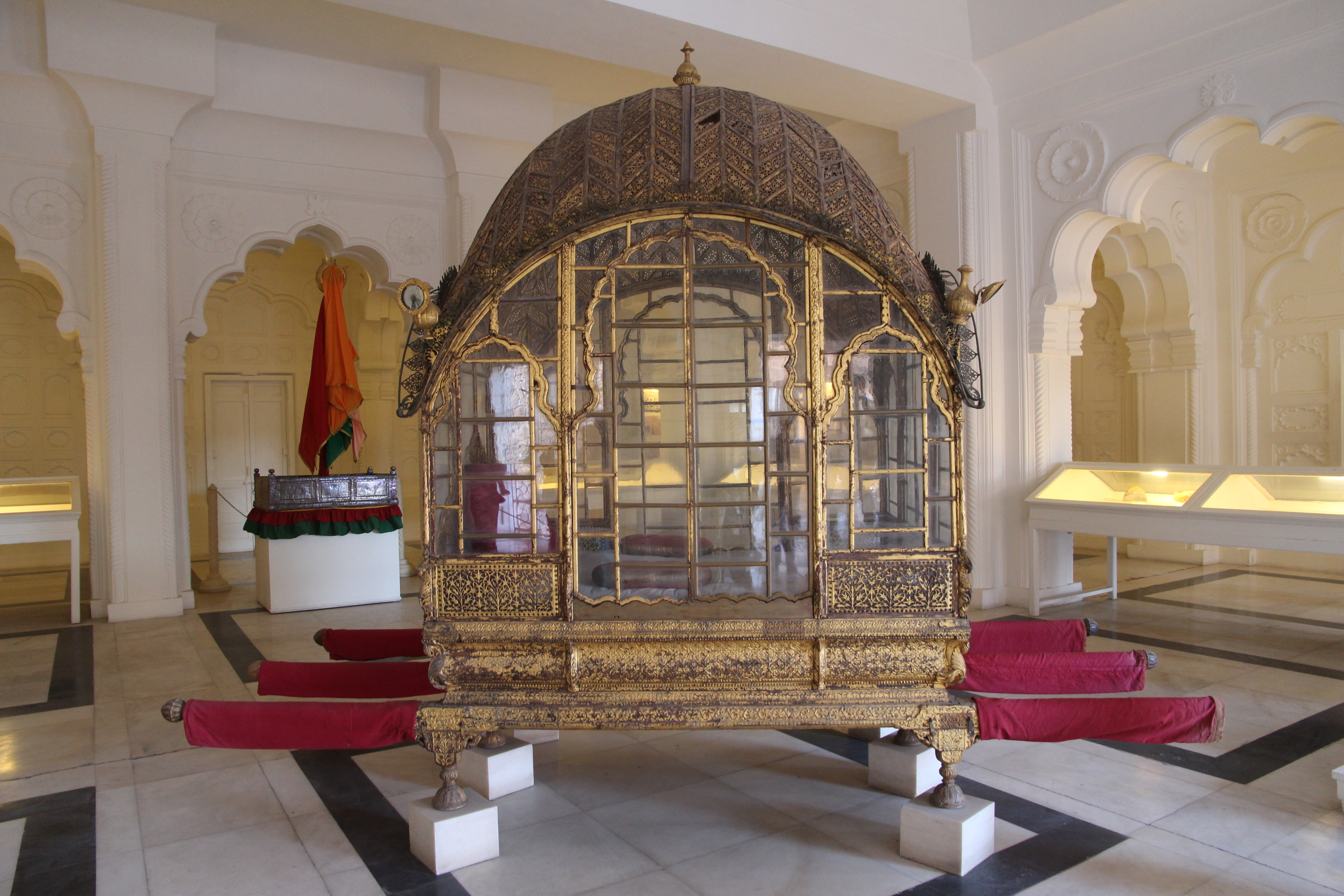
Ornate palanquin


The museum rooms of the fort have collections of palanquins (for carrying noble women and occasionally noble men), howdahs (seats for riding elephants), royal cradles, miniatures, musical instruments, costumes and furniture. There’s even a turban gallery, which we managed to miss, but we did see a demonstration of a turban being wound onto a fellow’s head.

The fort’s ramparts provide an amazing view of the city and interesting overviews of the fort itself. There’s also Kilkala, a preserved old cannon.

View from Mehrangarh Fort’s ramparts

View of Jodhpur from the fort
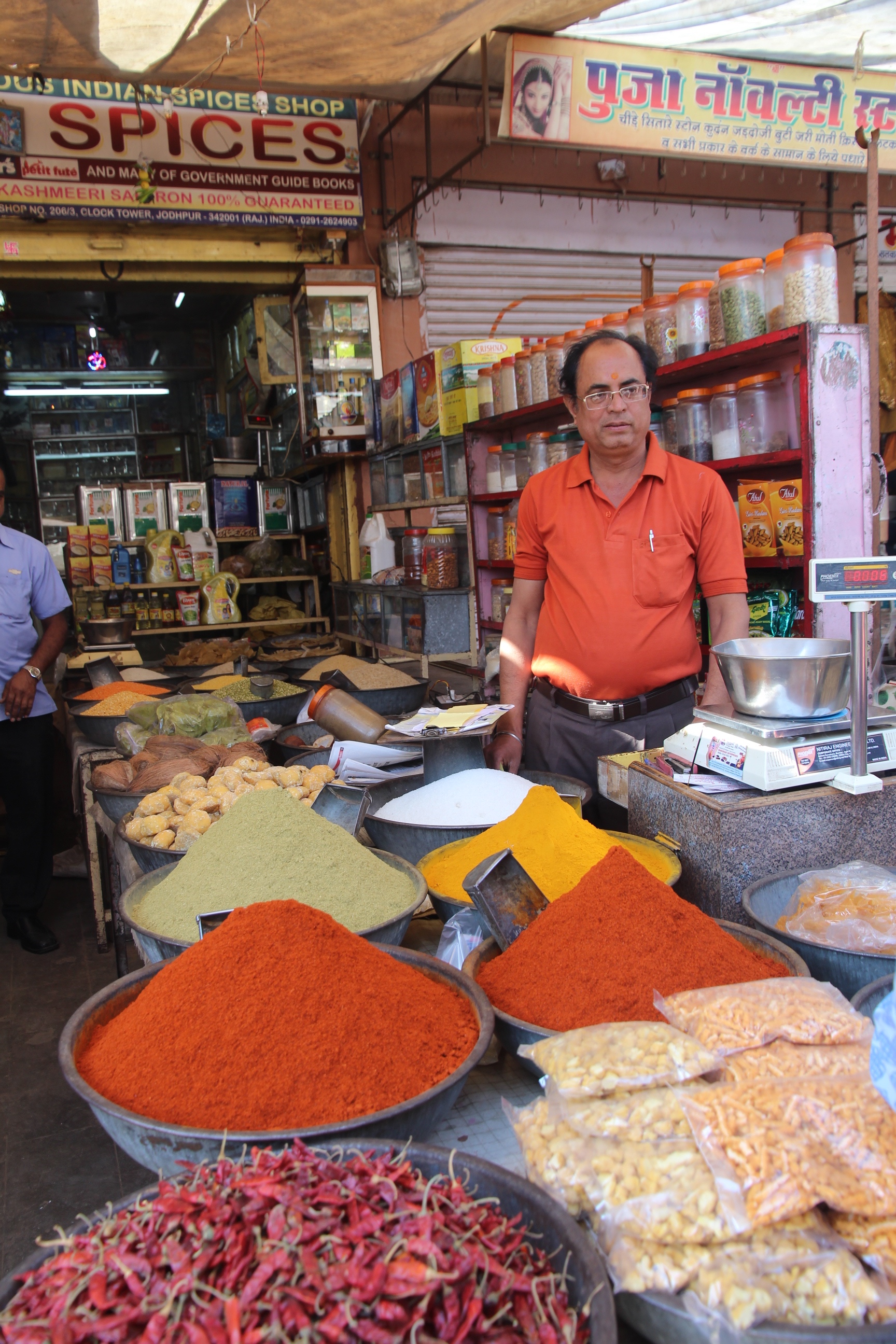
If spice is your thing, India is a great place to shop. Saffron is a good buy. This place is called M.M. Spices.
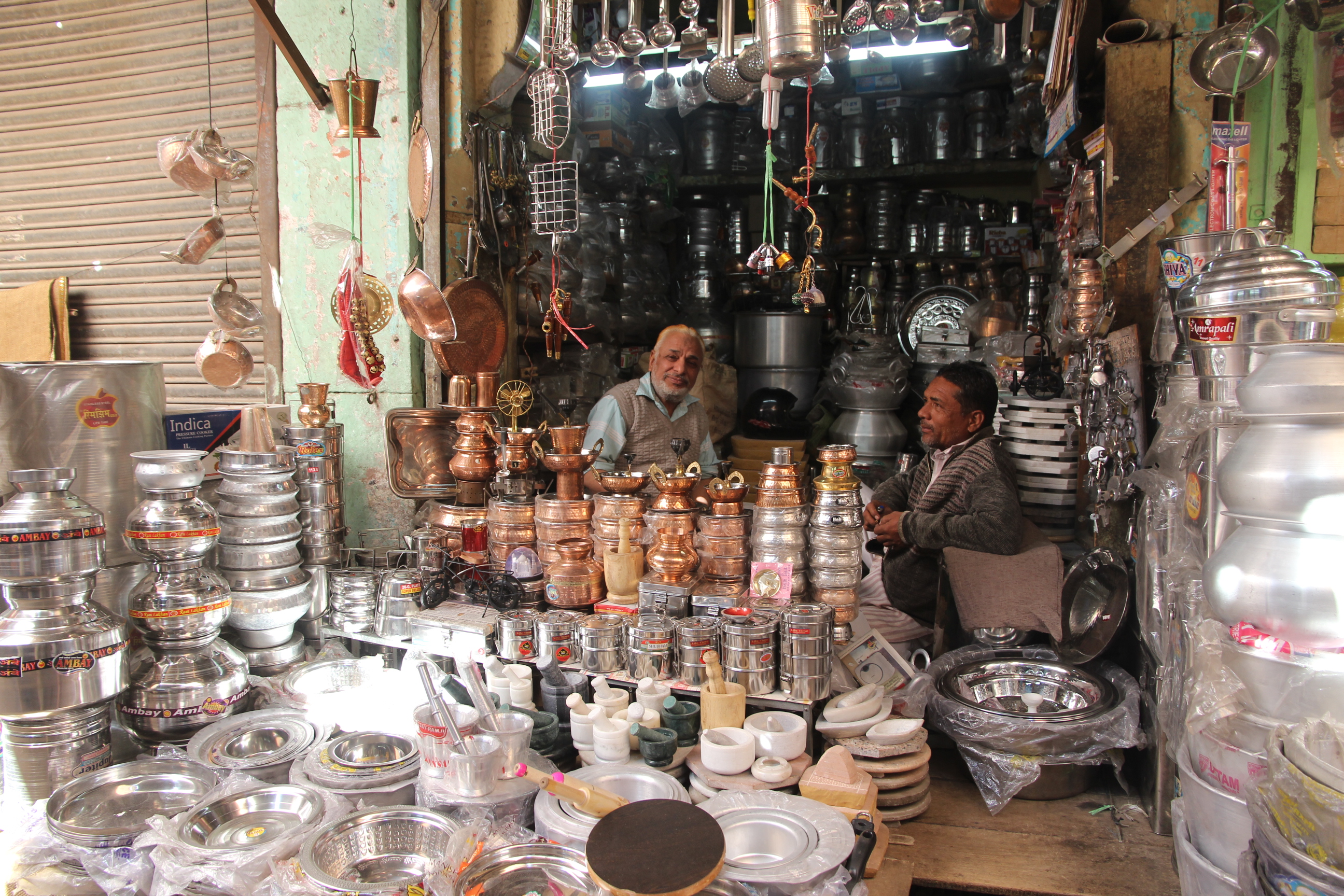
I bought my copper dishes here at the fairest price I got anywhere in India
Jodhpur is famous for its Mehrangarh Fort, one of India’s largest. I promise to get the fort soon enough, but today I want to share the wonder of one of Jodhpur’s amazing markets.
Poor John and I spent almost half a day in the city’s main market. After all that, I’m pleased to report that we managed to get out with just one purchase—a set of gorgeous copper dishes for serving curries—I cook a lot of Indian food.
This sort of restrained buying makes me smug. It also means that at the end of the trip, I’ll still able to lift my backpack.
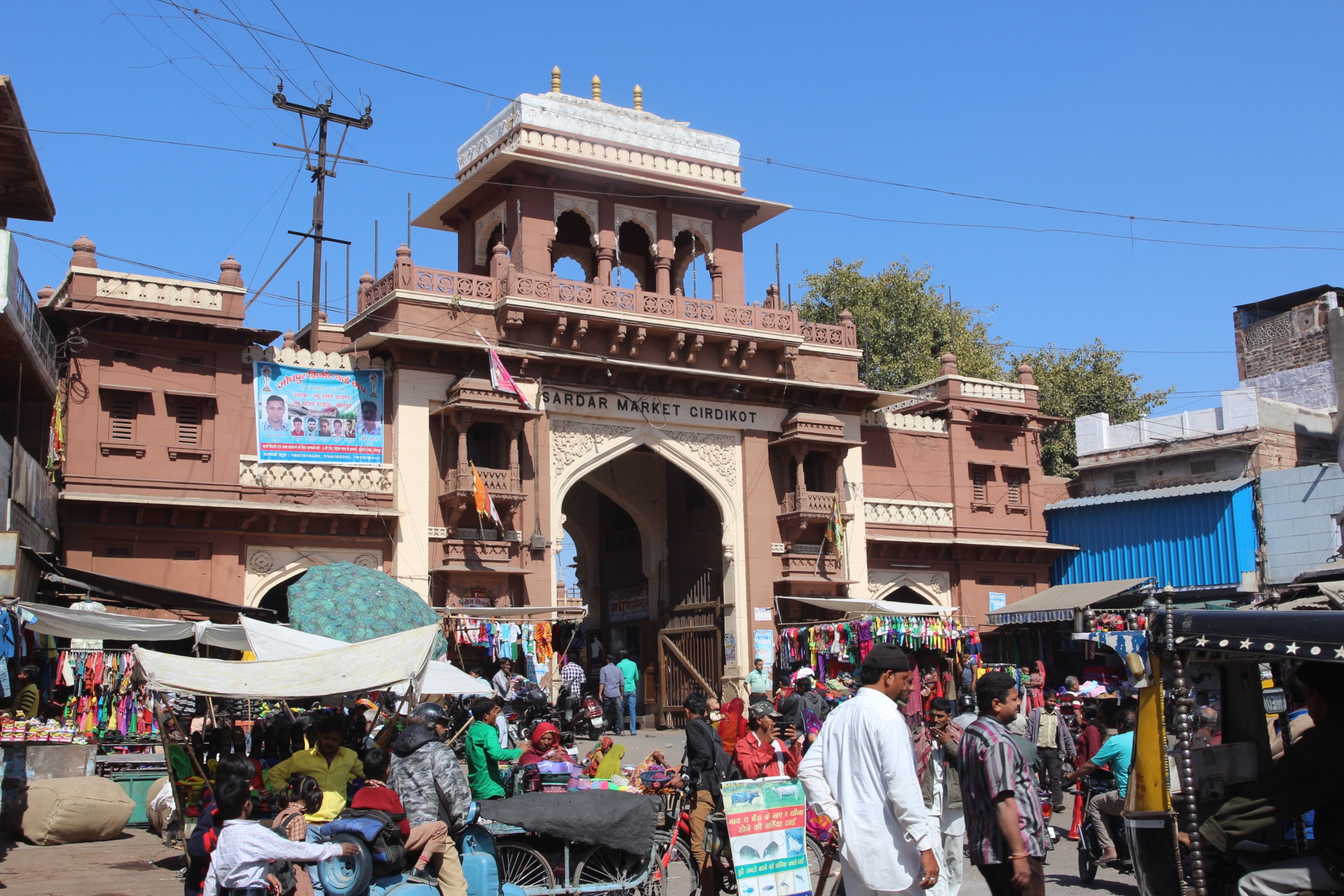
Jodhpur’s main market
Jodhpur’s markets are overwhelming for their crowds, noise, bustle, colour, variety and choice. When it comes to choice, every Indian market is a long way from a western supermarket.
You won’t be able to choose from 30 kinds of breakfast cereal , but you will be able to bulk-buy 30 kinds of dried spices. You’ll find jerry cans galore and fabrics in every colour you can imagine. The fruits and vegetables will be the freshest you’ll ever get, and there might even be a few you’ve never seen before.


You can buy a steel wool scraper, a bracelet, a single clothespin (peg) or get a bicycle repaired, but it’s a lot easier if you know the local word for what you want or if you can sketch it.
A quick sketch has helped me to buy clothespins all over the world.
Today I can bring you pictures of Jodhpur’s main market, but I can’t sketch in the sounds and smells.

Saris, fabric and scarves—colours in abundance


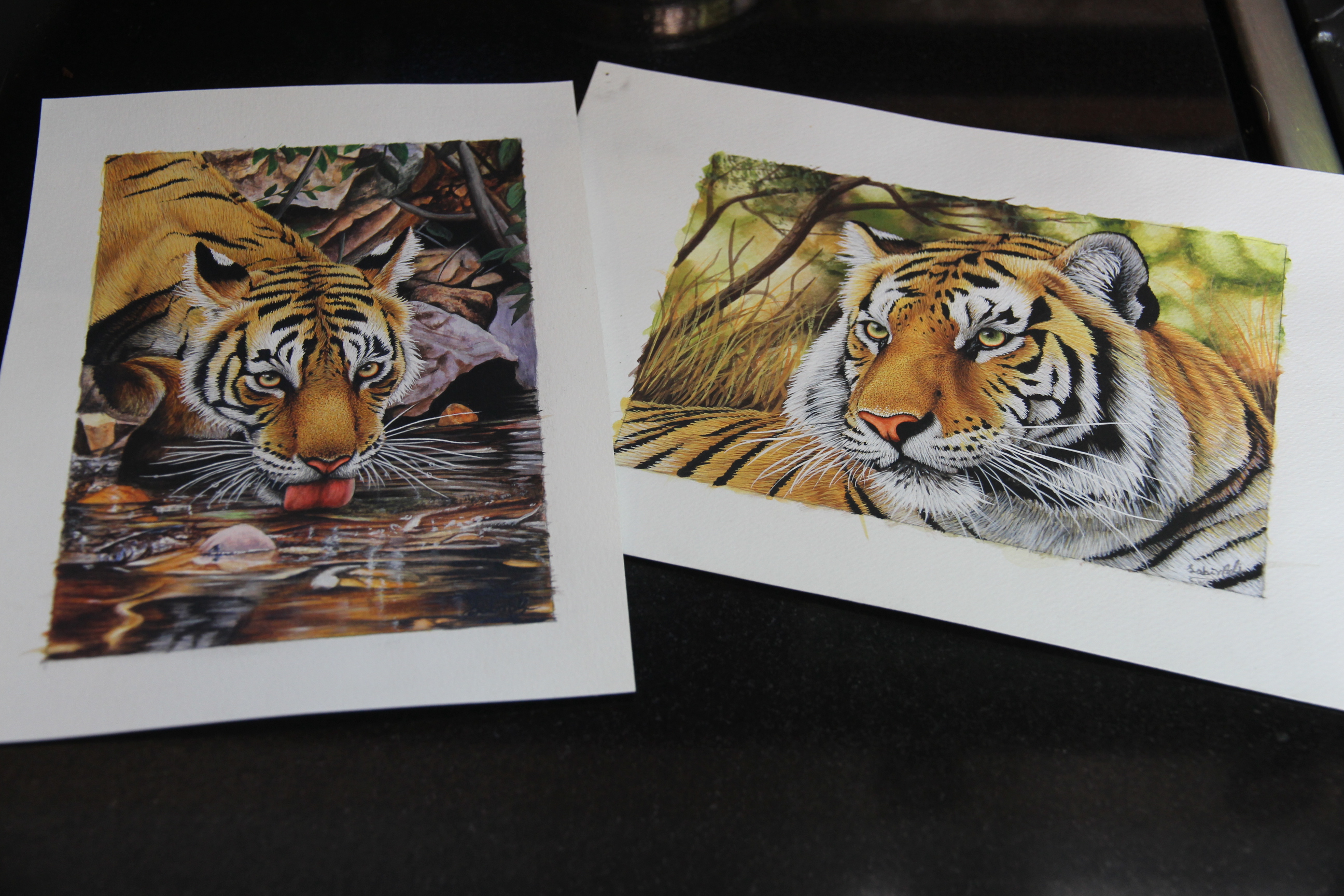
Watercolours by Banvari Sharma—I bought these two
Our house and garden overflow with art, and most of it has been purchased on our travels.
We’ve found wonderful paintings in Burma, Thailand, Ethiopia, Papua New Guinea, Australia, Egypt, Mexico, the UK, the USA and more.
We’ve lugged home amazing textiles, ceramics, sculptures and carvings from those places, as well as Turkey, Germany, France, Italy, Bolivia, India, Kenya, Sri Lanka, Brazil, Greece, Lebanon, Palestine, Mali, Iran, Russia and Uzbekistan. I wonder which place I forgot?
A few years back, airport security in Colombo was concerned about a black, roundish lump in one of our carry-on bags until we showed them it was a plump elephant carved in ebony.
Most of our purchases haven’t been too hard on our wallets. Physical labor is under-valued in most of these countries, so we’ve often paid for supplies but almost never enough for time. I always feel bad about that, and have a personal policy of not over-bargaining for art. You might remember the mask I wished I’d bought in Papua New Guinea. That artist should have received much more for his magnificent piece.
These days we try to restrain ourselves, but we did buy a few pieces in India. Luckily, they weren’t for us, but for our daughters. Our house is already too full and I’m still trying to off load some pieces to the girls. These pieces went straight to them. Just like that amazing skirt I bought for Libby in Peru.
The tiger watercolours we bought were painted by artist, Banvari Sharma. We first met Banvari in 2013, and then again this year. We were pleased to see that he now has a shop/studio/gallery where he displays his art as well as pieces by other aspiring artists.

The new gallery with Banvari, Anand and Deepti
The gallery is on the right just before you go in the park’s main gate. Drop in if you ever get to Pench. Prices are reasonable and quality and creativity are excellent. And Pench is where we saw tigers very close up.
Stay tuned for a post on how and why I bought a magnificent piece of Bhutanese weaving last month. And let me know if you’d like me to give you a tour of the other art in our house.
And be sure to check out what’s cooking on page 32.


The shop owner adds labels to the jars
Pickles of all kinds are at the top of my food chain, and I’m happy to eat ’em, cook ’em, make ’em, mix ’em, steal ’em, promote ’em.
One of my favourite sandwiches—I have no idea how, when or where I learned this recipe—is good bread with thinly-sliced dill pickles and a generous spread of peanut butter. Go on, try it. You might love it as much as Poor John and I do.
Poor John used to tease me about this unusual combo until the day I sent him off to work with that exact mix in his lunchbox. That was when I was still making his lunch (a service that didn’t last much longer).
He came home raving about how delicious it was. Duh, he could have believed me from the outset, but I had to prove it sneakily.
So you can imagine how thrilled I was to discover Pickle Heaven (not its real name) in Kalimpong, West Bengal, India. This was serious pickle-dom, and the woman who runs the place makes all—well almost all—the pickles herself.
All kinds of vegetables, chillies and meat are done up in various sizes of glass jars and plastic packaging, and all crammed into a narrow shop on Kalimpong’s main street.
Obviously, I wasn’t going to buy anything to take home. Glass and liquid aren’t good travelling companions, and Australia’s quarantine regulations prevent many foodstuffs from being brought into the country.
But I was determined to buy/try some. The owner graciously offered to open jars to let me try, but I had a better idea.
When India and Australia were facing off in the semifinals of the ICC Cricket World Cup. Anand and I promised to buy a present as a consolation prize for the loser. Not only did Australia beat India in that game, we won the entire competition. Sorry New Zealand, because we wouldn’t have minded if you’d won because it was the first time ever that New Zealand made it to the finals.
The whole cricket competition was over and I still owed Anand his present. How about I take you to Kalimpong’s pickle emporium and buy you five kinds of pickles—your pick?
He couldn’t believe there’d be five kinds of pickles he actually wanted, but then he walked into the place.
Anand may be Indian, but he’s not vegetarian. And there, on the shelves, he found jars and bags of goodies such as pickled beef, pickled chicken and pickled pork. Choosing his five ‘prizes’ was too easy and I bet he’ll shop there the next time he’s in Kalimpong.
If you’re a fan of pickles, chutneys and sambols, you might like the mint sambol recipe on my cooking blog.
On a sad note, Kalimpong is close to Nepal and the devastating earthquake that hit there earlier this week. Three people are confirmed dead in West Bengal and some buildings have collapsed. I can’t imagine the shelves of pickles fared well.

A wall of pickles
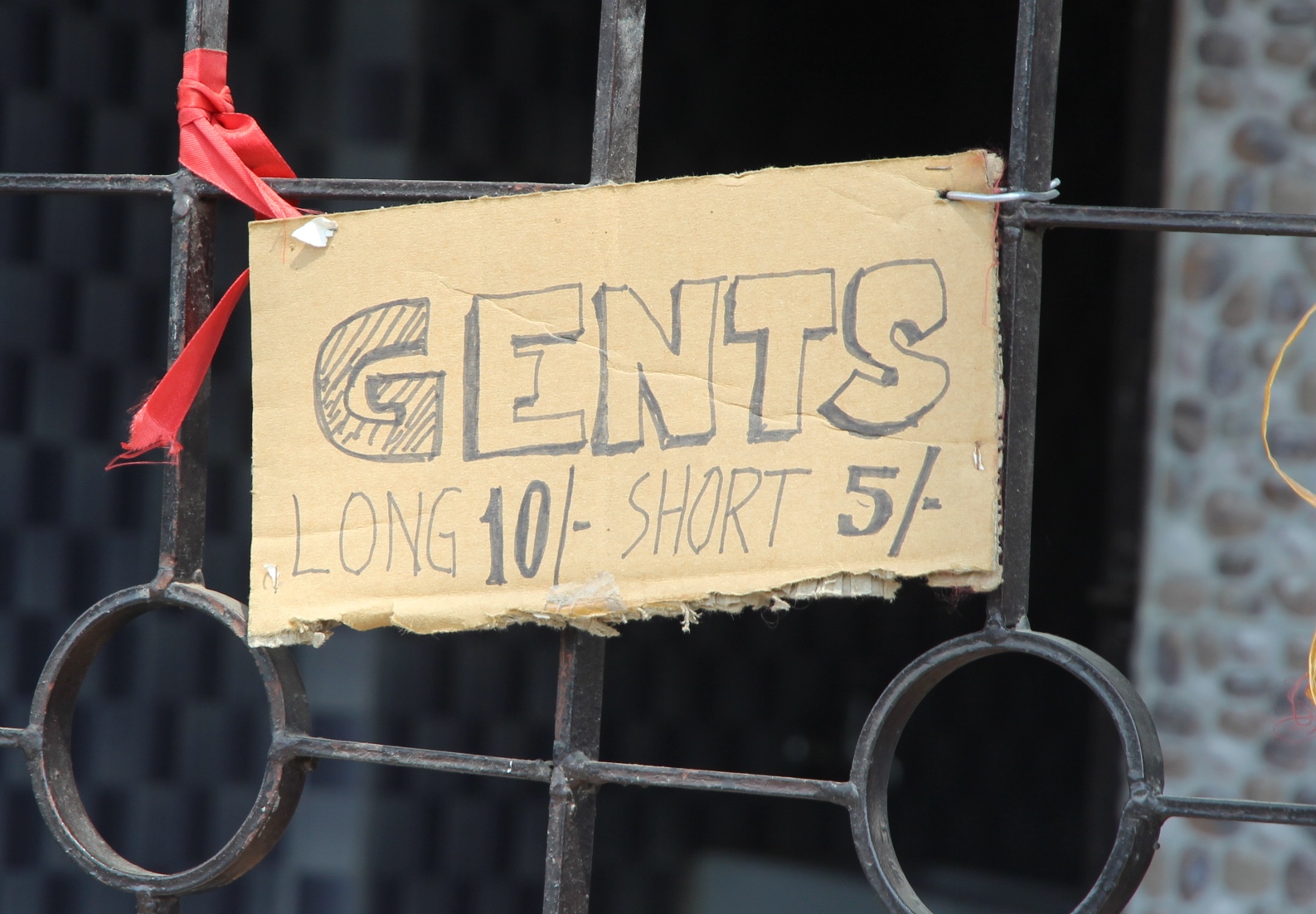
I wonder who decides?
The Mirik Sports Association runs the men’s toilet by the lake in the village of Mirik in West Bengal, India. I suppose they run the women’s too, but I couldn’t find it so can’t share any signage from it.
But the men’s sign says the price, in rupees, varies according to size. I’m still wondering whether the size—short versus long—refers to the time spent, the size of offering or the ‘equipment’.
A fellow traveller reckons he’d declare ‘long’ every time. Never mind the expense! What do you think?
P.S. Five rupees is about 10 Australian cents.
P.P.S. Don’t forget to stop by my cooking blog.

Two blue tents for sleeping and the toilet tent perched near the edge. See the dog waiting in the road below?
Bugs love me. In 1971, I landed in the Middle East for the first time and about two million mosquitos zeroed in on me singing out Dinner is served.
Generally, I do my utmost to avoid the biters and stingers. Bug repellent and I are good friends. So much so that my mother predicted that my adult perfume would be a scent called Eau de Bug Spray. And it’s true that I wear more Rid than I do perfume.
Our overland travels always present certain challenges for me. If there’s a risk of mozzies at night, I cover up with long sleeves and long trousers. I also carry multiple bottles of Rid, Australia’s tropical strength +antiseptic insect repellent, that I roll on daily.
I managed very well during our 10 weeks in India even though were we camping at least half the time. Got maybe one or two bites a week.
But my guard was down in Bhutan. Good grief, it was freezing. It’s supposedly spring here, but I’ve been wearing closed shoes, woolly socks, long pants, three layers of merino tops, a beanie, gloves and a puffy jacket. Some nights the temperature has dipped to 2–3°C (or 35–37°F).
Surely there aren’t any mozzies about. But I forgot about fleas.
Every single campsite (we aren’t in actual campgrounds) has been overrun with dogs.
Having been bitten in 1986 by a dog that later became rabid, I have a personal travelling policy of not touching dogs I don’t know. Never mind how much I love dogs, I still remember the series of injections I needed back then.
So I have not honeyed up to these camp dogs. Nevertheless, they make themselves at home around the camp. All day they lie curled into tight balls, perking up when the dining tent shows some activity or as soon as the sun goes down.

Camp dogs sleeping off their night of barking. I assume the fleas are sleeping too
Nightfall brings on their barking frenzy. They race round and round our tents and weave back and forth across the campsite. Too late it dawned on me that their patrolling was also scattering fleas everywhere.
A swarm of those fleas found me. And based on where most of the bites are, it’s obvious that I was caught with my pants down, literally.
Our camps haven’t had a toilet, per se, but a toilet tent. That means a rectangular hole dug in the ground with a small tent set up over it. The dug-out soil is spread around the edge of the inside of the tent, so you can kick dirt over your ‘offering’. It’s functional, basic and your knees have to work.
The day of the flea attack, we were supposed to camp at a place called Chendipji, but the flat ground that was supposed to be used for camping had been taken over by a new stupa (those Buddhist monuments scattered all over Bhutan).
So the crew in the van carrying the main camping equipment had to drive on for many kilometres to find a place even remotely suitable for camping. Of course, after much searching they found a place that was ‘remotely suitable’ for camping.
The dining and kitchen tents were pitched beside the road. Our sleeping tents and the toilet tent were perched on a small cliff, which was home to a few dogs, and overlooked the other tents and a vast valley.
Poor John had pointed out some broken bits of glass on our cliff, and I had noticed that the toilet tent was rather close to the edge.
So about midnight when the bladder called, I opted for convenience and safety instead of stumbling toward the toilet tent. Around the back of my tent, I dropped my daks and had a quick pee, disturbing hundreds of ferocious fleas. They were quick, deadly and hungry.
Flea bites take forever to calm down, so six days later I’m still suffering. And I figured if I have to suffer, you can too, even if it is too much information.

Even cows drop by to check the toilet tent. Do they carry fleas too? The kitchen tent is in the right background. The hut in the middle is a shop (like a general store) and the building on the left is the shopkeeper’s house. We are camping (to the right and out of view) in an unplanted rice field
 Where to next?