
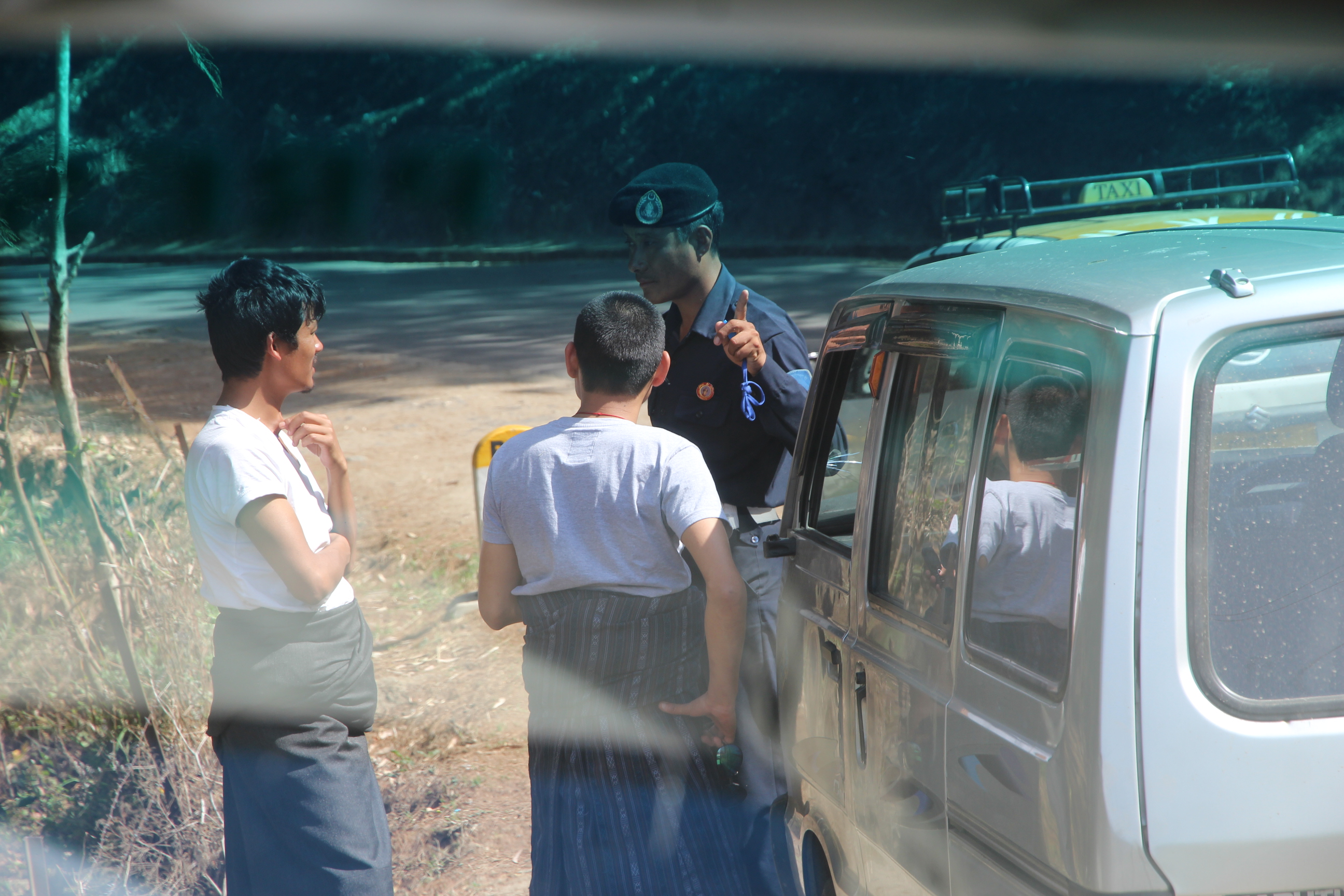
The policeman talks to Tek (our guide on left) and the offender. I decided NOT to get out of the van to take the pic
After travelling with Anand and Deepti for more than 15,000 kilometres across India and Bhutan, I suppose a prang was inevitable. Prang being the Aussie slang for a minor car accident.
Now before I go any further, I should say that Anand in a superb driver. He’s watchful, patient, polite and cautious (without being a fuddy-duddy). He observes the speed limit and other rules of the road, which is rare in India. In other words, both Poor John and I feel completely safe with him at the wheel.
That doesn’t get around the other nuts on the road.
While our particular prang was frustrating, the overall outcome was more than satisfying.
Here’s how it played out.
We were on our way to visit the temple/monastery of the Divine Madman (how appropriate) when some knucklehead decided to zoom past us. As he did, he sideswiped our van, startling us all and prompting Anand to pull to the side of the road.
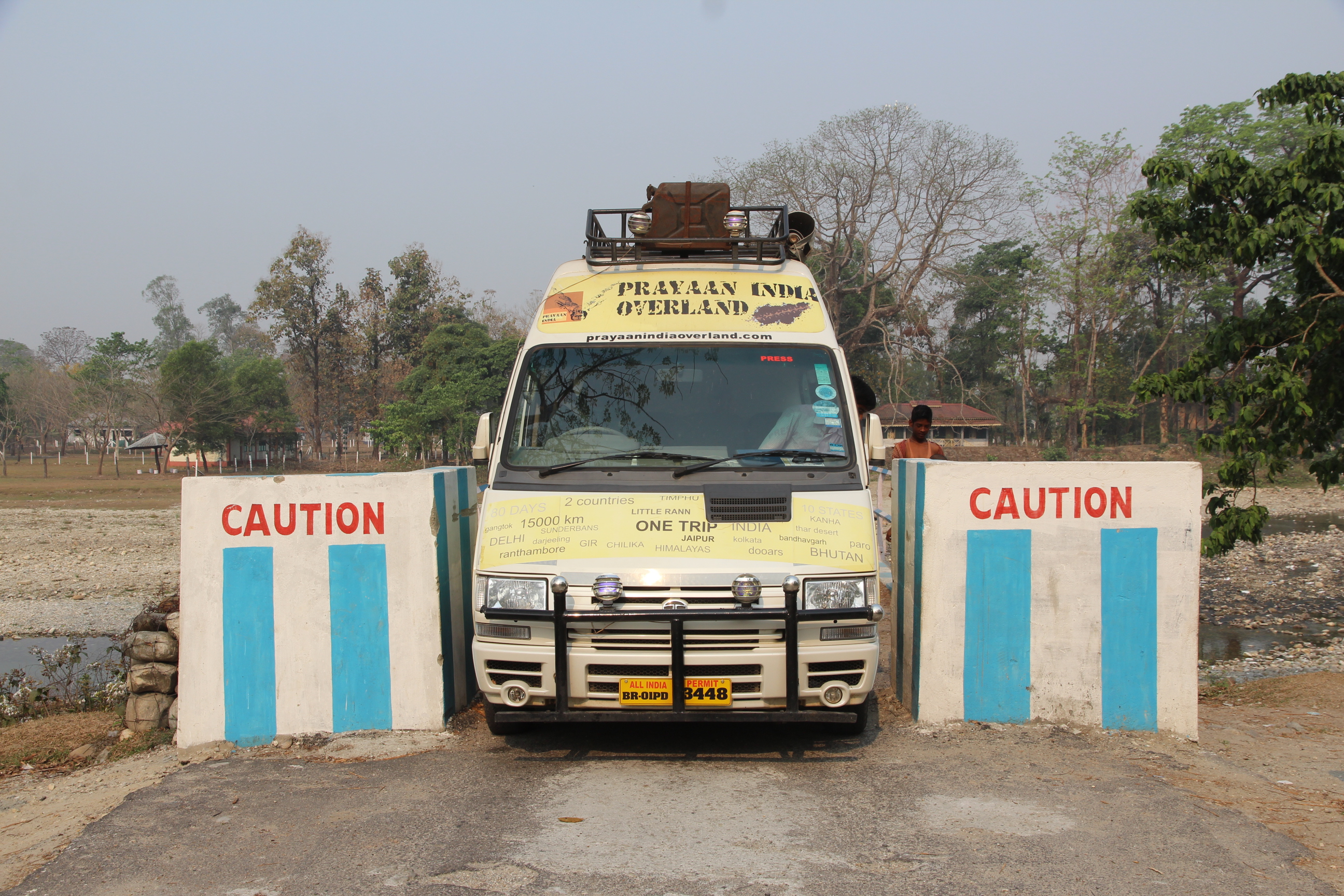
Anand proves he can get out of tight spots
The offender pulled over too and jumped out of his van to start a shouting match. He was the only one shouting, because Anand and Tek, our Bhutanese guide, kept their cool.
We couldn’t hear the conversation, so I’m guessing as to the exact words, but we got a full report when the fellows returned to our van.
Offender shouting and with arms waving: Hey mate, what do think you were doing? You weren’t even in your own lane.
Anand, calmly but firmly: I was in my own lane. You chose to pass where the road was too narrow and you didn’t even beep to ‘ask’ me to move over. Even if you had beeped, I couldn’t have moved over without hitting the guard rail. Surely you could see that.
Offender still behaving badly: Don’t give me that. You weren’t in your lane.
And then a taxi arrived and out stepped an off-duty policeman, in uniform.
Offender embarks on his rant again when the policeman interrupts: I saw the whole thing. You shouldn’t have passed when you did. There wasn’t enough room. This man, pointing to Anand, was completely legal. You were wrong.
Offender went purple. He wasn’t about to give up so easily and argued on. It soon became obvious why he was so insistent on transferring blame. He was driving someone else’s van and he was going to have to explain the accident and pay for the damage. If only he could shed responsibility.
The policeman said he was unable to press charges because he was off-duty, so if Anand wanted to claim insurance both drivers and both vehicles would have to go to the cop shop.
The offender had a huge scratch down the side of his van and the wing mirror had broken off, but he wasn’t keen to have the accident reported. After a thorough inspection of our van, Anand decided the damage wasn’t too bad, and much less than he feared. So he let to it go.
Besides, we had a more interesting Madman to visit. More about that fellow soon!

The total of our damage
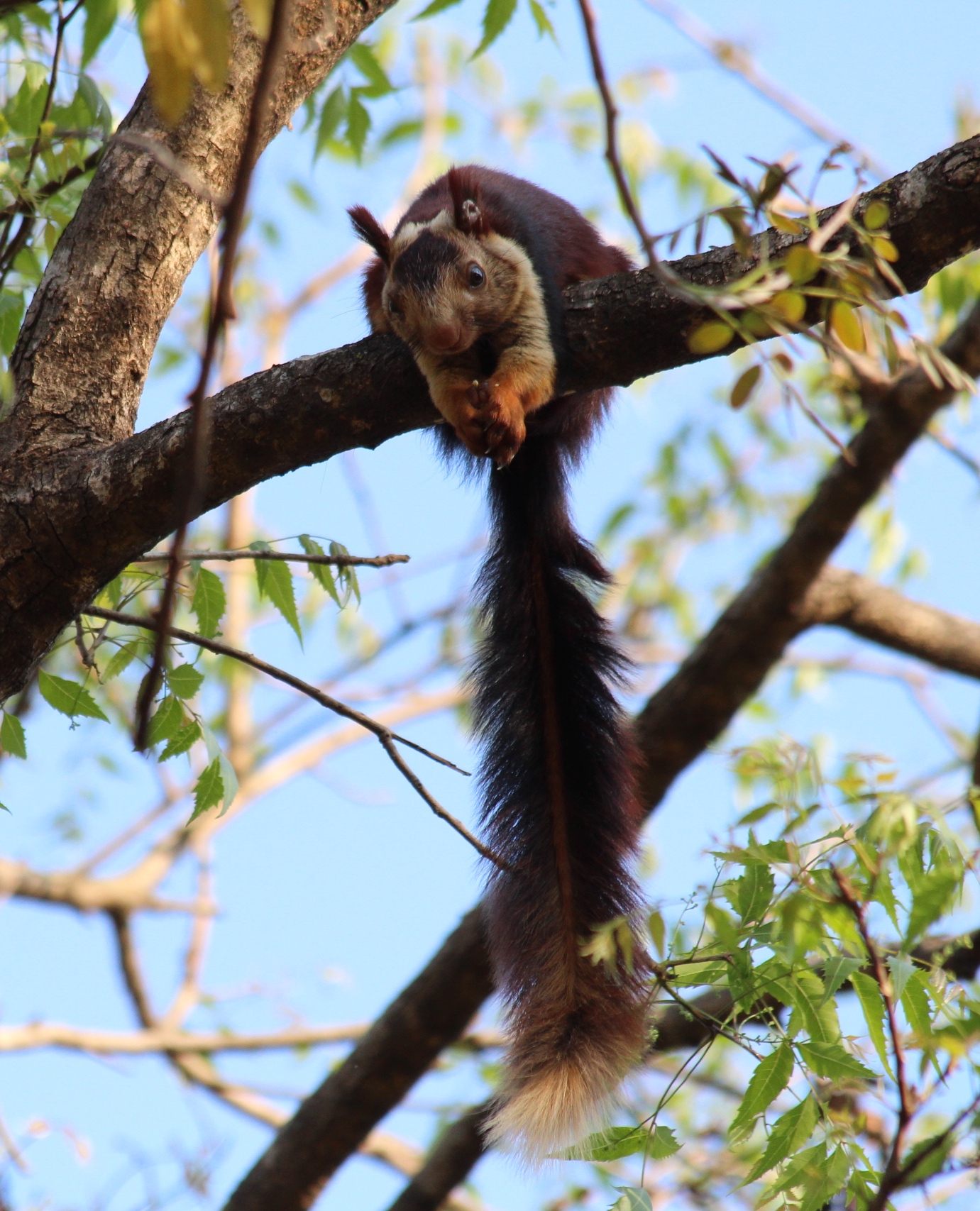
It’s a giant what?
After my recent post on some of our gastronomic delights in India, a faithful follower has asked me to avoid food posts in favour of posts on animals and people. Seems she overdid comfort eating (ice cream) to compensate for her lack of India food at home.
I didn’t actually agree to her request, but let’s take a side trip anyway to Satkosia Gorge Wildlife Sanctuary on the Mahanadi River in the eastern state of Orissa. It’s probably fitting because we were on our way to the gorge when we stopped in Angul for those remarkable paneer rolls I described in my ‘offending’ last post.
This sanctuary and the Baisipalli Wildlife Sanctuary make up the Satkosia Tiger Reserve. If the brochure is to be believed, the reserve is home to a ‘significant’ population of tigers. It also boasts leopards, elephants, spotted and barking deer, sambar, bison, wild dogs, sloth bears, jackals and porcupines.
We didn’t see any of them, which is not surprising when you read on to find that the 1000-square-kilometre reserve has 17 tigers.
This is when you have to remind yourself that the national parks and reserves of India are NOT zoos. There’s never any guarantee that you will see anything.
So we did laundry instead—lots of it.
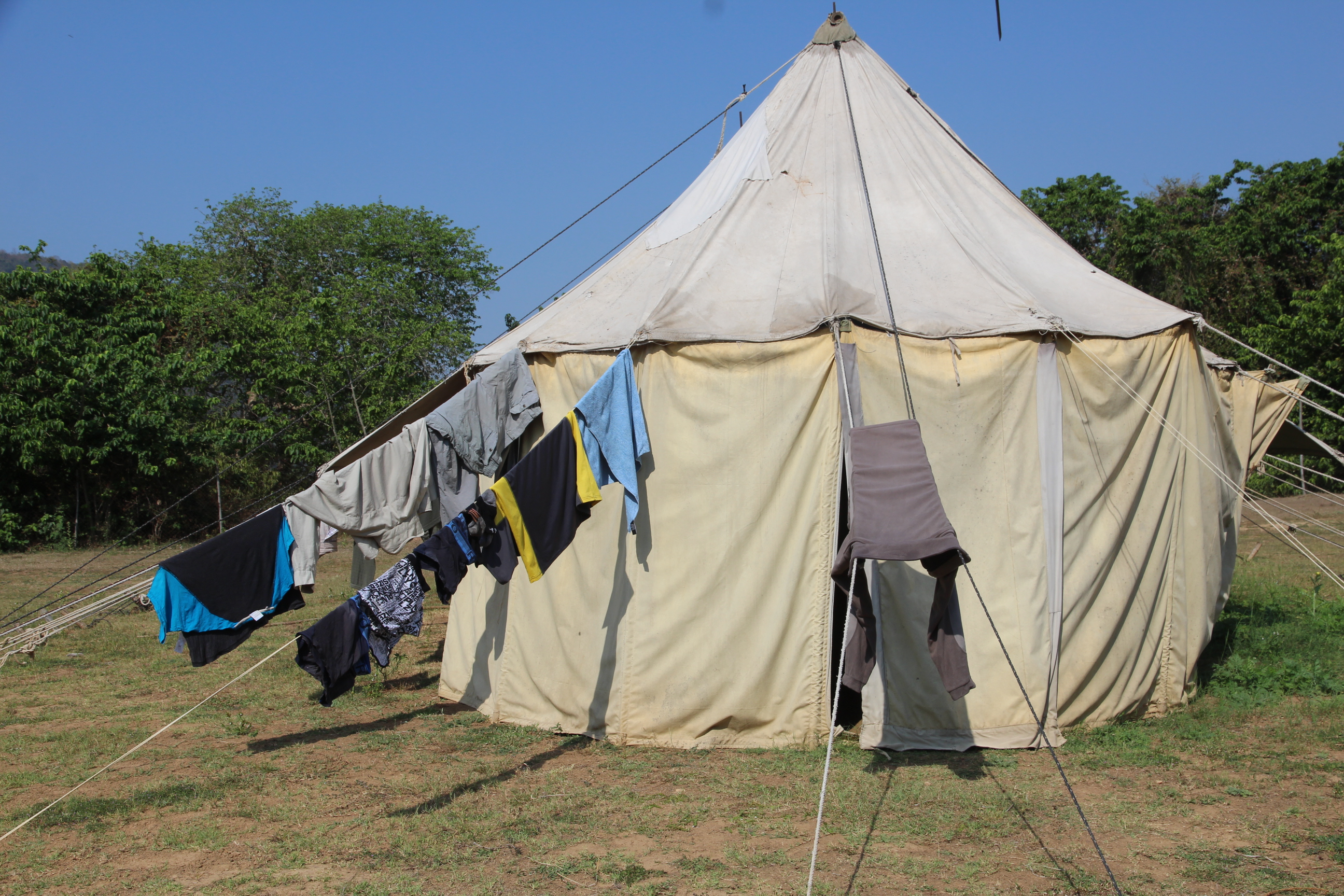
Tents make good clotheslines
Tikarpada village, where we stayed, had plenty buckets, plenty of water and plenty of sunny weather.
After ‘household duties’, we went for an afternoon canoe ride on the river. We scrambled down the hill (Tikarpada sits on a cliff now) and across the laundry-laden rock field to the riverbank.
Then it was into the canoes—Poor John, Gary and Deepti in the first one, and Anand and me in the second.
As we ‘stepped’ into these wooden crafts, we threw all thoughts of occupational health and safety overboard. The river was running fast, we’d be sitting a few centimetres above it, there were no lifejackets, the canoes were leaking and the cheerful polers/paddlers were baling as needed.

Poor John, Gary and Deepti brave the Mahanadi River
But the cruise was peaceful with not much happening. A few birds were around and some fishing boats and baskets were ‘parked’ on shore.
Our poler explained that in the prawn (shrimp) season, which is now, traps are set during the day and collected at night. He catches 200 grams to 5 kilos of prawns a night, and sells them to a middleman for about 250 rupees (A$5) a kilo. I now forget the amounts he quoted for fish, but the catch weight was higher and sale price was lower.
In the midst of all this chatter, there it was—THE GIANT! Our poler spotted it first.


Of course, I’d never seen such a giant before, and with the exception of our two polers, no one else had either. This was momentous. Anand and Deepti, both accomplished naturalists in India, were as excited as I’ve ever seen them.
But because we were facing the setting sun, the giant appeared as a silhouette. So our polers took us farther along until we could get a better look. And then before long we saw a second giant, in an even better light.
We all danced around with joy—in our heads and not in the canoe—at this multiple sighting of a new species for us, and after a long look headed back to ‘port’.
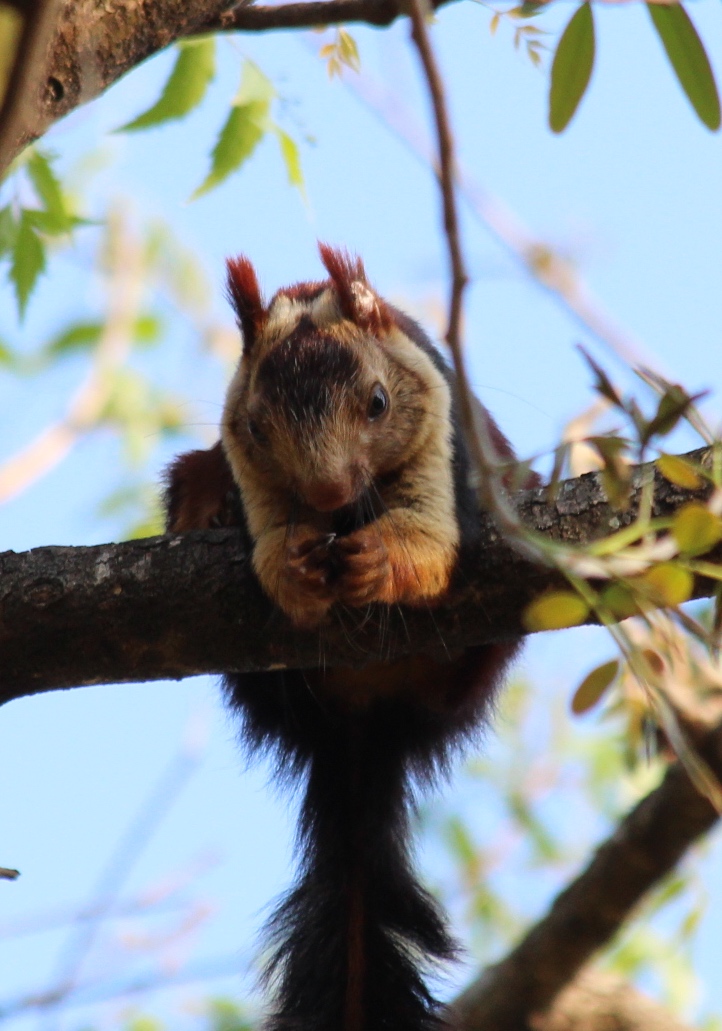
Snack time for a giant squirrel


So a giant what?
I’m talking about the Indian or Malabar giant squirrel—the largest tree squirrel in the world and one of the most beautiful.
Eastern grey squirrels are about 10 inches long (head and body), while the adult Indian giant is 16 inches long, plus a tail that is almost another 2 feet. The long tail acts as a balance and a rudder, allowing the squirrel to leap almost 20 feet at a time.
And they’re colourful. Indian giant squirrels are two-tone and sometimes three, with colours of creamy beige, buff, tan, rust, brown and dark seal brown. The colour schemes tend to be region-specific, so if you manage to see the squirrel up close, you can usually tell where it comes from.
Indian giant squirrels are quite shy and dwell in the upper canopy of the forest. They almost never leave the treetops. No wonder it was such a challenge to get good pictures of them.
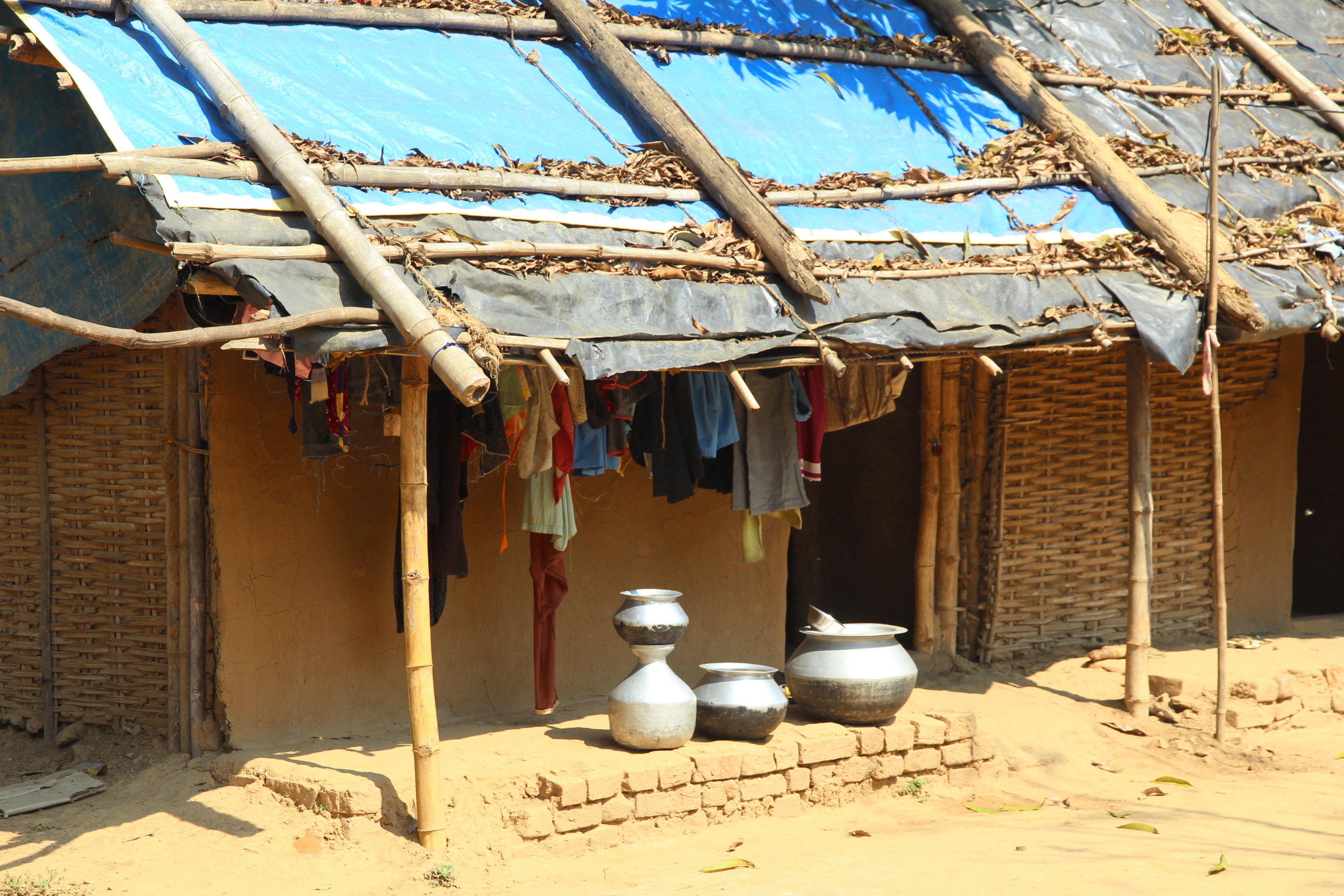
A house in the village
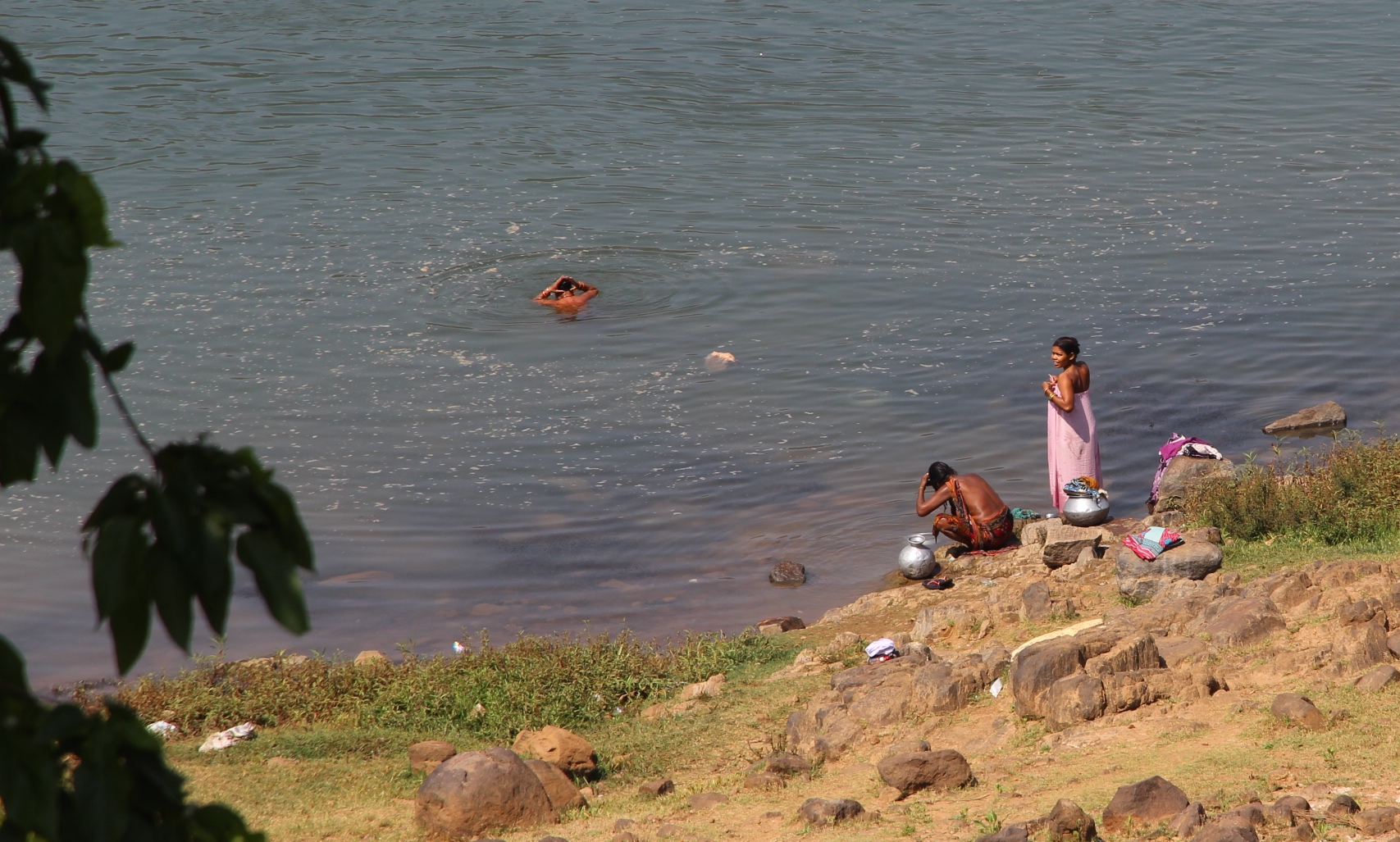
A giant bathtub on the doorstep
Walking the other direction
The next day we set out on a stroll through Tikarpada village and then up the gorge. Overnight we were told that the village is at the far end of the gorge and that our canoe trip had been away from the gorge.
Apparently people aren’t really allowed into the gorge and the proper part of the tiger reserve. Geez, how hard do they need to make it for you to see the wildlife that they promote? But you smile—and grit your teeth—and press on.
Luckily this outing proved to be more productive.
For starters, we got a good look at the village. Tikarpada is the proverbial moveable feast. While a few structures look fairly permanent, the river’s high monsoonal flow means the village sometimes has to move a bit after the water subsides.
Recently they had to move a lot—away from the shore, gorge and reserve. Why? Because the government decided hey were encroaching on the wildlife. Beats me how a long-time village that the government promotes as one of the places to stay among the wildlife has now become a problem?

The others check out the sandy shore where Tikarpada’s tourist tents used to be
But complaining aside, the walk was rewarding.
After the village, we came upon the gharial breeding and research centre. I’ve already introduced this endangered crocodile, and this gave us a chance to see them close up.
Gharial breeding in Satkosia is having mixed results. There are several (maybe three) adult gharials in the river, possibly all males. Well, that’s not going to produce any offspring. The centre says it collects eggs, hatches them and releases the gharials into the river. They also breed mugger crocodiles.
Anyway, admission was a whopping 10 cents a person and allowed us to walk unescorted through the centre and out the other side, which was padlocked but we slipped through the gaps between the gate and the fence posts.
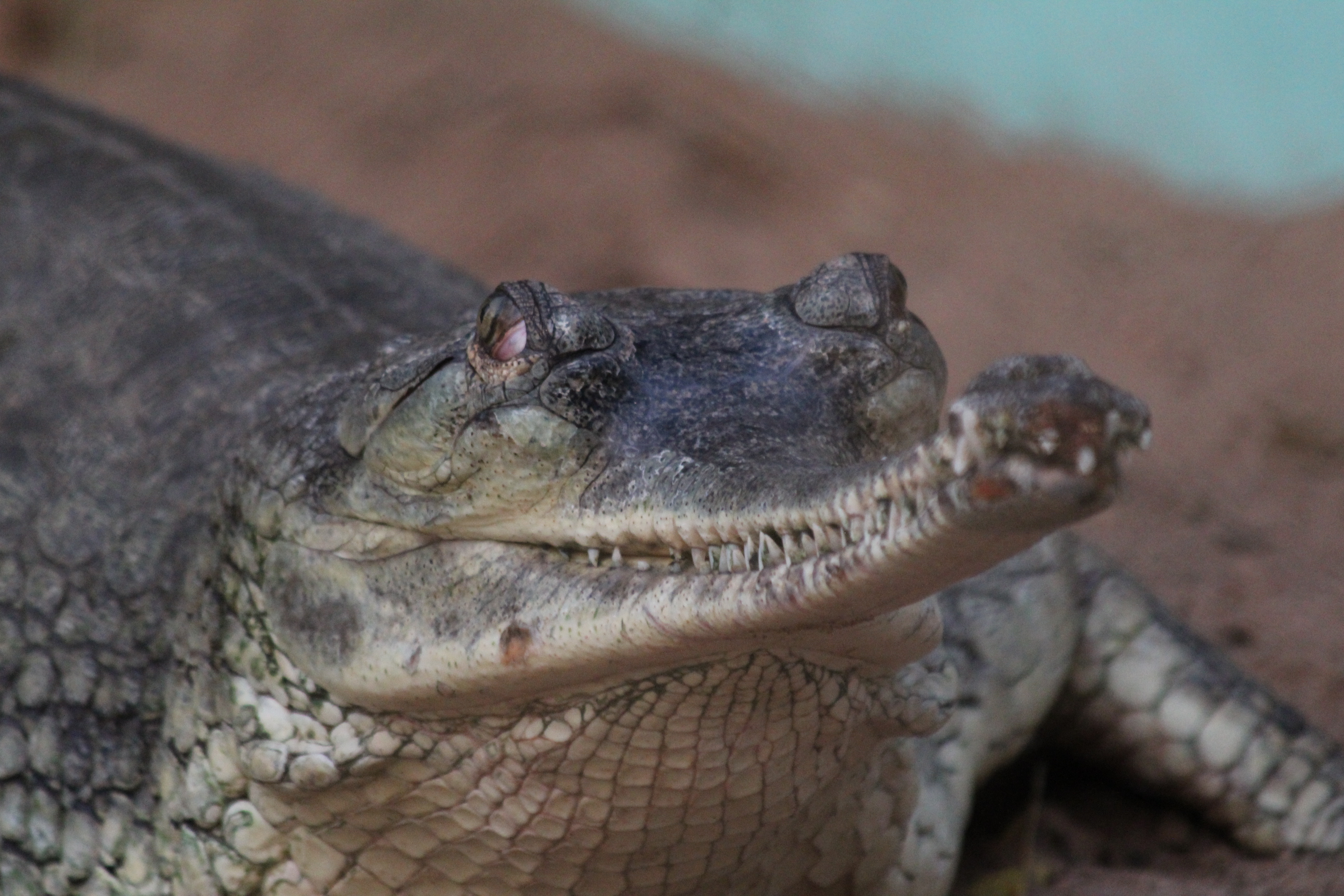
Gharial crocodile
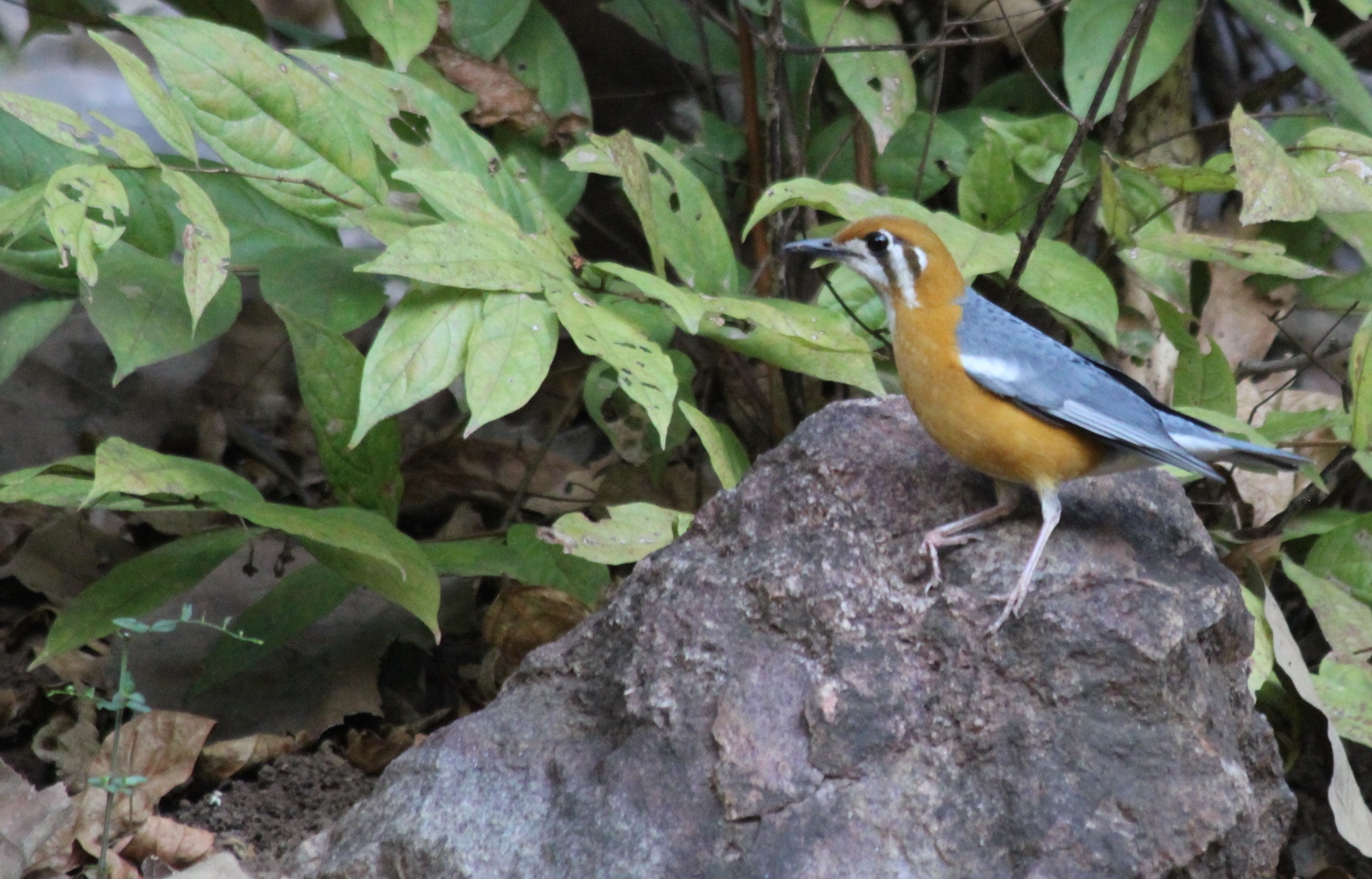
Orange-headed thrush
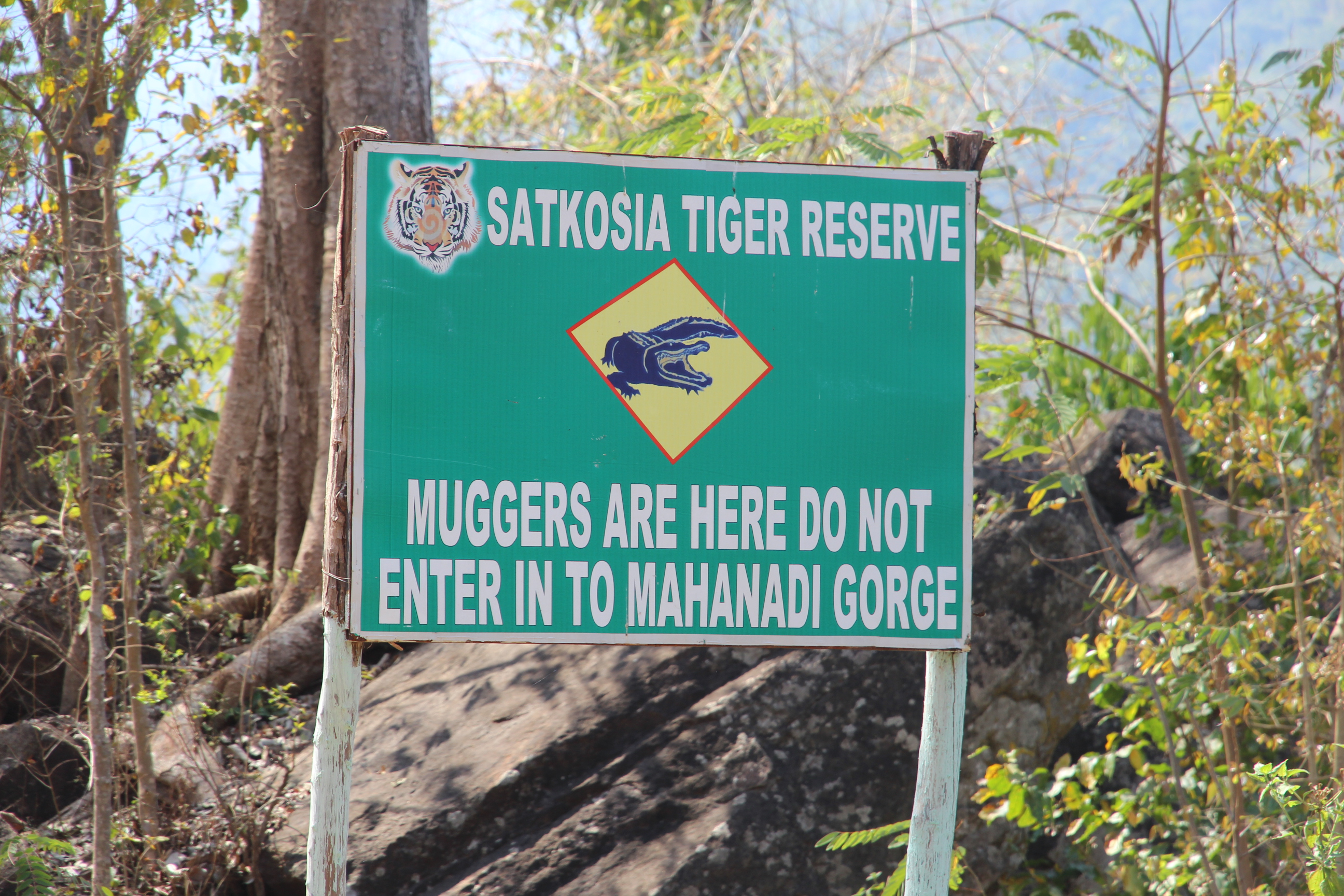
No swimming
Quite sensibly, we paid attention to the sign that said don’t go in the water because of crocodiles. And ignored the sign that said something like Satkosia Tiger Reserve, keep out.
It didn’t take long for the forest to present us with more to look at, including quite a few giant squirrels. And they were in lower branches so easier to photograph.
After a bit, Anand, Deepti, Gary and Poor John decided to walk on to where Tikarpada used to have its tents on the shore. I’d had enough of scrambling down hills so opted to wait for them.
We’d already been walking for a couple of hours so I found a flat rock to sit on, while I scrolled through photos on the camera.

Gary is dwarfed by the Satkosia forest. He is 6’2″
Not sure why I happened to look down when I did. A baby snake had slithered across my thong (flip flop) which I’d slipped off earlier, and was thinking about crawling up the inside of my shorts. I didn’t scream, I didn’t shout, I didn’t even jump. Instead, I ever so slowly stood up and backed away.
Hello my little friend, and just who are you? No answer, just a curious look and then it slid away through the leaves and down the embankment. It seemed like ages before the others returned and I could tell them about this close encounter.
But the question of who it was remains unanswered. So far, no one has been able to identify what kind of snake it was. Can you?

Can anyone identify this snake? Please!
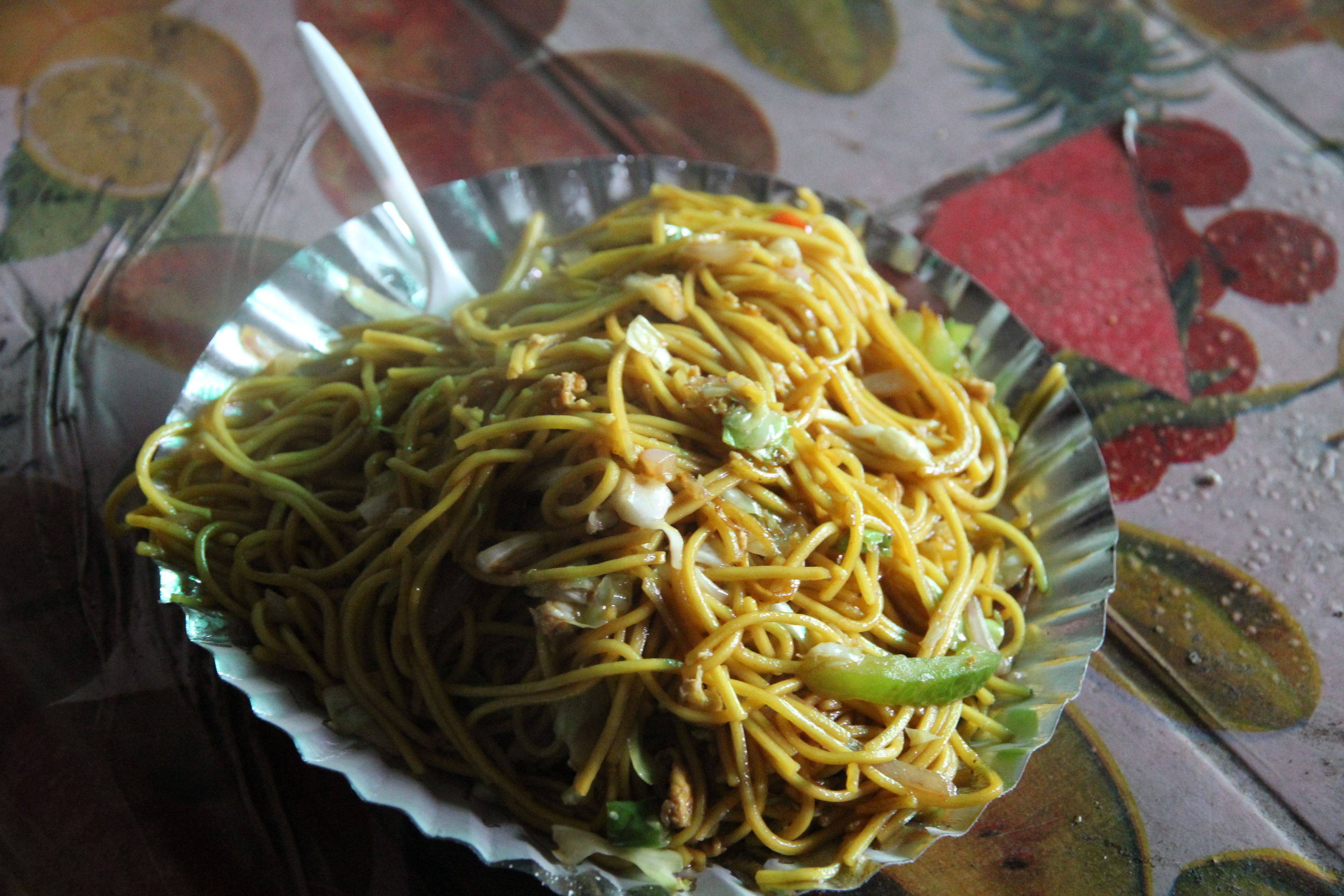
Amazing noodles
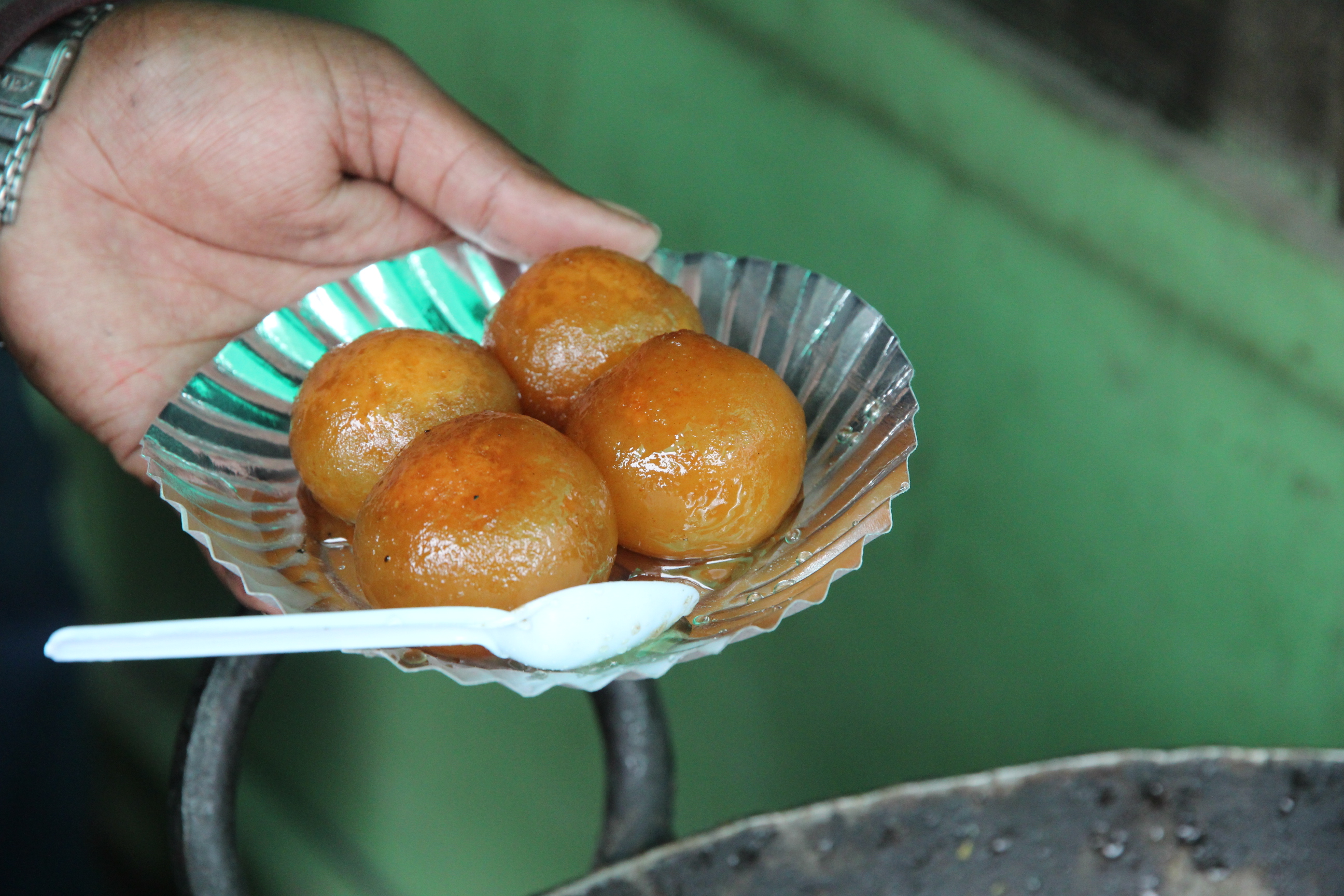
Sugar bombs
We’ve been eating our way across India and we have the waistlines to prove it. Thankfully, I can still do up the top button on my shorts and trousers.
So here are the facts—in almost 10 weeks we’ve visited nine Indian states, covered well over 11,000 kilometres, sampled all sorts of cuisines and eaten more than 200 meals, plus a lot of snacks.
Can’t say we’ve had a bad meal in all that time. Sure, some have been better than others, and some have been sensational. We’ve had some amazing snacks too.
The other day, I realised I hadn’t said much about the food on this trip, so it’s time to bring you up-to-date.
While I don’t have pictures for all the delicacies, I can give you a run down on some of our recent favourites.
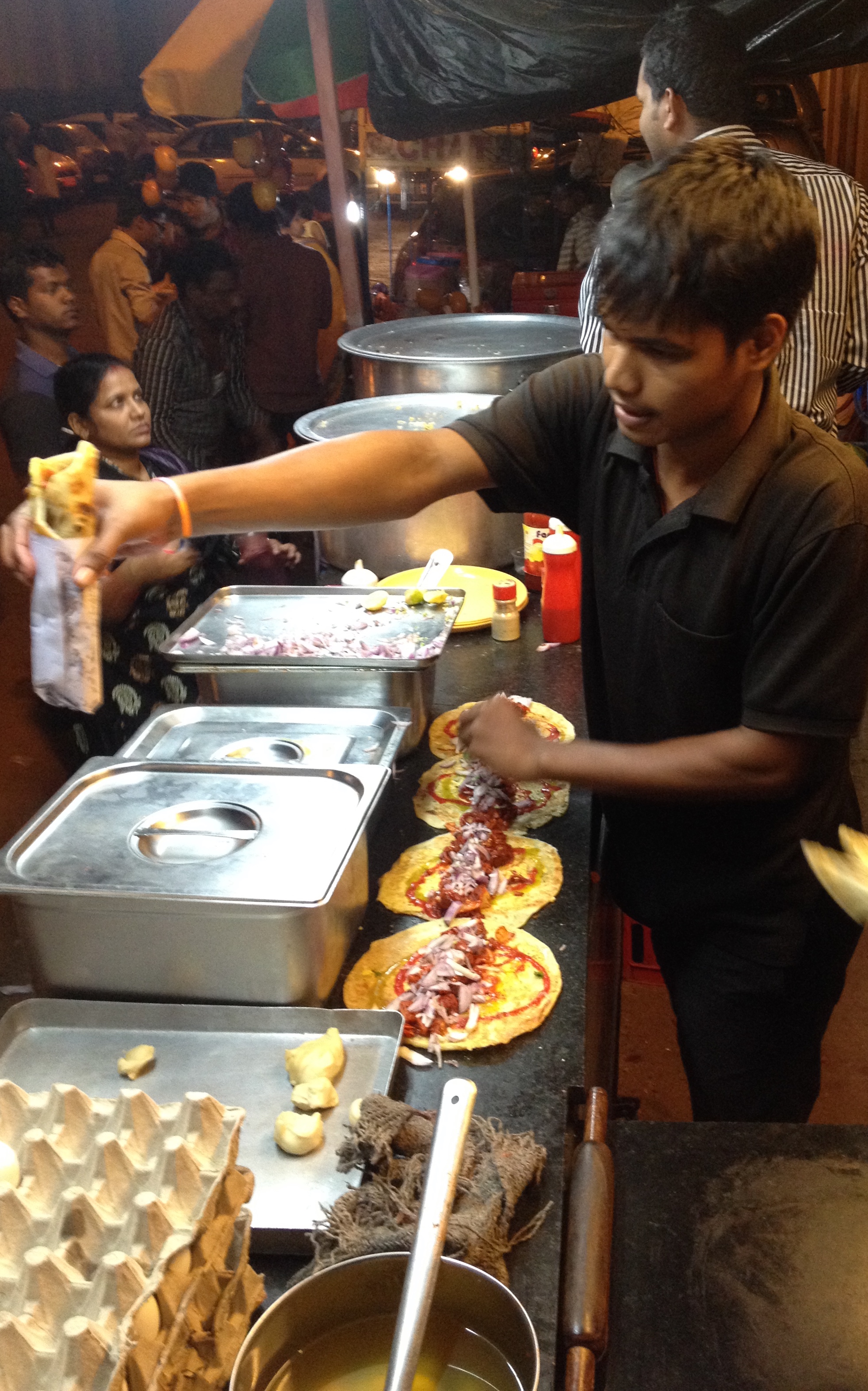
Serving a chicken roll
Top of the list has to be the paneer roll we had in Angul in the state of Orissa. Paneer is a fresh cheese common in Asia. It’s made by curdling milk with lemon juice, vinegar or some other acid. It’s easy to make at home and I’ll post a recipe when I’m back in Australia. Confession: I bought a paneer cookbook yesterday and here’s hoping there are some guiding recipes in it.
Anyway, back to that paneer roll. Deepti went into a small shop to order five of them—for her, Anand, Gary, Poor John and me. We were starving (it was a late lunch) and she didn’t return for ages. Good grief, were they milking the cow?

Making a roti for a roll
But the wait was worth it. That roll, with oodles of paneer and cooked chillies and veggies in a tomato sauce wrapped in a homemade roti, was out of this world. We could have eaten two, even three, and we all said it was the top treat of the trip.
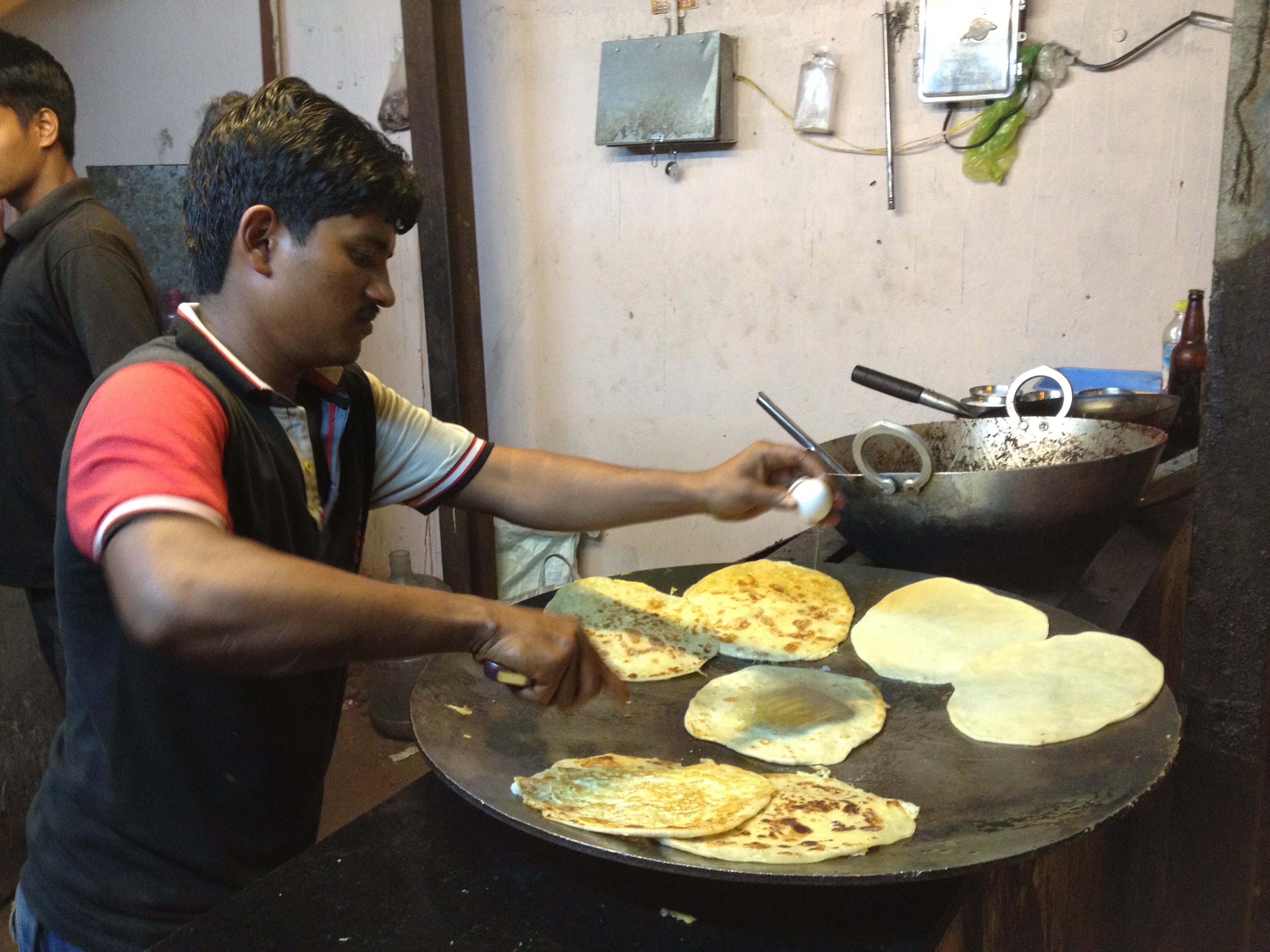
Adding egg to roti
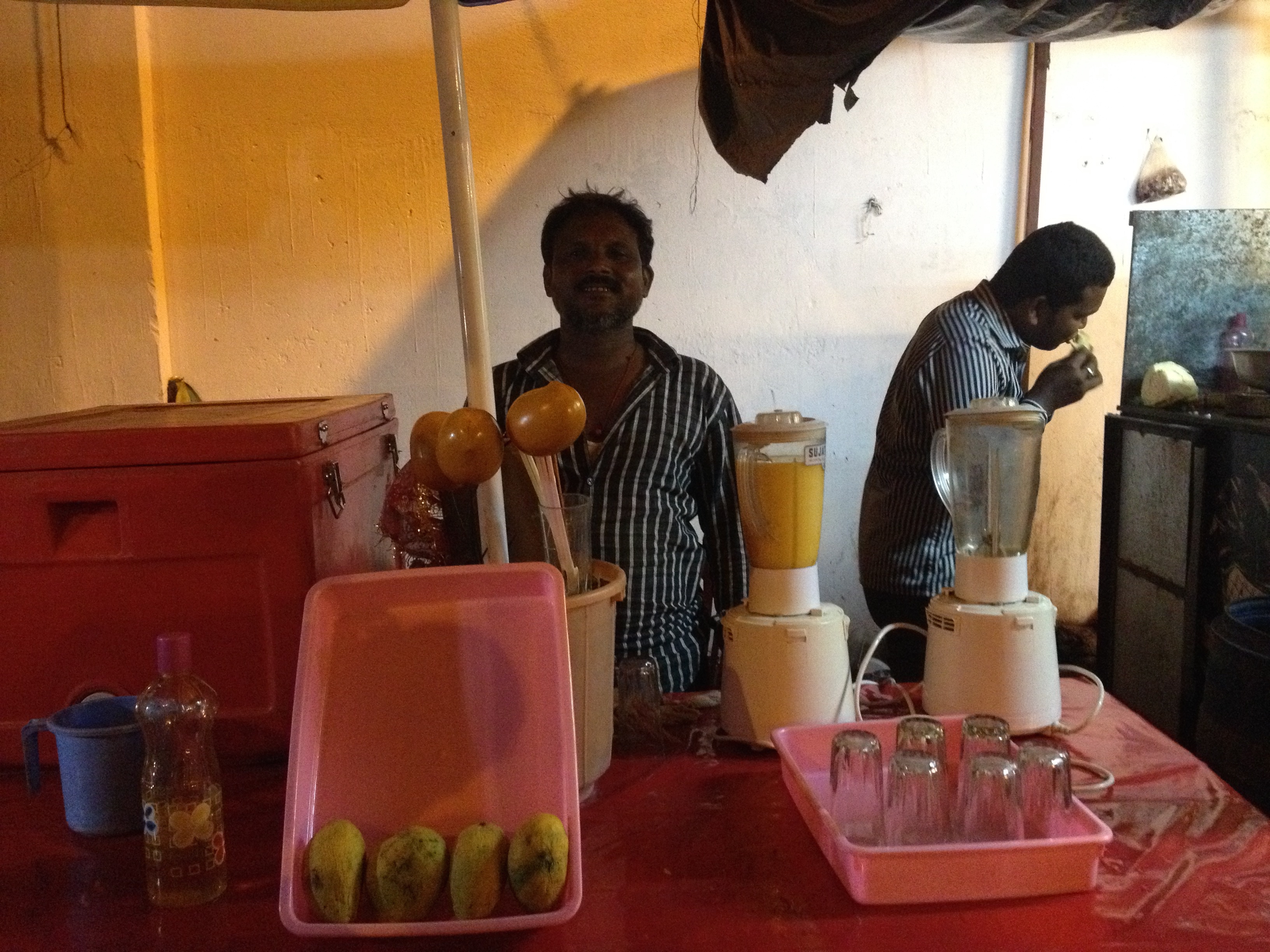
Making mango juice
So finding an equal has been a mission ever since. The chicken rolls we had from a street stall in Ahmedabad came close. The big bonus at this stall was being able to watch and photograph the fellows making them from start to finish.
First roll out a roti. And while it cooks, crack an egg onto it and swish it around. Gosh, they make it look so easy. Then line up five cooked rotis to receive the toppings. There’s a squirt of oil (not sure what kind), then a squirt of some red sauce (catsup or chilli?), then a liberal dose of cooked chicken in a tomato sauce, and then a generous sprinkling of finely chopped raw red onion.
Finally, wrap it up and hand it over. Now I have something to go on if I want to try making paneer or chicken rolls at home!
We washed our rolls down with glasses of mango juice—really expensive at 20 cents a glass. The proprietor, whose stall is next to the chicken roll guy, says he squeezes 15 kilos of mangoes a day in the off season and about 40 kilos in the on. Mangoes will be ripe about six weeks after we leave India. Darn!
We had an interesting breakfast in Chalsa, after visiting a so-so game park. We stopped and the woman said she had only one dish—a combination of puri breads and a chickpeas and potato curry.
Simple and delicious and as soon as we emptied a dish, she replenished our plates. No wonder our waistlines are expanding at a frightening rate.
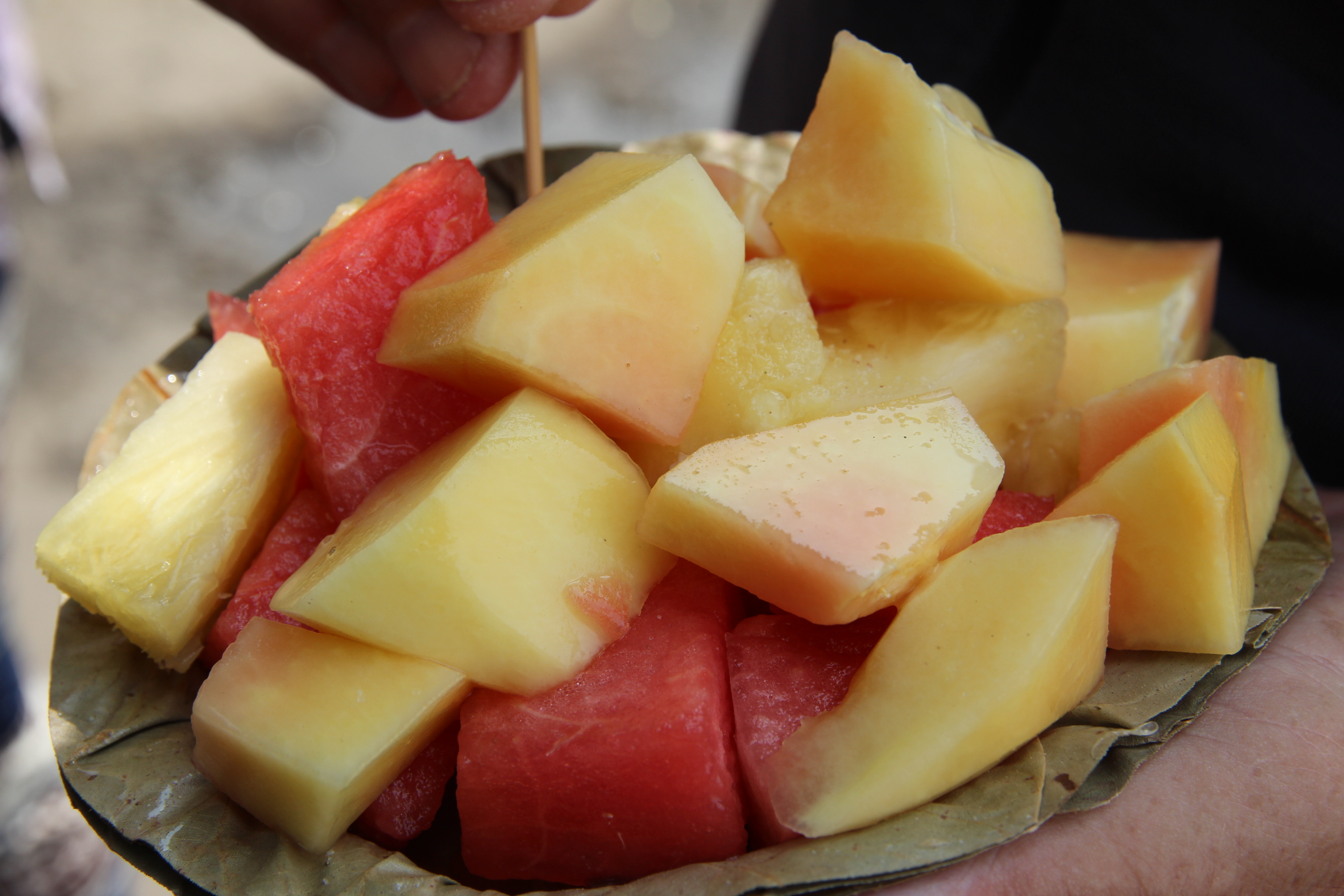
Watermelon, papaya, pineapple and a sprinkling of black salt. Delicious
Another find was the fruit bowls in Mirik, a popular tourist town north of Darjeeling.
The fellow running that stall was a whizz. As he worked, bag after bag of pineapples, watermelons, papayas and cucumbers were being delivered to his roadside stand.
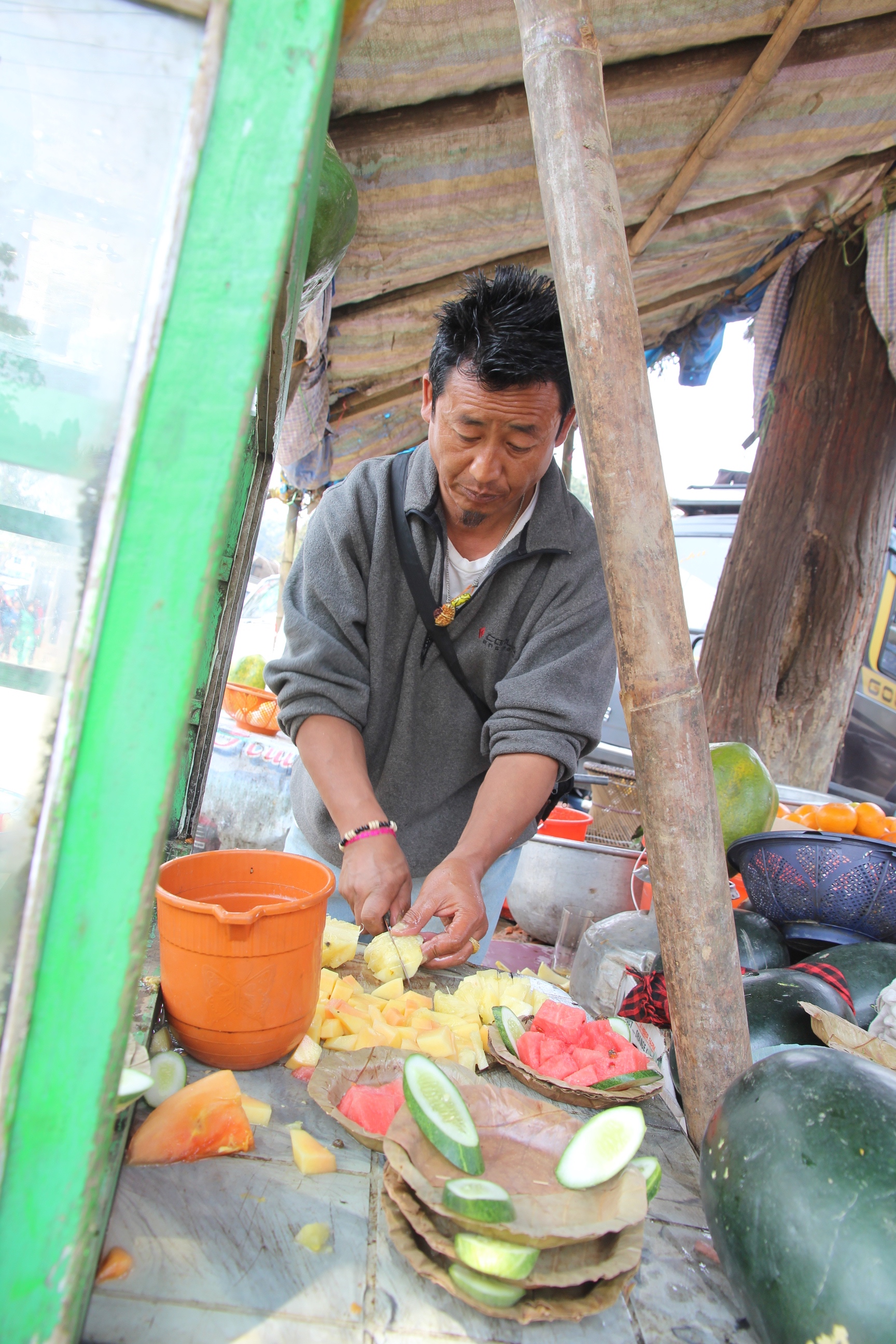
Fruit seller at work in Mirik
It took him seconds to peel and chop all those fruits to create a bowl of colourful and healthy nourishment. And several things made the fruit extra special.
Obviously, fruit is seasonal, so with the exception of bananas, mandarins, grapes and pomegranates, the variety of fruit available has been limited. Quantity has been limited too. So it was great to get this full-on hit of vitamin C and new fruits as well.
Also, the fellow offered bowls of black salt (or kala namak) to sprinkle over the fruit. The raw material for black salt is mined in Bangladesh, India, Nepal and Pakistan. It has a distinctive pungent taste, and I’ve bought three lots of it to take home to Australia. If I believe the hype, I can use it to cure goiters, treat hysteria, relieve heartburn and intestinal gas, and more. Maybe I’ll never fart again.
The final bonus was that the dishes were made of leaves that had been pressed together and shaped into a bowl. It really was the optimum use of biodegradable products.
Two other winners came from a hole-in-the-wall eatery in Lava, a small hamlet near Kalimpong in the hills of West Bengal. We drove up there for an outing and arrived about lunchtime.
There were restaurants galore but no one seemed to be in the mood to cook. They kept urging us to go to the Orchid Restaurant which they said was in the market about 200 metres up the hill. Anand speculated that the restaurants we saw might think foreigners wouldn’t enjoy their food.
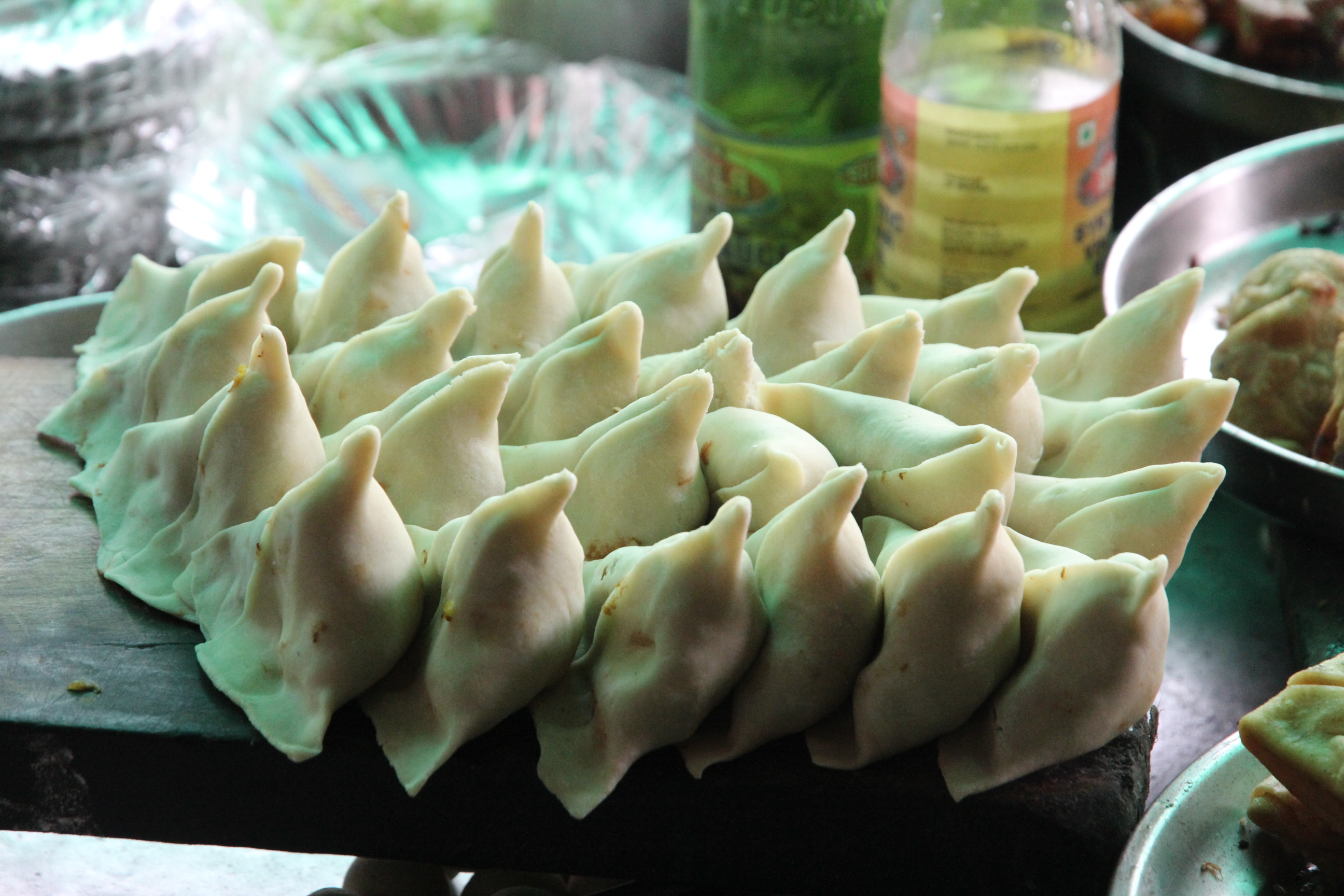
Samosas waiting to be cooked
We trudged uphill—it was steep—for 300 metres or so without coming upon the Orchid, but we did see a fellow cooking a deep vat/wok of sweets that we refer to as ‘sugar bombs’—one bite and your mouth gets an explosion of sweet syrup and dough.
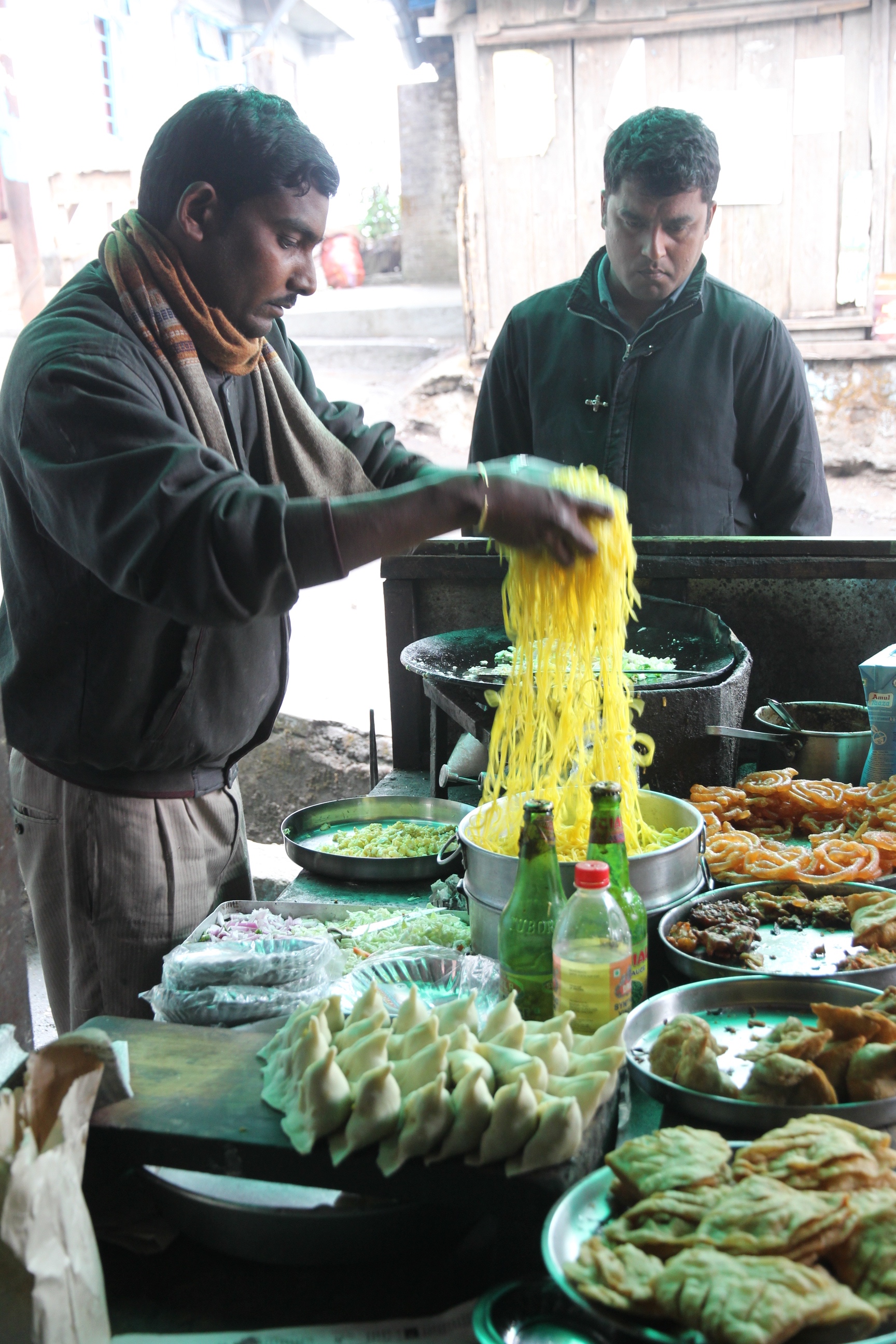
He also had platters of samosas ready to hit some fat. Anand ordered a round of samosas and five servings of noodles. The chef/cook swapped over his woks and fired into action.
The samosas arrived in no time and they were the lightest and tastiest samosas I have ever had anywhere in the world. The dough wrapper was perfect. The filling was perfect. So we ordered another round.
Then he got to work on the noodles, frying spices, onions and other veggies, and adding homemade noodles (not those 2-minute impostors).
At the end and even though we were totally full, we ordered a round of sugar bombs!
It was all pure deliciousness. And the whole spread, for five us, cost about A$8.
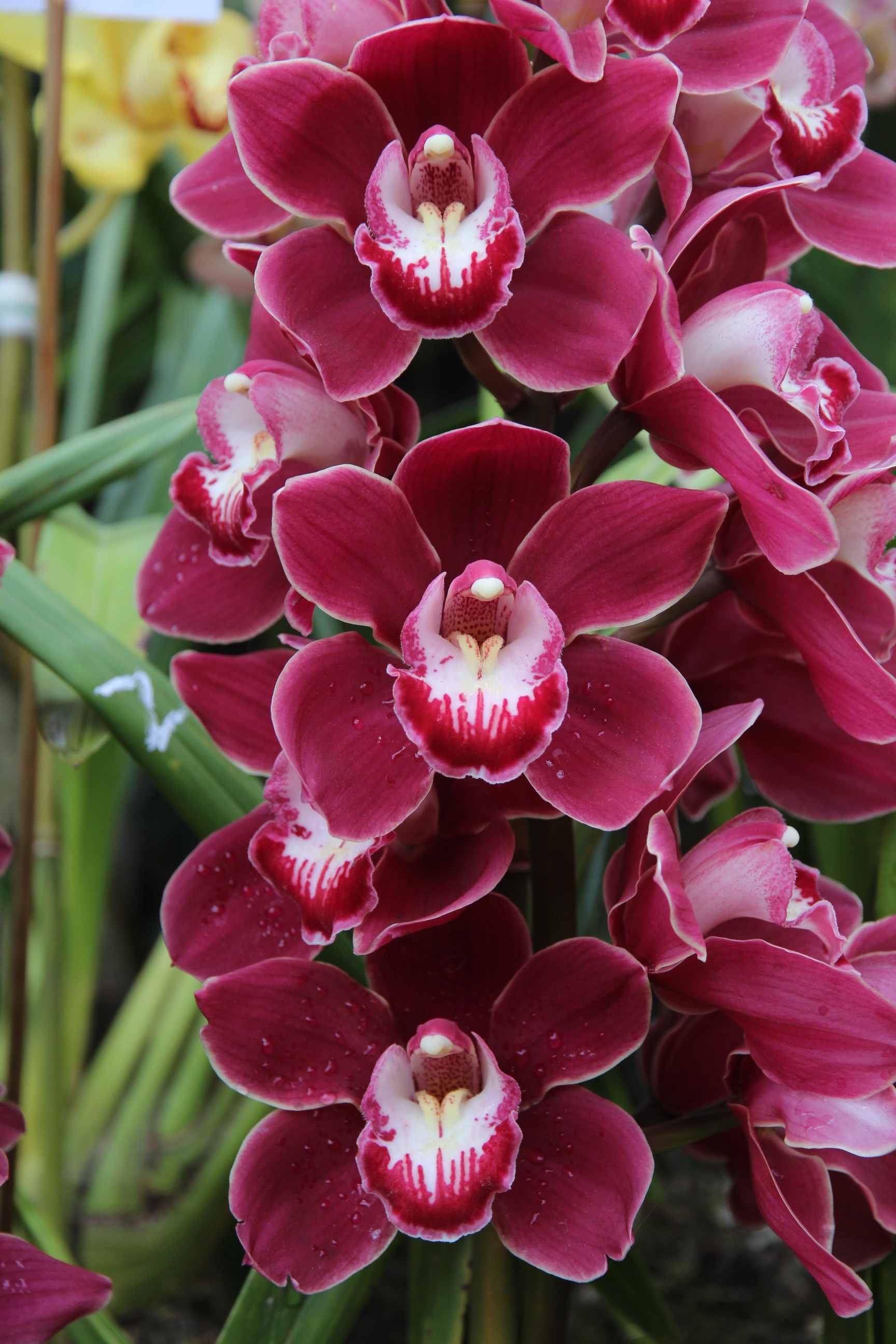
Rose-coloured orchid
My green thumb is pretty faded. In fact, it’s never been all that green. I love plants and flowers but I’m not very good at growing them. Just like I’m not very good at hand washing laundry.
So I admire anyone who can get the earth to offer up healthy food and things of beauty.
Needless to say, I was gobsmacked by the array of orchids at the Flower Exhibition Centre in Gangtok in Sikkim in the northeast of India.
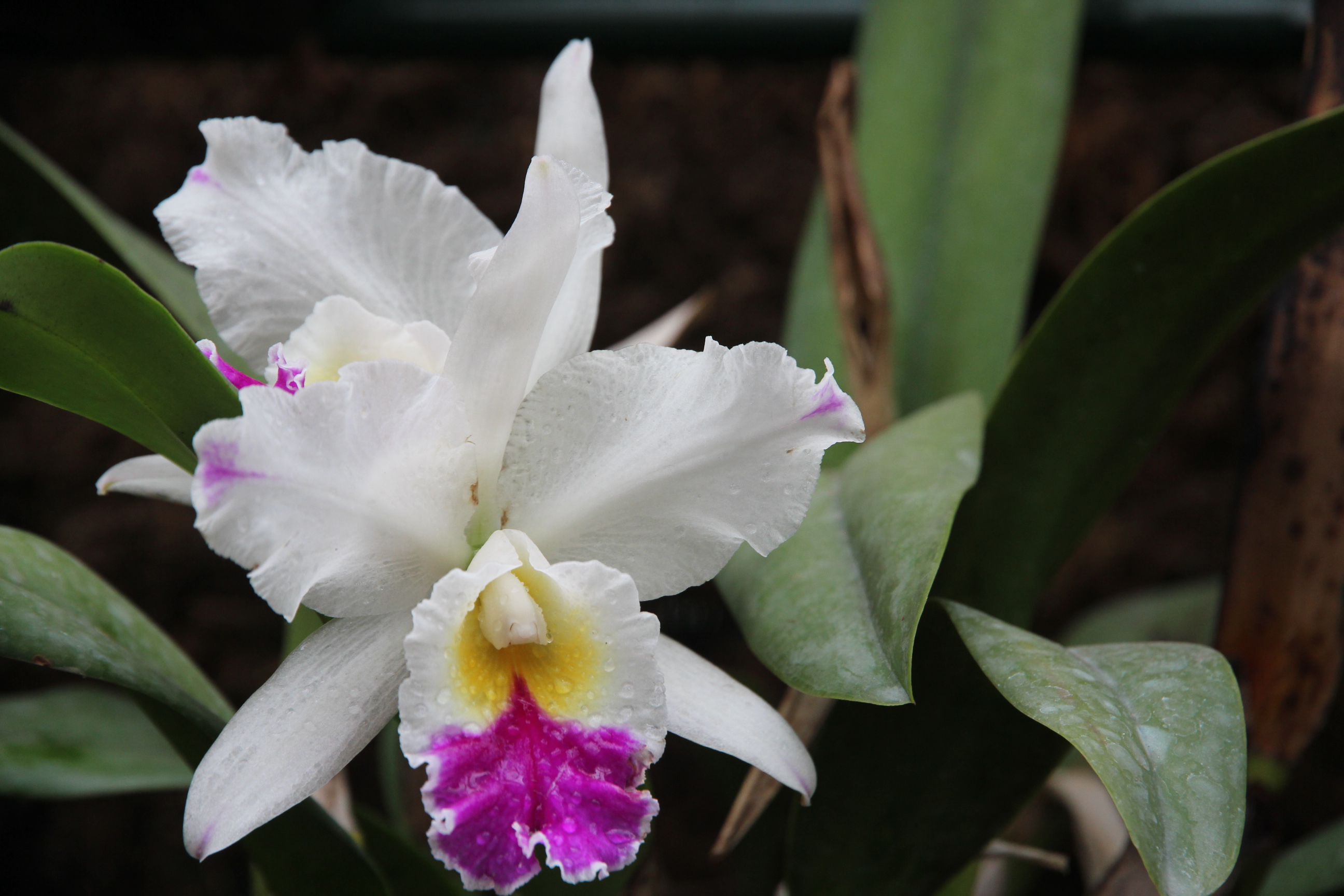
White orchid with deep pink and yellow centre


The centre, which is located in a large tropical greenhouse, is open year-round (admission is 10 rupees or 20 Australian cents), but we were lucky to have our visit coincide with the annual Sikkim Flower Show.
The display features pot after pot of beautiful orchids, in all colours and from all parts of India. I couldn’t help myself and took way too many photos (50 to be exact) of plants I didn’t recognise and couldn’t name. You can see I used some restraint when I chose what to post here.
Some plants still had their identifying tags, but most of those had faded or the ink had run in the two weeks since the show opened.

Brown orchid


As a consequence, I’ve managed to identify only a few of these beauties, so I need your help to name more. Please share names (or possible names) for any of these orchids, and I’ll be mighty grateful.
Thanks is advance for any insight you can give.
This year’s the month-long Sikkim Flower Show opened on 17 March. If you’re anywhere in the area be sure to visit and take your camera. If you can’t get there this year, put it on your 2016 calendar.
P.S. I wonder what Nero Wolfe, the famous detective and orchid aficionado, would have thought of this display? He was an avid eater too, and I wonder if he’d have liked my page-32 recipe for Indian cheese pakoras. If you’ve never read his books, written by Rex Stout, you should give them a try.
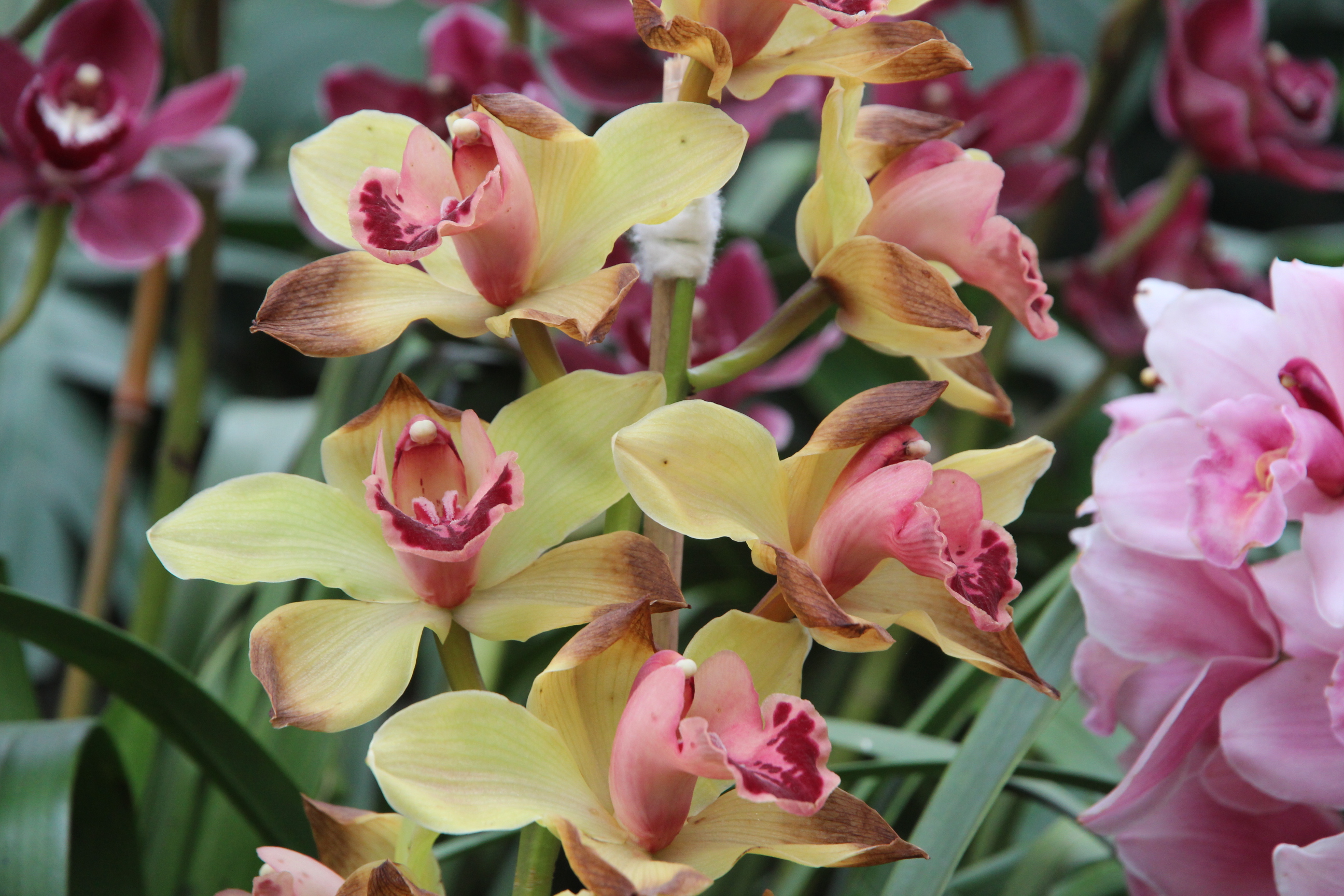
Yellow pink orchid


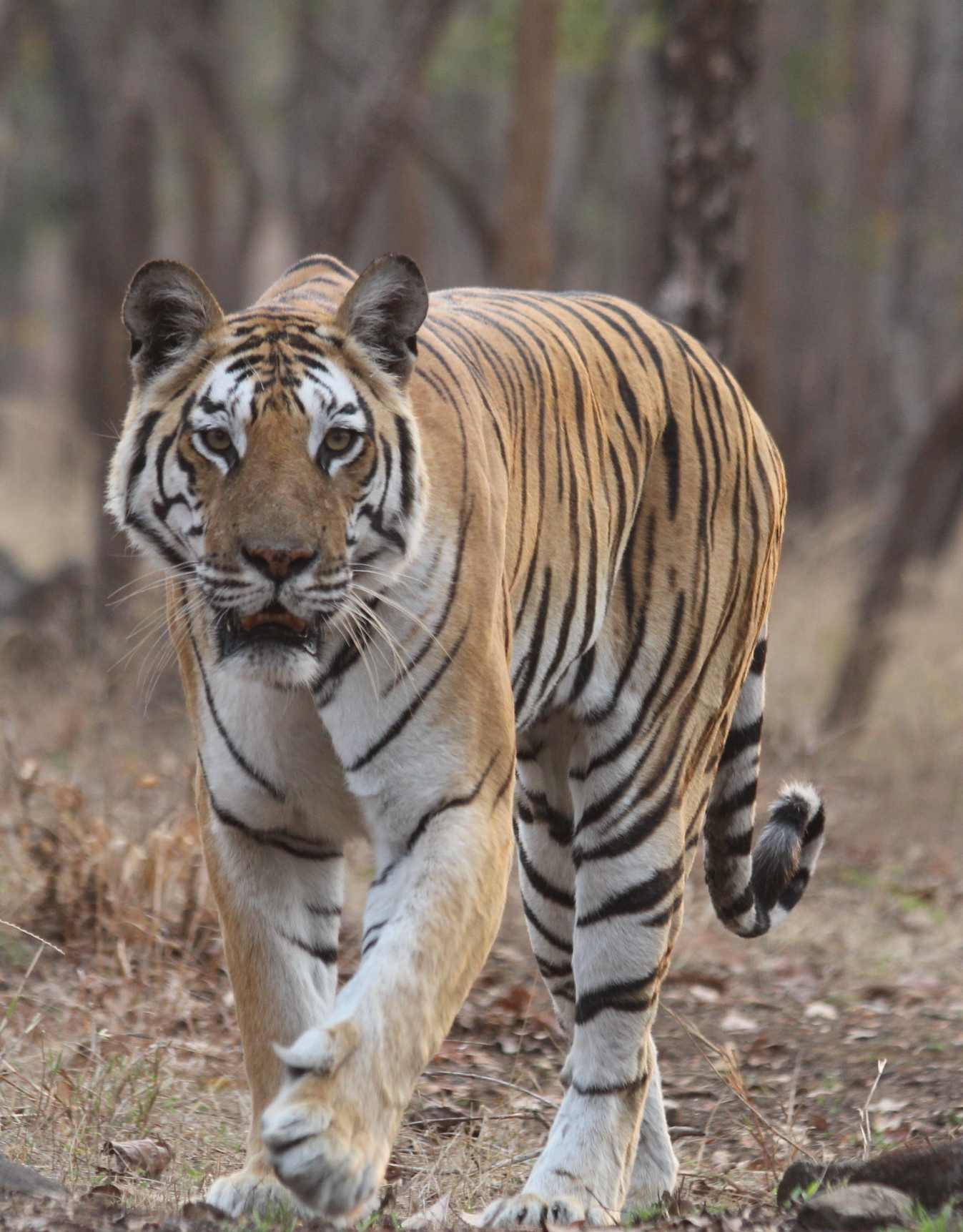
Junewani patrols her jungle
India has been full of exciting moments. Top of the list has to be the unexpected marriage of our daughter, Libby, to Daniel.
To be honest, that didn’t happen in India, but we were in India when the ceremony took place in Australia. Check out the story of how we missed their shindig.
But two other amazing events are next in line. I’ve already written about the great show we got from the Asian lions in Gir National Park in Gujarat. And then Pench National Park outdid itself with two excellent sightings of Bengal tigers.
We loved Pench the first time we visited in 2013—in fact, it was probably our favourite park even if we didn’t see a tiger then—and this year it outdid itself.
It didn’t seem promising at first. Day one, a lone tiger was spotted having an afternoon snooze. He was far, far in the distance—it was a miracle that anyone noticed him. Dense trees and shrubs obscured him, and most of the time all we saw were a slice of his bum and a flicking tail.

The best view we had of the first tiger

The gypsies descend to view one lone tiger in the distance
As often happens in parks, word of a tiger sighting spread quickly and soon 15 Gypsies descended—full of noisy tourists. We know how to behave on a game drive, but so many people don’t. Every park would be wise to give guests a crash course on being quiet and respectful to the animals and fellow visitors.
Unfortunately, the most annoying Gypsy passengers were next to us. It was a large family with Dad complaining Where is it? I can’t see anything, mum pointing and shouting it’s there, it’s there and three teenage girls squealing isn’t he cute. Obviously the three girls have a thing for male bums.
Luckily the tiger raised his head for a few minutes and people could snap some slightly better photos. Then it was a mad dash to get out of the park before closing time. Gypsy drivers who return late are often heavily fined and barred from the park for up to a month.
But then came day two—the day of Libby and Daniel’s post-wedding party!
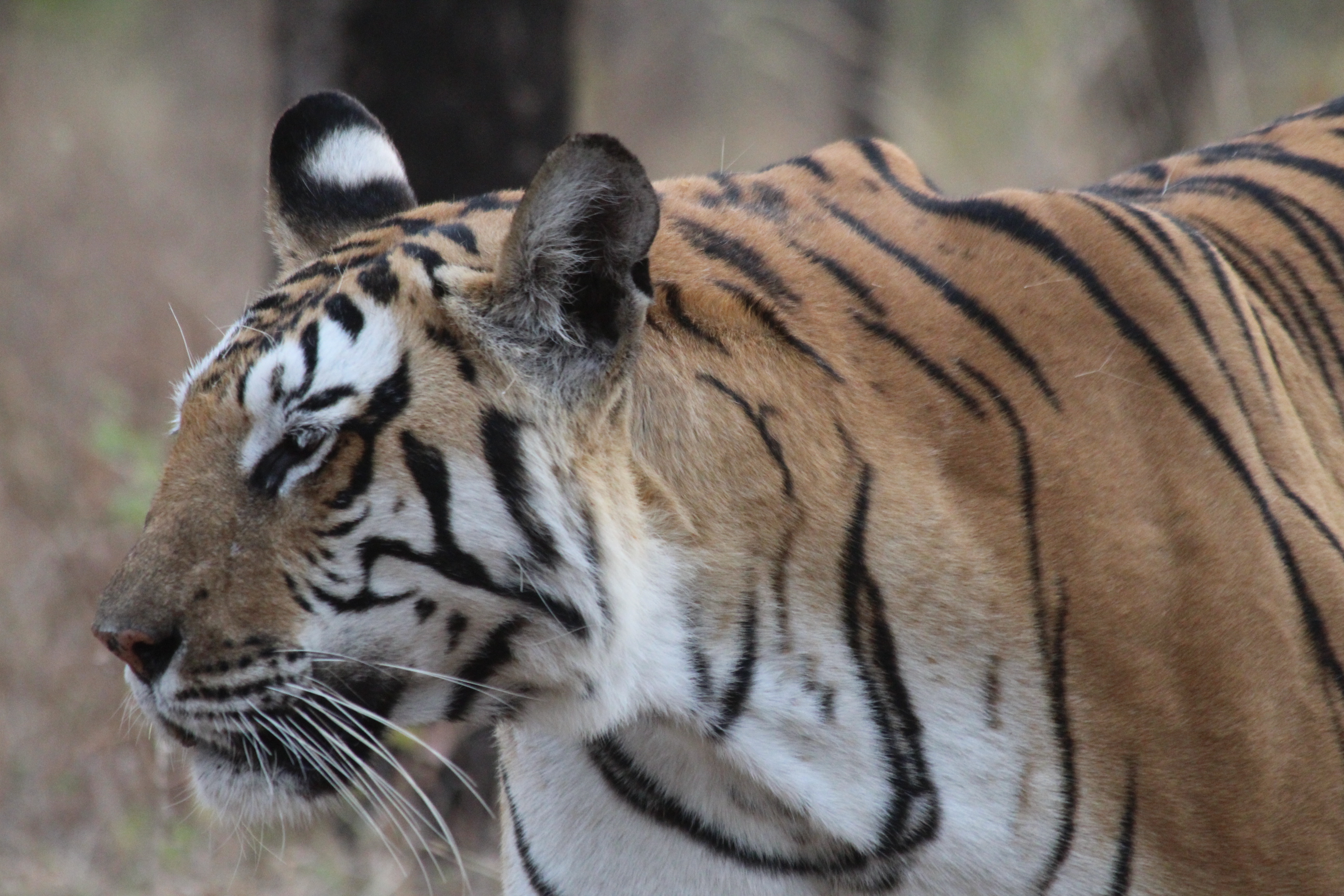
Junewani looking her best
We set off in the early morning with a seasoned guide and driver, who both knew their park and its tigers. As an added authority, Anand, one of the naturalists leading our trip, was with us. He usually lives near Pench and knows it well.
The park guide and Anand must have had the hint of a sound, a whiff of a smell, a sixth sense, physic powers or maybe all of the above. Because they urged the driver to turn left down a side road. It seemed that no one else had gone that way.
Within 30 minutes of entering the park there she was—Junewani—a seven-year-old female padding through the forest. She saw us but ignored us, and kept ambling on.
A big bonus was that there was only one other Gypsy present, carrying a couple of tourists who did know how to behave.
We watched spellbound for quite sometime. It might have been hours, but I suppose it was only minutes. After she sauntered past us and into the bush, we zipped around a corner to catch another sighting. She did reappear and then strolled into taller grass and stopped for a lie down.
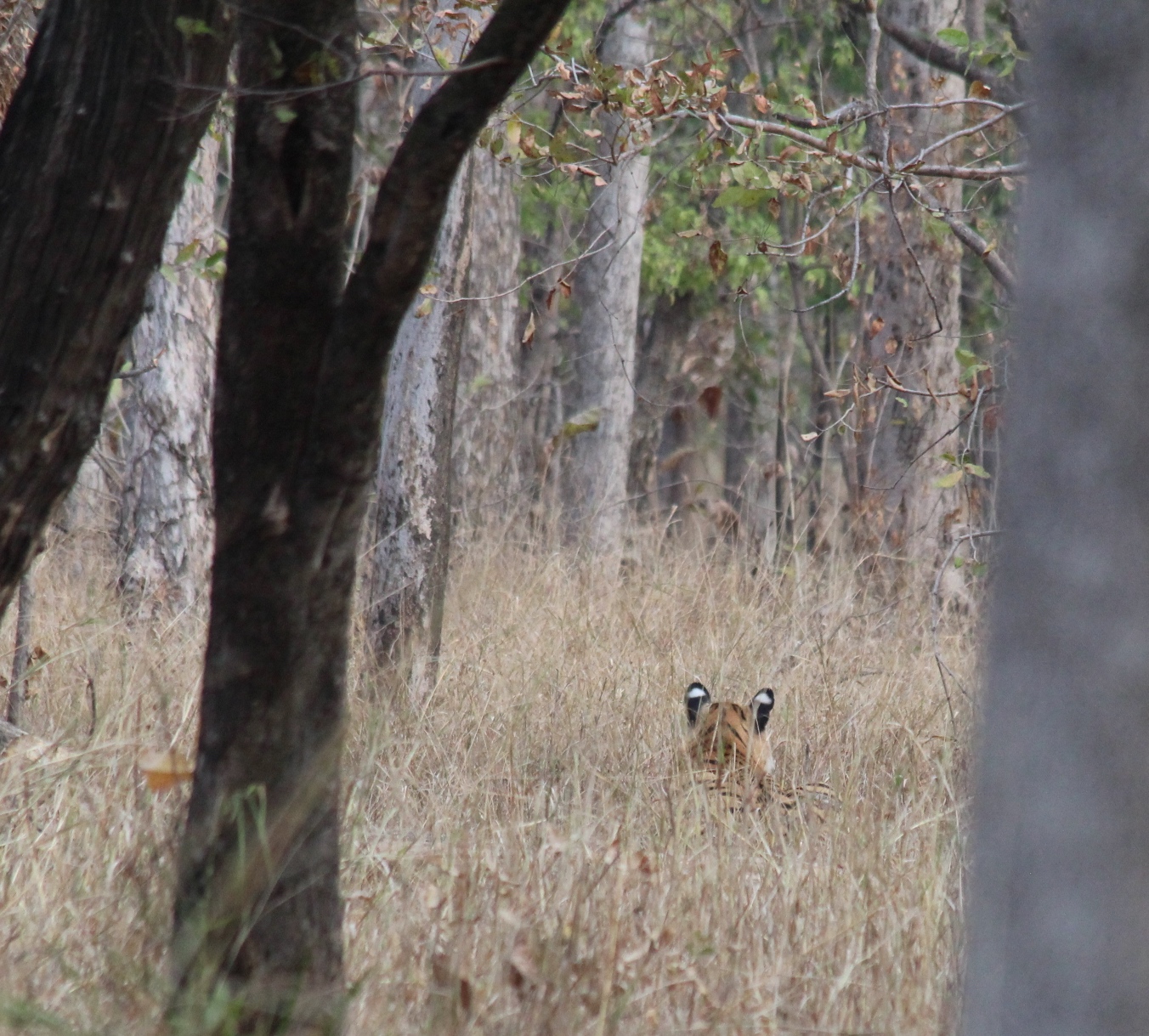
Junewari settles down for a rest in the tall grass
With her back to us and her ears poking up above the grass, we decided to move on to explore more of the park.
The thrill of this wasn’t going to wear off anytime soon. It had been the best and closest sighting of any species we’d had in something like 30 game drives over two trips to India in 16 months.
But another big surprise was to come. About an hour later, we came upon Collar Valley, an aptly named 10-year-old female who sports a tracking collar.

Collar Valley graces us with her presence
She’s the mum of the tiger we saw on day one, and she is most likely pregnant again. She strode across some open ground and no one had the heart to ask if we were seeing a baby bump or middle-age spread.
When we first encountered Collar Valley, there were only four or five Gyspies around but, as I said, news of such a find travels fast and vehicle numbers swelled quickly.
Meanwhile CV (you know who I mean) plodded on and the Gypsies followed, jockeying for the best viewing position. At one point, she slipped into a thicket of lantana and we thought she might hunker down for some privacy.
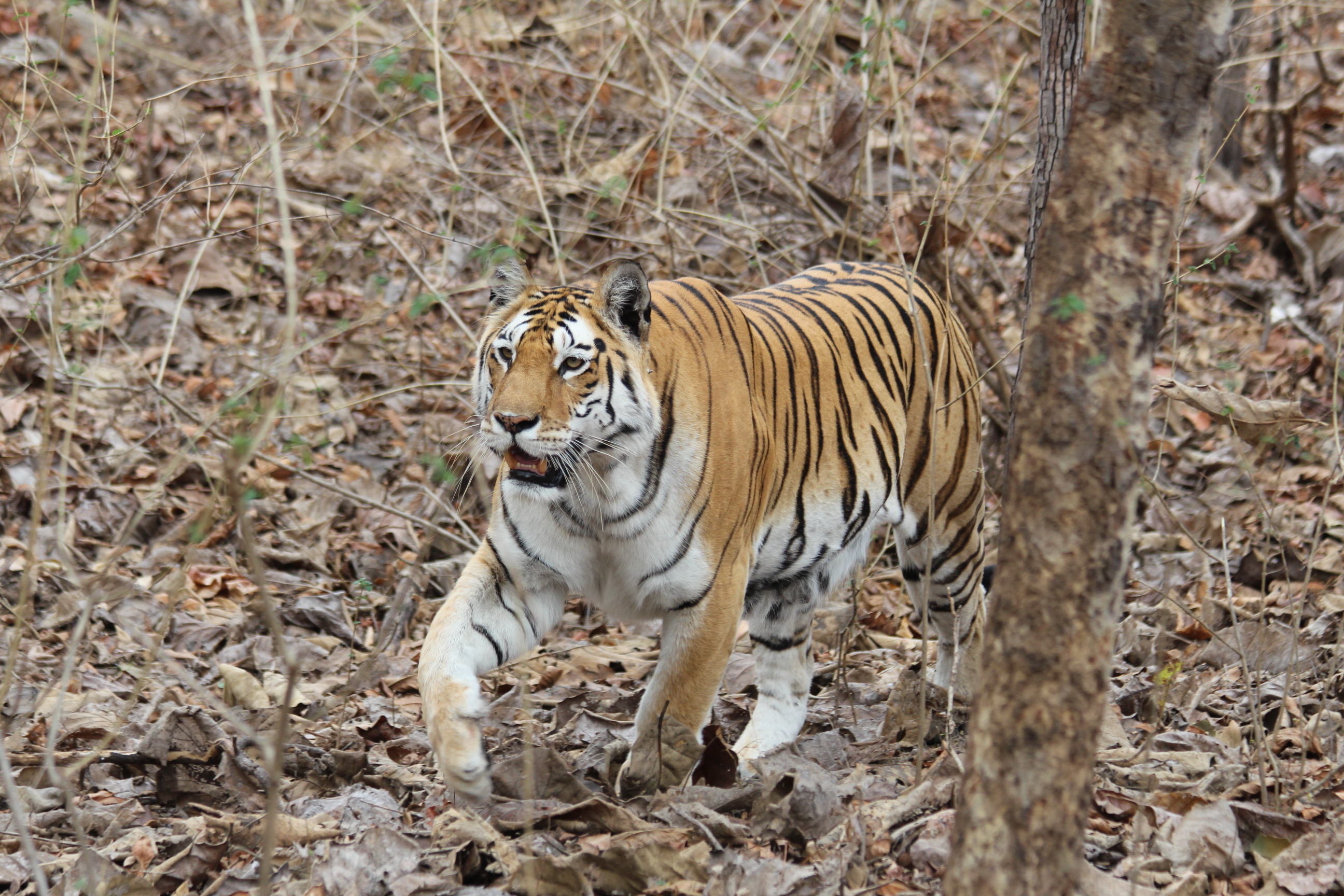
Collar Valley on the hunt. Is there a baby bump?
Then a couple of unexpected but breathtaking things happened.
CV crept on through the lantana and emerged from an opening almost beside us. While there’s no way of knowing what a tiger is thinking, it seemed she wasn’t all that happy to be almost surrounded by hordes of gawkers. She glanced around and growled. You can bet the three of us in the back of our Gypsy ducked down with our noses (and my camera) poking over the seat.

Collar Valley peers from the lantana

Where did all these Gypsies come from?
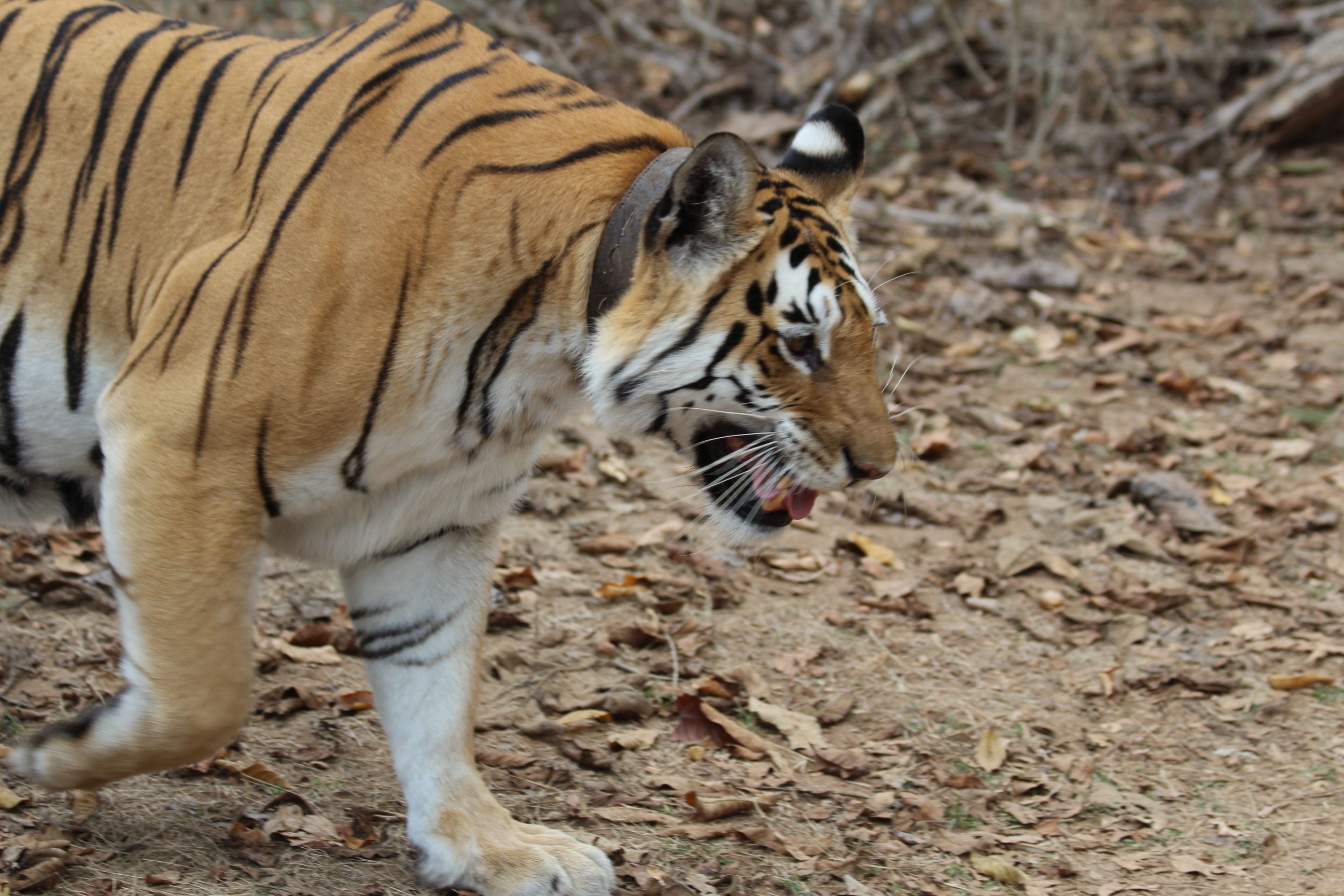
Maybe they’ll get out of the way if I growl

Making a dash for it
Suddenly she dashed across the road. There couldn’t have been more than five metres, possibly less, between our Gypsy and the one behind us. It’s not much when she could have decided to grab a quick meal on her way by.
Our cautious reaction didn’t last long. CV moved on and so did we. It seemed that she had her eye on a small herd of spotted deer, so we stayed on her trail/tail for as long as we could to see if she started to stalk. Tigers often give birth to four cubs, so if CV is pregnant, she is eating for five.
Amazingly, throughout the sighting, our Gypsy managed to maintain one of the best viewing positions. Even now when I look at the pics, I am gobsmacked to think I have been that close to wild tigers. I’m thrilled too.
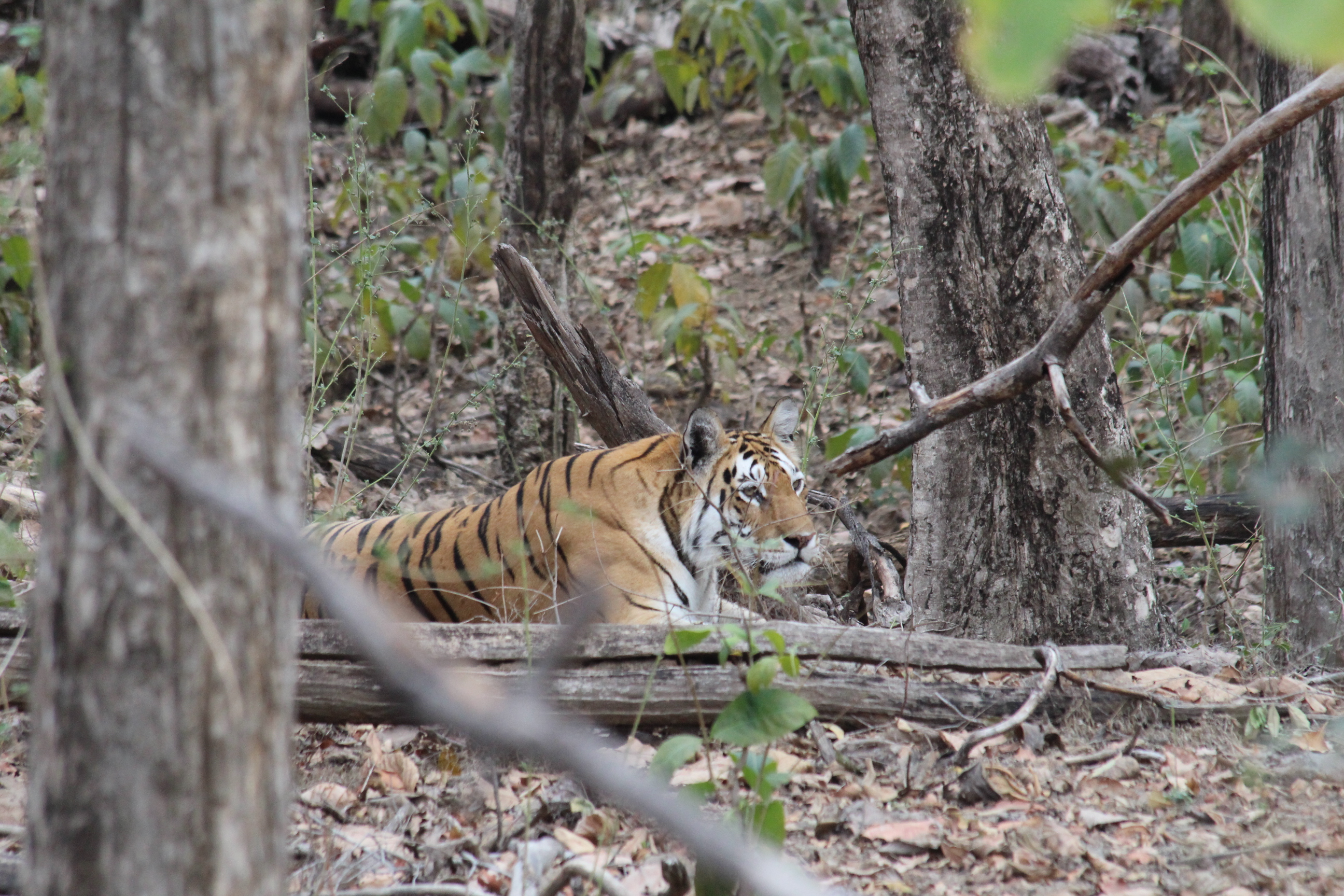
Collar Valley takes a break after escaping from us
Some tiger tidbits
My first childhood memory of tigers must have been Tony the Tiger, a promotional gimmick for a brand of over-sugared cereal targeted at kids.
Luckily, my knowledge has moved beyond that.
Now I know—in fact most of us know—that Bengal tigers are endangered. And no amount of pictures of tigers on the sides of cereal packets will bring them back.
But India is working on saving them, with varying degrees of success. Project Tiger was launched in 1973. It aims to protect and expand tiger habitat so the country can have a healthy population of tigers.
Within 11 years there were 15 tiger reserves covering 24,700 square kilometres. At that time, India probably had just over 1800 tigers.

Back to hunting
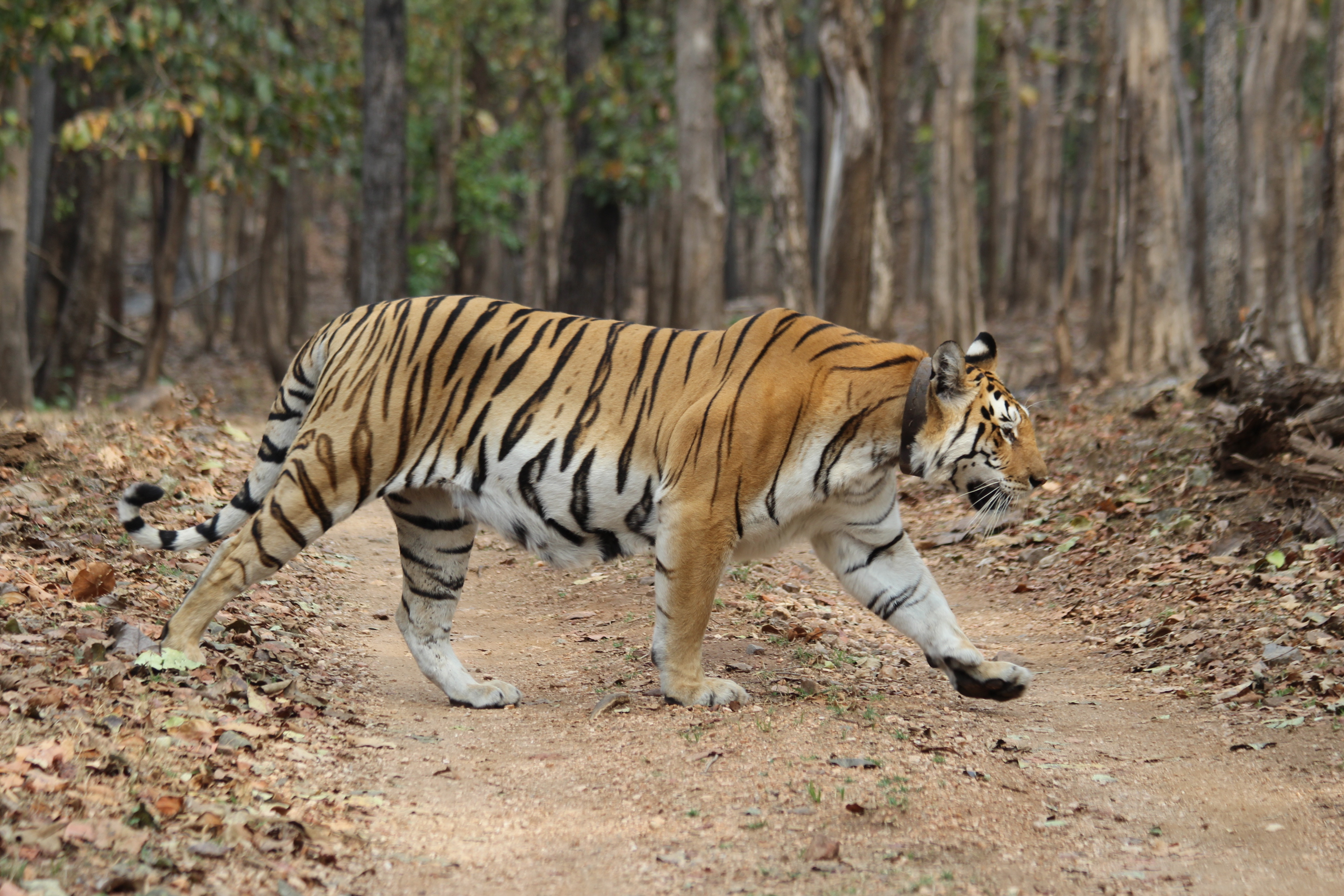
A baby bump slightly more obvious
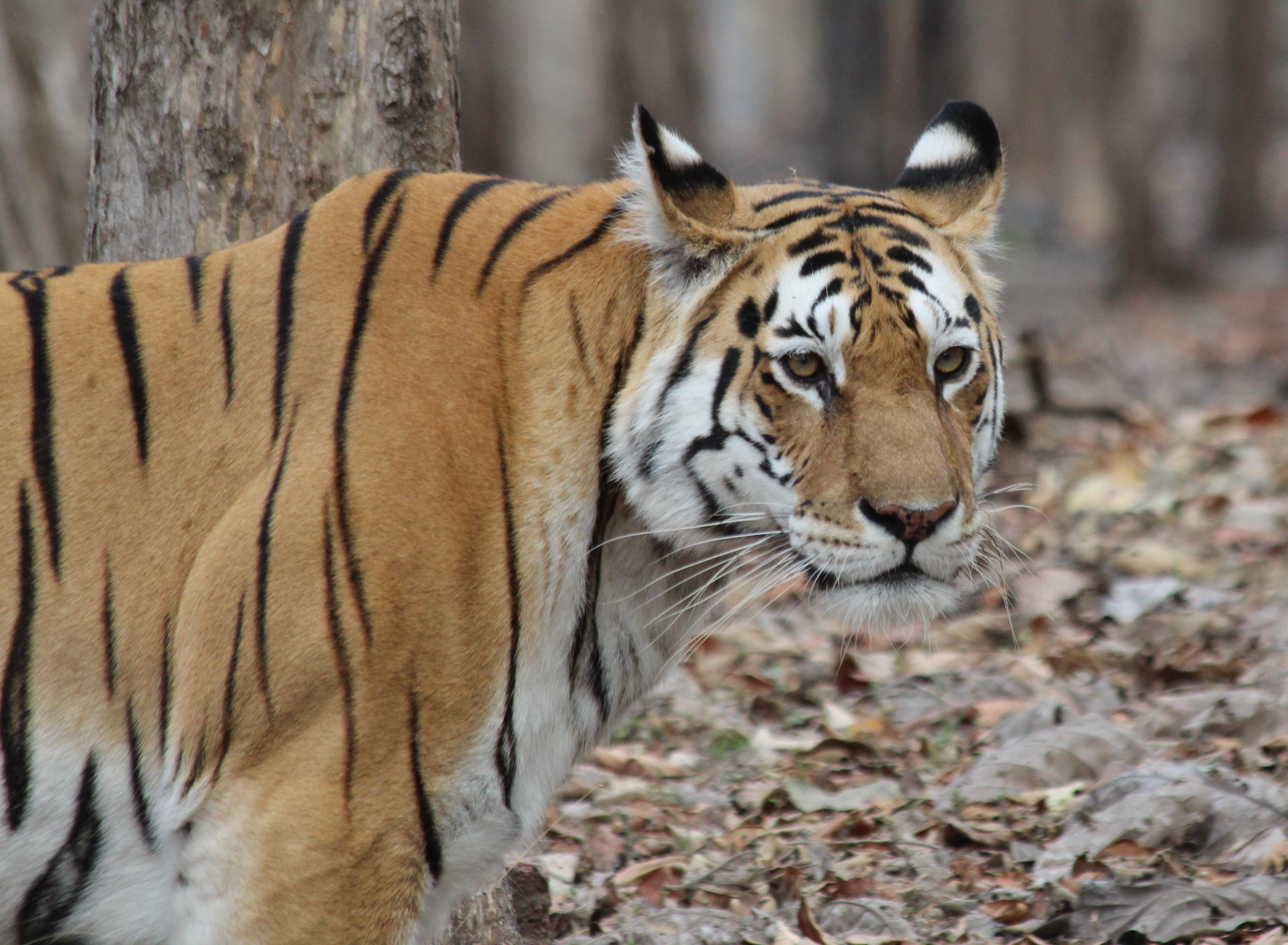
I’ve had a enough of you folks
Numbers doubled by 2002. Then, because of poaching and killings by locals, numbers plummeted dramatically. By 2008, tiger numbers in India were thought to be as low as 1400.
Methods for counting tigers are not foolproof—early censuses relied on identifying the footprints, known as pug marks, of individual tigers. But many reserves now use camera traps so India is fairly confident that numbers exceed 2200.
You’d think a tiger would be easy to spot. As the largest member of the cat family, males can weigh up to 325 kilograms or 700+ pounds. On average, males weigh 500 pounds and females about 350. By comparison, male African lions weigh 300–400 pounds. Including the tail, a typical male tiger measures 270 to 310 centimetres (110–120 inches). Females are a little less.
Every single tiger is distinctively marked and colours vary too. The coat is yellow to light orange. Stripes range from dark brown to black. The belly and inside of the limbs are white. The tail is orange with black rings.

Admire my tail because I’m on my way
Mothers and their offspring are the main social unit for tigers. Females give birth to one to four cubs after a gestation period of just over 100 days. Cubs suckle for about six months, which is about when mum starts to teach them to hunt.
The little ones leave their mum when they are 2–3 years of age. After the family splits, the female comes into heat again.
Without the family unit, tigers lead solitary lives, establishing home ranges that may overlap or at least be near other tigers, especially those of the opposite sex.
Which is good news for all of us who hope that tigers keep going forth and multiplying.
The country’s The Telegraph newspaper had another encouraging news item yesterday. In an effort to promote further conservation, India has decided to provide tigers and training to other countries.
I wonder how they’ll manage providing their favourite foods of chital (spotted deer), sambar deer and gaur (bison)?
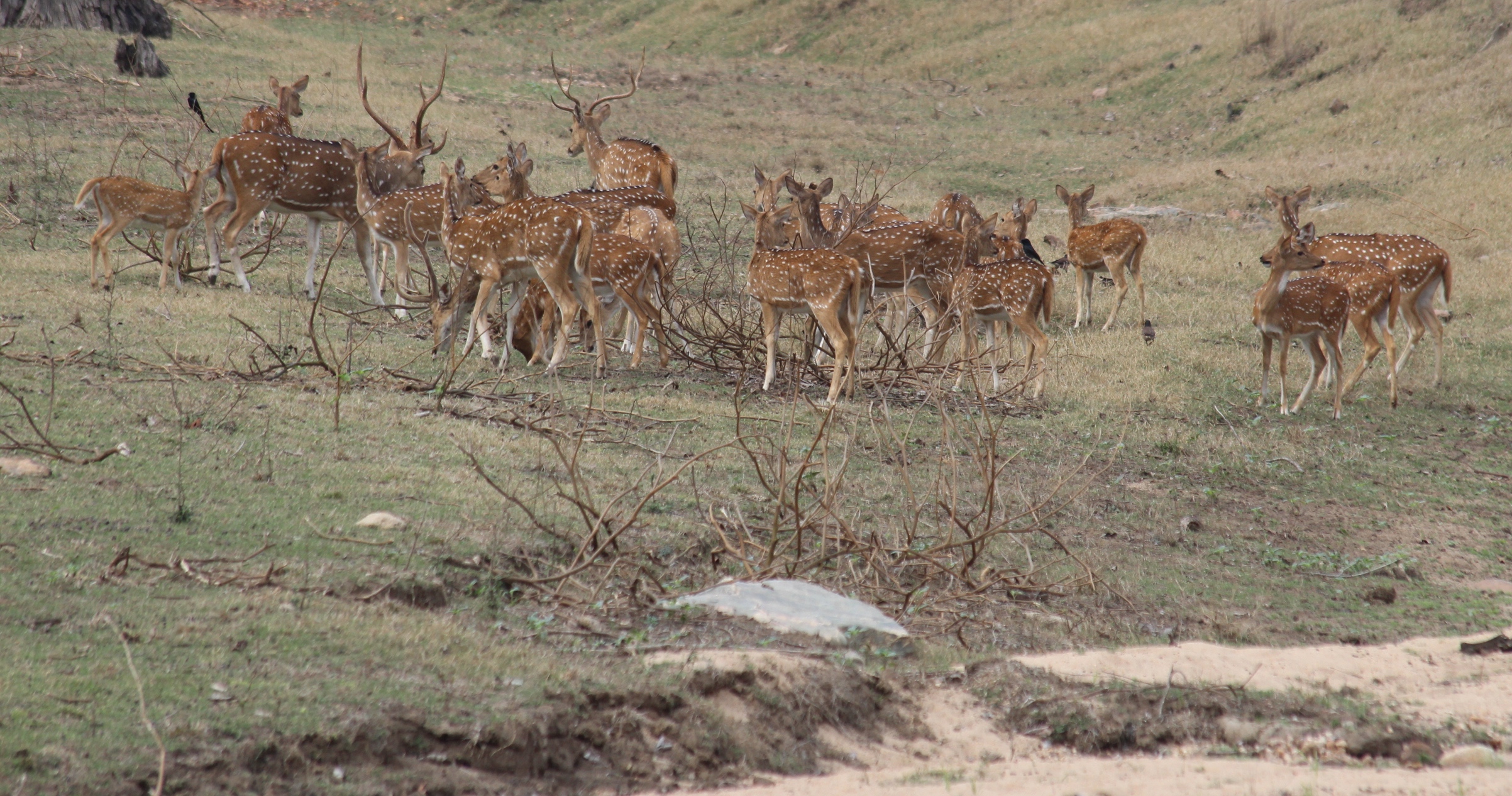
Collar Valley has her eye on this herd of spotted deer

Two-tone apartment block with a wrecked truck as an unexpected sculpture out the front

A common colour combination
Paint is one of the cheapest and quickest ways to transform your home—inside and out.
Some people love big bold colours in their rooms, while others (Poor John is an example) prefer muted colours. Off-white is his favourite, but I don’t let him choose all the colours in our house.
Exterior paint jobs run the gamut too, but nothing quite prepared me for the use of colour in and on Indian homes.
Because we’re travelling around India by road—we’ve already covered 10,000 kilometres on this trip—I’ve had plenty of opportunity to whizz by houses of every colour imaginable.
Once I got over the shock of seeing so many eye-smiting electric green houses with orange and brown verandahs and trim, I started photographing some of the most startling combinations, as well as the most, in my opinion, subdued, which you see just below.


Sometimes a homeowner builds a small shop as part of the house, so you may notice counters and goods. These are still predominantly houses and not businesses.
Virtually all of these photographs have been taken from a moving vehicle, so the angle, focus and amount of house shown vary, but they’re enough to show you just how the imagination takes flight. There are some fabulous ones that aren’t included here simply because I wasn’t quick enough with the camera. Such a pity.
At least interiors stand still and they can be equally creative.


Just above are pictures of Deepti and Anand dining in front of electric blue, and Gary trying to relax in an electric pink hotel room in Jaisalmer in Rajasthan. Gary just happens to be a house painter and while he gets a kick out of the array of colours in use in India, he is appalled by the way paint is slopped around.
We know what he’s talking about when we hear him mutter,
Haven’t these people heard of drop cloths?
Doesn’t anyone know how to tape trim?
But Gary’s pink room is no exception. Pink and mauve seem to rule as house colours in India, along with shades of green (and almost never grey).

One of my favourite combinations. Note the blue driveway gate


Another favourite
The exterior of our small hotel in Kalimpong in West Bengal is pink (no photo because the street is too narrow). Inside and out, the quality of work is fairly good; however, colour choice on the inside is another matter.
In just our room, the walls are chartreuse, the carpet is red (and has been pieced together so there isn’t any carpet under the bed), the trim is brown, the doors are white, the curtains are blue and white floral, the bedding has brown and amber circles, the bathroom has five kinds of tiles with five different colours and patterns, and the ceiling is timber. I’d take a picture but I can’t step back far enough to capture the full impact.
So I’m wondering. Do any of you out there have anything that can compete with these gems. I’d love to see them.
P.S. Interested in more colourful house photos? Let me know and I’ll keep taking and posting them.
P.S.S. If you saw the last post about our daughter getting married, I thought you’d like to know they have arrived in Paris. They’ve shared a sunrise picture from their temporary apartment. Needs a bit of colour!


Libby and Daniel at Inle Lake in Burma. They are travellers too.
Libby and Daniel got married almost four weeks ago in Sydney Australia. Poor John and I were in India at the time. In fact, we still are.
So how do parents miss their own daughter’s wedding?
Two things for the record.
They didn’t elope, and we aren’t in the midst of some family feud.
So here’s how it unfolded. About nine days before we were leaving for India and Bhutan (an 84-day trip that had been planned for many months), I called Libby from Moruya on Australia’s South Coast.
Hey hon, there’s a great sterling silver cutlery set for six here at the market. The price is right, shall I buy it for you and Daniel?
Thanks mum, but no. We’ll probably be moving and I’d prefer to travel light.
Hmm, moving? Could we have this ‘moving’ conversation now?
About three years ago, Libby and Daniel made the much loved Prinzregententorte for my cooking blog. Around that same time, they moved to Sydney. But recently they’ve been feeling ready for a change. Turns out that on the morning I called about the cutlery and after months of waiting and trying not to think about applications, Daniel was offered jobs in Melbourne and Paris, Yeah, the Paris in France.
He was going to take a few days to weigh up the offers and decide what to do. In the meantime, I wasn’t to buy anything. So I got off the phone and bought the cutlery. Good grief, I figured someone would need it.
Of course, he chose the job in France. We are thrilled for them. What a wonderful opportunity and adventure for a young couple.
Then a day or two before we went to Sydney to fly to India, Libby called to say there was a hitch in the new employer’s terms and conditions. For them to be entitled to all the allowances and considerations, they would have to get hitched.
Great, I said. We’ll be there Thursday and you can get married Friday.

Daniel in Kuşadası in Turkey—they were taking pictures of one another

Libby in Ephesus in Turkey—they were taking pictures of one another
Unfortunately, it isn’t that simple in Australia any more. Prospective couples must register their intention to marry, and then wait a month before going through with it.
So instead of going to the registry on Friday to see them marry, we went to see them register. And that night we took them out for a crash-hot ‘rehearsal’ dinner at the Almond Bar, a well-loved Syrian restaurant. Very appropriate because Libby was born in Damascus.
Given that we were going to miss the wedding, I did make one request at the registry. They registered on 23 January and would be eligible to marry on Monday, 23 February.
Can I make a suggestion hon?
Sure, she said.
Thirty-five years ago, your dad and I got married on a Tuesday. I reckon Tuesday is a good day to do anything so why not wait one more day.
So they did. But they kept it simple. While they intended to be together forever, they never planned to marry. Their simple ceremony was on Tuesday 24 February at the registry office with Libby’s sister and Daniel’s mum as witnesses.
In order not to disappoint their many well-wishers, Libby and Daniel organised a Saturday party at the Waverley Bowling Club near where they live. Ahem, we missed that too.
Now they are off to France before we get home. Their departure date is quite suitably 24 March—another Tuesday. And we’ll be going to visit them later this year—most likely on a Tuesday.
Oh, and what were we doing on the day Libby and Daniel got married? We were in Bandhavgarh National Park in Madhya Pradesh. To make that adventure worthwhile we saw a tiger in the distance. On the day of their party we saw two tigers in Pench National Park. I could have reached out and patted one if I hadn’t cared about losing my arm. More about them soon.

Tiger on Tuesday at Bandhavgarh
A few words about us getting hitched
Poor John and I eloped. We hadn’t really planned to do that, but we were in the Middle East and it seemed a huge fuss to go back to the USA and arrange a wedding.
It’s a long story that I’ll tell another time. But enough to say we got married on a Tuesday in Ajlun in Jordan.
P.S. Libby says she’s not ready to share photos from her most special Tuesday. So the pics here are from other times. And I can’t share any from our elopement, because none were taken. Oh, and the cutlery is still sitting on my dining room table.

Pottery cups waiting to be used—with a pot of water in the background
India and Africa are teeming with wildlife, but they aren’t zoos.
You might drive into the wilderness with promises of seeing all manner of wild beasts—but don’t count on it.
We’ve usually been lucky on our safari drives, but we’ve certainly had a few disappointments. Bagheera Camp in Rajasthan was one. Apparently sloth bears came through the camp in the night when we were sleeping. Leopards spent the next morning hiding from us.
The place we stayed after Bagheera Camp said don’t tell anyone you didn’t see a leopard. You must be the first group ever not to see a leopard.
You can imagine that had to make us feel bad—and short-changed—but the reality is there are never any guarantees when it comes to wildlife.
We’ve been in the mangroves of the Sundarbans these last few days (more about them soon) and had the extremely rare pleasure of seeing a tiger. Only a glimpse, but it was still a tiger.

A couple of peacocks enjoying a misty morning
The area around Bagheera Camp is supposed to be teeming with leopards and sloth bears, but we saw only a few peacocks and a lot of rocky outcrops.
In an effort to console us, our hostess took us to the best tea/chai shop she knew. It still didn’t quite make up for not seeing a leopard (we still haven’t seen one on this trip) but it was a fantastic cup of chai—and in the middle of nowhere.
The chai maker has quite a system going with a small fire surrounded by a metal shield to keep out the wind. He cranks a small handle to operate small bellows (I presume) to keep the fire going. When the chai is cooked/steeped/brewed, it is strained through a small sieve and transferred to another pan for dispensing.

A big pot for dispensing lots of chai


The brew is served in small conical-shaped pottery cups that are usually smashed when the drink is finished. I couldn’t bring myself to smash mine, so it is tucked away in my backpack with one sock inside it and another sock cushioning it from the outside.
I’ll let you know if it makes it home. NEWS FLASH: The little cup made it home. Yay!
But back to the chai itself. It was probably the nicest one I’ve had in India—and I’ve had lots. We’ve had one or two a day for more than 40 days. Our hostess says the chai maker has some secrets. He adds local herbs, and she says he can make a chai to perk you up or calm you down. I wonder which one we got?
P.S. We finally saw sloth bears in Barnawapara, but are still hanging out to see a leopard.
P.P.S. Bagheera is the black panther in Rudyard Kipling’s The Jungle Book.
P.P.P.S. We also got to see some local women coming to the communal well to gather water. When you have water flowing freely from taps in your home, it’s very sobering to see what some people have to do to get water.

Village women gather at the communal well for water
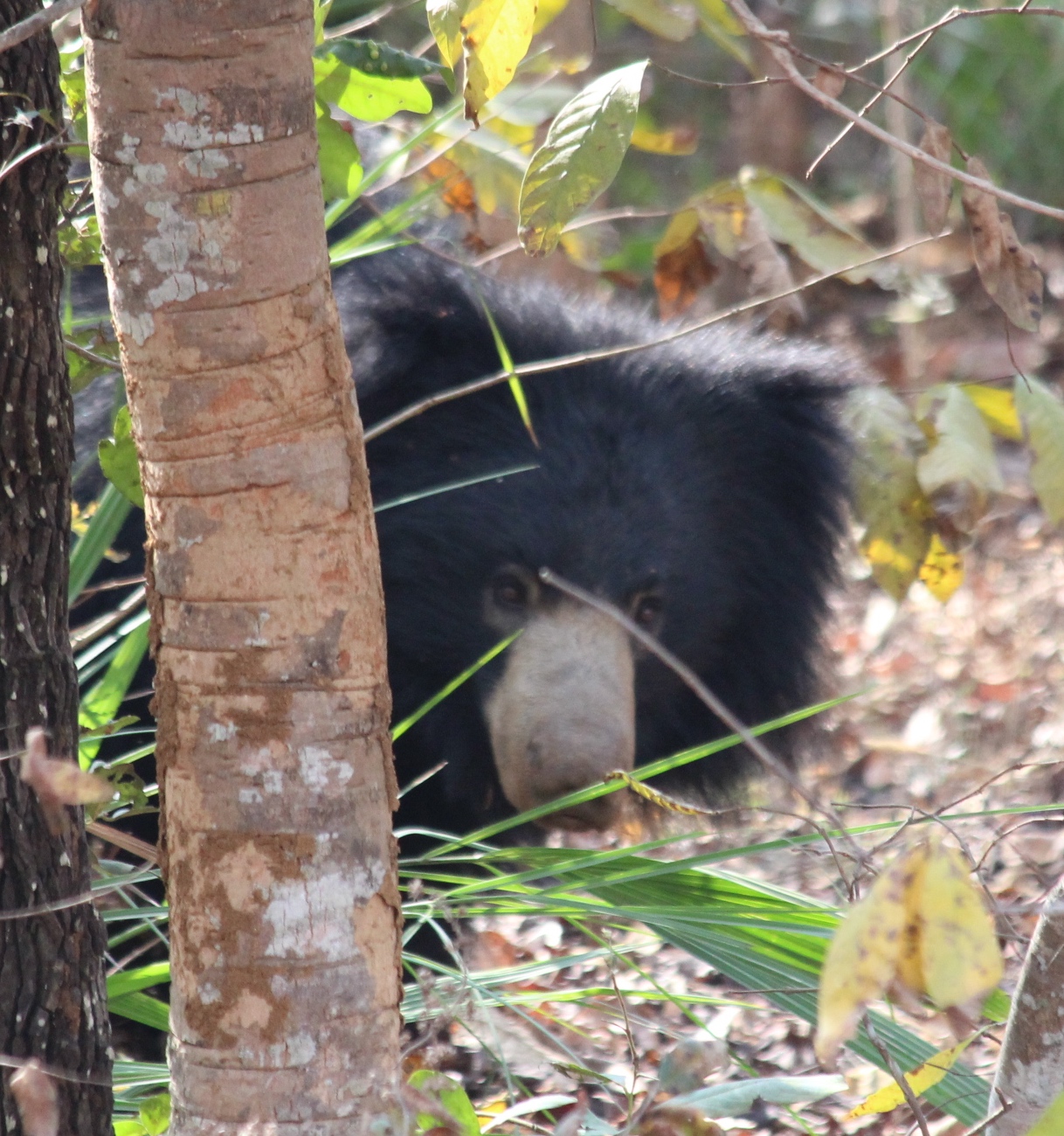
Our second sloth bear is oblivious to our presence
You’ve probably heard of Baloo, the bear in Rudyard Kipling’s The Jungle Book and The Second Jungle Book, written in the mid-1890s.
Baloo and Bagheera, the panther, save Mowgli, the young boy, from Shere Khan, the tiger. In the jungle book stories, the pair are conscientious mentors who strive to teach Mowgli the Law of the Jungle.
In Disney’s 1967 movie, The Jungle Book, Baloo is still Mowgli’s friend and mentor, but he’s much more relaxed. Rather than serious, this bear is cuddly, fun-loving, easy-going, irresponsible and ticklish. He sings and dances, with ‘The Bare Necessities’ being especially popular.
While Baloo is identified as a bear, there’s some disagreement as to whether he’s a sloth, brown or Asian bear. Kipling refers to him as being brown in colour, but all the other descriptions point to him being a sloth bear.
Surely Baloo was a sloth bear
So I’m going to stick with Baloo being a sloth bear.
Maybe that’s because we have all so desperately wanted to see and photograph a sloth bear in India. It’s been a mission ever since Poor John glimpsed one in Ranthambhore National Park in Rajasthan in November 2013.
At that time, six of us saw it, but it whizzed by so quickly that we didn’t get any photos and we could ‘bearly’ describe what we had seen. It was black, furry, shaggy, speedy and low to the ground.
So since this current trip began, with five of the same six people on board, we’ve been hanging out for a decent sighting of a sloth bear. How many sloth bears will we see today?, has been a question to start each safari drive.
We’ve seen and photographed countless animals, but sloth bears have eluded us. That is until we got to the state of Chattisgarh.
Our first camp was at a lodge near Barnawapara. Nothing about the first safari there was promising. About 4:30am, an hour before the drive was to begin, it started to rain—heavily. Good grief, most of the animals we wanted to see don’t like being out in the rain. Leopards shelter under dense brush and sloth bears lurk in caves, all waiting for it to clear.
We decided to drive to the main gate, about 40 minutes away, on spec. It was still drizzling when we arrived and there was unanimous agreement that we wait until afternoon.
Our first glimpse of the gaur herd
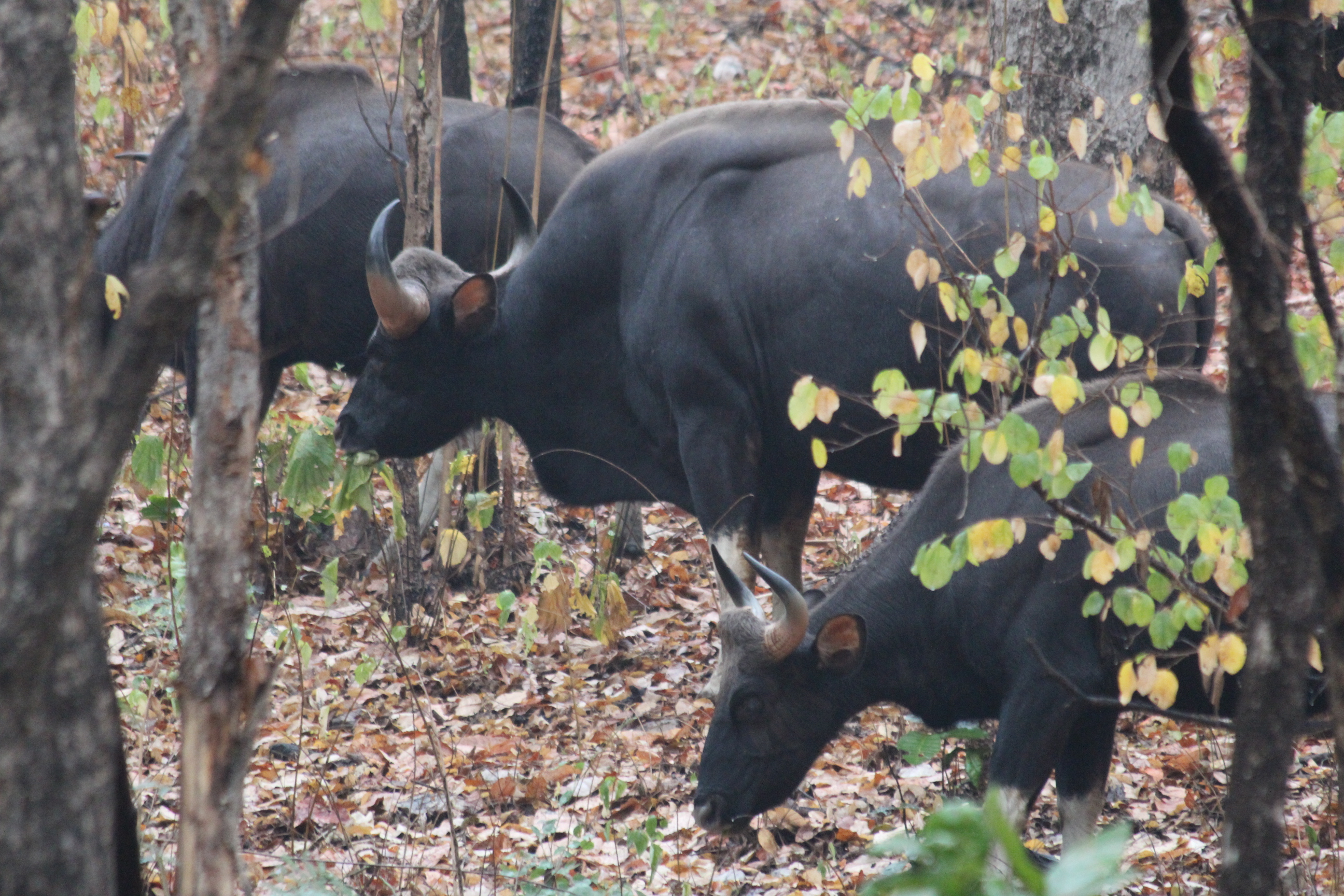
On the way back to camp, we were most surprised to see—no, not a sloth bear—a herd of gaur. Apparently they don’t care about rain. It was a great sighting and we spent 15 minutes or so just watching them plod along in the forest to the side of the road.
We saw plenty of gaur in November 2013, and I wrote about them then. But this was our first sighting on this trip. And we were thrilled to see so many of these enormous beasts. They are also known as bison and Indian cattle, and are the largest cattle in the world.
Anyway, the herd of gaur made the outing worthwhile and we returned to camp with big smiles and hoping the weather would clear for an afternoon drive. By 2:30pm, we decided it was worth another try, so headed back to the main gate.
Our first sloth bear sighting
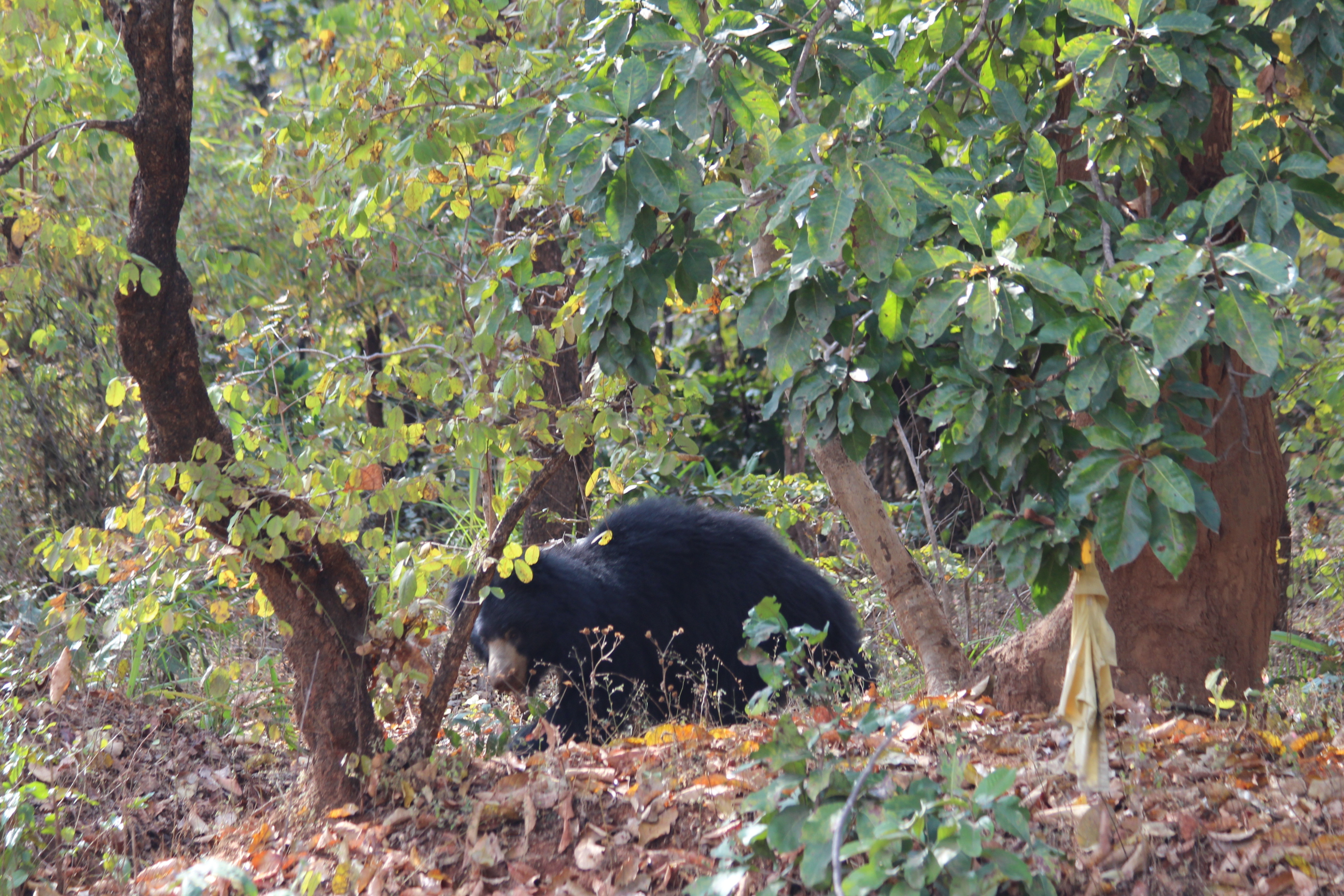
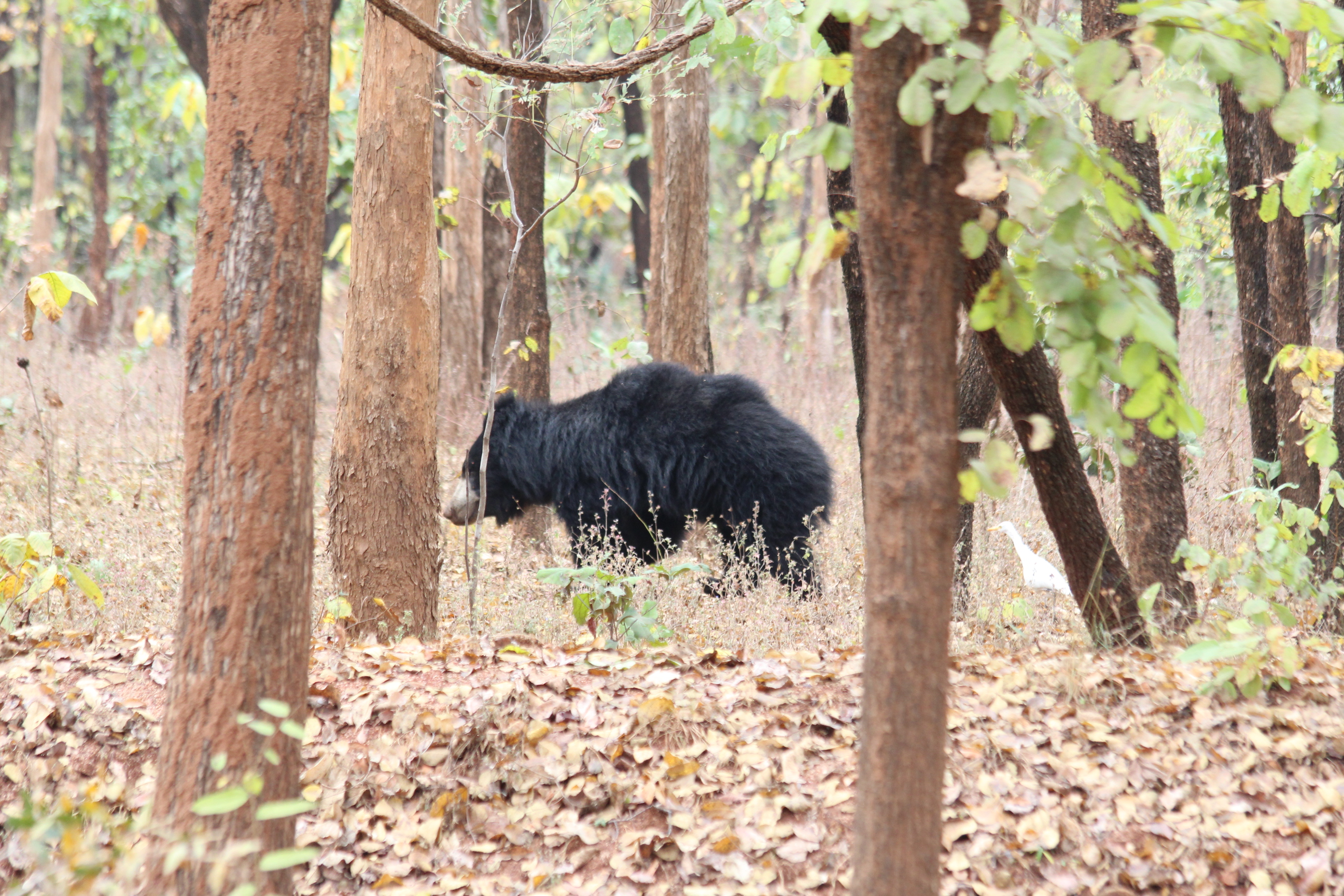
About a kilometre short of the gate, there it was—a sloth bear scrounging around in the shrubs and leaves in search of ants and termites. We were spellbound.
It shambled slowly, about 15 metres from us, partially hidden by all the undergrowth and poking its nose where it did belong. We didn’t get very good pictures, but we watched for five minutes or so before it shuffled down the far side of the embankment and was gone.
Oh wow, oh wow, oh wow! We’d seen a sloth bear and we hadn’t even started the safari drive.
After the sloth bear ambled off we headed on to the main gate to get a guide and driver and board our Gypsy (small 4WD). As we came back out the gate, a fellow pointed excitedly over his shoulder into the bushes.
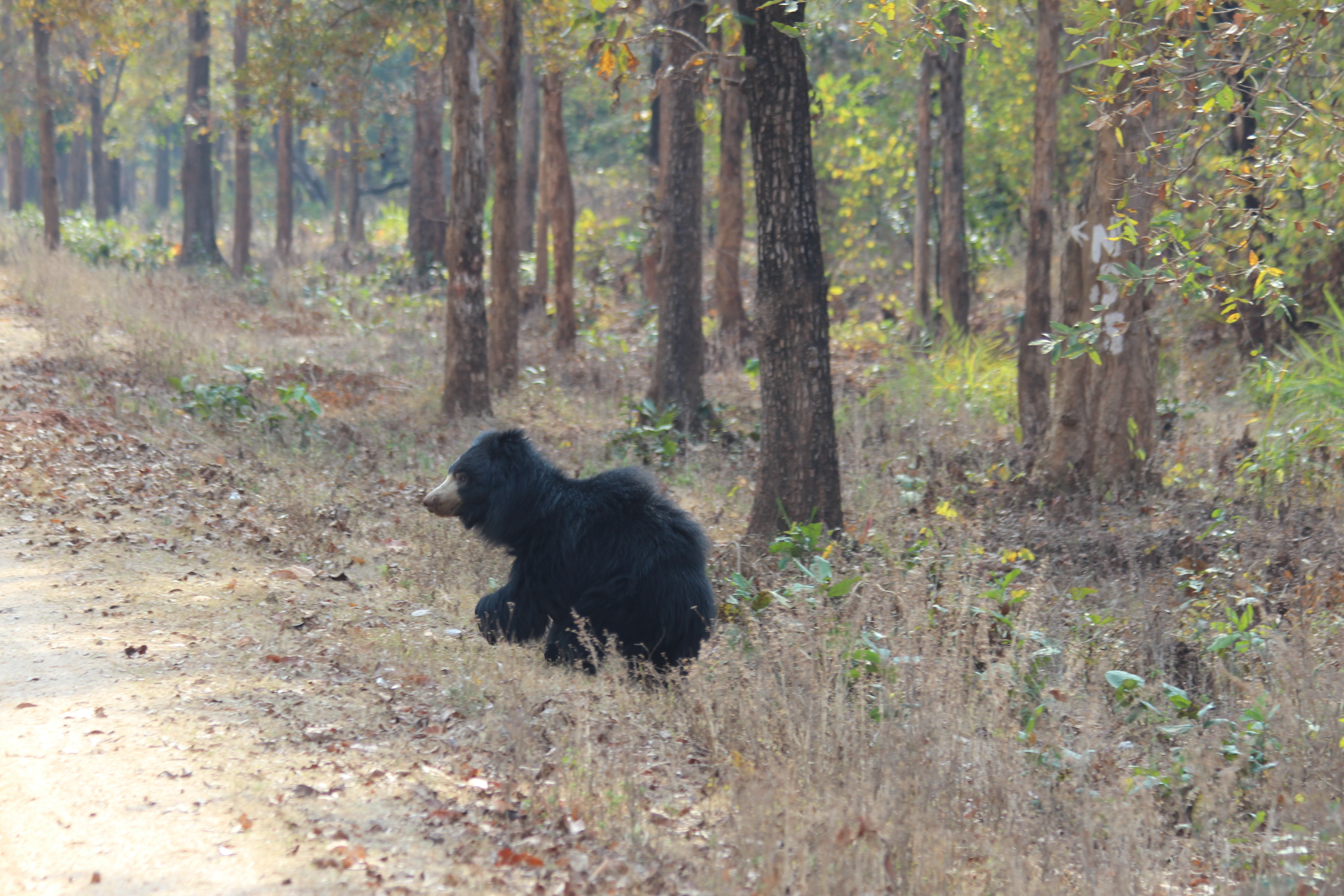
The Gypsy stopped and we all squinted into the undergrowth to see—another sloth bear. We watched for quite a few minutes—the sloth bear ignored us—and we probably could have watched for many more. But along came a group of nosey, giggling and curious teenagers on their way home from school.
Some were on foot, others on bicycles, and they began to approach the bear. It scared the dickens out of the poor thing. It barreled out of the scrub, across the road and into the forest.
Sloth bear on the run 1
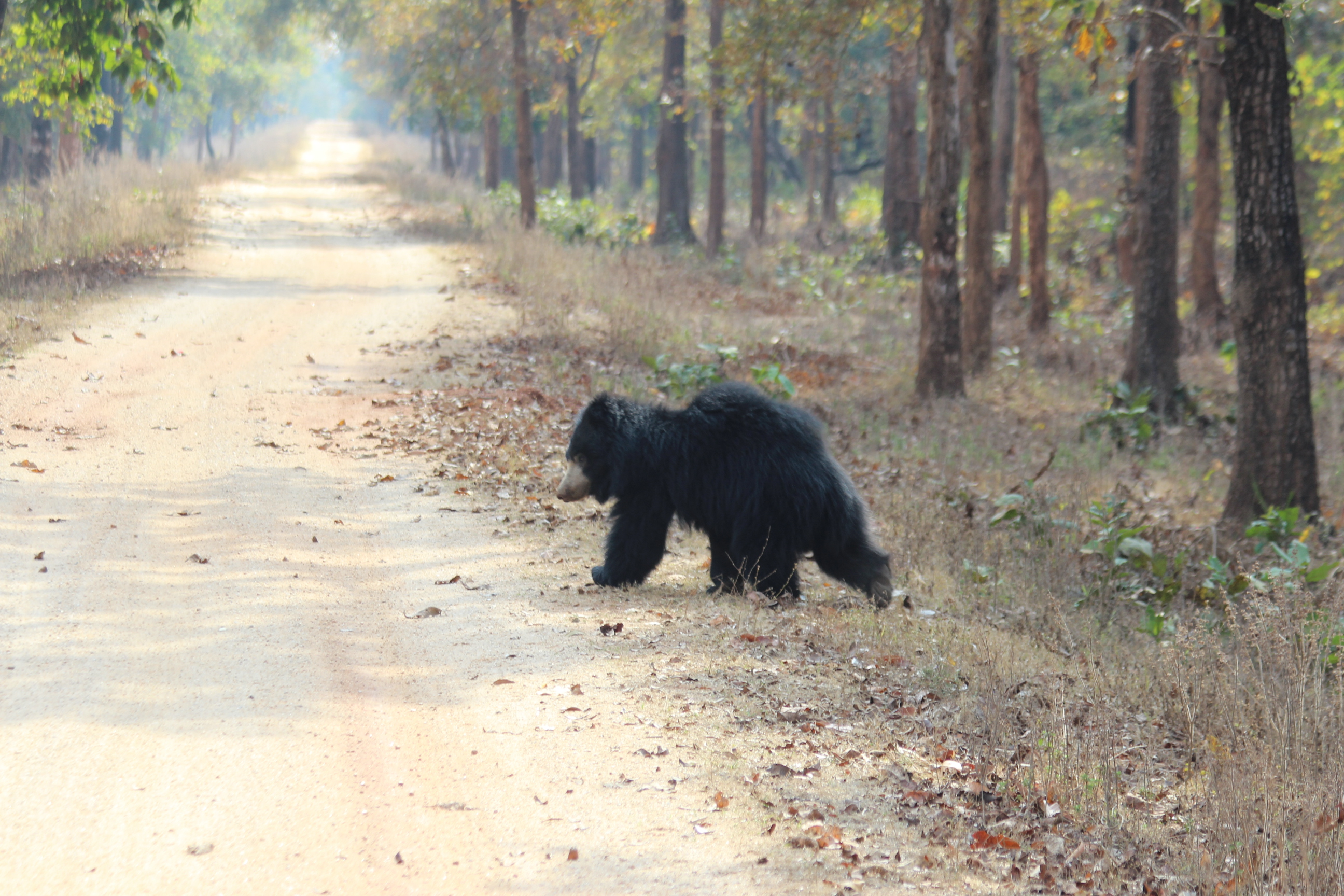
Sloth bear on the run 2

Sloth bear on the run 3

Sloth bear on the run 4
Bummer! All we could think was that this had been a great start to a safari, and hoped it was a good omen for what was to come.
As it turned out, we didn’t see any more sloth bears or any of the hoped for leopards, but we managed to get very close to a couple of gaurs and then another herd of them.
It was only after these encounters that we heard that gaurs had attacked a couple of people in recent times—killing one man. The ones we saw didn’t seem at all concerned by our presence.
But sloths bears, which are native to the Indian subcontinent, are another thing. Remember the helpful Baloo of The Jungle Book and the fun-loving and carefree Baloo of the Disney movie?
Don’t be fooled. Most writings refer to the sloth bear’s aggressive and grumpy disposition. If you get in their way, they would just as soon rip off your face.
According to Robert Armitage Sterndale, in his Mammalia of India from 1884, the sloth bear is ‘more inclined to attack man unprovoked than almost any other animal, and casualties inflicted by it are unfortunately very common, the victim being often terribly disfigured even if not killed, as the bear strikes at the head and face.’
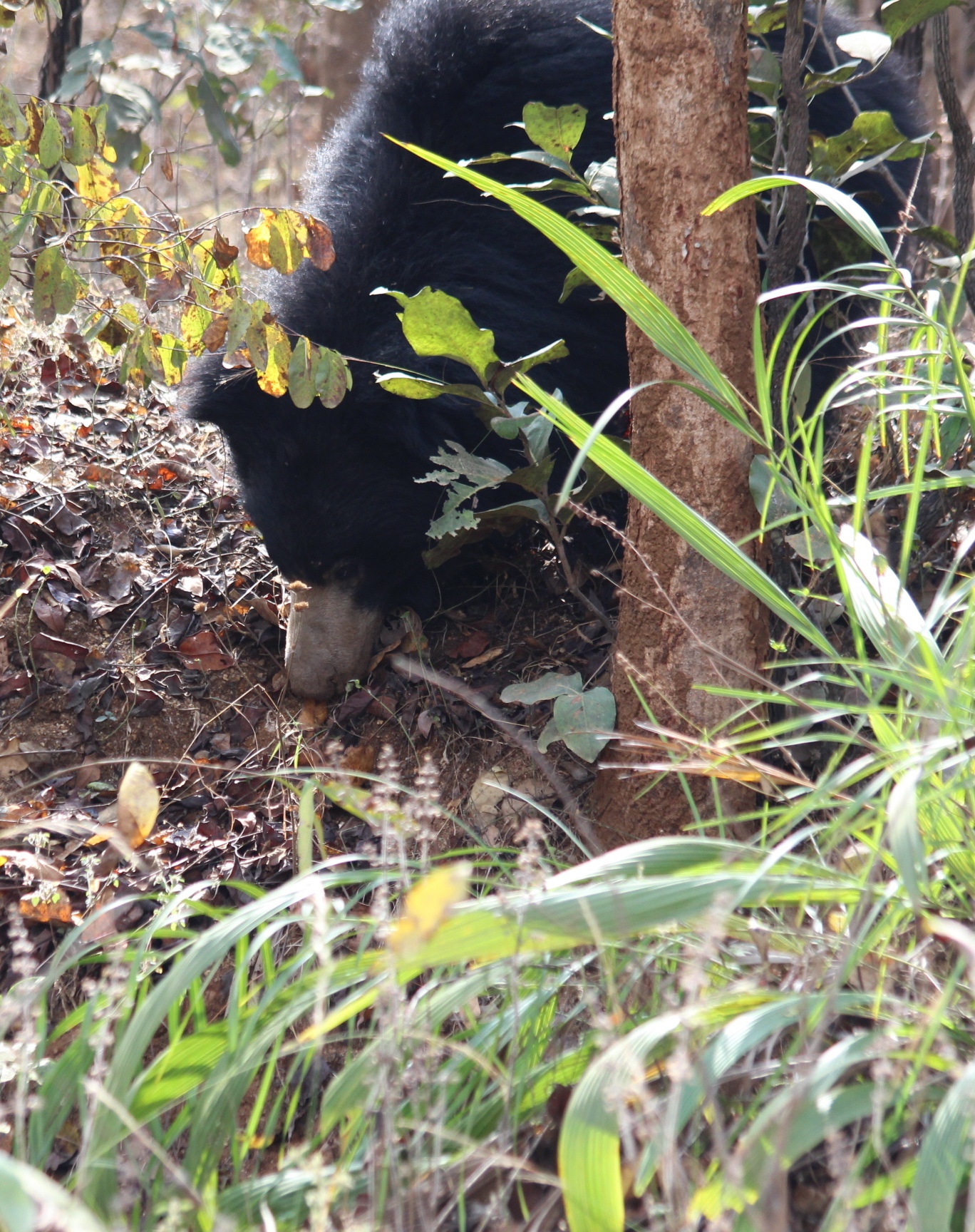
Sniffing for ants
But they are cute. As I mentioned before, they are black, furry and shaggy, with a cream-coloured muzzle, white claws and a whitish V or Y-shaped mark on the chest. They are mostly nocturnal, and feed on fruit, flowers, honeybee colonies, ants and termites. Their sharp, curved claws and sheer tenacity allow them to destroy termite mounds so they can suck out the residents.
I was impressed to learn they could easily wreck a termite mound. In four hours. four of us with an axe couldn’t break through one in Kenya to make an ad hoc pizza oven.
Sloth bears have a lanky build and average about 130 kilograms (290 pounds) in weight and 60–90 centimetres (2–3 feet) in height. They can run faster than humans, climb smooth trees and hang upside down. They don’t hibernate.
Their sharp teeth and generally crabby disposition mean that tigers usually give them a wide berth. Elephants and rhinoceros (yes, there are rhinos in India) do not like them and may charge at them.
Funnily enough, sloth bears can be tamed. There is a history of them being kept as pets and in the 20th century as many as 800 were performing as dancing bears. This practice was banned in 1972, but the last dancing sloth bear was not freed until 2009.
The International Union for Conservation of Nature lists the sloth bear as vulnerable and estimates there are 20,000 left on the Indian subcontinent and in Sri Lanka.
I feel blessed to have seen two. Even if the dense forest meant I didn’t get great photos.
P.S. The camel I rode in the Thar Desert was named Baloo. I’ve learned that the word stems from ‘bhalu’, the Oriya language’s word for sloth bear.
P.P.S. Stay tuned for more pics of the gaur.
P.P.S. Heading into the Sundarbans early tomorrow. It’s the largest block of tidal mangroves in the world. We’ll be out of touch for at least three days, maybe more.
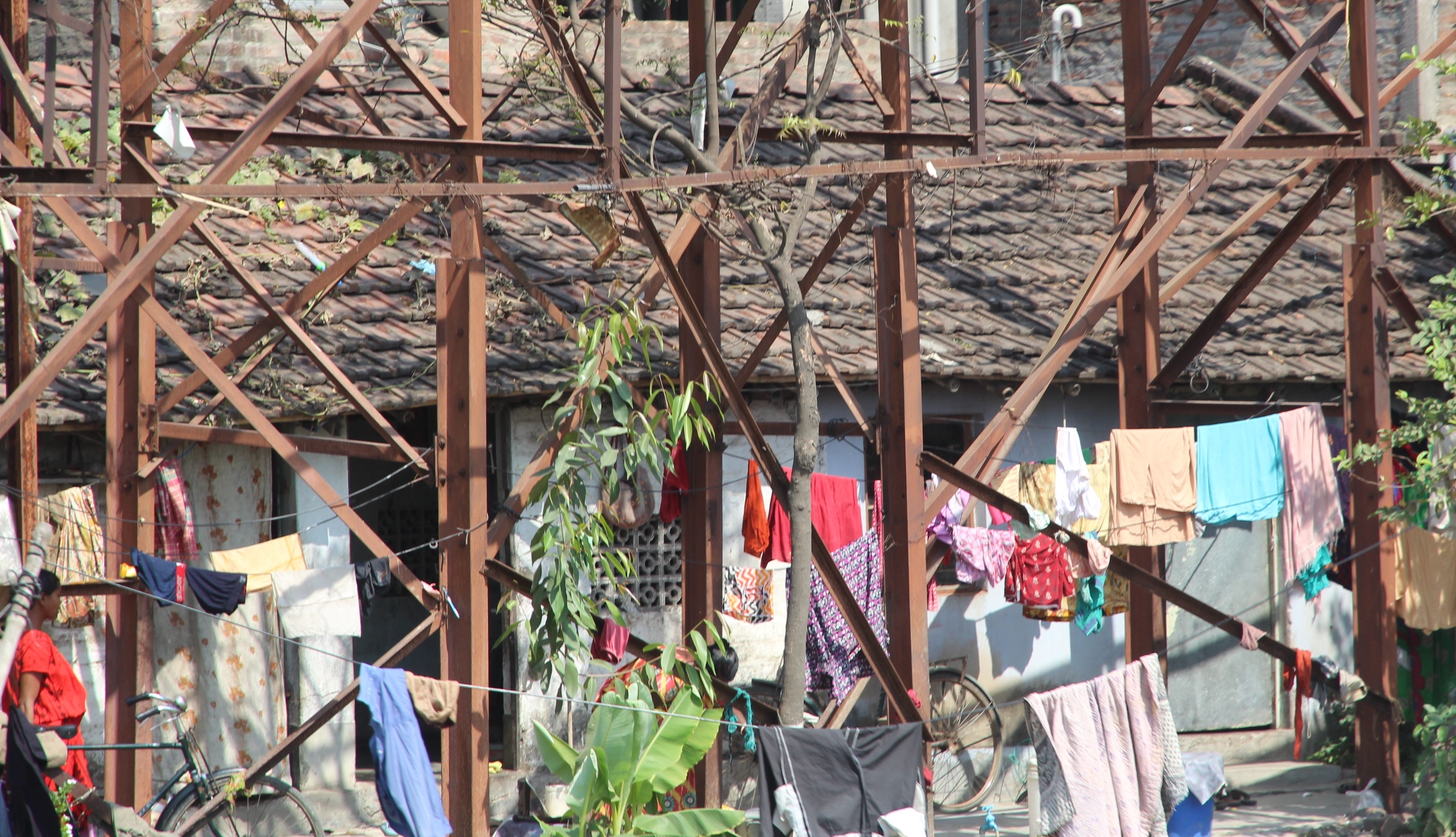
Clothes draped on the base of a billboard
If you’ve followed this blog for a while, you’ll know I hate washing clothes by hand. Oh, I do it, but it’s my least liked household chore. And you might remember that I am also not very good at it.
But you can’t get away from doing it on an overland trip. It dogs me day after day. We wear an outfit for a few days—two is the minimum and five is the max and depends on how far away the next shower is—then change clothes and wash what we’ve been wearing. Luckily, Poor John is a good sport and does his share of laundry duty. We’re both reasonably good at stomping on clothes soaking in a bucket. However, he’s much better at scrubbing and I’m much better at wringing out.

A busy rooftop
Funnily enough, I don’t at all mind hanging out laundry, bringing it in or folding it. In fact, I take some pride in producing a reasonably well-hung line even on overland trips.
Which reminds me of a piece contributed to the Sydney Morning Herald by a reader a couple of years ago. I’ll share it here, and extend my thanks and apologies to the newspaper and Glenda Ellis of Brisbane (the author). I hope they don’t mind.
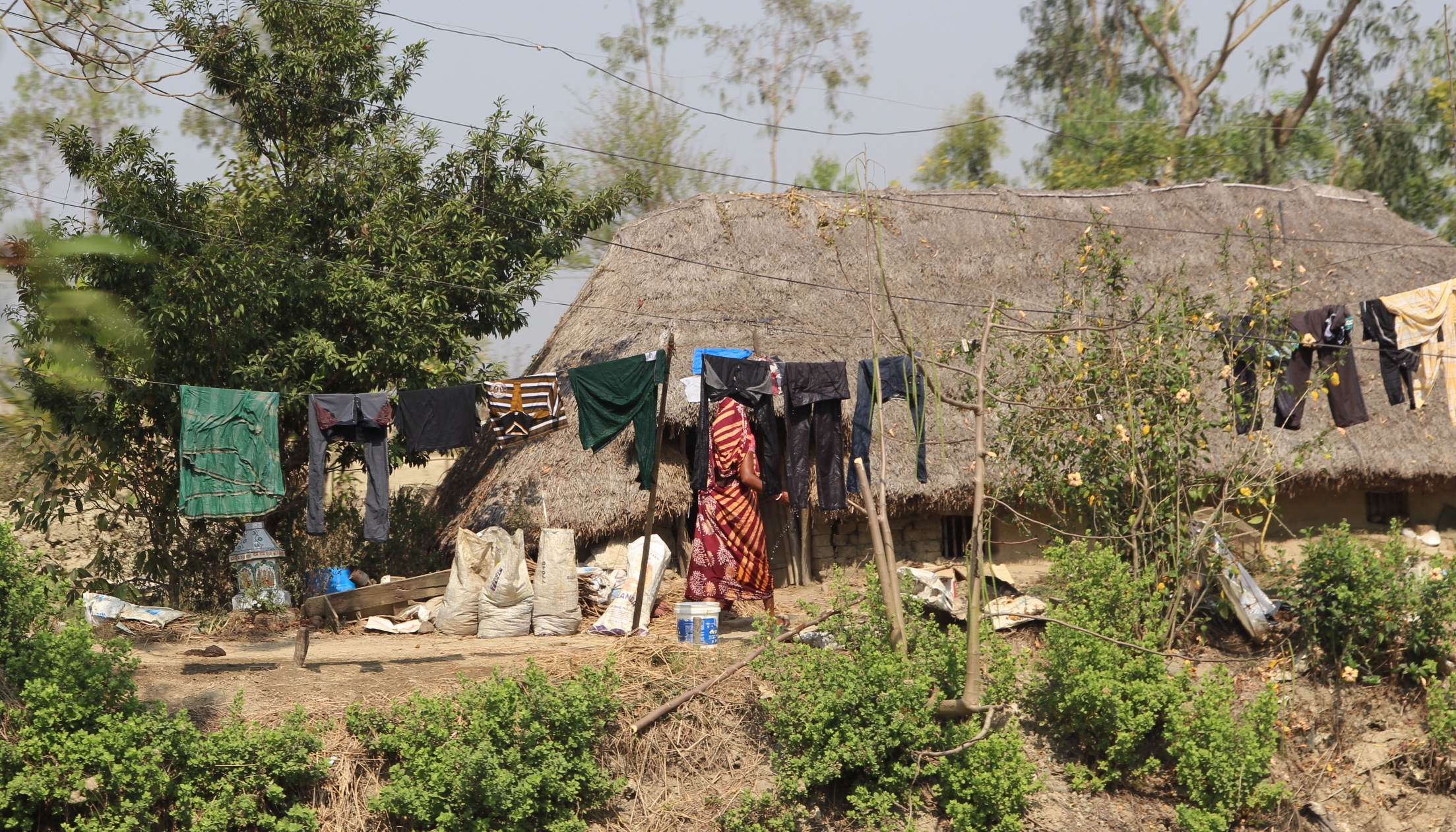
Laundry and a thatched roof too
by Glenda Ellis
‘In the Laundry and Home Management classes at my school in the 1950s, I learnt to admire a well-hung clothesline. Not only did we sort the washing to be laundered, we sorted the washing to be dried, and it still irks me to see haphazard clothing flapping in the breeze. My daughter cannot understand my disappointment at finding a pyjama top far from its other half, let alone pillowcases separated from their pairs and far from one another.
‘Mrs. Frazer (or was it Fraser?) must have had a subliminal impact on me, because if asked to name a teacher who influenced my later life she would not have sprung to mind; at least not immediately. Lately, however, as I have hung washing on the line with new-fangled super-strong plastic pegs, I find myself remembering her classes.
‘She taught Domestic Science at my school during the 50s, and there would not have been a girl who did not regard her as awesome, to borrow a 2012 description. Her cooking classes were nothing like those on the television today. We girls were there to be instructed in the essentials of cooking using The Commonsense Cookery Book, and we were also there to learn Laundry and Home Management. It is the laundry lessons that remain etched in my memory.


‘Until I attended Mrs Frazer’s classes, I was unaware there was a right and wrong way to hang items on a clothesline. I watched my mother for many years as she struggled with the sheets, pillowcases and clothes, pegging things on the line then hoisting it up with the prop to catch the breeze. Her clotheslines were orderly and a pleasure to behold.
‘Mrs Frazer insisted that we peg clothes and other items with the smallest amount of overlap. On the rare occasions my husband puts the washing out, I am mortified to find the towels hung over the line at the top.
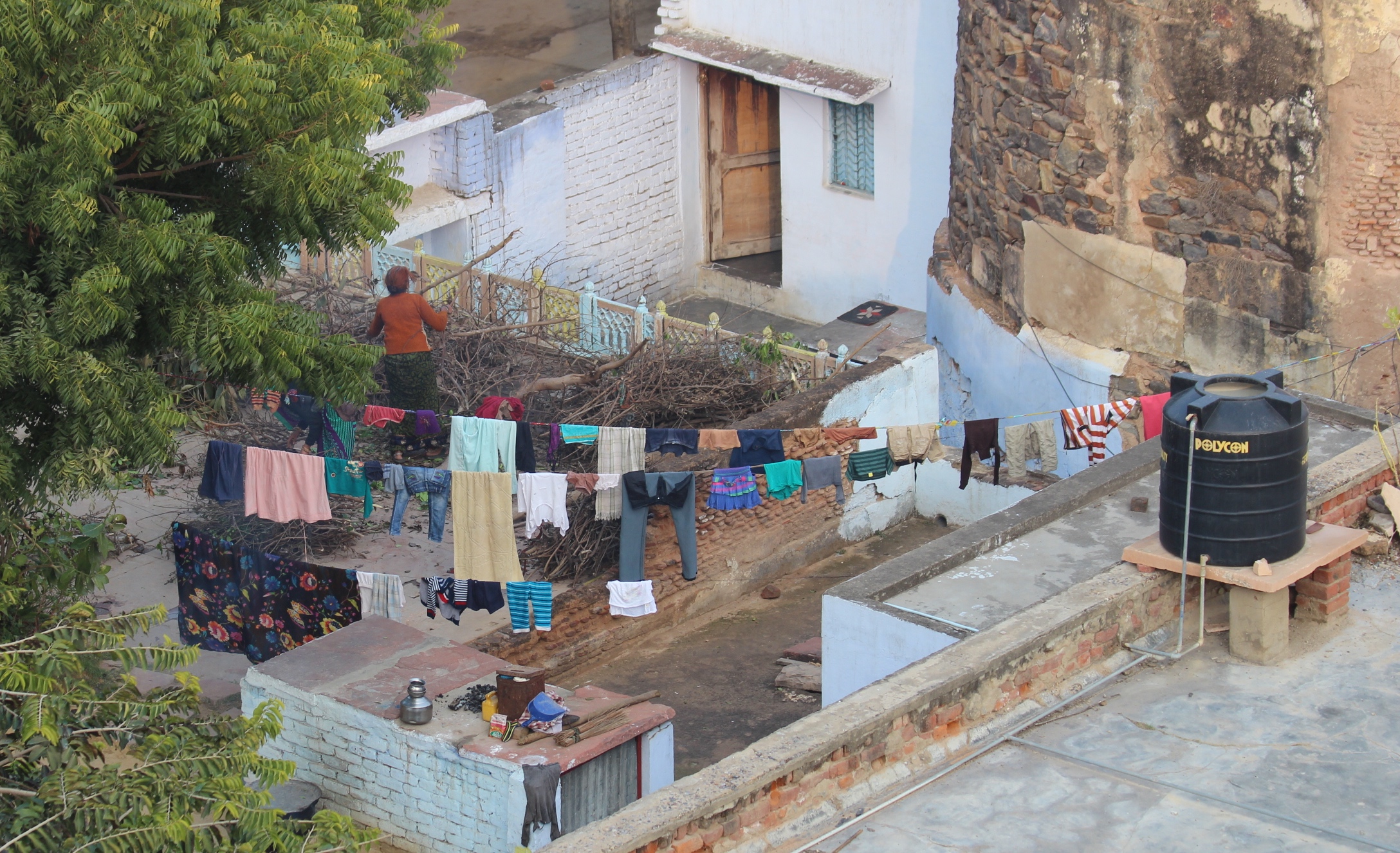
Lots of laundry spread over several lines
‘Doesn’t he know this increases the necessary drying time? His insistence that they dry just the same cuts no ice whatsoever.
‘My daughter has never learnt to arrange a line of clothes satisfactorily, despite my urging. It is not something one discusses over the dinner table, I suppose, and I don’t think it would be a point of debate at parent–teacher evenings nowadays either.
‘I still think of Mrs Frazer. I wonder how she would have managed the fitted sheets of today, and what she would say if she knew I leave my pegs on the clothesline? But I’m sure she would nod her head at my well-hung line.’
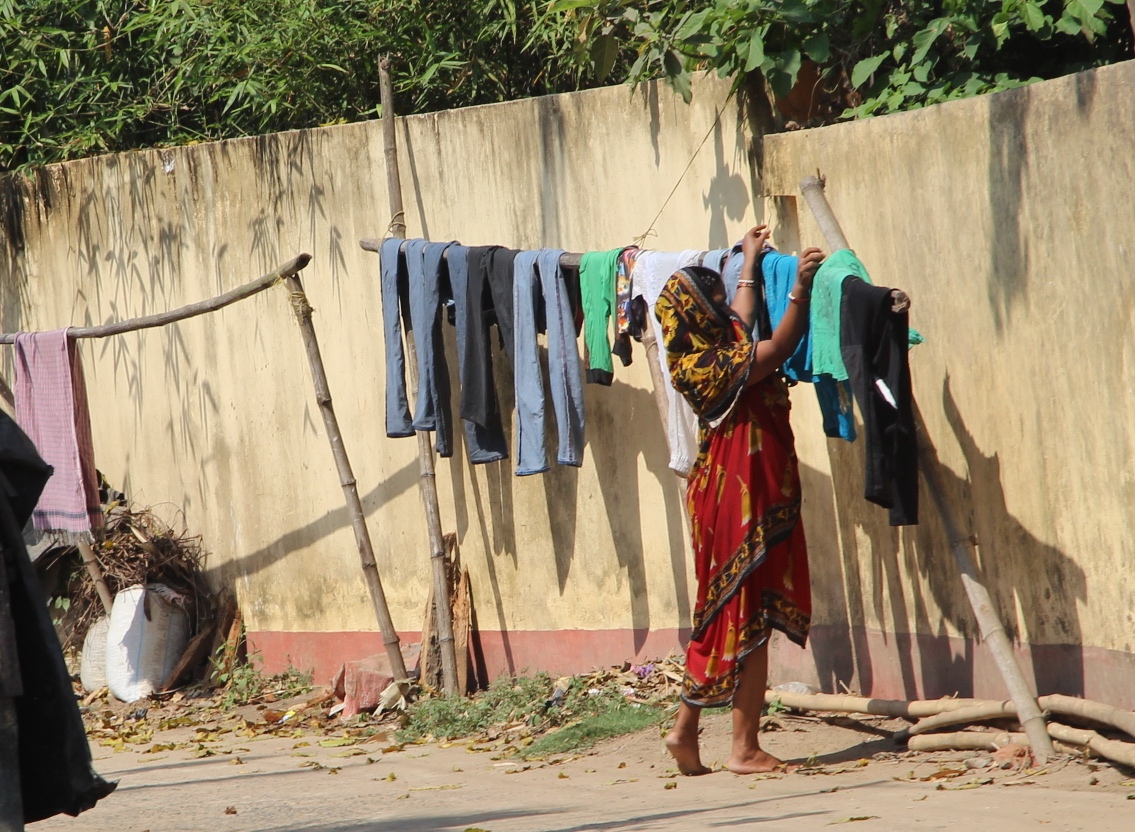
A West Bengali woman creating her own well-hung line
Unlike the author of the above, young people in India probably aren’t taught Domestic Science in school. Some classes might touch on cooking, but I bet there are no lessons on beating your clothes against a rock to get them clean. Not surprisingly, clothespegs (clothespins) are also very difficult to find.
This means clotheslines in India are rarely well-hung. Instead they are almost always haphazard, interesting and colourful. I shared some pics when we were here in 2013, and here’s another batch.
So tell me—how well hung is your line?
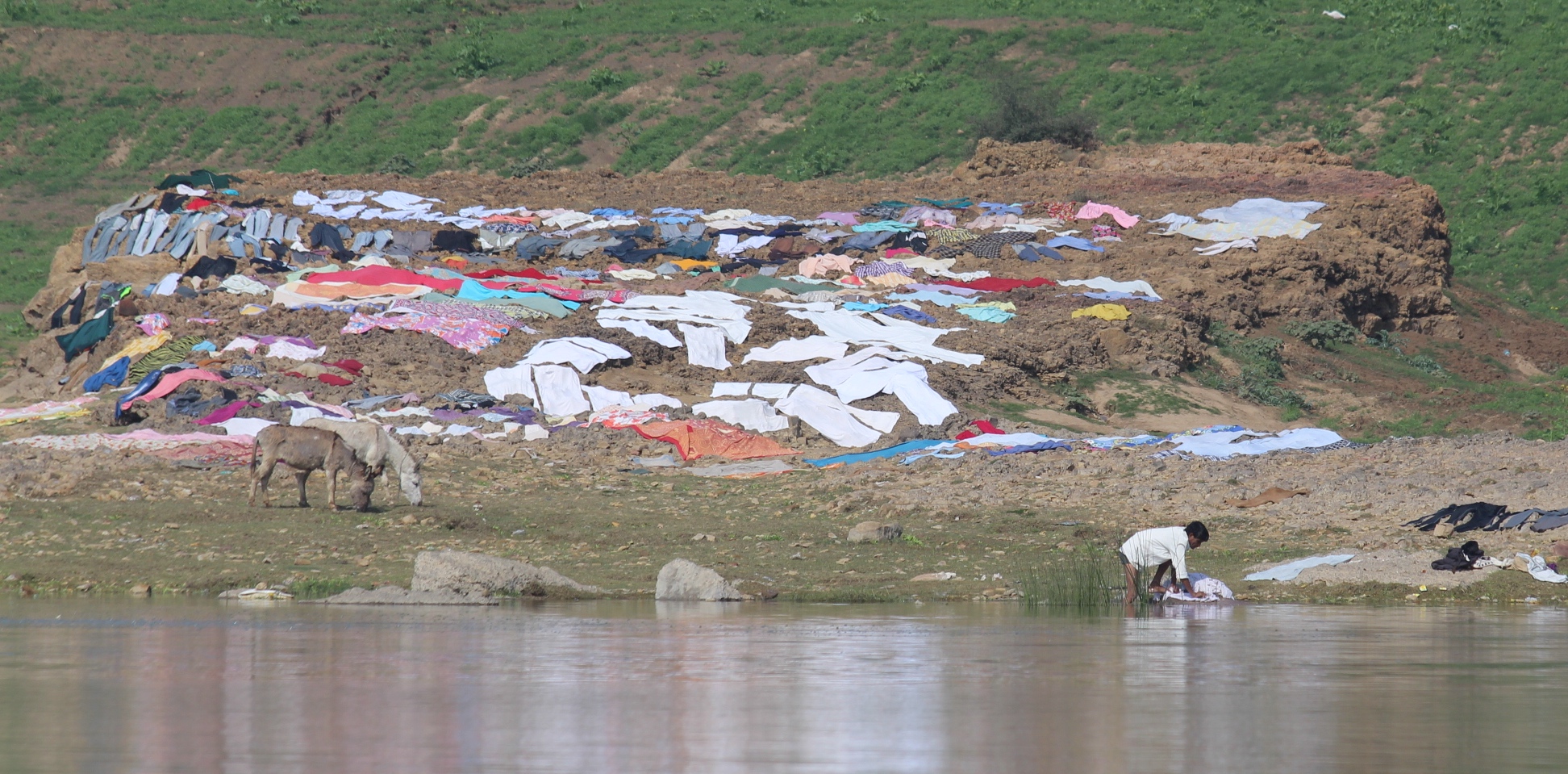
Who needs an actual clothesline?


