

Some of our guides and camels. My guide is in purple. See the little fellow to the left of the guy in turquoise? He less than 10 years old
Poor John is never keen on riding animals. Horses are out. Bull-riding is out. Emus and ostriches are out. Donkeys are marginally okay because, as he says, it’s not that far to fall off a donkey.
So you can imagine he wasn’t at all impressed when he realised that our travels in India included two days in the Thar Desert on CAMELS.
Oh, you should have heard him grumble and grumble and grumble. But he swallowed his complaints, mounted a camel and was heaved high into the air.
He was never sure whether his camel was named Rajah or Roger—he really should have his hearing tested. Although to be fair, his confusion was compounded by the fact that two other camels on the trek were named Robert and Rocket.

One of two long drinks the camels had in two days

Robyn’s leopard camel
You might remember that I was on Baloo, who nearly dumped me in a water trough in the first 15 minutes. But once we got past that scare, we were off with our food provisions, cooking gear, bedding, luggage and many litres of water securely tied on the rumps of eight camels.
Baloo had the dressiest ‘outfit’, Rajah/Roger’s gear looked like men’s pyjamas, Robyn’s camel looked the most interesting with his naturally-occuring leopard spots and Sherry’s camel kept calling for his wife, who had apparently run away recently.
In addition to camel quirks, it was an awkward and uncomfortable start until we asked if someone could help us put our feet into the makeshift stirrups. Luckily, the guides were quick to oblige. Even though the saddles were well-cushioned and quite comfy, none of us would have survived two days on camels with our legs dangling in midair.

Poor John’s camel with new riders. The young handler is sitting in front

Dinner time for camels
Musa was Baloo’s camel handler. He’s grown up in the desert and is a farmer and tour guide there. He said they usually grow two crops including one that provides feed for camels, but he said drought conditions for the last few years have hampered/killed most of the farming. I’m guessing tourism keeps him and his family going.
But Musa and the others are perfect for the tourist job. Whenever we arrived at a ‘destination’, they were straight into starting the cooking or setting up the overnight camp.
And they made excellent food, given the primitive circumstances. I wouldn’t want to have to build a fire and cook a half decent meal in a windy desert.

Making lunch
But the handler who impressed me most was a young boy who was aged no more than 10. A couple of the handlers seemed to think he was only seven. This young boy owned one of the camels, so was allowed to join us on the expedition and be its escort. No doubt, he should have been in school.
I never caught his name, so I’ll call him Mowgli. Mowgli was fearless when it came to camels. He had his own and everyone else’s under control. He also helped set up camp, care for the camels, gather wood for fires and serve meals. I wonder if true desert expeditions will last long enough to keep him happily employed for the rest of his life.


One of our stops was at the handlers’ village. Based on the artwork painted on doors and the women’s dress and preference not to have their faces photographed (the men didn’t mind), we wondered if the ‘tribe’ was originally from Afghanistan. They didn’t claim any such link and thought they and their ancestors had always lived in the Thar Desert.
But back to the expedition. Aside from my near tumble, the jaunt went smoothly. Oh wait, there was a stretch where the fellows got the camels trotting and all I could wish for was a sports bra.
When we camped for the night, most of the camels and crew went home for the night—we hadn’t travelled far and probably in a circle. The fellows who stayed behind cooked and offered to fetch beers for us. How could we resist after a day spent in the hot sun.
Then it was time for bed. We’d brought our sleeping bags and the crew provided mattresses and coverlets. After a couple of beers, Robyn, Sherry and I managed to completely miss the pile of mattresses and instead spread coverlets on the ground. The sand was soft enough but the extra thickness of mattresses would have provided some good warmth in a chilly desert.

‘Red’ gets comfy on a mattress
Robyn scored some surprise extra warmth. In the middle of the night, someone tossed a mattress over the bottom half of her sleeping bag. In the morning, that’s where we found ‘Red’, the dog that had followed our entourage for most of the previous day.
Turns out Red—we gave her that name—didn’t belong to our fellows or their village. She’s a caravan groupie, following those who give her handouts and moving on to a new group when the current party disbands.
When we dismounted, Red trotted off quite happily. And we moved on for a night in a desert ‘resort’.
I get a kick out of the word ‘resort’ in India. This one promised luxury tents, hot showers, a buffet dinner featuring Rajasthani dishes, and a unique show of local dancing and music.


Oh my, the promises they make! The tents were large, a bit grubby and the canvas doors wouldn’t close. Toilet paper was not provided, but towels were. The water ran freely but never ran hot. Dinner came about 9pm (we were starving). And most of the show reminded us of one we had seen in Ranthambhore in 2013, except the costumes were much more elaborate.
I think we all would have been just as happy sleeping another night on the sand. Even Poor John had to admit that the trek was much, much better than the one he so hated in the Sahara Desert in Mali six years ago. But that’s another story.

Thar is the world’s most densely populated desert
About the Thar Desert
Also known as the Great Indian Desert or Marusthali (Land of the Dead), the Thar is the world’s 17th largest desert, and the most densely populated. It straddles India and Pakistan (about 85 per cent of it is in northwestern India) and has an average of 83 people per square kilometre. In India, it spreads over four states and covers 320,000 square kilometres.
We travelled into the Thar from Jaisalmer in the state of Rajasthan. I was surprised to learn that about 40 per cent of all Rajasthanis live in this desert.
Most of the desert is shifting dunes, and the high winds that occur just before the monsoon mean the landscape changes dramatically each year. Rainfall is scarce with no more than 20 inches a year and often as little as four.


That said, there is a rich mix of vegetation, human settlement and animal life. Wells and tanks supply water, and the Indira Gandhi Canal brings irrigation to northwest Rajasthan. This allows locals to grow some crops and raise livestock. In fact, almost 50 per cent of India’s wool comes from this area.
There are also concerted efforts to grow more trees in the desert, especially Prosopis cineraria and Tecomella undulata, which are valued as all-round trees. Camels, goats and sheep can eat the leaves, flowers and pods. The wood can be used for construction and made into farming implements.


Thar is also home to more than 110 species of birds, and almost 50 species of snakes and lizards, as well as varieties of antelope and deer. We hoped to see a desert cat or fox, but our wildlife sightings were limited to birds, a beetle and a couple of deer.
The landscapes reminded us a lot of deserts in Africa.
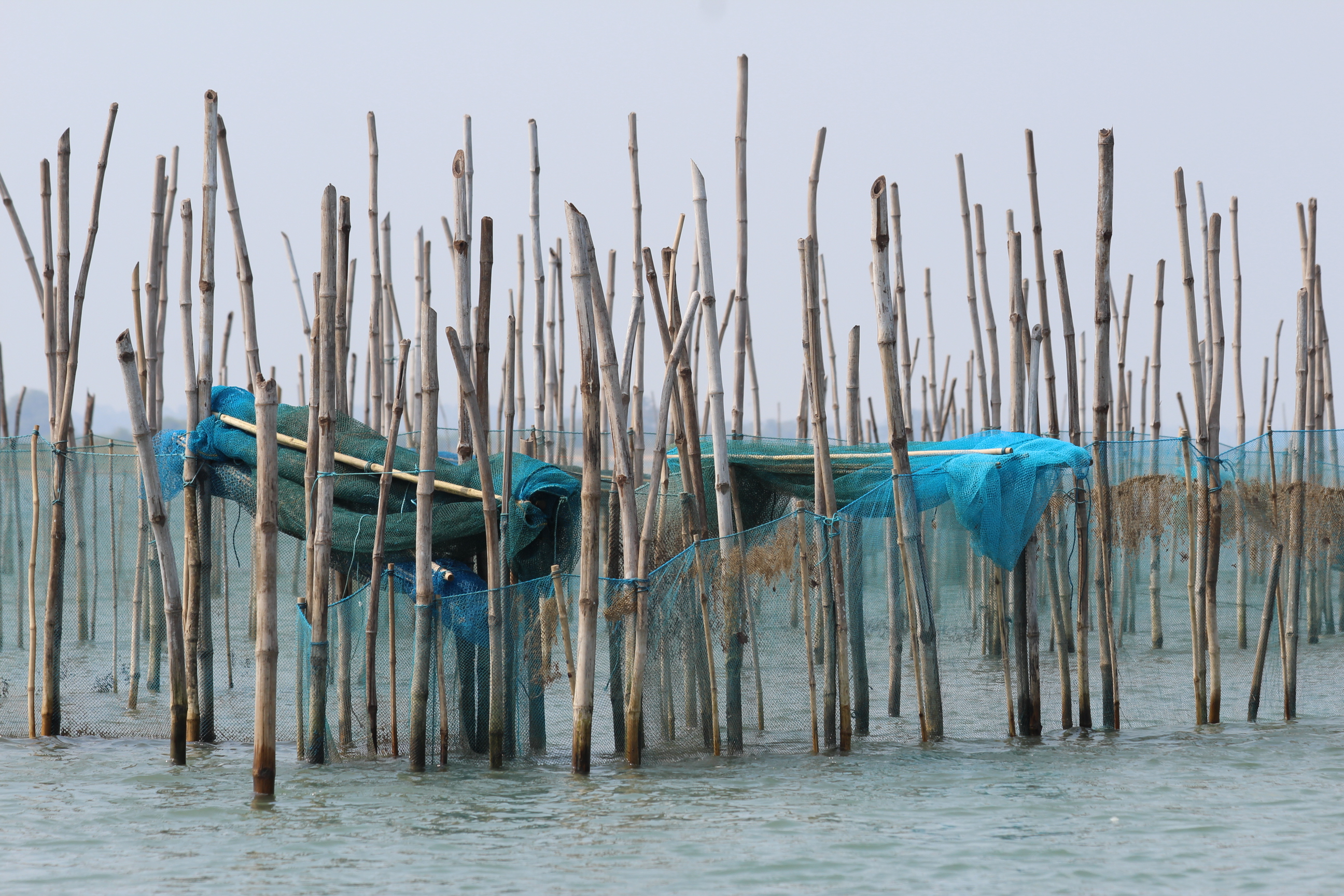
Nets abound in Chilika Lake
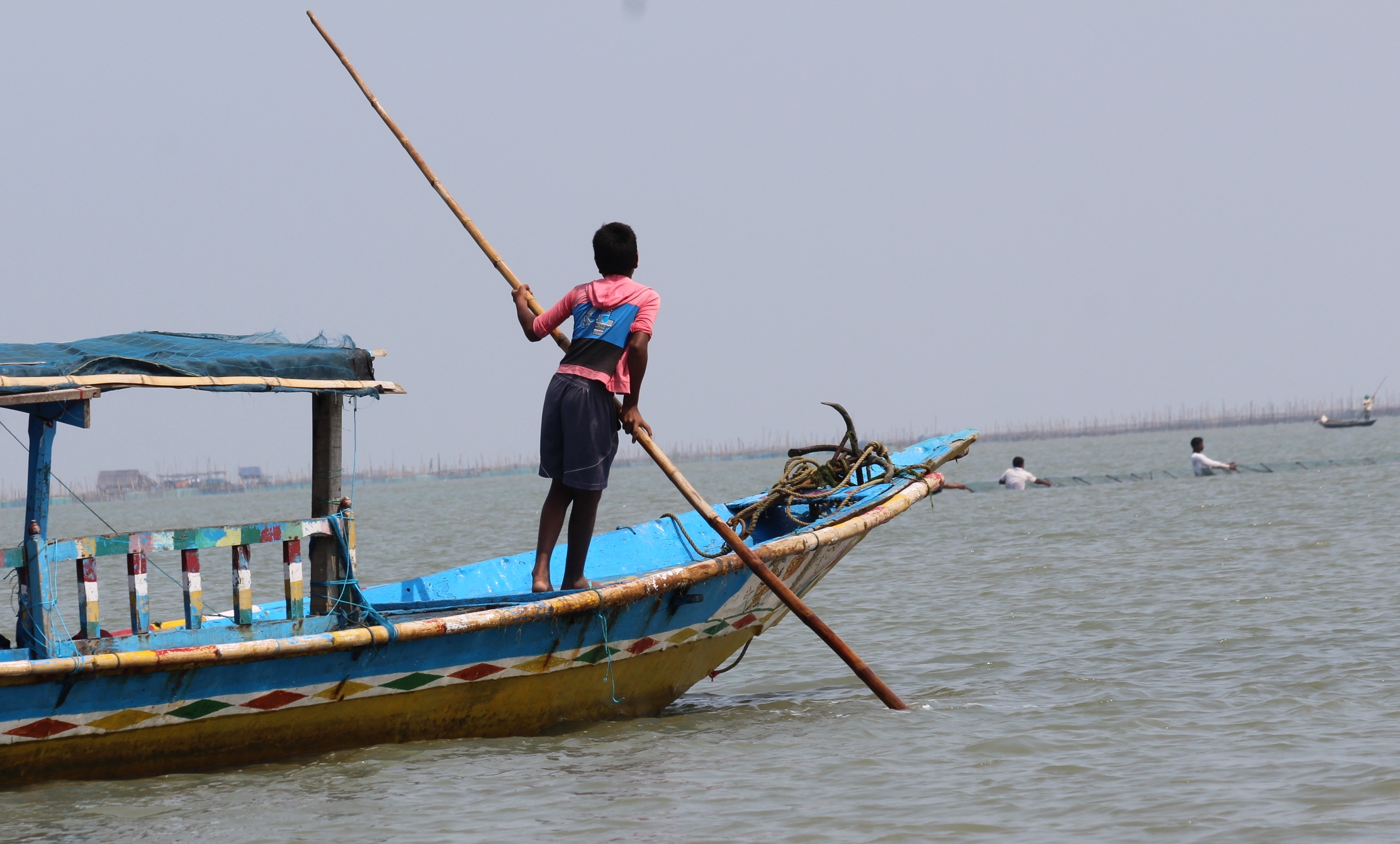
The boat minder watches the nets being dragged
Chilika Lake in the Orissa state in eastern India is Asia’s largest brackish lagoon. Separated from the Bay of Bengal by a 60-kilometre-long sandbar, the lake is home to more than a million migratory birds and who knows how many fish.
We didn’t see many of the birds. They flock to a particular island that is now off limits to tourists without a permit. We were told that a while back too many tourists (not foreigners but Indians) left too much rubbish around the island and many birds died after eating the junk. You’d think they just ban everyone from taking food and containers aboard the boats that cruise the lake.
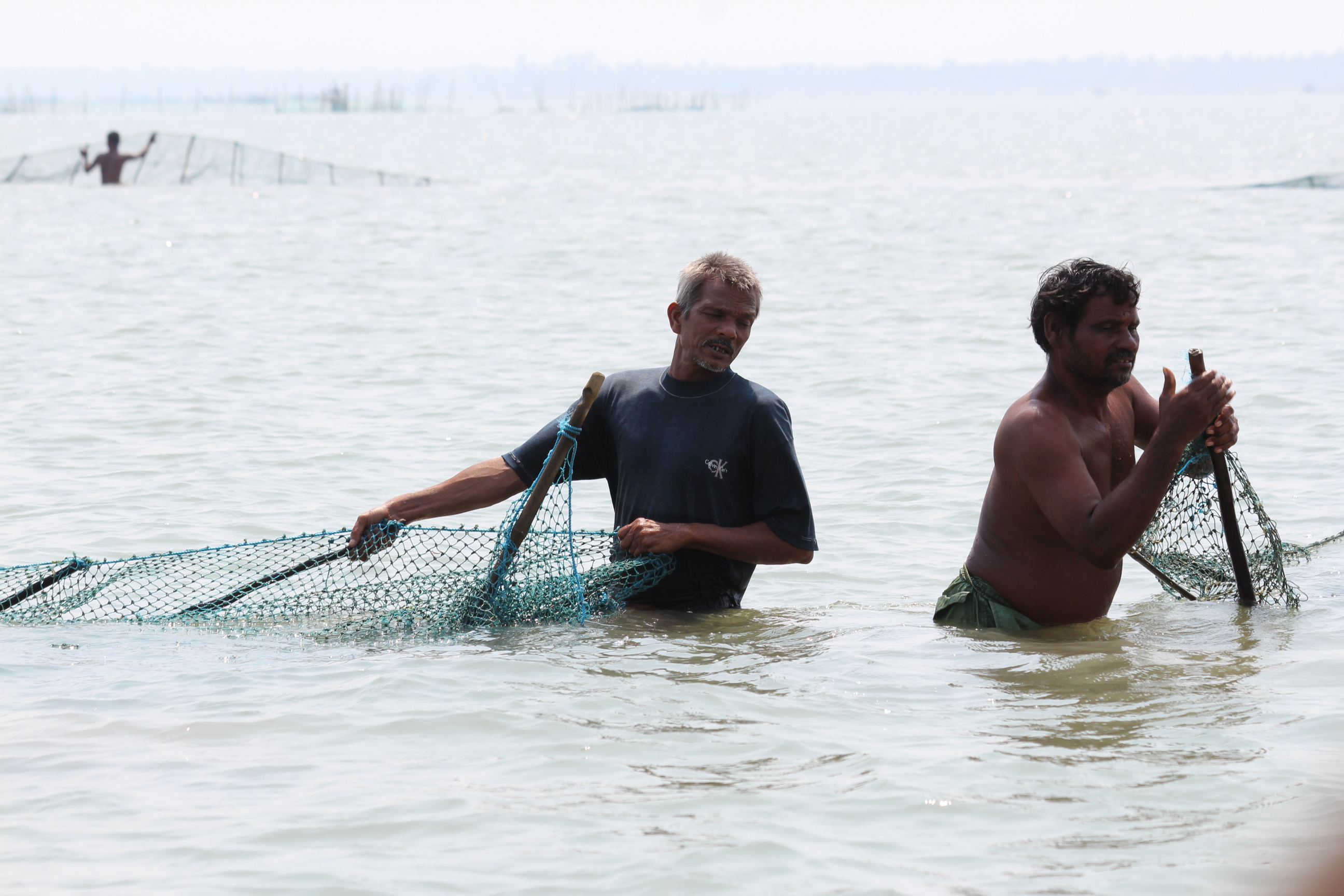
Anyway, we didn’t see many fish either, but we certainly saw the evidence. Vast networks of nets are strung around the lake, plus we saw an impressive fishing technique being carried out by 12 men. Their efforts are possible only because so much of the lake is extremely shallow.
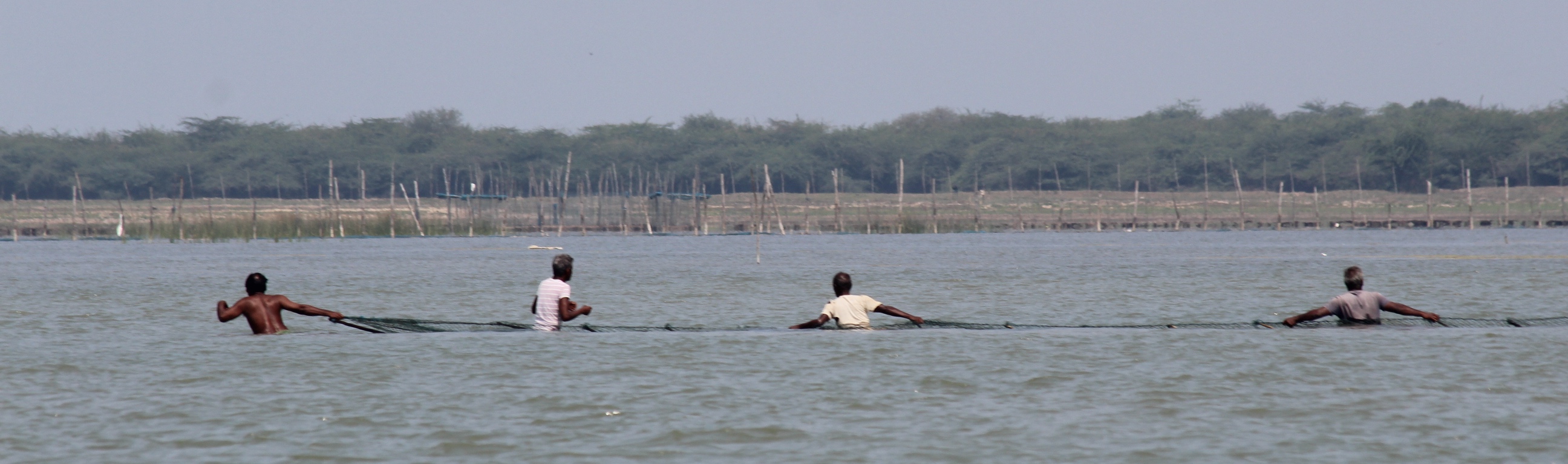
Men dragging nets across a shallow part of Chilika Lake
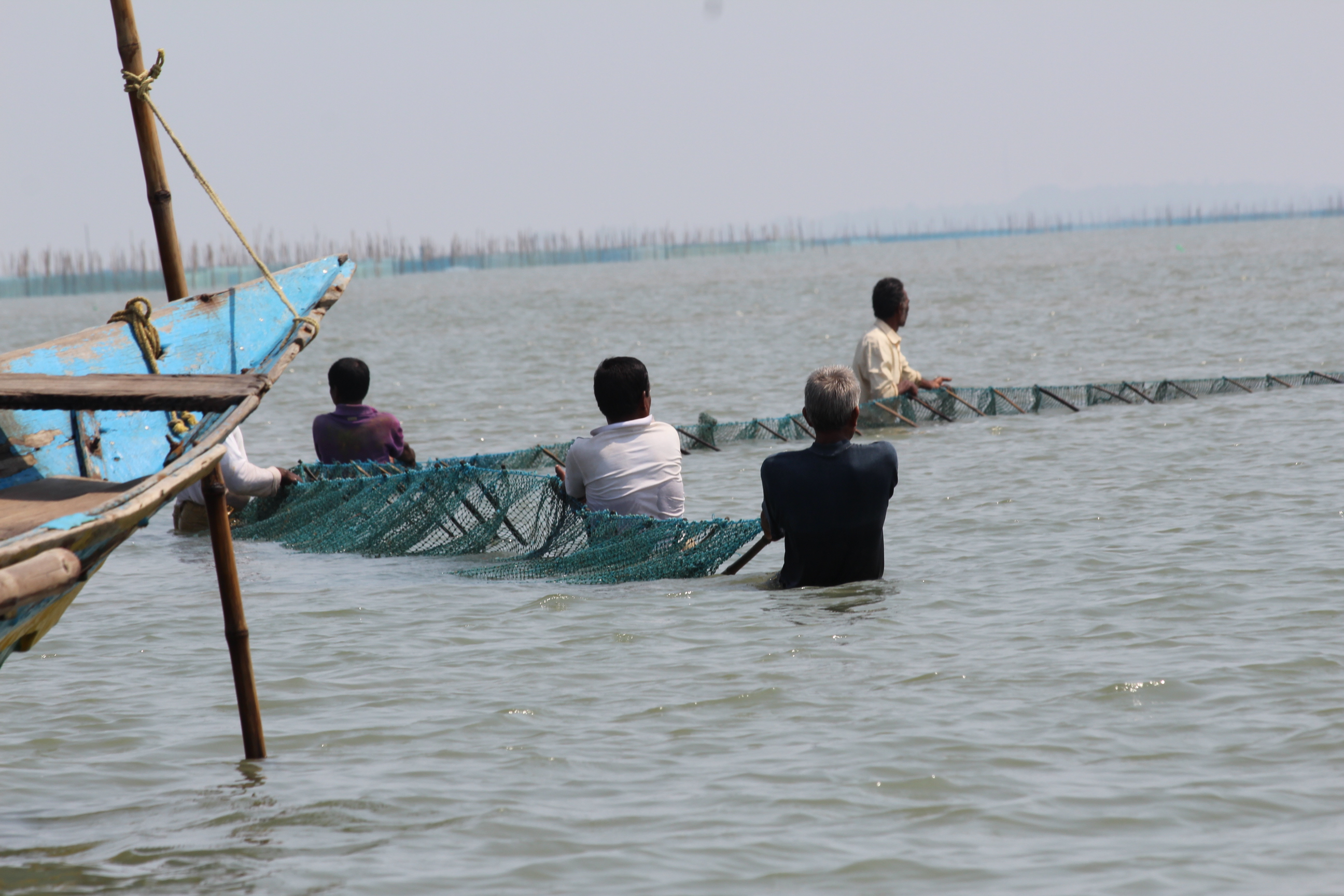
Curving in to join the nets
Two nets come together
Here’s how it works. While one man (who looked like a teenager) was left to mind the two boats, the remaining 11 divided into two groups to wade and drag two nets towards one another in an attempt to corral fish in the middle.
The dragging process took about 20 minutes as the two groups tugged and hauled the long nets and their frameworks together. They then formed a circle and worked inwards.
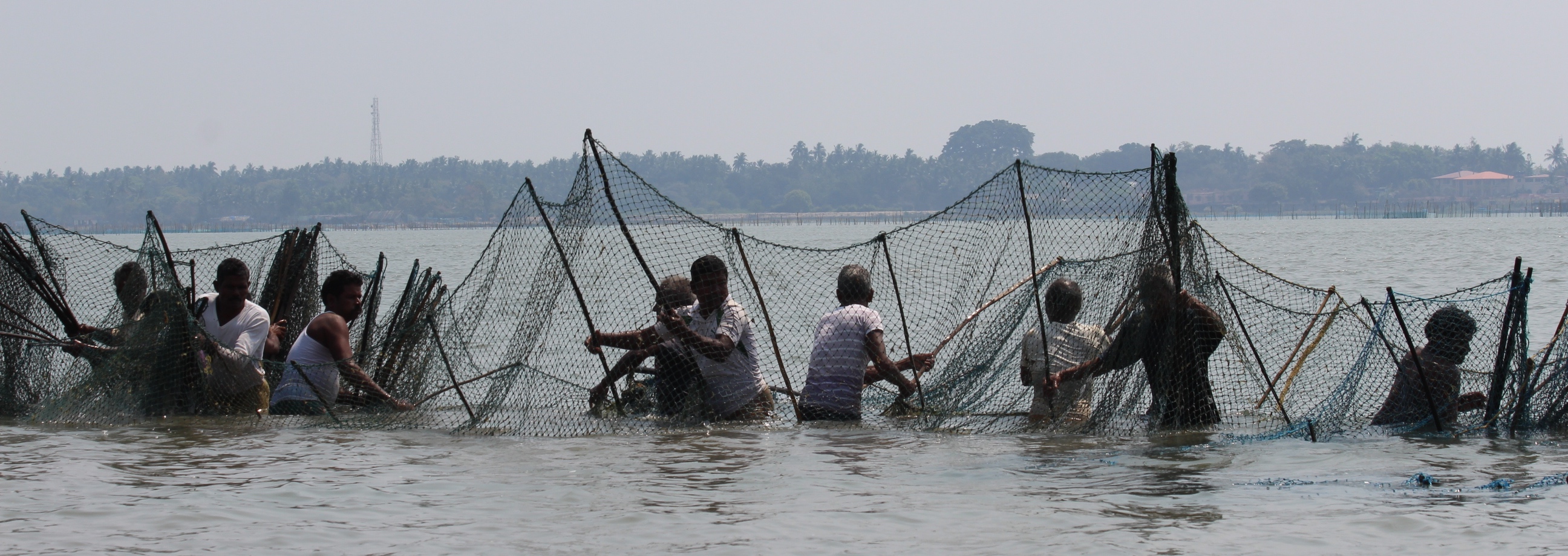
Tightening the circle of nets
Our boat driver (yes, we cruised the lake for about five hours) explained that lots of fish escape this tactic, but the fishermen are happy if they get one or two of the most valuable fish. These sell for about 700 rupees a kilo, or about A$12.
Our fellows, if I can call them that, did capture two of the pricey fish, probably weighing a total of five kilos, maybe more.


After the ‘catch’, they folded up their nets and headed off to another promising fishing spot. We were told they make four or five similar attempts per day, and are likely to finish the outing with 25–30 kilos of fish.
That would earn them up to 21,000 rupees for their efforts. Assuming the money is evenly split, each man could take home A$35 a day. Not bad by Indian standards.
Oh, and we were told that, in this case, the boats and nets belong to the middleman who buys the fish. Each net alone is worth 100,000 rupees (1 lakh) or A$2000. That’s a lot of fish!
If you love fish, here’s a great African stew recipe I learned in Ghana.
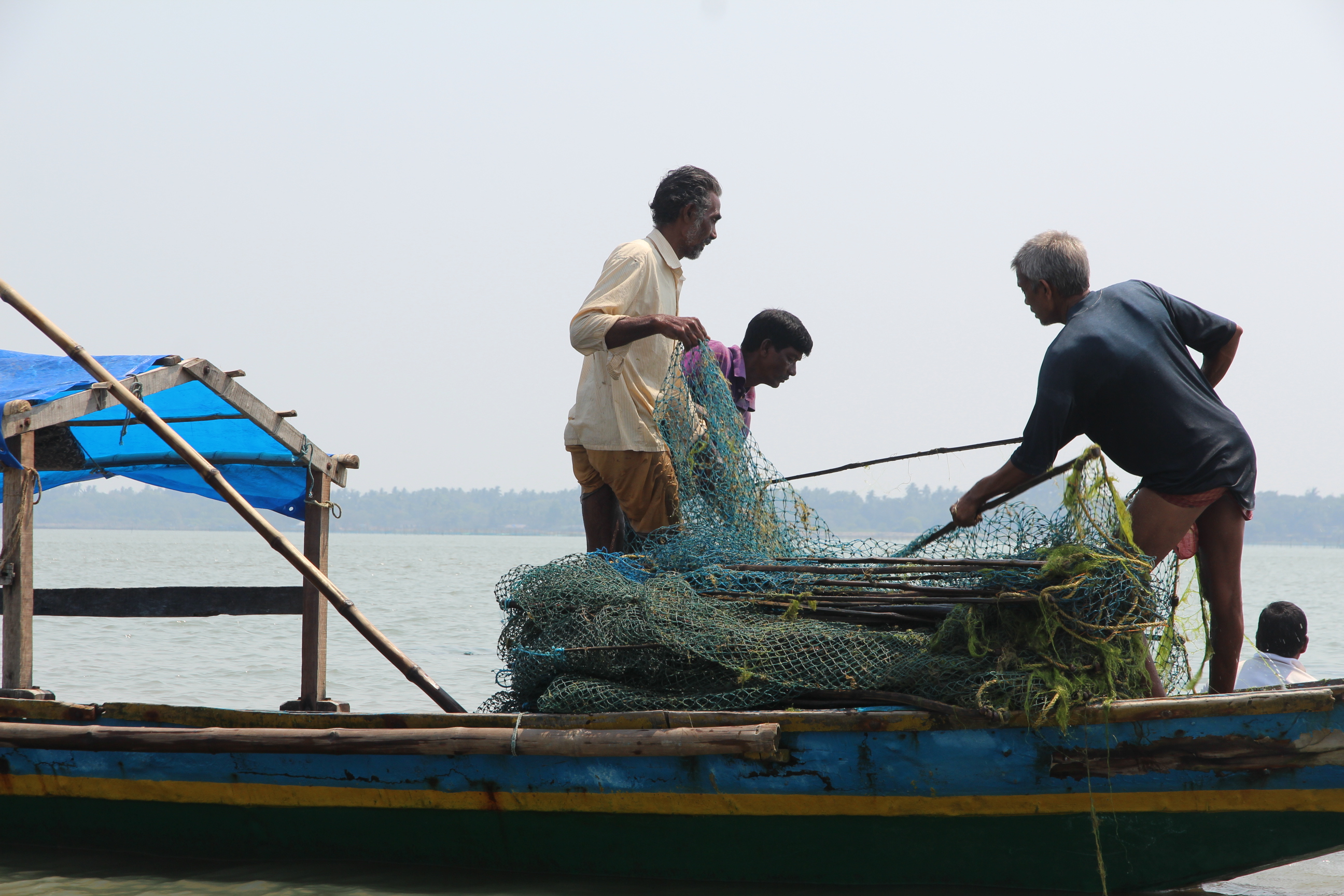
Folding the nets

Getting ready to move on

Three gharials on the Madhya Pradesh side of the river
Travel is educational.
What an understatement. Travel has taken me places that don’t appear on most maps, allowed me to meet people with extraordinary stories, put me in front of all sorts of exotic and fantastic foods, and given me the chance to see rare animals.
The gharial (sometimes called a gavial or fish-eating crocodile) is a recent example. For starters, I’d never heard of this species of crocodile, which also meant I had no idea that wild gharials are critically endangered.
In the mid-1940s, these fish-eaters were widespread across the Indian subcontinent. They lived in every major river and their population was estimated to be between 5000 and 10,000. By 1997, there were fewer than 500. Over the next nine years, the number of gharials living in the wild fell by another 58 per cent.

Walking to the entrance for the boat cruise (see Poor John’s hands behind his back)
Today there are thought to be no more than 200 breeding pairs in the wild, with most of them in the National Chambal River Sanctuary.
Gharials don’t even kill or eat people! So how did this drastic decline happen and in such a short space of time? And how can it be stopped?
There are many causes. Gharials are hunted for skins and indigenous medicine, their eggs are taken for food, they are trapped in fishermen’s gill nets, their riverine habitat is diminishing and even pollution gets them.


As for a cure, things are happening slowly. When numbers fell sharply in the 1960s and 1970s, the Indian Government added gharials to the Wildlife Protection Act 1972.
In 2010, the then minister for Environment and Forests announced a tri-state committee to manage, research and protect gharials within the 1600 square kilometres of the national sanctuary on the Chambal River.
We first saw gharials on the Chambal where it runs between the states of Rajasthan and Madhya Pradesh. We spent several hours in a boat cruising up and down the river, seeing gharials, mugger crocodiles and a whole range of other wildlife.

A jungle cat on the hunt

A checkered keelback snake claims a rock on the Rajasthan side of the river
A jungle cat on the hunt was an unexpected sighting, along with a checkered keelback snake basking in the sun.
About a month later, we saw more gharials in the Gharial Research and Conservation Unit within the Satkosia Tiger Reserve in the eastern state of Orissa. Limited numbers of gharials live in the Mahanadi River there, but for some reason do not breed. However, the research unit conducts a somewhat successful breeding program in which the young are released into the wild.

A young gharial sunbakes on a rock on the Rajasthan side of the river
A bit about gharials
Gharials are one of three crocodilians native to India, with the other two being the mugger and saltwater crocodiles. They are among the longest of crocodilians, with males measuring up to 6 metres or 20 feet in length and weighing up to 160 kilograms or 350 pounds.
Because they are primarily fish eaters, the gharials are characterised their long, thin snouts and more than 100 sharp, interlocking teeth. The male, once he reaches maturity at about age 13, has a distinctive knob (called a boss or a ghara) that begins to grow on the end of his snout.
Gharials usually mate in December and January and then dig nests in the sand for eggs in March and April. Females can lay anywhere from 20 to 95 eggs. The young hatch in July, just before the onset of the monsoon.
As for me, I feel lucky to have seen some in the wild.


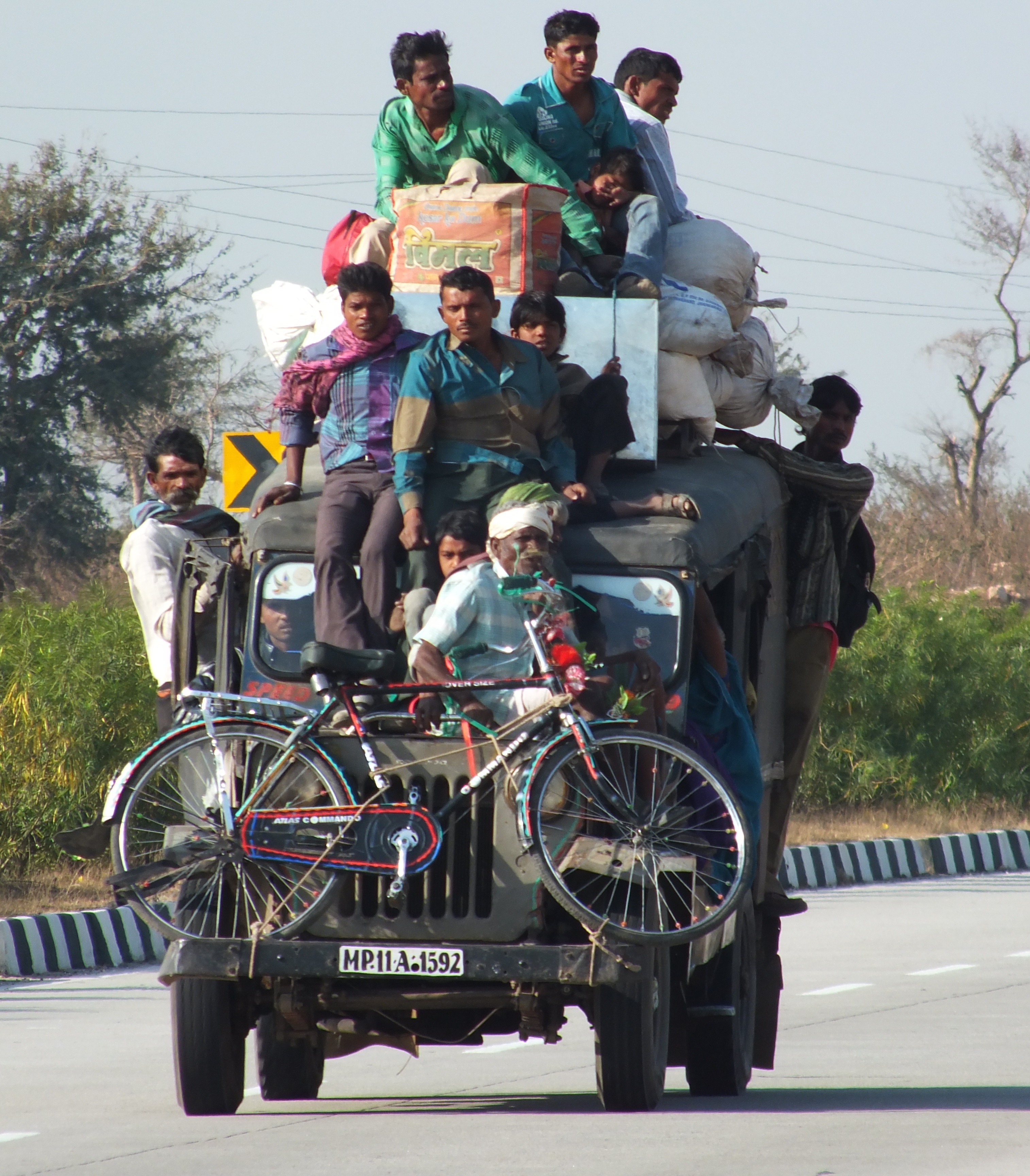
Just a few passengers and their belongings. Photo by Gary Foster
Can you believe it?
These pictures are of real trucks/vans, moving at high speed, and carrying real people and real stuff—lots and lots of people and lots and lots of stuff—in Gujarat, India.
Indian states charge border taxes—sometimes huge ones—for commercial vehicles that cross state lines. For example, the state of Maharashtra, where Mumbai is located, has a minimum one-month fee that runs about A$300.
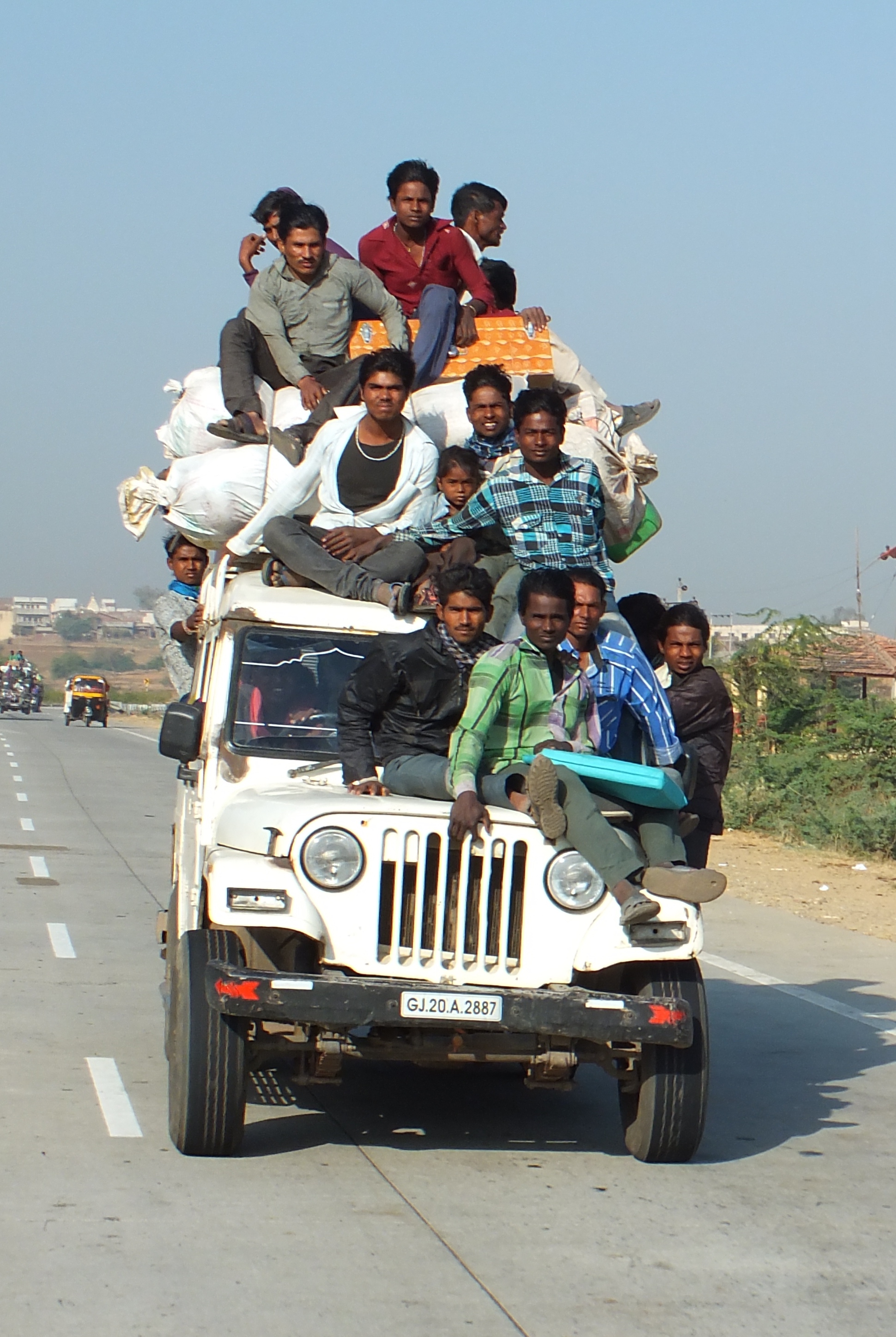
I wish I could run a count-the-number-of-passengers competition, but even I don’t know how many there are. Photo by Gary Foster
We guessed that the pictured trucks were being driven to the border between states of Gujarat and Madhya Pradesh in the middle of the country.
We assume the trucks then do not cross the border, but offload their passengers into some equally overloaded vehicle on the other side. And there are even more passengers riding inside.
We saw one today that had a rear tractor tire (or bigger) sitting on the bonnet (hood). We weren’t quick enough to get a photo.
What a way to travel! I’m glad it’s not us.
Gary was on the best side of our van to be able to take most of these pictures. I took the one below.
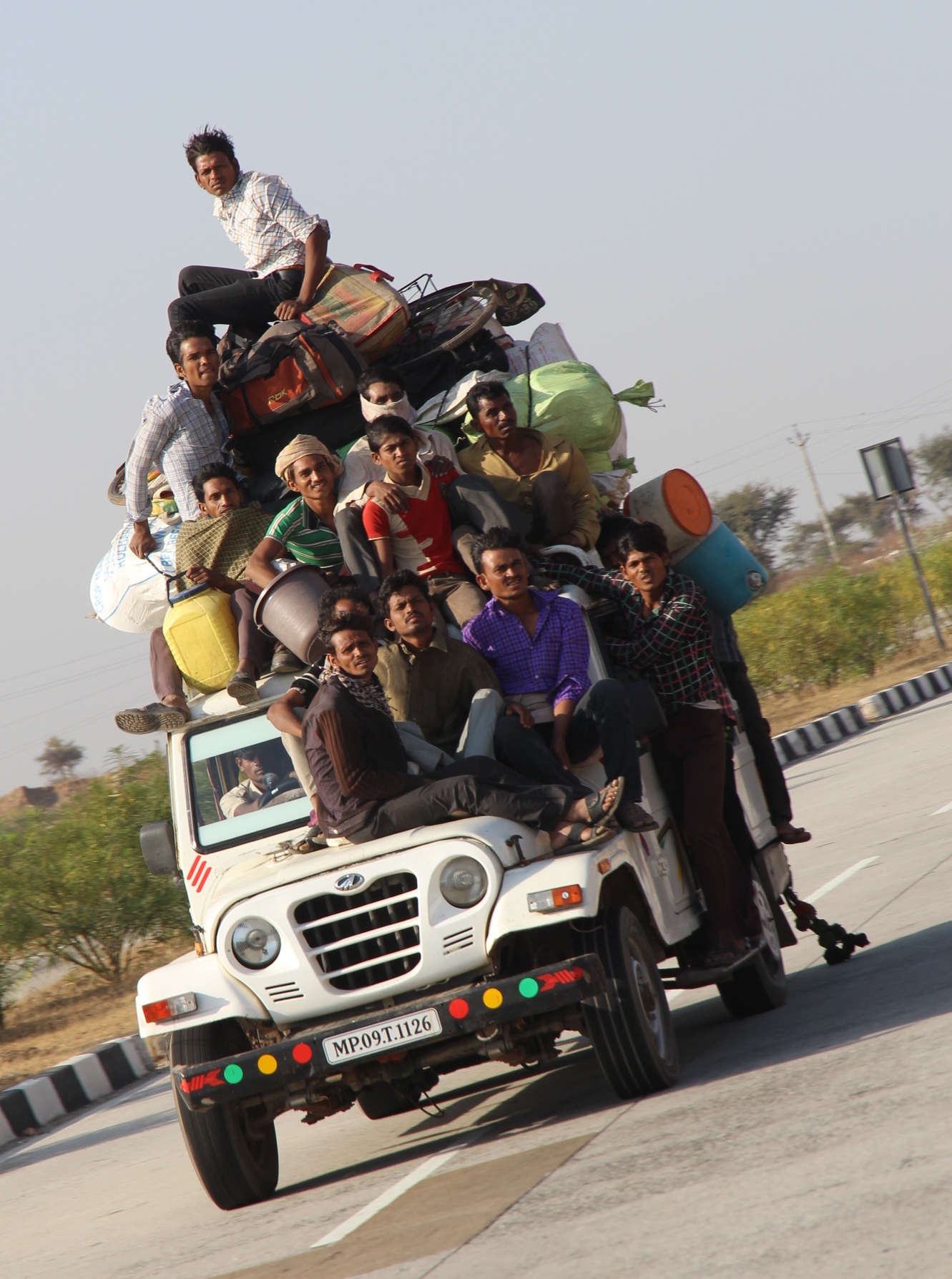
Most vehicles have three or four hanging off the back too

Niharika rolls out yet another roti. See the small griddle to her right
It’s sobering to think how hard some people work to make a living.
About four years ago, Niharika and Ramesh moved north from Mumbai to open a small restaurant on the outskirts of Rajkot in Gujarat.
When we stopped for lunch at their place, called Punchnath Chinese and Punjabi Dhaba (dhaba means eatery and is sometimes spelt dhoba), I learned how hard it can be just to pay the rent.
Niharika, who sat cross-legged and serenely on the floor rolling out and cooking rotis in seconds, explained that their monthly rent was 25,000 rupees (or about A$500). Some months they have to dip into their savings to cover the cost.

Ramesh checks on the curries
While Niharika was making rotis (anywhere from 300 to 400 a day), her husband, Ramesh was whizzing around serving up the main dishes she made earlier in the day.
We were served a thali (mixed plate) of chickpea curry, potato and pea curry, a dal and a fourth dish I can’t remember. Ramesh kept topping up our plates and bringing as many rotis as we could eat. I hadn’t realised that rotis come with a thali, and are an all-you-can-eat item. No wonder she makes so many every day.


Niharika was working off a five-kilo batch of dough, pulling off bits no bigger than a cherry then rolling them out to almost six inches in diameter.
By the way, we stopped at their place by chance. We’d been looking for a place to get the van’s wheels aligned, and their little eatery is almost next door. So if you’re ever on the road out of Rajkot to Porbandar, look out for the big Bridgestone sign on the left. Niharika and Ramesh’s place is just before it.
The all-you-can-eat thali was only 70 rupees per person (or A$1.40). You have to sell a lot of thalis to cover the rent. Luckily two more tables of customers arrived just before we left. And on the way out, we bought nine ice creams at 25 rupees each (50 cents).
Oh, and the wheel alignment was done in less than 30 minutes and cost a mere 250 rupees (or A$5).
P.S. I’ve never made rotis, but I plan to try when I get home. I have reason to be confident because I had great success making Arabic bread.


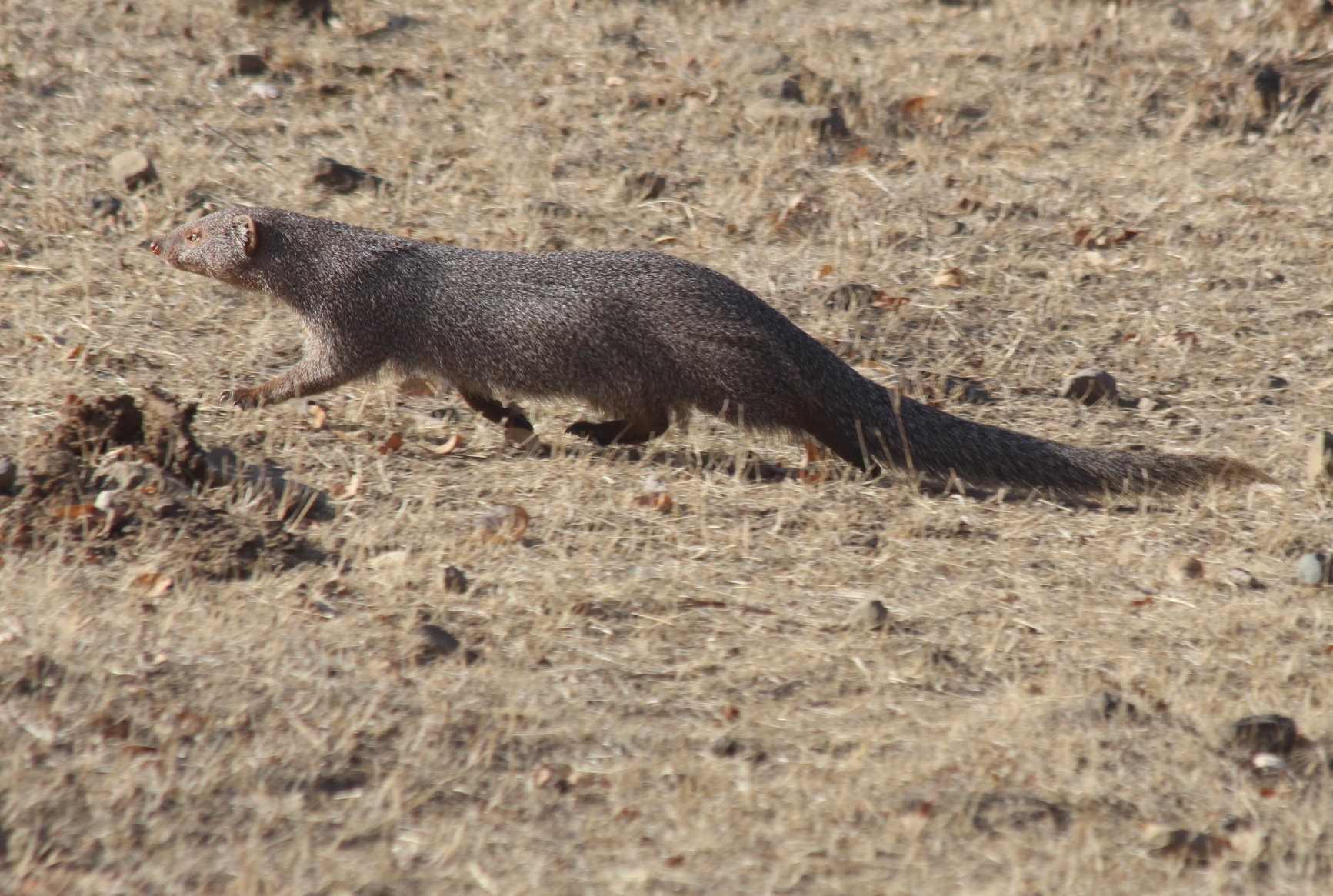
A ruddy mongoose scurries into hiding


You’ve already met the Asiatic lions of Gir National Park, but you should know that the park and surrounding sanctuary abound with life beyond lions.
Our four game drives—two in early morning, one in mid-morning and one in mid-afternoon—gave us the chance to enjoy plenty of wildlife, scenery and interesting facts about this semi-arid region.

Open landscape that was filled with three lions a few minutes later
Let me impress you with some numbers. According to a booklet where we stayed, the park boasts 38 species of mammals, 300 species of birds, 37 species of reptiles and an almost unbelievable 2000 species of insects. Even more amazing is that I didn’t get a single bug bite. Yay!
Some of the critters we saw included spotted deer (chital), blue bull antelopes (nilgai), ruddy mongooses, wild boar, crocodiles and a range of birds.


Plants are not quite as prolific, with more than 500 types of trees, shrubs, herbs and grasses. I was stunned to learn that about 5 million kilograms of green grass is harvested there each year (worth about US$10 million). The forest also provides 123 million metric tons of fuel wood. The Maldhari, the semi-nomadic tribe that lives in the park, also collects and dries dung that is on-sold as fuel. Plant-wise, I particularly liked the stone apple and flame of the forest trees.


But the most amazing thing I learned was how the recent lion counts have been carried out.
In 2005, the government banned the use of live bait to attract lions in, and demanded that only lions that were actually seen could be counted. The census that year was completed with the help of about 1000 forest officials, experts and volunteers.


Five years later, the census work was done by about 40 ‘Cat Women of Gir Forest’. These women, mostly from Muslim tribes in neighbouring villages, travelled the park counting only those lions they actually saw. The women, who seek to protect the lions, have worked hard to gain trust and cooperation from local villagers and the Maldhari herdsmen who live in the park. They also seem to have gained the trust and respect of the lions, who leave them unmolested to go about their counting.
The more I learn about Gir, the more I think it is one of my favourite parks in India—except for that damn outrageous camera-use charge.
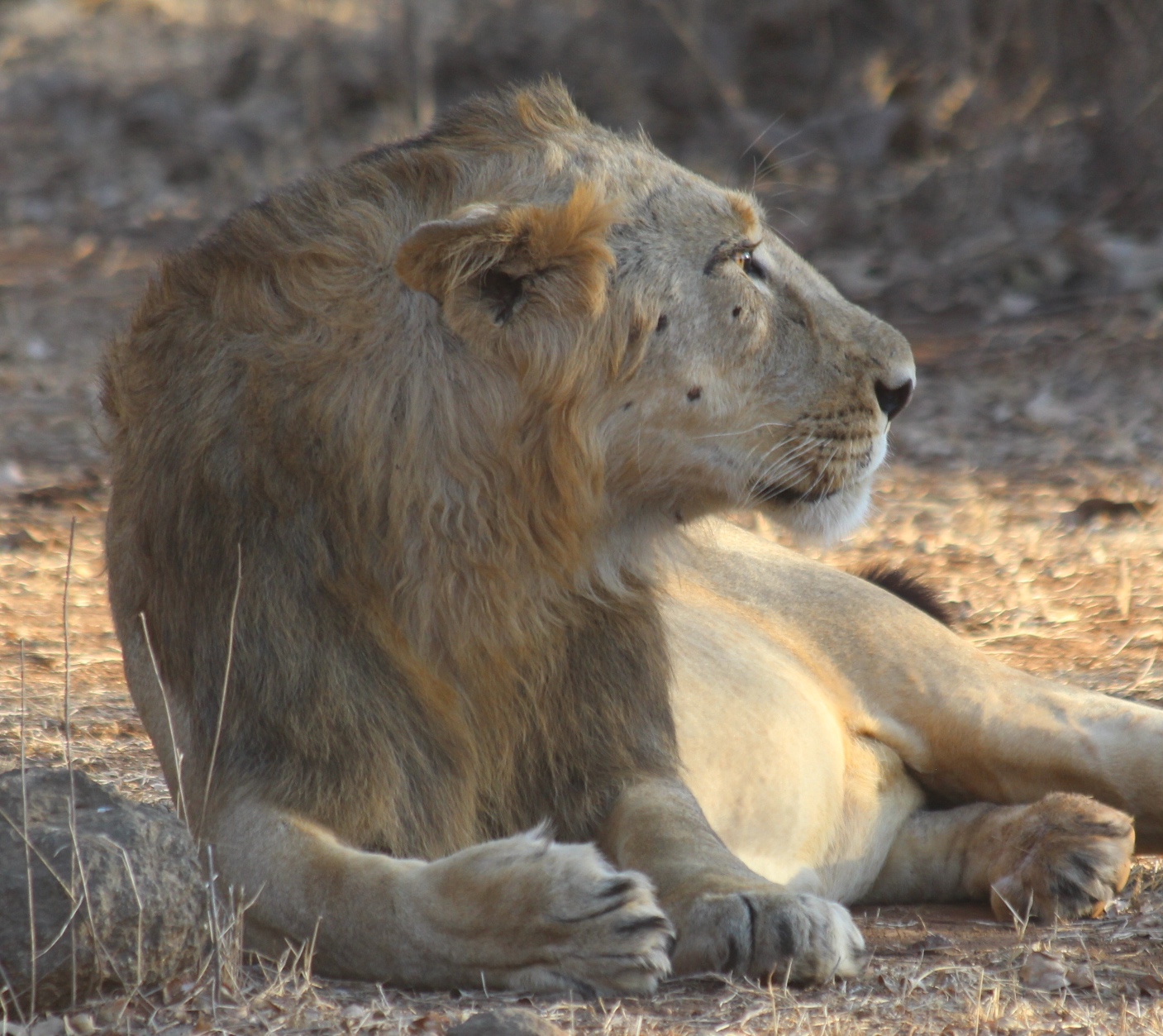
A male in profile

So close I could have stroked her. Notice the scars on her nose
People often assume that Africa and zoos are the only places to see lions, but they’re wrong. Asiatic lions, which used to roam widely throughout Asia, are still kings of the jungle in a small part of Gujarat in western India.
According to the last census in 2010, Gir National Park has a population 411 of these lions. The park’s 2015 census, scheduled to take place in early May and using GPS technology, will determine whether the numbers are up or down. I’m expecting them to be up. They went from 359 to 411 in the five years prior to 2010.
As of this week, I was lucky enough to see not just one, but nine of these magnificent cats. Over three separate game drives (more about them below), we saw two females with a cub (thought to be female), then a mum with two male cubs, then a lone male and finally a courting/mating couple.

Two females and a cub
But we didn’t just see them. The first group—the two females and the cub—walked beside us. I was told to sit up straight and not hang my head out the side the Gypsy (what the vehicles are called). If my arms were a bit longer and I was a bit more daring, I could have stroked them.
The mating pair were lounging around when we were there, but we were told by a guide who went by after us, that they’d become a bit frisky.
Seeing nine was a huge bonus. According to Wikipedia, Iran’s last pride of Asiatic lions (a female and four cubs) were cornered and shot in 1963. The male had been shot earlier. No sightings have been made since then.

A cub keeps ‘her’ distance from us
Back in the early 1900s and during a severe drought, there were only about a dozen lions left in Gir’s teak forest. The then Nawab (Muslim ruler) of Junagadh provided enough protection for the animals that the numbers recovered a bit between 1904–11.
But the slaughter resumed in 1911 after the Nawab died and, by 1913 the numbers were estimated at 20. The British Administration implemented shooting restrictions and, by 1936, the count was up to 287.
Today most of the lions roam across 545 square miles of Gir sanctuary (that encompass the 100 square miles of actual park). For the most part, they co-exist fairly peacefully with the Maldhari—8400 live in the park. These nomads raise livestock and while their settlements have caused some problems for the lions, they have also provided the beasts with some protection.

Licking his chops and remembering lunch
The 2010 census shows that about a quarter of the lions live outside the sanctuary. The state of Madhya Pradesh has made a successful court application to have some animals moved to their Kuno sanctuary, but this has not yet happened.
I can understand Gujarat’s desire to remain the lions’ last host—what a great tourist drawcard—but they are not thinking ahead. What if disease or fire sweeps through the Gir lions? In 1994, an epidemic of canine distemper hit Serengeti National Park in Tanzania and killed about 1000 African lions.

The mating pair lounging around
Compliments and complaints about the game drives
We had four game drives through the Gir forests. We were only supposed to have two, but the van we are travelling in needed new brake shoes so we stayed in the area for an extra day. Luckily we were able to squeeze in two more drives.
Getting a drive spot is a real production. There are only three drives per day—starting at 6:30am, 9:30am and 3:30pm—and 30 vehicles allowed per drive. Fifteen vehicles are allocated online, several months in advance.
If you want one of the last 15 slots, you have to queue from the middle of the night. Two days in a row, Gary and Shalak took up the challenge, heading to the queue at 4am and then 2am. The third day Gary and Anand went at 4am and we ‘only just’ got a place. Our campsite host had arranged a proxy to stand in the queue for us, or we never would have managed.
It was almost a pity that we did. This third drive was totally crappy because the guide was hopeless AND, even worse, the governor of the state showed up and all the good drive zones were set aside for his use only. But the fact that we were already at the park meant Gary and I hopped in the queue for the last afternoon drive. Our four-hour wait paid off and we got a slot and a great game zone.
Even though you have to wait a long time to get your placement, the system works fairly smoothly. There’s a bit of arguing in the queue, and a bit of attempted queue-jumping. But calm is restored when the guy with the handlebar moustache and spear turns up. Sorry I missed getting a pic of him.

The trackers with their sticks—some protection
Lion-spotting is improved too by the work of fearless rangers. These fellows travel through the park on motorbikes and then tramp into the bush, carrying only a stick and sometimes a walkie-talkie, to urge lions out of their slumbering hideaways. I give them a lot of credit.
But here’s my big, big gripe about the organisation. Unlike every other park in India, the parks of Gujarat charge 600 rupees per person for a camera on every drive. That’s about US$10 and A$12 per drive. So I paid A$48 for camera usage alone over three days. Ridiculous and thievery in my opinion! Especially because you also pay to enter the park, pay for the use of the vehicle and pay for the guide. Thanks goodness Poor John doesn’t carry a camera.
On reflection, I don’t mind the camera charge for three of the drives, but I never even got my camera out of its bag on that third drive. So whatever you do, avoid zone 1 and try your best to get zone 2 (exiting from zone 6). Brilliant!

The courted female having a rest
A bit about the Asiatic lions
While these lions are slightly smaller than their African counterparts, they are equally majestic. It terms of size, they can still run to 420 pounds in weight and 3.5 feet in height at the shoulder.
Gestation period is about 100 days, and mothers nurse their young for about two months. The cubs aren’t completely weaned until they are three to four months old. Then the diet is meat only, which keeps the mum busy as a killing machine. Cubs starting hunting for themselves at about the age of one or one and a half. Their first attempts, usually involving small prey such as birds and mice, are quite clumsy.
Male cubs leave the pride at about age two, mostly to prevent in-breeding and establish their own territory (marking, roaring and fighting) at about the age of four. Every adult lion we saw had scars.
Our guide thought the mating male was five or six years old and might maintain his authority for another six or seven years—certainly not for 10.
And a bit of trivia: Asiatic lions were the beasts doing battle in the Coliseum in Rome.
P.S. Lions are carnivores so I wonder if they’d like the beef cheeks recipe on my cooking blog?

A couple of young boys

Sunset in the Thar desert
Apologies to everyone for posting so little over the last little while. And for visiting your blogs so irregularly.
Poor John and I are in India for two months (and then Bhutan for two weeks) and this trip is proving to be much more remote than our last one in late 2013.
Our days trotting through the Thar desert in Rajasthan were great fun, but not an internet cafe in sight.

Robyn and Gary follow suit with Poor John’s common walking stance
In fact. I felt lucky to survive the trip in one piece. When we stopped at a watering hole so the camels could tank up, my camel tripped backwards over a stray sheep and I, with camera in hand, nearly fell backwards into the trough. Amazingly my left hand took on the properties of a clamp, so even though Baloo (the camel) reared up and stumbled backwards, I managed to hang on and keep my seat.
We rode two days in the desert and camped overnight in the dunes. While it was colder than we expected we all stayed warm enough.
There’s lots more to tell about that expedition and our current foray into the Little Rann of Kutch in Gujurat, but for now a few pics and a promise to be back within a couple of days. We’re off to Gir tomorrow to spend three days in a remote camp searching for leopards and Asiatic lions.
P.S. Of course, my camel was the flashiest, most decorated camel on the desert. Nothing like hanging out with a showpiece.

Baloo looking suitably overdressed. Note my sleepijng bag and backpack hanging off his saddle

A bird’s eye view of the kitchen and serving
We’re already two weeks into our overland jaunt across northern and central India and I’m still not tired of eating curry. In fact, with the exception of a couple of pieces of toast, one bowl of cereal and quite a bit of fruit, I’ve had curry at every meal since 24 January. And all I can say is Bring it on.
I like to think I make good curries—to be honest, I do a very good job—but the master curry makers are in India and we keep encountering them every day.
For starters we got street food—skewers of fish and chicken cooked while we waited and served up in a large stainless steel bowl. Delicious and spicy.

Skewers of fish and chicken being made in Delhi
The first dinner was in a restaurant in Old Delhi, not far from the Jama Mosque. This narrow eating establishment is part of the Rehmatullah Hotel, with a bit of seating both downstairs and upstairs. From our upstairs perch, we could watch the chefs ladling up bowls of curry, rice and dal, and adding plates of bread.
We could also see several rows of men squatting on their haunches on the footpath out the front of the restaurant. These fellows, who are beggars, take up this position daily outside many restaurants waiting for the day’s leftovers or to have a generous diner pay 40 cents or so for a meal to be served to them before the restaurant is closing up—a sensible option if leftovers look to be running low.
We enjoyed a simple meal of saffron rice, chicken curry and bread. A couple of us added some rupees to the payment so a couple of beggars could get their meals early. I desperately wanted to take a closer-up pic of these fellows, but it just didn’t seem right. Too intrusive.

Saffron rice and chicken curry
We had some truly wonder meals over the last two weeks. One that surprised a couple of fellow travellers was the idli with sauces for breakfast. We’ve had this South Indian breakfast dish before, so I knew exactly what it was—little pancake-y rounds made from de-husked black lentils and ground rice. We had three dishes on the side—coconut, chilli sauce and dal. These were the nicest idli I’ve ever had, so well worth recalling.

Idli with coconut sauce, chilli paste and dal—and a missing bite
We also had a delicious lunch at a rundown roadside cafe not far over the border into Rajasthan. Two dishes were Rajathani specialities and they were excellent. I was surprised to see that one of them included pasta, but then pasta is widely sold in the markets throughout India. They also served chai (spiced tea) is small pottery cups that are meant to be thrown away after use. Seems such a pity.


And another favourite has been the thalis. A thali is sort of a sampling plate. There are lots of little bowls with a selection of dishes such as curry, rice, vegetables, curd or raita (yogurt), dal, bread, roti and a sweet. We’ve had a couple of sensational thalis, especially one at a restaurant in Jaipur called RasRaj. If you ever get the chance—go there! It was one of the two best meals we’ve had so far and I didn’t get a pic of the best one in Jaisalmer at a small rooftop restaurant called Sunset City Palace. That menu included a speciality dish of desert vegetables which apparently grow only in Rajasthan.

The sensational thali from RasRaj Restaurant in Jaipur
Oh, and do you know the expression to give someone curry? It’s a slang expression meaning to give someone a hard time either verbally or physically. For the next 10 weeks, it’s going to mean bring me my next meal! 🙂


We’ve always known that Port Moresby is a tough town, but we had no idea how extremely dangerous it is until we got there.
For many ex-patriot employees, a condition of service is that they agree NEVER to take a taxi or other public transport. If they get caught doing so, they will be sent home.
Walking anywhere is also discouraged, and many even have to agree NEVER to drive in certain parts of town. Their cars are fitted with tracking devices that let an employer know if they have violated the agreement.
If people are wary of their surroundings when driving, they can call for an escort vehicle. In fact, they are expected to call for an escort at night, regardless of whether they feel concerned. That happened when we stayed several nights with Tam at the end of our trip.
Rascals (criminals) don’t care if you’re a foreigner or Papau New Guinean. They want your money, your car, your mobile phone, your shoes, even your life if you don’t cooperate. The week before we arrived in PNG, a local teenager was stabbed to death in the market because he refused to give up his mobile phone.

The guide breaks the rules and takes a picture of us inside Parliament House’s main chmaber
So there we were in Port Moresby and other parts of Papua New Guinea for almost three weeks.
When you have no car and are discouraged from walking or taking any form of public transport, your immediate thought is ‘we’re stranded’, but Poor John is a lateral thinker and tackled the problem with flair.
He asked Jo, with whom we stayed for the first few nights, what was the biggest tourist hotel in town. Surely, he said, they must have a taxi driver they trust and rely on.
So Jo called the Ela Beach Hotel and, without hesitation, the staff recommended Mr Lucas and passed on his phone number. We called and arranged to meet him the next day in the hotel’s carpark.
Jo’s nanny walked us down to the hotel. It was a less than two kilometres away and the walk is considered ‘safe enough’ if done in daytime and with an escort. We made it just fine.
When we arrived, another limo driver tried to pass himself off as Mr Lucas, but I asked a couple of questions that confirmed he was an impostor. Nice try, but fail.
And then came Mr Lucas, who was perfect—big, burly, honest, knowledgeable, calm, cheerful, friendly, a good driver and a victim himself of three car attacks.
Over the next several days, Mr Lucas drove us to all the touristic sights. He came and went as required (keeping in touch by mobile phone), and filled us in about his city and his native highlands.
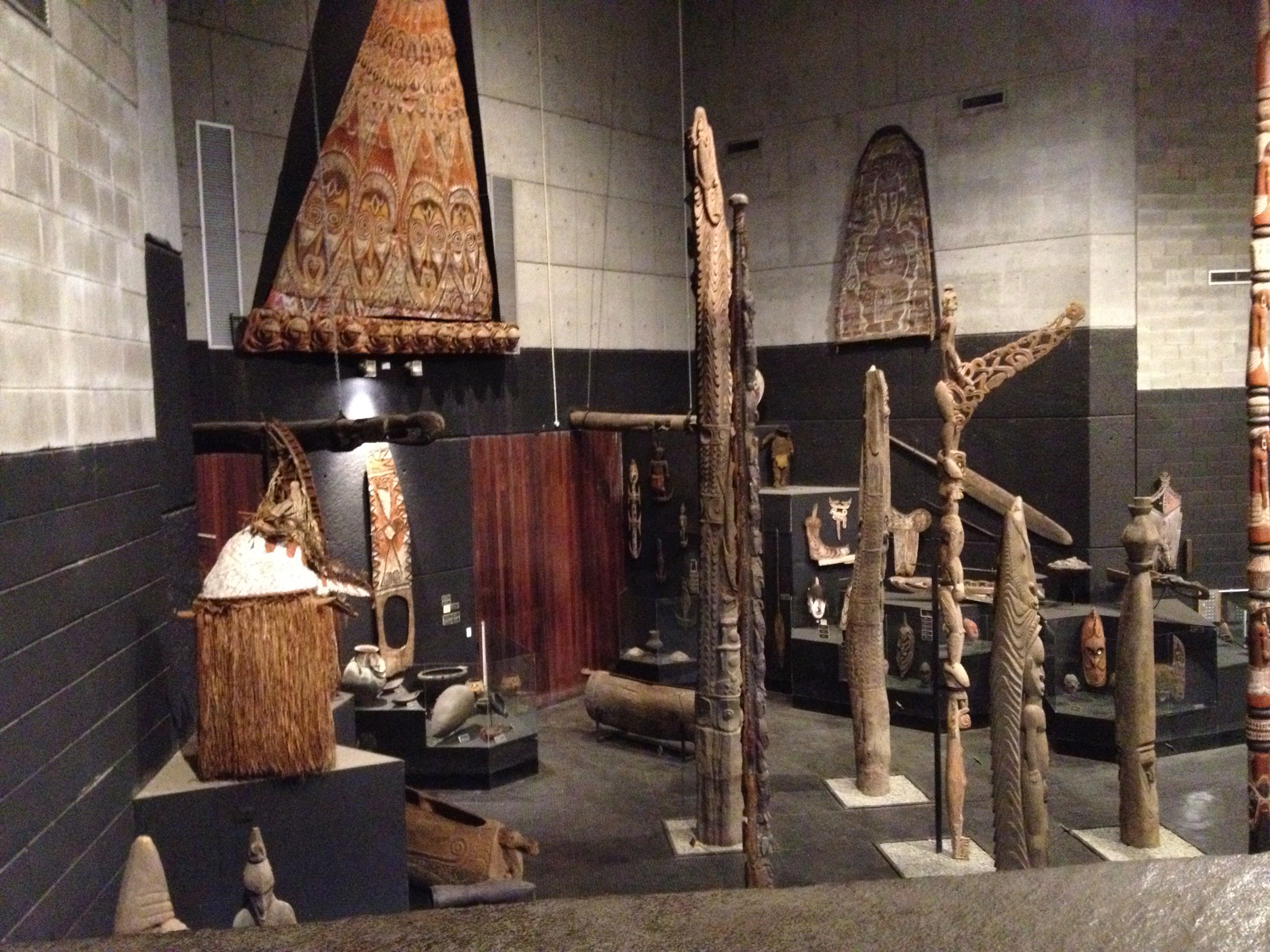
Totems in the PNG museum
Thanks to Mr Lucas we saw Parliament House, the botanic gardens, an orchid garden, a nature park, the war cemetery and the national museum. I’ll write about most of these separately, but here’s an interior shot—taken clandestinely because photos aren’t allowed—from the museum. The displays are old but fascinating.

The amazing Mr Lucas
So here’s our call, for any transport requirements in Port Moresby, we can wholeheartedly recommend Mr Lucas. Once you are there, his direct phone number is 71 468 488. If it’s changed—unlikely unless his phone has been stolen—call the Ela Beach Hotel and ask for his number.
Jo’s nanny and her husband also escorted us through a small market, but they aren’t available for tourism. 🙂
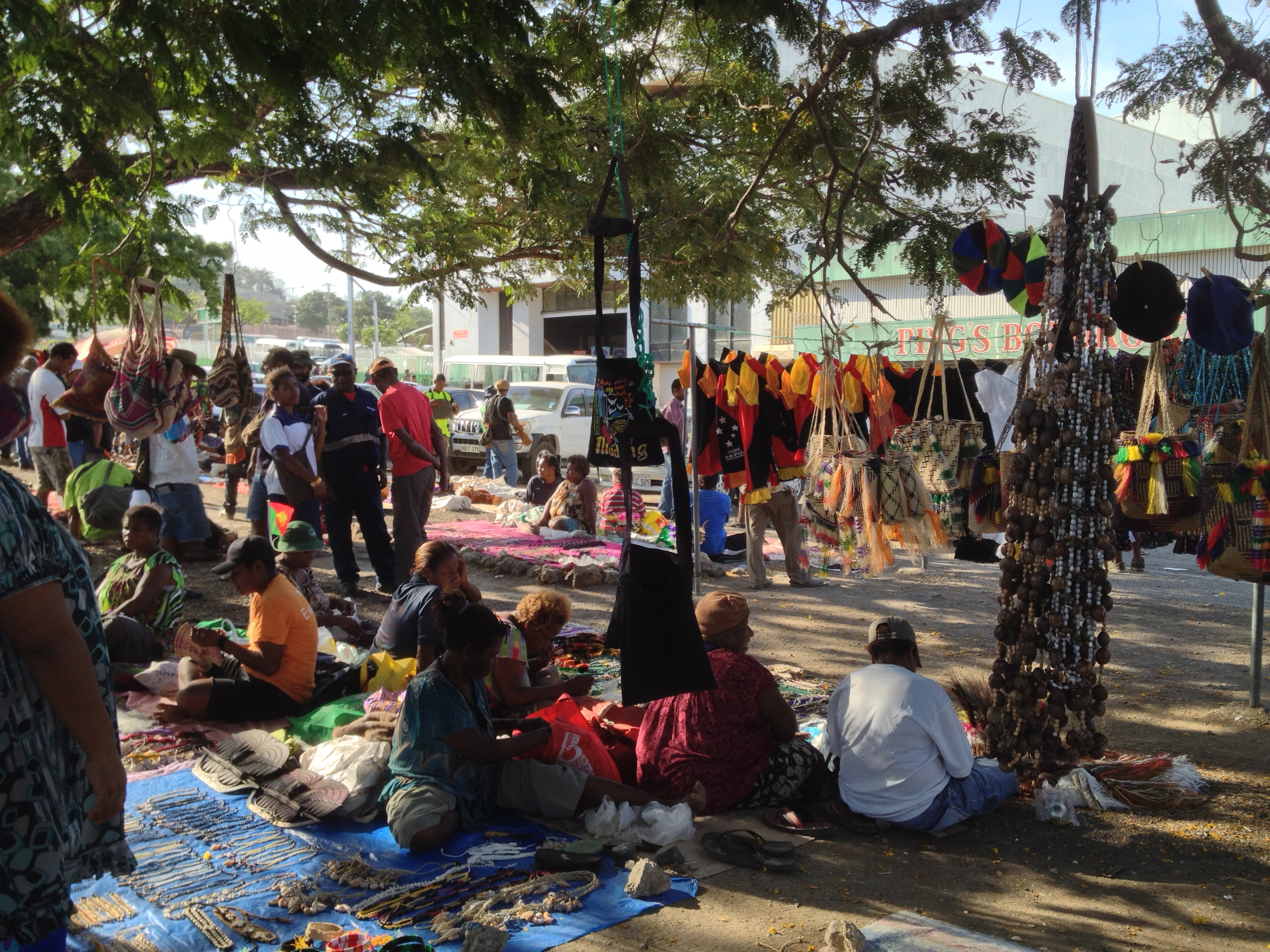
Port Moresby market


Safety beyond Port Moresby
While Port Moresby is probably the roughest town in Papua New Guinea, plenty of other towns are considered unsafe. Whether you’re a local or a visitor, you need to stay aware of your surroundings.
Safety was a prime concern in the highlands where we attended the Goroka Show. I’ve already written lots about the show, but I haven’t yet gone into detail on the safety precautions.
We stayed at the National Institute of Sport and the security was top-notch. The show was on the grounds attached to the institute and the whole compound was fully fenced with guards at the gates.
A large group of us walked into town on the first afternoon, stopping in a local supermarket to buy drinks and snacks on the way. We chatted with some locals and, although we were constantly on alert, we never felt in danger.
Many people walked back and forth to town and many took the free, on-demand van-service offered by the institute. For example, if we wanted to go for dinner at the Chinese restaurant, the van would drop us there and collect us at a time we nominated. On the return trip, the van had to park across the road, and the restaurant’s guard would escort us to it.
I was constantly struck by how hard the locals tried to keep us safe and, indeed, we never had any issues. Once when we planned to walk to an outside destination, the guards said they thought the crowd was too restless outside and recommended we take the van instead.
I read that one of Australia’s media correspondents was pick-pocketed while in Goroka, but none of us—we were a group of around 20—lost a thing. No doubt, other villages with local shows have similar safety systems in place.
Our other stops on the trip were at an Asaro village and three coastal villages near Tufi. I’ve already written several items about the Asaro village, and the wonderful time we had there. The mock wedding was a special event.
Tufi was equally rewarding and totally safe. In fact, there was no hint of safety issues and we walked around Tufi itself and the three villages without concerns. I’ll post more about them soon.
But for now if you are thinking of travelling to PNG, be sure to stay aware of your surroundings and follow safety advice, but don’t spend the whole time terrified and fearing for your life.


