

One of my favourites


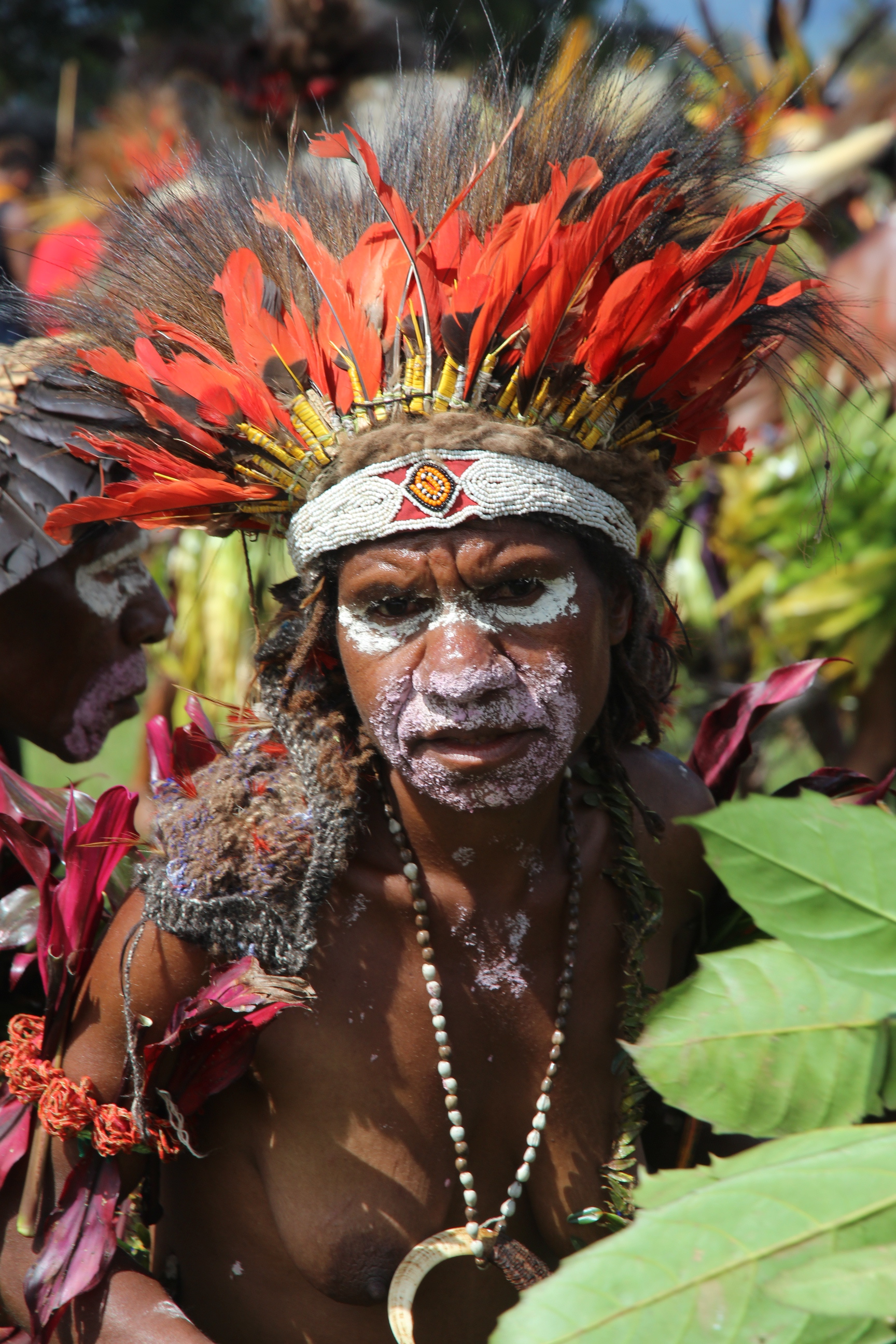
Soon after I started posting items about the Goroka Show, a reader commented that my photos reminded of him of old National Geographic magazine stories. Not really erotic, but filled with an abundance of interesting flesh.
I have to admit that I was a little surprised by all the flesh on display at the show. I’m no prude, but I simply hadn’t expected that at least half of the performing women would have stripped down to their bare bums and breasts.
I suppose the show offers locals a time of year when they can embrace the culture they used to live. Having said that, I suppose plenty of women don’t want to strip off these days.


Poor John visited Papua New Guinea twice during the 1980s (I didn’t get to go). He never got to Goroka back then, but he did get to other highland communities. He clearly remembers seeing many locals ‘roll’ into town in similar get-ups. There wasn’t any show on at the time. It was simply the dress of the times.
Frankly, it makes a lot of sense. Good grief, it gets hot in PNG, and many people have no source of cash income, so they have to make-do with what the earth and sea have to offer.
It didn’t take us long to figure out that the materials and ‘fabrics’ on hand for clothing tend to be leaves, grass, shells, bark, bush rope (made of bark), gourds (more about them soon), feathers (and sometimes whole birds), branches, skins, fruit, seeds, straw, dyes, mud and clay.

Another favourite
As an aside, the Goroka Show reminded me of our two visits to Brazil—where anything you wear that’s skimpy is totally okay. After a couple of months in Brazil, I even got to the point where I thought it might be okay for me to buy and wear a bikini. Luckily, I came to my senses. It might have been okay in Brazil, but no where else in the world.
But after me dangling the ‘boob’ carrot for a while, it’s time to produce the evidence. So here it is.
I had to laugh (and agree) when one reader commented that if we all looked this good without clothes, the habit might catch on everywhere. Of course he’s right, but I guess it might depend on the season and the weather. Also have to admit that I’ve now seen boobs of every single shape and size imaginable. Have even seen some you can’t imagine.


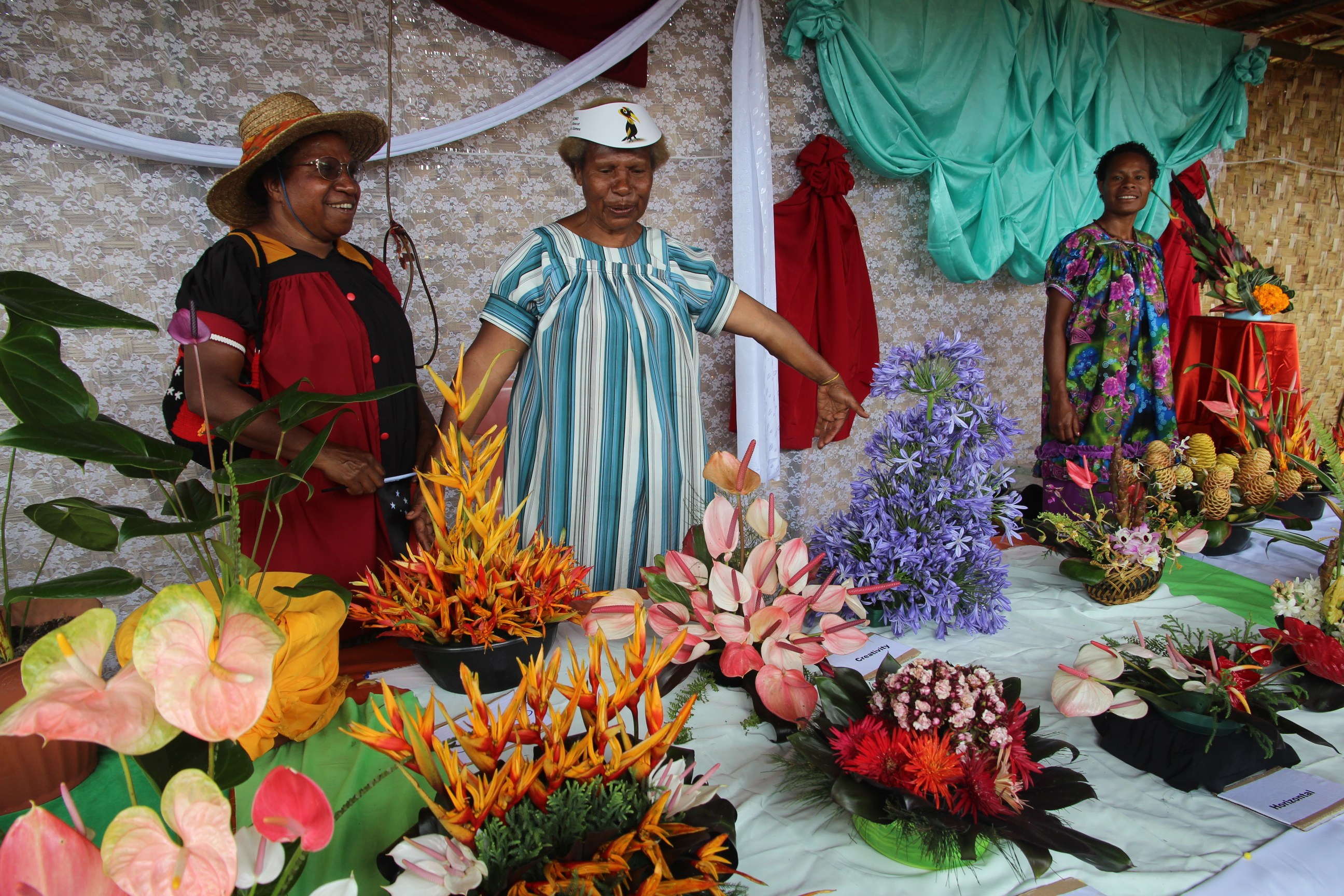
These two gals did all these. It was probably the biggest display of flowers at the show


The Goroka Show has something for everyone.
While sensational song-and-dance performances are at the core of the event, the Papua New Guineans don’t stop at that. There are plenty of stalls selling crafts (remember the mask I didn’t buy?) and lots of local delicacies (such as creepy-looking red sausages, grilled pork and coffee beans).
The flower show is a popular event and colourful too. As far as I know, this is the only aspect of the show in which winners are announced. Song-and-dance performances aren’t judged because so many of the tribes might be or could become enemies. But flowers are different. They must be calming! And the participants (mostly women) wore huge smiles and they showed off their efforts.

She gets my vote for best and biggest smile
We enjoyed checking out the various displays about an hour or so before judging (so we don’t know who won). It was yet another opportunity for colour overload. Displays were classified in six categories, such as vertical, horizontal, creativity and colourist. Backdrops were judged too.
One of the last stalls we visited asked us to pay a kina (about 50 cents) to take a photo. We just laughed and said No thanks. We’d already taken a load of photos and everyone else had been thrilled to show off their handiwork.

Perhaps my favourite display—birds of paradise


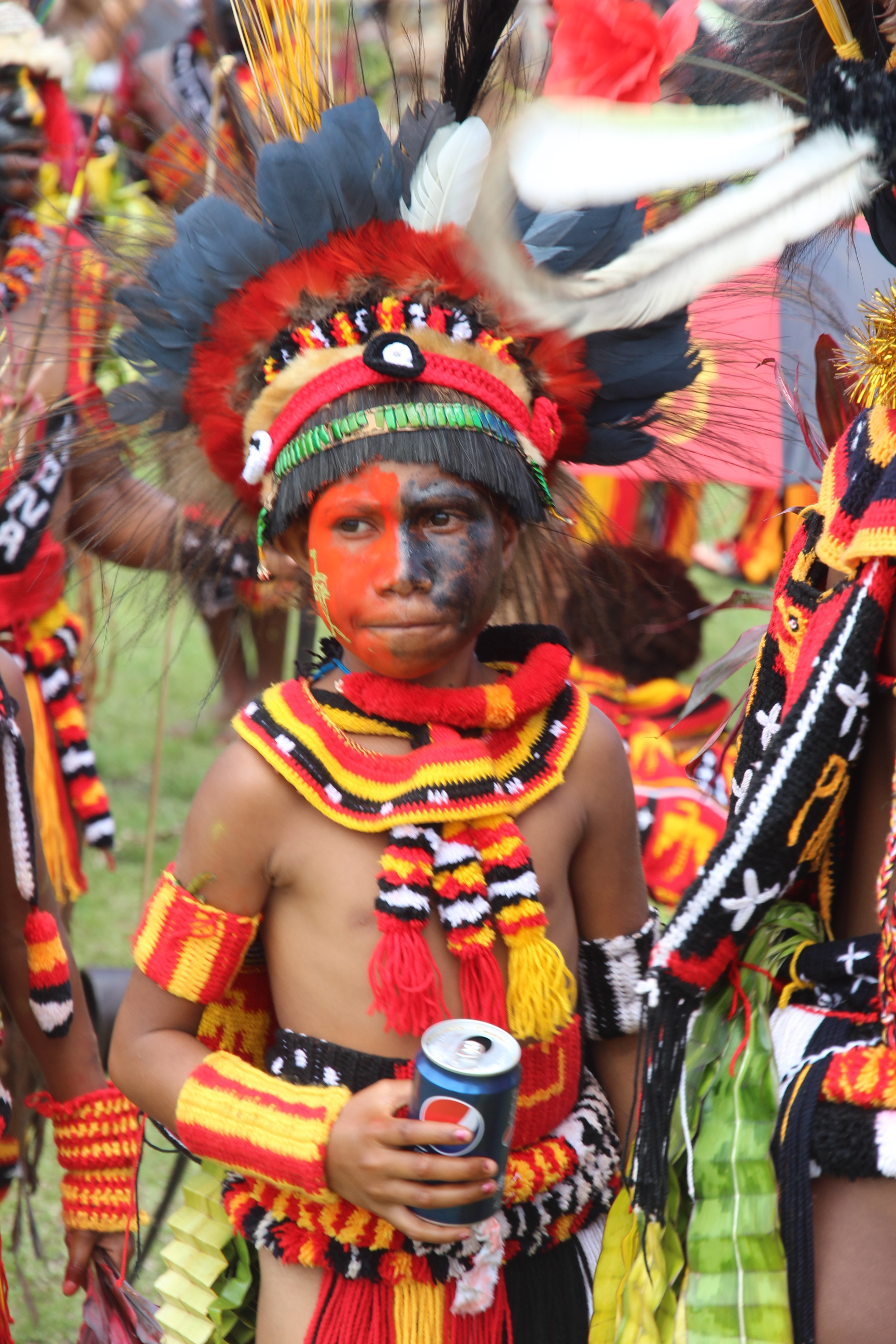
Famous American comedian, W.C Fields said, Never work with animals or children, but he’d never been to Papua New Guinea and seen the kids participating in the Goroka Show.
Fields’ theory was that kids (and animals) are erratic and unpredictable. Duh! Of course, they are. But they are also stars in Papua New Guinea.
I was so pleased to see so many children being involved in the groups performing at the annual Goroka Show. Almost every group had at least one child involved, and many had six or seven. Their costumes were almost as elaborate as any adult’s costume (these get-ups are developed over years, so it’s not surprisingly that ones for kids lag behind).


The Goroka show has been going for almost 60 years, and I’m hopeful that will go on for at least another 60. And that’s simply because the young’uns are being taught about the costumes, songs, dances, chats, drumming and patience.
I think their patience impressed me most. Many performed from morn until late afternoon on both days. Thousands of people watched them with a careful eye, and photographed them until the camera clicks must have driven them crazy. But in all that time, I did not hear one child crack an emotion (throw a tantrum), raise their voice, throw a swing or behave badly.
Kids don’t have to be monsters or run the show. This article has some great advice.
P.S. I think the boy in the pic below is part of the same tribe as Mr Grumpy pictured at the top of my previous blog post.


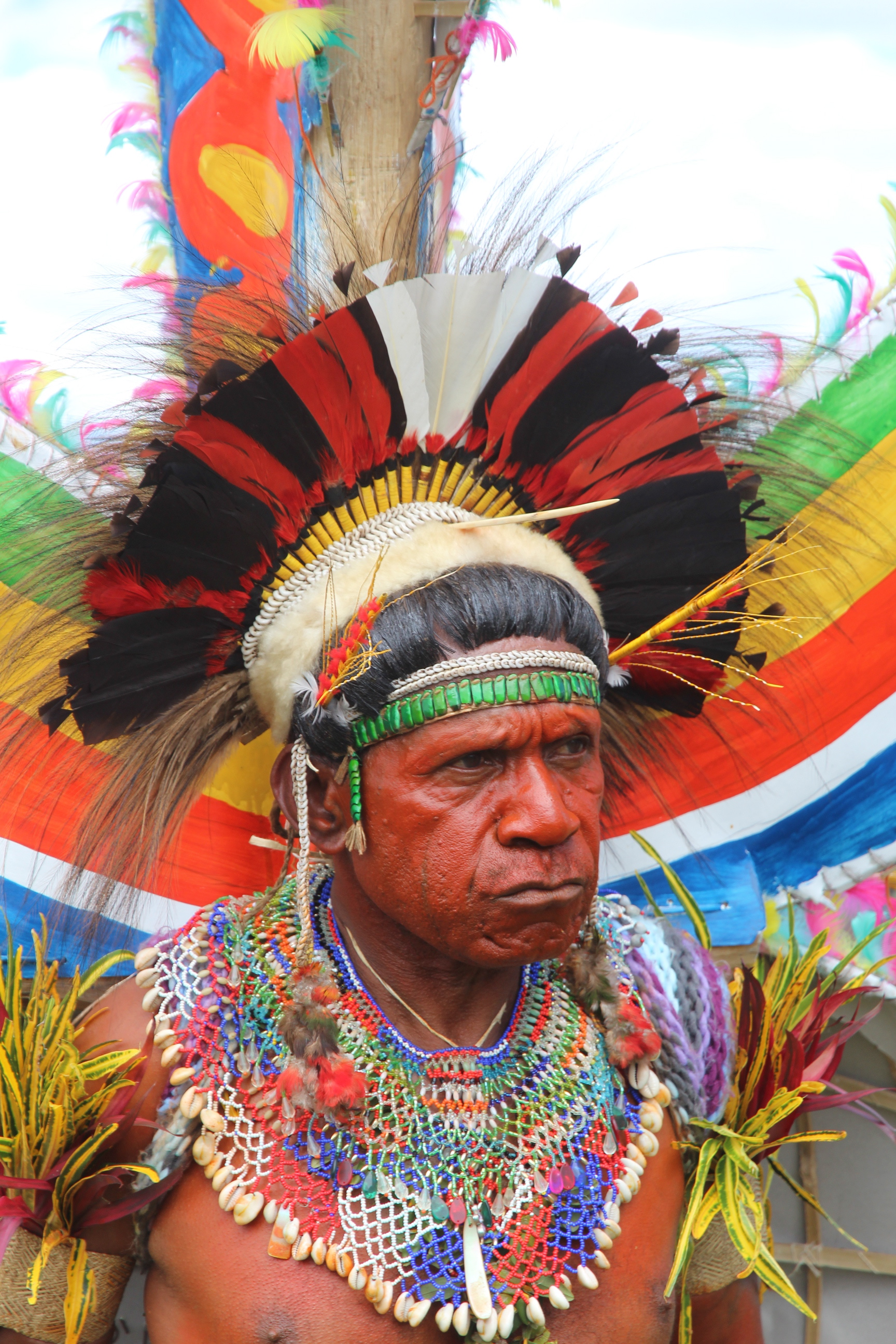
With more than 130 tribes prancing, dancing, singing, whooping, drumming and jumping around the Goroka Show, I hardly knew where to look next.
Most performers make their own costumes, and some spend years embellishing and enhancing them. I was told that many performers carry their costumes to and from the show wrapped in newspaper. Can you imagine storing one of these from year to year?


It’s amazing how nature provides almost all the materials used in costume construction.
There are shells, ferns, leaves, bark, beads, nuts, skins, flowers, rope, twine, wood, and feathers, feathers and more feathers. Indeed, I cringed to think how many birds gave their lives to provide the tens of thousands of feathers used in so many of the headdresses. I know that most of the orangey-goldy feathers are from the national bird, the Bird of Paradise. The very long black feathers are from drongos. the large crescent shaped shells—usually worn on the chest—are kina shells. The local currency is called the kina.


The range of colours is overwhelming. And the photos are the best evidence of that. Sorry but I don’t know the names of most of the groups. But the pic directly below makes the identity of this tribe clear.
Stay tuned tomorrow for a look at the kids participating in the Goroka Show. So great to see the young ones being involved.
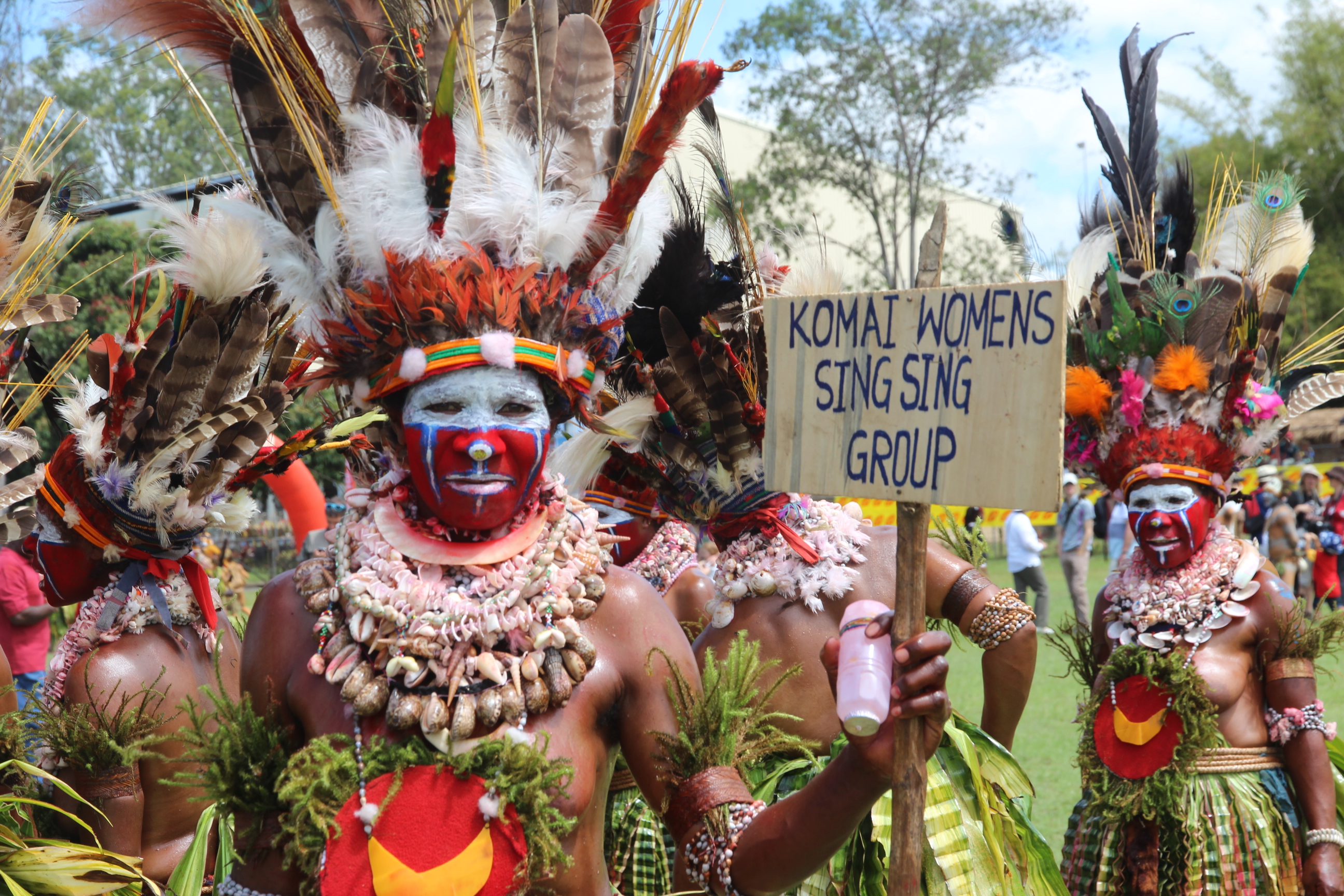
Komai Women’s Sing-Sing Group


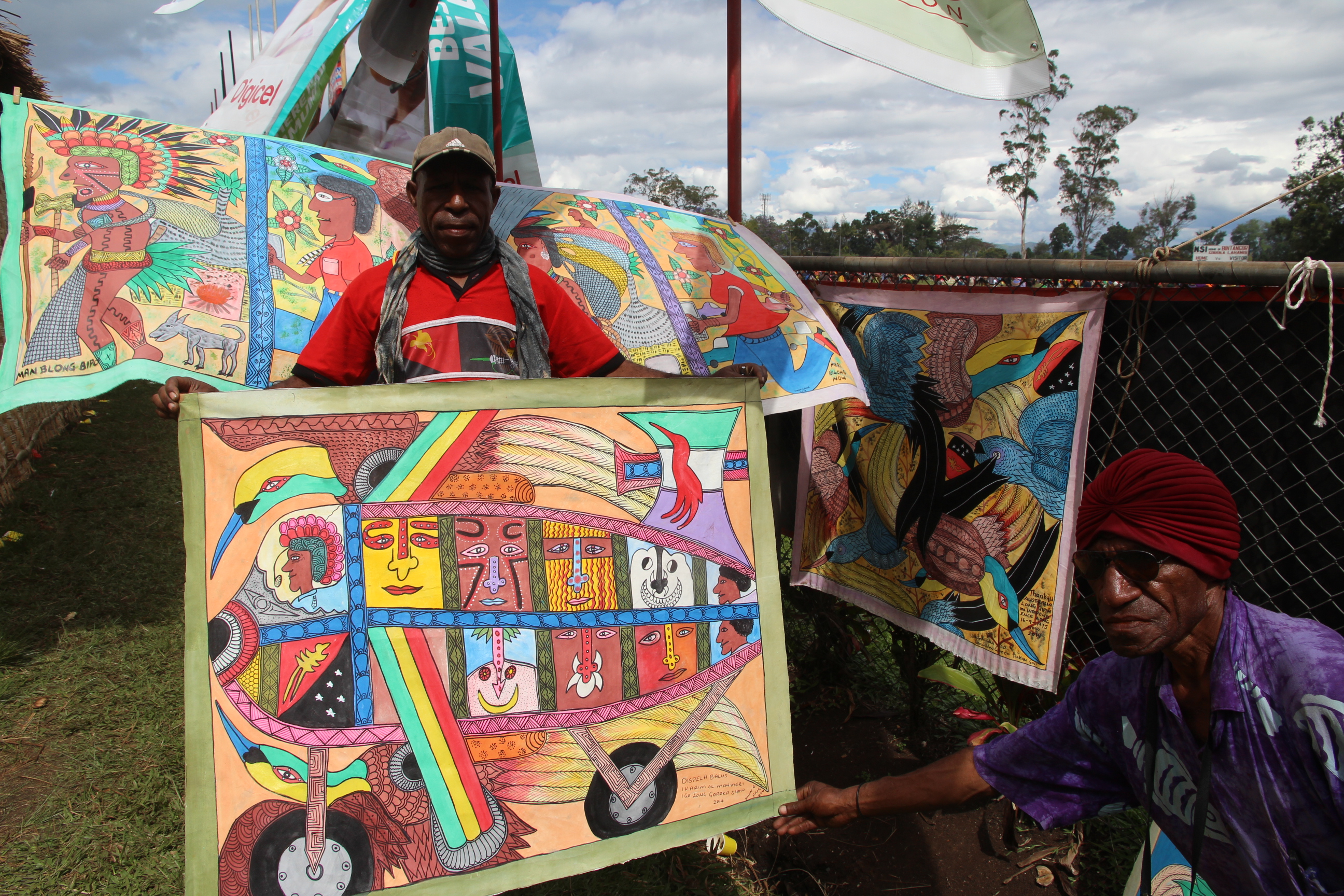
Our newest painting and the tribes represented. Top row from left (including the pilot): Morobe from Lae, Huliman, Trobran Ireland, Central from Port Moresby, Mudman from Asaro. Bottom row from left: PNG flag, Dukduk from Rabaul, Simbu and Daru. Simon G is in the red shirt
For quite a few years, Poor John has played a stern devil’s advocate every time I start looking seriously at travel souvenirs.
And where do you plan to put that, he says. And what will you get rid of in exchange?
So I was rather surprised when we cruised through the craft area at the Goroka Show, and he actually encouraged me to buy a couple of somethings.
We dithered for quite awhile over several paintings and, in the end, bought one showing a planeload of tribesmen all dressed up and heading to the show. My dad was a pilot and I’m rather partial to airplane art.
I was pleased to purchase the painting direct from the artist, Simon G, and get a picture of him with his handiwork. He also told me the names of all the tribes shown in the plane windows—see the caption for the details.
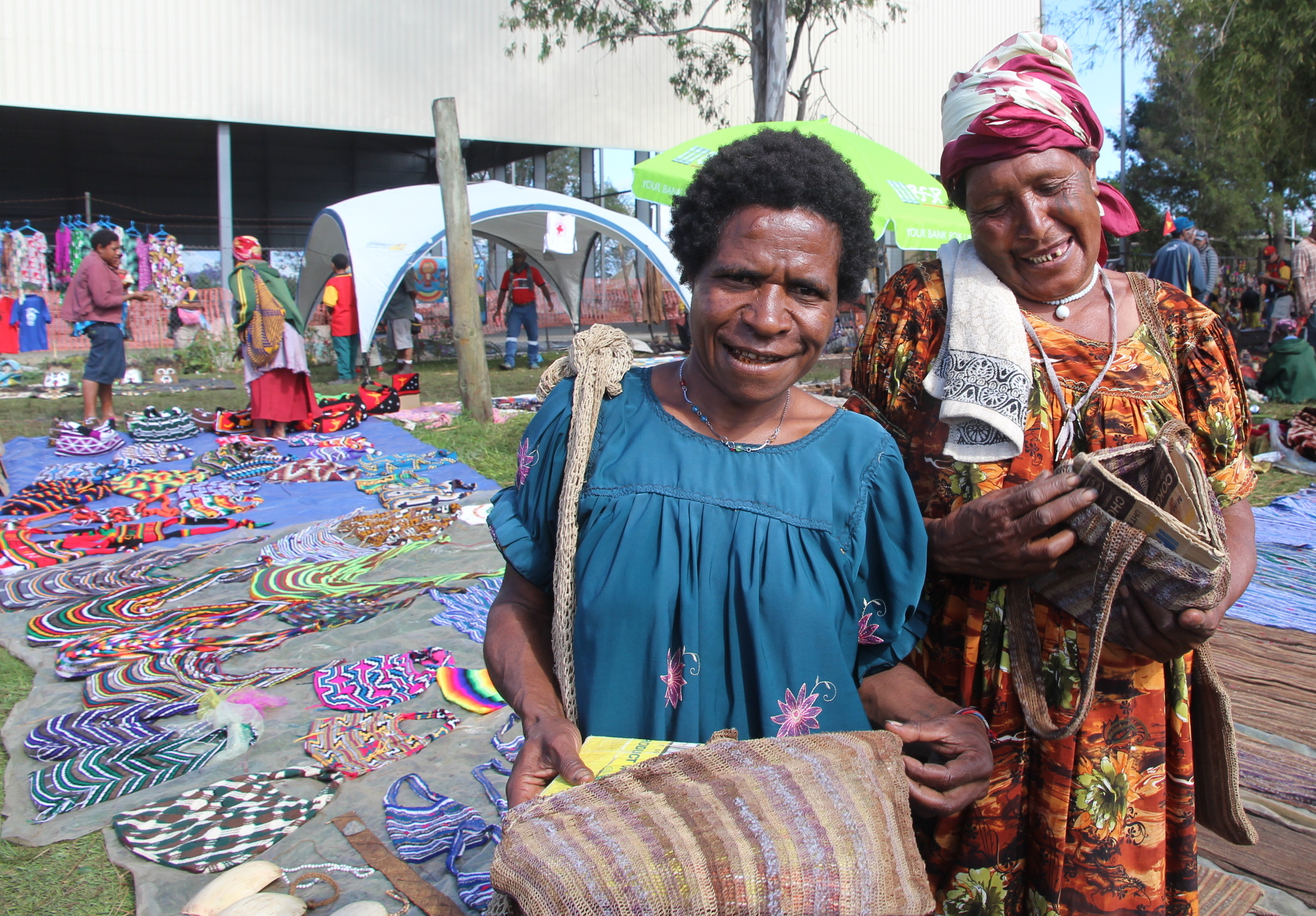
I bought three (or was it four) bilums from the woman on the right
Bilums were next on the list. Everyone in Papua New Guinea carries one of these handy woven bags. I bought several made of bark, which is often called bush rope.
Coffee was our next hit. Poor John really, really loves his coffee. He’s an addict in the extreme. At the moment, we have at least nine different varieties of coffee beans in our house—and some inferior instant stuff. We visited the coffee tents several times and tried to order two kilos of coffee beans. On the last day of the show, the sellers were most apologetic about not being able to fulfil our order.
Power in town had been out for a couple of days (there was a generator where we stayed) and they couldn’t run the machine that could vacuum seal bags of beans. So we bought almost three kilos of ground coffee, and another three kilos of beans when we got back to Port Moresby. (I remember when Poor John visited Papua New Guinea in the 1980s and brought home something like 18 kilos of coffee.)

PNG women have a role in selling and growing coffee
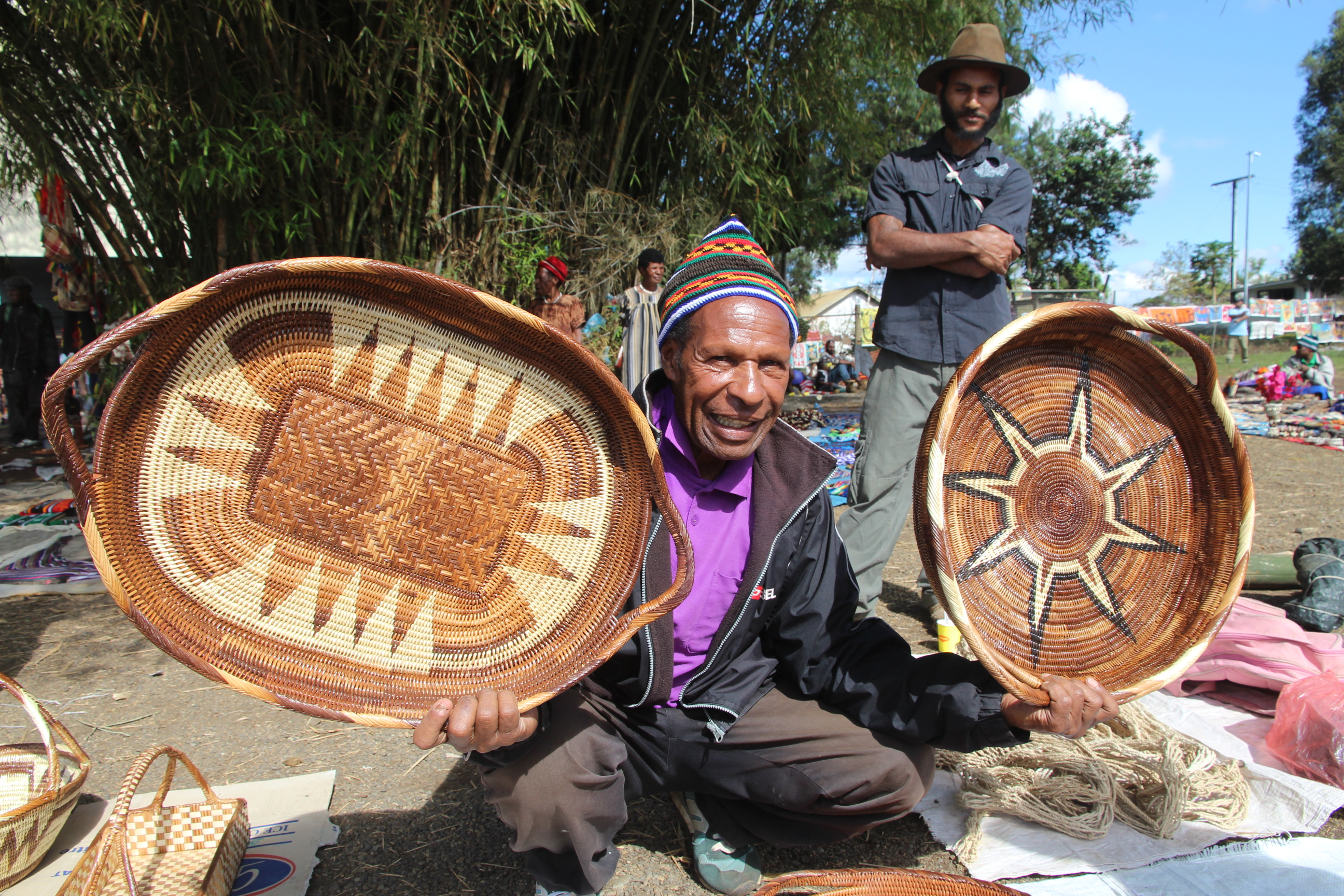
We bought one of his baskets (not shown)
But then there was the mask. Normally I avoid masks, but this one was so amazing and so detailed and so lovingly made. And probably so out-of-bounds for Australia’s quarantine laws.
Luckily, this one wasn’t made with any hair products, but I was still wary. Poor John said, Go ahead and buy it. I’m sure it can be treated. The artist—I never got his name—said it took him a year to make and he wanted 250 kina or just over $100.
But I foolishly said, No, no.
I wasn’t so much concerned about quarantine, but more thinking that he should sell it to someone who doesn’t have a houseful of weird artefacts.
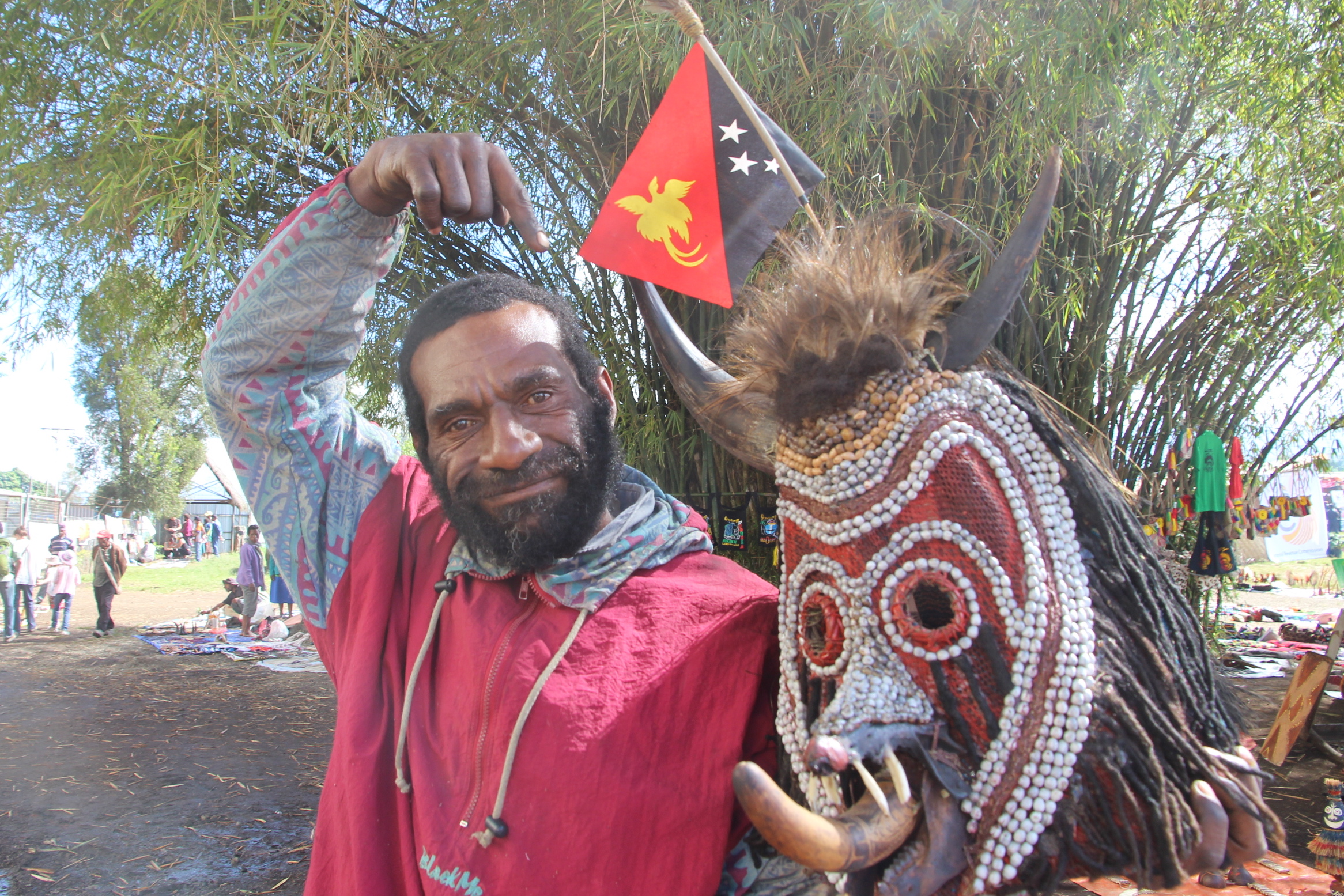
The mask I wish I’d bought
Imagine my dismay on day two of the show, when we went back to the craft area to see if the mask was still there. It was gone. 😦 I asked the artist was he got for it. The customer had ‘beaten him down’ to a mere 100 kina. He didn’t look very happy about that.
Now that’s the crime. A guy works for a year on a work of art and gets less than a measly $50.
Even if it had been taken off me at quarantine in Australia, I wish I’d bought it for 250 kina. At least the fellow would have had some decent recognition and compensation for his labour of love.
And I might have ended up with an amazing mask somewhere in my house. I still don’t know where I would have put it, but don’t tell Poor John. He encouraged me to buy it, but never asked where I’d put it. Maybe he’s sorrier than I am.

The seller wearing that mask. Still wish I’d bought it
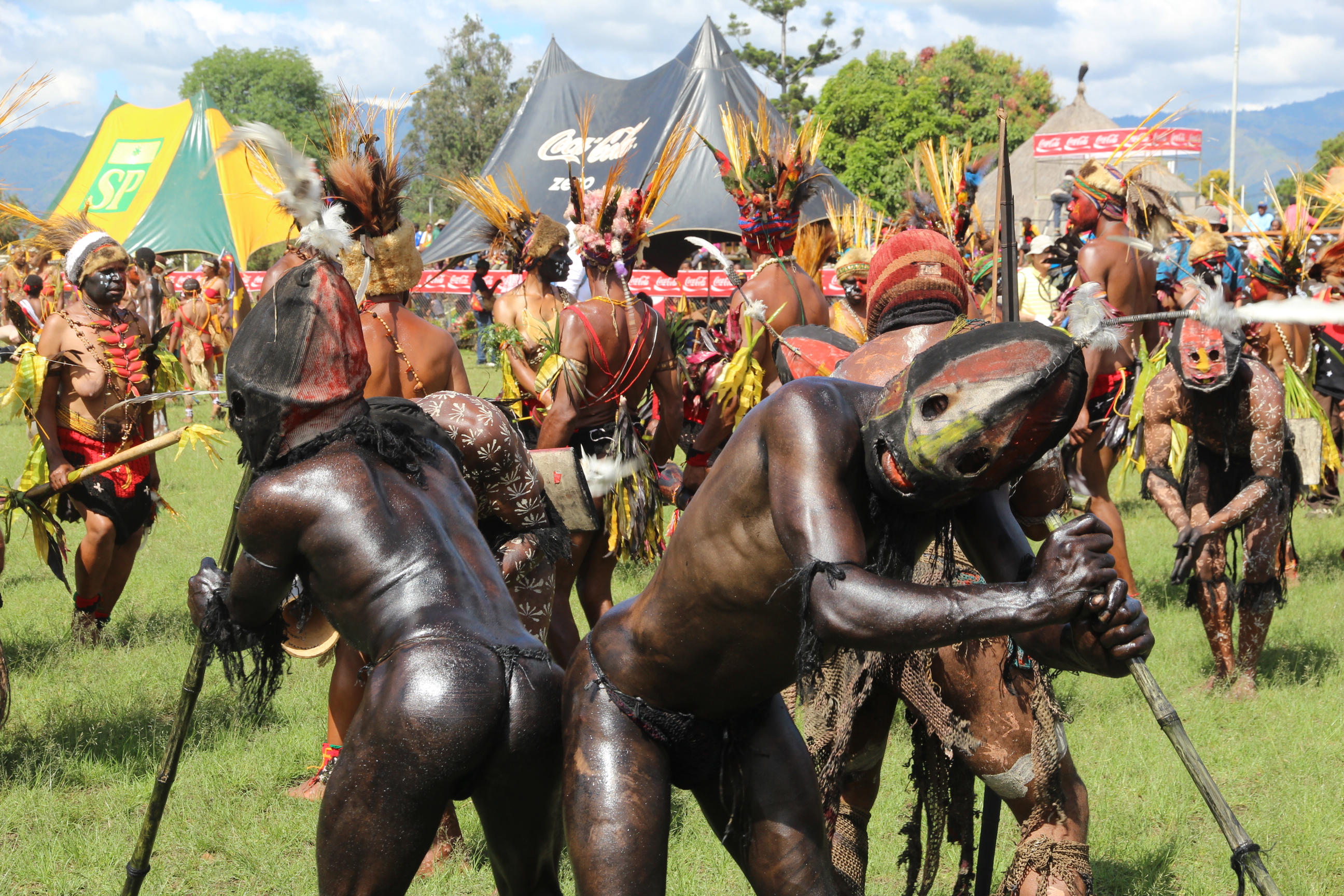
Dancing cheek-to-cheek—the Junife group from Henganofi


I was totally out of control at the Goroka Show in Papua New Guinea—all that flesh, all those flashy get-ups, all those muscles, all that body art, all that pulsating music, all those thumping drums.
It was a complete sound-and-sight overload, so I caved in and did what I swore I wouldn’t do again after the last time my senses took a similar hammering in the Himalayas in 2011.
So what did I do? I confess. I took 800 pictures (and a few movies) in two days. I’m not proud, but then again, I suppose I am.
Now it’s taking me ages to wade through them (luckily I’m popping quite a few in the trash).
But I’m not going to keep you in suspense while I fiddle with photos.
So I’ve settled on sharing a big dose of bums, backs and bustles (I’ll save that other ‘b’ word ‘boobs’ until later).


But first I’ll tell you a little more about the show. It’s one of many such extravaganzas held each year in Papua New Guinea’s highlands. This two-day event usually occurs on the weekend closest to PNG’s independence day, 16 September.
This year about 130 tribes performed. Interested tribes pay a deposit to secure a place, and are then paid if they appear. No prizes are awarded, which makes sense when you consider the fact that some of these tribes are enemies.
I heard that the organisers had hoped to limit participation this year, but too many tribes already know the show’s bank account details. So they just go ahead and pay their deposit, and are confirmed as being in.
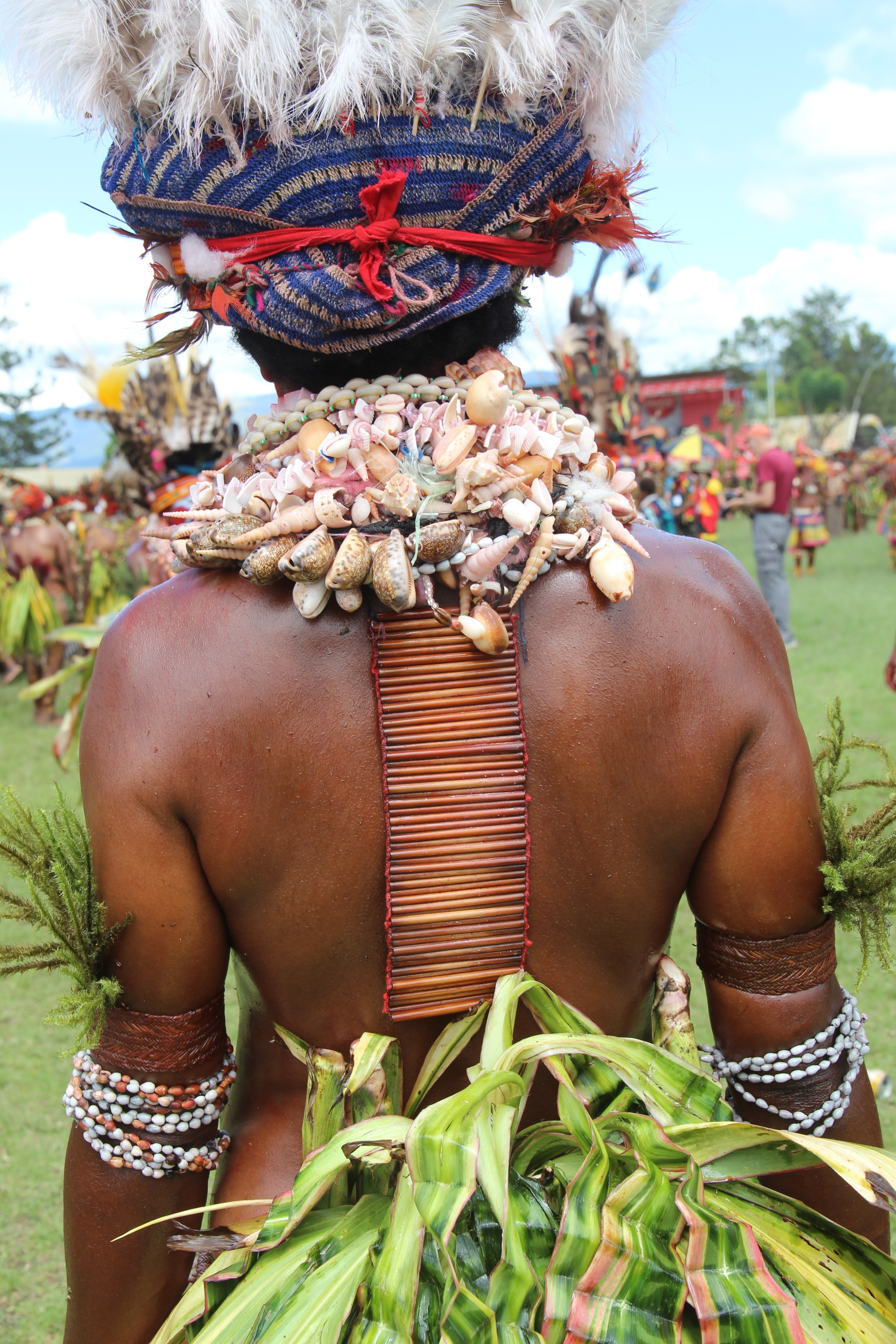


Groups can have any number of people (most are large), and I’m guessing there were at least 2000 performers.
We were VIP guests—a $60 option available to foreigners and well-to-do PNGers. There weren’t more than 400 VIP tickets sold this year (compared to 360 last year). The big bonus in these tickets (general admission is about $2) is early admission. We were allowed in at 9am both days, while the general public can’t get in until noon.
Performers love the crowds and play their parts to the hilt. The great thing for us was being able to walk amongst all the performers. Every now and then, we found ourselves in the midst of a dance or facing a bow and arrow or a brandished spear. But it also meant we could closely examine the costumes and all those magnificent bodies, and even chat to the performers on the rare occasions that they actually took a break. You may have noticed that one of the back decorations is an animal pelt. It’s a cuscus or a PNG possum. Another performer is wearing cassowary feathers over his bum.
In addition to the still pics, I’ve added two short video clips of bums and bustles. I think you’ll agree that these bums, backs and bustles are impressive and expressive. The fellows in the top photos are part the Junife tribe from Henganofi. They were having a great time hamming it up and dancing cheek-to-cheek.


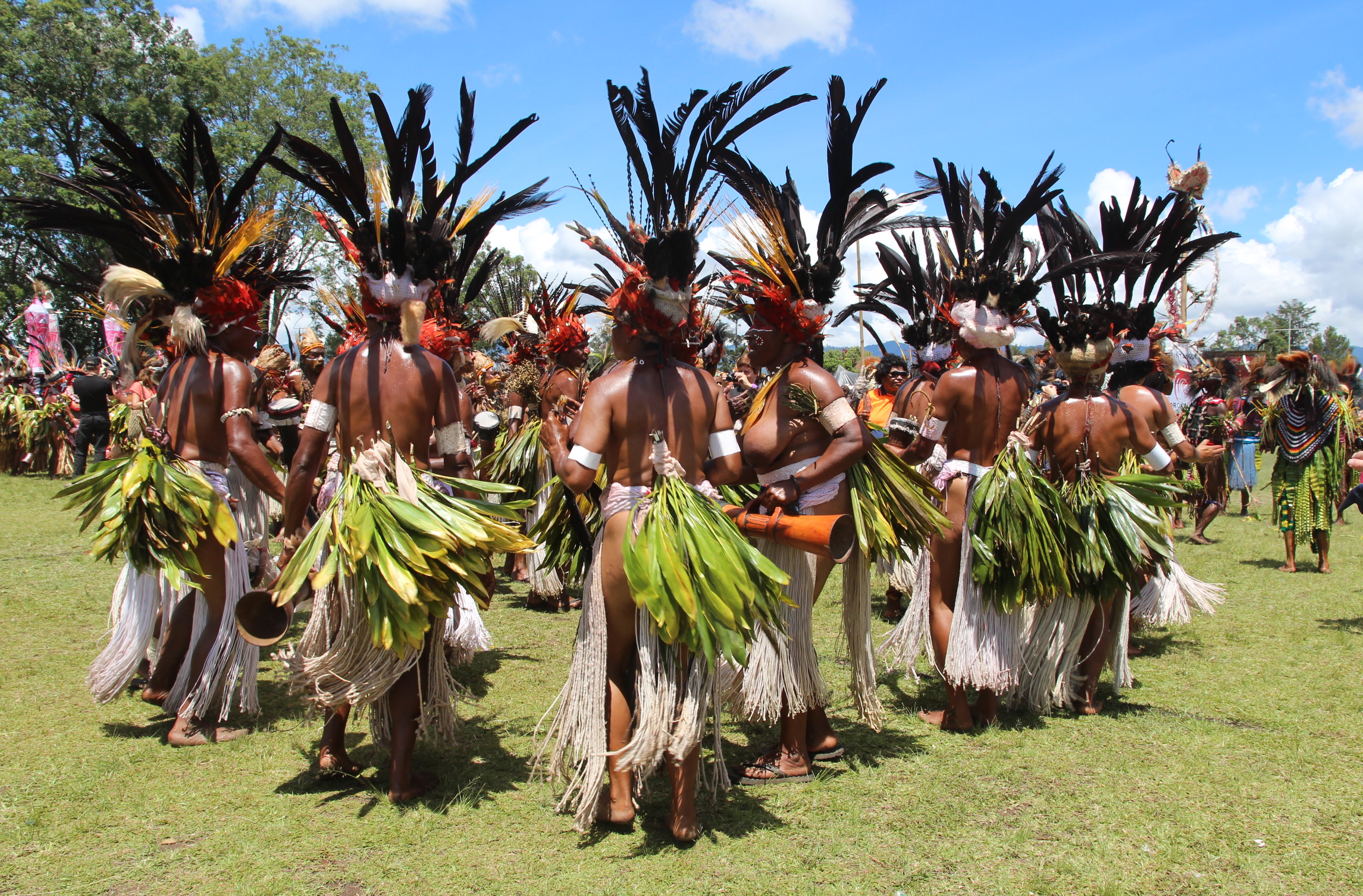
Bustling about at the Goroka Show

A bit of grass that missed the soot treatment
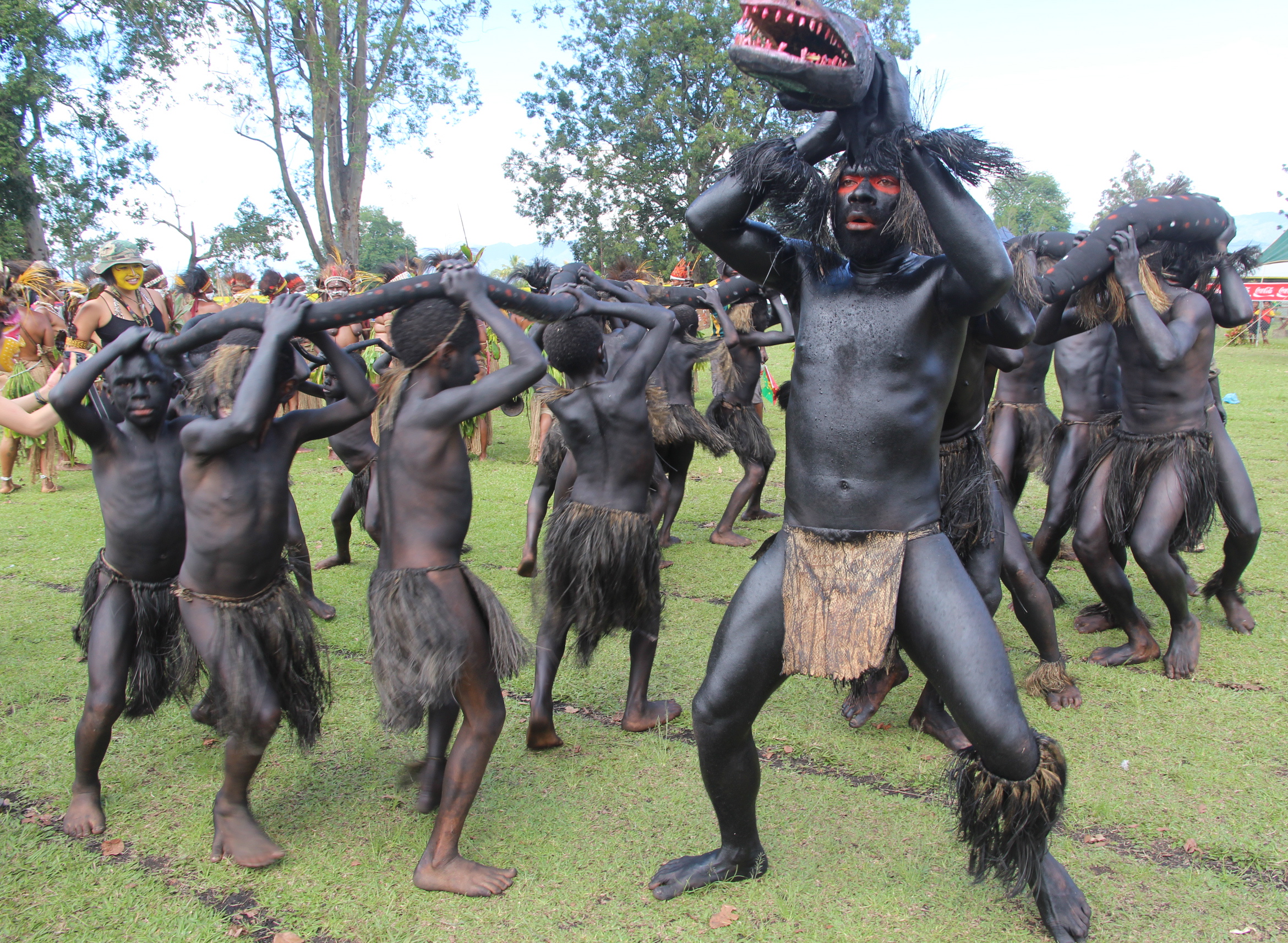
The dancers get underway
Some of my readers are very, very squeamish when it comes to snakes. I know this because they’ve told me. So I thought I’d get the Goroka snake dancing out of the way, so these readers don’t have to live in fear that more snakes are on the way (this time around).
This group of all-male dancers was easy to spot. Covered in black soot, they are one of only a few of the performing tribes that blacken their grass adornments as well as their already black skin.
The snake, however, is a bit more colourful with a few rows of red and white dots and plenty of menacing red teeth. This year’s snake was made of a spongy sort of tube (maybe foam) covered in fabric. It was very flexible and probably quite light. I was told that snakes used to be made of wood. What a struggle to carry.
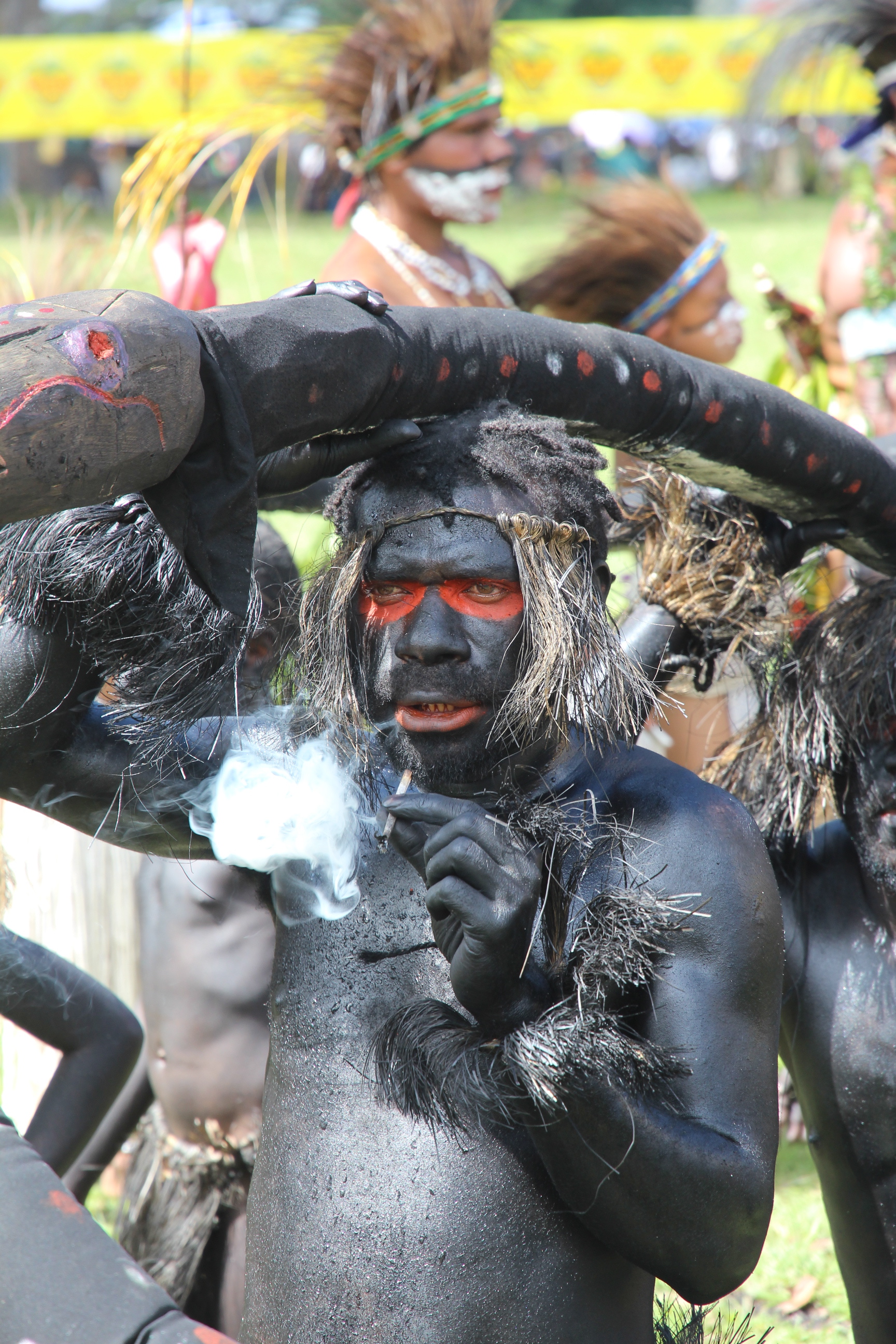
The lead dancer stops for a smoke


I came upon these dancers early on the first day of the show, when they were having a rest between numbers—the lead fellow was even having a smoke. Looking at the photos now, I can’t figure out exactly how many dancers there were or even how long the snake was. But I was impressed to see that there were dancers of all ages.
In fact, lots of groups included young girls and boys, and it’s great to see the tribal traditions and rituals being passed on.
By the way, Papua New Guinea is about the size of California. It has about 7 million people living in 19 provinces. It is one of the most culturally diverse countries in the world with about 850 distinct tribes and languages.
I think this tribe is from South Simbu Province, but let me know if you know they are from elsewhere.
Finally, here’s a short video clip of one of the many snake dances. I think the singing is coming from a nearby group because most of these guys aren’t moving their lips.
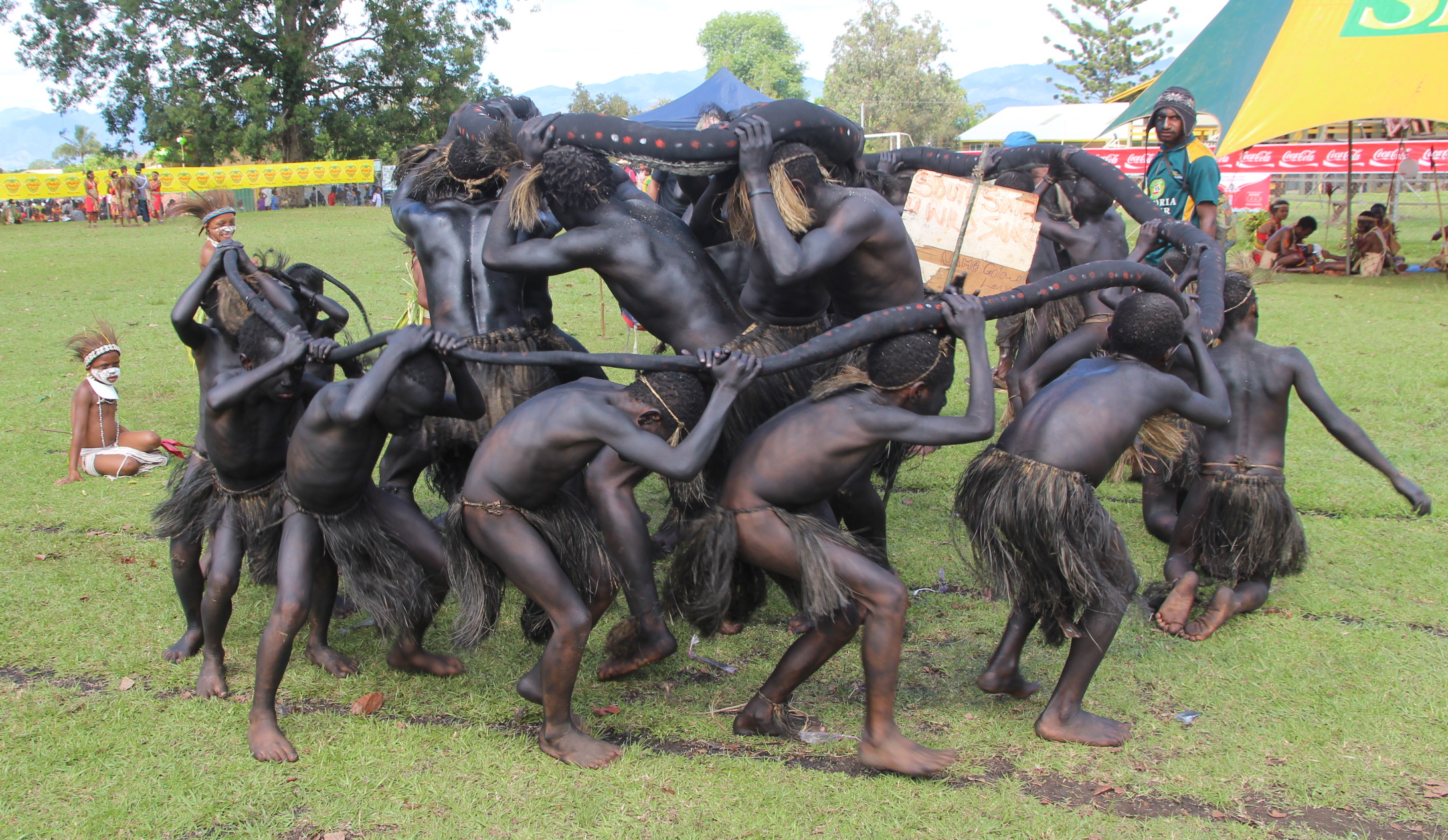
Snake dance in motion
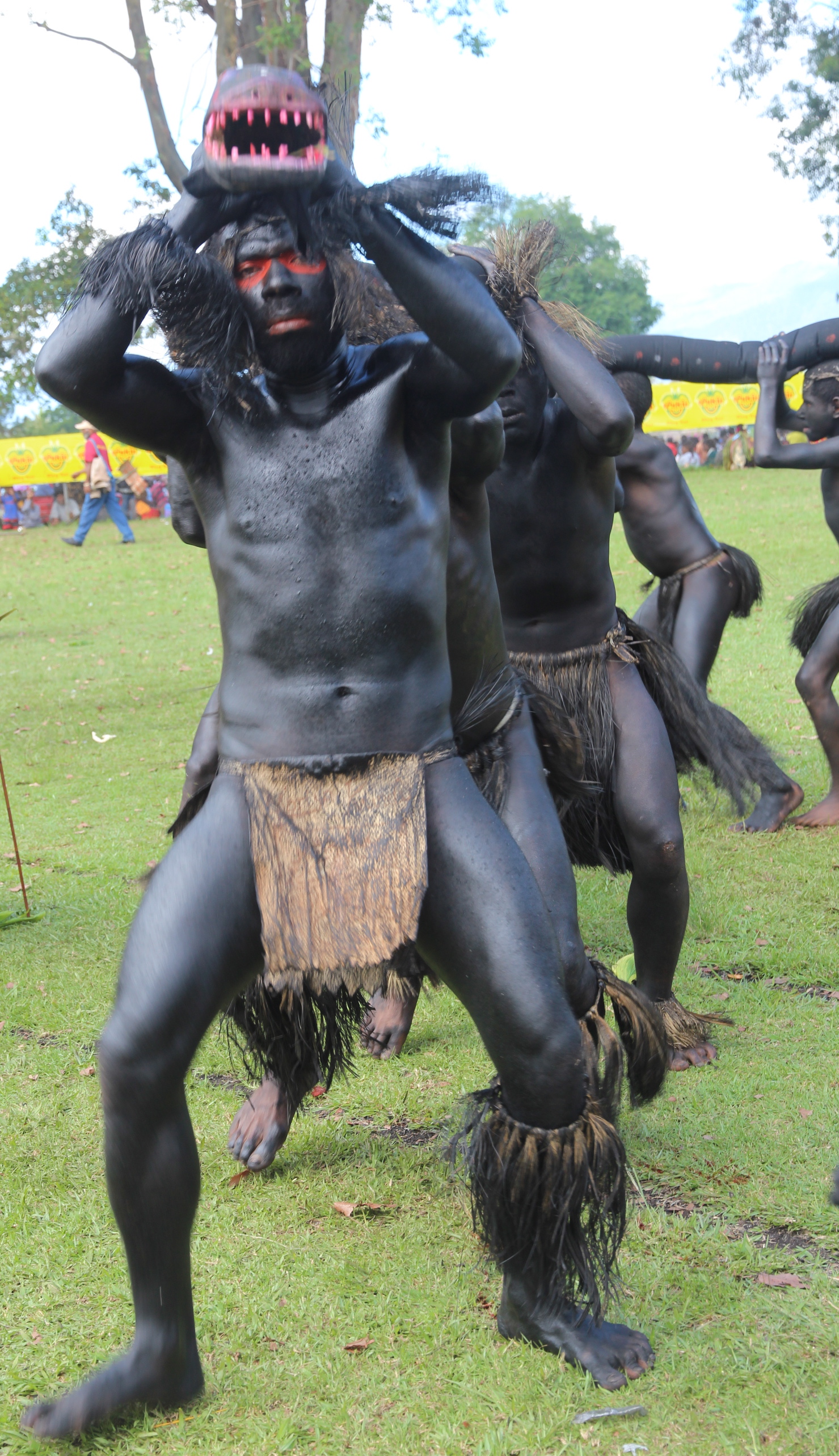
Look at those muscles!
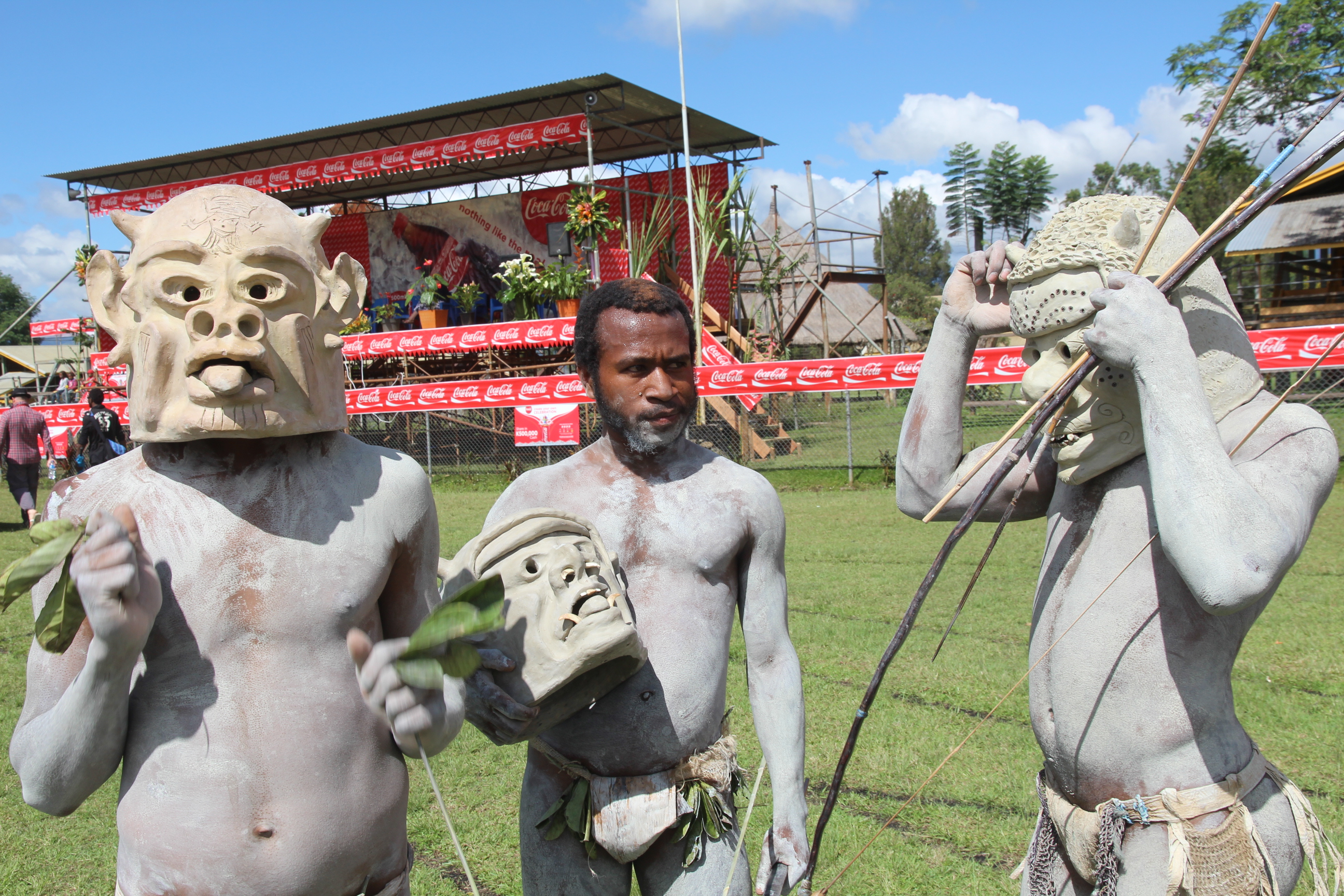
Asaro mud men don’t look quite so scary without their spears and masks
Where to start with the Goroka Show? Frankly I’m still reeling from an overload of colours, sights, sounds, songs and jiggling flesh. Oh yeah, I seen enough flesh to last a lifetime.
This show is just one of many tribal gatherings—known as sing-sings—that occur across Papua New Guinea. And they are unique to that country.
Australian administrators got the shows going in the 1950s and 60s as a way to get tribes to celebrate PNG’s extraordinary and diverse cultures.
Imagine bringing together hundreds of different, and sometimes warring or isolated, ethnics groups, and turning them loose in an enclosed area with all the body paint, eleborate decorations, boundless energy and stunning creativity from whatever the jungle, sea and shops have to offer?
Goroka’s sing-sing is one of the biggest and most colourful. It got started in 1956 and is usually on the weekend closest to 16 September (the date in 1975 that Australia gave PNG independence).
For the last few years, a friend in Port Moresby (and someone we travelled with in Africa in 2009) has urged us to see the Goroka Show, so this year we started planning. Poor John is the great organiser, so I left it to him to find a reasonably priced option.
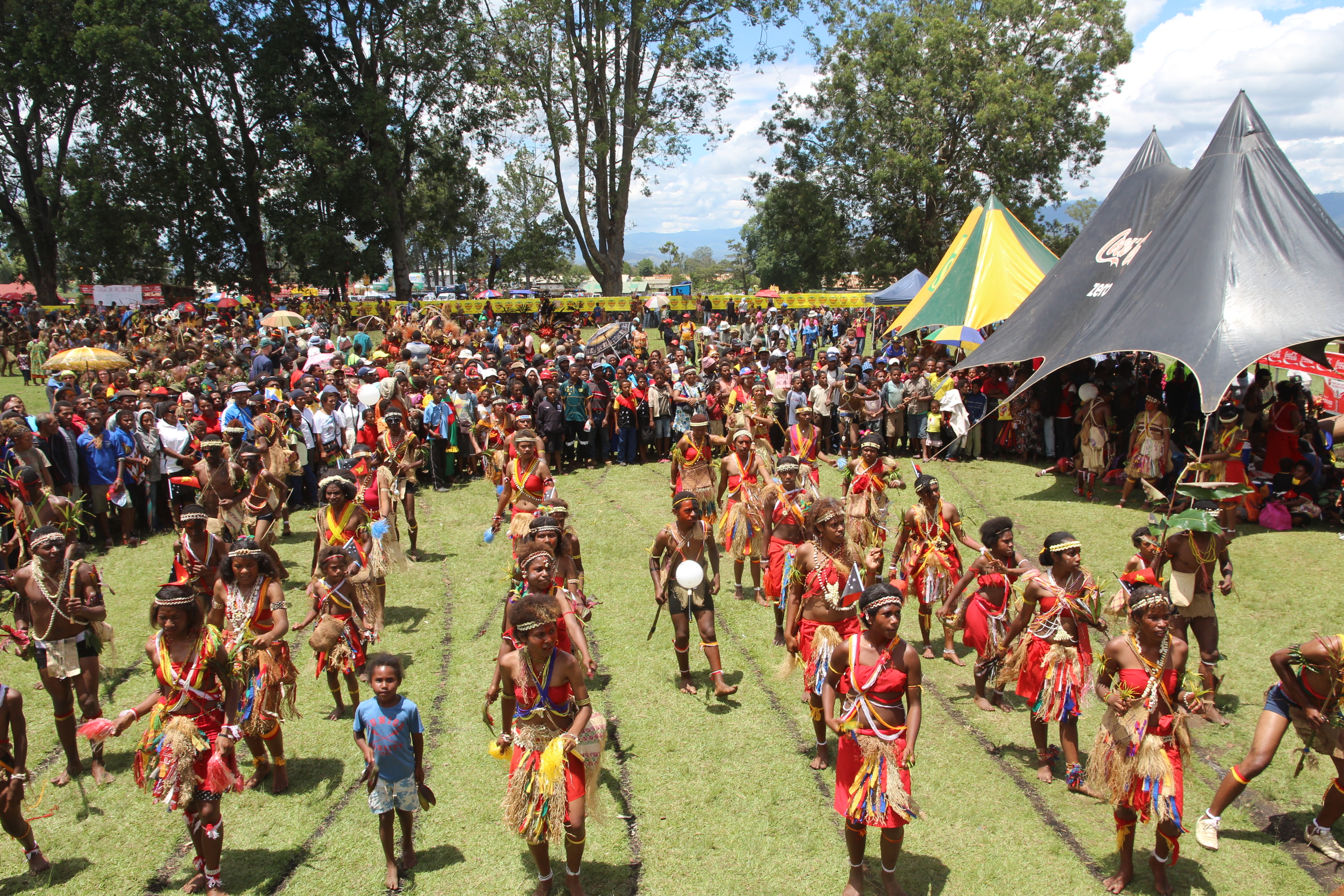
The crowd watches one tribe strut their stuff
He found a wonderful choice in Best of PNG. The 11-day package included four nights in Goroka, two nights in an Asaro village, and five nights in and around Tufi. The price was fantastic (no, we didn’t get any discount or freebie), and we talked to people on more deluxe packages that spent four times what we did. But I should point out that we slept in basic grass shacks and in dorms at the National Sports Institute in Goroka,
I’ll be covering all the elements in our package, as well as the days we had in Port Moresby before and after. For now, here are a few more introductory pics—I’m still sorting through the hundreds I took. Also hope to post a couple of videos.
Oh, and about my comment that I’ve seen enough flesh to last a lifetime. I was joking. I want to go back next year and the next and…
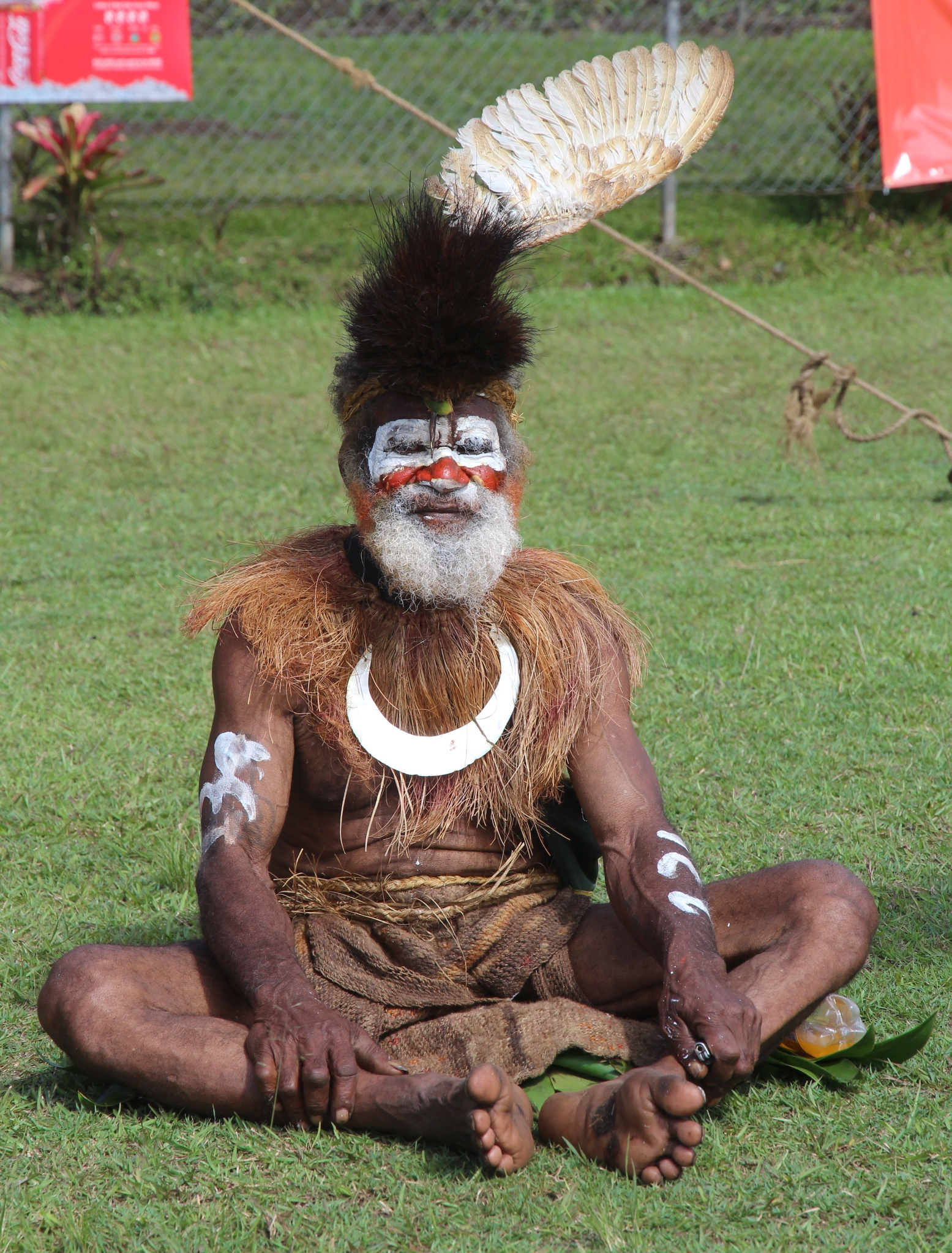
A quiet moment before joining the dance, and yes that’s a bird wing on his head

Just a sample of the faces, smiles and colour at the Goroka Show. The face paint shows the Papua New Guinea flag
I’m still trying to get my head around our trip to the Goroka Show in Papua New Guinea.
This amazing show where tribal clans—from across the country—come to show off their costumes, music, drumming, singing and dancing is absolutely breathtaking.
Frankly I’ve never seen anything like it, and I’m still thinking about how to bring it to you.
I confess that I took 800 photos in two days. So far my gut instinct is to deliver bite-sized chunks that feature bums and boobs (believe me there was an overload of flesh), faces and feathers, headdresses and bustles, crowds and crafts, and anything else I can think of.
So stay tuned for the colour frenzy, along with music and side trips up mountains and to villages in the highlands at the coast.
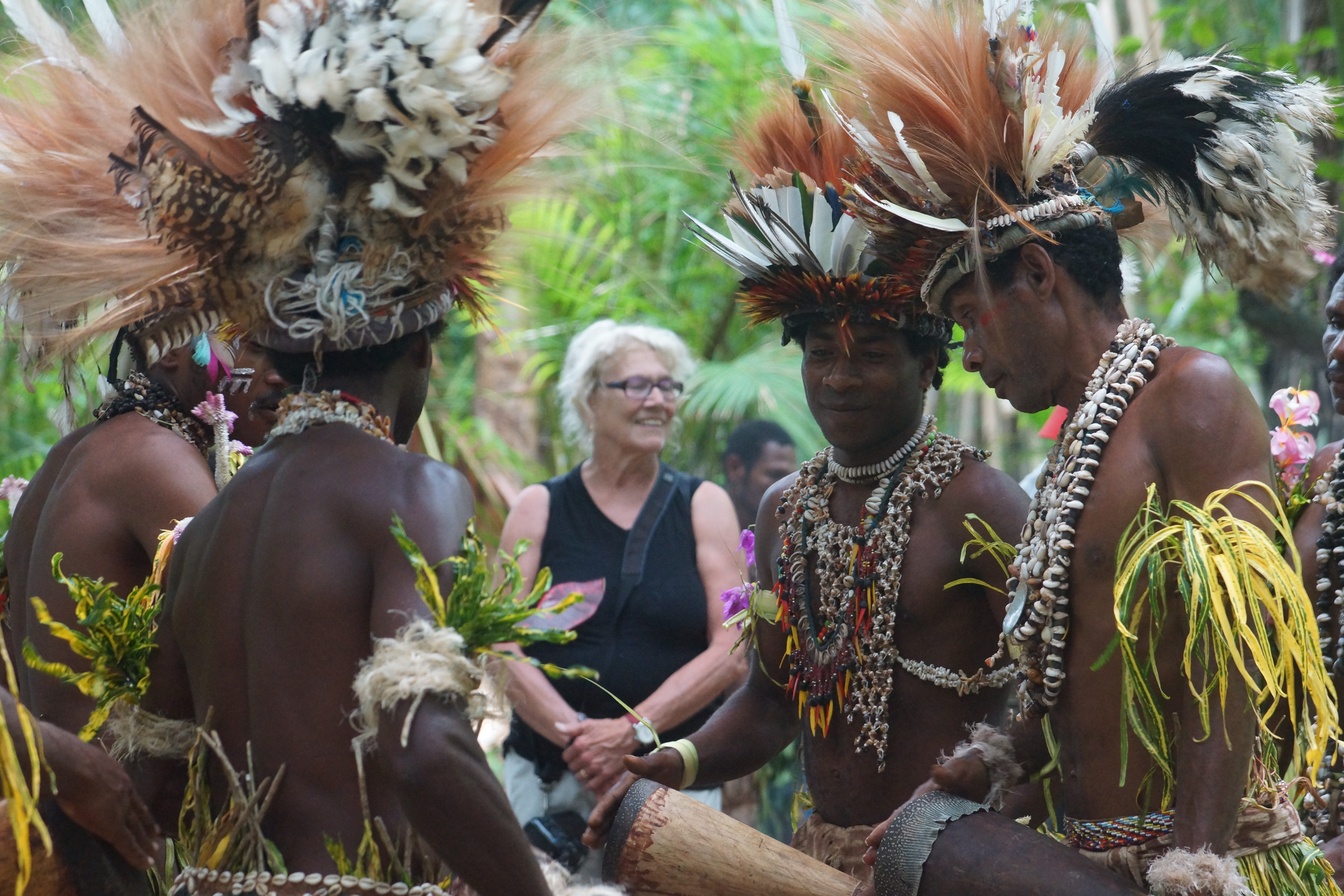
Enjoying the sights and sounds of Papua New Guinea. Poor John is NOT off somewhere being barbecued. Photo from Milly and Dick Guiliani
Sorry about the silence over the last couple of weeks.
Poor John and I have been exploring the wilds of Papua New Guinea. The capital, Port Moresby, is infamous for its rascals and thugs, but we’ve been enjoying visits to the highlands, jungles and beaches.
So far I’ve managed to keep my head and my smile. Stay tuned for oodles of updates when I have a better connection.
Thanks to travelling companions, Milly and Dick, for the pic.
 Where to next?