
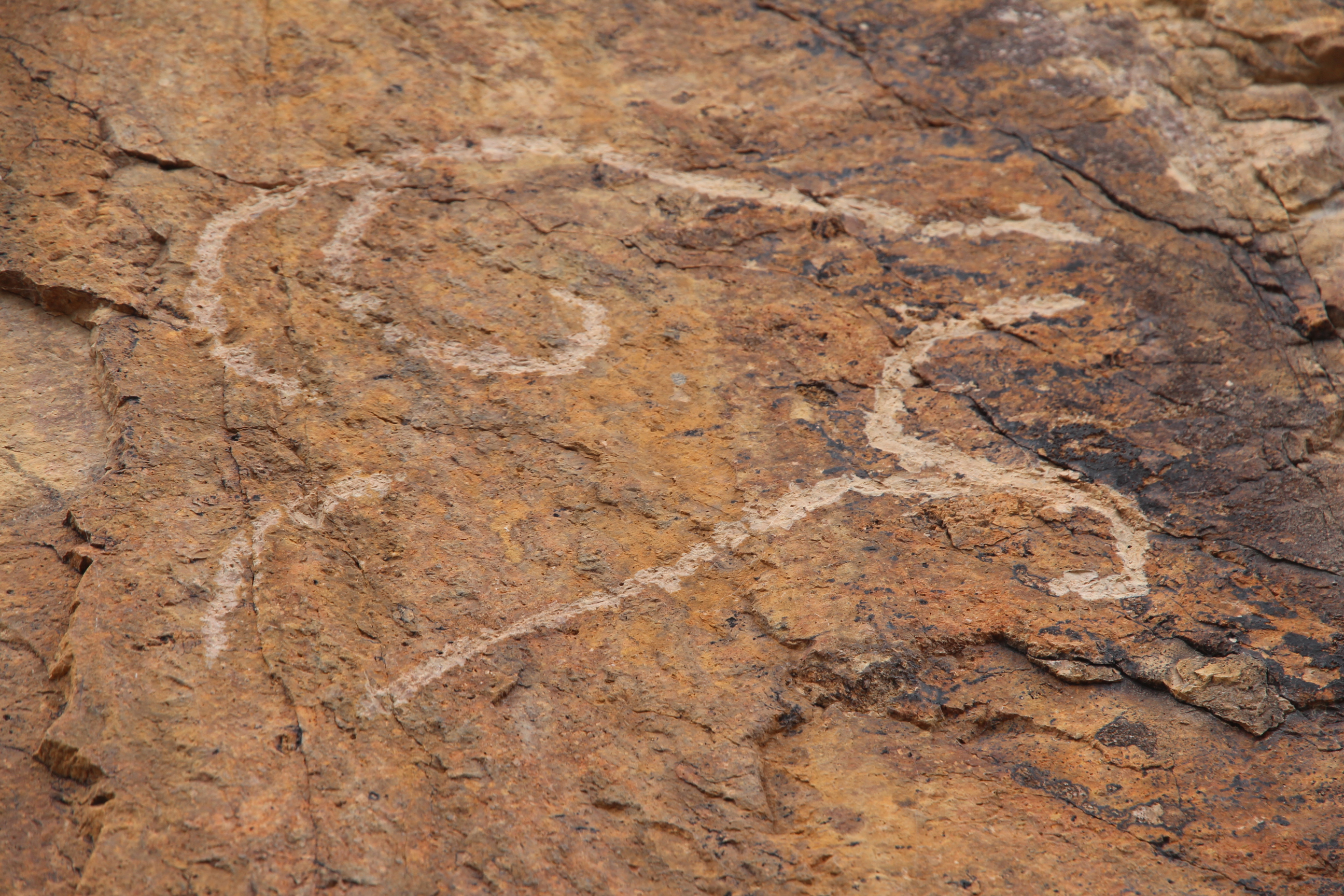
Certainly it is an animal, but is it a deer, a ram, a mountain goat?
Before we headed north out of Almaty, Suse, our driver, said we’d try to visit a few interesting places on our way to the border with Russia. We’d already spent way too many days in this large Kazakh city pursuing the ever-elusive visas for Russia and China, and everyone was ready for some serious sightseeing.
Tamgaly Gorge on the steppes of Kazakhstan was our first stop, and what a great place to switch from being thumb-twiddlers to travellers.
It seems like it’s in the middle of nowhere yet there, ringed by the Chu-Ili mountains, is a remarkable collection of ancient 5000 petroglyphs (rock carvings) dating from the Bronze Age and right up to the beginning of the 20th century.
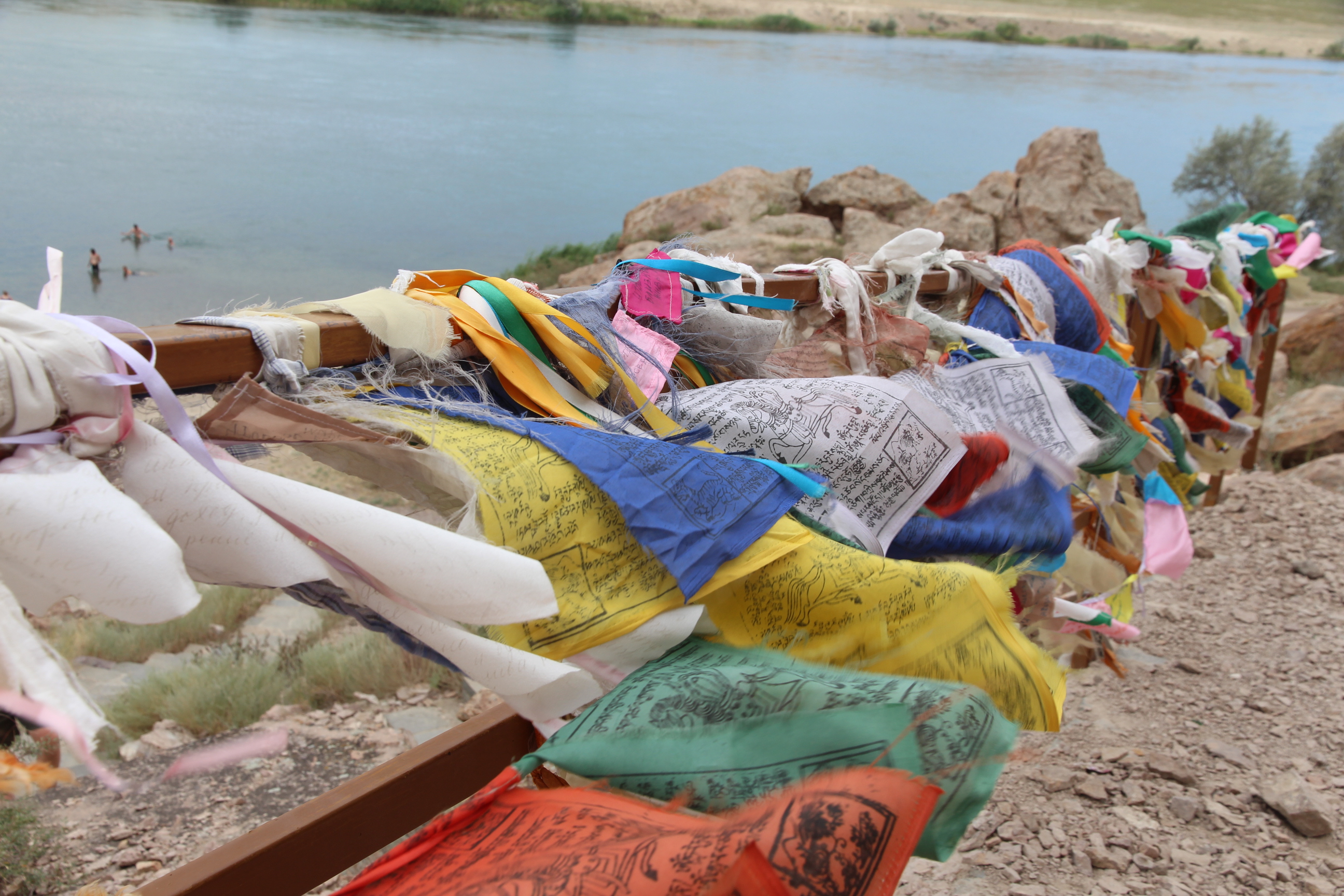
Flags at Tamgaly with the river in the background
The petroglyphs are spread across 900 hectares, including 48 distinct settlements and burial grounds. The largest concentration of artwork is in the main canyon, which is where our truck rolled to a stop with, would you believe it, another flat tyre. 😦
Suse waved us away, telling us to go enjoy the petroglyphs and their history, while she and a few others would tend to the tyre and have a dip in the nearby Tamgaly River.
Sarah led the way towards a likely tomb she’d spotted in the distance. As we climbed, we scanned the cliff faces for petroglyphs, but most of them were so faded that it was difficult—more like impossible—to figure out what was being depicted.


So while there was a great view from up near the tomb, there still wasn’t much in the way of art.
As we descended, we noticed some of the others had veered to the left, to follow a rough path that led between more cliffs and the river.
Silly us! Of course we’d find the petroglyphs around the corner where it was shady. We had walked to the would-be tomb under a blazing sun. Obviously, people back in 1500 BC already had enough sense to stay out of the midday sun.
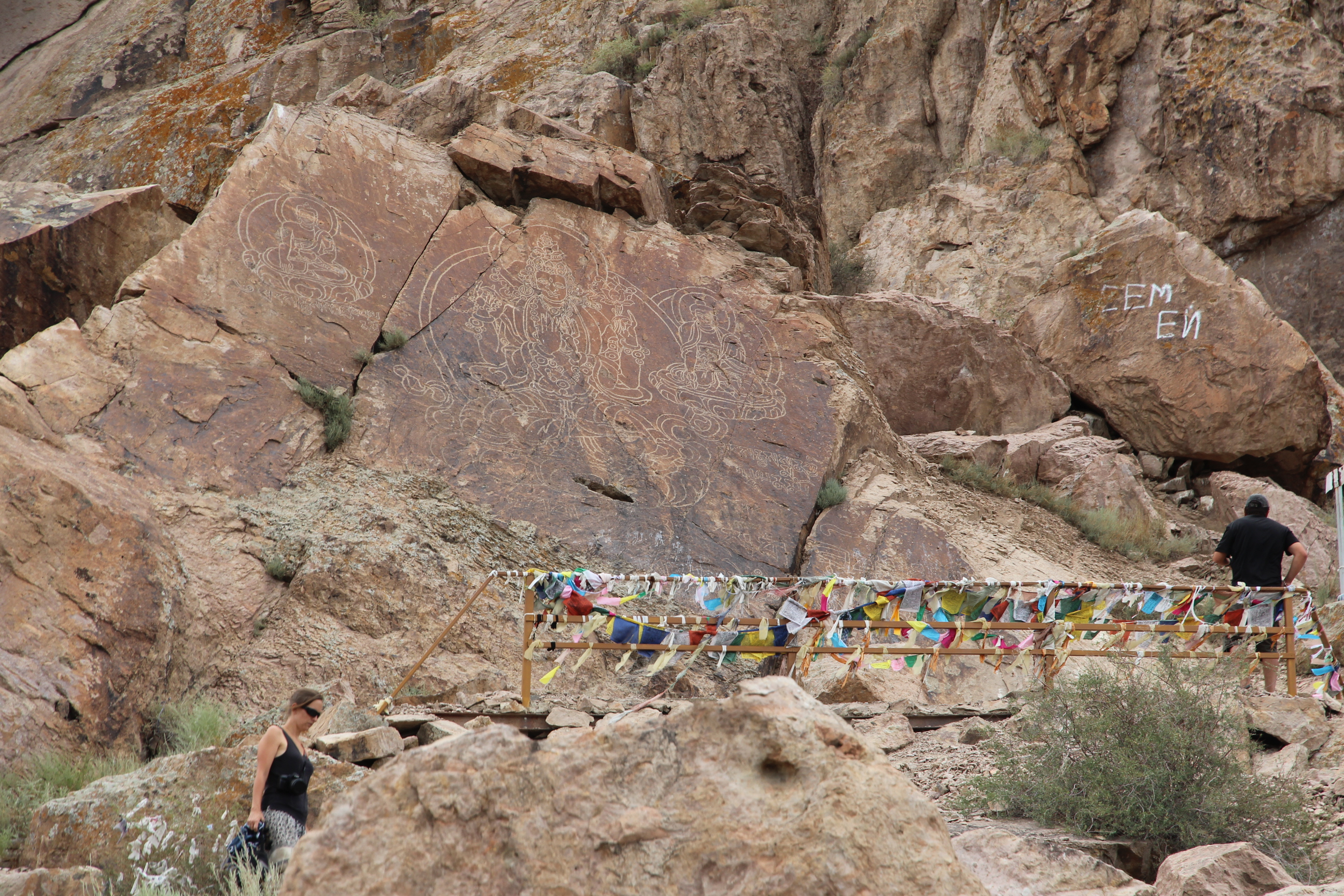
Buddhas with the flags in front
And it was there, in the shade, that we found petroglyphs galore.
No doubt these were chipped out by the many peoples who swept across the Central Asia steppes. Poor John read that it was possible for the old marauders to ride their horse, unencumbered, across the Asian steppes from Mongolia to Hungary.
Tamgaly must have been an interesting or popular stopping place. According to UNESCO—this is another World Heritage Site I’d never heard of—the best engravings are the earliest ones. There’s a wide range of deeply-etched images, including solar deities, zoomorphic beings dressed in furs, disguised people and animals and hunting scenes.
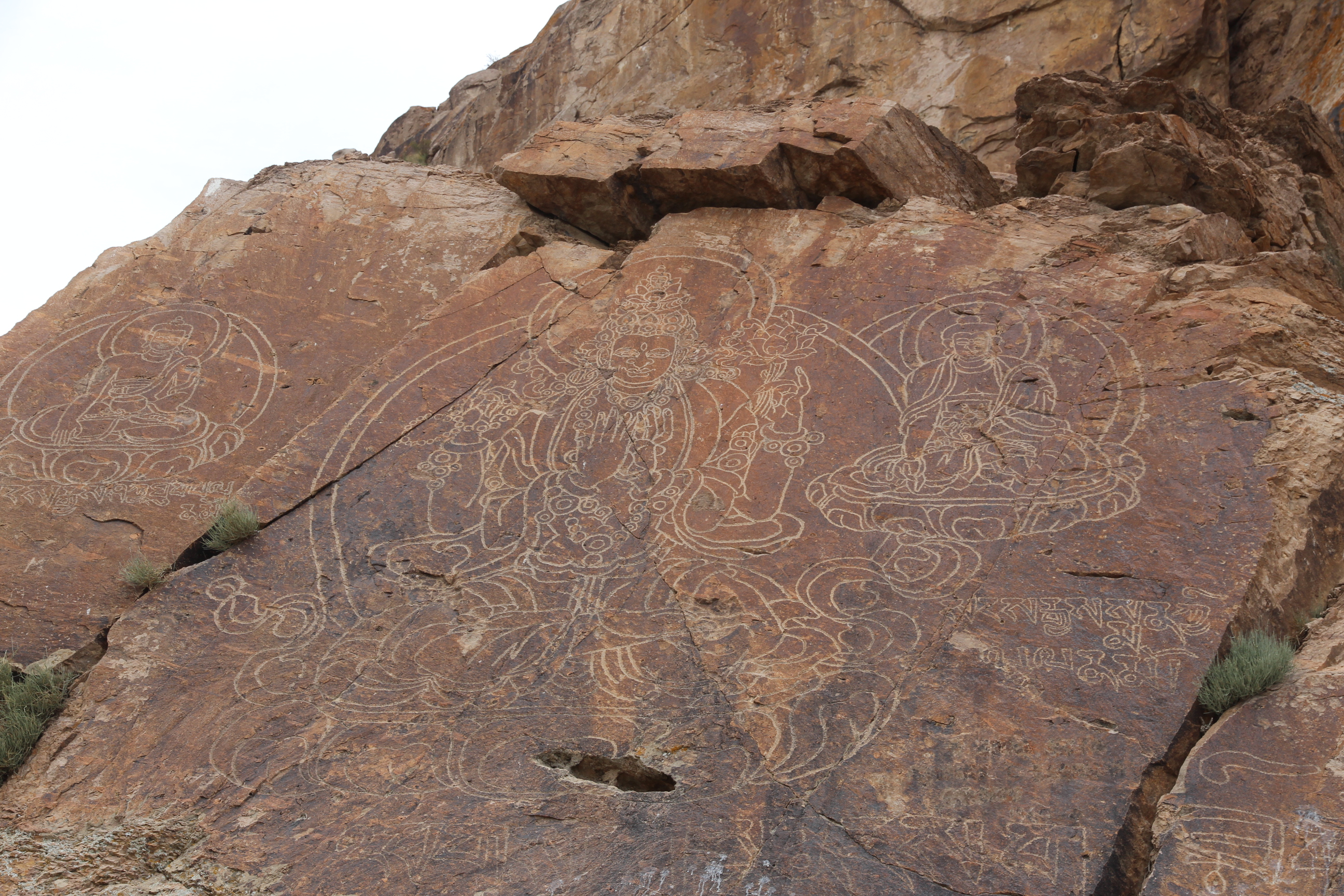
Buddha and sidekicks {click to enlarge}
Many images sit quite high on cliff faces, and I had to wonder if people climbed up or down to carve them.
There is also a Buddha (Shiva) scratched in about the 8th century AD. He is surprisingly large—at least five feet tall—with smaller Buddhas on each side.
I also liked the etched sets of ‘contemporary’ symbols and, looking at them, I was reminded of mathematical equations from my university days.


And there are plenty of colourful prayer flags and rags tied to railings edging some of the petroglyphs and pathways. This may be linked to the festivals carried out by local Muslims, but I can’t confirm this.
Research does indicate that over the years no permanent dwellings were ever built in the area, so the region must have been peopled and visited by nomads and yurt-dwellers. As part of the presumably-Soviet collectivisation of the 1930s and 40s, these dwellers were moved on and not allowed to return until the mid-1950s.
As a result, the petroglyphs weren’t ‘rediscovered’ until 1957. I’m so glad these were part of our discoveries of 2014.
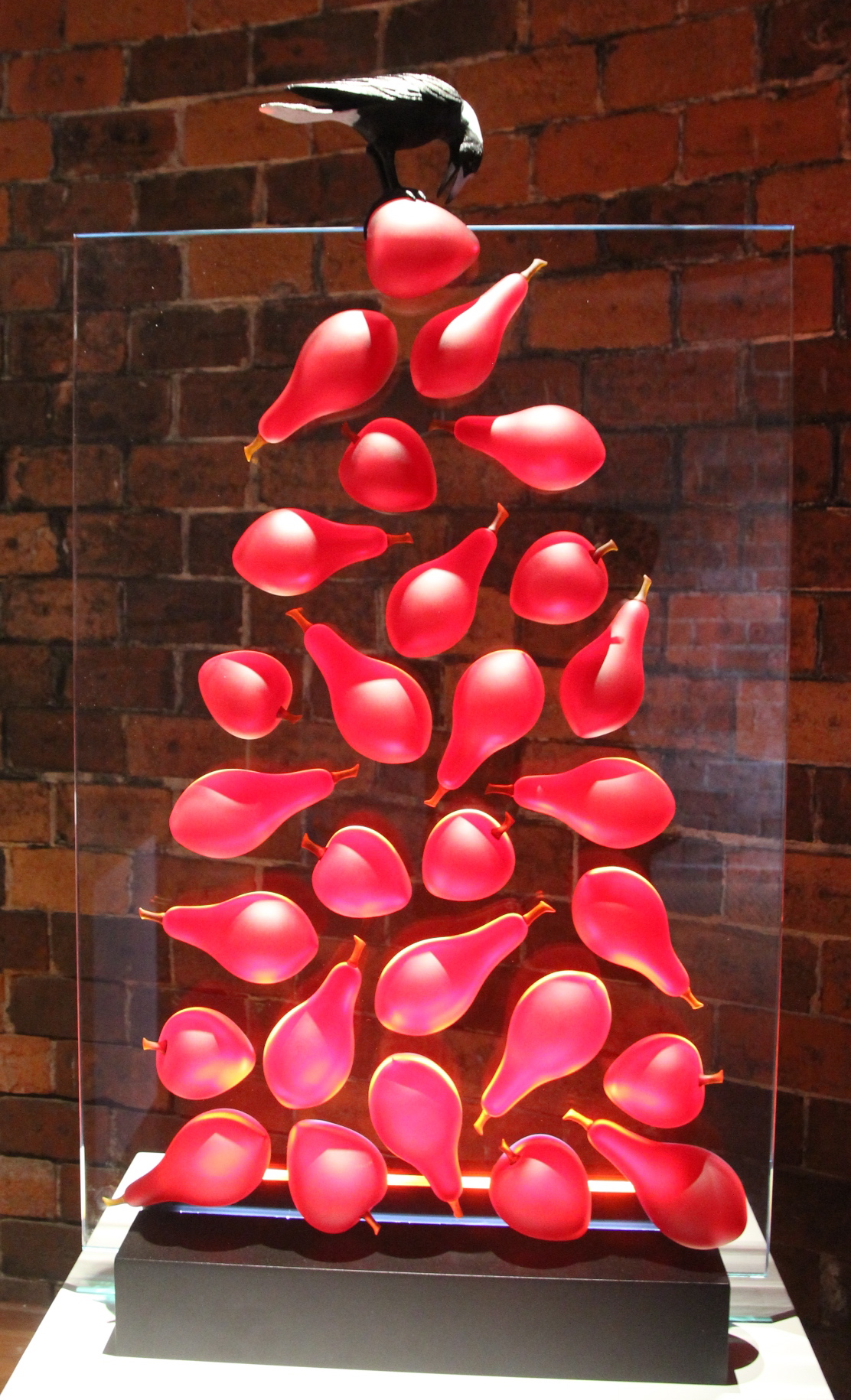
‘The Magpie’s Hoard’ by Robert Wynne, Australia
I’m taking a little diversion from my Central Asian/Silk Road travels to tell you about the Ranamok Glass Prize.
Over the last 20 years, this prestigious annual acquisition event has showcased creativity, skill and innovation in contemporary glass works in Australia and New Zealand.
Founded by Maureen Cahill and Andy Plummer, both accomplished glass artists, Ranamok has flourished, along with the careers of its winners and finalists.

Detail of ‘Carpet’ by Kathryn Wightman, New Zealand, winner for 2014

‘Carpet’ by Kathryn Wightman, New Zealand, winner for 2014
This year’s winner and finalists are on display at the Canberra Glassworks. Poor John and I took ourselves along, and I was delighted to be encouraged to take as many photos as I wanted.
Work offered for consideration for the prize is expected to be a major piece from the artist. Finalist works are chosen for showing innovation, excellence and imagination. There were 28 finalists this year and the winner was awarded $15,000. Judges were Grace Cochrane, Ivana Jirasek, Frank McBride and Andy Plummer.
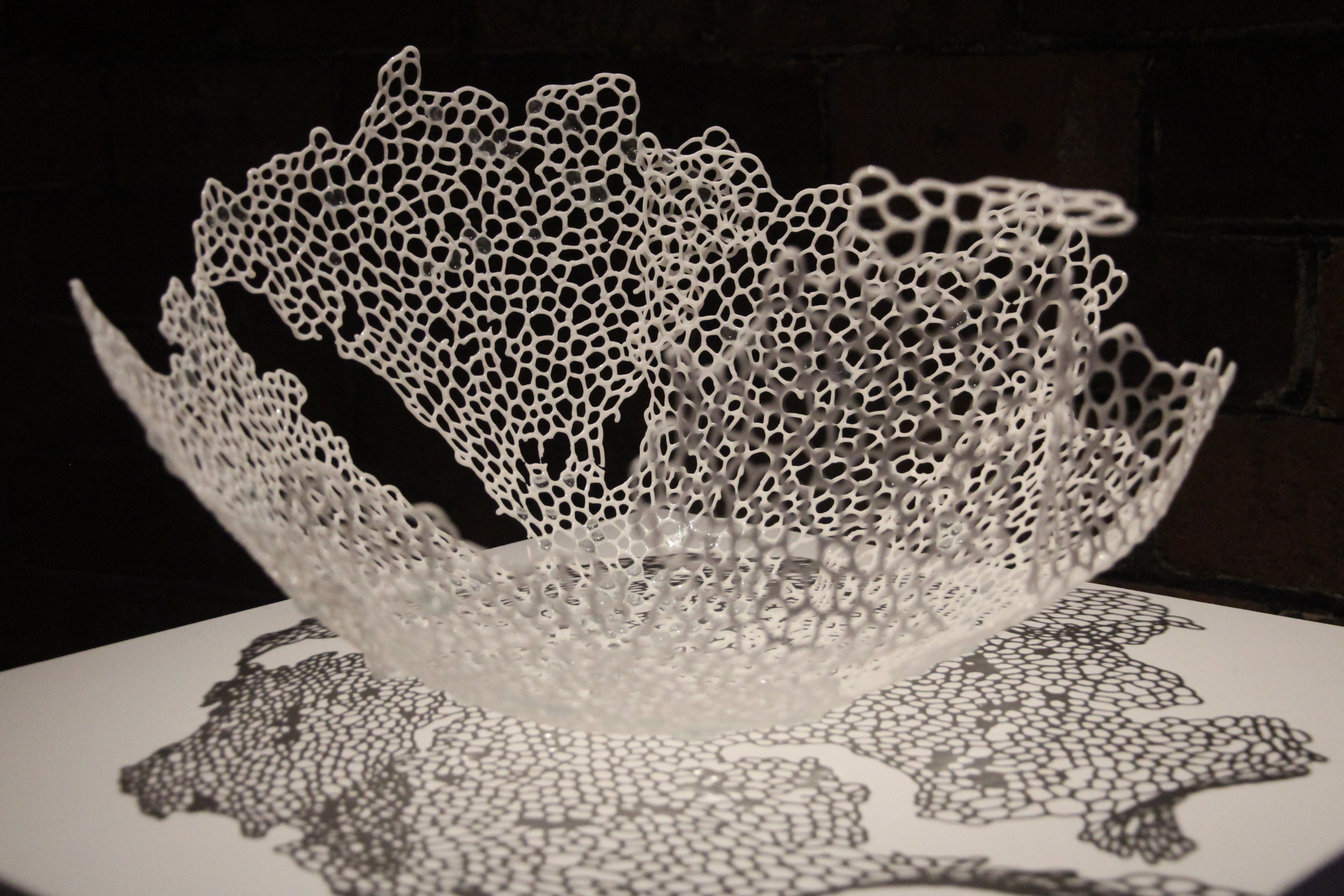
‘drawing – cell’ by Shizue Sato, Australia
Sadly, this is the last year of Ranamok. Cahill and Plummer believe the event has fulfilled its purpose to raise the profile of glass artistry. Running it has been time-consuming and costly. It’s a non-profit event and costs about $150,000 a year to run, and chasing sponsorship has been a challenge.
But even though Ranamok won’t run next year, Cahill and Plummer are going to donate Ranamok’s acquisitive collection—all the winners from the past 20 years—to the National Gallery of Australia.


If you’re anywhere near Canberra in the first half of September, take time to visit Ranamok (the exhibit closes on 18 September). The Glassworks is at 11 Wentworth Avenue, Kingston, and open Wednesdays to Sundays from 10am to 4pm. Admission is by a gold coin donation—for non-Australians that means $1 or $2.
At that bargain price, I just might have to go back for another look. But I’ll resist buying anything. The winning piece isn’t for sale, but the rest are. Many are affordable, but one has a $20,000-plus price tag. Can you guess which one?
P.S. I haven’t included pics of all the works. Some were hard to photograph (white-on-white or at awkward angles) and a few photos weren’t all that great. Which artwork do you like best?


P.P.S. I can’t get the caption to stick on the Magpies pic directly above. The piece is from a collection of six by Mark Eliot, Australia.
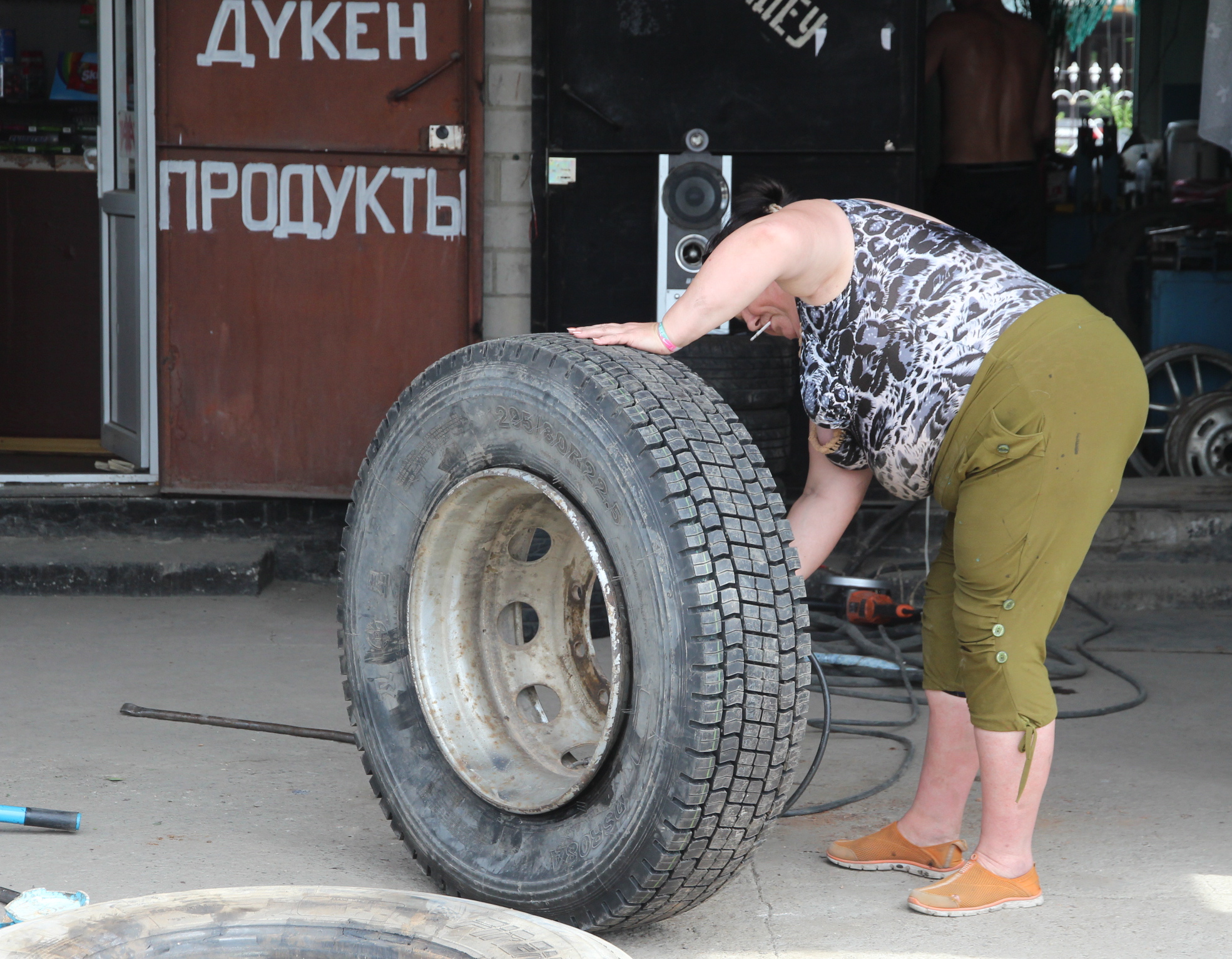
The wife gets to work on the tyre (wearing her swimmers)
We had several flat tyres in rapid succession (mostly in Kazakhstan). One blowout let off such a spectacular blast that Sarah thought someone was shooting at us. But these were just flats and blowouts that left us completely out of spares.
Suse bought replacement tyres in Almaty, the capital of Kazakhstan, and stopped in a small town short of the Russian border to get them fitted to the wheels. A good way to get rid of some leftover Kazakh money (called tenge).
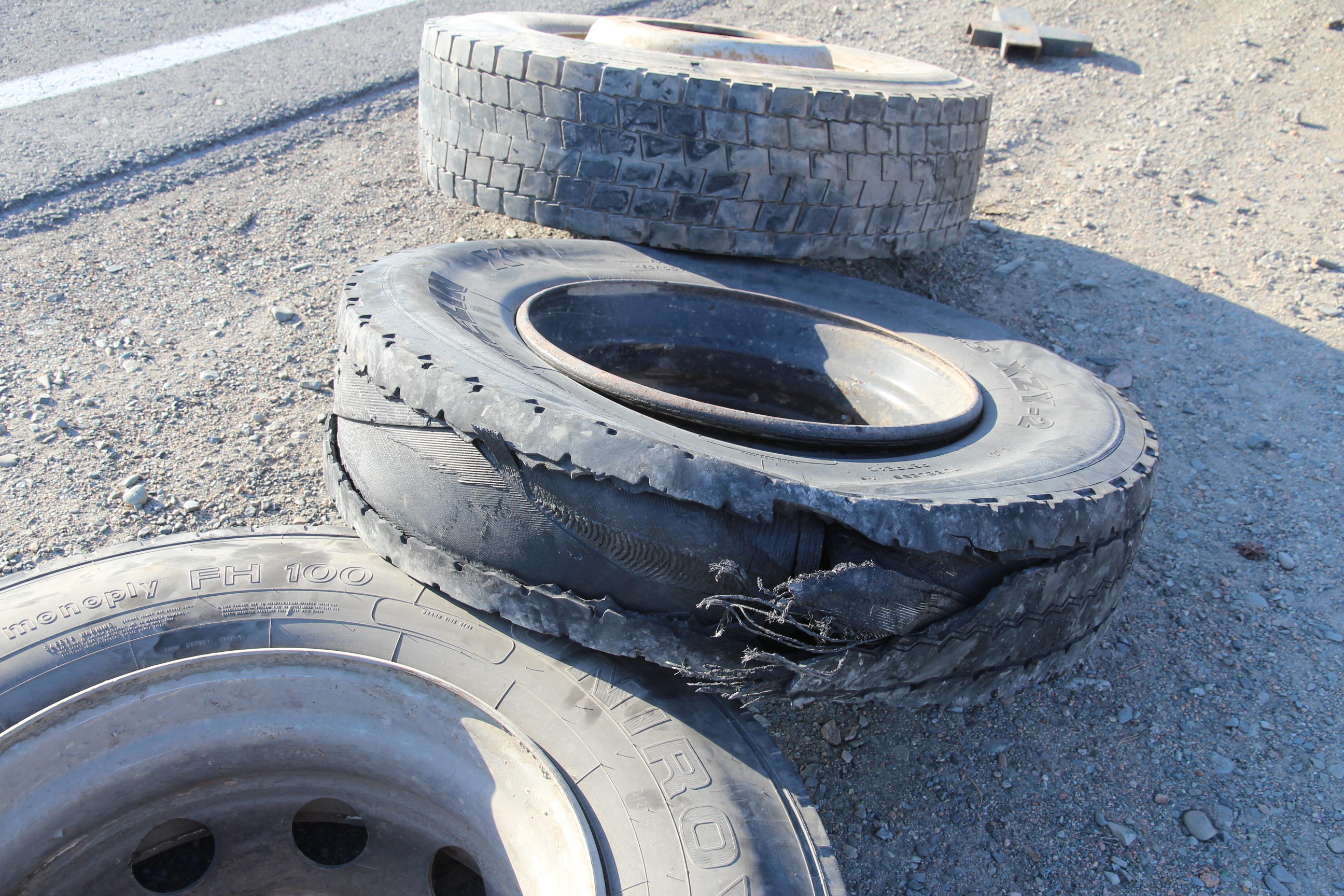
The blown tyre in the middle
When she pulled up outside the mechanic’s shop, Suse used her best, non-existent Kazakh and Russian, and a fabulous array of sign language, to tell the fellow what she wanted.
Even without knowing the language, we all knew he replied, No, no, I couldn’t possibly do that.
But enter his wife. She wasn’t going to have any of that! A paying job is a paying job, and money from foreigners is even better.
She charged out of the shop and made a beeline for Suse in the cab. She shot her hubby a withering look and said (or we assume she said), Of course, we can do whatever you need to have done.
So the flats—Suse told them to keep them—and spares got bounced off the back and roof of the truck, and hubby went to work.
After lingering for a few moments, the rest of us wandered off to check out the market, have lunch or go for a swim in the nearby river. In fact, the wife urged us all to have a swim, and Nat jokingly said she’d swim if the wife joined her.
When we got back from having lunch, hubby and some assistants were still struggling with the second tyre. I know I’m not going to explain this correctly (so someone please correct me), but he couldn’t get the beading to connect. Does that make sense?

The tyre struggle continues
Meanwhile, the wife was still urging everyone to run down to the river for a dip. And I noticed that she’d donned her bathers/swimmers/cossie (or whatever you call it). Hers are black and white—just like mine.
Hey, Nat, I said, I guess you’re going swimming. Nat nearly fainted. She was sure her swimming-costume smoke screen would get her off the hook. Luckily, business at the shop picked up and the wife was suddenly super busy with other customers. She even pitched in on our tyres for a bit.
After about another 15 minutes of struggling—the hubby gets full marks for persistence and effort—the beading connection made a satisfying sound and we were ready to head for the Russian border.
We’ll always be glad the wife jumped in and said they could do the work. And Nat will probably always be glad she didn’t have to go swimming.


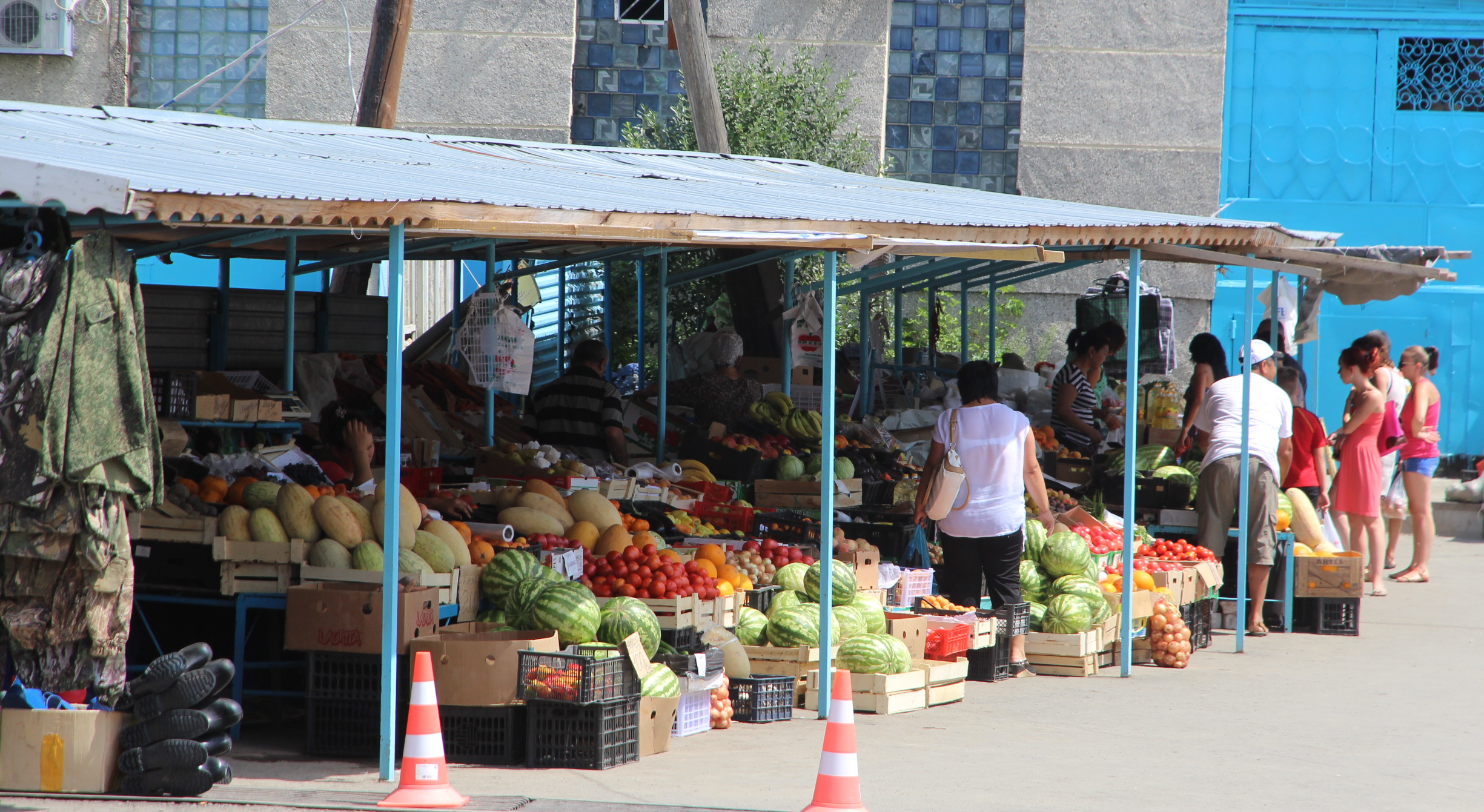
A glimpse of the market

Old architecture in Barnaul
Diego, Poor John and I must have looked like typical tourists—daypacks strapped to backs, cameras slung over shoulders and lost looks plastered across faces.
We were in Barnaul, a large town in the Altai district of Russia. One bank had already refused our request to exchange our fistfuls of Kazakhstan tenge. In an attempt to help, they waved a hand in a far-off direction and scribbled the name of a bank that might oblige.
That vague hand-wave got us nowhere, so we stood on a corner trying to decipher the bank name written—in Cyrillic—on a slip of paper. Suddenly a chirpy blonde woman with a ponytail appeared at our side. Her English wasn’t perfect, but it was damn good.
Can I help you?


Handing her the paper, we explained that we needed to change Kazakh money to Russian roubles. She and her hubby consulted and decided the nearest branch office was quite far away.
But we can take you. We have just come from the police station where we were completing forms. It’s okay. Go ahead, get in the car, she said. If you aren’t afraid!
Hmm? Police station? Completing forms? Oh, what the heck.
They seemed genuine. Besides, we were three and they were two. Not that Poor John and I would be a match for determined kidnappers.
So we piled into their Mercedes and off we went. And what a wonderful experience we had.
Elena (sounds like Helena without the ‘h’ but foreigners never pronounce it right) drove through traffic for almost 15 minutes before pulling into a bank parking lot. Her hubby (whose name I never got) was charged with getting Diego and Poor John set-up in the bank, while Elena and I had a good old Aussie chinwag out in the car.
You know plenty about us, so let me tell you a bit about them.
They have their own business—ball bearings that get sold in Kazakhstan and other neighbouring countries. Her hubby spent much of his childhood in Almaty, the capital of Kazakhstan, where we had just spent almost a week.
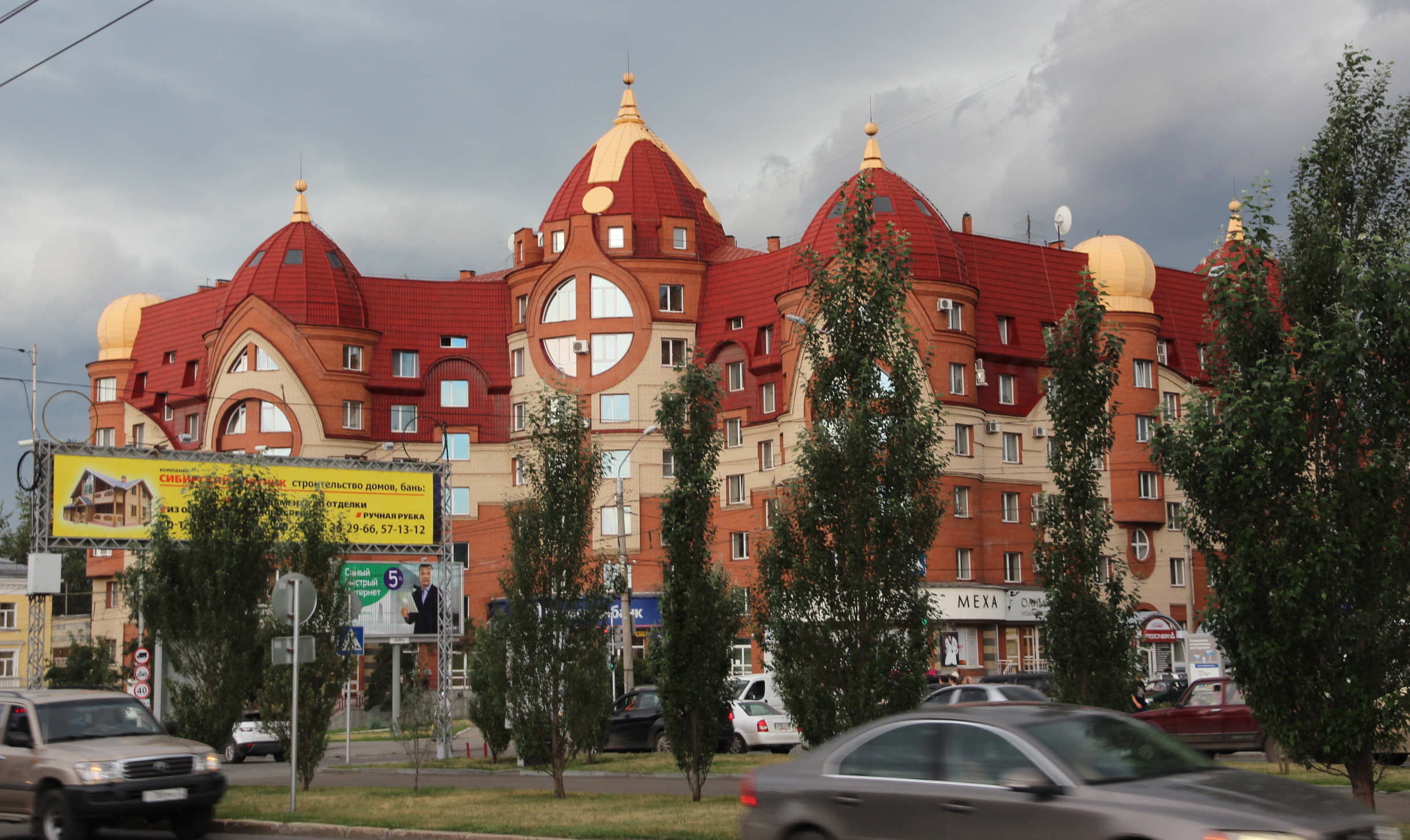
New architecture in Barnaul
Their grown-up daughter (their only child) is studying in St Petersburg. She has promised to join them on a family outing to the lake region in the Altai sometime this month. Every night recently, they’ve searched Google maps trying to decide exactly where to go.
They’ve had fun being on the register for couch surfing even though not many people choose Barnaul as a travel destination.
They are avid travellers and would love to visit Australia, but the challenge of obtaining a visa is costly and time-consuming. Elena said they would have to fly to Moscow to be interviewed and stay in a hotel while waiting for certain processes to be completed. Even then, a visa was not guaranteed.
I reckon that people who own and run a business in Russia are unlikely to overstay their visas, so it made me sad they were finding it so difficult to visit Australia. It also made me think back to how easy it was for Poor John to front up to the Russian Embassy in Canberra to get our visas a couple of months ago.
Oh, and why had they been at the police station? To fill out forms to provide a letter of invitation so an Uzbek could apply for a visa to visit Russia.
Eventually the fellows returned with the roubles (after Elena went in to hurry things along). Then they drove us back to where we got ‘lured’ into their car.

Near where we got picked up
We hoped to buy them lunch as a thank you, but they were running late for another appointment, so they dropped us off and moved on. I did have time to scribble down the url of this blog and I hope Elena finds her way here to know how much we appreciated their help.
When I get home to a better internet connection, I’ll find their listing on couchsurfing and post a link here. They’d be wonderful hosts.
P.S. We had just a couple of hours in Barnaul and didn’t manage to fit in much sightseeing. These pics are what we captured between the time we finished our banking and when rain started to bucket down. Notice how the colour of the sky changed.


Quinn and Alex raft and bathe at the same time
Overland trips are a surefire way to learn about the simple joys of a bucket bath.
Twice in Africa we went 13 days without access to showers, or access to much water in general. The first time was as we travelled across remote western Nigeria where we encountered no towns, no rivers, no lakes, no wells—not even any puddles.
There must have been water around somewhere, but we didn’t find it, so we had to make the 400 litres we carried in jerry cans last as long as possible for cooking and drinking. Like our travelling companions, Poor John and I also had many more litres stashed away in our locker.
Fortunately, most of Central Asia is different. Tajikistan, Kyrgyzstan and Kazakhstan have abundant water—Uzbekistan and Turkmenistan pretend to have abundant water and are peopled by the most wasteful water users I have ever seen, but I’ve already written about where their precious water comes from.
Eastern Russia (read Siberia) has plenty of water too, in the form of fast-slowing rivers and scenic lakes that are completely picturesque and absolutely freezing.
Five days ago, in a hotel in Ust in northeastern Kazakhstan, we said good-bye to our last hot showers for 11 days. By the time you read this, we will have reached Mongolia’s capital of Ulan Bator, having covered 2500 kilometres of remote Asia. I hope I will have had a hot shower. One must have little dreams.

A likely spot for a bath in Kazakhstan
Along the way, we have had to make do with all manner of creative ‘bathing’. Quinn and Alex did not one, but two speedy trips on li-los (blow-up swimming pool rafts) down an icy river. I’ve never seen goose bumps as big as the ones that came up on Alex’s arms after the first foray.
Steph had a quick dip, Sarah washed her hair (and said she couldn’t feel her head after that), several scrubbed face and hands as they stood on the riverbank, a few (including Poor John) did full dunkings. I did a sort-of bucket bath—standing at the edge of a shallow, almost-still pool and paying attention to the tits, pits and other bits.
One fellow, however, resisted everyone’s demands that he have at least a mini wash so we could stop holding our breath and noses around him. He’d better be careful. People like that run the risk of being left behind at the next border crossing.
P.S. We’re heading to a biggish town in western Mongolia today (29 July). It’s day six without a shower and there’s a small chance of wifi before we drive on to the next bush camp. Our reluctant bather caved in and had a bit of a wash and a change of clothes before we crossed the border from Russia to Mongolia.

My private bathing pool—where Poor John stood guard
I spent almost four hours last night—sitting directly under the router—trying to post one blog entry. Geez, I hate it when the internet connection shows that there’s a good signal, but that two photos take two hours to load, and then the next batch never loads at all. 😦 Frustrating in the extreme. In the end, I published with only two pics.
We’re in northern Kazakhstan and heading to the Russian Altai Mountains later this morning. It’s a remote location, with some of the most beautiful scenery in the world (if the pictures are to be believed).
Chances are I won’t have a connection again for at least at week. So don’t worry about us, and stay tuned for the next entries. In the meantime, read some old ones just for the fun of it. Or check out my cooking blog. Or do both.
If all else fails, we are supposed to reach Ulan Bator (you can all argue about the correct spelling of that) in Mongolia by the 4th or 5th of August. I’ll be back as soon as possible.
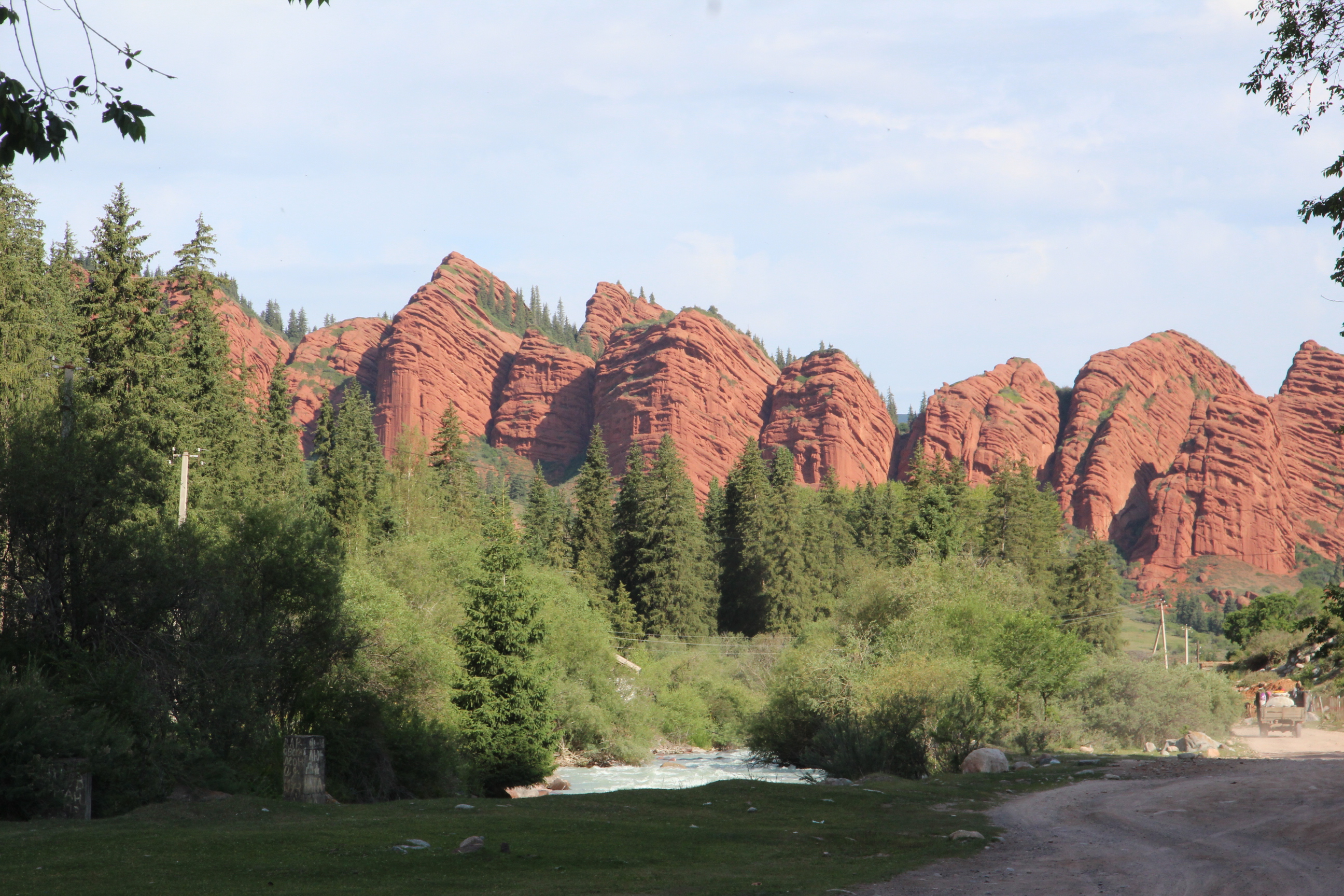
Approaching Jeti-Öghüz, coming from the Valley of Flowers
Amazing how you can see a place you’ve never heard of before and then have it stick so permanently in your memory. The breathtaking canyon and red sandstone rocks at Jeti-Öghüz are just such a place.
We first visited this icon in eastern Kyrgyzstan in 2011. I never expected to visit Jeti-Öghüz once in my lifetime, let alone twice. But it was certainly one of the drawcards that lured us back in 2014 for another overland trip across Central Asia.
This grouping of sheer cliffs, a unique geological formation composed of red conglomerates, is also known as the Seven Bulls, for the seven main bluffs. There’s a folklore tale of seven calves growing up big and strong in the valley’s lush pastures. Over the years, the elements have taken their toll and those burly bulls have multiplied. In fact, it’s hard to determine exactly where the seven begin and end.
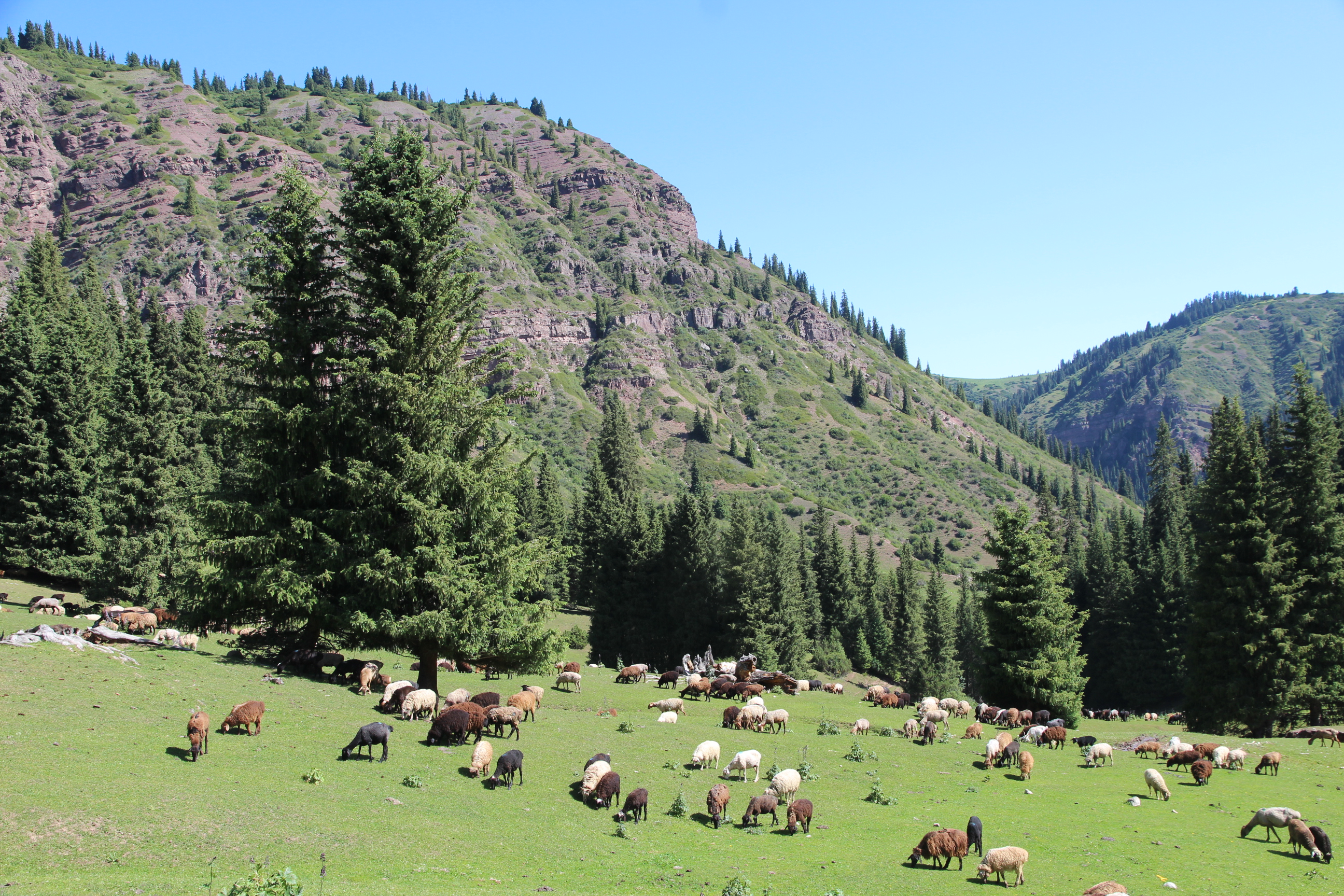
In 2011, we camped beneath the cliffs, but this year we drove on another five kilometres to camp in the higher pastures (the Valley of Flowers) where sheep, cattle and horses graze throughout summer. That gave us the luxury of being close to the starting point for a hike to the waterfall and dwarfed by the magnificent backdrop of surrounding mountains.
The morning we drove out of the Jeti-Öghüz region, Neil, and Poor John and I headed out on foot a couple of hours earlier than the truck so we had plenty of time to photograph and wander around the Seven Bulls. It was a five-kilometre walk and the view of the bulls was the bonus toward the end.
I may be wrong, but I reckon the bulls are virtually unclimbable. I didn’t see any avid rock climbers clinging to the rocks, and I certainly wouldn’t want to be dangling from a rope anywhere near the rugged cliff faces.
So instead we climbed the gentler rocks that rise on the opposite side of the road that cuts through to the village of Jeti-Öghüz. The views of the cliffs and the surrounding countryside are sensational.
Although we couldn’t figure out exactly where it is, there is supposedly a spa in the village that has been frequented by big names from Central Asia. Russian President Boris Yeltin and Kyrgyzstan President Askar Akaev had their first meeting here in 1991.
A river runs through the valley and some of the braver ones in our group took ‘baths’ in the icy waters. I only managed to wash my face and hands.
I’ve read that this area is so loved that it is the subject of songs, paintings and even music videos. It will always be famous in my mind’s eye. Stay tuned for a post about our stay and drive to get to our mountainside campsite in the Valley of Flowers.
P.S. I’ve had major problems posting to the blog from northern Kazakhstan. I have eight photos to add to this entry, but after four hours of trying to load the pics, I give up for now. I’m posting anyway and you can come back to see all the amazing views. See the next post—assuming I can get it to post—for details of my whereabouts.
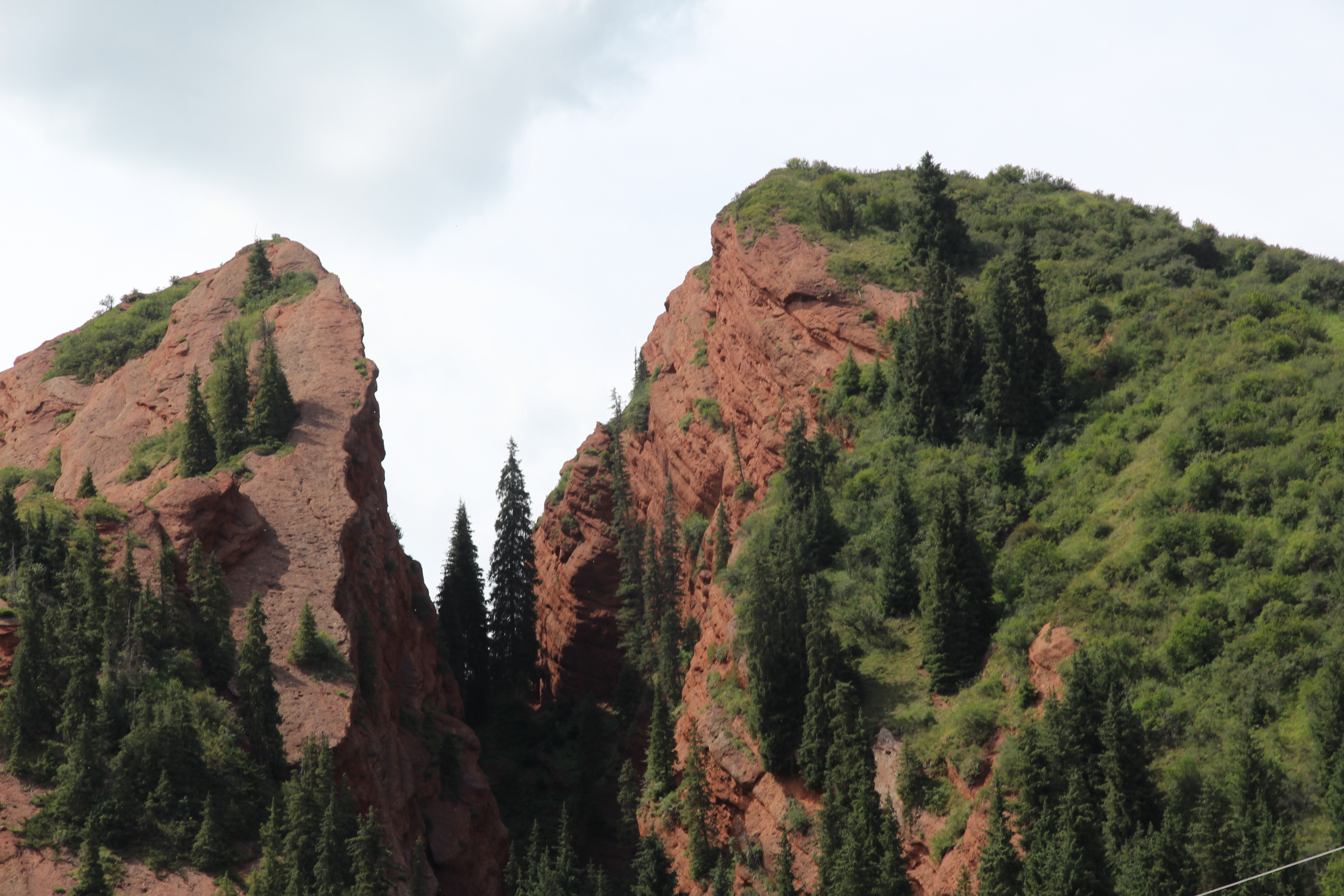
Looking back at a section of Jeti-Öghüz

In search of a waterfall
No one should accuse me of rushing into things—at least not when it comes to things (namely me) going up and especially me going down slippery paths. Whenever we scramble along gravelly, muddy or just plain steep terrain, I swear a lot and regularly remind Poor John that the chances of me falling are slim, but the consequences of me falling are great. Unfortunately, it doesn’t do me much good. By the time I say the words ‘the chances of me falling’, he has shot ahead about 50 metres with his head and shoulders hunched forward and his hands clasped behind his back. If you follow this blog, you will know this stance.

Near the beginning of the uphill
Of course, my pleadings are in the hope that one day he’ll stay close by and offer a helping hand or a willing shoulder. Instead I have to foist myself on other men or women who seem to be steady on their feet and who make the mistake of staying anywhere near me. So all this explanation is a lead-up to my second stab at reaching the waterfall near Jeti-Öghüz (more about this soon) in Kyrgyzstan. My first stab was in 2011 on our London to Sydney overland. That year, the group set out with a guide who swore he knew the way (but didn’t). They (not including me) got there in the end with a lot of detours, missed turns, and slipping and sliding in the mud.
Farther up the hill—a bit
I intended to make it to the waterfall, but back-tracked across a small (but raging) stream to keep Lin company. She had tried her best to cross that stream, but the slippery rocks were just too daunting. I sympathised and (if I confess) wasn’t all that keen to slog up the muddy hill before me. It had been raining steadily, and it might still have been drizzling. Fortunately my memory is a little foggy on that count. But the others pressed on because the guide said the waterfall was only 30 minutes away from where I turned back. Not true. Lin and I waited more than an hour (more like two) for the group to return. After no sign of them, we headed back to the village to have lunch. We’re supportive like that. In the end, the group took so long to return that Lin and I actually became quite worried, but a couple of hours later we saw them trudging along the path towards us.
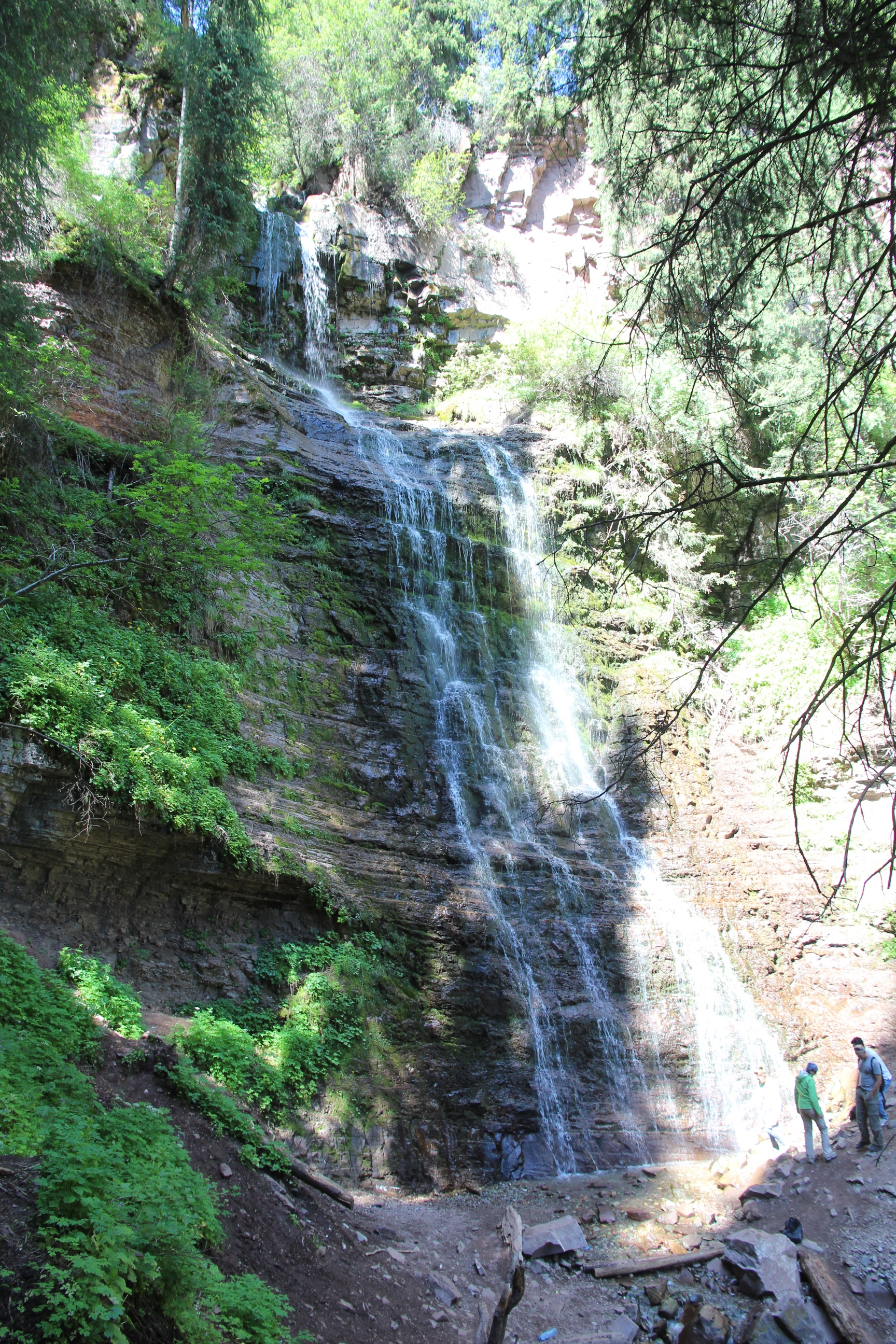
As waterfalls go, this one is not all that impressive or am I just hard to please?
Poor John’s first words were You would have hated it. Very slippery and muddy! Norman (Lin’s hubby) had a more colourful story. He found the path to be especially slippery and dangerous (so yes, I would have hated it). He said he struggled to make progress UNTIL he looked up and saw Poor John, with his hands clasped behind his back, powering up the hill. Norman said I thought if Poor John could do it, so could I, so I clasped my hands behind my back and powered up the hill.
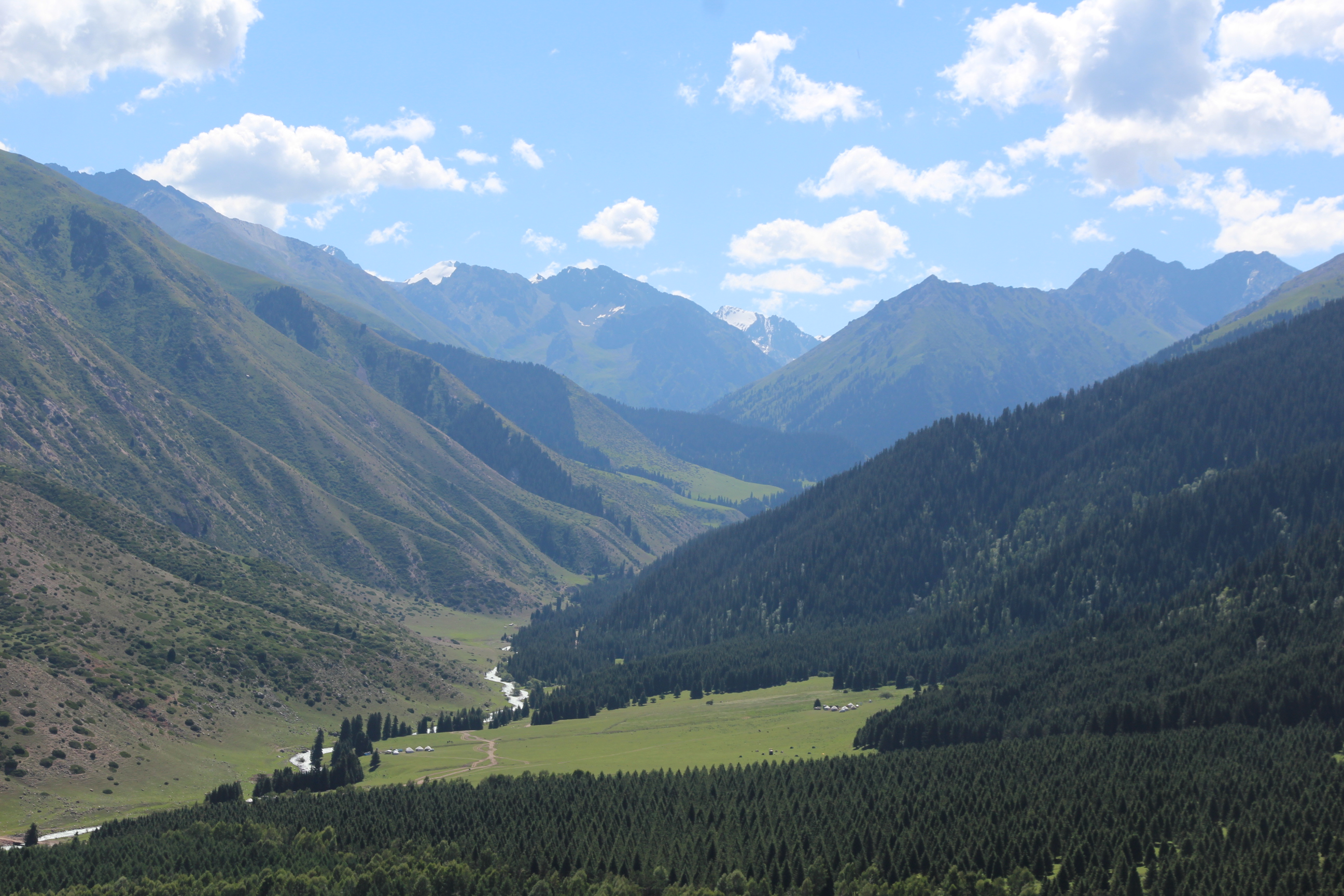
Our camping spot in 2014—in that big green patch. Can you make out the truck and our tents just to the left of the trees? We’re about halfway up to the waterfall
So fast-forward to 2014. We’ve camped at Jeti-Öghüz again and much, much closer to the start of the walk. In fact, we’ve knocked off about two hours of walking on the flat and lower hills. The sun is out, Poor John sort of remembers the way and I have plenty of time to make a second stab at it. So Nicola, Poor John and I set out. Poor John reckons the waterfall is about an hour away.

A small settlement near Jeti-Öghüz

A local store with a resident falcon
We strolled through a couple of small settlements and crossed a couple of rough timber bridges. Then we hit a really, really steep bit where even the goats were struggling. Mind you the three-legged goats were having more trouble than the four-legged ones. Okay I’m stopping here, I said. I don’t like going up and I know I’ll hate coming down.
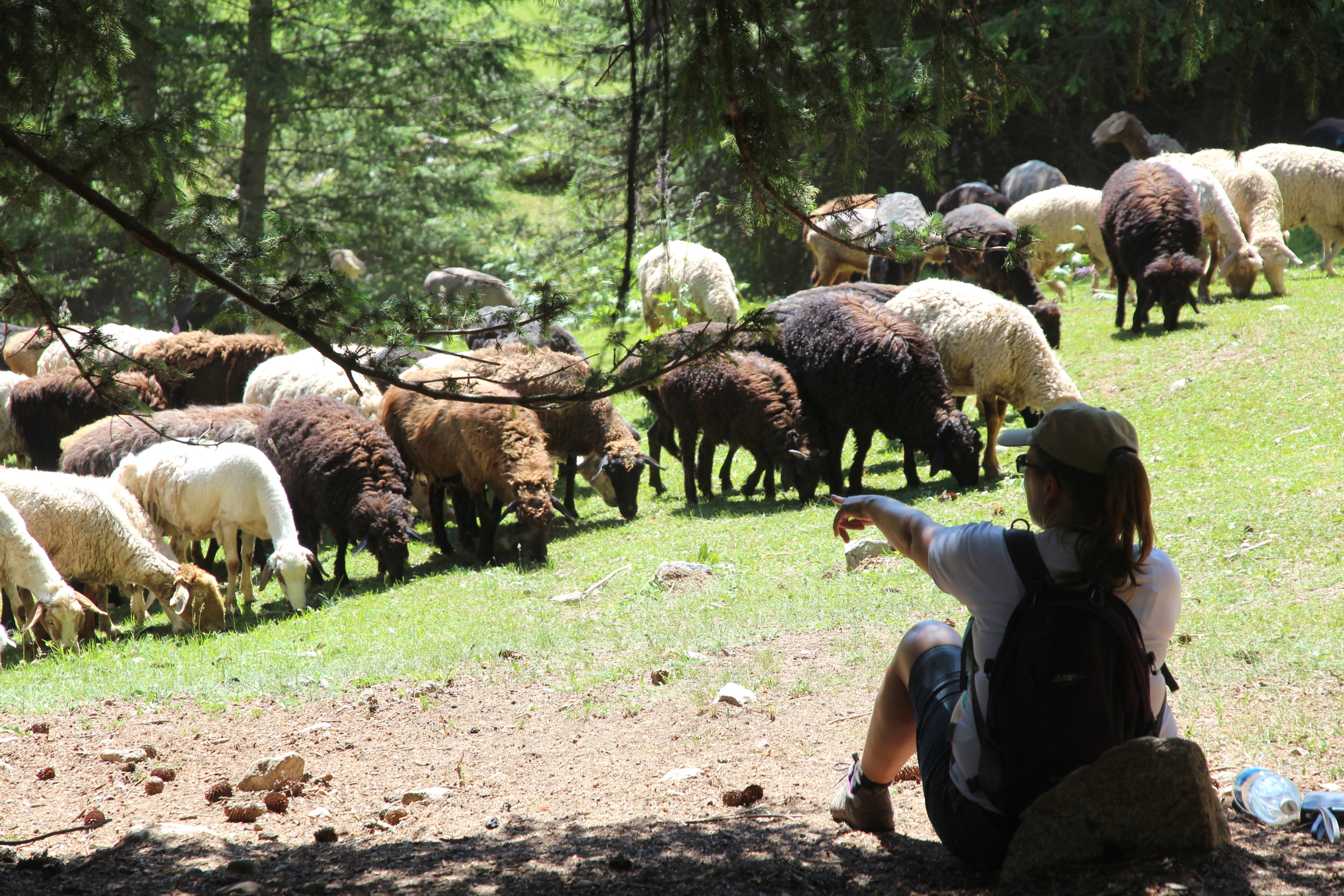
Nicola takes a break in a steep (it’s steeper than it looks) and gravelly bit. She’s picking out a sheep for the barbecue (just kidding)
But then we saw a couple of other walkers quite high above us (even people we knew). They were striding confidently along the right (almost level) path. So I relented and kept going up until we reached the path that wasn’t quite so challenging. There were plenty of other scary spots, but Andy was with us by then (rather we were with him) so he became my convenient ‘crutch’ for the rest of the walk. And we made it to the waterfall, which we all had to admit was only just worth the effort. The views, on the other hand, were well worth the trouble. I nearly went over a cliff just short of the falls. We came upon a group of Kyrgyz men who had spent their morning drinking vodka at the falls. They were leaving—stumbling up the hill—as we arrived and desperate to have their photos taken with us.

The merrymakers approach. The white-shirted one nearly sent me over the edge
As they rushed towards us, a jovial but very wobbly fellow lurched forward and nearly pushed me over the edge. Luckily I already had a death grip on a tree stump. So I made it to the waterfall—AND BACK. Funny how coming back was so much easier. I only swore a couple of times.
Hungry?
You may be hungry after seeing all those sheep in the mountains. May I suggest the lamb pilaff recipe from my cooking blog.
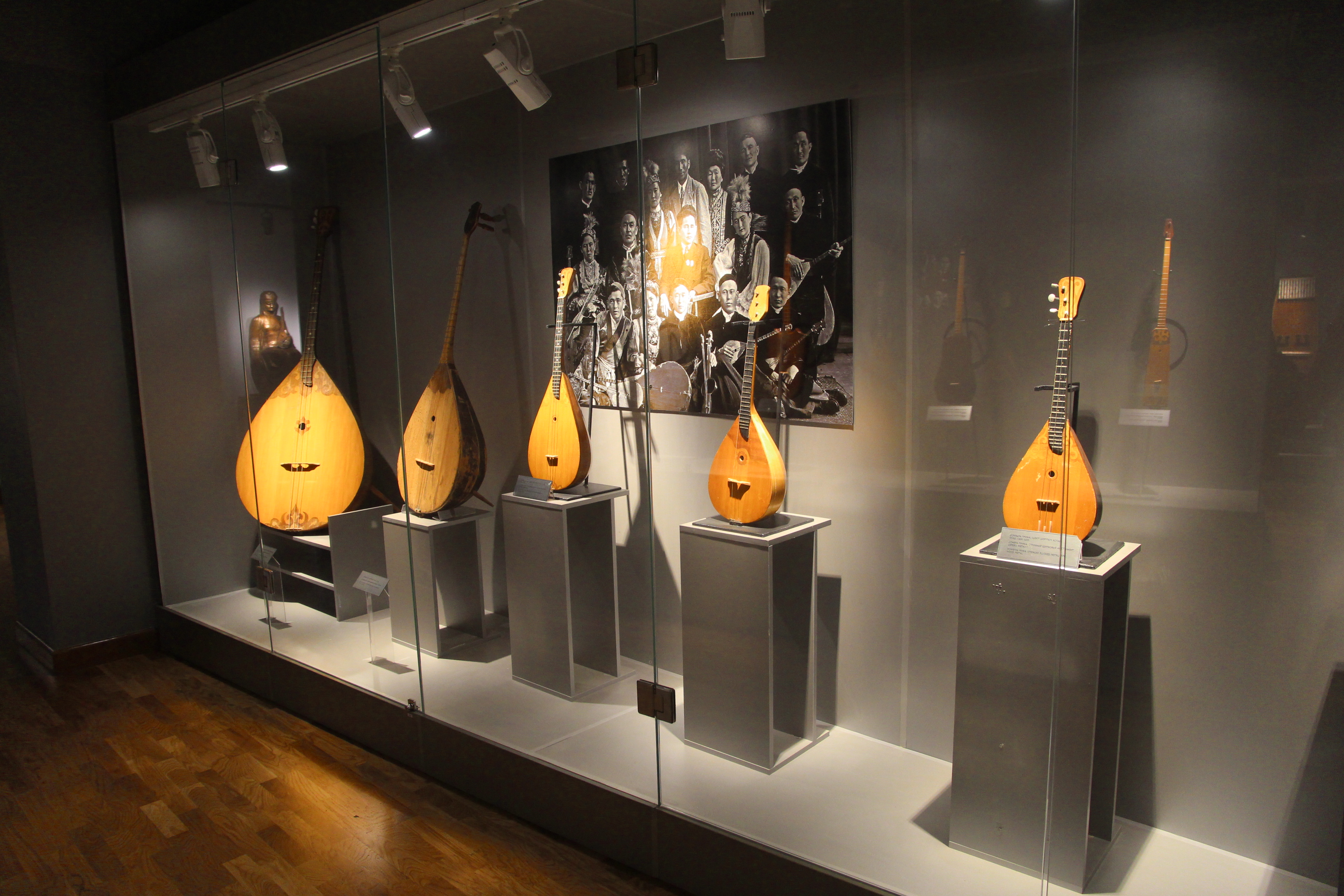
Kazakh stringed instrument
I took you to Kazakh cathedrals in the last two posts and its time to move on to something not too religious. So how about music?
We’d been tourists on the streets for Almaty for just a few hours when local people started badgering us to visit the Museum of Kazakh Folk Musical Instruments. It’s the best museum in the whole city, they assured us.
We will, we will, we promised. In fact, we’ve already tried, but the museum is closed on Mondays. So off we trooped on Tuesday.


The museum is striking before you even walk in the door. It’s housed in a lovely timber building that’s more than 100 years old and designed by the architect, Zenkov, who also created the nearby Ascension Cathedral.
We rushed to scurry in the front door ahead of an elderly man who was being interviewed as he walked towards the entrance. Our speculation that this might be part of a documentary on the museum was confirmed after we entered and saw cameras and lights everywhere inside.


Admission was cheap—just 350 som or less than $2 per person—so by comparison the 500 som they wanted for using a ‘professional camera’ was outrageous. I’m just a tourist, and this isn’t a professional camera, but the woman at the entrance insisted the charge applied to all cameras. Paint me annoyed.
We started on the right side of the museum to avoid the documentary filming that was happening on the left. Luckily, that hubbub meant we were pretty much ignored and I was able to sneak in a few shots with my phone.


After we ogled all the wonderful instruments in rooms 1 to 6, we headed back to reception where the woman said, My mistake, you can take photos without charge anywhere in the museum. But no flash.
So I headed back to the beginning for another slow run-through taking pics of the fabulous array of drums, didgeridoo look-alikes, stringed instruments, percussion instruments, performance costumes and more.
All the instruments were identified and some placards even explained who had owned the item.
Then we moved on to room 7 and its display of instruments from other countries.
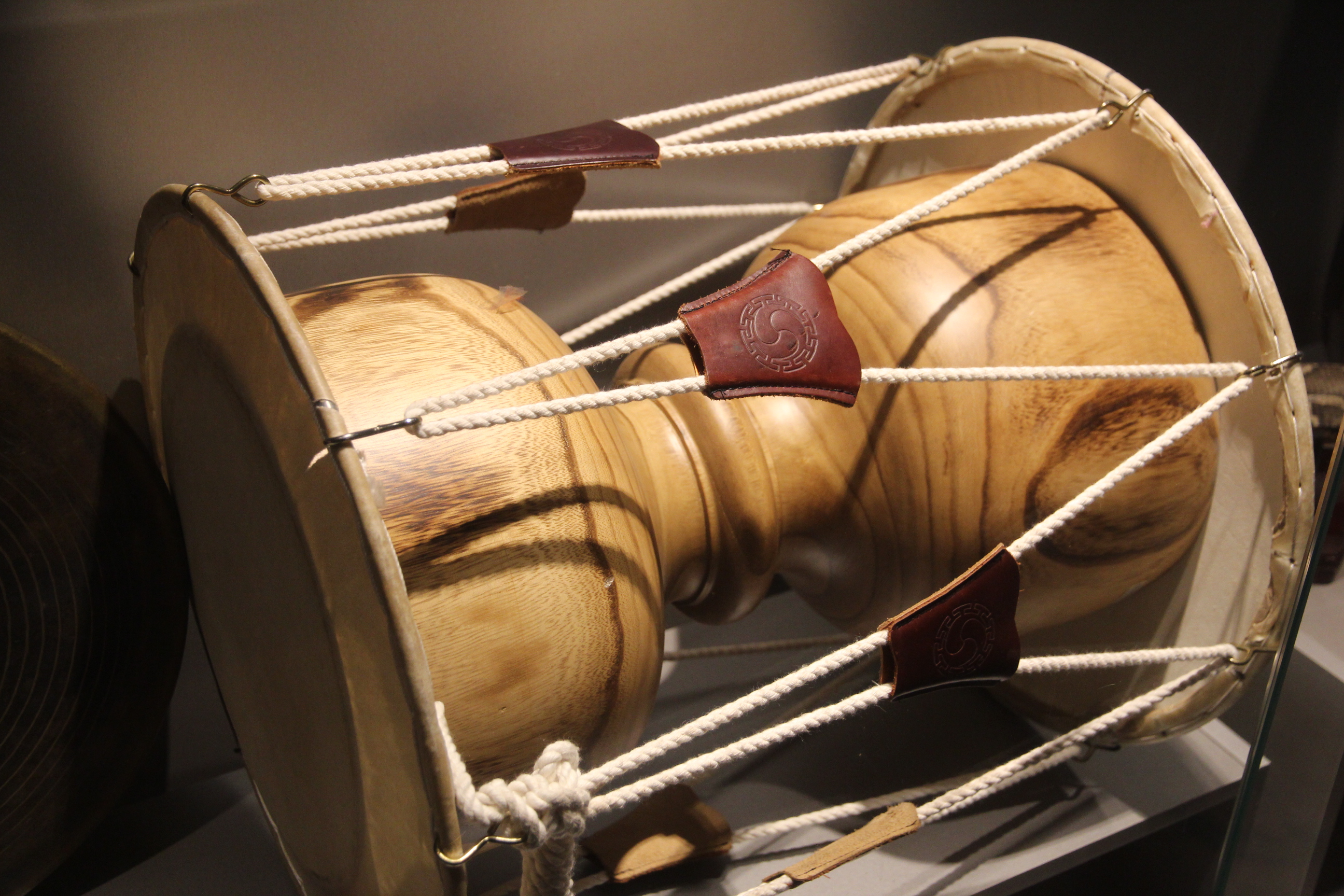
Korean drum


Today the museum is also a research and education centre. Employees try to unravel the mysteries and histories of unknown and forgotten musical names as well as non-attributed musical works. A large room behind the reception area is for performances and instruction. Some drum-playing students were having a lesson while we were there.
Extensive work on the museum was completed in 2013 and I have to say we were super-impressed by the care and style shown in the exhibits. All truly first-class. Don’t miss it if you’re ever in Almaty. In fact, go out of your way to get there.
Need a snack?
Hope you’ll go out of your way to check out the easy-to-make lemon and ricotta pancakes on my cooking blog.
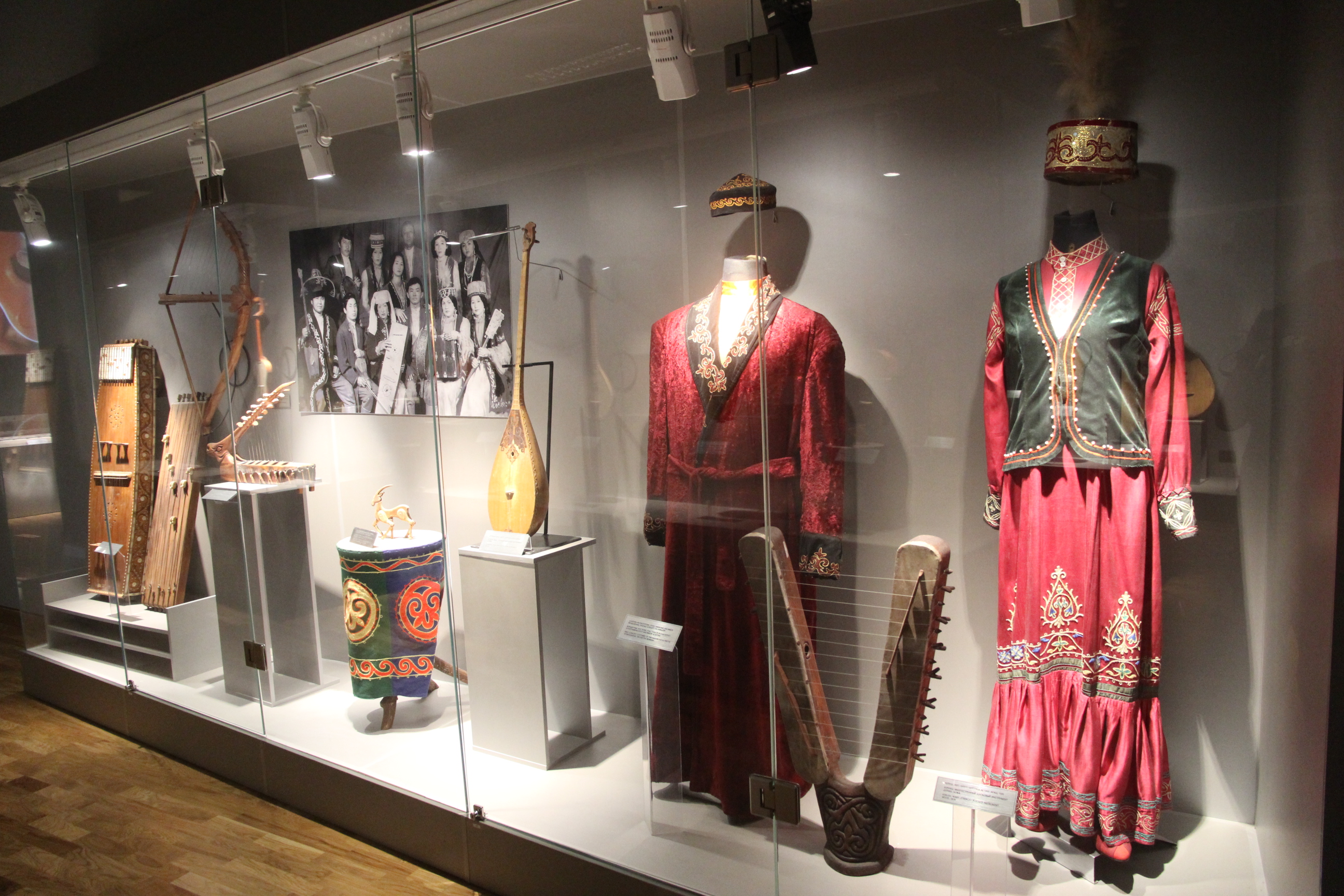
Costumes and instruments


Fairy tale roof
After the childish performance by a haggy old woman at the St Nicholas Cathedral in Almaty, I thought I ought to tell you about our visit to the city’s main house of religion—the Ascension Cathedral, also known as the Zenkov Cathedral.
I had heard that this was a very picturesque building, but having never seen a photo of it, I was not quite prepared for just how beautiful it is or how much it reminds me of a gingerbread house or a fairy castle.
The rooflines, angles, curves, arches, domes, windows, trim, gold and colours all work together to create an enchanting structure that emerges from the trees in Almaty’s Panfilov Park.
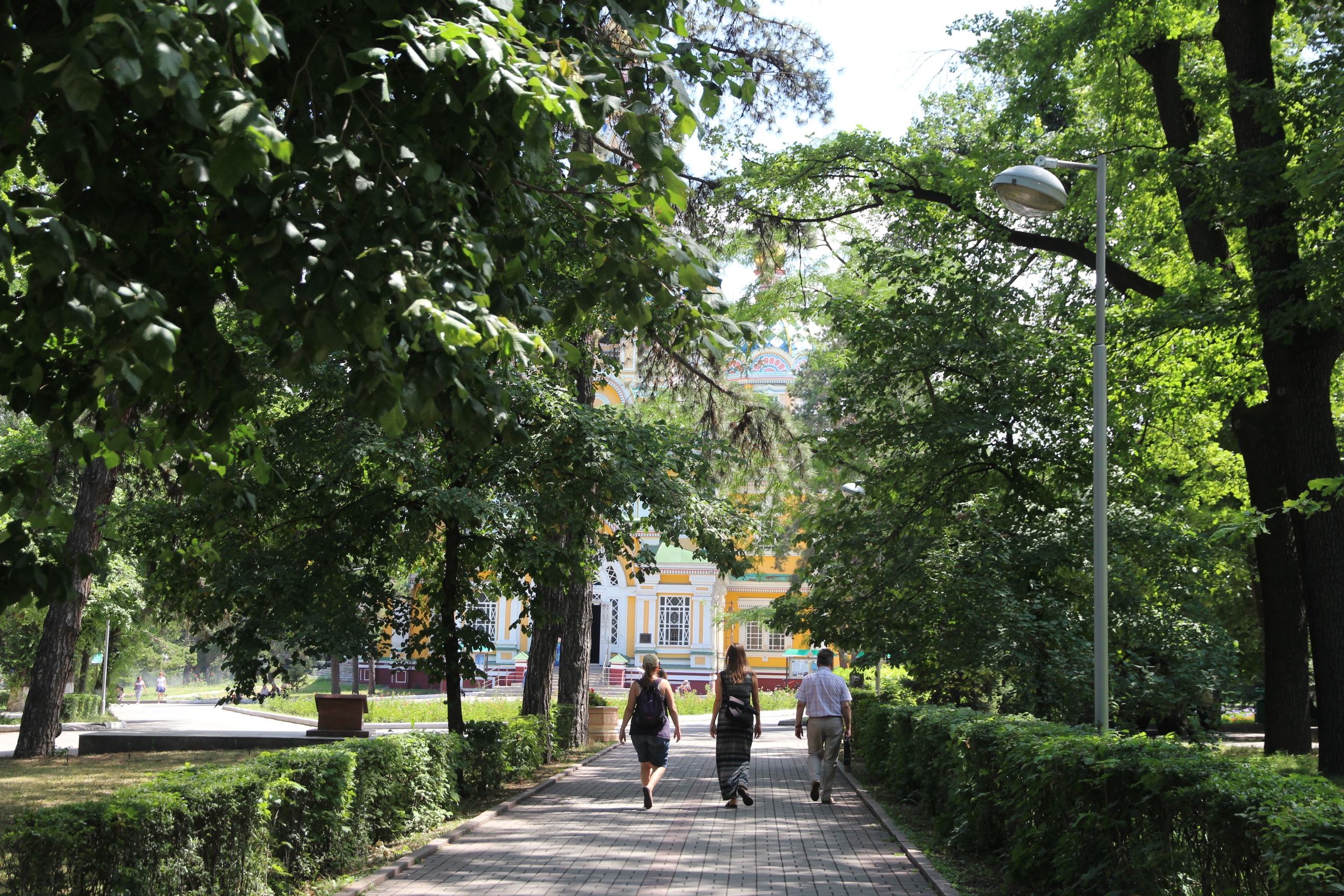
Nicola and Sarah (and someone we don’t know) approach the side of the cathedral through Panfilov Park
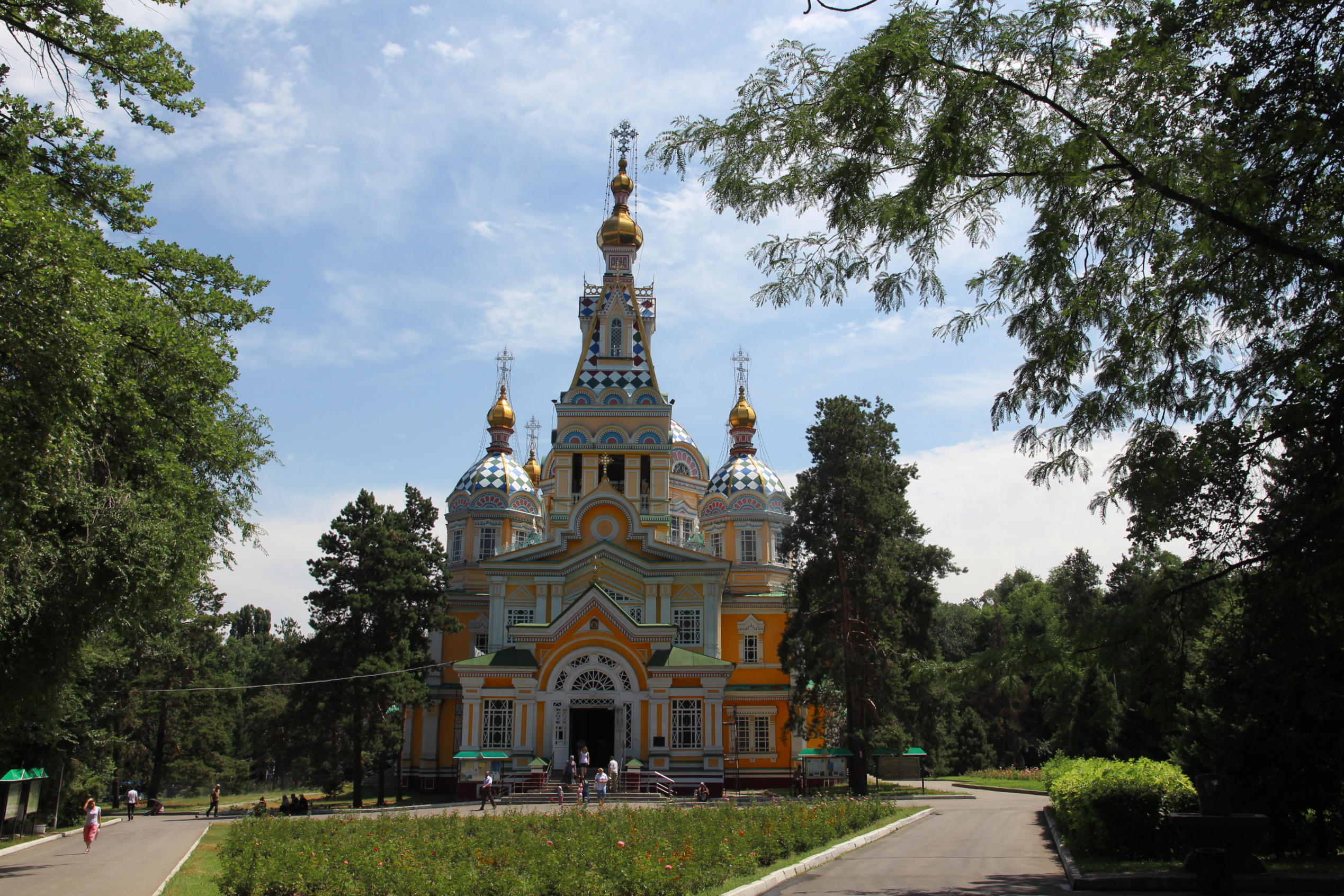
The front view
We’re lucky the cathedral is here at all. Many important buildings from the tsarist period were destroyed in an earthquake in 1911.
As Poor John and I entered, we noticed the ‘no photos’ sign on the door (along with the no dogs, no ice cream etc signs), so I parked my camera at my side and strolled around admiring the art and architecture.


That was until a woman, who might have been the cleaner, came up and insisted that I take photos. With a mix of Russian and a few stray words of English, she made it clear to us that photos aren’t allowed during services (this was a Monday afternoon) or at night. But photos now were fine. So I snapped a couple of the interior.
Later we noticed her talking a bit anxiously and at length to the young priest. Was she confessing to letting us take pictures inside? We’ll never know, but he gently patted her hand and said something that looked like There, there, everything is okay, so we stopped worrying and so did she.
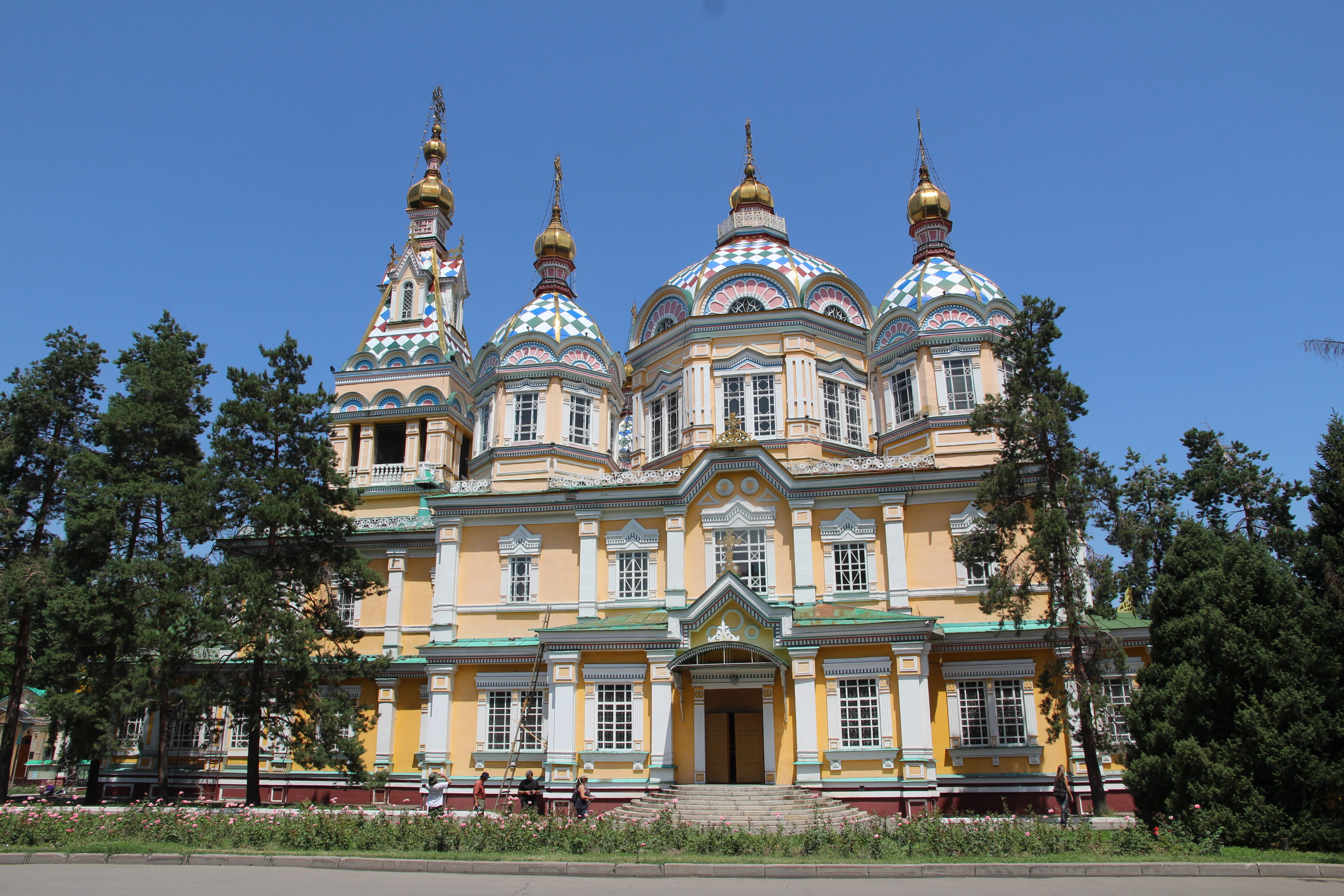
Side view
About this Russian Orthodox cathedral
Work on this cathedral took place from 1904 to 1907. It is supposedly built completely of wood and without the use of any nails. If you go around tapping on surfaces, it all sounds like wood.
Some of the interior was built in artistic workshops in Moscow and Kiev.
I read that it is the second tallest wooden building in the world, but after numerous online searches, I can’t confirm that nor can I determine which is the tallest wooden building. Do you know?
After the Revolution, the cathedral housed Kazakhstan’s Central State Museum and was a venue for concerts and other public events. Almaty’s first radio transmitter was installed in the belfry.
At some stage, the cathedral was boarded up, but restoration work was carried out in the 1970s and again in the 1990s. Control of it was returned to the Russian Orthodox Church in 1995 and religious services recommenced two years later.
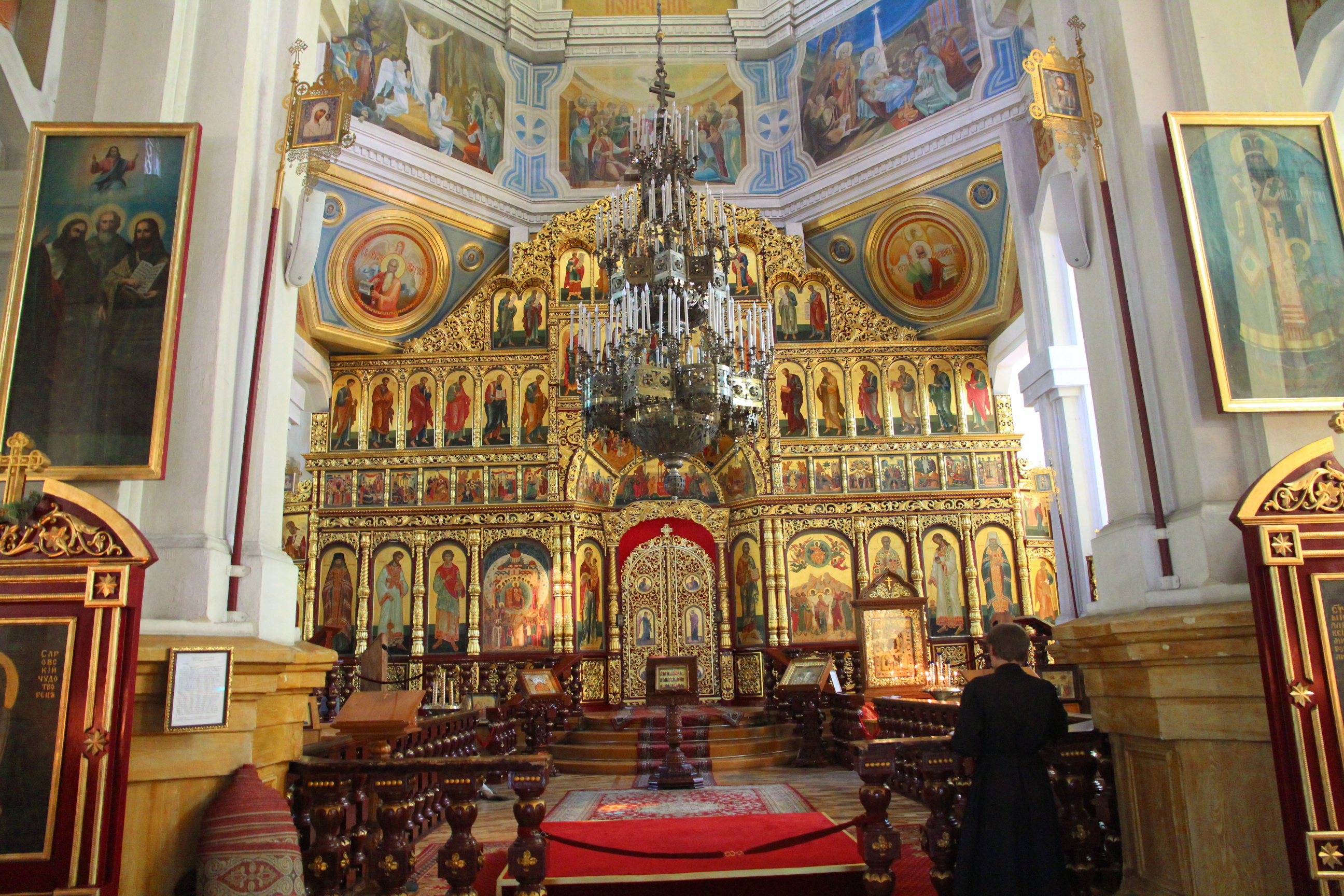
Interior, with the young priest on the right
 Where to next?