
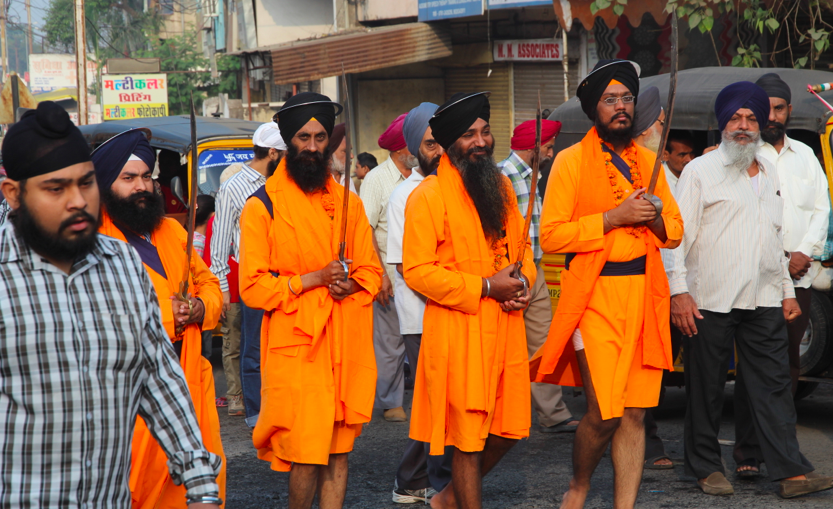
Sikh swordsmen in a procession going down the middle of the road
You wouldn’t want to be a bank robber in India. Your chances of getting away with the loot are absolutely zero. In fact, snaking through the maze of traffic, whether in town or the countryside, is rather like running a slalom race uphill wearing concrete shoes.
Even in a short stretch, you are likely to encounter pedestrians, tuk-tuks, rickshaws, tractors, cyclists, motorcyclists, pushcarts, street vendors, processions, dogs, camels, donkeys, cows and the routine traffic of cars, buses and trucks. Elephants are less common.
When we tried to drive out of Jabalpur, we were initially held up by a long Sikh religious procession with floats, musicians, swordsmen, sweepers and masses of followers.

Stuck in clogged traffic in Raya
Then came the railway crossing in the middle of town where hundreds waited impatiently for the train to come and the boom gates to rise. But many pedestrians and cyclists ignored the gates and scooted through anyway as the train approached.
It took us ages to creep through bustling Raya, with everyone jockeying for a better position in the snarl of traffic. At least we had a lot to look at. Ad hoc shops and workshops were set up on both sides of the railway tracks on our left. Plenty of local trains trundled past and we waved at the passengers, who waved back. A couple of hours and a couple of kilometres later we realised the road crossed the tracks, with very few vehicles slipping across between trains. No wonder we had inched ahead so slowly.
Pedestrians and animals make for an interesting challenge. People generally walk with the traffic, so have no idea what’s bearing down on them. Even a blaring horn doesn’t give them an indication because the smallest of motorbikes is often equipped with the loudest of horns. We’ve walked along roads on several occasions and it’s rather amusing to hear an approaching horn and then try guess what vehicle it goes with.
Cows, buffalos, dogs and pigs are equally likely to be walking on the edges or middle of the road. The night we flew in to Jabalpur, the taxi to town swerved around 10 to 15 cows lying in the road.

It helps to know how wide your load is BEFORE you try to pass. Check out how wide the road is!
Passing requires spatial awareness, nerve, speed and a horn! I’m guessing vehicles without horns are deemed unroadworthy. All trucks and tuk-tuks (called autorickshaws) have painted signs on the back that say ‘Horn Please’ or ‘Blow Horn’. A laying-on of horn lets them know you want to pass.
Anand is good about giving a simple toot-toot before passing, but the majority of drivers think a continuous blast for at least 30 seconds is infinitely more effective.
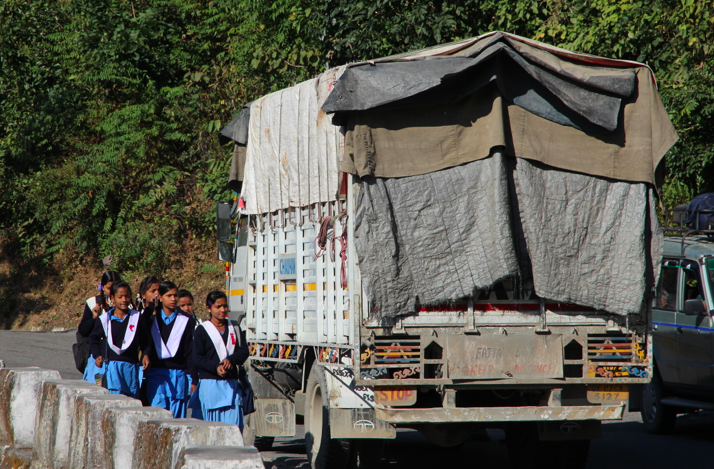
School girls sensibly walking against traffic. To their right (out of view) is where a fellow stopped in the middle of the road to inspect the contents of the truck you see in the pic
Some drivers are just idiots. We saw an official have his driver stop the car in the middle of the road, hop out and stop an oncoming truck, then proceed to inspect the truck’s load without making any effort to park either vehicle out of the way of traffic. There was nearly a collision when vehicles travelling from opposite directions tried to pass the parked vehicles at the same time.
Then there are the roads themselves. Gravel and dirt roads are common and generally not too bad. In Uttarakhand, one of the states we’ve visited, less than one-third of its 33,000 kilometres of road is paved.
Roads with broken tarmac are the absolute worst. We brace ourselves and Anand takes a white-knuckled grip on the steering wheel as we bounce along the irregular surfaces, which can go on for long distances. Note to self: remember to wear a sports bra on these adventures.
Because road quality can be so poor, it’s not uncommon for vehicles to weave back and forth across the road in an attempt to miss the worst of the gigantic ‘potholes’ and drop-offs. As a consequence, it is disarming to see several vehicles approaching you head on.
Speed bumps get thrown into the mix, and Anand says villagers sometimes bribe road workers to add extra bumps, so children and livestock are less at risk. It’s not uncommon to have five bumps in a row.
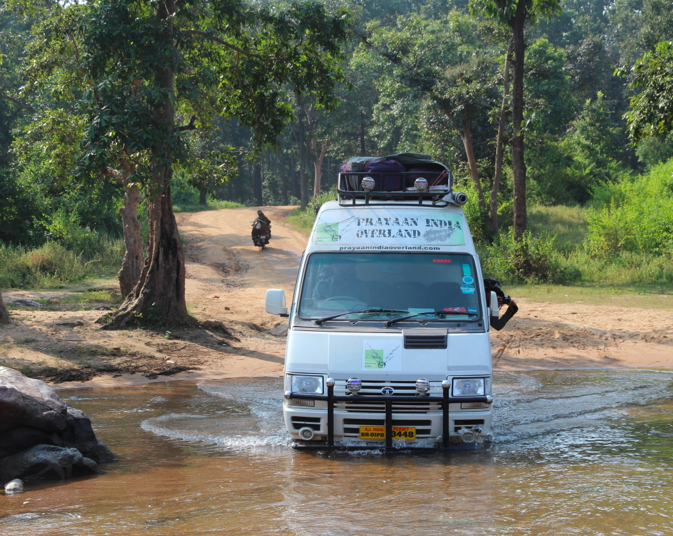
Sometimes roads go through streams
It’s only two months since the end of the monsoon, so road and bridge repairs are now common across the country. We’re often been diverted around a missing bridge and through a river that is no longer swollen with rain runoff. Some roads run through a small stream anyway.
One morning, we saw a group of men building a brick wall to keep motorists from driving off the end of a road leading to a washed-out bridge. Anand said, They really ought to be fixing the bridge instead.
Road closures have been problematic. One day we had to make a 100-kilometre detour because a new median strip prevented us from turning right. This morning we made a huge detour because a main road was closed after a fatal traffic accident.
The locals set up a barrier after police and ambulances had come and gone. Anand says that it is not unusual for a fatal accident to become a village occasion.
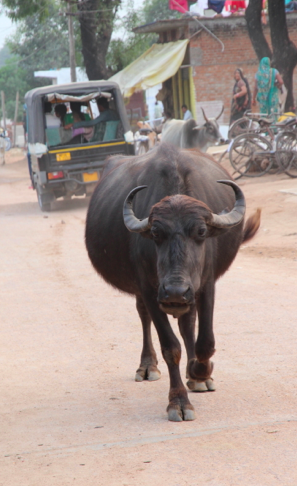
Oncoming traffic—India style
While the fatalities often have nothing to do with the village itself, the deaths bring everyone out to gossip, inspect the scene and mourn the victims. Such gatherings sometimes get out of hand and the Rapid Action Force has to be called in to disperse the crowd.
Svetlana has been another ongoing problem. She’s the van’s GPS system and is named after my criminal doppelganger from Turkmenistan. Every road in India is embedded in Svetlana’s database, and she’s programmed to take the shortest route possible, even if it’s a one-lane dirt road versus a national highway.
We mostly ignore her pleas to turn right or left in whatever distance. That’s because when we get to the appointed turn, we can see that it’s a driveway or a lane than heads into a field of sugar cane. Svetlana has even tried to lead us through a shop.
We’ve come up with a way for GPS systems to ingest a bit of humour into a drive. We reckon that after every 10 times we ignore Svetlana’s directions, she should be programmed to say something like Is anyone listening or I hope you’re lost.
By the time we finish this trip, we’ll have zigzagged across almost 4000 kilometres of roads in central and northern India. I still keep wondering what’s around the next corner?

A colourful float leads a Sikh procession
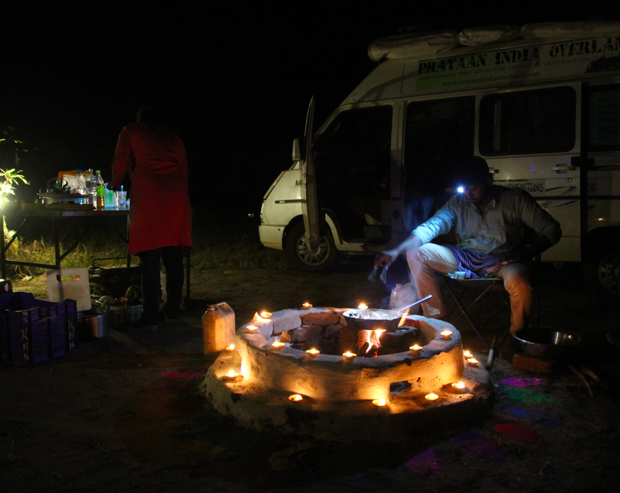
Cooking for Diwali by torch and candlelight
We’ve just seen this month’s full moon and it dawned on me that I hadn’t yet written about our Diwali celebrations, which happened two weeks ago on the new moon.
Popularly known as the Festival of Lights, Diwali (formally known as Deepavali) is celebrated by Hindus, Sikhs and Jains throughout the world. Many countries declare Diwali an official holiday.
It is India’s most important holiday and, in past years, we’ve seen it widely celebrated in places such as Singapore and Burma (Myanmar).
In most parts of India, Diwali coincides with the end of the harvest season. As winter approaches here, it is a time for farmers to give thanks for a good crop and pray for a bountiful year ahead. Some businesses start their new financial year on the first day of Diwali celebrations.
For the most part, people celebrate Diwali with family. They pray to Lakshmi, goddess of wealth, light, prosperity and wisdom, and to Lord Ganesha, the ‘remover of obstacles’ and ‘lord of beginnings’.


Before we even arrived in India, Deepti wrote to say our little overland ‘family’ would be marking the occasion with a simple celebration in a campground, but with decorations, fireworks and new outfits.
Renae was especially thrilled by the mention of fireworks. Quite a few years back, the place where we live in Australia banned ‘cracker night’, meaning no fireworks in the backyard.
Of course, for us to prepare for the festivities in style called for a couple of special shopping expeditions, including one to stock the van.
Whether you are rich or poor, two days before Diwali is everyone’s chance to go on a shopping spree. The shopping is compulsory. There’s even a name—Dhanteras—for the day. Silver and gold are the most popular purchases on Dhanteras, but we stuck to the 3Fs—food, fireworks and fashion.
My Diwali outfit failed the 3Fs policy I have for clothes. It did Fit (sort of), but it did not Flatter and it certainly was not Fashionable. Renae’s get-up was better, but Gary, Poor John and Anand did quite well. Gary even struck a pose. Deepti ‘cheated’ and wore an outfit she already owned.
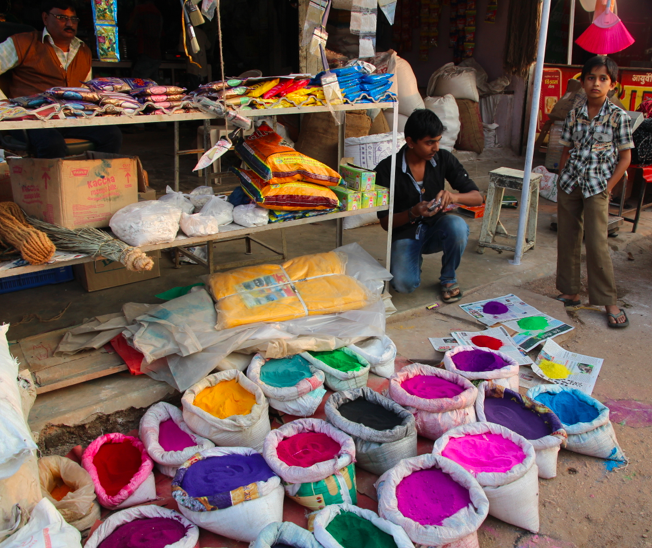
Powdered chalk for Diwali decorations

Deepti finishes putting simple chalk designs around the campfire
We saved some of our Diwali requirements so we could make purchases on the roadside and the local market near our campground. We bought a woven bamboo decoration, an array of powdered chalk for making patterns on the ground, small clay candle dishes, a selection of fresh veggies and a couple of live chooks (Aussie slang for chickens). This would be the first of many times that we would buy our protein live—the best answer when refrigeration is limited or non-existent.
After a couple of safari drives in Pench National Park, it was back to camp for a simple and memorable Diwali event.
If you want to know more about Diwali, check out this interesting and informative blog post I found.


India is awash with colourful billboards. Whether they’re erected on the side of the road or painted on the side of a building, there are several common themes.
Now that we’re in Rajasthan, the coming state election is advertised everywhere.
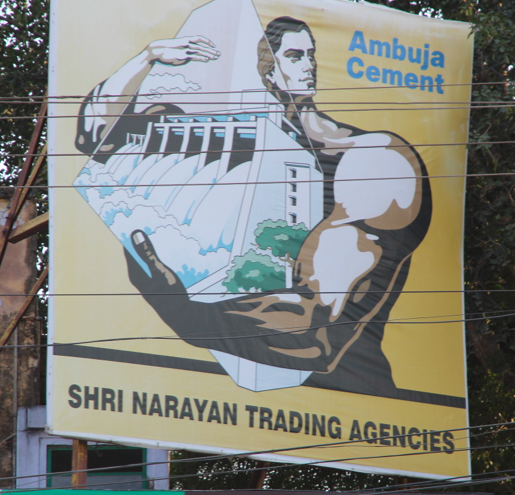
But Poor John was first to point out that cement and underpants (or innerwear, to use the India terminology) top the list as the overall most popular billboard topics.
I’ve lost count of the number of brands for each. I’ve managed to snap pics of many different cement signs, with my favourites pictured here, but I’ve not been quick enough to capture images of such memorable and descriptive underwear brands as Big Boss, Brute, Venus and Lux Cozi (selling vests and drawers).
There are plenty of reminder signs too—such as advice to put toilet paper in the bin rather than the toilet itself and to not spit on walls.
People must be pretty good about following the first because no toilet has backed up on me yet, but there are a lot of tobacco-splattered walls that are evidence that few pay attention to the latter.


A golden jackal off to check out a possible meal
India has no shortage of golden jackals, and that’s probably just as well because these dog-like critters play an important role in the country’s food chain.
Put simply, jackals clean up the bodies. They are ever on the alert for signs of a carcass that needs to be finished off. Hordes of descending vultures, the calls of crows or the smell of rotting meat are all signals for jackals to rush to the scene of the kill.
Once there, they will wait patiently until the original predator leaves the kill for any reason. They then move in swiftly to eat as much as they can before the predator returns.
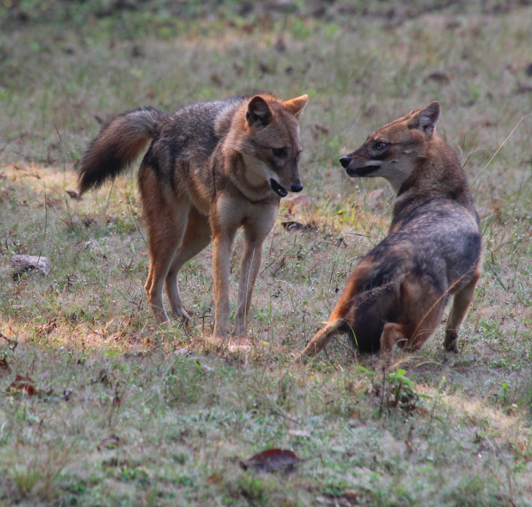
Jackals generally travel in pairs, but will form packs when hunting larger game such as small deer and antelopes.
When carcasses and wild prey are scarce, jackals are more likely to seek out insects, fruit and vegetables than kill poultry, lambs and goat kids. That said, some jackals must have a severe caffeine addiction because they can be nuisance where coffee beans are grown.
We’ve seen jackals in most of the national parks we’ve visited and as we’ve driven through the countryside. Usually we see them in pairs, but we have also seen a group of four or five. Those were far enough away, it was hard to count them. Others have come quite close to us and we’ve certainly heard plenty of jackals howling at night, but apparently only a rabid jackal will attack a human.
Like the fox in Western literature, the jackal is often cast as the trickster or mischief maker in Indian folklore and stories.
I was intrigued to find a website asking for input on sightings of golden jackals in India. The website says that although jackals occur throughout the country, very little is known about them. I’m off now to add my experiences.


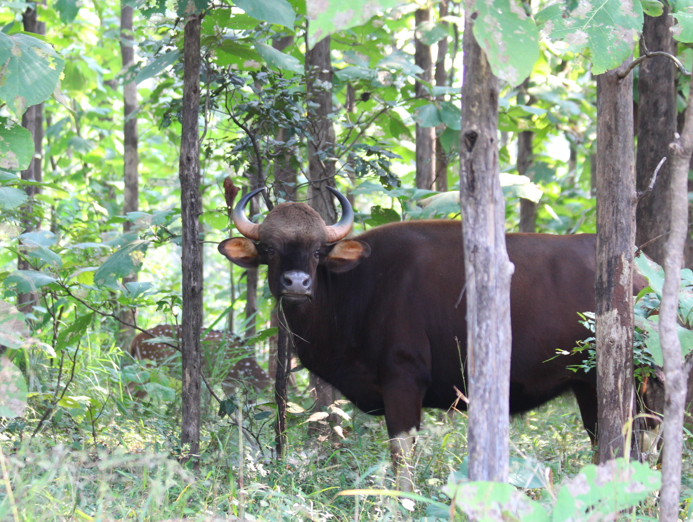
All gaur have horns, regardless of sex
I have to confess that I’d never heard of gaur until after I’d seen lots of them. Anand and Deepti kept talking about all the bison we’d see on our game safaris, and sure enough we saw plenty in Pench and Kanha national parks.
But when we checked out the visitor’s centre at Pench, I learned that Indian bisons—the largest wild cattle in the world—are also known as gaur.
A full-grown bull can measure up to 330 centimetres in length (almost 11 feet) and 1500 kilograms (3300 pounds) in weight. Only elephants, rhinos, hippos and giraffes consistently grow heavier.
We saw gaur grazing, mostly solo, but in Kanha we saw a family herd of about 15 animals including some younger members. The smallest calf was quite curious and approached our vehicle cautiously, with eyes wide.

A calf checks us out
The adults didn’t show much interest, but if a tiger (their main predator) were to stalk the herd, the adults would form a circle around the young. There are even cases in which a gaur have managed to gore and trample a tiger to death.
Surprisingly, gaur are fairly agile for their size and weight. They prefer hilly terrain with evergreen and/or moist deciduous forests. In addition to grasses, gaur eat leaves, shoots, bamboo, shrubs, trees and bark. But apparently they won’t touch areas that have been affected by forest fires.
Gaur have been listed as a vulnerable species since 1986, with about 70 per cent of their population depleted in the last three generations. Populations are stable in well-protected areas such as Kanha and Pench, which has about 700.


Wild dogs flop in the grass at Pench National Park
Of the four national parks we have visited so far, Pench has given us the greatest variety of wild animals. While we didn’t see tigers or leopards there, we did feel especially lucky to see a pack of four Indian wild dogs on our second safari.
Deepti, who spends a lot of her time in and near national parks, says she’s only ever seen wild dogs once before and that was five or six years ago. This isn’t surprising—according to Anand there are only about 500 wild dogs left in India, and about half of those are in Pench.

Nope, a girl can’t have a pee in private
Known also as dholes, these wild dogs roam through South and Southeast Asia. While they look a lot like domestic dogs, dholes are more closely related to jackals than wolves.
They are classified as endangered because of reduced habitat, depleted populations of prey, competition by other predators and possibly diseases from domestic and feral dogs.
Dholes are highly social. They live in large packs, and sometimes split up to hunt. They communicate through whistles and yaps (they don’t bark), and hunt by running their quarry to exhaustion and then attacking from all sides. Interestingly, adult dholes will let the pups feed first.
The dogs we saw seemed more interested in playing and lounging around than hunting. They loped along behind our Gypsy (small safari 4WD), stopped for a not-at-all-private pee (just like us gawking at a tiger) and flopped down in the grass for a roll and a stretch. Perhaps they were having a post-lunch stroll and mini siesta before they scooted off.
I’ve read that dholes are afraid of humans, but as a pack are brazen enough to take on much larger and heavier animals such as wild boar, water buffalo and even tigers. They eat fruit and vegetable matter too.
Since Pench, we’ve visited three more national parks and had eight more safaris, but no sign of more wild dogs. Here’s a great article about the dogs being endangered.
Tomorrow we’re off to look at birds in Keoladeo National Park near Bharatpur.


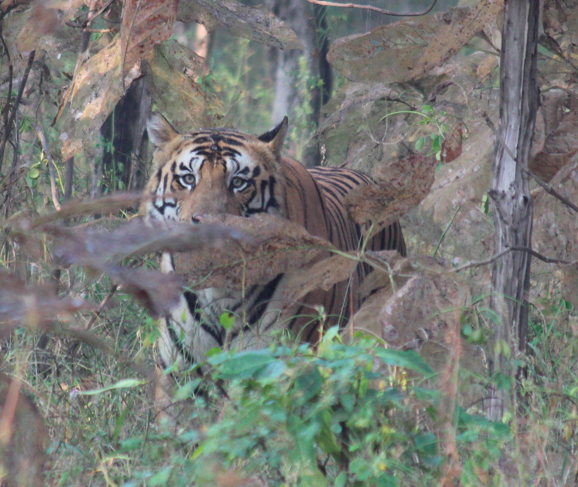
T1’s son has his eye on us
The last couple of days have been all about tigers.
In less than two weeks, we have visited three national parks in India—Pench, Kanha and Panna—and done eight safari drives, including one that lasted almost six hours.
But the tigers eluded us. We got a glimpse of one in Kanha. An army of Gypsies (the local safari vehicles) descended upon a leafy stretch of road near where a mum and three cubs were supposedly relaxing in the scrub. One cub ventured close enough to the road to peek through the bushes and inspect the fuss. I got a quick pic that looks about as much like a tiger as a monarch butterfly.
So we pretty much agreed that this wouldn’t count as a true sighting unless we never saw another.
But then we got to Panna National Park with its remarkable story of taking its tiger population from zero to a healthy count of 24 in just over four years.
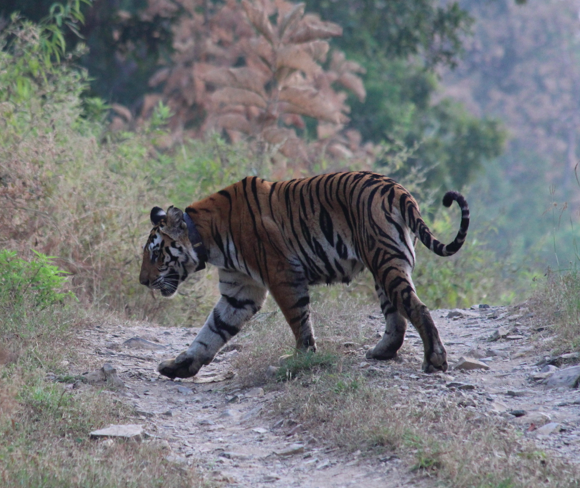
T1 sniffs out a good place to pee
Created in 1981 and declared a tiger reserve in 1994, Panna was declared devoid of tigers in February 2009. Anand explained how this came to be.
Poachers were active and far too successful in Panna for many years prior to 2009. In fact, the population was most likely depleted by 2007. But Panna’s forest officials (who were in on the poaching scheme) had plaster casts of tiger footprints (known as pug marks), and used these to fool higher authorities into believing that tigers still roamed the park.
Finally, an expert on tigers was called in to assess the situation. He did camera-trap studies and other research and issued a verdict of ‘no tigers in Panna’. Local park authorities were outraged and filed a lawsuit against the expert for making false claims.

T1 shows off her monitoring collar
But the National Tiger Conservation Authority trusted the comprehensive research and verdict, and acted to rescue Panna. Some of the corrupt officials were suspended, others went to jail, and a long process began to return tigers to Panna.
In March 2009, two females (T1 and T2) from Bhandhavgarh and Kanha, respectively, were relocated to the reserve. A Tiger Reintroduction Project plan was developed that called for a total of four females and two males to be moved to Panna.
There was an instant and unexpected challenge when, for the first time ever known in history, a male tiger displayed homing instincts and left the park to head toward his home territory of Pench.
He had to be tracked (many of Panna’s tigers have monitoring collars) for 50 days to be protected and finally tranquilised, recaptured and returned to Panna, where he has since stayed put.
Happy tiger ‘families’ have thrived since then. T1 had her first litter of four cubs in April 2010. A second litter arrived in early 2012. T2 also had two litters in that period of time. And the cubs keep coming.
Which leads me to our tiger encounters.

Can’t you people let a girl crap in private?
It was about 4:30pm when we saw the flick of a tail heading though the grass in front of us. Damn, was that going to be as good as it got? But she (it was T1 herself) padded up the hill, turned right, ambled along the ridge and descended again behind us.
She sniffed a bit, had a crap and a pee (nothing is private when you’re a tiger being stalked by people with cameras), and wandered into the bush on the other side of the road. She rummaged around and flopped down in the tall grass.
Even though we could hardly see her, we watched spellbound, snapping photos and cherishing every moment of the 30 or so minutes we spent with her, even though our only good views were while she was on the road. We moved on only because the park was closing for the night and we had just under 30 minutes to get to the gate OR get in trouble.
Next morning, we set out with the intention of going straight to the place where we’d seen T1 the day before. But alarm calls from a sambar deer and a couple of tiger growls were enough to send us, and all the other Gypsies full of gawkers, off in another direction.
After 45–60 minutes of chasing sounds, there he was—one of T1’s offspring from her second litter. He glared at us from his hide in the grass. Suddenly he began to move and we’ll never know whether he was after prey or determined to have his morning crap in private.
In a flash, he loped through the grass, across the road and disappeared into the brush.
So now we’re counting all three tiger sightings, and we’re on our way to Ranthambore National Park in Rajasthan, with another four safari drives over the next couple of days. Look out tigers and leopards too!

T1’s son makes a dash for it
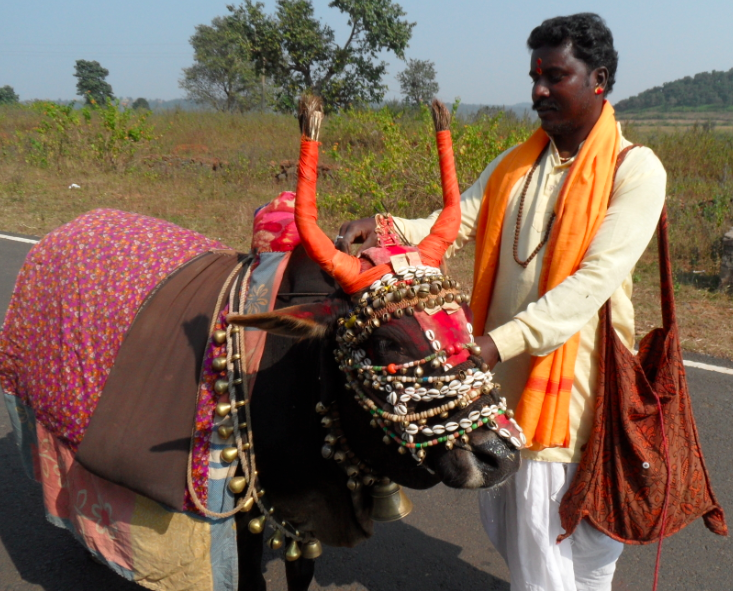
A heavily decorated Holy Cow and his minder. Photo by Gary Foster
You don’t often expect a slang expression to come to life, but that’s exactly what happened the other day as we drove through central India on our way to visit a national park.
Suddenly there they were—a priest and his heavily decorated Holy Cow—moseying toward us on the edge of the road.
This cow, which in this case was a bull, was deemed holy because of an unusual lump on its neck. It’s deformities such as this that set a Holy Cow apart.

On the road. Photo by Gary Foster
According to Deepti and Anand, if you own a Holy Cow (usually a female), you and your cow can’t just laze around.
You can choose to travel the countryside with it spreading holy messages and inspiration. Or you can give the cow to a priest who will take on the job.
Either way, a cow and its carer walk from village to village, sharing hope and faith. In return, villagers feed and house the priest and cow.
Deepti and Anand travel extensively in India and say they don’t see Holy Cows very often, so I consider myself blessed and privileged to have seen one in action. The priest stopped to let us take photos and we tipped him generously, which was only right.
Not every day that you see a Holy Cow.

Our first supermarket shop with (from left) Poor John, Renae, Anand, Deepti and Gary
Our latest overland journey kicked off with a shopping spree to stock up on dry goods to hold us for those days when we can’t really buy anything fresh.
The only other time we’ve done a big shop before starting a trip was before we headed into Africa for almost year. I’ll write about that soon, but India is top of mind at the moment.
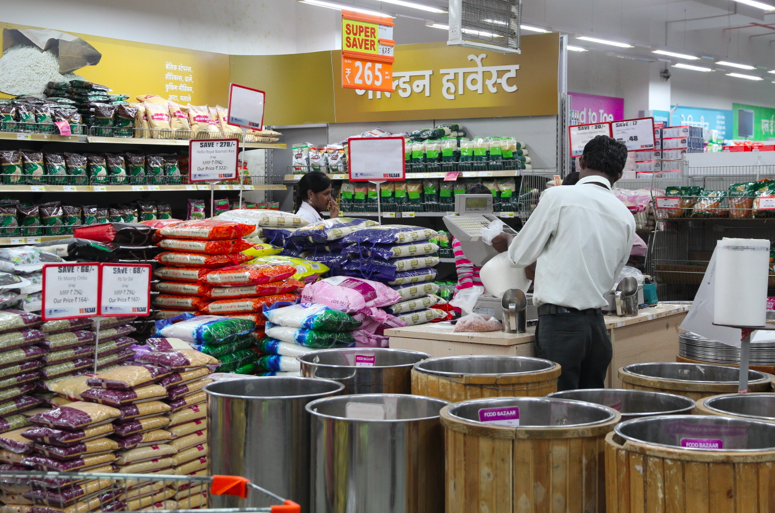
Overwhelming choice of rices and pulses
Anand and Deepti have a clever idea for getting passengers involved in a shop. On day one of our overland, they took Renae, Gary, Poor John and me to a Big Bazaar supermarket in a medium-size shopping mall in Jabalpur.
Once we arrived, they handed each of us a list of four or five items to find in the store. I drove the trolley and we scattered around the store to buy essentials such as cooking oil, spices, rice, dry noodles, sugar, salt, pepper, jam, peanut butter, milk powder, cereal, dish soap, sponges, tissues and the like. We even bought a packet of table napkins endorsed by the famous and talented Indian cricketer, Sachin Tendulkar.

The crowd at the checkout
I’m a good shopper, but almost missed out on the top bargain of the day. When I grabbed a five-kilo bag of rice, the salesperson put a second bag in the trolley. I took it out and said, thank you but I only need one. He looked puzzled.
When we got to the checkout, Anand asked who bought the rice. Me, I piped up. Well, go get the other one, he said, it’s buy one, get one free.
Oops! So now we have 10 kilos of rice for a month. I wonder if we’ll need to buy more?
Interestingly, lots of groceries items were discounted for Diwali, the Festival of Light, which is the year’s most important holiday for Hindus. Our final bill for an initial trolley of groceries was 4100 rupees or about A$73.

Renae watches the checkout process with amusement. Note the Profit Club sign in the background
Checkout was an interesting and slow process. Many customers were taking advantage of the Big Bazaar’s Profit Club, a special that meant they could pay 10,000 rupees and then spend 1000 rupees per month for the next year at that supermarket. Nice incentive, but supported by mounds of paperwork.
Shoplifting must be a problem in Indian supermarkets. Renae bought a bottle of moisturiser and popped it in her bag after paying. Oh no, that won’t do. The bottle had to be put in a small carry bag, which was then sealed with a cable tie. A number 1 was written and circled on the bottom of her docket. Later we realised this was to let the fellow at the exit check how many bags she was supposed to have.
Then it was on to the general markets to get Diwali decorations, lights, clothing and fireworks. Just because we would be camping didn’t mean we wouldn’t be celebrating.
Buying clothes was the biggest challenge. I finally found something that went around my bust. It fit, but it didn’t flatter, and I’m rather hoping that a pic of me in it never makes it into cyberspace.


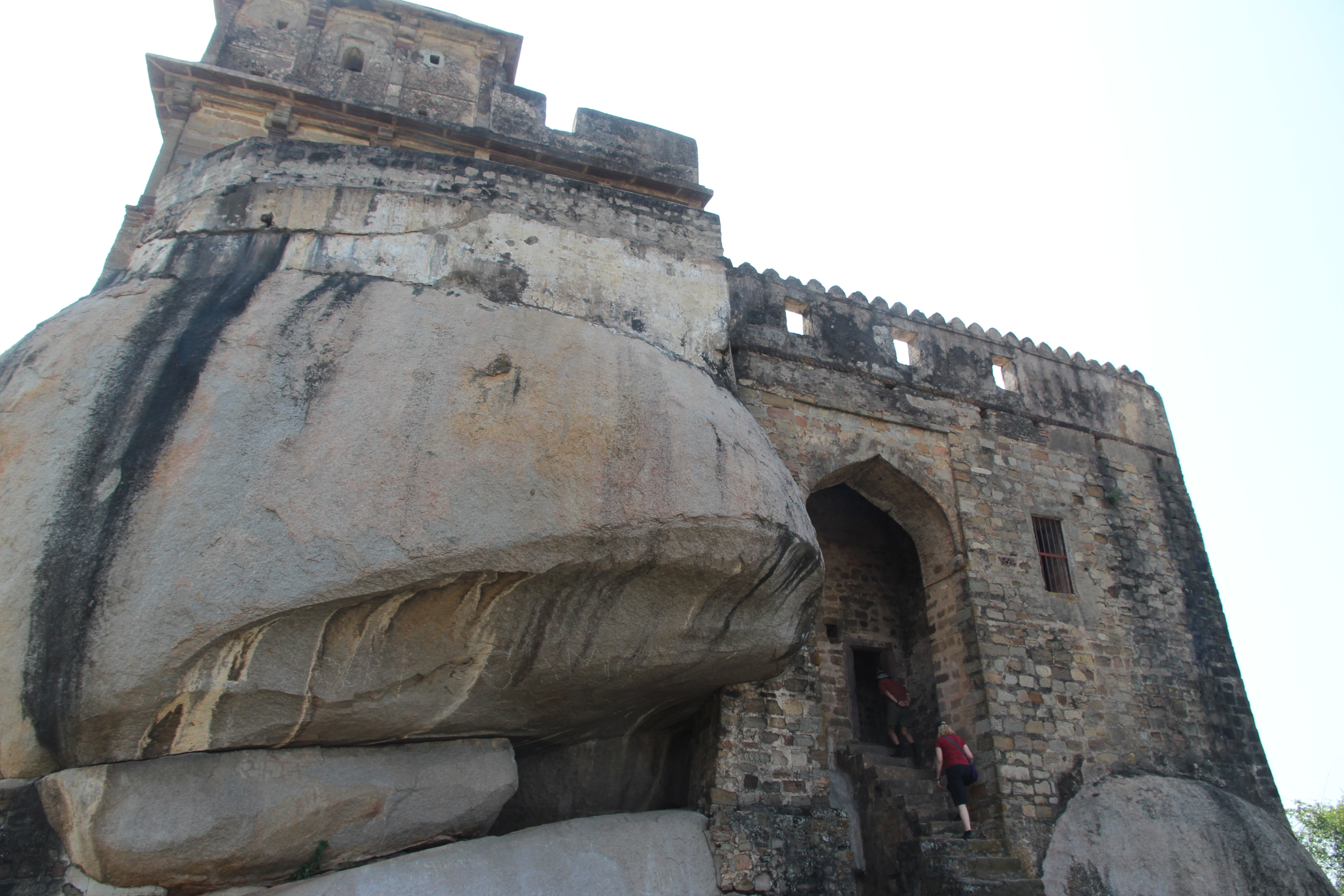
Looking up at the huge rock that provides a foundation for Madan Mahal
After Pisanhari Temple, the Madan Mahal or Durgavati Fort was next on our list of must-see sites in Jabalpur.
It’s a miracle we—Renae (one of two friends travelling with us on this overland), Poor John and me—even got there.
The guidebook says the fort is six kilometres out of town on the way to Marble Rocks (another site on our list). We crossed the road so we were heading the right direction and flagged down a tuk-tuk, known as an auto rickshaw in India.
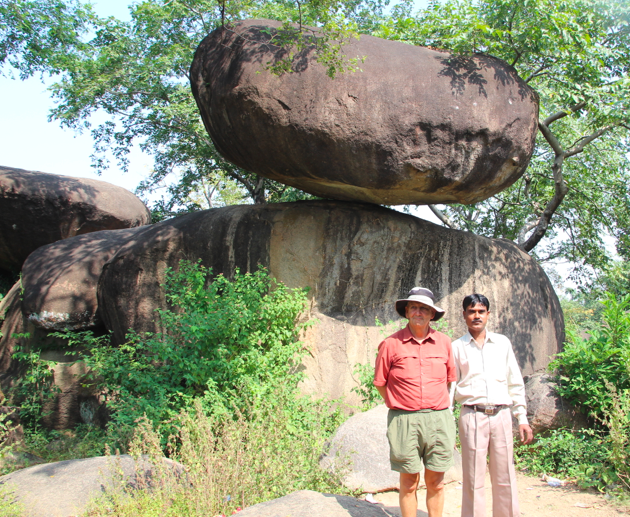
Jabalpur’s famous balancing rock
With a few words of Hindi (namely Madan Mahal, Madan Mahal) and much waving of hands we settled on the price and destination. Of course, it was shock when the fellow drove on 30 metres and did a U-turn and headed back toward town.
He insisted he was going the right way, we insisted he wasn’t. He stuck to his plan and we decided it didn’t really matter where we ended up—it was still an adventure. Before long we turned right onto a narrow side road that took us past the Balancing Rock.
The guidebook says the Balancing Rock is on the path/track leading to the fort, so unless there are two such rocks in town, we knew we were heading the right way.

A small shrine tucked amongst boulders
The driver stopped briefly and led us to the rock where I snapped a pic of him with Poor John and the rock, which has survived many earthquakes over the centuries.
Then it was on to the base of the stairs leading to the fort.
Luckily, there are two catch-your-breath-and-take-a-photo stops on the way up—neither of which gets a mention in the guidebook. There’s a picturesque lake and a small shrine, complete with offerings, tucked into an outcrop of large rounded boulders that have been painted blue. Renae couldn’t resist stopping at the makeshift ‘gym’ attached to the shrine and give the homemade barbell a couple of lifts.
And finally we reached the fort.
Built in the 11th century by the Gond rulers, the Madan Mahal fort is strongly associated with Rani Durgavati, the Gond Queen, and her son, Madan Singh. She is also credited with building many temples around Jabalpur. Rani Durgavati eventually died fighting the Moguls, and Indian history hails her as a martyr.
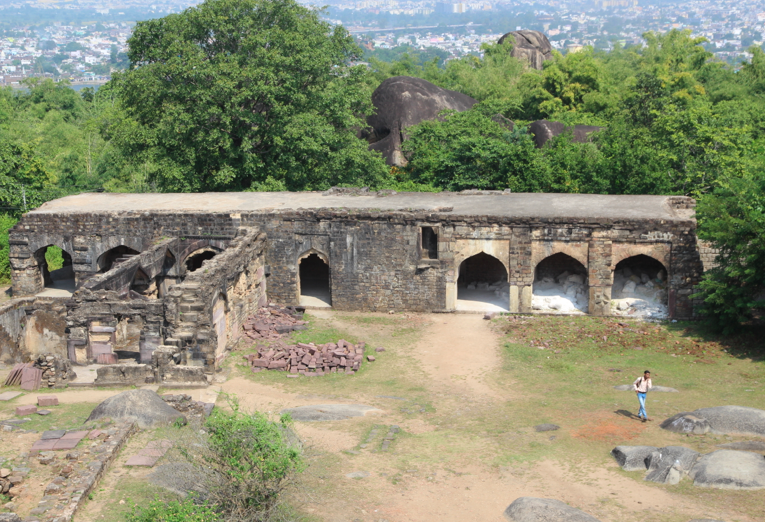
Looking down on the stable
The compact fort served primarily as a watchtower, where troops kept a lookout for invaders. In addition to the fort, there are three other structures—a stable, a small reservoir and a pleasure chamber for the rulers. None of these are marked and your guess is as good as mine as to the pleasures that were taken.
The stable—or what we assumed was the stable—has an interesting ceiling design that is reminiscent of Arab constructions.
Quite a few Indian national tourists visited while we were there. One fellow was ensconced upstairs and treating the fort as his own personal office.
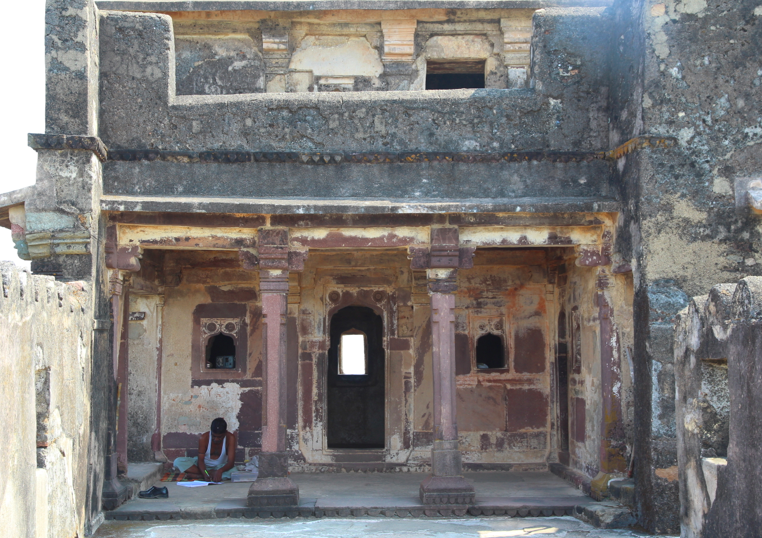
Upstairs at the fort where a fellow seems to be running his office on the left
From the upstairs, we could look across to the Pisanhari Temple we visited the day before.
Rumour has it that there is a long a underground tunnel that was used as a possible escape route and to transport artillery. There is also, supposedly, a Gond treasure of gold bricks hidden somewhere on the grounds. We didn’t see anyone prospecting.
When we’d thoroughly explored the fort and surrounds, we walked down the hill and back to our hotel—just over two kilometres. So much for the fort being six kilometres from town.
I get annoyed with guidebooks. This one must measure from the centre of town and, while we stayed nowhere near the edge of town, our hotel was well past the six-kilometre mark. It would help if they made it clear on their measurements work.


