
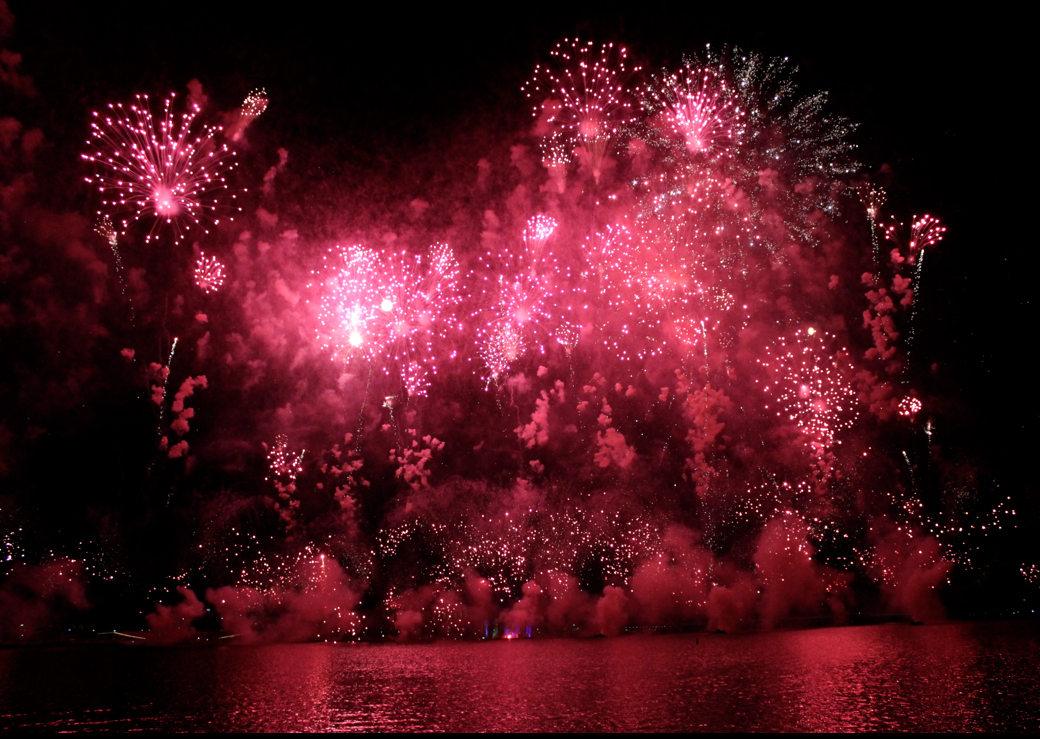
Canberra in the pink on her 100th birthday
Canberra was officially named 100 years ago—12 March 2013—and we’re having a big-time celebration to mark the occasion.
Our event calendar has been huge—two pages of fine print. But the highlights have been fireworks, numerous concerts and ethnic performances, film festivals, hot air balloons, a 1920s gala ball, a football game, boat and horse races, exhibitions, food stalls and the world’s longest bubbly bar.
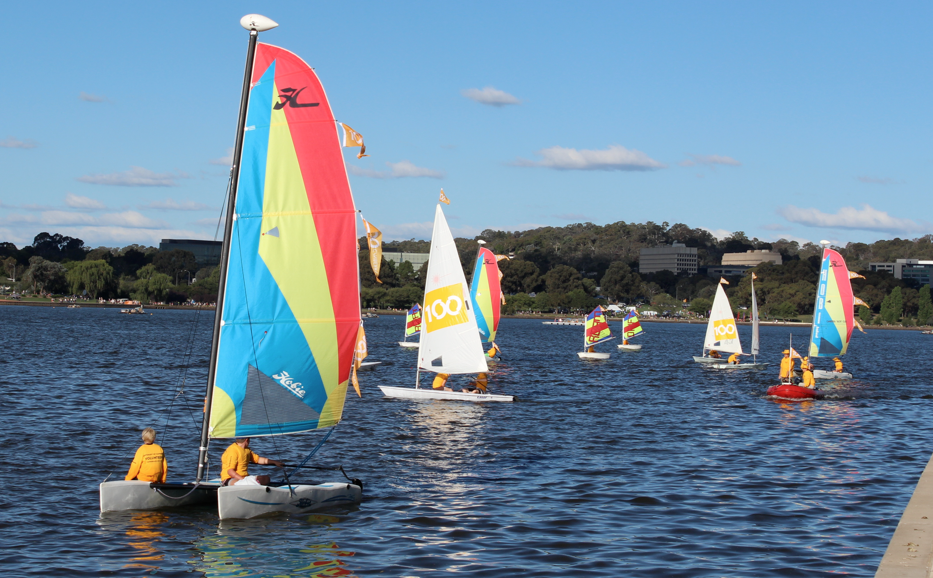
Boats out in force on Canberra’s 100th birthday
Yep that’s right, 800 metres of walkway on the edge of Lake Burley Griffin were set up to serve bubbly and tapas. Poor John and I resisted buying tickets to the event—heck he doesn’t even drink—but here are some of the details.
The event had multiple seatings, and was completely sold-out in advance. For $15, you could stay 45 minutes and have one glass of bubbly and tapas. An extra $10 got you a 90-minute stay and a second glass of fizz.

The bubbly bar was set up on that distant stretch of shore
The team of more than 100 servers expected to serve 800 people every 20 minutes, and go through more than 1600 bottles of grog (Aussie slang for alcohol).
Local winemakers created a series of celebratory wines for the event, including the Centenary Sparkling (we can’t call it champagne). Local produce was used in all the tapas options. To be sure, I would have loved to sample the roasted mushroom soup, deconstructed bruschetta, smoked capsicum (bell pepper) parfait, Clyde River oysters, smoked trout and slow-cooked pork belly.
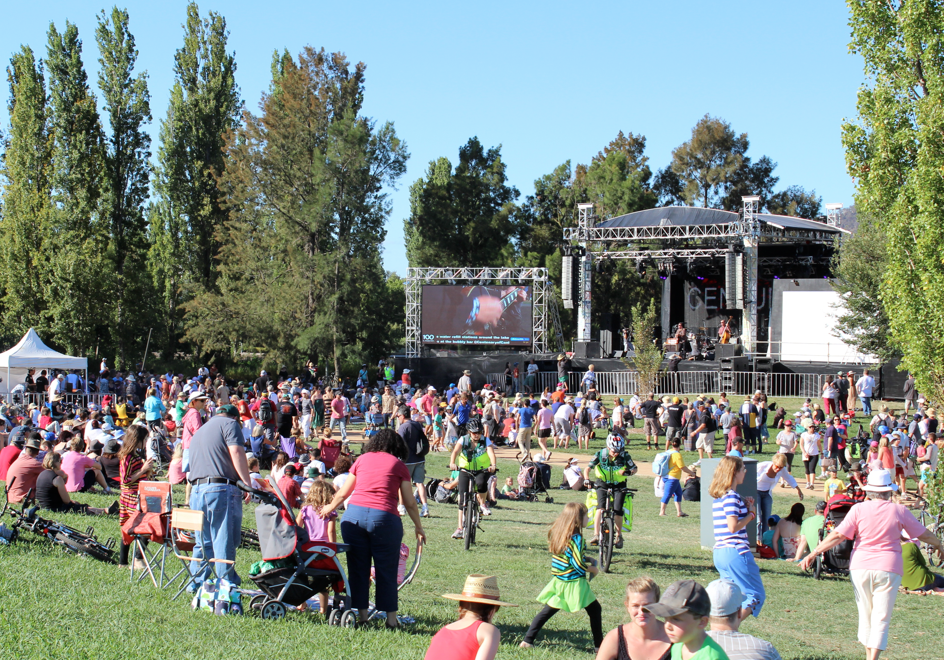
One of many concerts by the lake
A little background on Canberra
In 1901, when the states of Australia came together as a federation, neither Sydney nor Melbourne wanted the other to become the capital. Ultimately it was agreed that a compromise location, in New South Wales, be chosen that was at least 100 miles (160 kilometres) from Sydney.
After a long process that involved numerous also-rans, Canberra, as a location, was identified in 1908. Then began the process to design and name this new capital.
An international design competition concluded in 1911, with Walter Burley Griffin, a Chicago architect, the winner. Griffin’s (he hated his middle name, but it gets used here all the time) entry relied heavily on the drawings done by his talented wife, Marion Mahony Griffin, the world’s first female architect graduate.

An Indian dance troupe at the celebrations
As a carefully planned and designed city (Burley Griffin even envisioned the lake), Canberra has a wonderful elegance and style, coupled with a bush setting.
People who don’t live here complain that it has no soul, no heart. Others say it’s just plain cold. Yes, it’s cold in June and July, when so many school kids make their only trip here as part of a school excursion.
But heart and soul? Canberra has got both in trumps. It’s a wonderful city and I feel lucky to live here. Plus, we live about a 10-minute walk from the lake.

A rocket of Woomera
In the 1950s and 60s, Woomera was the world’s second busiest rocket range. Only Cape Canaveral was busier.
Today Woomera, located in South Australia’s outback, is a much smaller operation. It’s still an Australian Defence Force (ADF) base, commanded and administered by the Royal Australian Air Force, but rocket launches are a memory.
In fact, Woomera was at risk of closing in the late 1990s. About that time, a long-term study of ADF’s needs through to 2035 showed that Woomera had the only test and evaluation range in the western world that was suitable for testing ADF’s next generation of defence systems. A bonus was that Woomera’s climate meant it could be used year-round.
Around that same time, the Howard Government (don’t get me going on the Howard Government) set up immigration detention centres for asylum seekers. The village at Woomera was one such site. The detention centre was highly controversial and closed by 2003.
Residents now are defence workers or contractors, and the population fluctuates between 150 and 200.

More in the Woomera arsenal
We’ve been to Woomera twice since 2011, and had a long and interesting stroll around both times.
Everyone should check out Woomera’s National Aerospace and Missile Park, in the centre of town. It has missiles and rockets that were developed and tested there over the last 60 years, as well as some of the historic aircraft that were used in trials.
The Heritage Centre has a display about the legendary Len Beadell, the famous surveyor and road builder who laid out the original range across vast tracks of the Australian outback, stretching from Woomera to the far northwest coast of Western Australia.
A story about the rogues of early Woomera
Outback Australia brings out the mischief in folks. Decades ago and the night before a coming federal election, the workers of Woomera got well and truly pissed (Australian for drunk).
Drunkenly and collectively, they decided to vote for the Communist candidate. Oh boy, did that have the officials trying to figure out what was going on in Woomera.
A story about Len Beadell
Len really is a legend in outback Australia, where he created many of the roads. One day he came upon a truck stuck in mud up to its axles. The driver was nowhere to be seen. He’d no doubt gone to seek help.
Len used his tractor to pull the truck out and then used his grader to smooth over the mess. Later he wondered how the truck driver, on his return, managed to convince his rescuers that the truck really had been stuck.
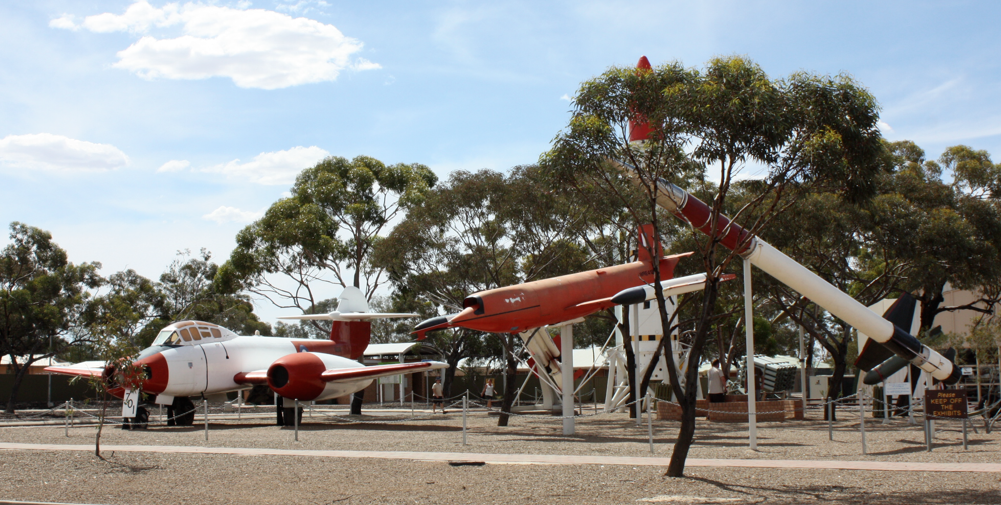
Stand back and enjoy Woomera’s National Aerospace and Missile Park
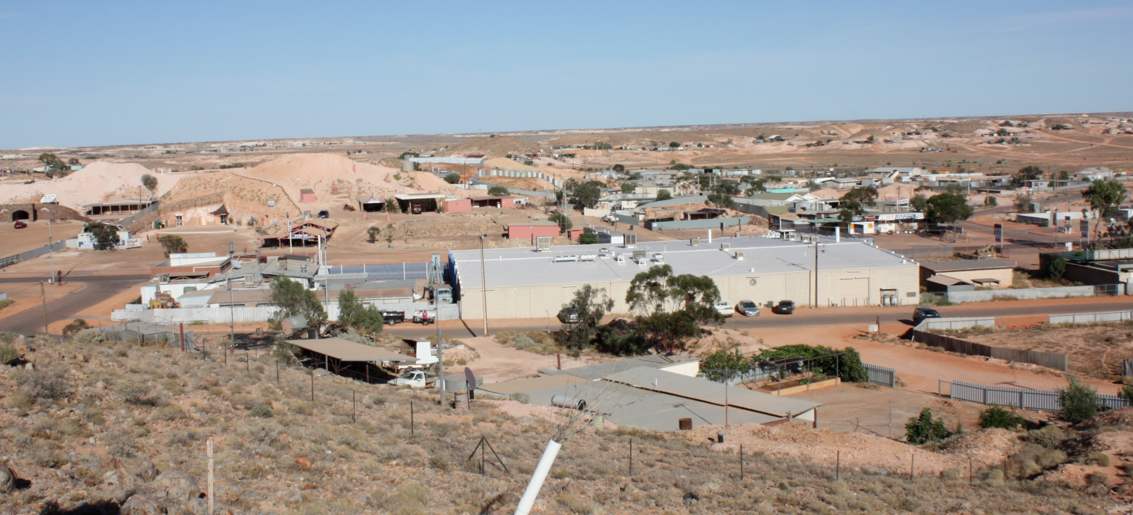
Looking out on Coober Pedy
Coober Pedy was a must-see stop on our outback road trip to the Red Centre.
This South Australian country town is famous for two main reasons. For starters, it’s considered the Opal Capital of the World, plus, because it gets so hot there, a lot of the town is built underground.
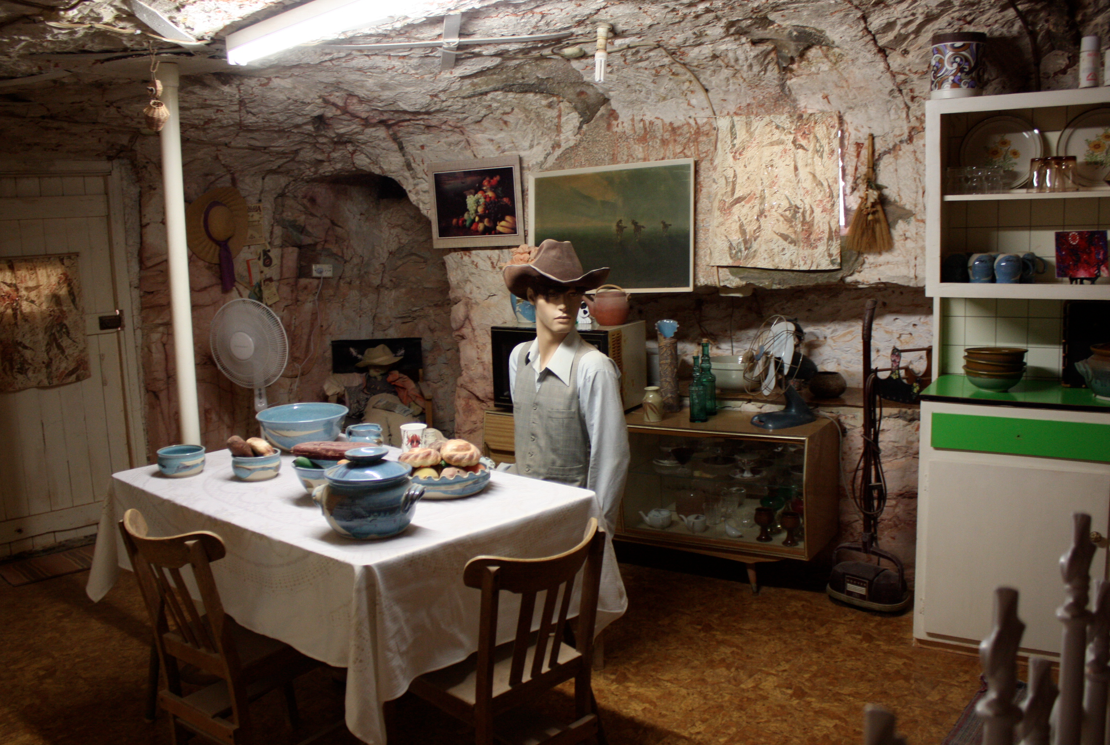
Breakfast anyone?
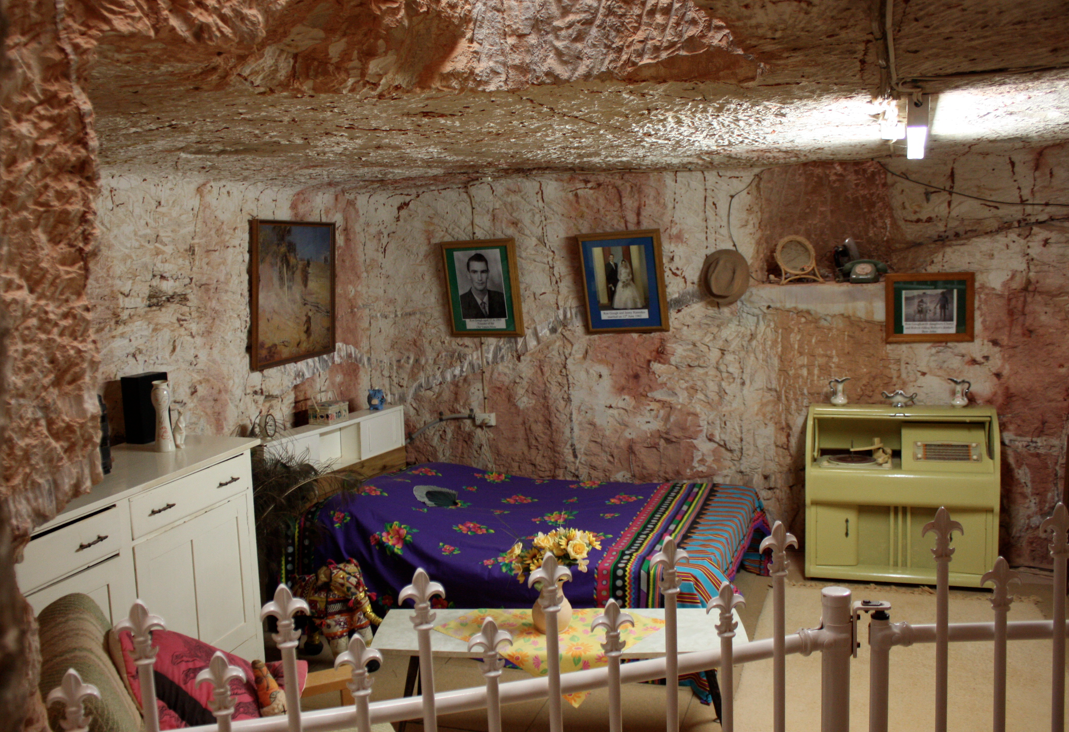
No need for curtains in an underground bedroom
You can live in an underground house, sleep in an underground motel, dine in an underground café, visit an underground gallery, attend an underground church, shop in an underground store, work in an underground mine.
The piles of dirt and rock that extend for many kilometres in and around Coober Pedy are evidence of the digging that goes on there.
It all started in 1915 when a father and son team, Jim and William Hutchsion, who had been searching unsuccessfully for gold found surface opal instead. The resulting settlement, originally known as the Stuart Range Opal Field, was renamed in 1920. The current name comes from the Aboriginal words ‘kupa piti’, commonly thought to mean ‘white man in a hole’.
Conditions were harsh in the early days and life was not easy. Water and provisions were carted in from great distances. Each person was entitled to only two gallons of water a week.
Coober Pedy has changed a lot, and tourism is a big drawcard.
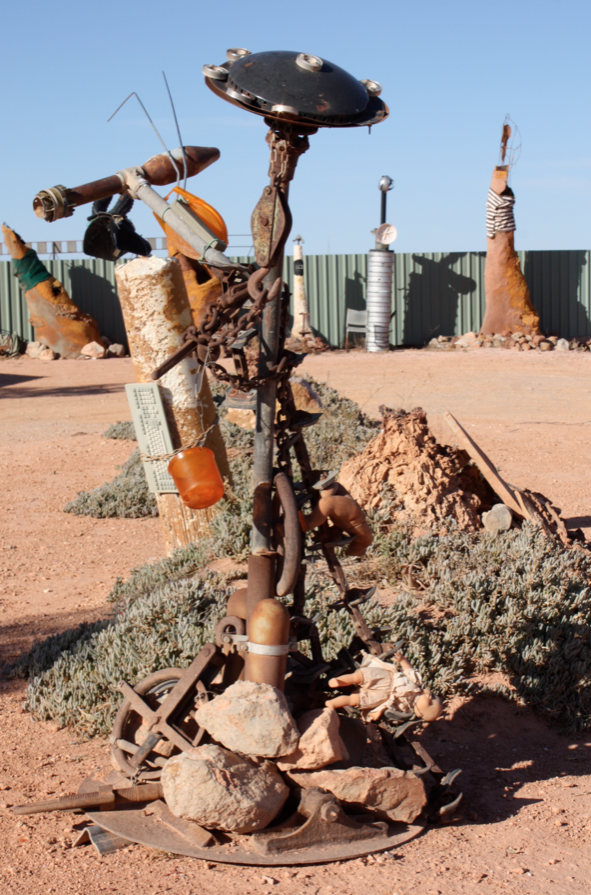
Quirky art at the Coober Pedy lookout
Our first stop was aboveground—at a lookout near the Big Winch. As an aside, Australia has lots of goofy big things—the Big Lobster, the Big Beer Can, the Big Bushranger, the Big Banana to name a few—and I’ll share those with you as I come to them.
The entrance to the Big Winch is closed now, but a nearby lookout is still open. You can get a good overview of the town and a good laugh at some of the quirky art that’s on display.
Next stop was the Old Timers Mine. This is a great place for an all-in-one glimpse of Coober Pedy’s history.
We donned hardhats to visit the 1916 mine, underground house and museum. It doesn’t take long to figure out why hardhats are compulsory—the ceilings are low, jagged and unforgiving!
After touring the mine and at the owner’s suggestion, we had our picnic lunch in the shade by the entrance. As the owner said, it’s probably the best shade in town.
We were also impressed to see a large fenced area off to the side, complete with water bowl, where travellers can park a pet while they tour the mine. Nice thinking.

I liked the way the road train parked behind the NO TRUCKS sign
Wish I’d kept track of how many road trains we saw on our recent travels in outback Australia.
Road trains are big truck rigs made up of a conventional tractor unit that pulls multiple semi-trailers. They operate in the USA, Canada, Argentina and Mexico, but the longest and heaviest ones are in Australia.
These biggies are allowed to operate only in western New South Wales, western Queensland, Western Australia, South Australian and the Northern Territory. Because Australian road trains transport all sorts of freight—livestock, fuel, mineral ores—they have remote areas of the country to develop economically.
We were able to have a close look at a parked rig, that came from the Olympic Dam Mine at Roxby Downs, South Australia. It was hauling 50,000 tons of copper sheets stacked across two flatbeds. It had 42 wheels and it took me just over a minute to walk slowly down its length. It takes quite a while to pass them on the road too.
We also saw a lot of wide loads, but none as impressive as the pipes/tubes we saw being hauled last year in Western Australia.
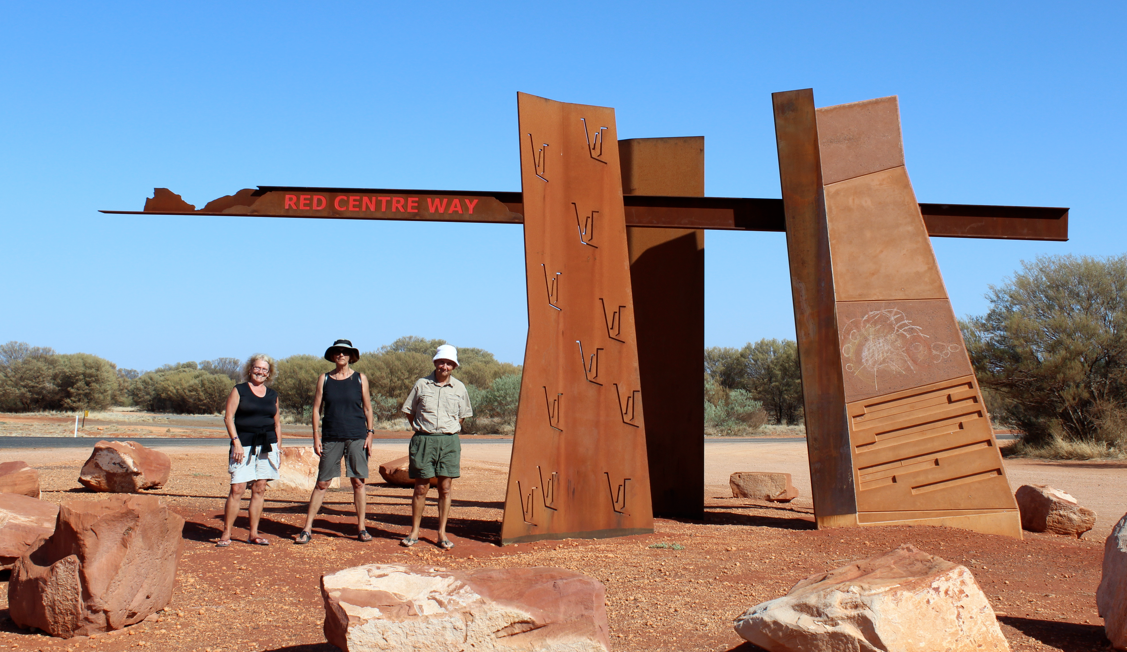
Me, Sherry and Poor John at the Red Centre ‘entrance’, Northern Territory
Sherry, a childhood friend from the USA, is visiting Australia for the first-time, so has given Poor John and me a good excuse to load the Subaru with camping gear and water, and head to the Red Centre.
This isn’t just a jaunt. Uluru and Kata Tjuta (which some know better as Ayers Rock and the Olgas) are almost 3000 kilometres from Canberra. We were last there in December 2011, when we travelled overland from London to Sydney.
A lot of people would blanche at the thought of driving 3000 kilometres—especially when about two-thirds of the journey being through scrubby desert—but we are about to make it in three-and-a-half days, with no day being ridiculously long.
So far we’ve had three great camps. Australia has vast expanses of flat, tent-friendly land. Even better, the country is dotted with rest stops and roadhouses that often have space for campers. Plus, we have a great book—Budget Camps and Stops by Paul Smedley—that rates each place and gives full details.
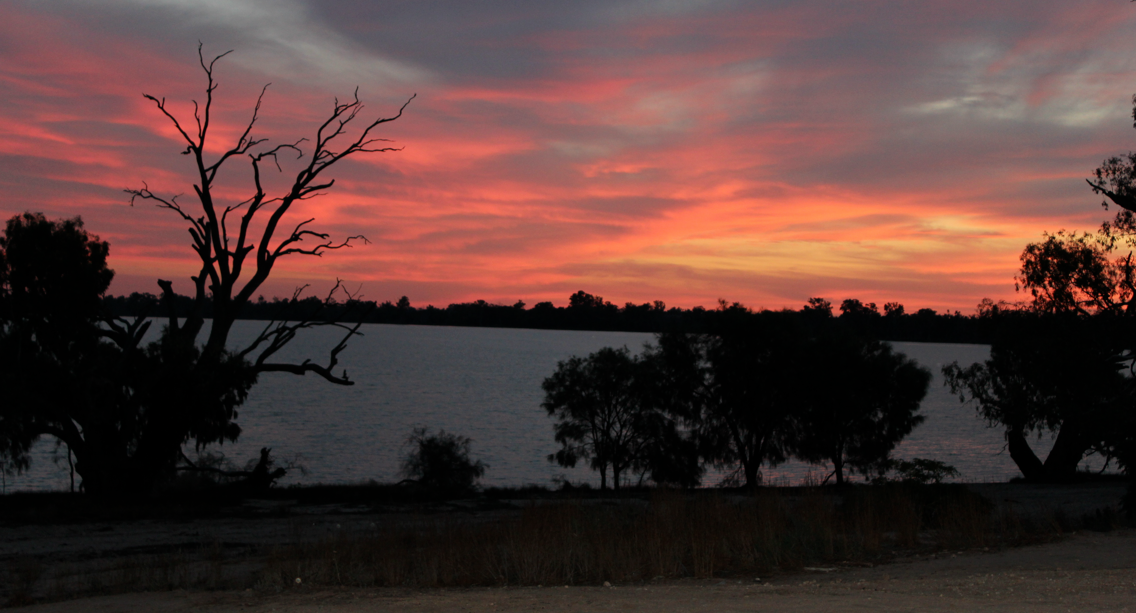
Sunset at Lake Bananee
The first night we camped near Lake Benanee (which I had never heard of) and were treated to a spectacular sunset. Our second night was at the famous Spuds Roadhouse near Woomera in South Australia (I’ll tell you more about Woomera later). Camping was free and a hot shower was only $2. There was a sign reminding campers to make a donation towards electricity in general, so we chipped in another $1 each. Last night we stayed at Fly Central. Actually we were at the border between South Australia and the Northern Territory—where the flies of the nation gather from dawn to dusk to torment travellers. At least they don’t bite—the flies I mean, not sure about other travellers.
We’ve been here long enough to become a bit philosophical about the flies, but Sherry considers them to be a form of extreme torture. That said, she is getting adept at the Australian salute—the act of waving flies away from one’s face.
Stay tuned for our visits to Uluru, Kata Tjuta and, if time permits, we’ll get to Kings Canyon too. By the way, years ago Australia eliminated all the apostrophes from place names, which explains why there isn’t one in Kings.

The port in Ushuaia seen from the Ocean Diamond
Quite a few people have asked how we got our last-minute deal on a ship to Antarctica.
I can’t speak for anyone else or any other company, but this is what we know in relation to the quest for our good deal.
For starters, long before we left for South America, Poor John said that once we got to Ushuaia (in the very south of Argentina), that we should try to find a discounted expedition to Antarctica. He reckoned we could leave the overland trip for 10 days or so, and then rejoin the truck in Buenos Aires or beyond. He’d been researching all this online—and had found lots of info. He’s an internet novice, so his searching would not have been very in-depth.
He found that good deals were around, and seemed to link to early or late bookings.
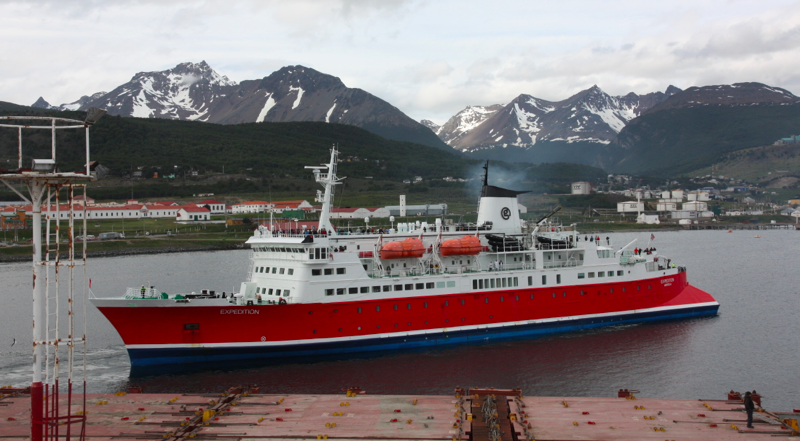
Another ship sets out for Antarctica. Three left the day we did
Most companies seem to offer great deals in advance. It seems to be quite easy to get 25 per cent off if you book 10 months in advance. We met people on our ship who got that kind of deal. We got the same kind of deal by booking a day or two before departure.
I’ve seen comments that trips can cost in excess of $50,000. I have no idea how long those trips last and what they include, although I suspect they must carry you across the ice and snow on a litter.
Our trip cost less than a tenth of that $50,000. Our trip lasted 10 nights and we were in a triple room. I feel honour-bound not to reveal the exact price we paid because we signed a confidentiality agreement. But I will say that throughout Ushuaia, we saw signs promoting last-minute deals for 10-day trips for $4100. We paid less, but not a lot less.
After the fact, I have to stress that the $4100 price tag is a huge bargain and not to be ignored. We got a slightly better deal, but gosh I’m glad we went at any price.
So how did we get our better price?
Poor John suggested that we walk to the port and go to the ship and ask for a deal. Not surprisingly, we got stopped in our tracks at the port entrance—sorry, but passengers and crew only.
That said, the woman in the port office told us to visit a particular travel agent. This agent was linked to Quark Expeditions—the next ship to depart—and could help us in our quest.
I don’t know if the woman at the port would have sent us to someone else if the next-departing ship was linked to another company. We saw three or four other expedition ships coming and going from the port.
Anyway, we followed the advice of the woman at the port, and visited the agent. She offered the same $4100 price tag. We hemmed and hawed, and she said, ‘Why not make an offer.’ So we did. There had been some people in front of us and we heard what price they were paying, so offered the same. The company accepted.
An escort back into port
Let me know if you need the agent’s address and contact details. And I’m happy to share the final price in an email, but not here. I must honour my agreement. We paid $300 more than people paid the previous year with a different company.
There a few things that all Antarctic travellers must remember.
We went in November. There are pluses and minuses for this timing. It’s:
—before the main whale migration and calving occurs
—after penguins eggs are laid but before they hatch
—before snow melts and exposes a harsher landscape
and more.
So don’t assume that getting yourself to Ushuaia is any guarantee for a great or cheap trip. We’ve heard of people who paid $27,000 for their trip and then got iced in. There are no guarantees. In the word’s of my father, ‘It’s a bit of a crap shoot.’
Let me know if you have an ‘interesting’ experience booking an Antarctic expedition.
P.S. It just occurred to me that people might think we got a discount because of the blog. Nope! I’ve never had, and never asked for, a freebie or discounted price because of the blog. I’m just having fun.

Antarctica is filled with colours, but shades of white are predominant
Our chance to visit the Antarctic came about so quickly (last-minute deal) that I didn’t have time to do anything sensible in relation to my camera. What I had was what I used.
That camera is a not-so-ancient Canon 450D with a lone 15–85mm lens (more about that later). I bought the body, along with two kit lenses, in 2009 in Cape Town, South Africa, after a point-and-shoot Canon died in Namibia.
Both the kit lenses died in 2011 and, after much dithering, I replaced them with the 15–85 number. For the Antarctic, I wished I’d had a proper telephoto lens as well.
But you wouldn’t believe the cameras that came to Antarctica with us. Every time I pointed my camera, I felt like a guy with a teeny-weeny willy.
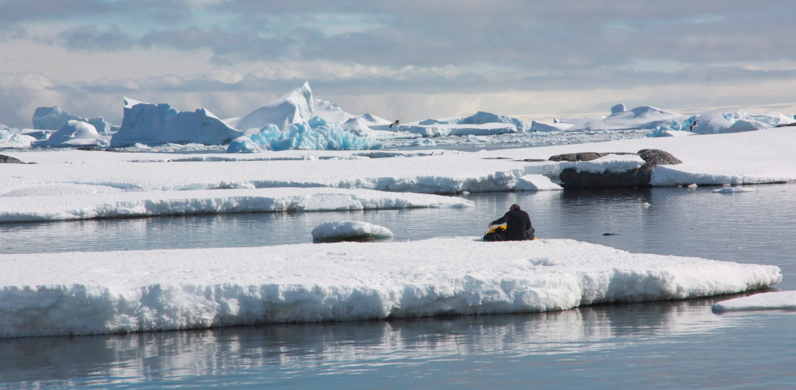
A keen photographer gets in position
There was one (maybe two) group of Chinese tourists who brought cameras lenses I didn’t know existed. We’re talking huge willys—lenses as long as my leg, There may have been one or two as tall as me!
Group members were part of a photography club, and I’ve since seen an online reference to the fact that they might be able to sell a photo for up to $50,000.
I have no way of knowing if that is true, but I went on a Zodiac cruise with eight Chinese and I could hardly hear for the clicking of cameras. The last time I heard that amount of clicking was in the early 1980s during the civil war in Lebanon—and clicking was of a lot of people cocking their kalashnikovs.
But I digress. I need to answer more of the questions asked about cameras in relation to this expedition.
Given my ancient camera and lack of preparedness, I fear I may not be the best adviser, but this should help others who are not overly prepared.
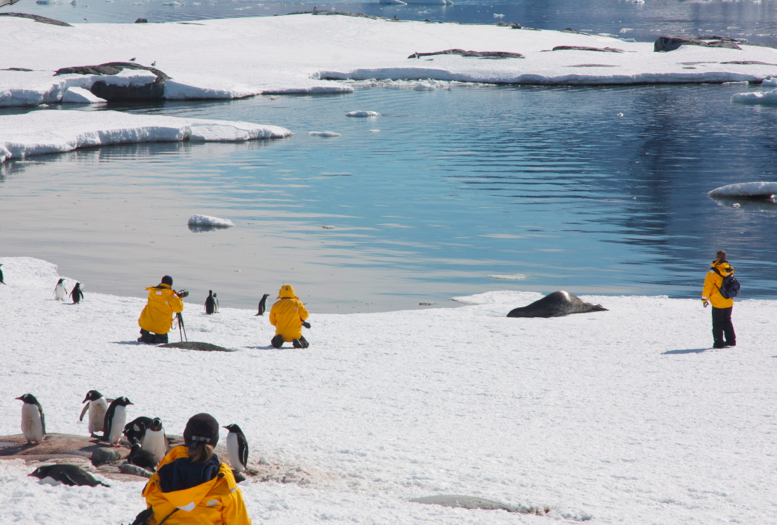
Lots of the yellow penguins have tripods and ginormous lenses
Did you use a tripod?
Nope, I didn’t have one. That said, I could have used one. But we travelled for many months on the back of a truck, so I decided not to take one. There’s only so much you can carry in anticipation.
I’m guessing here, but I think a tripod would be especially important on an Antarctic expedition that was plagued by bad weather—anything to control movement and lighting. You can’t predict the weather, so if you can afford the room and/or weight, take a tripod.
How much did you use a polariser?
I might have used a polariser a lot, but I didn’t have one. Poor John has polarised sunglasses and it was nice to look through them for the view every now and then, but I never used them with the camera.
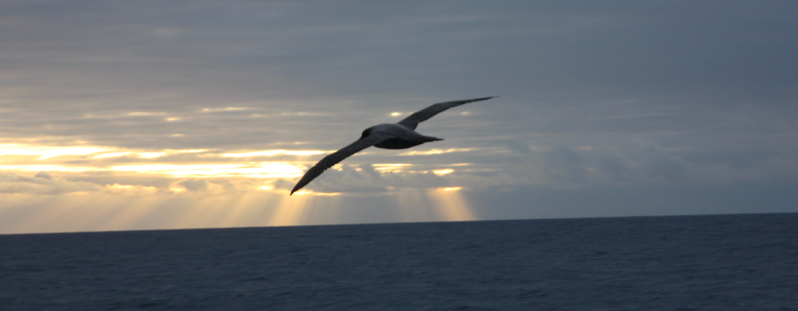
A good reason to use a fast shutter speed
What settings did you use?
I’m kind of embarrassed to answer this, but I’ll be honest. The expedition photographer gave a lecture about camera settings. He talked about ISO settings and various other aspects, which I can no longer remember. I think he said to lower the ISO to 100.
I didn’t mean to ignore his words, but I kind of know my own camera and preferences. As a result, I tried an experiment that worked, and stuck with it. I used the TV setting that relates to shutter speed. I set it at a 250th of a second and left it there for most outside shots.
Part of the reason I went with a 250th of a second is that I wanted be able to freeze action when necessary, so that fast shutter speed allowed me to capture a few nice shots.
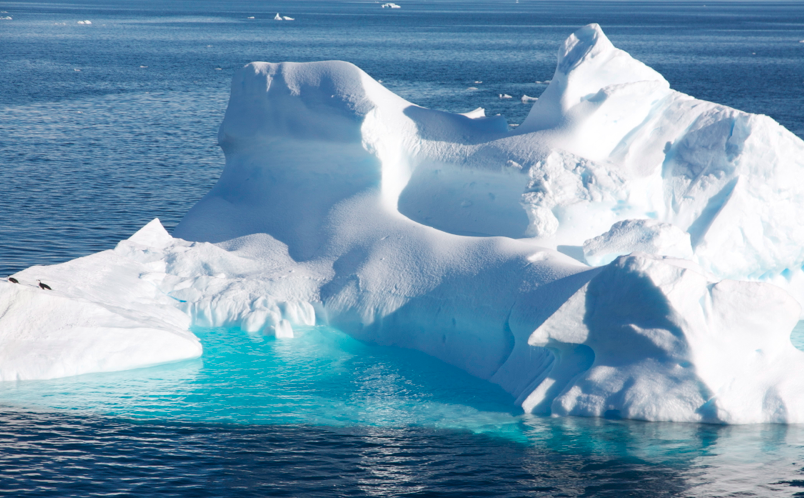
With weather like this, we didn’t need dry bags. Note the two (tiny) penguins on the left
How did you protect your camera?
Here’s another confession about unpreparedness. Poor John and I have several ‘dry’ bags that we always take on overland adventures. Oh, except we forgot this time! He thought I’d packed them and vice versa.
The day before our first landing, the expedition photographer explained the challenges to keep your camera safe and dry—a dry bag was essential!
Rats! The onboard gift shop was closed and would not reopen until after the landing. So I winged it and I was lucky. In fact, I was lucky for the entire time.
We had beautiful calm weather for the entire trip. Occasionally, when the Zodiac sped along, I sheltered the camera against my jacket, but overall it wasn’t an issue. So I never had to buy a dry bag.
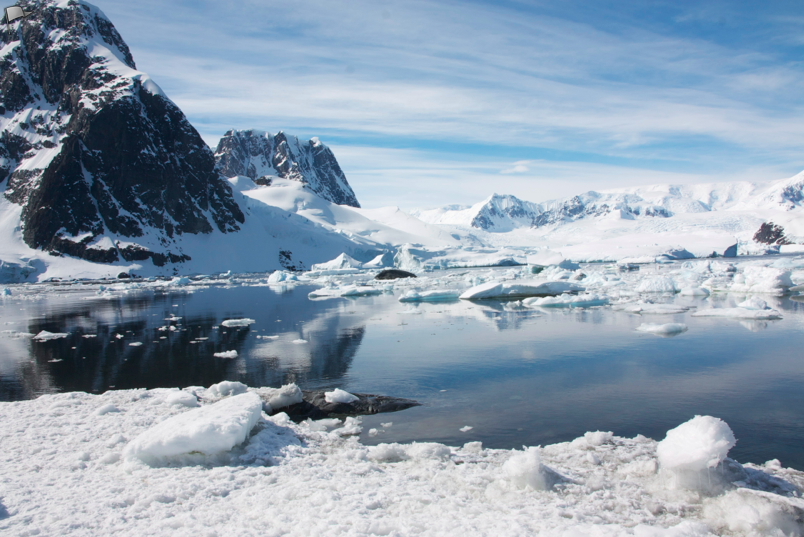
It was impossible to stop looking at and photographing the scenery. Absolutely gobsmacking
What video camera did you use?
Geez, you people ask tough questions. Remember, I wasn’t prepared. My iPhone did a pretty good job of filming.
I always slipped it in my pocket and it even survived being dropped in the disinfectant bath we walked through as we left and returned to ship for landings.
When I go again
On my next trip to Antarctica—oh, yes, I will return—I’ll plan to take a new camera body, several lenses including a not-over-the-top telephoto, a tripod, my own dry bags and a video camera. Oh, and I’ll take the iPhone as back-up!
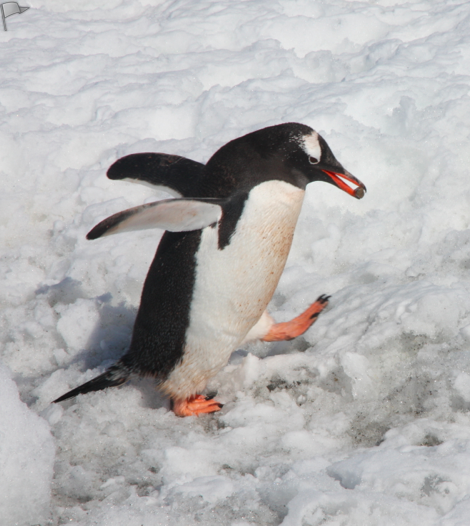
What you see when you stand by the penguin ‘highway’
If you want to set foot on Antarctica, you first have to set foot on an inflatable boat. In our case it was a Zodiac.
The Ocean Diamond had 18 Zodiacs that were used to ferry us ship-to-shore and back, and provide us with cruise adventures that got us closer to whales, seals, penguins, icebergs and more.
Zodiacs are a cross between a boat and a catamaran, with an outboard motor and rigid floor. A Zodiac comfortably holds 10–12 passengers plus the driver, who stands in the centre at the back.
I’m not sure how many cruises I had in our 10 days—probably about 30—and I enjoyed them all. But I gotta tell you that the coldest we ever were in Antarctica was when we were in a ‘speeding’ Zodiac.
A lot of people have asked specific questions about the landings and Zodiacs, so here goes. Let me know if I missed anything, but keep in mind that I can speak only from my own experience (and I’ll write about cameras separately).

Up close with the penguins
How many landings did you have?
We had three and a half days in the actual Antarctic, with a total of six landings—two on the continent itself. We were supposed to have eight landings, but nothing is certain in the Antarctic.
We missed one landing because Port Lockroy was iced in. That stop was replaced by an extended Zodiac cruise. We missed out completely on the last landing because of an medical emergency mentioned elsewhere.
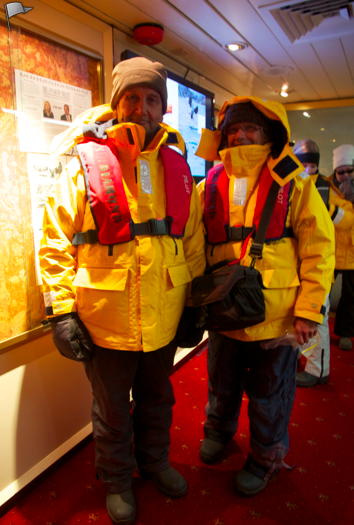
Outfitted for an Antarctic landing
Are there rules for landings?
It doesn’t matter what ship or expedition you are on, there are lots of landing rules—and they’re consistent and all about common sense and protecting the environment.
As we crossed the Drake Passage, we had a compulsory talk on environmental concerns in relation to the Antarctic and what we could and couldn’t do. If you didn’t attend, you couldn’t land. And yes, there was an attendance sheet.
As for the rules, they’re not rocket science. Don’t take anything ashore except yourself, your camera, your warm clothes, your enthusiasm and a bottle of water. A tissue is okay, but don’t leave it behind. If you have to pee, you must go back to the ship. Like my mum used to say, ‘Go piddle before you get into your snowsuit’.
But there’s more! Walk only on the marked paths and stay five metres away from the wildlife. That said, it’s okay if you stand somewhere and they come to you. A popular trick is to stand beside a penguin ‘highway’ when a penguin is at least five metres away and wait for them to come to you.
Don’t be too noisy. Those of you who know me will not be surprised to hear that I was warned about this offense—but only once.
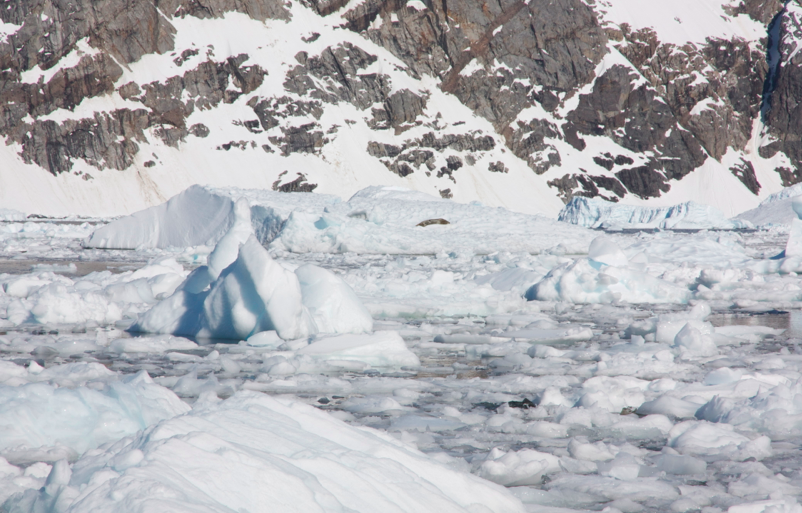
A field of brash ice
Many Antarctic sites limit landings to 100 people. How did they manage 182 people?
Quite easily! As I mentioned earlier, the Ocean Diamond has 18 Zodiacs that can carry 10–12 people each plus a driver. So there was no problem carrying all 182 passengers (plus drivers) at any one time.
But for all our landings, the group of 182 passengers was split into two. The first half would land and the second half would cruise. Then we’d change places.
So here’s an example. Let’s say there’s a landing at 9am. If you want to land first, make sure you’re in the queue to board Zodiacs by about 8:45. I always wanted to do the landings first—just in case weather or other conditions changed—and never missed being in the first group. I never heard of anyone not being able to do landings/cruises in the order they preferred.
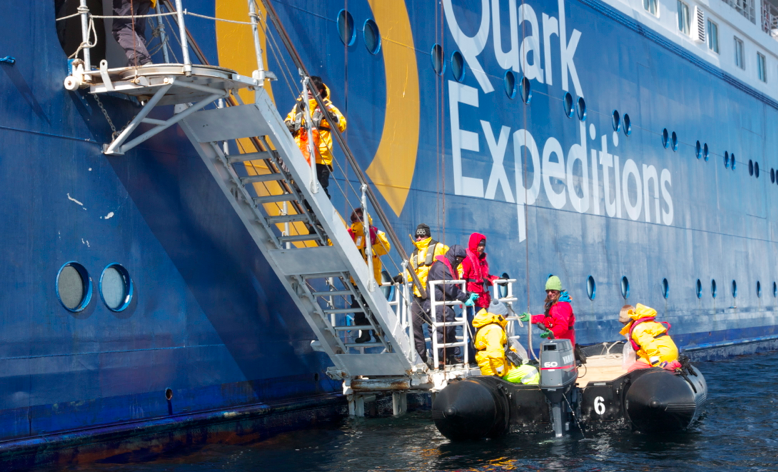
Disembarking from Zodiacs
What’s Zodiac etiquette?
There aren’t a lot of Zodiac rules, but a biggie is don’t stand up without asking the driver if it’s okay. There are a few passengers I could kick for not following this simple rule.
We were also told what to do if the driver fell overboard! All our drivers were people we got to know because they also gave lectures or had other high-profile duties. They are ‘clipped’ to a kill-switch on the Zodiac, so if they fall overboard (it didn’t happen to us and probably is very rare) the engine cuts out. All drivers carry a sophisticated walkie-talkie, and they share information about wildlife sightings and safety.
All other Zodiac rules relate courtesy and common sense. Don’t stand up in front of your fellow passengers and block their view or chance to take photos (better to turn and kneel). Stay quiet if wildlife is about.
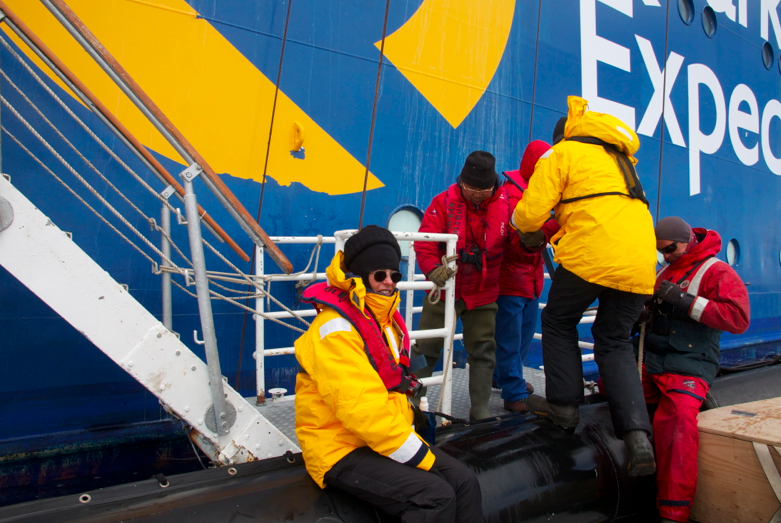
Not too hard to work with Zodiacs
How hard is it to get in and out of a Zodiac?
Breathe a sigh of relief. It’s not that hard. While we were still crossing the Drake Passage, we attended on compulsory talk on how to enter, exit and behave in a Zodiac (another attendance sheet).
We were shown the ‘fireman’s grip’ or maybe it was called the ‘get in the Zodiac’ grip. It’s how the crew members who are there to help you to embark or disembark will grab your arm (gently but firmly) to guide you into or out of the Zodiac. The step up or down is about 12-15 inches, and you have two or three people hanging on to you—helping you.
Seriously, if you can get up and down the single flight of stairs to where the Zodiacs are, you can get into the Zodiac. Trust me!
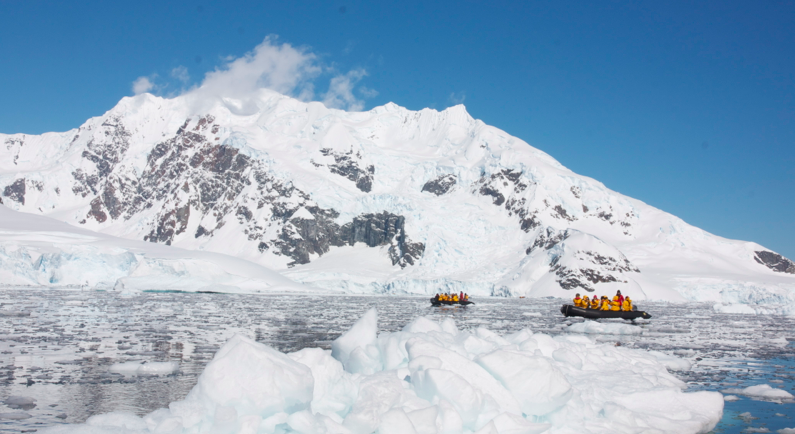
Zodiacs in the Antarctic
Are Zodiacs safe in ice/rough water?
We had wonderfully calm waters for the entire time we were in Antarctica, so I have no experience with rough water.
That said, Zodiacs were invented in the 1950s by French Navy officer and biologist, Alain Bombard. He sailed a Zodiac across the Atlantic Ocean in 1952 so I’m guessing rough waters don’t present too much of a problem. Jacques Cousteau loved Zodiacs and used them extensively on his expeditions.
As for the ice, we spent one morning cruising through and over huge chunks of brash ice (wreckage from other forms of ice) because Port Lockroy was inaccessible.
The ice was quite ‘dense’ and you could hear it crunching under the Zodiac as we passed through. One passenger asked if it was safe for us to be there. The driver (who resisted rolling his eyes) made it clear that he wouldn’t be doing it is he thought it was dangerous. I chose not to worry. My call is that the driver doesn’t want to die and the company wants to keep its good reputation. Nobody is going to do anything too stupid.
A footnote
I could write on and on, but will get this posted. Feel free to ask more questions.
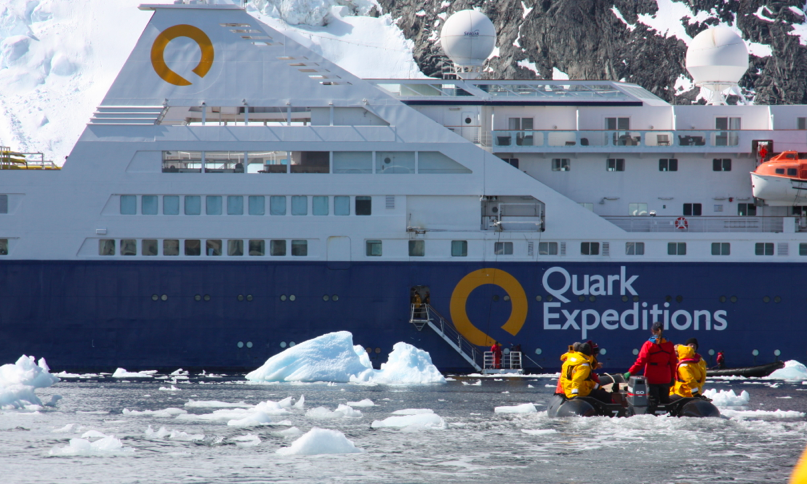
Heading back to the Ocean Diamond
Quite a few people have contacted me with questions about various aspects of our trip to Antarctica.
I’ll do my best to tackle them all, and this first ‘stab’ covers the queries relating to the expedition and ship.
I plan to write separately about how we got our last-minute deal, crossing the Drake Passage, landings and Zodiac cruises, cameras, kayaks, camping and anything else important that comes to mind. Links will be live when I’ve written the answers. 🙂

Ship flags on the bridge
Our trip
Many companies offer Antarctic expeditions sailing from Ushuaia in Argentina. Trip packages—ship size, number of passengers, number of days, destinations, extras and price—vary tremendously.
We were already part of a four-month overland journey through much of South America, so a diversion to Antarctica would take us off the truck. We didn’t want to miss too much truck experience, so were looking for an expedition that would last 10 to 12 days.
We found a 10-day trip—the ‘Antarctic Explorer: the Classic Adventure’ on the Ocean Diamond used by Quark Expeditions—that was leaving two days after we arrived in Ushuaia. We sailed on 30 November and returned to Ushuaia on 9 December.

Heading to the Antarctic Peninsula
We boarded about 4:30pm on 30th and sailed about 6:30pm. We were near the entrance to the Lemaire Channel by the evening of the 2nd. It’s said that the Ocean Diamond covers the passage in 12 hours less than other, smaller ships.
We set sail to return on the afternoon of the 6th, at least half a day earlier than scheduled, because one passenger needed medical attention that could not be provided on board. I think it may have been a detached retina.
So in between we had almost four days at the Antarctic Peninsula.
Our ship

Lounge on the Ocean Diamond
This was the first season Quark Expeditions used the Ocean Diamond, and I found it comfortable and spacious, although quite a few people wished there had been a sauna.
The Ocean Diamond has seven levels and can take 189 passengers—we sailed with 182 and more than 100 crew. There were deluxe rooms with balconies (why bother?) down to our triple (with two portholes) that we shared with Olivia.
The bridge was on level six and often open to visitors. Level six also had a small gym and pool, which was not filled while we were crossing the Drake Passage.
Poor John’s favourite spot was the glassed observation room on level seven. He had a great view, a great reading chair and was very hard to find until I decided to think like him.

Reception area on the Ocean Diamond
His second favourite place was the library on level five. The collection is huge and covers the whole range of topics applying to the Antarctic.
Poor John abandoned his Kindle for the entire expedition and read about five books from the library. Since then he has told everyone who will listen about the windy phenomenon known as a williwaw.
My regular haunts, besides the dining room on level three and the library, were the auditorium on level five (for lectures and yoga) and the lounge on level four. It had hot drinks on tap all day, including a decent coffee when you got up at 6am and breakfast wouldn’t roll around until 7.
Coming next: the most requested topics—landings and Zodiac cruises.
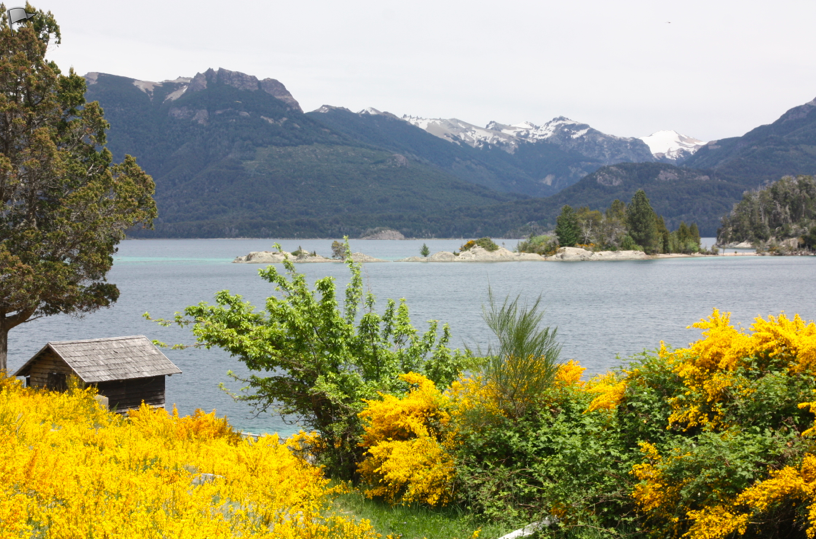
A breath-taking view from Victoria Island
It’s no wonder Bariloche is a popular tourist and resort town in Argentina. Set in the heart of Patagonia and the country’s scenic Lake District, the town feels a lot like Switzerland.
Snow-capped mountains, ski fields, networks of lakes, lush greenery, carved gables and a glut of classy restaurants, cafés and chocolate shops go a long way to making you feel like you are in the centre of Europe and the Alps.

Our ship to Lake Victoria. There were at least 10 of us and we had the ‘cabin’ right at the front—plenty of windows
Some of our group hired bikes and spent a day pedaling along the shores of Lake Nahuel Huapi. They raved so much about the scenery that we wished we’d had an extra day in Bariloche. (If any of them are reading this, don’t forget you promised to write a short spiel and send photos!)
While they were pedaling, a group of us bought the makings of a picnic lunch and way-too-many bottles of wine and headed to the chairlift at Cerro Campanario for a chance to overlook the surrounding lakes.
But it wasn’t picnic or wine time yet. We were saving that for Victoria Island. So after Cerro Campanario, we hopped on a bus to the port where we caught the boat for a lake cruise to the island and later to Los Arrayanes National Park.

A lone piece of rock artwork on Victoria Island. I wonder if there is more?
Victoria Island is incredibly scenic. As expected, Poor John and Super Jong were the only ones to set off on a couple of island walks. The rest of us lounged around eating and drinking wine. Some of the bravest ones went swimming—it takes a lot to get me into bathers, swimmers, bathing suits or whatever you call them and even more to get me into cold water.
So most of us just tucked into the wine and picnic food, told tall tales, laughed at silly jokes and stories, and counted our blessings for such a lovely day.
But stage two was in the offing, and what a great stop it was. Our boat (which had made a second run to the port to pick up more passengers) returned to collect us and take us all to Los Arrayanes National Park.
This incredible reserve protects a forest of myrtles, with some trees being 15 metres tall and between 500 and 650 years of age. Timber boardwalks (and a Spanish-speaking guide) led us through the trees. The most surprising aspect is the fact that this forest inspired the animators who ‘sketched’ the surroundings for the Disney film of Bambi.
Gosh, we could look at the forest and see the inspiration. I could have stayed for days.
 Where to next?