
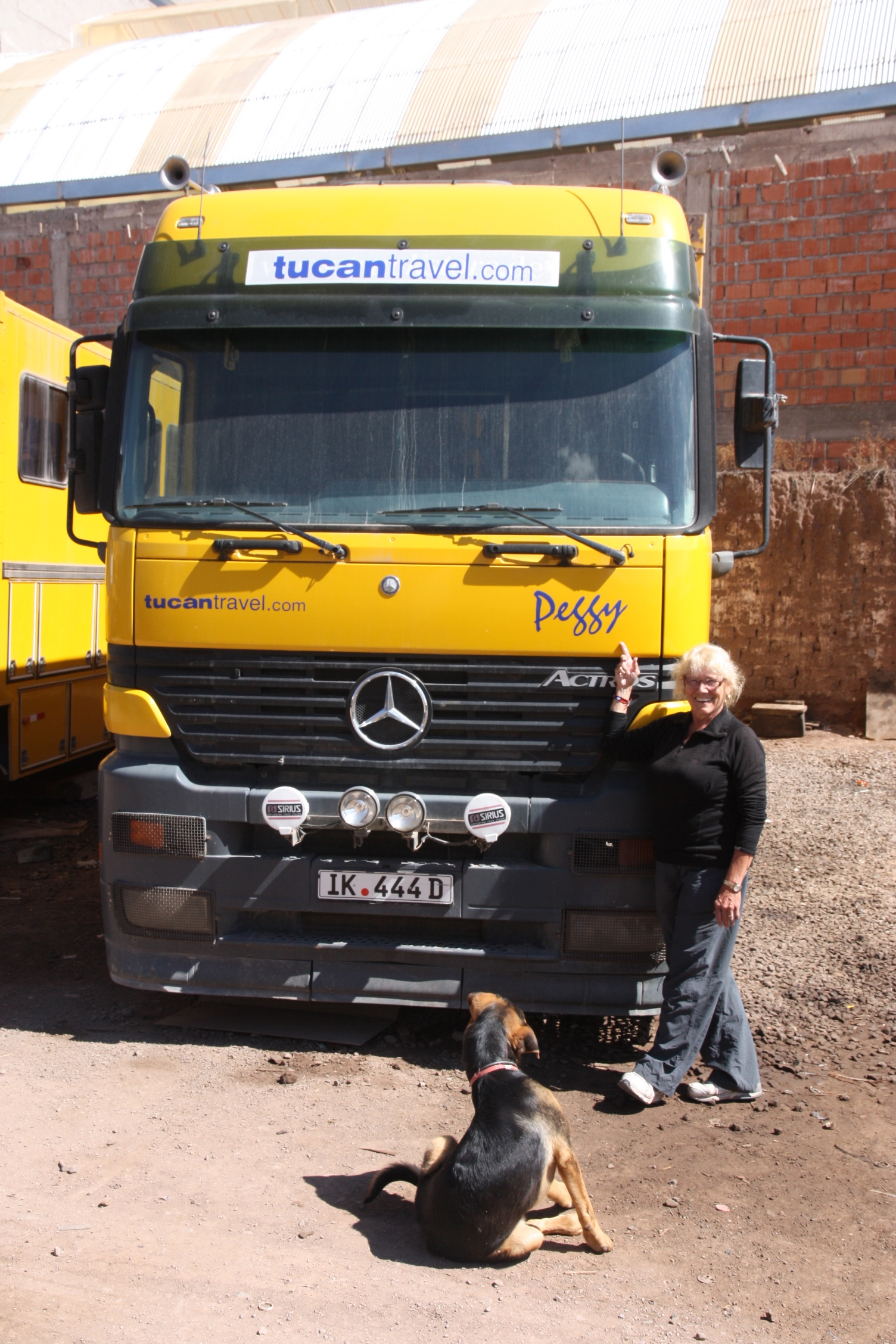
Two Peggys and a dog
We head to Bolivia in about 45 minutes and hope to arrive late this afternoon, depending on the border crossing.
Sponge Bob, our Oasis truck, has been all gussied up and is ready to go. In Cusco, he was parked opposite Peggy, one of Tucan’s trucks (Oasis’ friendly competition). Colin, our driver, got a pic of the two Peggys together.
I’m quite far behind on posts. We spent three weeks in Ecuador and almost a month in Peru, and I’ve covered less than half of what we’ve done. So don’t worry if the coming posts seem out of chronological order. They will be! But I’ll just be trying to catch up.
Really appreciate everyone’s enthusiasm, interest and comments. Feel free to share the blog far and wide.
Earlier today I couldn’t see one of the photos on a blog entry. A little while back a friend said she couldn’t see my slideshows.
Let me know whether or not these things work for you so I can try to track down a solution or at least figure out what’s going on. Give me as much details as possible, such as whether you’re using Mac or PC and which browser. 🙂
Thanks
Peggy
P.S. If, like me, you are travelling in South America, there’s a good chance the problem is the often lousy internet connections.
News Flash: One of my daughters has an answer. This is what she said,
‘It’s a Javascript problem. If people have javascript turned off then the slideshows won’t work. I disabled it on one of my browsers (Chrome) and it immediately stopped working. It also isn’t working in Safari 5.0.6 on Mac OSX 10.5 (Leopard).’
Hope that helps anyone with photo issues. 🙂
One of the best parts of travel is the chance to try unfamiliar foods in unfamiliar places.
Chivay (pronounced Chee-bye) is a popular jumping-off point for people wanting to see the condors of Colca Canyon in Peru. Like most tourist towns, it has eateries promoting pizzas, crepes, burgers, sandwiches, buffets and the like.
While Poor John and I have nothing against these dishes, we can and do have them at home, when travelling we go in search of markets or holes-in-the-wall serving local fare.
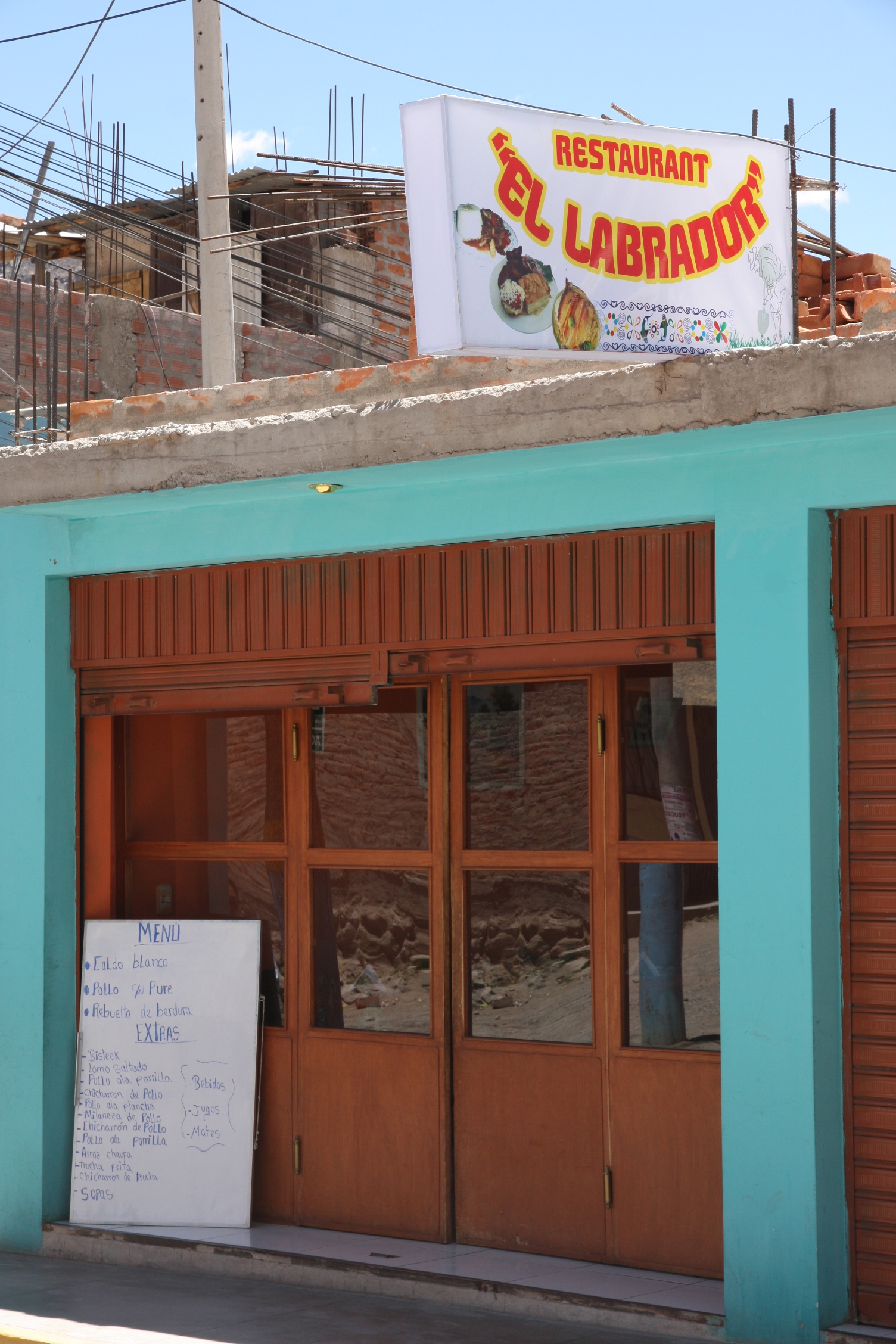
El Labrador Restaurant
We had only one night in Chivay, so the hunt was on for dinner. We checked everything around the village square, so headed the opposite direction to see what we could find.
Three course dinner at El Labrador
Two blocks up the neon lights of El Labrador beckoned to us and when we drew level with the entrance, we could see that the place was packed—I mean packed—with locals.
The whiteboard menu outside listed a set menu and a bunch of extras. In we went and claimed the last table. We weren’t eyed with suspicion or curiosity, even though there was only one other female customer and a female waitress. Every seat was occupied, and I counted 23 male bums on them. But turnover was quick, and I’m guessing at least another 10 customers came during our meal. People stood outside waiting for seats to become free and would then join whatever table had space.
Without a word, the waitress brought us each a bowl of chicken noodle soup and a set of cutlery. A little later, she returned to clear away the bowls and ask it we wanted fried chicken or another choice we didn’t quite catch. We ordered one of each.
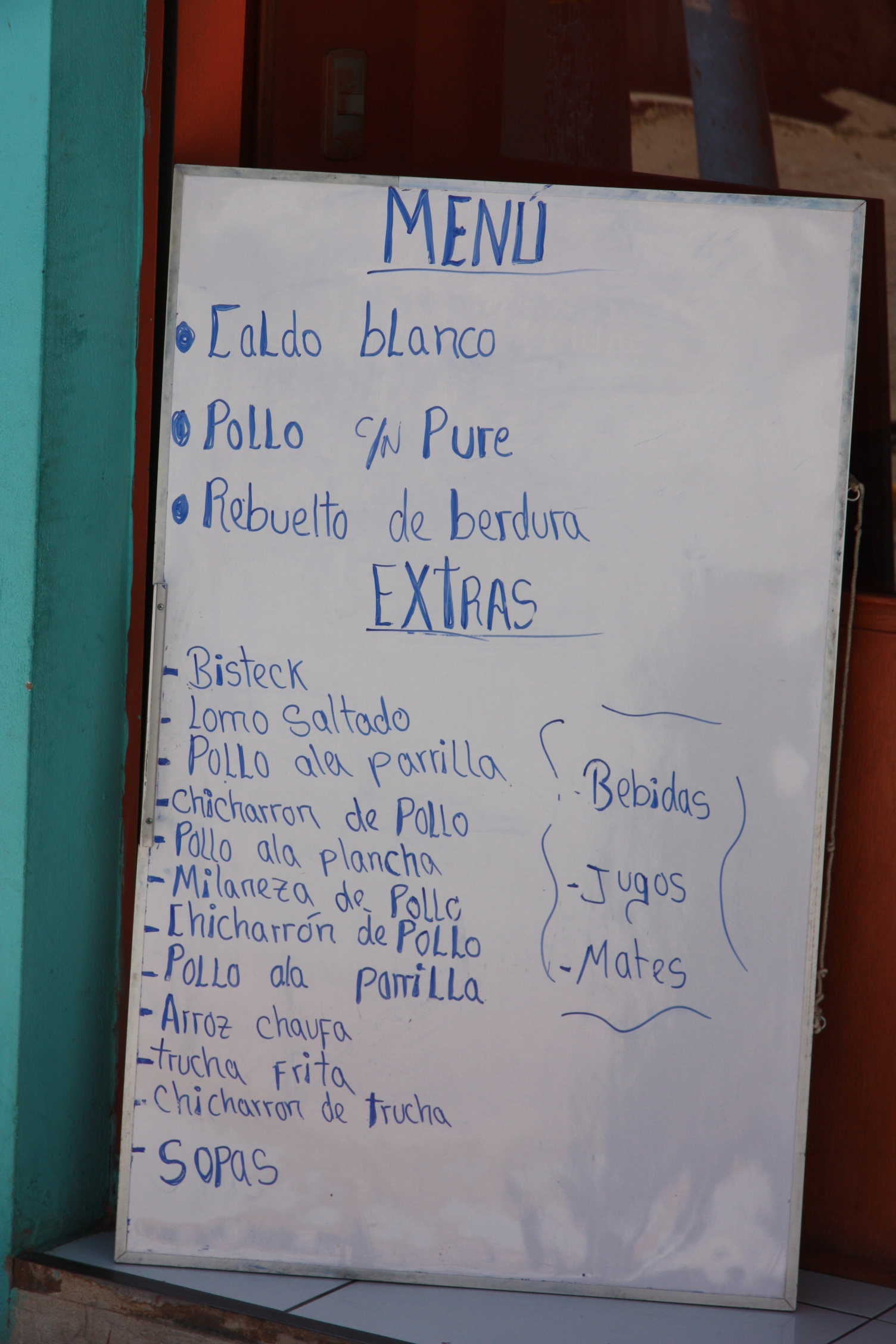
El Labrador’s menu the next day
Poor John had the chook (Aussie slang for chicken) and I had a casserole-y concoction with vegetables and a bit of meat, with rice on the side. The waitress soon reappeared with two bowls of thick purple syrup, which Poor John assumed was meant to be dribbled on the chook and rice. A glance around the restaurant told me it was dessert, so he took my advice and stopped adding it to his meal.
A huge pump-action thermos of hot water and a selection of tea bags—licorice, coca and chamomile—were brought to round out the meal.
A very native-looking fellow at the next table wasn’t quite sure how to operate the thermos, so managed to squirt water across his table. No one batted an eye or raised a laugh.
We went to the counter to settle the bill. ‘How much?’ we asked. ‘Ten soles,’ she said. ‘Each?’ we queried. ‘No, for both.’
So we paid less than $4 for two three-course meals. The food wasn’t gourmet, but it was tasty, healthy and filling, and the atmosphere was perfect. The waitress was thrilled with a 50-cent tip, and I’m still kicking myself that I forgot to take my camera. I went back the next day to grab a couple of snaps.
Off to the market for lunch
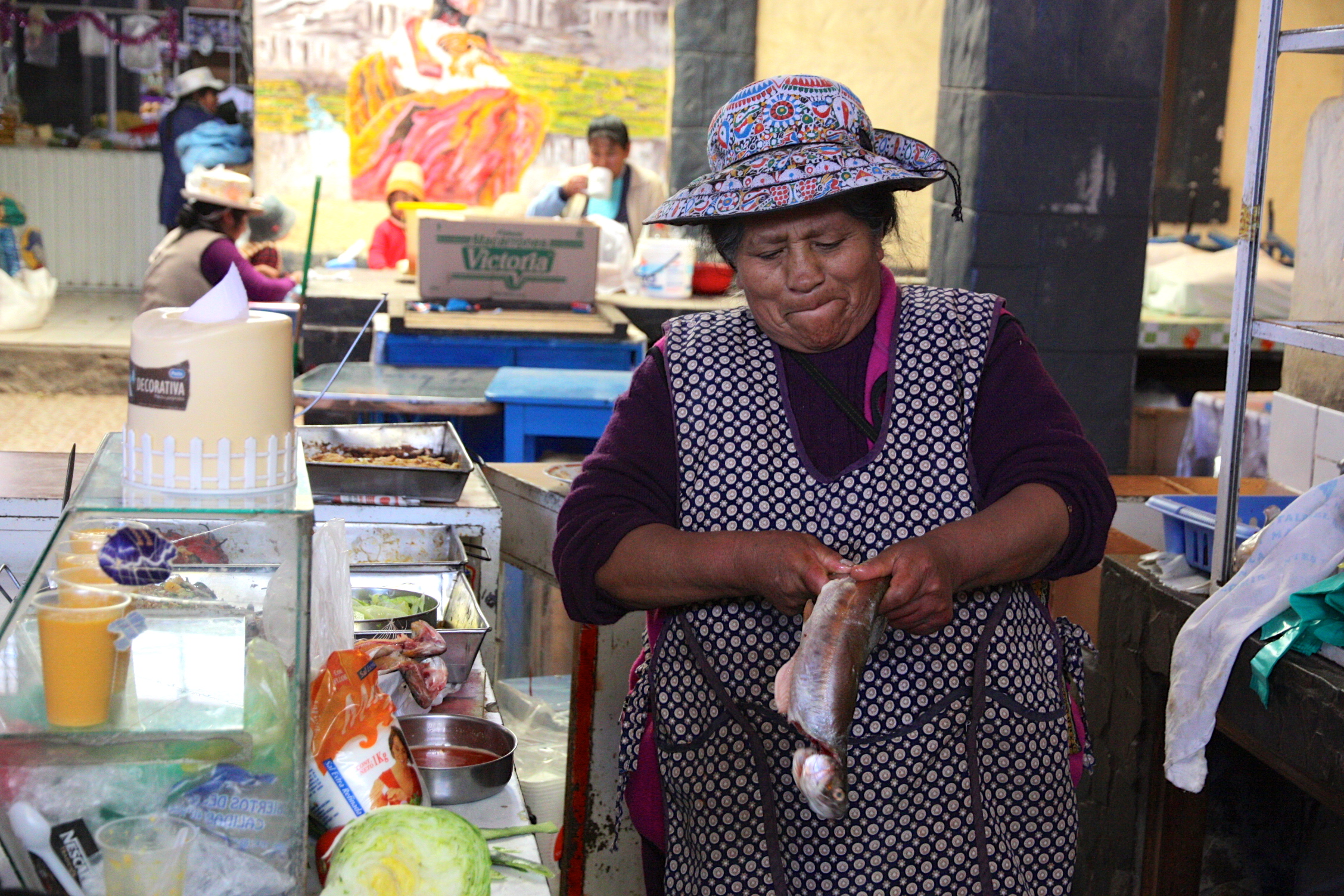
Our vendor was a dab hand with a knife—filleting fish
We returned to Chivay after a morning expedition to see the condors of Colca Canyon. Our guide gave us a mere 35 minutes to have lunch, so Jong, Poor John and I headed straight for the market.
We’d seen the lunch spread there the day before and were keen to try a couple of local specialties.
After a cruise of the stalls, we settled on the only one selling rocoto rellenos (stuffed peppers/capsicums). These are a Peruvian favourite and this was the first time I had seen them being served.
The three of us ordered a mish-mash of the woman’s dishes, including the peppers, fried rice and a potato bake, and wolfed them down. She was also filleting and frying fish, but we decided we didn’t have enough time to order that too. That was a pity, as the fellow sitting next to us ordered it and it looked delicious.
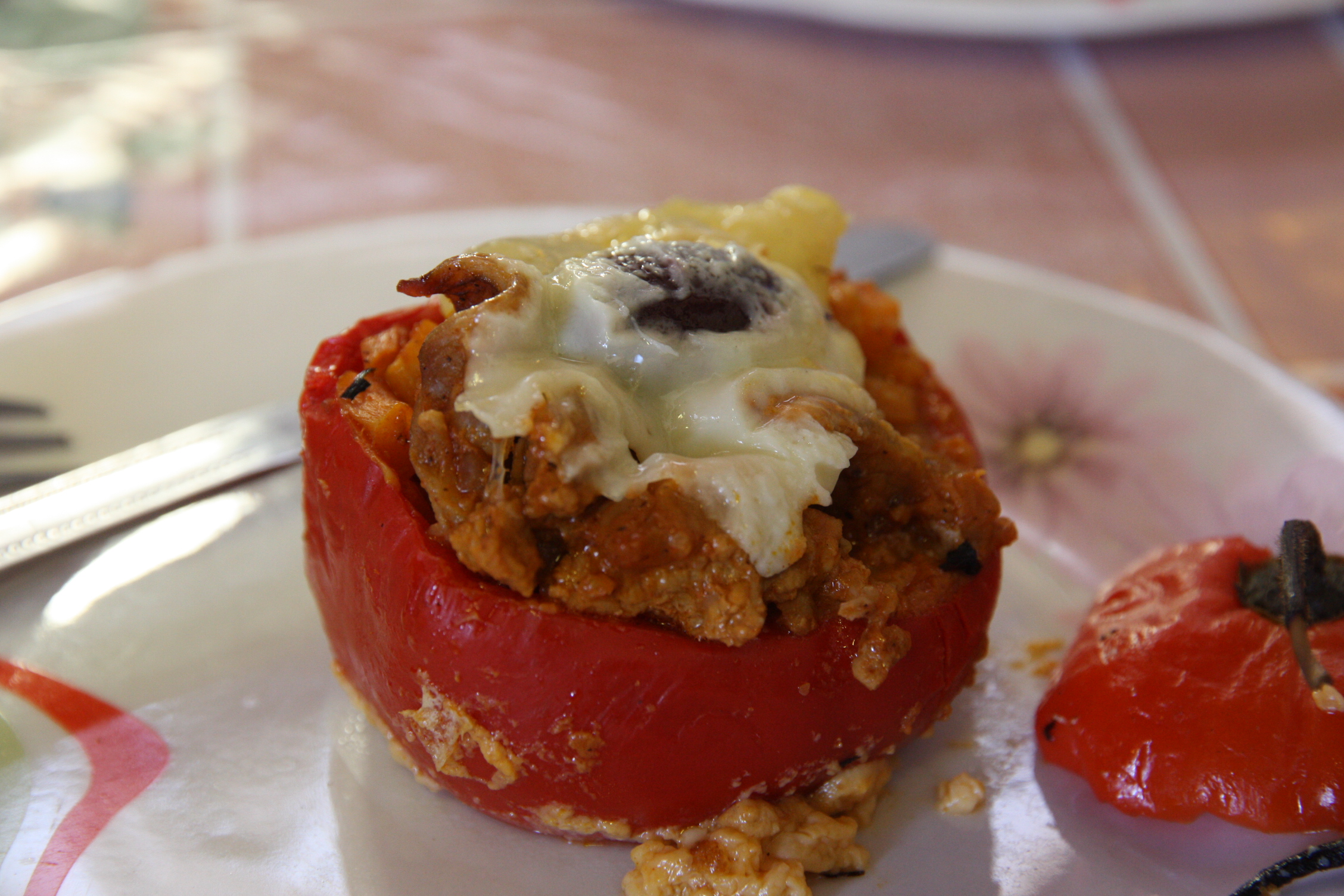
Rocoto rellenos—a Peruvian favourite
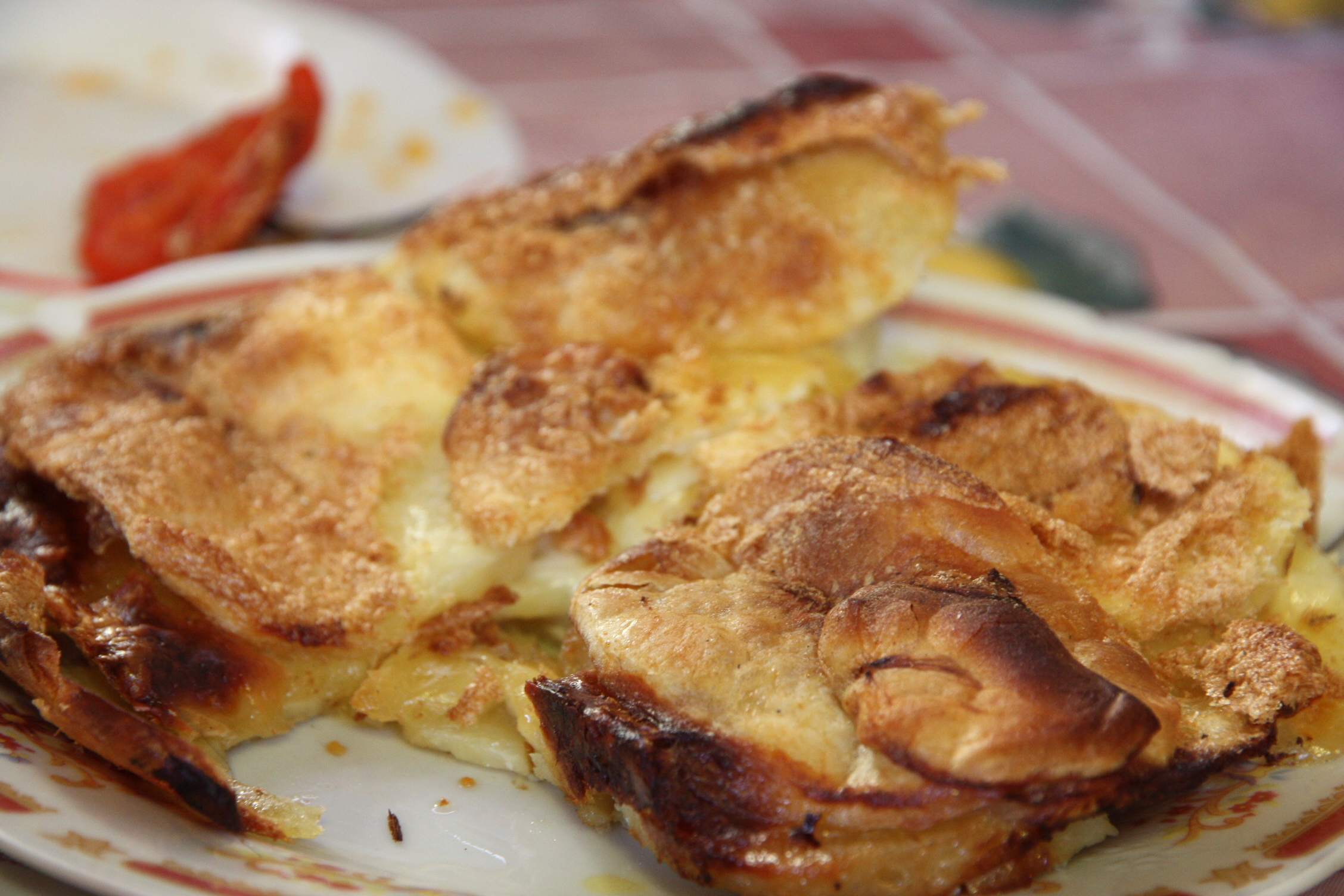
Potato bake
Time to pay came and she demanded 35 soles (or about $14)! ‘But, but that’s robbery. That’s a tourist price,’ said an aghast Poor John. The vendor didn’t miss the opportunity to point out we were indeed tourists. Poor John pressed on and haggled it down to 15 soles for the three of us, which was still probably over-priced, especially after our three-course-meal experience the night before at El Labrador.
That said, the rocoto rellenos were sensational and far better than the other versions I had before we left Peru. They were filled with spiced meat, vegetables and a little gravy, then topped with goat’s cheese and finished under the grill. I’ll post a recipe when I find a respectable one. Some testing will be required. 🙂
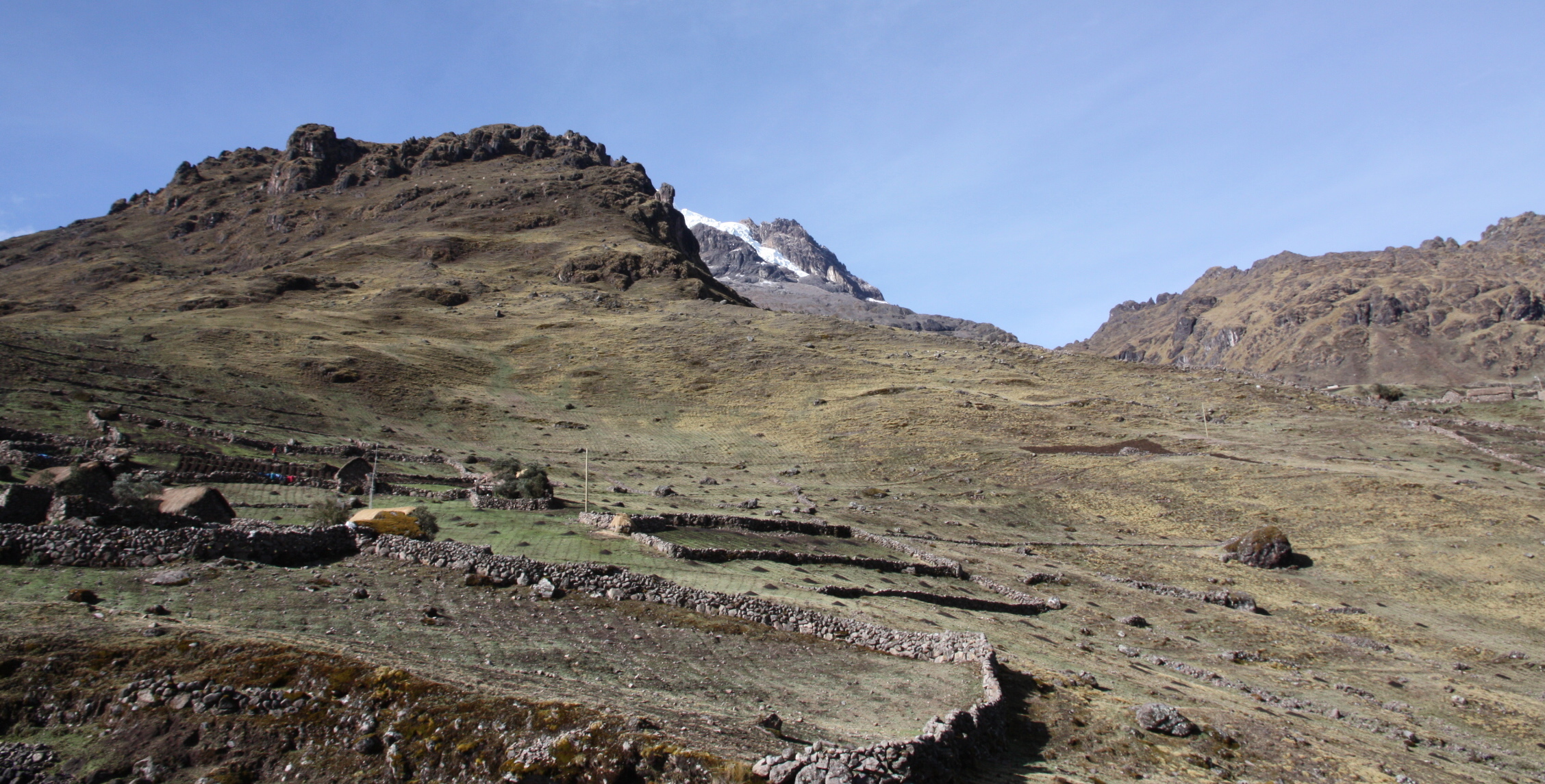
Quechua village
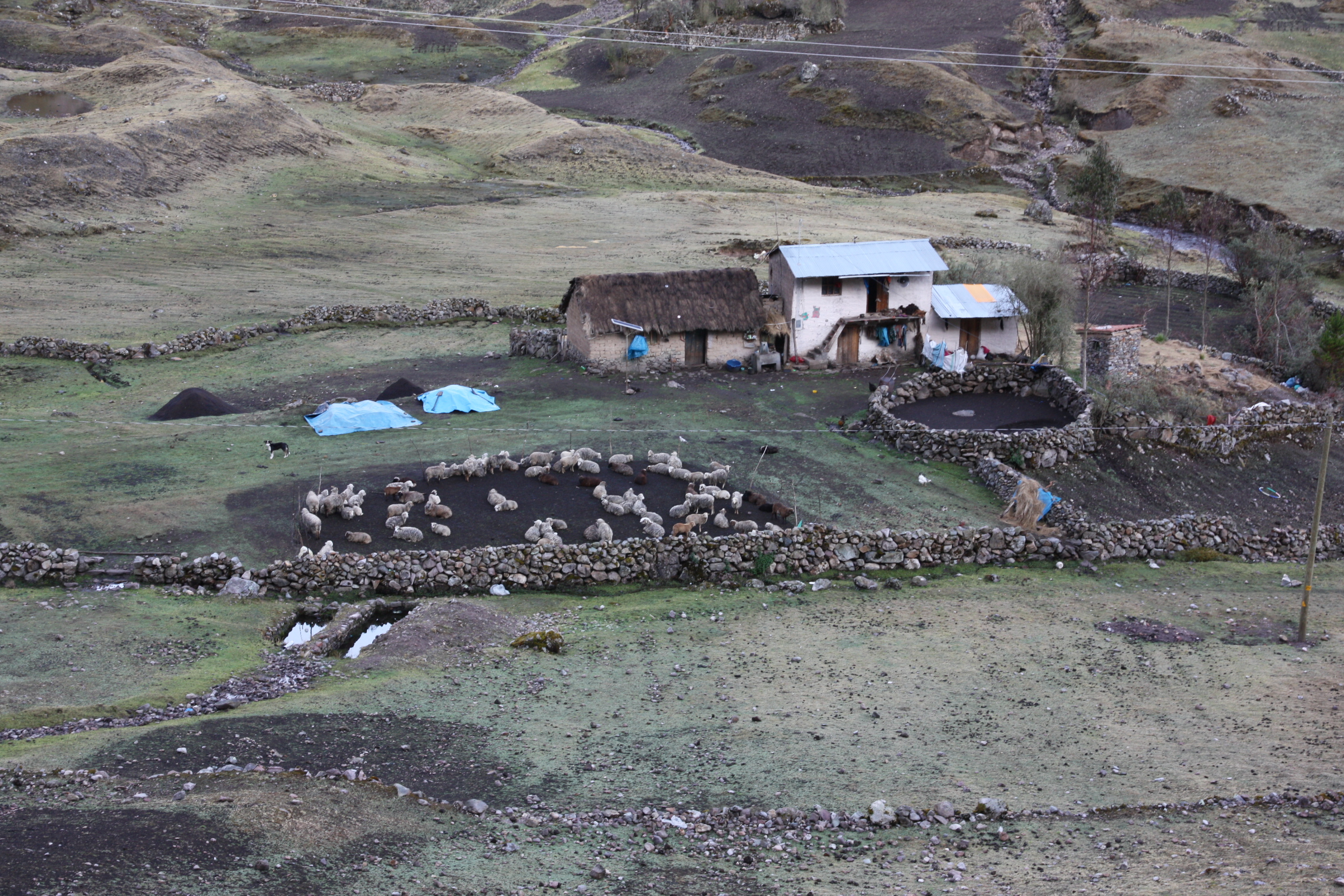
Quechua village
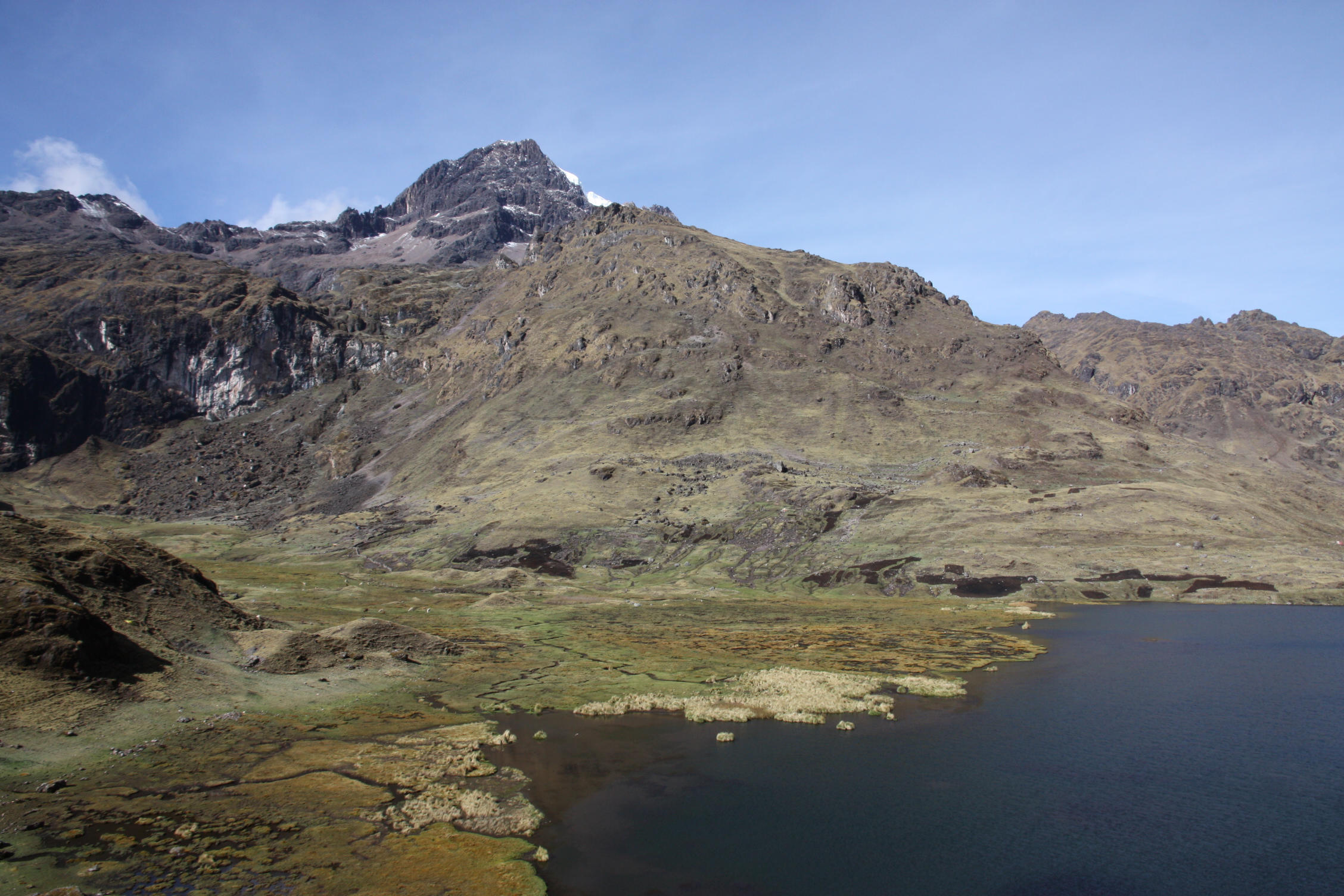
Andean lake view

Miguel’s favourite green lake
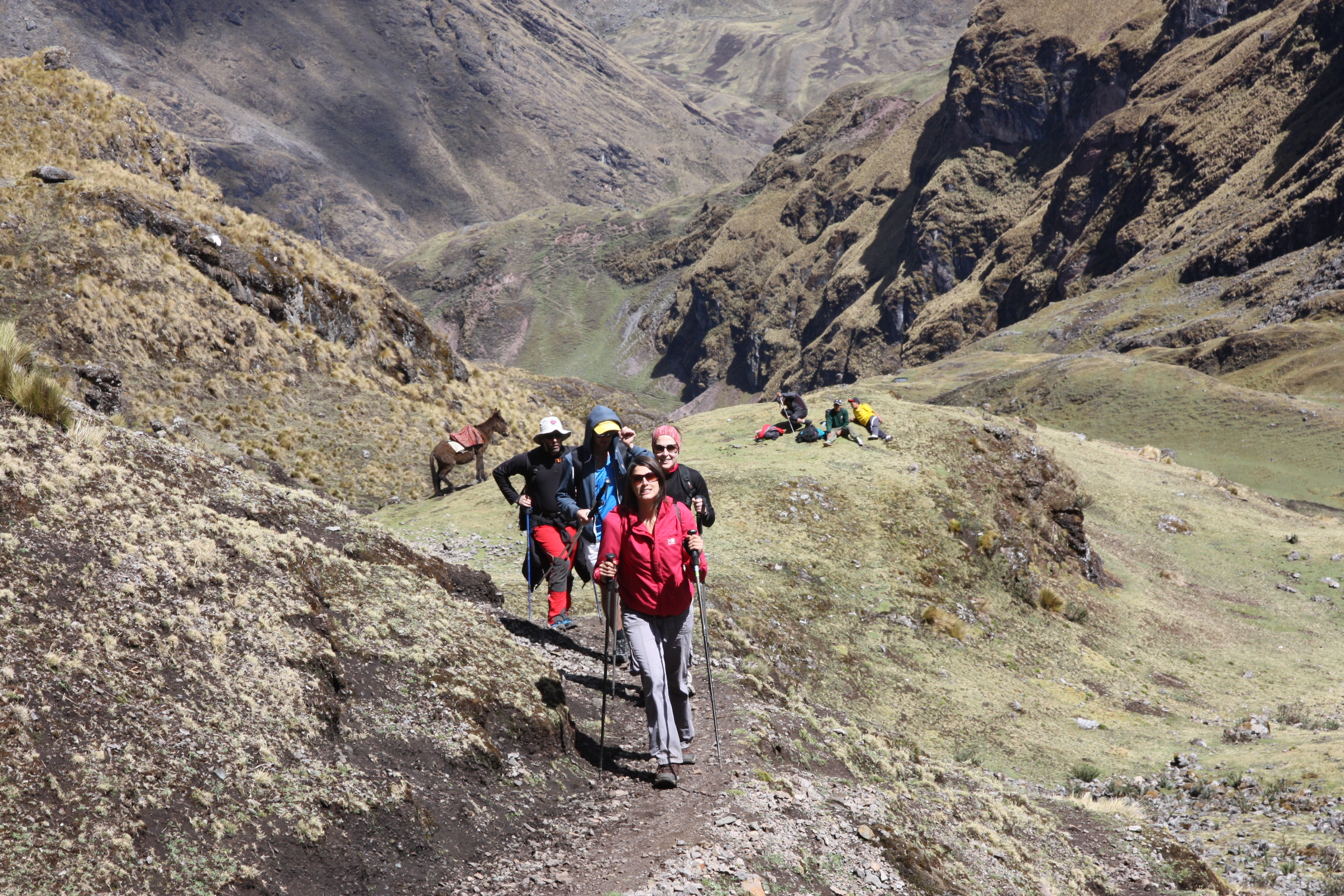
Donna-Leah and Angie take the lead
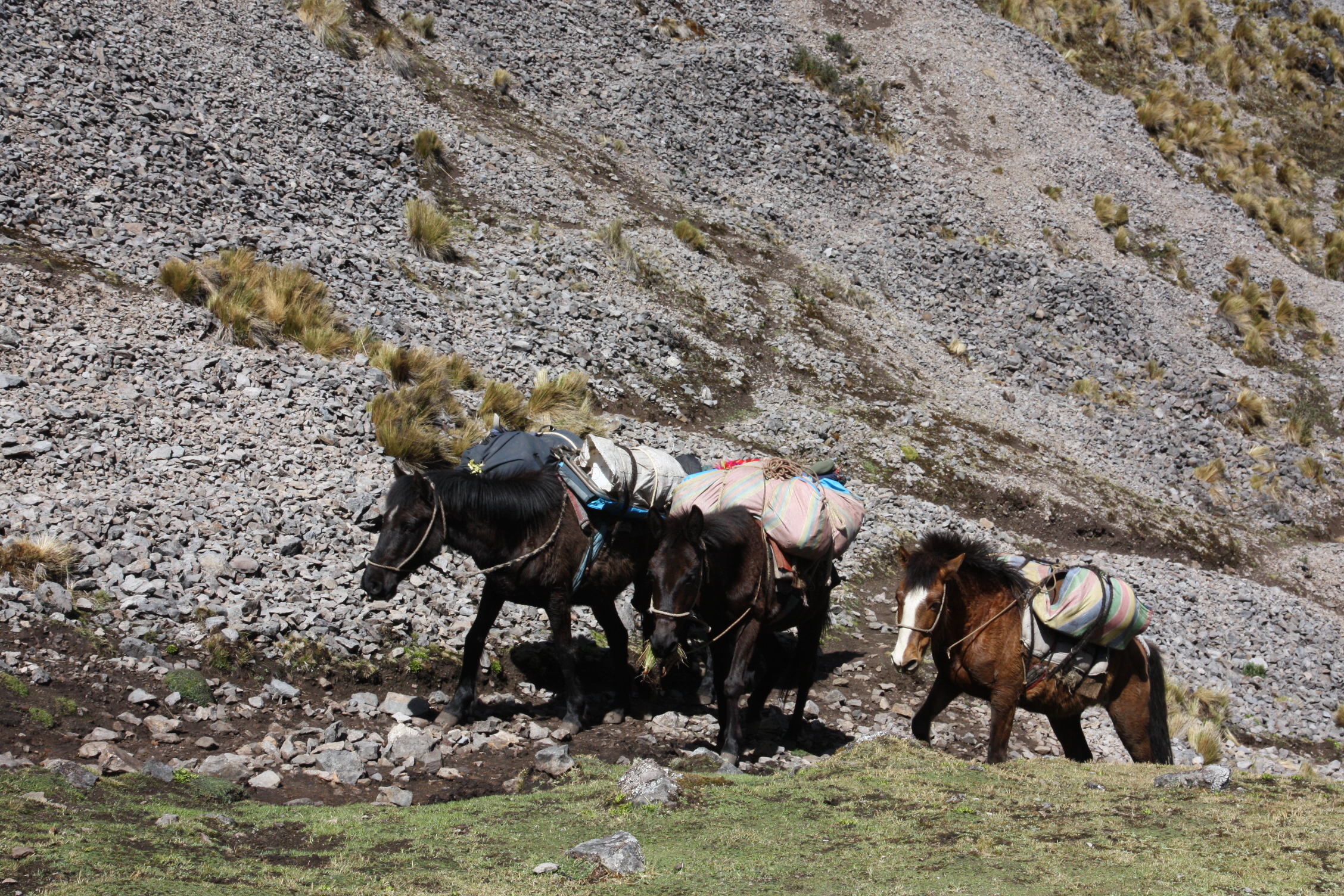
Pack horses catch up
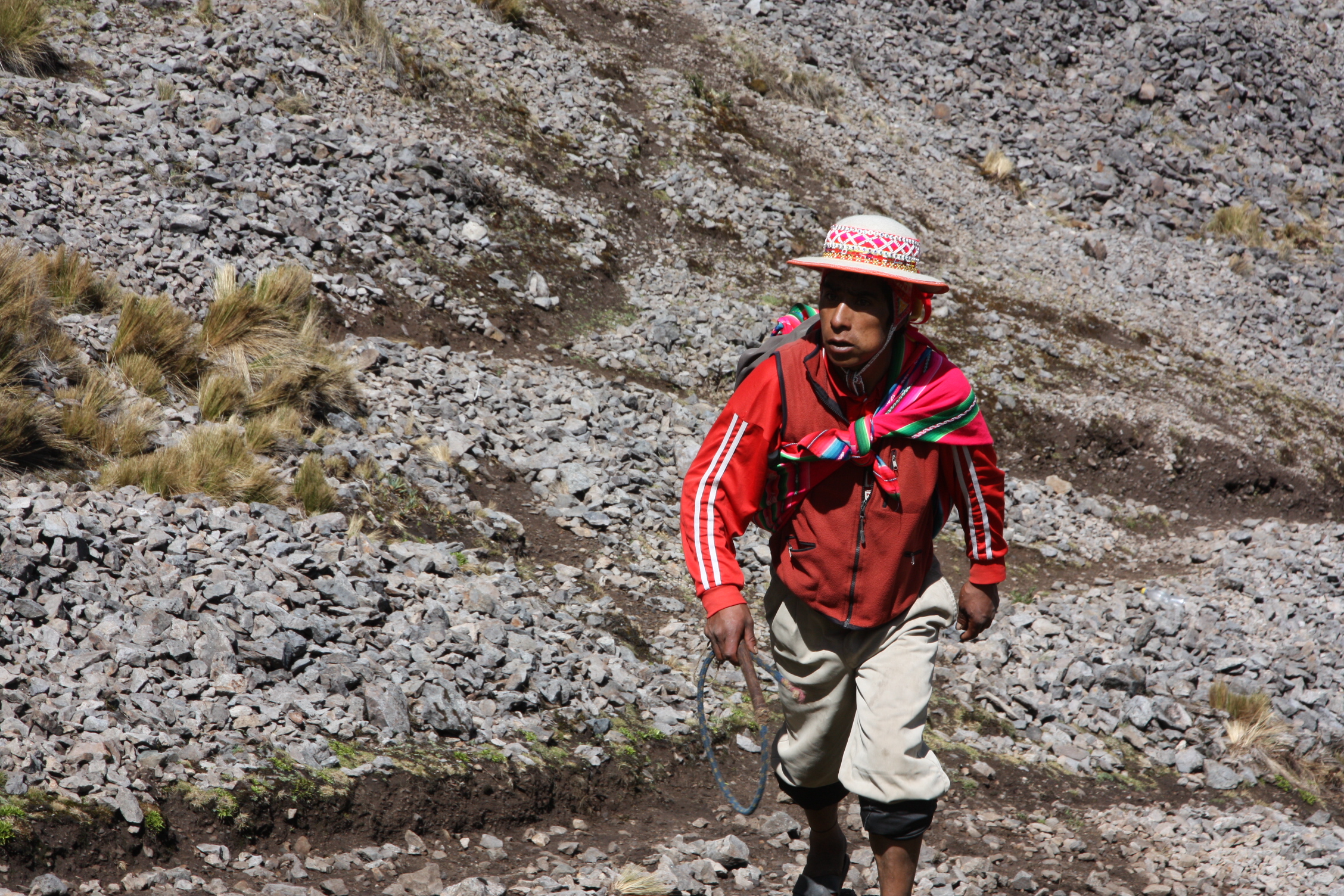
Horseman Grigorio and his famous hat
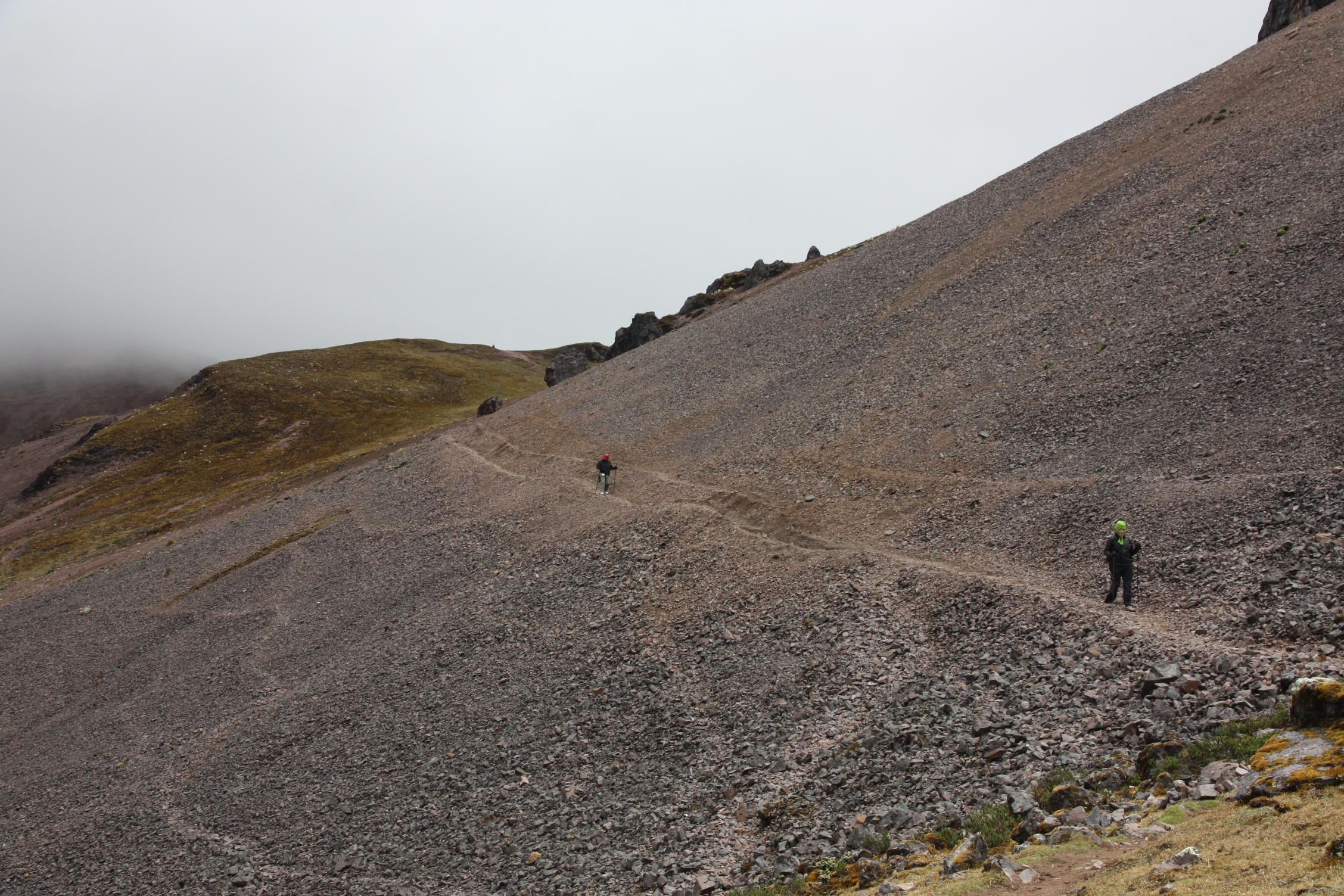
A brief bit of level track
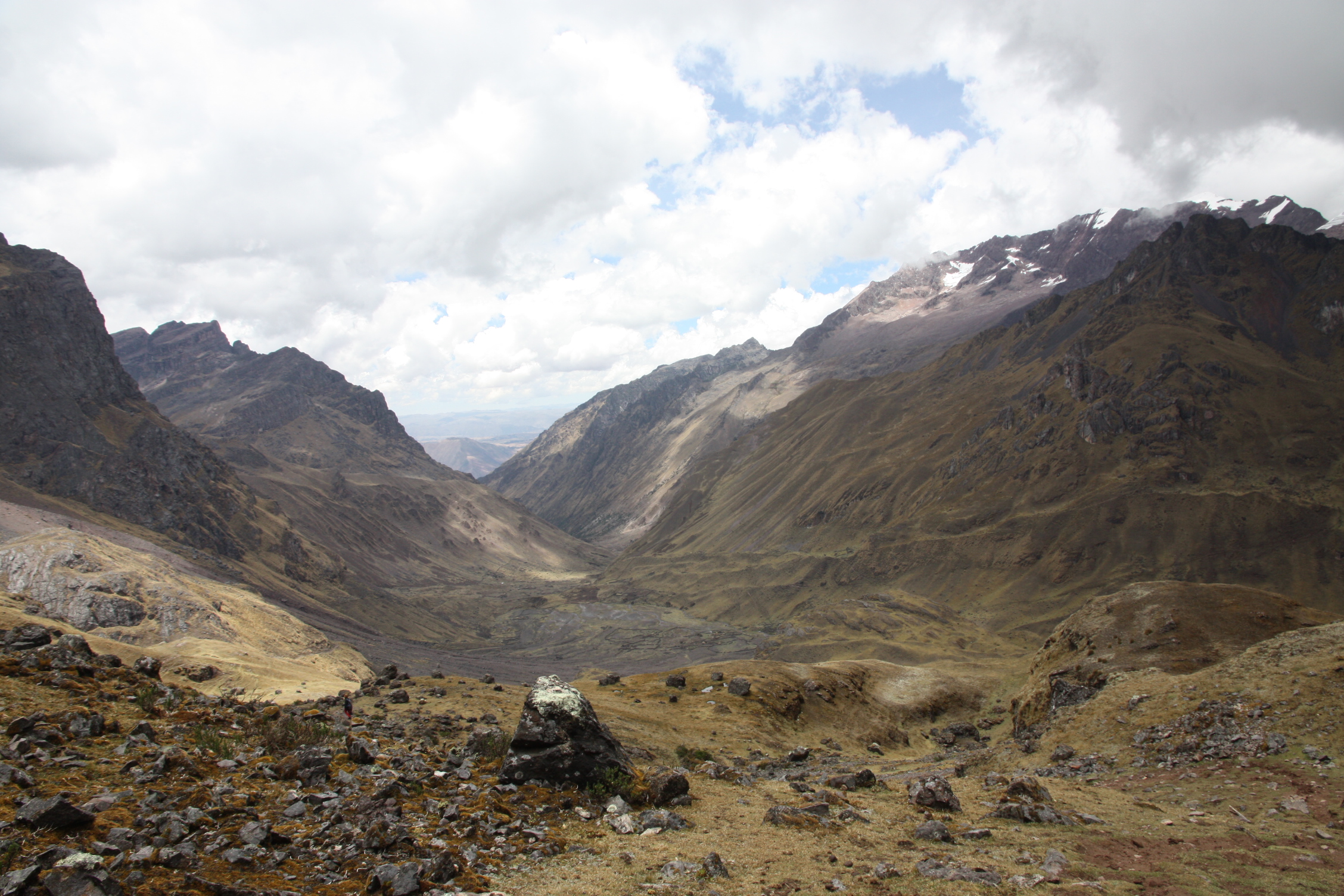
Surrounded by mountain majesty
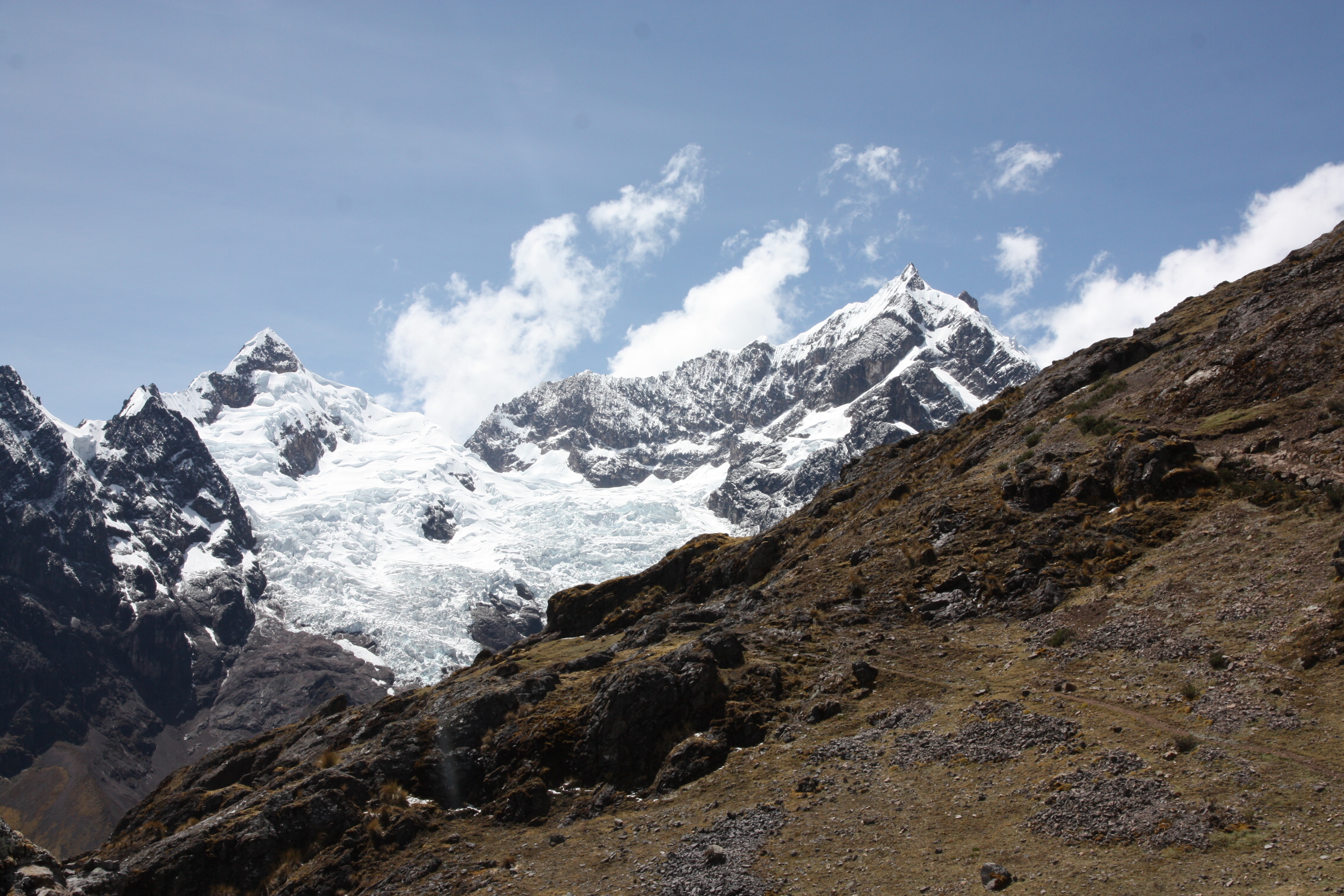
More mountain majesty

The last bridge on Day 2
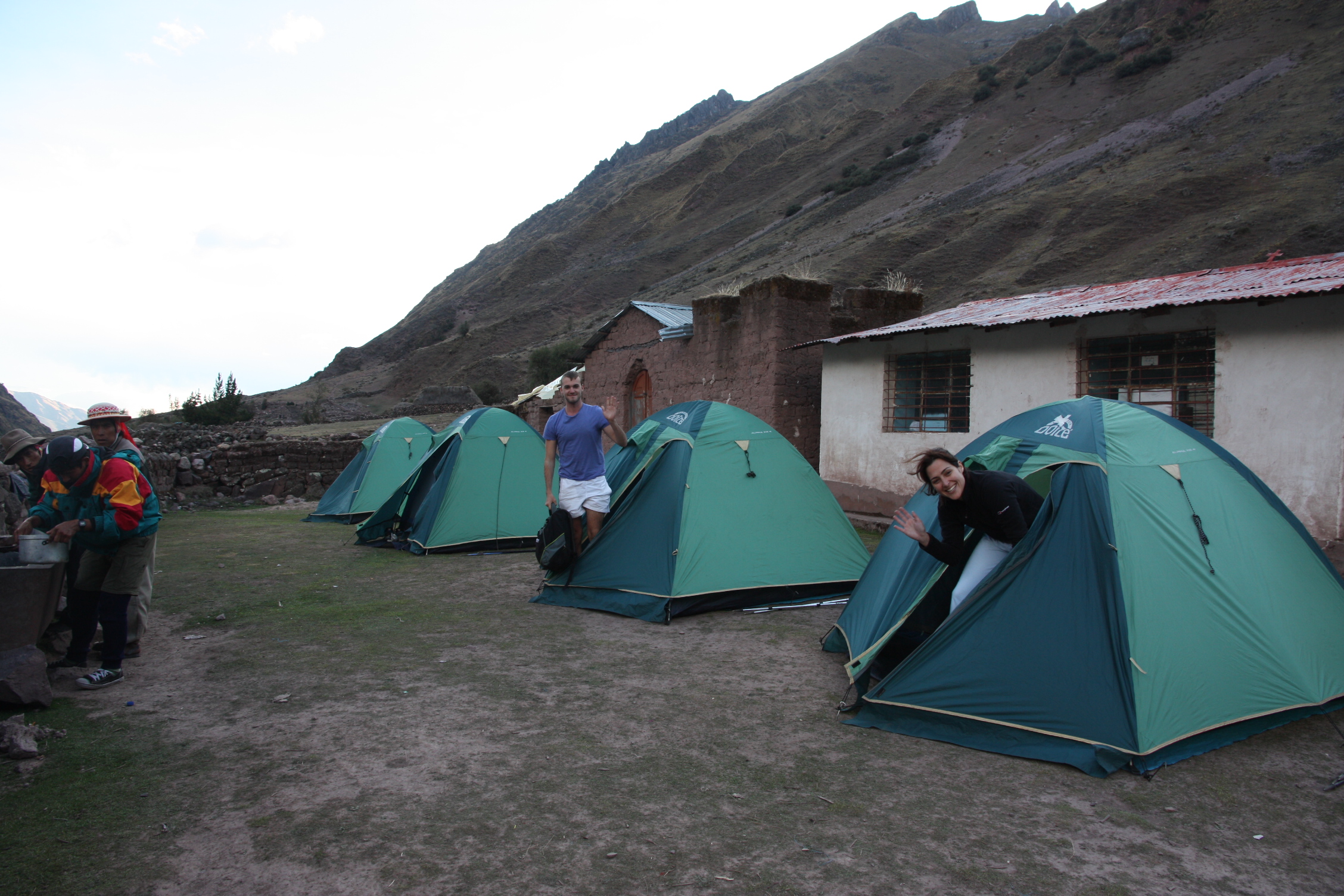
Matt and Sophia welcome us ‘home’ at the end of Day 2
Day 2 of our 28-kilometre Lares Trek was always going to be the worst. I was not looking forward to hiking an exhausting 10 kilometres uphill to a 4600-metre pass, followed by a treacherous 4 kilometres down.
But after the previous night’s rain, we woke to a sunny morning and the promise of a day of decent weather. Our wake-up call came at 5am with cups of coca tea being delivered to our tent doors, along with two basins of water so we could wash our hands and faces. Coca tea not only wakes you up, but helps you to adjust to the altitude.
The support team would pack up our tents and roll mats after we set out, but before breakfast we had to organise the rest of our belongings into our duffel bags. An easy task done within minutes.
Breakfast came 45 minutes later with everyone being served a simple veggie omelet, bread and jam, and hot drinks. I think cereal was available too, but the memory fades.
By 6:15 we were off again, with our first destination being the campsite we would have used had it not been raining the night before. That 90-minute jaunt included plenty of very steep bits and, on the way, Angie and I each had a brief turn on the horse/mule. Angie was having intermittent leg cramps, and my excuse was old age.
I can still hear Odon telling me to, ‘Get on the horse.’ I tried to resist, saying I would be fine, but he insisted. ‘Just for 10 minutes of this really steep bit,’ he said.
How could I disagree? For that matter, how could I reject such an offer? It was a most practical way for Angie and I not to straggle too far behind the rest of the group.
I should mention that Poor John is part mountain goat. He does ‘mountain’ walks most days in Canberra, with a 10-kilo pack on his back, so he easily kept pace with the young’uns. I wasn’t surprised, but Odon was definitely impressed. Luckily, Odon and Miguel stayed reasonably close to us—to keep us company and to make sure we didn’t get lost.
The uphill trek took almost five hours, with Angie and I each having three or four short stints on the horse. Thank goodness for Francisco, who led the horse and helped us off and on. Peruvian horses/mules don’t care whether you mount on the left or the right.
At one stage I had to mount from flat ground—no helpful rock about. Odon offered his shoulder as support, but I pointed out that if I used it, I’d end up backwards on the horse. That’s when Francisco pointed out the stirrups—a huge help that had been hidden under the colourful horse blanket.
The whole group stopped short of the summit for a much-needed break, and then we were off again.
Although shorter, the trip down was perhaps worse than the trip up—I think it was the longest 4 kilometres of my life and impossible to have done without the walking sticks (no horse available on the way down because it was dangerous for them too).
Many parts of the track were extremely steep with lots of loose stones and gravel. I did plenty of slipping even though I dug the walking sticks in before taking each step. There were some stone stairs, but most had high risers making every step down a jolt for the hips, knees and ankles. The fact I had hurt muy knee in July did not help.
But breathtaking views and scenery made all the suffering worthwhile. Mountain lakes, Quechua villages and people, glaciers, blue skies, gnarled trees, rocks galore. Miguel has a great interest in geology and picked up every second rock as we descended. Both he and Odon knew the various minerals and launched into long discussions. Their dawdling let Angie and me catch our breath.
It seemed that we could see our destination for hours—a schoolyard way down in the valley in the village of Cancha Cancha, which I have since learned means ‘lightning’ in the Quechua language.
At the very end this day’s trek, the terrain leveled out and then we had to cross three streams—one by steppingstones, one by branches and one by a sod bridge. Poor John and the young’uns had arrived about 1, but Angie and I and our escorts of Odon and Miguel puffed over the finish line about 2:30.
Our camp was all set up and lunch was ready almost immediately—Poor John said the cook had dithered over when to serve. Eating was not high on Angie’s or my to-do lists. Water (lots of it) and soup seemed to be the best options.
After lunch, the support team launched into a game of soccer as a lead-up to the Peru–Bolivia game that would be played later in the afternoon (they had a solar radio so they could follow the game). I crawled into our tent and collapsed for a couple of two hours.
I was able to catch my breath, thanks to the fact I was taking high altitude tablets. I still don’t know which part of my body hurt the most, but my mind kept thinking of the train to Machu Picchu and my mother’s travel dilemma many years ago.
It was six months after dad died in a car accident. Mum already hated to drive and she dreaded the thought of motoring 600 miles (900 kilometres) from Nebraska to my grandparents’ place in Wisconsin.
For weeks ahead of the trip, everyone tried to reassure her. On and on it went—‘It will be fine, Connie. Just take it easy. Peggy can help drive.’
The day before we set out, she sat at the dining room table, her head in her hands and tears rolling down her checks. She looked up to the crowd of neighbours who were wishing her well and said, ‘You all keep saying it will be fine. Why didn’t one of you just say “Take the train”?’

Avocado salad with olives and veggies
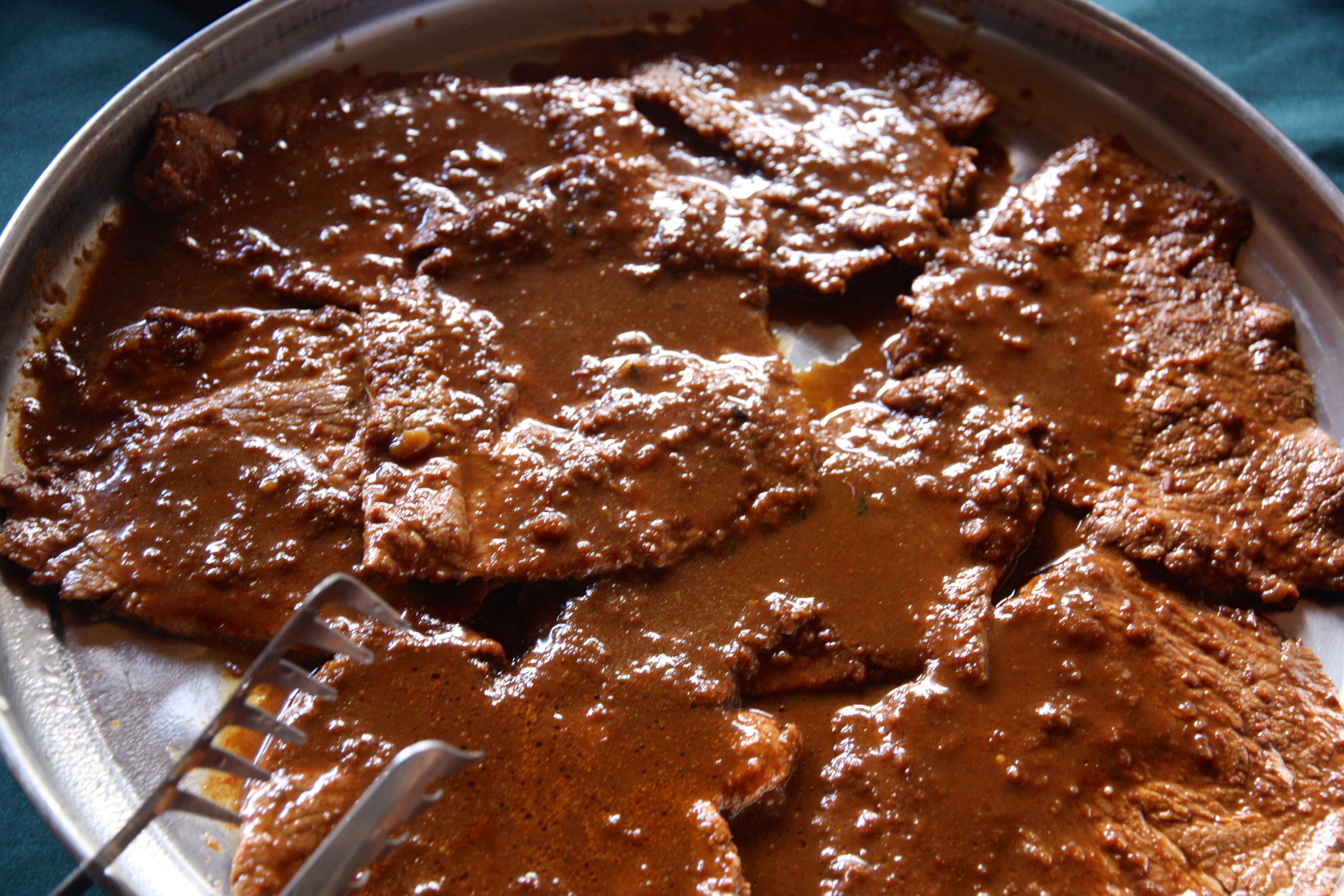
Alpaca steaks with gravy
Day 1 on our Lares Trek had a late start—that’s if you call 6:40am late.
Poor John managed to squeeze in a quick coffee before Odon, our guide, came to collect us at the hostel in Cusco. But my order hadn’t arrived so I was out the door without it.
We carried our gear around the corner to a waiting van. Each trekker was limited to a duffel bag filled with no more than 7 kilos of gear for the whole four days. I took my sleeping bag, a super-warm bag liner, a rain jacket and rain poncho, a change of clothes, thermals, extra socks, limited toiletries, a hat, a book, a head torch, a water bottle and my electric toothbrush. Someday I’ll do an item on toothbrushes. All this was put into a large plastic bag that went into the duffel. Hey, it could rain!
My camera and case (plus bug repellent and sunscreen in the side pouches) weren’t counted in the 7 kilos because I was going to carry them, instead of putting them on a pack horse. That said, I reckon my duffel weighed no more than 5 kilos and probably less.
Our first stop was to pick up Angie and Miguel, a Spanish sister and brother, who were joining our group of five trekkers.
Then it was off to Calca, an hour or so up the road, for breakfast and supplies. On the way, we passed by the Sacsayhuamán ruins just north of Cusco. Sadly we didn’t have time to stop, so it will have to stay on my to-do list.
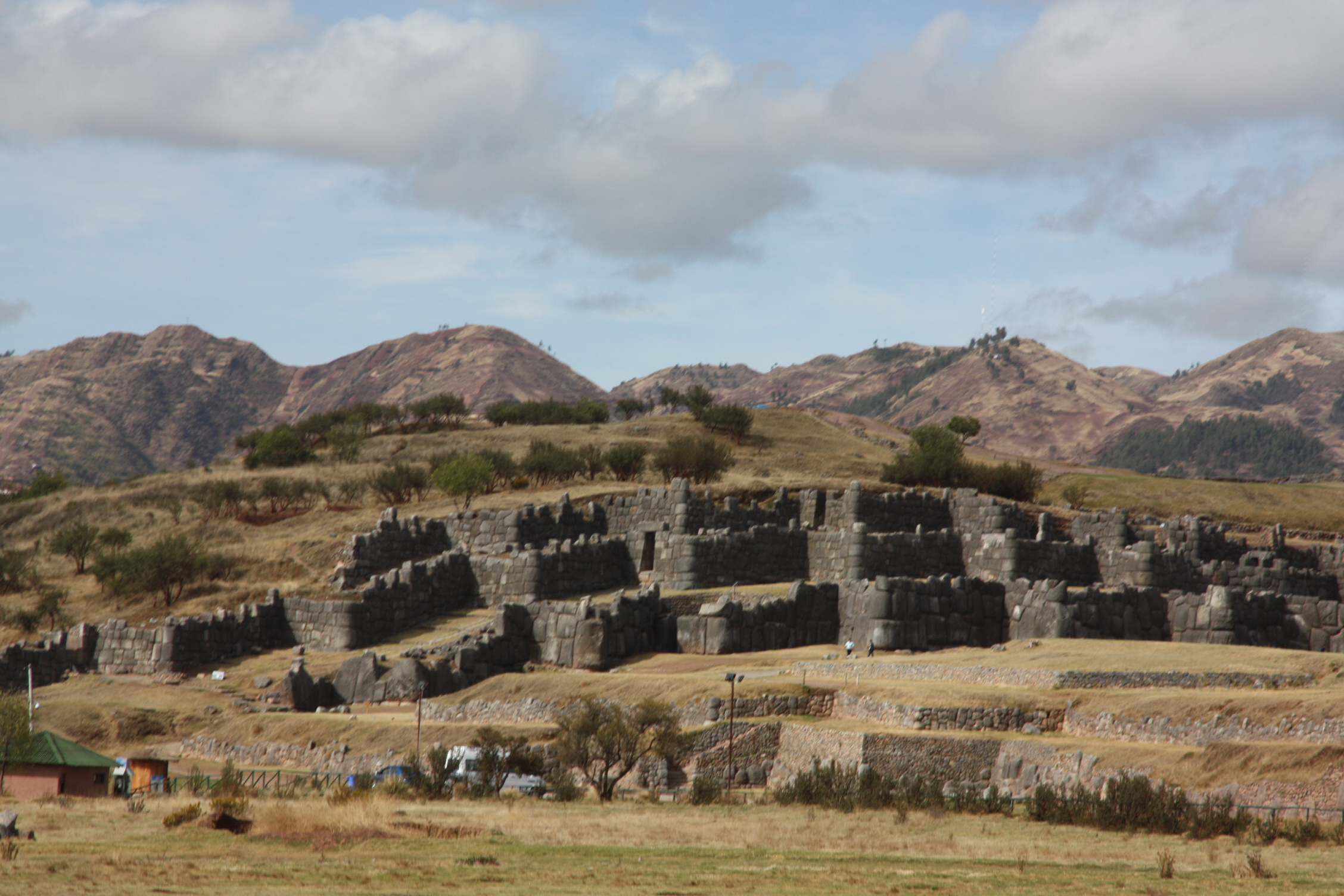
Sacsayhuamán ruins north of Cusco
In Calca, Poor John and I headed straight to the market and found the little eateries upstairs. For the extravagant sum of $2, we each had a toasted cheese sandwich and two cups of coffee.
The coffee is interesting and I regret not taking a picture. You get a jug of a thick coffee syrup that you pour into your cup and then dilute with hot water to the desired strength. It’s not too bad as coffee goes, and a darn sight better than the Nescafe that was so often served in Ecuador. There we’d order coffee and get a cup of hot water and a jar of instant.
After breakfast we wandered down into the market proper and bought some snacks for the rest of the day. The two packets of chocolate biscuits proved to be very popular—not during the trek, but four days later when the train back to Cusco stalled.
Francisco, one of our support team, also joined us at Calca, along with his wife and young son—who did not join us on the trek.
After another hour, we reached Lares where we bought bottled water and collected Grigorio, another support team member. Primativo, the cook, was already with us, and the two horsemen would join us at the start of the trek.

Looking down on the Lares thermal baths
The stop in Lares included a side trip to the thermal baths, which is also where Primativo whipped up the first of our many great meals. What a great start—alpaca steaks, potatoes and a rather fancy avocado salad.
After the cleanup we head back to Collpana, which is where the trek began about 2:30pm. The laden horses (carrying pots, pans, tents, food and such) and support team shot up the hill so they could have camp ready for our arrival, and we began the 6 kilometre uphill leg.
Within 15 minutes it started to rain, so it was on with our el-cheapo ponchos (made in Vietnam) and a wish that the rain would subside quickly.
It didn’t. We trudged on, following the road and taking slight overland shortcuts to chop the ends off the sharp turns in the road.
The rain turned to hail and as we turned corners, the deluge reverted from hitting us in the back to hitting us in the face.
This is when you really start to wonder what in the hell you were thinking when you signed up to do the trek. I kept telling myself ‘I only have to get through today.’
We came upon a wide-ish creek and I watched in amazement as a Quechau woman leapt from stone to stone. She was wearing a full skirt and sandals and carrying a large weight on her back. ‘Look at her go!’ I exclaimed, and then realized my turn to cross was coming up. I thought we were just passing by.
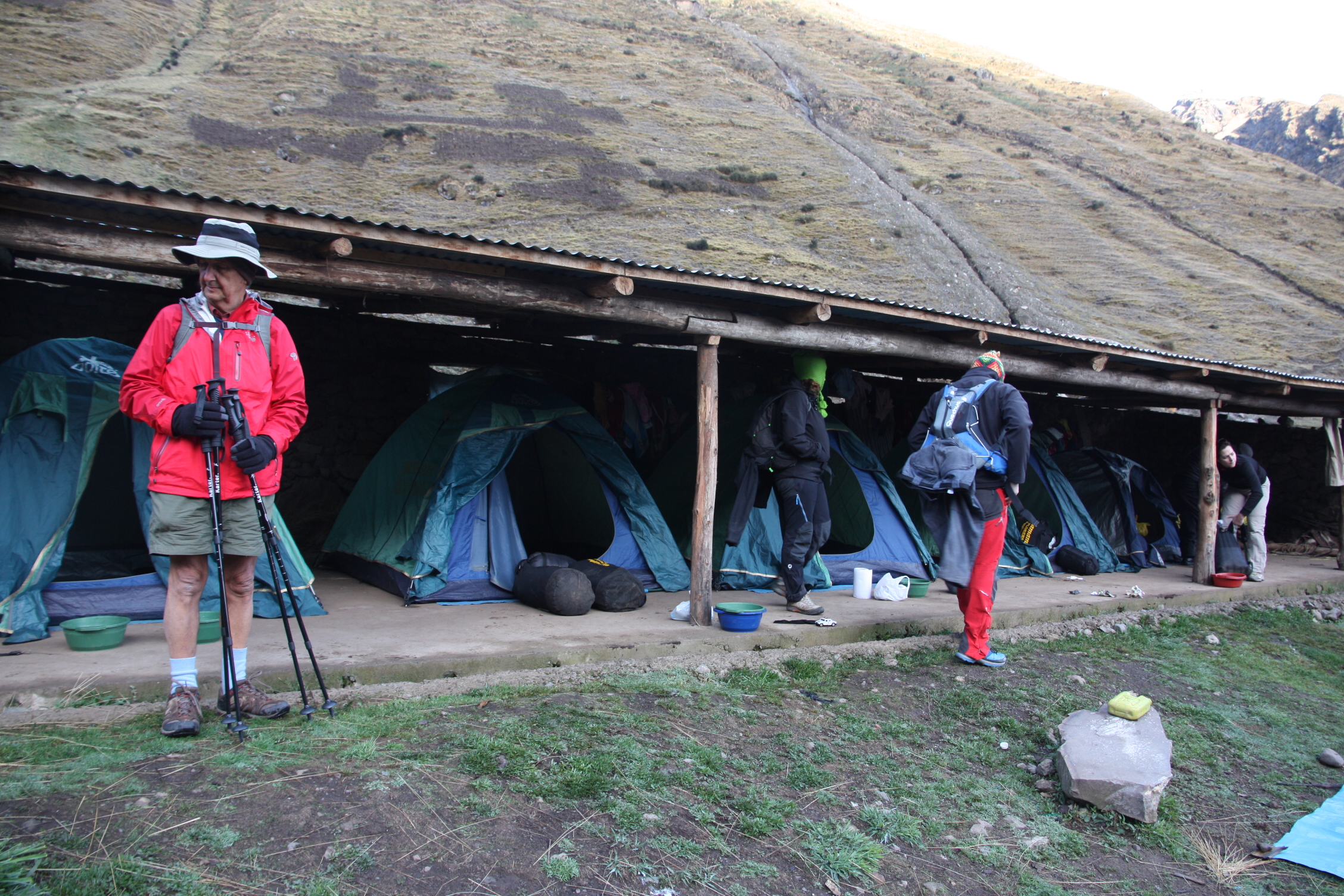
Our tents at Ezekiel’s farm

Afternoon tea with Odon, Matt, Sophia, Donna-Leah, Angie, Miguel and Poor John

We had our meals downstairs in this farm building
My walking sticks and I tottered across the rushing stream, with the support team offering helping hands and adding a few extra large rocks for me to balance on to stay above the water line. It’s so laughable now. My trousers, socks and shoes were already drenched. I could have walked straight through the water without getting any wetter than I already was.
But crossing the stream was the home stretch. Suddenly we were at Ezekiel’s family farm near Quishuarani. Our tents were up—and under cover. The duffel bags were there so I had a set of dry clothes. A camp stove was going so I could start to take a bit of the wet out of my shoes. Happy hour—with tea, popcorn and savoury biscuits—would be served at 6 and dinner at 7.
Day 1 was almost over. I had not taken many pics because the camera was under the poncho.
At 7:40pm, I crawled into my cozy sleeping bag and did not move again until 5am, when the need to pee became too great. It was a long drop toilet around the other side of the barn. It was clean, if muddy.
Day 2 started sunny and stayed pretty much that way. And I began the day by repeating ‘I only have to get through today.’
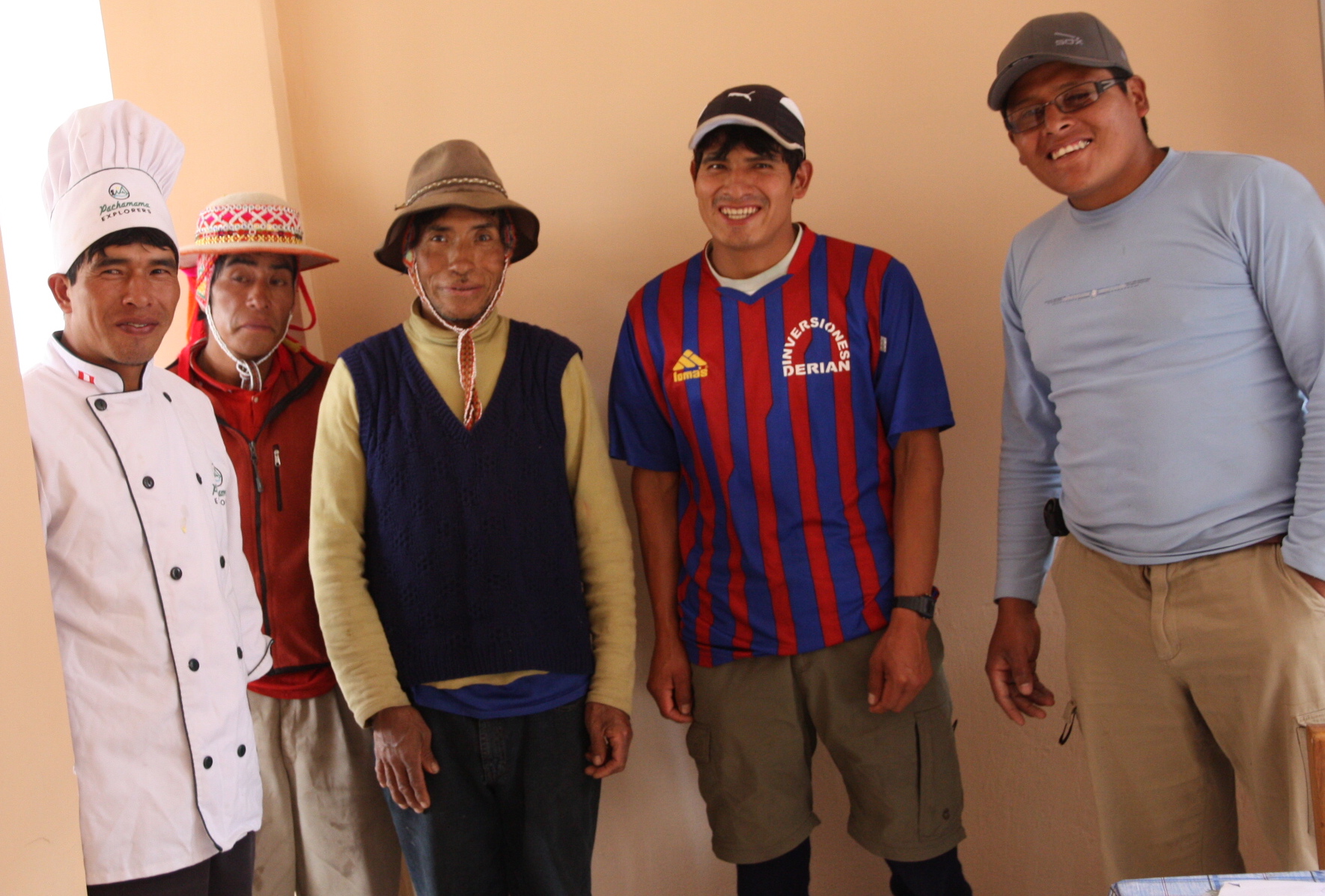
Our Lares Trek support team. From left: Primativo, Grigorio, Ezekiel, Francisco and Odon
Thank goodness we didn’t have to blunder through our Lares Trek unsupervised. Oh no, we had a support team of five and they all were amazing.
I’ll start with Odon, our remarkable guide. Odon is Quechuan and the Peruvian Andes are his territory. He speaks Spanish, Quechuan, Italian and English. Odon has been a guide on the Inca Trail and Lares Trek for 11 years, and I was constantly amazed by his knowledge of the region and its/his people. He is so proud of Peru and has every right to be. It was a true privilege to share our Lares journey with him. In another blog entry, I look forward to sharing his insight into the Quechuan communities of the Andes.
Primavtivo (gosh I hope I spelled his name right) was our genius cook. Every day he churned out breakfast, lunch, happy hour and dinner, plus snacks for the trek and plenty of boiled water for drinking. He had a couple of gas burners, a pack horse full of pots and pans, bags and bags of fresh meat and produce, sharp knives and a chef’s uniform. How could he go wrong? His meals were varied, filling and delicious. And I managed to get the basics of one of his inventive potato dishes—we had at least two kinds of potato for almost every lunch and dinner.
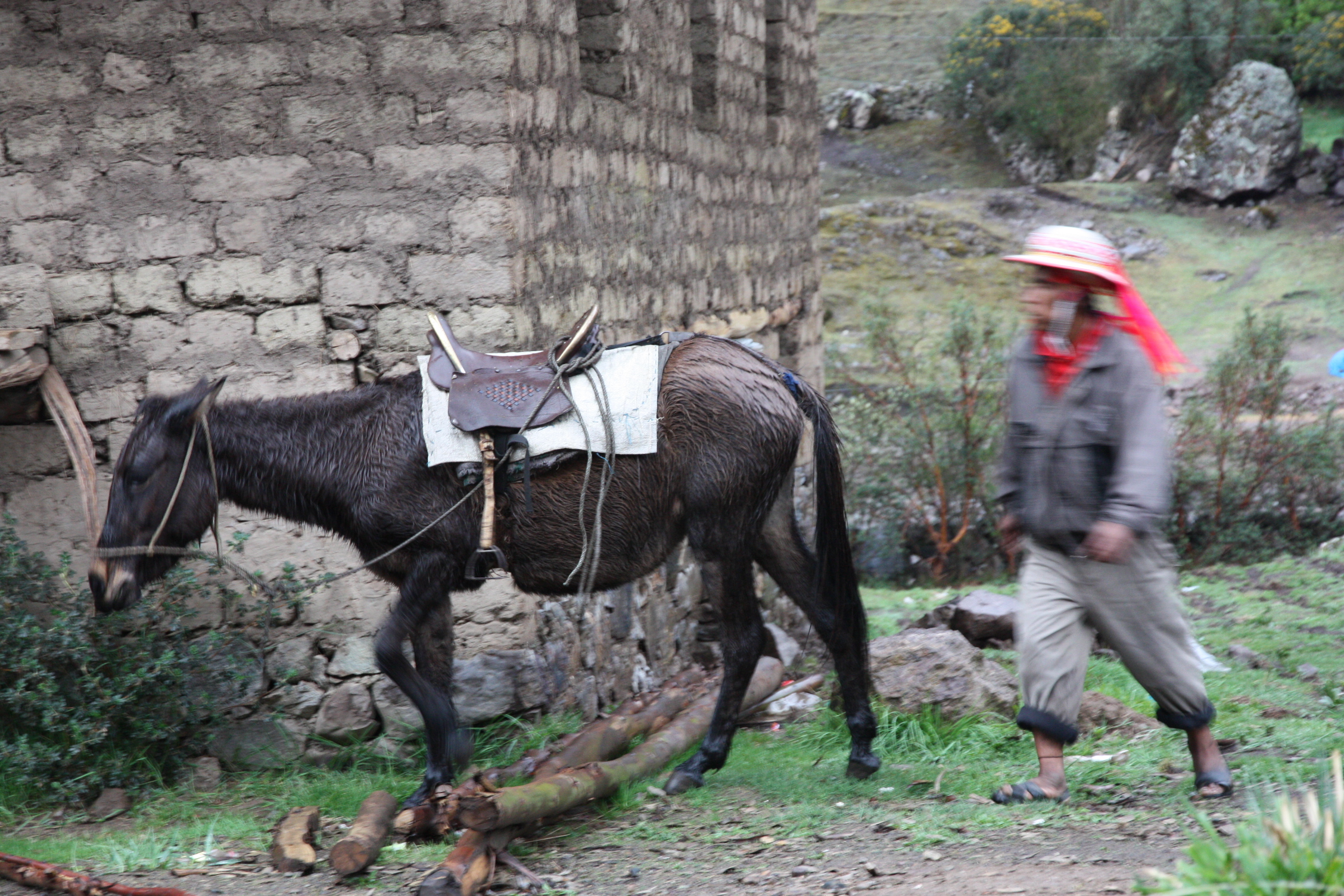
Grigorio chases a horse/mule out of the potato patch and around the barn
Francisco was assistant cook. He is a whiz with the knives and it was impressive to see him chopping vegetables on a cutting board that was casually balanced on his knees. Francisco played another important role on Day 2. That was the day we trekked 10 kilometres uphill (then 4 down). Francisco, bless his heart, was in charge of the horse/mule that had been relieved of pack duties that day to cart anyone who became sick or who needed assistance up the steepest parts of the climb. More about that in Day 2.
Ezekiel and Grigorio (another spelling challenge) were the horsemen, as well as great hands in the kitchen. We were travelling through their ‘country’ and actually camped at Ezekiel’s home at the end of Day 1. These two men made sure the horses (actually they were mules but always referred to as horses) were well packed and doing the job best suited to each beast. Each morning they rounded up the horses, which had grazed freely through the night (except for one that had to be tied—must be a bolter). Although Grigorio spent the first evening keeping one horse out of one of Ezekiel’s potato patches. Grigorio also had the most amazing hat, and suffered a badly injured toenail, thanks to a rambunctious horse.
All these men made us their top priority and we could not have made the journey without them. I will always be grateful.

Lares Village—a shop on the stairs
When Poor John and I started to plan our trip to South America, we had big choice—should we do the Inca Trail or the Lares Trek.
I have to confess that I didn’t know a lot about the differences between the two. The Inca Trail has a lot of steps—more than 2000—and a lot of ruins. The Lares Trek focuses more on villages.
When Poor John first raised the options, I thought we ought to do the Inca Trail. Isn’t that the done thing? So I said, surely there are some villages on the Inca Trail? Nope, there aren’t. I’m a sucker for villages and markets, so it suddenly became an easy decision for the Lares Trek. Plus Poor John suggested that if the going got really tough, I might be able to ‘rent’ a donkey.
As it turned out, the Lares Trek is way off the beaten path. It has many variations in route, degree of difficulty, duration and distance.
All the options are remote and rarely visited. Most communities have changed little in the last 500 years, and the region offers insight into the lives of Andean/Quechuan farmers and communities.
I have no idea what our route is called, but the attached map is pretty close to what we did. It is 33 kilometres and ours was 28. We stopped at Calca (bottom right of map) first to have breakfast. Poor John and I had a couple of coffees and cheese sandwiches. We also picked up some crew members and bought supplies, such as snacks and water. None of this would be available on the trek, although our meals and clean drinking water were provided once we got going.

Very close to the Lares Trek we did
We then drove on to Lares (top centre of map) where we could try out the thermal baths to get us ‘in the mood’ for the cold to come.
Then we backtracked southeast to about where Rio Lares appears on the map (so we didn’t do that little loop of yellow-dotted line off to the left).
That’s where we started our trek, which then followed the remainder of the yellow-dotted line south.
It was 6 kilometres uphill on first day, 10 kilometres uphill and 4 kilometres downhill on the second, and 8 kilometres downhill on the third. Then who knows how many kilometres around Machu Picchu on the fourth.
All of it was tough—we trekked over a 4600-metre pass—and the downhill was often harder than the uphill because of loose gravel and steep inclines. According to what I have read, it is considered a ‘difficult’ rather than ‘moderate’ trek unless it is spread over more days.
That said, the young’uns in our group were well-prepared and fit enough to have easily done the Inca Trail. Frankly, I doubt I would have survived the Inca Trail. No wait, I’d have survived, but I’d probably still be on my way up.
But the scenery, travelling companions, crew and experience were sensational. A never-to-be-forgotten expedition.

Thermal baths at Lares
I’m going to do a mitt-full of blog items on these few days, and the links below will become live as I complete each one.
Day 2 Quishuarani to Cancha Cancha
Day 3 Cancha Cancha to Huaran to Aguas Calientes
Day 4 Machu Picchu
Quechua communities
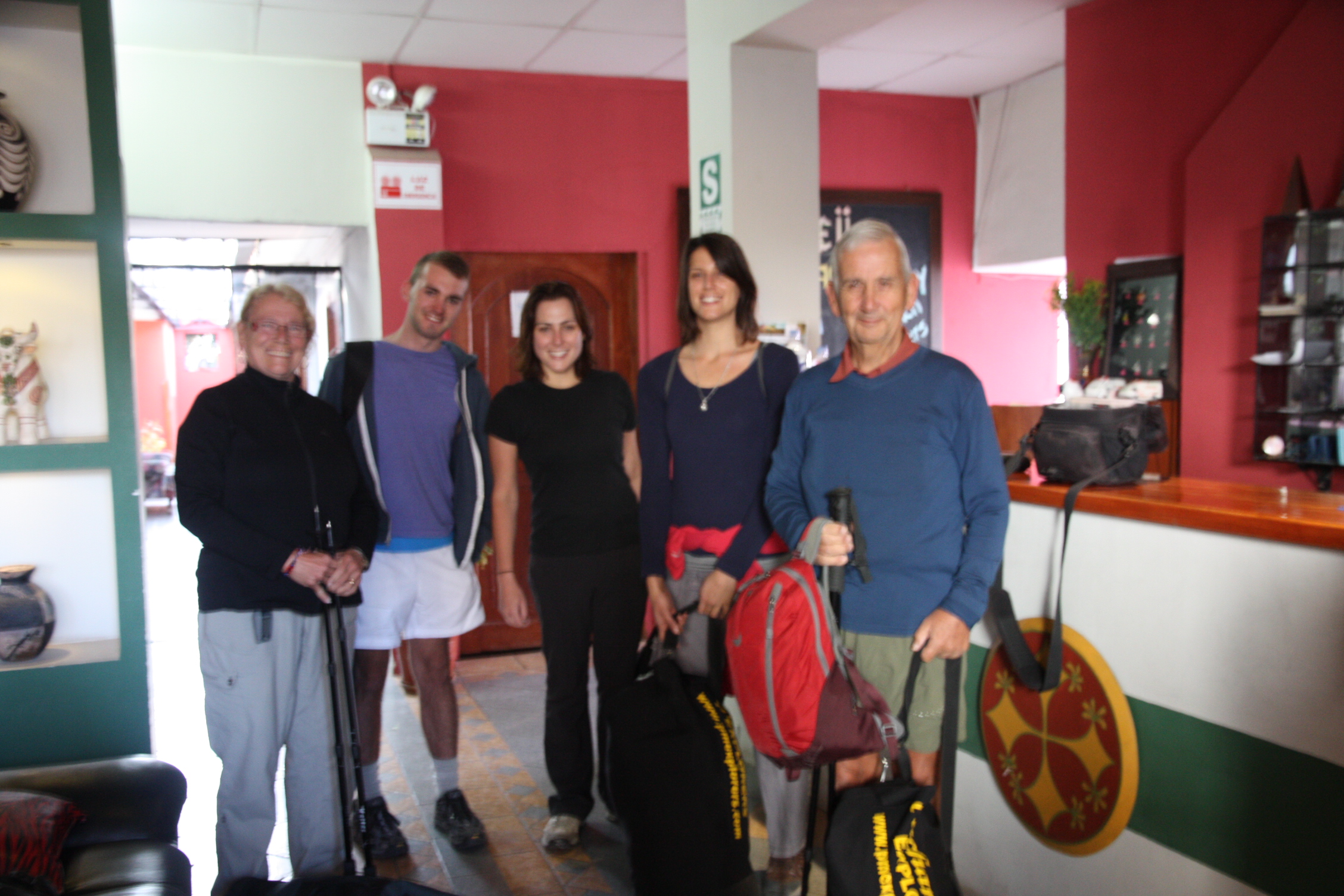
Our Lares trekkers. From left: me, Matt, Sophia, Donna-Leah and Poor John. We were later joined by two great Spaniards—Angie and Miguel, who are sister and brother
Just back from our trek through a tiny bit of the Andes in Peru on our way to Machu Picchu. It was 28 kilometres on the Lares Trail—a less travelled and less crowded path than the Inca Trail.
There is so much to tell, but I need sleep. Hope these three photos are enough to tempt you for the many instalments that will follow in the next few days.
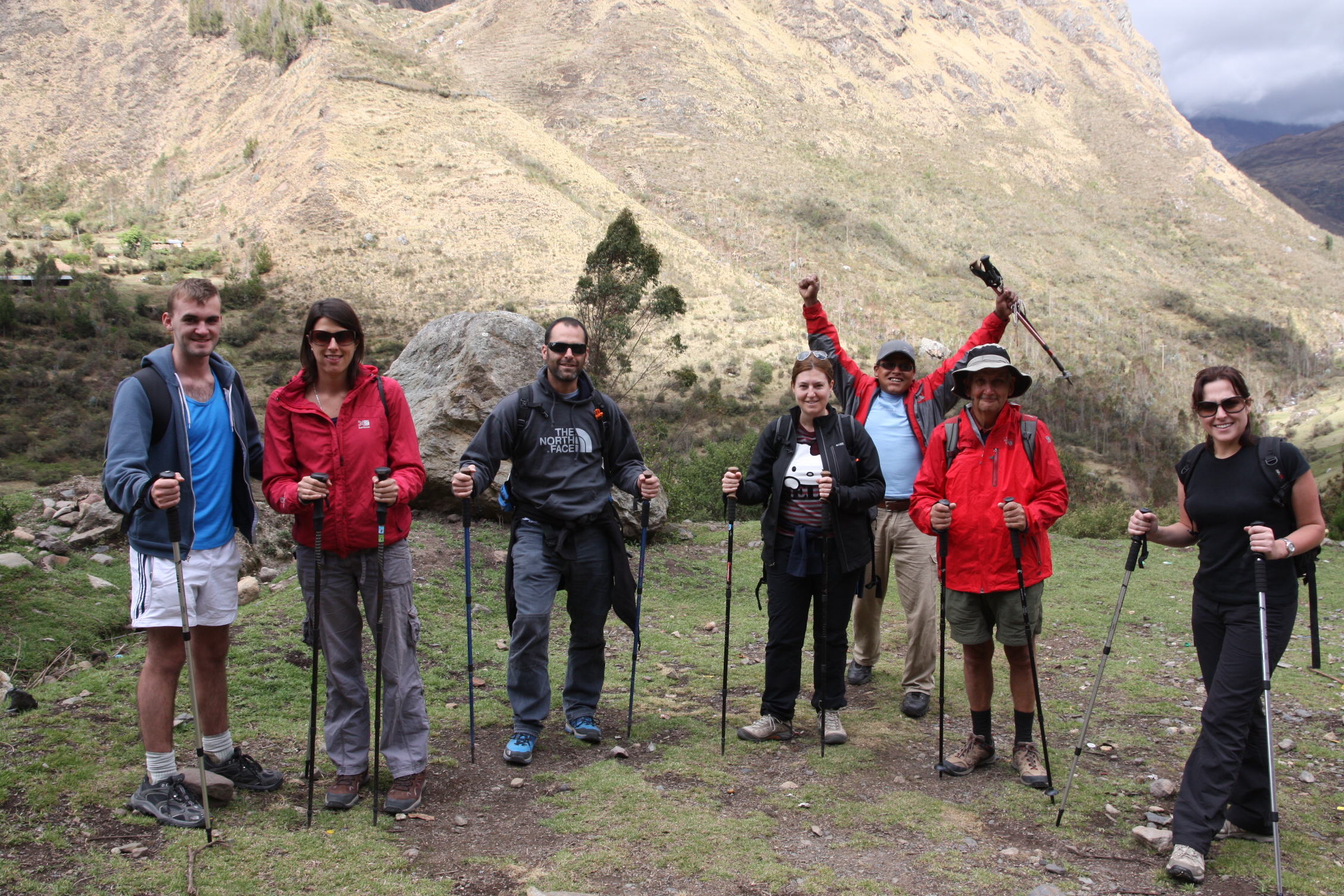
My fellow trekkers just before starting out. From left: Matt, Donna-Leah, Miguel, Angie, Odon (our guide), Poor John, Sophia. About 15 minutes later it started to rain, then hail.

Some of our pack horses/mules
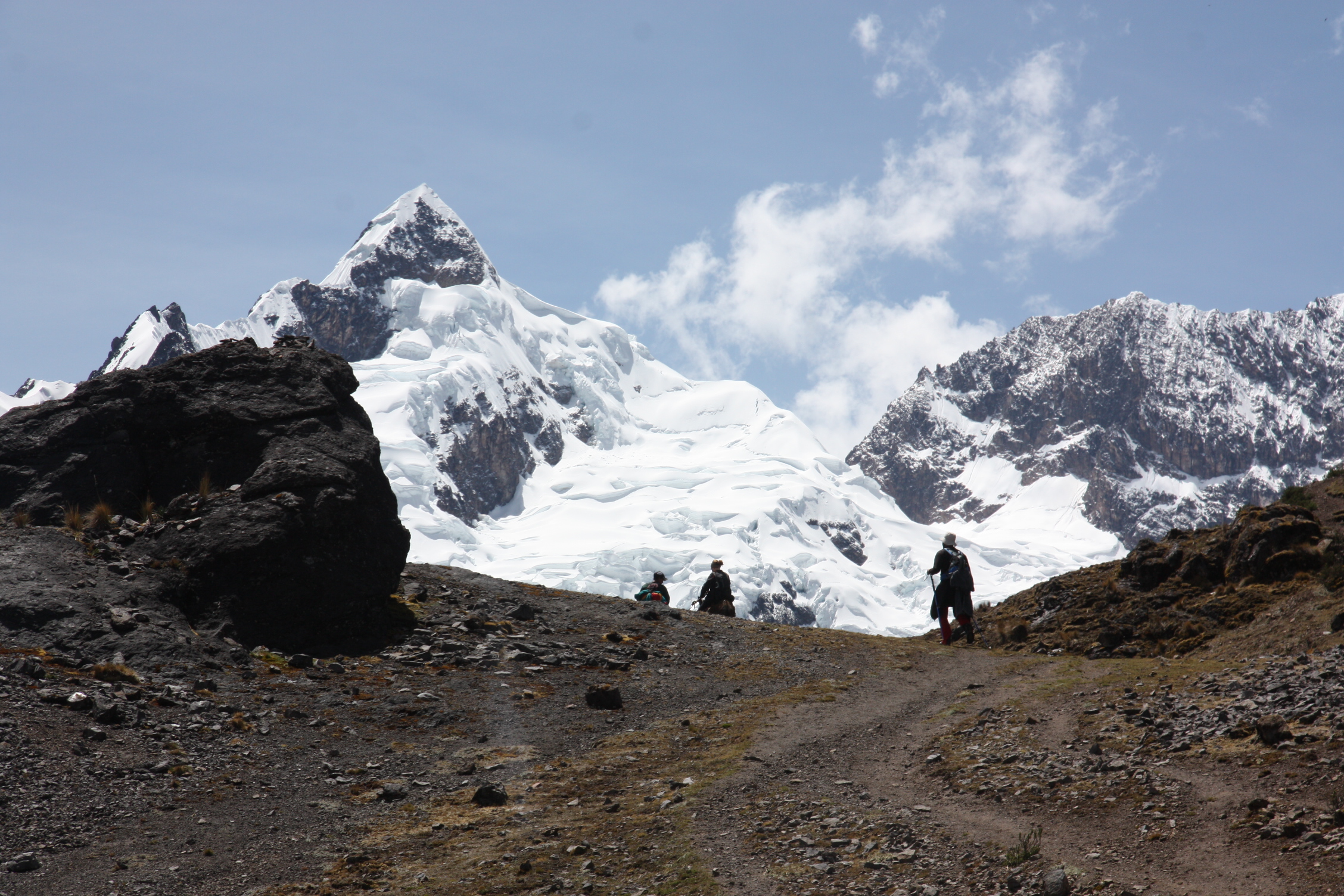
Heading towards a 4600-metre pass we need to cross.
We’re heading to Machu Picchu tomorrow—walking. Oh, we get a ride part of the way, and some train and such, but we’ll trek 28 kilometres uphill over the next three days. Some of our group will be doing 40+ kilometres.
There will be no electricity, no running water, no toilets. But we will have a guide, porters and cooks. Our entourage will have horses too. Wish us luck. I’ll be back Thursday my time—I hope—with some good news of this latest big adventure—and lots of pictures. Stay tuned.
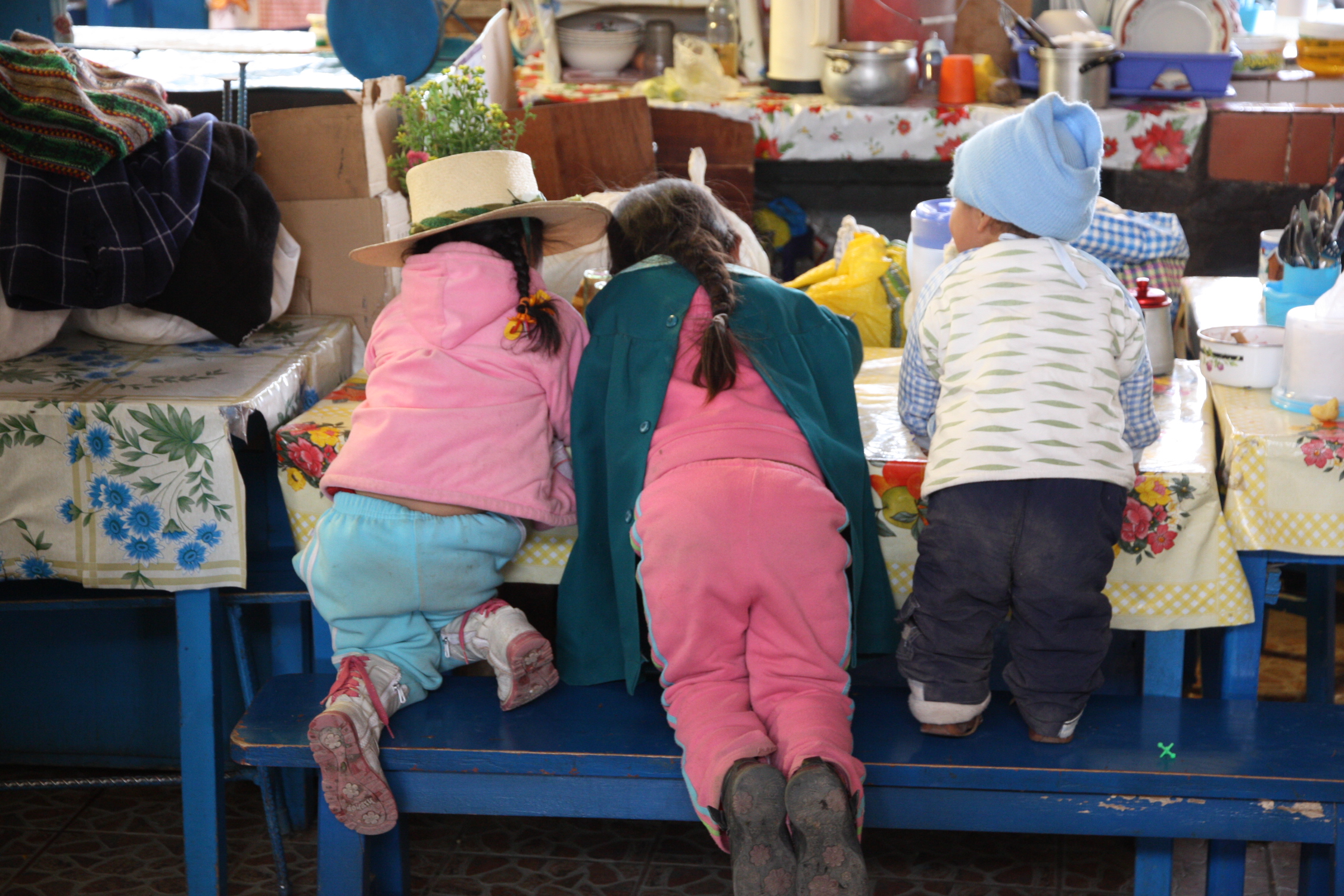
Chivay children having lunch
We travelled to Chivay in the Colca Valley, about 150 kilometres north of Arequipa, as a staging point for our side trip to see the Andean condors.
This village, with its population of 5000, is definitely set out to cater for locals and visitors. There are plenty of hostels and restaurants, a large and bustling market, and a picturesque town square.
Thermal springs, with five pools, are three kilometres up the road, and there are also adventure activities, such as ziplining, on offer.

Cultures meets—A Cabana on the left and two Kollawas on the right
Chivay has two dominate cultures represented—the Cabanas and the Kollawas. The average person can easily differentiate the women by their dress and especially their hats.
Cabanas wear a heavily embroidered hat with a brim that is rolled at the back. Kollawa hats are like bright white top hats. Many are covered in sequins and have flowers on the side. If you’re interested, here’s more about these distinct hats.
We had a nice stroll around streets of Chivay and explored the many corridors of the covered and open-air markets. There were children and dogs everywhere.
Even though the village sits at 3650 metres, we didn’t feel overcome by altitude sickness.
We had two very interesting meals in Chivay. They both cost about the same, but were totally different.
 Where to next?