
Today’s adventure is to the Bolivian salt flats near Uyuni. Old clothes are recommended. All my clothes are now old, so that should be no problem.
Not sure how much I’ll be posting over the next few days. We were in Potosi two nights ago. The hostel (in fact the whole town) had no electricity. I loved the fact that the anticipated outage was reported in the newspaper that came out AFTER the power went out.
In Uyuni, the hostel allows four people online at a time. Given that there are about 50 people staying here, a person’s turn comes around RARELY.
We head to Argentina first thing tomorrow morning, with a couple of nights of camping. I’ll be back as soon as I can.
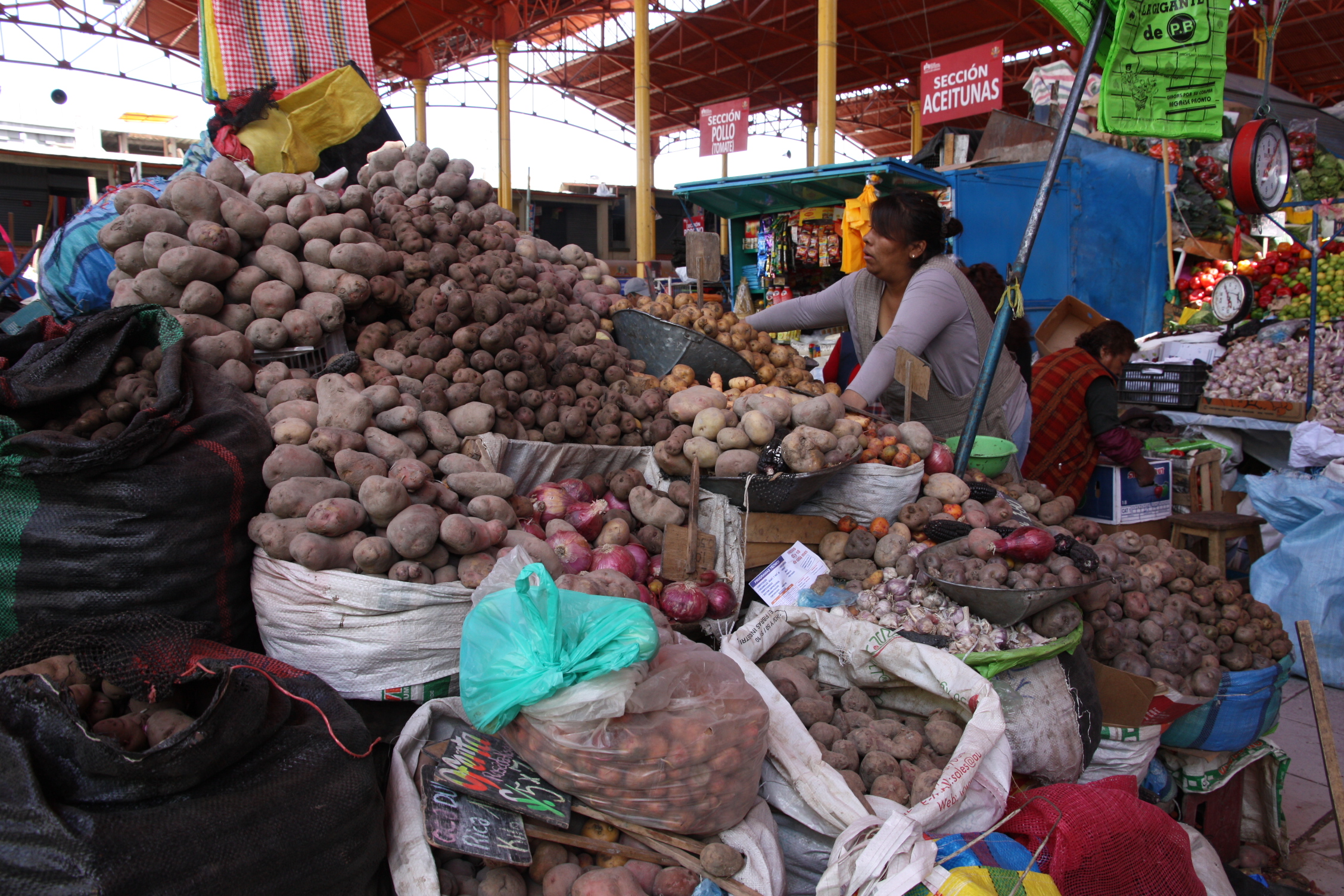
Mountains of Peruvian potatoes

Dog food by the kilo
Arequipa is Peru’s second largest city and in all our travels, it is the first place where we have been able to take a ‘Reality Tour’.
Almost everyone on our overland truck signed on for this interesting half-day tour that shows you aspects of a major city that are often ‘hidden’ from tourists.
Our itinerary started with a trip to the local market, followed by a visit to a wawawasi (child care centre for marginal families) and its attached comedor (where women cook hundreds of meals a day), and finally on to the sillar mine. These sites are in the shanty towns and/or outskirts of Arequipa.
Wherever we go, Poor John and I manage to visit most markets as we travel along, but we’re always looking forward to seeing a new one, and to seeing what new items might be on offer.
The Arequipa market had a couple of firsts for us. We saw the first pet stall—it wasn’t actually selling pets, but food, toys and other supplies. We’ve seen a lot of dogs in South America, but very few cats, and the products leaned towards dogs.
We saw stalls with up to 20 varieties of potatoes for sale. Usually we see no more than 10. Although thousands of types of potatoes are grown in Peru, most are reserved for home consumption. Oodles of varieties of cheese were on offer too.
We also saw the butchering and fish shops being run by women—again. I’ve found out why that is here, and will do a separate post on women butchers and fishmongers.
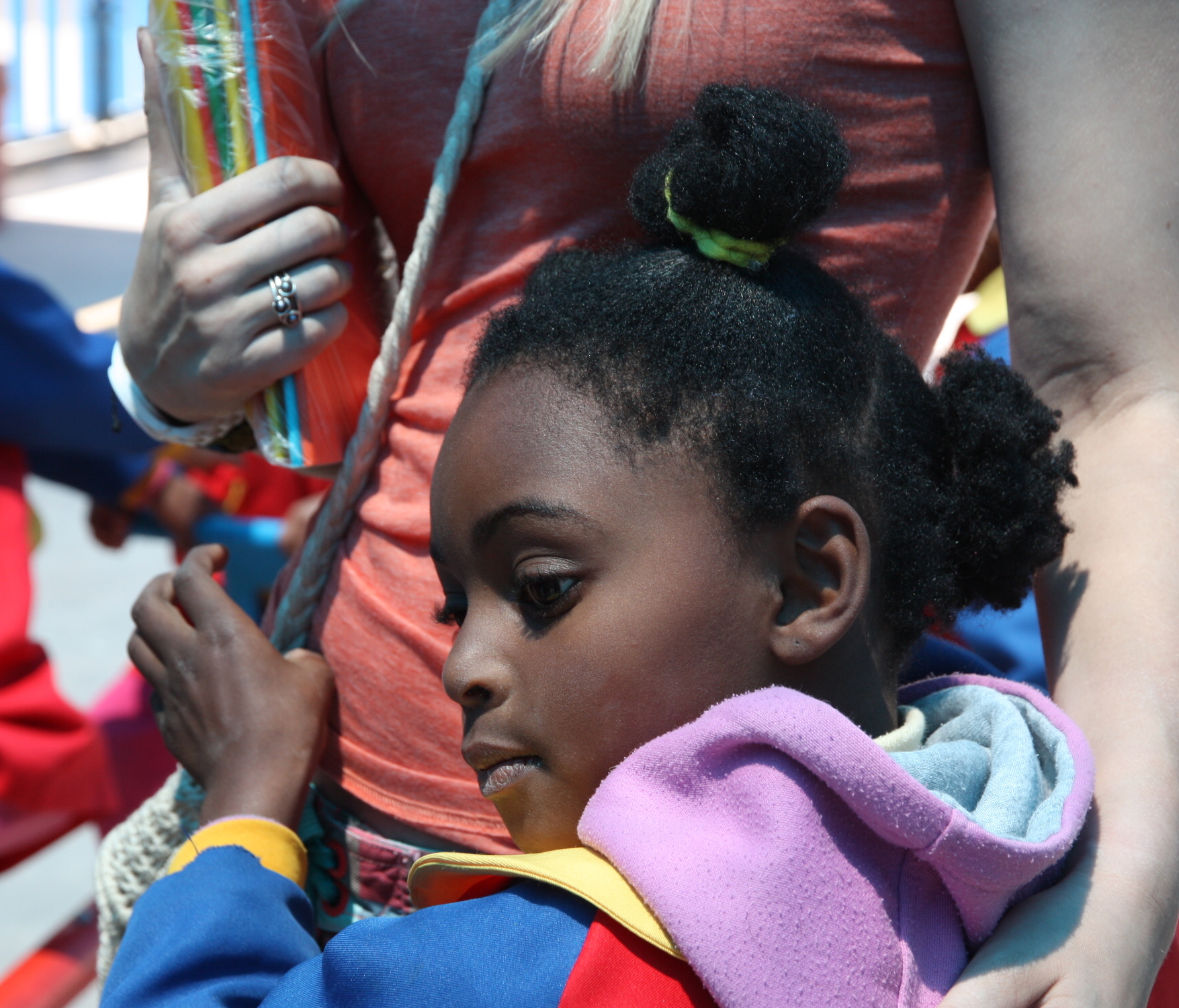
A 5-year-old girl gives Lauren a hug
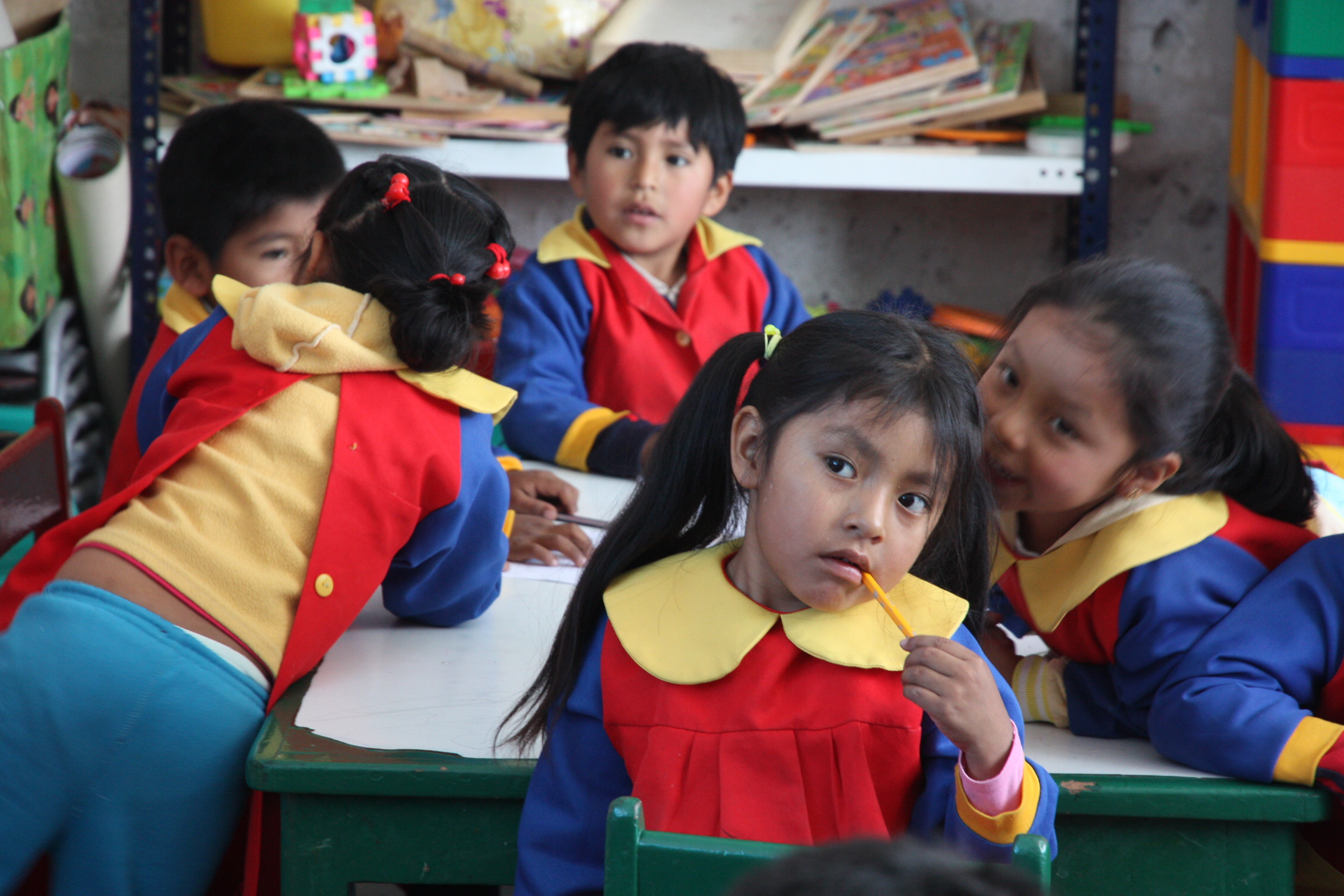
Every child has a uniform
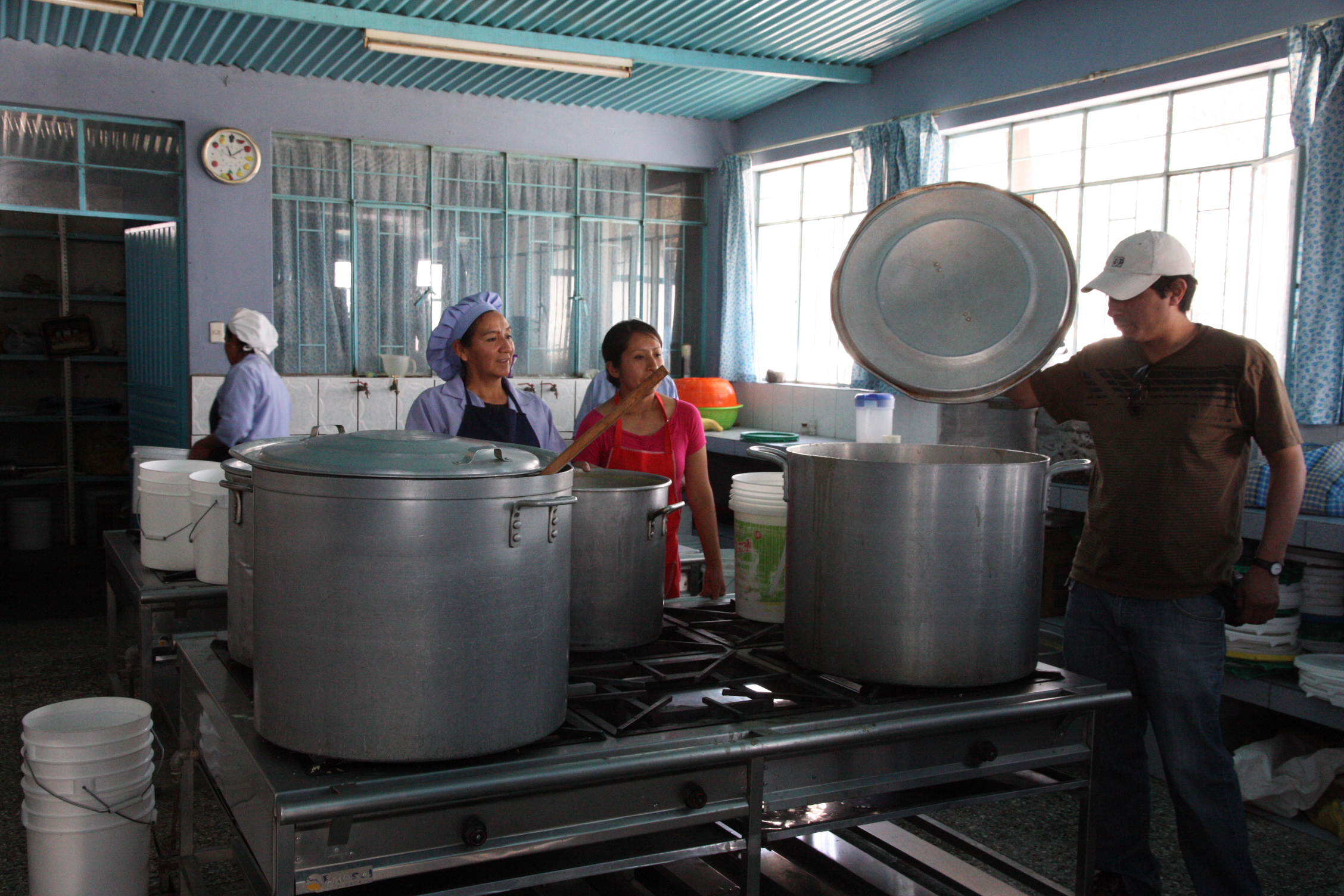
Cooking for the masses
Our guide explained that the Arequipa market was designed by Mr Eiffel (of Eiffel Tower fame). It is large, bright and airy and, as usual, I took too many pictures.
Our main reason for visiting the market was to buy goodies for the child care centre and the sillar miners (our next two stops).
Pens, pencils, paper, puzzles and the like were on the list for the kiddies, along with fresh fruit. It’s a way to contribute to the centre and to thank them for sharing their space and time with us.
Preferred thank yous for the miners are bottles of water, bunches of bananas and bags of coca leaves (to chew for energy). Coca is popular throughout South America. And although it is the source for the production of cocaine, the leaf is invaluable at high altitude. Poor John and I chewed it several times a day as we did the Lares Trek.
But on to the centre where we met classes of engaging 3, 4 and 5-year-olds. It’s obvious they love having visitors. Each age group sand songs for us, and we reciprocated with tunes like the ‘Teensy-weensy spider’. The children are also learning English, and proved that they know more of our language than we do of theirs.
After spending time with the children, we walked along the compound and met the four women who make 700 meals every weekday. About 150 of these meals are served to people who come to the centre. The rest are delivered to families in need within a radius of about 5 kilometres.
Considering the output, the kitchen is tiny and the women who are cooking are about the same size as the pots.
Then it was on the sillar mine, which is open-cut and is supposedly 18 kilometres long.
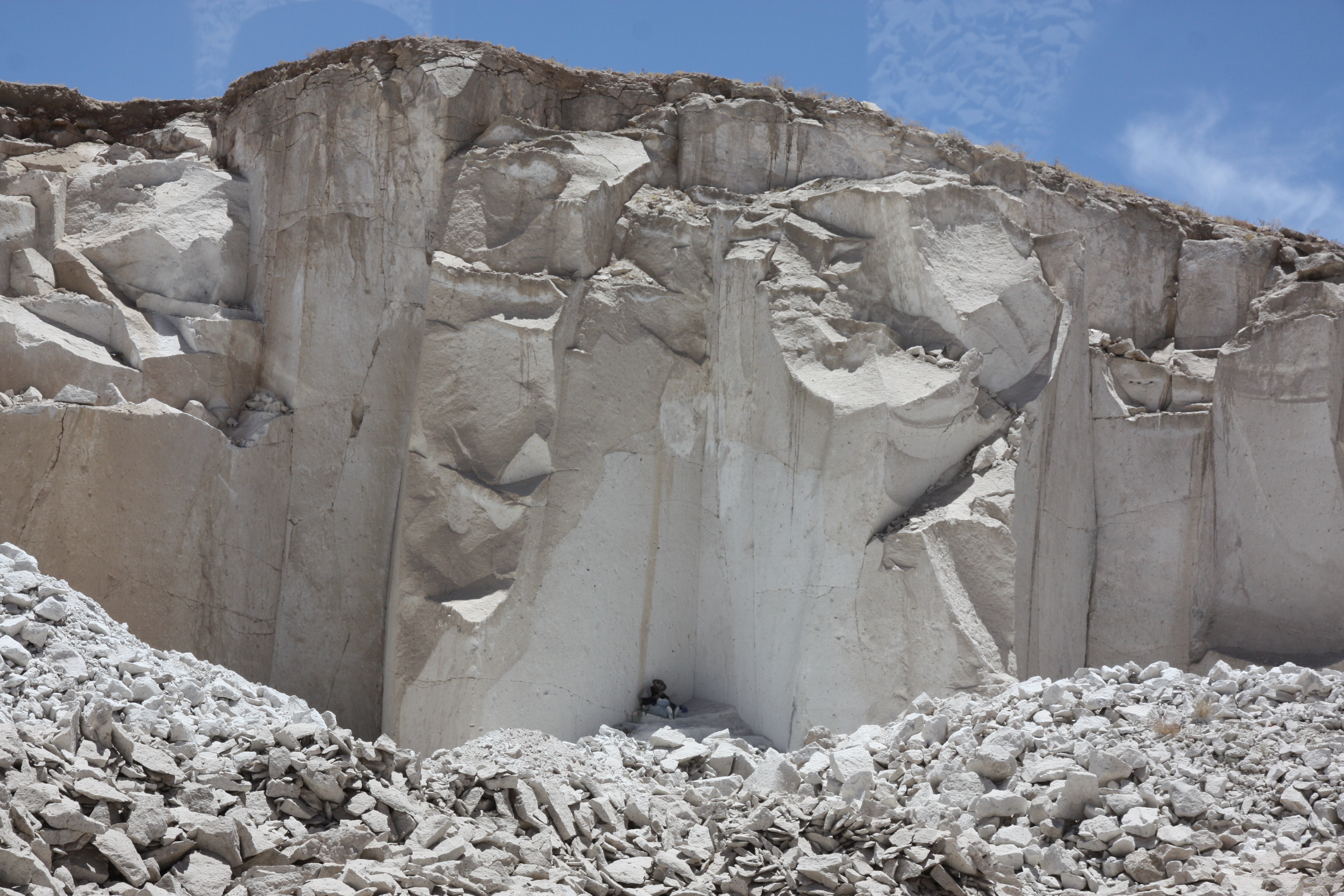
A miner takes a lunch break at the bottom of a wall of sillar
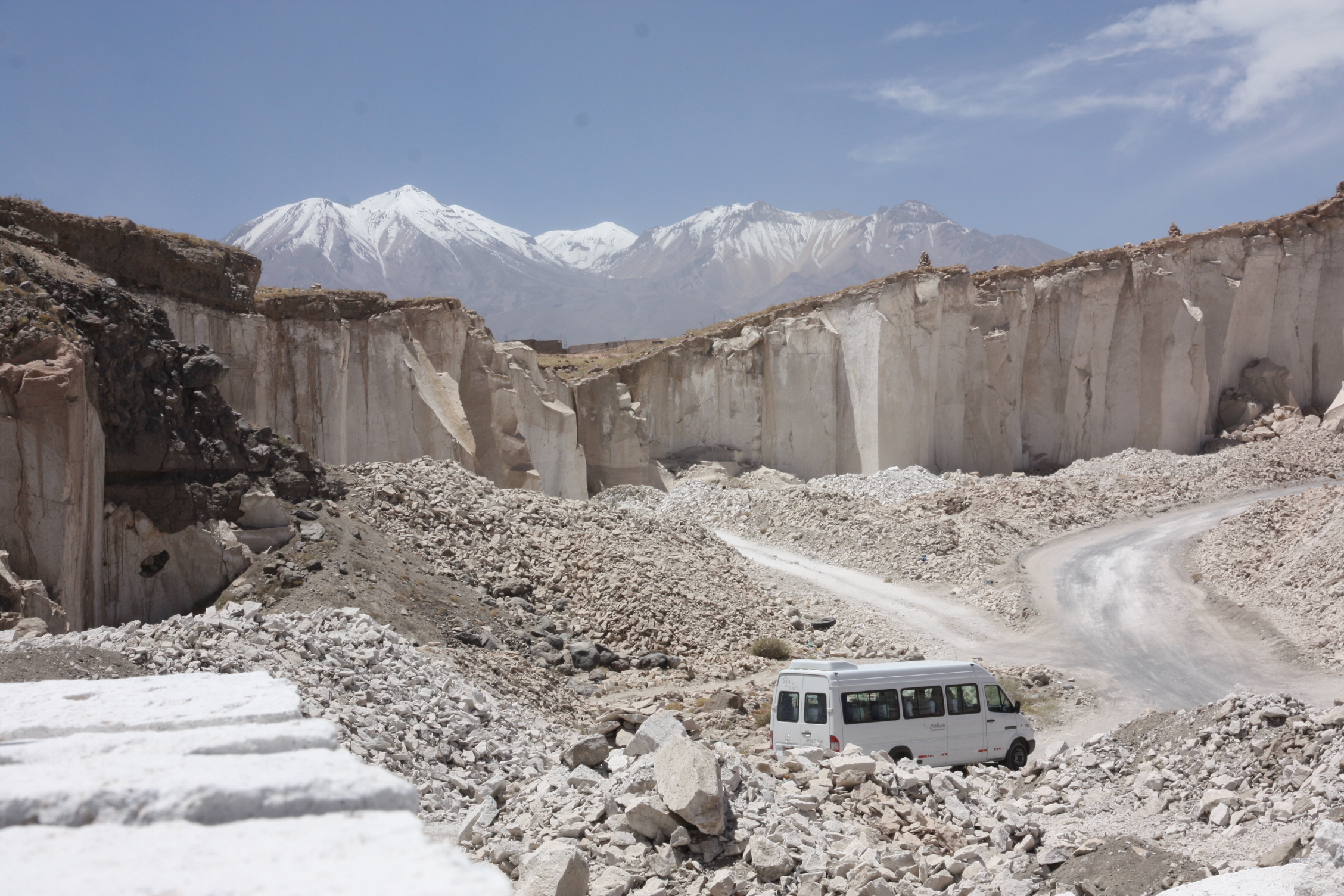
Our van is dwarfed by the sillar mine, and Mt Misti in the background
Sillar is volcanic stone. It is extracted in a traditional way, and later used to build houses, fences and other structures. Most of Arequipa seems to be built of it.
We arrived around lunchtime and it took quite a while to find miners who had not yet knocked off for their midday meal.
The two we did find were most happy to demonstrate how the sillar is cut.
They start with a largish block that is then broken into smaller pieces with a hammer and chisel. The reduced pieces are halved and those halves are then trimmed to size with a mini sledgehammer. Apparently sillar is quite easy to work with at first, but it becomes harder as time passes.
Miners make about 200 blocks a fortnight and sell them for about $2 a piece. Each block weighs about 40-45 kilos.
The mine appears to be unsupervised and that anyone who wants to mine can do so, but we were pretty sure there must be some regulations that govern the extraction. That said, it was eerie when we arrived. There was no entrance and no gate. We just drove in. In addition to a lack of security, there wasn’t much in the way of occupational health and safety.
We were also surprised to see that the acres and acres of small chips of sillar go unused—they’re not even further broken down for gravel.
The outing was fascinating in every way, and I hope more cities think of adding reality tours. We need to get out of our comfort zones.
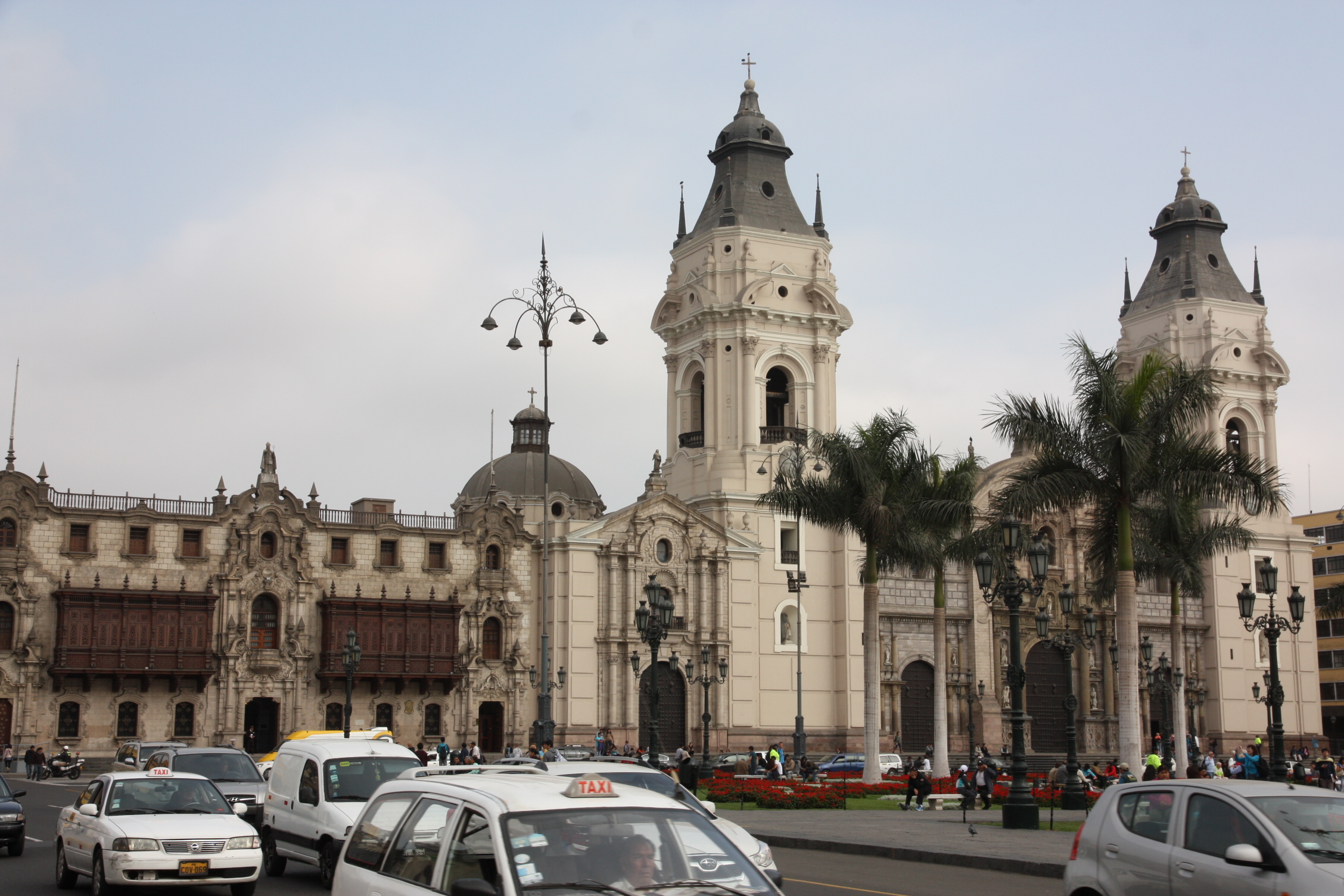
Palace on the left and cathedral on the right
It’s a package deal to visit the Archbishop’s Palace and Museum, and the Lima Cathedral with its Museum of Religious Art.
The one-for-two admission ticket is a good way to get 30 soles ($12) out of a person in one hit, but don’t go late in the day because the tickets are good for a single day only.
Poor John and I saved our visit until the morning of our last full day in Lima, so we had plenty of time to get our moneys worth.
The palace and cathedral sit side-by-side, facing Plaza Mayor, the city’s main square.
Our first stop was the palace. Built in 1924, the current residence is considered a prime example of neo-colonial architectural that developed in Lima during the early 20th century. It replaced an earlier structure that was in disrepair and demolished.
Today the palace serves as the Archbishop’s residence, the administrative headquarters for the Roman Catholic Archdiocese of Lima, and headquarters for the cardinal of Peru.

Entryway
It is a beautiful building. The façade is made up of baroque elements, and built of re-integrated rock. Ornate cedar balconies frame the main entrance. As you enter, there is an illuminated ceiling that allows the entryway (with its marble staircases and wooden handrails) to be flooded with light.
Downstairs is a collection of religious artworks. I admit to being rather sick of religious art, but I did like the intricately carved panels on display.
The rooms upstairs are spectacular. The furniture, drapes, carpets, lights, colour schemes are all beautiful, without being over the top. It’s hard to imagine that anyone lives there. Perhaps my entry fee pays for someone to dust and pick up after the archbishop.
Then it was off to the cathedral, which I somehow have no pictures of. Must have been forbidden.

Central courtyard
We spent almost a week in Quito, Ecuador, so had plenty of time to explore some of the lesser-known touristic sights. That’s how we happened to come upon the Casa Museo María Augusta Urrutia on a weekend morning when most of the city is out and about being seen.
This 19th century mansion belonged to Maria August Urruita, a well-known Ecuadorian philanthropist who focused on helping the poor, especially children and their families.
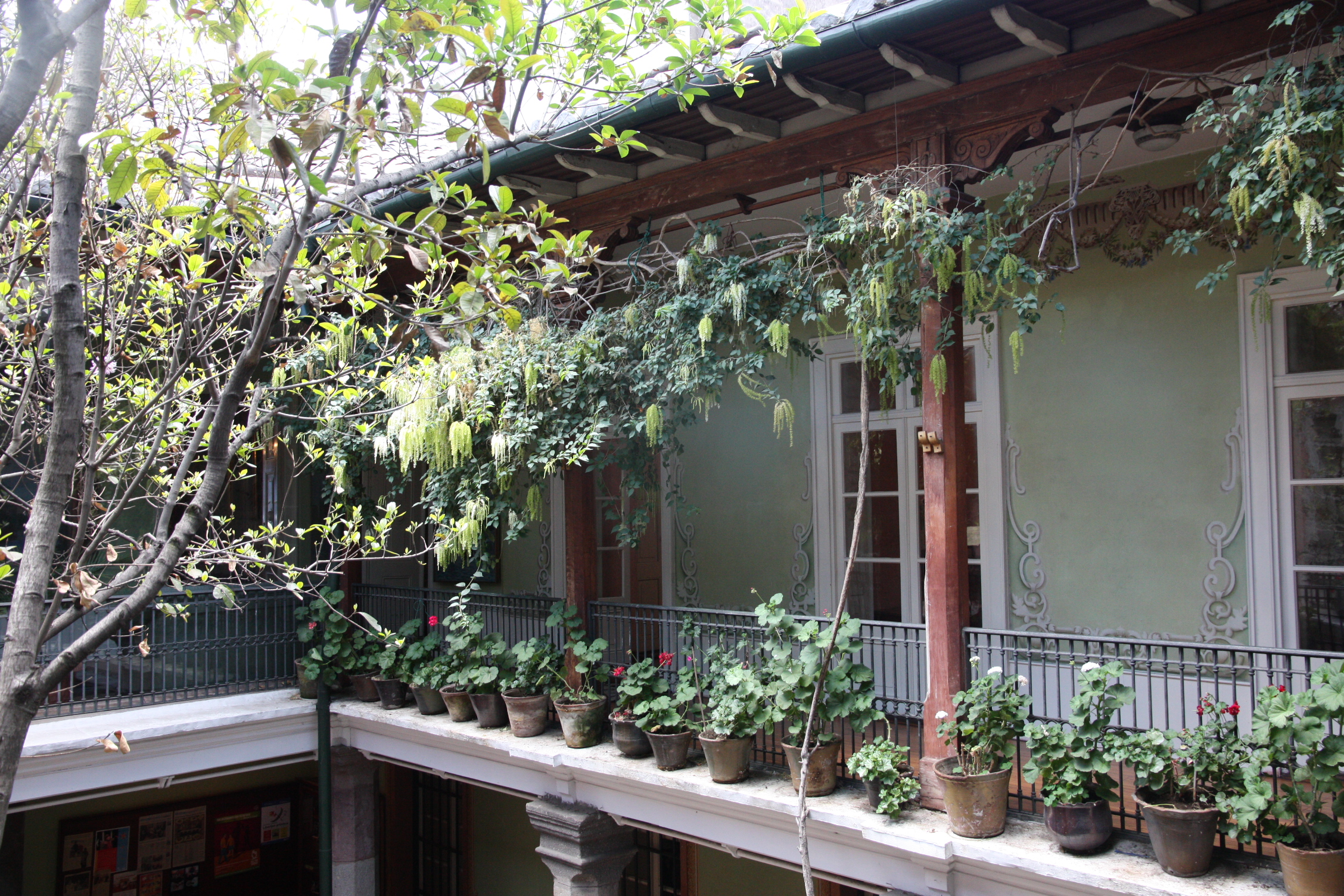
Upstairs terrace
Born to a wealthy family in 1901, Doña Maria married young and became a young widow. The mansion, which had belonged to her husband, was put to good use after his death as a place for feeding and schooling the young poor. Doña Maria also continued to live there alone with 24 servants until her death in 1987.
Guided tours are now offered around the house, with an admission of about $2 person. Many rooms remain virtually untouched, and provide a fascinating glimpse of how Quito’s upper classes lived in the 20th century.

The guide said the blossoms of this unusual plant die if anyone touches them
We saw the kitchen, with a huge old German range and lots of copper pots; the dining room, crammed with crystal chandeliers, French china, silver tea services and other family heirlooms; the grand drawing room, with fancy gilded furniture imported from Europe; as well as Doña Maria’s bedroom and that of her maid. Interestingly, the maid’s bedroom is the larger and more lavishly furnished.
The bathroom was closed for repairs (the ceiling is falling), but it is said to have beautiful hand-painted glass and fittings imported from England.
Photos were allowed only in the courtyards.
Fundación Mariana de Jesús, the charity founded by Doña Maria in the 1930s, owns the house now. The organisation strives to alleviate poverty in Quito.

Libby all suited up for an interview
I’m delighted to report that for the third year in a row, Libby, one of our daughters, is taking part in Frocktober. The deal/challenge is to wear a dress or skirt for every day of the month of October.
This annual event helps to raise money for the Ovarian Cancer Research Foundation in Australia. Ovarian cancer is not detected through pap smears.
Although Libby doesn’t work at the National Museum of Australia any more (she moved to Sydney), she’s part of the National Museum of Frocks team and trotting out the frocks with a bevy of former colleagues.
The team hopes to collect $3000 and they’ve already reached $2200, but the month is almost over. I’m off to do my bit now.
Here are some useful links.
Fashionistas from Frocktober 2013—fun pics and commentary
I’ve been through the pics and noticed that Libby has ‘ahem’ appropriated some of my jewelry as accessories this year. With my blessings. 🙂
Fashions from Frocktober in 2011 and 2011—fun pics and commentary
If you scroll down just a bit on this site, you’ll see a token picture of me wearing a skirt, taken last October in Bangkok. There will be no repeat this year. I wore a dress once in August. That’s enough.
To make a donation on behalf of the National Museum of Frocks participants

Cloisters and courtyard
After a couple of months in South America, I’m pretty churched out, but every now and then a religious location captures my interest and admiration.
The Church and Convent of Santo Domingo in Lima is one of those ‘hidden’ wonders, and I’ve been surprised how hard it is to find information about this location.
Two reputable guidebooks don’t mention it at all and it’s very hard to find anything online, except for one very lengthy piece in Spanish. The very little I found in English seems to have been written in gibberish, or badly translated from a Spanish source.
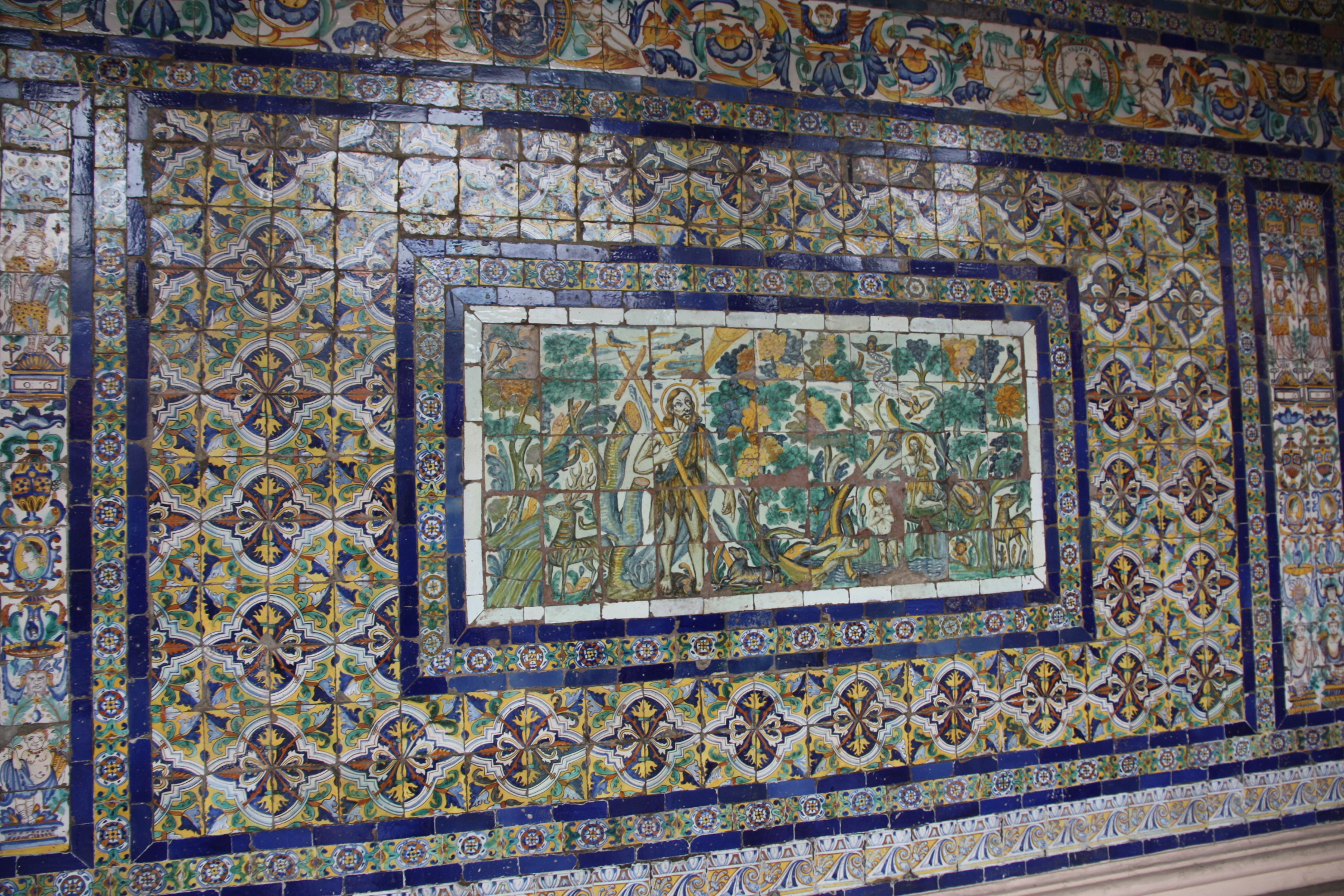
Spanish tiles
That said, maybe I’m looking in the wrong places and under the wrong names, because I have seen it referred to as a basilica, monastery, convent, church and more. In any event, my details here may be inaccurate.
Regardless, it is certainly worth a visit. The day we went, there was a huge banner hung outside advertising the Convento Santo Domingo part of the complex, so I’m going to assume the ‘owners’ of the place know who they are.
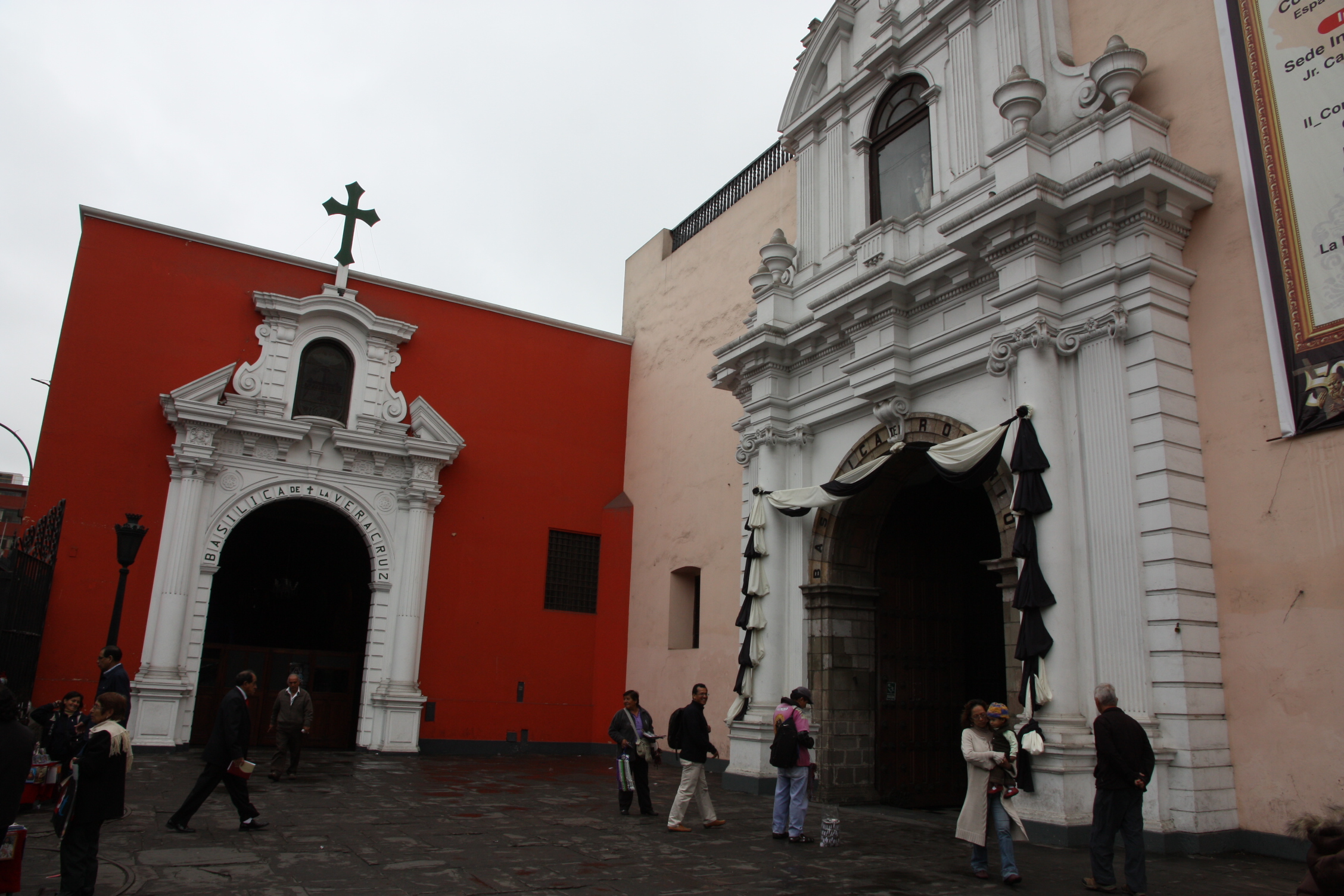
Entrance on right
We paid our 5 soles (about $2) admission and entered this vast pink building (climbing the bell tower was not an option on our day).
Built in about the mid-1500s on land granted to the Dominican Friar Vicente de Valverde, the church/convent has been rebuilt and remodeled many times over the centuries.
The convent has beautiful gardens, courtyards and cloisters. The church itself has three naves.
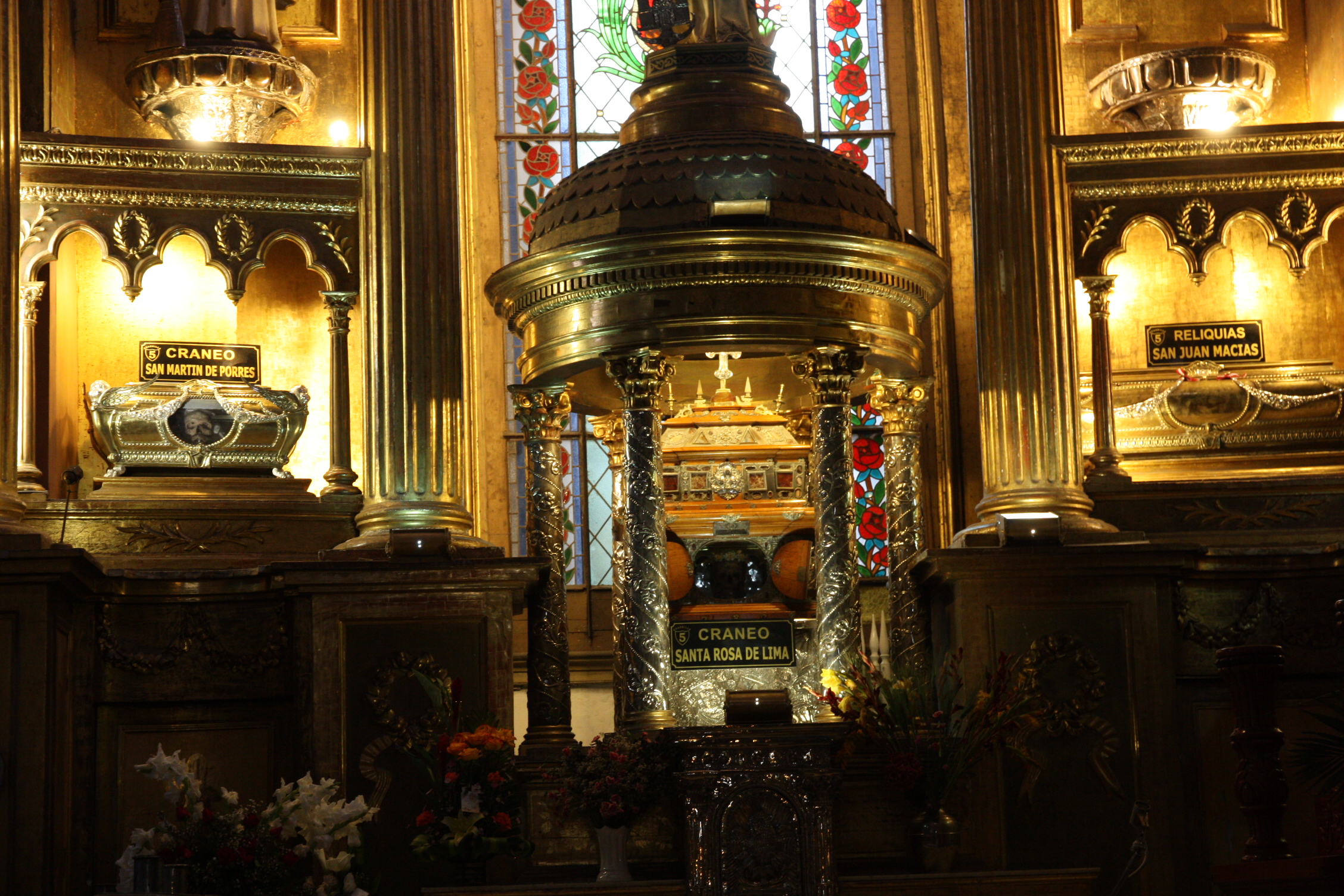
The relic skulls
A big claim to fame (and the reason I find the lack of information so surprising) is that the convent has the tombs of three important Peruvian saints: San Juan Macías, Santa Rosa de Lima and San Martín de Porres (the continent’s first black saint).
In fact, the church has the more cherished relics—the skulls of San Martin and Santa Rosa, displayed in glass cases to the right of the main alter.
But my favourite spots within the church and convent were the many courtyards and cloisters and the Spanish-style patios with their colourful array of Moorish tiles brought from Spain.
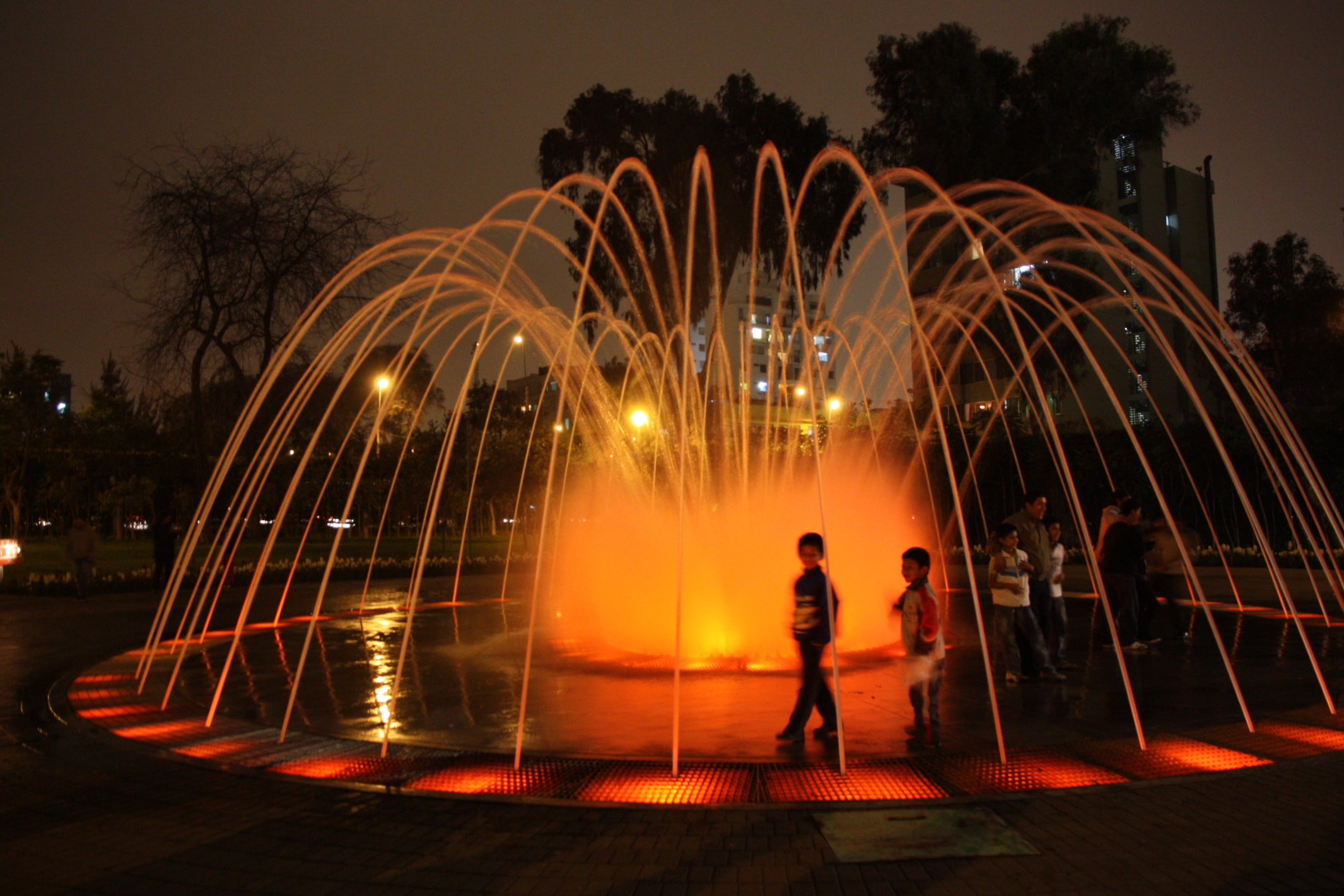
An interactive fountain
Seven passengers joined the overland trip in Lima and one of our first group outings was to the city’s Magic Water Tour at the Park of the Reserve.
What a showpiece!
The Magic Water Tour is the current record holder for the largest fountain complex in the world. With 13 distinct fountains spread over eight hectares, the tour opened in 2007 and had 2 million visitors within nine months. It was packed the night we were there.
All of the fountains are lit at night, many with continuously changing color schemes. The largest one, known as the Magic Fountain, ‘performs’ every half hour or so after dark. It has a jet that can shoot water 80 metres in the air. Sadly I couldn’t get a decent photo of it.

One of 13 fountains
Other highlights include the Children’s Fountain that kids can walk and run around in, the 35-metre Tunnel Fountain of Surprises that people can stroll through, and the 120-metre-long Fantasia Fountain with a light show that is synchronised to music. There is also a tunnel connecting the two sections of the park, which contains an exhibition highlighting recent public works projects in Lima.
There has been controversy surrounding the park, mostly because its construction altered an already historically significant park. Critics also complained about the new entrance fee (about $2 for anyone 5 years of age and older).

Pisco being aged
No trip to the Pisco Region of Peru is complete without a side trip to a pisco vineyard.
This grape brandy has been being produced in Peru and Chile since the 16th century when Spanish settlers developed it as an alternative to a brandy being shipped from Spain.
The first vineyards were planted in Peru, with plants from the Canary Islands. There is plenty of disagreement about the origin of the name pisco. It may be named after a town, a river, a bay, a valley, a Quechua word for bird or a Spanish word for mud container. The latter has some merit in that the vineyard we visited still ages its pisco in earthenware pots.
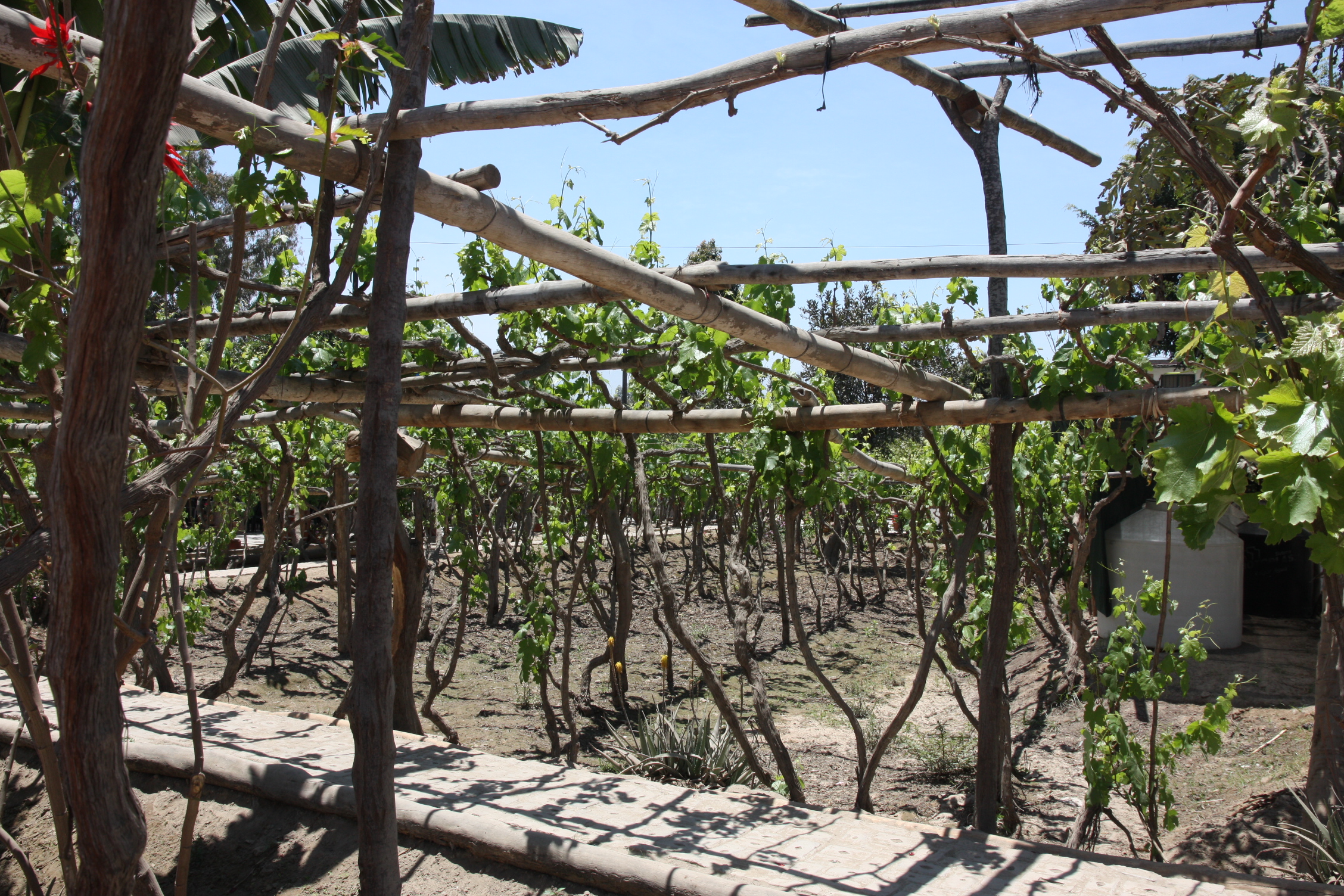
Pisco vineyard
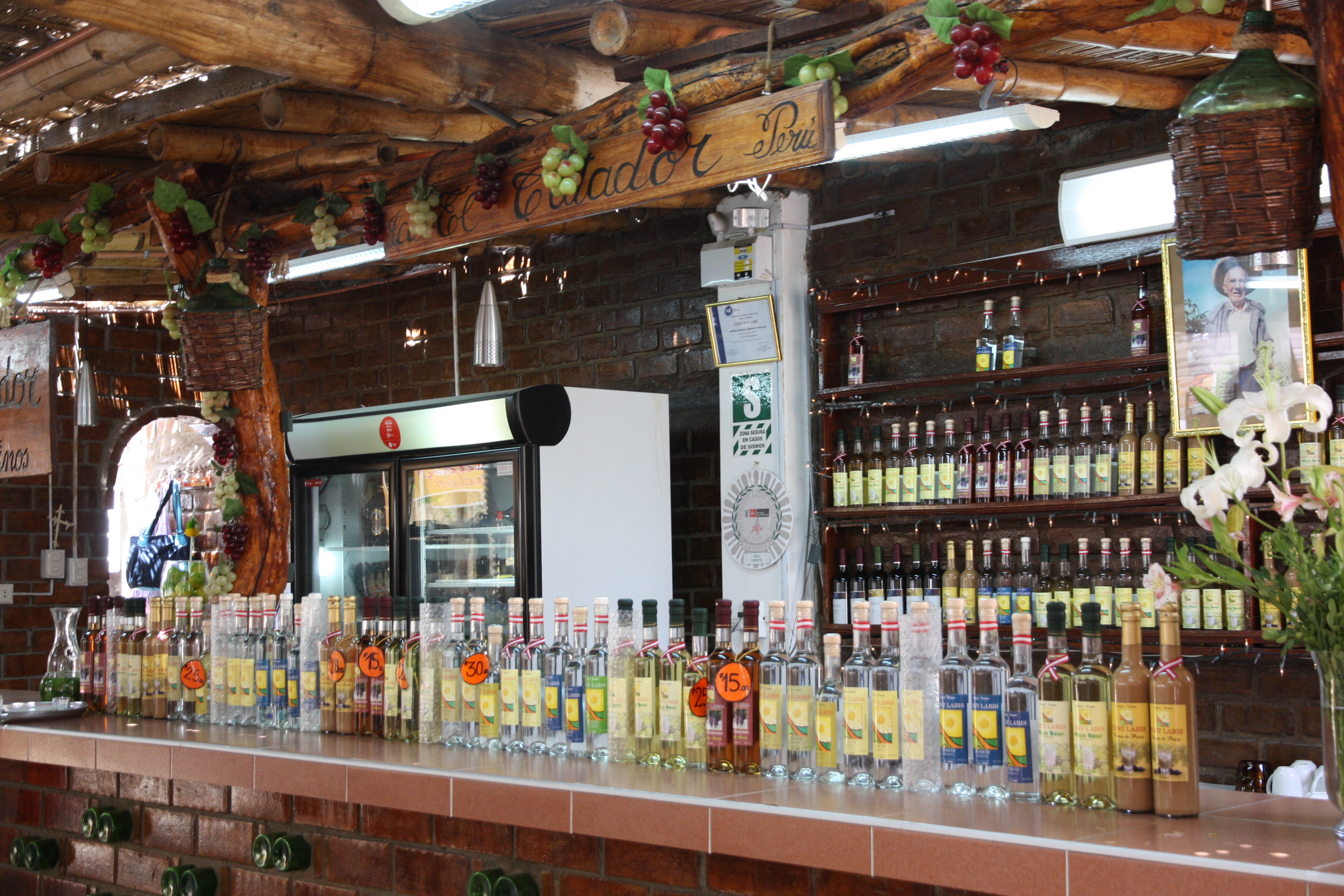
Plenty of pisco choices
Peru claims the exclusive right to the use of the pisco label name (in the way that France holds the exclusive right to use the term champagne), but large-market countries such as the USA, Mexico, Canada and Australia allow Chilean products to be identified as ‘Chilean pisco’.
Our visit included a tasting of various kinds of pisco, including some already mixed to cocktail stage.
I was tempted to buy a bottle of a pre-made pisco sour which is, not surprisingly, the sourest of them all. This drink is Peru’s national cocktail and is prepared with egg white, lime juice, simple syrup and bitters.
Many years ago, our dear friend, Ken, introduced us to pisco sours. I had forgotten that they were so tasty, but I won’t forget again.
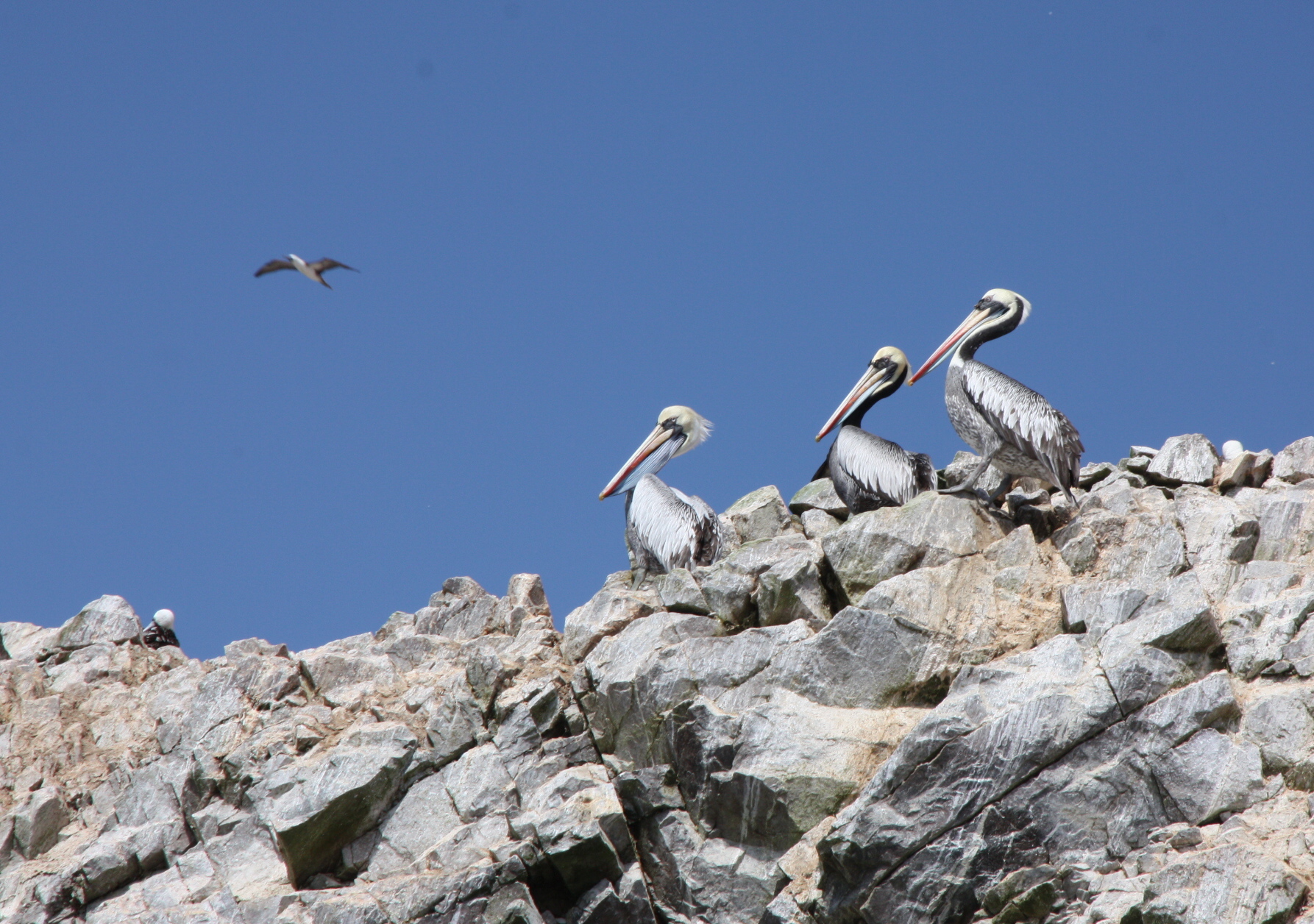
Peruvian pelicans on Ballestas Islands
It’s amazing how many places we go on this overland journey that I’ve never heard of before. The Ballestas Islands and Paracas Candelabra are good examples.
Located on the south coast of Peru, these two landmarks are near the town of Paracas in the Pisco Province of the Ica Region.
The small group of Ballestras Islands are about an hour’s boat ride from Paracas and home to a great variety of wildlife. With more than 160 species of marine birds, including Humboldt penguins, cormorants, and Peruvian boobies and pelicans, the Ballestas almost qualify as a mini Galapagos. The seas around the islands are rich in creel and provide safe breeding and/or feeding grounds for sea lions, fur seals, dolphins and whales.
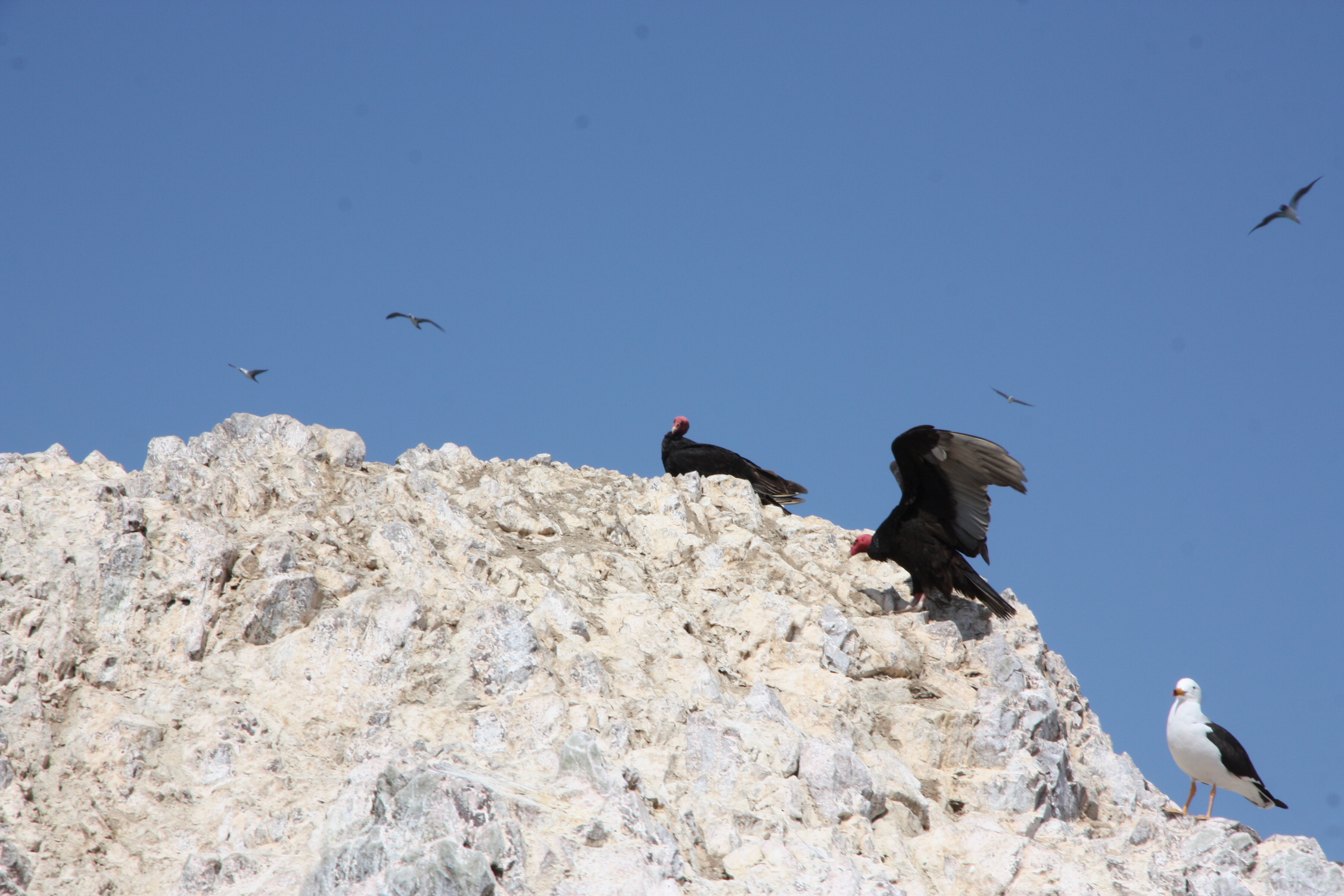
But it’s the birds that made Ballestras famous and profitable. Probably for centuries, they’ve pooped to their hearts’ content and created mountains of guano, which can be gathered for fertiliser. Our guide said that when the islands were first discovered, the guano was 20 metres thick. It became Peru’s main industry of the time. Even now there are a few guano factories on the island. Tourists, however, may not come ashore.
On the way to the islands (and the only way to get to them is by boat), we saw the gigantic Paracas Candelabra on the Paracas Peninsula.
At first I thought it was some sort of promotional gimmick dug in the sand. But the guide set us straight. It’s a 595-foot tall geoglyph that is visible from 12 miles out to sea. Geoglyphs are works of art that were made by moving or arranging stones, soil or other objects within a landscape.
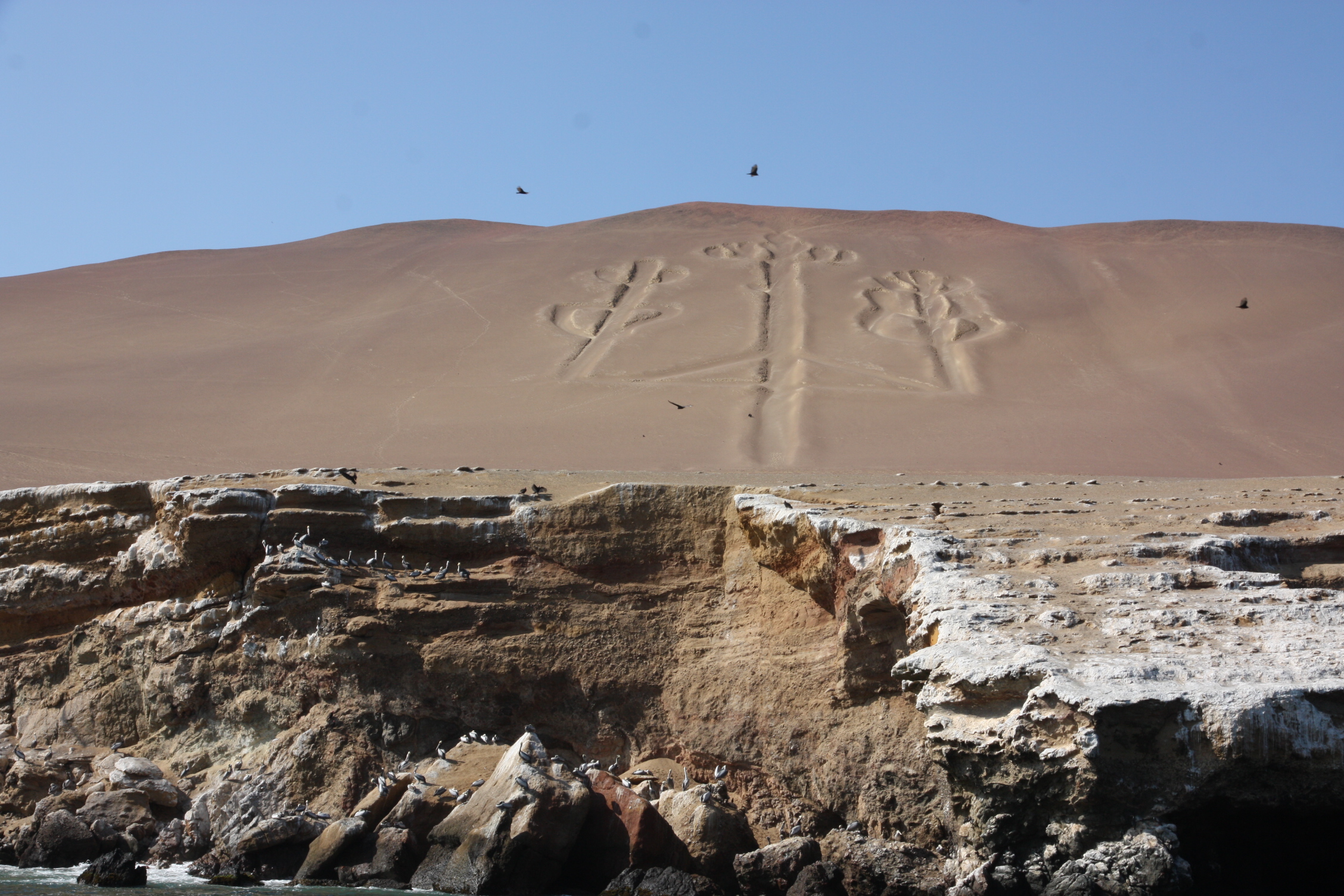
Paracas Candelabra
This one is made of 2-foot deep trenches carved into the hillside. Stones have been used to mark its edges.
No one knows the exact age or reason for the Paracas Candelabra, but archaeologists have found pottery around the site dating back to around 200 BC.
Local tradition says it represents a lightning rod or the staff of the god Viracocha, who was worshipped throughout South America.
After we returned to Paracas, we popped in to a beachside restaurant and asked about the price of a beer. A shocking 12 soles, or almost $5. ‘How come so much?’ we asked. ‘Because we serve such great food.’ ‘But we’re not eating.’
It was an exchange made in good humour, but we went round the corner (one street back from the main drag) where beers were just 3 soles. It pays to shop around.
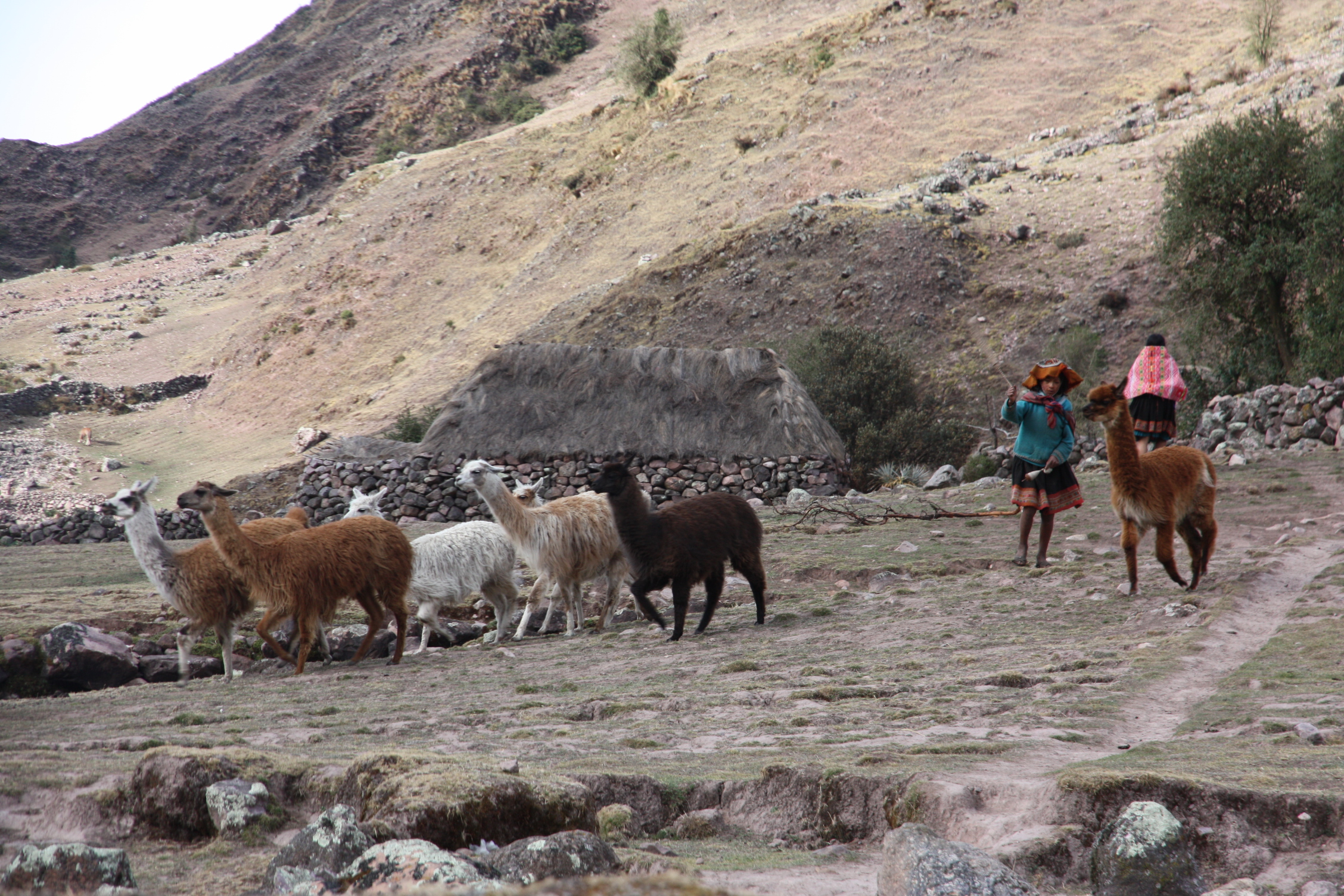
Llama duty begins
Day 3 had a late start—7:30 for breakfast and an 8:15 departure.
We’re all so used to getting up early, that there was a little resistance to ‘sleeping in’. But Odon, our guide, assured us that if we descended too quickly we’d reach the village at the end of the trek and have too much time with nothing to do.
As with Day 2, our wake-up call was cups of coca tea and washbasins placed just outside our tents. Then it was time to pack up our gear before a breakfast of pancakes—which are spelt panqueques in Spanish.
The late start had some special benefits.
For starters, we saw the women of the village set out for the day with their flocks of llamas and alpacas. I suppose visitors to Peru think these women ‘dress up’ for the tourists, but their every day clothes are colourful skirts and shawls. And in spite of the chilly temperatures, they wear sandals without socks or stockings.
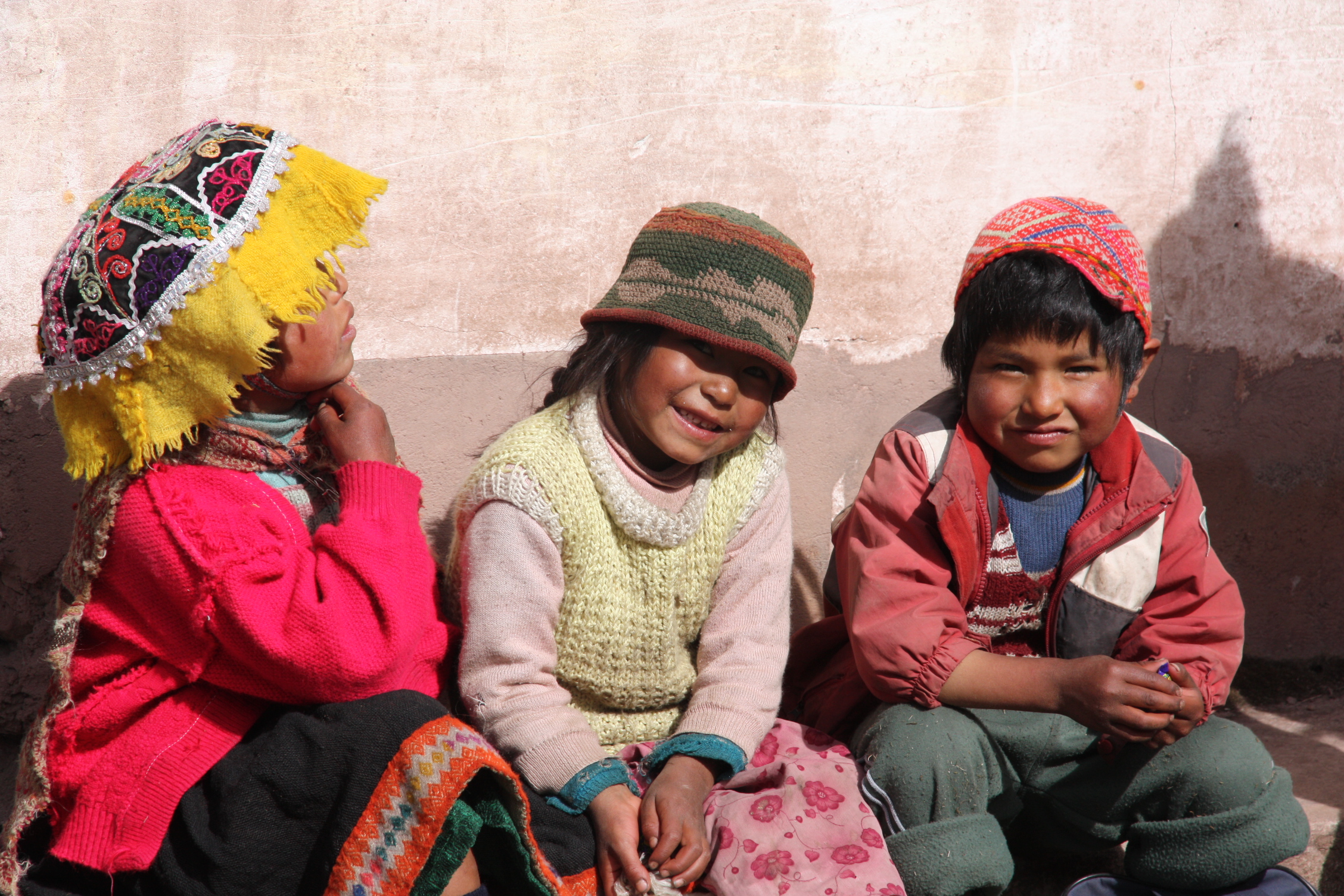
Waiting for school to start
Our tents were set up in the schoolyard, so we also got to see the children arriving for the day. Apparently the school may close soon. While there are plenty of kids in the area, most don’t come to school. They help in the potato fields instead. The children we saw were all quite young.
Our support team used the school kitchen to prepare our meals, but it is really just a room with a table, some chairs, workspace and a cooker. The toilet block behind the school had four stalls—three long-drops and what we think of as a normal toilet (without a seat).
Our trek this day was 8 kilometres downhill. There’s nothing easy about hiking down steep, gravely hills. Walking sticks help with balance and grip, and I think a person would be crazy to try the descent without something to hang on to. And the horses aren’t available on these stretches. They have their own challenge getting down.
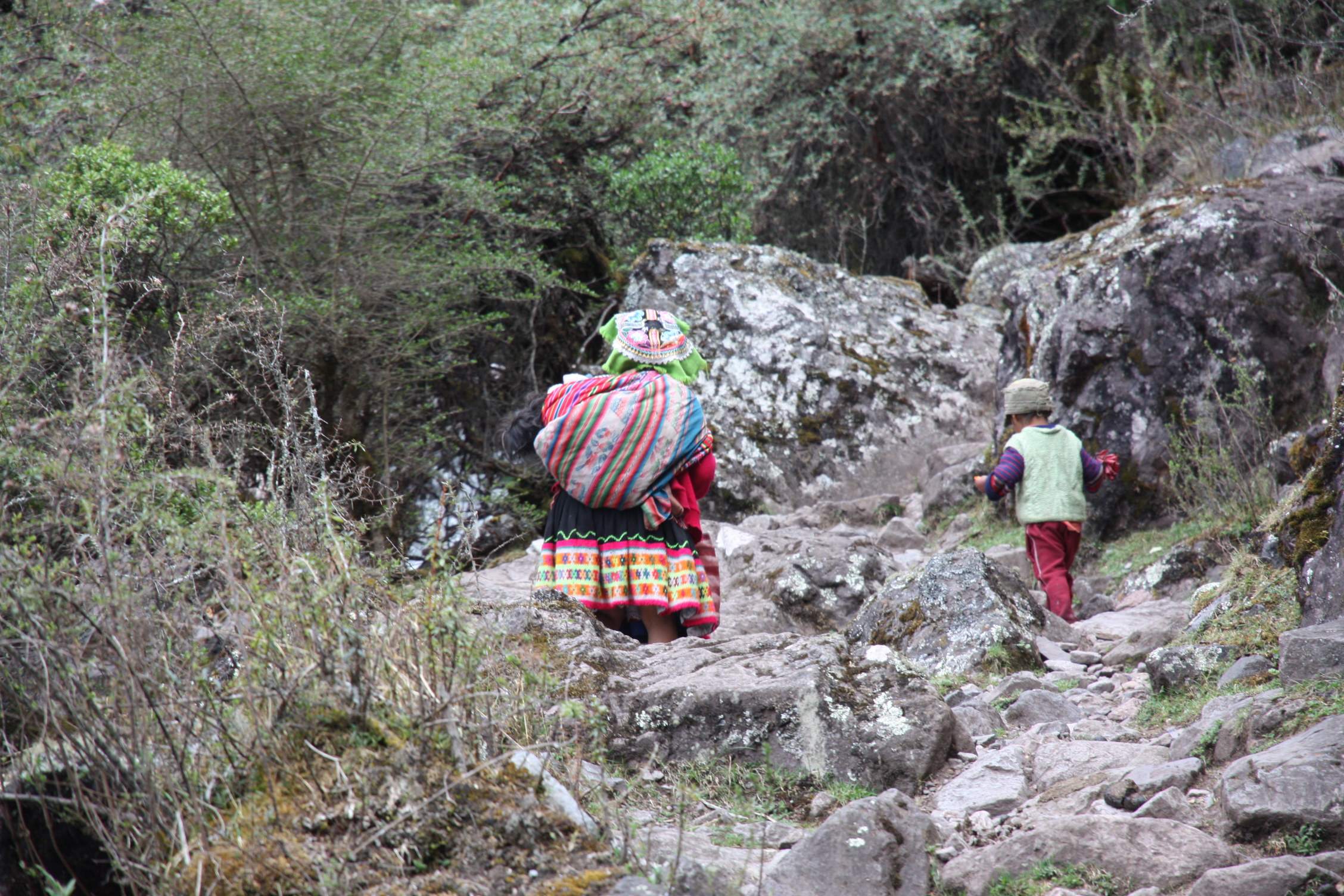
Quechua woman carrying a toddler on her back
Once again, most of the occasional steps had high risers and loose rocks. Plus the Andes are full of streams so there was a lot of running water across the path.
We encountered a few people on the path, including a group of women butchering a sheep, and a woman walking effortlessly uphill with her toddler tied to her back and an older child at her side. I just stared in disbelief, but was quick enough to get a snap.
Of course, once again the scenery was sensational. As we got lower, there was a lot more plant life and I’ll do a separate item on flora.
From many kilometres away, we could see our final destination in the valley below. At first I thought we were aiming for a green lake, but it was actually lush fields of crops.
Lunch was served in the village and then it was our chance to say goodbye to and tip our support team (except Odon who would travel on with us for another day to Machu Picchu). Angie and I gave Francisco a bonus for being our horseman the day before.
After our farewells, it was into a van and then on to a train to Aguas Calientes, the town below Machu Picchu. We were staying a hostel this night, with real beds and the best shower head we’d had since starting this overland. Pure luxury and most welcome given that we needed to be up the next morning at 3:30 so we could board the first bus to Machu Picchu.
 Where to next?