
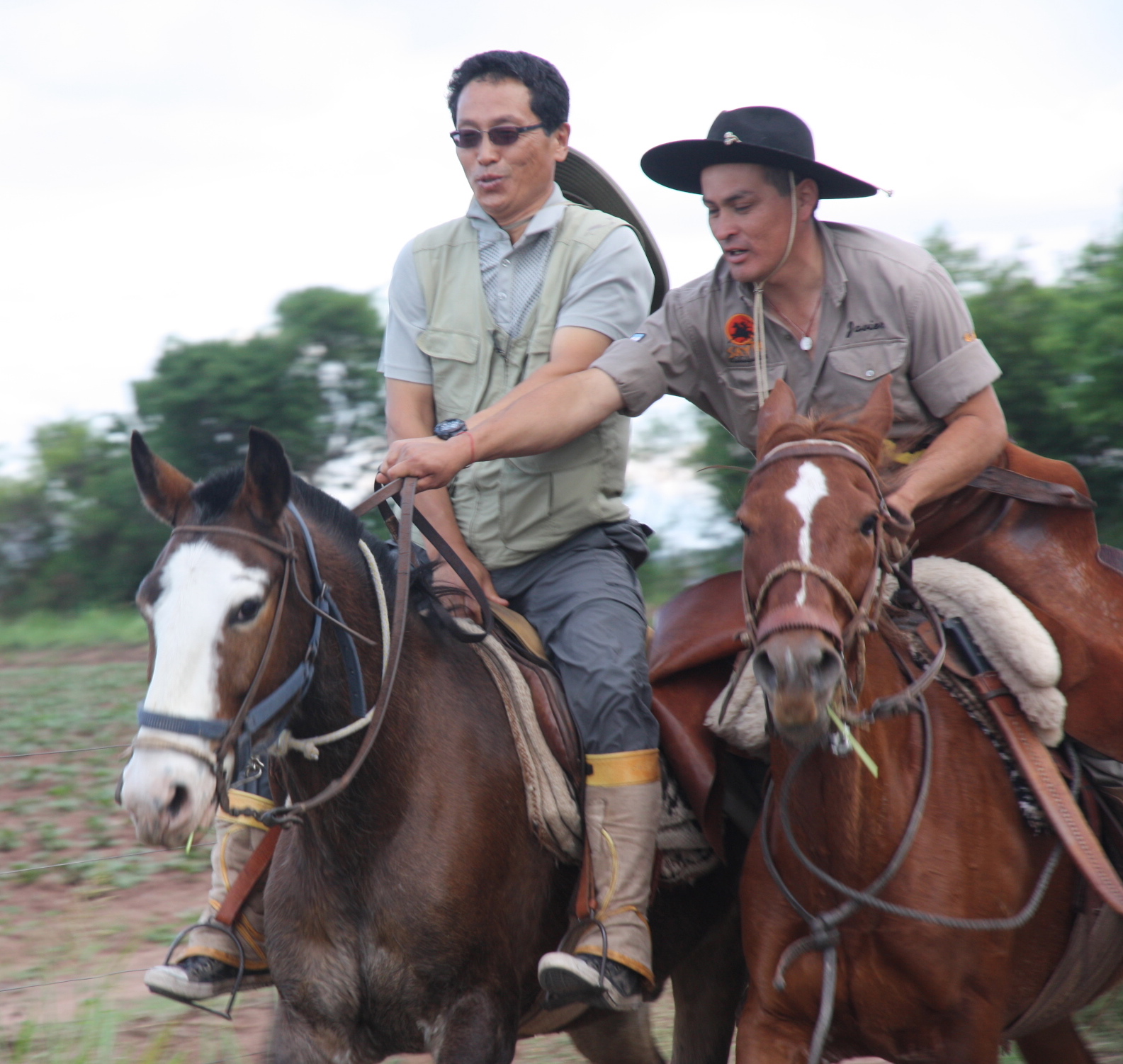
Jong tries horse riding for the first time in his life
Argentinian horses speak Spanish. Well, maybe they don’t speak it, but they certainly understand it. That’s why all the giddy-ups in the world won’t get their attention, but a single ‘vamos’ will.
In the company of several genuine gauchos, a whole group of us had the pleasure of ‘vamosing’ on horses from the Sayta ranch near Salta in northern Argentina.
We had a two-hour, gentle ride after a boozy lunch featuring delicious Argentinian beef—and the magical chimichurri sauce—and a wide selection of salad and vegetable dishes. To finish off the ride and once lunch had settled, we could have an escorted gallop—wouldn’t want anyone falling off and hurting themselves.
Sayta, which is run by the irascible Enrique, offers a variety of options for guests. We did lunch/beginner ride package because most of our companions had never ridden before, but you can opt for combined camping and trail rides that last for several days.
People can also bunk at Sayta and enjoy home-cooked meals and riding lessons.
We met Kylie, a British lass. After learning Spanish for a few weeks, she signed up to spend seven months as a volunteer on Sayta ranch. She’s especially delighted because she’s improving her Spanish along with her riding skills. I wonder if it’s something Poor John and I might do in future.
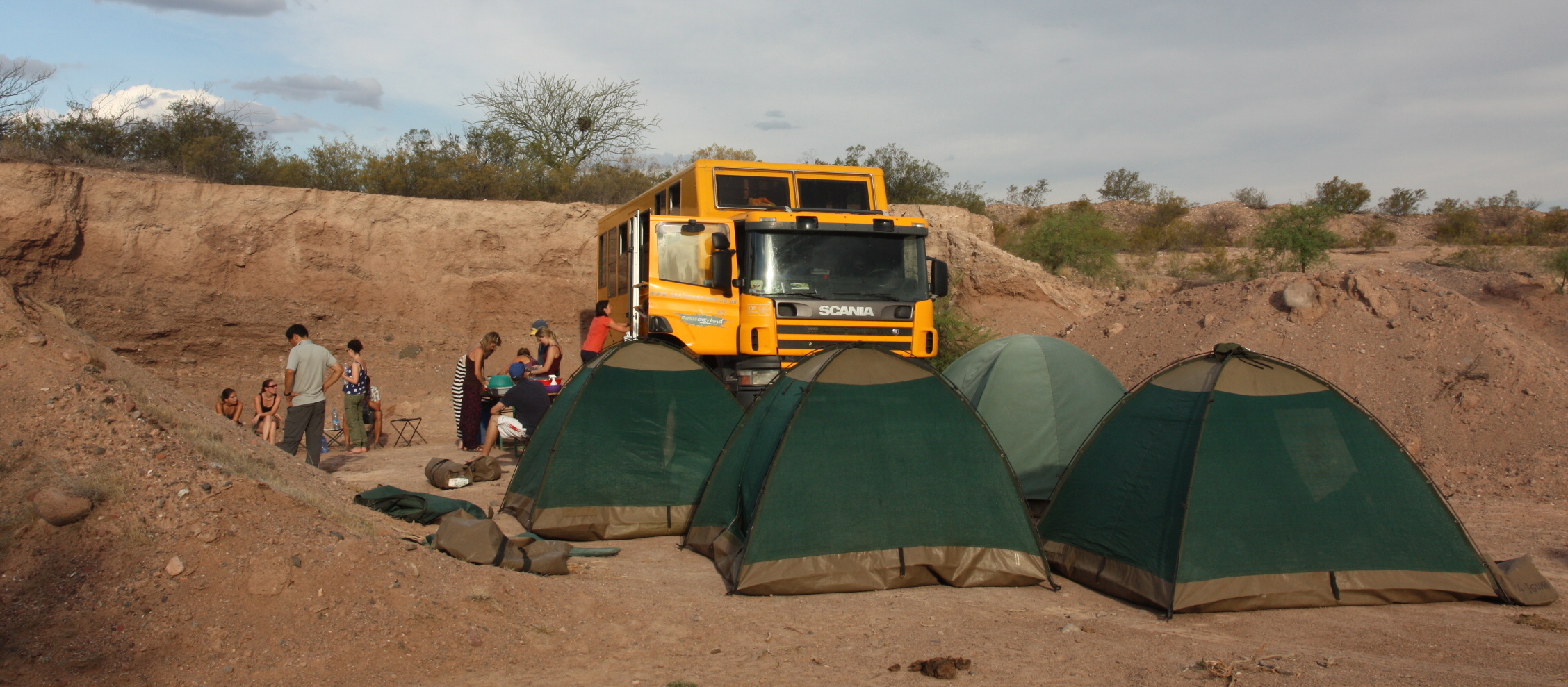
Bush camping in a quarry—always piles of rock to hide behind
When you’re travelling overland in remote parts of the world, your whole day can revolve around toilets or the lack of them.
The first question has to be—is there a toilet? It goes from there. Is it a hole in the ground, porcelain squat or ‘proper’ throne? If a throne, does it have a seat? Toilet seats are rare. Has it been stolen or do they leave it off so it isn’t stolen? Maybe it just broke and was never replaced? I’ve sat on a few cracked seats that viciously grabbed my thigh as I shifted to wipe. I recommend a close inspection before sitting, and a willingness to sit side-saddle if necessary.
But the questions continue. If there’s a toilet, does it flush? If it flushes, does it flush for every person or only occasionally? Is there toilet paper? Is the hypothetical paper in the actual cubicle or in a gigantic dispenser on the wall outside? I saw huge dispenser with the brand name of Willy. But woe to the person who forgets to collect a few sheets of paper from Willy on the way in. And if there is no toilet paper, is there a bum gun (I’m sure you can figure that one out)?
Speaking of toilet paper (as I did the other day)—in most far-flung places, don’t think of disposing of those little bits of tissue in a toilet. The pipes just can’t cope with great or even little gobs of toilet paper. The rule of thumb is that if there’s a bin near the toilet, you are meant to use it for the paper. If there’s already a pile of paper in the corner on the floor—well, just add to it.
But I digress.
If it’s a bush toilet stop, do I need to take a shovel? It pays to plan ahead. Also how high or wide does a bush or pile of soil or rocks need to be to shield a view of my bum? After a while, does anyone really care?
I always liked the story of Denise, a 73-year-old woman who was on the African trip a year before us. I heard about Denise after I told Chris, our driver in Africa, that people can do this kind of travel as long as their knees hold out. Oh no, said Chris, Denise managed just fine. He went on to explain that Denise travelled with her own toilet seat on legs. Chris said it was quite a sight to see her march into the bush with a shovel over one shoulder and the collapsed toilet seat under the other arm.
Denise was a no-nonsense kind of gal. But the truth is, some people seize up when expected to relieve themselves in ‘public’. This hesitation, which is rare in men, usually passes within a few days although some ‘suffer’ for months. That said, bush toilets are scary in Ethiopia. The locals seem to have a sort of radar that draws them to your side before you even have a chance to drop your daks.

A sightseeing stop—sometimes combined with a pee stop!
But for the most part, bush toilets have a lot of positives. Hygiene for starters! I’ve used toilets that would make your hair curl. I wrote about one such toilet, encountered when we took a rust bucket across the Caspian Sea from Azerbaijan to Turkmenistan.
I could fill a book with details of the bad toilets I’ve used in Africa, Asia and South America, as well as a few tales of luxury.
A memorable toilet in Gabon was simply a 12-inch square ‘hole’ in the middle of a circular concrete plinth. The plinth was about 12 inches thick and maybe 10 feet in diameter. It was in the middle of a much, much larger room. Unfortunately, a lot of women hadn’t bothered to get anywhere near the hole to do their business.
We hit luxury in a shopping centre in Angola. A marble-walled bathroom that was all light and mirrors. There were 10 stalls, deluxe sinks and toilets, hand dryers and copious amounts of paper towels and toilet paper. Being intrepid overlanders who never miss an opportunity, we washed our feet in the sink.
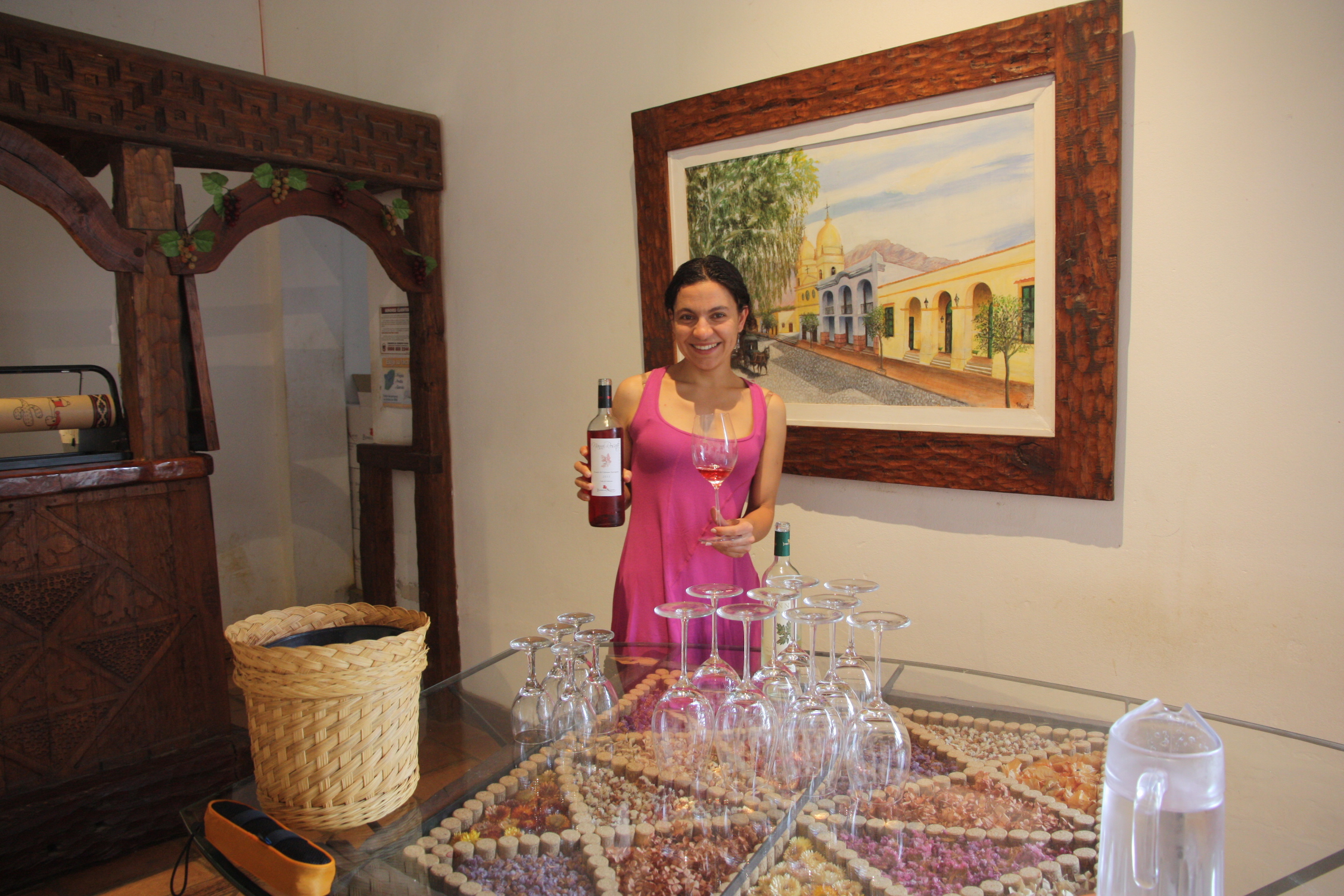
Cynthia shows off wines at the Nanni Estate in Cafayate
Argentina is well known its excellent wines and we had a chance to try them first-hand when we camped in Cafayate in the north.
While Mendoza is the country’s biggest wine producer—making about 75 per cent of the annual output—Cafayate is a more intimate and relaxed way to visit wineries.
Soon after arriving at the campground, Poor John and I headed in to town and the Museum of Wine. Located in an old winery, this museum is a tribute to the wines of the area. It opened fairly recently and it used to be free to enter. Admission now is rather expensive, especially considering that you don’t even get a taste of wine, but it was still interesting to read about the region and see the old wine-making equipment.
They are quite proud of the fact that, at 1750 metres, Cafayate has some of the highest vineyards in the world, which they claim helps them to produce more complex wines. They also credit their 340 sunny days per day.
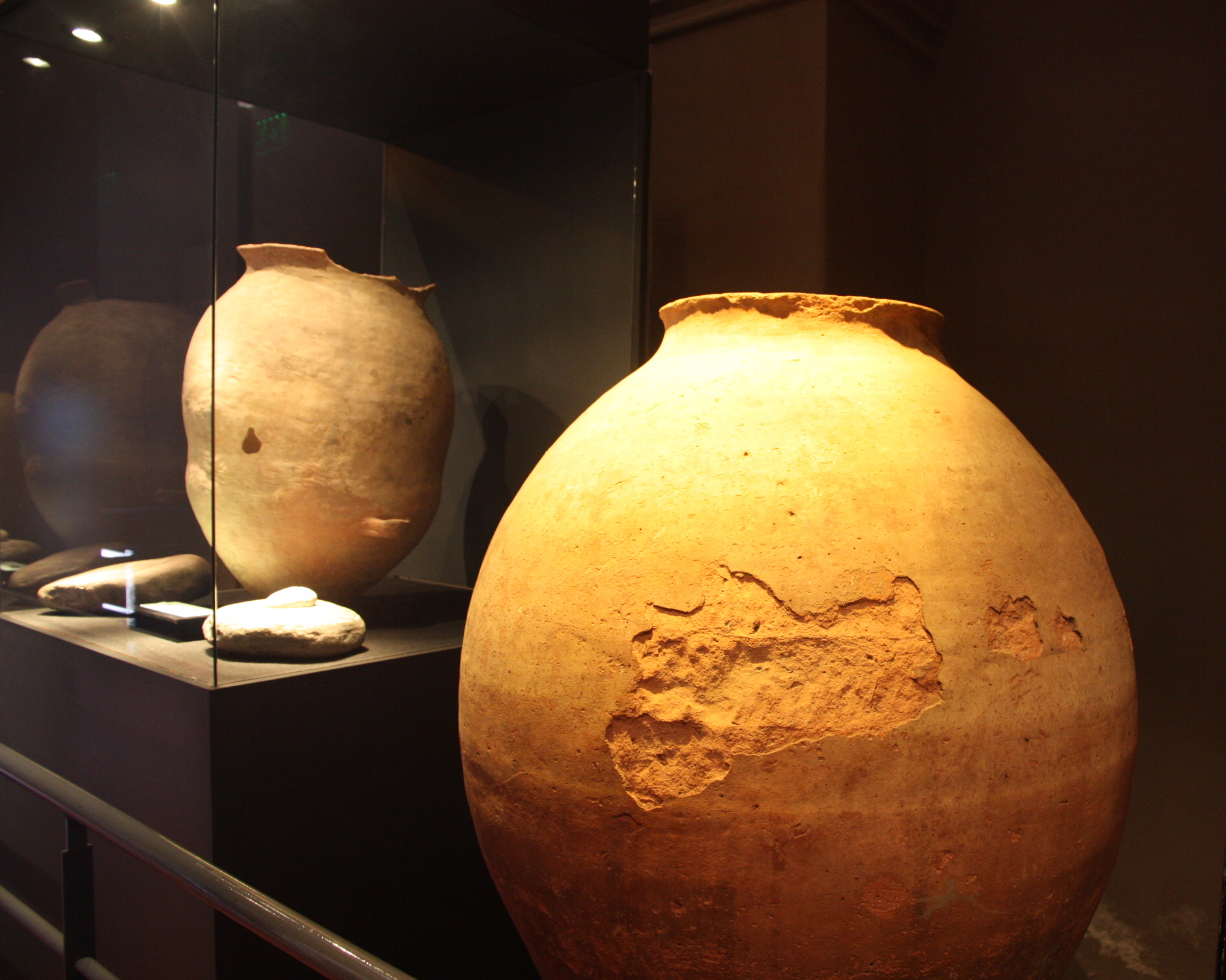
Pottery wine casks at the Museum of Wine
Torrontés is one of their claims to fame. This grape variety, brought from Spain many years ago, is used to make a white wine that fools you. It smells sweet and fruity—almost like apple juice—but has a lovely dry finish.
I got to taste it the next day when we visited the Nanni Winery. Cynthia offered four wines for tasting—torrontés, a rosé, a red (tannat) and a late harvest white.
I usually don’t care for sweet or dessert wines, but that late harvest white blew my socks off. It reminded me of the sensational icewine I tried in Toronto. I didn’t buy a bottle, simply because I knew it would be impossible to keep it cold, but I can still savour the taste.
I did buy a bottle of the tannat, which is tucked away in my locker for a special occasion.
Everyone did some wine-tasting on our second day in Cafayate. Those who hired bikes to travel farther afield were challenged by a 6-kilometre hill they had to ride up. They swear the ride down made it all worth it, but I have my doubts. 🙂
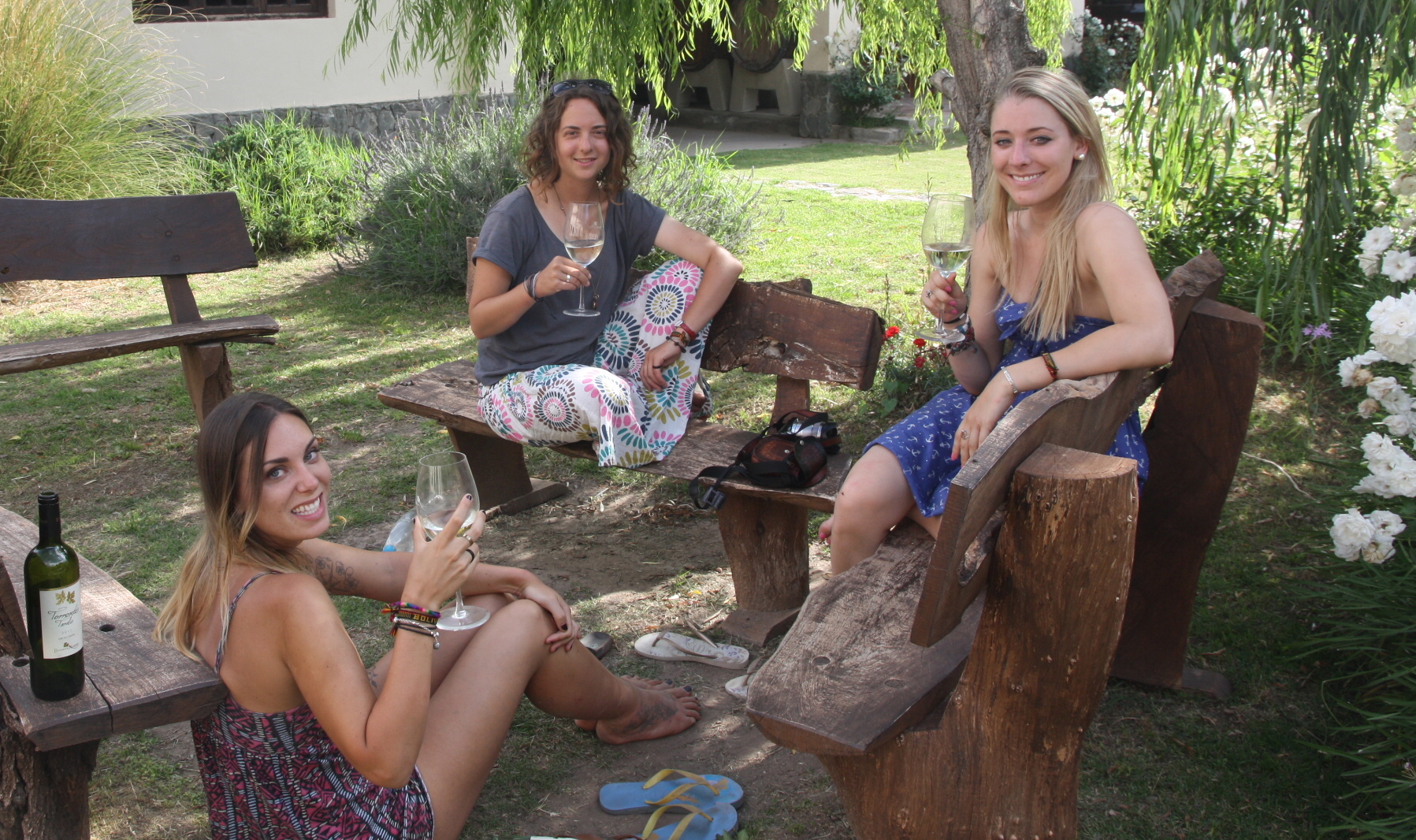
Rael, Louisa and Lauren sample the late harvest white at Nanni Winery
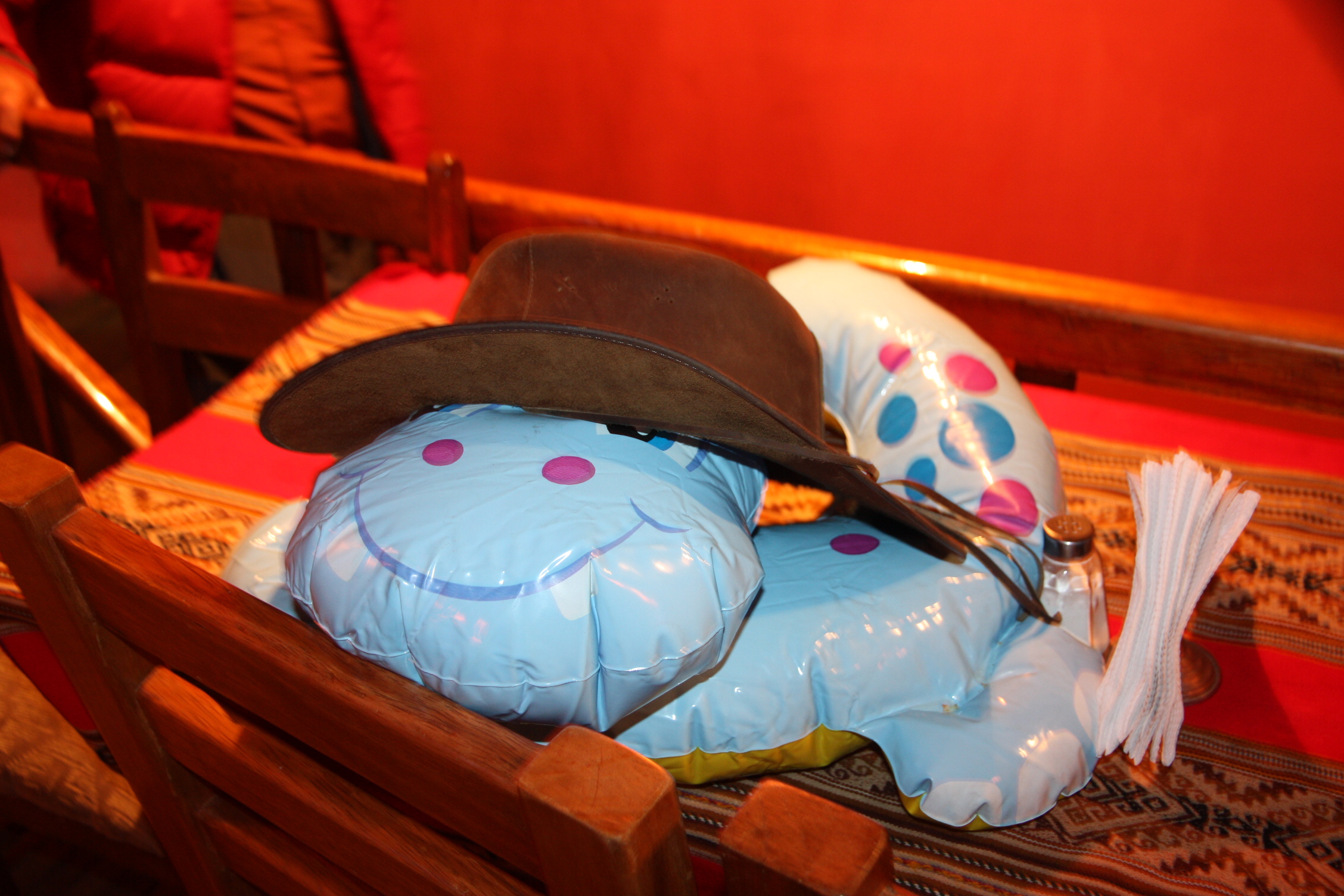
Hippy sits and smiles quietly in a posh restaurant
There’s a quick and surefire way to upset an overland driver? Just call his/her pride and joy—their baby—a bus instead of a truck.
The bus versus truck usage has been an issue on all of our overland journeys. I’ve seen drivers—even big guys—cringe, gnash their teeth, sweat, cry and convulse when the B-word is mentioned in relation to their baby. It grates on me too.
It’s a truck, not a bus, is the ongoing cry.
Actually, it confounds me how people can make the same mistake over and over again. We’ve all learned to say please and thank you without missing a beat. Surely it’s not that hard to learn to say truck instead of bus?
Amusingly, our current overland journey has had a small ‘penalty’ for saying the B-word. Offenders get to carry/wear Hippy until someone else utters the forbidden three-letter word.
I’m guessing that at least three-quarters of the passengers on this trip have escorted Hippy at least once. Some seem to have him all the time.
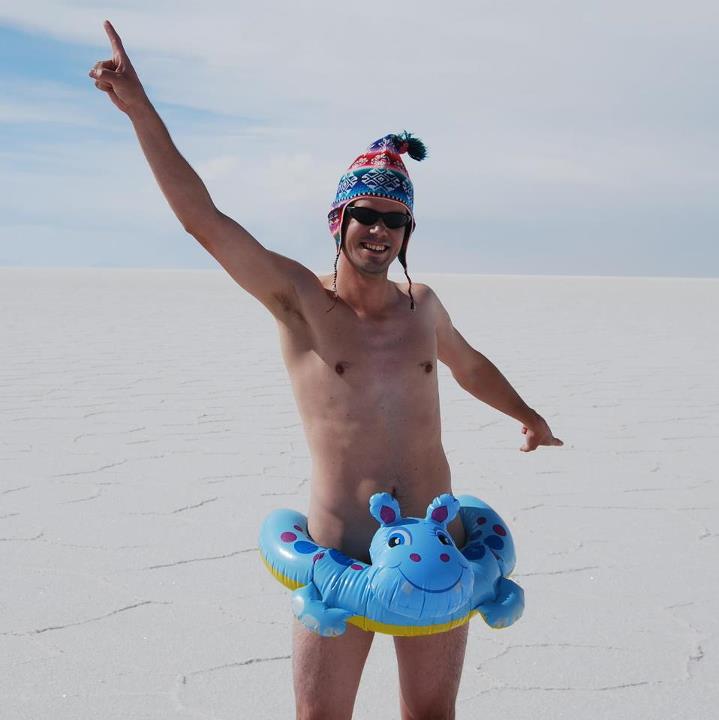
Tom and Hippy on a trip to the salt flats in Bolivia. Photo by Julia
No doubt about it, Hippy is adventurous! He’s done a variety of extreme sports, been to fancy restaurants and provided modesty on the salt flats of Bolivia—always smiling his special smile.
But his rambunctious nature has been harmful to his health. We’re on our second blow-up Hippy. I wonder how many Hippy brothers Sammy has tucked away in the cab of the TRUCK because we’re due for a new one?
As expected, neither Poor John nor I have had a turn with Hippy. We learned all about truck versus bus terminology in Africa—and the lesson has stuck. Thank goodness.

Poor John and Sophia as wallflowers?
When you spend a lot of your time riding around in trucks, events such as birthdays and public holidays are a chance to bring out our creative and rowdy sides.
Halloween was a perfect opportunity for us to reel out of control. Our hostel in La Paz, Bolivia, was just around the corner from fancy-dress street and not far from alcohol street, so a Halloween plan was soon in place.
Everyone had to draw a ‘victim’s’ name from a hat, and then buy a costume for that person to wear on Halloween. Our spend limit was 50 Bolivianos, or about $7.
You don’t need to know details of the draw, except that I got Colin’s name. He’s our driver and he’s ginormous. I might be exaggerating, but I reckon he’s 6 foot 12—and fancy-dress street caters for the kiddies.
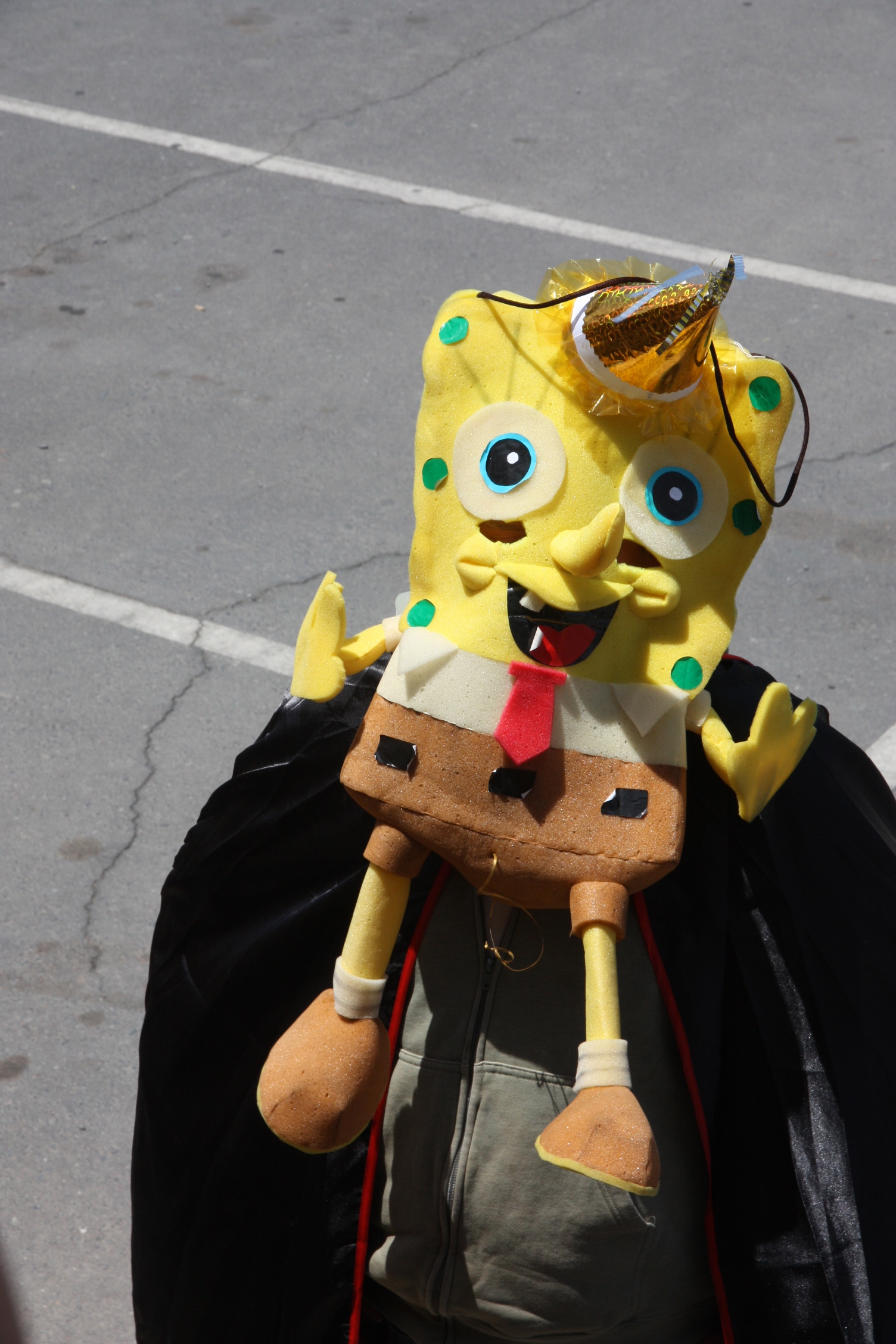
Spongebob goes shopping
In the end, I found the right mish-mash of ingredients— a generously-sized black cape, a golden party hat and a foam Sponge Bob. Now you might wonder why this was the perfect combo, until you remember that our truck is nicknamed Sponge Bob.
My challenge was to turn foamy Bob into wearable art. Luckily, I hoodwinked Colin into loaning me a shoelace, so I could turn Bob into ‘fashionable’ neckwear.
We resisted wearing our costumes as we crossed the border from Peru to Argentina, but we decked out for a trip through the shopping mall to buy groceries.
We donned them again when we went to town for a Halloween dinner at an Argentinian steak restaurant. We drew lots of stares, smiles, wolf whistles and laughs from all ages.
The next day we went back to behaving like grown-ups—sort of. Besides, our next party date was less than a week away—Guy Fawkes Day on 5 November.
P.S. Here are some pictures from the day. The four chickens are here. I came as the Giant Pumpkin.
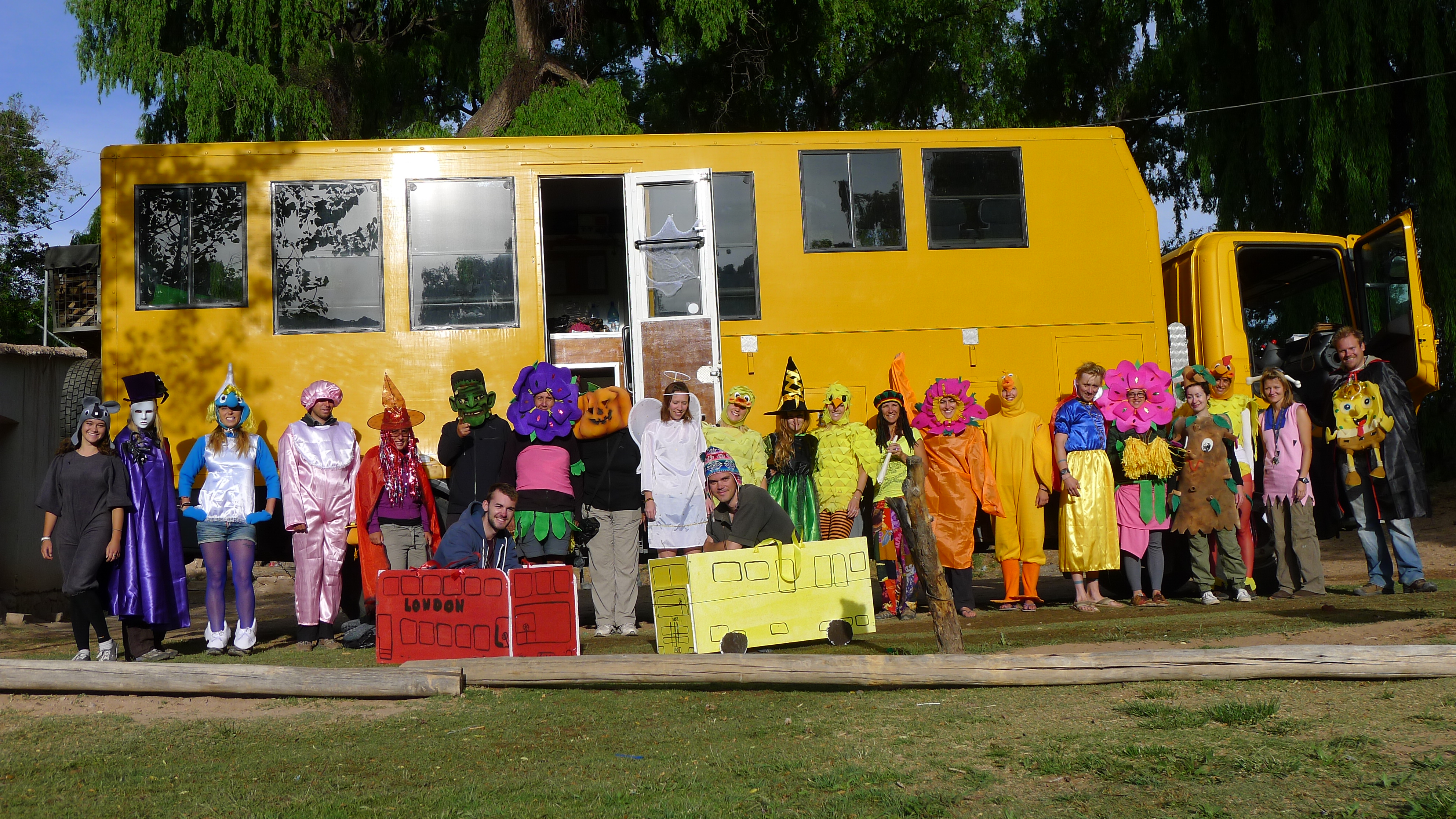
Spongebob and the weirdos
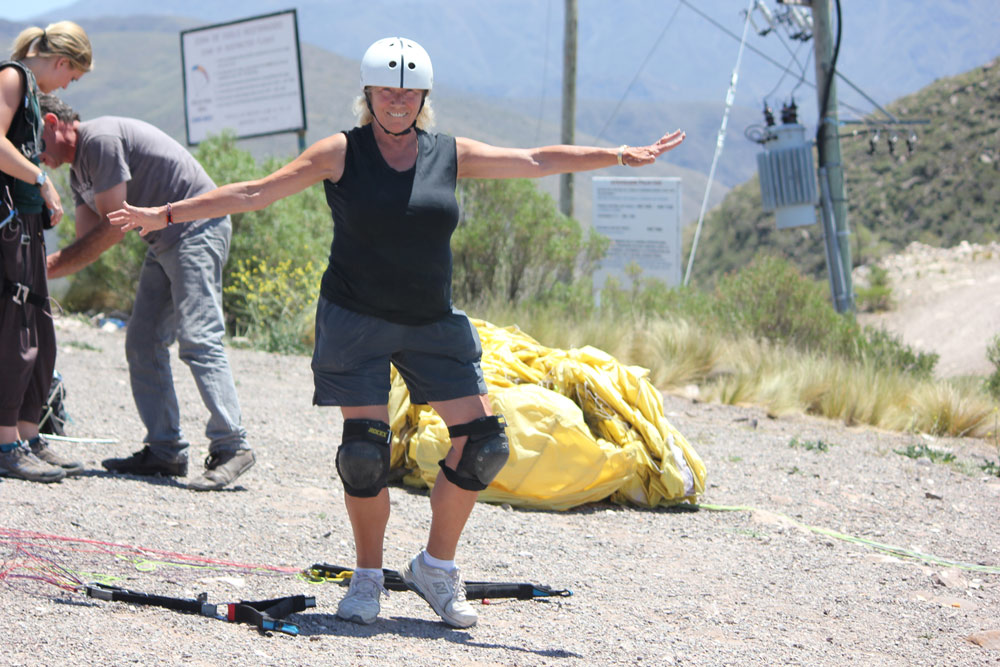
Knee pads and helmet—check! Looks like I might be ready to go skateboarding.
In a rash moment, I said yes to tandem paragliding in Mendoza.
What was I thinking? Mendoza is Argentina’s leading wine-growing region and I could have signed up for any number of wine-tasting tours.
But I can drink wine all over the world, but paragliding in the Andes doesn’t come around very often. Besides the price, 400 pesos a person, couldn’t be beat. At our exchange rate that amounted to $60 for an hour of nail-biting fun and breathtaking scenery.
So eight of us took off with Mario and Diego of Paragliding Parapente for a new adventure.
And what a great day we had!
For each of us, the adventure began in an ancient Russian 4WD vehicle. Once loaded with two experts, two novices and all the gear, the little red beast made a 25–30 minute drive up a rugged Andean ridge to get to the ‘departure lounge’.

You want me to run off the edge of that?
We heard in advance that the ridge was scary, and it was. Rocky and narrow, with drops that were close and sheer. After the ride up, everyone was more than delighted to be coming down on a glider.
Mario, who I think owns the company, is confidence inspiring. He’s been paragliding for 20-plus years and has more than 3000 hours in the air. From the outset, he explained that it was possible that not everyone would be able to glide. It all depended on the weather and winds.
It was also impressive to see the checks and double checks done as I got ‘suited up’. Nice to know that nothing is left to chance.
That said, the Mother Nature had her way when it came to take-off. Mario explained the procedure. Bend forward, legs straight, take four or so steps backward and then run forward.
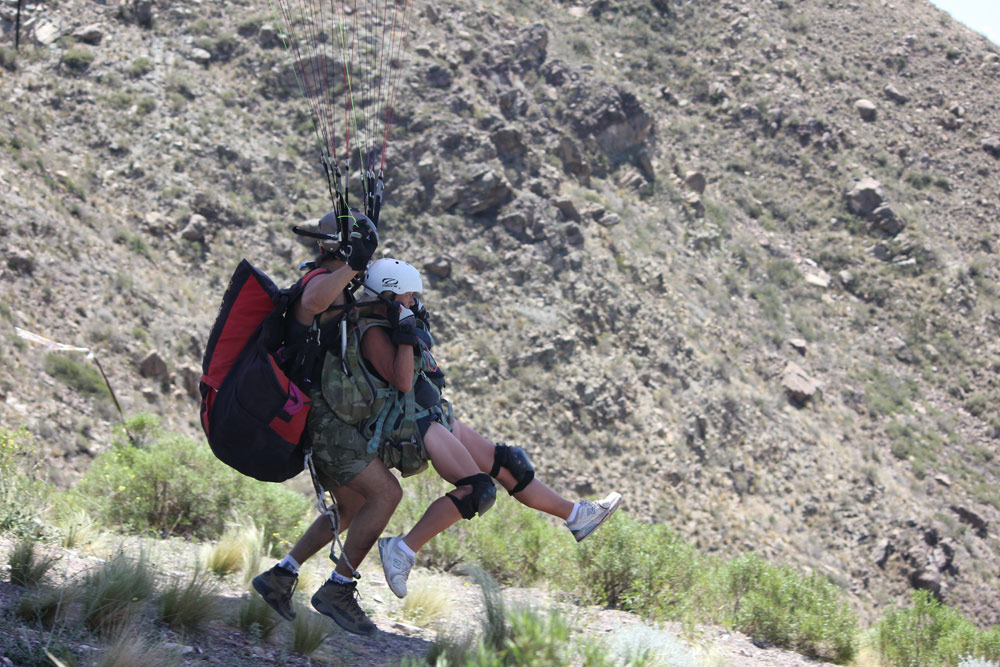
And we’re off
I was hitched up to Diego (the Hunk) and before we even had a chance to think about making a proper exit, a gust of wind swept us into the air. Diego got in a few steps, but I was instantly airborne. I felt like Mary Poppins with a giant umbrella.
The ride down was amazing. Wonderful scenery—I could see all the way to Chile—viewed from 1750 metres. The mountain colours ranged from deep rust to charcoal to all shades of brown and green. I confess that I didn’t take my camera. I just wanted to enjoy the experience, without succumbing to my tendency to take too many pics.
Others did have cameras so stay tuned and I’ll do another post on the scenery.
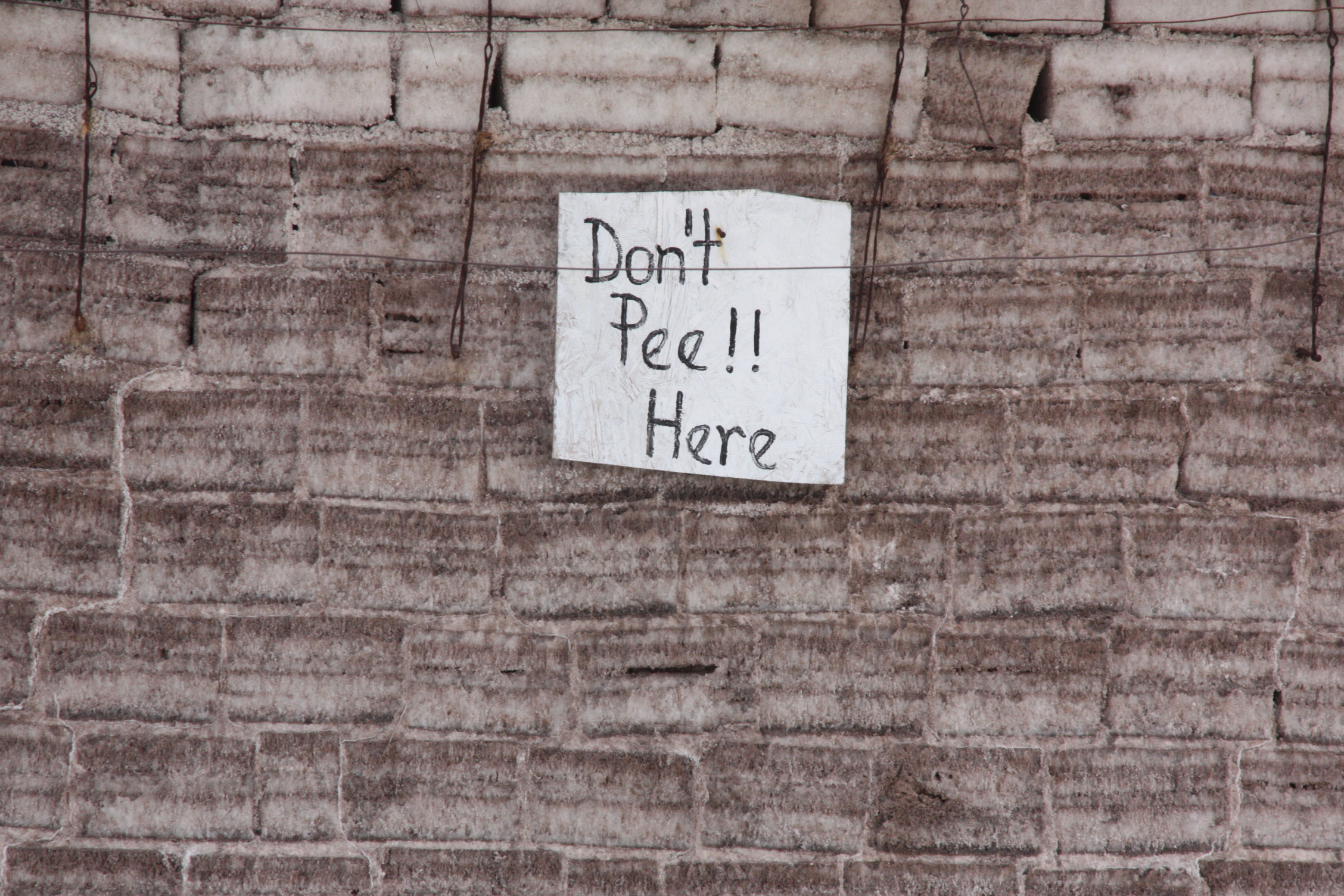
Every wall is a potential toilet, so warnings are common and often ignored. This sign is on the back wall of a hotel.
Even at its thinnest, perhaps especially at its thinnest, toilet paper is an unavoidable topic of conversation on an overland journey. Well, maybe not unavoidable, but certainly a matter of day-to-day concern.
Just yesterday there was a brief panic because our truck had RUN OUT of toilet paper. Now before any other overlanders faint dead-away from that comment, I have to assure you that this truck DOES NOT provide toilet paper. In fact, no overland company in its right mind would even fleetingly consider providing toilet paper.
Toilet paper is a personal thing. Quantities of toilet paper are a personal choice. I’m not going to confess how little toilet paper I can get by on, nor am I going to tattle on those who use two, three, four or even five times as much paper as I do to deal with a bit of wee.
So while an overland truck provides breakfast and dinner when passengers are camping (and sometimes lunch on long-drive days), it would never attempt to provide toilet paper for the masses.
This trip, our toilet paper supply actually comes from those masses. Early on, there was leftover money from some activity, and people used it to buy toilet paper—lots of toilet paper. Now it’s expected and a third purchase of the beloved paper was made today.
Poor John and I didn’t contribute to the first purchases—or if we did, we did so without realising—but we’ve happily anted up for the second two, for the bargain price of about 20 cents a person. There’s always a chance we’ll run out of our own supply.
And there’s the key—our own supply. In Africa and from London to Sydney, everyone had to buy their own TP (I feel I can use the abbreviation now that we’re on such familiar terms).
On those travels, the TP was often an industrial weight version in lurid hot pink, purple, blue or green. There were 20–50 sheets on a loosely-wound roll, and we went through it like mad even when we were being thrifty. When we stayed in hostel or hotels, most people would pinch a roll or two from their room or the shared toilets, but I would never take a roll—20 sheets, yes, but a whole roll, no.
Turkmenistan’s TP was a steely grey and like coarse sandpaper—my bum remembers it well and I saved a piece to show to disbelievers. I carry it in my camera case!
But the best TP was sold in Yaounde, the capital of Cameroon. Poor John found it in a supermarket near our campground. He bought a pack of four. What made it so good? It was soft, thick (at least 2-ply) and rolled super, super tightly—plus there was no inner core, just sheets and sheets of paper.
The packaging claimed each roll was equal to four normal rolls. But I reckon it was more like one to eight. And through economical use and occasional acquisitions from a hostel, we made it last for seven months—almost until the end of the trip.
I’ve brought two rolls on this trip, and we’re still on the first. We’ve stayed in so many hostels, it’s been easy to keep the supply topped up, 20 sheets at a time. I’ll let you know if I have to buy more before we get to Rio at the end of the year.
P.S. I’m going to do a piece on toilets too. Stay tuned.

A jovial-looking fellow
Poor John is a whizz at researching the places we ought to visit wherever we go, so I tend to let him plan our itinerary on most of our sightseeing days.
Peru was no exception and the Larco Museum in Lima was high on his list, so we set out one morning by taxi. It was a longish and expensive (by Lima standards) ride via the suburb of Miraflores, but the driver was pleased that we were going to this amazing showplace.
Brought together by Rafael Larco Hoyle, the collection first went on display in 1926 in another part of the country.
Larco (although as a descendant of my own line of Hoyles in North America, I prefer the Hoyle tag, which was his mother’s) was passionate about archaeological research and preserving Peruvian artifacts from diverse cultures.
His enthusiasm was influenced by his father, who began acquiring northern Peruvian pre-Columbian pottery in 1903 when the young Larco was a toddler.
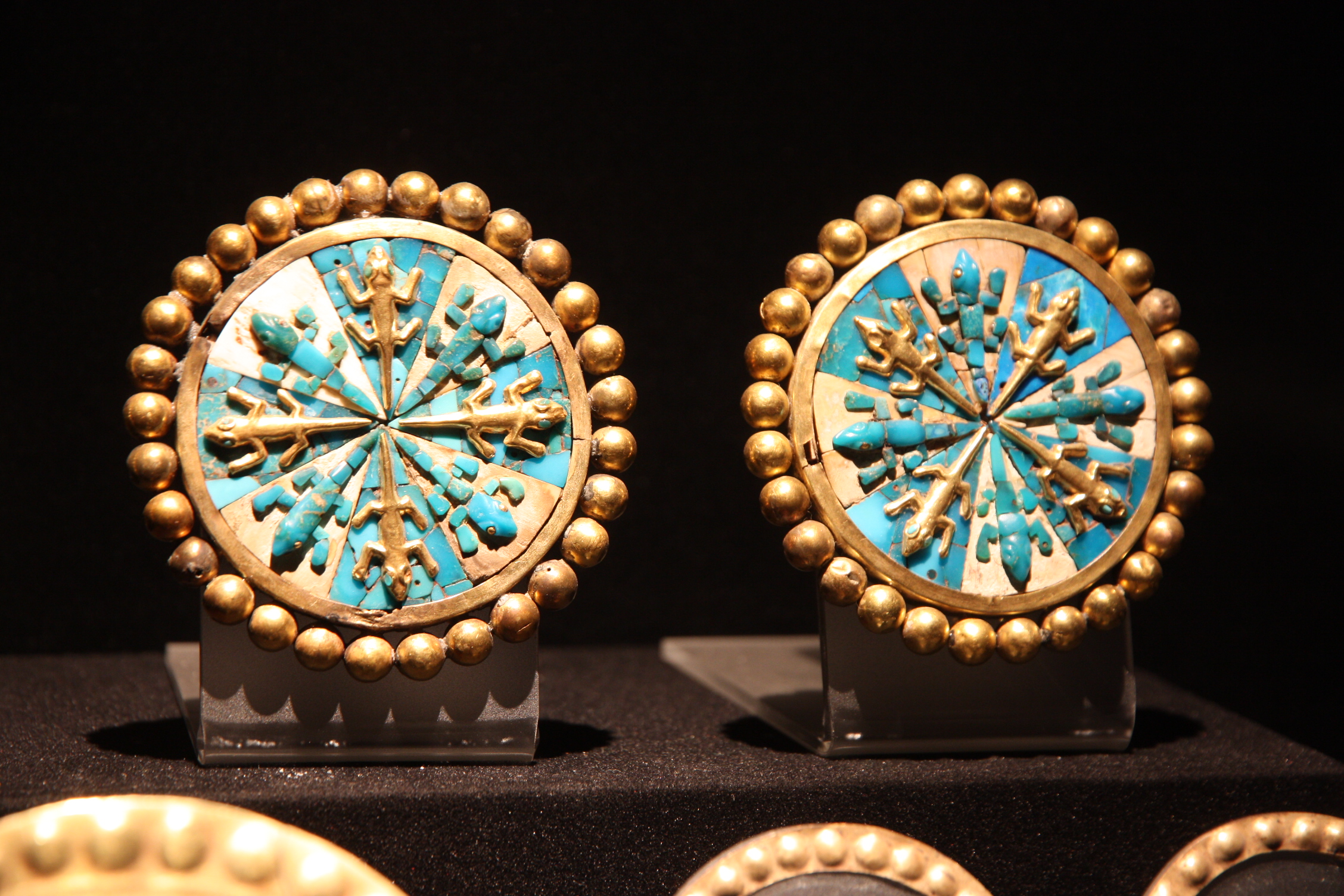
Old gold and turquoise Peruvian earrings, about 3 inches in diameter
Like his father, young Larco bought collections—especially of pottery. But he also began extensive explorations and excavations in remote parts of Peru. Apparently, his family and friends entered into the chase and enjoyed taking part in fieldwork. So much so that today the museum has more than 40,000 complete pottery vessels and thousands of metal, textile, wood and other artifacts.
I was gobsmacked to see all of the Larco treasures. They are beautiful, diverse, well-displayed and awe-inspiring. The sheer volume of pottery and gold adornments is overwhelming. And the pieces cover at least six or seven different ancient cultures. It was a big bonus to be able to photograph the exhibits because the Larco Museum has fine examples of works that I couldn’t photograph in many other museums in Peru.
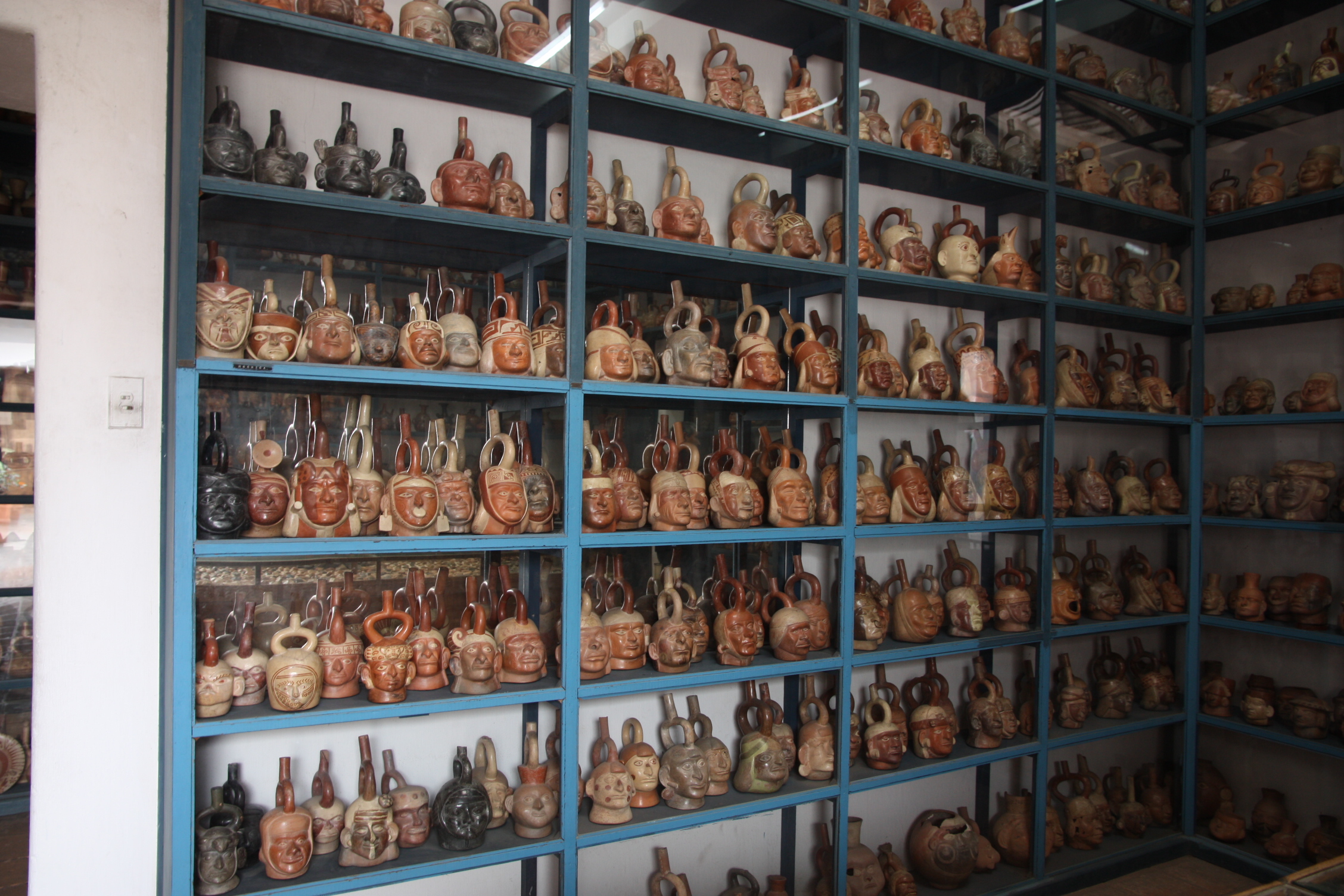
One of many storerooms
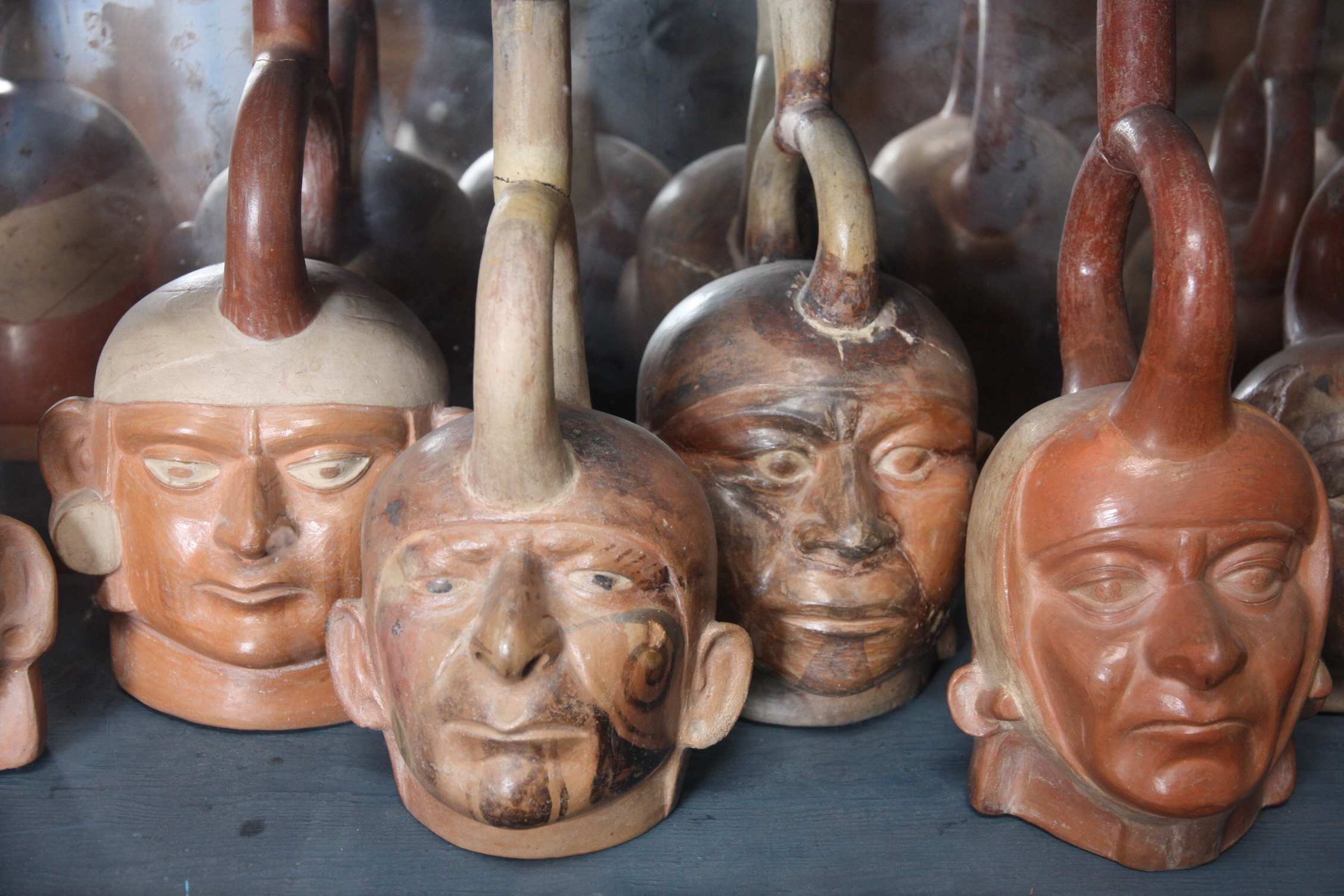
Touching pottery faces
It was also a special treat to get a look inside the museum’s many storage rooms. These spaces hold countless, floor-to-ceiling glass cases of pottery pieces. Many depict the actual faces of men who were most likely sacrificed in ancient times. Each face is different, and all are beautiful and heartbreaking.
There’s also a large collection of erotic pottery, with some quite playful and many having sassy facial expressions. These displays no doubt contribute to the fact that the Larco Museum is one of Peru’s most visited tourist attractions. I took quite a few pics of the erotic specimens, but they’ll have to wait for the sealed section of the blog. 🙂
The museum structure and its beautiful gardens are worthy in their own right too. The exhibits are housed in an 18th century vice royal mansion that was built over a 7th century pre-Colombian pyramid.
Poor John and I decided to splash out on a meal in the deluxe restaurant there. He had grilled scallops (nine on a plate) and I had an exotic salad. Not cheap, but delicious, and I resisted taking photos of the meal itself.
We’re having a Halloween extravaganza tonight. More soon when I have a better connection, but here’s some of the silliness! By the way, we went grocery shopping in these get-ups!

Chicken on the menu? Nope, we’re in Argentina, so it will be steak!
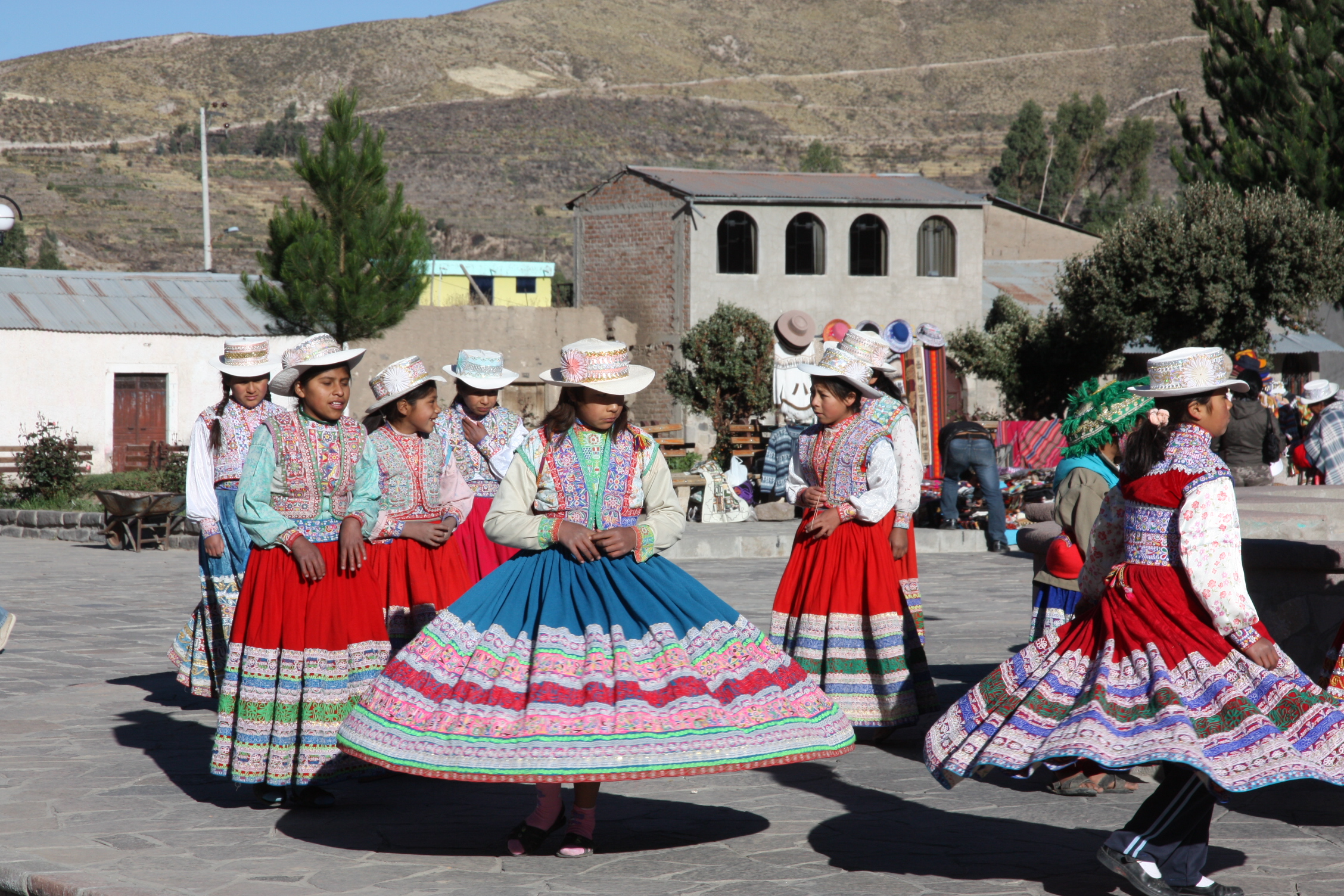
Dancing in the square at Yanque
Our drive from Chivay to Colca Canyon to see the condors included stops in several Peruvian villages.
There’s no doubt these villages are geared up for the morning tourist trade. We set out from Chivay about 6am and reached the first village, Yanque, not long afterwards.
Yanque was up and ready for our arrival with a group of schoolgirls (accompanied by several village dogs) in the main square doing a dance to celebrate—our arrival, I suppose.
The churches were open too and we visited ones in Yanque, Achoma and Maca.
In all the churches, it was interesting to see the statues of saints decked out in local dress, including hats typical to the region or the dominate culture. One female saint had four names embroidered on the skirt of her red gown—Rod, Charly, Samuel and Walter. I’m guessing either she or her gown was donated by them or in their memory.

A tourist’s photo dream with kids and llamas
The kiddies and their llamas were out in force too. Tourists, especially those with limited time in the country, find such villages are great places to have their pictures taken with a decorated llama and kitted out child. Luckily, we are in South America long enough to find other, less staged opportunities.
Every village had an army of souvenir sellers too. All the gear is pretty much the same—belts, bags, scarves, hats, gloves, knick knacks and soft toys—but the array colours always draws my interest.
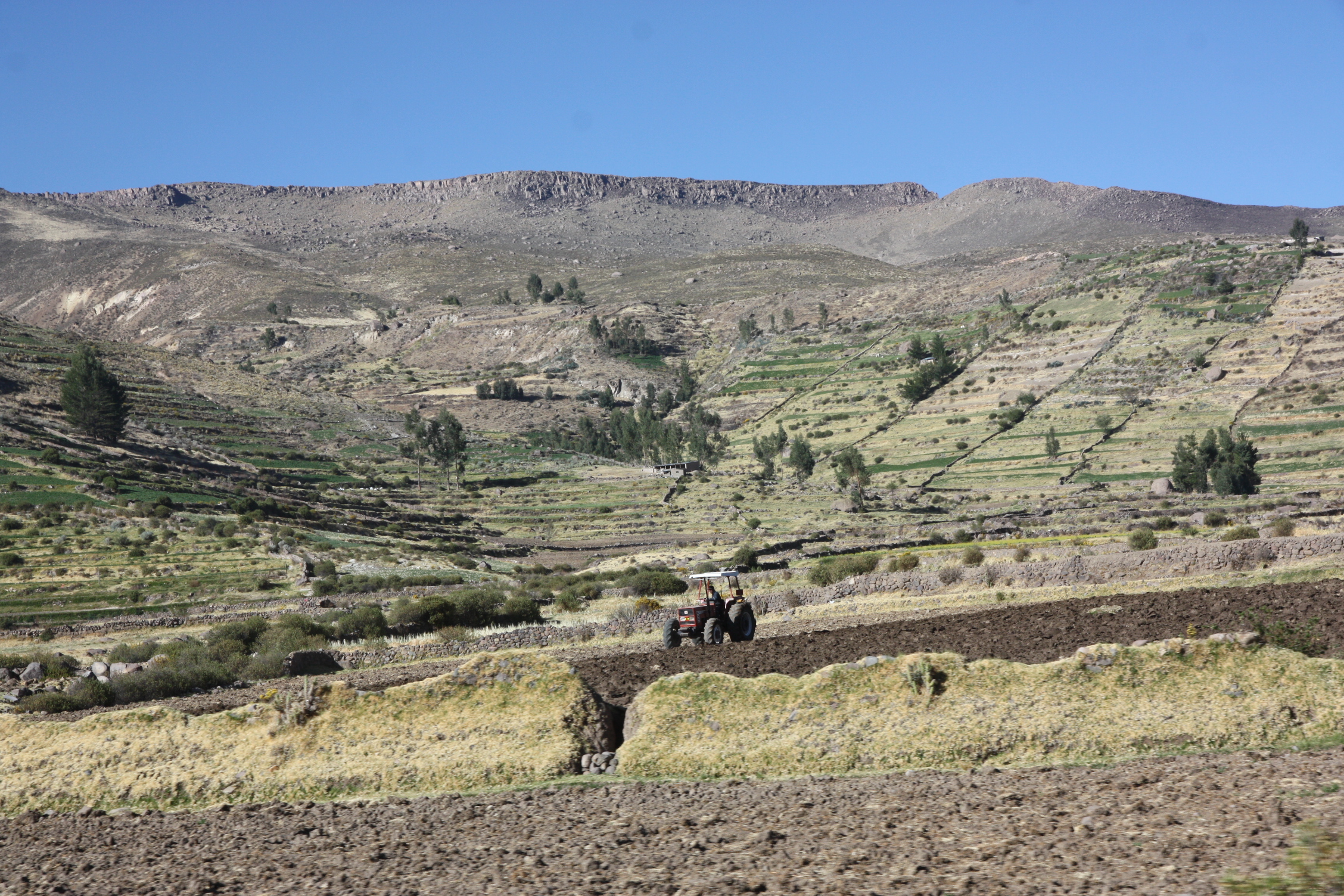
Early morning plowing
The legitimate early risers were the farmers. They were out plowing. The countryside around Chivay and the Colca Canyon varies from flat to very hilly. It was interesting to see the mix of lush broad, flat fields and the heavily terraced hills that are planted to potatoes.
After running the gauntlet of villages—we arrived about 8:30am, along the thousands of others, to see the magnificent condors of Colca Canyon.
A couple of hours later, we went back to Chivay through all the same villages. The places were deserted and everyone had gone home. Obviously, tourist duty was over and it was back to normal life.
 Where to next?