
Poor John and I are in Quito, Ecuador. We head to the Galapagos Islands in about seven hours. Doubt that I’ll have internet access. Assuming that is the case (and that I don’t post anything before I go to bed), we’ll be back on the 11th. Stay tuned.
P.S. I think this is our boat.

Tagged a basket of fire
We had an amazing afternoon in the ginormous Jean-Talon Market (Marché Jean-Talon) in Montreal.
This farmer’s market is where my friend, Brenda, shops and I can understand why. It’s one of the best markets we visited in Canada—certainly the biggest, most diverse and most colourful—and it was a struggle to resist buying up big on almost everything.
As it was, Poor John indulged in a pamplemousse (grapefruit) ice cream. He first discovered pamplemousse products in West Africa in 2009. It was love at first bite.
Three items in Jean-Talon caught me by surprise.
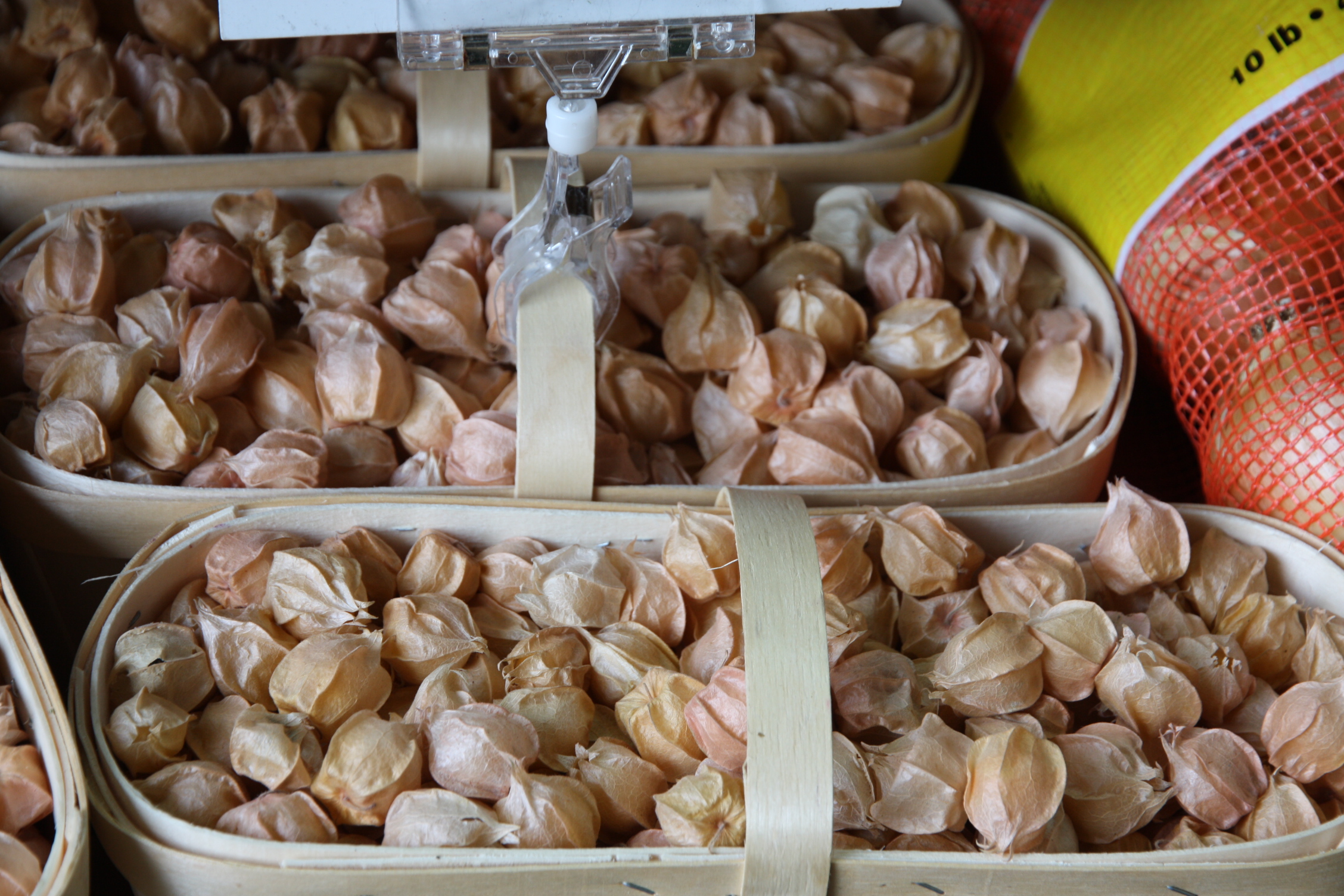
Chinese lanterns—good for jams, jellies and gout?
There were teeny-tiny potatoes, grenailles, that were smaller than a cherry tomato and oh-so cute. I wonder how they are used. Suggestions and opinions on how to cook or serve them would be most welcome.
The edible Chinese/Japanese lanterns were another first. Supposedly they are tomatillo-ish in flavour and can be made in to jams and jellies. The Chinese supposed use them to make a gout remedy—now I’m interested!
The third item was the colourful array of cauliflower. We get some colours in Australia, but nothing like the ones in Jean-Talon. At least I haven’t seen them.
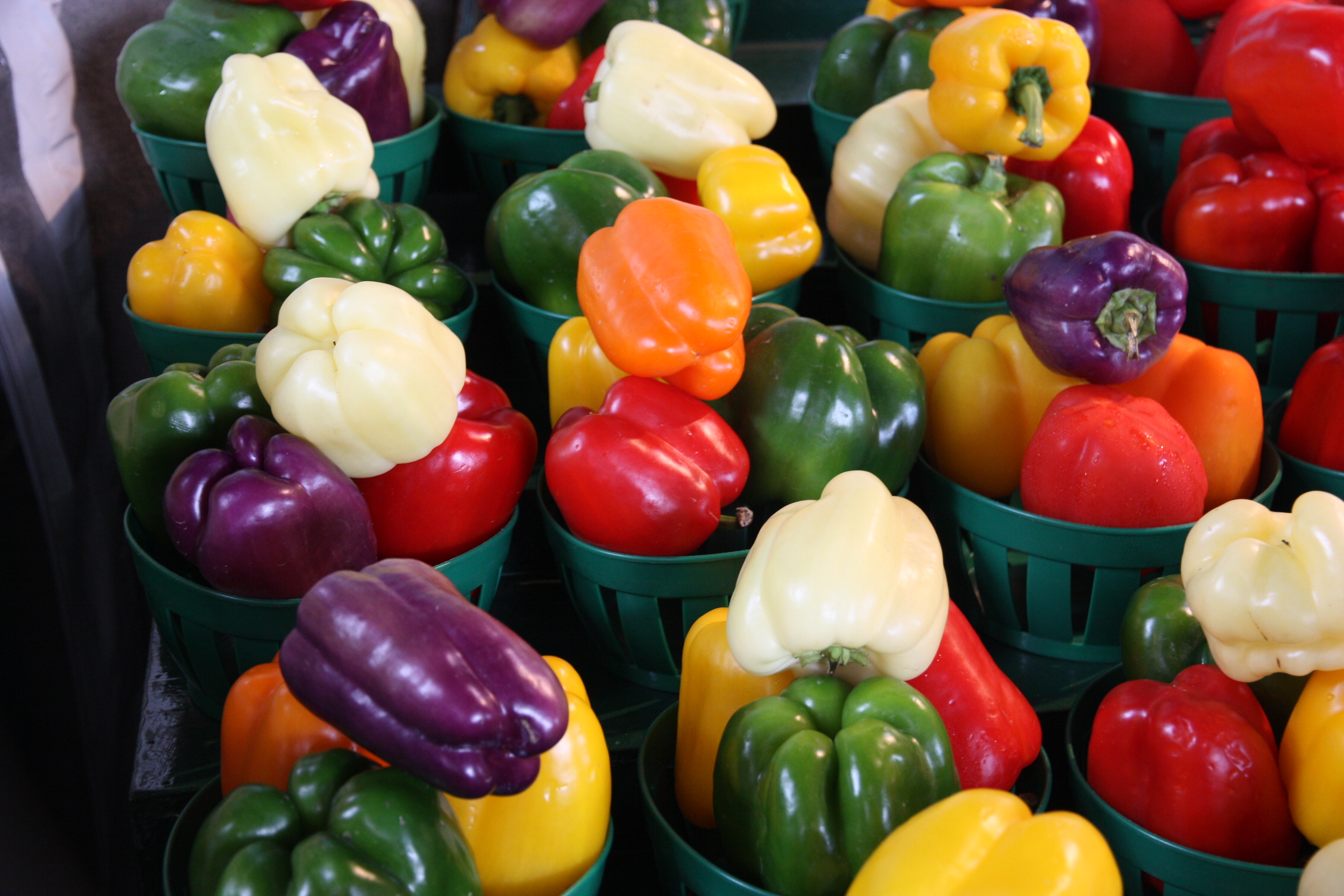
A colourful array of bell peppers, called capsicums in Australia.
A fourth thing surprised me too—there was almost a total absence of Asian and Middle Eastern products (except for spices), so I’m guessing there must be another market for those. Or perhaps that part of the market that I missed.
Jean-Talon Market, in the Italian part of town, has been going since 1933. It’s open year-round, but in the harsh winter months, there are walls put up around the entire market area.
The peak months are June to October, with as many as 300 vendors a day. In addition to the open-air market, there are other specialty food businesses dealing in meat, fish, cheese spices, baked goods and meals.
Believe me, next time I’m in Montreal, I’m going to need to shop up big at thee sensational markets. How could I resist?

Main sanctuary with carved angel on left
The Salt Cathedral of Zipaquirá isn’t really made of salt, but it has been built within the tunnels of a salt mine about 200 metres underground in Colombia, and not far from Bogotá.
Although it has no bishop, the cathedral functions as a Roman Catholic church and gets about 3000 visitors every Sunday. We were there on a Saturday—having come by steam train—and I’d say it was just as busy as any old Sunday. That’s because in addition to being an important tourist destination, it is a place of pilgrimage.
The cathedral is part of larger complex that includes the Salt Park and a museum devoted to mining, mineralogy, geology and natural resources.
The church is considered an important achievement in Colombian architecture and I’d have to say it’s a tribute to the jackhammer too. Such a lot of digging. At first we thought it had been dug by hand—I’m sure the early parts were—but the statue of the miner with jackhammer set us straight.
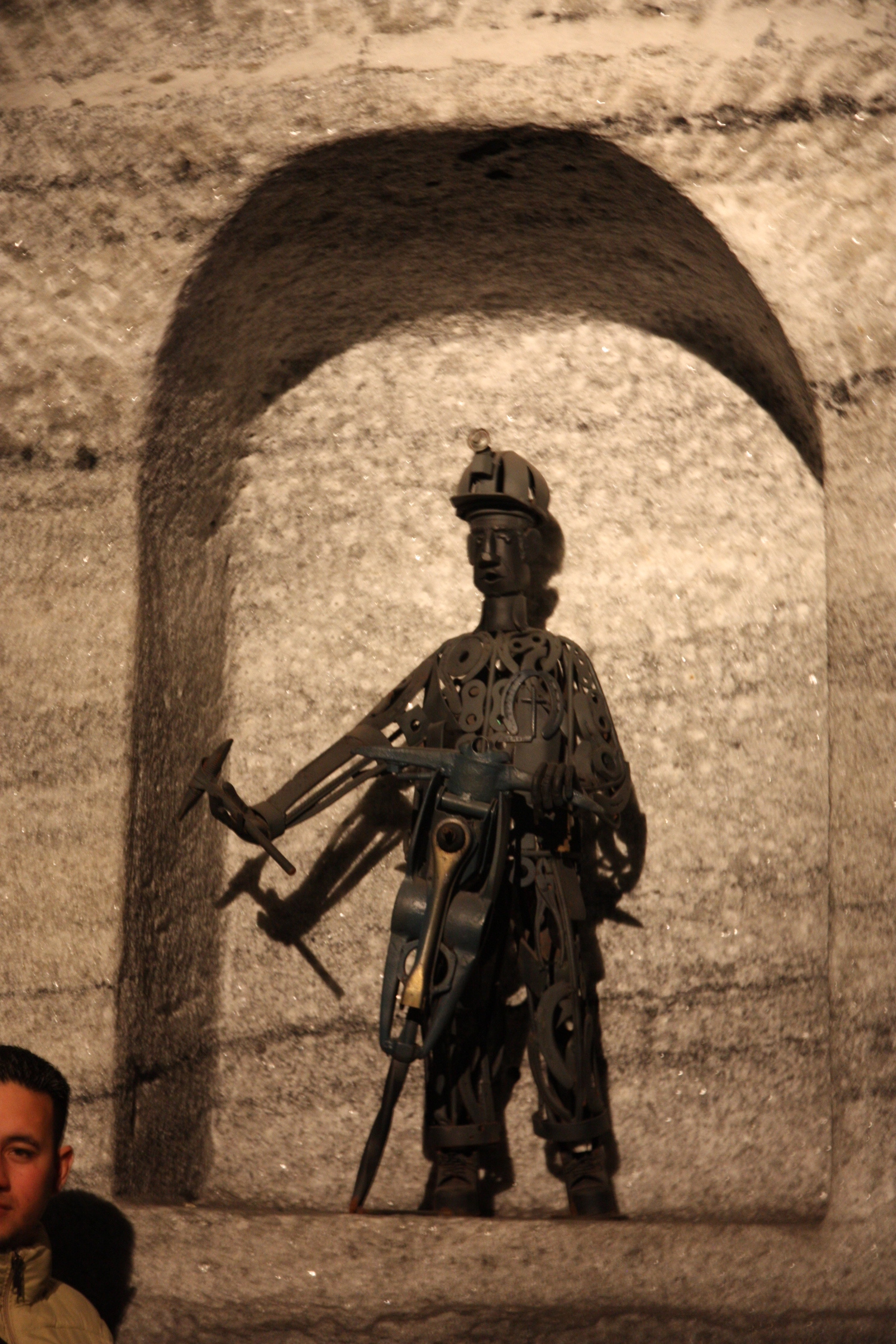
Miner with jackhammer
In the 1930s, miners dug a sanctuary where they could offer their daily prayers. The actual church was started in the 1950s and dedicated in 1954. Because it was built within a working mine, the sanctuary became unsafe over time and was closed in 1990.
Work on a new cathedral began the next year, 200 metres below the original one. It was inaugurated five years later.
This version was created by making additions to the caves left behind by old mining operations.
The main sections of the current cathedral are 14 colourfully-lit chapels representing the Stations of the Cross, the dome and three naves. There are also four huge columns representing Matthew, Mark, Luke and John. Oh, and don’t forget the gift shop!
We spent about 90 minutes visiting the cathedral. It’s an easy stroll down and a long, brisk walk back up because we were afraid we might miss the bus to the train and lunch.
I wish I could tell you more about the dimensions of this enormous place, but our guide spoke only Spanish.
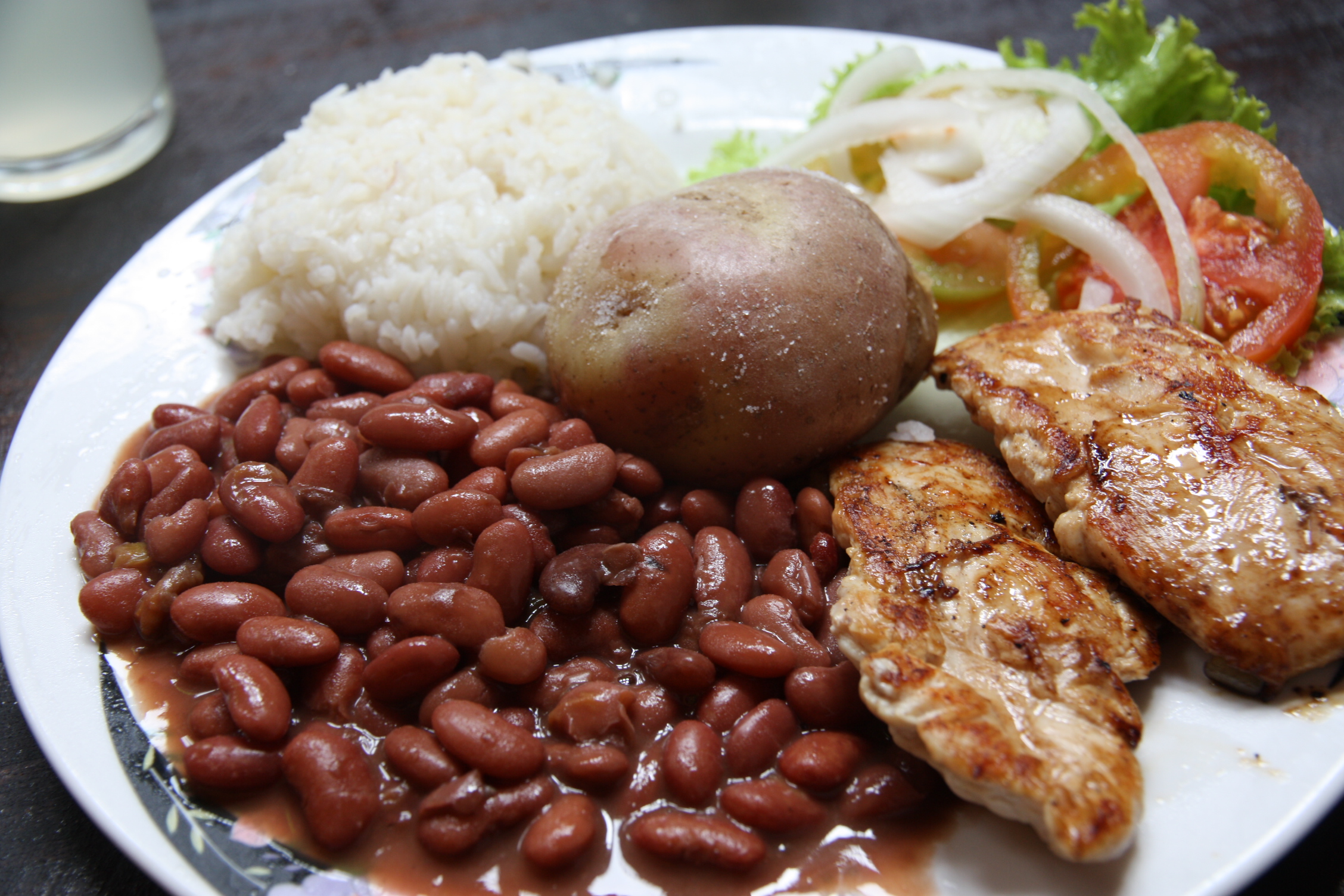
Beans, rice, chicken AND a potato
South Americans love their beans—and I’m not talking about green beans.
I’m talking about the musical beans. You know the ones I mean—beans, beans, musical fruit, the more you eat, the more…
We’ve had a few Brazilian exchange students. Beans, rice and meat have been the staples in their diet. In my experience, vegetables have been pretty much ignored. They’ve eaten corn, potatoes and salad, but that’s about as far as it goes.
One of these students had his parents visit and they brought me a wonderful Brazilian cookbook (written in English). It’s almost 700 pages long and the last chapter—of about 25 pages—is devoted to vegetables. The first 10 pages of that chapter are devoted to beans.
Obviously, these things are important!
We’re in South America for four months, starting in Colombia. Recently we spent an amazing day on a steam train going from Bogotá to Zipaquirá. From there we did a side trip and ended up in Cajicá for lunch.
We could have stayed at the trip organiser’s ‘recommended’ restaurant, but Poor John and I prefer to check out the hole-in-the-wall eateries. Tourist restaurants have to be okay for one-offs and passing trade, but a popular local restaurant wants their customers to keep coming back.
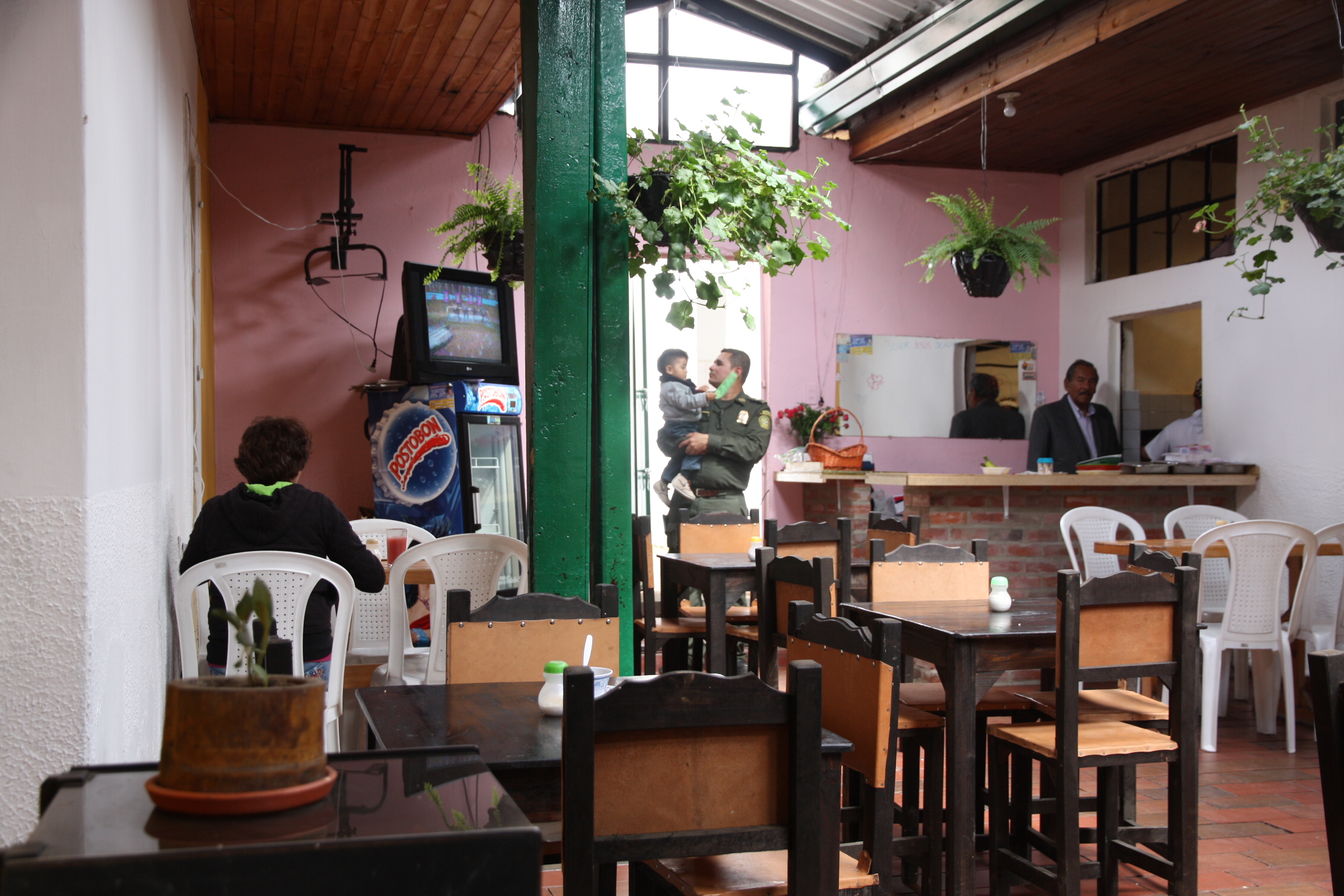
Restaurant in Cajitá—we arrived late so most of the customers were gone
So we went in search of a place with no tablecloths and local clientele.
We found a great little spot with no menu, but an ample waitress who said we could have ‘a string of words that made no sense to us’.
The helpful fellow at the next table—who was from Colombia and who’d lived in New York and Miami and who’d then followed his Colombian wife home to Cajicá—explained that we could have beef, beans and rice or chicken, beans and rice.
We’re even-handed so took one of each. They were delicious, and even though Poor John’s beef was pounded to an extraordinary thinness, the flavor was good. We even shared our dishes with one another.
The beans have continued to share for many days since then.

Orchid?
Here’s the last item from the Montreal Botanic Garden. It really is a random collection of photos that I like too much not to share.
Begonias get a look-in. I love begonias, but seem to have a blind spot when it comes to growing them.
There are two photos of what I think are orchids.
Finally there are several photos of leaves. Everybody likes the flowers, but I like the leaves too. I appreciate their colour, texture, shapes and variety.
Please let me know if you know what any of the unidentified ones are.
Thanks again Brenda for showing us such a wonderful spot in your part of the world.
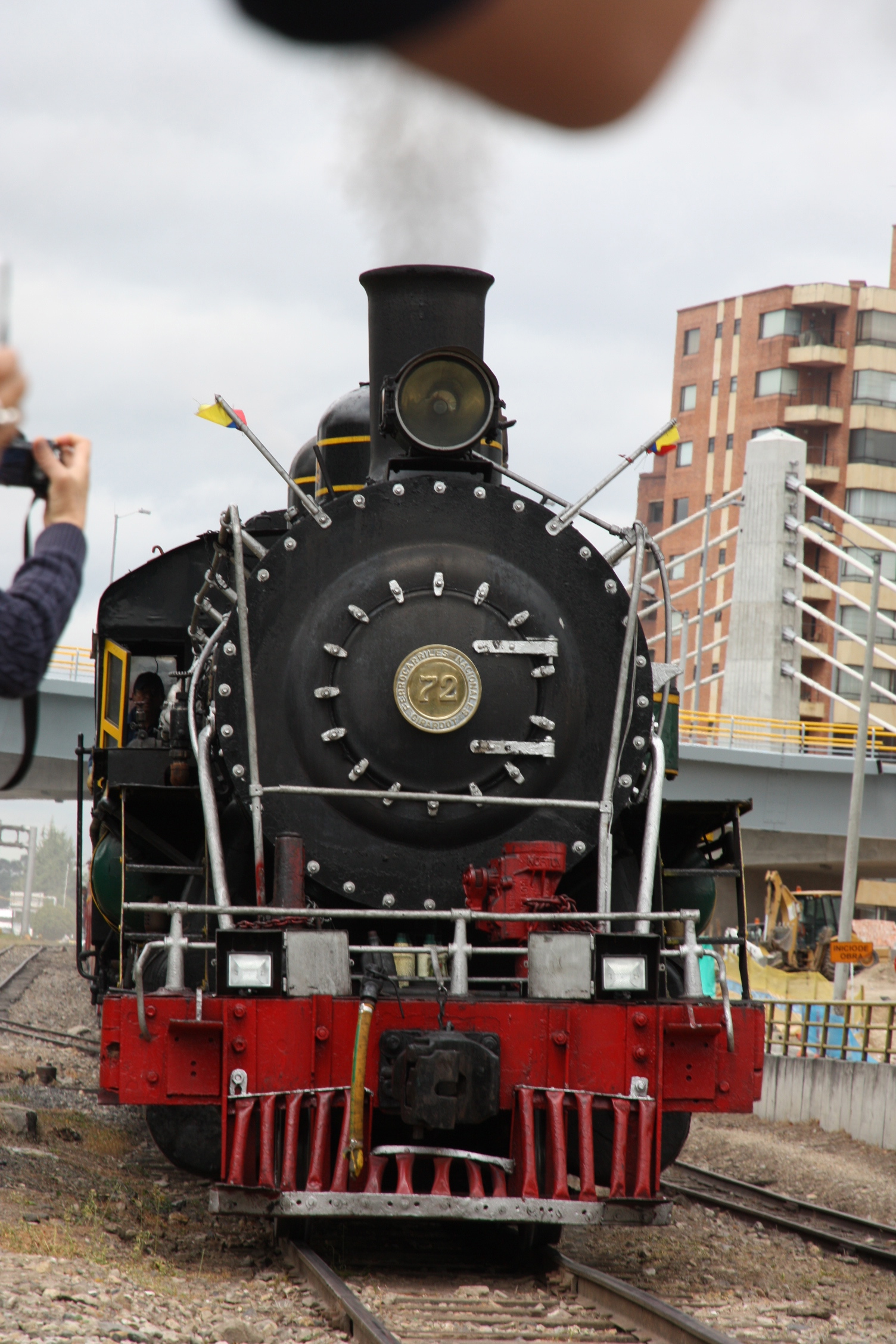
Steam engine pulling into Usaquén Station
Everybody loves steam trains and Poor John and I were lucky enough to spend the good part of a day chugging along on one in Colombia.
Known as the Tren Turistico de la Sabana, the choo-choo runs on Saturdays, Sundays and public holidays, but the steam engine makes its appearance only on Saturdays.
The train heads out about 8:30am from La Sabana Station, although we caught it about an hour later at the Usaquén Station which was a lot closer to our hostel.
The trip and the day are true family affairs, and very popular with Colombians. I reckon there were at least 12 carriages, seating about 50 people each. Ours was full and I assume most others were too, and there were no more than 5 per cent non-South Americans. Spanish was the language of the day.
It was very touching to see what probably were divorced fathers taking their children on a day’s outing. Dads doing cartwheels, buying ice creams and souvenirs, giving the biggest hugs you can imagine and looking very despondent at the end of the day.
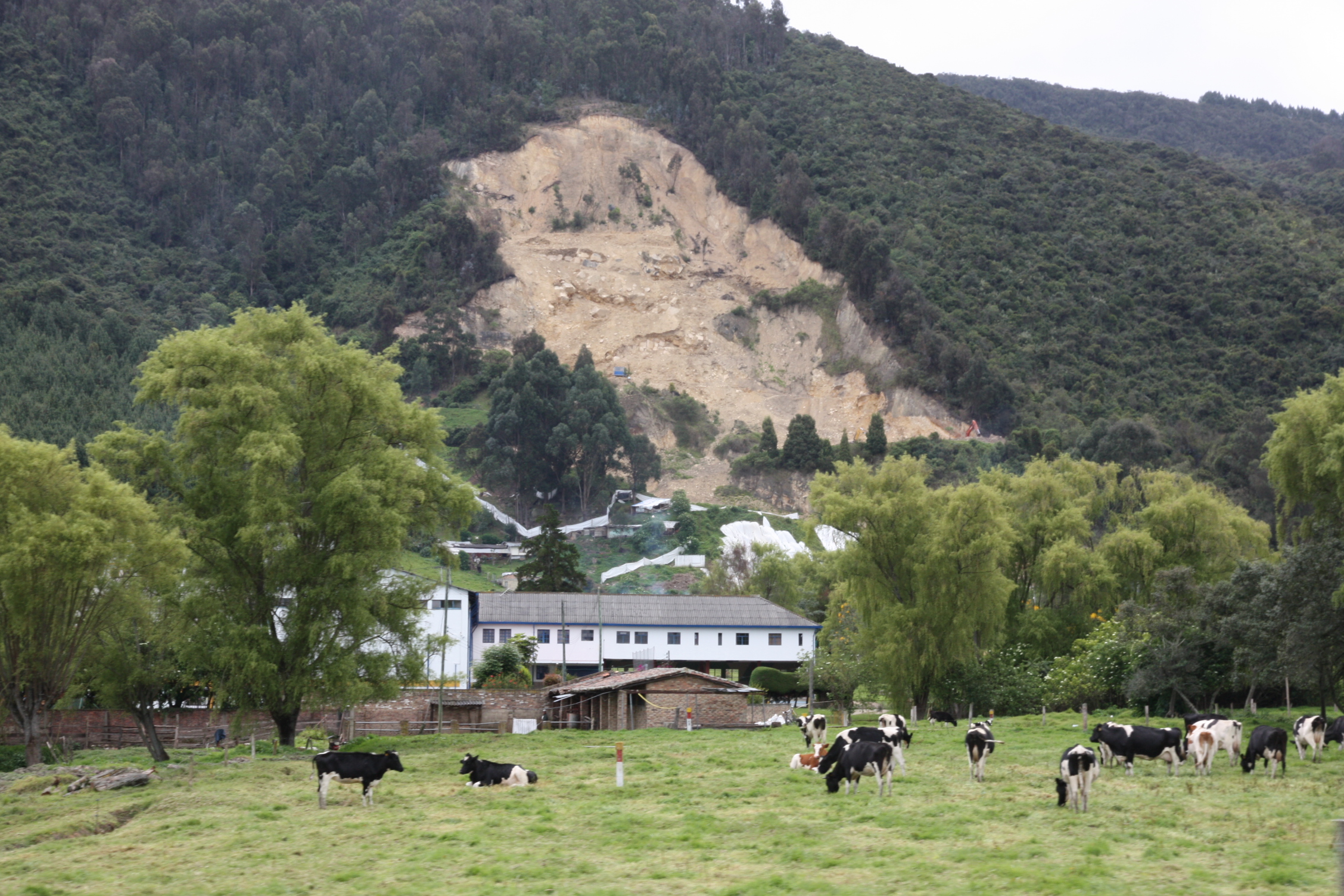
View from the train—a farm on the savannah
Our carriage had a wedding party—two young people from Australia, with Colombian heritage, were ‘home’ to get married. They and many of their Aussie and Colombian guests were out for the day and full of merriment.
The strolling band helped to get everyone going. The six-piece band played in the station while passengers boarded, but they also wandered the length of the train, playing rousing Latin tunes in each carriage. A two-man band came through later in the journey. After a couple of tunes, they asked if the crowd wanted an encore. The cries of ‘yes’ were answered with a good-humoured sales pitch for their CD.

The band played on
The train travels 53 kilometres to Zipaquirá. We had a laugh coming into town, which was reminiscent of the little train that thought it could. Our engine had to go forward and then backwards a long way three times in order to get up enough steam to make it up the slight incline into Zipaquirá.
From Zipaquirá, passengers have a few choices for side trips they can make.
We took the bus trip to the Salt Cathedral (more about that soon) on the edge of Zipaquirá. We had more than an hour to visit the cathedral, which is underground in a salt mine.
After that, the bus delivered us to Cajicá, a typical town in the savannah, where we could have lunch before returning to the train.
The bus dropped us outside its ‘recommended’ restaurant. But there was plenty of time so we struck out on our own to explore the town and find a place that was less commercial.
We found a great little spot to eat—stay tuned.

Poor John waiting for more breakfast
I have a vague, distant memory of loving Vegemite and thinking I would miss it terribly after my jar was confiscated by US Security.
Then we came to Colombia and breakfasts have been off the chart. We stayed in a great little hostel in Bogota where breakfast was fruit, juice, three kinds of breads and Colombian coffee. Myriam, our hostess in Bogota, lined us up to stay at a special hostel in Cartagena where the breakfasts, she said, are legendary. Aw, come on! What could make breakfast in a hostel legendary. Let me show and tell you!

Fruit bowl for two
We got up about 4:30am to catch a flight from Bogota to Cartagena. I don’t ‘do’ early morning very well, but I staggered out of bed, brushed my teeth and hoisted the pack on my back. The taxi we booked turned up on time and we were in the airport enjoying a cup of coffee by 5:30. Lan Chile served a snack, but by the time we arrived at the hostel in Cartagena, the offer to be served breakfast couldn’t be declined.
A huge bowl of fruit appeared immediately, along with juice. Did we want eggs prepared some way—scrambled, poached, fried or did we want ‘mumble-mumble’. Of course the woman didn’t say mumble-mumble, but we couldn’t figure out what she did say and we hesitated to ask, so we ordered it. It turned out to be arepas con heuvo—an egg surrounded by a cornmeal crust and served with sour cream and salsa. It was sensational. In fact, we ordered it again today.
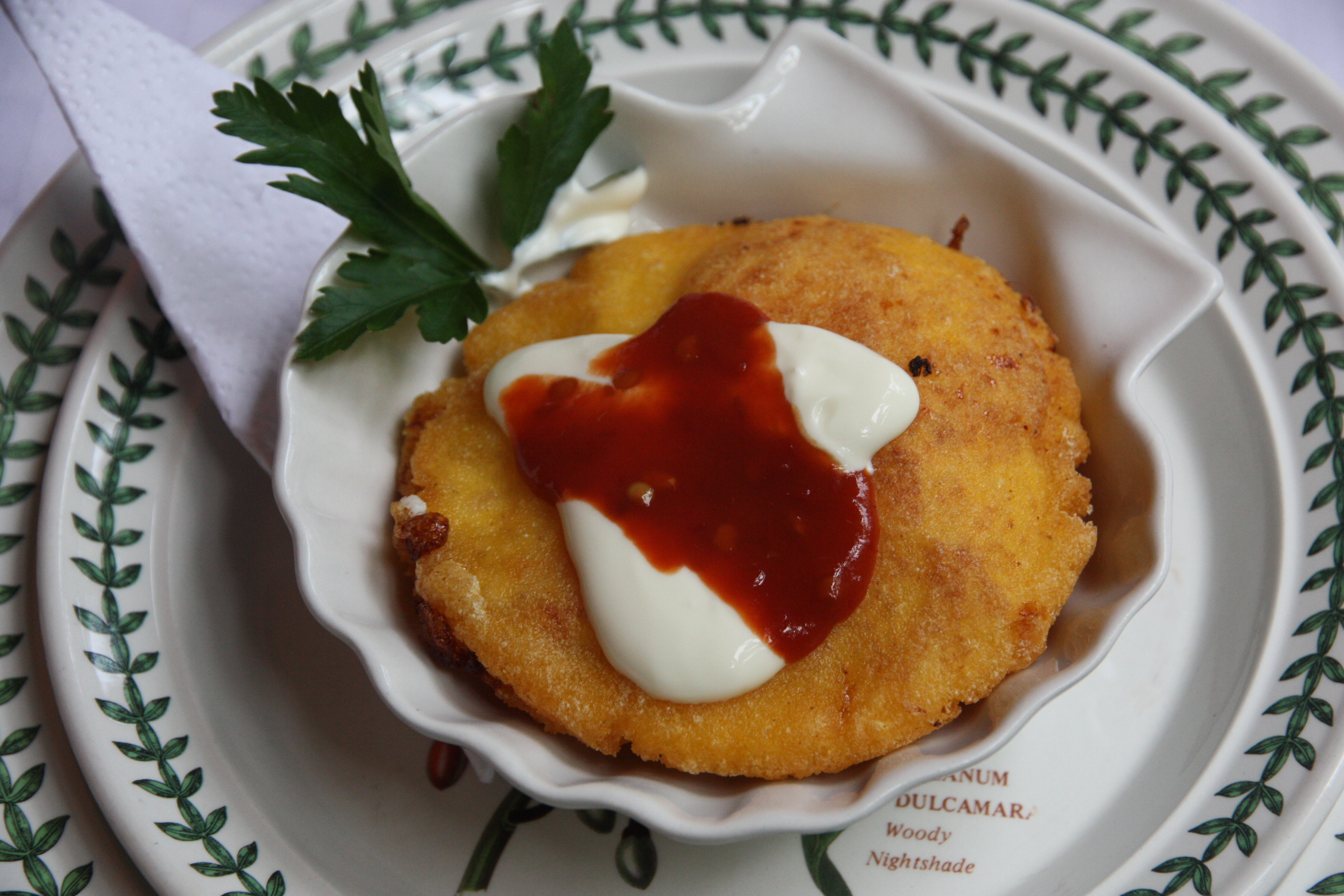
Arepas con heuvo
We also got a basket of bready things including toast, muffins, brownies and two or three kinds of savoury items, as well as butter, jam and plenty of coffee.
And if you want something else—go ahead. Order pancakes, waffles, another arepas con heuvo.
Right now, I’m sitting here at 10 o’clock at night dreaming of tomorrow’s legendary breakfast and being chewed to bits by mosquitoes, so I’m going to bed. Maybe Santa…er breakfast…will get here faster that way.
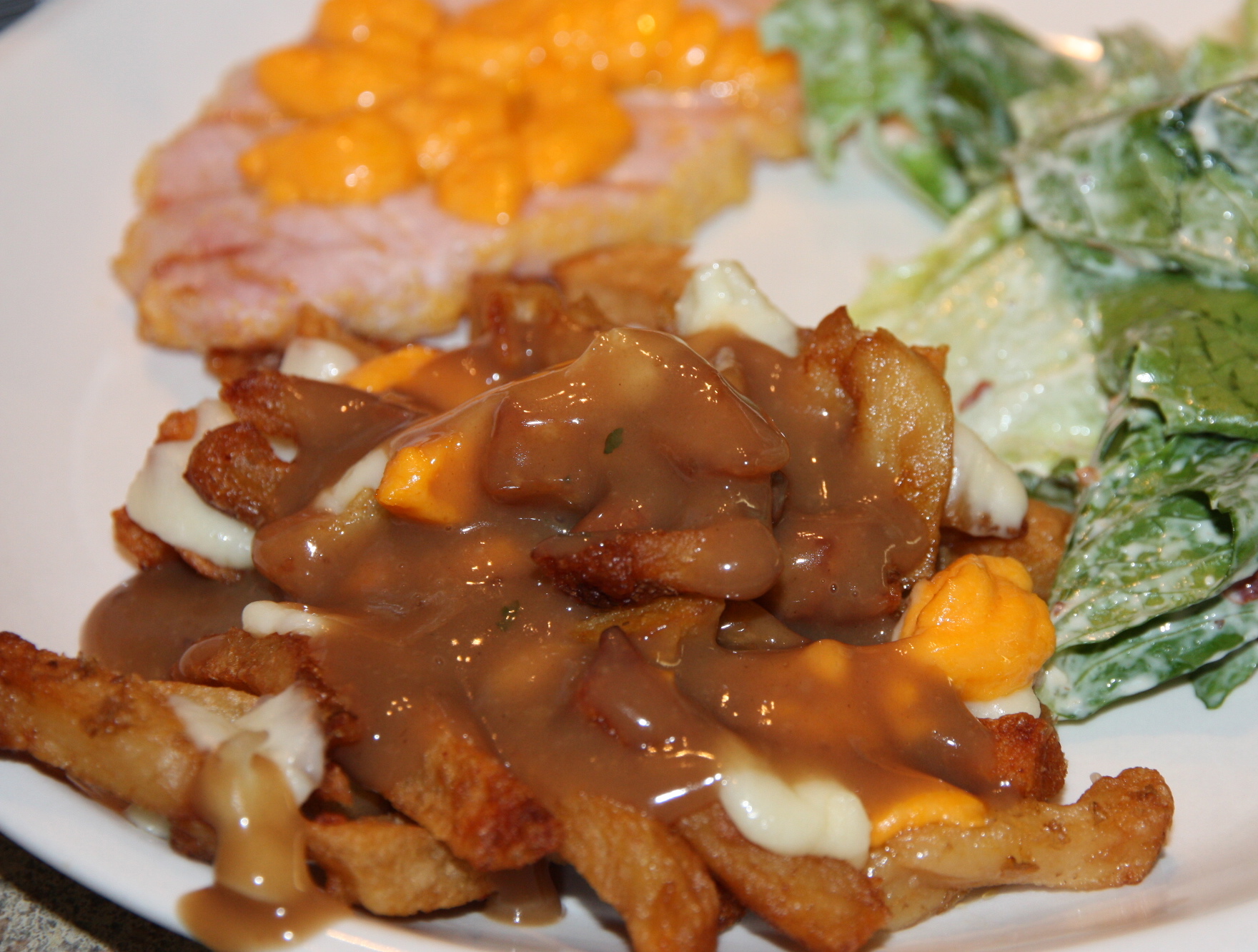
Poutine with peameal bacon and salad
Leslie and Wayne said Poor John and I absolutely, positively HAD to try poutine, a French Canadian specialty that has been embraced by the nation.
‘Invented’ in Québec in the late 1950s, poutine (pronounced poo-teen) is a heart attack on a plate. The ingredients are hot chips (french fries), smothered in brown gravy and topped with cheese curds.
You wouldn’t want to eat it every day, but every now and then I am sure it’s good for the soul even if it’s not so good for the waistline.
While poutine is often considered a fast food (even served at the big-name, fast-food outlets), our production took quite a bit of time.
It started with a trip to Toronto for lunch with some Zaar friends (more about that soon), and on the way we swung by the St Lawrence Market where we bought two kinds of cheese curds and a slab of peameal bacon to go with the poutine.
After lunch and some more touring of inner Toronto, we headed home and in search of a roadside chip wagon. They had already closed so Wayne and Poor John popped into a restaurant and bought five (yes five) servings of french fries.
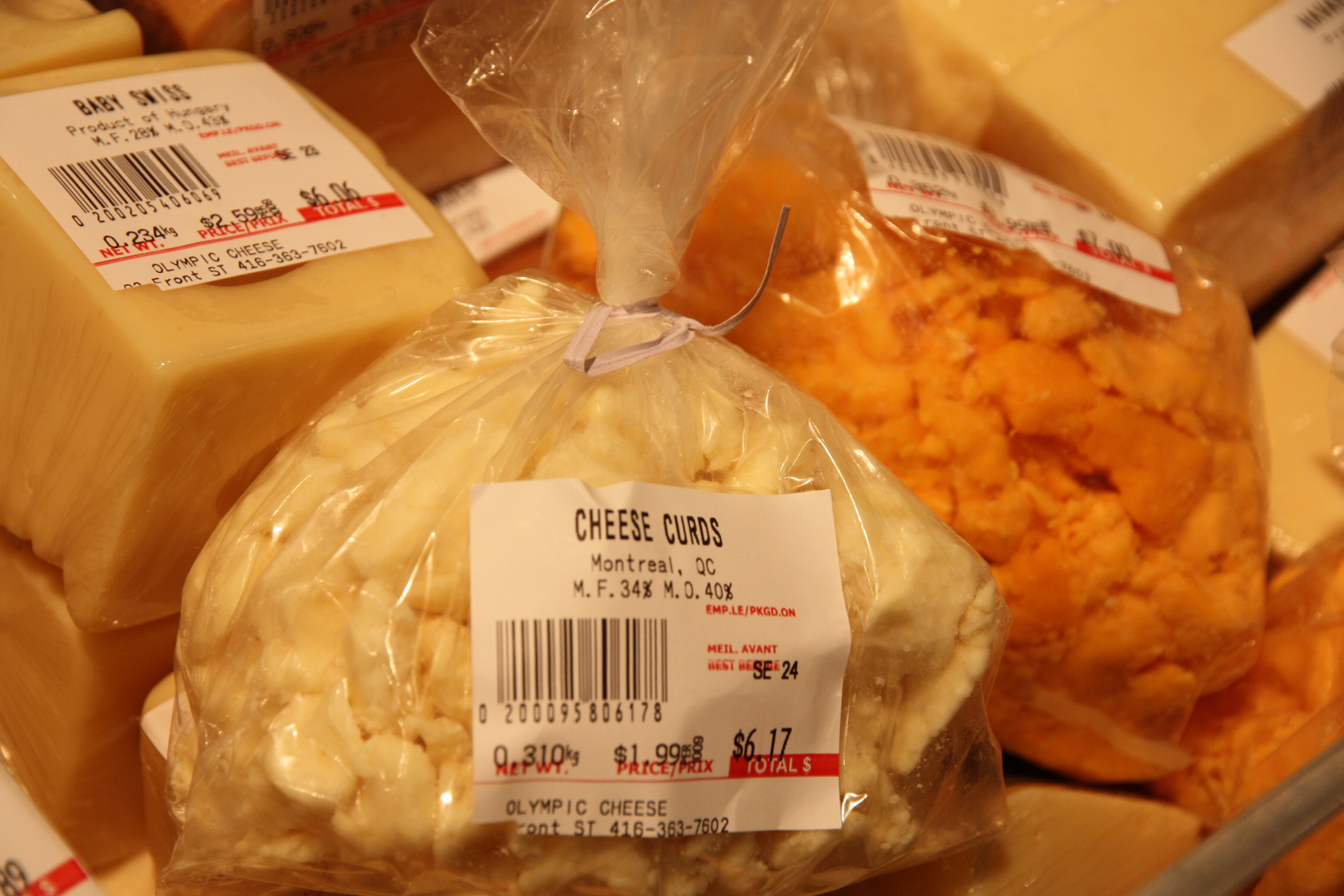
Cheese curds
Once home, Wayne was in charge of assembly. First he spread the chips across two trays. Then he sliced the peameal bacon (which had been brined and rolled in cornmeal) and covered the chips in cheese curds. Next he fried the bacon and made some chicken gravy (with a bit of light beef gravy mixed in) to top the chips and curds.
The poutine was finally popped in the oven for the cheese to melt and—voila—dinner was ready. The gravy was added at the table.
The combination was different and delicious. The peameal bacon was tasty too and we topped it with more curds.
I like the anecdote (can’t verify its truth) of how it was named. A Fernand Lachance of Québec claims he invented the dish in 1957. He said ‘ça va faire une maudite poutine’ (it will make a damn mess). I’m also delighted that I have experienced yet another cultural delicacy.

Lobster claw bromeliad
I’ve already shown off the Montreal Botanic Garden as well as its extensive Japanese garden and collection of cacti. Now I’m on to the bromeliads.
I had never realised that bromeliads were native to the tropical Americas. This is great news. Poor John and I are in South America until January and I hope to see and photograph oodles of examples. I’ve read that they even grow on telephone lines there. A study in Ecuador found that many small animals—such as tree frogs, crabs and salamanders—make their homes in bromeliads, and that the plants themselves sometimes create homes for other bromeliads.
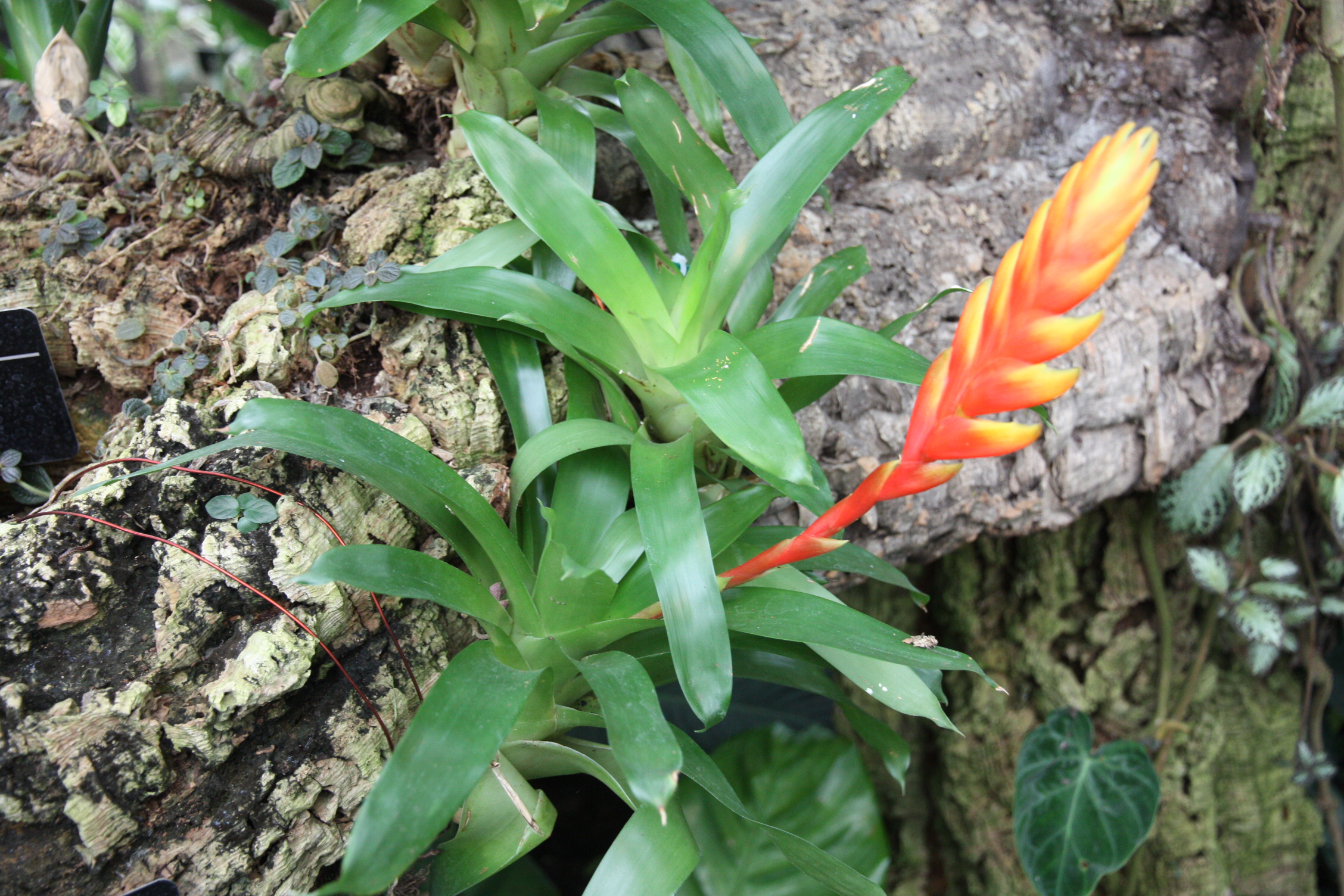
Bromeliad Blaze Vriesea
There are more than 3100 species of bromeliad. They are diverse in size, shape, colour and perfume. They can be found from sea level to 4200 metres, and in rainforests to deserts.
The largest bromeliad reaches 3–4 metres in height with a flower spike up to 10 metres. The smallest is Spanish moss, also known as the air plant. I’m guessing the one we know most commonly is the pineapple.
The Montreal Botanic Garden has lots of showy bromeliads and I photographed the ones that were easy to ‘reach’. I’ve named all the ones that had accompanying signs. Sorry if I have misidentified any. Fell free to correct or add information. Always appreciated.
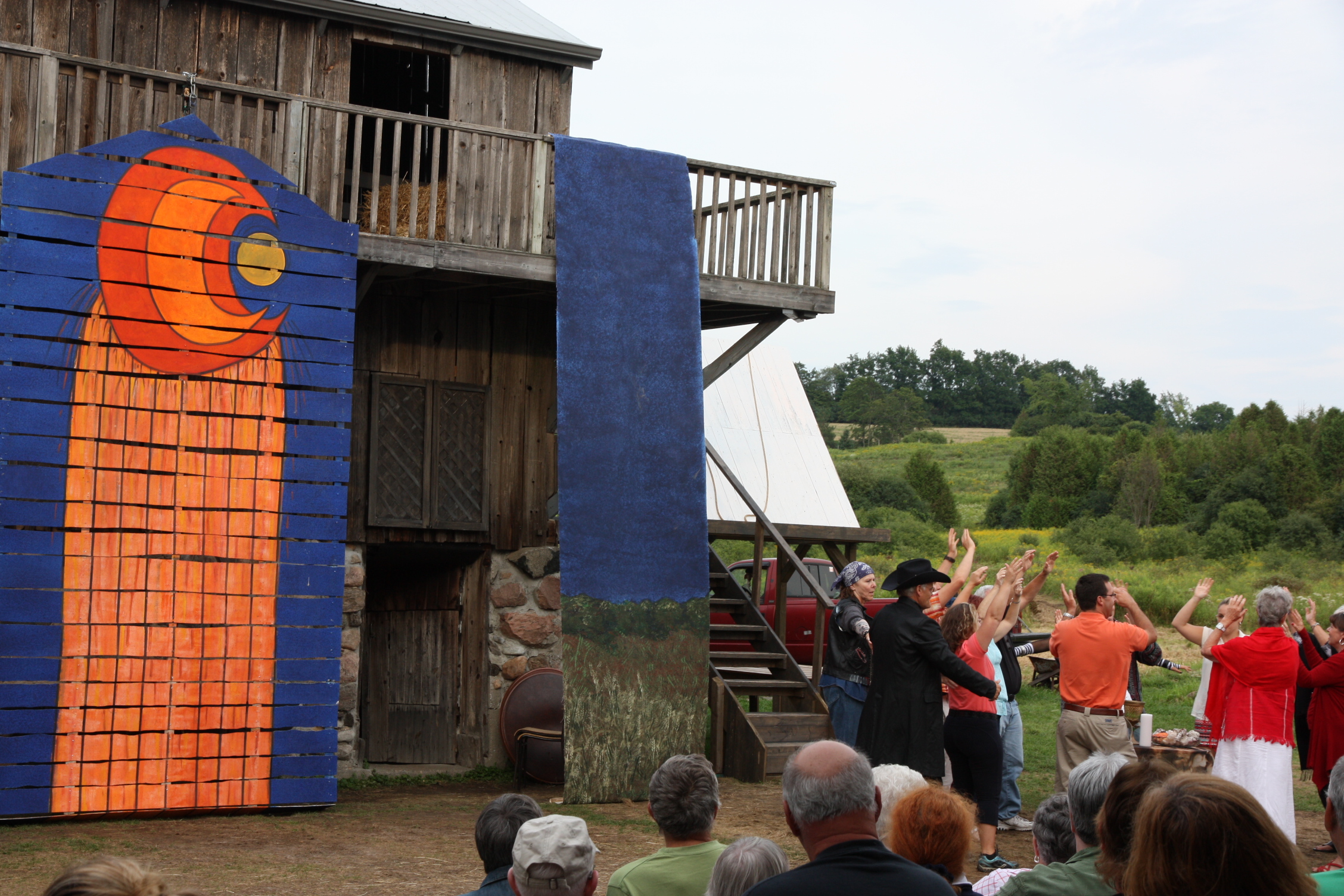
Intermission at St Francis of Millbrook
It’s a special treat when you can enjoy local experiences even though you are just visiting a place for a couple of days.
We were going to stay with Leslie, Wayne and Sarah, east of Toronto. When Leslie and I discussed an arrival date, she said they were going to a local play on the Monday.
That sounded perfect. Poor John and I like to support local theatre (called repertory theatre in Australia), so we asked Leslie to buy us tickets.
About 5pm, we headed off to the 4th Line Theatre’s production of St Francis of Millbrook. Even though opening night wasn’t until Friday, we arrived to find a full house and perfect weather.
The 4th Line is Canada’s premier outdoor theatre company. Now in it’s 21st season, the company performs two locally-inspired plays per northern summer at Winslow Farm.
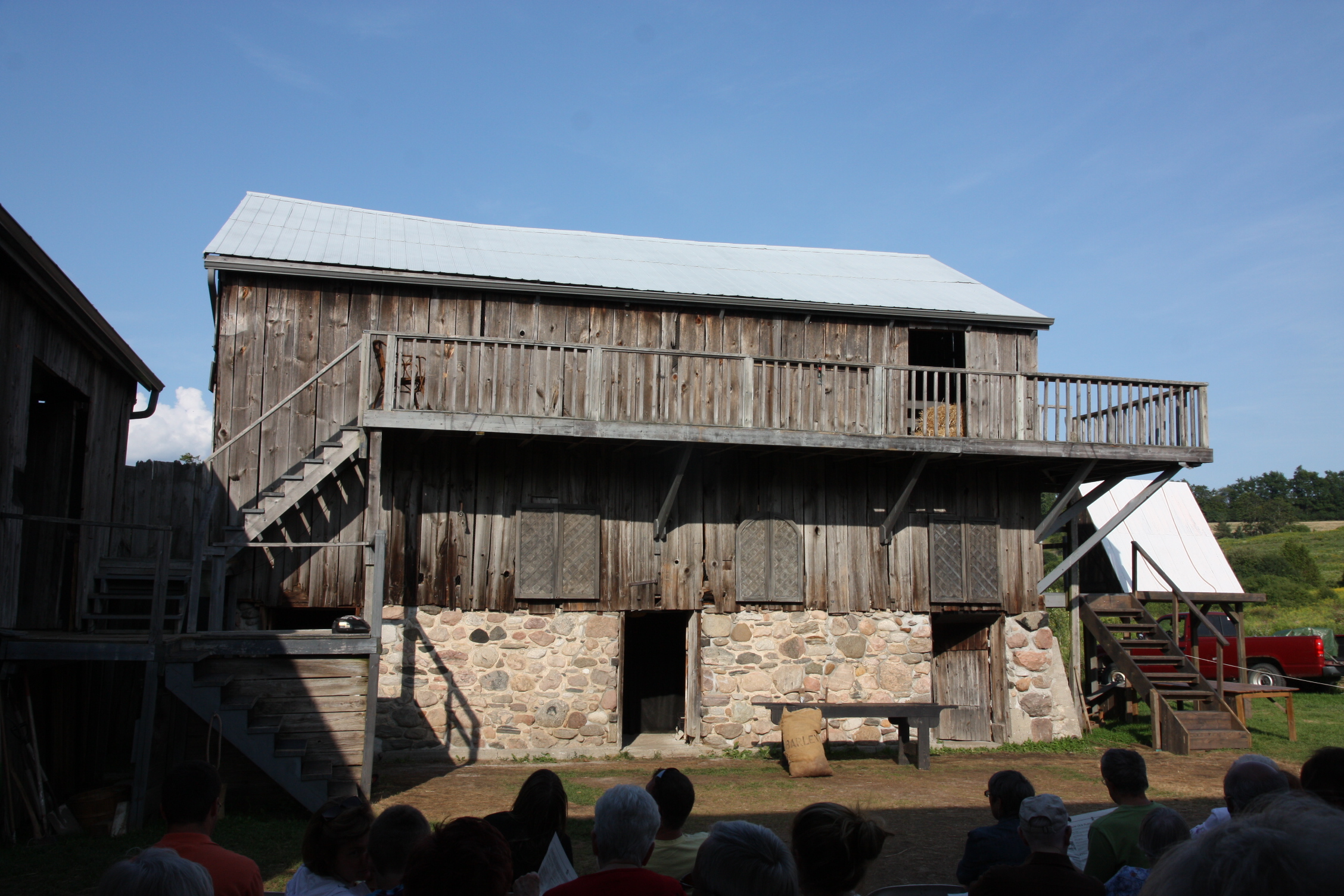
Main setting at Winslow Farm
Robert Winslow, the company’s artistic director and fifth generation at the farm, likes to think that the plays are the farm’s ‘creative crops’.
Every second year, 4th Line has a competition to get play ideas from professional playwrights. This summer’s plays—Queen Marie by Shirley Barrie and St Francis of Millbrook by Sky Gilbert were both winners.
St Francis of Millbrook is about a hockey-playing teenage boy who is growing up gay in a rural community in Ontario. He loves St Francis of Assisi and Madonna, and is trying to figure out how to cope with the turmoil in and around him. In addition to sexuality, the play touches on bullying, alcoholism, abuse, sibling friendships and rivalry, aspirations and dreams.
It was a sensitive and bittersweet production—with tears and laughs and some very kitschy parts thrown in for good measure. I liked that the program said 35 racing pigeons would be released (they were) and that a horse would appear. The horse’s part, which was small, was shared by Poncho and Rusty. Perhaps one of them couldn’t make it to all the rehearsals?
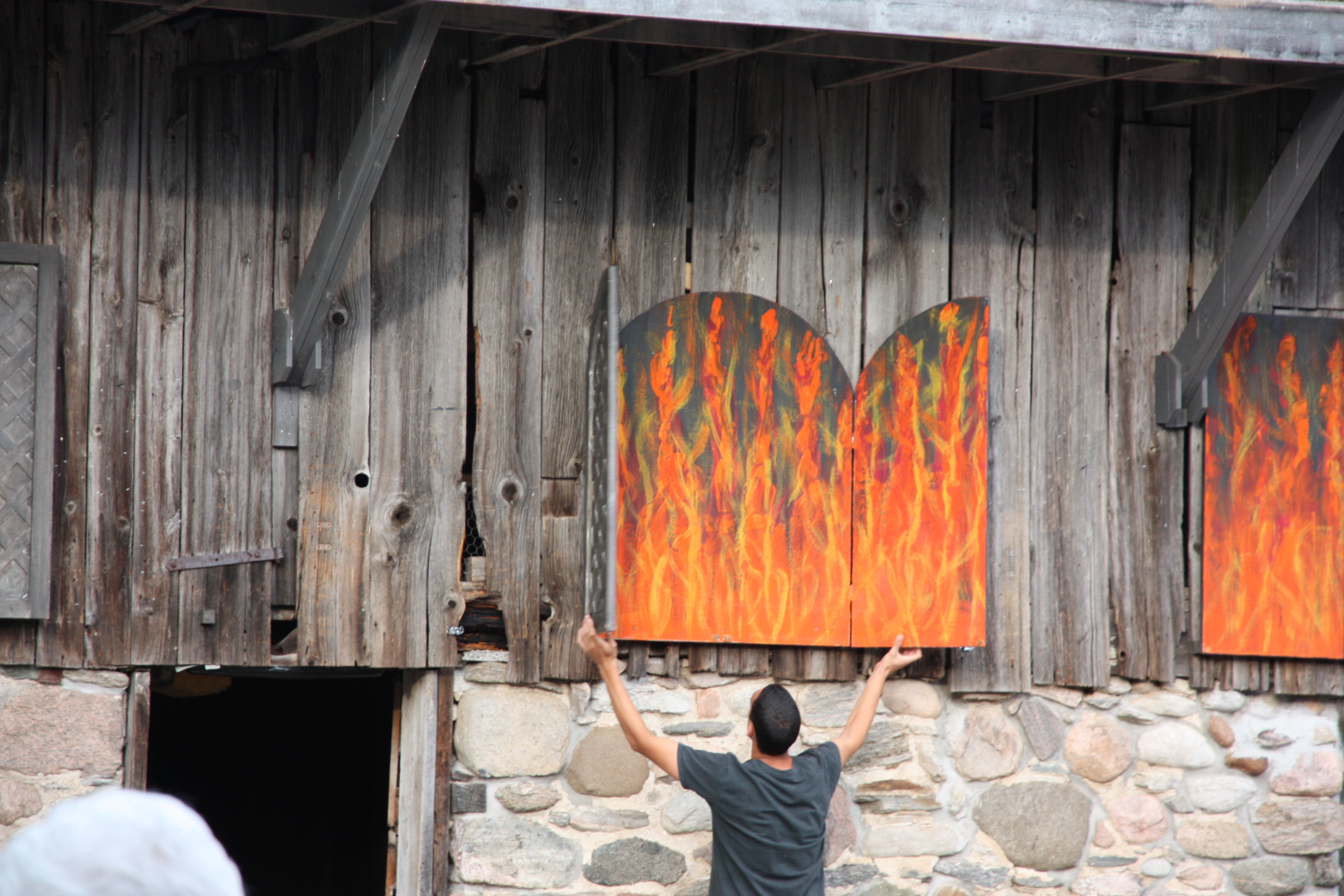
We wondered what the strange farm windows were and then realised they were props—representing fire and brimstone
I also liked that the play involved about 35 actors, plus many staff, volunteers and more. What a great community event!
P.S. Photos were not permitted during the play, so these are from intermission. By the way, Winslow farm was the perfect setting for this play.
P.P.S. The next night we enjoyed a feast at home.
 Where to next?