
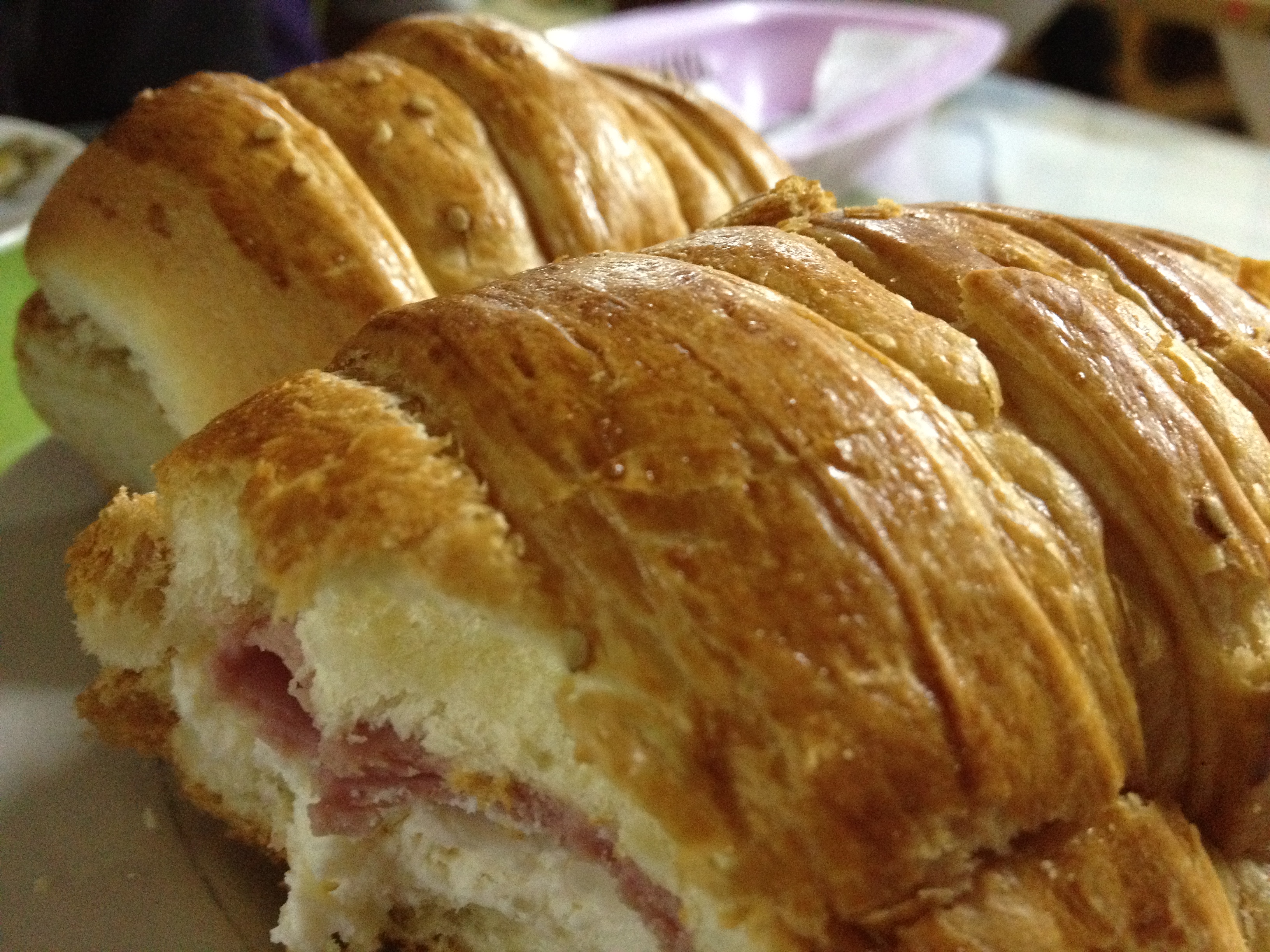
Bologna and cheese sandwiches—on a croissant-like bun. Delish!
The other night Poor John and I stopped at a hole-in-the-wall restaurant for dinner. We’d had a big lunch, so weren’t very hungry. There was no menu and the sign out the front listed a whole bunch of Ecuadorean dishes we didn’t recognise.
The waiter/owner didn’t speak ANY English and neither did any of the other customers. So with hand signals, smiles and a smattering of Spanglish, we ‘ordered’ something small and light, along with a grande (large) beer and a black coffee.
He responded with 30 seconds of Spanish chatter, accompanied by understanding nods, smiles and more hand signals that included an approving thumbs-up for the beer order.
Then he dashed out the door and returned soon with a packet of the white cheese that is so popular in Ecuador. He probably bought it at the small shop next door. Hmmm, now we were curious. What had we ordered? What were we getting?
But the suspense ended soon enough. In a few minutes, we were presented with the Ecuadorean version of bologna and cheese sandwiches, which were on croissant-like buns and delicious.
And the total bill was $3.75.
We had lots of similar experiences in Africa. Sometimes we didn’t know what we’d ordered and other times we got something that was nothing like what we ordered.
An episode in Ethiopia stands out. A few of us took a side trip to some towns in northern Ethiopia. We stopped in a rather large restaurant for lunch. Andy (who joined us for lunch) was keen for a burger. Even though they were pictured on the menu, there was no listing, so he settled on something else.
I can’t remember what Poor John ordered, but I chose a special omelet. When our meals arrived, I was given a plate with four miniature hamburgers on it. Andy’s eyes glazed over with envy and I said ‘hang on, I ordered a special omelet.’ And the waiter turned, smiled and said, ‘Ah yes, that is a special omelet.’
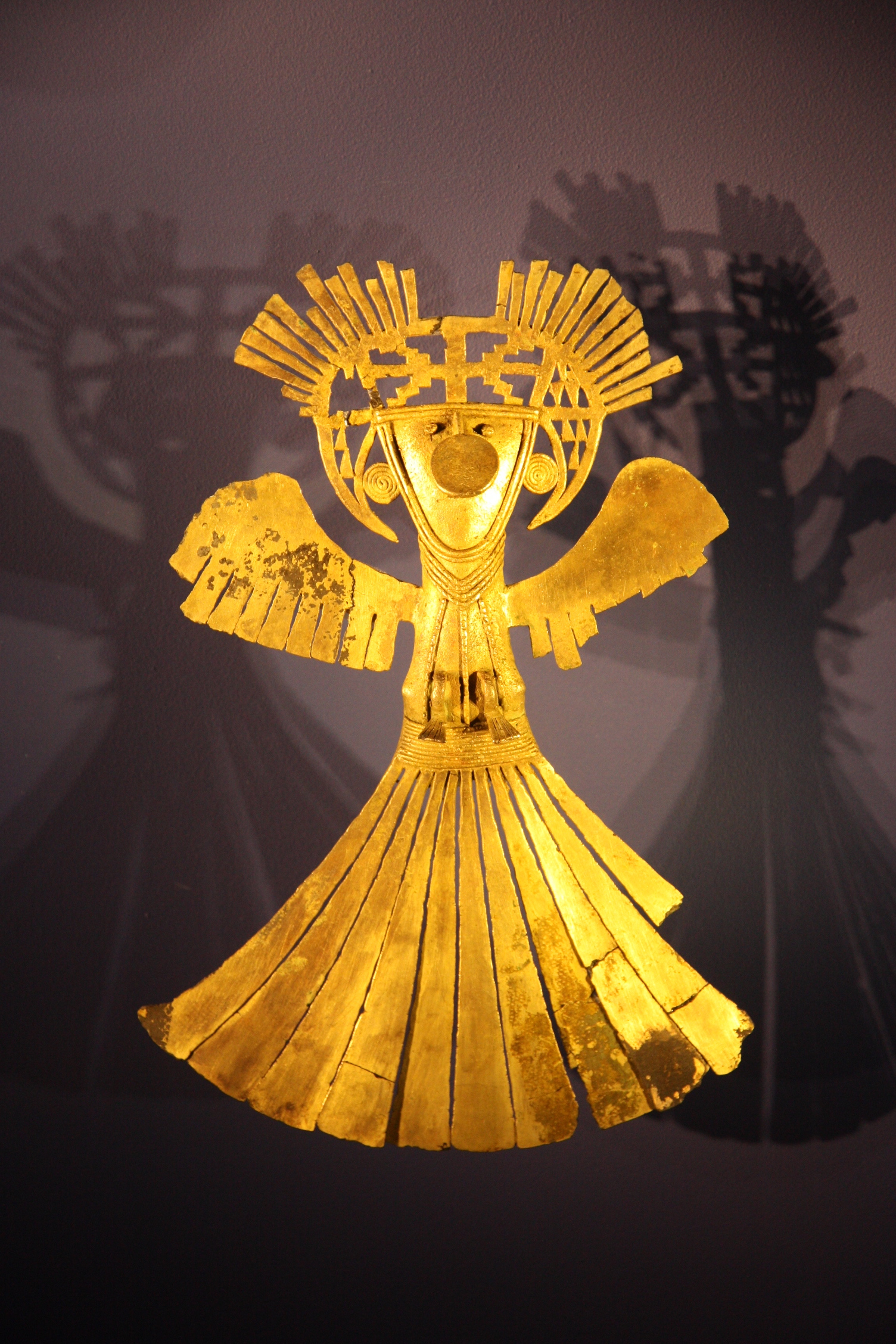
One of my favourite pieces
When you visit the Gold Museum (El Museo del Oro) in Bogota, it’s easy to believe that all the gold in the world is in Colombia—in that one place.
The museum holds 55,000 gold items, with 6000 pieces on display. It is, indeed, the largest world’s collection of gold artifacts from pre-Hispanic times in South America. The detail and intricacy are incredible, and highlight the high level of metal-making skill that existed then.
Most exhibits have descriptions in English as well as Spanish, which is a painstakingly effort on the part of any museum—and most appreciated by those limited to a foreign language phrase book.
We were also impressed to see how the displays covered works by the many different cultures, such as the Calima, Quimbaya, Muisca, Zenu, Tierradentro, San Augustín, Tolima, Tayrona and Uraba.
In addition to gold, there are displays of pottery, stone, wood, shell and textiles. There were also simple explanations on how the various items were made.
We spent half a day wandering through the museum (and stayed for lunch too). The owner of our hostel suggested the outing, and her timing was perfect. We went on a day when admission was free.
Sorry about the sheer volume of pics. I couldn’t resist. I’ve shared pics of a wide variety of items, and have added a few notes of explanation. I probably could/should explained more, but my eyes are still dazzled.

No, not this ducktail
The ducktail is back, and I don’t mean the cute little bums we saw along the waterfront in Toronto.
I mean the men’s hairdo popular in the 1950s.
I shouldn’t confess this, but I remember the ducktail well. We used to spend our summers with my grandparents in a trailer park in Lake Geneva Wisconsin.
Artie Johnson was a regular in the trailer park. He and his folks used to drive up from Chicago for the weekends. Artie was COOL, Artie had a ducktail. He was 16 and I wasn’t yet a teenager, but I had a crush on him anyway.

I mean this ducktail!
Way back when, The Fonz had a ducktail too. So did Kookie from 77 Sunset Strip, the subject of Connie Stevens’ song ‘Kookie, Kookie, Lend Me Your Comb’.
Now I find the ducktail is a fashion statement in Quito, Ecuador. I’ve been here five days and seen six versions of the ‘do’ including a double ducktail that I wasn’t fast enough to get a good pic of.
The pic here is of the first ducktail I saw—thinking it was a novelty.
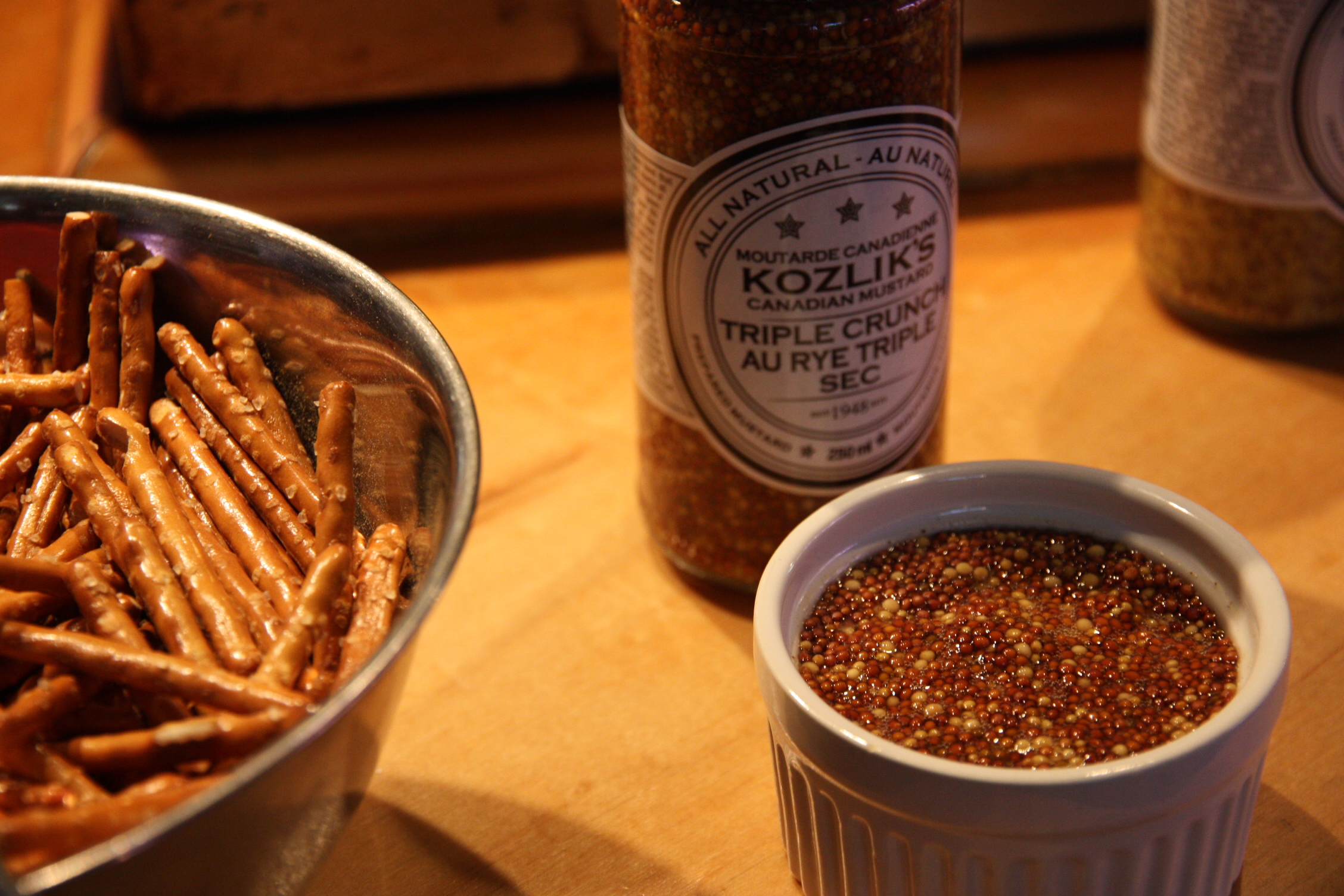
Triple-crunch mustard and pretzels for dipping. Great treat!
St Lawrence Market was one of our first stops when we hit Toronto, and it certainly is impressive.
In fact earlier this year, National Geographic named it the world’s best food market, but I’m not sure what the criteria were.
As we arrived, a meat trolley was being loaded with stacks of enormous cuts, which we followed in the door. From there, it was a feast for the eyes and torture for someone (me) who wasn’t really able to buy.
Instead we drooled over the seafood and delicatessen items, and sampled several delicious mustards and the sensational icewine. Wayne and Leslie stocked up on two kinds of cheese curds for a batch of poutine, and some peameal bacon to go on the side.
So here’s yet another market I’ll have to return to when I’m actually able to succumb to the delicacies—and buy and cook some selections.

Climbing Mount Real—look at all those steps. I wonder if anyone is getting up to anything in all those bushes?
You can’t go to Montreal without climbing Mont Real (Mount Royal)—the place for which the city is named. Of course, at 233 metres (764 feet), it’s a hill not a mountain.
But back in 1535, it must have looked pretty impressive to Jacques Cartier, who ‘discovered’ Canada and who was the first European to climb it.
He was so enchanted by the beauty of the landscape that he named the ‘mountain’ for his patron, King François I, hence the reference to royal (spelt ‘real’ is those days).
Initially the name referred only to the island (yes the core of Montreal is on an island), and then to the greater city from the 18th century.
There is a road to the top, but Poor John and I took the footpath and stairs through Mount Royal Park. It’s an athletic event for some people, and we saw locals having their second and third ‘goes’ jogging up. I’m grateful that I could make it to the top at all.
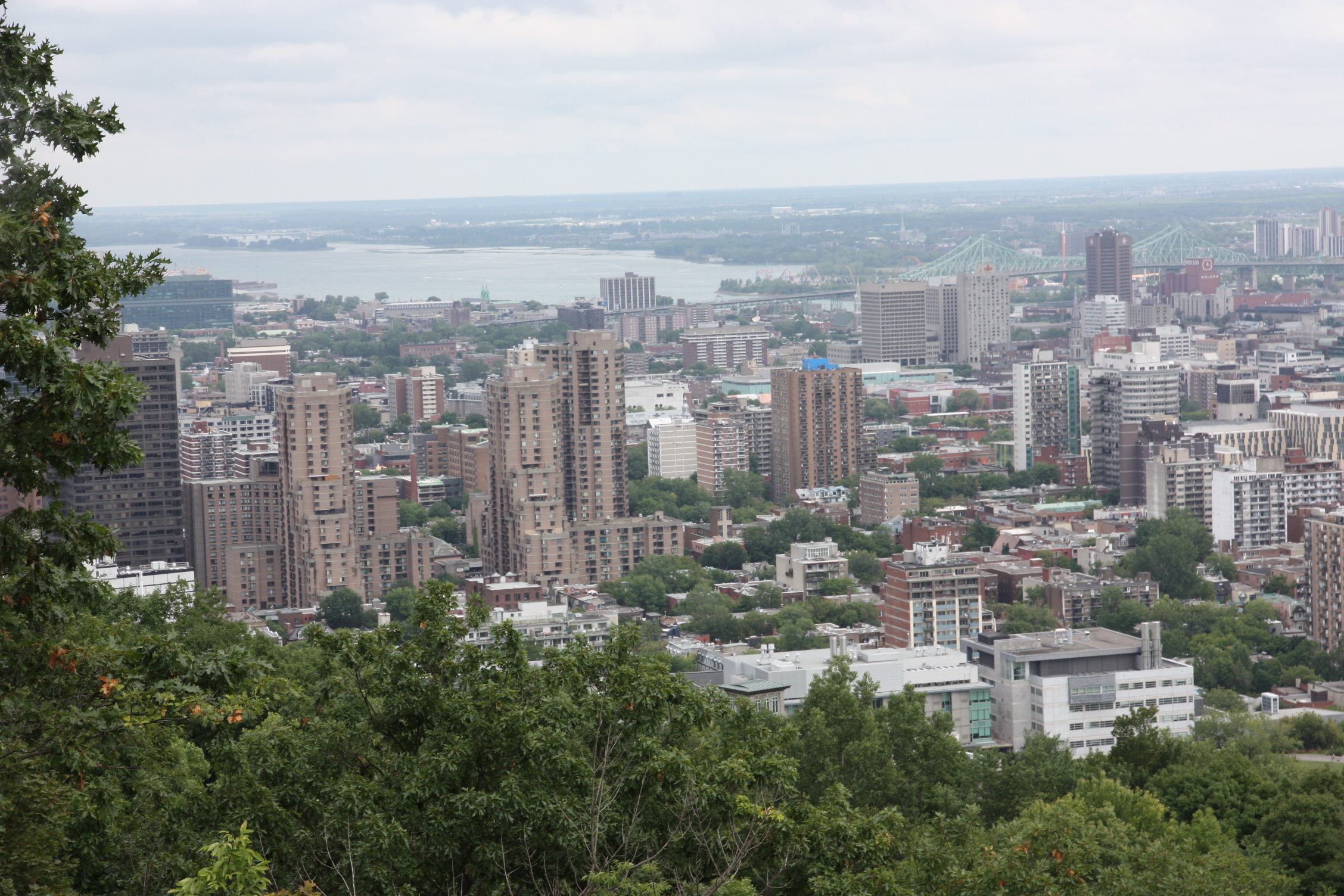
Bird’s-eye view of Montreal
That said, the trip is worth it for the sensational 180-degree views out over the city. Frederick Law Olmsted, who also designed New York’s Central Park, did the plan for this park. It opened in 1876, but not quite to Olmsted’s plan, mostly because of a recession in Montreal during that decade.
There are a lot of other things to see at the top. Our friend, Brenda, told us the lake probably was being renovated. We suppose she was right, because we never found it. Didn’t find the cross or the time capsule (to be opened in 2142) either.
But along with the crowds of people already there, we strolled around the Kondiaronk plaza (named for a Petun chief whose influence led to a major peace accord between the French, Iroquois and other Indian tribes in 1701). We also popped into the summerhouse or ‘belvedere’. I read that the snack bar in there is closed while they figure out a healthier menu.
I had to laugh about the healthier menu idea. Apparently in the 1950s, the then mayor had some of the lush forest removed—morality cuts—so people couldn’t have sex in the bushes. It’s grown back, but we only saw tourists enjoying the view—and those health nuts jogging up and down the stairs.
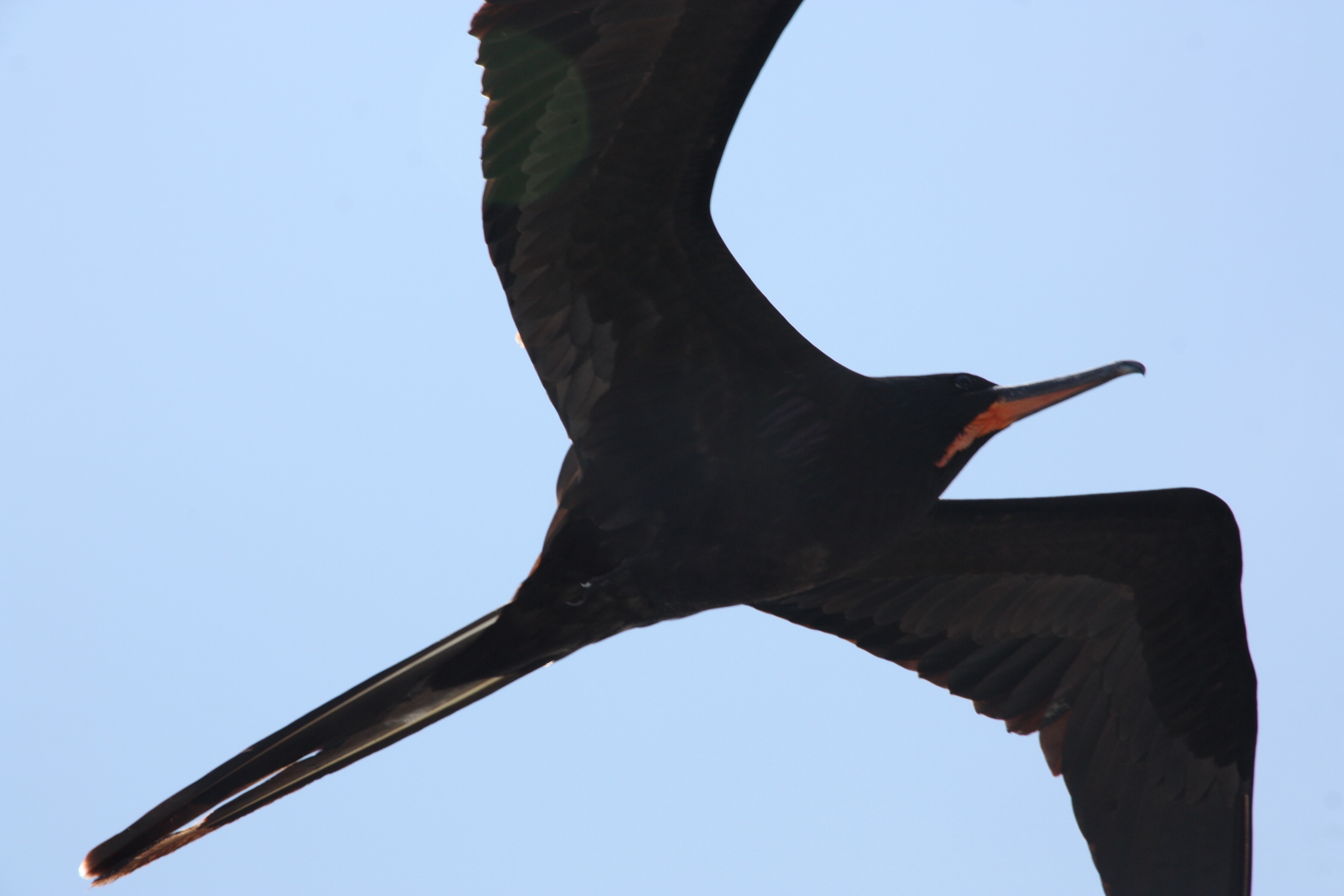
A frigatebird cruises alongside our boat.
I’ll be introducing lots of birds from the Galapagos, but I’ll start with the one I found most unusual. Not because it’s beautiful or colourful or clever, but because it’s the most powerful feathered flier I have ever encountered.
It’s the frigatebird.
This large bird, with iridescent black feathers, cruises the skies of tropical oceans almost non-stop. With the largest wingspan to body weight ratio of any bird, they can stay aloft for more than a week. Sometimes they ride weather fronts and signal a change in weather patterns.
Frigatebirds have their own problems though. They produce so little of the oil needed to keep their wings dry that they can’t swim or land on water. They’re clumsy walkers too and can’t take off from a flat surface. When they do land, it has to be on trees or cliffs.

Frigatebirds escorting our boat
They eat on the fly, literally, snatching food from the ocean’s surface or sometimes harassing other birds until they drop their catches. This may be why their other names are Man of War and Pirate Bird.
Frigatebirds lay one egg per breeding season, and then spend almost a year raising the offspring. It’s the longest parental role in the bird kingdom.
The Galapagos Islands have two kinds of frigatebirds—Magnificent and Great. They are hard to tell apart when flying. We think we saw both, but can’t be sure.
Officials reckon there are about 4000 pairs of frigatebirds in the archipelago.
Every day, up to six birds ‘escorted’ our boat on its travels. We chugged along while they hardly ever flapped their wings—just rode the drafts. I never saw them catch or steal food, and never saw them land.
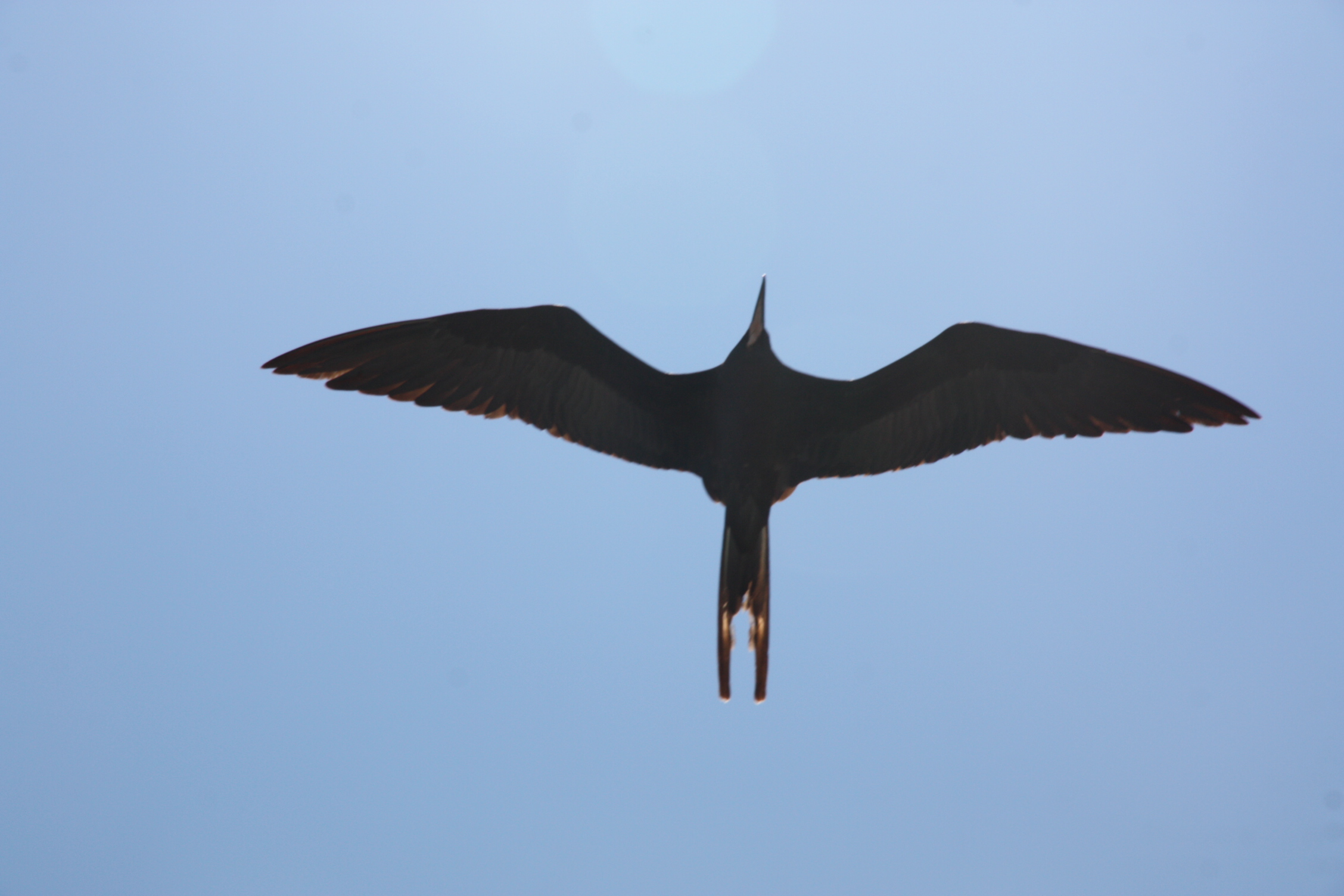
Frigatebird—note the forked tail

A Sally Lightfoot crab in the Galapagos
The Galapagos Islands have hundreds, no thousands, no millions of crabs.
And there are just two main kinds—Sally Lightfoots and fiddler crabs. There must be other types, but we didn’t see any.
Sally Lightfoots (Grapsus grapsus) are also known as red rock crabs. They are usually 3–5 inches across, and are common along the Pacific coastline from Mexico to northern Peru.
In the Galapagos, and probably elsewhere, they live mostly on the lava rocks, just above the sea spray line. You see them everywhere, and usually hanging with the marine iguanas and sometimes the sea lions.
They’re cute, colourful and fast.
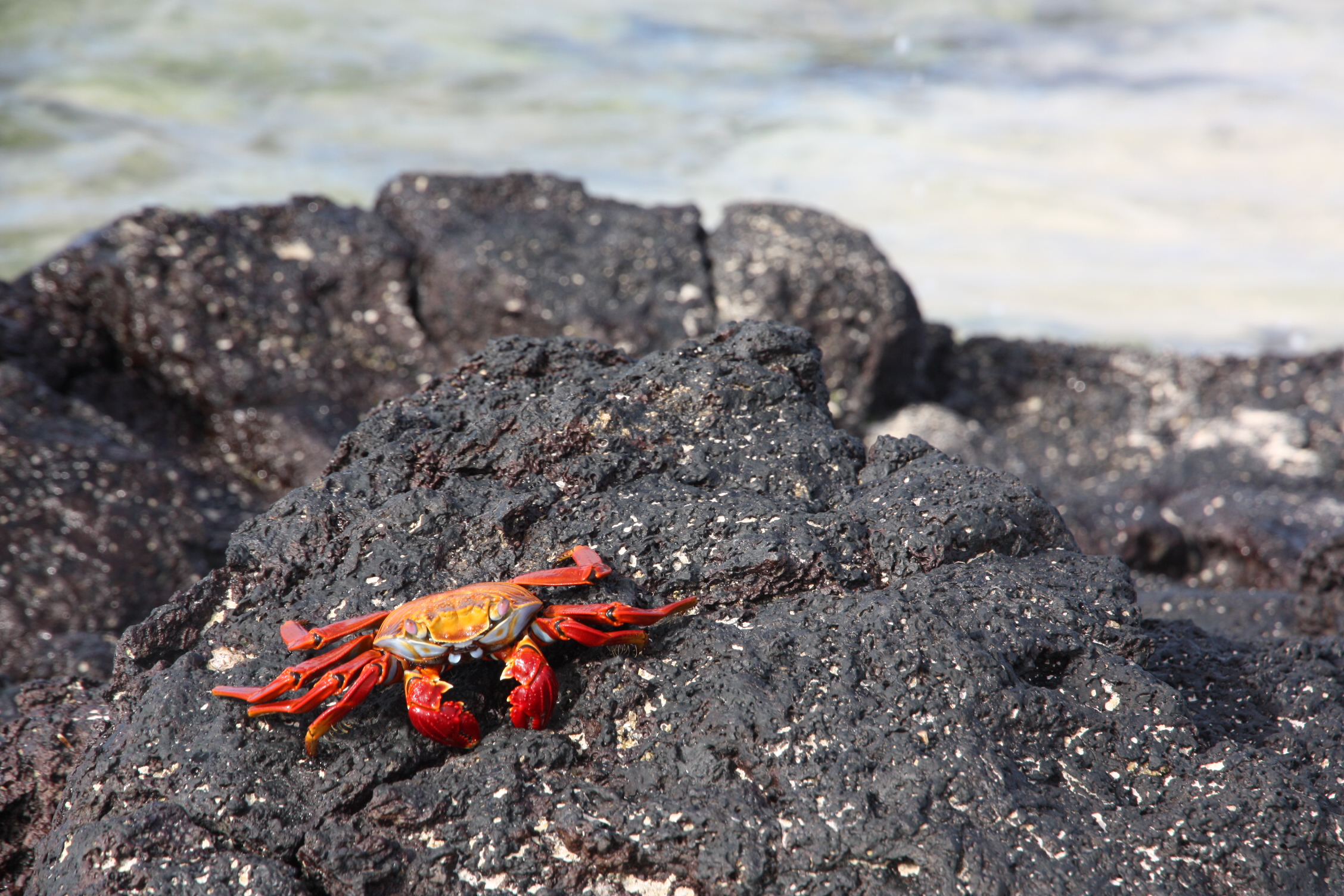
A Sally Lightfoot with a flash of yellow
It’s their colour that catches your eye first. As babies they are black so they blend into the lava rock, making them invisible to their predators such as herons. But as they age, they become bright red, often with spots of pink and yellow. Our guide, Rodrigo, explained that red signals poison in the animal kingdom, so Sally Lightfoots are well protected as adults. Ah, except from fishermen who like to use them as bait.
But first they’ll have to catch them. These little buggers are fast and agile. They are flat and close to the ground. Their five sets of legs let them scamper and jump across rocks. They can climb vertically and seem to be able to walk on water.
It’s not easy to get a close-up photo either. As soon as you approach, they vanish under the rocks. So it pays to stand or sit motionlessly until they reappear, but even then lifting your camera sends them scurrying.
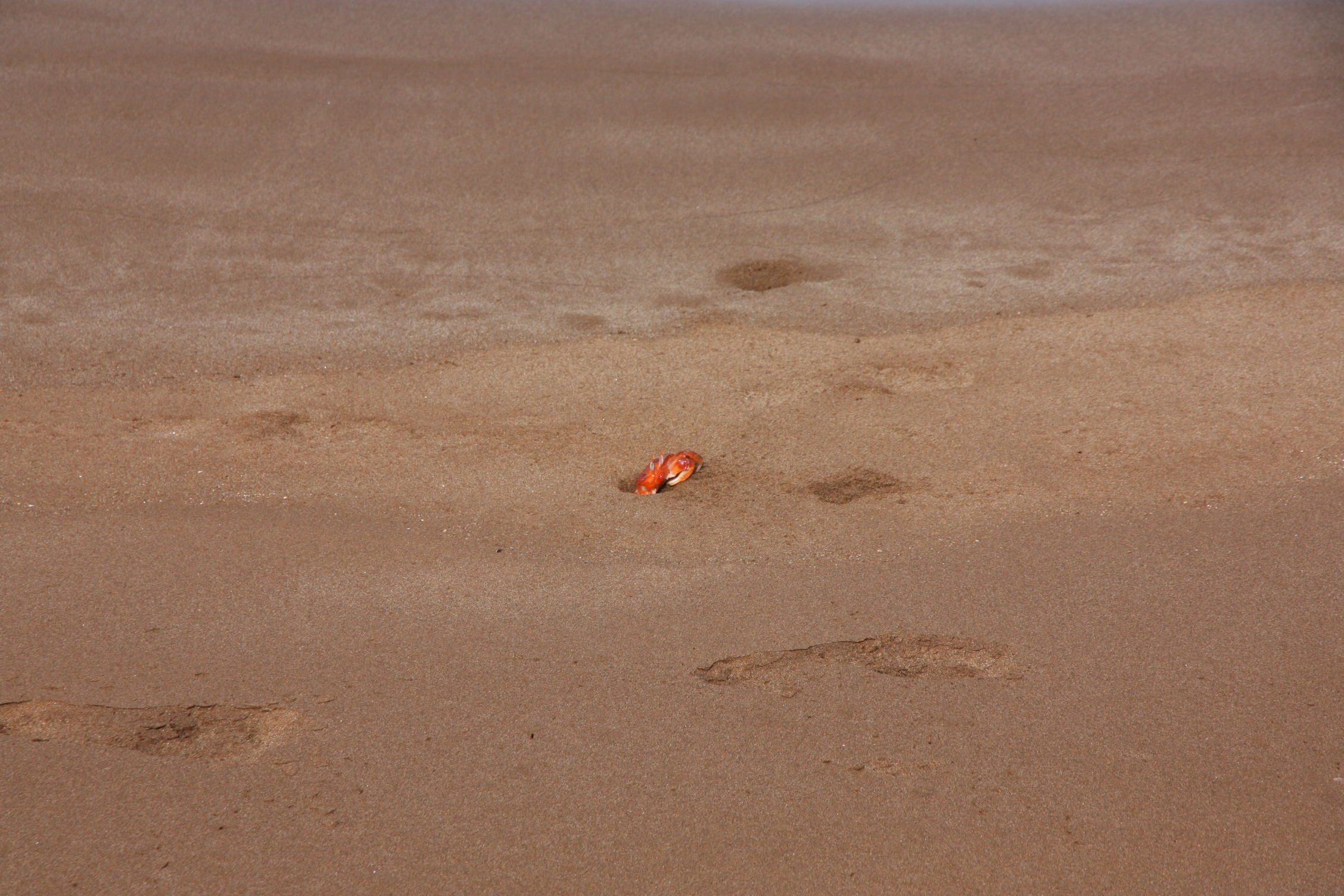
A fiddler crab ducking for cover
Fiddler crabs—only about an inch or two across—are equally fast. They spend their days on the sand, and as you approach any beach you see battalions of them dash for the protection of their recently-dug burrows.
According to Rodrigo, a fiddler crab spends the night above the tide line. Each morning they dig new burrows. The digging is part of feeding. The crab lifts the sediment to its mouth to sift through it for food. After everything edible is taken—such as algae, microbes, fungus or other decayed matter—the remaining sediment is discarded in the form of a small ball. Sediment balls radiating out from a burrow’s entrance indicate that a fiddler crab is in residence. But just looking at the movement on the beach is enough to show you the sand is alive with fiddlers.

A fiddler crab scurrying among discarded sediment balls
By the way, the name fiddler comes from the crab’s asymmetrical claws. The movement of the smaller claw from ground to mouth during feeding makes it look as if the animal is playing the larger claw like a fiddle.
I spent a lot of time stalking crabs. I stood as still as possible until they would re-emerge from under rocks or burrows, but they always had their little eye stalks pointed my direction. So I only got shots from a distance. Next time I’ll take a tripod, a remote shutter release and a triple dose of patience.
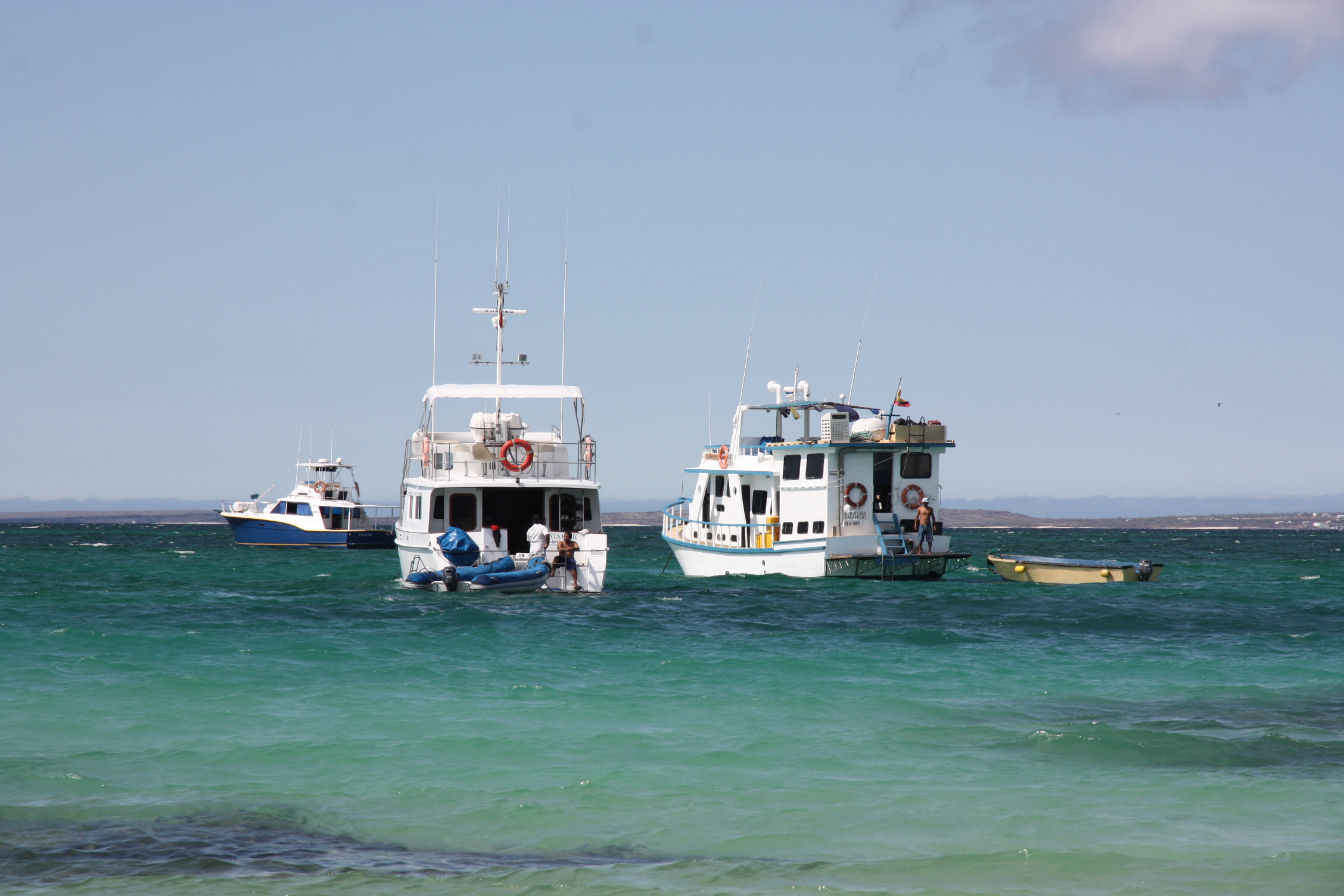
New Flamingo on the right
Poor John and I don’t really ‘do’ deluxe travel. Give us a tent and a couple of roll mats and sleeping bags, and we’re pretty right.
So our budget yacht/boat in the Galapagos suited us perfectly. We were on the New Flamingo—a two-star craft with a five-star crew. You need to know that two stars don’t mean rickety or sub-standard boat. They mean a seaworthy craft, capable crew, small and basic cabins, good food but nothing gourmet, no cocktail hour and like-minded travellers.
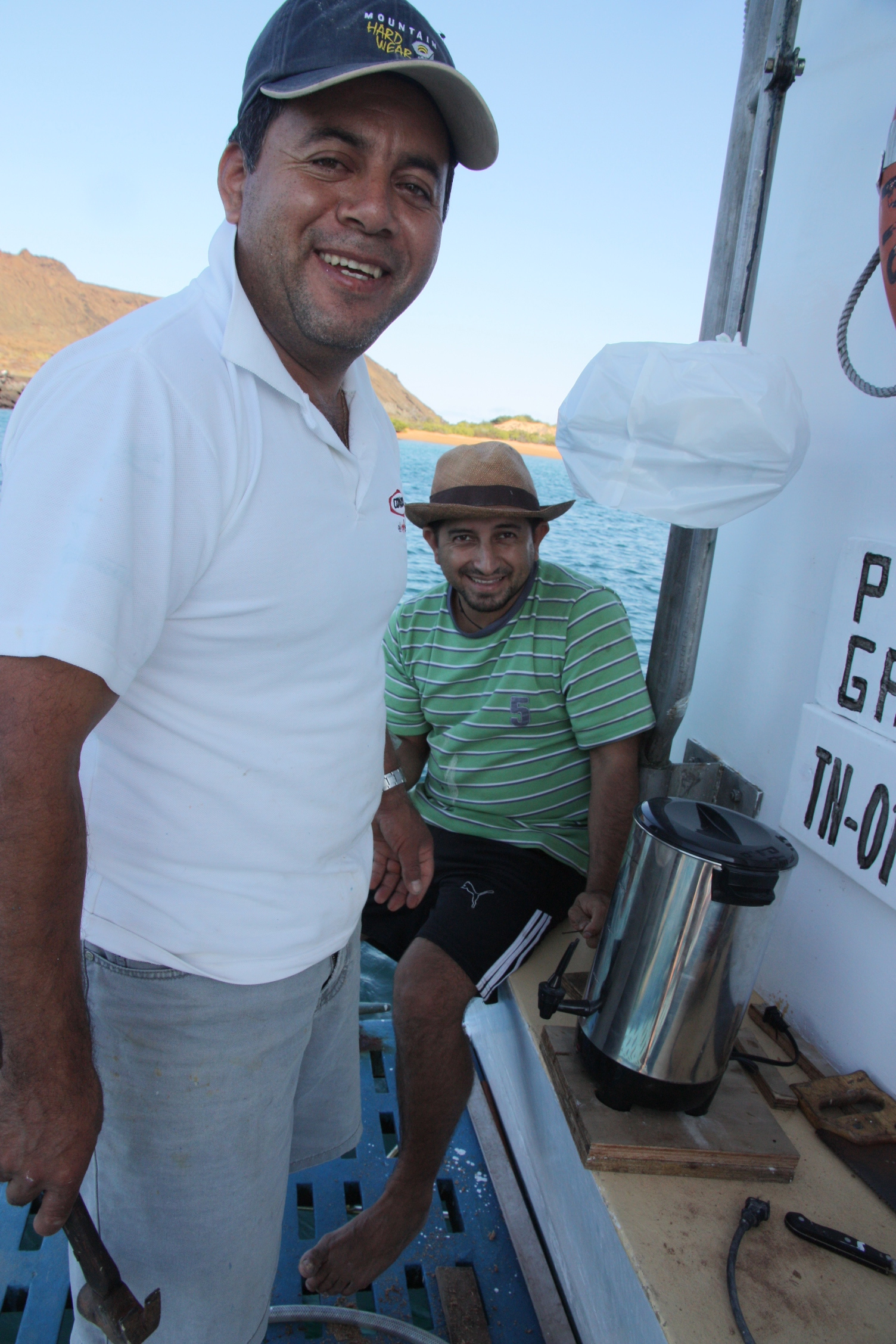
The captain and mechanic made a stand for the coffee urn
The New Flamingo is 45 feet long and has a maximum speed of 8 knots per hour. It was built in 1994 and refurbished in 2007. But refurbishment seems to be ongoing because the boat hardly ever comes off the water to be worked on. Every day, a member of the crew was ‘wearing’ new dabs of paint on their arms or face. One project was to make a stand to hold the coffee urn firmly in place.
The boat takes 10 passengers in five cabins, and we had a full complement. Our cabin was narrow and small—a set of bunk beds (I always get the top), two shelves, a light bulb, a small bathroom with a hot-shower sprayer and WINDOWS!
Two-star boats rarely have hot showers, so this was a big bonus for us. There were also two nice but small deck areas and one largish dining area. And of course, there was the crew’s domain, including the kitchen. Nothing like a boat to show you the true meaning of a galley kitchen.
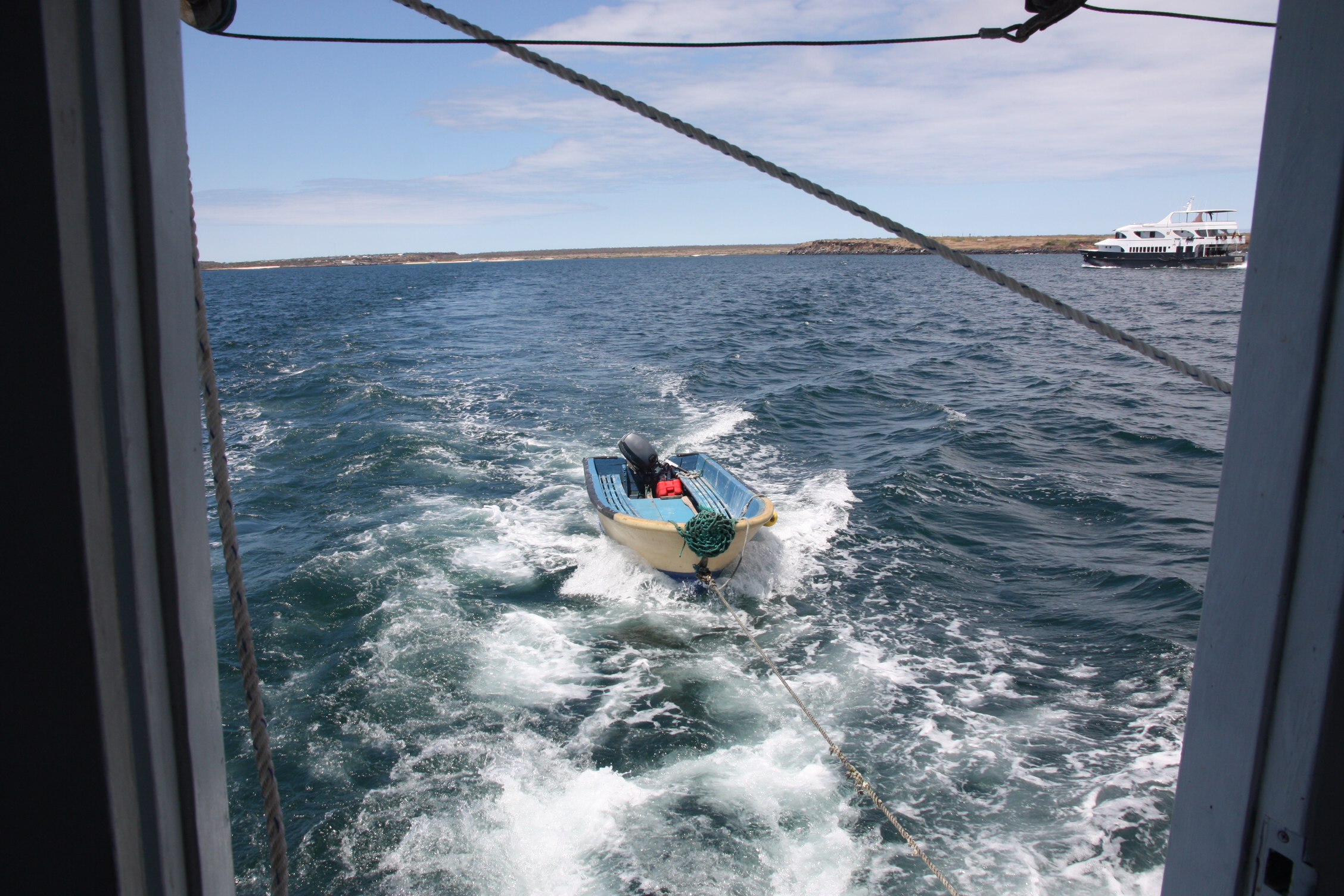
Our little panga trails behind
There was also a panga, the small boat that we used to get to shore. It was interesting to see how Lenin, the assistant captain, maneuvered us to shore. He reversed in and lifted the motor as we glided toward the beach or other landing.
The Galapagos Islands are so fragile, and great care needs to be taken at every stage. That’s one of the reasons the average number of people per boat is 16. While there are boats that carry up to 100 passengers, our little boat is closer to the norm.
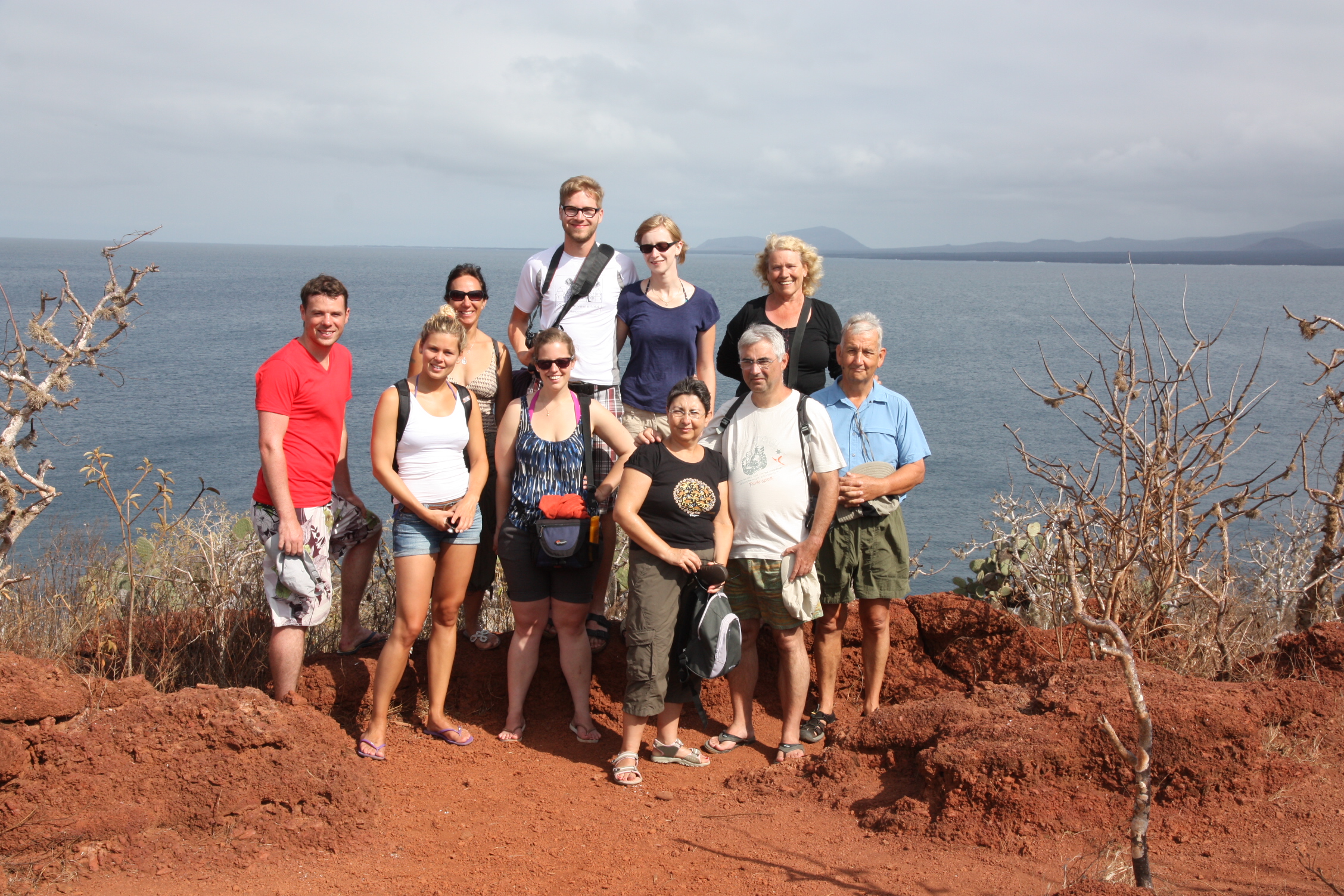
On dry land in the Galapagos—our fellow travellers
In addition to having a great crew of six (Including our knowledgeable and enthusiastic guide, Rodrigo), we had great travelling companions. There was a good range of ages and six nationalities represented—Spanish, Dutch, German, English, Australian and American.
Each evening, Rodrigo gave us a briefing for the next day and posted a new schedule of activities. The boat usually travelled the longer distances at night, stopping by 10 or 11 for the night. The seas were rough-ish and some of the group were seasick. That’s probably one of the downsides on a smaller boat.
I sleep well in a rocking boat or moving train, so made a beeline for bed about 8 each night. We had a wonderful five days and I’d do it all again with the same boat, crew and companions.
P.S. Thanks to Natalie at Oasis Overland for organising this for us. And here’s more about the boat if you ever want to book for yourself.
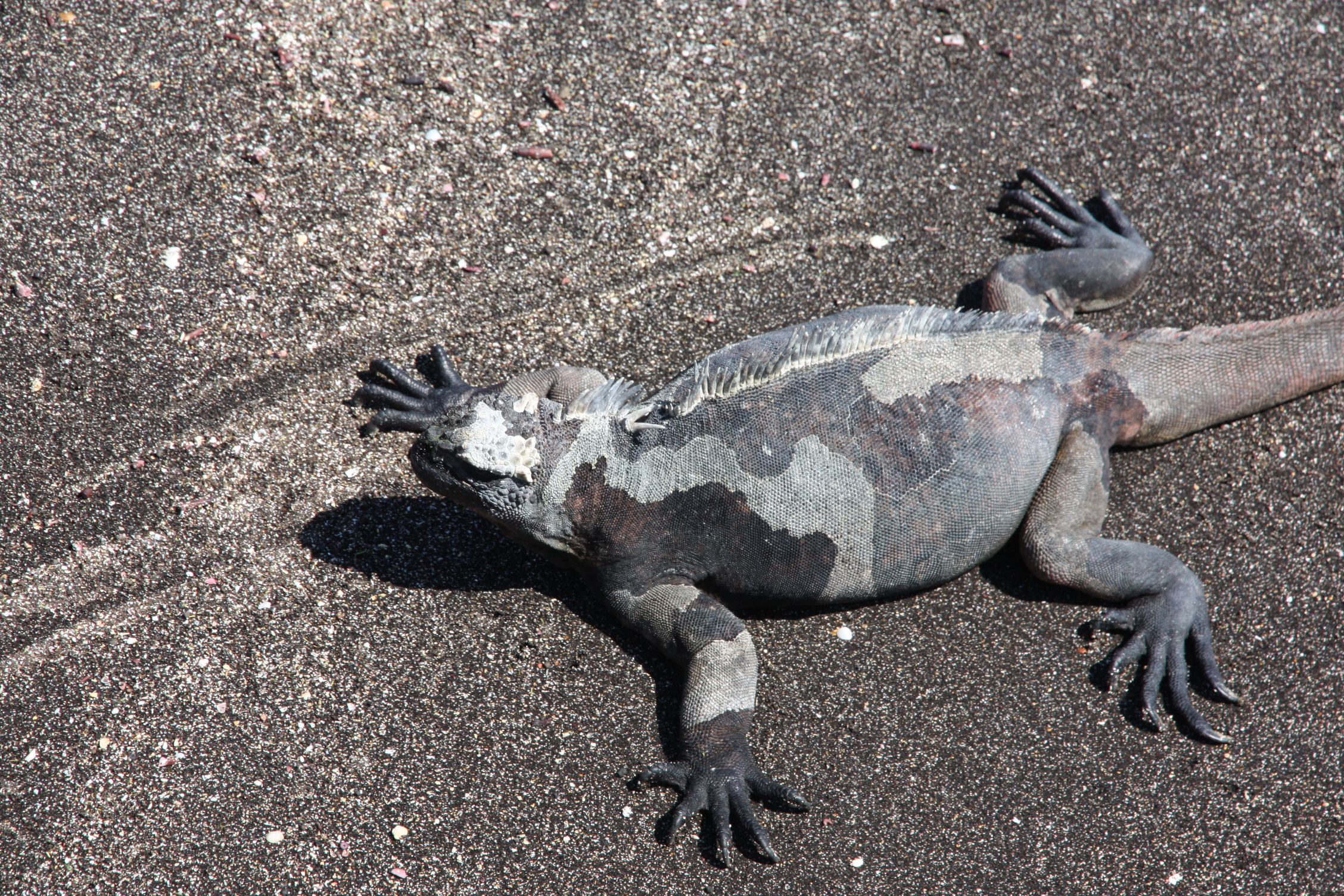
Multi-coloured iguana
You’ve already met the sea lions of the Galapagos Islands, so let’s go from cute and adorable to ugly and prickly—meet the marine iguanas.
Charles Darwin thought they were hideous. He saw them everywhere on his travels to the archipelago. He noted that the black lava rocks were frequented by large (2–3 feet in length) disgusting, clumsy lizards.
He called them ‘imps of darkness’ and described them as ‘black as the porous rocks over which they crawl and seek their prey from the sea.’
In fact, all marine iguanas aren’t black. We saw many that were multi-coloured with greys, reds, greens, golds and, of course, black.

Marine iguanas return from feeding
And their ‘prey’ happens to be almost exclusively algae. During low tide, iguanas dive up to 10 metres to harvest algae from the underwater rocks. Their flat snout and sharp teeth help them get as much food as possible in the shortest amount of time. Dives can last up to 30 minutes. Then they hurry back to shore to bask on the rocks so they can warm up and begin to digest their food.
Marine iguanas exist only in the Galapagos—and they are everywhere. The Charles Darwin Research Station reckons there must be hundreds of thousands. We saw hundreds of them—on the rocks, on the sand, swimming back to shore and feeding underwater when we were snorkelling.

Marine iguanas warming up together
Apparently they can be aggressive when they are warming up. That’s because they can’t run when they’re cold, so it helps to scare off any predators. Their main issues are with cats and dogs on inhabited islands.
One thing I saw just once, but wasn’t quick enough to photograph, was an iguana snorting water out through its nostrils. They have a special gland in their snout that filters their blood for excess salt ingested while feeding. Later they ‘sneeze’ out the salt.
So who should I introduce next? I still have the boat, crabs, birds, lizards and more to go. Stay tuned.
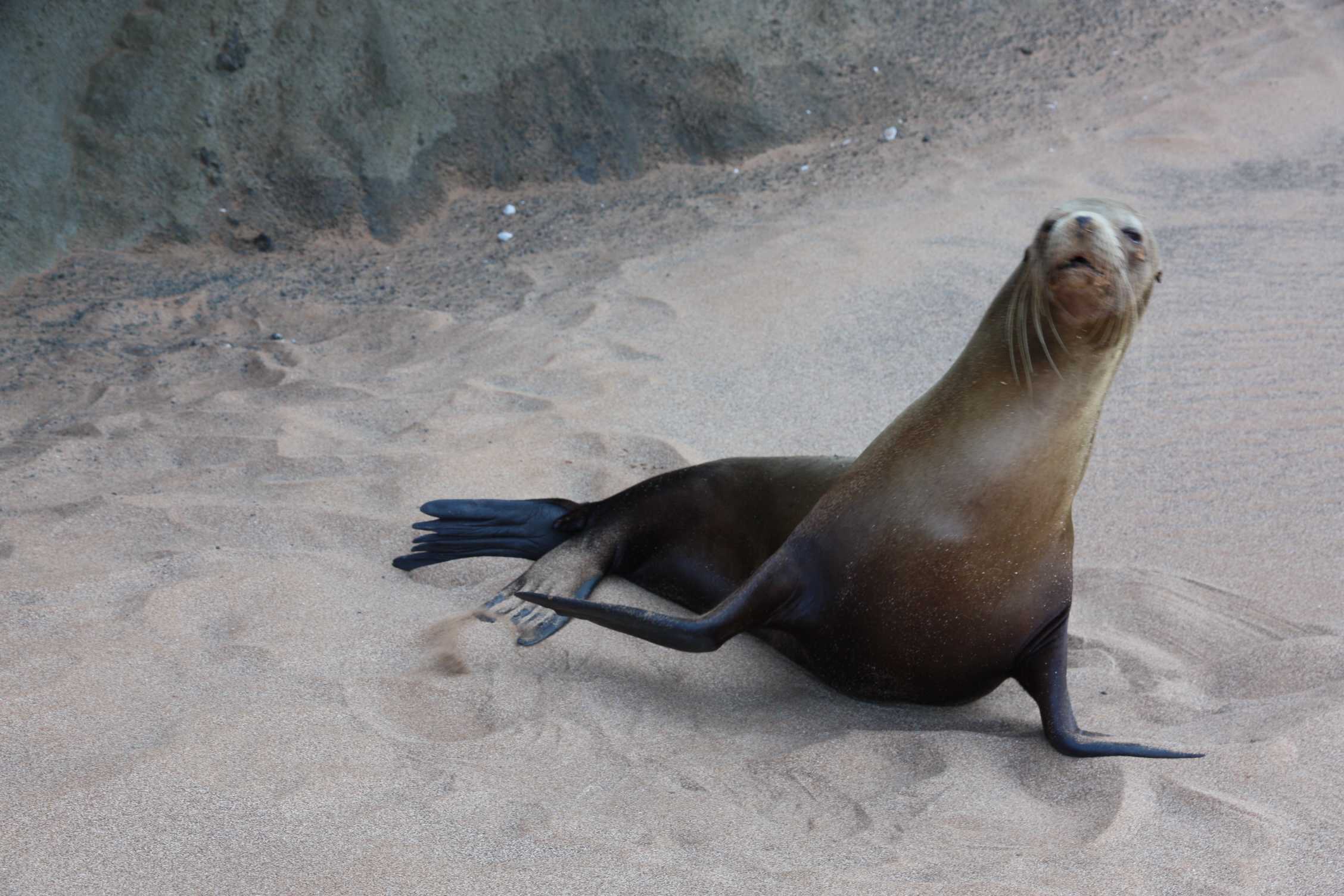
Sea lion—the welcoming committee for the Galapagos Islands
We’ve just had five glorious days in the Galapagos Islands, 1000 kilometres off the coast of Ecuador.
It was hard to decide where to start with my tales of this amazing archipelago, but I figure cute and cuddly will be popular and welcome.
So meet the Galapagos sea lions—lobos marinos in Spanish—who have cute in trumps.
These social and playful creatures appear on almost all the islands in the Galapagos. There are anywhere from 20,000 to 50,000 of them lounging around on the sandy beaches or romping in the waters in this far flung part of the world.
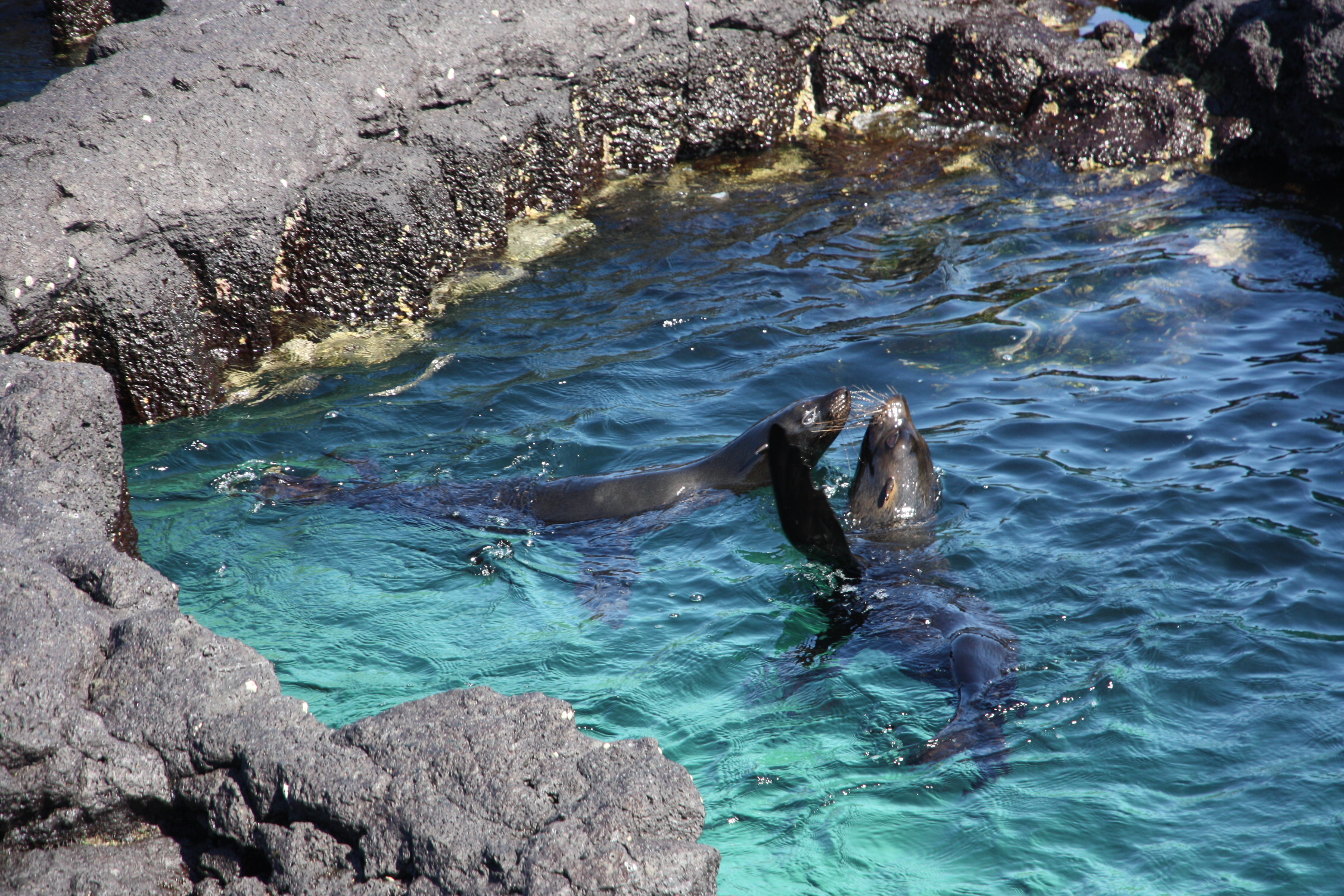
Play time all the time.
We saw lots of them up close, really close, although never quite managed to touch one. Three of them were bunched together on the landing when we got off the boat at one island. Several times they swam with and around us as we were snorkeling. When we walked along the beach and someone yelled ‘look out,’ they were usually warning us not to step on or trip over a sea lion.
Of course they are all protected so they aren’t really afraid of humans. We could walk right up to them and around them, lean over them with a camera waving in their faces, follow them along the beach or across the rocks (they prefer sand).
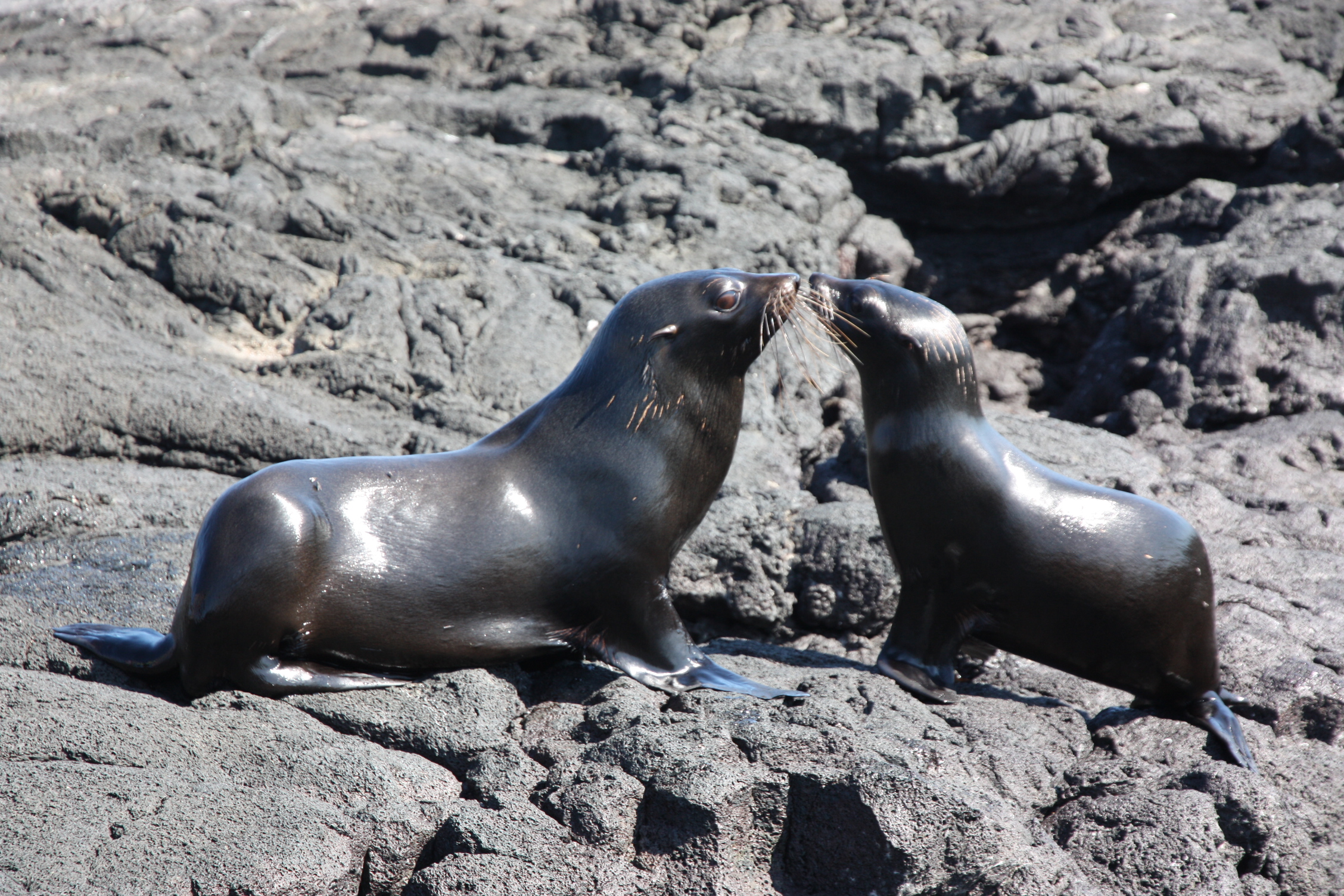
A sea-lion smooch?
So how about some more detail.
Galapagos sea lions have been thought to be related to the California sea lions, but recent genetic data indicates they may be their own species—Zalophus wollebaeki.
The males and females have pointy, whiskered noses, obvious ear-like flaps and flippers (with claws that resemble toenails).
They look a bit awkward when they walk on land, but oh boy can they swim. They are so agile—twisting and turning, leaping out of the water, zipping back and forth. It really is hard to keep tabs on their antics and whereabouts.
Sea lions feed mainly on sardines. When times are tough (during el Niño events) they swim far off shore where they may fall prey to their main predators—sharks and killer whales.

Two-toned sea lion when wet and dry
When sea lions are wet, they’re a dark chocolate brown. When dry, they are many shades of brown and gold.
Sea lions live in colonies. A single dominant bull (they grow up to two metres in length) guards and protects his harem of five to 25 cows. His job lasts only a few months. He’s so busy protecting he doesn’t have time to feed, so is soon overcome by a well-fed fellow.
Bachelor bulls usually live peacefully in their own colonies, waiting for a chance to take charge.
Breeding occurs May to January, so there are almost always pups in a harem. We saw pups, but tried to keep our distance in case mum was nervous.

‘Dad’ gives up barking for a minute to rejoin the family on the beach?
Sea lions are pretty noisy, especially the males. Their bark sounds quite dog-like and the males can bark on and on and on. We saw and heard one do exactly that on the last full day we had on the archipelago.
If our guide was right, a female had just rejected the advances of a male. He let us all know how irritated he was, barking all the way to the water and then for the next 30–40 minutes while he sat in the water and we explored one side of the island. He might still be barking, but two pups returned to shore and he waddled in to greet them. A family reunion?
Stay tuned for more on the Galapagos turtles, tortoises, lizards, iguanas, crabs, lava, flora, the boat we travelled on, and the beautiful and diverse land and seascapes.
 Where to next?