
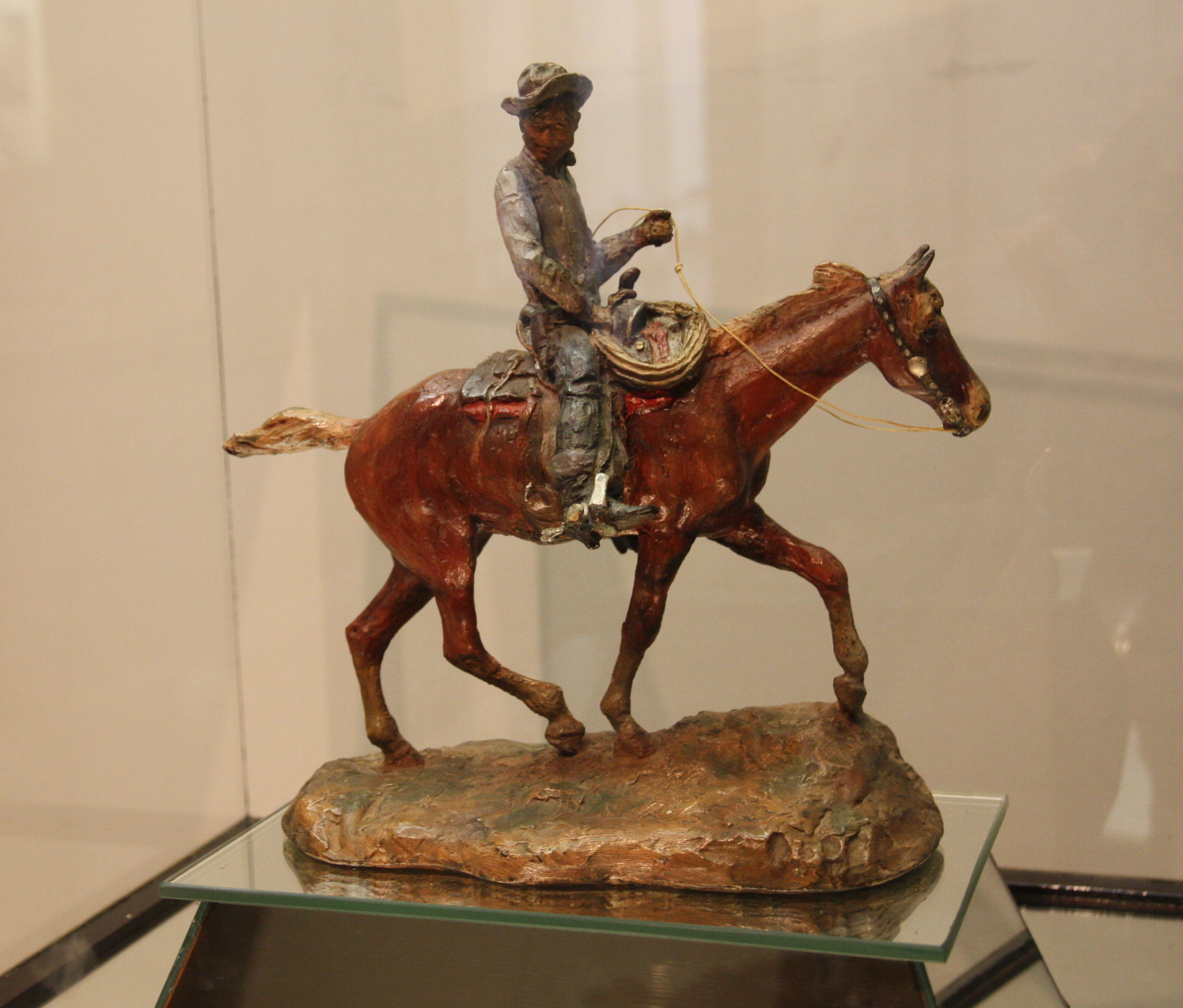
Charles Russell did a sculpture of Rogers on a ‘horse with no name’. They disagreed about the brand the horse should have and other aspects of the piece, so more than one sculpture was made. This is a fragile, one-of-a-kind, hand-painted plaster copy that Russell gave to Betty and Will Rogers. It has been on display since 1999.
‘We honor the memory of Oklahoma’s beloved native son. A modest, unspoiled child of the plains, cowboy, actor, humorist and world traveler whose homely philosophy and superior gifts brought laughter and tears to princes and commoners alike. His aversion to sham and deceit, his love of candor and sincerity, coupled with abounding wit and affable repartee, won for him universal homage and an appropriate title, “Ambassador of Good Will”.’
Presented by the Cherokee Nation
The world lost a remarkable man when Will Rogers died in a plane crash in Alaska in 1935.
He was only 55 then, but had already travelled around the world three times, made 71 movies, written more than 4000 nationally syndicated newspaper columns, spoken regularly on radio and become one of the world’s best-known celebrities.
A native of Oklahoma, Rogers was one-quarter Cherokee Indian. He was down-to-earth, extremely proud of his heritage, believed in hard work and symbolized the self-made man.
In his early 20s, he tried his luck as a cowboy/rancher in Argentina and South Africa. On returning to America, his rope skills—he was taught by a freed slave—got him a job in Texas Jack’s Wild West Circus.
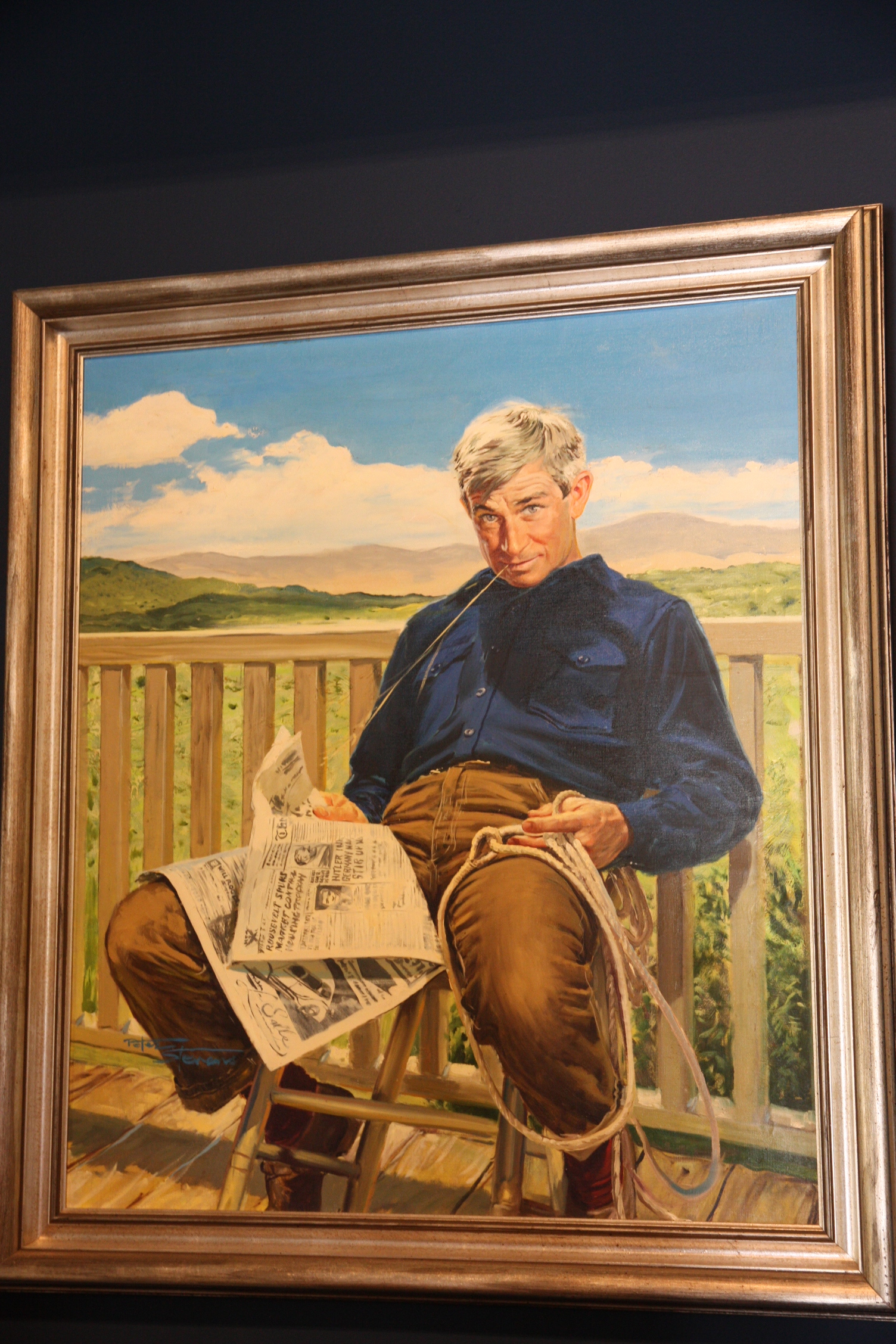
Will Rogers
He then had a stint in a circus in Australia before embarking on the vaudeville circuit in the US.
His rise to stardom began on a trip to New York City. A wild steer broke out of the arena in Madison Square Garden and began to climb into the viewing stands. Rogers nonchalantly roped the marauding steer and made front-page news.
From there came a chain of successes. He and his horse worked 10 years on the Victoria Roof, then on to the Ziegfeld Follies.
His riding and roping skills were soon joined by sharp satire. That happened after a performance attended by then president, Woodrow Wilson. Rogers improvised a ‘roast’ of presidential policies that had Wilson, and the entire audience, ‘rolling in the aisles’. The performance proved his remarkable skill at off-the-cuff, witty commentary on current events, and ever-after Rogers built his career around that skill.
I could write pages and pages about Rogers. He was just so inspiring. He was a family man, a movie star, a newspaper and radio man, and much more. He wrote for the Saturday Evening Post and his daily ‘Will Rogers Says’ column reached 40 million newspaper readers.
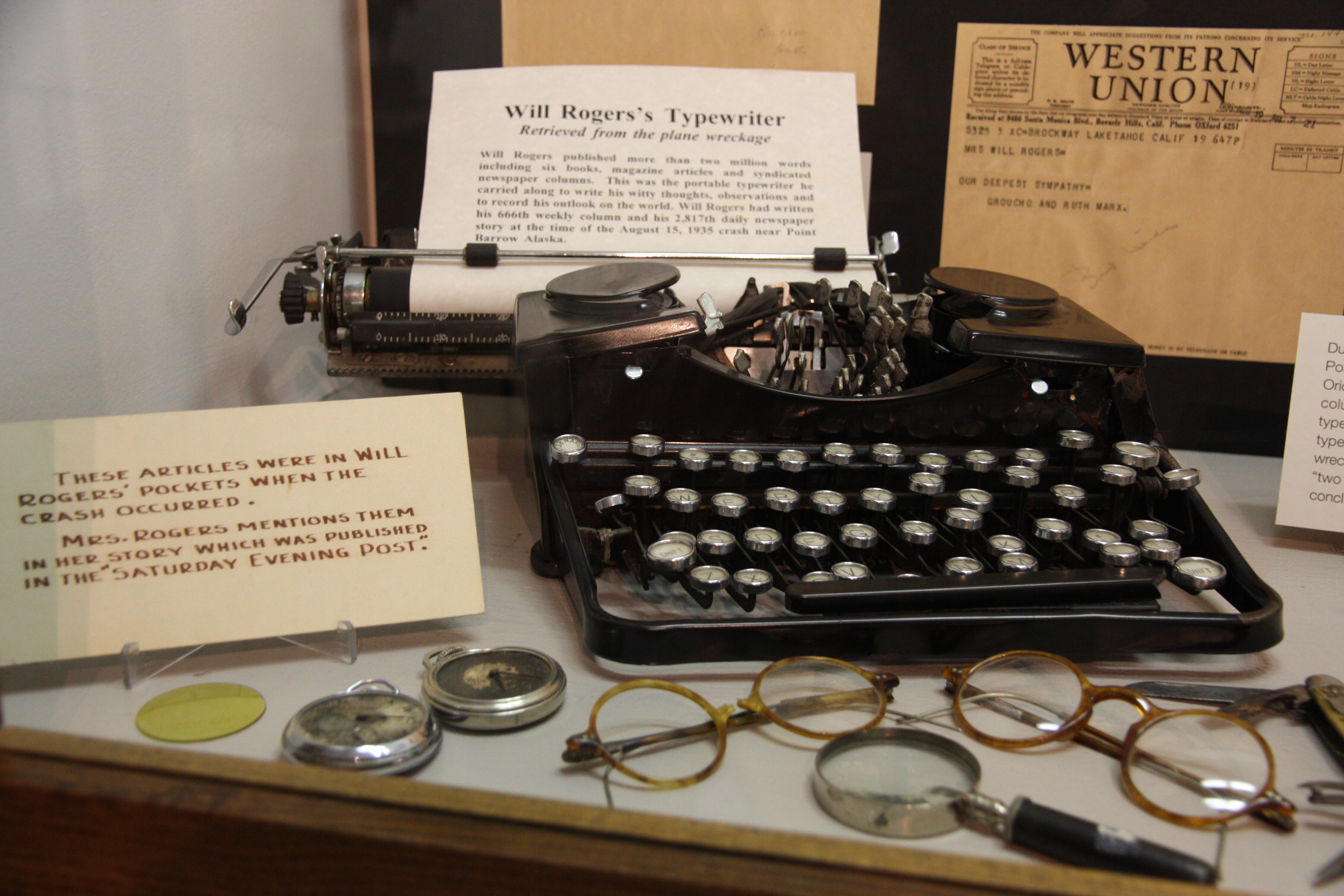
The items on the floor of this display case were in Rogers’ pocket when he died.
We spent ages at the Will Rogers Memorial and could have spent hours longer. We even took time to watch several short films. One was a movie clip. Another was an amusing piece about a day of life with his family and the third was ‘Ropin’ Fool’, which showcased his amazing skills with a lasso. Imagine roping all four legs of a horse as the critter gallops by!
Rogers has been honoured in many ways. Twice he’s been featured on US postage stamps. Plenty of places, buildings and roads throughout the country are named for him. In fact, Route 66 is known as the Will Rogers Highway, and there’s a plaque to prove it at the western terminus in Santa Monica.
Oklahoma leaders asked Rogers to represent the state as one of their two statues in the National Statuary Hall Collection in the US Capitol in Washington DC. He agreed on the condition that his image would be placed facing the House Chamber, supposedly so he could ‘keep an eye on Congress’. His is the only statue to face the Chamber entrance. Guides at the Capitol say each President rubs the left shoe of Rogers’ statue for good luck before entering the House Chamber to give the State of the Union Address.
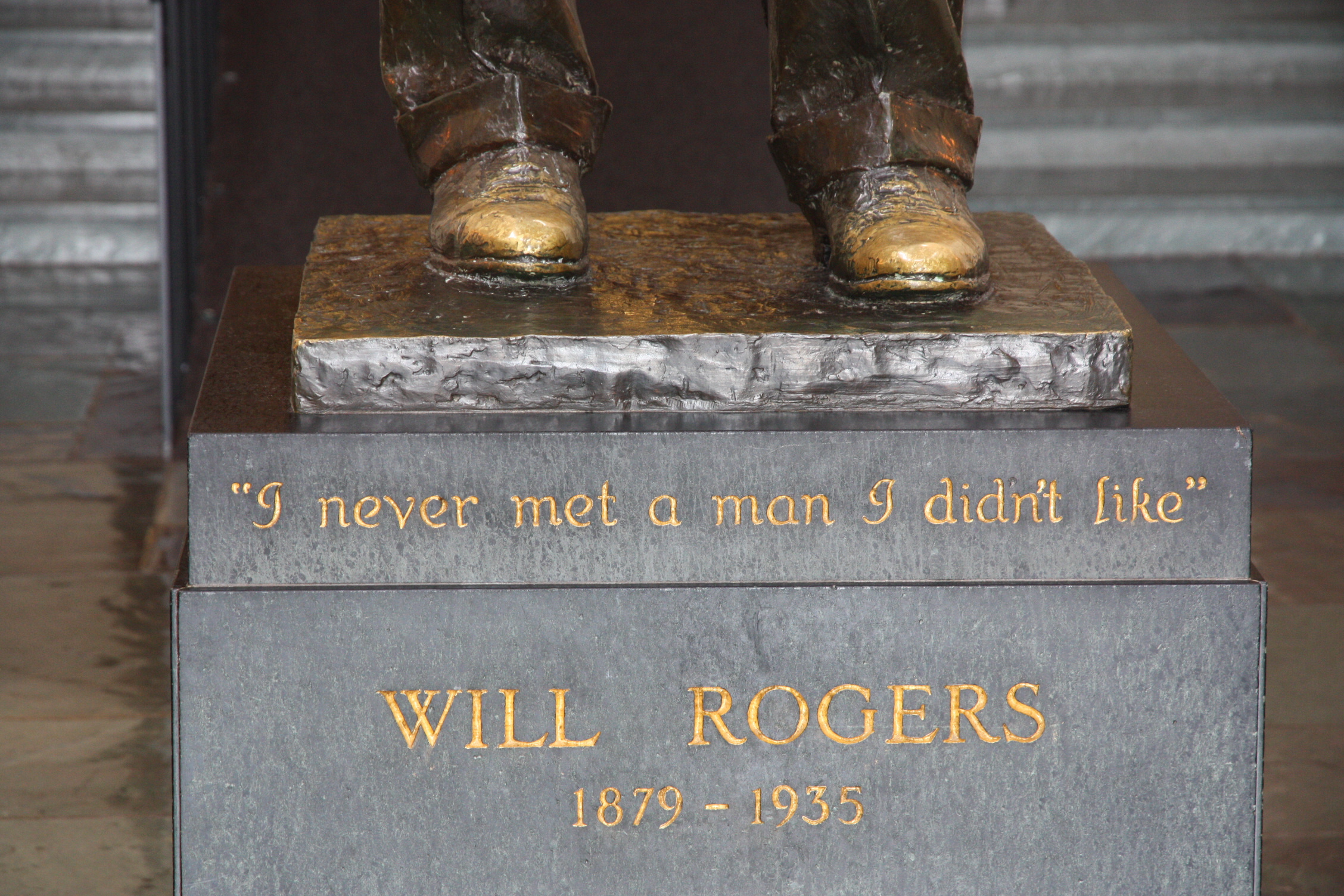
Rogers’ shoes get a good rub. This statue is in Oklahoma.
If you ever get to Tulsa, take time to go to the memorial in Claremore and learn more about this remarkable man. The woman in the gift shop said the Will Rogers collection is slowly being uploaded to the internet. There’s a university nearby and the students are obliged to do community service each year. Most opt to do something that supports and promotes the memorial.
For now I’ll leave you with some of Rogers’ quotes. He was famous for his folksy ways and colourful use of language, and was the leading political wit of the Progressive Era in America. Amazing how relevant some of his comments are today.
‘Our foreign policy is an open book—a checkbook.’
‘Everything is changing. People are taking the comedians seriously and the politicians as a joke.’
‘Income tax has made more liars out of Americans than golf.’
‘I am not a member of an organized political party. I am a Democrat.’
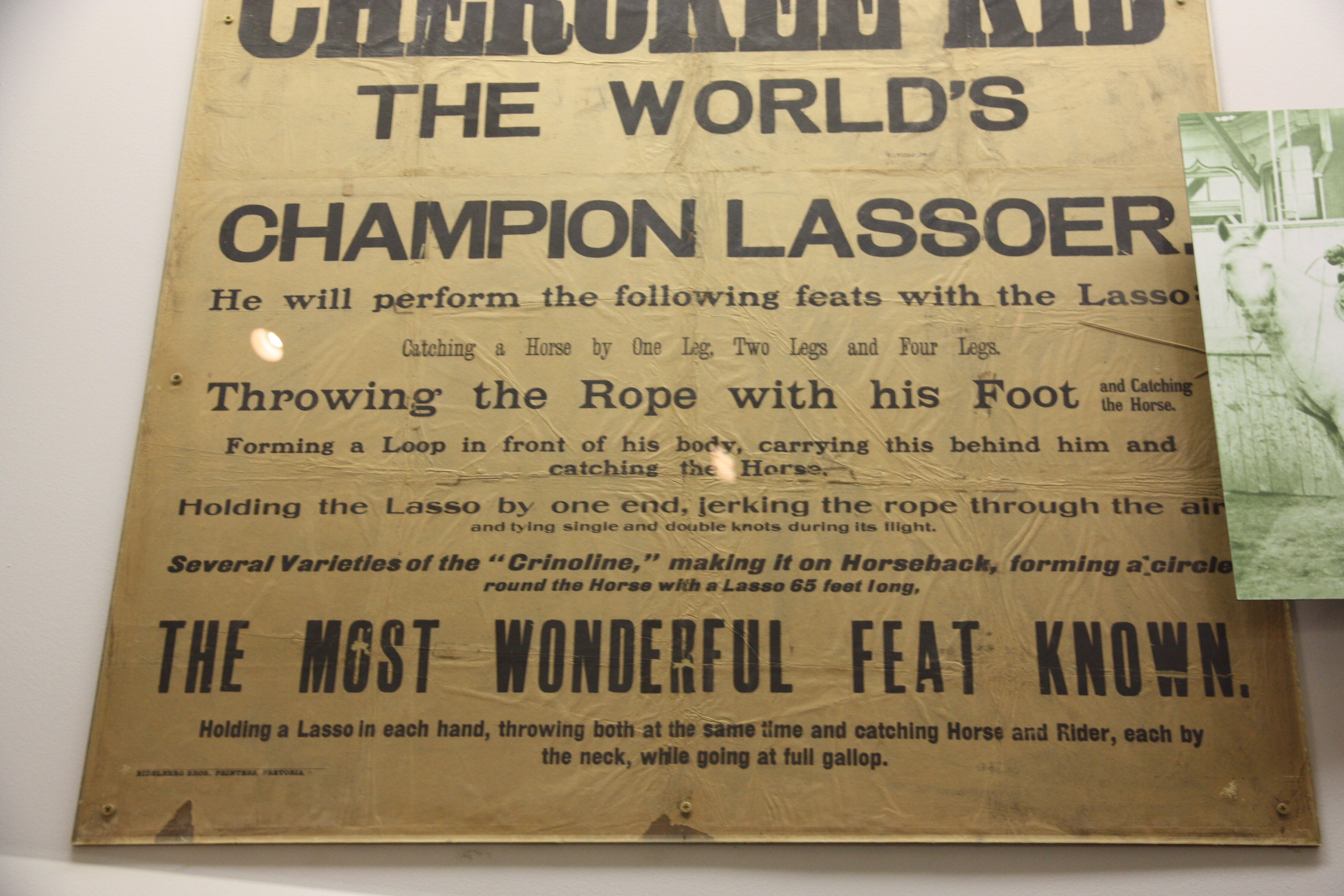
Ropin’ Fool
‘There are three kinds of men.
The ones that learn by reading.
The few who learn by observation.
The rest of them have to touch an electric fence.’
‘Lettin’ the cat out of the bag is a lot easier than puttin’ it back in.’
‘Be thankful we’re not getting all the government we’re paying for.’
And perhaps his most well-known—‘I have never yet met a man that I dident like.’ It is part of a much longer quote (look it up) and Rogers often used the spelling dident.
You can read lots more about Will Rogers at Wikipedia.
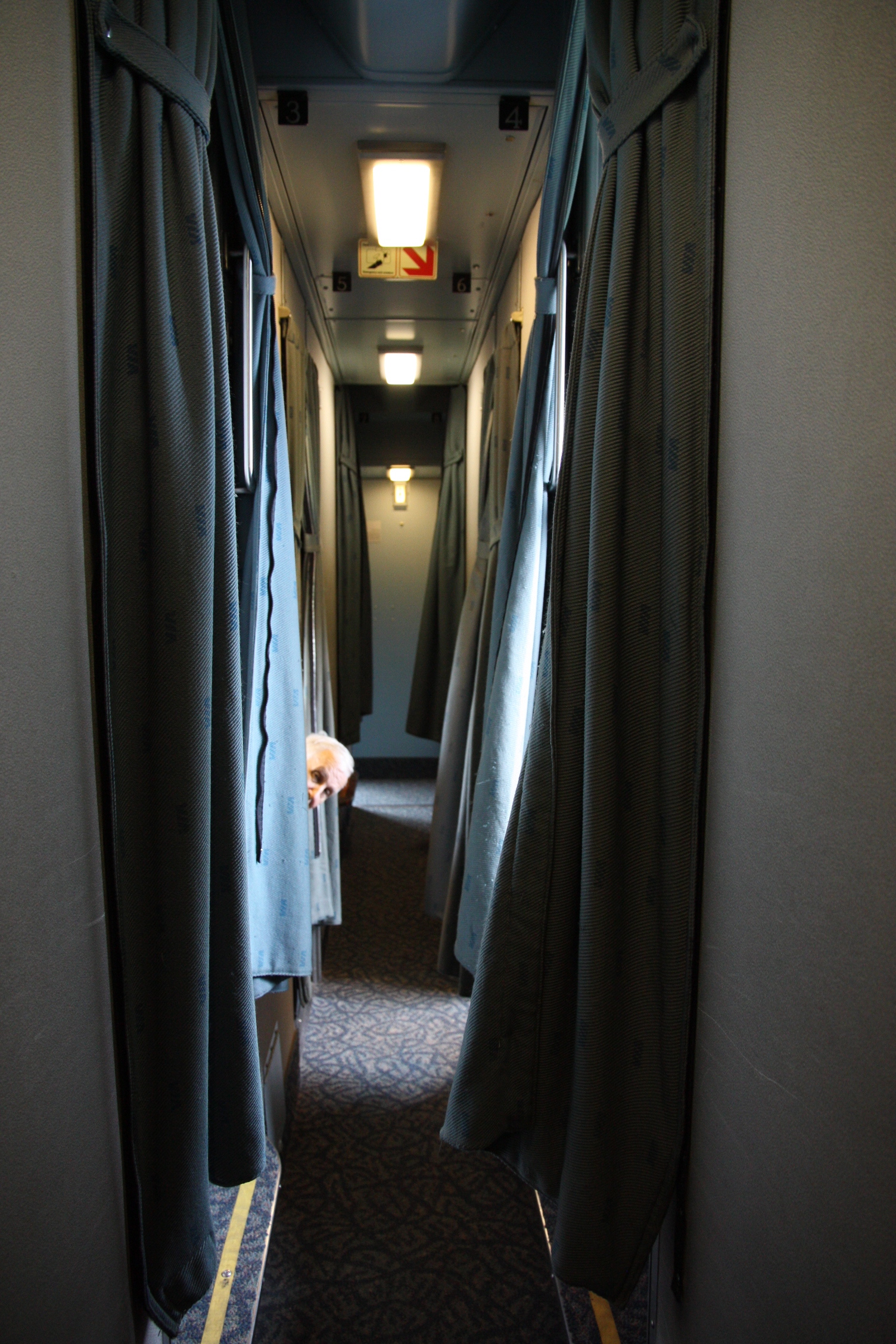
Poor John peeking down the carriage
Almost everyone we met in Canada raved about The Canadian—the train that connects Toronto and Vancouver. Not one of them had been on it, but they all knew it was a breathtakingly scenic, not-to-be-missed, once-in-a-lifetime journey.
So we booked it. Actually I dragged the chain and we nearly missed out.
Poor John saw a great online deal for a sleeper cabin for two from Vancouver to Toronto. The last-minute bargain price was just under $900 each, with all meals included—the usual fare is $2100-plus per person.
But I couldn’t make up my mind about a departure date. By the time I did, the option was sold out. Oops!
Time to go into recovery mode. What about Toronto to Vancouver instead? I picked a random date and, yes, there were four single cabins left. So I clicked on ‘book now’.
I breezed through the questions, and ticked the box that indicated we were seniors. Bang, the price dropped by almost a third to $581.10 each (including tax). That put a stop to any wavering about the date. I booked immediately and here we are now—sitting on the train.
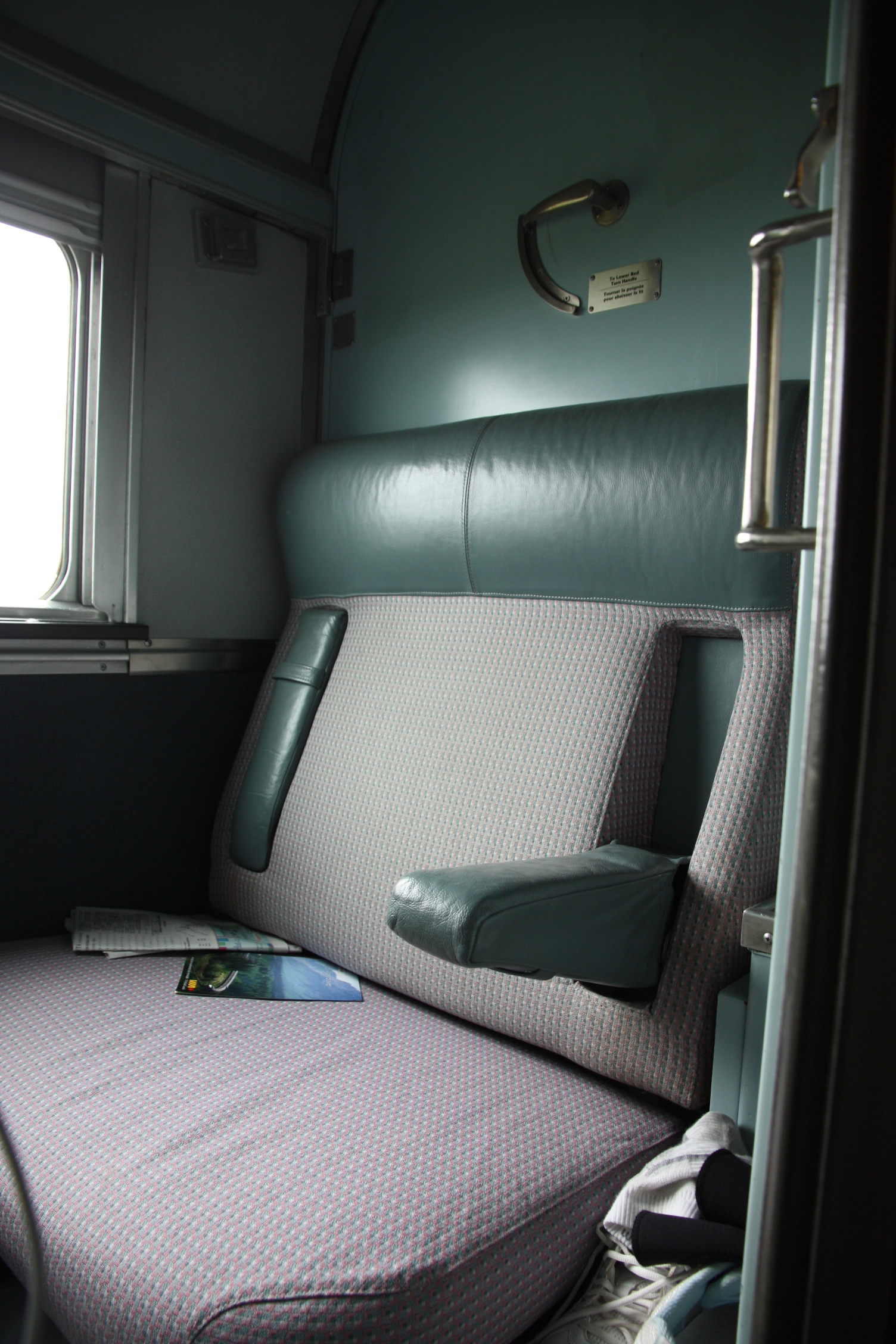
My chair folds down into a single bed—like a Murphy bed.
We boarded last night about 10, and were soon settled in cabins 4 and 5 in Car 119. The car has four double cabins, three sets of curtained bunks and eight single cabins (with four at floor level and four up a couple of steps). That must be how they manage the pull-out and fold-down beds. Poor John’s cabin is across the aisle from mine and at floor level. Our cabins are just over a metre wide and about an arm span long, plus the bed space.
Long before we boarded, we were asked to choose a meal schedule. Thank goodness we got to the station 90 minutes early because we managed to get the popular middle timeslots—12:20pm and 7:20pm rather than much, much earlier or much, much later.
Breakfast is open slather between 6:30–8:30am. Never expected to see so many people up by 7am. We were pleasantly surprised by the calibre of the meal—tomato, cheese and bacon omelet, with hash browns, toast or muffins, juice and coffee or tea.
Lunch was even more impressive. I had salmon and turbot with salad.
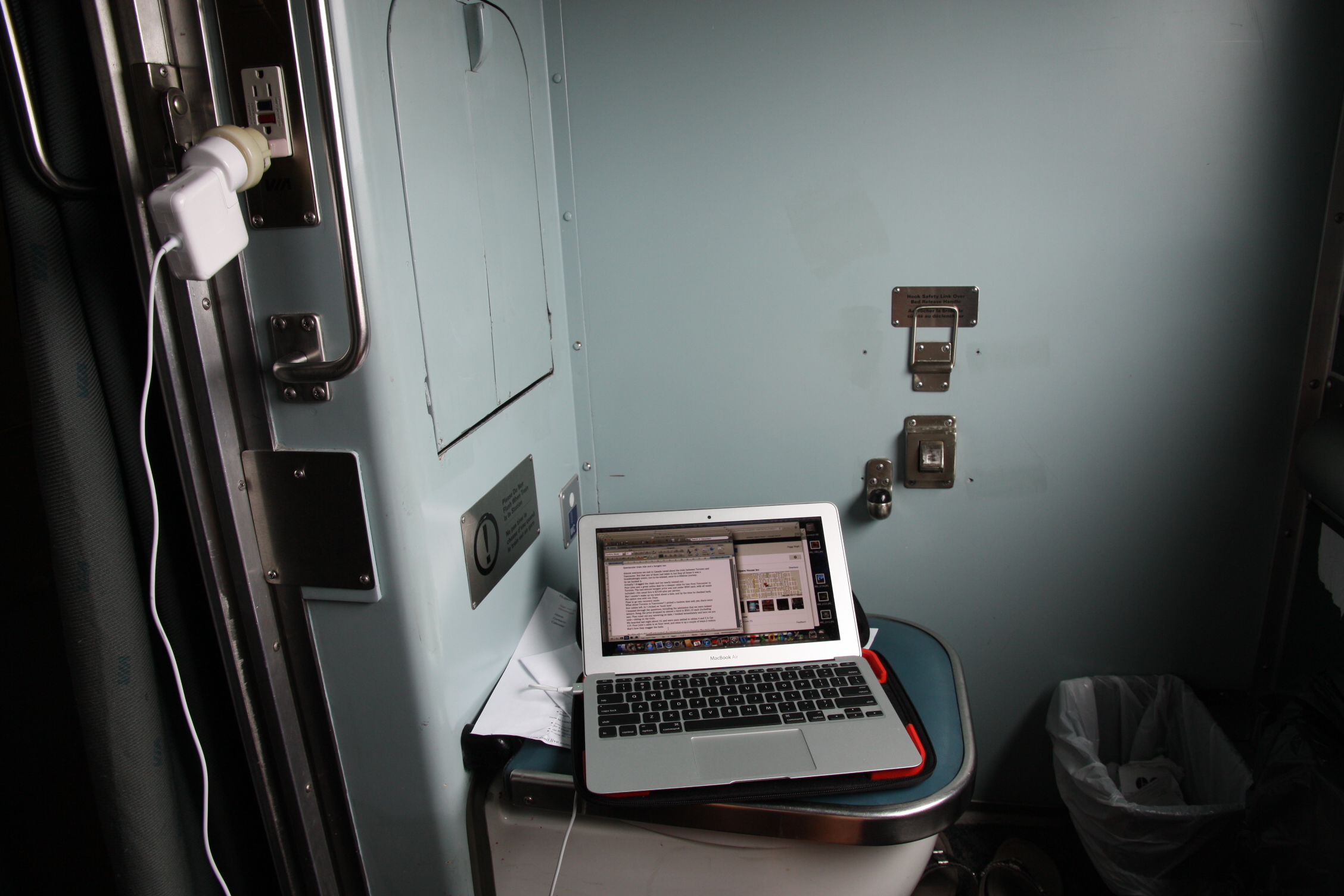
My workspace—the upholstered lid of the in-cabin toilet. Don’t flush while in the station, or when the computer is on top.
They like to keep us busy. I could have taken the napkin-folding course this afternoon, but I’m holding out for the beer tasting. Dinner is in a couple of hours.
Rather doubt that my waistline will survive four days of this.
I hope to post several items about the journey. No idea when they will actually appear. There’s no internet in remote Ontario. Info about the train promised wifi, but apparently that only happens on a single well-travelled and populated route between Quebec City and Windsor.
Never mind. I’ll cope, even if I have to resort to napkin-folding. 🙂

Icewine in the middle with other Peller products.
Ever heard of a rare dessert wine called Icewine? Neither had I.
As far as I can tell, this delicacy is made only on Canada’s Niagara Peninsula.
According to the fellow from Peller Estates Winery, which offered tastings at the St Lawrence Market in Toronto, some strict requirements must be met to create an authentic Icewine.
For starters, summer has to be warm enough to grow fine wine grapes. Then winter has to be cold enough (–10°C or colder) for at least five days in a row (but never so cold that the vines die).
The grapes must freeze on the vine and then be hand-picked in the middle of the night by people wearing fingerless gloves. (Sounds like we should be adding eye of newt!)
The frozen grapes are pressed immediately after picking, and each grape yields only a drop of intensely flavourful juice.
The fellow said it takes the same amount of grapes to make a case of table wine as it does to make a single 200-ml bottle of Icewine.
Apparently the hallmark of a good Icewine is a perfect balance between sweetness and acidity. Peller must be getting it right. They’ve won gold medals and trophies at leading wine competitions in France, Belgium, Austria and America.
Peller makes four varieties—Vidal, Riesling, Cabernet Franc and Oak Aged. I tasted the latter and it really was sensational. Truly worth all the hype and mumbo-jumbo, and I’m not a fan of sweet wines.
I resisted buying a 200-ml bottle for about $40. Not because it wasn’t worth it, but because I couldn’t fit it in my backpack.
It’s amazing stuff. Try it AND buy it if you ever have the chance. You can even invite me over and share it.
I was mad as hops when I came through the Dallas Airport last month. You know how they want you to tell the truth on the customs form? It works both ways. They should tell the truth in the instructions on the form.
This is what happened.
Poor John and I flew from Sydney to Dallas. It’s a 15-hour flight and a fairly new route for Qantas. Even though it’s long, I love it. We used to have to go through Los Angeles and, although I have wonderful friends I like to catch up with there, it has to be one of the most unpleasant airports in the world.

Potsie reminding me to laugh about the whole thing
If we’re not visiting anyone along the way, we wait around the LA airport to fly to Denver, then wait around the Denver airport to fly to Omaha. I’ve waited up to 10 hours between flights and it’s not fun.
So coming through Dallas gives me a straight shot to Omaha. This time we were stopping in Dallas, but that’s not important to the story.
They hand out customs forms on the flight. It says very clearly that there should be only ONE form per family. Only ONE! Got that? Just ONE. That’s all it says on the subject.
Just before Poor John and I lined up for immigration clearance, I reached for another form, but he reminded me that we needed just ONE form per family.
I hesitated. I almost took one—I go through the US citizen’s line and he goes through the non-citizen’s line. Maybe I needed my own. But then it dawned on me that customs clearance comes AFTER immigration and AFTER you collect your bags from the carousel. We’d be back together by then.
Can you guess where I’m going with this?
So I trail through about a mile of cattle run called the immigration line. It took about an hour before I got to the window. First thing the fellow asked was,
‘Where’s your customs card?’
‘With my non-citizen husband.’
‘Well you’re not going past here without a card.’
‘It says one per family and I don’t even have my bags yet.’
‘Well you’re not going past here without that card.’
‘Do you have any blank cards?’ and he leaned forward, smirked and pointed back to the doorway.
‘Nope, you’re going to have to go all the way back there and get a card and join the line again.’
And you can’t get mad or you’ll probably get arrested.
So I did it all over again. And if people had found a small pile of ash on the floor it would have been me after I burst into flames.
But I finally got through after another long trek. For about 20 minutes, I was the last person in line. Guess what? The fellow at the second window had a little stand with spare customs cards. I bet they all do!
Now to find Poor John. We agreed to meet on the other side of the immigration line. But he wasn’t there.
So I went down to the carousel. We were so late by now that the signboard no longer posted which carousel ‘belonged’ to our flight.
Information directed me to carousel 2. I found our bags on the floor, away from the carousel, but no Poor John.
So back upstairs. I had come down by escalator, but there were only steps on the return—equivalent to three flights. About a third of the way up, I twisted my already wonky knee (see the knee brace I’m wearing in some of the blog entry photos). It had been just about healed.
So while I may have been furious, it hurt too much to stomp up the stairs. And it’s lucky no one heard what I was saying under my breath.
As I approached this side of the immigration line, I saw that Poor John was still waiting to come through. Unbelievable how slow all this process had been! Seriously, two hours to clear passport control?
And then I find out he’s had a hassle too.
His fellow looks at his customs form and says,
‘Where’s your wife?’
‘In the US citizen’s queue.’
‘She should have come through this line with you because you’re both on the same form.’
So why in the hell don’t they add that little nugget of information to the form? We’re not mind readers!
I’m still annoyed, but I mostly got over it. Later that evening, I could even take the advice printed on the Dame Edna apron we gave to Potsie, our friend and host. Laugh!
P.S. What happened at customs
I forgot to tell you what happened when we got to the actual customs spot—AFTER we had collected our baggage.
There we were in the queue. I had my form for just me, stamped and scribbled on by my fellow at immigration. Poor John had his form for both of us, stamped and scribbled on by his fellow at immigration.
The customs official was politely grilling most people in front of us in the queue. I’m not stupid and I wasn’t going to explain again, so I put my form in my pocket. Poor John showed the official his form, and the reply was ‘You folks have a nice stay’ and he shooed us through. I swear I didn’t smirk.
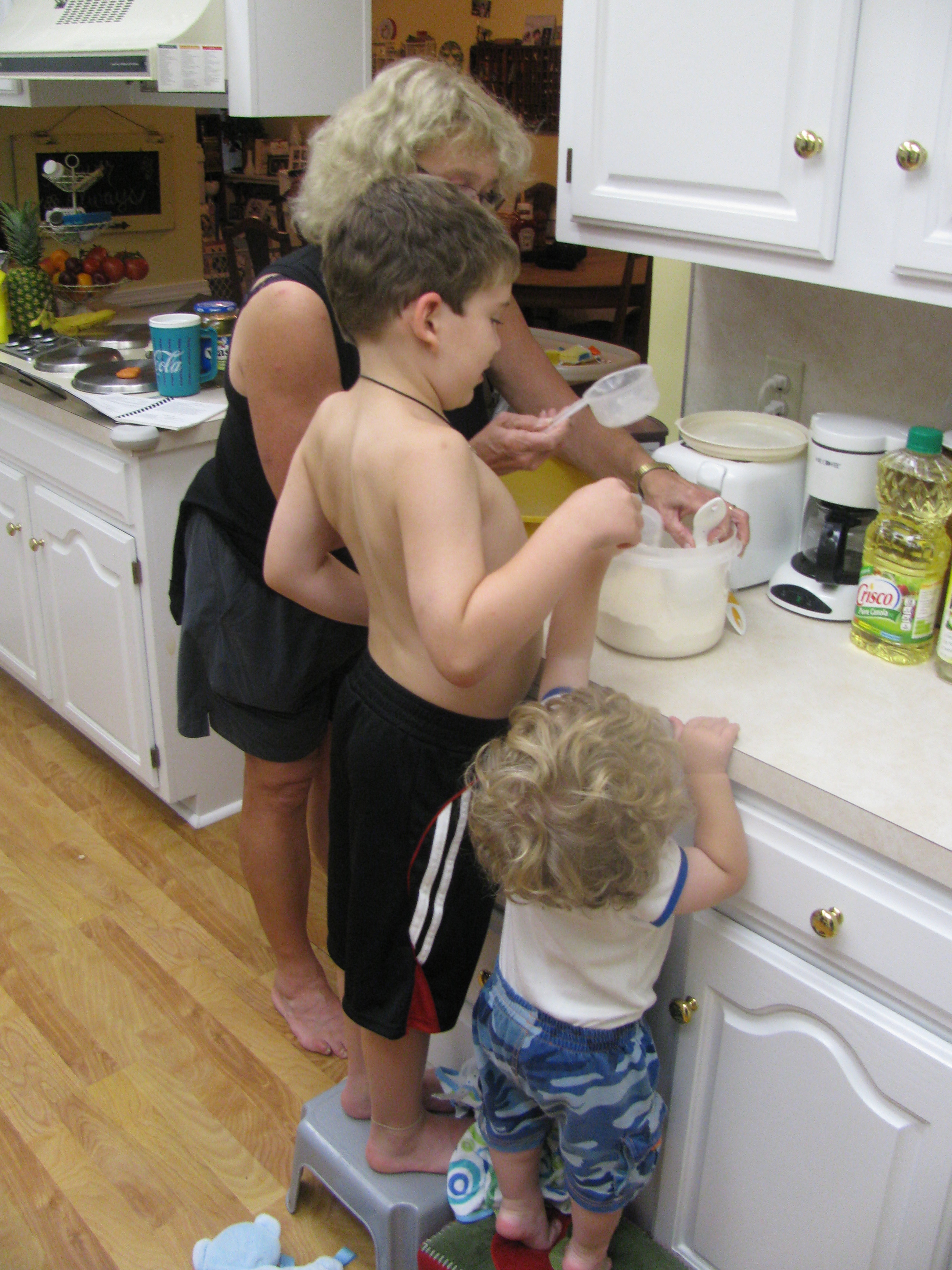
Nothing like cooking with a couple of live-wire nephews to take your mind off your travel woes.
We had a travel blow a couple of weeks back.
Brittany, our Flight Centre agent in Canberra, sent us the bad news—Kumuka, the company we were going to travel with through South America, had gone bust. Their trips departing before the end of July were still good to go, but everything after that was cancelled.
Our trip was supposed to leave today—Friday, 10 August. Hmm! Now that’s a nuisance.
Fortunately Brittany also sent us two possible solutions—trips with Tucan or Intrepid.
We were familiar with both companies. We saw Tucan trucks in Africa in 2009, and friends have travelled with Intrepid in Southeast Asia.
We opted for Tucan first. Their trip was a similar length, itinerary and price. The next day, Brittany got back to us to say that Tucan’s trip was for 18- to 35-year-olds only with NO exceptions. Actually I was rather pleased about the NO exceptions. Trips for that age group tend to be drinking extravaganzas. I enjoy a drink, but don’t need to for days on end.
Intrepid wasn’t as desirable a replacement. Their trip was shorter, had very few camping days (three in total) and didn’t include the bottom third of South America. Brittany came up with an add-on that covered the southern part of the continent, but that still didn’t offer us more camping.
But we were in luck—Intrepid’s trip was fully booked.
I asked Brittany if she knew anything about Oasis. No, not really. But I knew about Oasis. It’s another overland company—one that started up with some help from African Trails, the company we travelled with for almost a year in 2009.
I hit a big snag when I went hunting for Oasis. Their website was ‘down’ or had they too gone broke? A couple of people asked the same question on the Oasis Facebook page. But Natalie from Oasis answered fairly quickly to say the site was back up.
Within a few minutes we were discussing possibilities on their instant chat line, and about an hour later we’d paid and were all set up to do almost the same trip we had planned with Kumuka. Yay, Oasis!
We leave about five weeks later than originally planned (not until 17 September), so we’re spending more time bumming around the USA and fitting in some great travel and stops in Canada. Hope to sneak in a trip to Columbia and the Galapagos too.
So what could have been a disaster has turned out to be a bunch of bonuses.
And the best news of all—Kumuka was part of a Travel Compensation Fund. We’ve already got back 91 per cent of what we paid, and the other 9 per cent is looking promising. And a big thanks to Brittany who worked hard on our behalf.
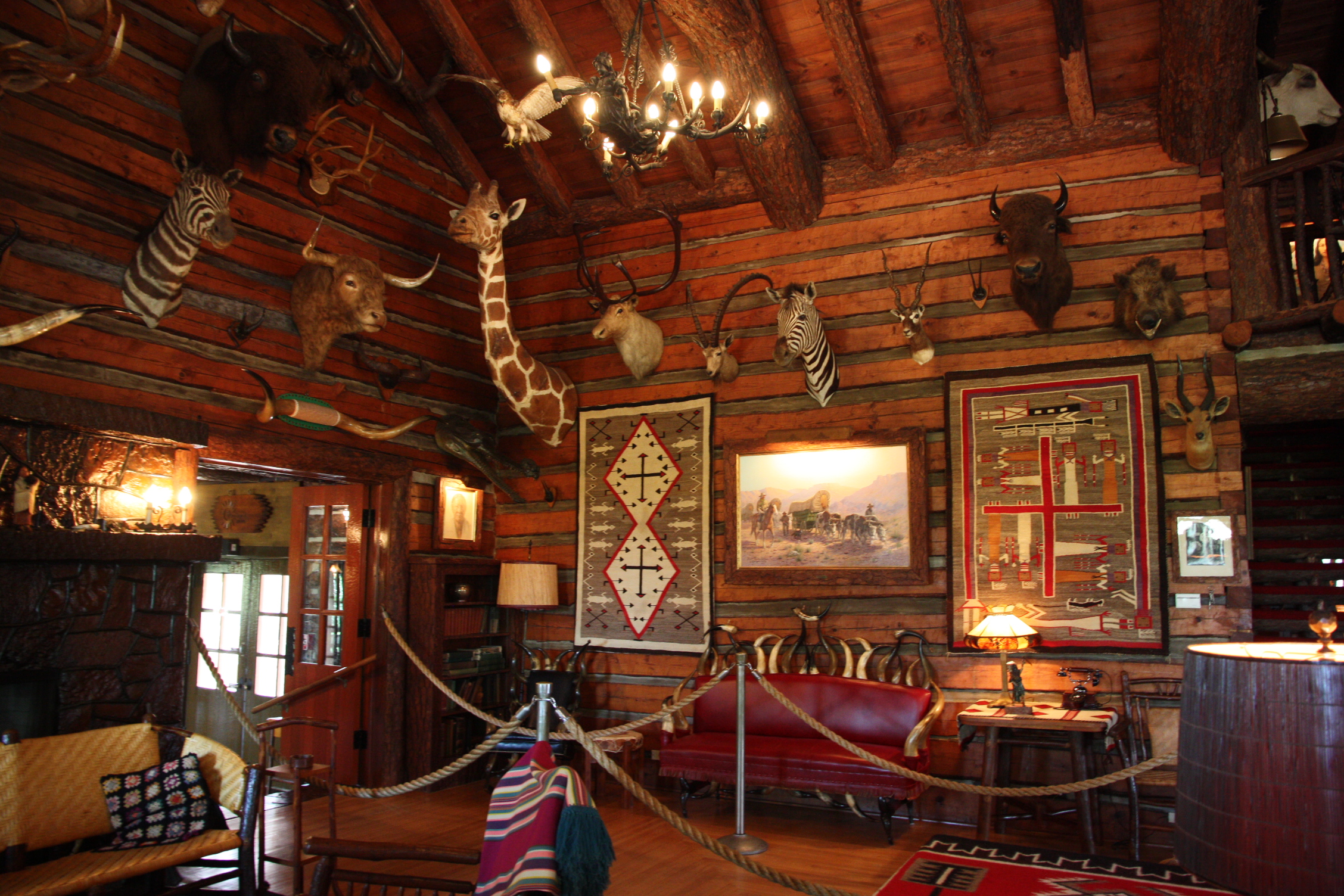
Woolaroc, the ranch built by Frank Phillips, is made up of three parts. There’s the magnificent museum, a wildlife preserve and a fully furnished lodge.
I’ve already written about the museum with its vast collection of American Western art and artefacts. There are all kinds of Native American pottery, baskets and beads, as well as impressive paintings and sculptures by leading western artists. There’s also a large collection of Colt firearms.
The 3700 acres of wildlife preserve are home to about 30 species of native and exotic animals—from bisons to zebras.
But the lodge is one of my favourite spots. This rustic ranch house was completed in 1927. It has eight bedrooms, a huge dining room and spacious entertaining areas. It was here that Mr Phillips welcomed East Coast investors, local Native American tribal leaders, and more than a few outlaws, bank bandits and train robbers.
The furnishing are a classic lodge style—and include an array of typically western gifts and artworks.
And then there are the stuffed animals. These are not hunting trophies. As animals from the wildlife preserve died from natural causes, their heads and horns were mounted and used as decorations. There are 97 heads and 107 sets of horns.
A long-time volunteer guide was there the day we stopped by. He was full of stories and tales that helped to bring the rooms and their contents to life. One story I particularly liked was about Mrs Phillips. She had a rather large photo gallery of friends in her bedroom. Your picture might hang there forever, but if you crossed her or made her cross, you got hung in the hall.
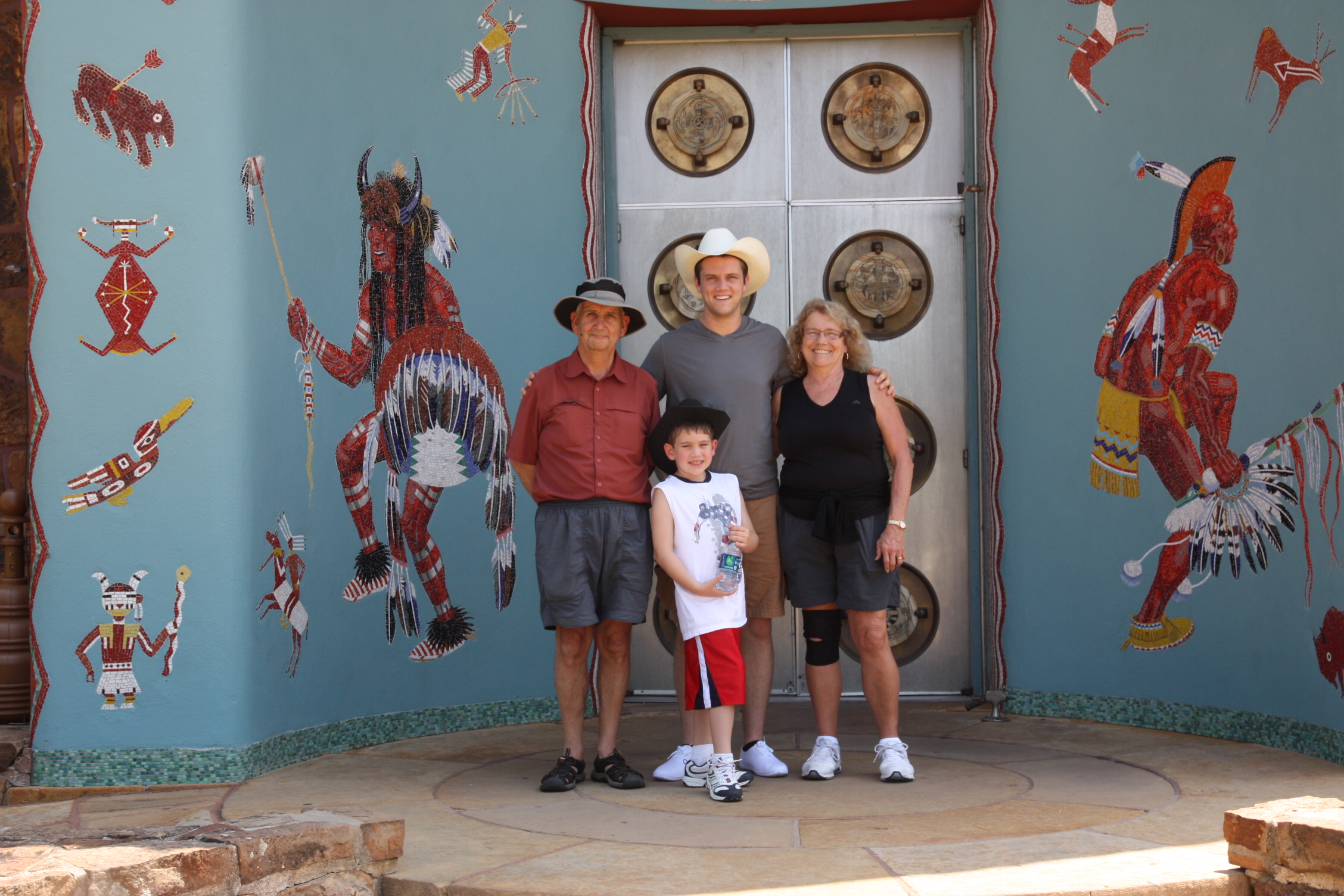
Poor John and me with Big Charlie and LIttle Georgie. Outside the entrance to the Woolaroc Museum.
I have a soft spot for Woolaroc. Actually, it’s more than a soft spot—Woolaroc is one of my favourite tourist destinations in the USA. Maybe it’s because of my dad, who probably never went there.
Let me explain.
Woolaroc is near Tulsa Oklahoma (it really near Bartlesville). Frank Phillips, who started the Phillips 66 petroleum company, founded the ranch in the 1920s because he wanted his friends to be able to have a taste of American country life.
It started with the house/lodge and later a small building to display the aircraft that won the Dole Air Race to fly to Hawaii in 1927.
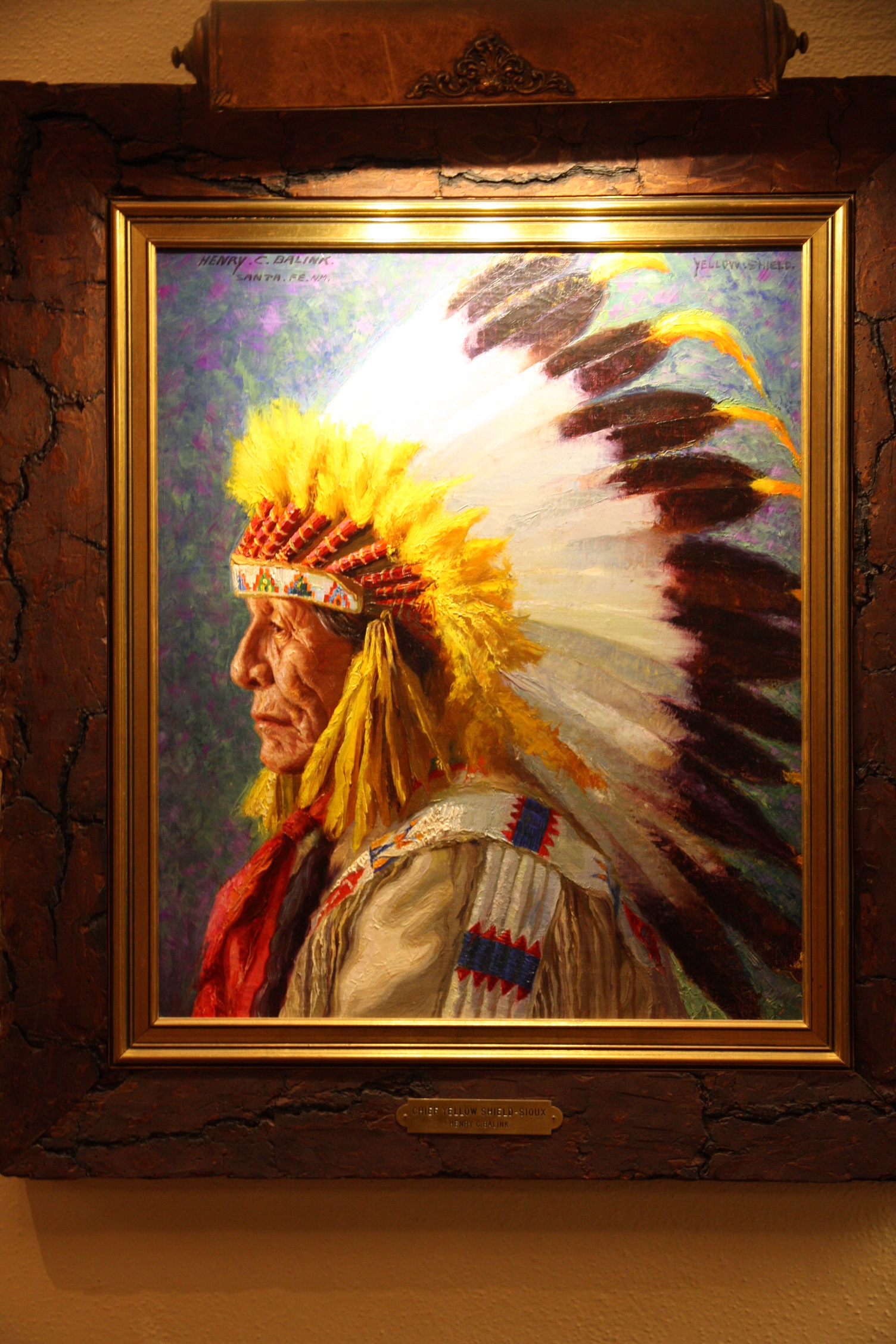
Today Woolaroc has a comprehensive western museum, a comfortable lodge and plenty of wildlife.
One of my sisters lives near Woolaroc. The first time I went there was about 25 years ago and dad was on my shoulder. Dad had been a pilot and he admired Mr Phillips. Not because of the flying competition but because Mr Phillips was a quiet and generous philanthropist. Dad always said that anyone who gave to charity without noise and fanfare was worth his time and admiration.
Mom remembered that. When dad died unexpectedly in a car accident (I was 18), mom invested a good chunk of the insurance money in Phillips 66. It gave her good returns and helped her to look after a bunch of daughters. I remember her selling shares to carpet and curtain various rooms in the house.
This visit to Woolaroc was a complete pleasure. I spent a lot of time enjoying the exhibits, and even more time running around after the human dynamo—my 15-month-old great-nephew Little Charlie. Couldn’t have done it without the help of Poor John and my nephew, Big Charlie.
We didn’t see much wildlife (probably too hot for them to come out of the shade), but we explored every inch of the museum and had enough time to pop into the lodge. I love that lodge.
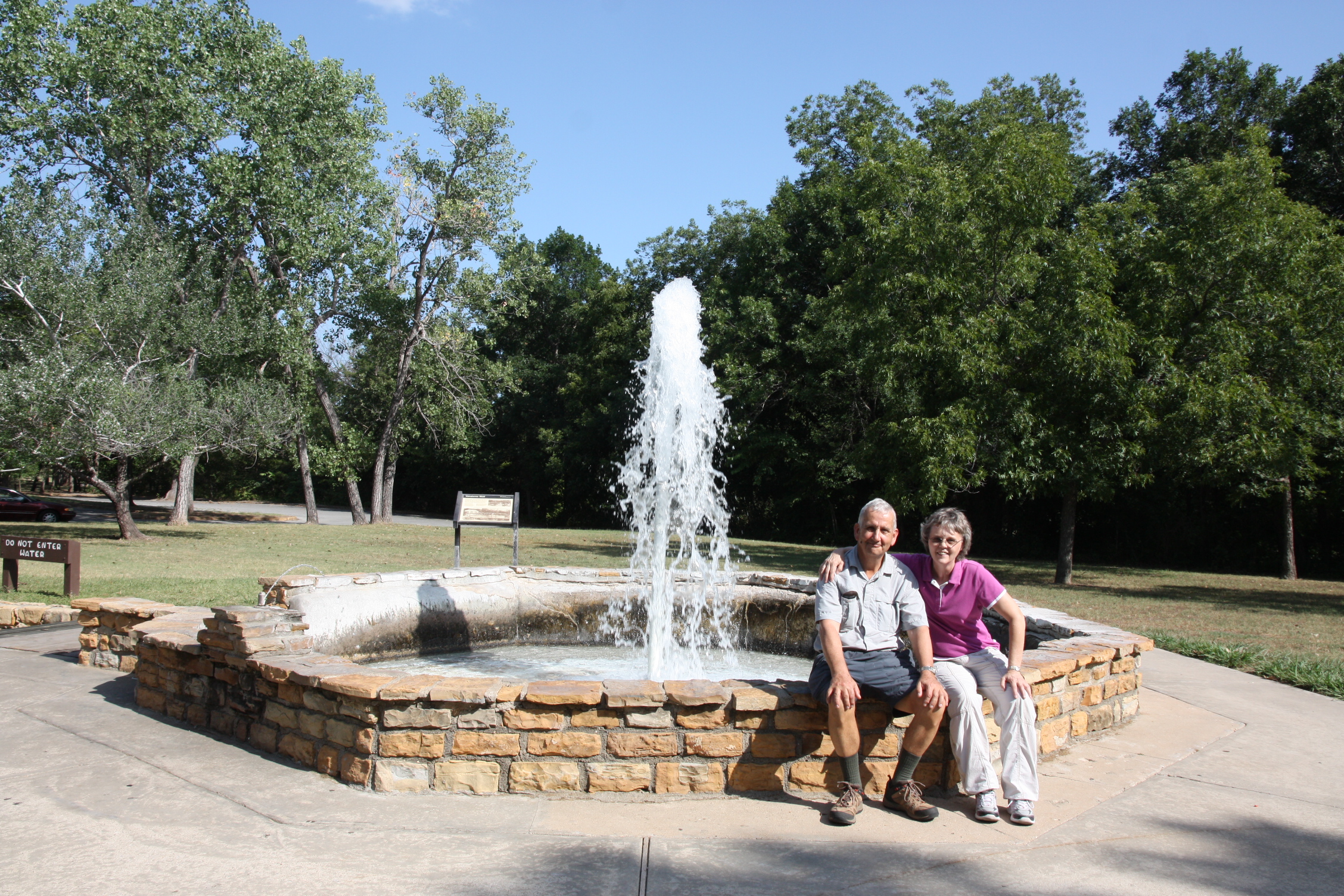
Poor John and Joy at the Vendome Well in Flower Park in Sulphur.
There are a lot of ways to get from Dallas Texas to Tulsa Oklahoma.
Given that we like to do a lot of our travels overland, we decided to take the bus. It also gave us an easy and reasonably quick way (about three hours) to get to Sulphur, in south central Oklahoma, to visit long-time friend, Joy.
The bus only goes near to Sulphur, so Joy met us in Pauls Valley and drove us the last 30 miles.
Joy has lived in Sulphur since at least the 1990s, and I was delighted to discover that the town has a lot more going for it than I had ever realised. For starters, it is home to the Oklahoma School for the Deaf.
I suppose the name Sulphur should have been a clue to the other big drawcard.
The picturesque Chickasaw National Recreation Area has a collection of mineral springs that were once thought to cure a whole range of medical conditions.
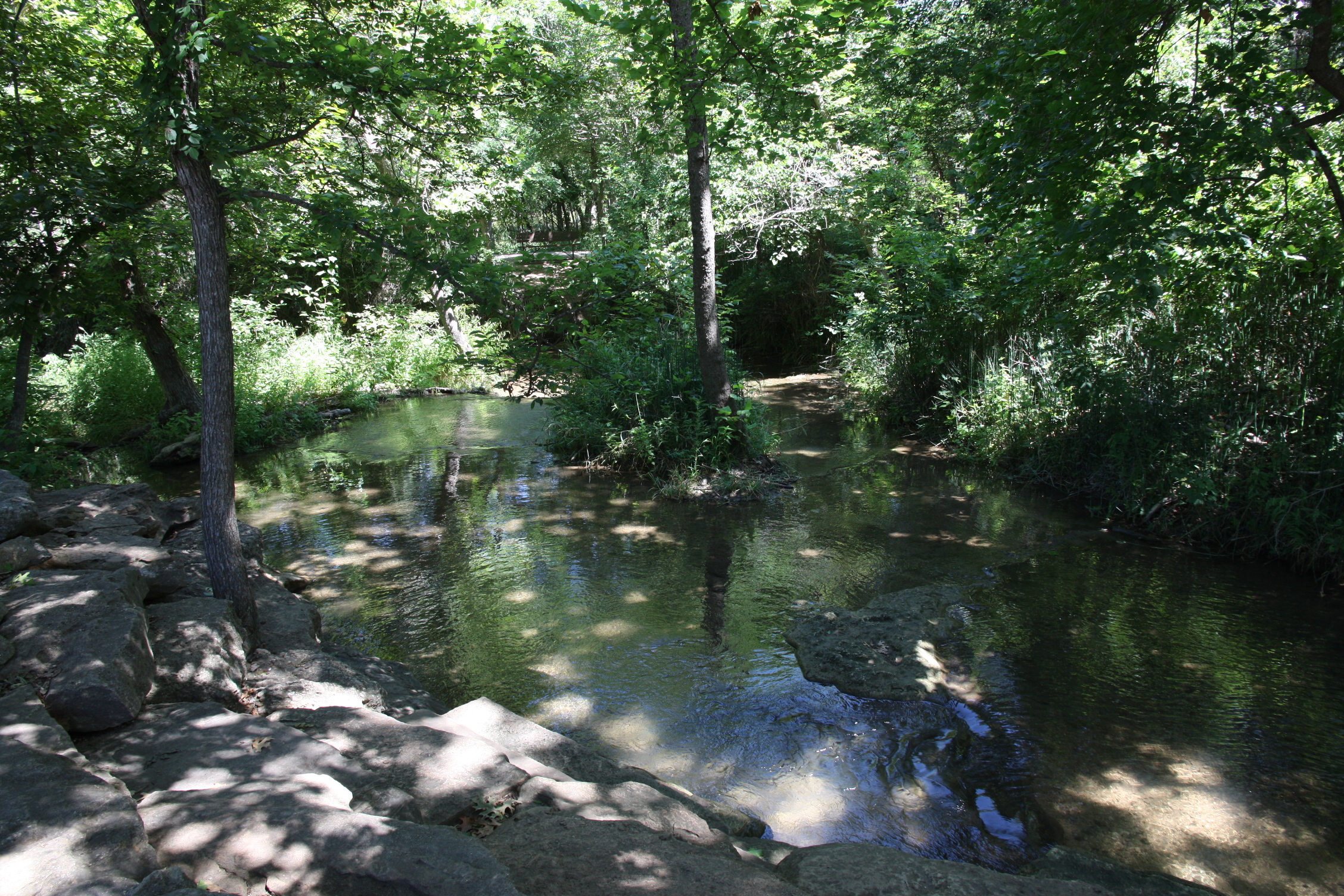
A picturesque sport in Chickasaw National Recreation Area.
Can’t say I liked the smell or taste of the water, but I splashed some on my personal array of bug bites (soothing and refreshing) and twisted knee (did nothing).
The recreation area is lovely and very popular. It gets 3 to 4 million visitors a year who come to hike, swim, fish, motorboat, ski, sail, camp and more.
We arrived in the late afternoon, so had most of the place to ourselves. We saw a couple of great swimming holes and took a longish but very easy walk. If you’re lucky, you might even glimpse some buffalos, but they were hiding when we were there.
The next day we visited the Travertine Nature Center, which is also part of the recreation area.
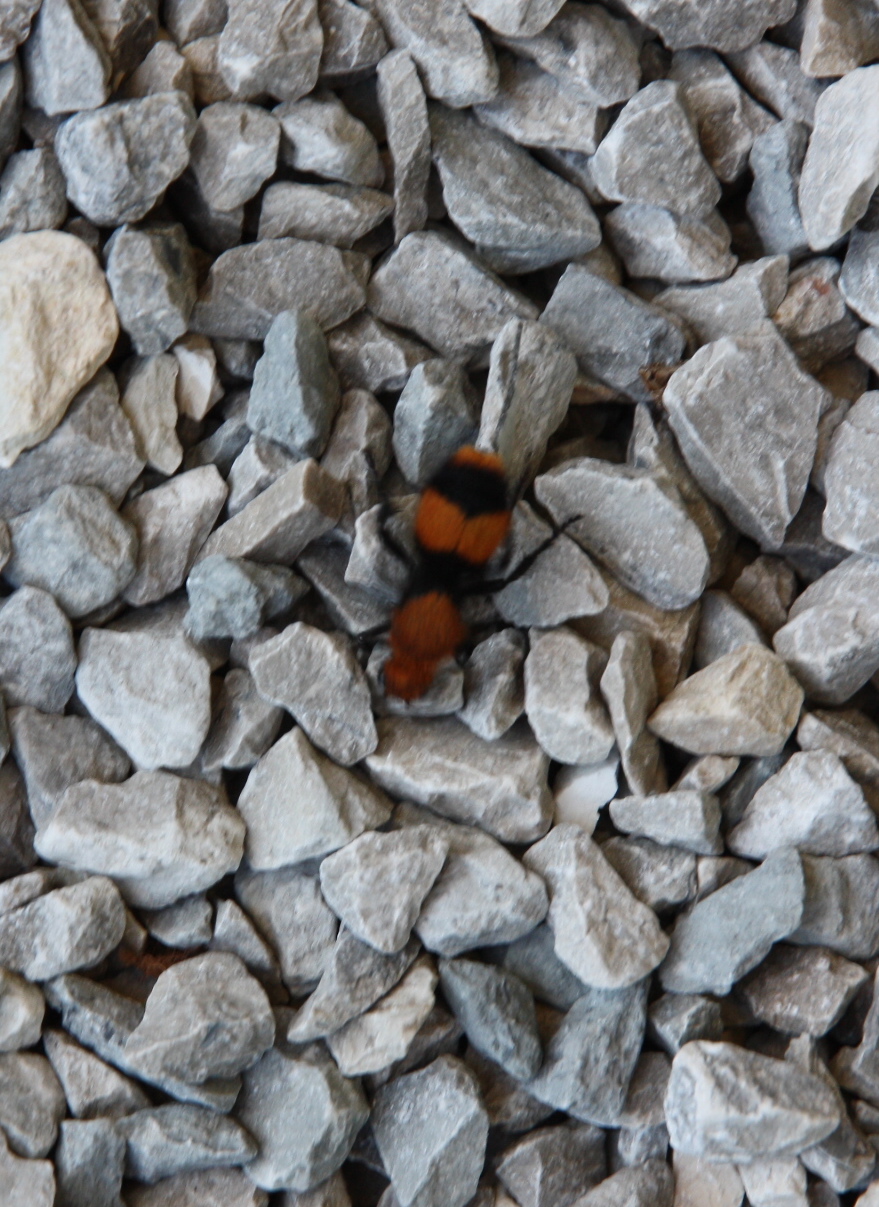
A female velvet ant
The information there solved a big question from us. Earlier we’d seen an exotic looking, fuzzy, ant-like bug. Turns out it was a hairy wasp that is called a velvet ant.
The wingless female velvet ant is more than a little vicious. Her sting is supposedly strong enough to kill a cow. Glad we didn’t tease the one we saw in Joy’s driveway.
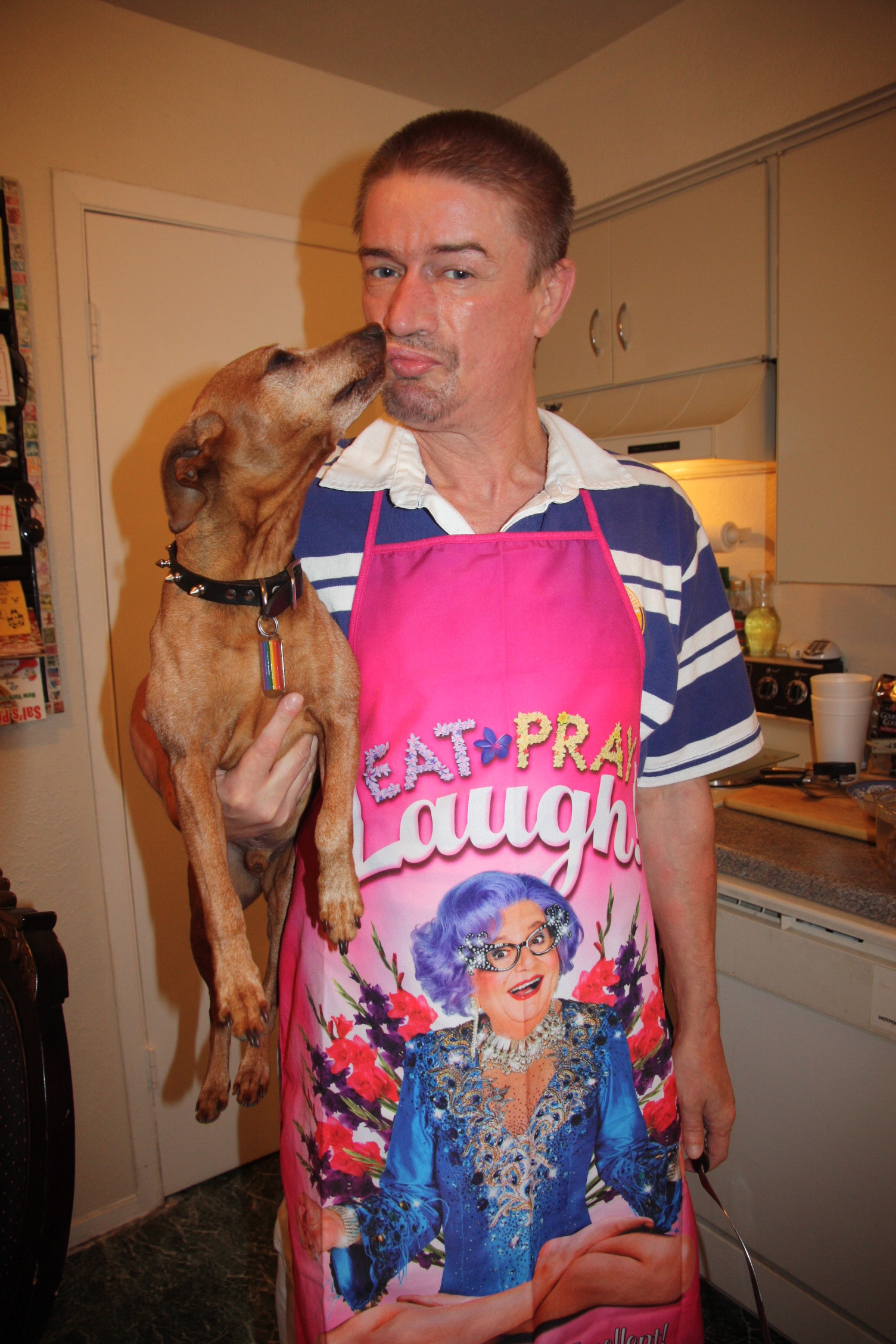
Potsie and Demon. Potsie’s on the right!
Travel is a wonderful and rewarding experience, but it’s the friendships I make, strengthen, renew and share that are the most special and cherished for me.
This trip is no exception. We started it with a bang-up stop in Dallas to see our buddy, Potsie. Pots and I met online almost six years ago—no I wasn’t two-timing on Poor John—on a cookery website.
It took about two minutes to figure out that we shared a wicked and sassy sense of humour. Soon we were causing mayhem as we marauded across the cooking site. Talk about a pair of disruptive, albeit entertaining, forces.
We popped in to see Potsie in Dallas in 2009, when we were on our way to Africa for a year. That’s when I realized he was an accomplished maker of Southern US food and probably Dame Edna Everage’s biggest fan.
Potsie’s big claim to fame—he gave hubby his downtrodden name. I think it was just after Poor John and I jumped out of an airplane to go skydiving in Namibia, that Potsie, along with my sister, Susan, started asking ‘and how is Poor John doing?’. Trust me folks, I don’t MAKE him do this stuff.

Commemorative stamps in commemorative style!
Anyway, we had a wonderful stay in Dallas. Saw the Chihuly exhibit at the Dallas Arboretum, the cattle drive in Pioneer Plaza, the Old Red Museum, the scene of JFK’s shooting and much more. We also ate very, very well!
Thanks Pots. Hope you enjoy the Dame Edna goodies!
In case you don’t know, Dame Edna is an Australian institution. She rose from being a simple housewife from Moonee Ponds, Victoria, to being a super megastar. We brought Potsie one of her aprons, a strip of commemorative stamps and a first-day cover. Potsie framed the stamps in style, complete with lots of purple and some flashy eyeglasses. Dame Edna would approve.
As an aside, Barry Humphries and his alter egos are making an Eat, Pray, Laugh farewell tour in Australia and New Zealand. It ends in February 2013. See it if you can.
I really should pay closer attention.
The woman at the tourist office in Dallas suggested that we visit Pioneer Plaza in downtown Dallas. I heard her say ‘It has 42 stairs and a large cowboy statue at the top’.
I had twisted my knee about two weeks before we started this trip and, although it had recovered nicely, I twisted it again trying to track down Poor John in the Dallas International Airport—a long story that deserves explaining so stay tuned.
By this stage, I had started wearing a knee brace and wasn’t too keen to climb 42 stairs to anywhere. So our dear friend, Potsie, and I hung around in the Old Red Museum while Poor John traipsed off to see the stairs and statute.
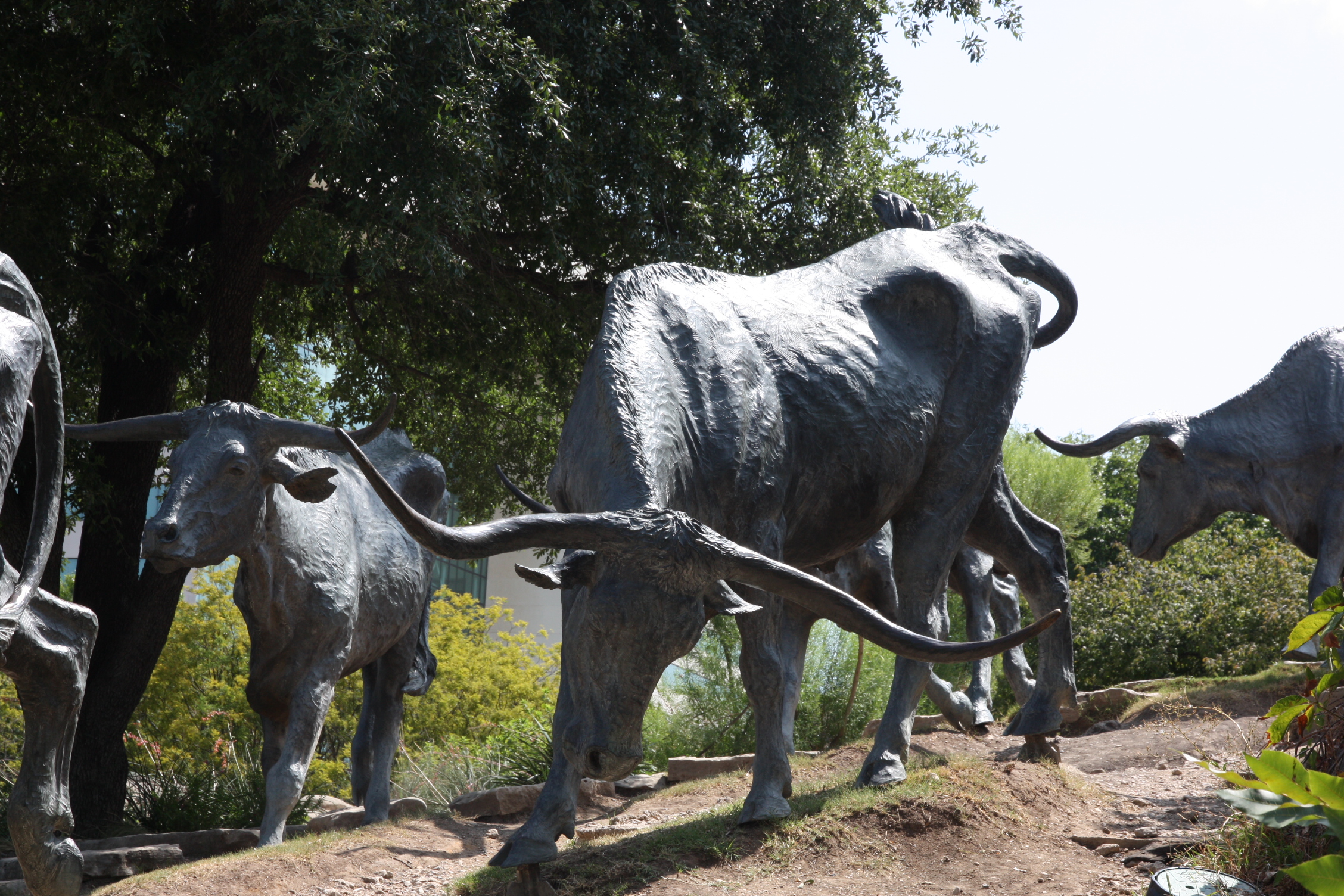
He returned, looking rather too smug. ‘Just so you know, there weren’t 42 stairs. There were 42 steers. Sort of like a mini cattle drive.’
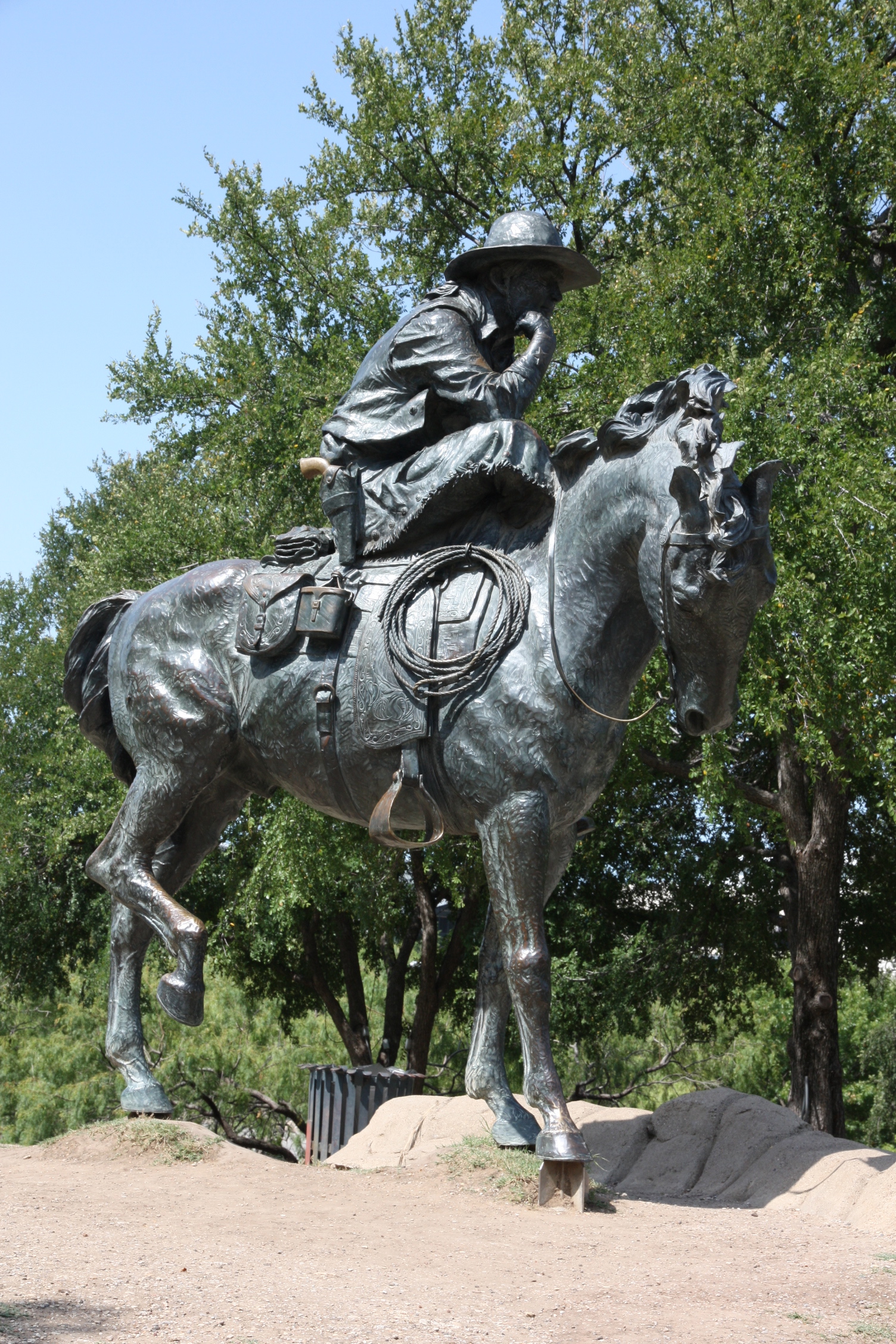
One of the bronze riders.
This I had to see! So the next day, with a darn backpack to further hamper me, we trudged several blocks from the Greyhound bus station to the famous Pioneer Plaza.
In the early 1990s, the city donated just over four acres of land in the Convention Center District. Real estate developer, Trammell Crow, who had the idea to begin with, got people to donate for the sculptures. In all it cost $9 million, with more than half the money coming from local individuals and businesses. I read that local artists tried to stop the project, saying it was historically inaccurate for the city, but the display opened on time in 1994.
The bronze sculptures, created by artist Robert Summers of Glen Rose, Texas, commemorate 19th century cattle drives that took place along the Shawnee Trail.
Poor John was wrong about the number of steers. There are 70, plus three trail riders. Each steer is a whopping 6-feet tall; and all together the sculpture is the largest bronze monument of its kind in the world.
Apparently it’s going to get even bigger. New steers are added to the herd from time to time. It is the city’s second most visited tourist attraction. And to think, I almost missed it!
 Where to next?