

I’ll write more about the Museum of Australia Democracy and Old Parliament House another time, but here’s a chance for me to share some of the great images that were displayed on its façade as part of this year’s Enlighten exhibition.
The building was built in the early 1900s and was only ever meant to be a temporary structure. It remained as Parliament House until 1988 when the new, and permanent, one was opened by Queen Elizabeth.
A lot of Australian history was made in this building and on the staircase out the front, and it is one of my very favourite tourist destinations in Canberra. For many years after it ceased to be Parliament House, it was home to the original National Portrait Gallery.
The interior is gorgeous and I’ll owe you some pics of that. Debt will be paid soon.
I’ve added captions where I’ve known enough about the image to make a useful comment.
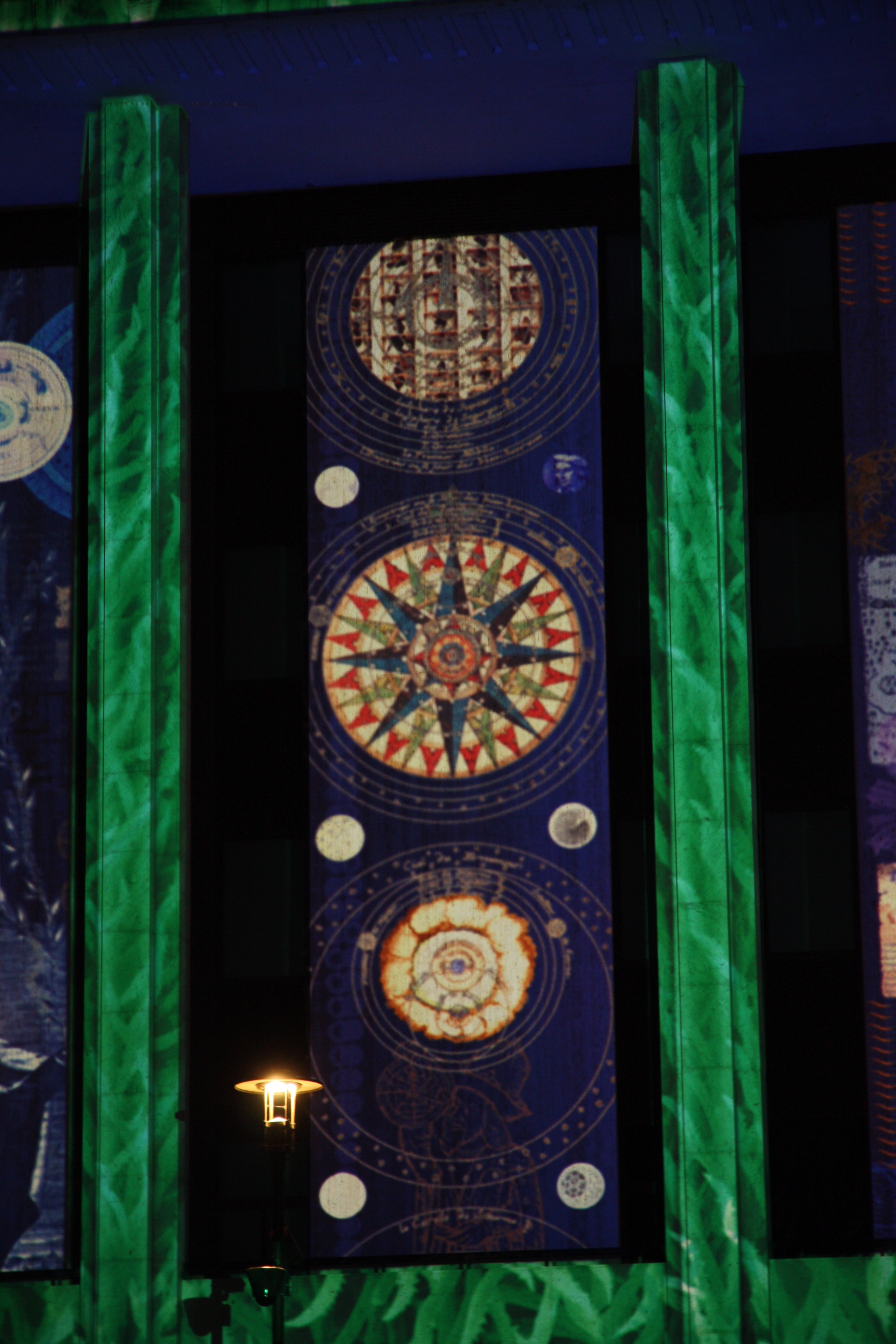
A single panel from the National Library display
I’ll write more about the National Library another time, but here’s a chance for me to share some of the amazing images that were displayed on its façade as part of this year’s Enlighten exhibition.
As you will see from the photos below, the library has seven recessed panels across its front. This allows them to display an impressive range of related images. Tonight’s displays have been based on the library’s collections that related to Asia, landscapes, early Australian discovery, typography, books (no surprise there), the night sky and more.
I love the panel displays, but I also love the reflections in the pond that sit in front of the library. So dazzling.
The library’s panels are used frequently and, in recent times, they have had quite a few nighttime displays that advertise/promote their daytime exhibits.
The most current exhibit—Handwritten: ten centuries of manuscript treasures—is a sensational collection of 100 documents from the Berlin State Museum.
These documents span 1000 years of history and include illuminated manuscripts, letters, sketches, musical scores and much more. Every item has been handwritten by a major figure in literature, religion, science, exploration, philosophy or music.
I must visit again before it closes next week, on 18 March 2012.
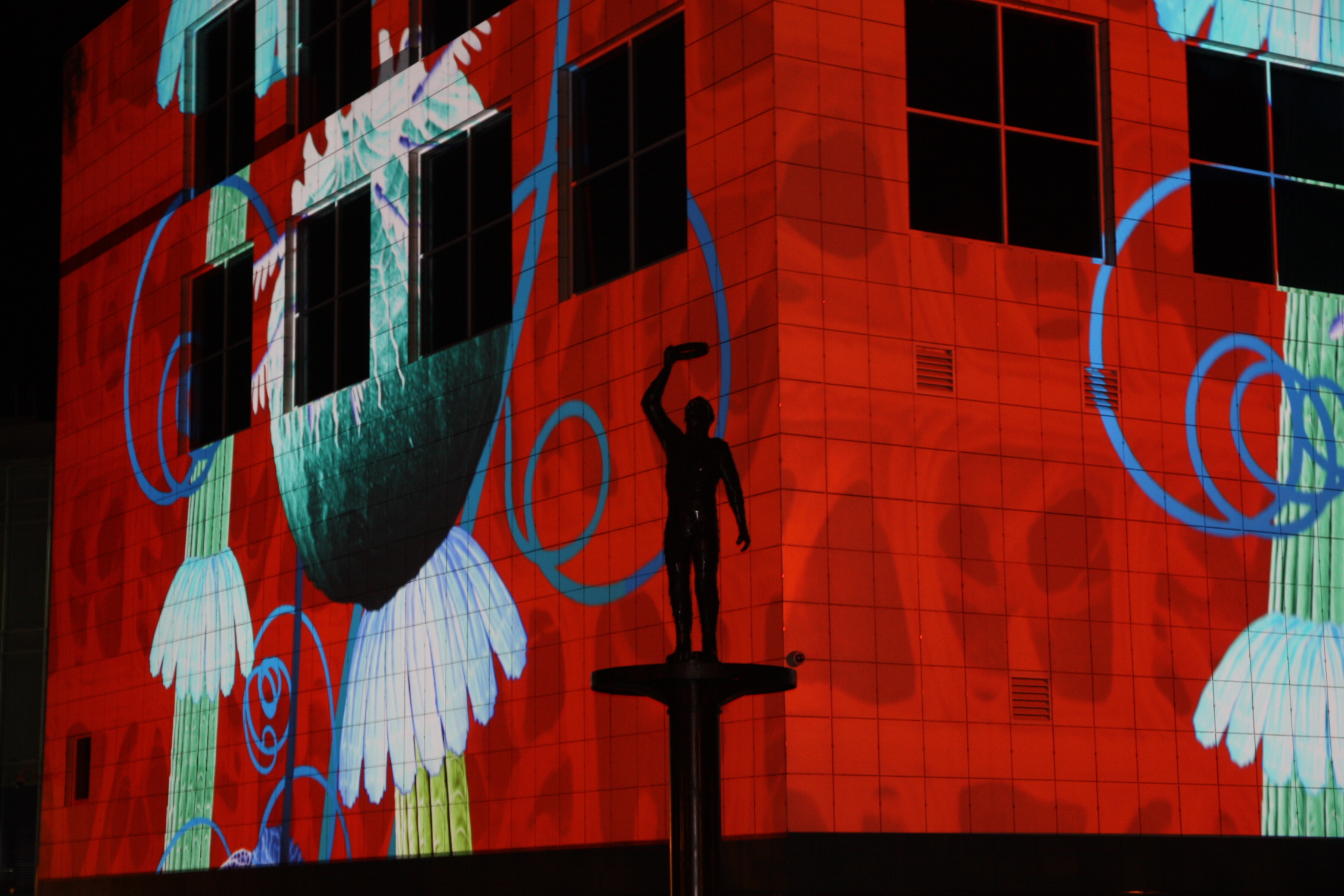
I’ll write more about Questacon—the National Science and Technology Centre another time, but here’s a chance for me to share some of the great images that were displayed on two of its façades as part of this year’s Enlighten exhibition.
Of all the images in the show, these were the most animated and mobile. They scrolled up and down and around the edge of the building, and some even rotated in place. They all referred to some aspect of science and technology—covering the elements, mathematical and scientific formulae, flora (but not much fauna), binary code, molecules, the universe, mechanical things, dinosaurs and whirlygigs. There were more than 15 different images and I’m still having trouble deciding which one I liked the best.
There’s a statue and a ‘No Entry’ sign at one corner of the building—where all the action was—and they both figure into all my photos. And you may notice on the far right of some images, there are a couple of leaves in silhouette on the side of the building.
I’ve added a few comments, when I felt as if I could add some information to the image.

I’ll write more about the National Portrait Gallery another time, but this is a chance for me to share some of the images that were displayed on its façade as part of this year’s Enlighten exhibition in Canberra, Australia’s national capital.
I found these images a bit puzzling. They were colourful and animated, but they didn’t seem to relate to any of the images I know are contained within the Portrait Gallery.
Another image was very interesting, but didn’t really make sense either and all my shots of it were too fuzzy to make it worth posting them.
There was a fantastic ‘rolling’ image that was filled with glimpses of portraits I know. But they flicked by so quickly I wasn’t able to get a decent photo of any of them. And believe me, I tried.
I do enjoy this gallery. And it’s worth visiting often because the portraits get rotated regularly. You never know who you might ‘see’.
By the way, I didn’t add captions because I don’t know enough about any of the images to make a sensible comment.
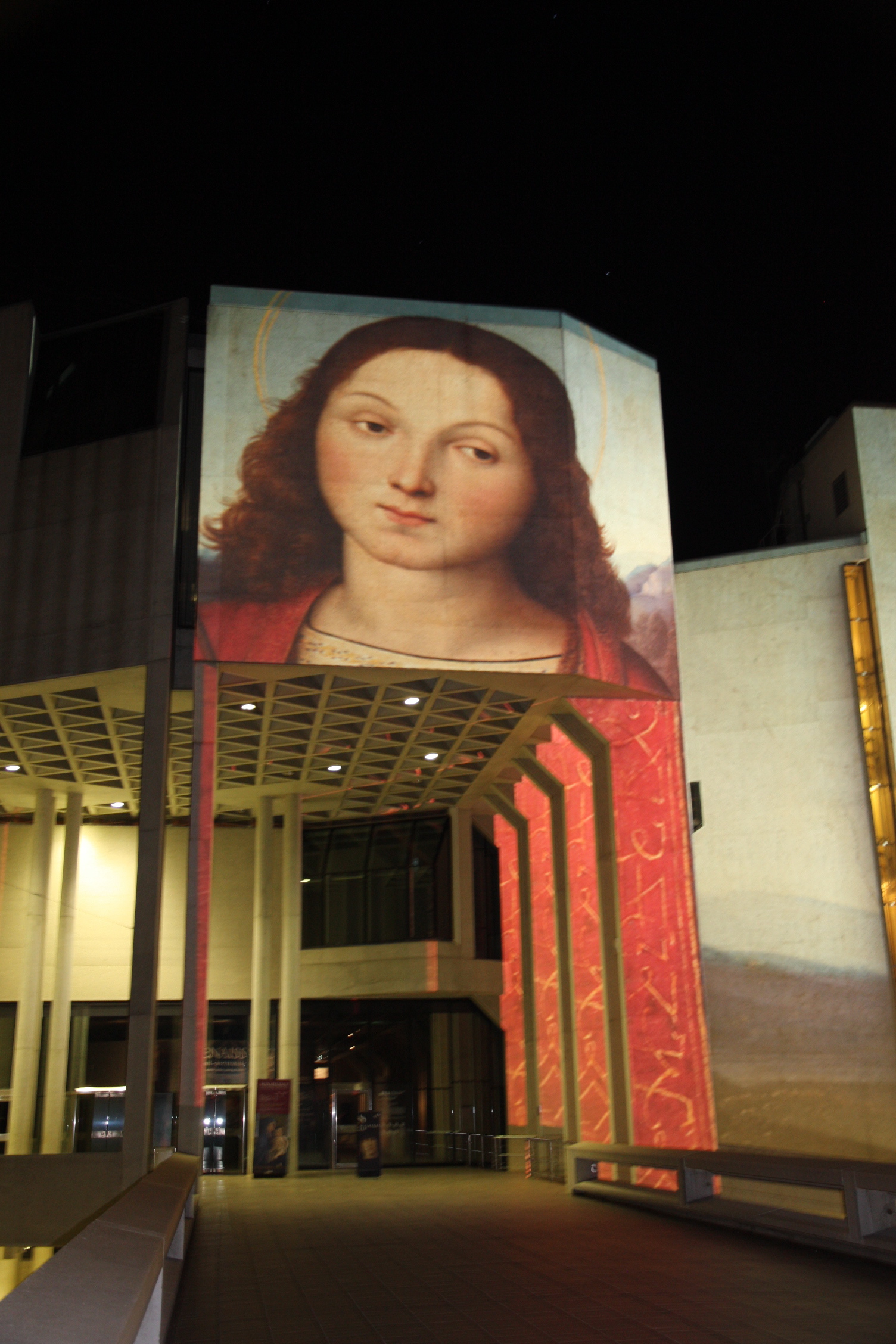
Saint Sebastian by Raphael at the old main entrance to the National Gallery
I’ll write more about the National Gallery another time, but here’s a chance for me to share some of the great images that were displayed on its façade as part of this year’s Enlighten exhibition in Canberra, Australia’s national capital.
These images are from the gallery’s current Renaissance exhibition, which opened in December and closes 9 April 2012.
The images were protected on to two gallery surfaces—a tall wall which is over the gallery’s original entrance and a huge wall at street level. There are two entrances at street level—a new major one and a minor one, which is shown in many of these photos.
The Renaissance exhibit features 15th and 16th century Italian paintings from the Accademia Carrara, Bergamo. It includes works by Raphael, Botticelli, Titian, Bellini and many more.
I’ve added captions to name the painting and its artist.

The bride arrives
We went to the best wedding last night.
Our dear friends, Louise (Louie) and Doug, finally got hitched. I’ve been waiting impatiently for this day, even though I had begged them not to tie the knot before we got home from our London to Sydney travels.
I remember when they first started dating. From the get-go, Poor John and I thought ‘this is a perfect match’ and at the wedding, we found out that everybody else thought so too. Louie is one of the Bloddy Girls, so she always has lots of people offering opinions.
The day was perfect. For the first time in many weeks, it didn’t rain on the Saturday. Last Saturday we got about 5 inches of rain and the temperature barely reached 18°C. But yesterday, the sun came out and the mercury rose to a comfortable 26°C (79°F).
Louie and Doug’s stylish ceremony began about 6:30. Julie Rattenbury, the marriage celebrant, was gracious and easy-going, the original vows were heartfelt, the smiles were huge and the bride wore black. BLACK, you ask? You bet, and it was perfect—a sensational Dior copy. Louie’s never been conventional, and I’m glad she didn’t start yesterday. And the shoes? The shoes were original Christian Louboutin’s, black patent stilettos with black bows and the signature red soles.
It was a cocktail wedding, with a bountiful supply of delicious food and drinks. Catering was by Kindle Cafe and Catering, and I just happen to know the menu.

* baby bruschettas
* bite-size stacks of grilled chorizo, basil and feta
* prawn skewers
* arancini balls with aioli dipping sauce
* lady fingers with yoghurt raita
* bacon, avocado and mango salad cups (don’t eat the cup)
* mini chickpea and sweet potato fritters with hummus
* Italian pork & thyme sausage rolls
* bite-size pizzas, two varieties
* mini baguettes with rare roast beef and hollandaise
And two cakes—a red velvet (dressed in black and white) for the bride and a lemon curd (dressed as Star Trek) for the groom.
Congratulations to both of you and thank you for sharing your sensational day with us.
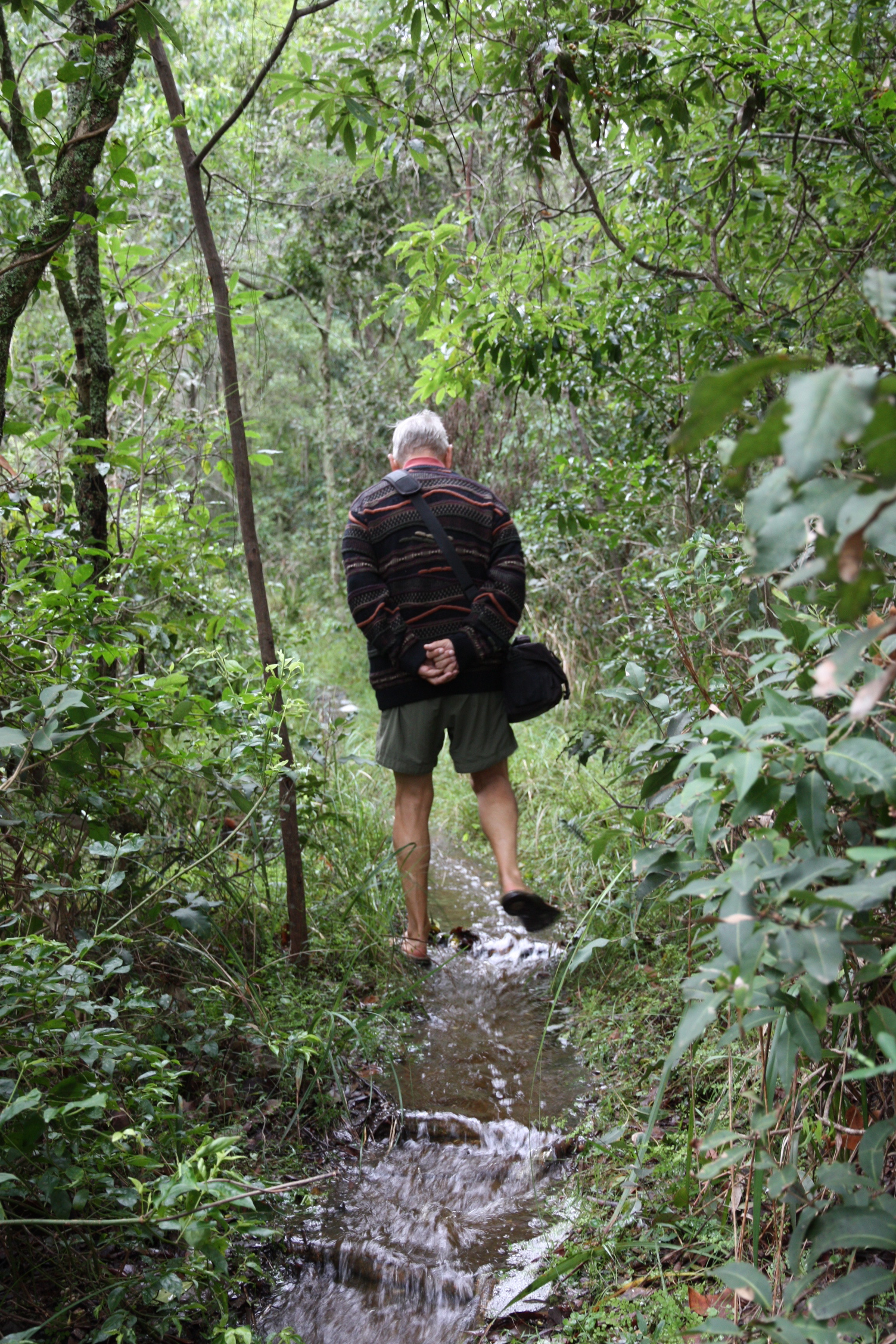
Poor John straddles the creek
There’s a narrow gully that runs along the bottom of our property at Rosedale, on Australia’s South Coast. It creates our path from our backyard to the beach, and it gets plenty of traffic from us, as well as other nearby residents and visitors.
The gully doesn’t belong to us—it’s Crown Land, which means it belongs to the government, and maybe Queen Elizabeth if she decides to make a claim.
She might like to see the flora and fauna we get, but she sure wouldn’t want to claim the land this week.
After quite a few days of torrential rain, our gully has become a creek.
Poor John and I headed to the beach this afternoon, to see the wild seas, and encountered our own wild gully creek.
It’s the wettest and deepest I’ve ever seen the gully, and we’ve had our place here for just over 20 years.
Poor John straddled the wet (the big baby), but I waded through and the water came up to my ankles. We made a detour around a fallen tree.
This gully has been bone-dry for almost a decade, so it’s wonderful to see the water gushing and rushing along, flushing out the whole ravine and carrying 10 year’s worth of muck and gunk out to sea. And I mean muck and gunk in the nicest possible way.
Check out what’s happening down by the sea or in our own Rosedale backyard.
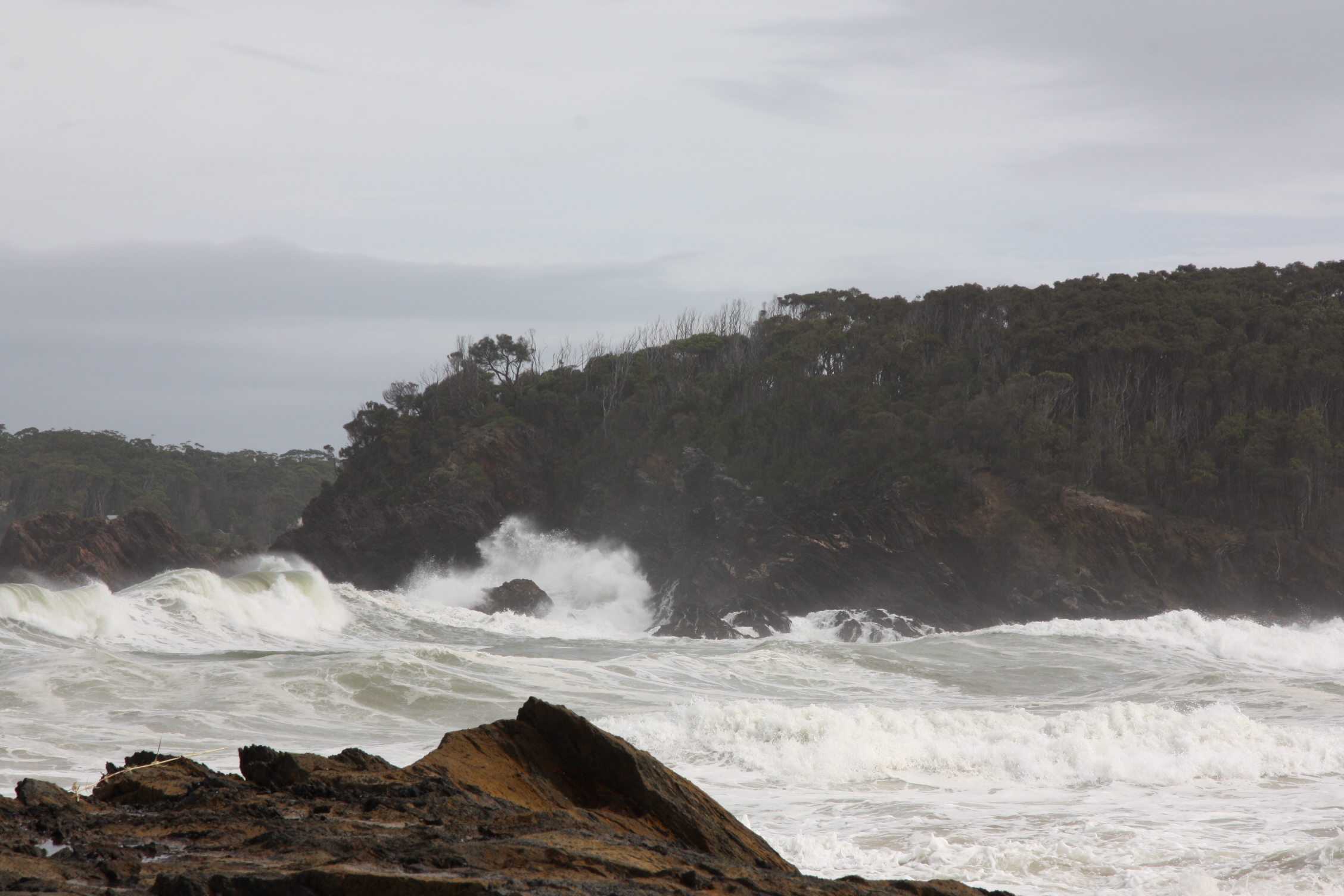
Nun's Beach at Rosedale, New South Wales, Australia
It’s been a long time since Poor John and I saw really high, rough seas at Rosedale, where our beach house is on the South Coast of Australia.
Twenty years ago, before we built the house and when Poor John’s brother and sister-in-law visited for a weekend, we had some of the worst weather ever. David and Charlotte barely saw our block of land, let alone the sea.
The waves were huge, the fog was thick and there was a chest-deep, menacing foam at the water’s edge, which kept us from venturing too close to either the water or the rocks.
But the seas have been wild this week. Nothing quite like 20 years ago, but still impressive. We followed our new ‘creek’ to the beach and walked along the sand.
Poor John reminded me not to stand too close to the edge. Australia is known to have random, rogue waves that will sweep a person to Kingdom Come, and then never send you back.
I confess that I love the wild seas. I’m glad I’m not out there in a boat, but I do love to watch them.
If you appreciate the sea too, I can recommend the book ‘The Perfect Storm’. It’s heartbreaking, but un-put-down-able, and one of my favourite books of the last decade.
If you want something a bit tamer, check out the blog items on our Rosedale waterway or backyard.
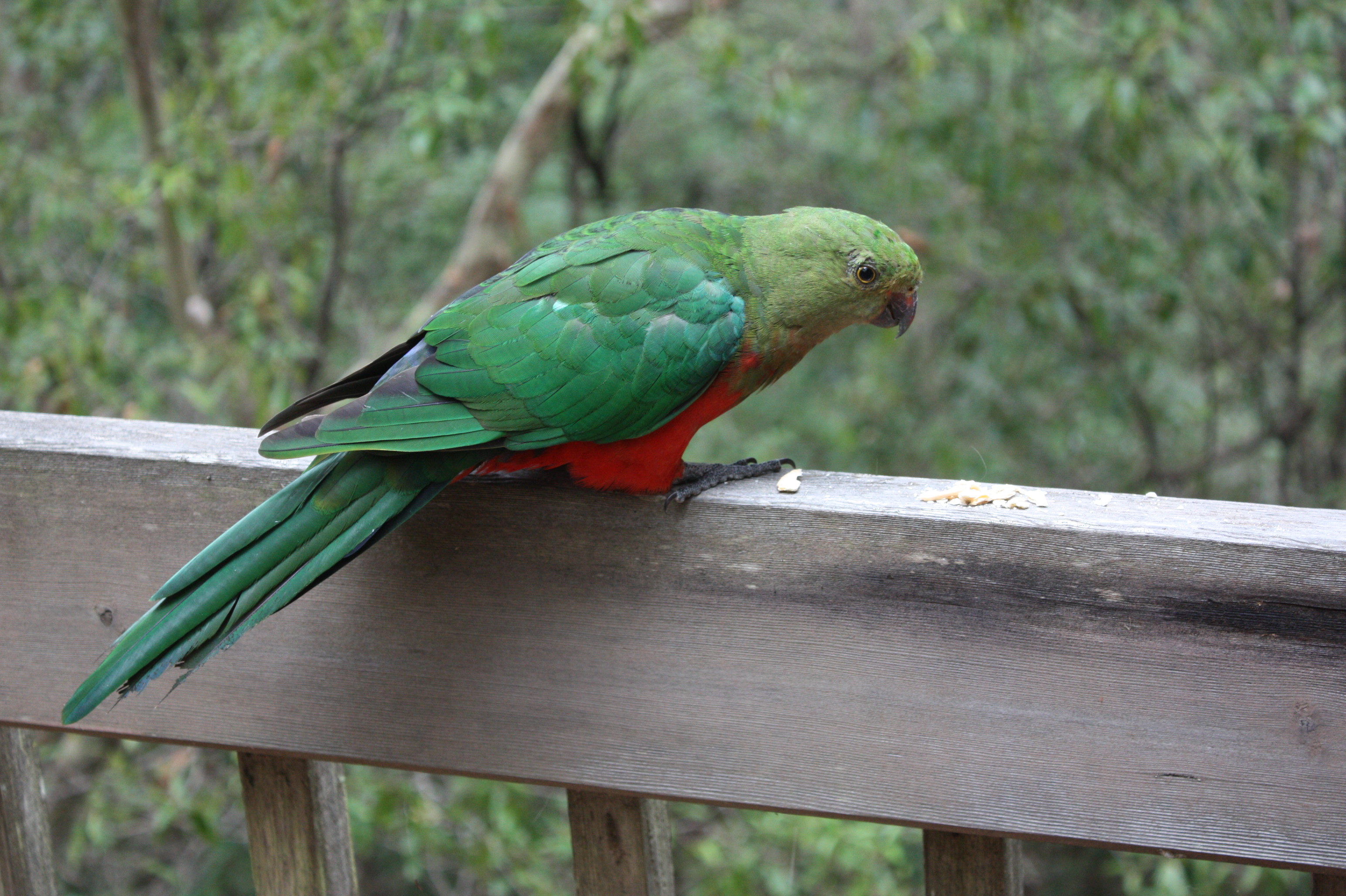
A female king parrot. The male’s chest and head are both red.
We’re at our beach house this week, in Rosedale, on the South Coast of Australia.
It’s a bush block with lots of trees and undergrowth, and plenty of wildlife too.
Mother Nature is always putting Rosedale in some sort of interesting transition.
Check out the stormy seas and the new creek running at the bottom of the gully.
Here are pics of some things I saw today.

Yerevan's Cascade
Armenia and Yerevan, its capital, were amazing bonus stops on our London to Sydney jaunt. Armenia wasn’t even on our original itinerary, but good roads in Turkey put us a few days ahead of schedule, so we swung through this welcoming and fascinating country.
The Cascade is one of Yerevan’s gems. Built—at least started—in the 1970s, the Cascade sweeps about seven or eight stories up a steep hill in the city. You can walk up the outdoor stairs or glide up the indoor escalators. The day we visited was a scorcher, so we rode instead of walking—most unusual for Poor John and me. But it was worth it. Plenty of contemporary artworks grace the sides of the many banks of escalators (I wish I had counted exactly how many levels there are).
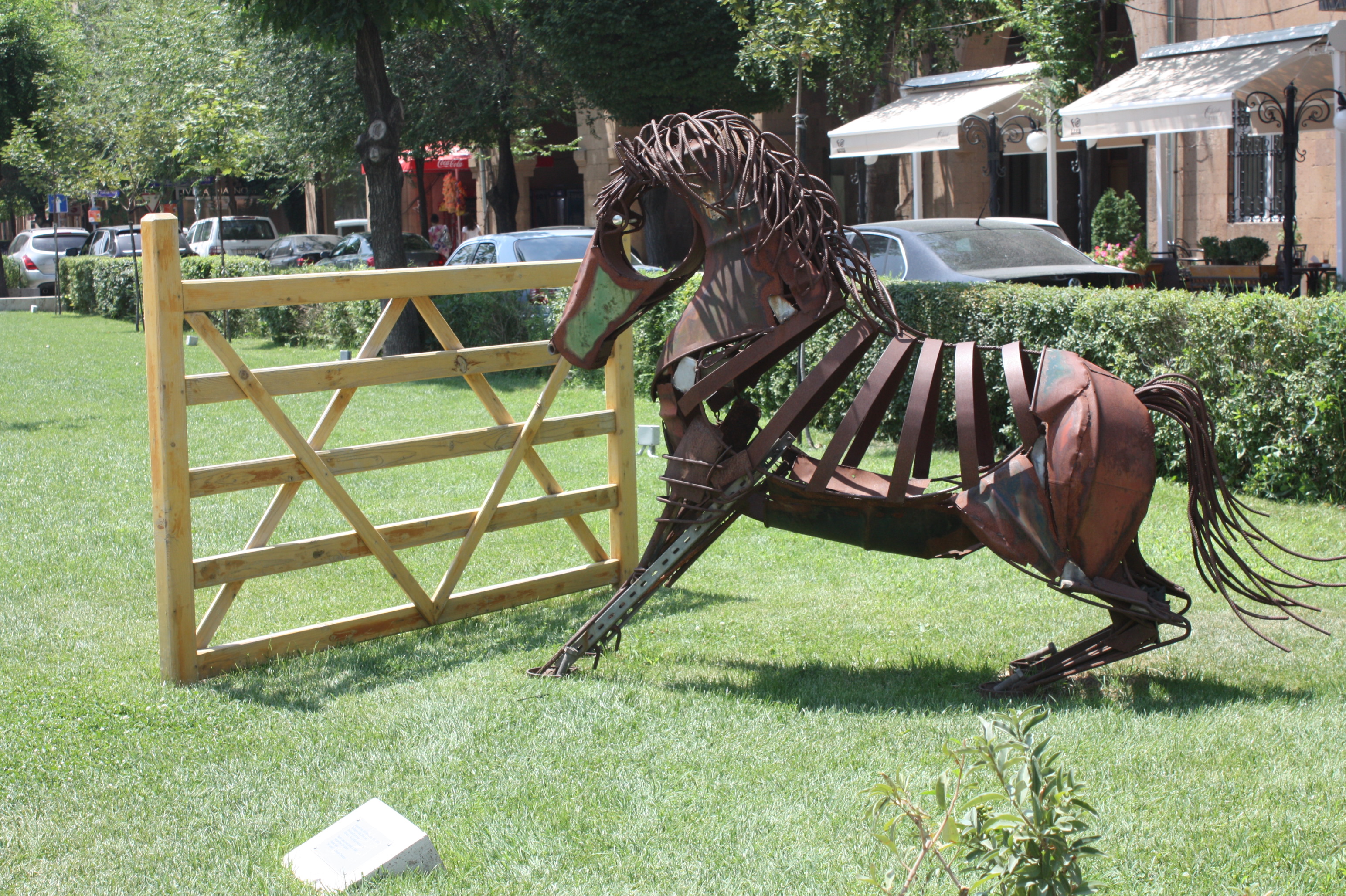
A Cascade sculpture
There are more artworks at the top and still more in the gardens at the front of the Cascade. I should admit that there are also lovely artworks, landings and fountains on the outside staircases. After all, the name Cascade refers to the water that tumbles down the sides.
The views from the top are great too. You can see the gardens below, much of the city and, on clear days, Mount Ararat in the distance. Of course, coming and going, you have to run the gauntlet of souvenir shops, but the salespeople aren’t overly insistent.
All in all, I’d say Armenia is worth another visit.
 Where to next?