

Sameba Cathedral
We spent most of an afternoon walking to and then exploring the massive and impressive Sameba Cathedral, also known as the Holy Trinity Cathedral, in Tbilisi.
Located on Elia Hill in Alvabari—one of the city’s old districts—the cathedral was built between 1995–2004. It supposedly commemorates 1500 years of autocephaly of the Georgian Orthodox Church and 2000 years since the birth of Jesus.
At 84 metres, it’s the world’s third tallest Eastern Orthodox cathedral. It has nine chapels, including ones called after the Archangels, John the Baptist, Saint Nino, Saint George, Saint Nicholas, the Twelve Apostles and the All Saints. Five of the chapels are in a large underground compartment. The structure, including its large narthex, covers 5000 square meters. The whole thing is topped with a dome, which includes a 7.5-metre-high cross covered in gold.
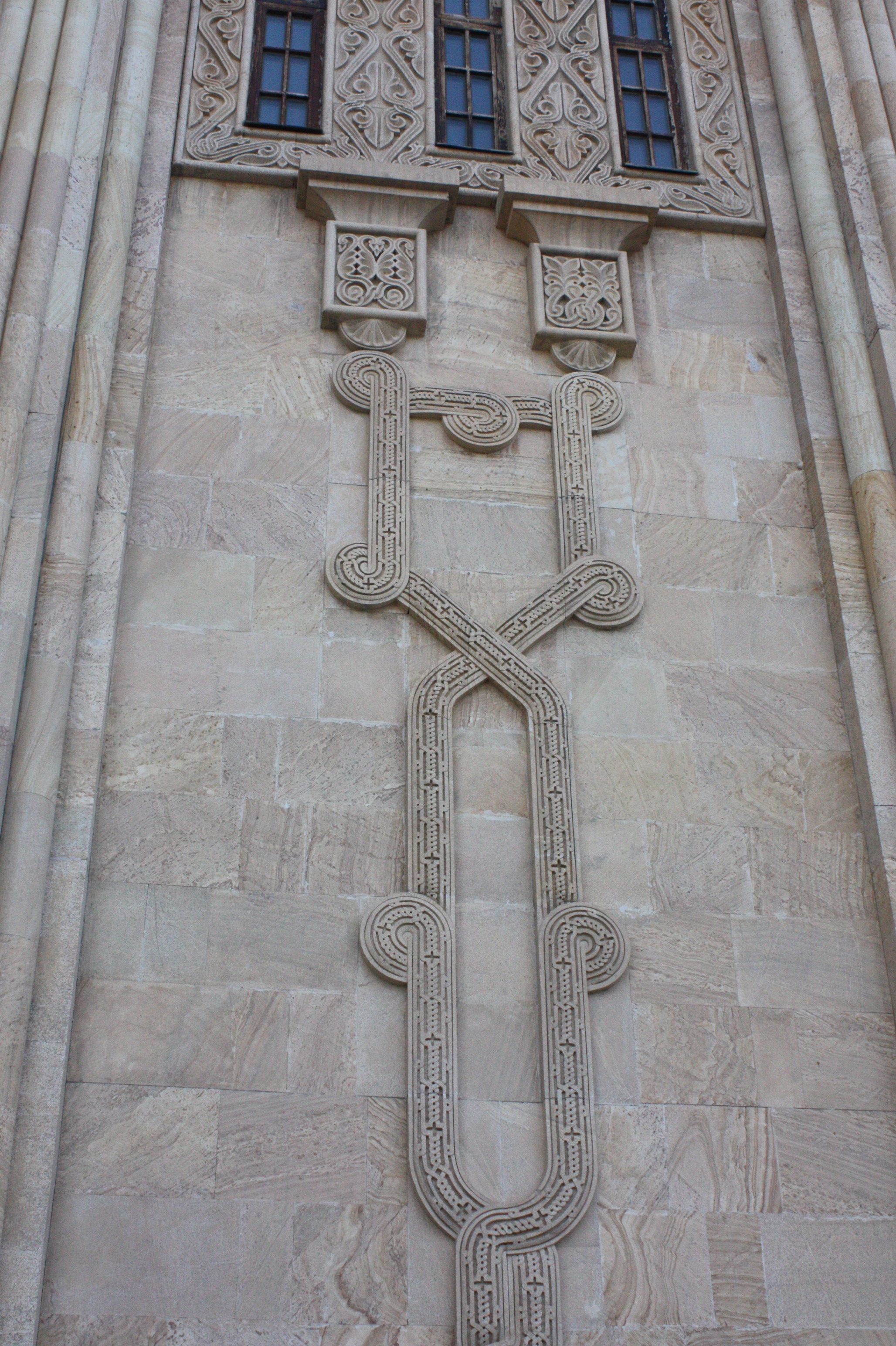
Stone work at the Sameba Cathedral
Promotional materials say the structure is made of natural materials. Online comments say the floor is made of marble tiles and the altar is decorated with mosaics. As usual, Poor John and I were wearing shorts, so didn’t manage to get inside.
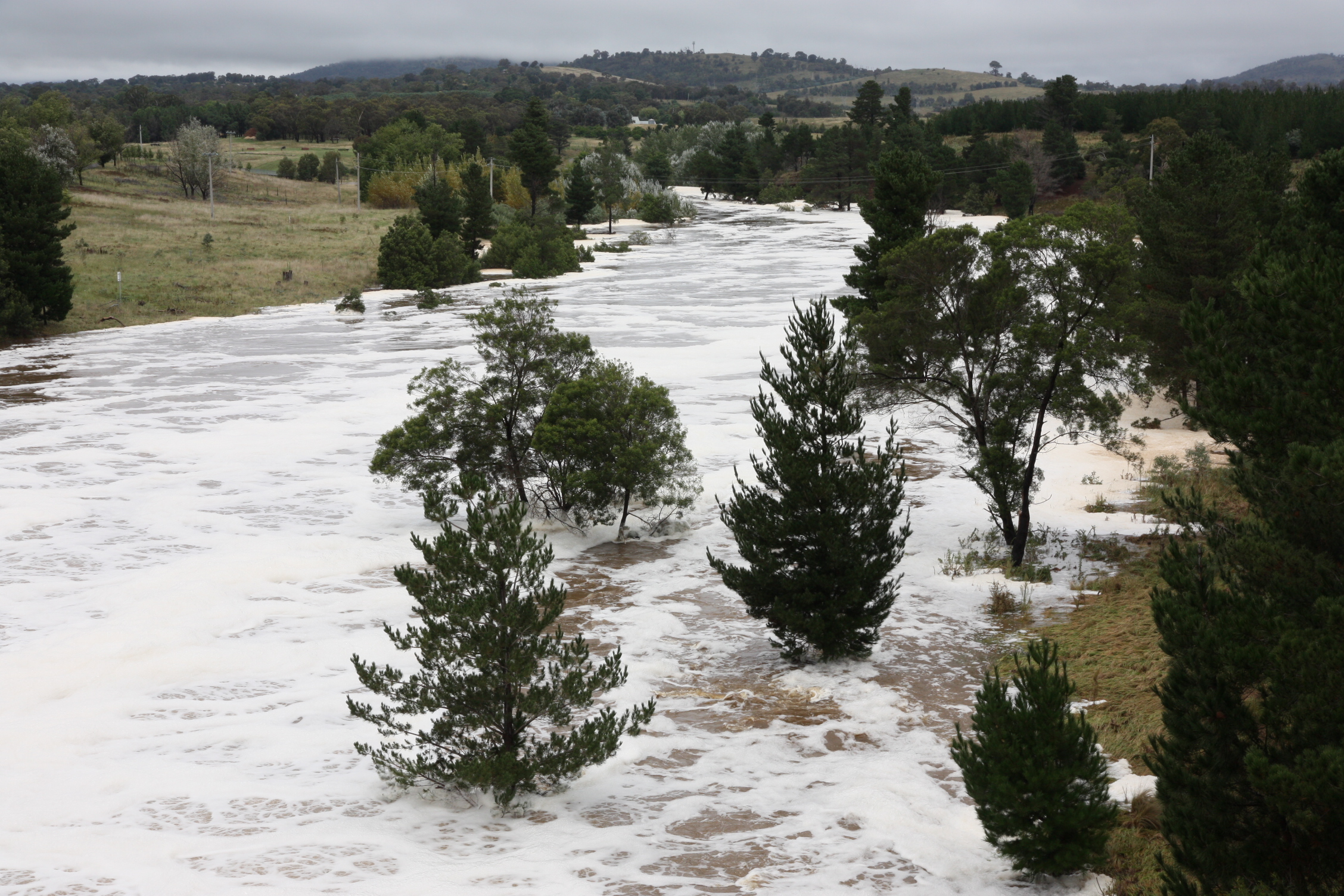
The Molonglo River, below Scrivener Dam
Canberra has had 8 inches of rain in less than three days, and this was after some soaking rains earlier this year.
We’ve had so much rain in recent times that people are beginning to wonder if Lake George might refill this year. This lake has mythical properties. It seems to fill and empty without warning, and many speculate that it might be connected somehow to Peru or South Africa. It’s been pretty much dry since 2002. It was also quite dry in 1982, when I first arrived in a drought-stricken Australia, but it filled the following year.
When full, it’s shallow, salty and treacherous. It’s Indigenous name of Werriwa means ‘bad water’. In the past, boats have overturned and the bodies of the missing fisherman have never been found.
But I digress. Yesterday I shared some pics of the flood debris on the shores of Lake Burley Griffin. Today Poor John and I went to Scrivener Dam (at the east end of the lake) to watch the water crashing into the Molonglo River.
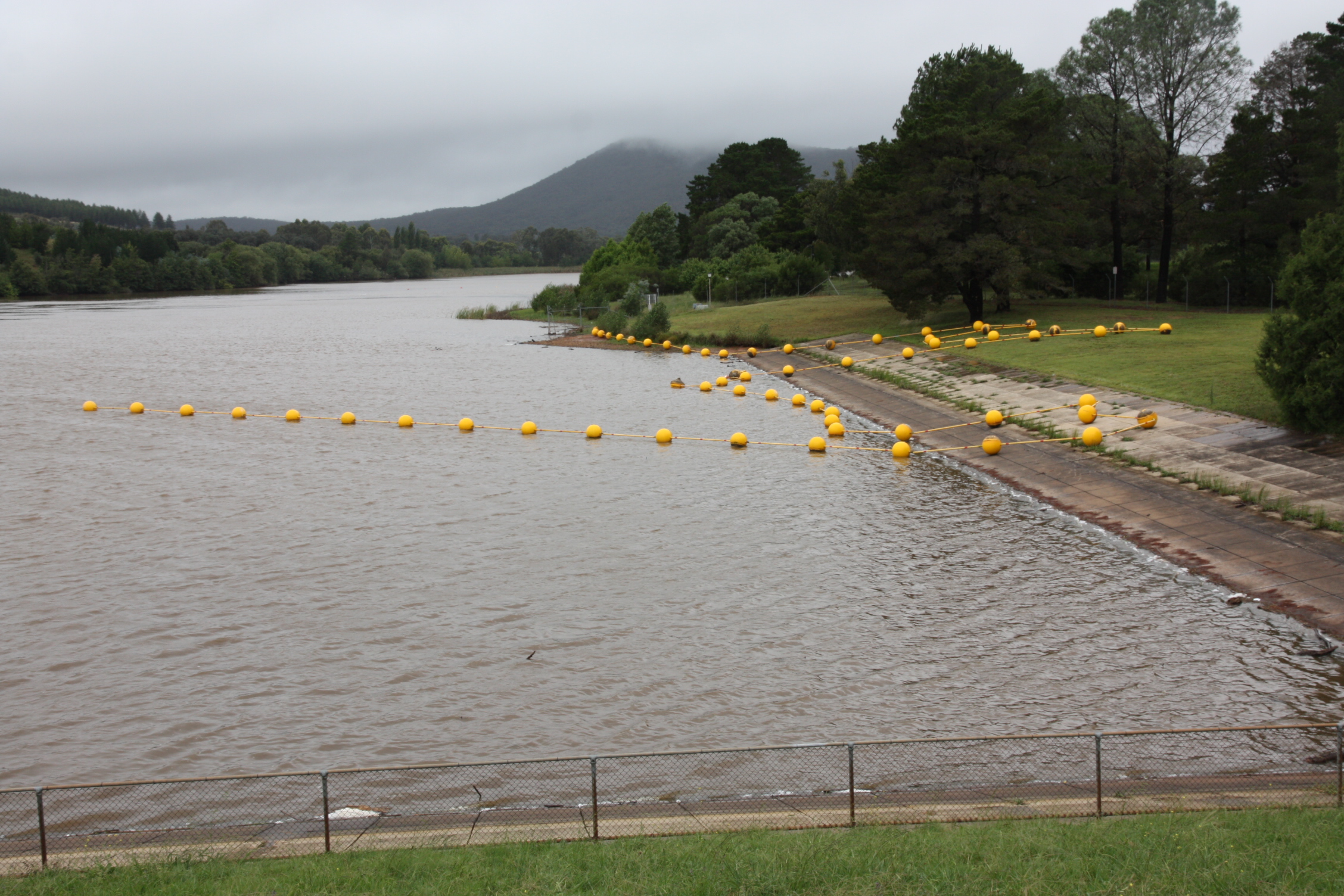
The buoys on Lake Burley Griffin hauled in for their own safety.
Wow, there’s some impressive and thundering force there. The city moved the buoys that usually alert people that they are getting too close to the dam wall. That was, no doubt, to save the buoy line from being destroyed and to let passing branches and other rubbish spill over.
Three of the five sluice gates were wide open, creating a rarely-seen local waterfall and an instant tourist destination.
They should have charged admission. Crowds gathered on both sides of the river and on the bridge as well. The southern carpark holds about 30 cars, and every space was taken. Plus, plenty of cars were parked on the grass and on the roadway verge. I visited twice, and a steady stream of spectators just kept coming.
The sun finally reappeared in the late afternoon—just a glimpse before dusk set in. Tomorrow is supposed to be sunny, warm and soggy.

Lake Burley Griffin with the National Library in the distance.
After 10 years of drought, Canberra and much of Australia continue to get the downpour they’ve been hanging out for. There’s rain, rain and more rain.
I don’t think I’ve ever seen so much heavenly water in such a short time. Canberra got 5 inches in about 36 hours. I think there’s been another 2 inches since late this morning—it’s 10:30pm now—but I’m not heading out to the rain gauge to check.
But the rain is affecting all of eastern Australia. According to the news, everywhere east of Adelaide is being dowsed. The rivers are rising and whole communities are being evacuated, along with the cherished belongings they can carry. Farm animals are being moved to higher (although not dry) ground, and pets are being taken to shelters for care.
Speaking of pets. Yesterday morning in Canberra, there was a slight lull in the deluge, so we trotted the dogs out in a constant drizzle—the dogs being Louie, Bailey, Chiyo and Merlin (pics another day because they weren’t looking very pretty).
Instead of tackling the bush path up Mount Ainslie, which would have been pure mud soup, we headed to Lake Burley Griffin, the city’s central showpiece.
The aftermath of the torrential rain is very apparent. I’ve never seen so much debris and muck washed up against the shoreline.
I didn’t have the camera with me at the time, but raced home after the walk and went back to get a few snaps to share here. The pictures speak for themselves.
I’ll check the lake again tomorrow, with camera in tow. I heard on the news tonight that water and debris are spilling over Scrivener Dam, the structure that created the lake to begin with. This is a little worrying. Apparently the 20 huge bolts in the sluice gates need to be replaced—at $140,000 a bolt. Until that happens, the lake level has been lowered by almost a metre. And now it’s overflowing. Hmm! Stay tuned for an update and more pics.

Pick-a-number prize
The numbers are in and there’s a winner.
I’m pleased to announce the kudos (and prize) go to Emma Bickley, who chose the number 33, and then modified it to 32.
So the winning number is 32, but 33 will play a role too (see below).
Actually either number would have done, because it was Emma’s reason that clinched the prize for her.
She linked her choice/s to my grandmother’s birthday, which was also the day that entries closed. That’s a good enough reason for me.
On this 29 February, my grandmother (my dad’s mother) would have been 132.
Now some of you might think that means she would have been celebrating her 33rd birthday but—and it’s a little known fact—29 February was not observed in the year 1900, so given that she was born in 1880, she would have been celebrating her 32nd birthday.
Grandma Zula—yes, that was her name—was larger than life. A true character.
She lived with my folks, my sisters and me for the last 6–7 years of her life. I’ll tell some of those stories another time, but you should know that life with Zula was like being on a roller coaster.
I remember her 21st birthday party in 1968.
She asked for an electric guitar! My mother got her one. Well, it wasn’t actually electric, but an electric look-alike. I think mum paid about $60 for it way-back-when. Zula taught herself to play it.
Quite a few years later mum sold that guitar for $600. Turns out very few of these were ever made and it became a collector’s item.
Grandma was a collector’s item too.
The prize
So what’s the prize for the winner.
It’s a copy of the cookbook My Egyptian Grandmother’s Kitchen by Magda Mehdawy. I bought it in Egypt and it’s a lot of fun to read, but then I read cookbooks like most people read novels.
Why pick a number?
I have a plan for an additional blog. Actually it’s more than a plan—it’s already being shaped—but I needed a number.
I have more than 500 cookbooks and probably another 500 cooking magazines. I read them like novels, but don’t cook from them nearly often enough. I need motivation to get into each and every book.
So from now on, at least a few times a week I’m going to cook from page 32, 132 or 232. If there isn’t a recipe on 32, I’ll look at page 33 or 133 or 233. My fall-back position will be page 64, which just happens to be Poor John’s age. He knew he’d get his age factored in there somewhere.
I’ll share the recipe and what I do with it in a new blog called What’s cooking on page 32.
And congratulations Emma!
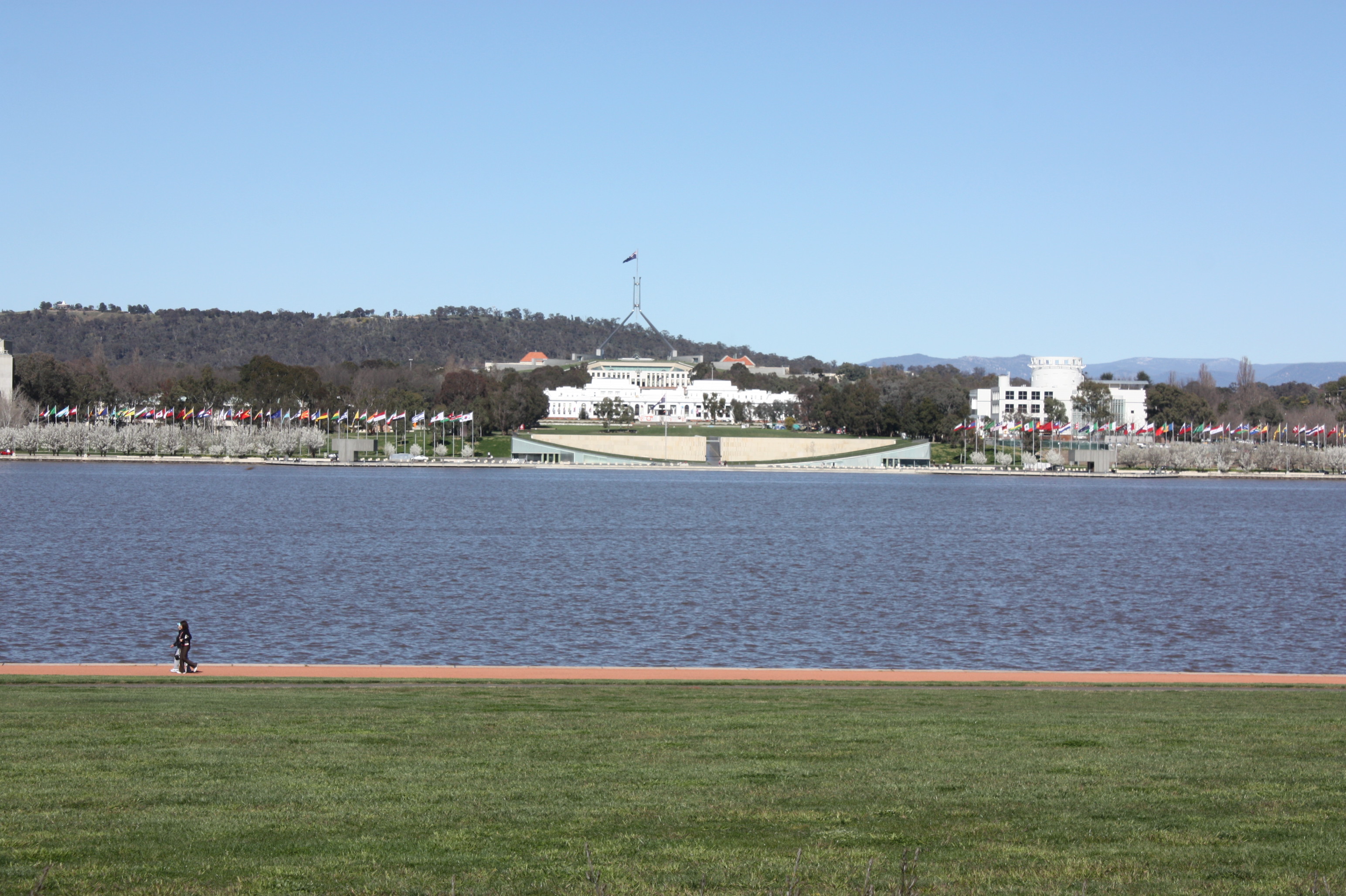
Australia's Parliament House (the building with the tall flagpole) viewed from across Lake Burley Griffin
Twice in the last 10 days, I’ve been stopped by security at Australia’s Parliament House in Canberra. Both times we had gone up for the daily afternoon Question Time in the House of Representatives.
The first time, we popped up on the spur of the moment, but today we planned ahead and booked in advance. We wanted to see some of the aftermath of the not-as-bloody-as-expected leadership challenge that took place yesterday.
Question Time can be pretty fiery on any day. The Members of Parliament are always trying to outmanoeuvre one another, and mud-slinging, name-calling and shouting are all part of the package. It’s a spectacle worth seeing.
But security is especially rigorous. You go through a detector at the front door, and then a second one right at the entrance to the actual House of Reps. This second detector is über sensitive and you have to empty your pockets, take off your shoes, and check your camera, phone and other electronics. We know this, so always go empty-handed except for the car keys and a plastic driver’s licence for ID.
So why do I always set off the alarms?
Last week, they let me through after a body scan. I sort of figured that my watch or the stud button and zipper on my shorts had set it off. So today I wore shorts with an elastic waistband and no zips or studs. But the alarm blared again. They had me take off my watch, but I still tripped the alarm. So another body scan, and another all-clear to go in.
‘This is ridiculous. Why does this happen?’, I said to the fellow doing the scan. He leaned forward and quietly said, ‘just so you know, I think it’s your bra straps.’
Still trying to figure out how I’ll deal with the next visit. Braless ain’t gonna happen.
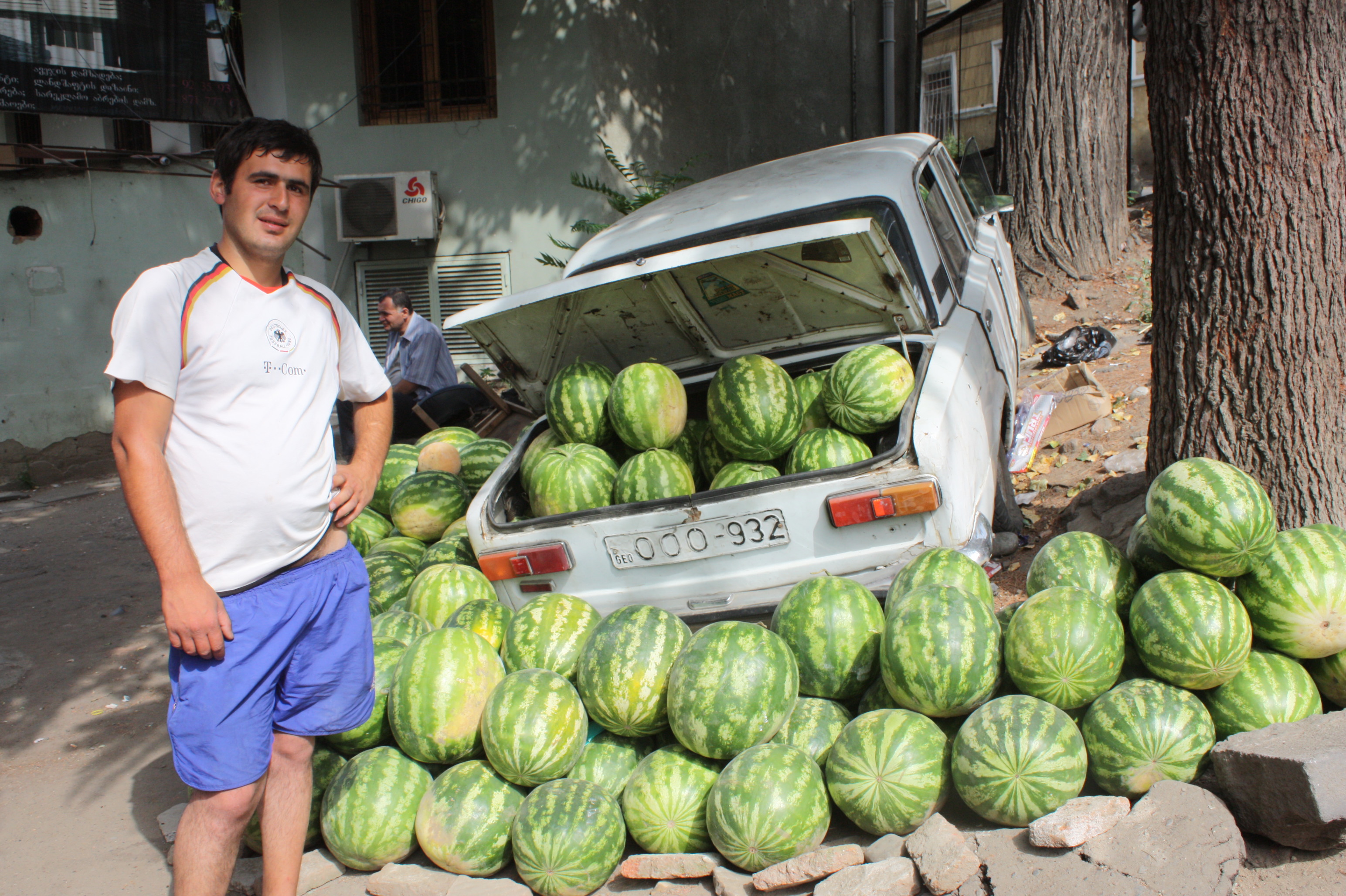
Anyone for a watermelon?
Usually from the minute we arrive at a new location, Poor John has us out walking the streets and taking in the local life. Tbilisi was no exception and we set out to explore the side streets and neighbourhoods surrounding our hostel.
It’s a great way to get glimpses of Georgian daily life and to see the variety of shopping available.
Our first encounter in Tbilisi was with an entrepreneurial watermelon salesman with his boot-load of fruit. I can assure you he didn’t drive there in that car. All the tires were flat and you’ll notice how the watermelons on the ground are held in place by chunks of concrete. A little farther on, we came to the corner shop with its beer sign and produce display giving an immediate indication that a shop was there.
Lunch was at a family-style restaurant with its own bakery. The smell was heavenly and the large flat loaves were being produced non-stop. The bakery itself wasn’t open to the public, but they were quite happy to let me take photos through the display window.
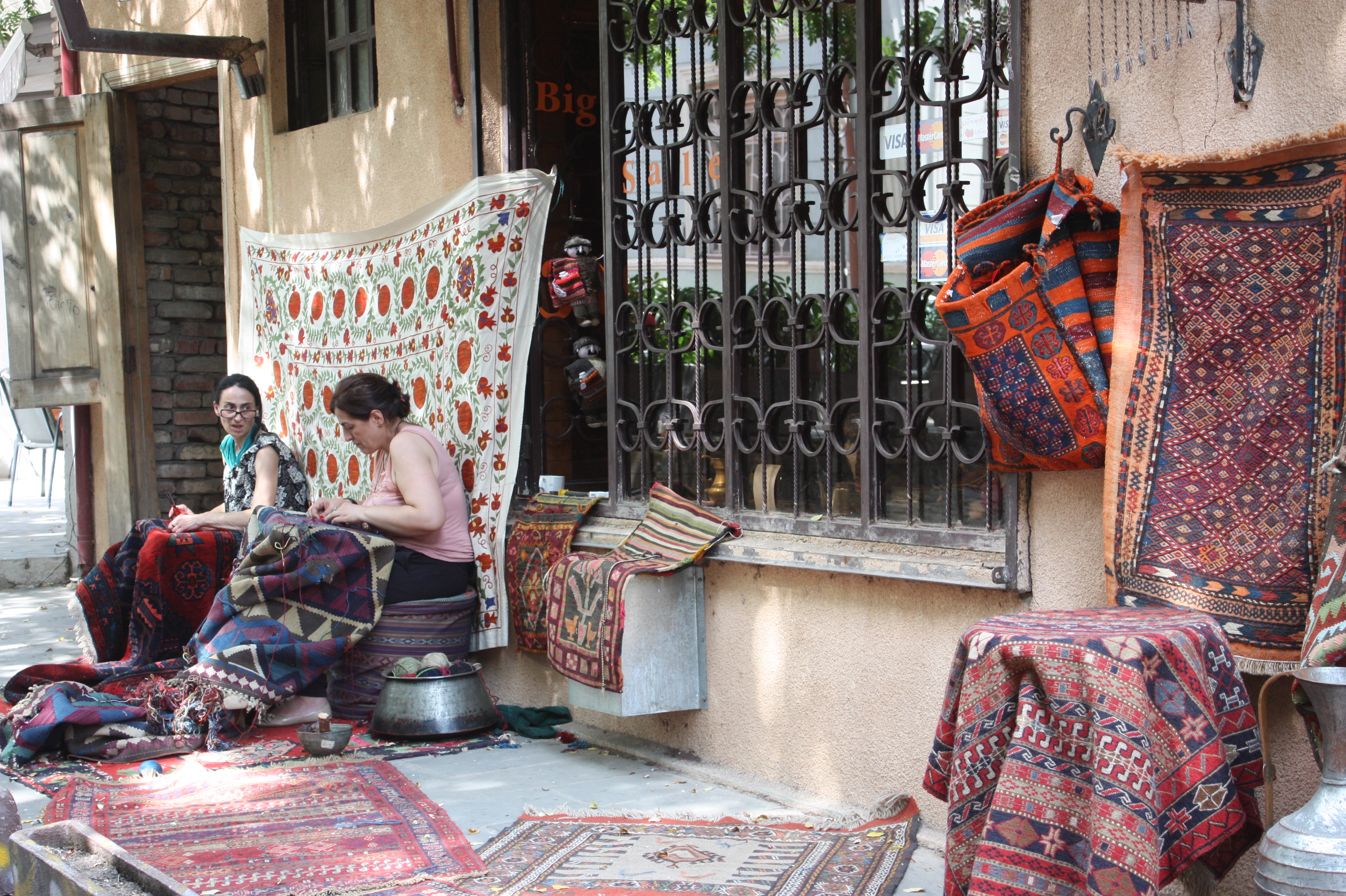
Working on carpets in Tbilisi
Another stop was at a textile/carpet shop. Two women—perhaps a mother and daughter—were out the front making carpets and/or doing repairs. Poor John, who is especially interested in carpets, went in to the shop to learn more, but a lack of language prevented him from getting a lot of detail. He did confirm, though, that woven carpets are made in Georgia.
But I don’t want to give an impression that all sales are made from hole-in-the-wall shops or car boots. Tbilisi is cosmopolitan and there are very smart shopping streets, with plenty of big brand names and stylish restaurants.
There are well-stocked supermarkets too. Georgia is known for its wine. In fact, it claims to be the birthplace of wine, and I can confirm that even the cheapest wine is quite delicious. Every supermarket has a wall of wine and another of vodka.
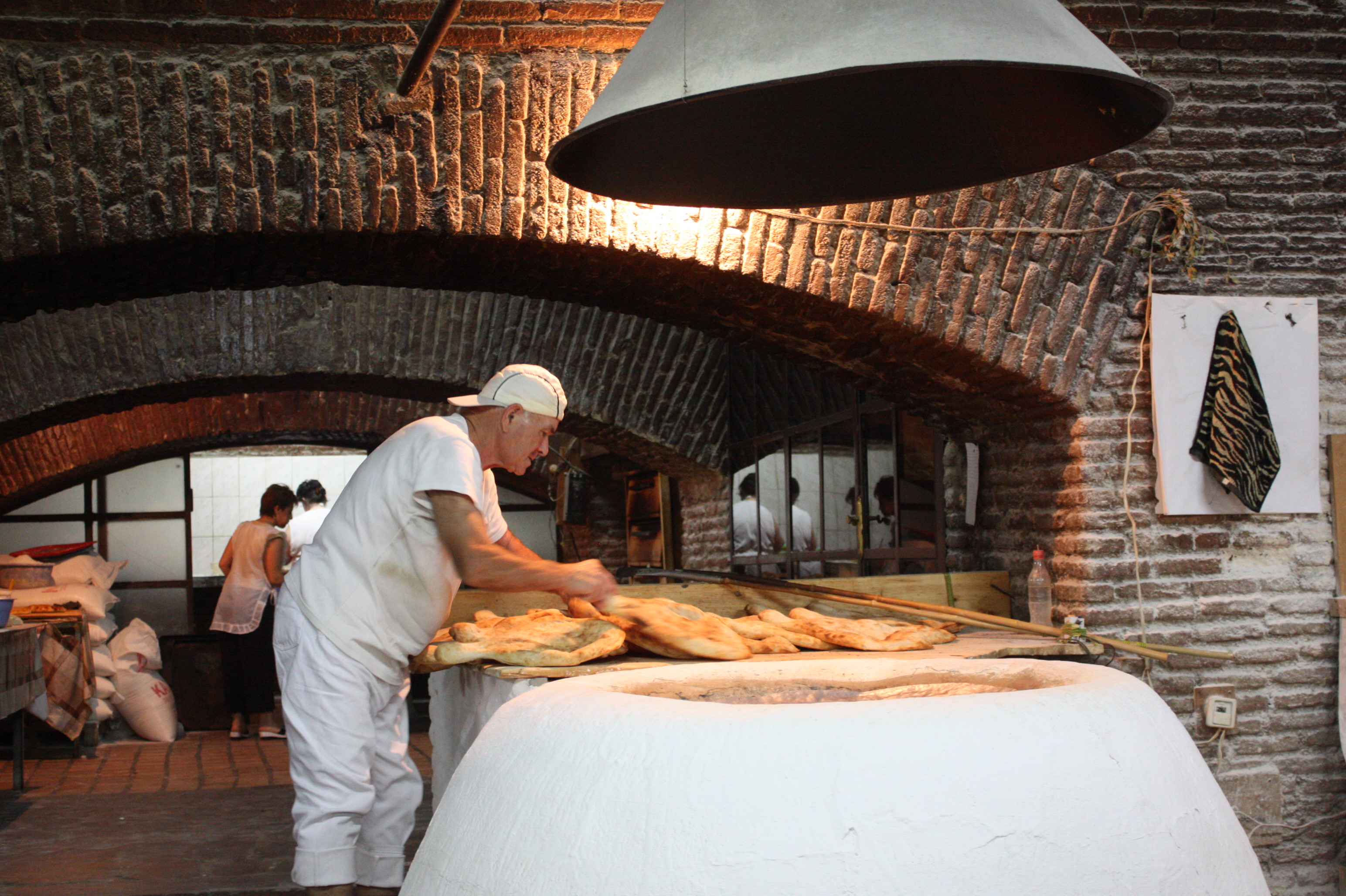
A bakery in Tbilisi
The supermarket around the corner from our hostel also had a professional beggar. I’m kicking myself that I didn’t get pic of her, but she would have charged me a bomb for it. For 8–10 hours of every day, she stood outside on the footpath, directly in front of and facing the supermarket entrance. Her hand was always outstretched and she often did a sort of half-lunge at everyone who came out of the store. Imagine her tapping the palm of her outstretched hand, demanding that you contribute a coin or note. She really was most insistent. Fortunately she took a bit of time off each day. I think it was a job-share arrangement—perhaps a family business—but her substitute wasn’t nearly as intimidating.
I resisted all their pleas. I don’t do beggars. I’ll always give to buskers, but not beggars. I won’t say never, but almost never. I have paid to take a photo and have given something to a few others. Poor John always thought we should have given something to the fellow in San Francisco who put out his hand and, with a big smile, asked us to ‘contribute to Obama’s economic stimulus package’.
Don’t forget to pick a number before 29 February 2012.
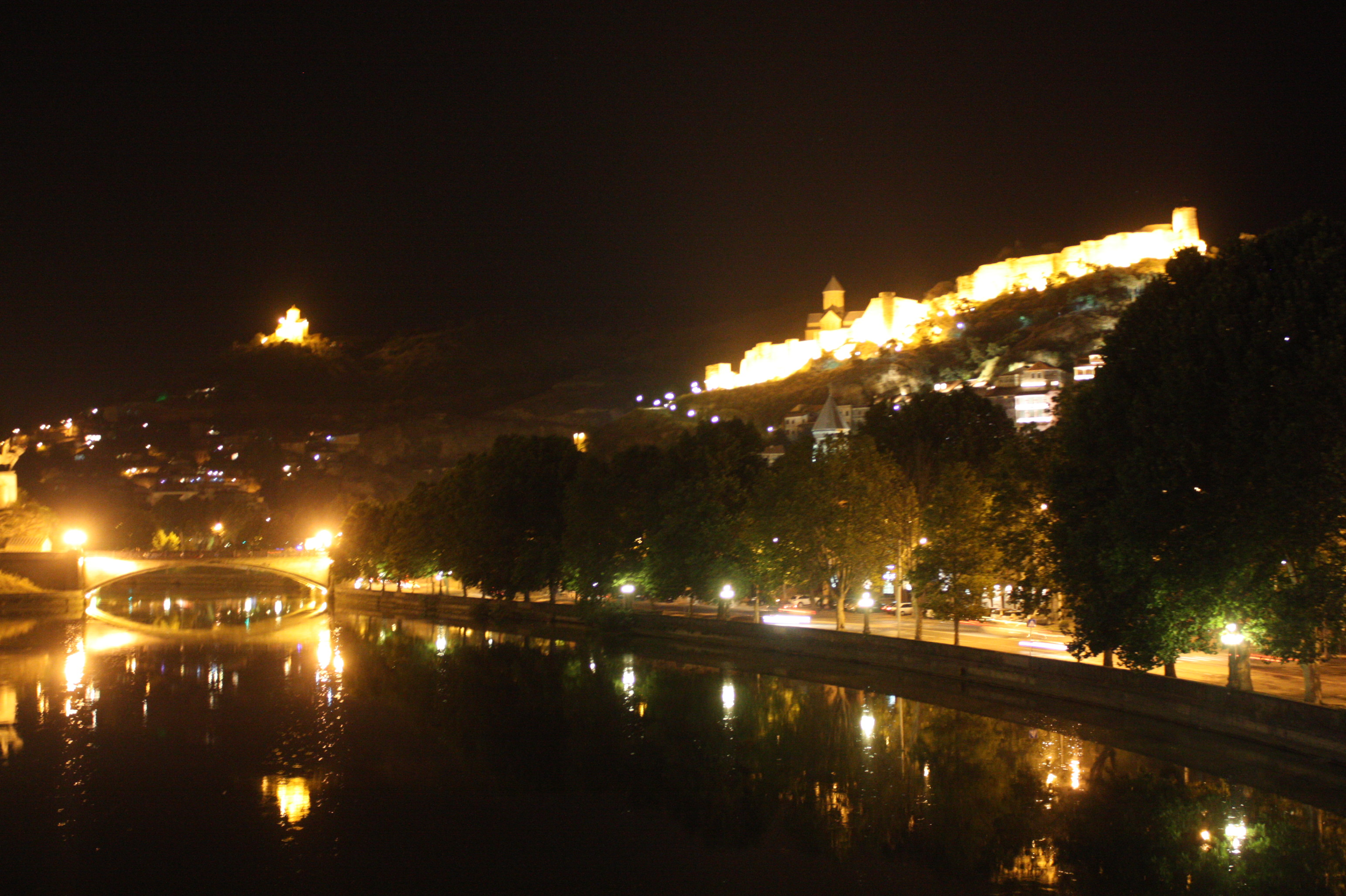
The Narikala Fortress
Tbilisi is a beautiful old city, but it’s especially stunning at night.
From the Bridge of Peace over the Mtkvari (Kura) River, I could look to my right and see a long expanse of old Tbilisi, including the brightly lit Narikala Fortress and Metekhi Church. Turning almost 180 degrees to my left, I could see the opulent presidential palace, which looks even bigger at night.
Poor John and I continued across the bridge to the bustling, Europe Square. a spacious park that comes alive at night for the dancing fountain display.
We were surprised to see so many people turning out on a Tuesday, but the place was crowded with families, sweethearts, food and balloon sellers, as well as some tourists. I assume this is a nightly ritual, because the fountains ‘perform’ daily. The hubbub was a big change from earlier in the day, when we got a feel for just how large (and deserted) Europe Square can be in the afternoon.
We saw dancing fountains in Yerevan, capital of Armenia. The Yerevan show is longer and more impressive, but I’d still recommend both.
Hey, don’t forget to pick a number before 29 February 2012.
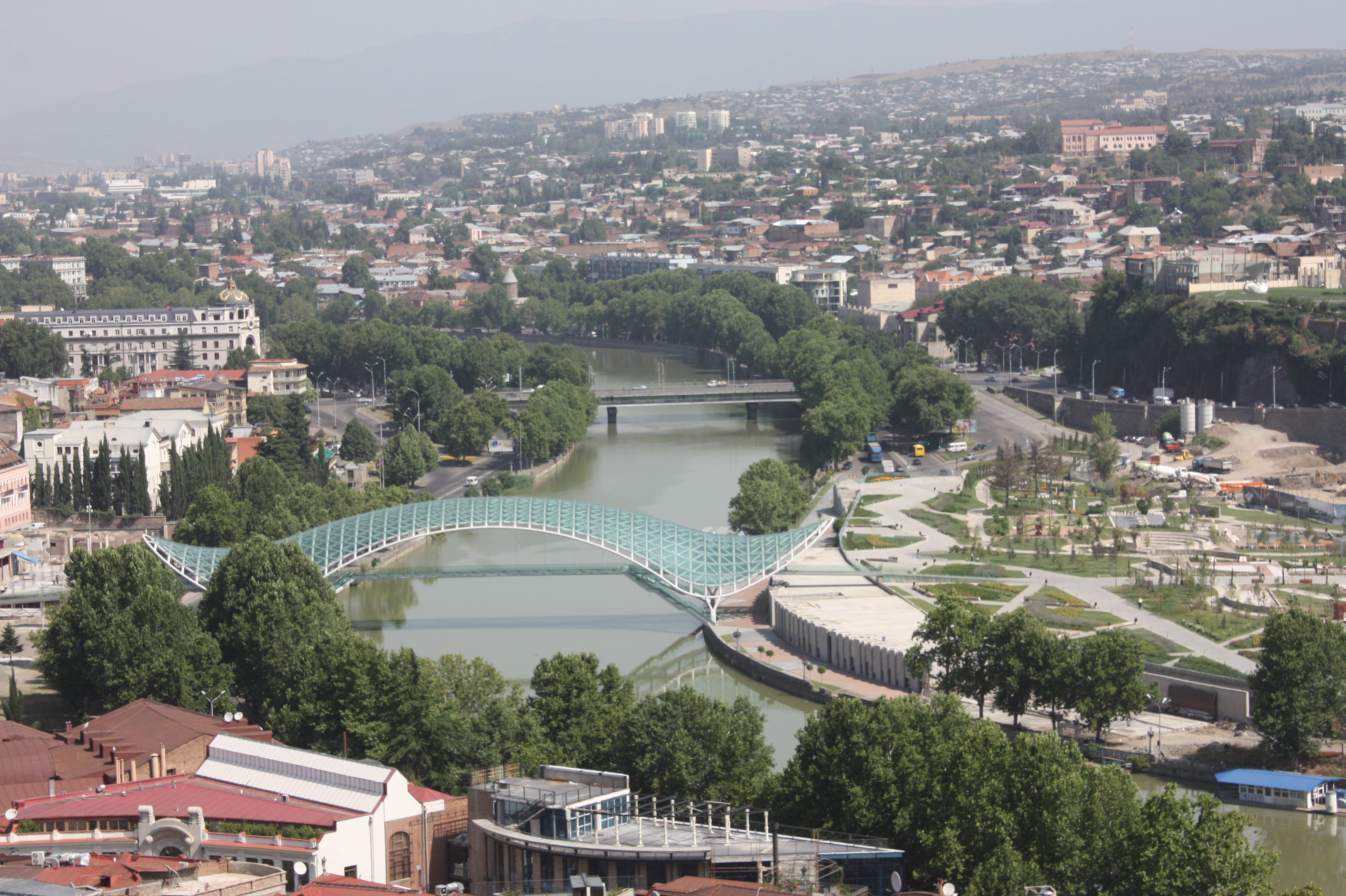
Bridge of Peace
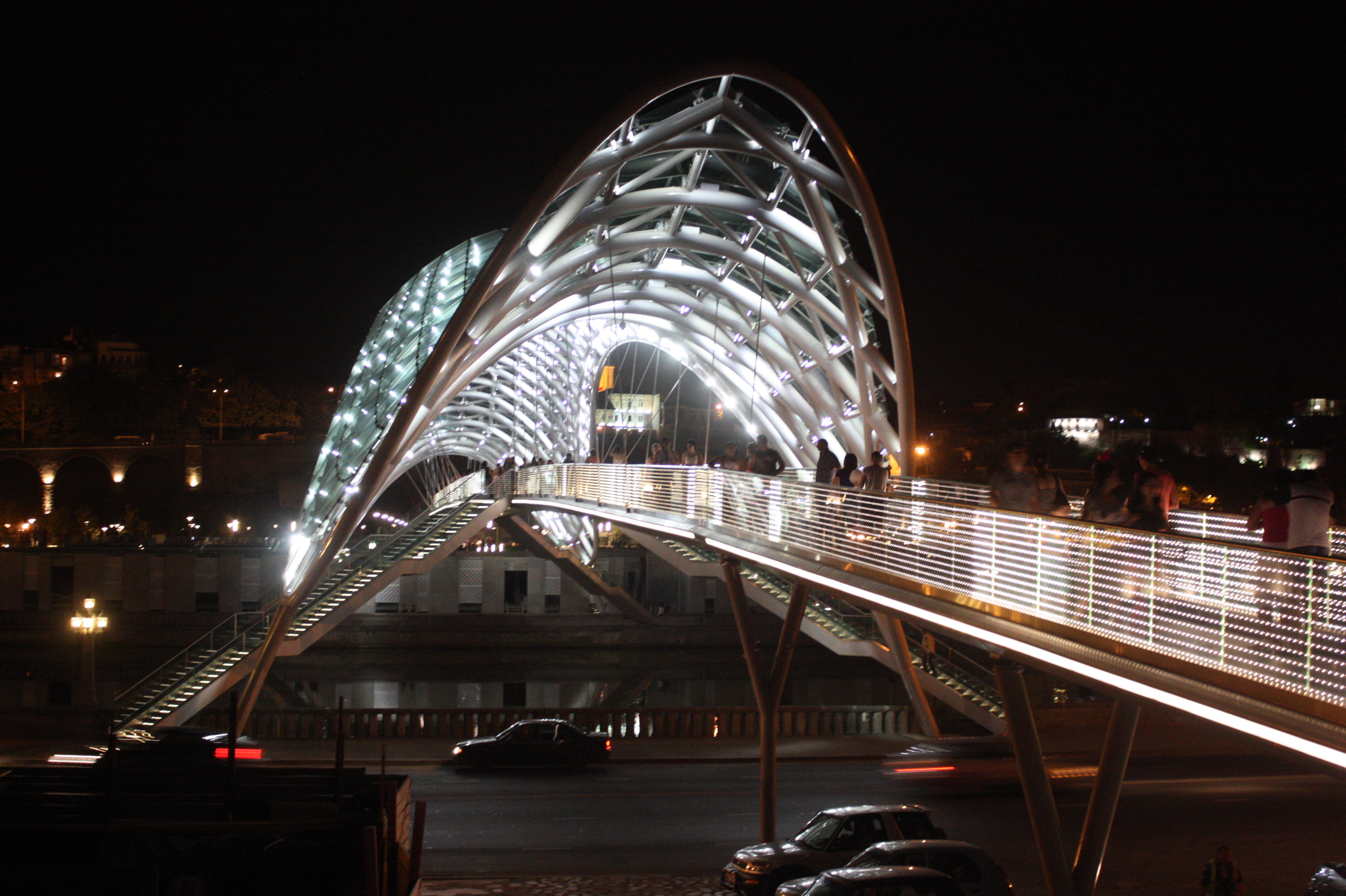
Bridge by night.
Opened in May 2010, the pedestrian Bridge of Peace is a showpiece in the centre of Tbilisi. It crosses the city’s Mtkvari (Kura) River—joining the old district with the new.
Designed by Italian architect, Michel de Lucchi, the bridge is all glass and steel. It’s bow-shaped roof is 150 metres long. During the day, the bridge sparkles in the sun. At night it is ablaze with a light display. French lighting director Philippe Martinaud created the light show, which has 30,000 LEDs and 240 sensors.
Apparently, the light display conveys messages which, according to Martinaud, celebrate ‘life and peace between people’. We walked over the bridge in daylight and in the dark, and while I noticed the lights flickering, I couldn’t really detect the messages, but then I didn’t know there were supposed to be any.
The bridge’s design has been criticised for clashing with Tblisi’s classic brick, woodwork and ornamental architecture. Similar criticism has been levelled against the president’s residence, another de Lucchi creation.
Clearly no one thought to put in a lift because the rubbish has to be carried out.
Hey, don’t forget to pick a number before 29 February 2012.
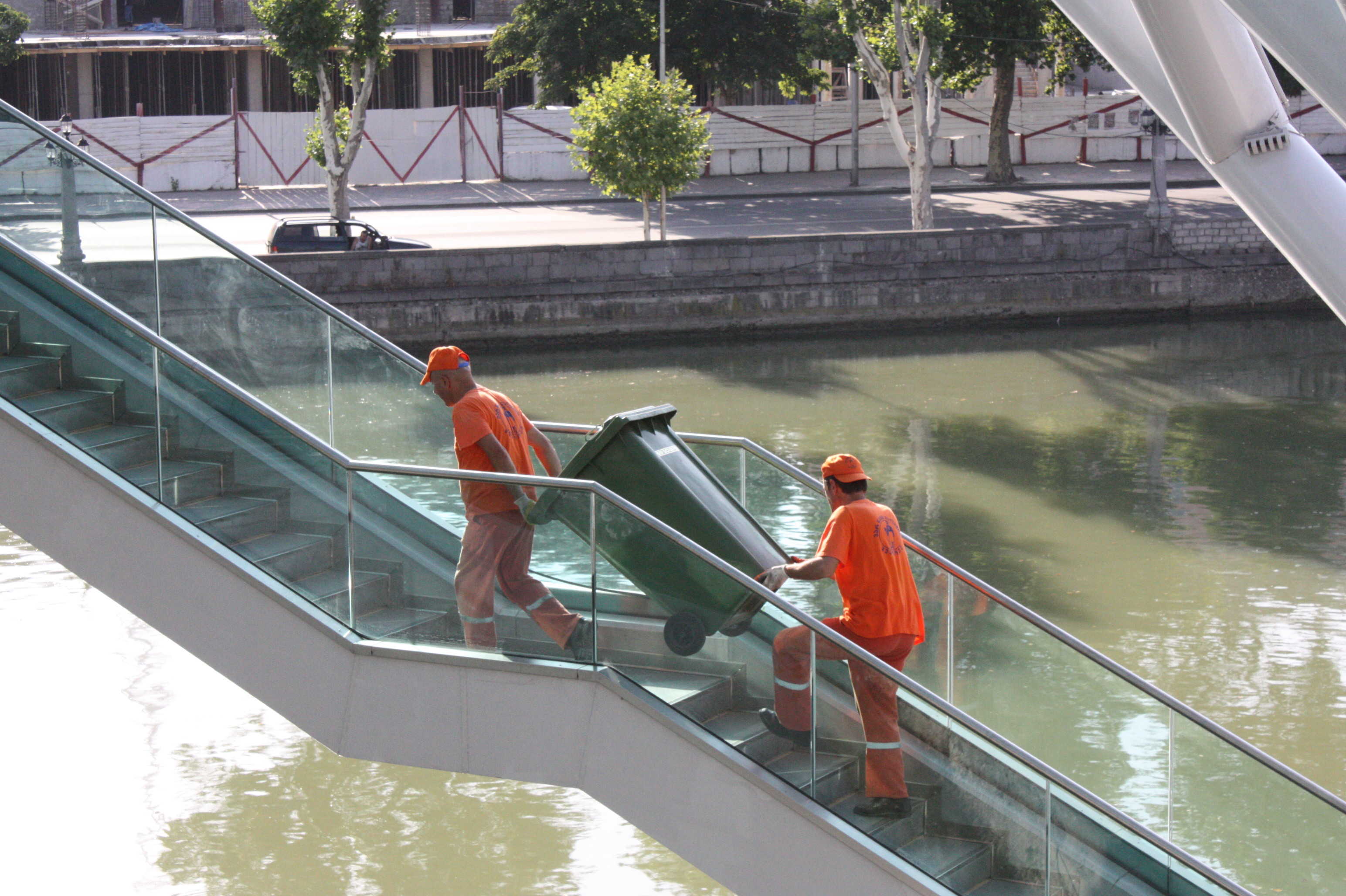
The clean-up crew at the Bridge of Peace.
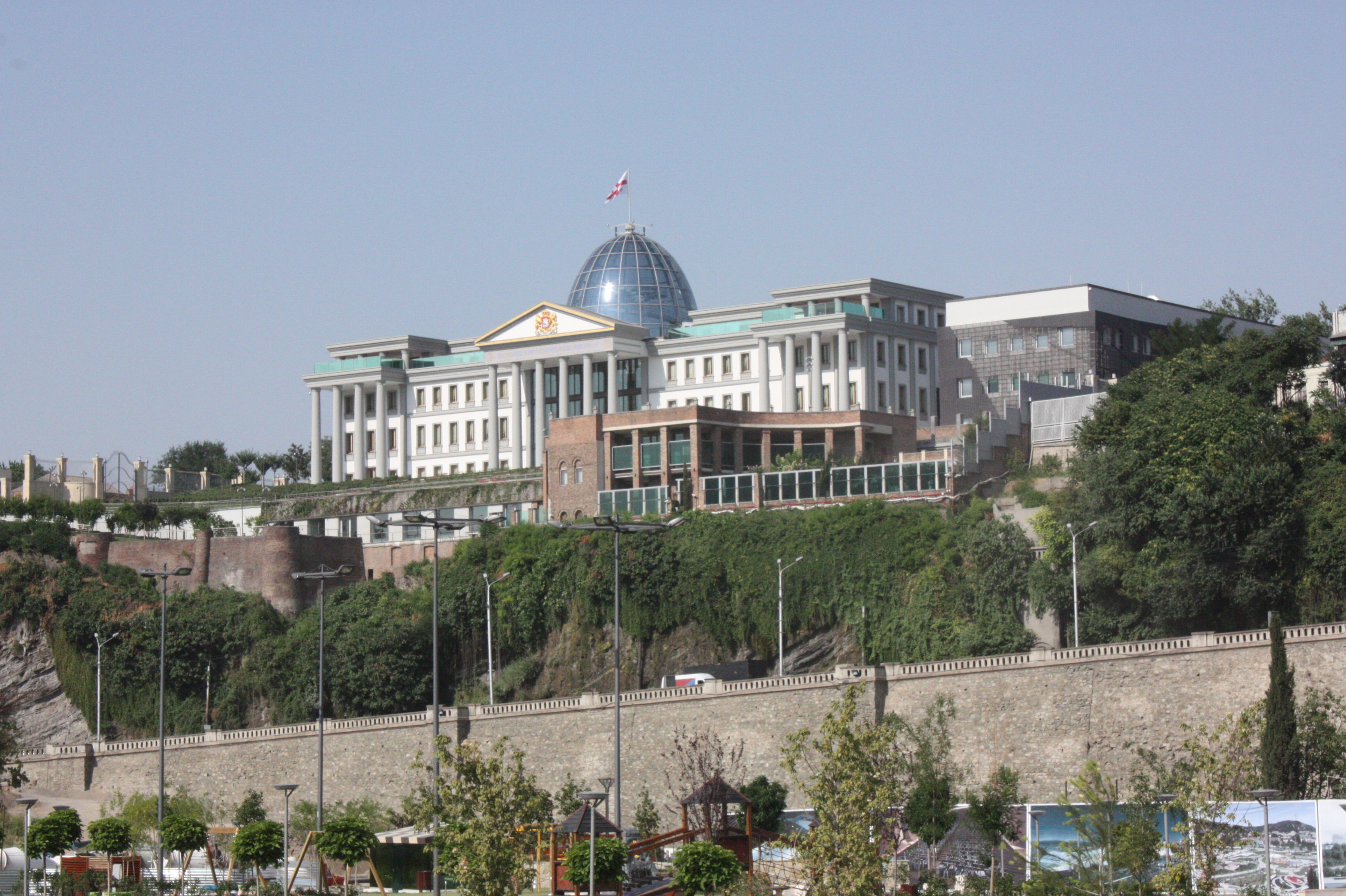
Georgia's Presidential Palace
I had a good laugh when I saw an online article about the newish presidential palace in Tbilisi, Georgia.
The place is ostentatious and ginormous—not as ginormous as the palace in Romania—but still huge. And in 2009, Georgian President Saakashvili said his new glass-domed digs had cost ‘a trifle’ to build—only GEL 13 million or US$7.8 million.
Oh, pleeze, I don’t think so. Then again, labour and materials must be cheap in Georgia.
The palace overlooks the Mtkvari (Kura) River and covers a massive expanse of land. I’ve tried to find out some of its dimensions, but the only promising sources of information are on YouTube and in a language I don’t even begin to recognise. It was designed by Italina architect, Michel de Lucchi, who also designed the city’s new pedestrian Bridge of Peace.
Poor John and I crossed that bridge to explore Tbilisi’s Avlabari District, where the palace is located. We managed to visit Georgia’s other ginormous structure, the Sameba Cathedral, and also tried to get near the palace. But no luck. We trailed through a labyrinth of small alleys and side streets, constantly running into high concrete walls and local people using hand signals to say ‘go this other way’.
It was a nice day of walking, but not overly productive from a touristic point of view. We did, however, find a much-sought-after padlock.
Our best view of the palace ended up being from the other side of the river. That position gave us an idea of how huge it is, but no idea of how opulent it might be.
President Saakashvili seems to think it’s pretty good, ‘This palace is not so rich, but it is the most perfect, modern palace, which has ever been built by anyone or anywhere in the modern world.’
He really should drop by the Madman’s Palace in Bucharest.
Hey, don’t forget to pick a number before 29 February 2012.
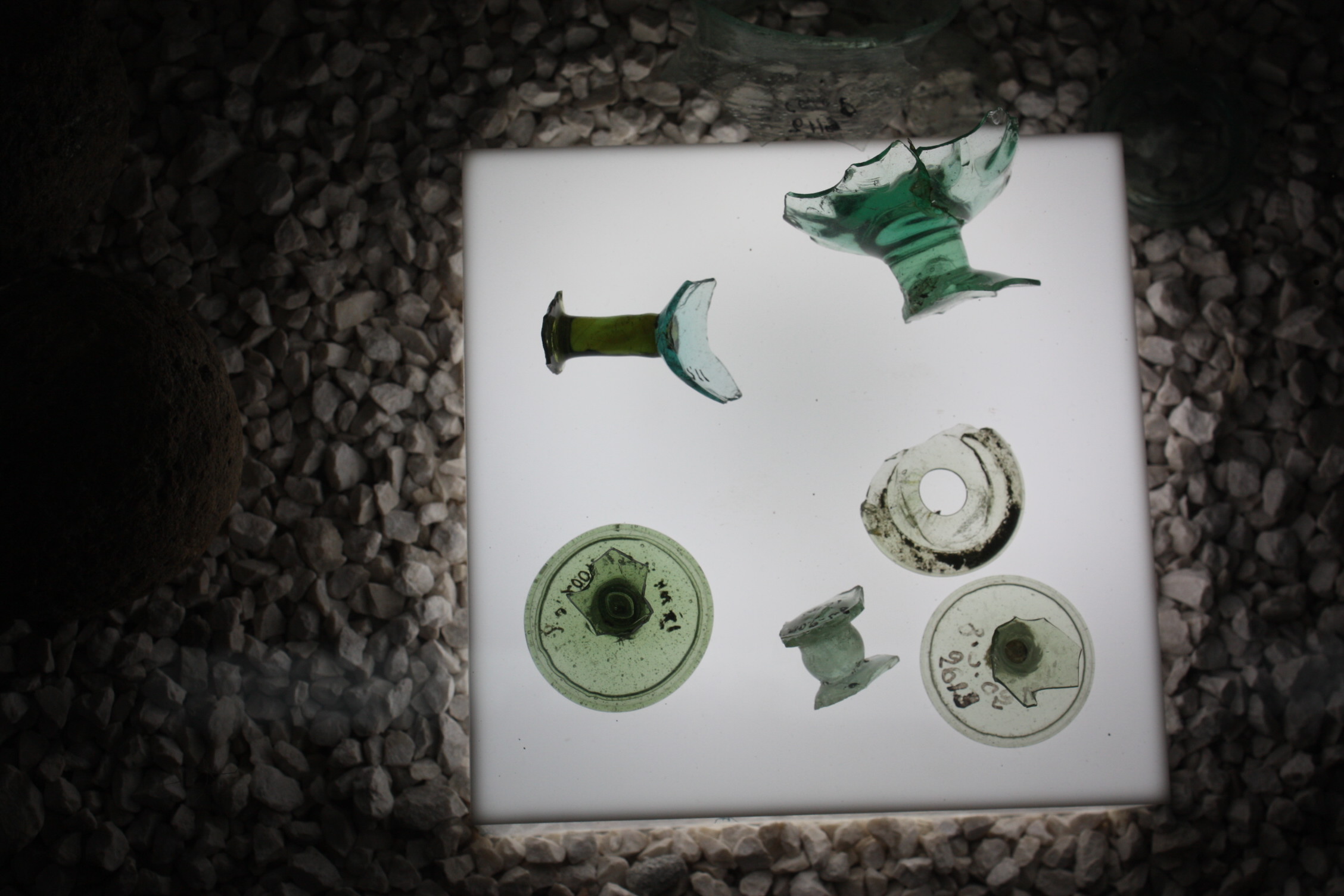
Glass items in the museum
Gonio Fortress was our first stop in Georgia. This Roman fortification, located on the shores of the Black Sea, is only 4 kilometres from the Turkish border. Admission is a bargain so we all piled out of the truck to have a quick look around.
Pliny the Elder first referred to Gonio in the 1st century AD. Within a century it was a well-fortified Roman city, and highly praised for its theatre and hippodrome. In those days it was called various names, including Apsarus, Apsirtus, Akampsis and Apsaruntos.
Over the centuries it passed through many hands—the Byzantines, the Genoese, the Ottomans and, finally, the Russians.
The grave of Saint Matthias, one of the 12 apostles, is believed to be inside the Gonio fortress. To date, this cannot be confimed because the Georgian government does not allow digging near the supposed gravesite. Other archaeological excavations are, however, taking place on the grounds of the fortress, focusing on Roman layers.
The small museum within the fortress is very classy. Exhibits are well displayed and the lighting was most impressive.
From what I read, the Gonio Fortress has become quite popular with Georgian tourists. I think that’s great because I was really glad we made this bonus stop.
Don’t forget to pick a number before 29 February 2012.
 Where to next?