

In case you've never seen an Edsel—here's a royal one.
Remember the Edsel? Of course, you don’t. You’re too young to remember the Edsel. But I remember the Edsel.
It was one of the Ford Motor Company’s biggest failures—probably its biggest. And the core of the problem was not the car, but the marketing.
The car first came off the production line in 1958 and was meant to complement the upmarket Mercury. The early models weren’t completely reliable, but that was soon overcome. A recession hit the US in 1957, which made it hard for the car to compete with other established names in its class. Some studies showed that consumers associated the name (after Henry Ford’s son) with the word weasel.
Only 118,000 Edsels were ever built and one of them survives in the garage at the Royal Palace in Luang Prabang, Laos. It was a cherished possession of Crown Prince Savang Vatthana.
I’m guessing that Ford gave it to the prince as a present, and the prince was delighted with this Yank Tank.
I got scolded for taking a picture of this Edsel, so I offered apologies and tried to show some remorse for not seeing the ‘no cameras’ sign. Honestly, I saw the ‘no videos’ sign, but I never saw anything about cameras.
As an aside, I’ve known two other Edsels—cars not people—one in my childhood and another in Rangoon, Burma. Burma is filled with cars that would make a collector swoon. cars can’t be shipped out of the country so they just sit there.

A sea of shoes in Hanoi.
My thong broke yesterday. Don’t get the wrong idea. I’m not talking about a pair of skimpy underpants that fell to the ground and that I then stepped gracefully out of and flicked into the distance with the heel of my stiletto. I’m talking about my flip-flops. My fake Reebok thongs. The ones I bought in Indonesia last year.
There we were—in the middle of the afternoon, in the middle of the road, in the middle of Saigon (called Ho Chi Minh City these days)—and no easy solution in sight. Hoi An was filled with cobblers, Hanoi was filled with shoe stores. Saigon didn’t seem to have much of either. So I hobbled along, with my first two toes trying desperately to keep the wretched thong on my foot.
Then I glanced at my wrist and immediately saw the answer. And what I did next has Petra saying I have ‘now become THAT derelict lady on the bus to Sydney’.
THAT derelict lady
I can’t say we met the derelict lady so much as encountered her in 1987. Now you know that if a family is still talking about an episode 24 years down the track, it must have been memorable. That morning, the derelict lady was lugging her over-sized suitcase onto the bus from Canberra to Sydney. Poor John, the girls and I were already on the bus, heading to the airport and a flight that would take us to the USA for Christmas.
As soon as the derelict lady—I’ve often wondered why we still refer to her as a lady—had hauled herself and her bag to a seat directly in front of us, she began to hurl random, foul-mouthed abuse at passengers and the world in general. The driver wasn’t on the bus yet, but as soon as he arrived, he ordered her to get her bag off so it could be stored underneath. She let rip with so many expletives. I knew that, someday in future, my kids would say that’s the day they learned to swear.
In the end, the driver threatened to toss her off the bus if she didn’t pipe down (he was more emphatic than that) and move her bag. She complied with both orders and was reasonably quiet for the actual road trip. But you have to picture her—hugely overweight, breath smelling of alcohol, clothes in tatters (lots of safety pins in use).
About halfway to Sydney, Petra, who was about four at the time, whispered ‘will that lady be in the seat in front of us on the airplane?’ I tried to keep a straight face and said I was pretty sure she wouldn’t be on the plane at all.

Flip-fops galore—and in all colours.
Me and THAT derelict lady
So what made Petra compare me to THAT derelict lady? It wasn’t the over-size luggage, the excess weight, the boozy breath, the ratty clothes or even the safety pins. Oh no, it was the rubber bands. She had her shoes held on with rubber bands, which is exactly what I did when my thong broke. I had a huge rubber band on my wrist (who knows when they’re going to need a giant rubber band?) and I stretched it around my foot and shoe. It worked perfectly until we could find a shoe shop selling thongs with a soft-ish sole.
So now I have a brand new pair of fake Croc thongs, five blisters and a very dirty rubber band back on my wrist. I am THAT derelict lady—ready for the next emergency!

Potala Palace—viewed from the south, where the Main Gate is.
No trip to Tibet is complete without a visit to the Potala Palace in Lhasa. Originally built almost 1400 years ago, its most important residents have been the 5th to the 14th Dalai Lamas. And while the current Dalai Lama has never lived there, it is an important place in the world of Buddhism.
Poor John and I were especially keen to see the palace, not only for its religious and governmental significance, but because there are rumours that it may be permanently closed to the public. Daily admissions are already limited to 2000 people, and the quest for tickets kept us busy for two days.
There are two ways to come by tickets. Groups can use an agent who will buy advance tickets that cost 300 yuan ($50) each. The ticket is for a specific time slot and gives the group a guide and an hour in the palace. Or you can buy one yourself. This ticket costs 100 yuan (about $17) and allows you to enter at a specific time and stay as long as you like until the palace closes.
This is a no brainer! Right? So what’s the catch? One catch is that you have to buy the ticket a day in advance. The other, and much bigger, catch is that you have to find the ticket office. This is like a gigantic scavenger hunt with vague and conflicting clues written in Chinese.
At least Poor John and I had a time advantage. Most of our group did the three-day trip to Everest Base Camp, so they had to go the agent route. But the altitude knocked us around enough that we decided to stay in Lhasa. Oh goody, three days to get a ticket.
Our first foray took us most of a whole day to NOT find the right ticket office.

Following the pilgrims around the outside of the palace.
We started at the Main Gate. They said go to the West Gate. Our first snag—there was no obvious West Gate, at least not one we could find. Without giving you a blow-by-blow rundown, we joined the pilgrims and walked back and forth around most of the building—and this is one huge building. Even the people in the palace’s outdoor cafe couldn’t help. We didn’t think it right to ask the pilgrims. They weren’t gong inside anyway, so probably didn’t know where to find the ticket office either.
We finally staggered out of the palace grounds and went in search of lunch. THat was a much easier challenge and we found two bowls of noodles for $1.33—gosh we love a bargain. As we were leaving the restaurant, a young man at another table struck up a conversation in English.
Poor John pounced immediately. Did this fellow know where to get tickets for the palace? Of course, and he advised us to go to the East Gate. Although he was in street clothes, he told us he was a policeman, so we felt a bit confident about his instructions. Another trip through the palace gardens and we were at the East Gate. We’d seen it before, but never went in because it wasn’t the West Gate.
Once inside, we saw signs for ticketing. This was encouraging, except that no one spoke English. Suddenly our policeman appeared at our side. He took over the conversation. It was like a tennis match. Yes, they sold tickets, no they didn’t, they sold to groups only, they could sell us one now if we could go in immediately.
Yes, yes, we’ll go in immediately, we said. That’s when the punchline came. Oops, sorry, we’re all sold out for today. I thought the cop might strangle the fellow behind the counter. It’s perversely satisfying when locals are driven crazy by their own system.
Our advice was to go to the West Gate. We set off again and after asking in every single office, souvenir shop, travel agency, we finally found the West Gate, which looks exactly like a driveway for delivery vehicles.
We went up the drive and, amazingly, there was a ticket window around the corner. It wasn’t really open, but we asked a chap if he had any advice. When he realised he couldn’t tell us anything in English, he helpfully pointed repeatedly at a sign in Tibetan and Chinese for us to read. Gosh, what a choice. Another fellow used a series of rather elaborate hand signals to tell us to come back the next morning at 7.

Prayer wheels line almost two whole walls of the palace complex. Pilgrims spin the wheels as they go past.
And so we did. We were the 67th purchaser in the queue, and got a time slot of 10:40 for the following morning. A little victory!
In the next few days, I write an item about the palace itself.

Just one of many bruises.
If you saw the post Do I look like I’ve been hit by the proverbial bus?, then you’ll know I promised to post a pic if I ended up with a black eye—so here it is.
The emu-egg lump that started over my left eye has subsided a bit and the bruise is moving down my face. Thanks gravity! I’m not sure how well the colour will show online, but most of that side of my face is now a sort of lurid purple, green, blue and yellow.
But don’t expect pics of my other bruises, including a leg, a knee, an arm, my back and a magnificent one under my left boob. I’m pretty sure the ribs are just bruised and not broken.
It’s interesting to watch people’s reactions when they see my face.
For the first few days, they’d look at me and then glare at Poor John. I think if I’d done a hitchhiker’s thumb in his direction, they’d have mobbed him.
Now that the bruise covers two-thirds of the left side of my face, people aren’t quite so quick to judge. It looks so much more than a punch in the eye. Quite a few Vietnamese women have asked, and only a couple of foreigners. A European woman approached me today and asked, in French, if I had fallen. We had a nice chat and I abused my very rusty French.
I hope the people I’ve told will remember this cautionary tale every time they try to cross the road.
But there was a sad, wordless encounter today.
Poor John and I were walking near the Saigon River when it started to rain. We took shelter under the roof of a riverside cafe. A Vietnamese couple were already there and she did a double-take when she saw my face. As she turned the second time, I noticed her black eye. Her nod, shrug and weak sisterly smile said it all.
She thought she knew where my black eye had come from. And I did know the source of hers.

Any chance of crossing the road? No, not really.
The greatest challenge in Vietnam is crossing the road. This country is simply not set up for pedestrians. There are zebra crossing painted on the roads, but no driver honours them. The roads are a sea of vehicles, and there is definitely a pecking order. Buses are at the top. When you hear a bus blasting its horn, everyone dives out of the way.
Cars are next, then motorbikes and scooters, then bicycles, the hand-driven carts.
Pedestrians are last. We’re dirt.
And the honking is incredible. I wish I had a movie camera and microphone so you could experience it with me. Earlier today I saw a fire engine but, for all the horn honking, I didn’t hear it’s siren until it was about 10 feet from me.
Ho Chi Minh City (Saigon) supposedly has 4 million motorbikes, but I think the traffic in Hanoi is slightly worse because the vehicles in Hanoi just never stop. Here’s a typical sampling of my being-honked-at experiences in the last few days. They all wanted ME to get out of the way.

The convenience of drive-through shopping. After we worked our way through another part of the market, we saw about 10 motorbikes on the other side—waiting their turn to enter. It never occurred to anyone to park and go in.
• A motorbike that was behind me on the footpath.
• A motorbike that was going the wrong way on a one-way street.
• A car that was behind me on the footpath. It drove into an exit-only driveway and took a shortcut down the footpath to drive into the entrance-only driveway.
• A car that was turning left over the zebra crossing when I was walking on the green light.
• A motorbike that drove around four vehicles that were stopped at a red light when I had the green light.
• Two motorbikes that were doing drive-through shopping at a nearby market.
And the list goes on and on.
Vehicles rule and the sooner all the pedestrians are bumped off, the better.
As Poor John said, it would be so easy to fix. Just slap a 20,000 dong ($10) fine on every offence. Great revenue raiser. And think of all the policemen they could employ!
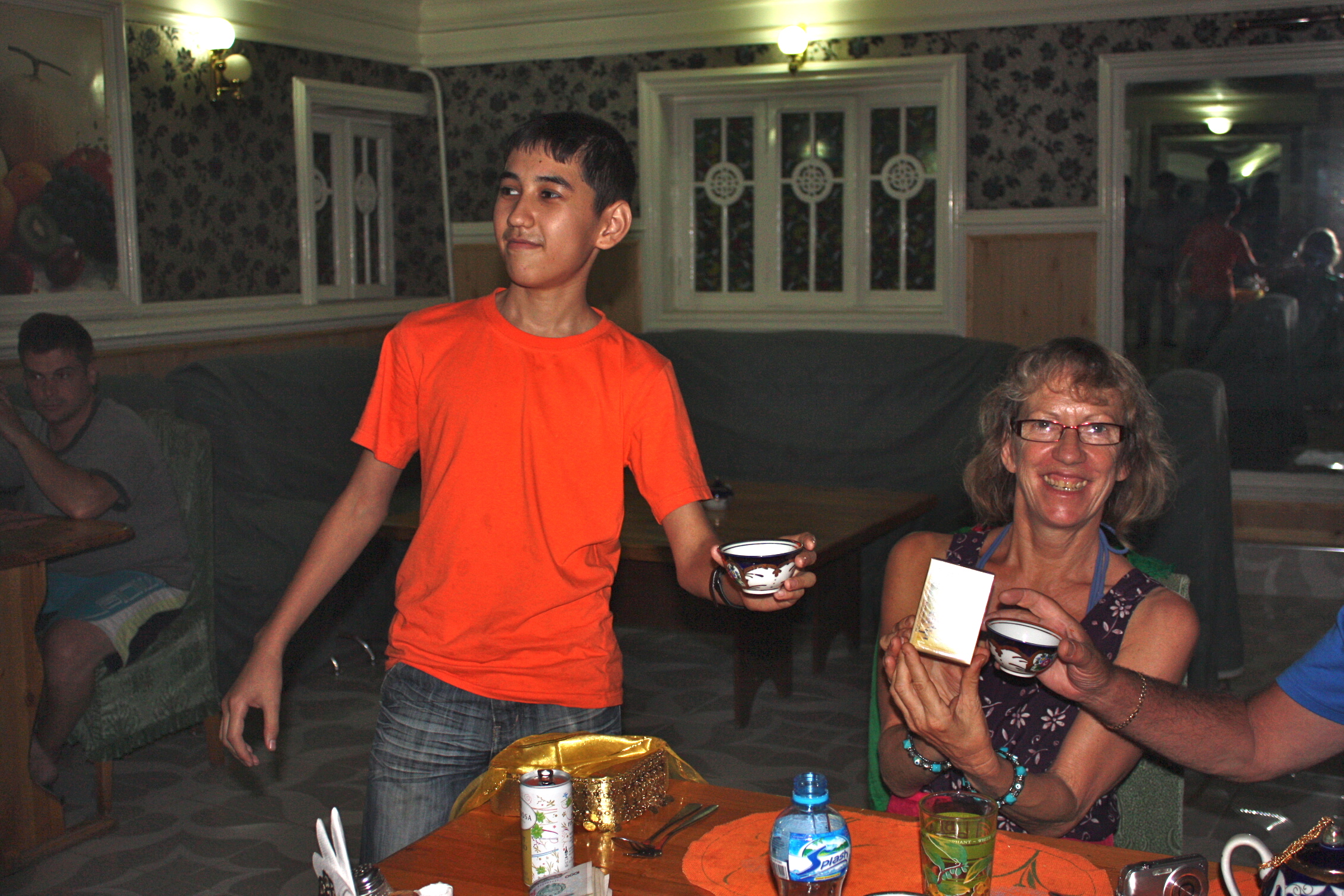
Evidence that Lily really did receive her cups from the hotel staff in Samarkand.
I wish I had a picture of Lu’s face and a recording of the gasp she let out when Lily announced that she had acquired two cups from the hotel in Samarkand in Uzbekistan.
The gasp was followed by a deathly silence before Lily chirped with a big smile, ‘Don’t worry, I didn’t steal them. They gave them to me last night as a present for my birthday.’ That’s when Lu finally exhaled.
It also prompted her to remind us not to steal anything from hotels, especially in China.
According to Lu, hotel staff across China do a complete inventory of every room before they let her check out and pay. Any losses are charged to the group account.
Lu recalled a woman, on an earlier trip, who was ‘collecting’ hotel towels for a friend. She managed to make off with one early on, and then kept swapping it for a slightly better towel as the group moved across China. Just before leaving the last place, the staff noticed the towel left behind was a ringer, an imposter, a foreigner. So on the bill it went. Took Lu a while to track down what had happened.
We’ve all been very well behaved on this trip. No thefts, at least not any that have been detected. One cup went missing in Kashgar, but that was from Will’s room. Will is our driver and owns the company. Lu didn’t make an issue of it and just paid for it. She figured he set it down somewhere outside the room, and forgot to retrieve it.
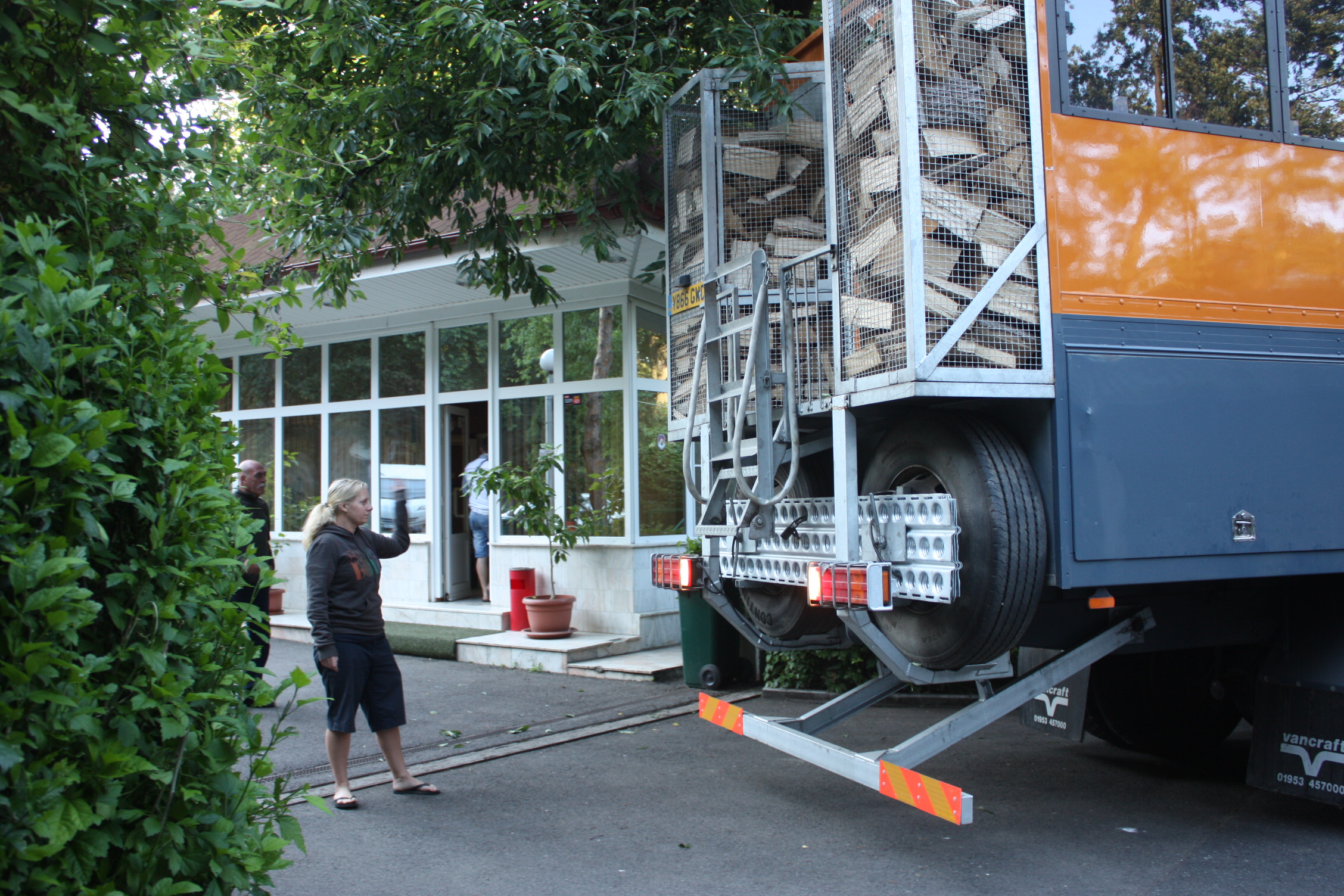
When the truck is in a tight turning or reversing spot, Lu provides a second set of eyes for Will, our driver.
Somebody has to herd all these UK to OZ puppies into the box, and that challenging task falls to our tour leader, Lu. Psst. Her real name is Lucinda.
Originally from New Zealand, Lu has been on the road for many years. Her first London to Sydney overland journey was in 2006 as a passenger. That experience was enough to hook her and she is now on her third stint as a tour leader for UK to OZ.
The title of ‘tour leader’ barely begins to describe all the things Lu is responsible for besides keeping us organised. She’s planned lots of our itinerary and organises the places we stay when we’re not camping. She sees our passports through many borders. When we are camping, she takes care of all the food shopping and figures out what we’ll cook on any given day—which depends on what she can buy, and that can be quite limited in a remote village. And that’s only an introduction to all that she does.
Her feet hardly touch the ground and she manages to stay busy most hours of the day. She keeps ‘threatening’ us with a complete truck clean but, with the exception of once in Kazakhstan, she always beats us to it and does it herself.
Lu’s personal challenge for this trip has been to never pay to have her laundry done. No, she’s not sneaking it into other people’s laundry bags. She’s doing it herself. It’s very commendable, especially because getting clothes washed can be so cheap. We had two complete changes of clothes done for a mere $1.25.
This is Lu’s last overland journey. She says she’s ready for a change of job, and she doesn’t think she’d make a good overland passenger after being a tour leader. She leaves us and the trip in Bali. That’s when we head off to Australia and Steve, who will be our driver and tour leader.
Keep us posted Lu, and thanks heaps for keeping us so well organised. Most appreciated.
Oh, and I can’t sign off without mentioning the time a local guide in Central Asia said ‘please, take me to your cheerleader’. Lu may never live that down—we’ve needled her about it ever since—and she ought to be grateful I didn’t headline this item Our cheerleader—Lu.
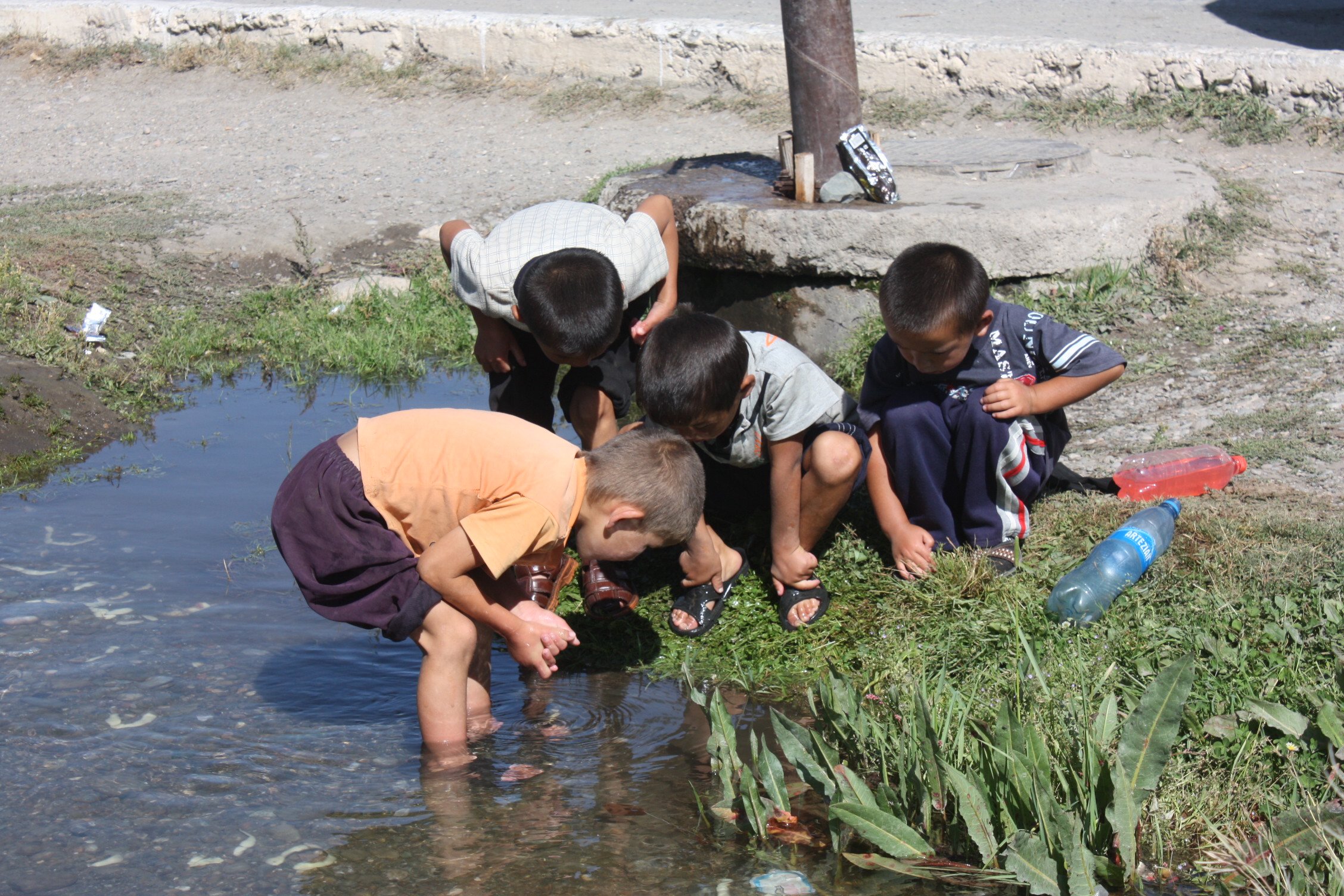
Water, tadpoles and curious boys—an unbeatable combination.
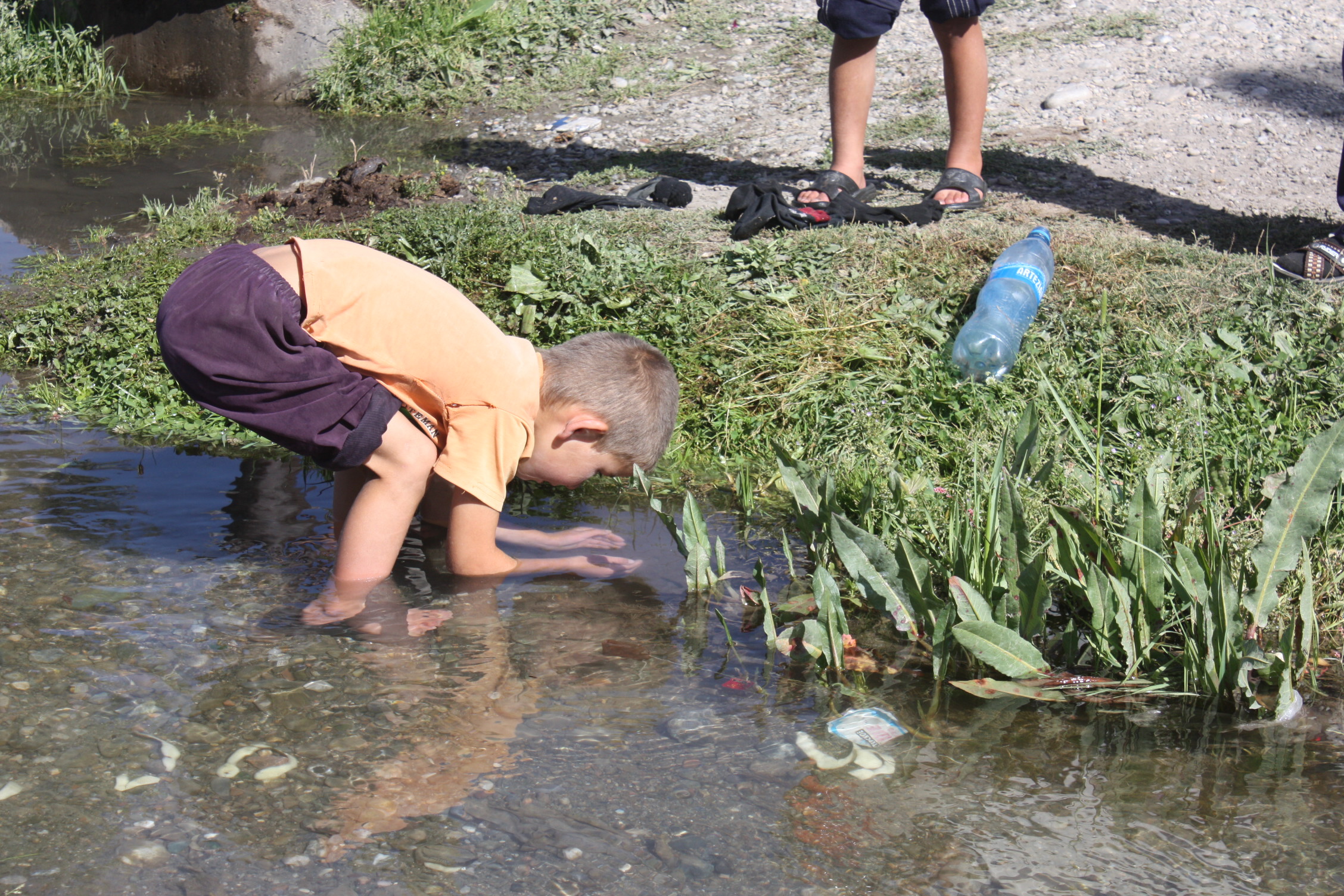
Hold still!
Catching a glimpse of every day life is one of the things I enjoy most about travelling. Kids, animals, markets, households, construction sites—they all draw my attention.
We stopped in a small town in eastern Kyrgyzstan and this group of young boys caught my eye.
It was the first day of school and they weren’t suited up for the event, so they were either too young to be enrolled or came from families who couldn’t support their education. I’d like to think they were still too young.
These boys were completely mesmerised by tadpoles in a small creek that ran alongside the main road in the village. They were so engrossed they didn’t even notice me or my camera. I was so mesmerised, I took way too many photos of them.
One of them finally mustered the courage to try to catch some of the wrigglers. We had to move on before he had any success, but the whole scene was enchanting.
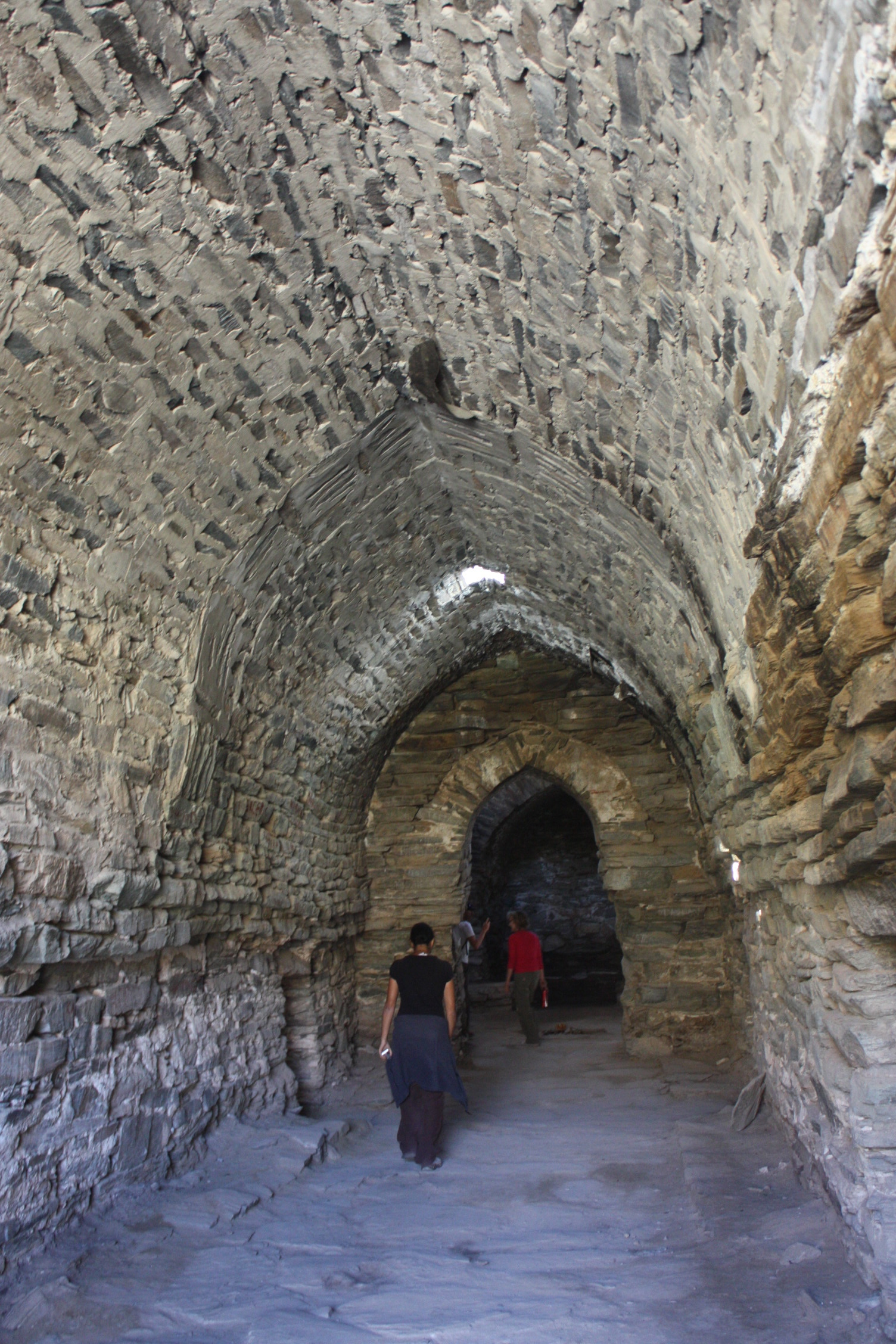
Tash Rabat’s caravanserai.
The last place we visited in Kyrgyzstan was a 15th century caravanserai at Tash Rabat. It’s tucked into a lovely and sheltered valley not far from At-Bashy, and looks more like a fort than accommodation for ancient silk road travellers.
We arrived on a gloriously sunny day, and piled out of the truck to roam through the rock structure which is very spread out, with plenty of indoor protection for livestock and their drovers.
The guidebooks say the Russians completely restored the building in 1984, but most of their work is rather crude, with concrete just slapped on the walls in many places. But the sheer size of the place is overwhelming, and I was especially glad Will, our driver, took us a bit out of our way to see it.
Because Tash Rabat is so far off the beaten track (about 60 kilometres from the main road), I wonder how make visitors make it there. Enough, of course, for the women living nearby to make/acquire souvenirs to sell to visitors. When we arrived, we saw a few people, a small encampment of yurts, a few vehicles, two dunnies (Aussie slang for outhouses) and a two-humped camel. When we emerged from the caravanserai, we found that two women had set up their ‘souvenir shop’ not far from the entrance.
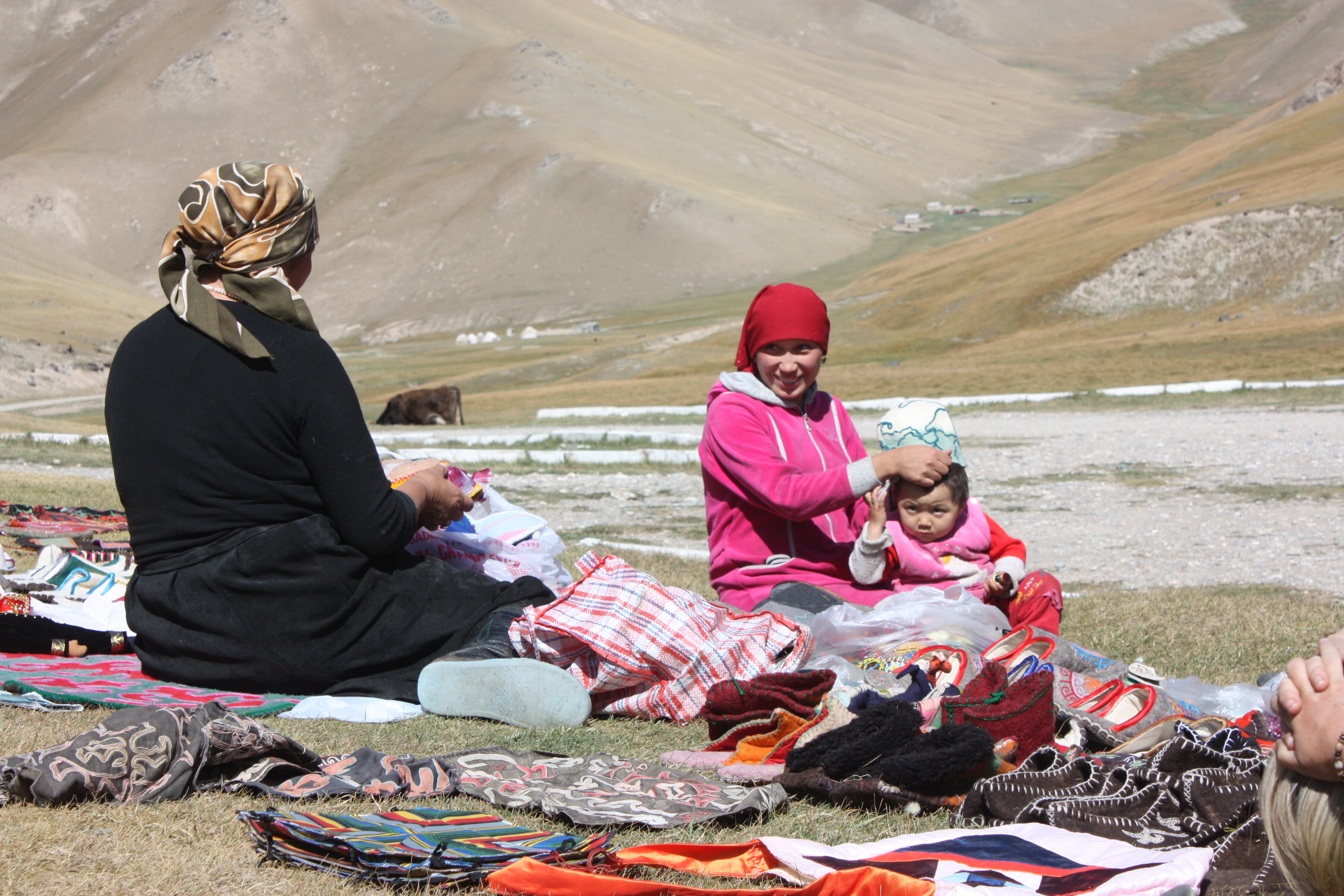
Babies—a good marketing tool.
On several blankets, they displayed a colourful range of handmade goodies and we, being good tourists, were dutiful shoppers. These women drove hard bargains—meaning they didn’t bargain at all. A price was a price. No discounts, no special treatment for multiple purchases, no caving in to a sob story that someone was down to their last 398 som (Kyrgyzstan currency) when the price was 400. Go ahead, borrow the last two som from one of your companions. They didn’t say that because they didn’t speak English, but sign language works quite well in these circumstances. They displayed the baby too, which is always a good marketing ploy. Tourists love to take pictures of a cute baby.
I suckered up and took pics of the baby and bought three lightweight items with the last of my Kyrgyz cash. I hope the recipients appreciate these little presents—Libby, Petra and Maggie, I’m talking to you.
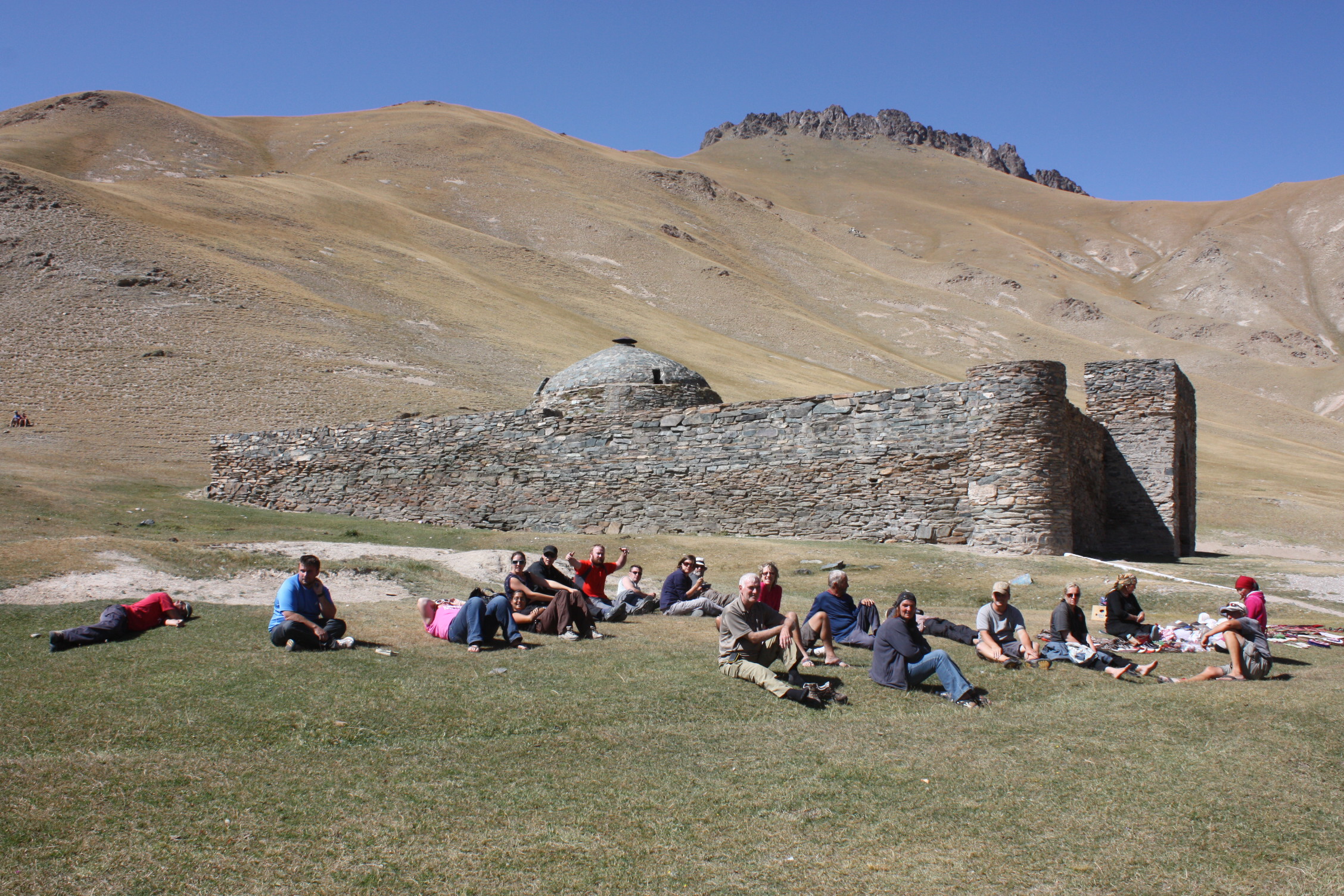
Soaking up the sun at Tash Rabat.
We set up camp for the night about halfway back to the turn-off from the main road. It was in a gully, and Poor John and I ‘discussed’ which way to put up the tent, given how windy it was. He argued that the wind would change direction in the middle of the night. Me—I just argued. We did it his way and the wind did change direction in the middle of the night. In the morning, he smiled sheepishly and said, ‘I know gullies’. Egads, I hate it when he’s right. Actually, I’m glad he was right, but you know what I mean.
P.S. For a picture of the camel, see Our own Burger King—Terry.

Open-air cooking in a small town in China. These two were having a great time cooking. While we were there, they took delivery of the carcass hanging in the background
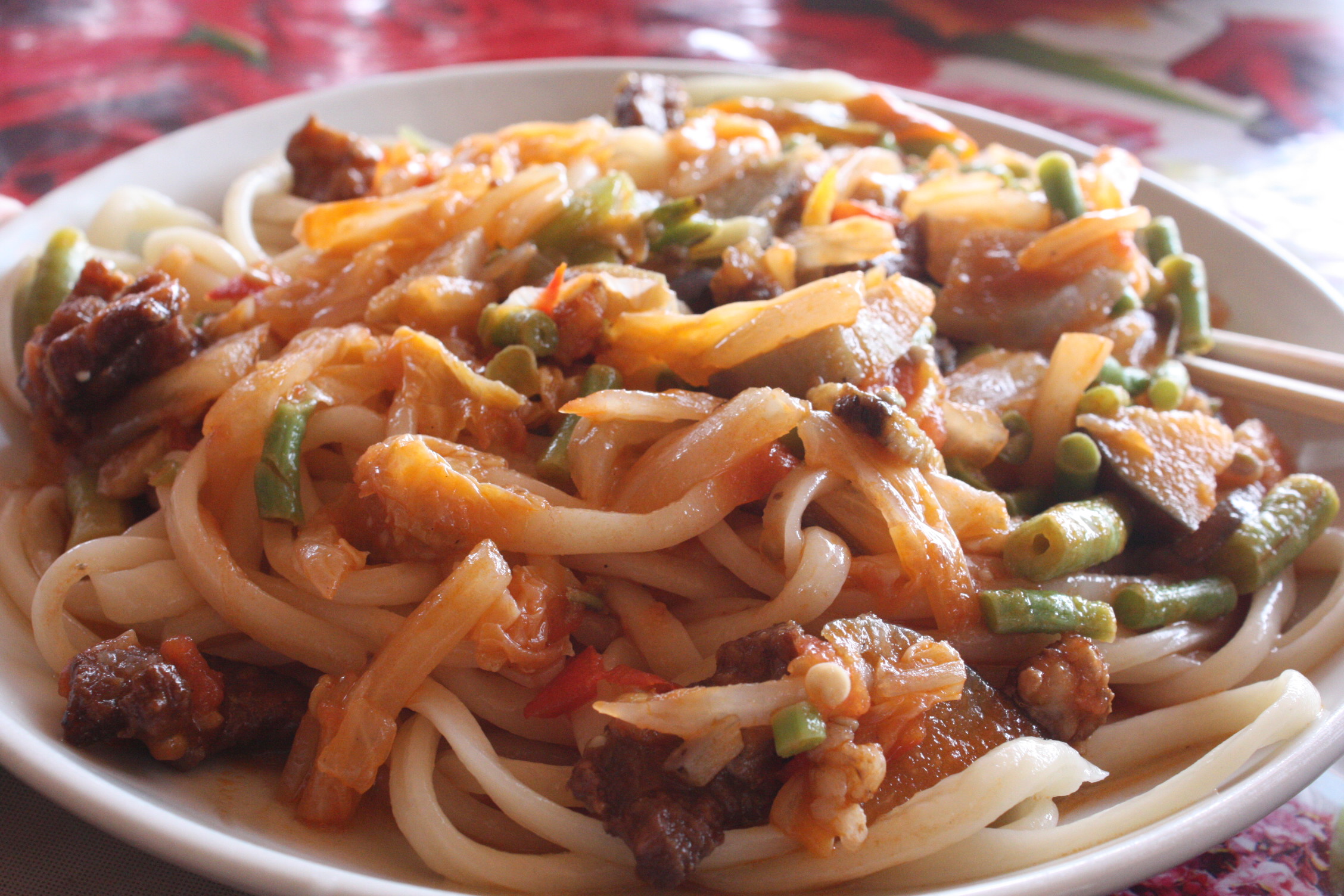
Lagman—a really common dish in western China.
The other day I wrote about the great meal we had at a hole-in-the-wall restaurant in Kashgar in western China.
After Kashgar, we spent the next eight days on the road, driving to Lhasa in Tibet. We camped at night and had our dinners and breakfasts made in the truck ‘kitchen’.
Lunches were more ad hoc. This part of China sometimes seems deserted. It’s a long way between inhabited places, and it makes you wonder where everyone lives.
Only once during that entire time, did we have lunch in a real town (Golmud with a population of just over 200,000). Other days, we’d roll into a small town that seemed to exist principally for travellers. I thought of them as China’s answer to a truck stop. Most had a hotel of sorts and a few small general stores selling snacks, drinks, basic staples and other necessities. Of course, there were plenty of mechanics and other vehicle-related shops. It was also quite common to see the local ‘medical service’ set up on the side of the road.
All the restaurants (and there were usually several) had the same menu with lagman (a beef noodle dish) being the most common item. In one town, our meal of lagman was made by two women (probably sisters) who had just taken delivery of a fat-tail sheep carcass, which they hung a few feet from our table. Even that didn’t put us off our lagman. It was delish.
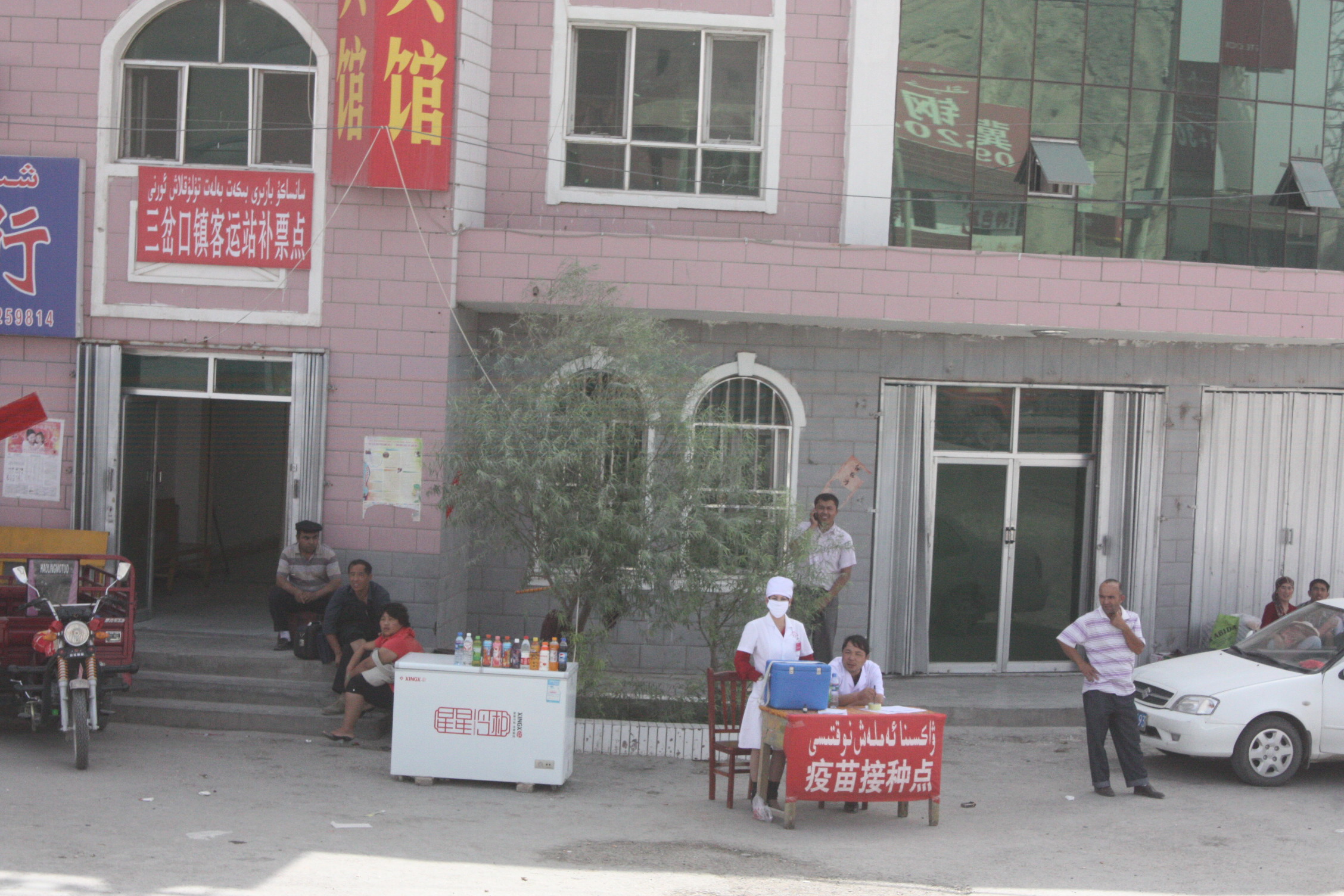
Road-side medical services. We saw dentists too.
 Where to next?