

It all starts with sifting the sesame seeds.
We had a few days in Hoi An, on Vietnam’s central coast. It’s a lovely quaint town, known for great shopping. In 24 hours or less, they’ll make all the clothes and shoes you can possibly ever need. But if traipsing from shop to shop isn’t tempting, it can be a challenge to find enough things to do to fill several days.
Poor John and I are great wanderers and spent two days enjoying the picturesque streets and buildings. Because we try to avoid going up and down the same street too many times, we headed across a small bridge to the An Hoi islet. It has plenty of inviting little streets, and it was down one of these that we encountered the sesame rice cracker factory.
I was gobsmacked and in heaven. Nothing quite like a new food adventure to get me snapping pictures and asking questions. It all started when I saw the crackers spread out for their first drying. Then I saw two women sifting sesame seeds. Then I stopped in my tracks and tried to take it all in. Finally, we went through the main gate and managed to give ourselves a mini tour of the ‘factory’. Everyone, every step of the way, was completely welcoming.
Although no one spoke English, it was easy enough to get the gist of what was happening. The seeds are sifted. A thin batter is made and the seeds are stirred in. Batter is then ladled on to a griddle and cooked quickly on both sides—sort of like a crepe. The fires for this stage of cooking are heated by sawdust that is constantly being shovelled in by the cook.
Once cooked, the wafers are then spread out on what looks like old screen doors. I have no idea how long these discs are allowed to dry, but we arrived around 4pm and a woman was bringing some in. It was a brilliantly sunny day and perhaps she had been doing that once an hour since morning. The semi-dried discs are then brought to another area where they are browned on both sides over a charcoal fire. There were fans blowing on the fires and the cooks, either to keep the fires hot or the cooks cool.
The finished crackers are then bagged—with bags holding anywhere from 5 to perhaps 50 pieces. Sales were wholesale and I saw a few people buying numerous large bags. As an indication of our thanks, we bought a bag of 20 for the bargain price of 40,000 dong or $2.
We walked back to Hoi An, with Poor John carrying the goodies, and almost immediately it was obvious that I might as well have hung a sign around his neck that read ‘This man is a hero’.
There were smiles, waves and thumbs-up from every direction—all focused on Poor John. Locals who spoke English called out ‘Oh, you have been to An Hoi’. Others stopped to chat and explain how the crackers are used—among other things, it is an important ingredient in Hoi An’s famous soupy noodle dish, Cao Lao. We went into a bookstore and a staff member there rushed to show us a Vietnamese cookbook with another recipe calling for these crackers. Of course, I bought the book.
In several kilometres, I don’t think there was a single local who saw us who didn’t acknowledge this purchase in some way. As we walked, I also noticed that not a single shop was selling sesame rice crackers. An Hoi must be the primary source, so it must be a real novelty when a tourist tracks down the factory and makes a purchase. Even the women at reception in our hotel were impressed.
We each ate a few crackers, which are slightly sweet, for breakfast the next two mornings, and gave the last of the package to the women at reception when we checked out. No sense ruining these delicious morsels by cramming them in a suitcase.
The one thing that surprised me when we carried the crackers back from the factory was that, in spite of the huge interest shown by locals, not one foreigner asked us what they were or where we got them. It’s true they looked a bit like poppadoms. But I haven’t seen poppadoms anywhere in South-East Asia, so I’d have been compelled to ask anyway.
The slideshow (starting with the women sifting sesame seeds) is in the order of the steps described above. Because I found the whole process so interesting, sometimes I have posted more than one photo of each step. It makes me hungry to watch. Hope I can track down a decent recipe when I get home. If I do, I’ll post it here.
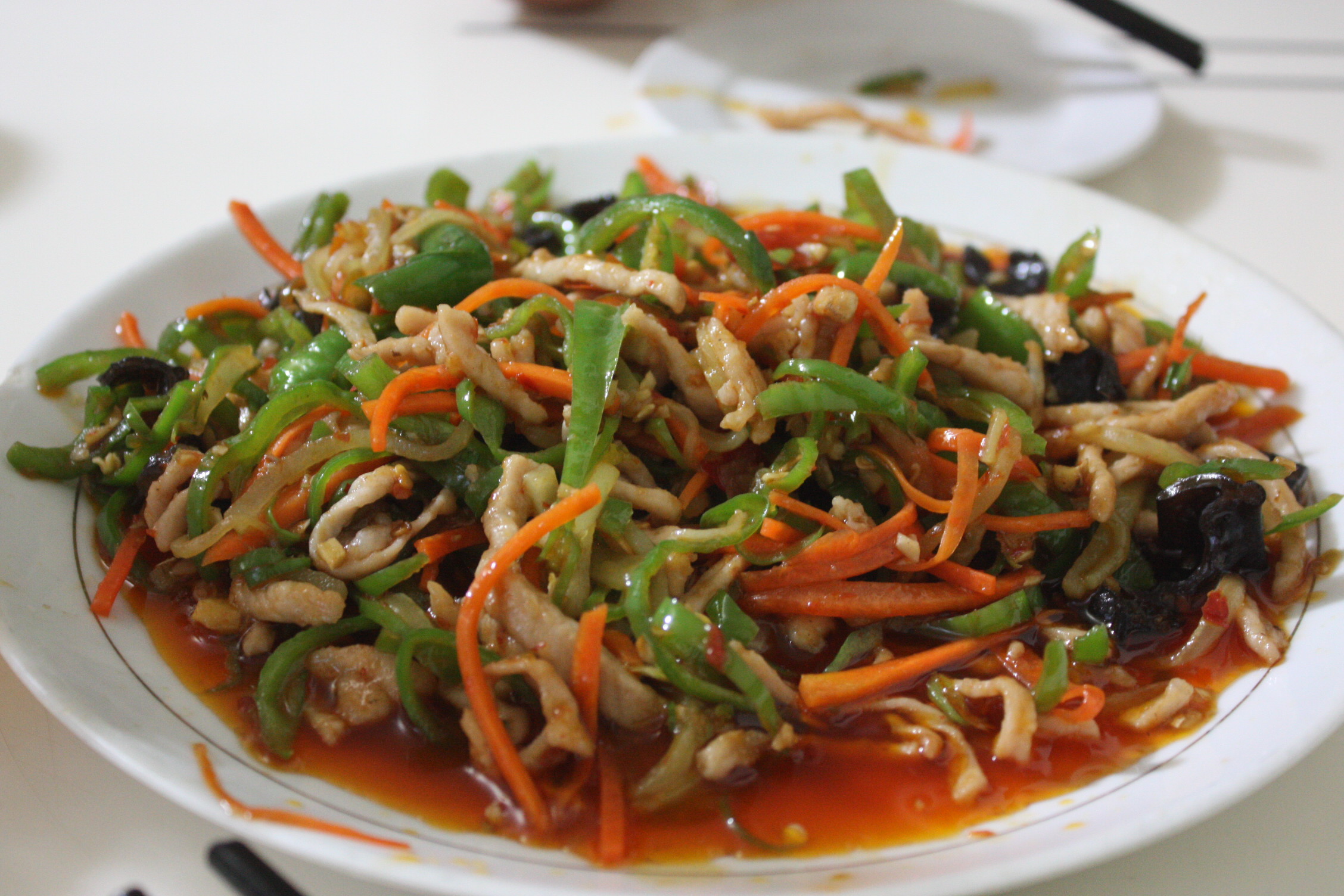
Fish-flavoured pork—no sign of fish and just the right amount of chilli.
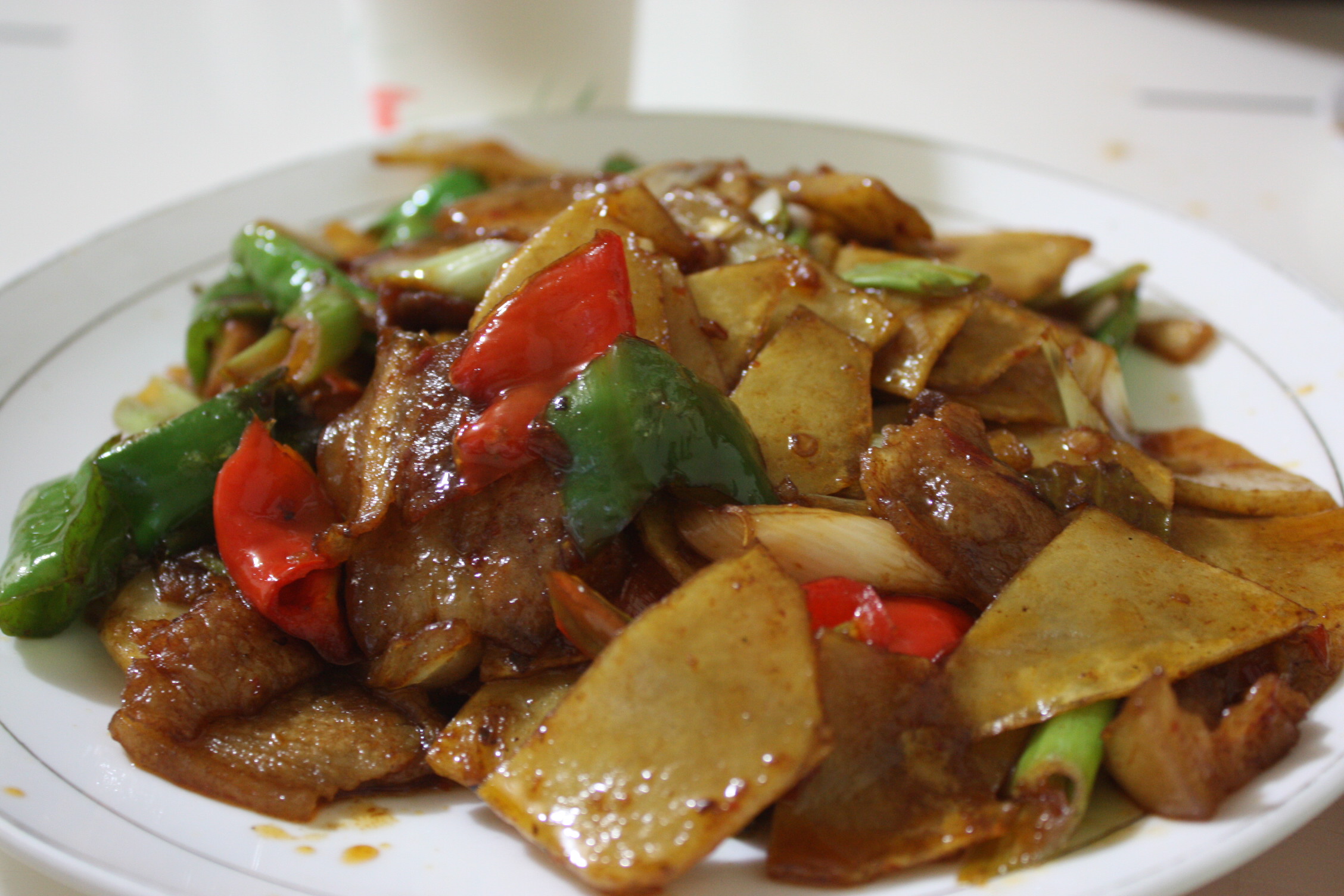
Twice-cooked pork with potatoes.
Every small town in Australia has at least one Chinese restaurant. They’re usually cheap and cheerful, with a predictable menu of sweet and sour whatever, lemon chicken, some meat with black bean sauce or cashews or ginger, fried rice and the like.
China is littered with countless cheap and cheerfuls. But unless you’re in a tourist town the menu looks nothing like a typical Aussie one. For starters, it’s all in Chinese. There might be a wall of pictures and sometimes one-line captions that note the ingredients.
Our second night in Kashgar, in far west China, we went hunting for a hole-in-the wall restaurant. We’d had a bowl of noodles the night before and were looking for something a little more substantial.
Side streets are always good places to find cheap and cheerfuls, and not long after turning off a main street we found what we were looking for. It was better than we expected in every way. One of their menus had stuck-on bits of paper that named every dish in English. We ordered fish-flavoured pork and twice-cooked pork with potatoes. Both dishes were sensational and we had the added benefit of watching the chef wield the wok. I couldn’t get a pic of the flames shooting up around the wok, but they were big enough to set the unwary’s hair on fire.
I can no longer remember exactly how much the bill was, but certainly no more than $5 for the two meals with rice, a beer and a soft drink.
Food has been an important part of our trip and I going to start posting more entries on memorable meals and other tales of food.
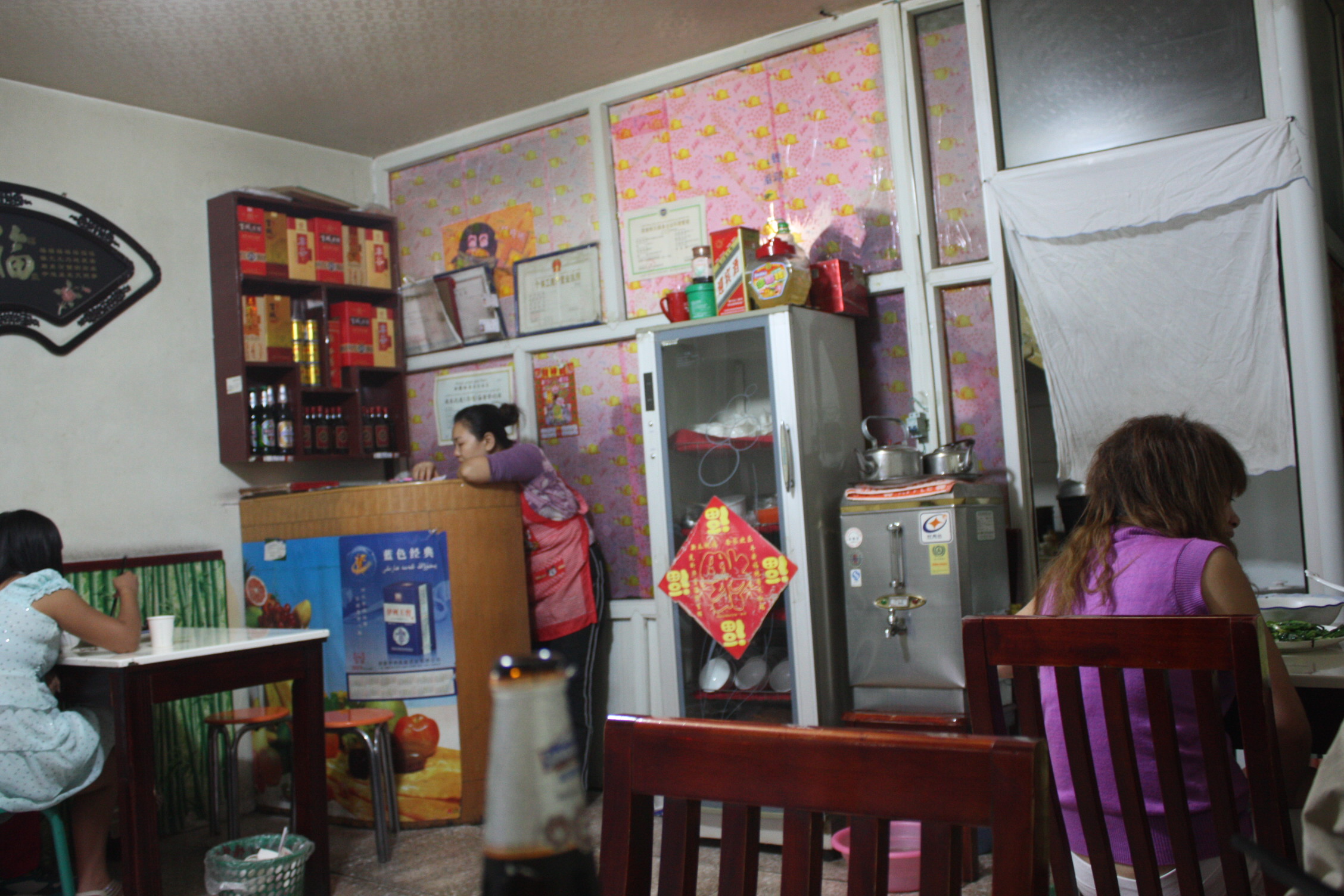
A busy hole-in-the-wall. The appliance that looks like a fridge is where they store the clean dishes. The shelf in the corner is where they keep the beer. Yep, the beer is served warm.

The old city of Kashgar.
In spite of our run-in with the thieving barber of Kashgar (see Always agree on a price FIRST in the China category), we really enjoyed our two days in this city of half a million people. Located in the far, far west of China, this oh-so-distant oasis was thought to be the end of the Chinese earth by early travellers. For us—arriving from eastern Kyrgyzstan and after many days of remote camping—it was our first taste of mod-cons in a several weeks. Oh wow, running water and flushing toilets!
Luckily, some parts of Kashgar still have a sense of history about them. The guidebooks recommend visiting the old city—which, in the past, charged admission to let you in. But you’d better be quick if you want to get a real feel for how the place looked as recently as a month ago. As we strolled through the ancient parts, we could see that demolition was underway everywhere and in earnest. It’s heartbreaking to see these old buildings go, but I suppose it’s hard to argue with people who want to move into the present century. In many of the places we visited on this overland journey, only a listing as a Unesco World Heritage Site has kept the people honouring and nurturing their past.
This slideshow has some views of the old city, but I can’t offer any detail on what’s what. I’m also going to add a post on the amazing market in Kashgar that sells absolutely everything. I don’t think there’s any chance it will be demolished any time soon.
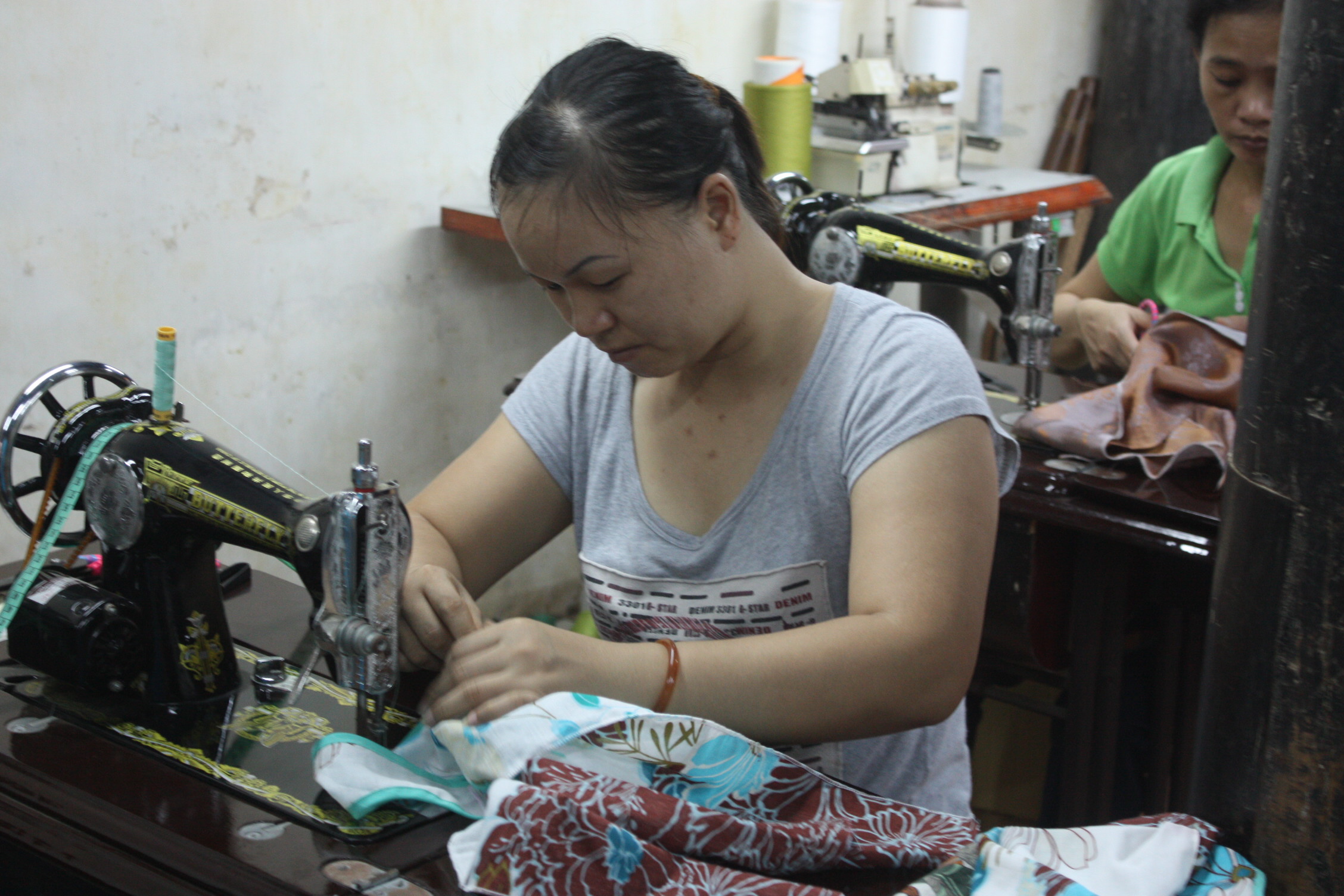
Busy creating at Reaching Out Handicrafts.
Even though there were buckets of rain, we thoroughly enjoyed our four-day stay in Hoi An, Vietnam.
The old city is a labyrinth of quaint streets and, of course, countless shops hoping to sell you something.
I was especially pleased to encounter two shops, with workshops, that sell art and handicrafts made by people with ‘different abilities’. The proceeds go to workshop members and help to give them a sustainable income and a true sense of independence.
There may be more such workshops in this lively community, but the two we saw were the Lifestart Foundation Workshop at 77 Phan Chu Trinh Street (http://www.lifestartfoundation.org.au/), and Reaching Out Handicrafts at 103 Nguyen Thai Hoc Street (www.reachingoutvietnam.com).
Check them out if you ever get to Hoi An. Their products are creative, colourful, well-made and reasonably priced.
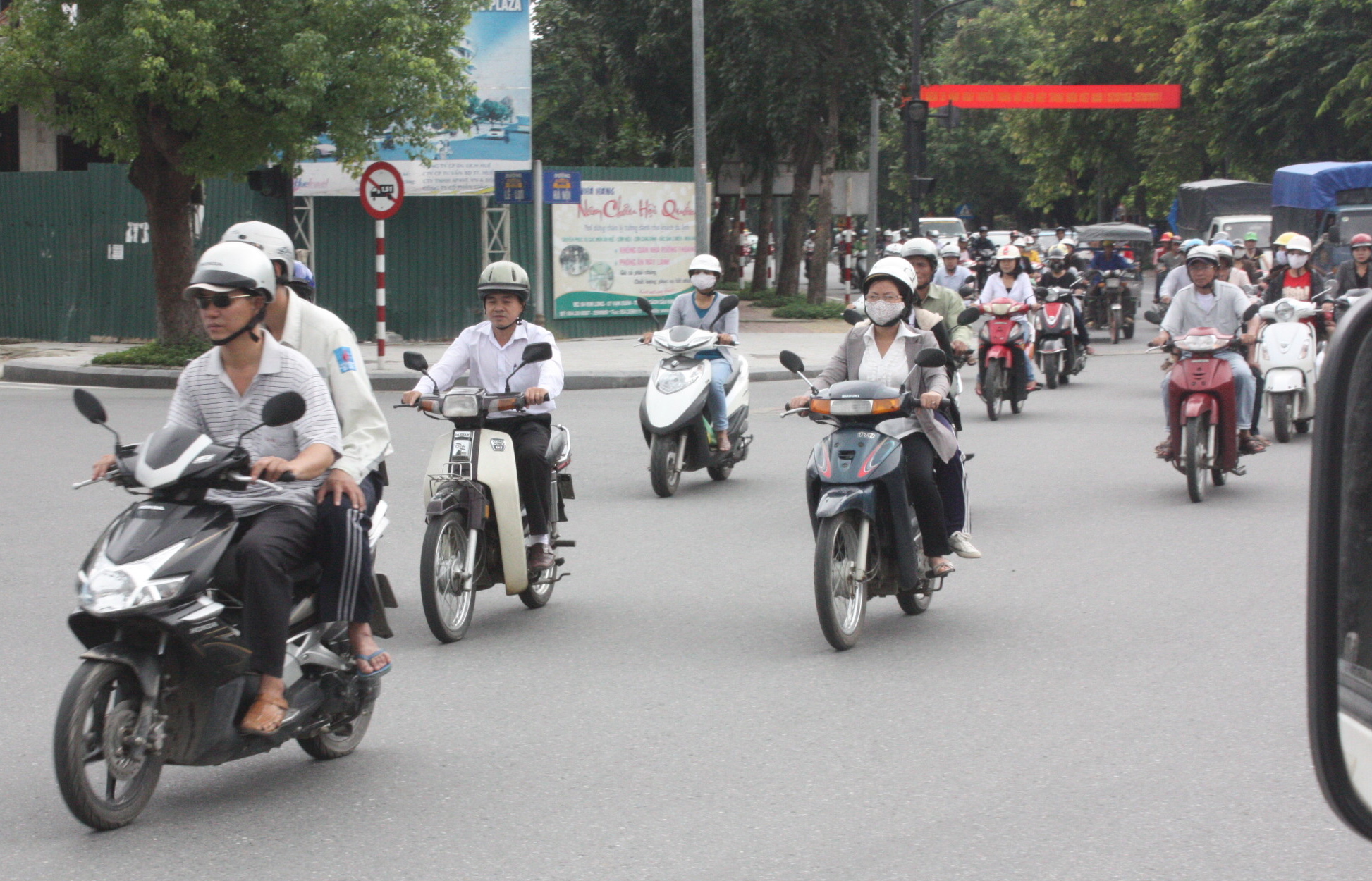
A barrage of motorbikes. This was taken in Hoi An, which has about one-tenth as many bikes as Hanoi.
No! But I do look like I’ve been knocked down by the not-proverbial motor scooter! Let me explain. Oh, and no pictures of my wounds just yet. Maybe if I end up with a shiner.
Late this morning, we arrived in bustling Hanoi, VIetnam. Poor John had arranged an airport pick-up for us—$22 for a 45-minute drive to the hotel. The driver wasn’t too bad, but would probably have had to pull over if his horn had broken. Nevertheless, we were irked for two reasons. Poor John was annoyed because the driver gave a freebie lift to one of his friends. I was annoyed because it soon became apparent that my seat (in a virtually new car) was soaking wet. Obviously, somebody had left the window open during some torrential rain storm. The driver giggled when I told him about it, and while I know it is common for Asians to laugh when they are embarrassed or apologetic, it’s still infuriating.
I was not at all pleased to walk into the hotel (even a budget hotel) with a soaking wet bum.
But after a change of clothes from the waist down, we set out to explore the old city. Everywhere we went, the streets were a sea of vehicles—cars, buses, taxis, minivans, motorcycles, motor scooters, bicycles, cyclos (pedicabs) and sellers’ carts.
Crossing the street is a nightmare. The traffic lights do change and the little green man lights up, but the vast majority of vehicles simply don’t stop, so you make a tentative dash, weaving between the vroom-vrooms and blaring horns. The element of danger is compounded by the fact that here is no such thing as a one-way street—even if the arrows point one way.
About 4pm, I must have been getting cocky because I saw a break in traffic and strode out into a road near the Opera House.
That’s when she nailed me—from behind. A woman on a motor scooter going the wrong way on a one-way street. The crowd was furious with her. I was lying face-down in the road, on top of my camera. I’d made a perfect three-point landing—on my left knee, my camera (just under the left boob) and the left side of my forehead. Poor John hauled me up. I gathered my things, and walked off slightly dazed and in search of a place to sit down.
I knew I was wounded, but I also knew I wasn’t bleeding (except a bit on the knee). But when I showed Poor John the emu egg on my forehead, he headed off to find a taxi to take me to hospital. I saw him standing beside a taxi negotiating with a fellow who suddenly rushed to my side and said he’d be right over with his cyclo. Oops! Rather than argue (although I rather ungraciously said I might as well walk) I took a seat, and scooted over so Poor John could squeeze in.
Our ‘driver’ pedalled up the road about a kilometre and stopped in front of a very swish building that looked more like an office block. No, no that wasn’t the hospital. So he pedalled on until we arrived at what looked like a hospital—a seedy one.

The Hanoi Opera House and surrounding traffic. Snapped a few moments before I was decked—a bit off to the right of the photo.
Once there, we tried several entrances (displaying my forehead each time) before we found anyone who did anything other than point us toward another entrance. Finally Poor John found a nurse who found a nurse who spoke a bit of English. She took one look at my head and disappeared into the surgery, returning with an ace bandage that she wanted to wrap around my head.
Just in time, a trio of young doctors in jeans and sport shirts appeared in the hallway, at least they said they were doctors. Poor John explained the situation. They examined my head and said the outside looked okay, as long as the inside (my brain) was okay. They said I might have an absess in a week and if that happens I should go to hospital. They too offered to wrap the ace bandage around my head, but I thought that was overkill. I am the walking wounded, but I don’t need to look it.
I suspect I’m concussed, but I’ve been awake now for five hours and I plan to stay awake for another three. We walked home from the hospital which was several kilometres way from the hotel. I haven’t been nauseous. The emu egg has expanded below my eyebrow. Two of my ribs are hurting like the dickens. They’re not broken, but they sure are bruised. It hurts to go up and, especially, down stairs. The camera still works, which is the most amazing and relieving aspect of all. A Canon 450D is tougher than I ever suspected.
I wonder how much I’ll hurt when I wake up, and where exactly the bruises inflicted by the motor scooter itself will be felt. Tomorrow morning we’re going on a junk into Ha Long Bay for two days and a night. Another medical emergency is the last thing I need.
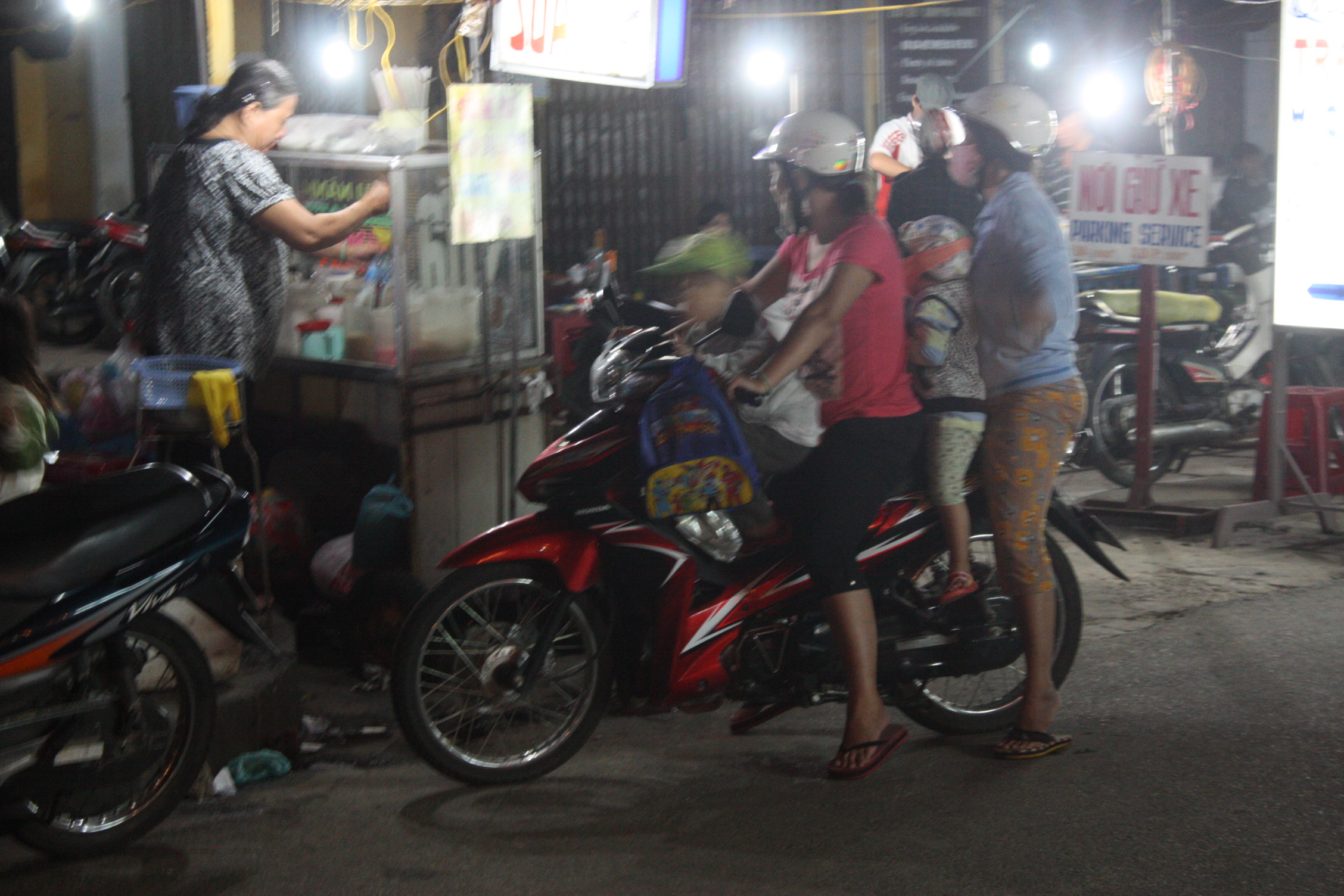
Picking up the shopping before heading home with some of the family.
The other day I wrote about the waves of motorcycles crossing the border between Vietnam and Laos in the very early morning.
Poor John and I lay in the tiled breezeway for the first hour that the bikes were zipping through, and we could tell in advance whether one was loaded with goods or people.
The breezeway was about 30 feet (10 metres) long and a bit narrow. In fact, the arches at each end were no more than 6 feet wide. Plus, there was a slight bump as bikes entered from the Vietnamese side and a bit bigger bump and a ramp as they exited toward Laos.
Bikes carrying people hardly slowed at all. If anything, they speeded up to enjoy the ride. No doubt, they knew to tuck in their knees and hang on.
But it was different for the goods ‘vehicles’. Loads were long and wide, and sometimes both. Some were so completely over packed that it looked as if the load had been ‘built’ around the driver. These bikes had to slow down. Some slowed to the point that the driver almost ‘walked’ the bike through the arches—especially the second one.
This packing of bikes is nothing new. Across Asia and Africa, we have seen bikes carrying a startling array of things such as pigs and other livestock, doors, plate glass windows, furniture and as many as five passengers (with at least two being children). I’ve never managed to capture a photo of five, and I’ve missed several opportunities to get pics of swaddled babies sleeping blissfully on the footrest of a moving motor scooter.
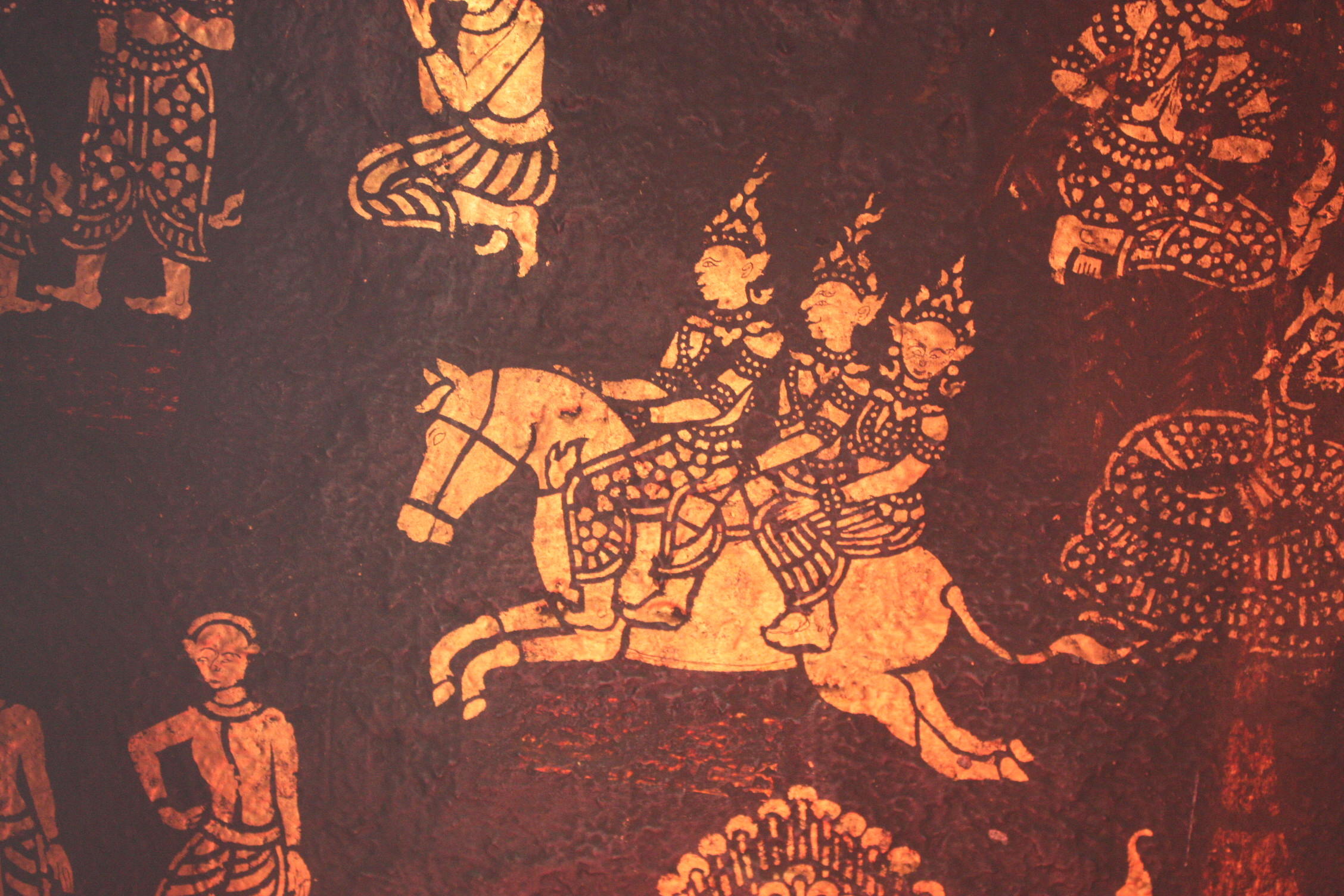
Frontrunner to overloaded motorbikes.
But I did get a pic of four the other night. It’s not a great picture, but it gives you the idea. They were stationary at the time, but they set out just after I snapped the pic.
Of course, Poor John says we shouldn’t be surprised by these mobile gymnastics. In one of the temples in Luang Prabang, Laos, he saw evidence that the practice has been around for centuries.
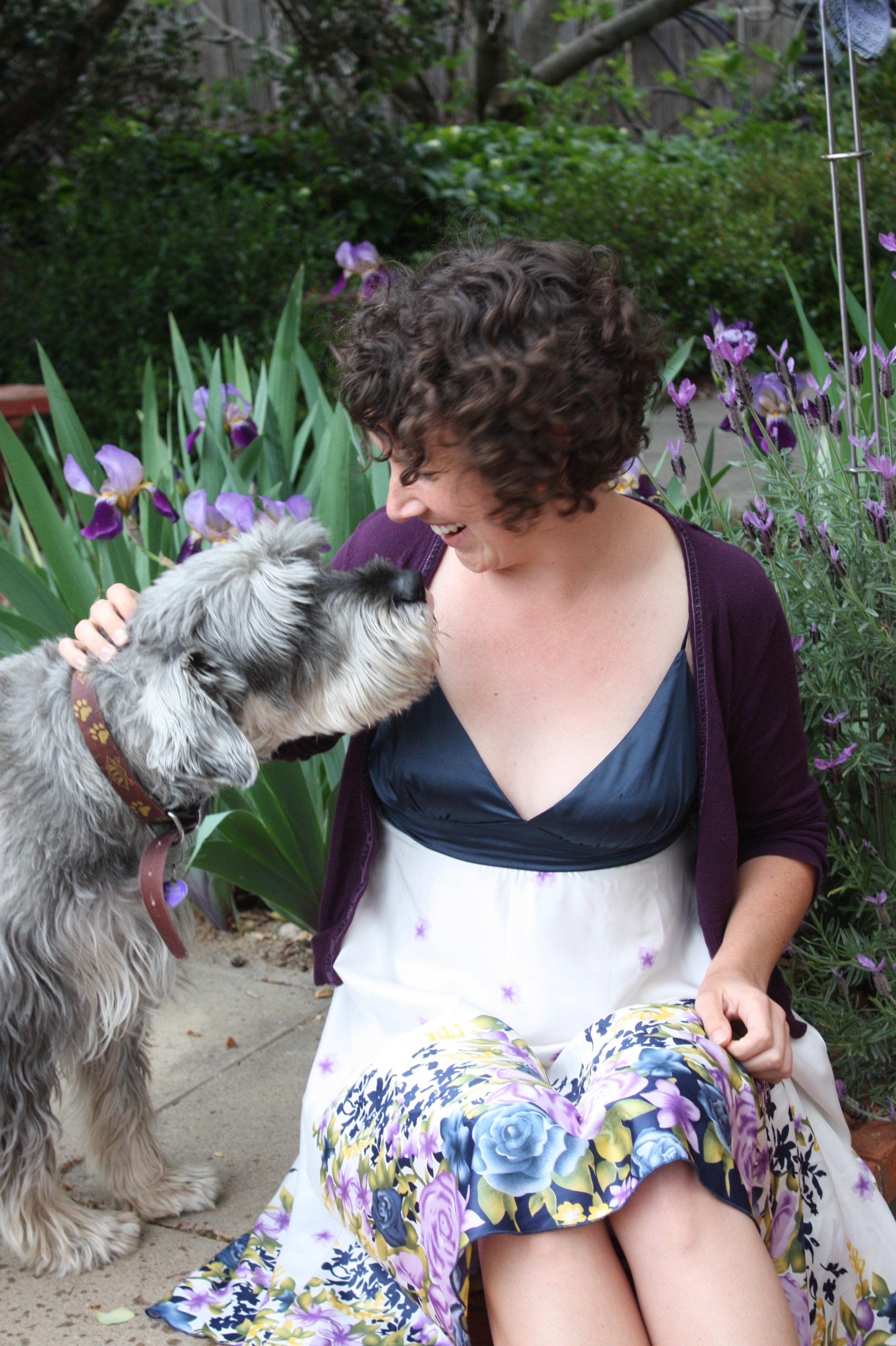
Libby in one of last year's frocks—being inspected by Aggie (aka Agadore Spartacus), the schnauzer who graces the banner in this blog.
We’re in Hoi An for several days—VIetnam’s clothing capital. Every second shop is occupied by a tailor. The in-between shops are given over to cobblers.
Walking down the street is to run the gauntlet of hawkers calling out—Madam, come see my clothes. Let me make a skirt for you. I make shoes for your bunions (I’ll do a separate post about my ‘bunions’ that aren’t bunions).
Most of our travelling companions have succumbed to the fabulous array of fabrics and styles. I look forward to seeing everyone in their new finery. This is just a small sampling of the purchases—Sarah bought three pairs of boots. Glen bought three suits. Eamon bought shorts. Norm even bought a tuxedo.
But after two days of walking through the main shopping areas, the touters have given up on us. They’ve come to accept that I really have worn the same pair of gold earrings for 35 years, and that the rest of my wardrobe is made up of flip-flops, khaki camping shorts or pants and black merino tops with varying sleeve lengths.
Poor John is almost as bad, although he branches out a bit more on the colour spectrum.
Our daughters, on the other hand, have a lot of style. Libby is especially keen on skirts and dresses. So much so that she is doing Frocktober again this year. I’m posting her announcement email here, so that you know a bit more about this charity activity.
Check out her blog, and I hope you have fun following the fashion frolics of Libby and Alison.
—————————————-
Hi all,
Some of you may remember Frocktober from last year. Well it’s that time again and Alison Spence and I are in full frocking swing. You can check out our efforts at our blog: http://vivalafrock.blogspot.com/
For those of you thinking ‘been there, done that, seen it all before’ I can assure you there will be new dresses, new adventures and new special guests. So it’s worth having a look. Please forward the link on to anyone else you think might be interested (either in ovarian cancer fundraising or in seeing stylish women in fetching frocks).
For those of you who don’t know it, Frocktober is a fundraising and awareness-raising campaign to help support the Ovarian Cancer Research Foundation. Alison and I wear a different dress (or skirt) every day and document it all via our blog, largely in the hopes you will sponsor us. You can sponsor us here: http://www.everydayhero.com.au/national_museum_of_australia_7 and there’s also a link on the blog. All funds raised go to the Ovarian Cancer Research Foundation (and it is much, much easier to make a donation than last year).
As for why we are supporting the Ovarian Cancer Research Foundation you should know:
- One woman dies every ten hours from ovarian cancer in Australia alone
- For many women with ovarian cancer, the disease is already well advanced when they are first diagnosed
- There is currently no screening test for ovarian cancer
- Frocktober aims to help improve the outlook for women with ovarian cancer by supporting the quest for a suitable early detection test through fundraising for the Ovarian Cancer Research Foundation.
Thanks everyone,
Libby

How much stuff can you load on a motorbike?
Yesterday we were cliff hanging at the Laos–Vietnam border (see One bus and 40 cases of whiskey for more detail).
It was after 8pm. We were officially stamped out of Laos, but there was no way Vietnam was going to let us in until 7 the next morning.
It may be a busy international border, but every night they close up passport control about 7:30. They pack away the date stamps, hide the pens, lock the cupboards and go home.
Only the border guards are left behind, and all they can do is say that they can’t do anything.
Lu, our tour leader, begged, pleaded, threatened, negotiated and cajoled. Surely they could let the 21 of us through. Although that girl is a smooth talker, none of it got her anywhere except completely frustrated. Actually in the end, she managed to gain two concessions.
First, the guards let her return briefly to the Laotian side of the border—by a chauffeur-driven motorcycle—to buy food for us as we had had no meal since noon. Second, she convinced them to find a slightly better place for us to spend the night than on the kerb by the border gate.
‘Slightly better’ is stretching it. They unlocked a stairwell that was part of the brick wall that created one side of the border gate. It was dark (no electricity), airless (no windows) and buggy. We could sleep on the floor, the stairs or the landing. The toilet was the great outdoors.
Poor John and I looked it over and decided our best option was to sleep in the breezeway just outside the stairway’s entry door. There was an archway at each end of the breezeway, with one end open in the direction of Laos and the other end closed off by a metal grille (no doubt, to keep us from scampering into Vietnam during the night).
We were the only ones to stay outside and we appreciated the fresh air. The floor surface didn’t matter because it was all rock-hard and rather grubby terrazzo. A good slathering of bug repellent kept the mosquitos away and we added some extra clothes to stay warm. I wrapped a sarong around my legs and a skirt around my shoulders. Our backpacks made okay, if lumpy, pillows.
Even though the border was supposedly closed, there was a lot of motorcycle traffic all night long, going each way across the border. In every case, they were driving on a little footpath that ran around the outside of the breezeway. In spite of this frequent and infuriating activity (if they could go through the border why couldn’t we?), Poor John and I actually fell asleep—until 3:55am. That’s when the guards suddenly flung open the metal grille beside us.
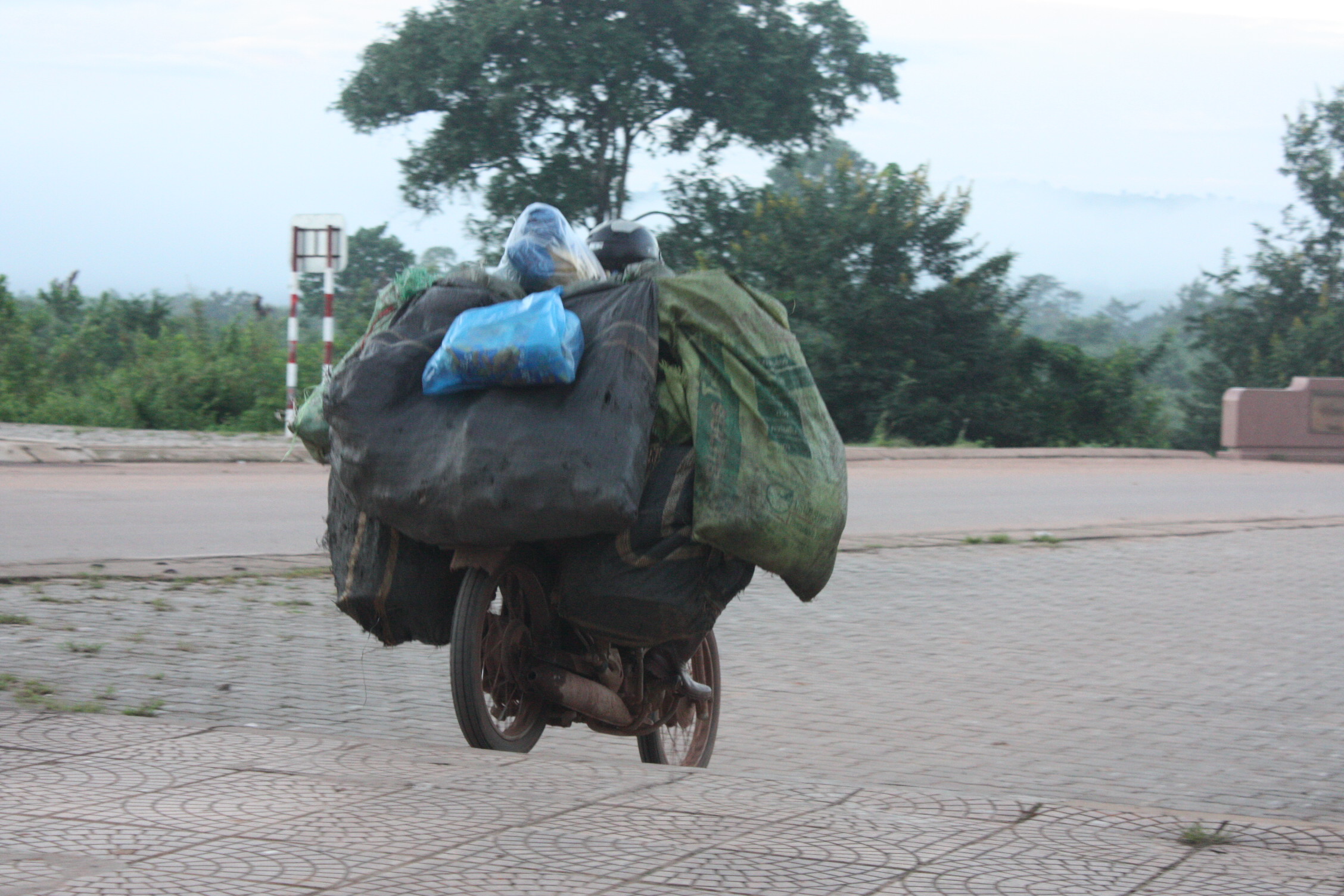
The sun rises and the bikes just keep coming.
Time for the real action. For the next few hours, hundreds of heavily laden motorbikes passed by, with most crossing from Vietnam into Laos. Not one stopped for any kind of border check and the guards took no notice of them (except to open the grille to help them on their way). We’ll never know if they were smugglers or simply early-rising entrepreneurs. Although photos are not allowed at borders, I managed to snap a few pictures as the bikes sped past my ‘bed’.
It wasn’t long before Poor John and I abandoned our sleeping spot and returned to the kerb by the main gate. Our travelling companions weren’t too far behind and once the border opened at 7, we were on our way to Hué, our first stop in Vietnam.
This is the third time we’ve spent the night at or near a border, and it was certainly the most entertaining.
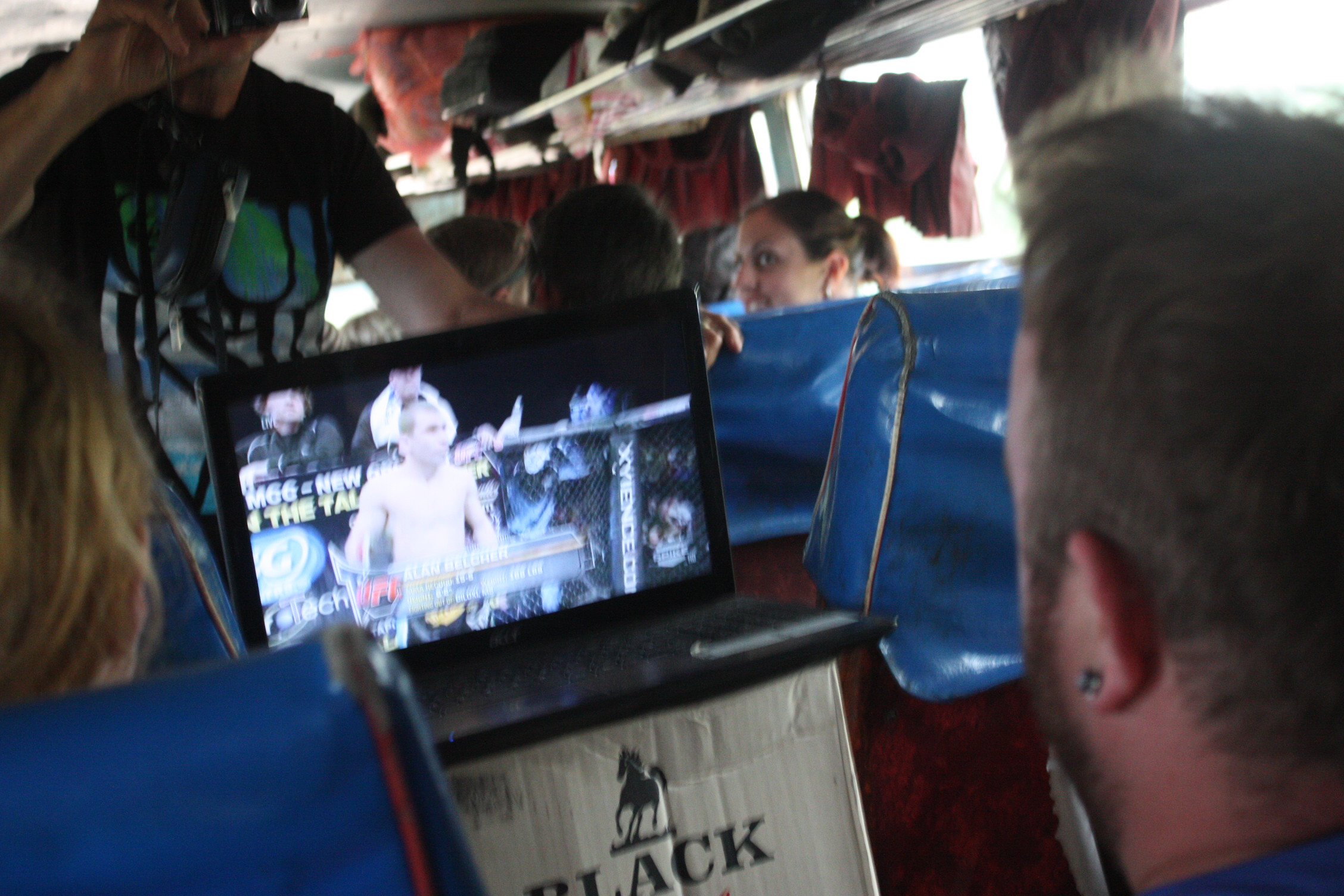
Terry watching the fight on his computer, which is sitting in the aisle on a stack of whiskey boxes.
Ever since we struggled up yet another Tibetan mountain pass, Will has been having trouble with the truck’s clutch. It’s not happy in 1st gear or something called crawler. It’s held together so far, but he’s been keen to get big orange beast to the Scania repair shop in Bangkok. So rather than drive us to the border between Laos and Vietnam, he decided to drop us in Savannakhet so we could take a bus the last 250 kilometres to the Lao Bao International Border Post.
We’ll be travelling without the truck for three weeks. Not because it’s being repaired, but because it can’t enter Vietnam easily and won’t be going to Cambodia either. So we’re carrying whatever we think we’ll need for the next 21 days and taking public transport—in it’s various forms—when we travel from place to place.
Now I’m not psychic (is anyone?) but I’d had a funny feeling about this particular border crossing for the last few days. Nothing specific, except that I sensed that things were going to go wrong. I even told Poor John that we’d be entering Vietnam a day late, and I wrote the same to our daughters. I didn’t think it would be another run-in with Svetlana (remember her?), but I thought it would be something.
So after a damp bush camp (and probably our last time to cook before reaching Australia, we set out for bus station at Savannakhet. Will dropped us there 11:30—giving us plenty of time to grab lunch before the next (and last) bus of the day to Danasvanh (on the Lao side of the border) left at noon. There was a spiffy-looking ‘international’ bus ready to set out for the Thai border—one with airline-type seats, curtains, air conditioning and the like—so there was a slight reason to think we might score decent transport.
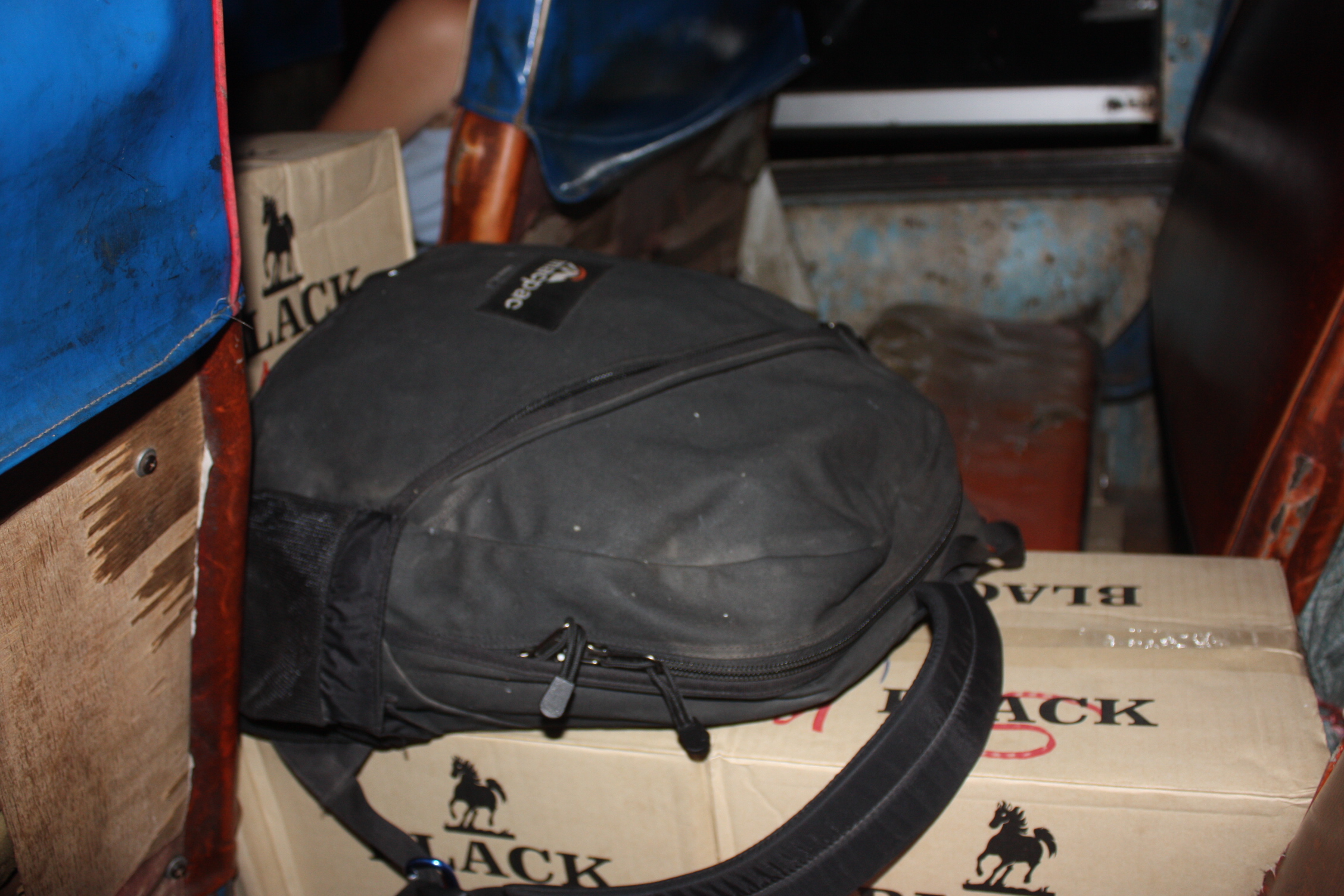
Whiskey in the aisle—helped to make sure we didn't fall out of our seats.
But as no other international bus was in sight, I was pretty sure our chariot would be one of the many ancient, dilapidated, blue-and-white local buses parked around the station. Close to noon, my suspicion was confirmed and our bags were handed over to be loaded into the back of the bus. Passengers (including a good number of locals) were instructed to board from the front and, as usual, Poor John and I hung back until almost the last. Big mistake. By the time we boarded there was only one empty bench at the back. We crawled down the aisle—stacked two-high with box after box of whiskey—only to find that our ’empty’ bench seat already had three cases of booze in the foot space. Obviously, the driver made his profit by ferrying great loads of grog (Aussie slang for alcohol) to the border.
So in we clambered and with our feet on the whiskey and our chins on our knees, we set out on a ‘five-hour’ jaunt to the border.
We weren’t the only uncomfortable ones. Most of the seats were missing most of their stuffing. Almost everyone was performing some sort of gymnastics just to stay on the bus. Terry sat in the aisle on boxes of whiskey (watching a pre-recorded fight on his computer), Lu was toward the front sitting on the engine and three locals were perched on our baggage and other freight at the back.
Because the bus was on its normal daily run, after we rolled out of the station we continued to stop and pick-up passengers and their belongings (yes there were two crates of chickens tied to the roof). From where we sat, it was hard to see the comings and goings, but I think the bus had 32 seats and close to 40 passengers. And, of course, about the same number of cases of whiskey.
After tootling along for three hours and before the half-way point, we stopped for a pee and snack break. Roadworks had slowed our progress, as had the continual stopping for passengers to get off or, more likely, get on.
Of course, time really shouldn’t have mattered EXCEPT that unlike most international borders—which are usually open 24 hours a day—the Lao Bao crossing closes at 7pm (or maybe 7:30). We had to beat the clock or we wouldn’t reach the border in time. The closer we got to the end of the line, more and more passengers wanted to get themselves and their gear off. The final disaster struck about 20 kilometres short of the border when the engine cut out. The driver hauled out his toolbox and went to work. Soon enough, we were underway again, but it was becoming ever more obvious that we were unlikely to make the deadline.

A basket of chickens gets unloaded from the roof of the bus.
Finally the bus came to its last halt—almost a kilometre short of the border. ‘Sorry folks, but this is where the bus stop is.’
So we hauled off our stuff and made a dash for passport control. Thankfully, the Lao side stamped us out quickly—except for me and John.
The short part of that story is that the border officials were confused that our visas had been issued in Canberra while everyone else’s had been issued in Laos. They dithered over what to do while we explained that Canberra was the capital of Australia. In the end, they called a superior for advice, but obviously they had trouble getting their story straight. In desperation, the guards passed the phone to Poor John who was suddenly explaining to the female superior that—NO, we weren’t trying to re-enter Laos on a single-entry visa, and that we were simply trying to leave!
With that, the superior told Poor John everything was fine and to pass the phone back to the border guard. It seemed as if she gave him (the guard) a bit of a talking-to for disturbing her with his garbled nonsense.
So we were promptly stamped out and headed for the Vietnamese side of the border, where we found most of our travelling companions sitting forlornly on the curb. The border was closed! We’d be entering Vietnam a day late! And I hadn’t thought to steal a single bottle of whiskey from the bus!
It was going to be a long night. Stay tuned for the next instalment.
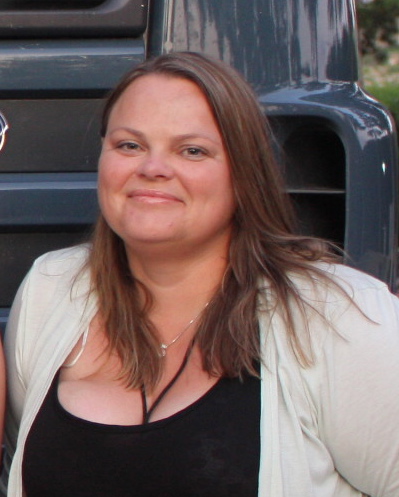
Sarah all done up for the Turkish night in Cappadocia.
For almost 16 years, Sarah has enjoyed playing the wench (and various other characters) in 17th century re-enactments in England. To be exact, she is in the Marquis of Newcastle’s Regiment, and attends at least three big functions each year. According to Sarah, it’s a great reason to get to dressed up in lots of finery and a fun way to meet people and learn more about British history.
Her interest in history doesn’t stop there. For the last seven years, she’s also been a keen volunteer for the National Trust, serving as a coordinator for week-long conservation projects around the country several times each year.
London-to-Sydney is her first long-term overland trip—in the past she’s done short overland jaunts around India, America, Central America and Australia. Obviously, she’s also traveled a lot in Europe.
Sarah is also treating this trip as an opportunity to make a big change in her life. She resigned from British Network Rail—after 20 years of service—and is still deciding what she’ll do next. We hope she’ll have time to pop down to Canberra for a few days. One thing is for sure, she’ll have to go home eventually to retrieve the cat that her mum and dad are looking after in her absence. As Sarah says, she’s a cat lover—with the scratches to prove it.
 Where to next?