

Poor John (standing) chats to Lene and Gary on the shores of Lake Song-Köl.
We thoroughly enjoyed our stop at Lake Song-Köl in Kyrgyzstan. Shepherds use the area around the lake as perfect summer pasture for livestock of all kinds—from horses and cattle, to donkeys and yaks.
There’s a narrow strip of land at the end of the lake where we camped that is chained off to create a reserve for birds. The fact it attaches to the shore at both ends means the water within is stagnant and a bit green. But 100 metres on there is open water that is crystal clear and a drawcard for all the animals grazing nearby.
The lake is much larger than you expect. Will and the other John thought they’d walk around it in a day, but turned back after four hours, having covered maybe a tenth of the distance.
Poor John and I also took a long walk along the shore. It was fun to see dozens of horses cantering up for a drink, and then hesitate as they approached us. Obviously we weren’t too scary, because they halted for only a moment before carrying on to the shore. A 15-day-old donkey wasn’t at all afraid of us, but the goats kept their distance. After we’d walked for more than an hour we caught up with Gary and Lene.
As I write this, I expect it has begun to snow at the lake, and the yurts have been packed up and moved to a warmer, more sheltered location. Sorry about a few duplicate pics in the slideshow. The connection drops out and I’m not always sure whether something has loaded or not. I can’t figure out how to delete the spares.
NOTE: If you have access to Facebook, please feel free to share this post with others. I can’t get on Facebook in China, so it’s impossible for me to let people know I am adding to the blog now. Thanks.
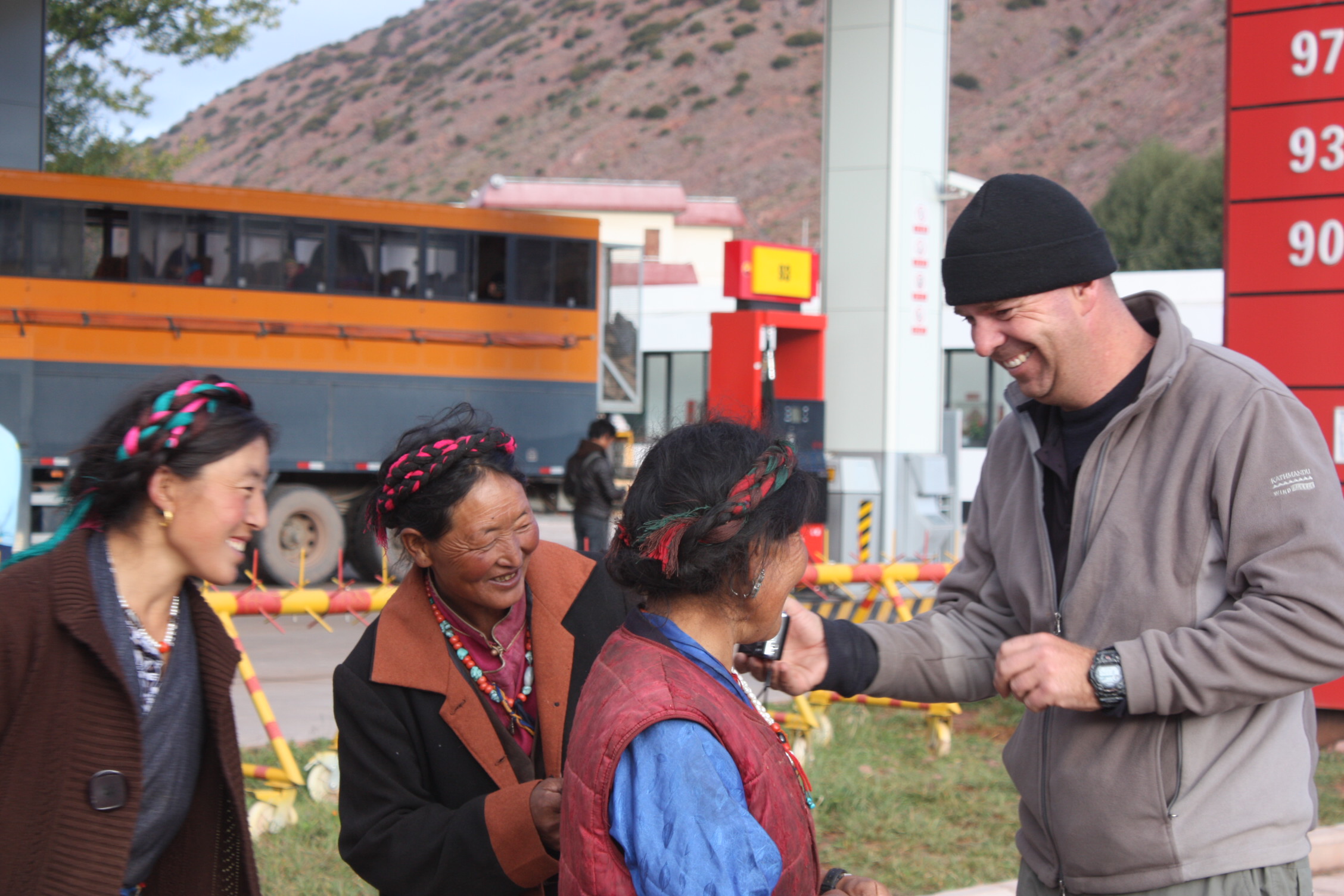
Every now and then we get photos of the people we see. At a stop for fuel, Gary shows three Tibetan women the photo he took of them and their yaks.
All across Central Asia and now China, I’ve waved and smiled at people (especially children) on the roadside, in houses and gardens, on bicycles and motorbikes, in buses, on construction sites, in fields and in workshops—actually anywhere they are that I can catch their eye.
Good grief, we are in a gigantic orange truck, so I think an acknowledgement that we are glad to be passing through their land is worth the effort.
Most people return the gesture or at least a cheerful nod of the head. Some wave furiously and shout hellos. Mothers nudge their children and urge them to wave. Some kids even blow kisses. It doesn’t always work. Today I saw an absolutely stunning Chinese woman, who greeted my wave with the grumpiest of frowns. Talk about lips like string! Maybe her boyfriend was late picking her up?
I have theories about those who show little or no recognition. Obviously, some people just won’t respond. But for others, I think we are sometimes trundling along so quickly that they simply don’t have time to react—that their wave comes when we are 50 metres down the road. Others, I fear, may see a large looming object, but their vision may be so poor, that they have no idea who or what has passed. I see so few people wearing glasses, that this must be the case way too often.
The Fred Hollows Foundation does a lot of wonderful work bringing better eyesight to people in the Third World. If you ever have a few dollars to spare, this is a good way to spend them. See http://www.hollows.org.au/.
NOTE: If you have access to Facebook, please feel free to share this post with others. I can’t get on Facebook in China, so it’s impossible for me to let people know I am adding to the blog now. Thanks.

Poor John getting an outrageously expensive haircut in Kashgar.
Whether we’re taking a taxi, buying lunch from a roadside stall or purchasing any other kind of good or service—we both know it’s absolutely essential to agree on a price FIRST. When we’re travelling, we accept that we’re going to be ripped off to some extent, but by establishing the price first, we agree to an amount we can live with.
Although this rule is imprinted on our brains, we miss it every now and then.
In Kashgar in western China, Poor John decided it was time for a haircut. In his perfect world, haircuts should cost no more than $2 and the barber should not speak unless he has to ask what type of cut is required. We’d seen plenty of snazzy unisex salons run by hairdressers in tight jeans, spangly tops and modern hairdos, but he rejected all those as being too upmarket and probably too expensive. Then he saw a hole in the wall barbershop on the edge of the huge market. It had, literally, holes in the wall, paint peeling, rickety chairs, filthy towels and was packed with locals—all signs of a decent cut at a rock-bottom price.
When we went in, Poor John tried to establish a price—’how much’ he asked a few times, but before anyone would say anything, he was railroaded into a chair. In no time, his hair was being washed (he admitted the rinse water ran very dirty) and the scissors appeared. In addition to the barber, there were two young boys, perhaps his sons. One of the babies—seriously, he looked about 14—was snipping away at Poor John.
I didn’t worry too much about the final price. Quite few people left while I sat there, and no one seemed to pay more than 10 yuan for a cut or a shave.
So imagine our surprise and outrage when the boss decided our bill was 100 yuan! I don’t get angry and upset often, but I was furious and momentarily speechless. Then I called him every clean name in the book—thief, robber, cheat, liar, evil, nasty and all the other choice ones that came to mind.
I wanted to call the police. I wanted to torch the shop (not that a fire would have affected the appearance much). We should have shoved 25 yuan in the boss’ face and stormed out, but when I’m so overwhelmed by someone’s complete audacity, I don’t always act sensibly. So we handed over 100 yuan and stormed out.
Of course, all this was over about $16—or less than the price of most men’s haircuts in Australia. But that’s not the point. He was so clearly gloating over his cleverness. NO other customers were left in the shop and he thought it was so funny to completely bilk the tourists, and not be caught in the act by any countrymen (OTHER locals often try to make sure you don’t get cheated). It was such a colossal cheat that I am sure some evil will befall him and he it will dawn on him that it was because of his thieving ways towards us. In fact, I’m sure the ‘you’ll be sorry’ I shouted as we left is still ringing in his ears.

Glen does a double-take when the cows come to call at our campground on the outskirts of Almaty, capital of Kazakhstan.
Overland travel isn’t about hardship. It’s about enjoying the adventure, accepting the unexpected and being creative so you can make the most of lots of different situations.
Some of the bush camps have been great, some have been dismal. It’s easier to accept your surroundings if you consider how hard it must be for the driver to find a clean and level-enough place that will hold the truck, our spread-out bush kitchen and about 15 tents. Sometimes we have to work around rocks, thorns, poop, broken glass and garbage.
Indoor accommodation and campgrounds have been up-and-down too. Sometimes they are clean and comfortable, sometimes not. Hot water and electricity can be variable and toilet paper is usually bring-your-own.
We’re almost always pretty scruffy. We can have showers and do laundry from time to time, but when you are on the road for eight or nine days straight, you realise it’s a good thing you all smell pretty much the same.
I was proud of myself at our homestay in Bishkek, the capital of Uzbekistan. It had one toilet and one sink, but there were two hot showers, so I decided to colour my hair. I wanted to look in a mirror to apply the colour, but there was a girl washing her clothes in the sink—under the lone mirror and sign that said ‘no clothes-washing in the sink’. So I stood in the driveway instead and used the car windows as a mirror. Not bad considering the car was a Lexus!
Having enough water for drinking and cooking is another challenge. The truck’s water tank holds 500 litres, but the trick is to find water that is clean enough, when treated, to be drinkable. Service stations often have good supplies of water, as do many villages. But sometimes the pressure is so low, that it might take us three hours to fill. In those cases, we drive on.
On occasion, we have had to cart water from creeks and distant rural pumps. We do this with big plastic buckets and look rather like an amateur fire brigade.
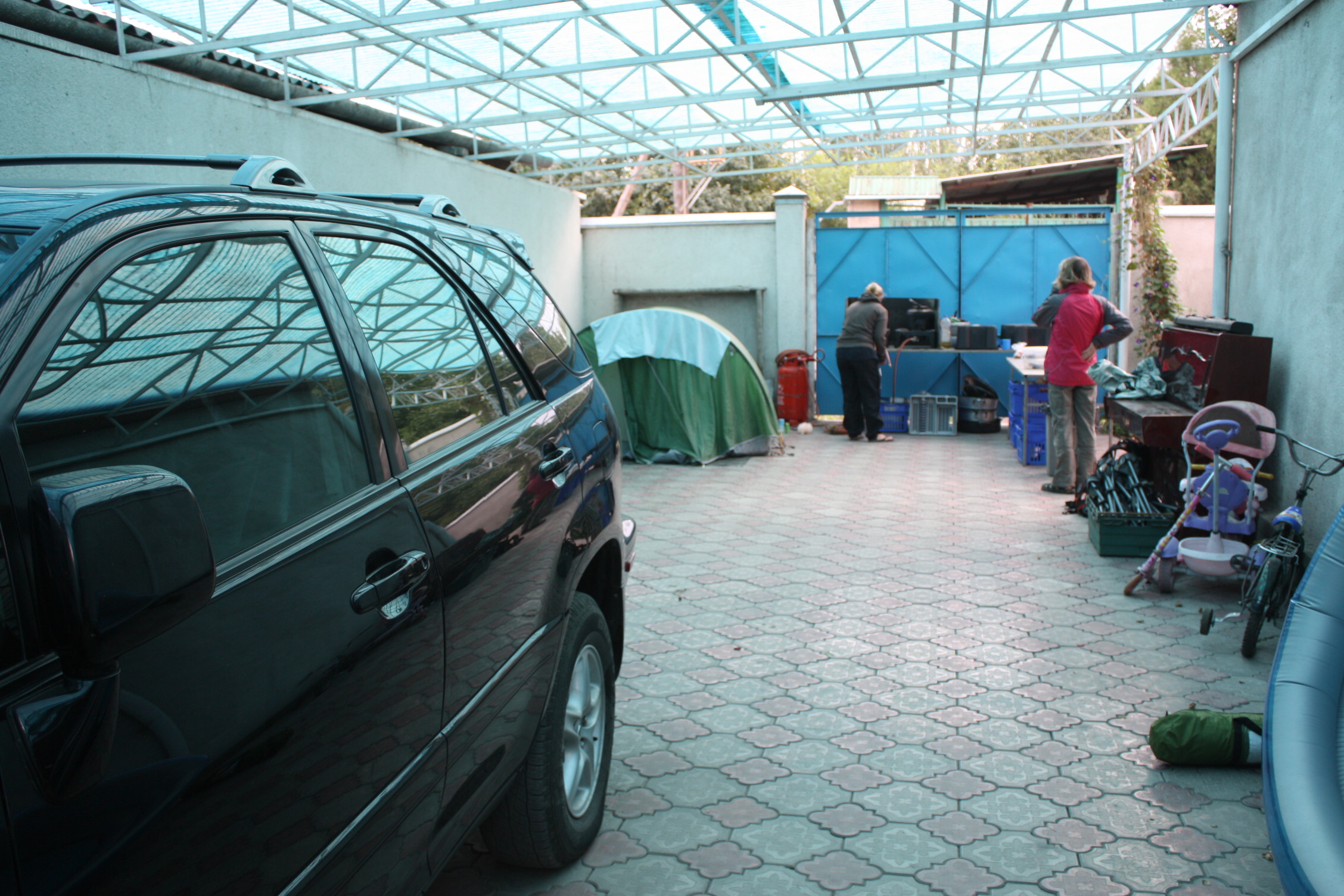
A well-used driveway—a Lexus, our tent, a makeshift camp kitchen and the kiddies’ playthings.
A few days ago, we had a mishap. We were filling from a restaurant hose. The water started clean, but ended up running diesel into the tank. In seconds the whole tank was contaminated and the water was black. It’s been drained, rinsed, cleaned with disinfectant, rinsed, cleaned with dish detergent, rinsed and refilled. Of course, then all the water was chemically treated. The coffee drinkers think it tastes funny, the tea drinkers think it tastes okay.
Poor John has been the unwitting guinea pig. He had a few unboiled gulps before being told he probably should wait until the tank has been drained, cleaned and filled again. He’s fine, so I guess we can risk it for now.
NOTE: If you’re hungry, be sure to check out my recipe blog.
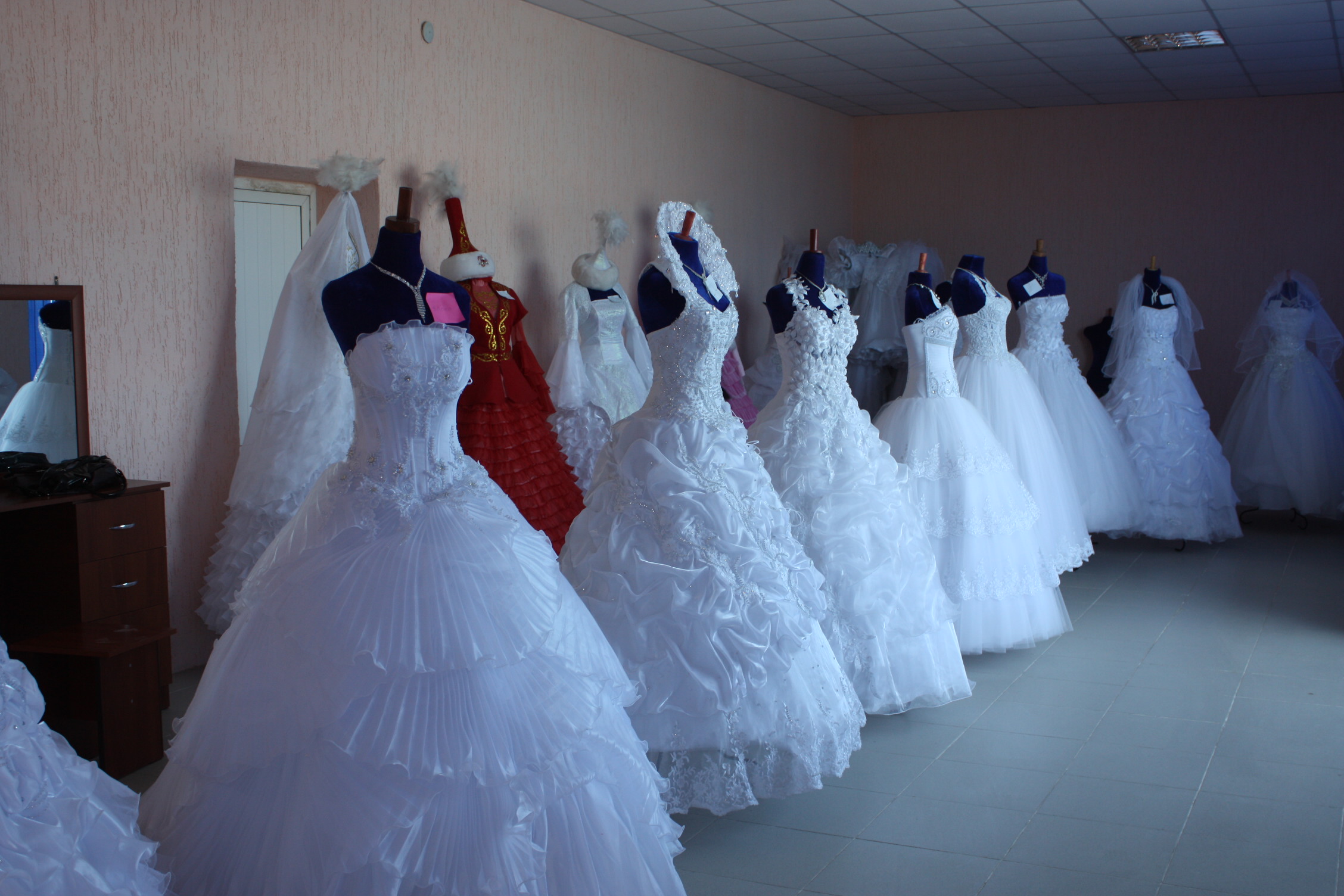
A wedding dress showroom in remote Kazakhstan.
In Australia, I’m hardly aware of weddings. At weekends, especially in good weather, you see bridal parties milling outside churches. And there are the processions of bridal cars, and dresses on display in shop windows and on the covers of the many bridal magazines. But otherwise, I never feel as if weddings are ‘in my face’.
It’s different in Central Asia. From Turkey onwards, we have seen countless weddings in progress or about to begin. Cars are elaborately decorated and processions hoot their horns wildly. Wedding dresses are for sale everywhere too. I’ve even seen them displayed outdoors in the rain—wrapped in several layers of plastic.
A few weeks ago, we stopped at a little general store in the middle of nowhere, not long after crossing the border into Kazakhstan. It was a long, low building, only one room deep. The left end was a fairly modestly stocked shop with dry goods, tinned foods, drinks, lollies, ice creams, toilet paper and such. But the right end was a huge and magnificently stocked showroom of at least 20 wedding gowns. They were all white-white (except for two traditional dresses), and they all had cinched waists, fitted bodices, lots of lace, ruffles, flounces, frills, hooped skirts and other heavy decoration.
In the West, these dresses would ring up in the thousands. I saw that price tags here were in the thousands too—20 to 30 thousand, in fact, but that translated to just $200-$300 in US dollars.
A girl, who I assume is the daughter of the general store owner, assured me that she had made all the dresses, but I’m thinking my question may not have been completely understood. She may have meant that she chose them, or was in charge of selling them. She posed proudly with her favourite dress—I know that question was understood.
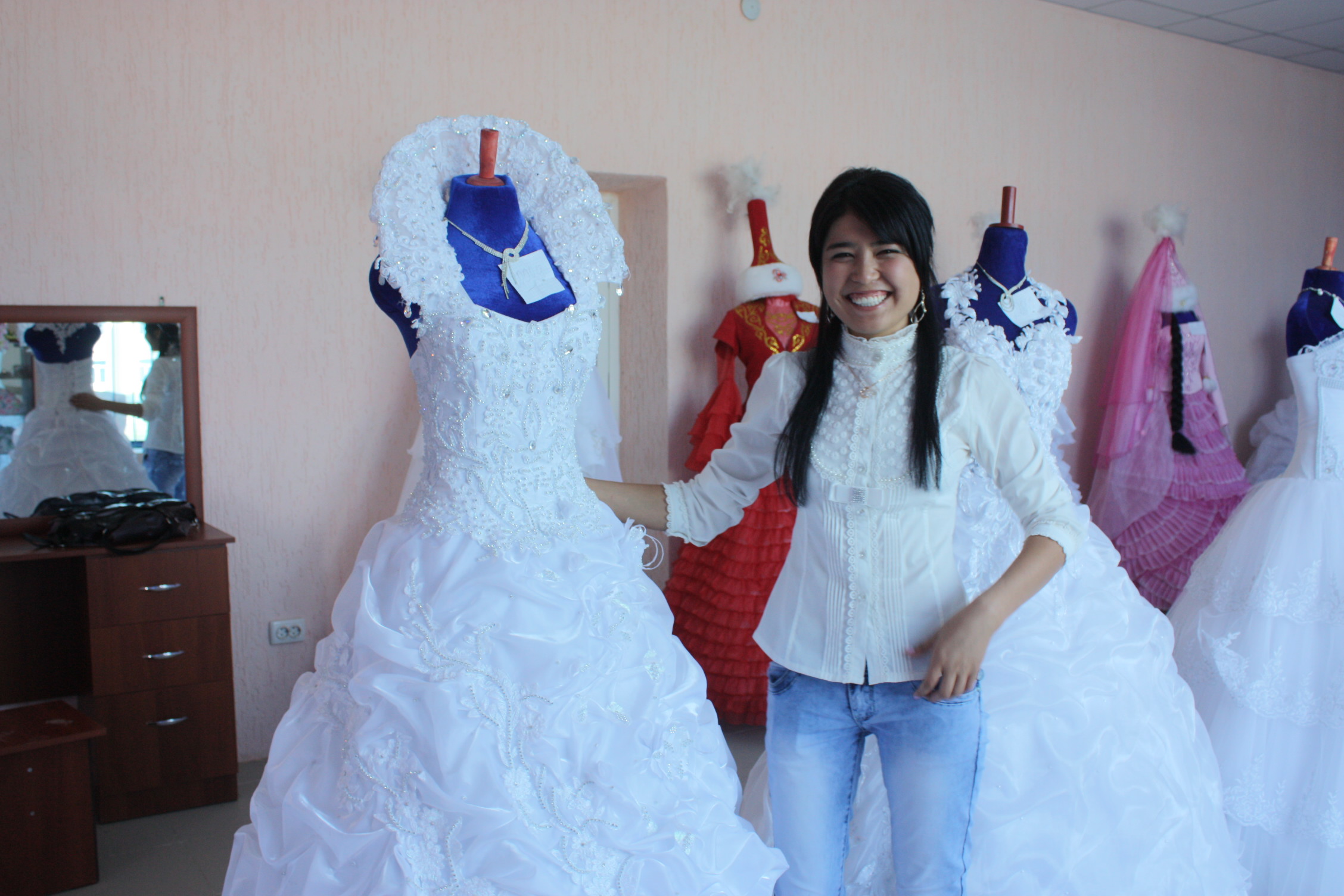
A favourite dress.
I’m also sharing here a picture of the smartest. cheekiest bride I’ve seen on all my travels. She and her husband-to-be were walking toward the large garden in Almaty, Kazakhstan, where many wedding ceremonies seem to take place (we saw three wedding parties within just a few minutes).
It was threatening rain and the groom dashed back to the car to grab some umbrellas. He lit a cigarette to calm his nerves and strolled back to his bride. I caught her attention and got a smile and a nod that said, yes, it was totally okay to snap a pic of the two of them. As I raised my camera, she twirled to her partner and planted a huge kiss on his lips.
And then I noticed with great satisfaction that she was wearing flat shoes. I like her style.
NOTE: If you have access to Facebook, please feel free to share this post with others. I can’t get on Facebook in China, so it’s impossible for me to let people know I am adding to the blog now. Thanks.

Clever bride in flat shoes.
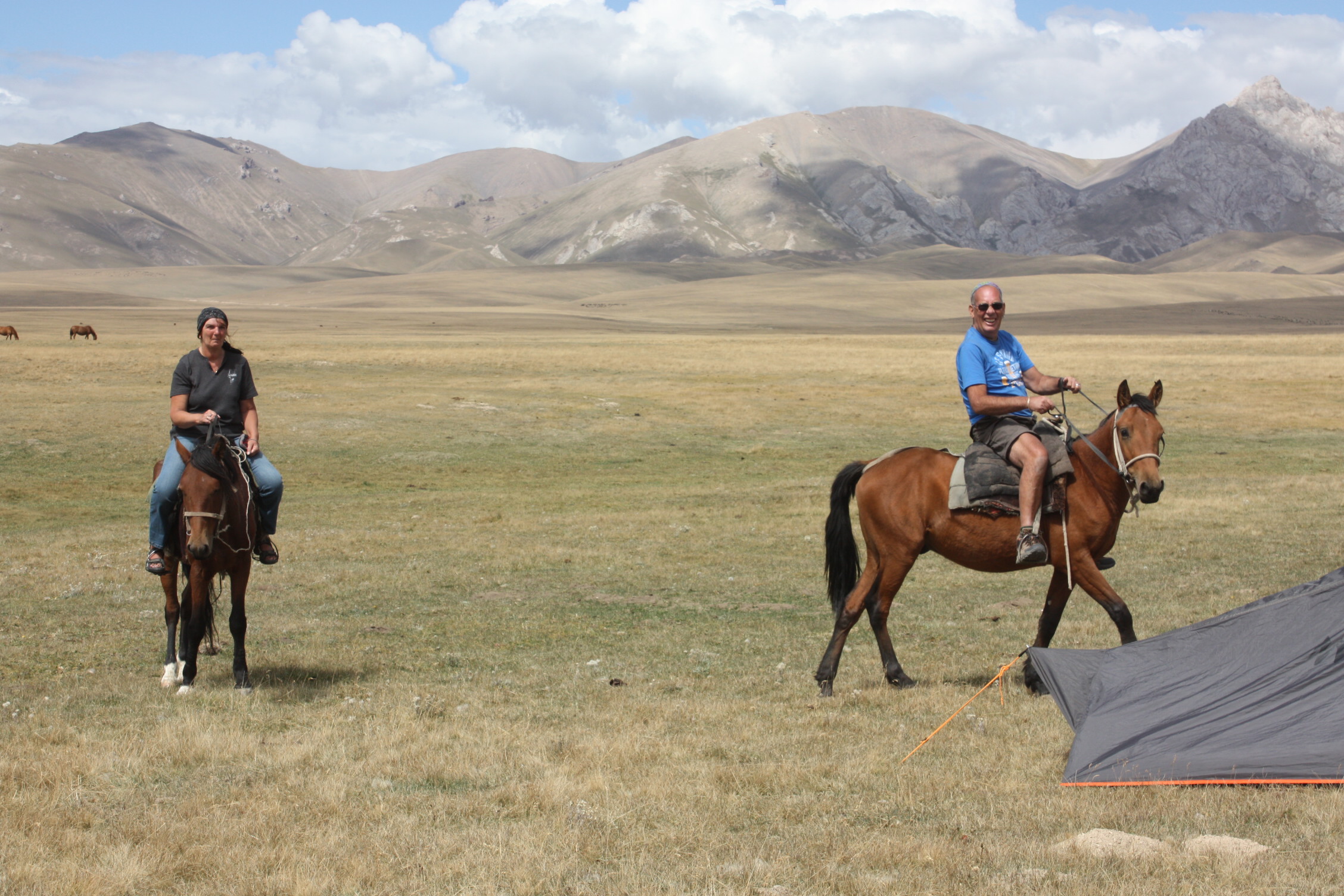
Horse-riding at Lake Song-Köl in Kyrgyzstan. Norm swears he can control a horse, but Lin isn't so sure.
Lin and Norm are definitely our Royal couple on the truck. As long-term employees of Britain’s Royal Mail service, how could they be anything else? And even though they have been a couple for many years, they finally got married (for a second time) about a week before our journey began. They got married once in India too.
Originally from Rugby, Lin is full of surprises. Way back in July when we arrived in Turkey in late afternoon, we need to recruit a few taxis to haul us all to the main bus station near the border. Who knew Lin spoke Turkish? Those same language skills also came in handy in Azerbaijan, Turkmenistan, Uzbekistan and Kazakhstan.
In his life before the Royal Mail, Norm was a social worker in Coventry, who specialised in helping those with learning disabilities. He’s active in many aspects of his beloved village, Ansty, and is even carrying a club flag that is being signed along the way. So far, he has at least one signature from every country we’ve visited. I promise to post an item about the flag.
Although Lin and Norm are both avid travellers, this is the first time they have ever done an overland trip and they are thoroughly enjoying it. They had planned to do this trip in 2012, but wanted to be at home then to experience the Olympics in London. Their next travel has already been booked—a three-month, around-the-world cruise. Guess they won’t be wearing thermals on that trip?
We’re also delighted that they’ll be coming to Canberra for a few days after the overland finishes.
NOTE: If you have access to Facebook, please feel free to share this post with others. I can’t get on Facebook in China, so it’s impossible for me to let people know I am adding to the blog now. Thanks.
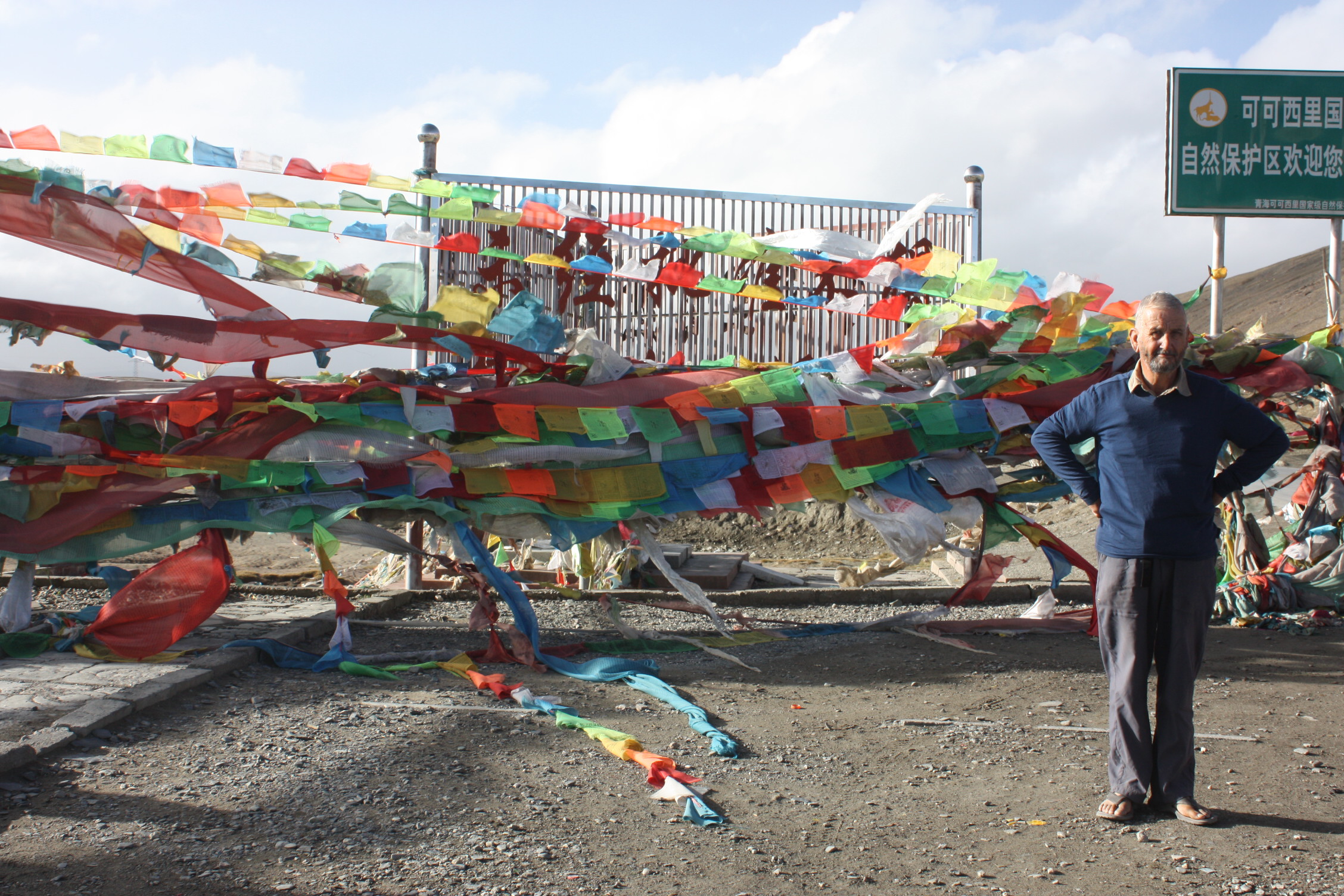
Poor John wonders how he got to this highly decorated Tibetan mountain pass at 4767 metres.
For most of the past two weeks, Poor John and I have suffered from altitude sickness. I was hit first and worst. It began in early September in Kyrgyzstan, when we camped at Lake Song-Köl in the Naryn Province. The altitude there was 3100 metres (just over 10,000 feet).
Mostly I felt weird—short of breath and headachy. Little did I, or many of us, realise the full array of symptoms to come. So far, many of us have experienced loss of appetite, general weakness, dizziness, lightheadedness, insomnia, pins and needles, and shortness of breath. A few have had nausea, diarrhoea and nosebleeds. I’ve also had a fever and a dry cough. The full list of symptoms is much longer, but we have been spared some of the most severe.
Most of Colorado’s ski resorts are at 2400 metres at the most. Since early September, we’ve been travelling across western China and camping at 1600 metres, 3100 metres, 3700 metres, 4700 metres and 4800 metres (not necessarily in that order). We’ve also crossed numerous passes, some exceeding 5200 metres. Mountain climbers often spend months at a base camp, acclimatising to the local conditions, while we’ve been up and down like yo-yos.
My worst night was the first night we camped at 4800 metres (or almost 16,000 feet). Poor John and I struggled to put the tent up and within 10 minutes I realised I’d better lie down before I fell down. So I went to bed at 8pm, and although I thought I might read, all I could do was shut my eyes. I didn’t eat dinner that night or the next, and no breakfasts either. My head was spinning like I’d had too much to drink, but how can you put your foot out of bed and on to the floor when you’re already lying on the ground?
As an aside, it snowed that night and I awoke the next morning in a tent that looked more like an igloo. It was a ‘drunken’ wrestling match to pack it away. Then later that day, when we rolled the tent out to put it up again, several huge snowballs fell out.
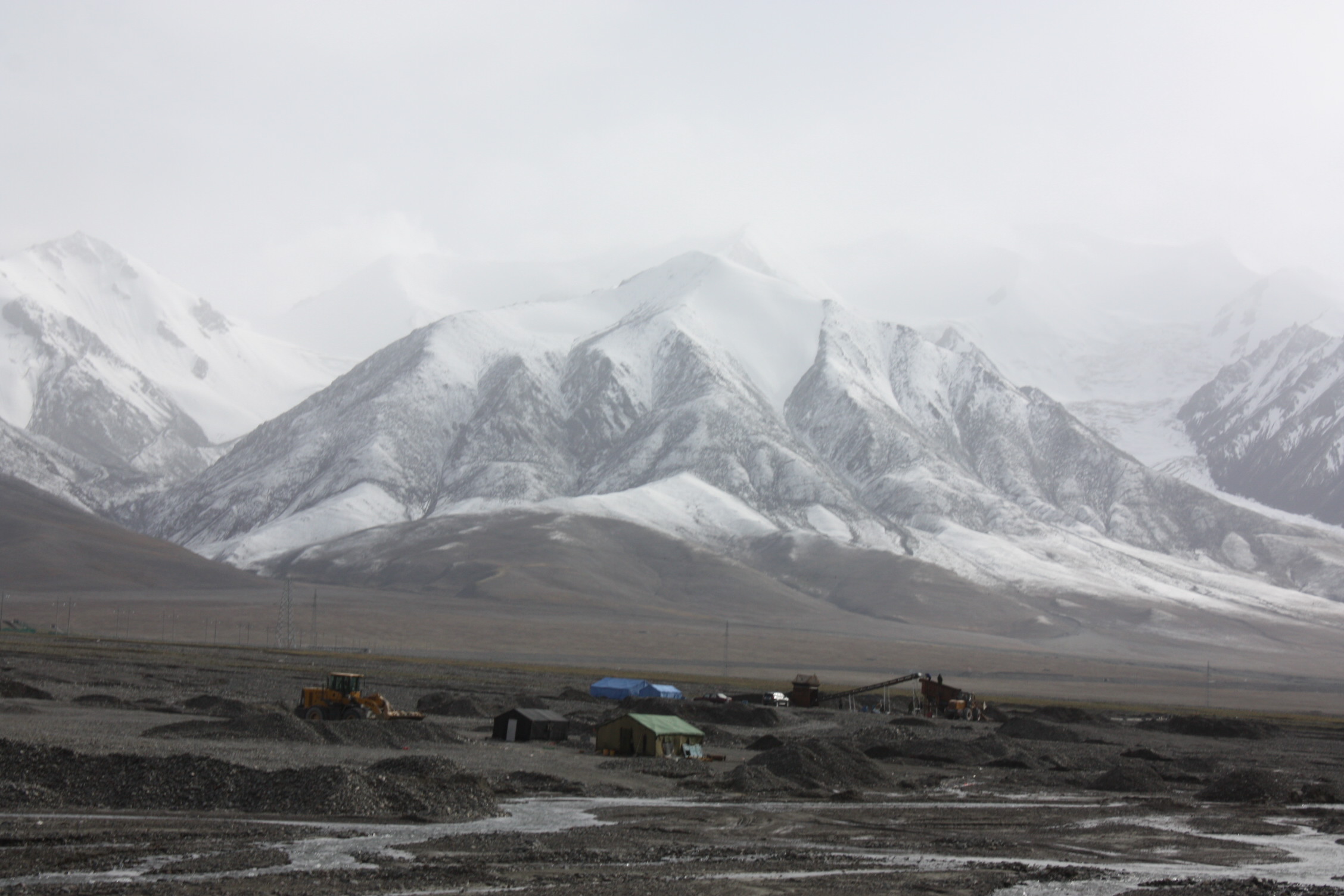
Poor John reckons some of these peaks are at least 7000 metres.
That said, the scenery has been spectacular. Snow-capped mountains, rolling hills, picturesque gorges. I’ll post some more photos in another blog entry.
But back to the altitude. So you know—caffeine, alcohol and fizzy soft drinks are big no-nos at high altitudes, and because dehydration is inevitable, it is important to drink as much water as possible. It also means you’re up a lot a night for regular pees. Not much fun to drag your bum out of the tent when it’s below zero Centigrade.
Luckily, we’re in a hotel in Lhasa, Tibet now—staying at 3700 metres. We’re still feeling the effects of altitude sickness, and while the symptoms are frustrating (imagine getting puffed going up just a few steps), they are not too severe. And it’s a bonus to only have to go as far as a real bathroom to pee and not out into the freezing cold.
About two-thirds of our group have taken up the option to travel to Everest Base Camp at 5200 metres. It will be interesting to see how they fare over a few more days in those conditions.
NOTE: If you have access to Facebook, please feel free to share this post with others. I can’t get on Facebook in China, so it’s impossible for me to let people know I am adding to the blog now. Thanks.
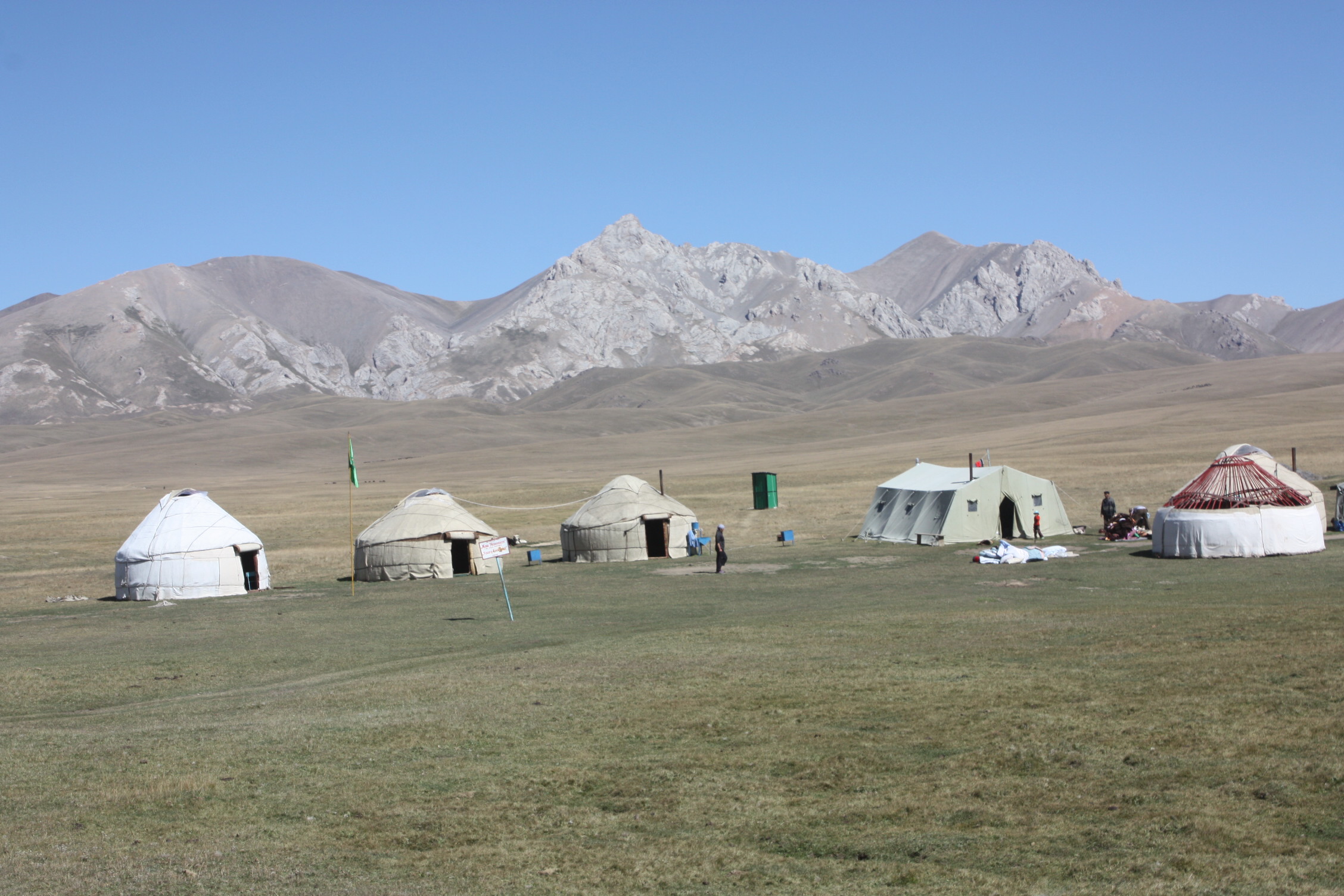
Yurts at Lake Song-køl in Naryn Province in Kyrgyzstan.
During our last few days in Kyrgyzstan, we had the chance to camp in and around some authentic yurts on the shores of Lake Song-Köl in the Naryn Province.
While the yurts we visited cater primarily for tourists, the owners really do live in them year round. To cope with the harshness of the climate, they relocate, as needed, to ensure the comfort of their families and livestock. We arrived in the dying days of summer and already the nights were quite cold, so I’m guessing ‘our’ yurts have already moved on to a winter spot that is warmer and more sheltered.
Yurts are surprisingly portable. We watched in amazement as an additional yurt was assembled in less than 90 minutes. That made a total of five yurts in our camp, plus a dining tent, a lone green long-drop toilet and a somewhat-distant handpump for water. Not bad considering that in addition to our group of 25 there was another French group of about 15.
Poor John and I spent time in the yurts, but didn’t actually sleep in one, although most of our group did. No doubt, we would have appreciated the warmth there (in the morning it was 3°C in our tent and the exterior was encrusted in ice). But we have warm thermals, and reckon it’s often better to sleep with your own burps, farts, snores and body odors, than share those of 16-17 other people.
In spite of the wind and chill in the air, the weather was sunny and glorious. Just about everyone pumped buckets of water so they could do huge batches of laundry. The dunny (outdoor toilet) made a perfect anchor for the array clotheslines we strung around. And our clothes dried in no time.
The second night was a bit scary. People staying at the yurts could rent horses to ride, and a couple of the French fellows took up an evening option. They galloped around our tent at high speed for about 30 minutes. We crossed our fingers and hoped they could clearly see our glow-in-the-dark guy-wires.
The slideshow here includes (not necessarily in order) some food shots, the collection of yurts (the yurt on the right is being assembled), a yurt interior, the truck and its shower stall hanging off the back, and a scenic view of everyone’s laundry.
NOTE: If you have access to Facebook, please feel free to share this post with others. I can’t get on Facebook in China, so it’s impossible for me to let people know I am adding to the blog now. Thanks.
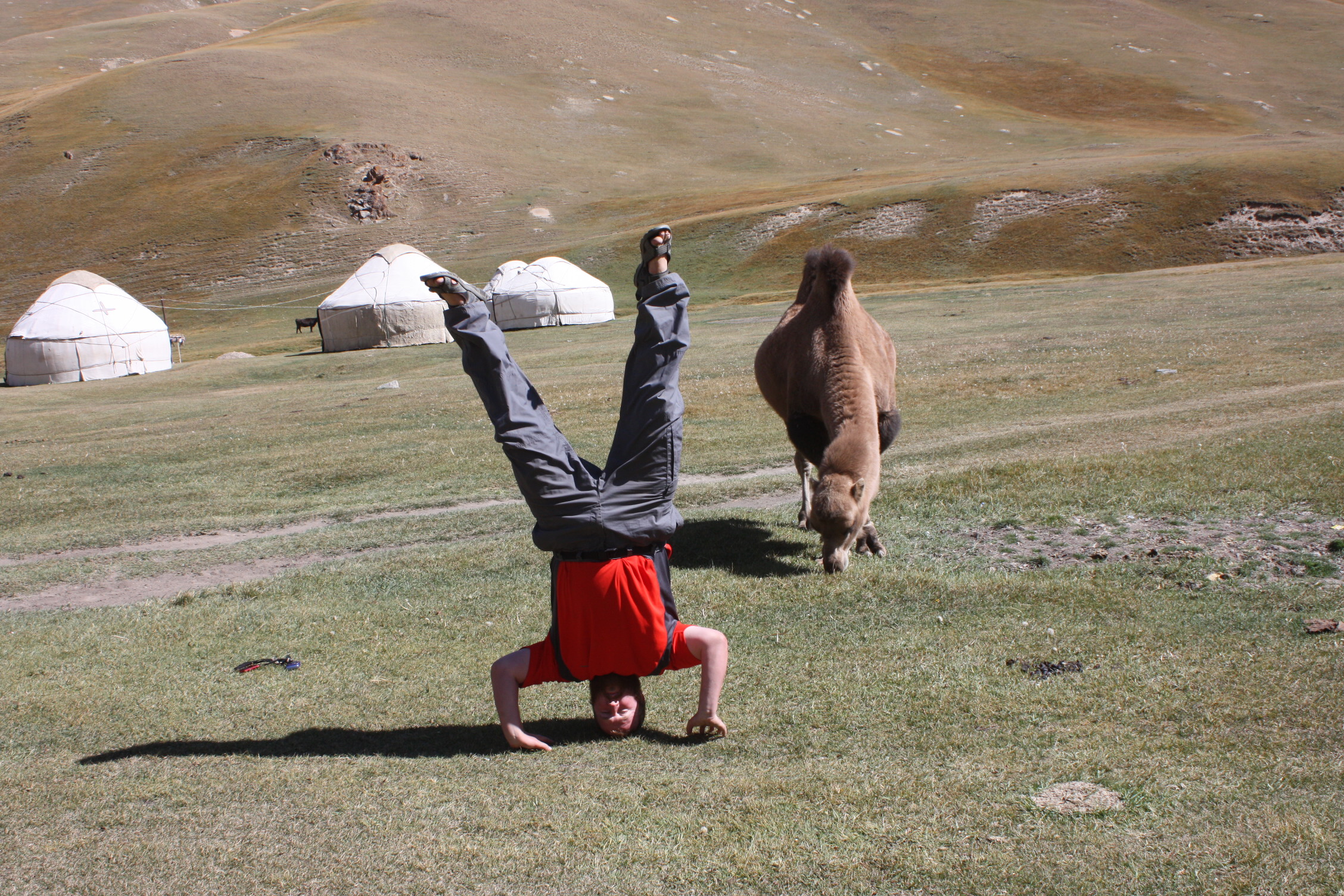
Terry takes the lack of camel burgers in remote Kyrgyzstan in his stride. So does the camel.
One of our travelling companions, Terry, has set himself a challenge for this overland trip—to have a burger for every day of the trip.
Obviously, he’s not having a burger every single day of the trip because too many places just don’t DO burgers, but he plans to have at least 169 burgers over the course of our 169 days of travel. Some days he’s in the black and some days he’s in the red. A while back in Kazakhstan or Kyrgyzstan, he was 10 down. I’m not sure about the current tally because he’s in a bus bouncing his way to Everest Base Camp, but he should be close to even. China has lots of Dico’s (their own chain of burger restaurants), and we’ve been in three towns with outlets.
According to Terry, a qualifying burger must be on a round bun and must include some kind of meat. Veggies are optional.
I’ll let you know how he goes. Midnight tonight is our halfway point in the trip and we’re in Tibet.
By the way, in his non-truck life, Terry works the night shift at Sainsbury’s in Cardiff, Wales. He’s done an overland in the United States and is planning his next journey. He loves his electronic gadgets, watching movies and cage-fighting events. He’s also a wonderful sharer. Terry buys all sorts of goodies that he very generously shares with everyone—especially on long-drive days. Everyone perks up when someone sings out ‘the jelly beans are coming!’
Update: Terry finished his challenge long before the end of the trip. And as soon as he was done, he started eating a tin of tuna (one of his favourites) most days.
Also don’t forget to pick a number before 29 February 2012.
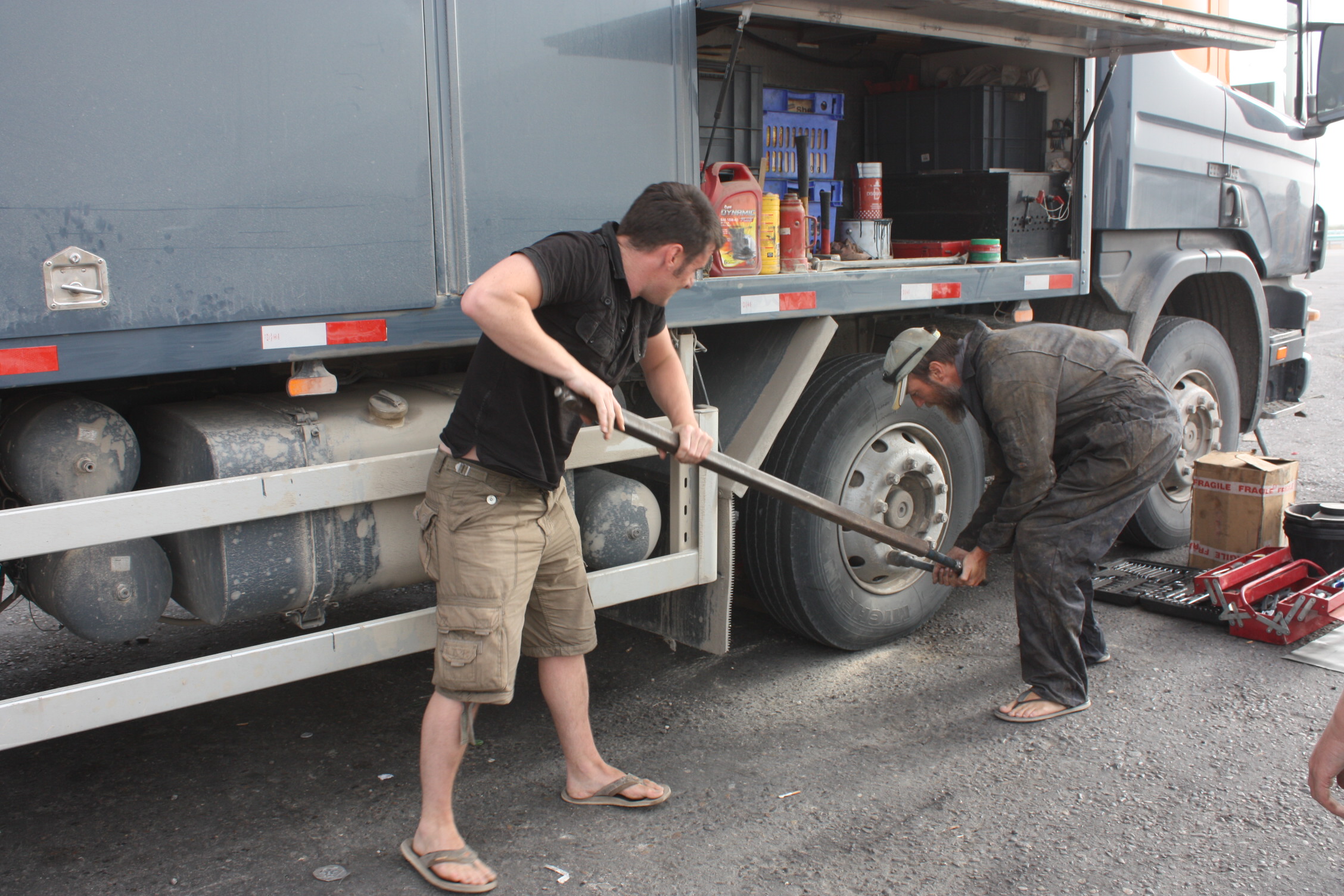
Even the tyres suffer on the rough roads. Martin and Will tackle the flat.
You may recall my references to the bone-crushing, tooth-shattering roads we have been driving on.
About 90 per cent of the time, I sit in the second last row, right over the rear wheels. I spend a lot of time airborne (yes, I faithfully wear my seatbelt which is a lap-sash only) and I can’t count the number of times a colossal bump, or a series of bumps, has caused me to bite down hard—sometimes getting my tongue or the inside of my cheek to boot.
Unfortunately, my comment about tooth-shattering was way too accurate. I now have broken two teeth.
About a month ago, I realised a chunk of a lower wisdom tooth was missing. It’s disarming and disheartening to find a little piece of tooth wandering around in your mouth. At least it’s not painful. Then yesterday, another chunk gone; this time from a small molar behind a lower incisor. Again it’s not painful, but I know there’s little chance that either tooth will be repaired before I get to Canberra.
I’ve spent a lot of money on my teeth and I like to stick with my own dentist. As soon as I have an internet connection—which may be in several days (namely when you’re reading this)—I plan to email him and ask for an emergency appointment in December. Hope he gets a chuckle out of an emergency ‘planned’ so far in advance.
But the breakages persist. This morning I trod on my glasses while we were trying to get the tent down in a brisk wind. One arm is badly bent, but the whole is holding together for the moment. I hope I can get them fixed in Lhasa, Tibet.
That makes three breakages close together, so I hope that’s the end of such dramas.
As for the boobs, I rather suspect that by the end of the trip mine will be dangling down to my waist, looking like two stretched-out sport socks with a billiard ball dropped into each toe.
Don’t forget to pick a number.
 Where to next?