
Today’s drive out of Bulgaria was the most bone-crushing, tooth-shattering truck adventure I’ve ever had. The road didn’t look that bad, but within a few kilometres everyone was reaching for their seatbelt, then their belongings, then their clothes, then their body parts.
We jiggled and pitched and ditched and bumped and bounced and swore. It was worse than any air turbulence I’ve ever encountered and not nearly as much fun as a good roller-coaster. Will, our driver, admitted it was the worst stretch of road he’d been across in a long time and said it had done-in his front shock absorbers. I was riding over the rear shock absorbers and can confirm that they too are ruined. In fact, I was the only one sitting at the back—everyone else thought they’d get a smoother ride upfront. Silly people.
Of course, it was frustrating and funny at the same time. We had an early start so we could get to the border with Turkey. Instead of breakfast before departure, Lu, our tour leader, announced we would eat along the way. There was bread, spreads, hard-cooked eggs and fruit set up toward the front of the truck. The trick was to get to it. Whenever there was a momentary lull in the lurching, someone would stagger forward until they could sit on the floor in front of the food supplies and assemble their meal. The next challenge was to make it back to your seat. The photos here are of Ian making a valiant effort to keep himself upright and his food on his plate. Lin wasn’t so lucky and ending up wearing quite of bit of her breakfast.
The jarring was so strong that twice my glasses shook off their chain and once they ricocheted off my boobs and hit me on the face. In the end I wore them—safer that way. Marina and I are built pretty much the same and we had our arms folded over our chests so that we might get to the Turkish border without black eyes.
All in all a memorable morning’s drive, followed by way too many hours waiting at the Turkish side of the border. I’m typing this as we move into our third hour of thumb-twiddling here. Wonder what the road ahead is like? Maybe I should buy a sports bra!
Late update: We ended up staying at the border for seven hours and then took taxis and buses to Istanbul. We’re legal, but the truck is stranded. Watch for two instalments soon—the truck saga (is it a bus?) and the most hair-raising taxi ride of my life.


I hate having to pay for a pee—and with only a few exceptions, the practice is common across Europe. Imagine paying 6 euros (about A$9) to visit a museum and then having to chip in another 50 euros cent to have a pee.
When we’re on the road, the boys nip round the back of the truck or a building and pee in the bushes (Poor John does this all the time just because he can), but the girls troop to the toilets and cough up the equivalent of up to A$1. It wouldn’t irk me so much if I actually got anything for my money besides a hole in the ground (even if it is surrounded by porcelain).
Take today. We were on the Turkish side of the border between Bulgaria and Turkey By the way, Bulgaria gets a gold star for mostly free toilets and slightly-better-than-the-usual 1/2-ply toilet paper—one campground even had genuine 2-ply paper. More about that great place later.
According to Will, our driver, the immigration facilities on the Turkish side are new. I’d show a picture, but photos are not allowed at border crossings. The buildings are immense and mostly spotless. There are two duty-free shops, a string of fast-food outlets, a bank (where you take a number to be served) and a few general shops.
And then there are the toilets. G-r-r-r! There are two large sets of toilets—one on each side of the building. It costs one Turkish lira (or about 75 cents) to pee.
But here’s the rub. The one set of toilets that were open were filthy. Water splashed all over the floor, muddy footprints everywhere (and it wasn’t raining outside), no soap in the first three dispensers I tried, no water in the first two sinks I tried (wonder where the water on the floor came from), a young girl in fake Crocs nearly slipped over, heck I nearly slipped over, my toilet cubicle looked as if some kids had had a TP decorating party before I arrived, the toilet paper wouldn’t pull down so a huge roll was propped against the wall and slowly soaking up some of the water on the floor. I’ll stop now because I’m sure you get the idea, even if you can’t visualise it. Clearly, my lira is not going to someone who will come along and clean up the place.
So I have that whinge out of the way. Thanks for listening. I should mention that I NEVER rely on a toilet to actually supply toilet paper, so I always have some in my pocket. If anyone is interested, I can explain how to get the most out of your toilet paper. My dad taught me.
Exception to my objection—I do not mind paying for a pee in places where my money actually is a source of income, such as a village in Africa or Indonesia. I’ll let you know my views as we travel across Central Asia.
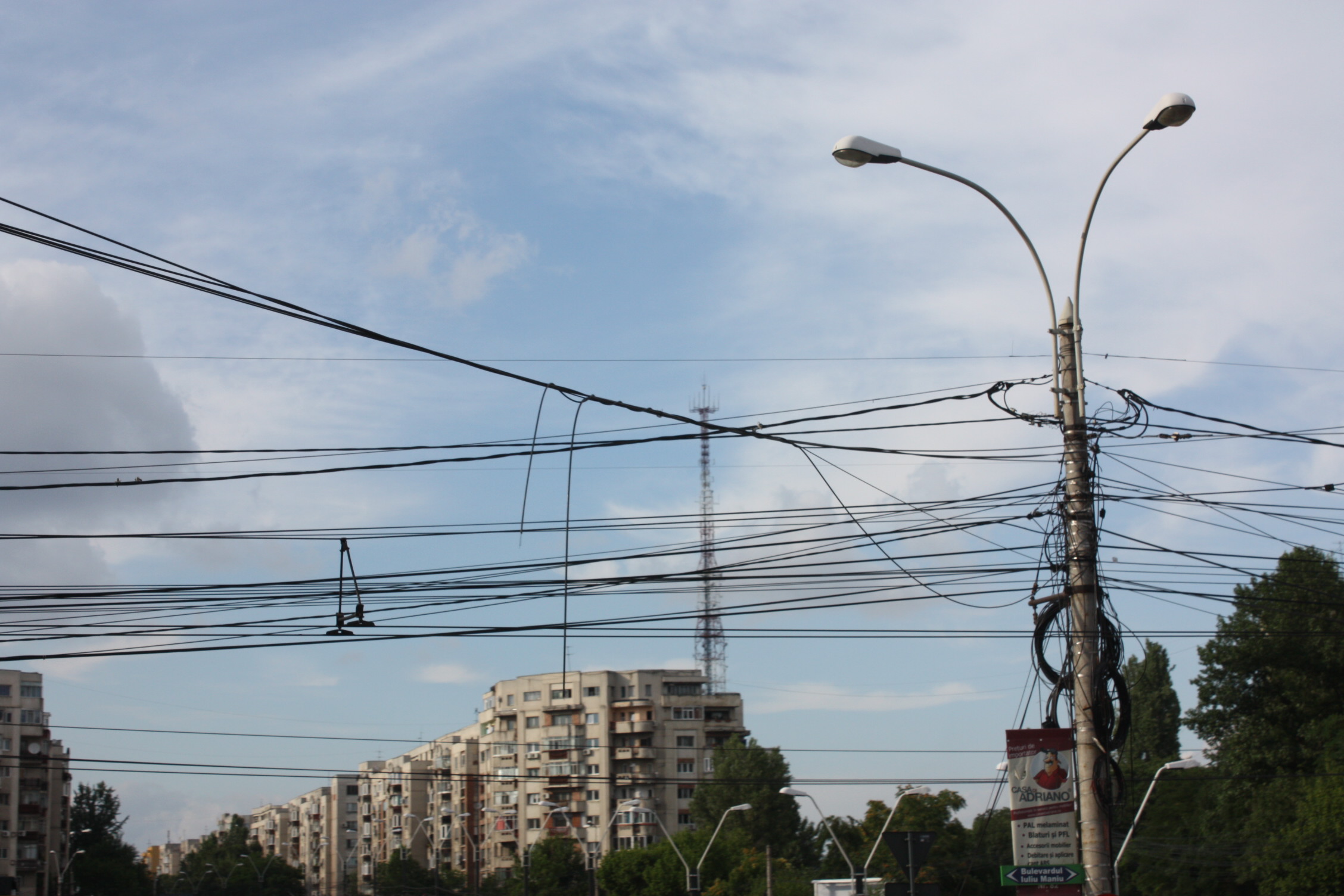
Wiring in Bucharest.
We had internet at the campground in Bucharest, but it seems a miracle as to how it’s there. The country is filled with some of the most haphazard wiring I’ve ever seen.
But speaking of the internet, I’ve been pleasantly surprised as to how freely available wifi has been. Most campgrounds have it free of charge. Connections can be a little dodgy—dropping in and out regularly—but usually resurface after an hour or so. Connections are slow too, but mostly that’s because so many of us have laptops that we push usage to the limit.
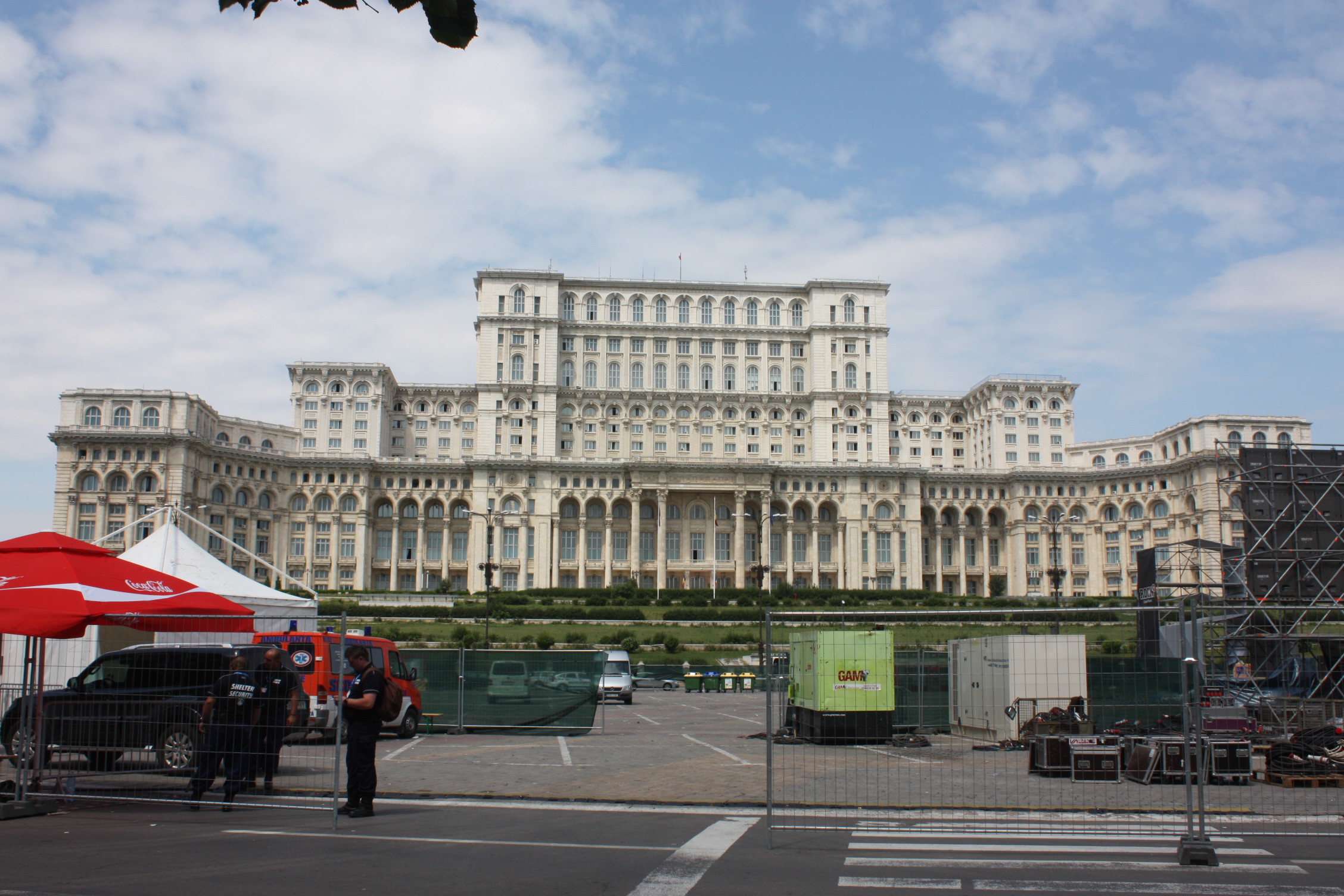
The Palace of Parliament epitomises the megalomania that gripped Ceaușescu in the 1980s. The building is massive—270m by 240m and 86m high—and second in size worldwide only to the Pentagon. It stands on the former Spirei Hill, which was razed for this project. There are 12 storeys and four underground levels (including a nuclear bunker). Ceaușescu wanted the palace to house ministries, Communist Party offices and high functionaries (in apartments).
The statistics are mind-boggling—1100 rooms (450 are in use), 4500 chandeliers, acres of marble and gold leaf, a 100m-long lobby, curtain panels that weighs 250kg each and a carpet that takes 80 people to roll out. There were 700 architects involved and 20,000 construction workers. Most of the workers were prisoners and soldiers. Our guide told us that many skilled engineers refused to work on the palace, but Ceaușescu got around this by having them conscripted into the army and then ordered to work on the project. The lead architect was a woman—and only 27 when she won the job. She remains involved and her role today may be greater than it was in Ceaușescu’s time. He and his wife had ever-changing whims—one sweeping staircase was rebuilt three times before they were satisfied—so the architects often only give technical advice.
Construction began in the early 1980s and continued after Ceaușescu was overthrown and executed. It became a white elephant, and was often referred to as the Casa Nebunului (Madman’s House). The new government agonised over what would be an acceptable use for it. In 1994, it was decided that it could house the Senate and Parliament. Many international conventions are also held there.
We had a 90-minute tour and saw about 5 per cent of the building—including some of the most dazzling rooms and decorations. The foreground of the first picture is being set up for Bon Jovi’s open-air performance next weekend.
If you have time, have a look at A bright idea and A grand avenue in Bucharest.
And don’t forget to pick a number before 29 February 2012.
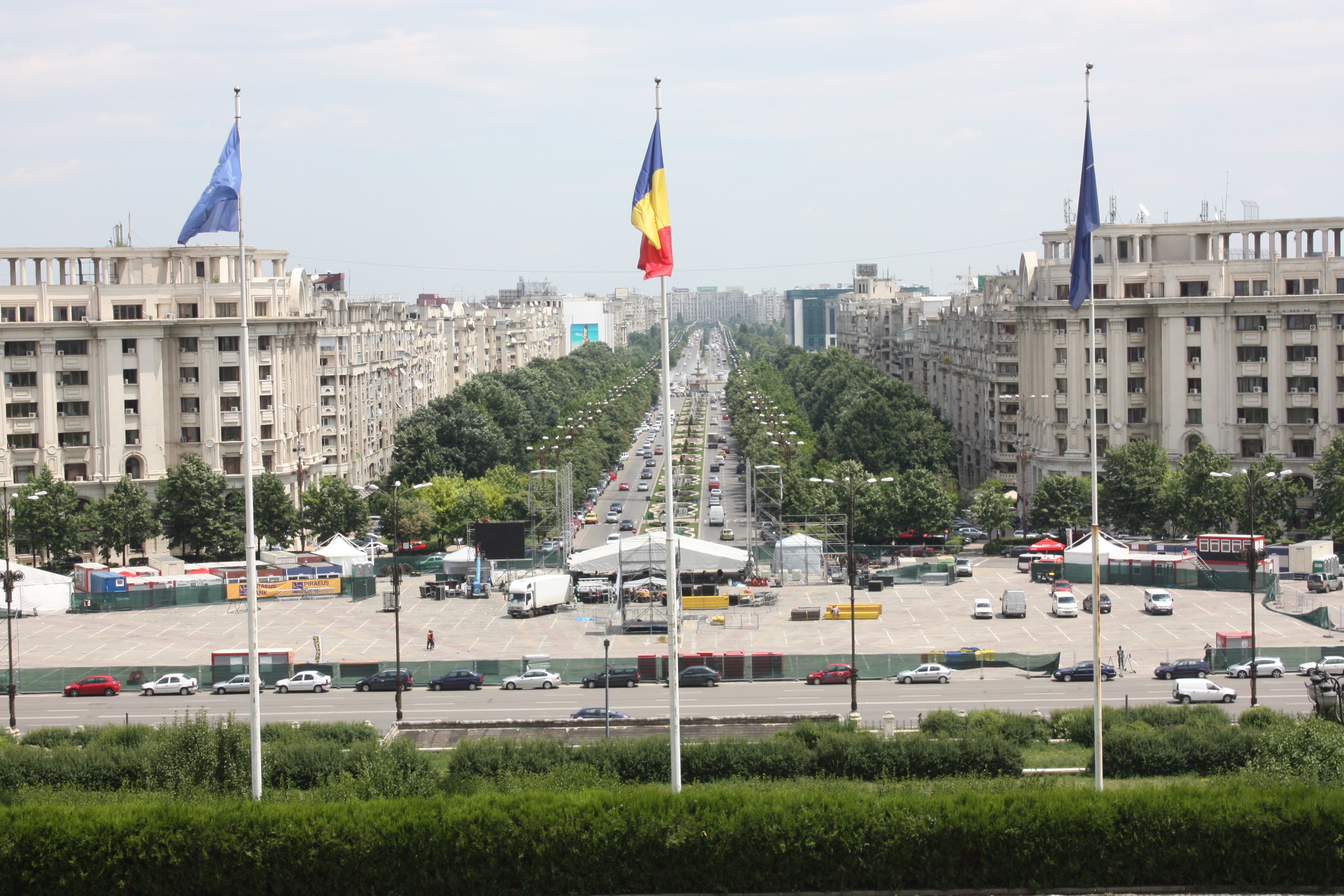
The Bulevardul Unirii viewed from the Palace of Parliament in Bucharest.
There’s no doubt about it—Nicolae Ceaușescu was a megalomaniac.
After seeing the grandiose avenues in Pyongyang, capital of North Korea, he set out to remodel Bucharest as ‘the first socialist capital for the new socialist man’ and to create a new administrative centre which was to be ‘a symbolic representation of the two decades of enlightenment we have just lived through’. Of course, it’s plain that he sought only to feed his own ego.
To bring this Centru Civic to life, he had one-quarter (about five square kilometres) of Bucharest’s historic centre demolished, with the excuse that the buildings were slums damaged in the 1977 earthquake. In fact, about 9000 undamaged 19th century homes were razed and their 40,000 inhabitants were relocated to developments on the outskirts of town. The world condemned this vandalism, especially because many old churches were also lost.
The core of the Centru Civic was completed by 1989, just in time for Ceaușescu to be overthrown and executed. The Bulevardul Unirii unites the two halves of the Centru Civic. The boulevard is four kilometres long and 120 metres wide, intentionally made just a bit larger than the Avenue des Champs-Élysées in Paris on which it was modeled.
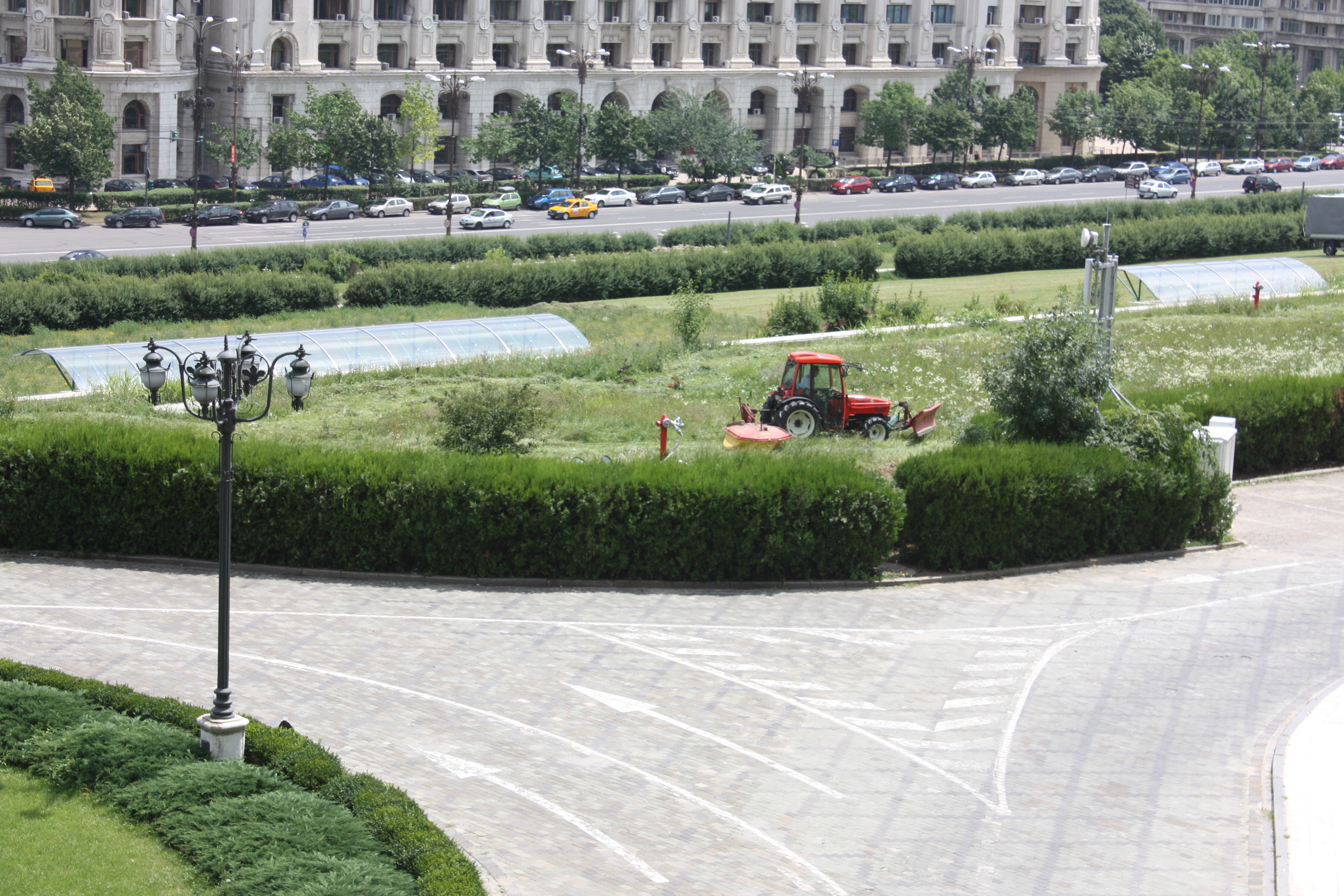
Mowing at the Palace of Parliament.
The photos here were taken from one of the balconies at the Palace of Parliament, which dominates the western end of the boulevard. The white marquee is where Bon Jovi will deliver his open-air concert next weekend.
As we approached the palace, we agreed that it desperately needed a mow, and they must have heard us. By the time we left, a mower was making the rounds.
If you have time, have a look at the Madman’s House and A bright idea.
And don’t forget to pick a number before 29 February 2012.
One of Poor John’s must-see sights in Berlin was the bust of Nefertiti. It’s not surprising—she is absolutely stunning. In fact her name translates as ‘the beautiful one has come’.
Poor John is not alone. The bust was found in 1912 at Amarna by the German Oriental Company led by German archaeologist Ludwig Borchardt. It was found in what had been the sculptor Thutmose’s workshop, along with other unfinished busts of Nefertiti. Borchardt’s diary provides the main written account of the find; he wrote, ‘Suddenly we had in our hands the most alive Egyptian artwork. You cannot describe it with words. You must see it.’

An unfinished bust of Nefertiti.
But I have to apologise for having no photo of the famous bust. Nefertiti and the room she is in (she’s the only exhibit there) are the only items in all of the Neues Museum (German for New Museum) to have ‘no photos allowed’. But here’s a photo of an unfinished bust, and a link to a photo of the famous bust and more information about Nefertiti. http://en.wikipedia.org/wiki/Nefertiti_Bust
And so you know—Egypt wants her back!
Poor John is plowing through books, and I’m doing a reasonable job too. Some have been good, but not great. Here are two I recommend.
The other day I finished The Kite Runner by Afghani author, Khaled Hosseini. Excellent book—a heartbreaking but inspiring story. Thanks to a donation from Julia (via Petra), I also have his second book, A Thousand Splendid Suns, which has great reviews. But as it is not a sequel, I’ll save it for later. Here’s a link to his website. http://www.khaledhosseini.com/
Bookwise I’m sticking with Afghanistan for the moment—perhaps it’s because it is one of the Stans we aren’t visiting. So now I’m reading The Bookseller of Kabul by Norwegian journalist, Asne Seierstad. I’m only halfway through, but find it fascinating. It’s caused some international stir, especially because the author has been successfully sued by one of the characters. http://www.guardian.co.uk/commentisfree/2010/jul/30/norway-afghanistan
Poor John highly recommends Treasure Islands: Tax Havens and the Men who Stole the World by Nicholas Shaxson. Warning—reading it will make you angry. http://treasureislands.org/
By the way, Poor John is getting his laughs by reading PG Wodehouse. As funny as ever.
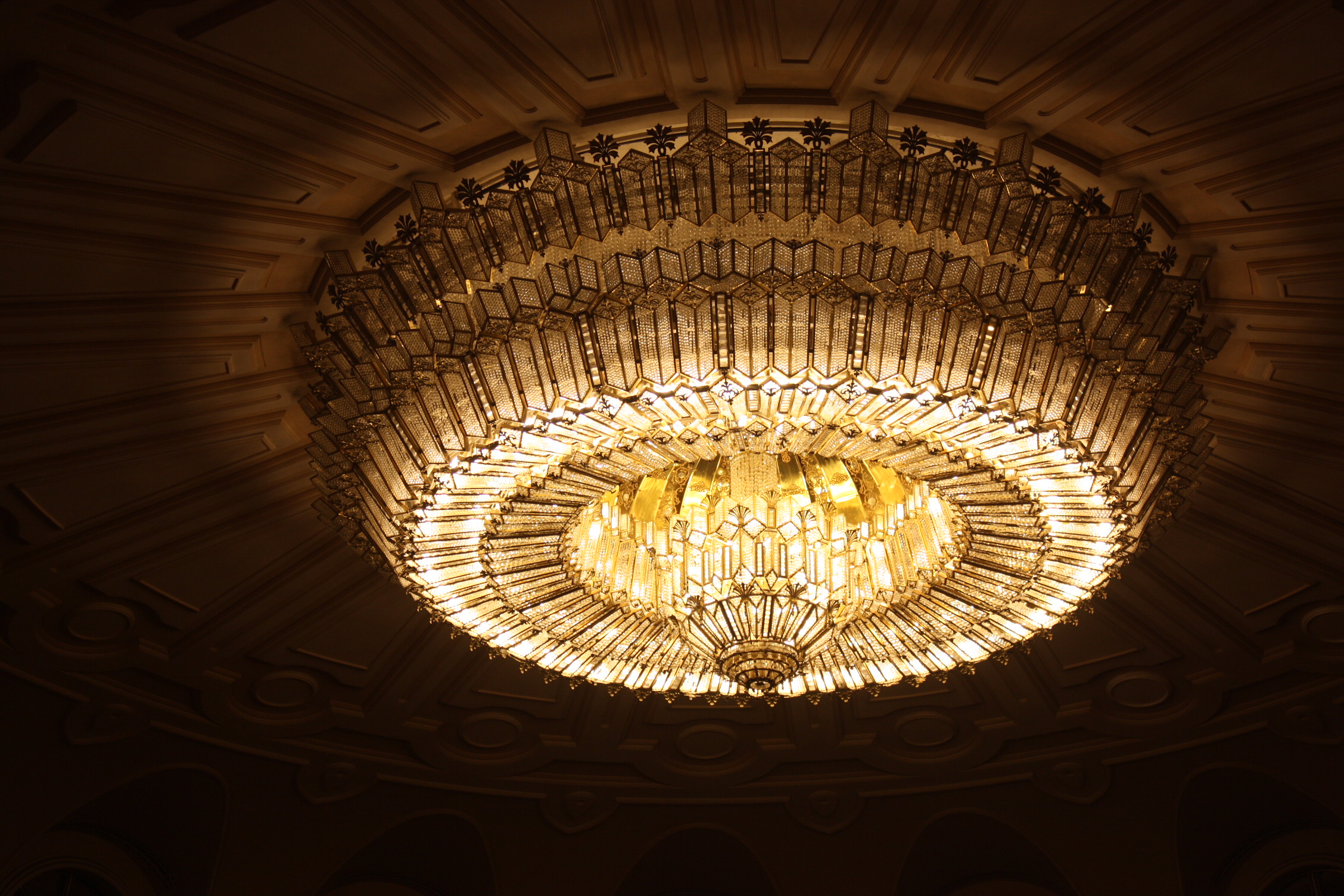
The largest chandelier in the Parliamentary Palace in Bucharest weighs about 1.5 tons.
The Parliamentary Palace in Bucharest is huge. It’s the largest building in Romania and has the second largest floor space in the world. Only the Pentagon in Washington DC is larger. Can you imagine lighting this place. For starters , it has about 3000 tons of crystal in chandeliers. As the tour progressed, I noticed that many of the chandeliers had energy-saving lightbulbs. So I had to ask—How many lightbulbs are there and how many use the energy savers?
Ana Maria, the lass who led our tour, wasn’t quite sure how many lightbulbs there were—she suggested millions and I believe her. It turns out that ALL the palace lightbulbs are energy-savers. Not long after the building opened in 1994, the electricity bill ran about million euros a month. Quick somebody—change the bulbs! According to Ana Maria, the savings have been incredible—the monthly bill is down to 180,000 euros.
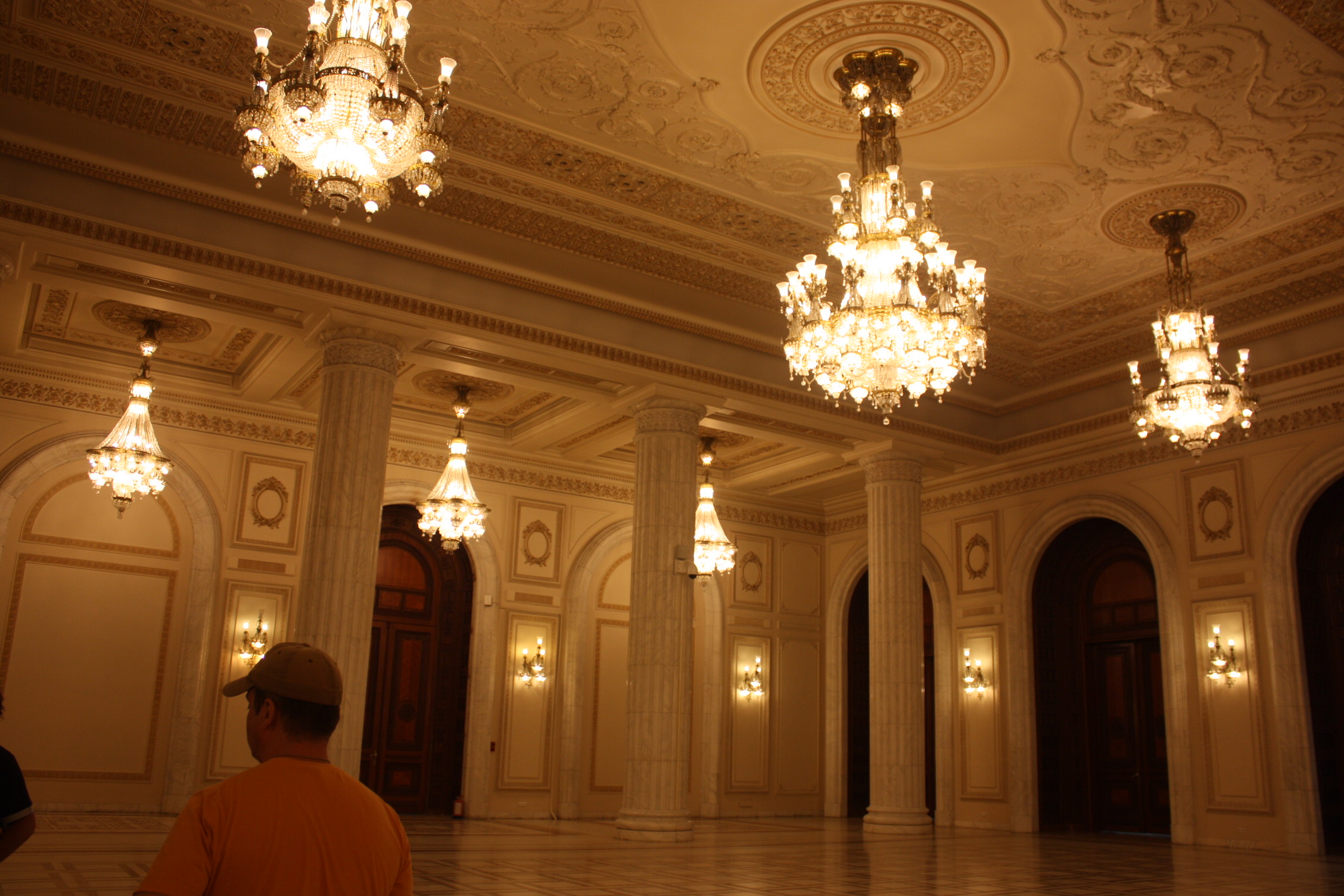
This grand hall has 12 chandeliers and another 16–20 lights on the walls.
I promise to write more—and add photos too—about Romania’s breathtaking Parliamentary Palace. It truly is an amazing and beautiful building. After the tour, Poor John took the time to tell the guide that the Romanian people should be very proud of this structure. Although pleased, she also seemed a bit taken aback. Perhaps because the dictator Ceaușescu originally commissioned the palace for personal use.
If you have time, check out the Madman’s House and A grand avenue in Bucharest.
And don’t forget to pick a number before 29 February 2012.
Toilet paper—or crapper paper as my dad used to call it—is a big issue on overland travel. The ‘bottom’ line is—you supply your own. Nothing wrong with that. How in heaven’s name could an overland company anticipate how much crapper paper one person, let alone a truck load of passengers, might go through in 24 weeks. At the very least, it depends on how good your gut stays. In some circumstances you could use quite a lot.
We’ve been lucky so far—hardly used any of our own paper. Mostly we’ve stayed at campgrounds that actually put paper in the cubicles. Plus most of our daytime toilet stops have been at service stations or supermarkets. Again, there’s been paper on the rolls. Not good paper, I hasten to add, certainly no more than 1/2-ply. Imagine the thinnest paper you can. Got it? The toilet paper is thinner than that. But who cares when there are rolls of it.
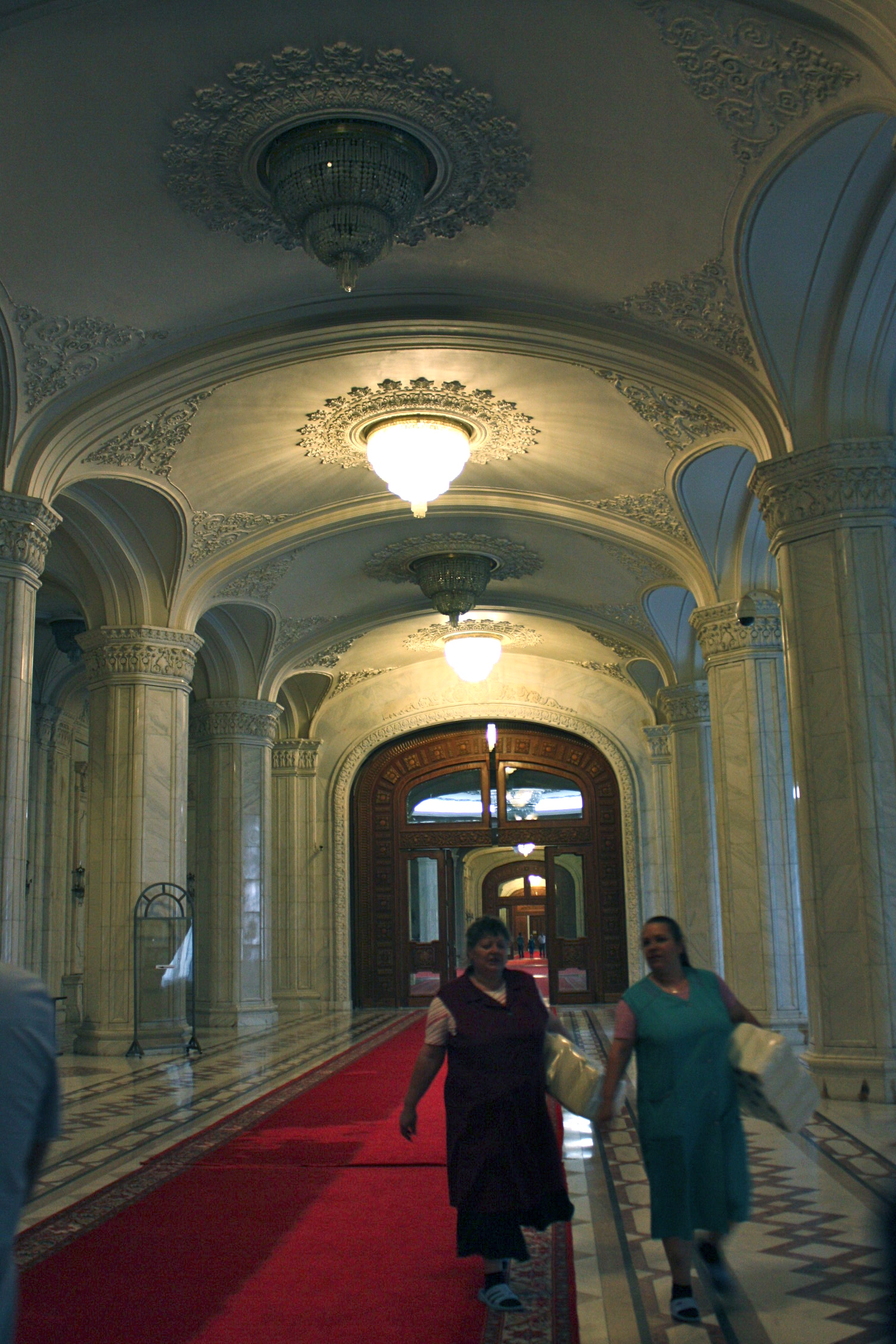
The toilet paper run in the Parliamentary Palace in Bucharest.
The toilet paper in most tourist sites has been just as sorry, but I had a pleasant surprise today. We visited the Parliamentary Palace in Bucharest, Romania. It cost a bomb to build and a slightly smaller bomb get in—a whopping A$12—but the toilet paper was half decent—and it’s okay with me if that’s how they spend all my admission fee. I was delighted to get this quick, and rather dark, shot, of two housekeepers (or are they palacekeepers) carrying giant packs of toilet paper through one of the grand hallways.
I’ll let you know how it goes as we travel east into Asia. From now on, most of the paper on sale will be an industrial-type pink version that is 2-ply but not finger-proof. It lasts a few days at best because there are about 50 squares on a roll. The same stuff was abundant in Africa—in a range of lurid colours.
But I have to add a note about Africa, where toilet paper was even more of a day-to-day issue. Unwittingly, we bought the grandma of all toilet papers in a supermarket in Yaounda, Cameroon. Poor John tracked it down. It was white, 2-ply, soft, sturdy, finger-proof and super tightly wound. The packaging claimed each roll was equal to four. I reckon each roll was more like eight or maybe 20? I felt as if we owned the never-ending roll. The four-pack we bought lasted us for the entire rest of the trip—or about six months. Poor John and I are on the look-out. Wish we could remember the brand name.
Just letting you know we leave Budapest tomorrow morning to set out for Romania. Sunday afternoon we’ll visit Dracula’s castle and that night we’ll camp nearby. If you never hear from me again, you can assume I’ve been vampired. But don’t panic until Tuesday which is when we are likely to have our next internet connection.
As an aside, it’s our turn to cook tomorrow (Saturday). So we’ll see if Poor John, Martin and I can whip up an interesting meal. Cross your fingers for us that we don’t have to cook in the rain (which we often did in Africa). When you cook, you make the evening meal and the next day’s breakfast. You also get to mop out the truck on the next day. Lucinda, our tour leader, helps with the cooking, but she doesn’t do mops. Smart girl.
 Where to next?