
Münster is a vibrant university town in Westphalia in Germany. It’s loaded with shops, cafés, street life, and there’s a scenic lake in the middle of town. There are 300,000 residents and a sixth of these are students. According to the guidebook, it’s the students who keep Münster from being too conservative.
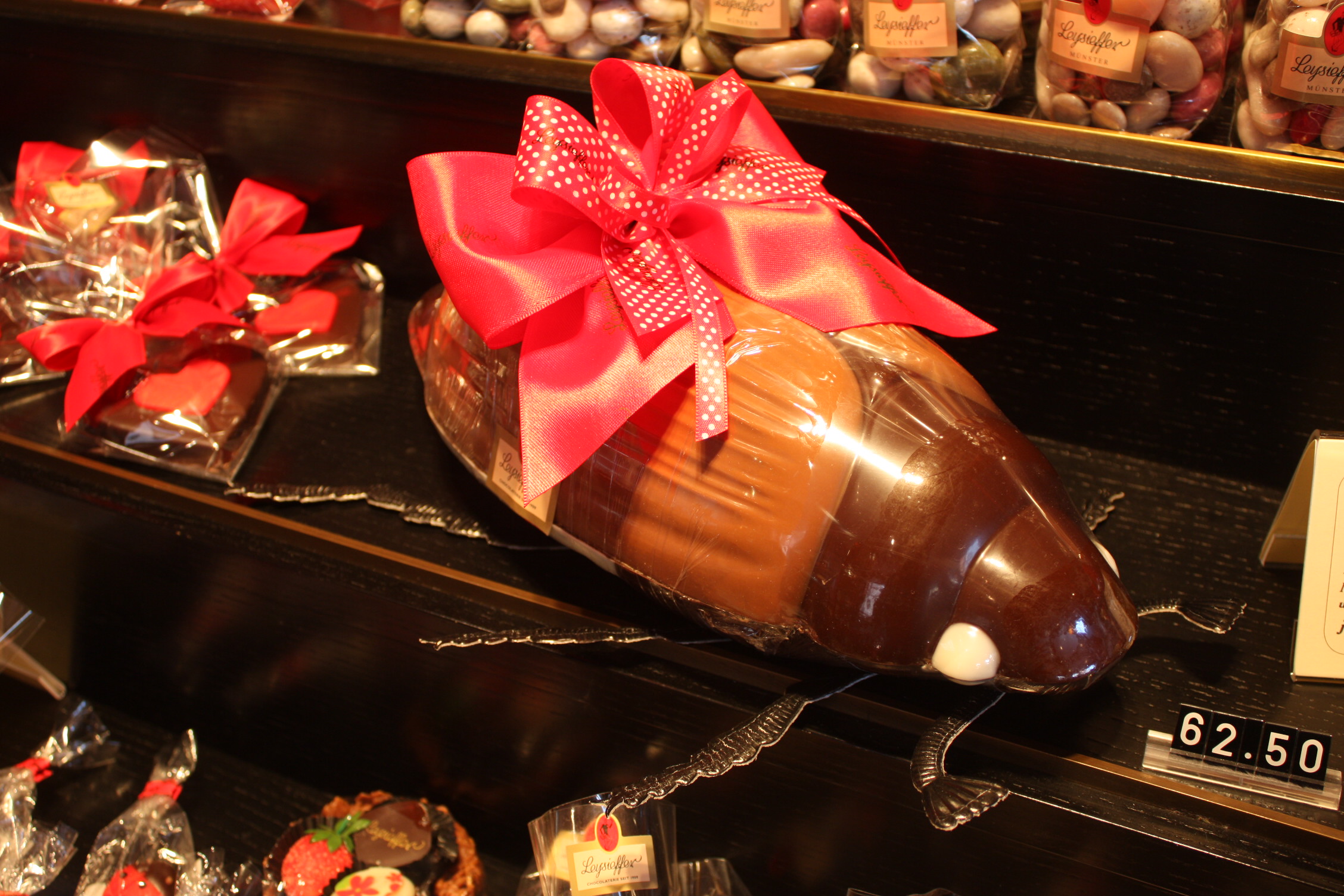
A chocolatier's sense of humour -- a choccie cockroach.
But I don’t know who arranged to have Germany’s best ice cream (at Lazzaretti’s) and chocolate (at Leysieffer’s) in the same town? Honestly, I haven’t yet had enough ice cream and chocolate in Germany to confirm these claims, but the treats are pretty darn good.
We enjoyed the day and the treats with former exchange students and internet friends. From left, the crowd is Poor John, Kirusan, Laura, Lia and Maxi.
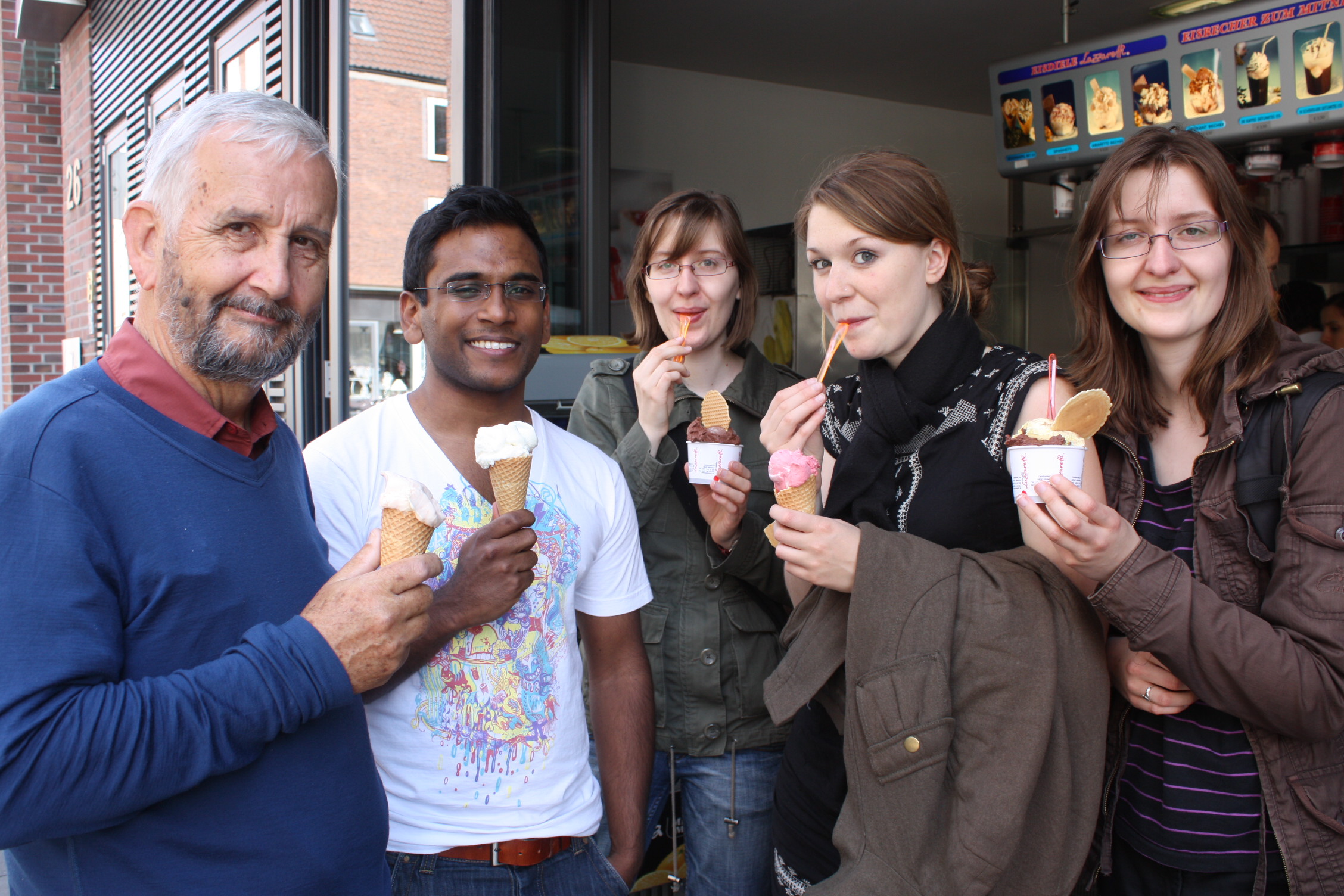
Ice cream at Leysieffer's in Münster.
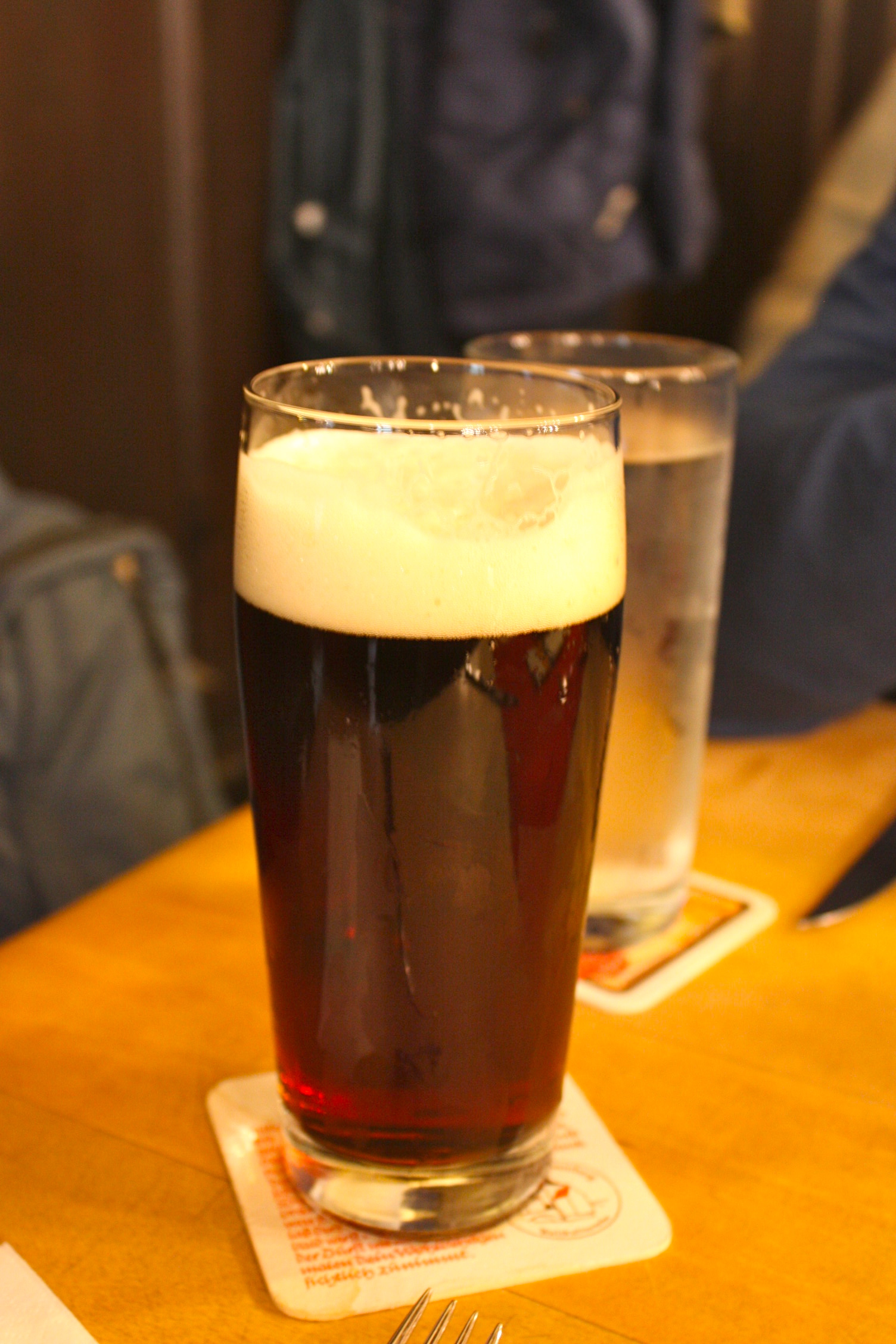
Smoked beer in Bamberg
It wasn’t the best day for it — cold, windy and raining — but we still had a lovely day trip to see Bamberg, a UNESCO World Heritage Site in the Franconia area of Bavaria. Bamberg made it through World War II with virtually no damage, so most of its fine buildings are originals.
Some structures are truly magnificent. The Altes Rathouse (town hall) is perched between two bridges spanning channels of the Regnitz River. One end is half-timbered and two side walls are beautifully painted. The east side is especially playful, with a cherub’s leg sticking out from the fresco (hope you can see it).
We also visited the Benedictine Kloster St Michael, a former monastery that is now an aged care home (sorry no photos), and the enormous Dom (cathedral). You can see how Poor John is dwarfed in this Romanesque–Gothic structure. It was burnt down twice in the 12th century and ultimately took more than 20 years to rebel. I loved seeing its array of organ pipes. And we both took note of the knight on horseback. His popularity seems to lie in the fact that no one is sure who it is.
Because Bamberg is a bit off the beaten track, it’s not packed with tourists — although it was hard to find a table at the popular Wirtshaus zum Schlenkerla, a 16th century restaurant where we had a Franconian lunch. The picture of the interior is after pic of the food. I enjoyed a version of their own smoked beer (Rauchbier). Apparently Bamberg is famous for its beer, with more than 200 varieties produced locally. Pity I couldn’t stay long enough to try them all.
But more soon on the many beers I’ve tried across the country.
Also: Don’t forget to pick a number by 29 February 2012.
Yesterday morning was like a nail-biting segment of The Amazing Race.
Poor John and I had to be at the Berlin Hauptbahnhof (main train station) by 10:26 to catch a train to Hannover and then on to Oberhausen. We left the flat about 9:20 and had oodles of time. After all, we had fewer than 10 underground stops to go. The fact that we would have to take three different trains really shouldn’t have mattered. Normally, the route to the next train is clearly marked. Coming out on one train, you turn right or left and follow the signs and arrows. You may have to run up or down a set of stairs or two, or maybe even cross the street. But in no time, you are usually at the new platform and the next train is pulling in within five minutes.

One of our hurdles -- an escalator with no steps!
Not today. We have been staying near Nollendorfplatz Station and there is construction work on the train lines in both directions. This has never really presented a problem. It simply means that to go almost anywhere else, you have to go at least one stop east or west and then change trains. Generally we have gone one stop west and changed at Wittenbergplatz. Today we studied the map and decided to head two stops east to Potsdamerplatz. It appeared to have three train options available to us, rather than the lone one at Wittenbergplatz.
Big mistake. When in a hurry — avoid Potsdamerplatz! The place is huge and maze-like. The various types of train stations are poorly marked and spread across great distances. We were on a U-train and wanted an RE-train. The S-trains were fairly obvious, but quite a hike away. After scrambling around the station it turned out that the RE-trains are ‘sort of’ co-located with the S-trains. Duh! But where are the signs? Anyway, we got to the RE-trains only to discover the next train to the Berlin Hauptbahnhof wasn’t until 10:26. Exactly the time we needed to be pulling out of the Hauptbahnhof! Yikes!
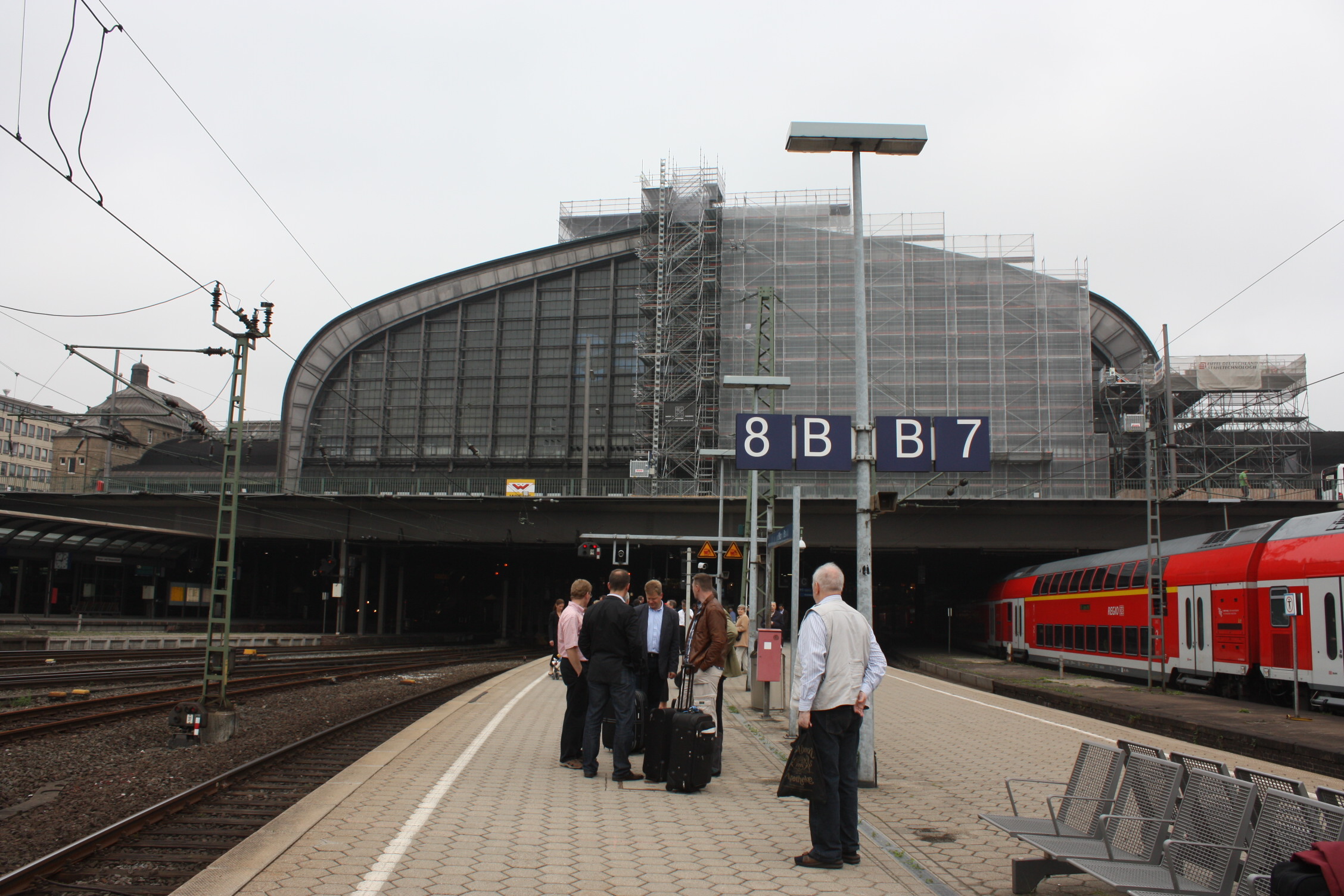
The station at Leipzig taken on a day we weren't in such a rush.
So it was a mad scramble back through four U and S-trains to streak into the Berlin Hauptbahnhof and down four flights of stairs to Platform 7 just a minute before the train left.
Poor John usually likes to cruise along the platform, choosing his first-class train car carefully, but today the bully in me said — Just get on the train.
There’s a chance — just a chance — that John and I will be the innocent bystanders in an action movie being filmed in Berlin. What movie you ask? We don’t know.
We walked to the Kaiser Supermarket this morning to return a bag of bottles for recycling and saw what appeared to be a car–bus accident on the intersection of Bülowstraße and Maaßenstraße in Nollendorfplatz (by the way, I can pronounce all these names now).
A lot of people were milling around. It was raining lightly. Passengers on the bus were snapping pics with their mobile phones and a plastic-wrapped camera rigged on a car seemed to be taking pictures of the scene. Poor John reckoned it was a police camera or a breathalyser. I wasn’t so sure.
Nothing seemed to be happening so we popped into the supermarket and ‘fed’ the bottles into a soft-drink-sized recycling machine. You feed them in one at a time, bottom first. The machine gives the bottle a roll and then calculates the value. A large plastic bottle is worth 25 cents, while a beer bottle is only worth 8 cents. We collected a grand total of 1.59 euros, or enough to buy two large beers, which we didn’t because the bottles didn’t belong to us. We’ll hand over the refund docket to our hosts tonight.
Next we popped over to the Wednesday street market and bought two West African curries for lunch — one was with a green sauce and the other with an lemon–olive sauce. They could be served over couscous (mine) or rice (Poor John’s). We had a nice chat with the shopkeeper, who is from Senegal, and enjoyed listening to some authentic Senegalese music. There was a real cloudburst while we were there, so we ate standing and sheltered under the awning of his food van.
But back to the movie. We went for a walk after lunch. More cars were scattered along the middle lane of Bülowstraße — all parked — and there were people everywhere with walkie-talkies. Two were going from car to car, chatting to the drivers. John speculated that a dignitary was about to show up, but I figured the cars were too tatty and dirty for that. He is usually the better detective, but this time it dawned on me first that we were standing in the middle of a movie set. This was confirmed when we saw a sign posted on a doorway, stating that the street would be closed from 9:00 to 20:00 both today and tomorrow for filming.
We walked on a bit and suddenly the motorbike–car chase began. Surprising how they managed it in such a short stretch. Only about two blocks of road were cordoned off. The motorbike rider, kitted out in the to-be-expected sinister black, slalomed his way through 12 or 15 cars, and then it was over. All the cars pulled forward to the barriers blocking the road, and one-by-one did a U-turn and went back to their positions for, no doubt, another take.
Were we caught on film? Will we ever see this film? Probably no and no, but it made for an interesting day.
Sorry about the lack of photos. Wouldn’t you know, it’s the one time I didn’t take my camera.
I’ve had a great time massacring the German language this month — and I’m getting better and better at it, or worse and worse. Depends on your point of view. I must admit that I studied German in high school (junior high too). My junior high years of language study were a very long time ago and were very much better than the years in high school. In fact, in junior high (years 7–9) I learned so much German and in the old script. Even now not many Germans learn that script — except for ß (the scharfes s). But sadly, I have rarely used the language. As a result, it is buried under 40 years of less useful information.
But being in Germany is bringing it back. I can’t really string together too many sentences, but I manage. Why doesn’t school put more emphasis on verbs? I can remember heaps of nouns, prepositions and adverbs, but where are the verbs?
I remember ‘to know’, ‘to go’, ‘to live’, ‘to want’, ‘to buy’ and a few others, and mostly in the present tense. Clearly that means I never ‘knew’ anything or ‘went’ anywhere. No doubt, Poor John is relieved that I never ‘bought’ anything.
But I outdid myself tonight. In fact, Maren and I outdid ourselves.
We returned to Berlin from Hamburg. Our host, Lutz, speaker of many languages, stayed on in Hamburg (he’ll be back tomorrow). But his partner, Maren, was in Berlin. Maren is proficient in many languages, but has never really learned a lot of English. Tonight was our chance to shine.

Maren and Nora
Gosh we had fun. Our combo of English, French and German served us well. We managed to use all three in one sentence — frequently. I even taught her a useful expression in Arabic.
Have added a pic of Maren and her lovely daughter, Nora, who has visited the US briefly and acquired a very strong American accent.

The rain on Am Langenzug in Hamburg.
Hamburg had torrential rain today. It bucketed down for about an hour, but in no time the water was halfway up hubcaps and the ducks were taking shelter.
I’m not sure how much rain fell, but according to the very prompt news posted online by Hamburg’s newspaper, in every minute about 40 litres fell in every square metre (or about 10 gallons in every square yard). Mühlenkamp (a street just around the corner from where we are staying) and the Central Train Station were among the hardest hit. The station was inundated and so were many shops. The local newspaper has 20 pics from around town that you can probably see here http://www.abendblatt.de/ if you are quick (be sure to scroll down to the pic of the guy whose car is almost submerged).
I took some pics from the protection of the flat’s balcony, but even then I got a bit damp and pelted with small hail.
The water on the street was gone in no time and after the storm, we headed out for dinner — down Mühlenkamp and on to Gertigstraße — to a nearby tapas restaurant. Lots of shops in the area are at garden level and those shopkeepers were struggling to bail out the knee-deep water. Within 30 minutes or so, fire trucks began to arrive to help pump out shops that were the hardest hit.
The slideshow is pretty self-explanatory — and the tapas were delicious. As an aside, Lutz says he has never seen his street flooded like this and he has lived in the same place for 25 years.
I’ve been surprised by the lateness of some trains. Doesn’t Germany always run to schedule?
The Frankfurt to Berlin train left eight minutes late, which was good for us because it meant we didn’t miss it. But by the time it reached Berlin, it was 21 minutes behind.
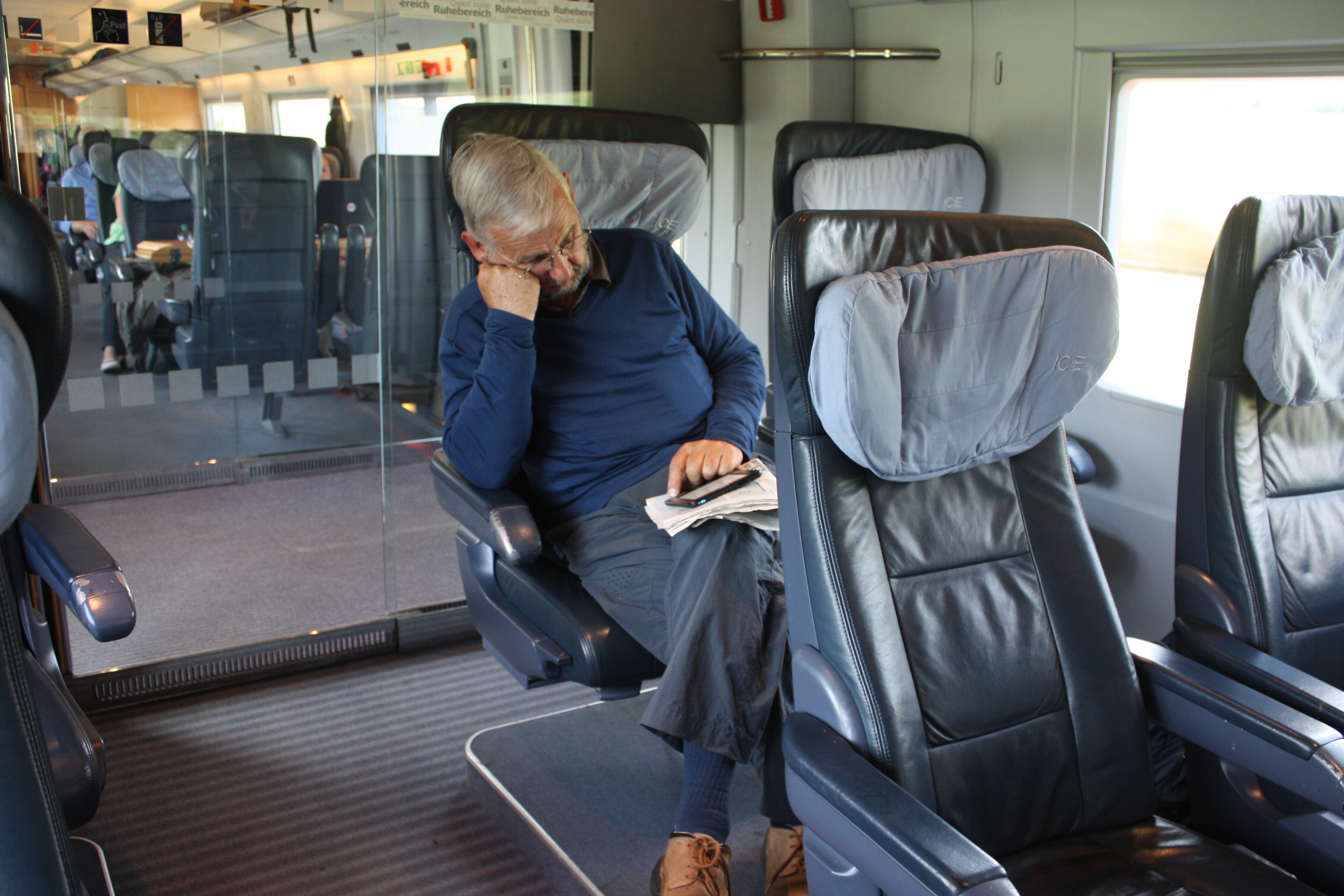
Poor John enjoying first-class train travel.
Thursday’s Bamberg to Augsburg/Munich train seemed to dematerialise. The electronic sign said the train would be late, but would still depart from platform 4 (I can still read enough German). Quite a few trains were running late — it was raining and the next day was a holiday. There was a lot of commentary in German and I listened intently for any mention of Augsburg or Munich (München) — nothing. So it was frustrating to stand on platform 4 and suddenly see that the destination sign had changed to Würzberg. Apparently, the Augsburg train departed from platform 6 at the last minute, but the announcement wasn’t made in English and wasn’t identifiable in German either.
Another train was due to depart in 30 minutes, but it actually didn’t leave for an hour. Those extra 30 minutes were a boon for holiday makers. Waves of them crammed in, so by the time the train pulled out of the station, even the space between carriages was full.
But it really doesn’t matter — we aren’t running to a timetable.
Afterall — look at Poor John sleeping/reading yet another book in his plush surroundings on the train. And check out the chocolate (edible label) that you get in first class.

First-class chocolate.
No doubt there is the usual outpouring of concern regarding the well-being of Poor John. Oh, pleeeze!
We aren’t quite into week three of our travels and so far he has read The Black Sea by Neil Ascherson, Another Kind of Traitor by John LeCarré, The Call of the Wild by Jack London and a few cheap suspense novels for which he can’t remember the titles, two other detective novels on his Kobo (electronic reader), a couple of PG Wodehouse books (also on the Kobo), and The Man Who Smiled by Henning Mankell. He reported that last one with his own sly grin.
It used to be that I delayed operations because I had to have a quick cigarette, but now that I have stopped smoking, we wait for Poor John to finish a chapter.
Recently the book supply was getting worryingly low, so we made several forays into bookstores that carry English titles. Books are cheap here compared to Australia, and we’ve bought seven or eight titles, or maybe it’s 10 or 12?! I’ve selected a few, but have so far resisted buying yet another cookbook. I was briefly tempted by Hunde Cookies (Dog Cookies) by Jeff Simpson, but remembered that our dogs will eat anything. Watch for a ‘Those Damn Dogs’ entry soon.
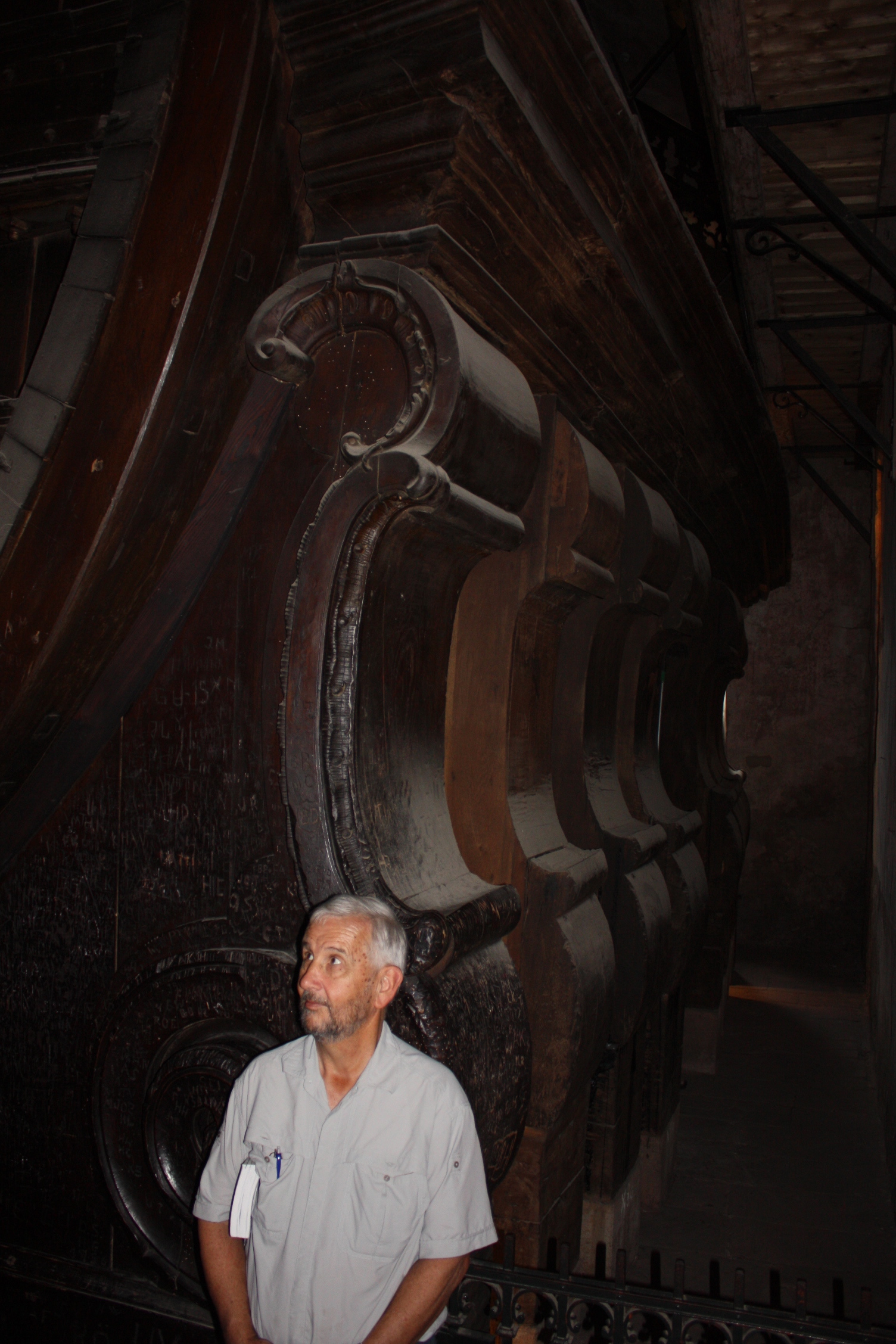
John using the giant cask as a back-scratcher.
Anyway, for those of you who need to see evidence of Poor John’s condition, he is pictured here in the cellar of the Heidelberg Schloss (castle). Behind him is a gigantic cask. Supposedly it can hold 228,000 litres of what I can only assume must be some pretty terrible wine. In the old days, the locals could use a tap to siphon off a daily jug of wine. Poor John appears to be standing innocently in front of the cask, but don’t be fooled for a moment. He was actually surreptitiously scratching his back against it. He does that at home too, but against the wall between the kitchen and family room.
As an aside, if you click on the small pic, you will get a larger version that let’s you see just how much dust has collected on that cask.
From Mainz, we took a day trip to tiny Bacharach, population less than 3000. The guidebooks really are right — Bacharach is one of the Rhine’s prettiest villages. On top of that, it’s famed for its vineyards and wine trade. Pity that I didn’t try any. 😦
The village is surrounded by a fairly well preserved wall, filled with charming half-timbered houses and overlooked by the impressive Burg Stahleck. This 12th century castle/burg has been the local youth hostel since 1925. It takes about 15 minutes to reach it by walking up a near-vertical path.
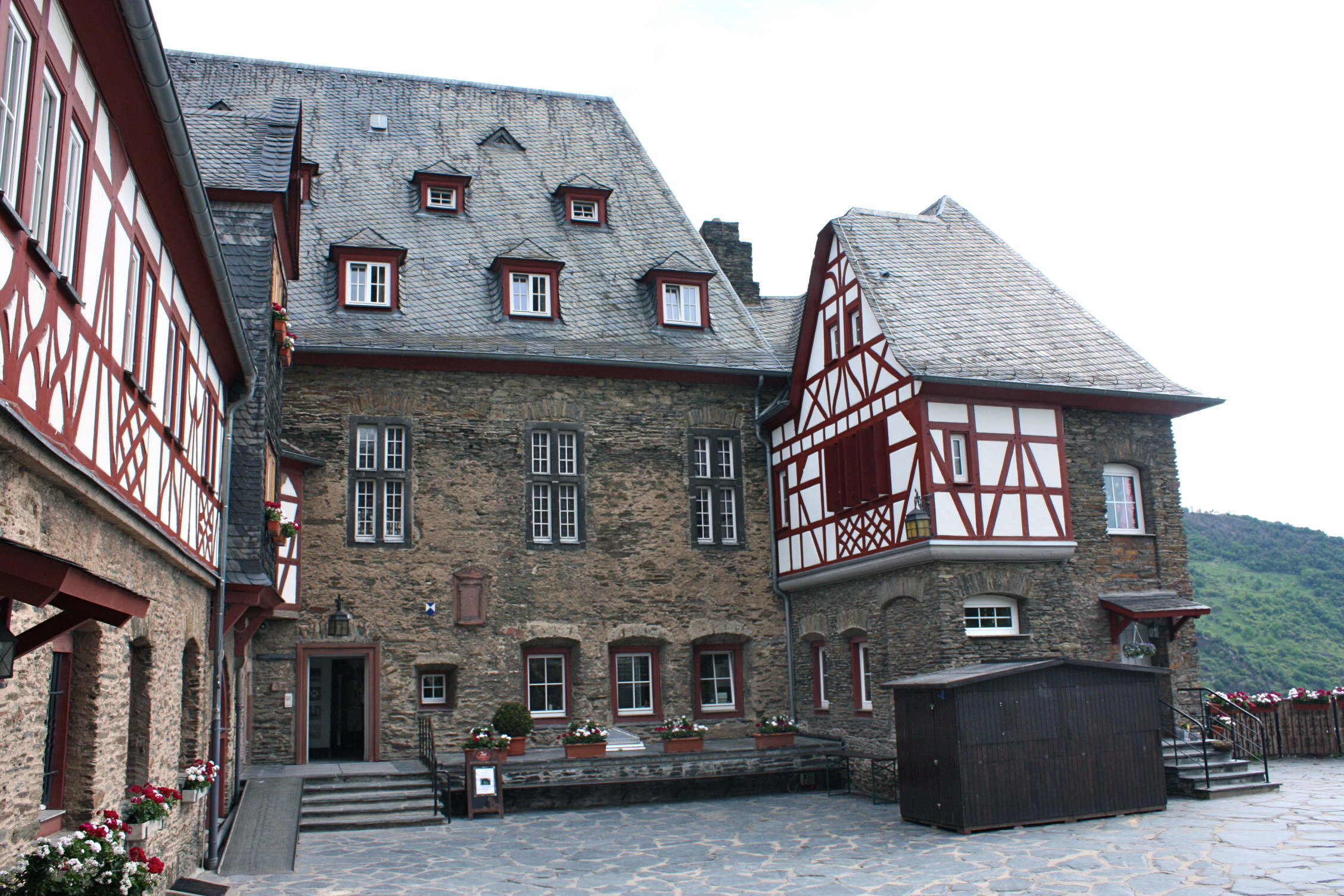
Entry to the youth hostel, Burg Stahleck.
We stopped in the tourist office to get directions to this main path and were quite amused by the brusqueness of the woman holding court there. She was more than pleasant to us — like her, we are people of a ‘certain’ age and so we knew how to jolly her along. But she took no nonsense from the young Canadian woman in front of us who made the mistake of asking, more or less, the same question twice. I understood the nuance in her second inquiry, but that aspect of English was lost on the tourism adviser. The Canadian got a gruff, ‘I just told you that,’ followed by a stern harumpf.

Ruins of the Wernerkapelle (Werner Chapel) in Bacharach, Germany
When you arrive at the top of the hill, it’s surprising to notice a wheelchair ramp that takes you up to the hostel’s reception office. How in the world could anyone in a wheelchair make it to the top? Obviously, it’s less of a mystery when you realise you can also drive to the castle.
We skipped the cake and coffee on offer at the top, and followed a side-track down to the eastern edge of the village. This gave us great views of the vineyards on the opposite hill.
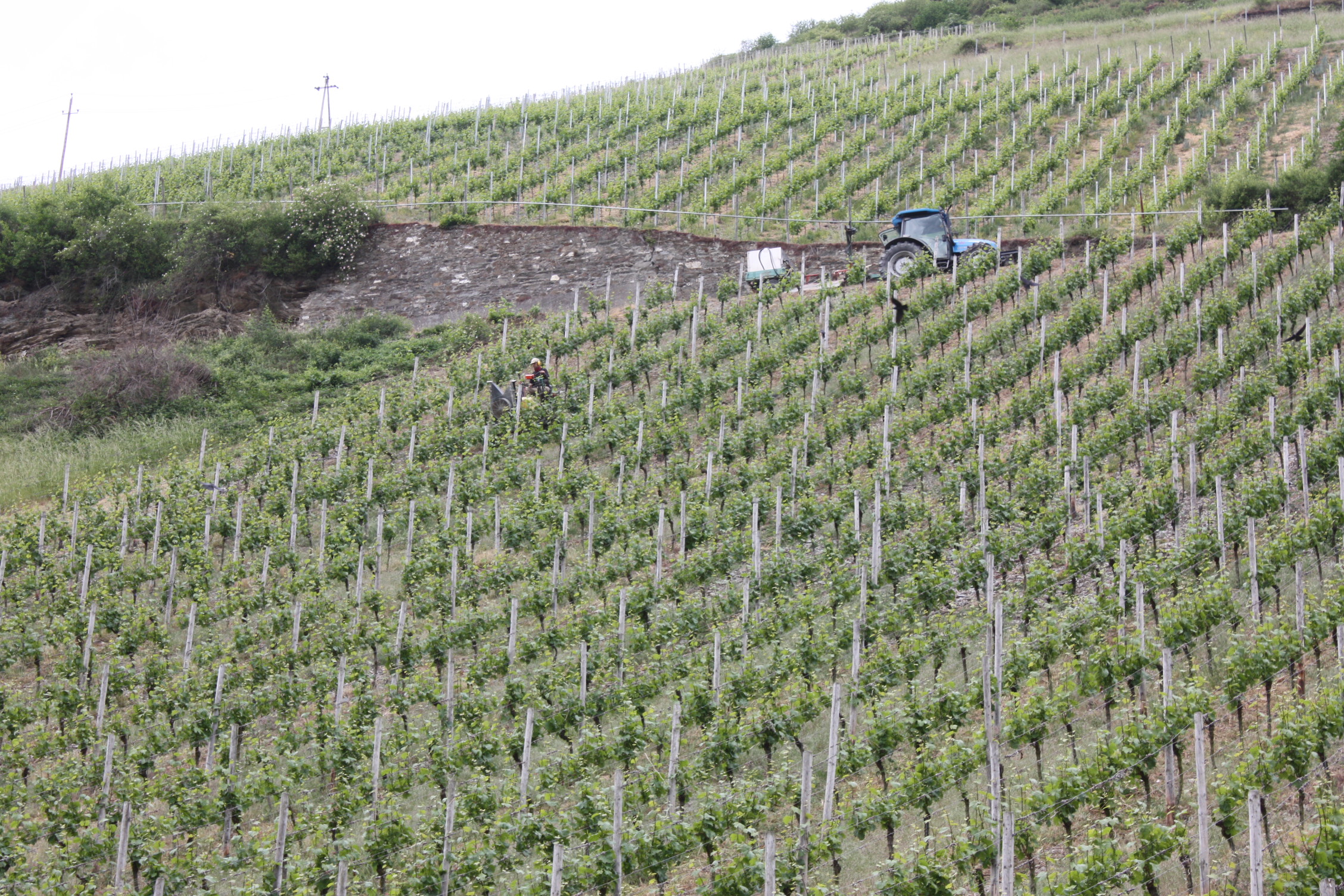
Crop spraying in the German vineyards.
Once we reached the bottom, we scaled some of that opposite hill to watch a vintner spraying his crop. His ride-on machine was surely a 4WD, as it putt-putted happily up and down the ultra steep slope. Don’t think I could ride it. In fact, I told Poor John that I wouldn’t be buying such a piece of equipment unless the salesman demonstrated it first — repeatedly.
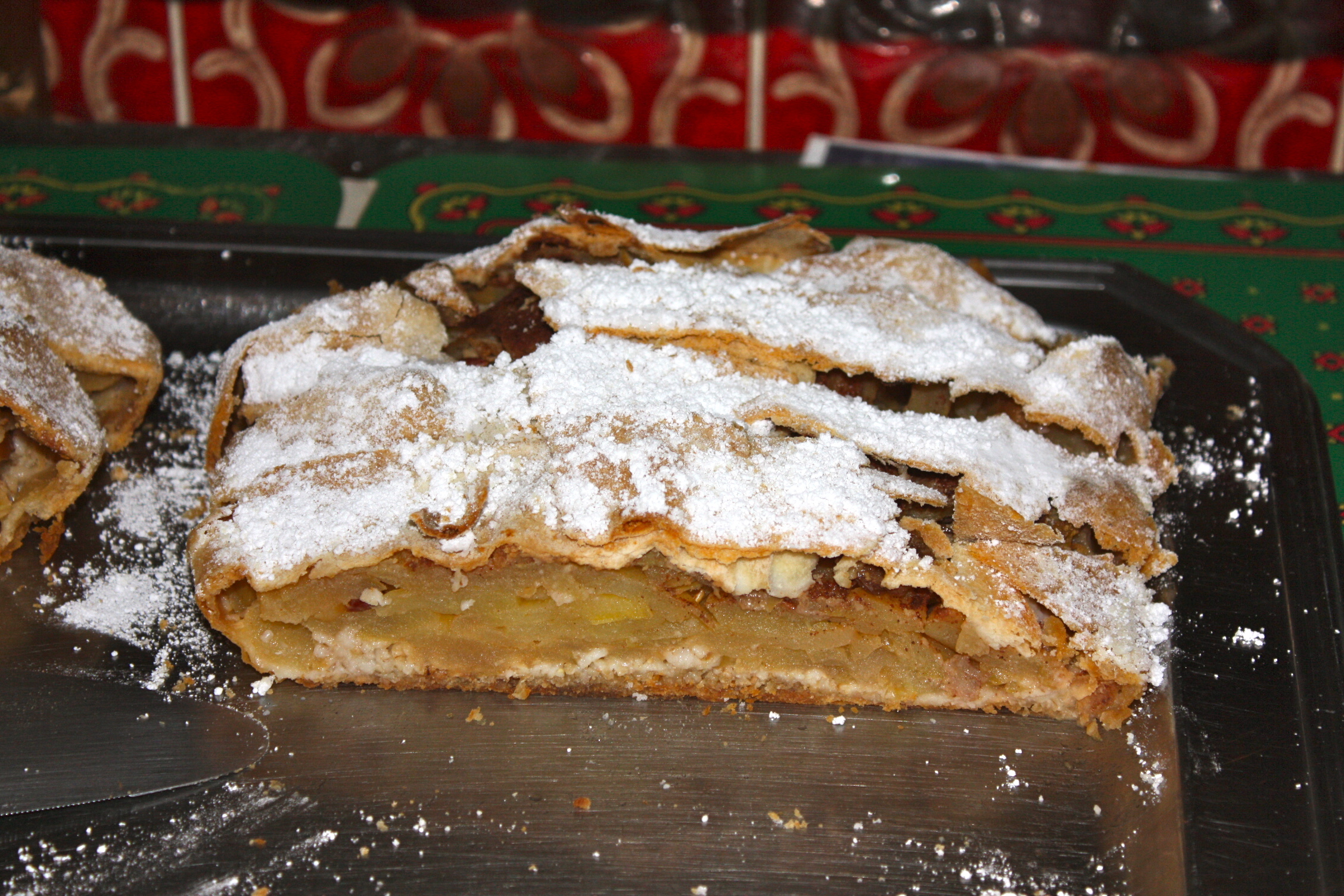
We took lunch in a picturesque little pub on the main street. It’s featured in a few guidebooks, so was suitably crowded. I’ll insert the name and url here when I re-find the postcard. The woman who served us — the owner I assume — has covered the interior walls with her paintings of horses. The apple strudel was laid out too, and I’m sure few could resist the temptation. We did — only because we ate outside and didn’t notice it until paying the bill.
A special stop in Mainz was at St-Stephan-Kirche to see its beautiful stained glass windows created by the Russian Jewish artist, Marc Chagall. These nine magnificent windows are predominantly blue, and serve as a symbol of Jewish–Christian reconciliation.
The church is perched on probably the only hill in Mainz, and Kirusan was quite pleased we found it. He has shown visitors around Mainz in the past and never seemed to be able to track down the entrance. All the pictures in the slideshow feature the windows.
 Where to next?