
I forgot to tell everyone about the little drama in the airport on the day we arrived in Germany. A suitcase was left unattended!

An ownerless bag in the rail-airport terminal in Frankfurt.
You have no idea how lonely a little carry-on flight bag looks when it is cordoned off — all by itself — in the middle of a rail/airport terminal. Especially in a city as busy as Frankfurt. It took a while for the authorities to realise that no one ‘owned’ this bag. The first step was to shoo everyone away from the machine that spat out rail tickets. Then came the don’t-cross-this-line tape and plenty of officials looking worried and grim. We watched all this from just a few feet away — while waiting in line to ask about buying a Frankfurt Card which would give us two days of discount travel. After waiting almost 20 minutes, we learned we were at the wrong ticket office (‘Go upstairs please to the middle floor’). By the time we returned, the bag was gone and so was the police tape. We’ll never know if the owner appeared or if the bag was executed.
But we had a little surprise at the Frankfurt Card office. We hadn’t said a word, but as we approached the counter, the saleswoman said, ‘Oh, you must be Australians’. Poor John has a theory that Australian travellers are always easy to spot. He rests his case.
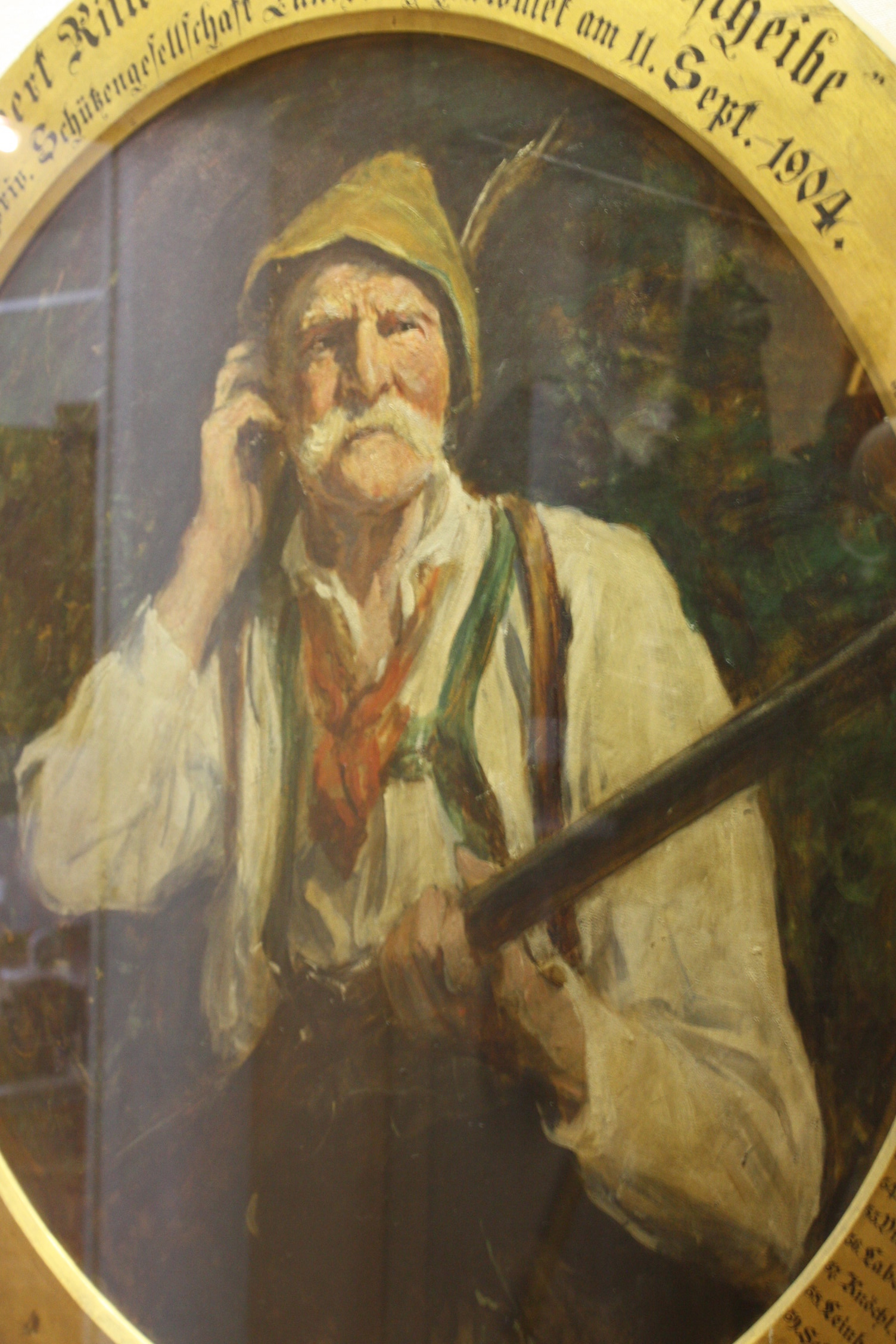
Huntsman on an early version of the mobile phone?
In the 1970s, I dated a fellow who, I was told, was the first person in Nebraska to have a mobile phone ‘for fun’ rather than ‘for business’. It was an old clunker of a thing — not as big as the car, but certainly as big as a brick. It was fixed to the car, and could be set to honk the horn when the phone rang. Scared the wits out of the cat once.
Then I visit Bavaria in Germany and find that they must have had mobile phones since at least the early 1900s. You doubt me? This pic is of an oil painting done in 1904. I photographed it yesterday in the city museum in Landsberg (not far from Augsburg). You tell me — is this huntsman/farmer using a mobile phone or not? I can hear him now — ‘Hey mate, which way did that pheasant just go?’
Currywurst is popular and cheap fast-food in Germany. It’s a wurst sausage, slathered in tomato sauce (ketchup) and sprinkled with curry powder. You can often get hot chips (french fries) and a drink on the side.
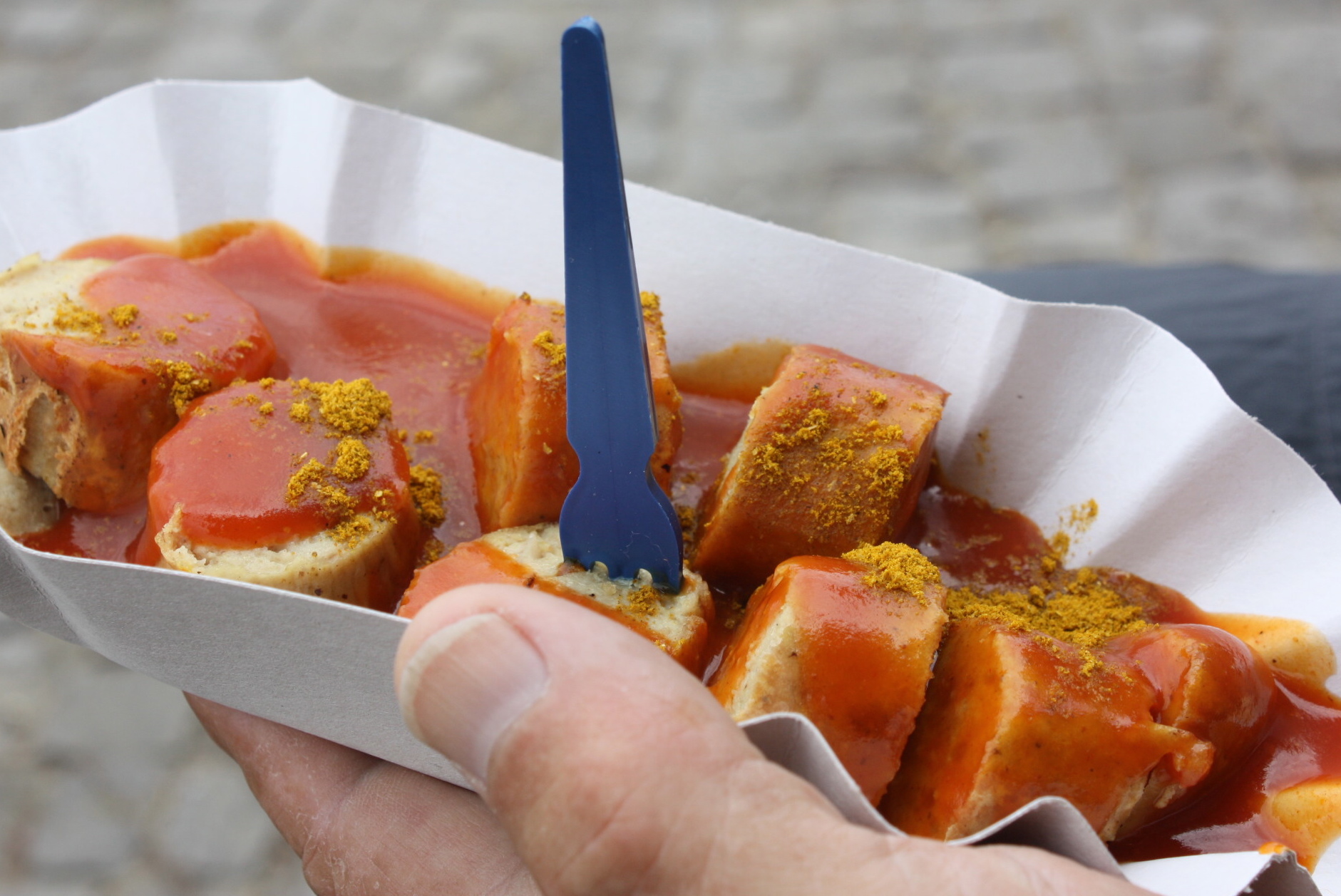
Currywurst -- this time in Berlin.
According to Kirusan, who was on exchange with us in 2006, there is a huge rivalry as to which outlet of Best Worscht in Town has the best wurst in the country. He reckons the winner is from his hometown of Oberhausen. Given that we are visiting a lot of German cities, Kirusan thought we ought to start our own judging. When he took a bit of time out from his engineering studies at a university in Darmstadt to show us around Mainz, he also introduced us to a nearby Best Worscht. We had to admit that it makes a pretty good snack. Also got a good laugh from the bratwurst menu item named a ‘Long Dong’.
I was keen to revisit Mainz — I remembered loving it when I was there in 1976 — so we made a side trip there from Frankfurt.
Mainz is on the confluence of the Main and Rhine Rivers. It’s also home to the wonderful Gutenberg Museum.
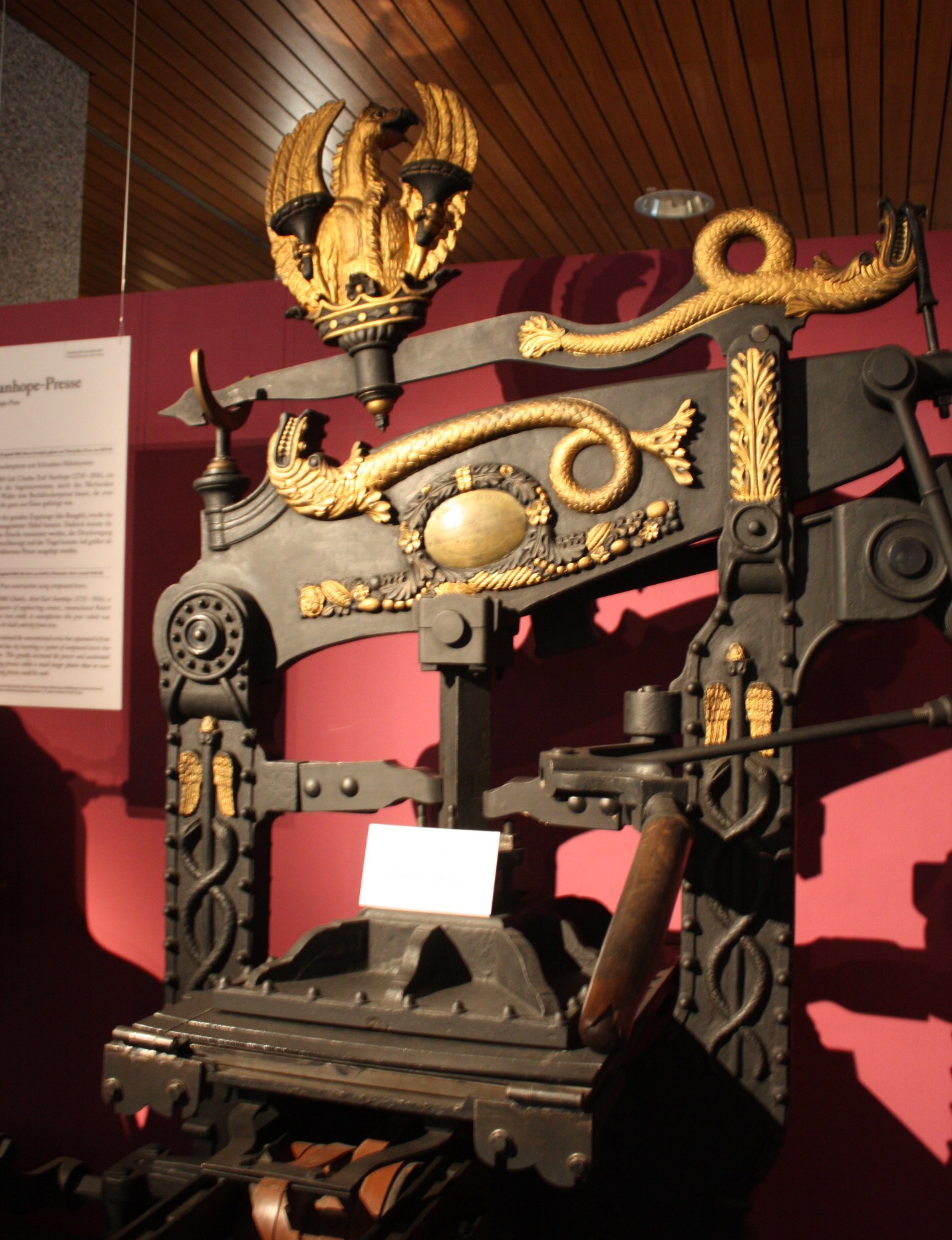
Columbia Press in the Gutenberg Museum
My background in publishing made our trip to the museum all the more interesting, and I managed to sneak in one photo before being told that photos aren’t allowed. Our daughter, Libby, works in the Australian National Museum. She has schooled me well and I really do try to observe museum rules as I know how precious the contents can be. I always look for an indication as to whether photos are permitted. And if they are, I never use the flash. But in this case, I missed the sign entirely (and never even saw one on the way out). Anyway, the one pic I did snap shows the gold embellishment added to a Columbia printing press, as an early form of advertising/self-promotion. Just so you know, once you’ve taken a rogue photo — whether intentionally or accidentally — the guard keeps a pretty close eye on you.
Lutz and Maren, our hosts in Berlin, tell us that at least one very visible aspect of East Germany has been retained all these years after the collapse of the Berlin Wall in 1989. That’s the Walk and Don’t Walk characters on the traffic lights. Berlin’s little green and red men have jaunty hats and stand in a steadfast pose — arms outstretched — or stride purposefully across the street.
The figures have even made it into a variety of commercial uses, such as t-shirts, pens, key rings and even the lounge chairs used by sun-seekers along the River Spree.
Poor John, who is observant in so many ways, hadn’t noticed that the traffic light characters were different in Berlin. I’m guessing he had never taken notice of them anywhere in the world. Perhaps he was just way, way overdue for the cataract surgery he had earlier this year.
Also: Don’t forget to pick a number by 29 February 2012.
We cracked the Uzbekistan visas — but not without spending quite a bit of time and money.
Almost two weeks ago, we handed in our passports and applications at the consulate in Frankfurt. We were there on spec so didn’t have the required Letters of Invitation. But the fellow at the counter assured us that these ‘LOIs’ wouldn’t be necessary — he’d just ask his foreign office if it would be okay to issue the visas anyway and he was confident they would say yes.
So there we were a week later to collect the news and, we hoped, the visas. By 9:30 there were already seven hopefuls ahead of us and the queue moved very slowly.
The waiting group formed more of a circle than an orderly line, and I worried that turn-taking would be random at best. I needn’t have been concerned. The guard who seemed to doubling as a travel agent (or vice versa) made sure everyone observed the honour system. He also shooed away anyone who tried to park in front of the consulate — ‘verboten, verboten,’ he warned as he waved a no-no-you-don’t-stop-there finger at them.
You can appreciate my confusion as to whether he was a guard or a purveyor of Uzbeki holidays. He wasn’t wearing any type of uniform — rather a navy polo shirt, khaki camping shorts, khaki leather loafers (is that an Americanism? — if so, I mean slip-on shoes) and pale grey golf socks. He was quite tanned and had sunglasses perched on his head. He spoke a bit of at least three languages, possibly more, and handed out travel leaflets and mini calendars to everyone in the queue.
Through hand signals — will you be using a steering wheel or flapping your wings? — he established that we would travel to Uzbekistan overland. This dismayed him — possibly because his leaflets promoted air and rail travel! But his greatest concern seemed to be that we would be passing through Georgia. His charade made it perfectly clear that in Georgia we ran a real risk of being mown down by machine-gun fire.
All this and we still hadn’t made it to the visa counter.
But our turn did come. ‘Yes, yes, the visas can be done’, said the fellow, who actually did remember us. We just needed to walk to the bank, cough up 80 euros each and return with the receipt. He didn’t mention, but perhaps he didn’t know, that the bank was going to charge us an extra 5 euros for the privilege of depositing money in an existing account. No wonder Frankfurt is the commercial/financial centre of Germany.
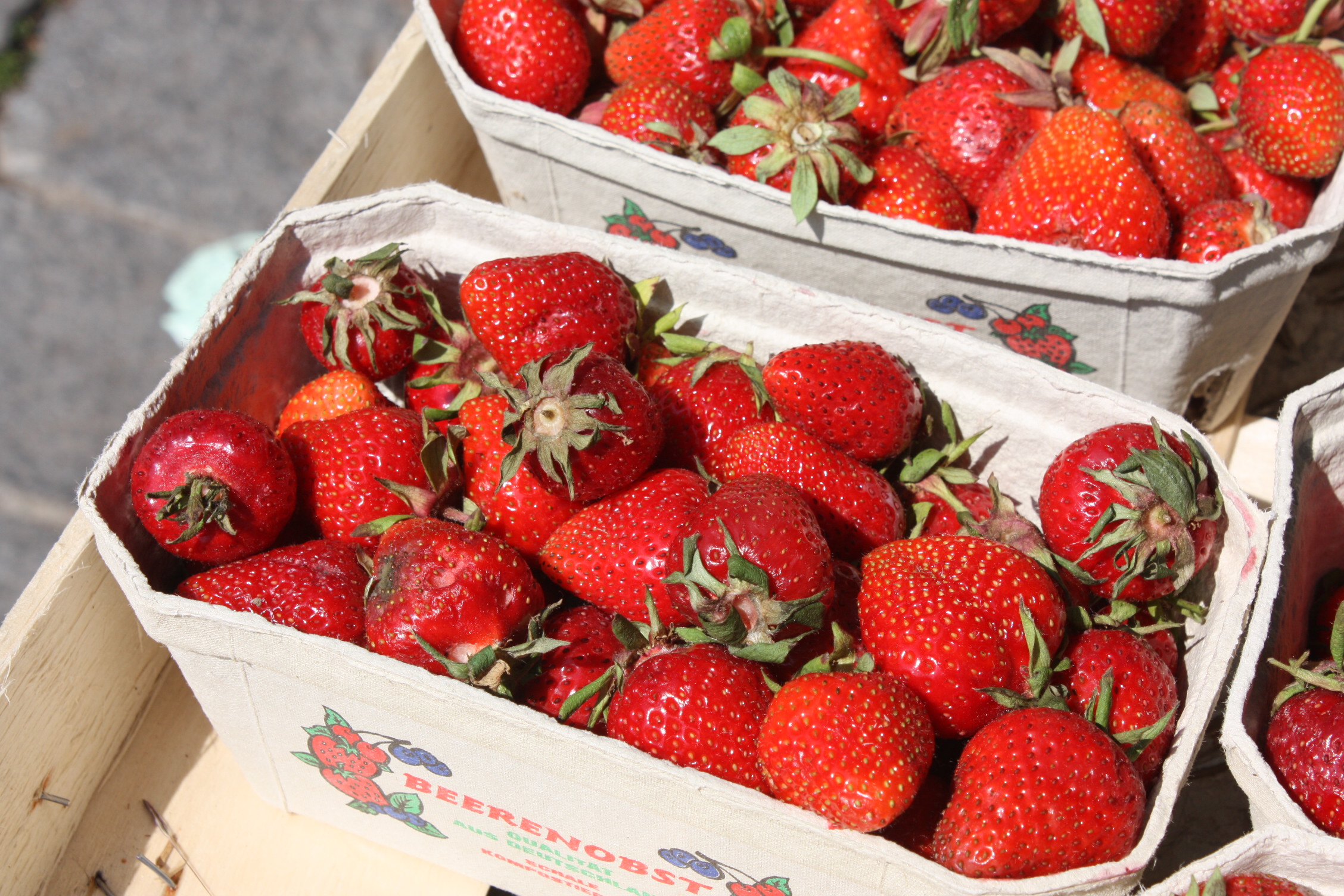
Strawberries
From a food point of view, we certainly picked the right time to be in Germany. Spring is when strawberries and asparagus are in season. And I don’t mean plain ole green asparagus. This is the white stuff, with each spear as big around as your thumb (or bigger) and about 20 centimetres (8 inches) long. The strawberries are huge too, and as sweet as can be. We had both for dinner tonight.
I helped our hostess to prepare the asparagus. Here’s what she did. Trim just a bit off the end and then peel each spear with a potato peeler. Wash well and cook in boiling water til tender (add a scant teaspoon of sugar to the boiling water to counter any bitterness and a bit of salt too). Drain, toss with butter and sprinkle with a good quality, grated parmesan. Serve. Eat with a knife and fork so you can ward off anyone who tries to steal your share.

White asparagus
I’ve been told the asparagus season ends on 17 June. No information on what happens after that day if you find and eat some.
We had a few days in Heidelberg and one of our most impressive visits was to the German Pharmacy Museum which is housed within the Heidelberg Schloss (Castle). It shows how old-time pharmacies were stocked and laid out with all the dressers, drawers, bottles and paraphernalia. I’m posting these pictures especially for my sister, Susan, who is a pharmacist.
She also collects mortars and pestles. Sorry Suze, but I didn’t buy you one. They weren’t for sale and, besides, we are travelling light.
The pictures include a shot of the exterior of the museum. You can see daylight through the upper windows. That’s because the upper floors have been destroyed. The entrance is at the very lowest level of that picture — through the wrought-iron gate.
The museum also has a memorial to Robert Bunsen, inventor of the memorable Bunsen burner we all used in high school science classes. He also invented the colour-spectrum analyser.
It’s darn hard passing by all the cake shops in Germany. Wedding cakes, in particular, must be a big business. All colours and all styles! Here are a few temptations. Luckily there was a plate glass window between me and them.
Five years ago today I stopped smoking. It’s a good thing I did it long before travelling. In 2009, Africa was overrun with cigarettes. Everyone smoked, or so it seemed. And of course, the smokes were cheap. We spent some time in Spain before we started that trip, and everyone smoked there too — in restaurants, hotel rooms, in taxis.
A few years on and I expected Germany to be a bit stricter. No so. The hotel receptionist in Mainz apologised profusely because she had to put us in a smoking room (Poor John and I agreed that the smell really wasn’t that strong). The hotel room in Heidelberg was clearly marked non-smoking, but there was a huge ashtray in the room. Just in case, I suppose.
But most startling was the cigarette vending machines bolted to random fences. No need to worry about running out. Just stroll down the street to buy from your local dispenser. Credit cards accepted.
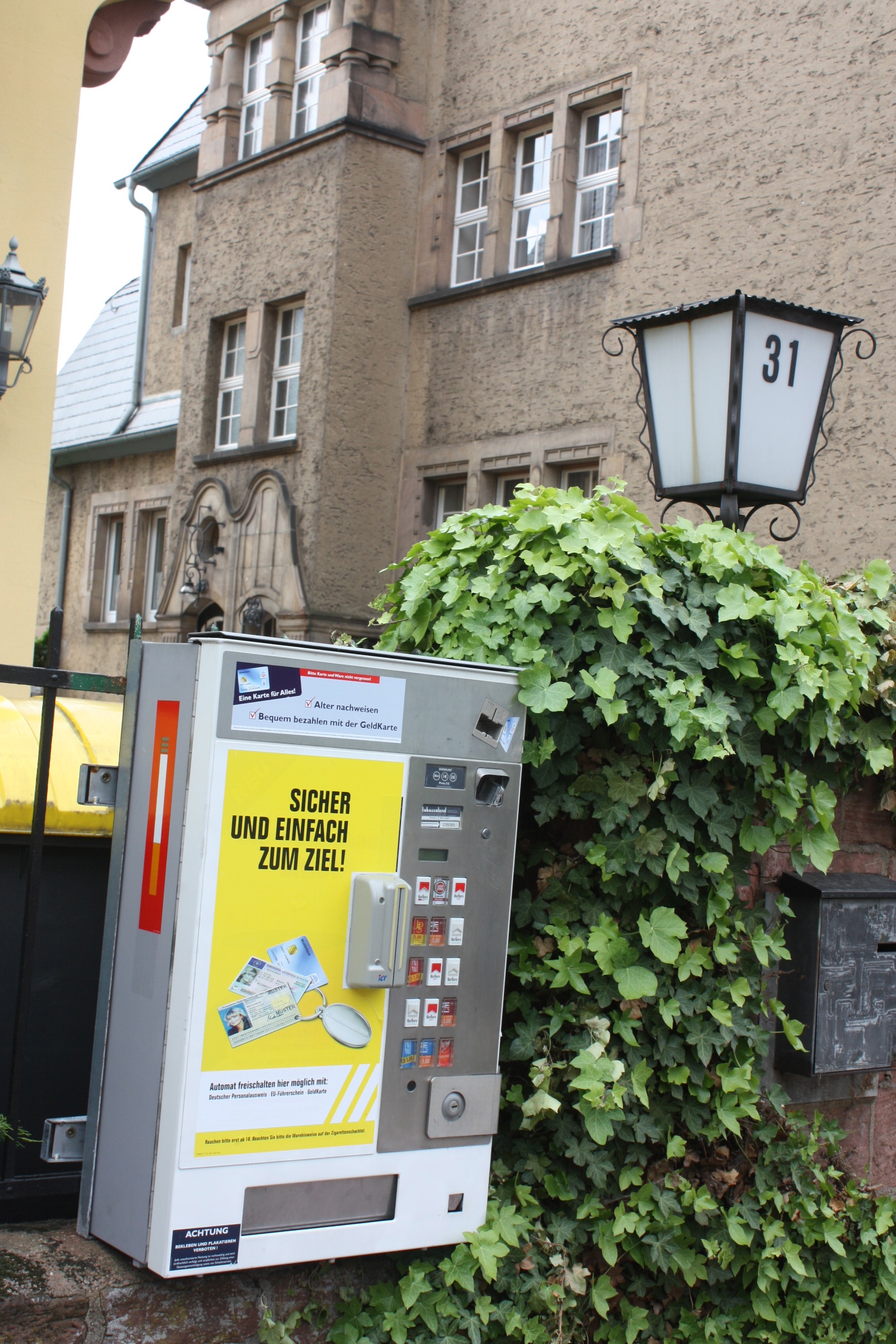
You'll never run out of cigarettes in Germany.
As an aside, the other day Kirusan said he remembered when I stopped smoking. He was living with us at the time. I bet everyone for miles around remembers when I stopped smoking.
 Where to next?