

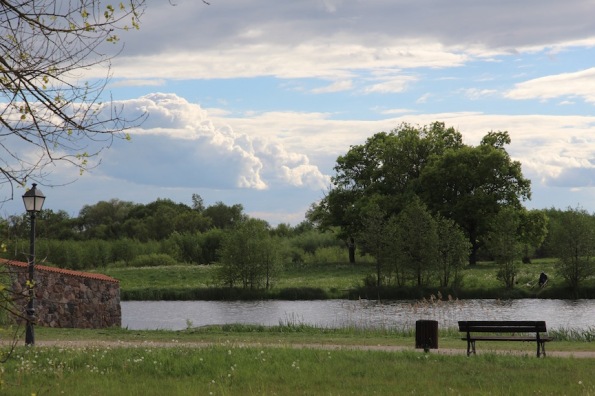
A view from the Pappilanniemi nature trail
Our first stop outside Helsinki was at a town called Lappeenranta on the shores of Lake Saimaa (the fourth largest lake in Europe) and only 30 kilometres from the Russian border. Not surprisingly, it is the second most visited Finnish city by Russian tourists.
We were excited to see signs promoting visa-free travel from Lappeenranta to St Petersburg, and were keen to see if we could manage at least a day-trip. We had originally booked to go to St Petersburg from Helsinki, but all the ferries were full. We were destined for disappointment yet again. Those trips (via the lake and canals) from Lappeenranta didn’t start up again until today, and we left Finland a couple of weeks ago.
But the city kept us well occupied. For starters, there is an old fortress.
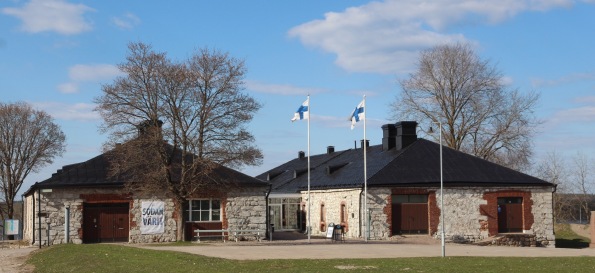
Museum at the fortress


For centuries, Sweden–Finland and Russia fought each other. This fortress was built to protect the border and formed part of a chain of fortresses between Finland and northeastern Russia. Over the years, it was alternately held by the Swedes and the Russians.
Today it is a tourist destination, with shops, cafés, a museum, a church and parsonage, a commander’s house, and great views out over the lake (pictures above). Most places were closed because we were there on a Sunday, also Mother’s Day in Europe.
So after checking out the fortress, we headed down to the lake to enjoy the boats and buy lunch. We’d been told that we absolutely, positively had to try a vety (pronounced vetu) sandwich. Wow, these things are amazing. So much so that we had them two days in a row. They’re a sort of baked bread pouch filled with rice, ground beef, smoked ham, pickles, onions and more. I’ve started the hunt for a recipe.
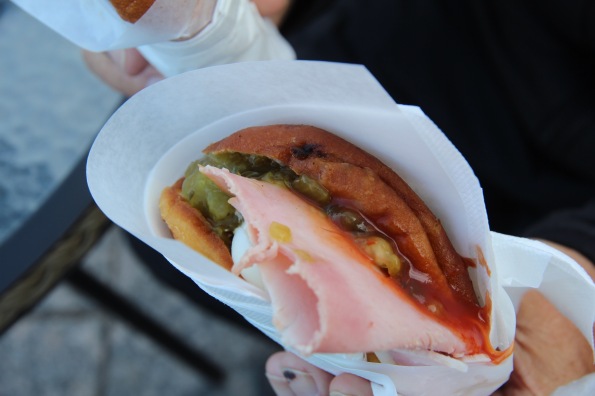
The vety sandwich is found only in Lappenranta. Anyone have a recipe?
To walk off some of the calories, we spent a couple of hours walking to and from the Pappilanniemi nature trail on one end of town. The trail itself is only 1.8 kilometres long, but it took us ages to get there and back. On the way back to town, we cut across a golf course and were careful not to get clobbered by golf balls.
Lappeenranta offered up a few other unexpected treats. It has the country’s oldest still-existing wooden town hall, built in 1829.


It’s also where breakfast included frozen yoghurt and those delightful tins with moomin designs (click through and scroll down to see the pic). A woman at the hotel guided us to a secondhand shop where I bought two moomin mugs. Hope I can get them home without breaking off the handles. For the moment, both are shrouded in bubble wrap. Will show them off when I get home.
A woman in the tourist office also directed us to two other great tourist spots—the concrete sculpture park I’ve already written about here and a museum of mechanical instruments (coming soon). It’s also where I bought my first Finnish beers.
All in all, Lappeenranta was a great start to our driving holiday around Finland. By the way, the town is also famous for an annual giant sand sculpture, but that wasn’t going to be completed until this month. We did, however, see the pile of sand. 🙂


Miller’s house turned into a hotel at Pakruojis Manor
Poor John and I have lived the most unreal existence over the last month. It’s called luxury.
Over the last eight years, most of our normal travels have been on the back of overland trucks or in vans. We’ve camped a lot, sleeping in tents that are waterproof. We’ve used self-inflating Therm-a-rest mats (highly recommended) that are almost as good as many mattresses. Our sleeping bags have been good for three seasons.
We’ve lived in camping clothes—merino (wool) tops that are machine-washable, but which would shrink to Barbie-size in a clothes dryer, and lightweight camping trousers or shorts. My favourite brands are Icebreaker and MacPac for tops, and Berghaus for pants (they just fit me right).
Approaching reception at Pakruojis Manor
But this trip has been totally outside the box.
We rented a car in Finland, Estonia, Latvia and Lithuania, and have stayed in four and five-star accommodation (with breakfast included). I wrote about some of those amazing breakfasts here.
The only constant has been our devotion to camping clothes. We’ve worn them every day, and worn quite a few layers in an effort to stay warm in an unusually cold spring in these parts. It was 7°C (45°F) yesterday in Tallinn, Estonia and, according to the weather report, the wind made it feel like -2°C.
Accommodation-wise we are back to earth and, luckily, the temperatures are warmer.
We’re still in camping clothes, and in a very comfy and nice B&B in Brussels, Belgium. But for a change, we’re up three narrow flights of stairs with no lift and a toilet that’s next door to our room and shared with another room.
We’ve had a great time being completely spoilt (I’ll be writing about the top three places we stayed), but now it’s time to re-adjust to the real world.
But in case you think we’ve been totally spoilt, I will point out that Poor John (also known as He Who Walks Everywhere) has had us walking to and from the ports in Helsinki, Stockholm and Tallinn.
Just picture me dragging a 15-kilo bag (on wheels) and carrying a 3-kilo camera bag and a 6-kilo carry-on bag as we trudge between port and hotel. Most walks have been about 40 minutes, until we’ve found the shortcuts to go back to the port.
Wonderful scenery around Pakruojis Manor
Clearly luxury comes at a price.
That said, Poor John once walked from our house in Campbell to the Canberra Airport (at 4am) just so he could say he’d done it. Many years ago, and because the banks weren’t open, he walked from the airport to the city in Istanbul, Turkey. Now that was a stroll in the extreme because it’s more than a 4-hour walk.
Anyway, I’ll be back soon with posts about our luxury stays and our less salubrious stays. We’ve booked a camping/cycling trip for next week in Brittany. Here’s hoping it doesn’t rain.
P.S. Plus lots more to tell about our times in Finland, Estonia, Latvia and Lithuania. It’s been a fantastic trip.
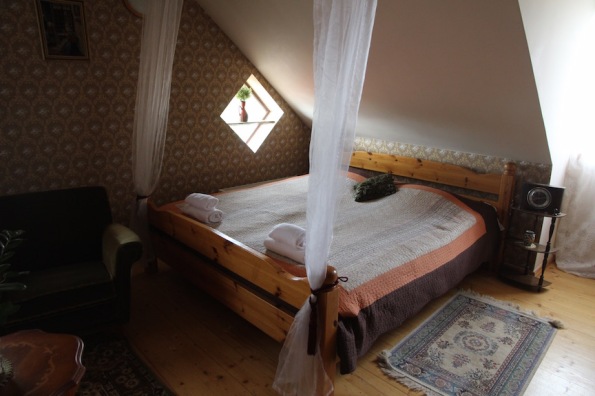
Our bedroom in Pakruojis Manor. Perhaps the most basic room we had

We’ve had a car for almost two weeks to drive around Latvia, Lithuania ad Estonia. Everywhere we have gone, we’ve asked about places to visit—places that aren’t on the main tourist track.
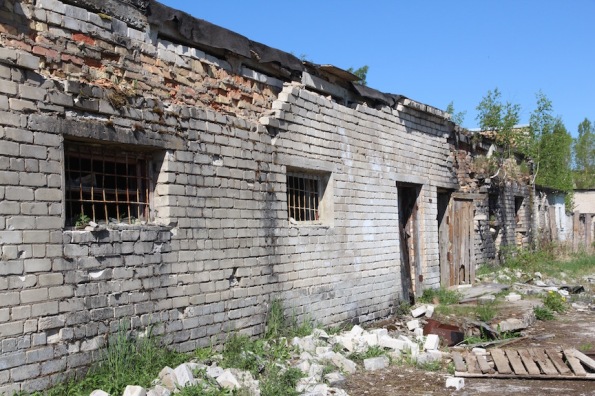
The abandoned military town outside Skrunda in Latvia was recommended by many.
The last person we asked about it said, You can’t miss it. It’s about seven kilometres north of town and there are signs to it on the left.
Of course, we managed to miss it, but soon figured out that we needed to turn back to where we had seen three tiny signs (about the size of a sheet of note paper).


Skrunda-1 is the most complete example of an abandoned communist-era security city in Latvia today, and it’s possible to roam around it.
After almost 20 years of lying idle, Skrunda-1 has entered a new phase. In 2015, the Latvian government paid €12,000 to a private company to buy it back, and return half of it to military use. The rest is used for tourism and other leases.
We rolled up on a Sunday morning. The ticket office looked as abandoned as the town, but a young lass was there to take our 4 euros each (no senior price) so we could explore. She handed us a map and warned us to not to take photos of or get in the way of the military exercises (apparently they use blanks) being carried out.


We saw one military truck with three masked soldiers, but otherwise we had the town to ourselves.
I read that Skrunda-1 was one of more than 40 secret settlements built by the Soviet Union during the Cold War. Each was given a code-name—a number and the name of a local town—and together they formed the technical foundations of the Soviet armed forces.
Skrunda-1 covers 100 acres and was home to underground bunker networks, factories, cold war radars and a prison. Up to 5000 people lived there at one time, and the town also includes dilapidated apartment blocks, hotels, a supermarket, a gymnasium, a hospital, officers’ and soldiers’ messes, and even a nightclub.


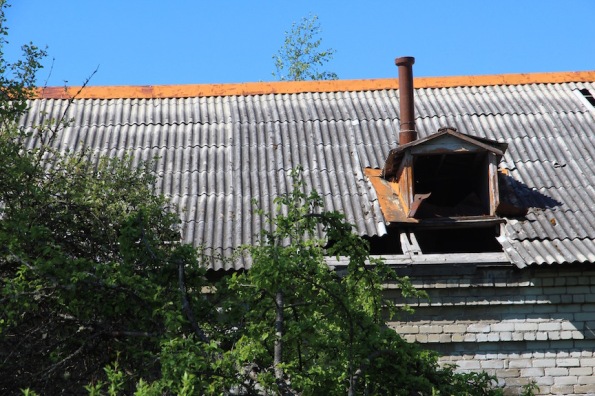
The last residents moved away in 1999 but artefacts of Skrunda-1’s previous life are still evident, giving it an eerie ghost town presence. Of course, the trees growing out of the tops of many buildings add to the sense of decay. We spent about an hour checking out the weirdness before heading on to our next stop.
I haven’t added captions (although descriptive tags have been added in the background). It really doesn’t matter which building you’re looking at. It’s all ghost town.
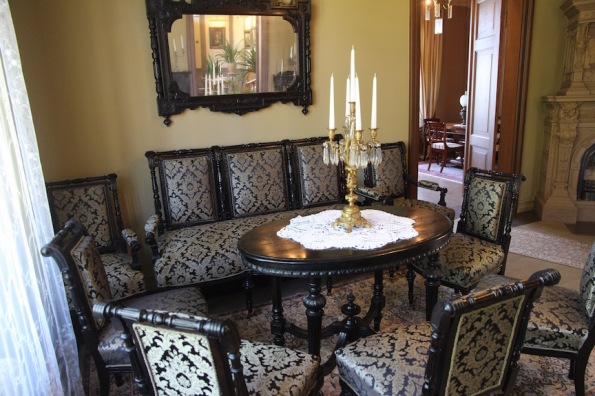
Sitting room
Several people suggested we have a look around Kuldīga, a town of more than 13500 people in western in Latvia. We were told it had a good museum, an interesting Old Town and the ‘biggest’ waterfall in Europe. We even saw a review on Trip Advisor that implied the waterfall was the most impressive in Europe.
One look at the accompanying picture had us howling with laughter—it resembled an overflowing bathtub. But the promise of a good museum and a bit of pretty old town (bunch of pics just below without captions) was enough to pique our interest.
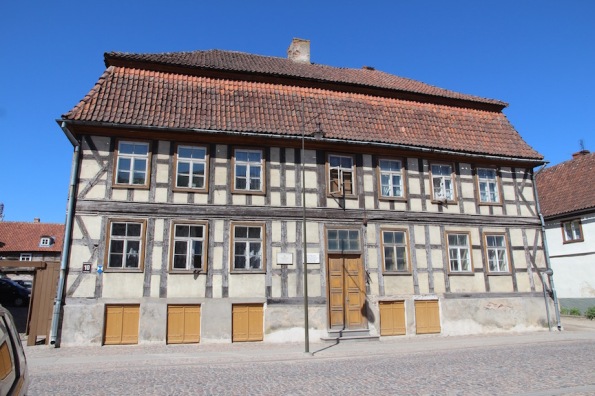


When we got to town, we parked the car near the centre, stopped at tourist information, grabbed a map, and set out to explore the Old Town and find this waterfall.
So let’s get the waterfall (called Venta Rumba) out of the way first. It’s not the biggest in Europe—it’s the widest at 800 feet. And while it’s not a raging torrent, it is absolutely gorgeous. Apparently in spring, you can watch the fish flying up the ledge; due to this, Kuldīga was once famous as a ‘place where they catch salmon in the air’.
When we were there quite a few people were swimming and playing in the water and others were wading across the wide expanse. It looked about knee deep to wade. The setting was breathtaking and we could see why people had such high praise for it. The main pic of it is at the bottom of the post—I saved it for last.
The Old Town was very interesting too. Cobbled streets and ancient buildings. As much as I love to look at cobblestones, I hate to walk over them. At an earlier tourist stop, we met a woman in a wheelchair. She’d fallen on the cobblestones in Riga—recovery four weeks.

Luckily, I haven’t fallen over YET, but I look down a lot into between times of looking up and around.
After the Old Town, we walked through the town park to get to the waterfall and the museum. The museum overlooks the river and falls (talk about prime real estate), and has been in the same location since 1940.
We met Liene and Līga (by the way, the line over the letter i is called a macron) when we arrived at the museum and paid our 1 euro each for admission. Goodness that was money well spent.
The museum has more than 100,000 items (obviously not all on display) covering archaeology, ethnography and numismatics (currency).
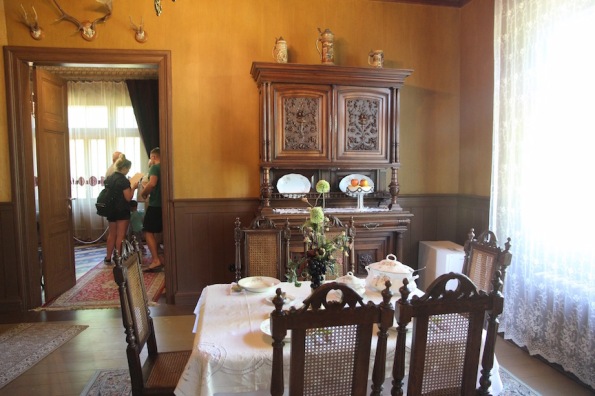


For example, there are written documents from the 13th century, furniture and household goods from past citizens of Kuldīga, art, photographs, and items recalling the Jewish community that lived in the town.
Two other displays especially caught my attention. There’s an amazing collection of playing cards that a resident donated to the museum. Methinks he got sick of storing and looking after them. They are very cleverly displayed in sliding drawers (both horizontal and vertical). Given my past life in printing and journalism, I was also drawn to the scrapbook of old labels done by the printing house that used to operate in the town.
Liene, whose English is absolutely superb, accompanied us for much of our trip around the museum. While almost all the exhibits are described in multiple languages, her explanations were always even more enlightening. And see the pic (above) showing how the language sheets are identified! Clever thinking.
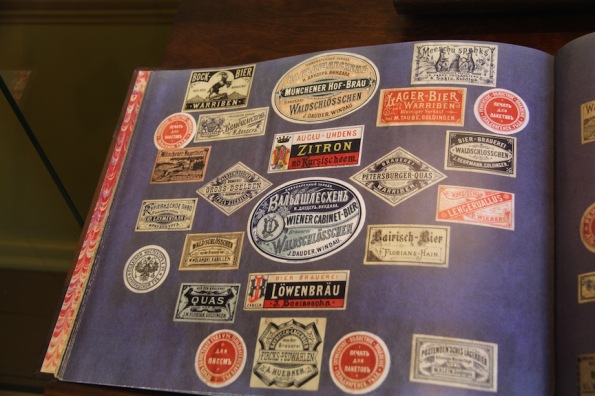
Selection of labels


After touring the museum, Liene recommended a restaurant, Pagrabins, and told us to order their rustic grey peas with vegetables stew.
We followed orders, and it was fantastic. And I completely forgot to photograph the meal. Oops.
On our way back to the car, we saw a little girl enjoying the random jets of water sent up by the town fountain. Pity that I missed some of the best shots.
That’s all from me on Kuldīga. Do stop if you are ever in the neighbourhood. It’s even worth going out of your way.
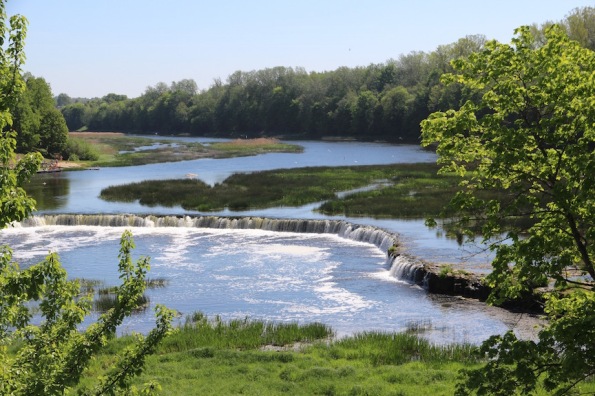
The beautiful Ventas rumba—not Europe’s biggest, but its widest
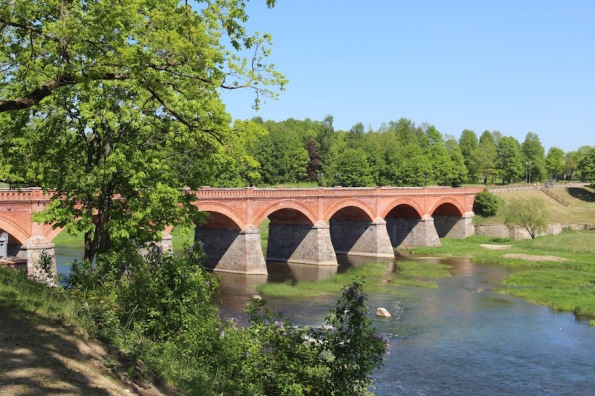
Bridge over the River Venta
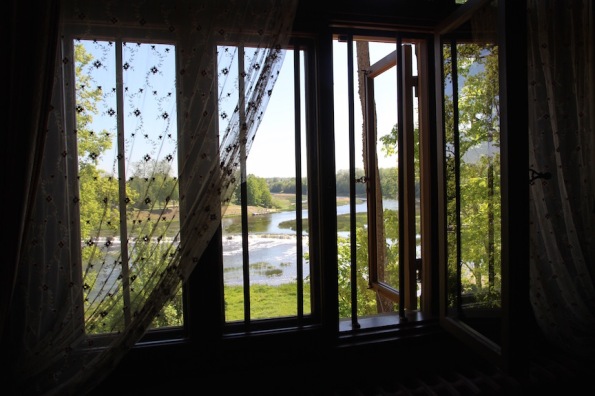
Museum overlooks the river

Pre-made meals and convenience food


Many of you love food as much as I do, and I’ve just noticed that I haven’t been very good about showing you the many markets we’ve visited on our travels.
In September 2015, I tempted you with two locations—the huge market in Barcelona, Spain, as well as the more intimate market in St Tropez in the south of France.
Both were fantastic, although much different in scale, and then we went to the Riga Central Market in Latvia. I’m still reeling from the sheer size of the market itself and the colossal array of products on offer.
Seriously, they’re selling foods of all kinds, including some I don’t recognise, as well as alcohol, shoes, clothes, pet products, kitchenware, garden seeds, music, toys and more.
But let me start with how and when we happened to go.


Long before travelling to the Baltic States, Poor John and I had read about the market’s fame—it’s a UNESCO heritage site along with Old Riga—so we were keen to see it.
Soon after we arrived in Riga, we asked the people at hotel reception about visiting the market. It was mid-afternoon and they said, No, no, it’s too late in the day. The stallholders will have gone home. Go tomorrow between 8 and 9am.
So we held off and I took some of that waiting time to find out even more about the market itself.
Plans for the market began in 1922. It was to replace the crowded and extremely unsanitary Daugavmala Market that had operated on the banks of the Daugava River for about 300 years.
The new market opened in 1930—it took almost seven years to build. I found it fascinating that the main structures are five pavilions constructed by reusing old German Zeppelin hangars.

Riga Market
So with all this information (and more), we set out (on foot) the next morning about 8:15. We didn’t really appreciate the size until we approached. The market has more than 300 trade stalls, and covers 72,300 square metres or more than 7 hectares (or 778,000 square feet or almost 18 acres).
The first building we entered was devoted to seafood. Other buildings seemed to have core products for sale. There were even stalls set up outside, especially for produce. We wondered if rents were cheaper there?
I could have spent days in this market. In fact, if I lived anywhere near Riga, I would be shopping here everyday, maybe twice a day. I so desperately wanted to buy something I could cook, but that’s not easy when you are staying in hotels.


So here are plenty of pics for you to enjoy. I’ve put captions on most, may have missed a few. Sorry if I did.
By the way, I’ve read that it’s possible to organise a tour of the markets, but I think most people can follow their instinct or their nose or their appetite. 🙂
P.S. Many of you know I have a cooking blog. So far on this trip, I’ve bought cookbooks from Finland, Latvia and Lithuania (still looking for one from Estonia). I’ll be cooking from these when I get home but, in the meantime, check out a bread recipe I made from Alaska. It’s appropriate because it’s been darn cold here for 20 out of 21 days
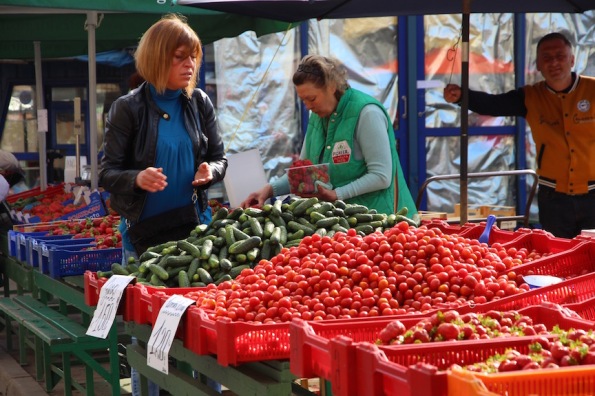
Outdoor stall


Stairs to a view in Vilnius
Poor John loves going up stairs and hills. If there’s a tower, we have to climb it. If there’s a hill, we have to see what’s at the top. And don’t get me started on mountains. In Canberra, he’s up and out the door by 5:30 most mornings to climb Mt Pleasant and Mt Russell (both are just big hills).
So I wasn’t even a tiny bit surprised when he suggested that we visit the Bell Tower at the Vilnius Cathedral in Lithuania. Don’t tell him, but I wanted to go up it too.
At a height of 52 metres (add five more for the cross), it’s one of the oldest and tallest towers in old Vilnius. It’s also a fantastic opportunity to see sweeping panoramas of the city, an exhibition of old bells, and the city’s oldest surviving clock mechanism.

View of the main square from the bell tower
So who cares if it has almost 300 steps and doesn’t have a seniors’ admission price!
The tower, which was started in the 13th century, stands in Vilnius’s main square and several metres away from the cathedral. This placement is apparently unusual outside Italy.
Many scholars believe the tower was part of the city’s ancient walls and the medieval Lower Castle that once stood near the modern square.
In the early 1600s, the tower was converted and became the cathedral’s belfry.


Like most ancient structures, it has had its problems. Much of the wooden parts were damaged by fire in 1610, and the main bell (which took 12 men to play) was destroyed.
The current clock was installed in 1672. It is the oldest and most important clock in Vilnius. There is no record of who made the clock’s mechanism, but it is thought to have come from Germany.
The last major repairs were in 1803—that date is incised on the frame—by Juozapas Bergmanas, the elder of the Vilnius clock makers’ guild.
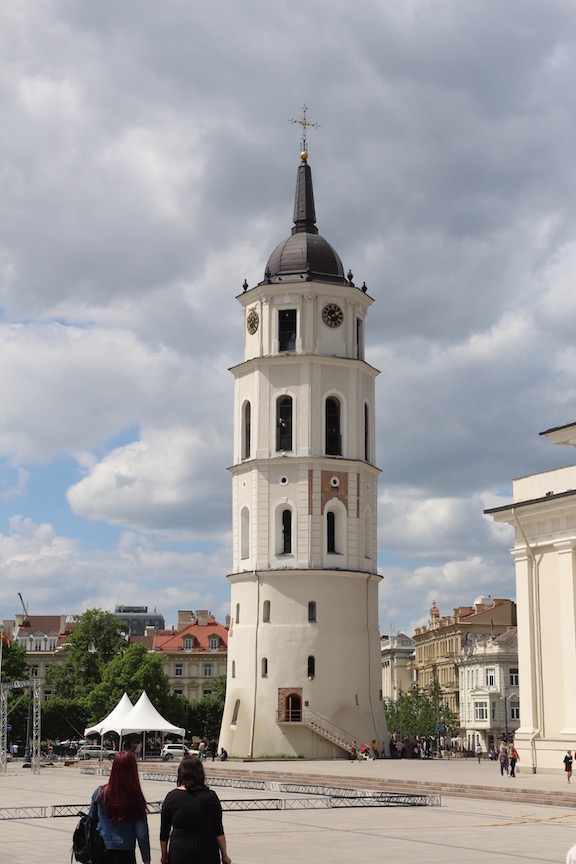
The bell tower is several metres away from the cathedral to the right
The clock has only one hand. Its obtuse end is decorated with a crescent, and the pointed end shows the hours. Bells help to count the time more precisely. They strike the hours, half hours and quarters with chimes. We were in the bell tower long enough to hear them three times. You should have seen one gal jump when the hour was hit.
There are recordings to listen to throughout the tower. One told us of Gustav Mörk, who cast the main bell in 1754. Apparently he added one of his wife’s hairs to every bell he made, which he claimed gave them a sweeter sound.


I read that the other bells of the clock differ in proportion (they have a much larger diameter in relation to their height), and their strikes are less resonant, which supposedly makes it easier to count them. These bells, which range in weight from 675 to 1600 kilograms, are named Saint Casimir (the heaviest), Saint Anne (the lightest) and Saint Stanislaus.
My favourite view from the tower was back over the cathedral and to the hills beyond.
Oh, and I counted the steps up and down, but have now forgotten how many there were. Close to 300 with differing kinds of staircases, from stone to timber.

My favourite view from the Vilnius Bell Tower
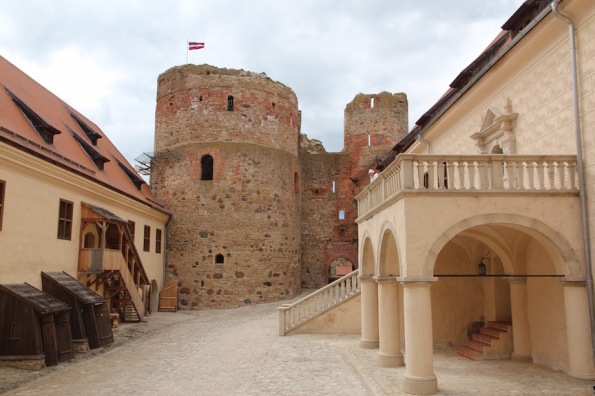
Castle courtyard
Over the last month, we’ve been travelling/driving around Finland, Sweden, Estonia, Latvia and Lithuania. Frankly I’d like to write about all of them at once, but every post takes time, research and sorting through photos. That’s all precious time when I’m supposed to be driving, sightseeing, eating, sleeping and doing the dreaded hand laundry.
So today I’ve decided to take you through a Latvian castle—Bauska—where I bet someone in the past would have done all the laundry for me. Unless, of course, I was the laundry slave. 😦 You can be sure I wouldn’t have been washing the outfits below.


For now, I’ll pretend that I was important and I’ll guide you through ‘my domain’.
This impressive (and now partially restored) castle stands on a narrow peninsula at the confluence of two rivers—the Mūsa and Mēmele—that form a third river—the Lielupe.
The Livonian branch of the Teutonic Knights started building the first stone structures in the mid-1400s. Construction continued into the 1500s.
The castle was both a military stronghold and the administrative centre of the area.
But after the Livonian Order collapsed in 1562, the castle became a residence/palace for one of the Dukes of Courland.


About 150 years later (in April 1706) and during the Great Northern War, part of the castle was blown up by the retreating Russians. By the end of the 1700s, most of it was in ruins. Gosh, don’t you hate it when that happens?
But luckily in the 18th century, the ruins were deemed ‘romantic’ and so attracted the attention of painters and historians, and ultimately restorers.


Today much of the castle has been restored, and what hasn’t still looks rather romantic. It was interesting to see a small area of floor tiles that were still original. They are very subtle compared to the replacements, and much nicer, in my opinion.
We also saw lots of furnishings, artefacts and clothing from days gone by. Sadly, I never saw a laundry tub (only a two-seater toilet), so I’m guessing that I wouldn’t have been able to get my clothes washed. I suppose they wore their get-ups for years on end.

Kitchen with an oven I could stand in
That said, I love seeing the kitchen. The stove/oven was big enough for me to walk into—really a spot to cook for a crowd. The clothes of the day were fascinating, too, and not really candidates for being laundered.
Hope you enjoy this swag of pictures of the castle.
P.S. We’ve visited a bunch of castles and palaces over the last month. I’ll try not to bore you with them, and will share only the ones that are different.


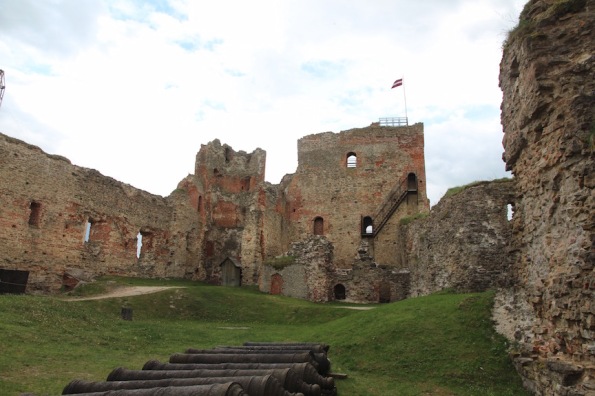
Watch tower on right (with flag flying) with cannons in foreground
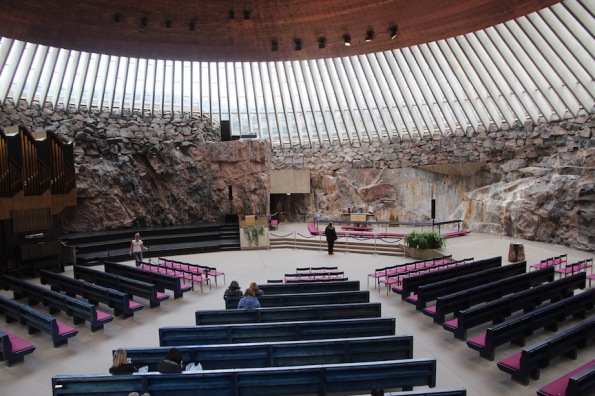
The Rock Church is partially underground with light flowing in from high windows
Over the last few weeks, we’ve visited Helsinki three times and managed to visit what are probably their three most important and most different churches.
Rock Church
The first was the unusual Rock Church, also known as the Church of the Rock in English, the Temppeliaukio Kirrko in Finnish and the Tempelplatsen Kyrka in Swedish. The two Scandinavian names (by the way, Swedish is the second national language of Finland) translate as Temple Square Church.
Plans to build a church in the heart of Helsinki dated back to the 1930s when the land (Temple Square) was chosen and an architectural design competition was run. Unfortunately, World War II halted all progress. Another competition, conducted after the war, was won by brothers, Timo and Tuomo Suomalainen, in 1961.


The land was excavated and the semi-subterranean church was built within the surrounding rock. It was consecrated in 1969.
Interior rock walls were not part of the original design. The Suomalainen brothers had considered leaving the rock exposed, but thought the idea might be too radical for the competition jury.
Luckily it went ahead when it was discovered that the rough, virtually unworked rock surfaces created incredible acoustics. In fact, the church has become a popular concert venue, and there were people setting up for a concert/event when we were visiting.
The church is also one of Helsinki’s most popular tourist destinations. About half a million people visit it each year.
Two more comments about this church. I tried to take pictures from the outside, including the church’s copper roof, but the whole structure sits very low and it was snowing on the day, so any picture was going to be problematic. Also, the whole atmosphere reminded me of the amazing cathedral in Brasilia, capital of Brazil.

A large choir rehearses on the steps of Helsinki’s Lutheran Cathedral
Helsinki Cathedral
We paid two visits to the Helsinki Cathedral, also known as the Finnish Evangelical Lutheran Cathedral. It was built between 1830–52 and was a tribute to the Grand Duke of Finland, Tsar Nicholas I of Russia. It was known as St Nicholas’ Church until Finland’s independence in 1917.
Designed by Carl Ludvig Engel, the building has a neoclassical style. It is surrounded by other, smaller buildings designed by him, and is part of the Senate Square.


Each of our visits occurred on a special occasion. The first time we were there when a wedding was just finishing. We got to see the bridal march and snap photos of the wedding party on the church’s side steps. I liked the fact that the bride wore a street-length dress and the group of attendees was a manageable size.
That said, our second visit was extremely large and impressive. There was a special choral event with close to 1000 choir members rehearsing on the church’s front steps. More singers (many in traditional dress) were arriving as we watched—we’d seen many of them checking into our hotel (ahead of us) the day before and that morning.
We heard only one song, and it was a treat to see such a large choir performing. We were staring our self-drive excursion later in the day, so missed the concert that was coming later.
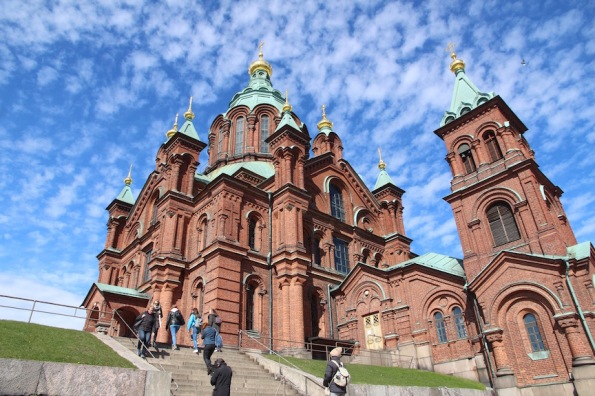
The Eastern Orthodox Cathedral overlooks Helsinki
Uspenski Cathedral
We also made two visits to the Uspenski Orthodox Cathedral, but never managed to get inside. Our first visit was too late in the day. So we planned to visit again after our road trip around Finland.
Sadly, on that second visit a sign on the door said ‘not open today’. We were disappointed, but a fellow we met on the steps felt even worse. He’d been living in Finland for 10 months and it was the fifth time he’d come to the cathedral and not been able to get in.
This Eastern Orthodox Cathedral, dedicated to the Dormition of the Theotokos (the Virgin Mary), certainly has the most impressive exterior in Helsinki, but we’ll never know what the interior looks like. Oh well, maybe if we go back again.
The cathedral, which was completed in 1868, has a wonderful position on a hillside peninsula overlooking the city. So even though we couldn’t get in, we loved looking at the surroundings.
No doubt there are scores of other churches in Helsinki, but these are the only ones we saw.
 With a view like this, who cares if the Eastern Orthodox Church is closed!.
For those of you who follow my cooking blog, I now have a Finnish cookbook so stay tuned for a page-32 offering. In the meantime, feel free to check out a make-ahead potato recipe from a cookbook compiled by the folks at Bethany Lutheran Church in Nebraska.

My first plate of food at breakfast—just getting started
Any thoughts of me losing weight on this trip—I often do when travelling overland—have been completely abandoned this time around. I mean how can I resist breakfast? Remember it’s the most important meal of the day! Right?.
Poor John and I are doing two self-drive car trips—eight days around Finland (after a side trip to Sweden) and 13 days in the Baltic States of Estonia, Latvia and Lithuania.

Breads and sweets

Spiced rhubarb (in the back on the left) is sensational
It’s a sort of package deal that includes the car, basic routes to follow, tips for sightseeing, hotel accommodation AND the breakfasts. Most of the hotels have been four-star or more (not our usual travelling style) and the breakfasts have been even better. Some days we’re verging on 10 stars, if that’s possible.
Frankly Eastern Europe and Scandinavia have breakfast honed to a fine art. None of this continental offering of a dried-out croissant, cold toast, hard butter and jam in a tiny plastic tub.
Oh no! Breakfast in these parts is serious business.
Most places have had buffets with eggs, bacon, sausages, meatballs, various kinds of potatoes, multiple kinds of cereal, a wide range of fruit and juices, stewed fruits, many kinds of cheese and lunch meats, olives and pickles, lots of raw vegetables such as cucumbers, seafood (even gravlax and smoked salmon), bread of all kinds, homemade jams and local honeys, and some sinful dessert-y things like chocolate-covered donuts, cinnamon biscuits or custard tarts.
Here are some of the unexpected high spots.
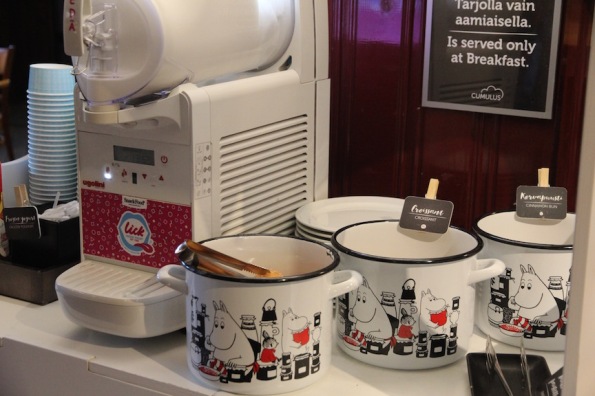
Frozen yoghurt dispenser (only at breakfast) and tins of donuts, biscuits and other treats. The plump little character on the tins is Moomin, who is famous in Finland. I think he’s been eating too much breakfast, just like me
Cumulus Hotel in Lappeenranta, Finland, serves frozen yoghurt, but only at breakfast!
Vihula Manor in Estonia offers herring doused in eight or so kinds of sauce, including blueberry. I like pickled in mustard sauce best.
Mezotne Palace in Latvia cooks up the most beautifully seasoned fried eggs I’ve ever had. Absolute perfection with salt, pepper and dill.
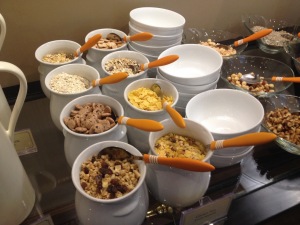
Plenty of cereals

Breakfast choices
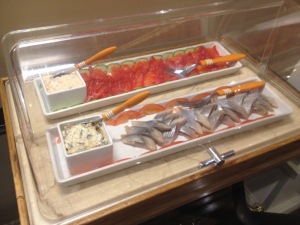
Smoked salmon and herring with sauces
Stikliai Hotel in Vilnius, Lithuania, makes wonderful chocolate cake truffles rolled in more chocolate and nuts.
But those are just temptations. I could go on and on, but my mouth’s full and I probably need to burp.
And we still have eight days of breakfasts to go! Geez, I am enjoying this. Part of that is because rhubarb, grapefruit, olives, pickles, cheese and herring have been popular on almost every table. Burp!
By the way, I’ve read that the deluxe hotel we are staying in tonight has the best breakfast in all of Lithuania. I’ll give it my best shot tomorrow morning and try to report back.
Oh, and for the most part the coffee has been very good, although one day it was quite cool/cold.
P.S. So sorry that some of the photos are a bit fuzzy. I took most of them with my 6-year-old smart-ish phone. It may be headed for retirement, or I could give it to Poor John who has never, ever had a mobile phone of any kind. Also, some of the dishes I’ve bragged about didn’t make the photo choices. Just too out-of-focus.
P.P.S. It you’re a sucker for breakfast, check out one of my most successful page-32 recipes for a great start to the day—my breakfast bowl. I’ll be making it again when I get home and dreaming of breakfasts on the road. Burp!

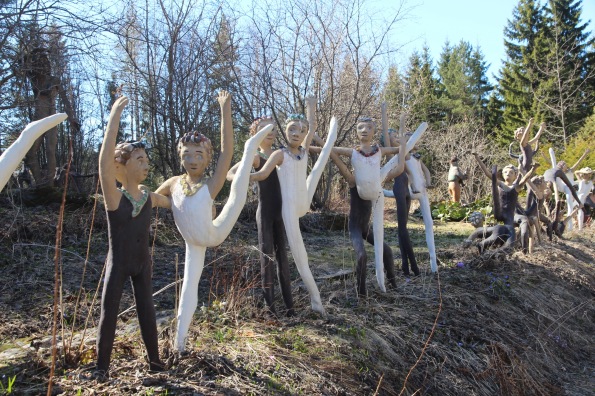
Standing yoga pose
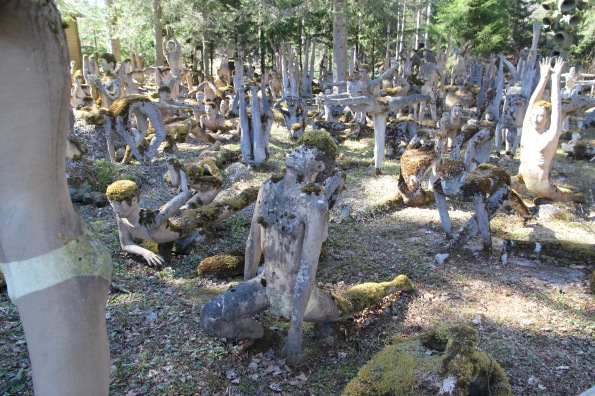
Lunging yoga pose and many more in the background
Go see the sculpture park in Parikkala, suggested the woman at the tourist office in Lappeenranta, Finland, it is just near the Russian border and has more than 500 statues.
It was only about an hour up the road on our drive to Joensuu, so we figured why not.
Little did we realise that this field of concrete figures would deliver creepy, exotic, weird, athletic, artistic, spooky, grotesque and remarkable all at the same time.
The park, which you enter on foot from a roadside rest area, showcases 50 years of work by self-taught artist, Veijo Rönkkönen, who died in 2010 at the age of 66.


Rönkkönen was a bit of recluse and had limited social skills. He worked at the mill, but spent all his spare time practicing yoga and creating 550 sculptures. Almost half of them (255) are of human forms in yoga poses and many of those are barely disguised self-portraits of the artist. He often said the park was a monument to his young body.
He cast his first sculpture in 1961. That piece drew a lot of attention from the community and encouraged Rönkkönen to keep producing.
The yoga pieces show all sorts of yoga positions, while the more general human (and alien) forms have a certain eeriness about them, especially because many are fitted with human teeth and glass eyeballs. I haven’t been able to find out where he got the teeth!


After Rönkkönen’s mother died in 1996, he focused solely on sculptures of children. Many thought it was his way of detaching himself from an unhappy childhood.
In the last months before his death, Rönkkönen completed a project he had been working on for many years—a parade of about 100 children. They are being led by a drummer boy marching towards the park exit. Some say the boy represents Rönkkönen stepping out into the world.
Another large display is of sculptures seeming to walk along the path through the park. They are of all shapes and sizes.


Rönkkönen never thought about ensuring the park’s future. When people asked, he would say he wanted to bury the park in sand and leave it in a thousand year’s silence, like the Chinese Terracotta Army.
Nevertheless, he hoped the park would be remembered and considered important to other people—in 2007 he received the Suomi Award from the Minister for Culture for his achievements in art.
His wish was realised. The new owner, Reino Uusitalo, was keen to have the park continue. In 2011 an association was founded to safeguard the park’s future. Volunteers offer their time and expertise to preserve the park and to broaden the scale of activities carried out there.


Two volunteers were doing a spring clean when we were there.
Park admission is free, but a sign recommends a donation of 5 euros per person. We gladly contributed, but it is rather disconcerting that the donation box is a concrete head with human teeth. Trust me, the teeth are sharp and the mouth isn’t open very far.
P.S. The woman at the tourist office gave us another great suggestion—a museum of mechanical instruments coming soon. And if all this talk of teeth has made you hungry, try out the recipe for banana chocolate chunk muffins on my cooking blog.

Parade of children led by drummer boy
The parade continues
 Where to next?