
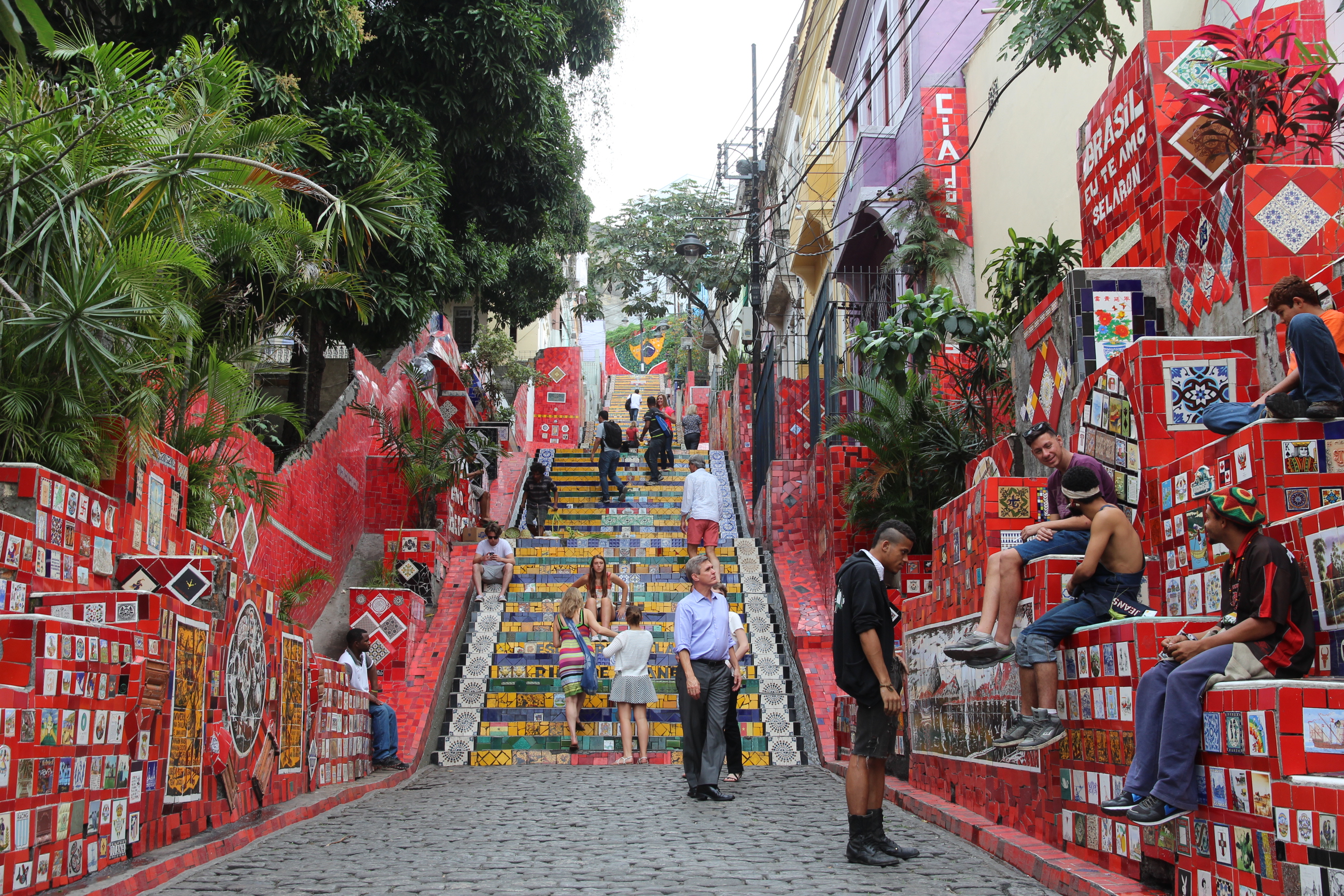
Tourists and locals enjoy the Lara Steps
Rio de Janeiro is all about the beaches, parties, music, dance, food, drink, energy and colour.
And when it comes to colour, there’s no place in Rio that is more colourful than the incredible and beautiful Lapa Steps.
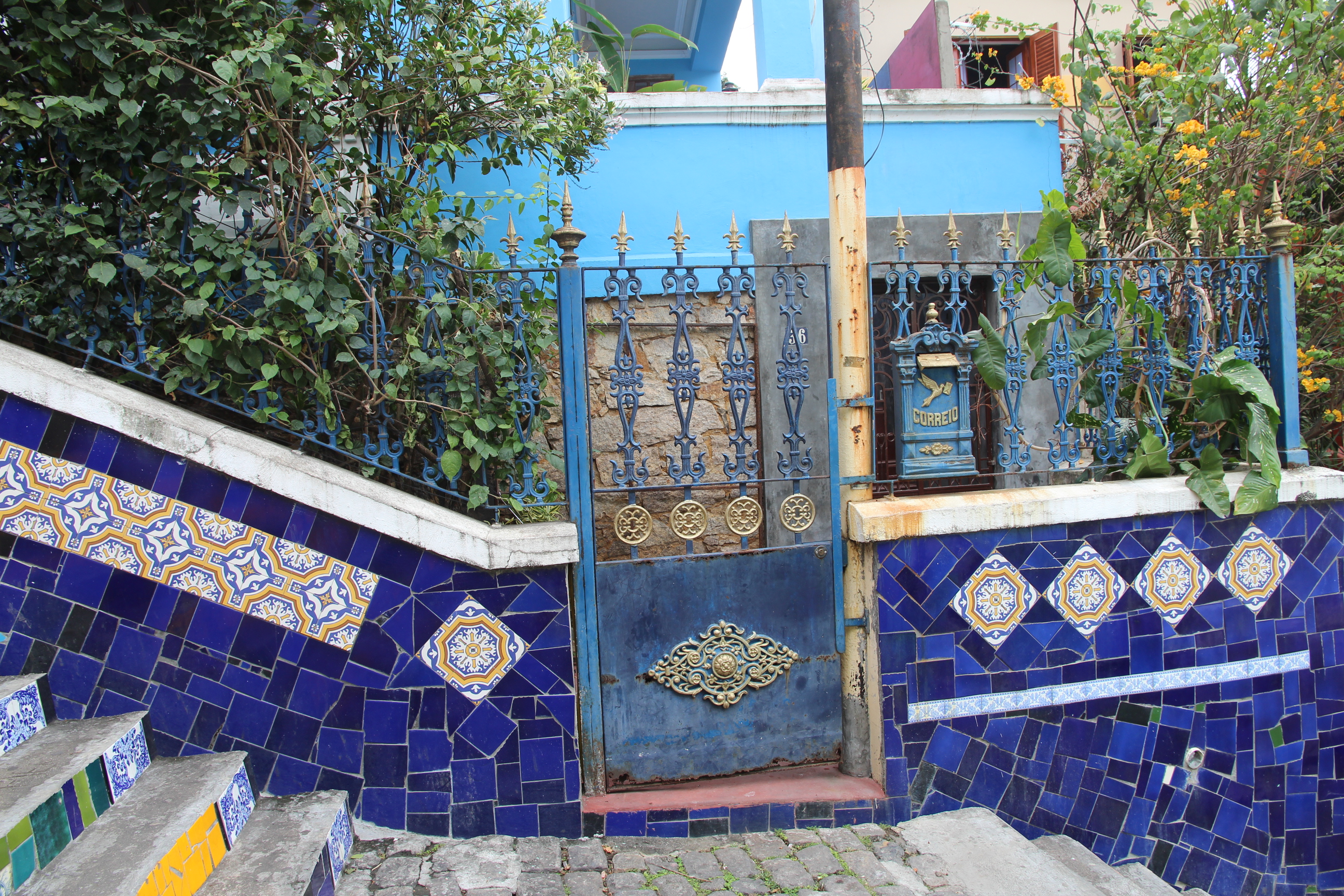
Blue house on steps

Red house on steps
Of course, the steps have been there for yonks—they lead to the Convent of Santa Teresa—but the colour didn’t start to appear until 1990. That’s when Chilean-born artist, Jorge Selarón, decided on a whim to create a ‘tribute to the Brazilian people’.
His tribute would develop on his doorstep. Selarón’s house was located on the stretch of dilapidated steps that connected Joaquim Silva and Pinto Martins streets. His plan was to renovate this 125-metre staircase with pieces of tiles that reflected the main colours of the Brazilian flag—yellow, blue and green.
At first, he scrounged tiles from construction sites and urban waste, but as transformation progressed, people from all over the world sent and brought tiles—many handcrafted by the sender/bearer—for Selarón to add to his creation.
Today the staircase displays more than 2000 tiles, ceramics and mirrors from more than 60 countries. Red and yellow are the dominant colours, and there is a recurring image of a pregnant African woman. Selarón hand-painted about 300 tiles showing the woman, but never explained the image’s significance except to say it related to a personal problem from his past.

Red is a dominant colour on the side walls
Selaron funded his obsession with the stairs by painting and selling potraits—he claimed to have done 25,000 depicting the pregnant woman. He also accepted donations. I was told that Selarón commissioned the tiles he used to recreate the Brazilian flag because he wanted the colours to be exactly right. We did not meet him, but people say Selarón was friendly and personable, if eccentric, and liked to chat with tourists.


Explanatory panels by Selarón, with English on right (click on the smaller images above to read)
There are two large explanatory panels near the bottom of the stairs—one in English and the other in Portuguese. On the English one, Selarón calls his work ‘The Convent Stairway’ but today the locals call it Escadaria Selarón, or Selaron’s Stairs.
The stairs have received a lot of international coverage, including the National Geographic channel, Time, Playboy and The Amazing Race. They also featured in Rio’s bid for the 2016 Summer Olympics.

Brazil’s flag in ceramic tiles
I was saddened to learn that Selarón, who was 65 at the time, was found dead on his beloved stairs just a few days after our first visit to Rio.
Friends said he had been depressed in recent times, but police confirmed that Selarón had also received death threats. As far as I can determine, there has been no final decision as to whether his death was suicide, homicide or natural. Such a tragic ending for someone who brought so much colour, life and respectability to a neighbourhood that, until recently, was considered to be quite rough.
Selarón and his fabulous artwork were admired by his adopted city. In 2005, he was made an honorary citizen of Rio and the Lapa Steps were declared a city landmark.
P.S. Of course, Poor John (aka He Who Walks Everywhere) and I went to the top of the stairs.


Sugarloaf Mountain (Pão de Açúcar) seen from Morro da Urca
After several years of roaming the world on New Year’s Eve, this year we enjoyed a lazy and home-based time at Rosedale beach on Australia’s southeast coast.
We watched the live coverage by the ABC, Australian national broadcaster, which included interviews with personalities (there was even one with Reg Mombasa) and lots of snippets relating to previous New Year’s Eves.
It brought back wonderful memories of our 2012 New Year’s Eve in Rio de Janeiro.

Looking down to Urca Beach and surrounds
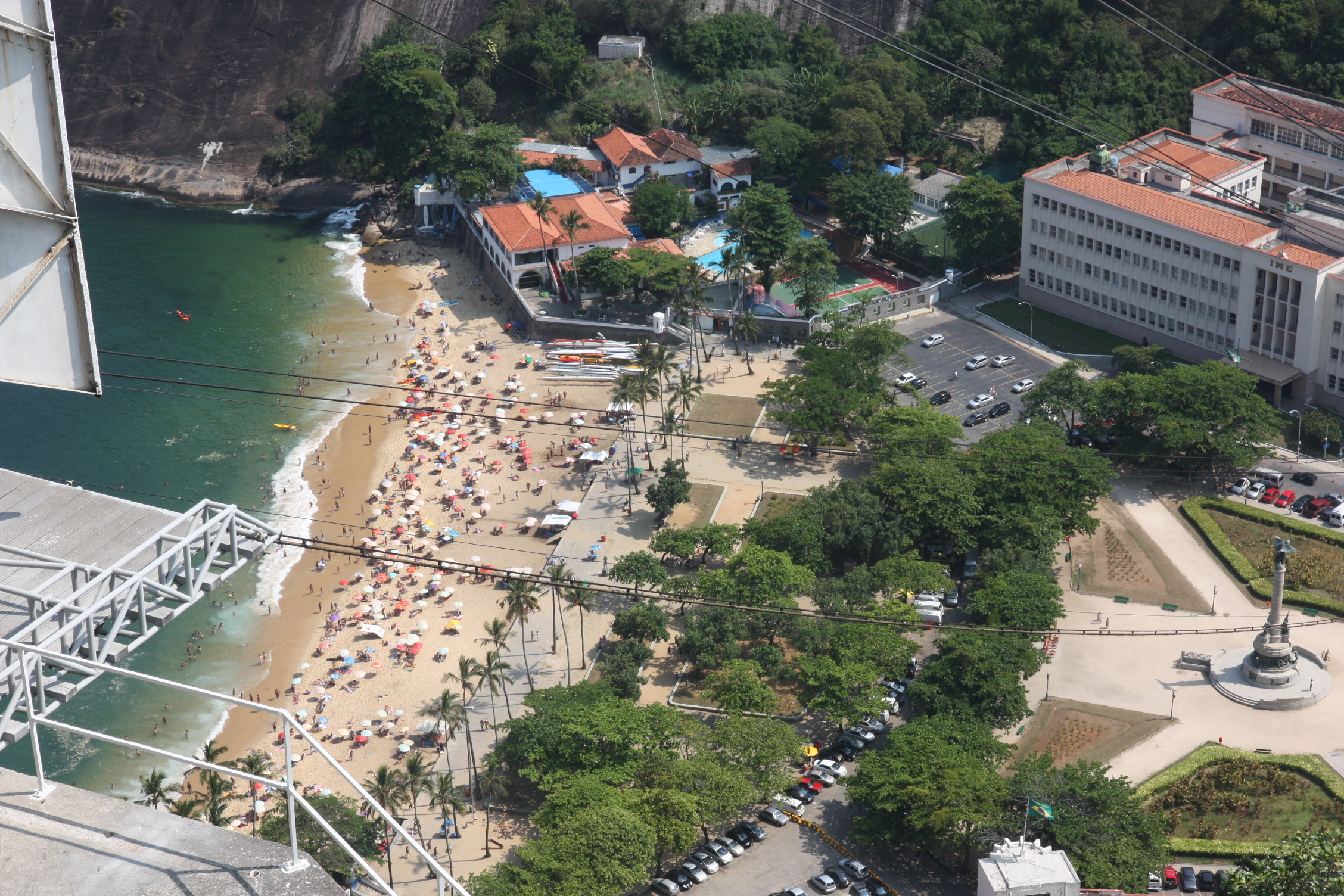
Urca Beach
That day, Poor John and I set out early on foot from where we were staying near Flamengo Beach. We were on our way to see Rio’s amazing Sugarloaf Mountain.
Sugarloaf sits at the mouth of Rio’s large Guanabara Bay, on a peninsula that juts into the Atlantic Ocean. It is one of several monolithic granite–quartz hills in the city that rise straight from the water’s edge. It’s almost 400 metres tall (1300 feet), and the fittest and most adventurous can actually climb the rock.
After walking five kilometres and standing in the entrance queue for about 90 minutes, Poor John and I opted for the two cable cars to the top. The first leg ascends to Morro da Urca, which is 220 metres high. The second ascends to Pão de Açúcar (sugarloaf in Portuguese) itself.
Views—from both the top and the glass, bubble-shaped cable cars—are sensational and pretty much 360 degrees. The city, its beaches, its ritzy suburbs and its waters spread out before us. I wonder how many people have made it to the top of Sugarloaf. There’s been a cable car arrangement there for 101 years.
The Portuguese coined the name Sugarloaf back in the 16th century when Brazil’s sugar cane industry was first flourishing. They thought the mountain looked like the conical clay moulds that held blocks sugar that were to be shipped from Brazil.
We explored every corner of the peak and managed to fill the whole day, until it was time to buy supplies for the after-dark celebrations on the beach with a group of our fellow overland travellers. Lots of wonderful memories and a fantastic start to 2013—which was a very good year too.
Wishing you all a happy and prosperous new year—wherever you are and whatever you do.


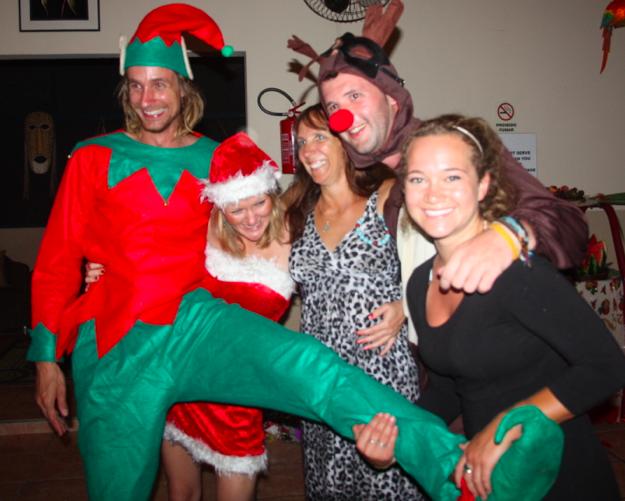
Colin (our second driver), Sammy (our first guide), Jane, Danny (our second guide) and Olivia
It’s taken less than 48 hours for us to polish off all the leftovers from this year’s Christmas lunch—I had the sense not over-cater. But our mini feeding frenzy reminded me of the wonderful feast we had last year in Brazil’s Pantanal.
We were staying at Pousada Santa Clara, a family-run operation that makes a big deal of Christmas and an even bigger deal of the activities they organise and the food they serve.

Rael snags a piranha. Actually she snagged many
Santa Clara is located in the southern part of Brazil’s vast wetlands known as the Pantanal. This amazing region—one of the world’s largest freshwater wetland ecosystems—has a spectacular abundance and diversity of vegetation and animal life.
It was the perfect choice for Christmas.
The original plan was to celebrate the holiday at Bonita, another Brazilian tourist area. Bonita is close to a beautiful clear water river, brimming with colourful fish. The campground is lovely (we went there later), and you can snorkel the river, but Bonita can never match the homey, Christmas-y, welcoming feel offered by Santa Clara.
Luckily, Sammy, our guide, and her fiancé and our driver, Colin (thanks to a travel handover, we ended up with two Colins), negotiated with Oasis to have Santa Clara as our Christmas destination. Brilliant!
Of course, it makes complete sense from a spelling point of view—there are only two letters of difference between Santa Clara and Santa Claus.
When we arrived at Santa Clara, we were divided into two smaller groups for the tours and activities—much easier to shepherd a couple of smaller groups through the magic of the Pantanal.
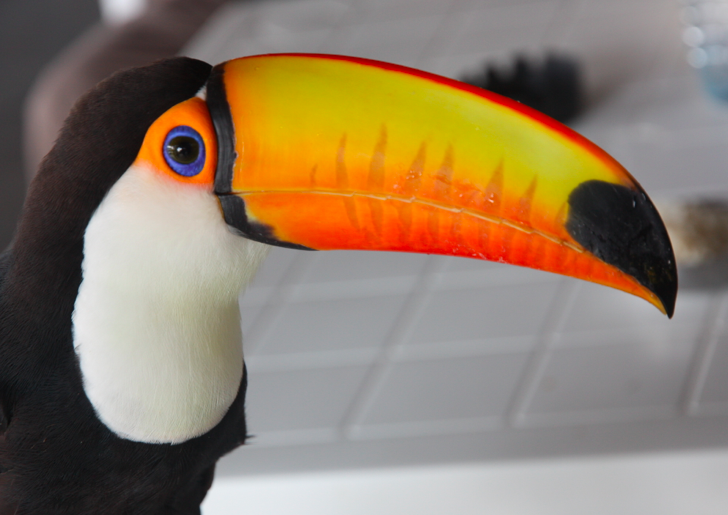
A Santa Clara toucan
For our group, Christmas Day started with piranha fishing, followed by a horse ride.
Yes, I managed to get Poor John on a horse—through the Pantanal bushland. We didn’t see much in the way of wildlife, but the horses were calm and the ride was uneventful (much to Poor John’s relief).
So the big bonus was Santa Clara’s amazing Christmas meal and festivities.
Everyday meals were served in a large open-air dining area, but Christmas dinner was presented in their large sit-down restaurant that was big enough to accommodate the whole crowd.
The speeches (all in Portuguese) made it clear how important staff and guests are to Santa Clara. And I was especially impressed by how graciously the resort honoured its diverse staff—from cooks to guides to cleaners.
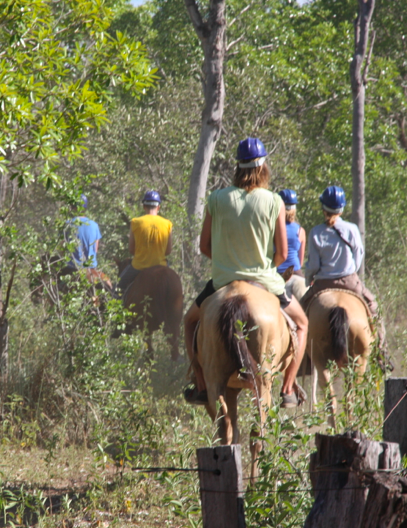
Horse-riding in the Pantanal
Our Sammy and Colin (who donned great Chrissy costumes) handed out gifts to staff and to our Secret Santa recipients.
Must confess that I don’t have a lot of great photos from this memorable day. About noon both my cameras lens (yes, I usually carry two) conked out. It took a while to figure out that the problem was the auto focus. The manual focus worked sometimes, but was unreliable in the dim evening light. So enjoy the pics I managed to get—even if they are a bit fuzzy.
And I’ll cherish the memories of that great day. Always glad I have a mind’s eye.

A tray of sugar overload—jalebis
Indians love their chai (tea) and sweets. In fact, they love food in general. Every village has a chai stall or two. While most stalls are basic, open-air operations, many are fleshed out with a vast array of sweet and savoury temptations to go with a cup of sweet, milky tea.

Samosas frying
Our first chia stop came on the first morning of our overland journey. We’d had a good breakfast in Jabalpur, but by mid-morning our tummies were rumbling and grumbling.
So Anand and Deepti pulled over in a small village and we hopped out to try some of the offerings. Jalebis are showy and give a great sugar hit. They’re doughy, orange, deep-fried and then put in a kind of sugar syrup. Makes them good and sticky. They look like giant pretzels.
I should confess that I’m not a big sweet eater, but think that jalebis are quite tasty—in strict moderation—and very pretty. I think Australia supermarkets sell a make-it-yourself version of jalebis. I wonder whether I could colour them with red and green for Christmas? Probably—the shopkeeper was making some green and red concoctions to colour another treat.
We tried the deep-fried samosas, sugary jalebis (just a taste), a few other sweet and savoury treats and, of course, the chai. Never got a pic of the chai this time. Too busy ogling at all the other treats.
If you’re a sweet, or food, lover in general, be sure to check out my recipe blog.


A good moustache, but not a champion
I’ve just finished reading a fun detective story I bought in India—The case of the deadly butter chicken by Tarquin Hall. Vish Puri is the detective and central character.
The book is very entertaining with wonderful descriptions of the sights, food, personalities and thinking we’ve encountered in India.

Another fine moustache
Two of the crimes (there were plenty of murders too) in this book involved a couple of national champion moustache growers, who had their facial hair stolen in the middle of the night.
The book makes it clear that moustaches are important in India. Apparently, certain professions, such as hotel doormen, require a magnificent moustache.
We saw some classic moustaches during our travels. I managed to photograph a couple, but not any of the most impressive. So enjoy these few. Sy of New York City, a faithful follower of this blog, has reminded me that my spiel on traffic in India has a good photo of Sikhs with moustaches and long beards.
P.S. In case you’re interested, Tarquin Hall has written more Vish Puri mystery stories. They get a big supportive tick from Alexander McCall Smith (of No. 1 Ladies’ Detective Agency fame) and from me too.

Great moustache, but not a champion
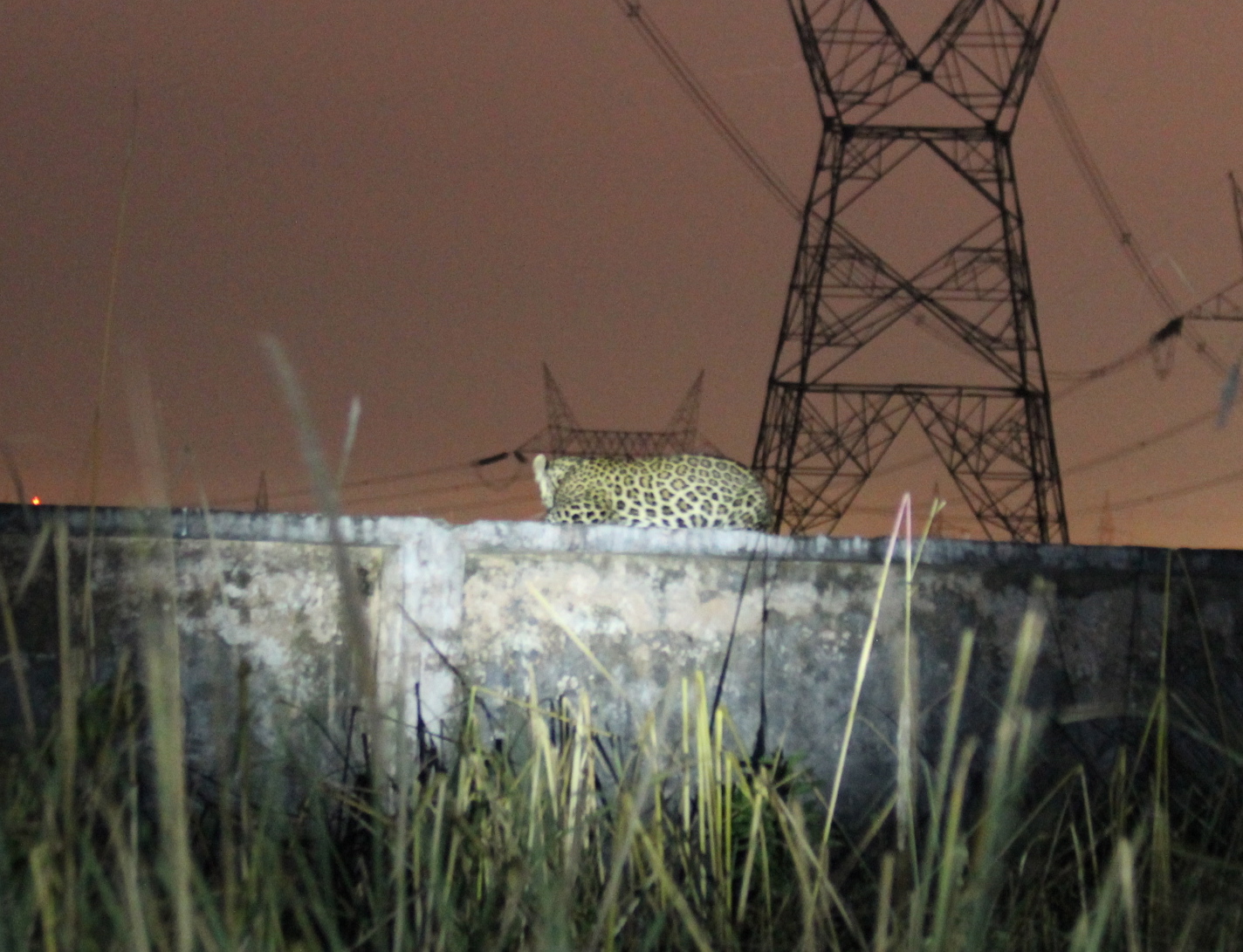
A leopard inspects his diminishing jungle
Our overland tour in India was always going to include more than 20 safari expeditions—most of them on the back of Gypsies (small 4WD vehicles), one on a canter (a larger 4WD) and a few on foot.
And while we knew that tigers and leopards live in India, we never expected to see any of them. How wrong we were. Our tiger sightings were fairly prompt—three of them popped up in the first week of our travels in Kanha and Panna National Parks.
But the slightly-more-plentiful leopards remained elusive. And Rajaji National Park, 250 kilometres north of Delhi, was going to be our last chance.
After our first safari through Rajaji—an afternoon trip on a Gypsy—we stopped for a tea/coffee break at the canteen outside the park.
The fellow who runs the canteen, and who organised our safaris in Rajaji, had a great suggestion. We were already scheduled to do two repeats of the route we had just done through the park, but he said, why don’t you try Ranpuri entrance for your last safari tomorrow? He said it was known for tiger sightings. Yes, yes, we said. It sounded like an amazing option.
The fellow (I can’t remember his name, but Sneaky will do) said he’d organise it for the next day. We all considered his comment a commitment.
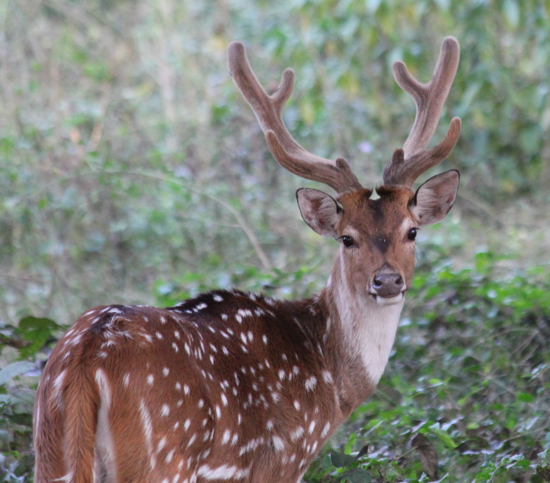
A chital deer—a routine Rajaji resident and common across all of India
Imagine our surprise the next morning when Anand reported that Sneaky was going back on his suggestion. Sneaky claimed he had already organised and paid for two more trips on the same route we had already done.
Going through the Ranpuri entrance would require reimbursement of a 3000-rupee entry fee, plus extra fuel money because this other entrance was 40 kilometres away.
Whoa, this called for immediate action. We knew Anand wasn’t trying to hoodwink us. We’d already travelled with him and Deepti for a month and knew they didn’t operate this way. Sneaky was the problem. He was in the for tourist kill.
Not to worry. Renae and I did what any two crafty Australian women would do. We cracked an emotional (my favourite Aussie slang for tantrum).
I can’t recount the entire conversation because I was only on the delivery end, but we made a stand. Through Anand and his phone we made it clear to Sneaky that his suggestion of the night before didn’t come with any ‘conditions’ or ‘exceptions’. The extra fuel cost was okay, but this rubbish about entry fee!!!!
There was a lot of toing and froing. In the end, Sneaky agreed to bear half the cost of the already-paid entry fee and accept a reasonable amount for extra fuel. And we told Anand to be sure to get a receipt for the supposedly already-paid entry fee.
After all the haggling, the extra expense was about $20 each. Given that it might—just might—improve our last chance of seeing leopards, we thought the price more than fair.
A little confession
Now I should confess that we did see a leopard the night before. After we left the canteen, and on our Gypsy ride back to the hostel, we caught a glimpse of a leopard standing on the side of the road.
At first the driver and guide thought it was a dog. As we approached, the ‘dog’ ducked into the scrub on the side of the road and, as we pulled alongside, we could see that it was definitely a leopard—well a leopard’s bum.
We sat spellbound for a short time and the bum moved on. It happened so quickly that I didn’t have time to get a pic, and Poor John was on the wrong side of the Gypsy and didn’t even get a glimpse.
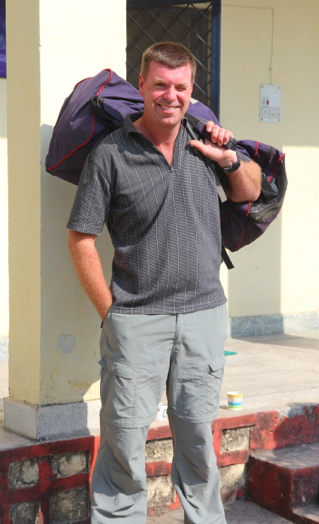
Bye Gary, you are and will be missed
Our last day in Rajaji—our last chance for leopards
Rajaji is a little-known and little-visited park in India. Who knew it would be such a momentous destination in our 31-day overland trip.
We had two scenic but routine safaris there, a victorious locking-of-horns with Sneaky, a sad farewell to Gary who had to leave at lunch before his visa ran out, and finally the excursion to the Ranpuri entrance.
Our guide and driver, who had been with us for our previous two safaris in Rajaji, were excited about going to Ranpuri. Neither of them had been there since at least June. Plus, they were still happy about catching glimpses of a leopard the night before and hoped to have repeat sightings.
I should stress that they had nothing to do with Sneaky’s bad behaviour.
Luckily, now that Anand and Deepti have been to Rajaji, they have good info about the best organisers, drivers and guides to deal with, so I don’t expect a repeat of our issues with Sneaky.
But on to Rajaji.
The entrance really was 40 kilometres from where we were staying and I was glad to be riding with a capable (and not reckless) driver.
Just before we reached the Ranpuri gate, we saw a huge wedding venue being set-up. As we already knew and had observed, November to January is the auspicious time to be married, and the entire countryside is geared up for celebrations.
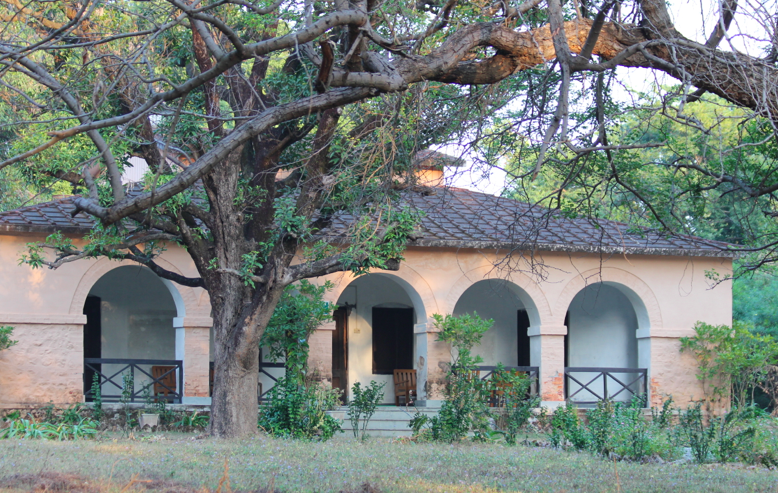
Old forestry house being refurbished for future use
When we arrived at the Ranpuri gate, we were told that we were their first visitors since the entrance reopened a few weeks early. India’s national parks close during the monsoon that goes from June/July to September/October.
We drove through the park slowly, seeing the many birds and deer species we had already seen so often. We got to the end of the route about 4pm, and the guide said we should wait there for an hour or so.
Leopards aren’t out yet, so we should wait, he said. So we waited. We explored the exterior of the chief forester’s house built in the 1880s (and now being refurbished for future use), saw a tusker (large bull elephant) trot by in the distance and twiddled our thumbs.
About 4:50pm, the guide said it was time to move on.
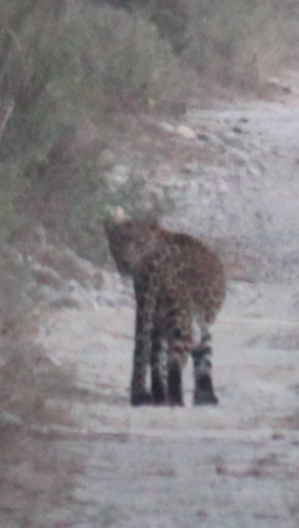
A leopard inspects us over his shoulder
Less than a kilometre down the road, there it was—a leopard on the road. He/she gave us a disdainful look back over the shoulder. What are you doing in my space?
We lingered behind (but advanced slowly) until the leopard trotted into the bush. My photo isn’t great, but it is evidence and a memory.
Most of India is in the Northern Hemisphere, so it’s winter there and the sun sets quickly in late November. It was quite dark as we approached the Ranpuri exit gate. Our guide reminded us to be on the lookout for leopards sitting on the wall along the edge of the park.
As a rule, parks aren’t fenced, but some perimeters have partially fenced boundaries. Ranpuri’s fence is a stone wall—looking old, tall and uneven.
So as the sun set and darkness set in, we watched and watched and watched. And then our efforts paid off. There were two leopards sitting on the fence. They were watching the power poles and, perhaps, thinking of grabbing a wedding guest or two—remember a wedding venue was being set-up just outside the gate.
We still can’t believe our good fortune. Our driver and guide agreed that they had never seen three leopards in one day (and certainly not four, if you count the one glimpse we’d had the night before).
So Renae and I are mightily pleased we cracked our emotional (I think Poor John, Anand and Deepti are too). What an amazing last safari day!
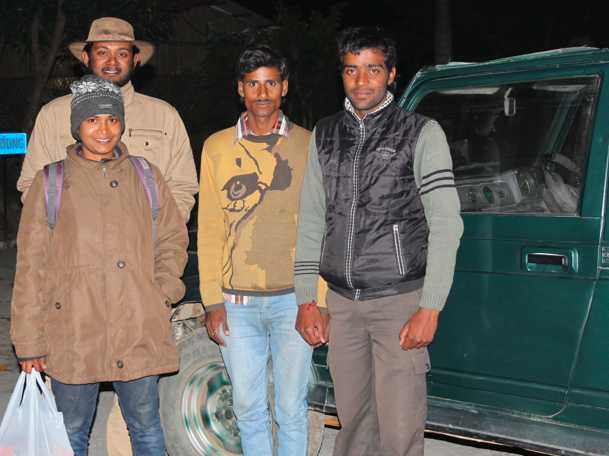
Deepti, Anand and our driver and guide—all wonderful people
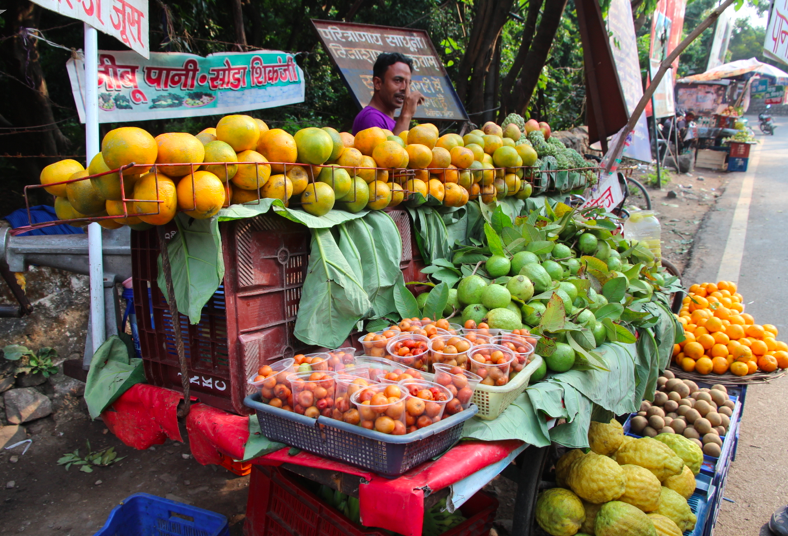
A roadside fruit stall of goodies
I’m a sucker for sour, bitter and spicy. Give me lemons, limes, grapefruits, kiwis, chillies, garlic, olives, Campari, and I’m happy.
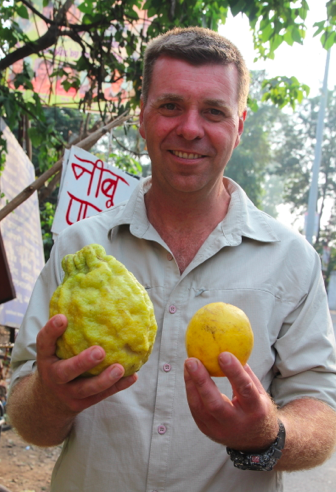
Gary shows off a pomelo versus a lemon
So you can imagine how a giant lemon caught my eye at a fruit stall in northern India. It was huge. We all oohed and aahed over it. Gary held it up for display and photographs. Seriously, it was the biggest lemon any of us had ever seen. But it had a kind of funny shape and as soon as the fruit seller cut it open, I knew it was a pomelo.
I first encountered this delicious fruit in the 1980s when we lived in Rangoon, Burma (or Yangoon, Myanmar if you prefer the current names). A pomelo is a slightly sweeter, less bitter and milder version of grapefruit. The flesh is paler in colour. It’s the largest citrus fruit, and can weigh up to two kilograms.
I once bought a bushel basket of it from the ‘Pomelo Capital of the World’ in Burma, but that’s another story.
But obviously, I love pomelo and was completely intrigued when the fruit seller said he’d make us a special pomelo drink. He put together a free sample and we all had a sip—fantastic! We were heading off to another place, but promised to return after lunch to purchase some.

Pomelo drink with the magic chaat masala
We always tried to honour our word, so were back soon enough. I’d have been disappointed if we’d missed it.
It’s probably one-quarter pomelo juice, topped up with soda (fizzy) water. Then he added a little sugar, some grinds of black pepper and a dose of chaat masala—a popular spice mixture that Indians sprinkle liberally over lots of food.
The drink is fabulous. So delicious, so refreshing, and so secret. The fruit seller won’t reveal the chaat masala recipe. It’s his grandfather’s recipe—says it only has four ingredients when most chaat masalas have many more—and only his young son will learn the magic. Said son was helping dad that day and smiled broadly when he heard this news.
You can’t argue with that family approach to business. I asked the fruit seller (mind you, he didn’t speak English so this conversation was through Deepti and Anand) if he’d ever thought to mass-produce the chaat masala. Yes, he had, which was another reason he kept the recipe secret.
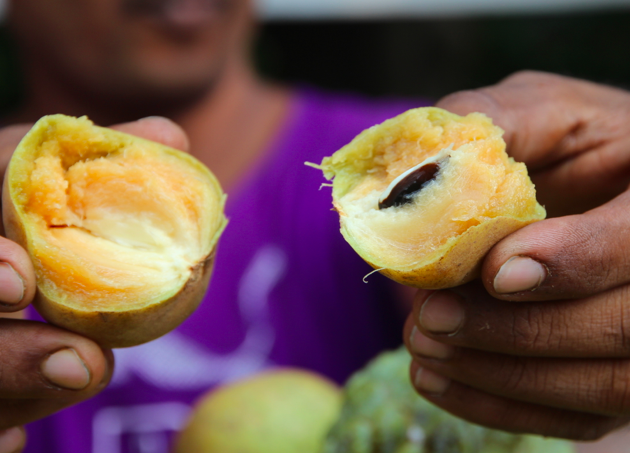
Zapota
His fruit stall was interesting for a couple of other reasons. He was selling two fruits I’d never seen before in my travels—one was zapota (a soft fruit) and the other was a berry-type thing that I’ve now forgotten the name of.
He also had custard apples, another fruit I knew from Burma, and some standards such as oranges and guavas.
Two asides. Our pomelo drinks cost 36 cents each. What a bargain. And I found a recipe for chaat masala. It’s by Sanjeev Kapoor—India’s leading TV chef. It has nine (not four) ingredients, but here it is. I’m guessing that chillies, amchur powder and cumin seeds are three of the four ingredients in the fruit seller’s recipe. He did add pepper (and maybe salt) separately.

Zapotas—looking like potatoes
Ingredients
1/2 cup (20 grams) coriander seeds
1 teaspoon cumin seeds
1 teaspoon ajwain
2 or 3 dried red chiles, stemmed
3 tablespoons black salt
1/2 teaspoon citric acid
1 teaspoon amchur (dried mango powder)
1 tablespoon table salt
1 teaspoon ground black pepper
Directions
Place a small non-stick sauté pan over medium heat. Add the coriander and dry-roast until lightly browned and fragrant. Transfer to a bowl.
One spice at a time, dry-roast the cumin and ajwain, and add them to the coriander. Stir and set aside to cool completely
Transfer to a spice grinder. Add the chiles, black salt, citric acid, amchur, table salt, and pepper. Grind to a fine powder. Store in an airtight container.
And if you are interested in recipes, be sure to check my food blog.


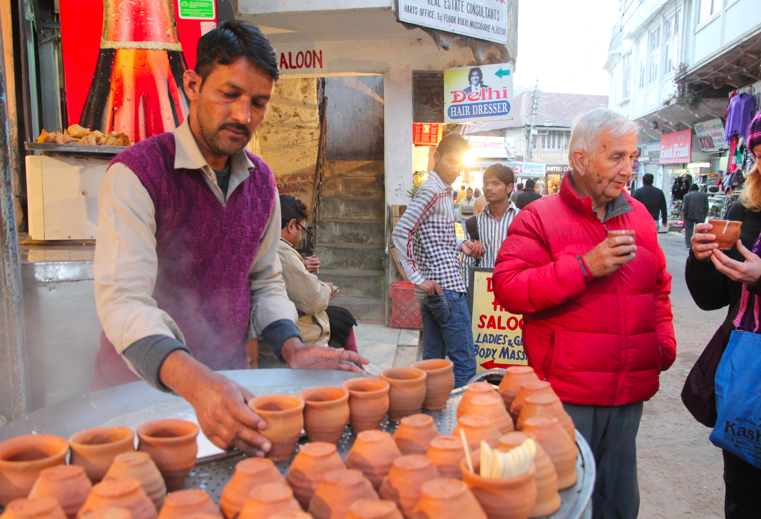
Poor John and Renae (just out of the pic on the right) sample the flavoured milk. I’d have preferred a Christmas-y egg nog.
As the festive season heats up, I reckon it’s time to introduce some of India’s drinks.
For starters, holiday cheer is often hard to find in India. While there are a few licensed English Wine Shops in most towns, very little wine is actually sold. The shops are usually tucked in out-of-the-way places and, when you front up as a customer, you’ll feel like you’re visiting a prison inmate. The hours are strictly limited and you conduct your business through a securely fenced opening. Peer through the grill, make your choice, push your money through an opening and receive your contraband.

Anand, Gary and Renae front up to the local grog/booze/alcohol prison
Renae and I felt like a couple of floozies the night we went to buy a bottle of Scotch whiskey in the hill station of Mussoorie. We fronted up to the cage and waited for one of the three staff to serve us. Ahem, cough, cough. Nope, we were shrouded in invisibility cloaks. Ahem, ahem, cough, cough, cough.
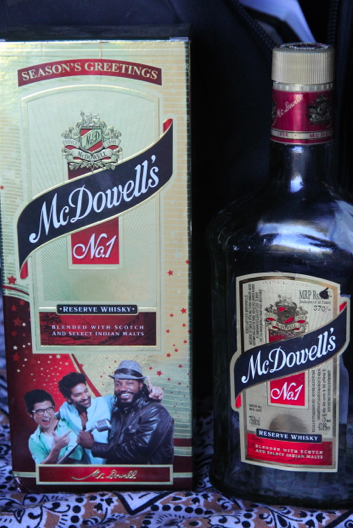
McDowell’s and a good box
Finally there was a glimmer of acknowledgment and we asked for a bottle of McDowell’s. We’d bought a bottle of McDowell’s several weeks earlier for 380 rupees (less than $7) and five of us polished that off over several nights. In the interim, we tried another local brand, which cost more than $15. Outrageous! Given that we found no difference in taste (and to be honest the taste was weak and bland for both), Renae and I figured the el cheapo option would be fine. We were presented with a crushed but intact box holding, what we hoped was, an intact bottle of McDowell’s. Pleased to report it was fine.
Beer is another matter. Depending on how ‘dry’ an Indian state is, the price of a 750ml bottle of the country’s Kingfisher Premium beer can range anywhere from 70 to 250 rupees (or from less than $1.50 to almost $5). Of course, both prices would be considered cheap in most English-speaking countries, but the pricey versions are still very dear for the developing world.

Two kinds of Kingfisher beer
The unavailability of booze links directly to the problems that the demon drink has caused in the country over the years. Men (and yes, it is mostly men) get pissed (Aussie slang for drunk) and fall over in the road and get killed. Or they spend all their wages on drink and the family starves.
Poor John’s story of who can drink and drive has always amused and scared me. When we first visited India in the 1980s, the rules were that a certified alcoholic could buy booze, but a certified alcoholic could not get a driver’s license. The alcoholic needed a doctor’s certificate to confirm the addiction. Trouble was that a boozy husband got his wife to be certified as the alcoholic and then he got the driver’s license. Bad combination.
We weren’t bound by these rules—I don’t think anyone is anymore. So we enjoyed a few different beers in India—Kingfisher, Godfather and Haywards. I think Haywards had a funny aftertaste, but the others disagreed, so it was just me.
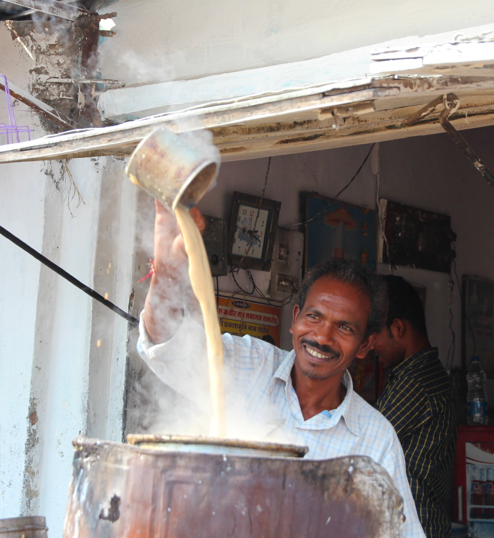
A fellow who loves his job of making chai in an Indian village
But the favourite drink of India has to be chai—a milky, sugary and very tasty version of tea. It’s made everywhere, all day and in enormous quantities. The biggest batch I saw being made was in a village near Kanha National Park.
Overall, I had way too many cups of chai. Normally I drink coffee, but early on in our trip I ordered a coffee that was so weak and so bad, that I couldn’t drink it. On reflection, it might have been made from chicory. Next time I ordered chai and that order seemed to hang with me forever-after. Can’t remember exactly when I broke the spell, but I managed to bring coffee back to the surface before the trip ended.
We encountered a flavoured-milk stall in Mussoorie, a hill station we visited for a couple of days after the Prayaan India Overland tour ended. I love milk and was impressed by how the fellow tipped milk from jug to jug, but decided I didn’t need to try any. I have lingering memories of Burmese cows having tuberculosis when we lived there in the 1980s, so I still, probably wrongly, worry about milk in the developing world.

Knows his flavoured milk job so well, he doesn’t even have to look as he pours
That means I’m not keen on lassi either, which is such a common and popular drink in India.
But before I finish, I have to mention the water.
Almost everywhere we went in India, we were told it was okay to drink the water. The exception was Bharatpur, where the water was okay to drink, but tasted terrible. The hostel in Bharatpur served filtered water in abundance.
In the end, we drank the water everywhere we went, except in Bharatpur. We did brush our teeth with it there, so I suspect that taste is the only problem.
All that said, I did get Delhi Belly for a couple of days. I was quite surprised because, over the years, my stomach has seen almost anything that nature can throw at it. The last time I had a seriously dodgy gut was in 1976 in Egypt. And that’s a pretty good claim after visiting about 90 countries.
But India gave me a seriously dodgy gut for a couple of days after our tour ended. I have no idea what sparked it. All of us on the tour ate the same food, in the same places. I guessing I got a poorly washed plate. Or who knows what?
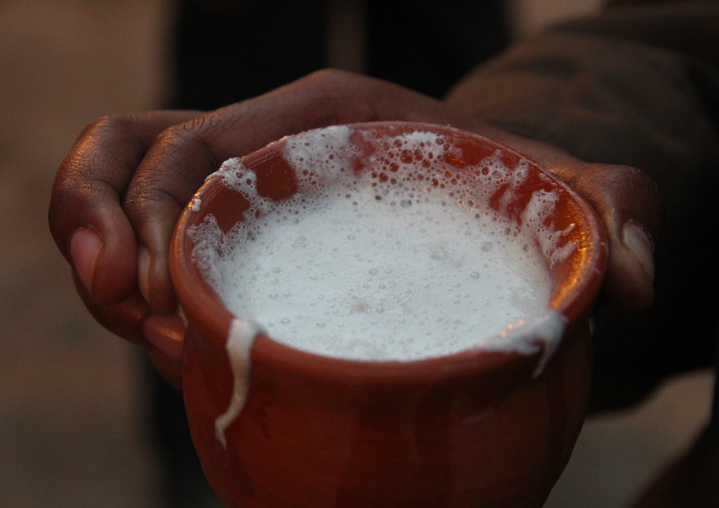
A warming cup of flavoured milk
My cure was water from the Ganges.
About a week before getting to Delhi, we camped beside the Ganges River. I’ve already written about Brij, the amazing cook at the Three Blind Mice resort, but I haven’t said that we all saved some bottles of the amazing Ganges water from our stay there. The resort was well north of the plains and where the Ganges rushes down from the Himalayas.
Soon after I hit New Delhi with Delhi Belly, Poor John said, Why don’t you try the Ganges water we brought back with us? So I did. Completely cured by the next morning. Who could have predicted that?
P.S. I have lots more to say about drinks and food in India, so stay tuned. Coming soon a post about a friend’s book on cocktails (Penquin Books asked him to write it), and check out an amazingly divine grapefruit-y kind of drink from a fruit stall seller, who wouldn’t reveal the recipe.
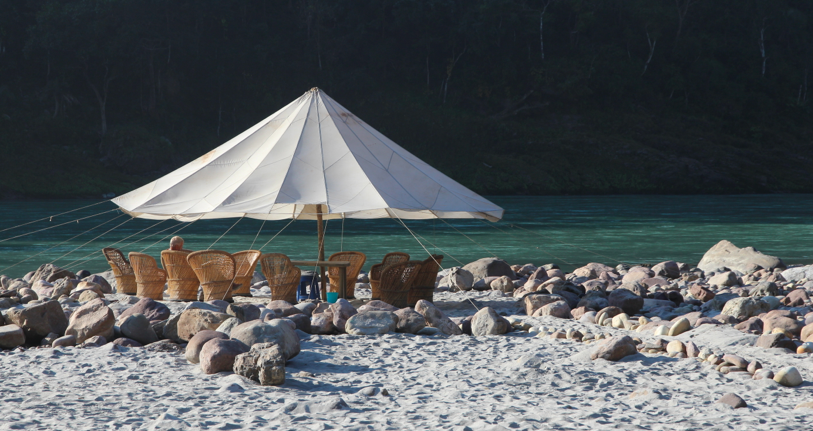
A glimpse of the restorative waters of the Ganges River from the Three Blind Mice resort
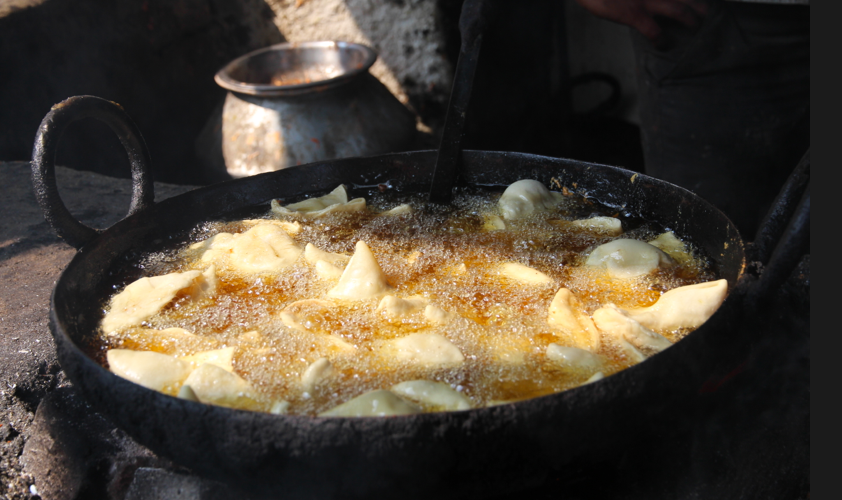
Deep frying in progress
We haven’t had a bad meal in India, although some have been better than others. But every single meal has had a deep-fried component. Usually it’s a deep-fried carb—or a deep-fried vegetable dipped in a carb mixture.
I really don’t know why this country and its people have not sunk into the Indian Ocean?
Deepti and Anand told us that people from the desert state of Rajasthan have ghee-drinking competitions. Ghee is clarified butter—I make it at home—and Rajasthanis can drink more than a litre at a time.
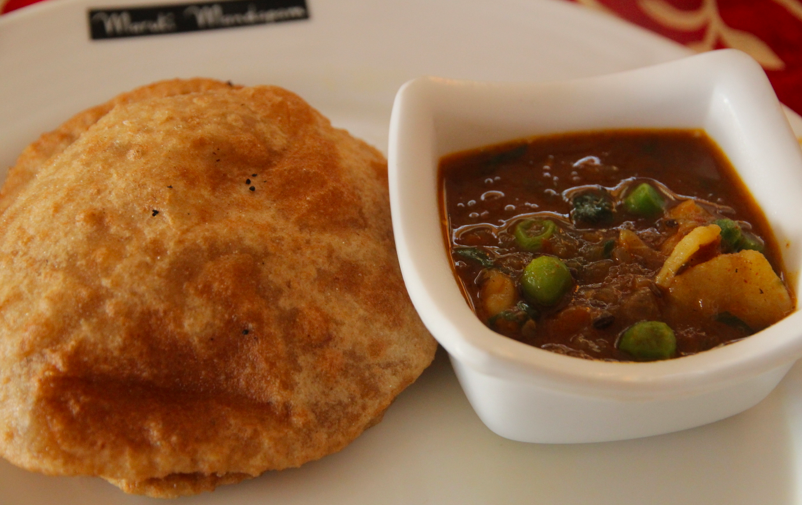
Deep-fried bread and a curry
That’s a lot of fat, but Rajasthan is not alone. All over India, we’ve had deep-fried potatoes, deep-fried and buttered bread, buttered rice, fried bread with eggs, and more. If we ordered naan bread, the restaurant would ask if we wanted added butter. No thanks.
We even saw a restaurant offering pizzas with a butter topping. We never tried them—were never even tempted—but I’m gobsmacked that I got out of India without gaining weight. Perhaps I should thank the two days of unexpected Delhi Belly I had at the very end of my trip (and after we left the tour).
Stay tuned for more about food—especially a great whole-in-the-wall restaurant in a hill station.
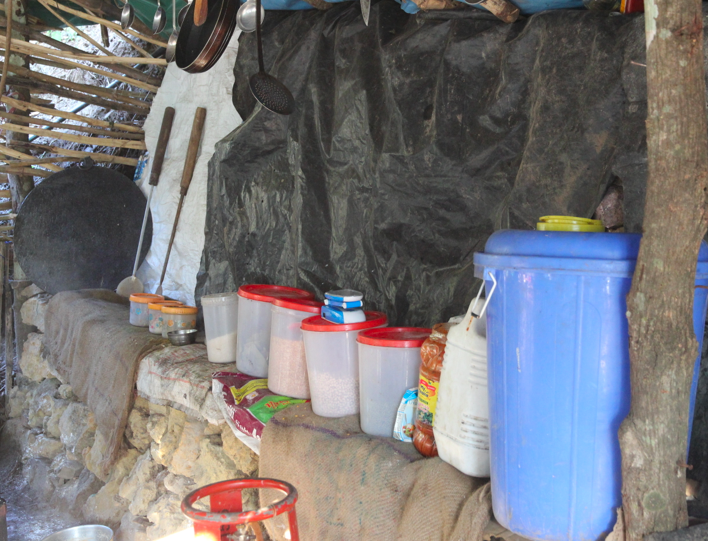
A simple kitchen that produces amazing results
After six weeks of eating my way through India, I have to tell you about the fellow who must be the nation’s best chef.
Assuming that I can read his handwriting, his name is Brij Mohan (I knew Mohan was right and Deepti told me the right first name). Brij cooks at the Three Blind Mice resort on the shores of the northern Ganges River.
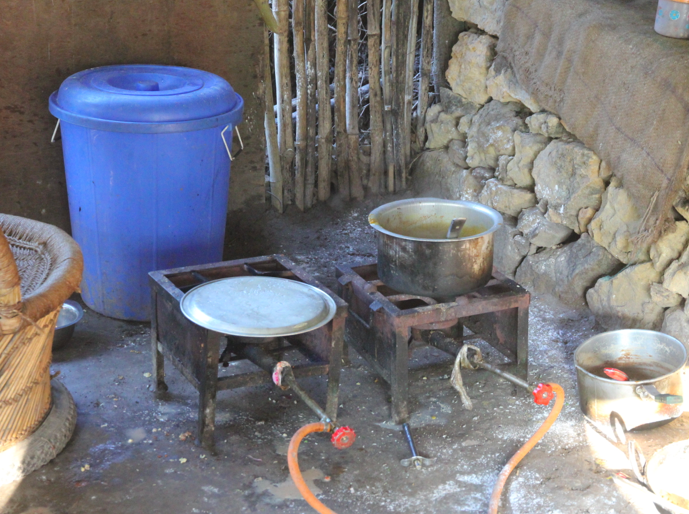
Two burners can work wonders
It’s where the river waters run beautifully clean, the sand is soft, the tents are already set up, the toilets are long-drops, an ashram with a spiritually important cave is next door and the food is sensational.
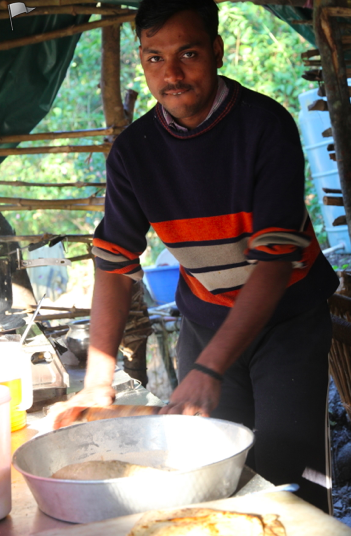
Binj Mohan at work in the kitchen
I had a grumpy start to Three Blind Mice. It’s winter in India and even though it wasn’t all that late, we arrived after dark. That’s when I discovered that getting to the camp was all down a steep and unlit hill.
Poor John—aka He Who Walks Everywhere—scampered down the hill, leaving me to fend for myself. This was going to be a 10-minute downhill struggle of huge stone steps and loose gravel. Gary gets a gold star for staying behind to shepherd me down the ‘stairs’.
As I often say, the chances of me falling are small, but the consequences of me falling are huge.
Once we reached the bottom, it was impossible to appreciate the sensational setting (that would not be revealed until the next morning), but it was very easy to appreciate the wonderful meal set before us.
I can hardly remember the order in which wonderful dishes were served to us, but not one dish disappointed.
We had several days of meals there—plus snacks—and enjoyed dishes with chicken, chickpeas, paneer, eggs, all kinds of breads, peas, cauliflower and so much more.
On our last morning, I went up to the ‘kitchen’ to photograph and quiz Brij.
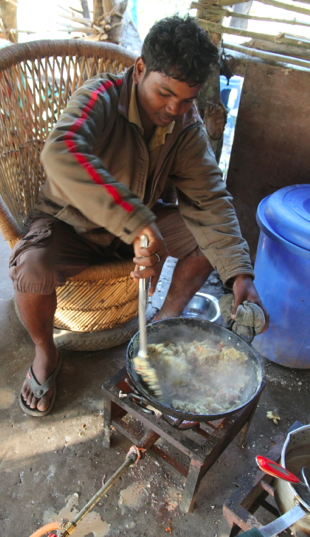
Some great chilli-flavoured scrambled eggs in production
He’s a Punjab and he trained in large hotels. I’m not quite sure how he ended up in a seasonal resort, but his cooking would get him a place in a top Indian restaurant anywhere in the world. I’m guessing he loves his new lifestyle because it is a gorgeous setting.
Rather cheekily I asked Brij if he could make seven days worth of new meals if guests were to stay that long. Of course, he said. So I asked if he could make 30 days worth of new meals. Yes, he said, but I’d need electricity and an oven.
And that comment reminded me that all the wonderful fare he had made for us had been done on two gas rings and in a shack made of sticks. I can hardly believe how he achieves all that he does.
He is clearly proud of his work, and I’ve urged Three Blind Mice and Brij to compile a cookbook of his dishes. He wrote out five of his recipes for me, but they are ingredient-only lists with no measurements.
Lots of his words are written in English versions of Hindi, so I’m figuring out that tejpatta refers to bay leaves, badi elechi is black cardamom, jeera is cumin and so on. Brij’s handwriting is open to interpretation, and I can only hope my spellings are right.
I may have to go back to watch over his shoulder as he cooks. His amazing recipes certainly deserve to be recorded and shared. I’ll do my best to collect and share. Stay tuned.


 Where to next?