
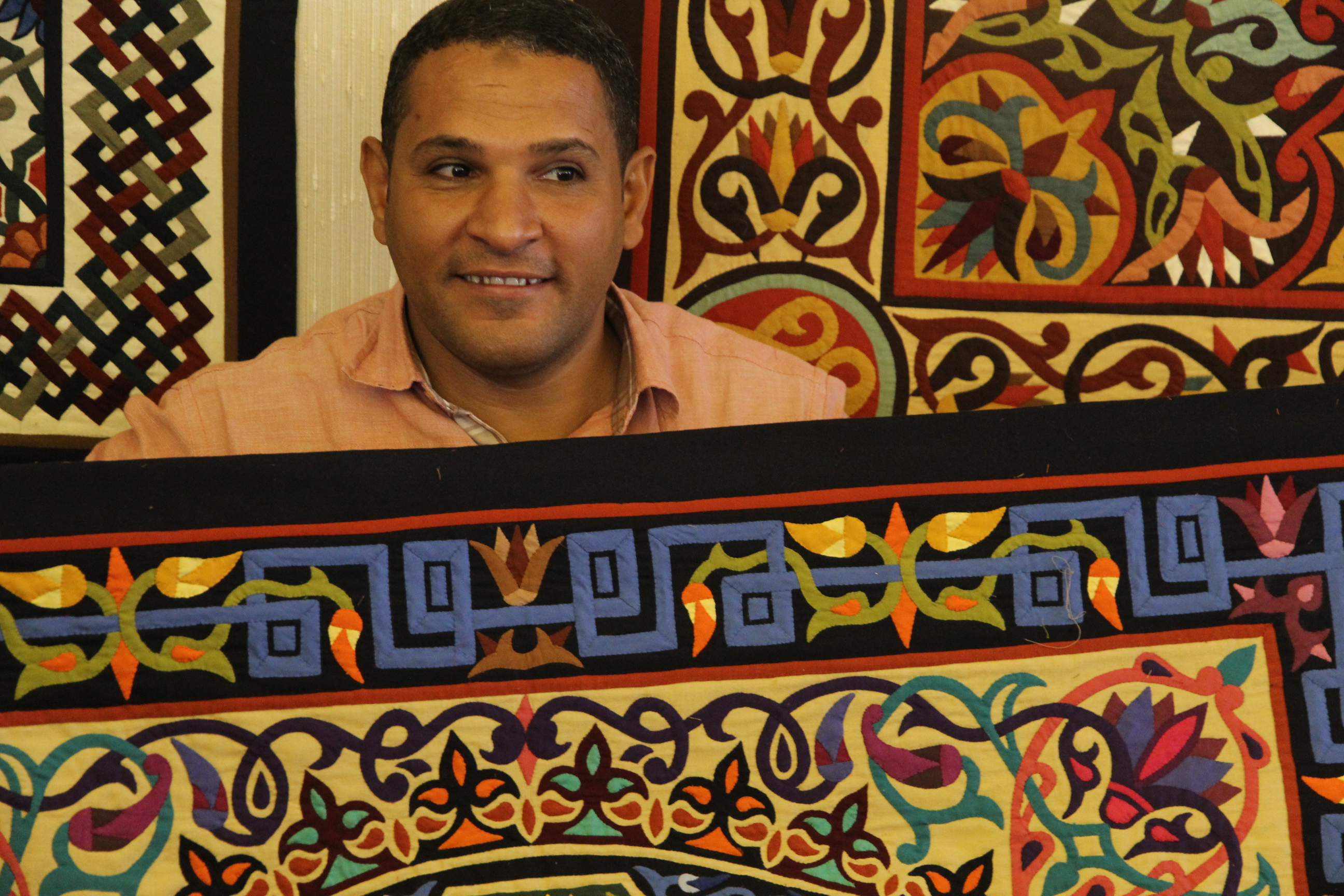
Ekramy shows off one of his works
I’d been in Cairo for about a month when I was invited to my first wedding. It was a lavish affair with lots of people, joy, laughter, music, food, belly dancing (a talent which comes naturally to all Egyptians) and loads of colour.
Egypt really isn’t known for her colour—unless you’re in the ancient tombs or fond of the dun brown dished up by the Sahara Desert—but she sure knows how to dress up for an important occasion.
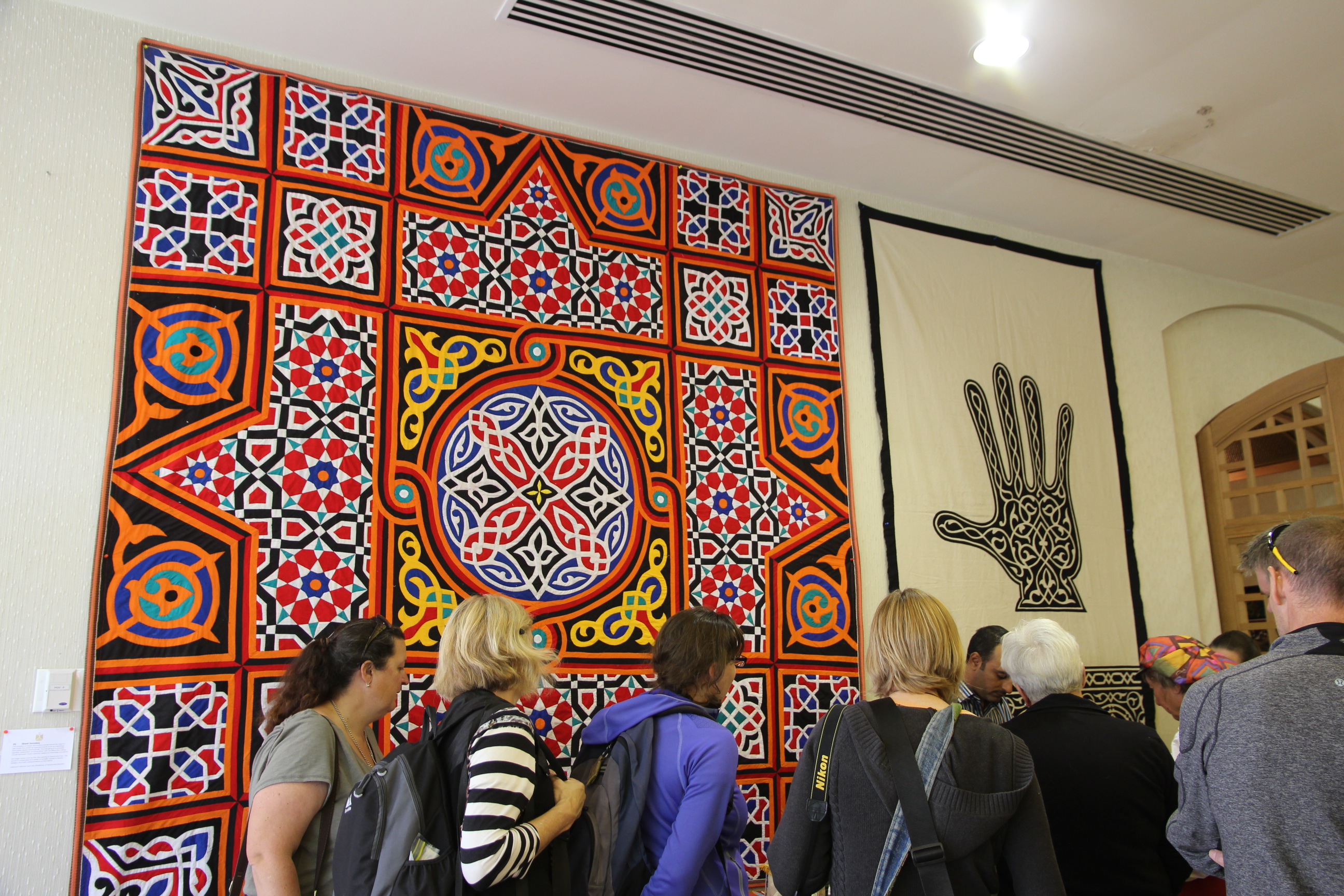
Multi-coloured street suradeqs are used to decorate occasions from weddings to funerals
Back in 1976, when I first arrived, many of Cairo’s festivities were liberally decorated with tent hangings. These enormous appliqués—with their bold colours and geometric designs—were used to create the walls and ceilings of celebratory spaces.
Even then, I knew tentmaking was an ancient craft. I’m guessing it started with nomads who wanted to bring colour and texture to the interior of tents pitched in the midst of desert landscapes.
But these days, handmade tent hangings are being replaced with acres of el-cheapo pre-printed fabric, and that change and a lack of appreciation for the skill needed to create the appliqués are killing the art form.
In the late 1970s there were about 45 master tentmakers on Sharia Khayamiya, the tentmaker street in old Islamic Cairo. Today there are fewer than 20.


But master quilter and friend, Jenny Bowker, is working hard to ingest new life into the craft and find new markets that will foster a healthy future.
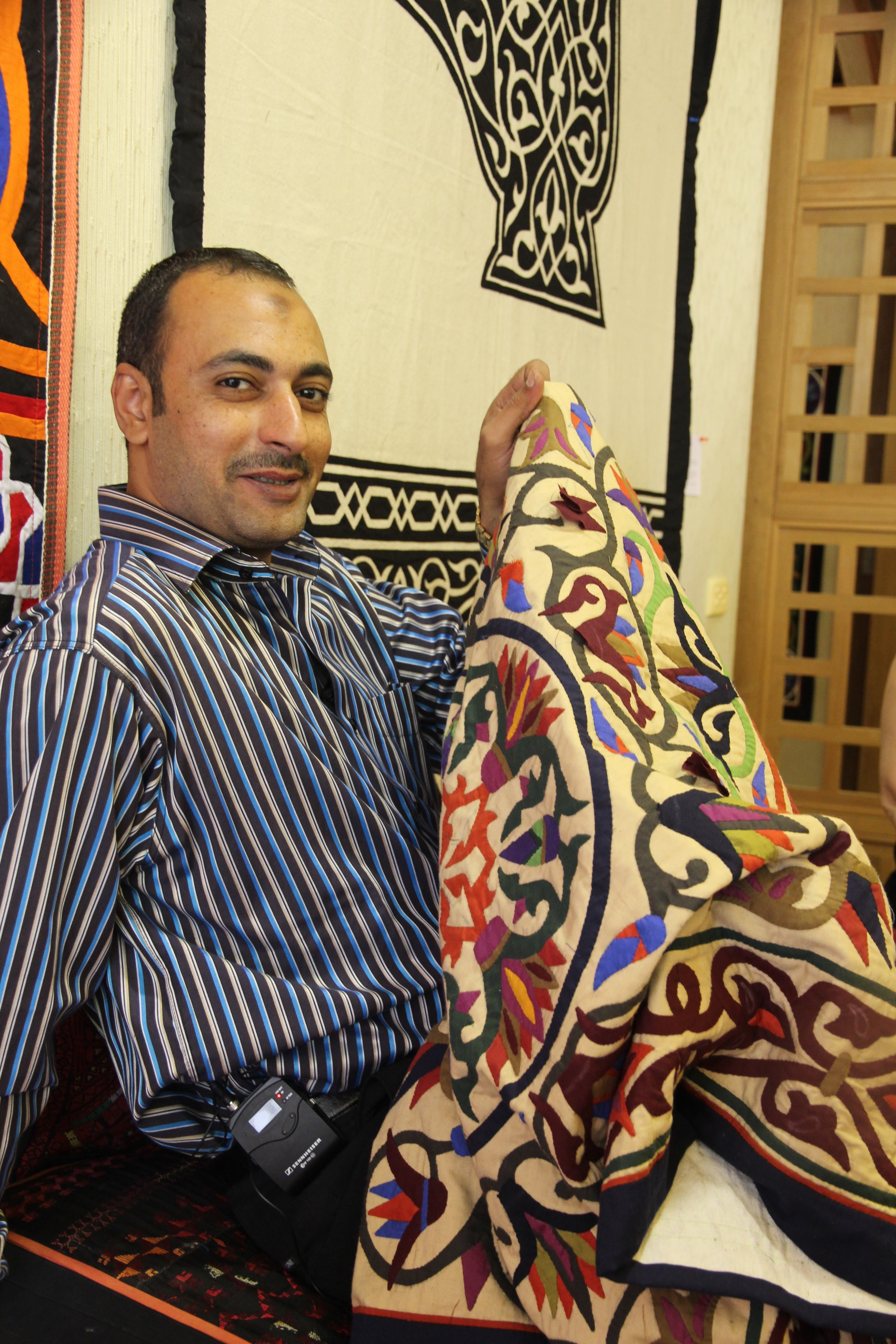
Hany shows off one of his pieces
And the folks in Canberra are lucky she’s sharing her crusade with us.
As part of celebrating Canberra’s 100th year, Jenny, the Canberra Quilters and other donors have joined together to bring two master tentmakers from Egypt to Australia for a program of displays, demonstrations and classes.
The fun started last weekend, when master tentmakers Hany El Sayed and Ekramy Hanafy wowed the crowds at the Egyptian Embassy’s Open Days. Both men learned their craft as children, and how they are passing the skill on to their own children.
Ekramy explained how a tent hanging comes to life from initial pattern to colour selection to construction to completed product, and Hany described the appliqué he created to mark the revolution of 25 January 2012 that saw Hosni Mubarak ousted from power.
The Open Days included a display of about 40 appliqués, including some of Jenny’s magnificent quilts inspired by her life in Egypt from 2005–09.
I feel blessed to have seen these displays and equally blessed to own about 12 small tent hangings purchased when I lived in Egypt in the late 1970s.
Jenny feels somewhat hopeful about the craft. The American Quilter’s Society has signed a three-year contract with 18 remaining tentmaking shops to provide works for international exhibitions.
Thank you Jenny for all yours efforts on behalf of the tentmakers of Egypt. If anyone is interested in knowing more about Jenny and her amazing work, please check out her website, including the images of her incredible quilts.
More exciting news was shared in a comment below. A film, titled The Tentmakers of Chareh El Khiamiah, being produced. Find out more at their website.


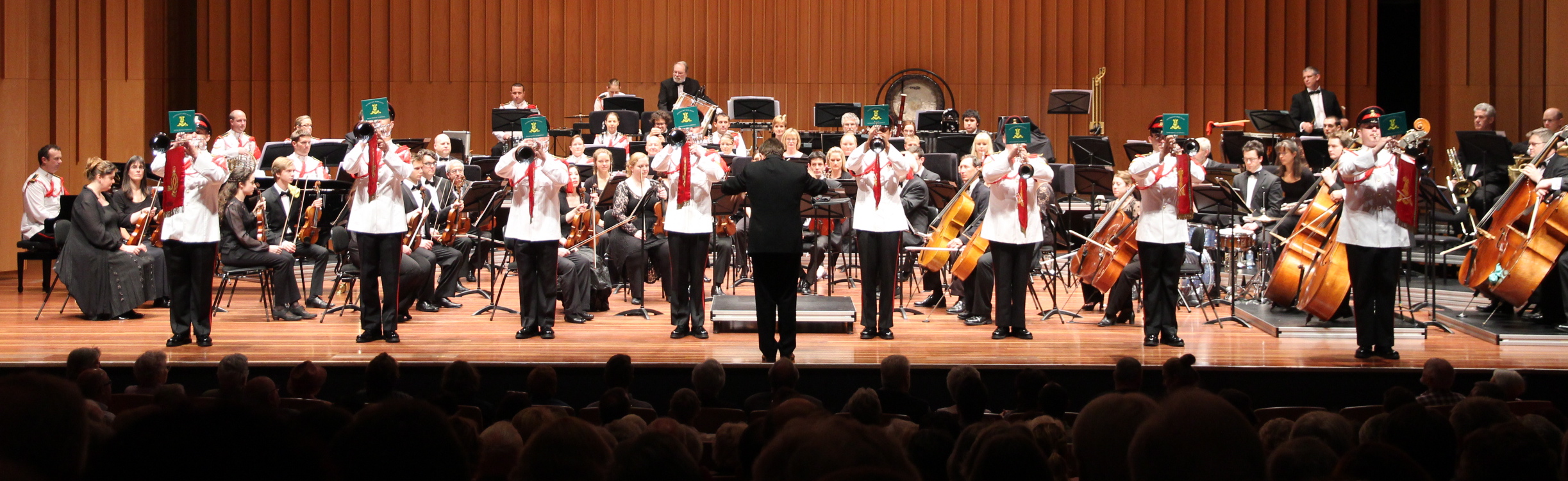
The opening fanfare
Nothing like a cannons-blazing rendition of Tchaikovsky’s 1812 Overture to bring everyone to their feet for a standing ovation.
And that’s exactly what a packed house did today at the concert presented by the Canberra Symphony Orchestra with the Band of the Royal Military College, Duntroon.

Concentration
Two hours of gifted musicians playing strings, brass, woodwinds, percussion and keyboards was pure magic. In fact, that’s what the event was called, The Canberra Weekly Matinee Magic, Strike up the Band!
According to Nicholas Milton, the orchestra’s personable chief conductor and artistic director, the collaboration between the two musical groups was supported generously by Nick Samaras, founder and publisher of the Canberra Weekly, a free magazine.
The concert opened with a rousing fanfare, followed by Gershwin’s Strike up the Band. Then on to Coates’ Dam Busters March.

The French horns
The rest of the first half featured Strauss’ Thunder and Lightening Polka, Walton’s Crown Imperial (played the way it was originally written), Sousa’s Washington Post, Elgar’s Pomp and Circumstance No. 4 and, finally, the Respighi’s moving Pines of Rome.
No doubt about it, we could hear the troops marching in throughout the Pines of Rome and, during intermission, everyone agreed it was the standout number of the first half.
If you believed the program, there were only three numbers after the interval—Suppé’s Light Cavalry Overture, Sousa’s Stars and Stripes (complete with piccolos) and the incredible 1812 Overture with accompanying ka-booms.
Most likely you know some of the ending—da-da-da-da-da-da-da-boom-boom!

Nicholas Milton thanks Nick Samaras for his generous support
There weren’t real cannons, but it sounded like it. And then the standing ovation. The applause, cheers and foot stomping were almost as thunderous as the cannons.
And they got the desired result—encores. The Gershwin medley included I’ve Got Rhythm, one of my favourites. Then there was the final number, the rousing Radetzky March, which had everyone clapping to the music (which is what you have to do for that piece).
Milton, who is a gifted violinist as well as the agile conductor (he’s a lot of fun to watch), tried to convince us that they hadn’t rehearsed this march, but I think he was fibbing. What a great note to end on—literally.
If you are anywhere near Canberra on 30–31 October, make a diversion to see the orchestra and a 300-strong choir perform Carmina Burana. The performance is a centenary gift to Canberra from the Embassy of Federal Republic of Germany. I recommend booking early.
I’d be there, but we’ll be in India.


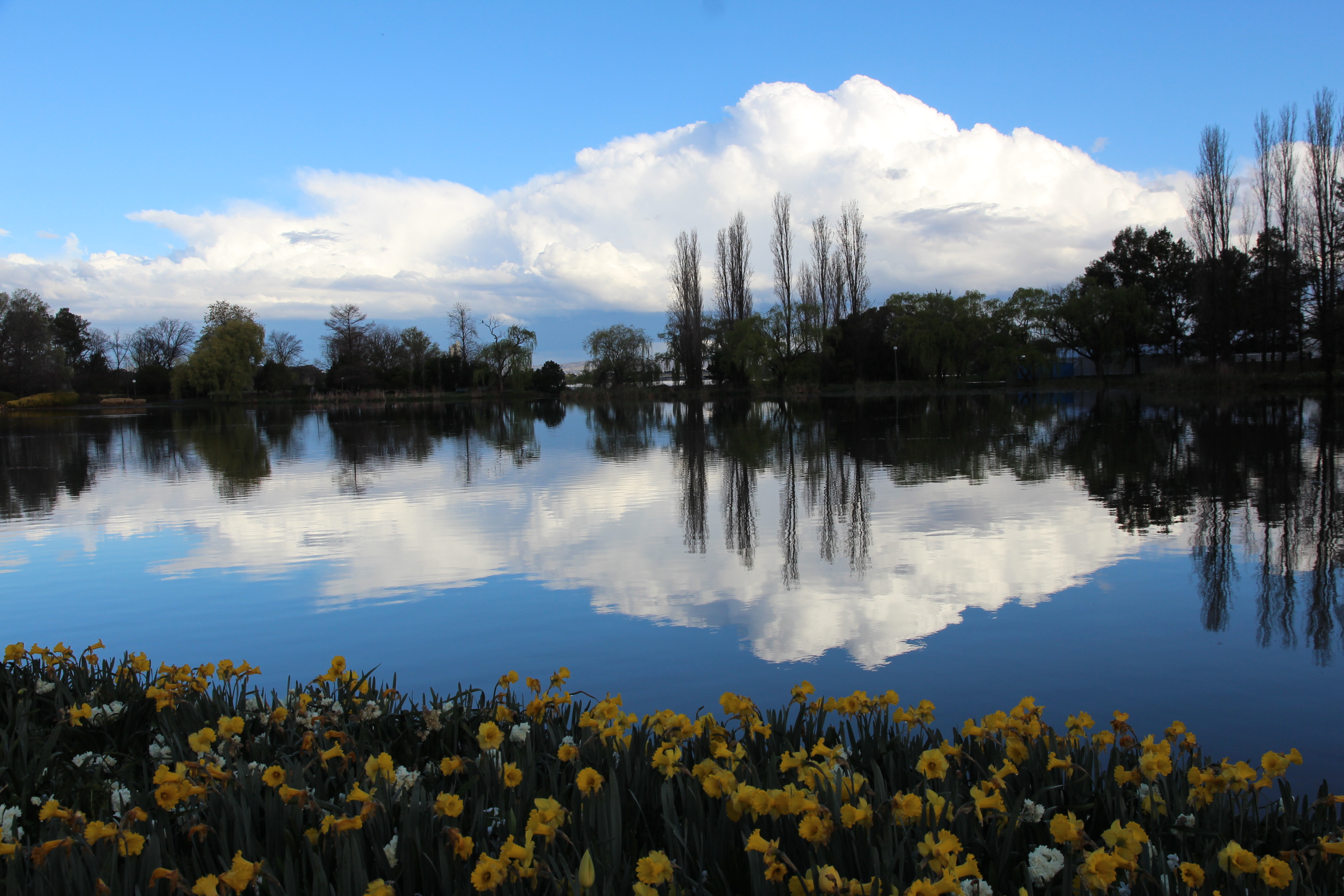
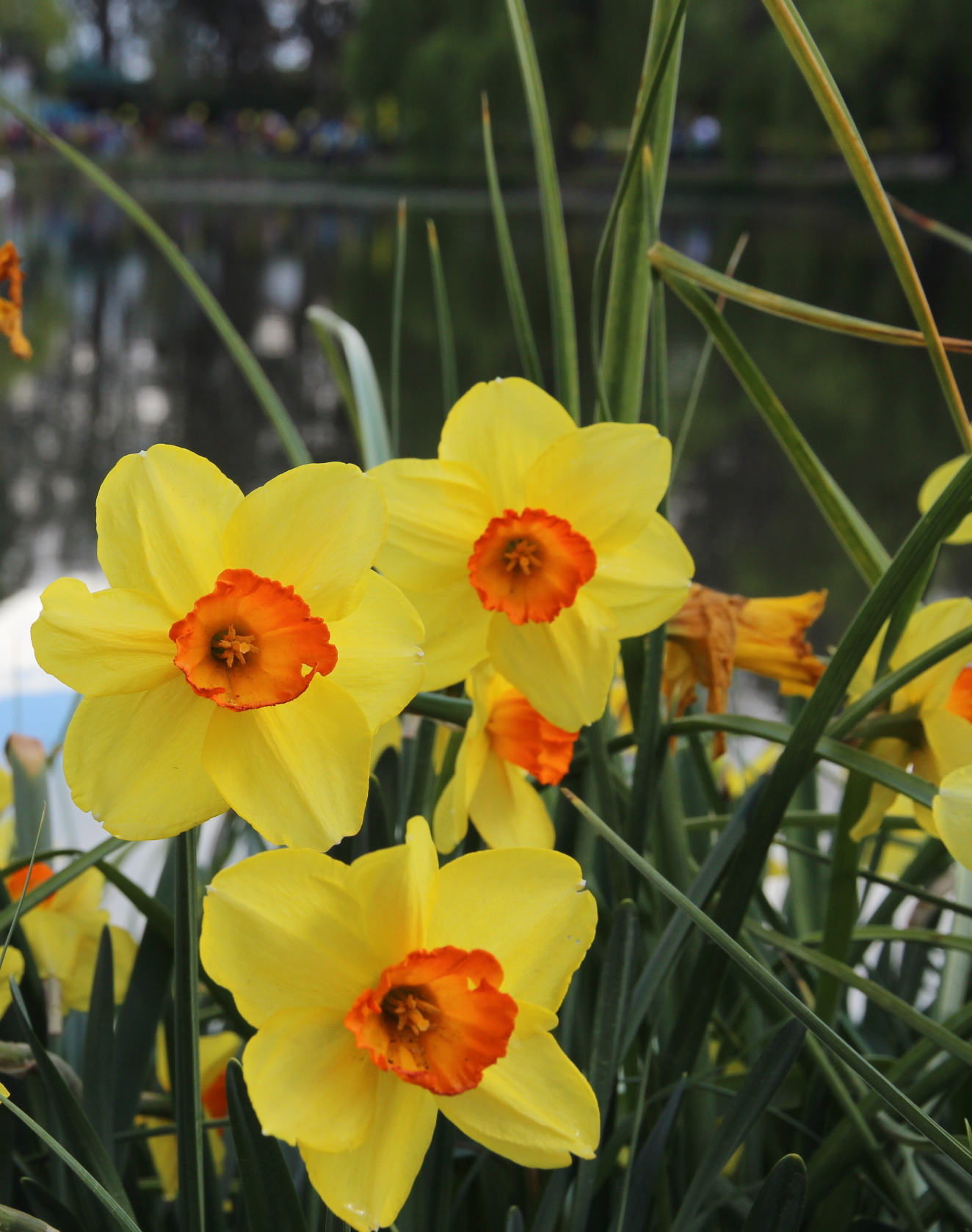
I took a squillion photos at Floriade—Canberra’s annual flower festival and the largest one of its kind in the Southern Hemisphere—but I’m especially happy with this one.
It’s not just about flowers, but about the whole package of what makes Floriade, Canberra and Commonwealth Park such wonderful places to visit. Hope you like it too.
P.S. I promise, it’s not a pic of Switzerland or a postcard I found somewhere. It really is Canberra.
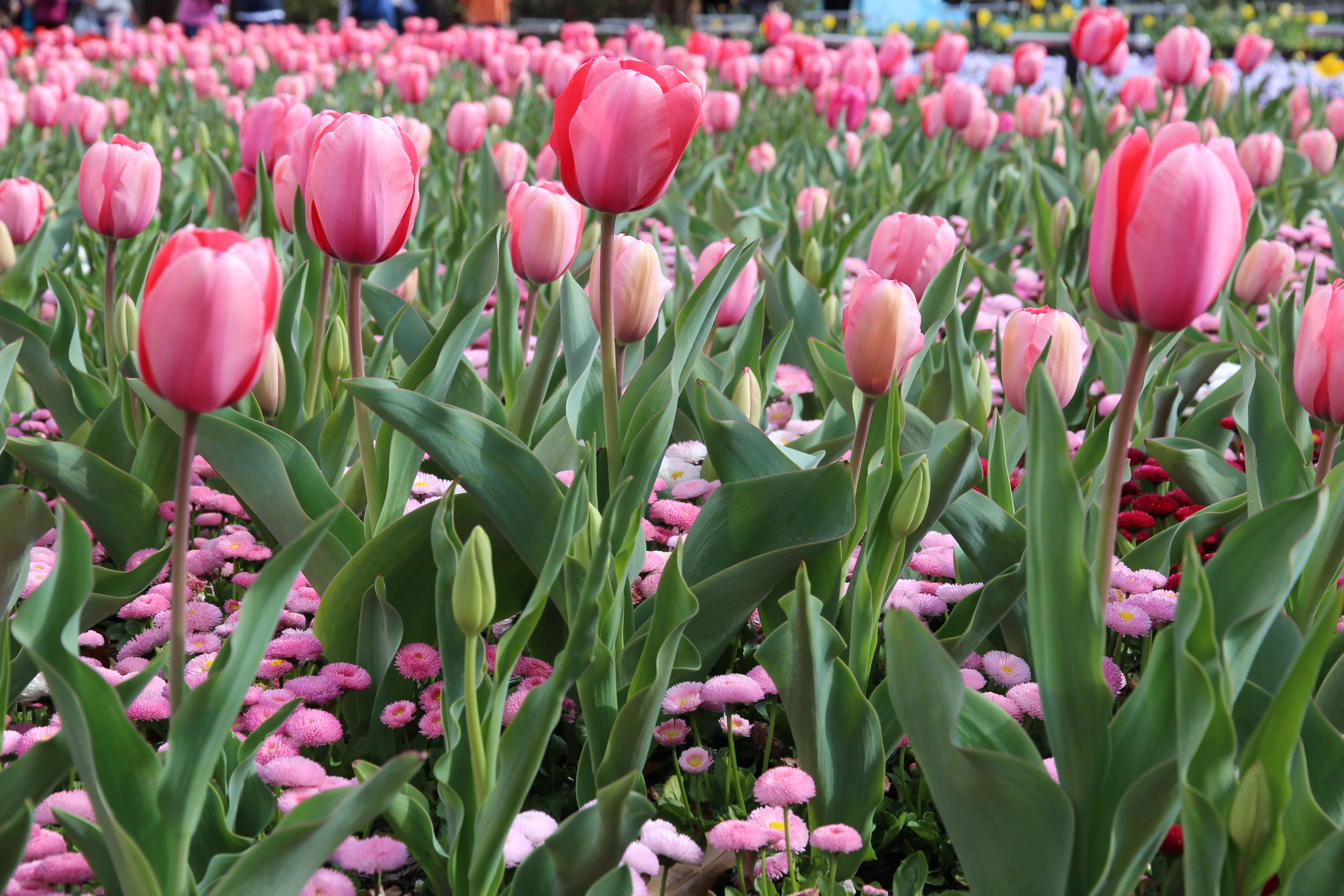
Pink on pink
Today we’re taking a quick diversion from South America because it’s spring in Australia, and Canberra is enjoying flower overload.
In Commonwealth Park alone, more than a million blooms are captivating crowds from across the country and across the world.
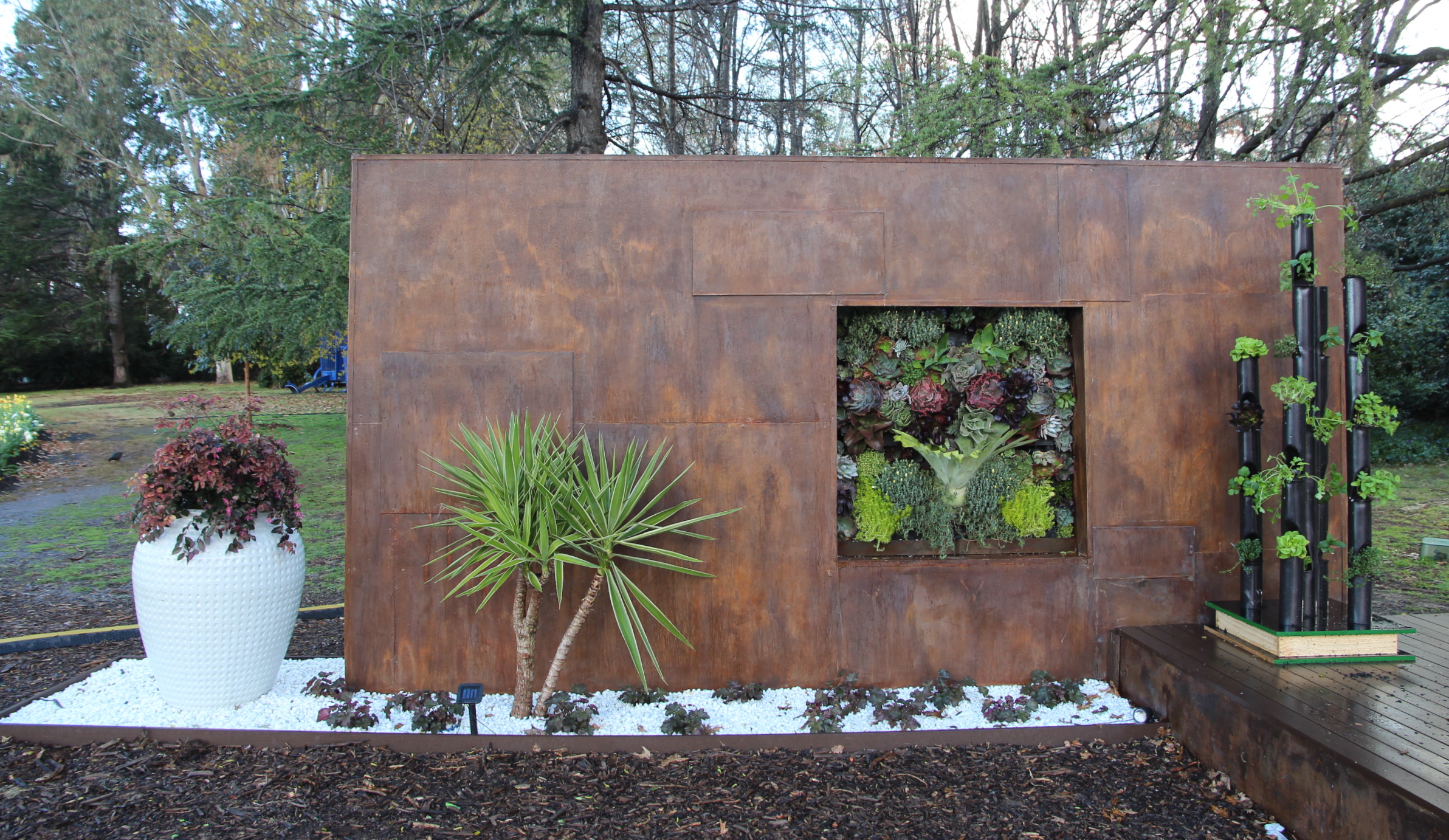
Creating a garden on the back fence
All these petals—and pollen—are thanks to Floriade, the Southern Hemisphere’s largest flower show. Floriade started in 1988, to celebrate the 75th year of Australia’s federation. It was a one-off back then, but was so popular that it has carried on ever since.
This year, Canberra celebrates its 100th birthday and, along with the community, Floriade has grown and changed.
I remember the years when the organisers tried to charge admission. What an uproar! I think it went on for two years—the uproar and the charge.

East Timorese dancers share a laugh after their performance
The first year EVERYONE had to pay to get in. The second year and after the outrage and kerfuffle, Canberra residents got vouchers to get in for free. Our main argument was—we already pay a shitload in bloody rates (taxes) for this event, so the least you can do is let us is for free.
Can’t remember if the admission debacle carried on for more than two years, but now it’s free for everyone.
But they get the money out of us in different ways. It’s not the local government collecting the dollars, but the retailers. In addition to all the flowers, there are whole areas devoted to cafes and retailers selling all sorts of things you don’t need, but might.
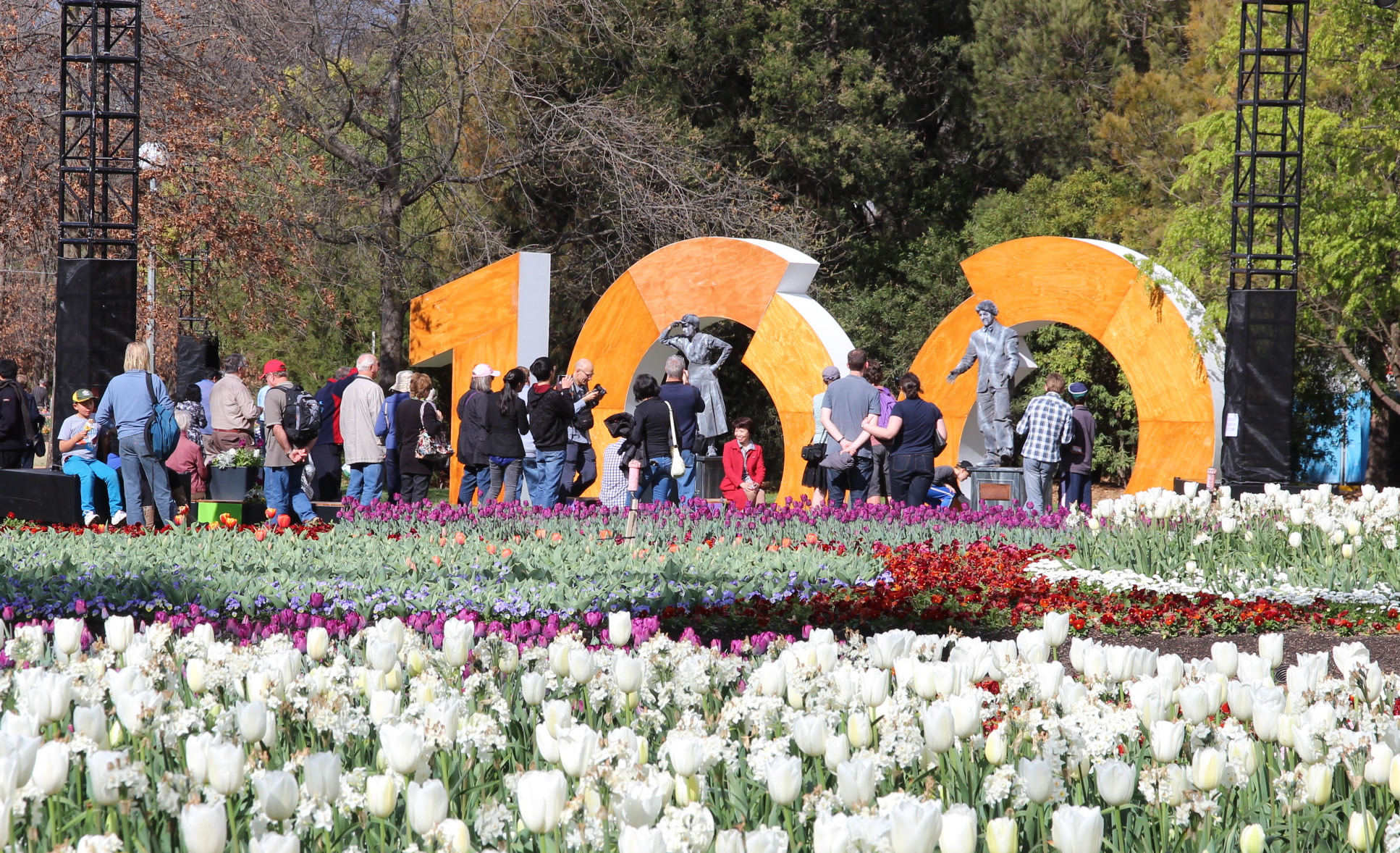
Floriade helps Canberra celebrates its 100th year
I dropped $100 on our first visit this year (and nothing on the second, although Poor John spent $5 on ice cream). I bought three amazing titanium vegetable peelers (one for me and one for each of the daughters) and a knife sharpener.
These purchases are proving to be interesting. I told Libby I’d bought her the ‘best vegetable peeler in the world’ and she reminded me that I’d already bought her a couple of best-in-the-world peelers in the past. (Crap, who knew I had a thing for vegetable peelers?)
Not sure about the knife sharpener yet. It didn’t working brilliantly on the first knife that went through the treatment and worked okay on the second. We went back to Floriade today, and I told the fellow that I loved the peelers but wasn’t so sure about the sharpener. He insisted that I bring the knife and sharpener back, and he’d look in to it.
Very glad there was no run-around and I’d like to think that it will all work out with a sharpener that I like or a refund.
But Floriade’s food credentials go beyond designer nuts, spices and coffee for sale. Poor John and I sat in on one of six sessions presented by Julie Goodwin, Australia’s first MasterChef winner. She made a savoury pumpkin pie, working with ingredients provided by Canberra’s Yellow Van.
I’m gobsmacked by the Yellow Van’s efforts. This organisation collects and distributes food that isn’t out-of-date, but might be tossed on the rubbish pile. It works with supermarkets and restaurants throughout the city. In the last year, it has collected about 250,000 kilos of food that helps to feed people who need support. Poor John and I travel a lot, but we are looking into how we can support this worthwhile group.
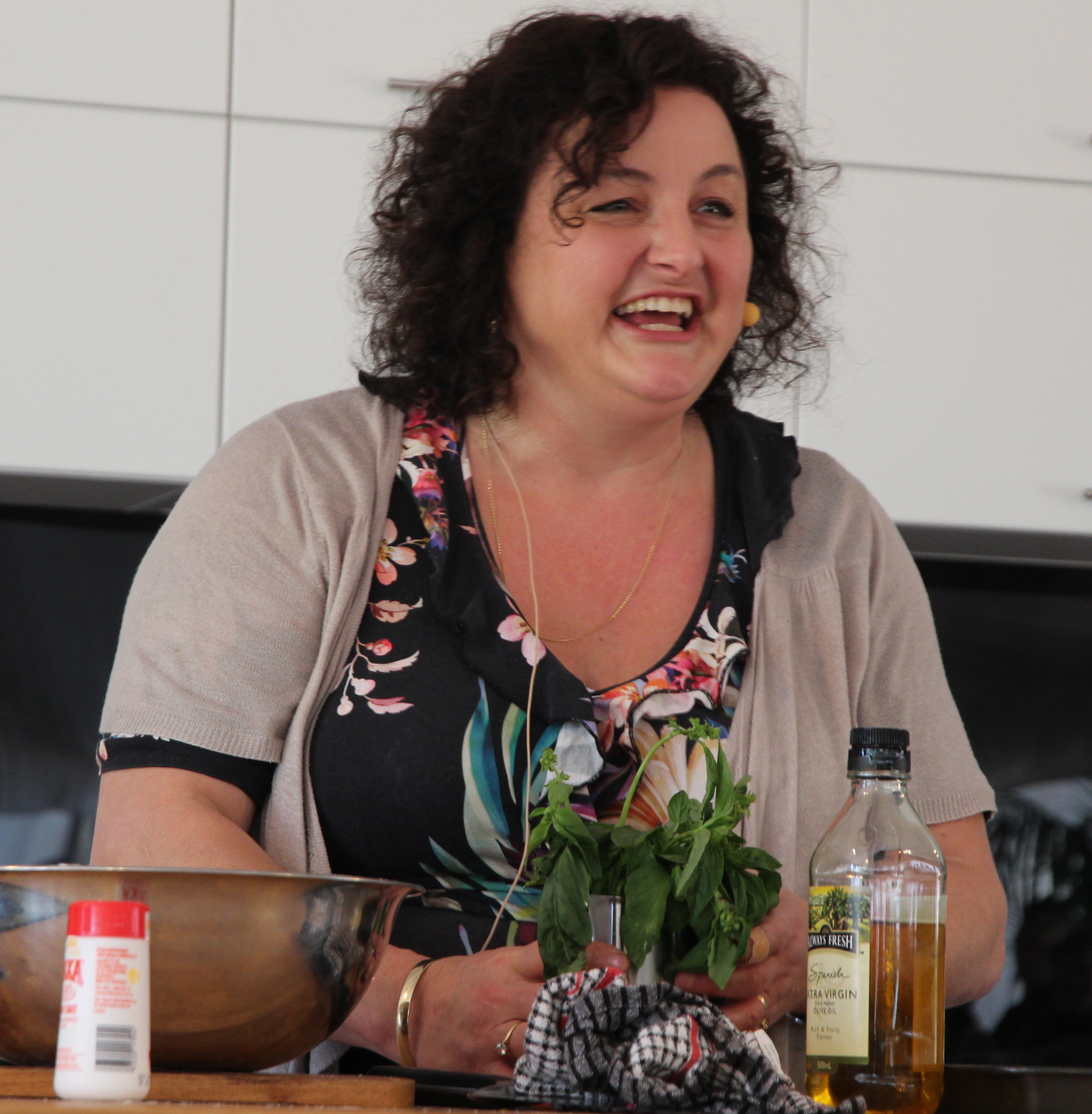
Julie Goodwin entertains with cooking and humour
The next three weekends will have other famous chefs sharing tips and demonstrations on different kinds of food. I’m looking forward to the lessons on how to grow and pickle olives.
Weekends have plenty of musical and dance performances too. Ethnic music wafted throughout the park as we strolled through the gardens, and we saw the East Timorese dancers relaxing after they danced. We stopped at a nifty do-it-yourself demonstration on beautifying your back fence—clearly I need to put Poor John to work and haul him back there next week for new DIY ideas.
But back to flowers and other displays.
For starters, the gnome event is back. This attraction started almost 10 years ago. Groups, businesses, schools and individuals can purchase garden gnomes to decorate. Entries can be submitted for the next couple of weeks. As of today, the monochrome and dragon boat entries stand out for me. Entries are open for another two weeks, so I’ll check back and let you know.

Dragon boating gnomes
Floriade’s veggie patch is growing like mad and reminds me that I don’t need a lot of space to produce a reasonable amount of food for the table. I grow lots of herbs and fruit trees, and I’ve already planted three tomato plants. Listening closely to the weather each night so I can protect them from any late frosts. The nearby good-plant, bad-plant display is always an eye-opener, but luckily our own predominately native garden doesn’t have any offenders.
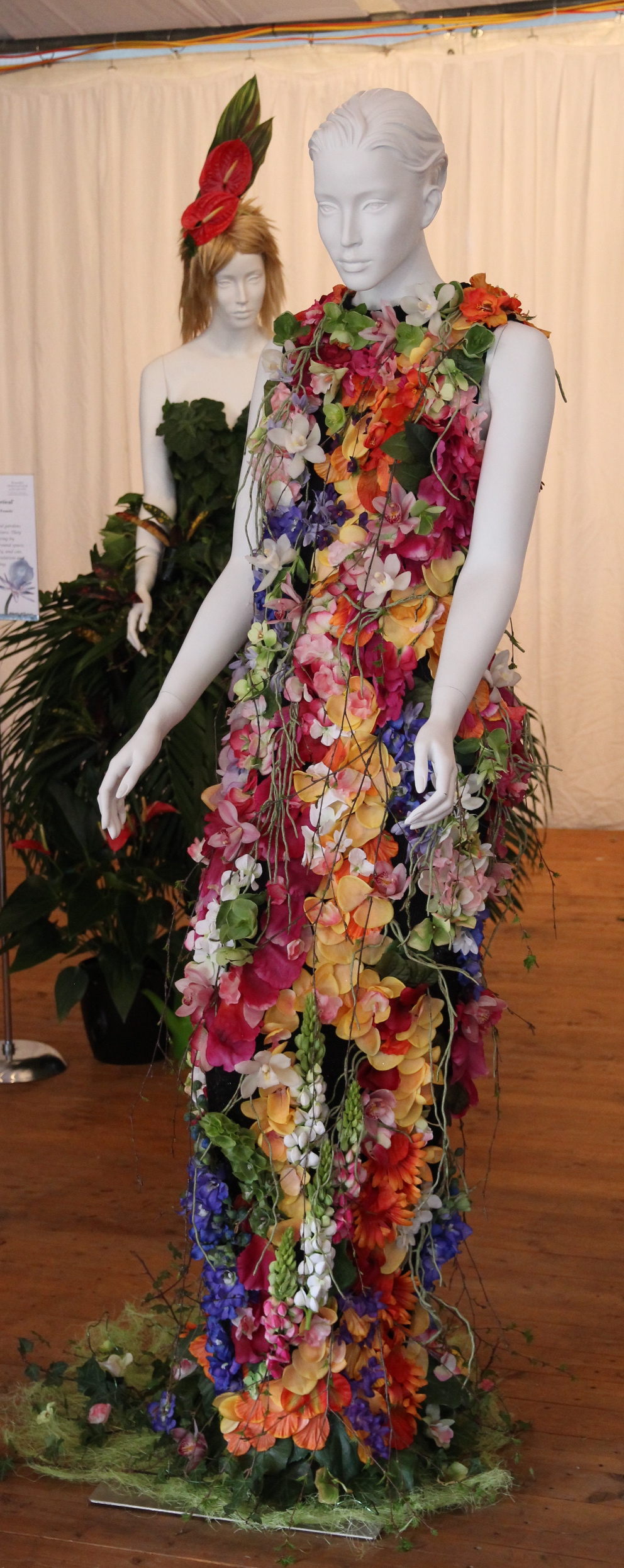
As for the flowers, I’m glad I saw the fashion creations before they’ve wilted. These are dresses made of leaves, flowers and other garden items. The creativity is amazing, but I suppose the actual dresses might be a bit scratchy to wear.
The rest of Floriade’s flowers are doing well. Lots have bloomed early, and I think they will continue to blossom for at least two weeks. Not sure how impressive the last week will be.
I could write on and on about this—where to park, the cookery displays coming up each weekend and more, and I might do just that. Ask questions and visit if you can. Or visit the website.
Floriade runs until 13 October and there will be special evening extravaganzas on 25–29 September. We’ve never been to a night-time event, so might have to check it out this year. Might do the ferris wheel too.


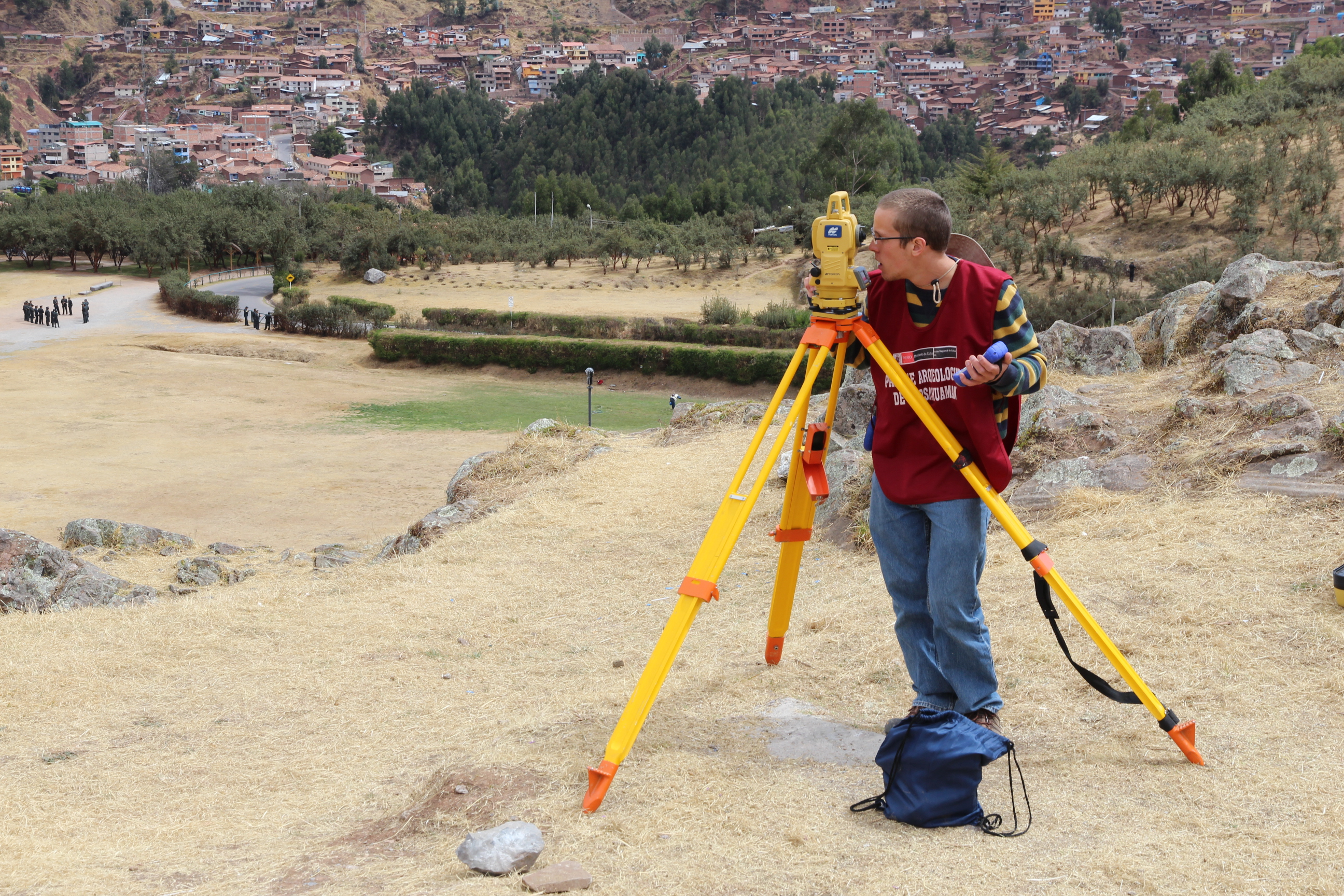
Paul surveys Saqsaywaman in the hopes of finding and solving drainage problems
Yesterday I wrote about our visit to Saqsaywaman (pronounced Sexy Woman), the massive Inca ruins just outside Cusco in Peru.
What I didn’t mention was some of the TLC the Sexy Woman is getting. You see, the old girl is suffering and a group of civil engineering students and their professor from the University of Virginia are trying to help her out.
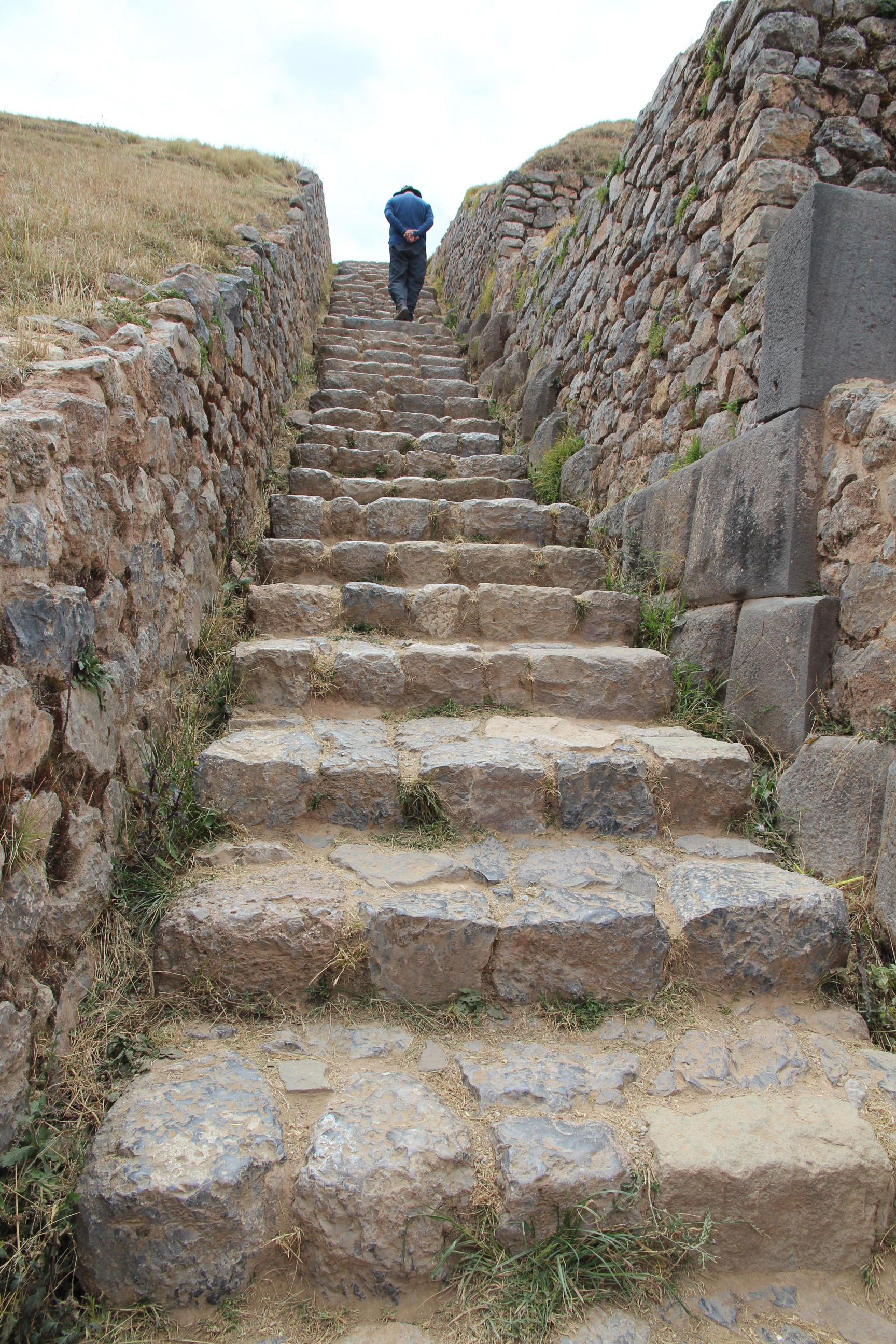
Hiking up stairs to see the view Paul was seeing
I found out about these efforts when I noticed a young man taking survey readings at the site. I know my theodolites, but Paul was surprised when I asked ‘what are you surveying?’ He said people usually don’t recognise the equipment and want to know what he’s ‘photographing’.
When we were there, Paul’s group was in their last day or two of several weeks of taking about 3000 readings that will help them to create a 3D model of Saqsaywaman.
The model will be used to help them figure out why and where the ancient drainage systems at Saqsaywaman aren’t working well anymore. Then they’ll try to come up with solutions that help this magnificent set of ruins to carry on in the future.
Paul, who is one of four students on the project, said the experience has been a wonderful opportunity for him and his fellow students, and a bit of extra work for him. His mum is from Colombia and he’s fluent in Spanish, so he’s had the task of translating for the rest of the group.
I quizzed Paul for about 15 minutes and thanked him many times over for allowing me to interrupt his work, which I don’t suppose I interrupted too much because he was able to keep on taking readings. He, in turn, very graciously thanked me for providing a diversion in his day. Nice guy.
Paul, if you see this, I remember that you were on the verge of starting a university exchange in Ecuador. We wish you well!
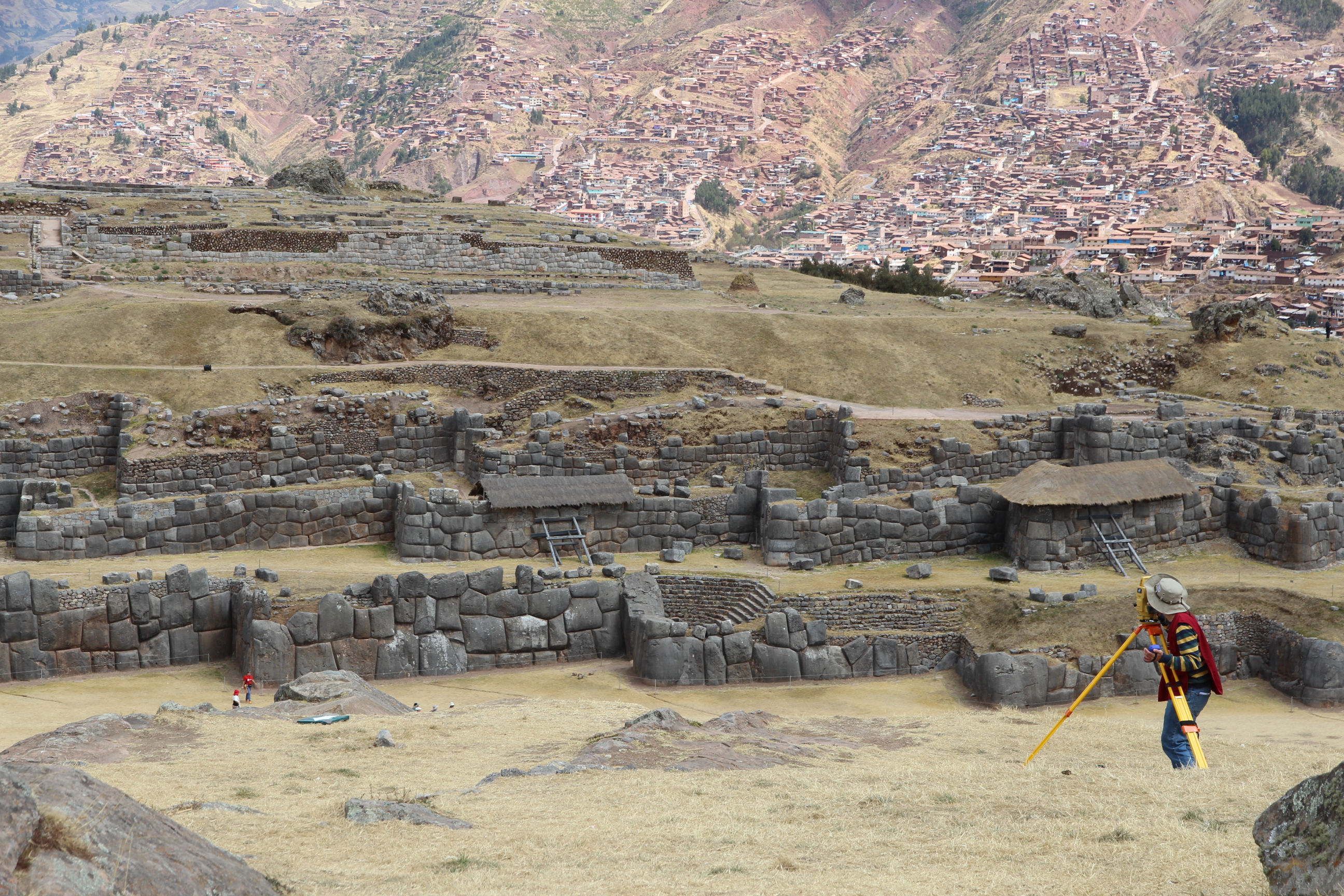
Looking over Paul’s shoulder from afar
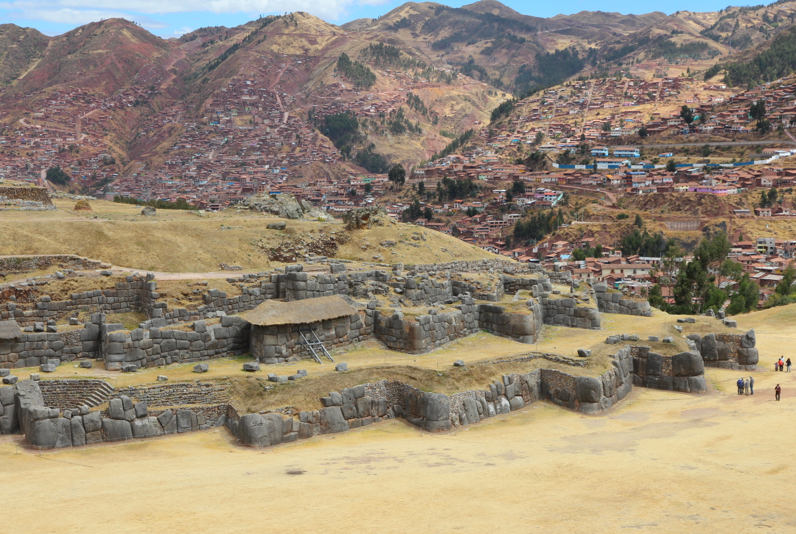
Three zig-zagged walls of stone from the Inca Empire
Yes, I was the grumpy woman. I confess, but I was hot, peeved and crabby too.
Poor John (who appears in this entry as He Who Walks Everywhere) and I set out from the hostel not long after breakfast. We were heading to another of the historical attractions linked to the pricey ($50 each) tourist tickets we bought to get us into a whole bunch of sites in and around Cusco.

The bus that made me walk
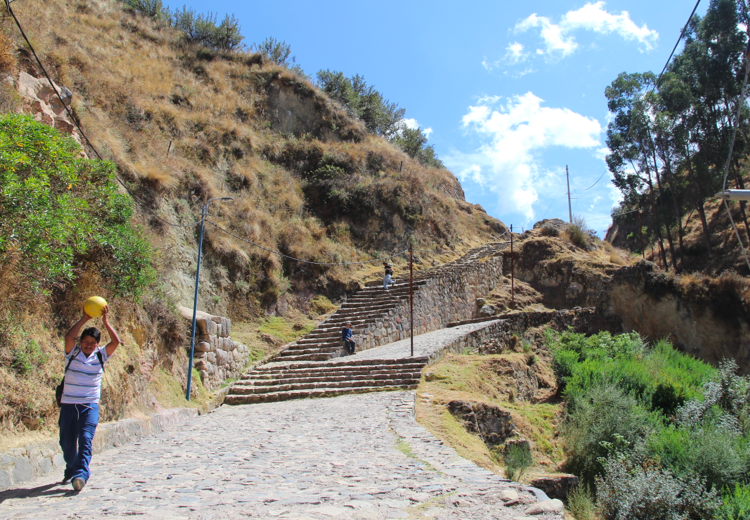
More uphill after the entrance
It was uphill all the way to this particular site—not a vertical hill, but it might as well have been. So I negotiated with He Who Walks Everywhere to ride up and walk down. Heck, I reckoned we’d spend a couple of hours walking around a lot of the site’s 3000 hectares once we got there.
I think my exact words were ‘The last thing I want to do is walk all the way up there!’ So we set out to find a taxi.
For starters, He Who Walks Everywhere picked what must be Cusco’s least-trafficked street and off we trudged. About three blocks uphill we came to a bus that had just stalled and was completely blocking the road.
‘Let’s go over a street,’ I suggested, gesturing to the left and adding that ‘no taxi is going to be able to come this way now.’ But He Who Walks Everywhere said, ‘Aw, let’s go up one more street.’
You’ve probably already figured it out, and I found out soon enough—there wasn’t another cross street. Now I’m not accusing He Who Walks Everywhere of choosing that street and ignoring the only cross street on purpose, but you never know.
Anyway the vertical street petered out (actually joined up to the main road) just near the site’s entrance. So much to my annoyance, I had indeed walked ‘all the way up there’.
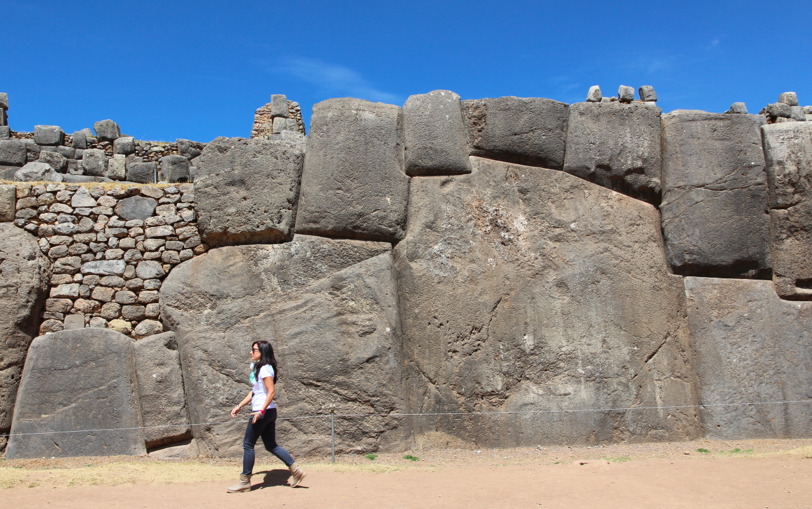
Blocks are up to 6 metres tall and 200 tonnes in weight
And so we stood before the Sexy Woman.
Sexy Woman—that’s what the site is called. But of course, that’s not how it’s spelt.
Saqsaywaman overlooks Cusco, and after you reach the lower entrance (which is where we were) you have to walk uphill another 500 metres or so before you really arrive at these magnificent and imposing Inca ruins.
Of course, I had to walk up that 500 metres, so I was plenty cranky by the time I got to the top—and discovered it was all very much worth the struggle.
Saqsaywaman sits at an altitude of about 3700 metres (more than 12,000 feet) so no wonder I was puffed by the time I got there. It’s amazing that people can live, let alone work hard there. I really have to praise the 20,000 people who laboured to create this enormous complex.
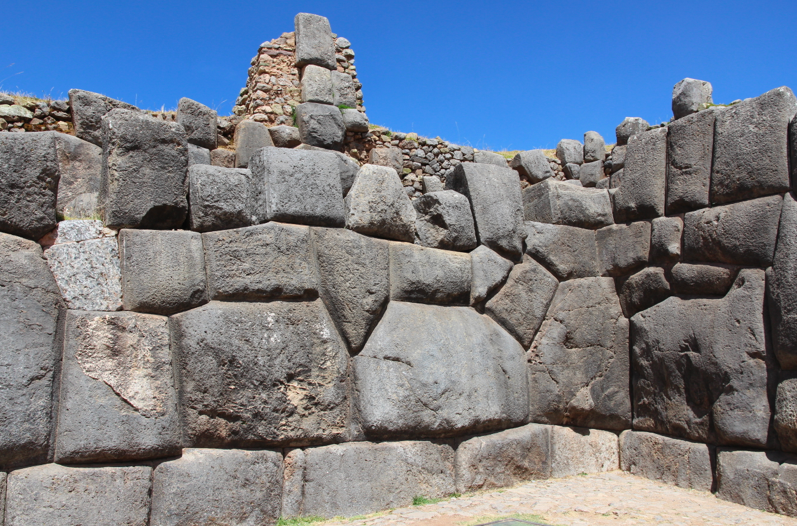
Intricate stonework that kept this all from falling down in huge earthquakes
Started in the mid-1400s, Saqsaywaman has gigantic polished dry stone walls, made of boulders that have been cut to fit tightly together without mortar. These boulders are so closed spaced that a single sheet of paper cannot be slid between them.
Once you’ve looked around for a bit, you begin to take in how intricate and planned the construction really is. Along one side, there isn’t one wall but three terraced walls or bulwarks—one behind the other—in a zigzag layout.
Each wall is about 6 metres tall and the longest runs for about 400 metres. The boulders (and they are boulders) lean into one another and it is their cut and interlocking shapes that have, no doubt, kept the walls from collapsing in major earthquakes.
But the construction techniques didn’t keep parts of Saqsaywaman from disappearing. They haven’t so much disappeared as been relocated. After the siege of Cusco (when it was the Inca capital) in the 1500s, the Spaniards started to use Saqsaywaman as their main source of building materials.

Some of the ‘small’ blocks that got left behind. This is part of the front zig-zagged wall
Why not make use of all this pre-made stone? As the ancient chronicler Garcilaso de la Vega said of the conquering Spaniards, ‘to save themselves the expense, effort and delay with which the Indians worked the stone, they pulled down all the smooth masonry in the walls. There is indeed not a house in the city that has not been made of this stone, or at least the houses built by the Spaniards.’
Today, only the stones that were too large to be easily moved remain at Saqsaywaman. And it would be a huge challenge to move them. The site is estimated to have 6000 cubic metres of stone, with the largest blocks weighing up to 200 tonnes.

Looking at the plaza from the terraced walls/bulwarks
That’s big stuff and so is the large plaza in the middle of the complex. It’s big enough to hold thousands of people and a visitor can only imagine how this site was used. The day we were there, a group of young people were preparing a floral tribute to the Asia-Pacific Economic Cooperation (APEC)
I’m guessing APEC had some sort of meeting in Cusco that day and the delegates were going to visit Saqsaywaman at some stage. As the day progressed, there sure was plenty of security posted in and around the site, but we missed seeing anyone important.
But back to Saqsaywaman. It’s served many purposes. The Inca called it the House of the Sun. The Spaniards thought it was a fortress. It’s been used for religious and military purposes, and now a popular tourist destination.
You can see Cusco’s statue of Christ from Saqsaywaman, and a lot of the city below. And there are acres and acres and acres of Saqsaywaman to explore. We checked out a lot.
I could write on and on about Saqsaywaman (and will add an entry in relation to the drainage), but I just have to say that even though I had to walk a long way uphill to get there, I loved visiting it, or should I say I loved visiting her! She’s one Sexy Gal!
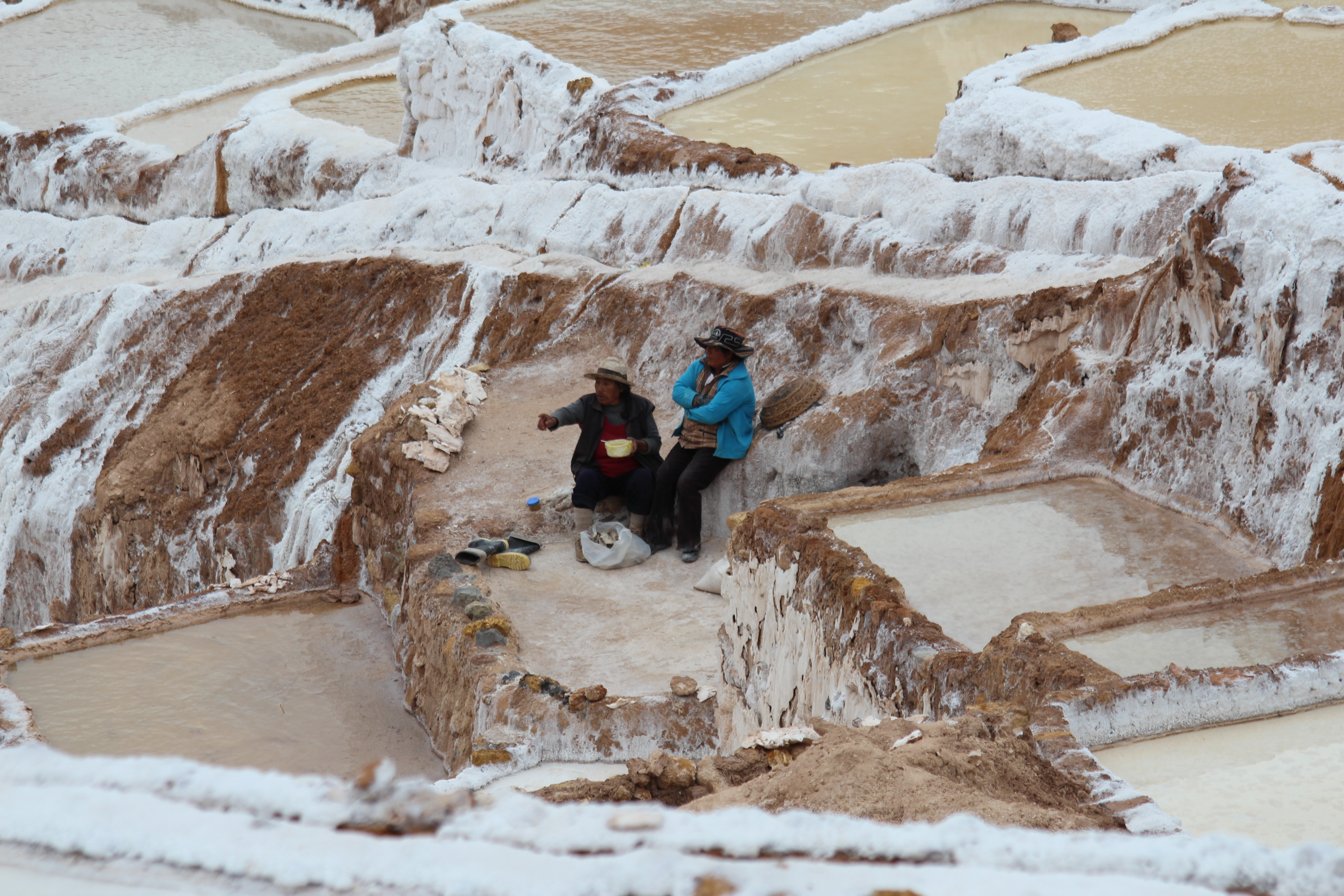
Two workers at Salineras
I love salt. I know I shouldn’t because I have marginally high blood pressure, but I love salt anyway. Always have.
So it was a great bonus to visit Salineras de Maras—the salt evaporations ponds of Peru. This was our last stop on our first day of touring the country’s Sacred Valley, and came after visits to Pisac, Ollantaytambo and Moray.
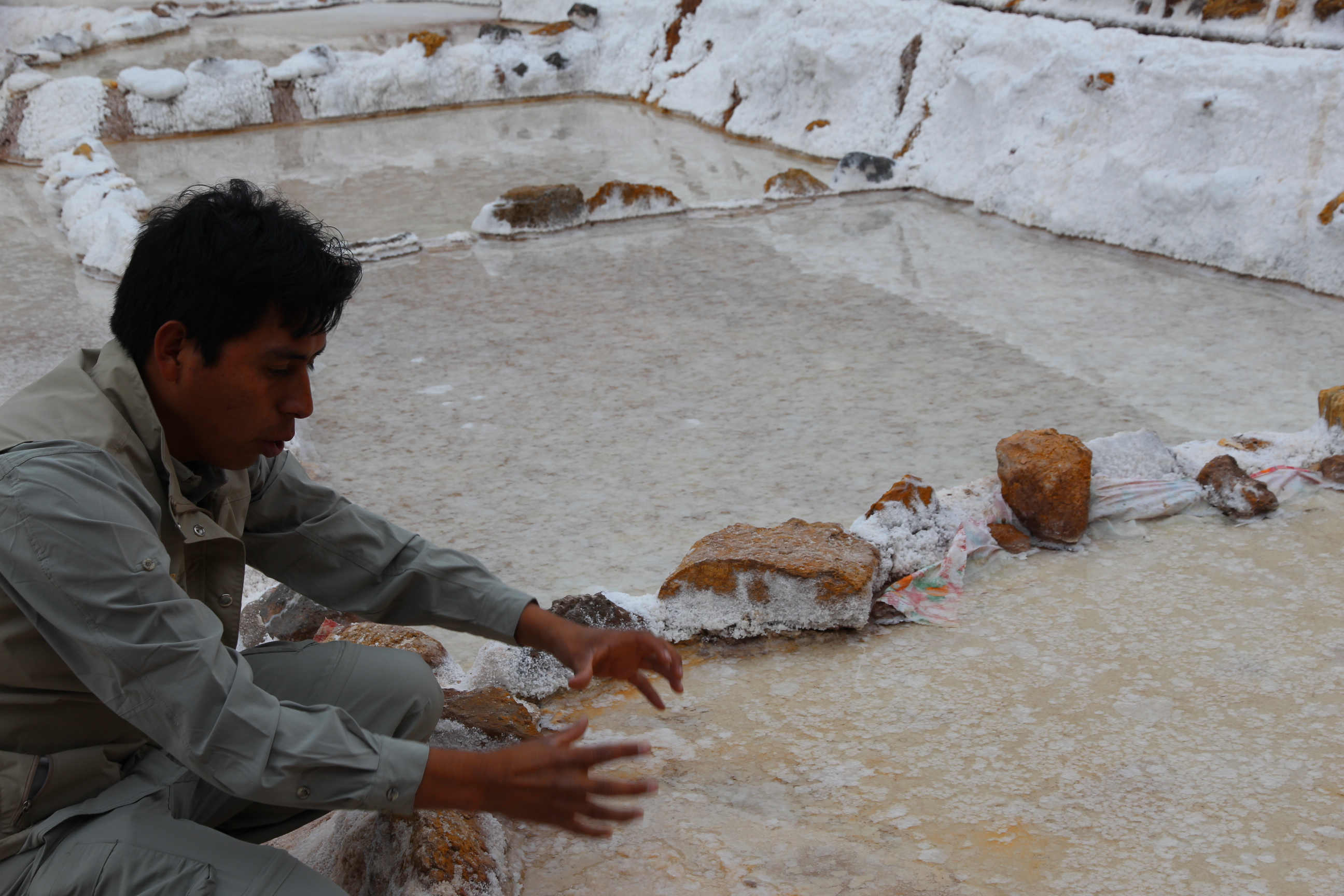
Herbert explains the salt-making process
Our guide, Herbert, explained that the Salineras runs as a cooperative. People from the nearby town of Maras share the effort of looking after operations. Families do three-month stints maintaining the overall health of the ponds (gosh I really want to call them salts mines, which seems to roll off the tongue, but they are above ground and do not constitute drudgery jobs).
Workers come six days a week (Sundays off) and have fairly normal working hours. During their stint at the mines…er ponds…they can take a reasonable share of the salt. But ‘management’ keeps an eye on everyone and those who don’t pull their weight have to accept a smaller share than others.
There were plenty of tourists when we arrived, but it was late in the day, so only two workers were still on duty and they may have just been having a chat. Thanks to my telephoto lens, I could get a pic of them.
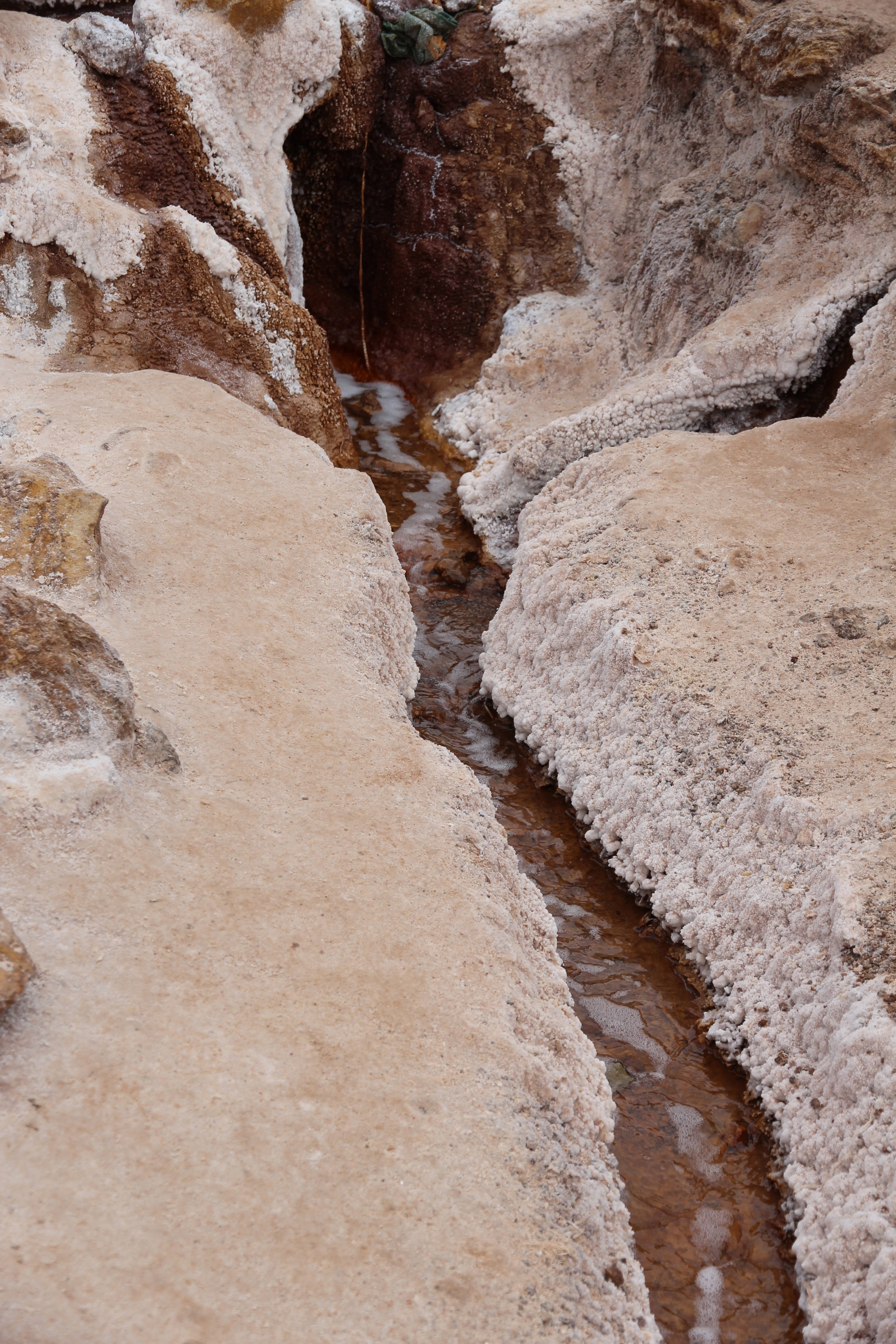
The spring that feeds it all
The ponds have been in operation for centuries—since long before the Inca arrived—and are fed by a spring that bubbles out of the mountain that sits under them.
Most ponds are less than four meters square in area and 30 centimetres in depth. A pond’s colour—which varies from white to red to brown—depends on the skill of the person looking after it.
I saw a comment somewhere—that I can’t find again—that said there are almost 1000 ponds. Some are unused, and it seems that a person can petition to farm/re-establish one of these ponds and keep all the salt.
I won’t be applying for a position any time soon. I can’t imagine myself scampering up and down those narrow pond boundaries, but I can picture myself on my face in the wet. Besides, I need to cut down on my salt consumption—and keep remembering to take my blood pressure tablets. 🙂
P.S. I meant to make the pictures into a mosaic gallery, but forgot to click the right button. Feeling silly. But you can click on any photo for the bigger images. They are interesting pics, so feel free.
-

- A whole hillside of salt
-
- Centuries of salt
-
- Salt tiered down a hill
-

- Tourists cruise along the top of the ponds
-
- Love the textures and terrains of these ponds
-
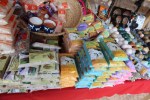
- Colourful salt for sale
-

- Colour defines the healthiest ponds
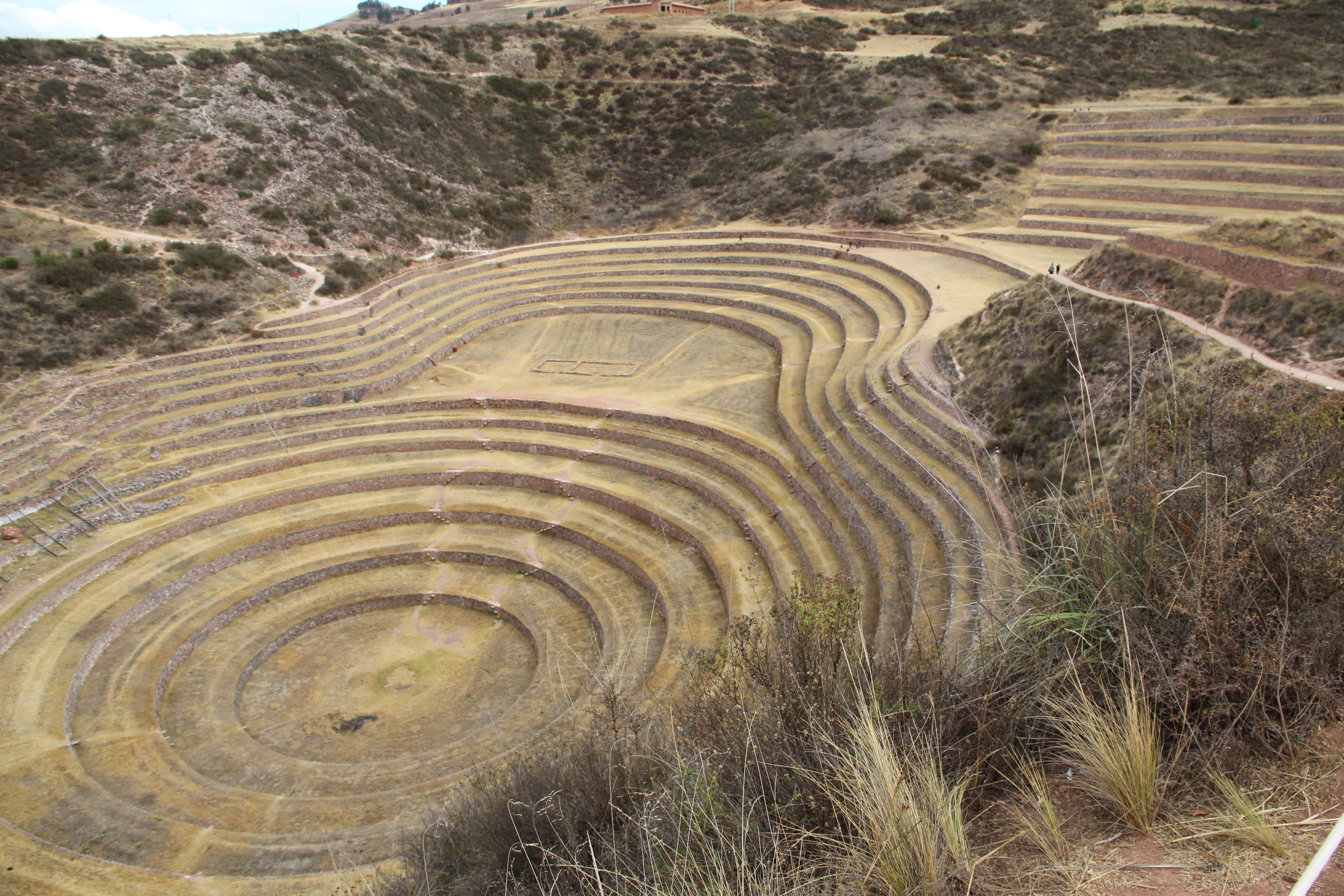
The largest agricultural circle at Moray
Climate change—or in this case climate difference—seems to have been a hot topic for centuries.
The Inca understood this and tried to figure out how to make temperatures work to their advantage. The best evidence of their quest is at the Moray archaeological ruins near the village of Maras.
Moray is on a 3500-metre plateau (about 11,500 feet) and while no one can be 100 per cent sure, it seems that the Inca used this site to test and develop plants so they could grow well at varying temperatures.
So how did this work? The site has several large circular depressions with sophisticated irrigation systems. Each depression is terraced and the largest is about 30 metres (98 feet) deep.
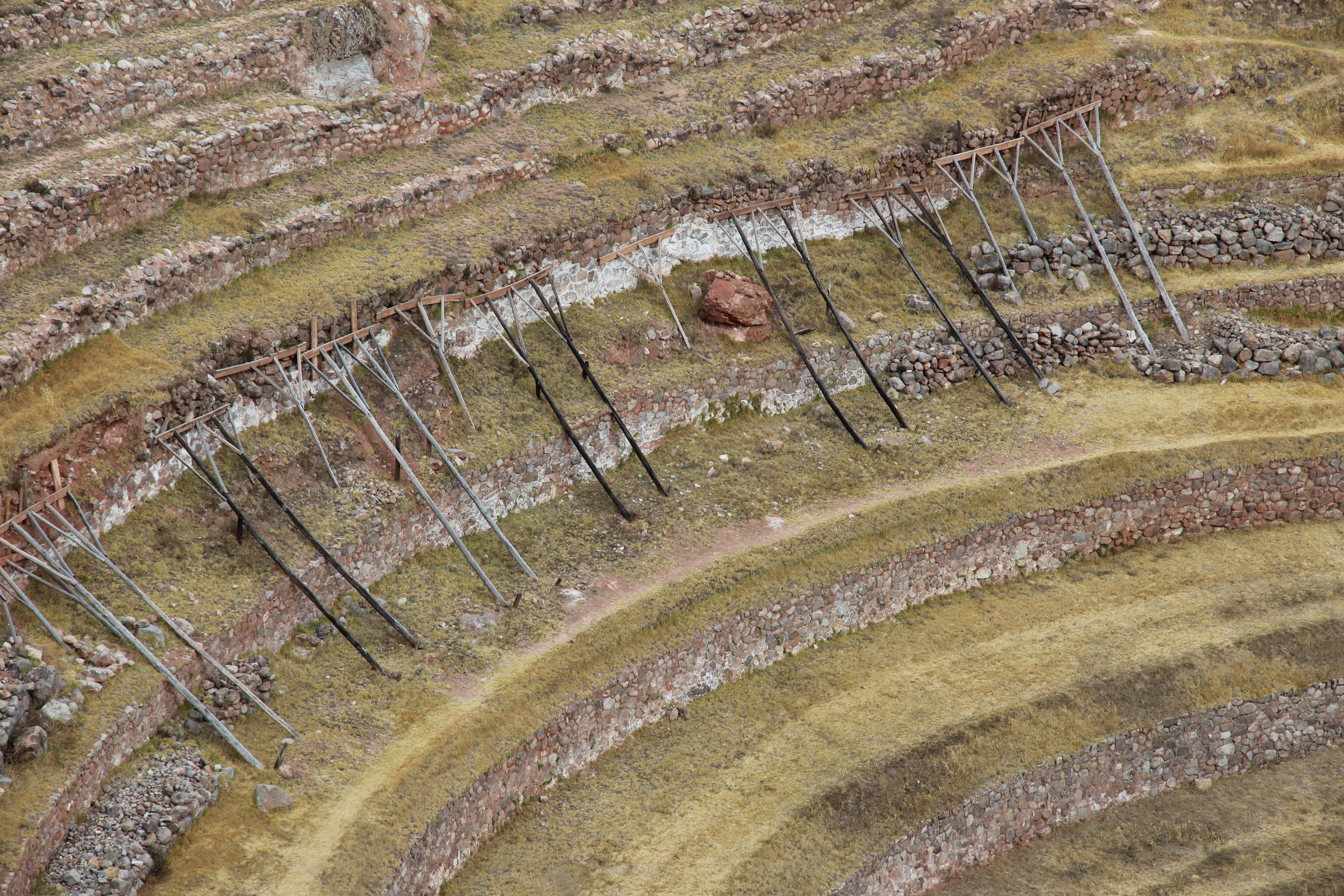
Shoring up the collapses at Moray
According to our guide, Herbert, the orientation with respect to the wind and sun mean that temperatures across the depressions can vary by as much as 15C (27°F), making this a great and likely spot for Inca scientists to carry out agricultural experiments and study the effects of climatic conditions on crops.
By moving plants up and down the depressions, they could figure out what grew well where, and also gradually train plants to grow in different climates.
The terraces, built from stone and compacted earth, suffered extensive damage a few years ago when the Cusco region had unprecedented rainfall. Part of the main Moray circle collapsed and reconstruction is currently underway.
We reached Moray by van, but it was great to see people also arriving by bike, motorbike and on horseback. If I manage to get there again, I’ll try to drag Poor John there on a horse. Please don’t warn him!
Next stop: the nearby salt pans.
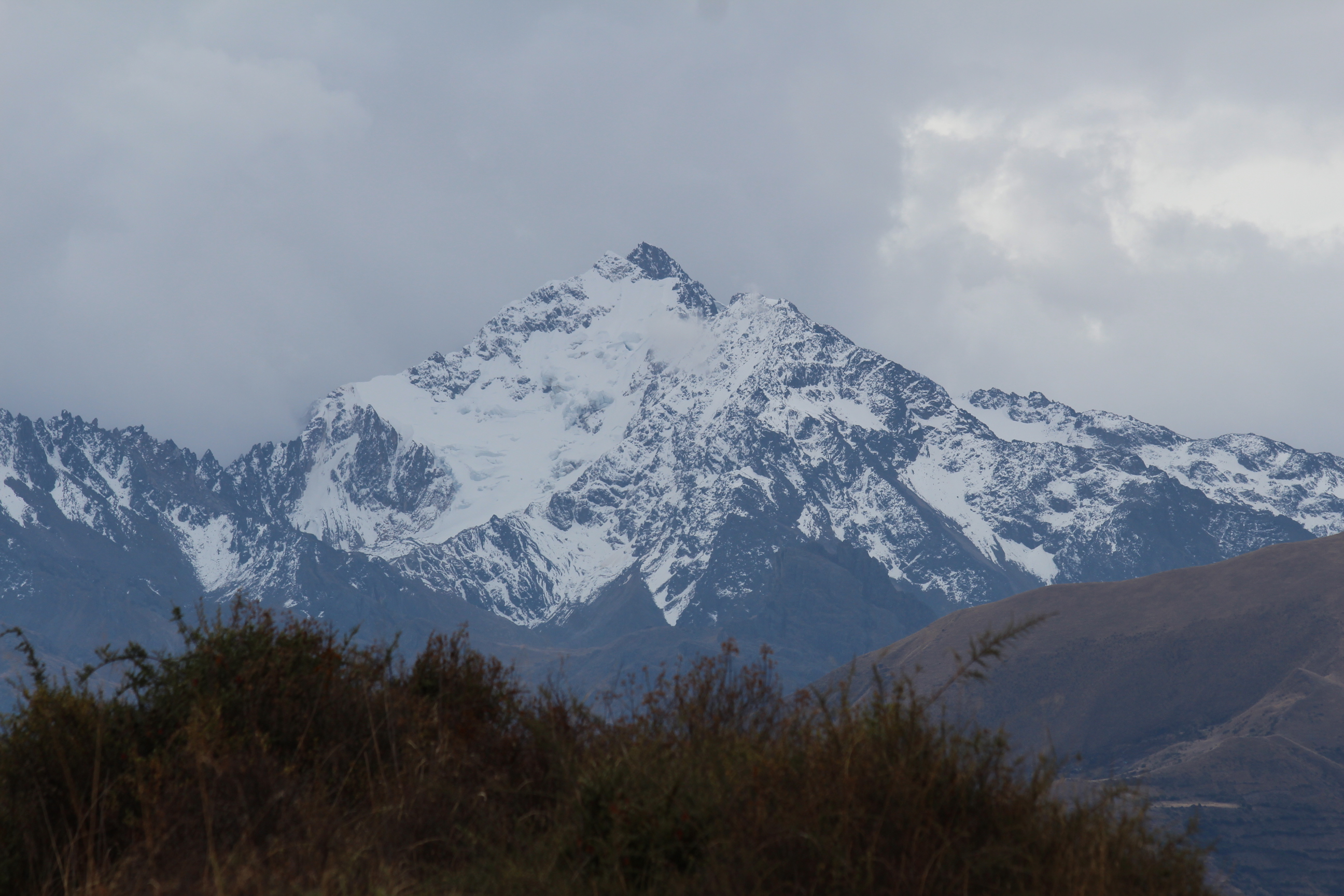
Looking back over my shoulder at the view from the agricultural circles at Moray
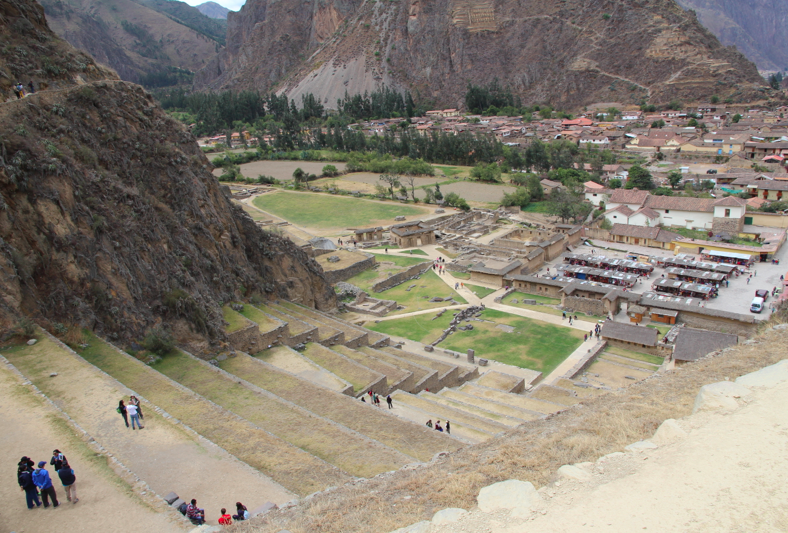
Looking down from the Sun Temple to the terraces and town below
Ollantaytambo was the next stop on our day-long tour in Peru’s Sacred Valley. It’s the site of more Inca ruins and where we saw our first glimpse of a Peruvian wedding.
Inca emperor Pachacuti conquered and razed Ollantaytambo in the middle of the 15th century, and incorporated it and the surrounding region into his personal estate.
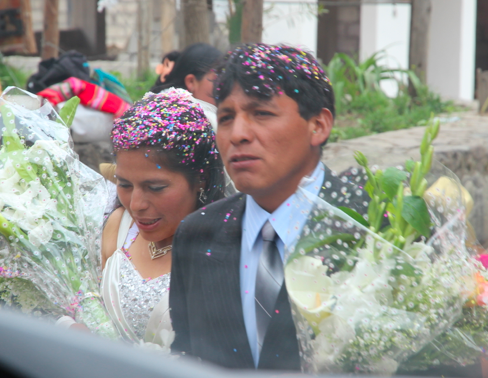
The newlyweds pass our car
He then arranged a lavish rebuild of the town and extensive agricultural terracing and irrigation.
The terraces were a gold mine. No, they didn’t find gold there, but they found an ingenious way to get the best out of their crops. Ollantaytambo is surrounded by mountains, and the terraces were ‘stacked’ up the surrounding hillsides.
This technique made farming possible on otherwise unusable land, and created a microclimate at every level. The benefit of this was that plants normally native to lower altitudes could be grown up the mountainsides.
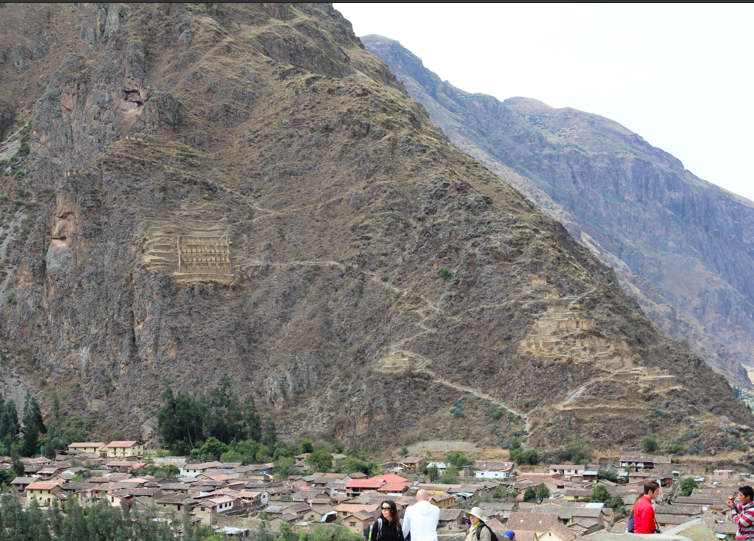
Storehouses (and path leading to them) on the mountain opposite the ruins
Herbert told us that the terracing at Ollantaytambo is considered to be finer work than at many other sites, because the walls are taller and are made of cut stone rather than rough fieldstones.
The Incas also built several storehouses on the nearby mountainsides to protect their produce from pests and decay.
I wasn’t thrilled with the pics I got of the storehouses because they are best seen from side on and I saw them straight on. But I found it fascinating that these stone structures were built so high up. Herbert said the position—well away from the community—allowed the incas to store their goods where the winds were stronger and the temperatures were lower. Almost like refrigeration.
Temple Hill, which is sometimes referred to as The Fortress, is the most important and most impressive part of the complex of ruins, and also one of the highest. Archaeologists believe the temple served a religious, rather than a military, function.
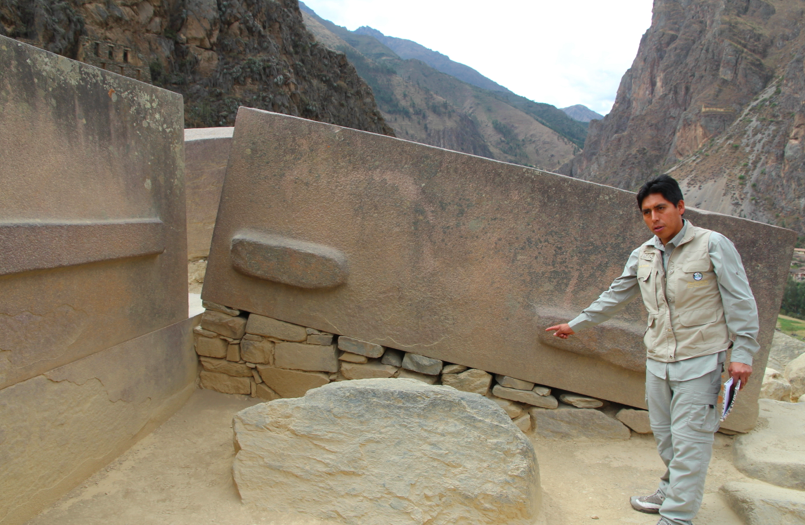
Herbert points out a ramp leading up to the Sun Temple
The temple was built of rose rhyolite, brought/dragged from a quarry about five kilometres away and on the other side of the Urubamba River. Herbert said there are many theories about how the Incas got the huge blocks up to Temple Hill, but there is a network of roads, ramps and slides that must have been used.
The temple is beautifully constructed. The stones are huge and have been expertly cut and fitted together. There are plenty of unfinished areas, including the Sun Temple with its Wall of Six Monoliths. Archaeologists believe the entire site was abandoned in its incomplete state.
The Incas built roads connecting Ollantaytambo with Pisac, where we were the day before, and Machu Picchu, where we’d visit in two days time.
But on this day, we drove on to visit Moray and Maras.


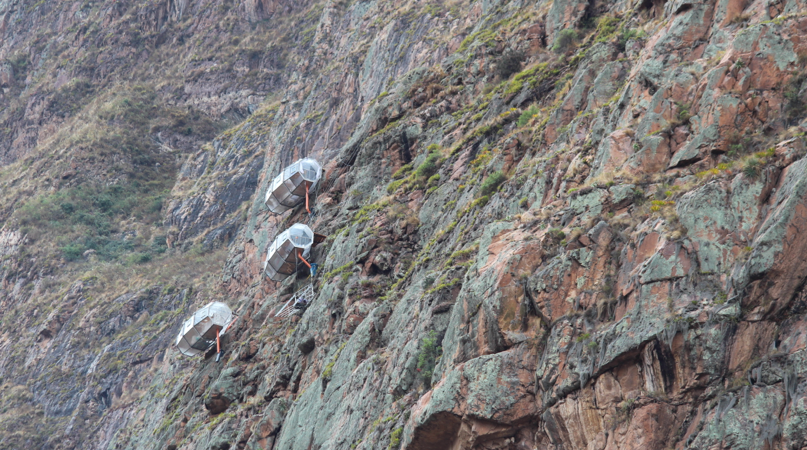
Hotel rooms on a mountain face. Getting there is the challenge
Derrick spotted them first. Three glass capsules suspended far above the Sacred Valley in Peru.
Our driver pulled over and we got out to take pictures and marvel at these unexpected structures. Herbert, guide for our day-long tour of the valley, explained that they were hotel rooms that guests climb up to. We even saw some hikers making their way there.
It took quite a bit of searching on Google to find out more about these aerial cocoons. Run by an outfit called Natura Vive, the skylodge is part of a package deal that can include ziplining, mountain climbing, dining and sleeping under the stars.
The modules measure 24×8 feet and are suspended about 300 metres up the mountain. Each tube can sleep four, and also has a dining room and private bathroom.
Check out Natura Vive’s website. Their prices look very competitive. Go on. Do it! You can bet it’ll be on my to-do list the next time I’m in Peru.

Guests working their way up to the skylodges, which are to the far left and not in the pic
 Where to next?