
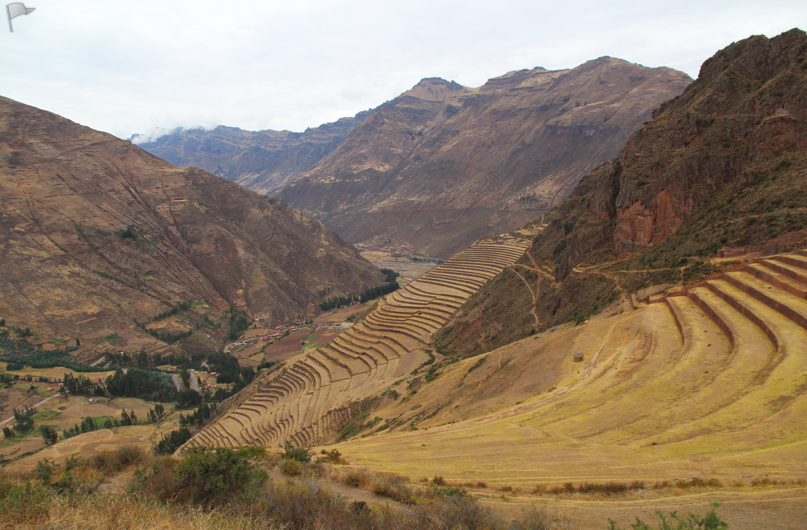
The terraces at Pisac, with the Sacred Valley beyond
Last year in Cusco, we spent most of our days hiking the Lares Trek, on our way to the ancient Incan ruins of Machu Picchu.
This year we decided to take the train to Machu Picchu instead, so we would have time to explore some of the other important ruins in the area.

Herbert points out some of the different corn kernel sizes from Peru
Poor John, who’s especially good at figuring out the best sights to see, said Sacred Valley was the top pick. Local tour organiser, Pachamama, came up with a one-off, day-long option that would get us to some ruins, as well as a few other interesting stops.
I’ve already blogged about the Cochahuasi Animal Sanctuary and the sensational bakery at Pisac, and now it’s time to start on the actual valley and its ruins.
Carved out by the Urubamba River, the Sacred Valley lies in the heartland of what was the Inca Empire. The valley runs for about 60 kilometres—from Pisac to Ollantaytambo.
The Incans thought the valley had special geographical and climatic qualities, which meant it became one of the empire’s most important areas for maize/corn production.
When we arrived at the Pisac ruins, Herbert, our Peruvian guide for the day, explained that the Incans really did understand their valley—world’s largest corn kernels are grown on the terraces at Pisac.
According to Herbert (guides have to do official study to become qualified), the local seed has been planted in other parts of Peru and the world, but it never grows as large as it does near Pisac.
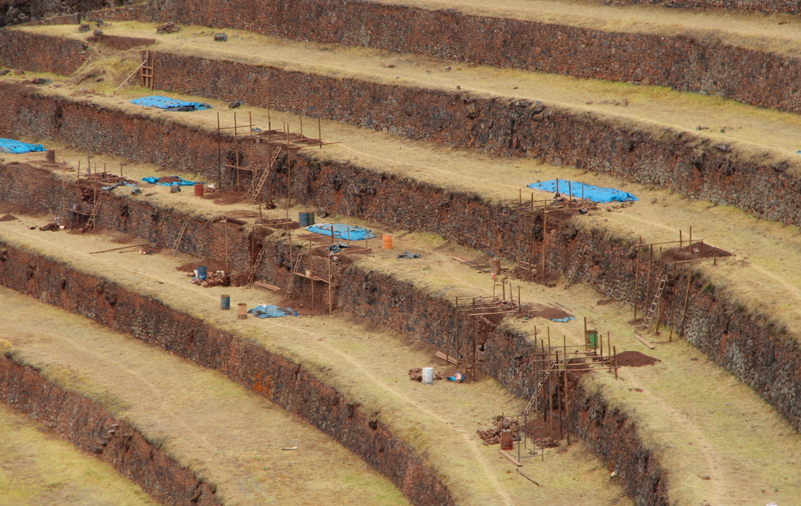
Repair work on the terraces stops on a Sunday
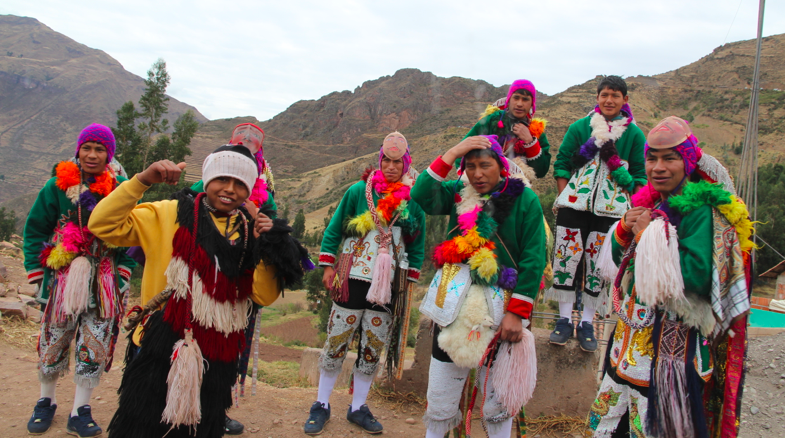
Party-goers near Pisac
While many of the ancient terraces are still being cultivated, we saw others that were getting some much needed repair work. But Herbert showed us that the old irrigation channels are still in good working order.
It’s a different story with the cemetery that overlooks the terraces. It’s a rocky hillside pocked with empty holes—where the bodies and possessions of common folks once lay. As is often the case with ancient cemeteries, looters stripped the graves bare hundreds of years ago.
Luckily, we encountered some living local colour in Pisac. A local woman bustled by with a bundle on her back, then the souvenir sellers urged us to buy a chess set. Their chess pieces aren’t simple black and white. They have the Incas versus the Spaniards, with the Europeans on horseback and the Incans on llamas.
As we drove on to our next stop at Ollantaytambo, we saw a group of party-goers heading to a Sunday village festival. If hand signals are anything to go by, I’m sure they invited us to join them.
P.S. The day-long tour cost US$260 (plus the admission tickets) and could have included up to six people for the same price, but only one other person joined us. It really was a great day and I hope others will consider it in future. (Oh, and you can click on any photo to see a larger version).


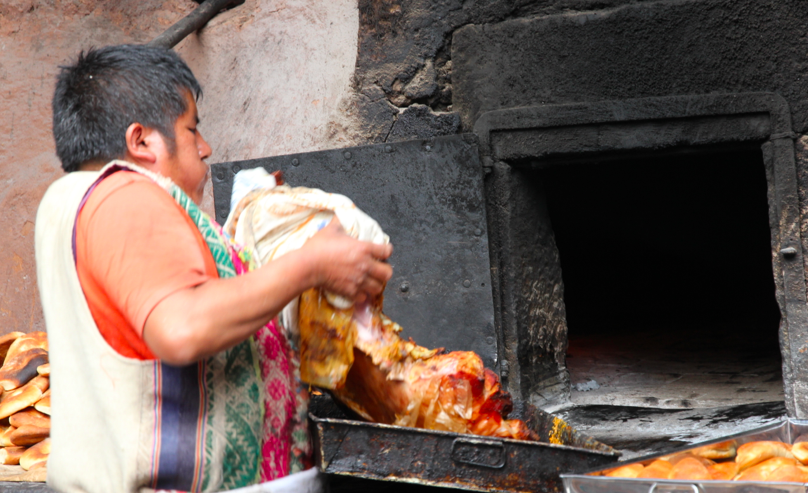
The baker manhandles a pork roast
I promise to get around to telling you about the Great Day Out we had in the Sacred Valley near Cusco, but I keep getting side-tracked by the unexpected things we did before we started the ‘proper tour’.
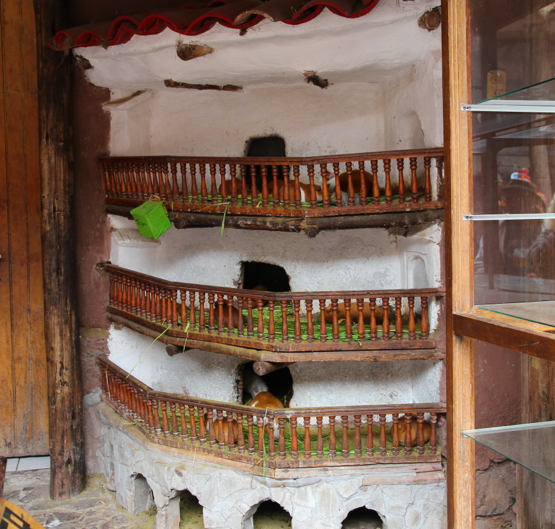
A four-storey guinea-pig residence
Our first stop was at the amazing Cochahuasi Animal Sanctuary, but then Herbert, our Pachamama guide, took us to his hometown of Pisaq. He’s mighty proud of Pisaq, and so he should be. There are some wonderful ruins (more about them soon), a huge and popular market, and an amazing bakery that was churning out roasted pig, bread and empanadas from the same enormous outdoor oven.
I’m a sucker for food—the name, the ingredients, how it’s made, how it’s cooked, how it’s eaten—and the Pisaq bakery was just a bit of bliss.
To get there, Herbert directed our driver, Eduardo, down a bunch of super-narrow side streets (it always amazes me how we can snake through a labyrinth of alleyways and still end up at a largish square).
We invaded the bakery first—sampling the sensational empanadas and the divine pork (whole pigs) being roasted for a wedding. We checked out the guinea pig ‘hotel’ too, but none of them were being roasted this day.
Then off to the market where I bought a couple of presents for our daughters (sorry, but no photos of the market or the pressies). It was the first real souvenir shopping I’d done in South America this time round, and I was rather pleased with my finds. Hope the girls are too.
Then we were off to Ollantaytambo—the big guns of ruins. Stay tuned.


Molly adds finishing touches to her anaconda
You meet all sorts of interesting people when you travel and it was a nice surprise to meet artist, Molly Keen, in eastern Peru.
Molly is a young American live-wire who is painting her way through South America for as long as her money and enthusiasm hold out. We met her in Puerto Maldonado where she was putting the final touches on a mural at Anaconda Lodge, where we camped for a couple of nights.
Not surprisingly, Molly was painting an anaconda, although she did confess that she has never seen a live one. I was quite taken by the colours in her mural, as well as the Aboriginal look in some of the patterns. A friend of hers, Lukas, was helping to fill in some of the black line work.
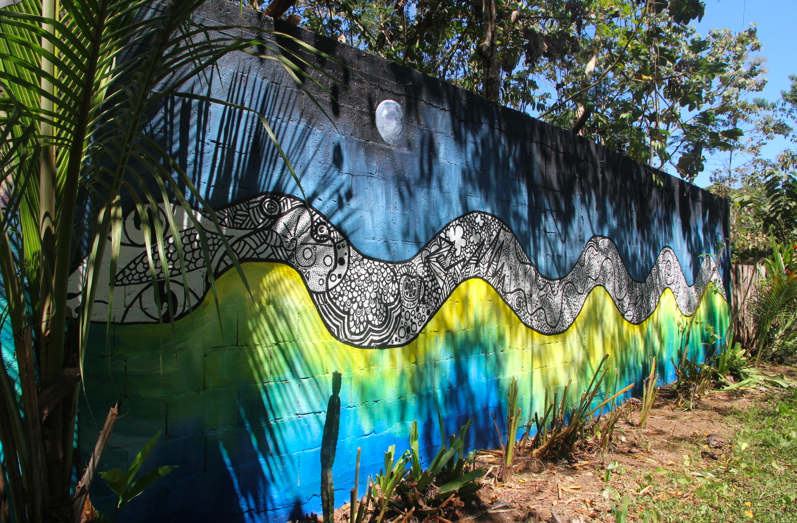
The whole anaconda
Molly is on her third country in South America. She has painted 15 murals in Colombia, another two in Ecuador and has just finished her first one in Peru. About the time we left for our trip in to the Amazon Basin, Molly was heading to Colca Canyon, where she has lined up another opportunity. At most places, she gets board and room for her efforts, and sometimes a bit of money.
She reckons her style is changing over time and wonders just what it will be when she finishes her stay in South America. It’s obvious that she loves what she’s doing and her smile lights up everything around her. We wish her well.
If you interested in seeing what else Molly’s up to, you can check out her blog or her art website. I plan to keep tabs on her.
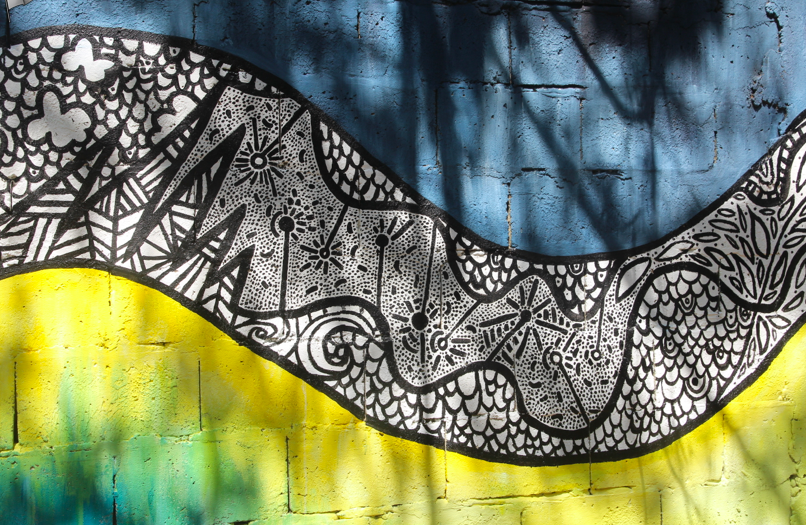
This section reminds me of art by Australian Aboriginals
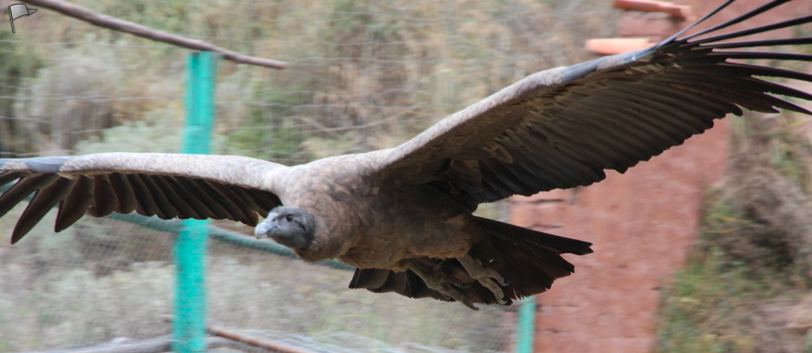
A young condor learning to fly
Last year we spent quite a few days in Cusco as well as walking the Lares Trek to Machu Picchu. Given that we weren’t doing any trek this time round (we cheated and took the train instead), we were going to have almost five more days in Cusco to fill with new activities.
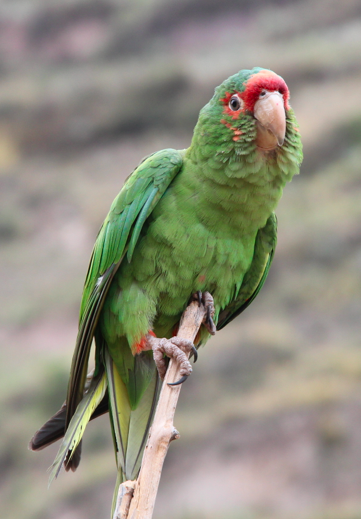
Green parrot
I asked Natalie at Oasis to contact Pachamama, the adventure agent in Cusco, to see if they could come up with a plan that would keep Poor John and me entertained and out of mischief for at least a little while.
Pachamama sorted out two great options—a custom-designed, full-day excursion to the Sacred Valley and beyond plus a half-day excursion in the other direction.
Day one took us to the ruins and market at Pisaq, the ruins at Ollantaytambo, the agricultural terraces at Moray and the saltpans at Salineas. But there was also a surprise visit to the Cochahuasi Animal Sanctuary.
It was our first stop of the day and a lot of fun, and it’s where I will begin a series of blogs about our Great Day Out.
A family-owned operation, the sanctuary has been going since 2007. It specialises in rescuing animals that have been abused or illegally trafficked. Many of their ‘residents’ are endangered, but there are plenty of common animals such as hawks and llamas.
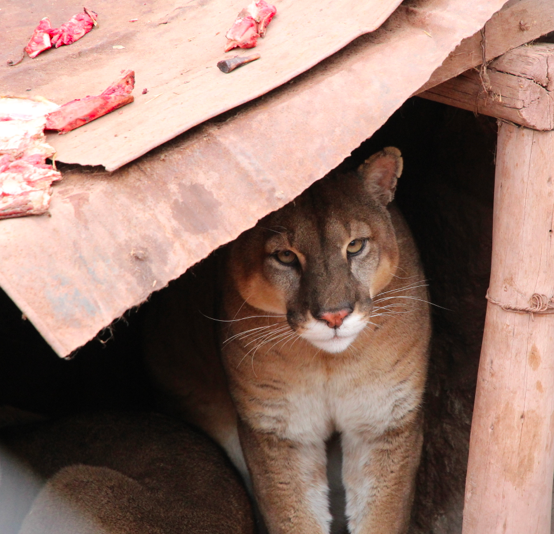
The pumas wait for the sun to come out
The family is showing a lot of compassion and seem to be doing a very good job. For example, the pumas are gaining weight. They were confiscated from a discotheque where people paid to have a photo take with the cats. At the time they were take, each puma weighed only 40 kilos, but they’re slowly working their way up to a proper weight of 90 kilos each.
Then there’s the condor with the withered foot and the juvenile condor that is being taught to fly so it can eventually be released into the wild. I was gobsmacked to see it fly from high up in an apiary and have it sweep past me with confident flapping of already mighty wings.
Some animals have been brought to the sanctuary after being poisoned by farmers or others wanting to kill or subdue the critters. Two small deer arrived as infants after their mum had been killed. I’m not sure how the ocelot came to be there, but I was surprised to see how much it looked like a tabby house cat—and not much bigger either.
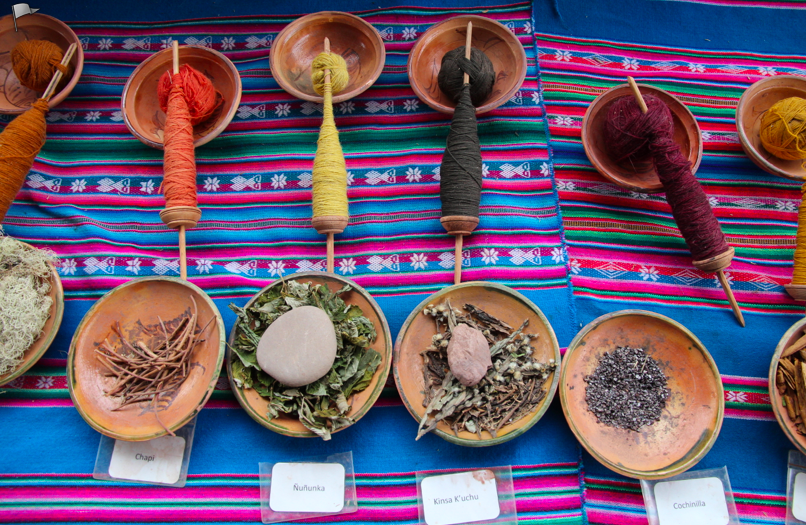
Plants and the dyes they make
In addition to the animals, the family has a display of the different dyes used in creating alpaca wools fabrics for clothing and artworks. The display includes the plants used, the process, the colours achieved and the finished wool.
There’s also a shop selling top quality merchandise made by local women. If I didn’t already have a houseful of souvenirs I would have been very tempted.
As an aside, admission is by donation (on your way out) and we were generous. How could we not? I was thrilled with how close we could get to the animals, impressed by the care they were receiving and delighted with the photos I snapped. Hope you enjoy them too.


Always on the lookout for something to chase, play with or bark at
Sy, a friend from New York, has followed this blog for a long time. Three things stand out about Sy: he’s an adventurous and creative cook, an avid and seasoned traveller, and a true lover of dogs—especially his beloved Laddy, an Irish terrier.
When I was just starting this overland, Sy asked me to be on the lookout for various breeds of South American dogs. He sent a comprehensive list and I duly looked up each breed and memorised their appearances.
So far I’ve spotted two very distinctive local breeds—the gigantic Fila Brasileiro and the quirky-looking Peruvian Hairless Dog.
So Sy, this post is for you—and Laddy if he’s paying attention.

Zulu and his boxer companion, Spartan
Fila Brasileiro
We encountered the Fila Brasileiro first, in Salvador Brazil. Zulu was holding court in the Hostel Galeria 13 where we stayed in the Pelourinho district.
Centuries ago, ancestors of the filas were bred the bloodhounds, mastiffs and bulldogs that had been brought to the New World by the Conquistadors. The resulting filas are great sniffers with overwhelming power and tenacity.
They’ve almost always been working dogs—guarding livestock and ranches against thieves and jaguars, tracking down runaway slaves and helping hunters to claim their prey.
Filas are aggressive and supposed to dislike humans they have not been raised with. Their testiness is okay even in the show ring. A fila should not let a judge (a stranger) touch it. And if the dog attacks a judge, the reaction must not be considered a fault, but a confirmation of the dog’s temperament. Oh yippee—you get savaged by the dog that goes on to win! Remind me never to apply to be a fila judge.
Zulu is a ginormous and handsome dog, but seems a gentle giant. He was quite well-behaved until someone he didn’t know tried to come in the front gate. He didn’t go ‘postal’ but he made it perfectly clear that the intruder better have some valid credentials.

Not really a headful of hair—just a few wisps
Peruvian hairless
So far we’ve met four Peruvian hairless dogs—two at the Anaconda Lodge in Puerto Maldonado, one at the Cochahuasi Animal Sanctuary outside Cusco and one in an art exhibition at the Temple of the Sun in Cusco.
The Peruvian hairless is an ancient dog. Often thought to be Incan, the dog actually dates to pre-Incan times. The first artistic depictions of the hairless came in 750AD on Moche ceramic vessels.
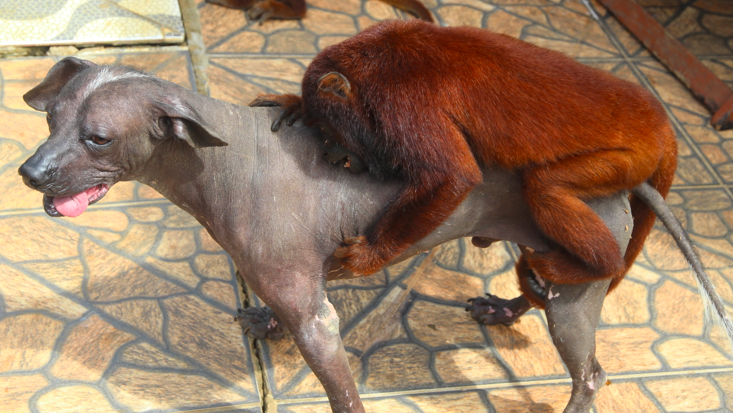
How’s this for having a monkey on your back!

The fourth hairless—an artist’s impression of a Peruvian hairless
The dogs can be completely hairless or have tufts of hair on their heads, feet and tail. Their skin colour can be black, elephant grey, copper or mottled.
Spain’s conquest of Peru nearly caused the extinction of the breed. Luckily the dogs survived in rural areas, where the people believed they had mystical value.
The dogs at Anaconda have had a rough-and-tumble existence with howler monkeys, so they’re quite playful. They’re also very alert—keeping a close eye on any dog that comes near Anaconda.
The fourth hairless we met—well you’ll have to see for yourself.
Laddy
And I have to sign off with Laddy wearing his expensive Scandinavian winter coat. Sy says he paid an arm and a leg for it, but I reckon Laddy looks doggone distinguished and, no doubt, worth every cent.

Laddy showing off his coat in a New York snowstorm
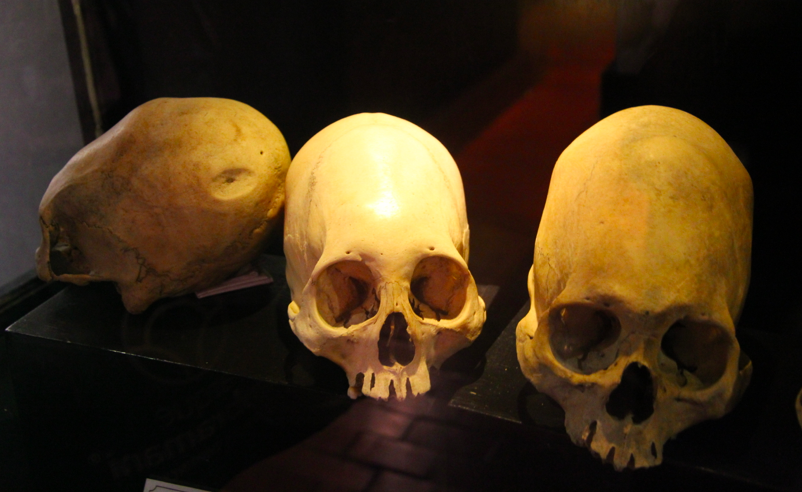
When being big-headed was a good thing
This trip, Poor John and I sprang for two Cusco tourist tickets. At 130 soles (about $50) each, they aren’t cheap. But they’re good for 10 days and get you into 16 government-run archaeological or cultural sites in and around the city. So far we’ve hit seven destinations with a couple more must-sees on the list.
The Museo de sitio del Qoricancha is a little gem we visited yesterday afternoon. It’s linked to the Temple of the Sun (Qoricancha), which has a separate admission fee because it is run by the church.
It took us about 20 minutes to cruise through the museum—it helps that all the signs are in Spanish and English. I was pleased to see that the displays confirmed much of the spiel our guide had shared with us over the previous two days.
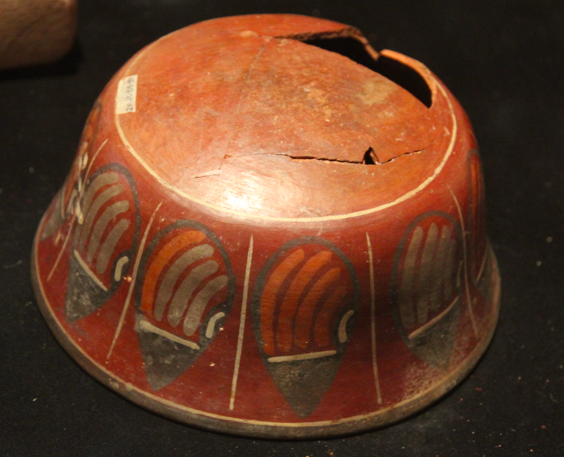
Pre-Incan pottery by the Wari (Huari) people
Take food for instance. The Incas knew how to dehydrate potatoes and beef, and I’m guessing the word for jerky comes from their word ‘charki’.
Skulls are another example. Incas deformed skulls as a way to differentiate the classes and create big/intelligent brains. Most skulls were elongated while others were given a bulge. Mothers and midwives used varying techniques to ‘massage’ the skull into a desired shape—changing dressings as a child grew. The mere thought gives me a headache.
Incan doctors also perform surgery on skulls, usually after an individual had suffered some traumatic injury. Our guide said that a hole chipped into the skull was covered with a gold mesh. If it healed, you lived; otherwise you died.
Which brings me to the mummies.
The museum’s three mummies are accompanied by an explanation of how they lived in death. The description comes from the chronicler Pedro Pizarro. I wanted to use his words verbatim, but the translation is garbled, so here’s a summary.
A lord’s servants were bound by law and custom to mummify their master and to continue to care for him as they did when he was alive.
They dressed him in finery and carted him along to all community events. Mummies ‘ate and drank’ with their servants and were regularly toasted by ministers.
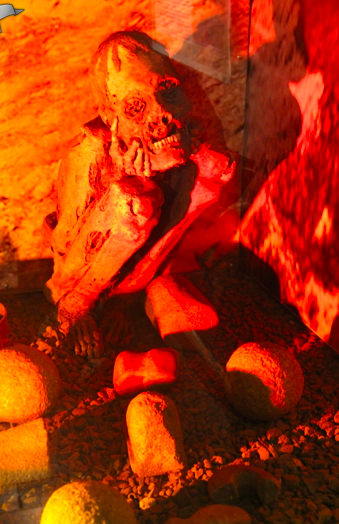
Paint the town red? Mission accomplished!
Mummies also went along when the servants visited the homes of others who had mummies present. The view was that the mummies wanted to carry on in death as they had in life.
The bit that tickled me the most is that they ‘would leave the mummies to spend time together’ and always brought them to ‘festivals of drinking and dancing’.
All this makes me wonder whether the art of mummification was truly forgotten, or just plain abandoned because it was considered to be not really worth all the trouble. What do you think?
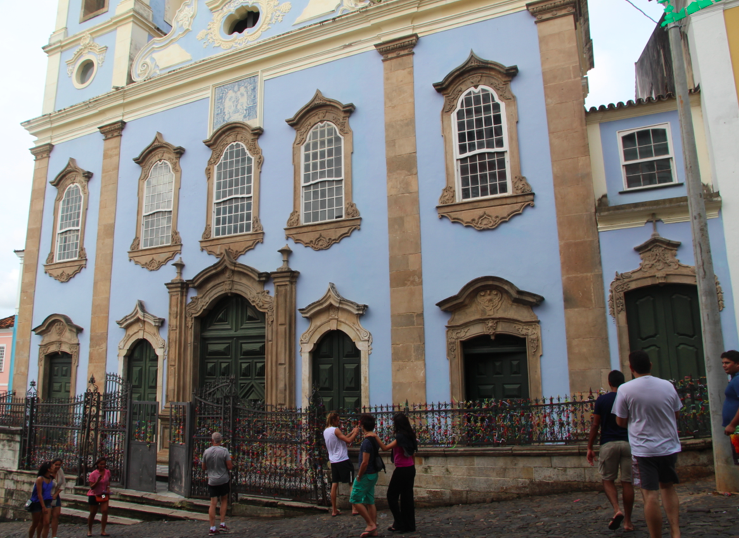
At first, you don’t notice the ribbons on front fences of the Church Our Lady of the Rosary of the Blacks
We may not have made it to Nosso Senhor do Bonfim—Salvador’s most important shrine and house of worship—but we got a taste of the magic the church inspires.
Nosso Senhor do Bonfim translates as Our Lord of a Good Ending, just one of many ways that Salvadorians refer to Jesus, and the church has a reputation for granting miracles and wishes.
Its success rate for ‘endings’ is so good that the church has a Room of Miracles decorated with photos and testimonials thanking Senhor do Bonfim for his ‘efforts’ that range from curing the sick to getting someone a promotion or elected to office.
The miracle room’s ceiling has a macabre display of wax and plastic body parts—from skulls to spines to boobs to feet—representing those who have been cured or who have ailments that still need attention.
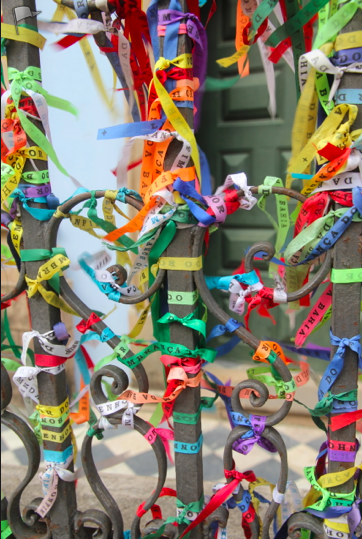
It will take awhile for the uprights to fill with ribbons
But as I already confessed, we didn’t see any of this. I read about it and saw some pictures.
We didn’t see the ribbon-clad fences out the front of the church either, but this is how what we did see comes in to play.
Nosso Senhor do Bonfim is almost completely covered with Bonfim ribbons, also known as fitas. These colourful ribbons are the beginning of many a ‘good ending’.
Today tourists and locals alike buy (or better still are given) ribbons to tie around their wrists, ankles or the church itself. But the Bonfim church fences are full, so people have had to branch out and have started tying their wishful ribbons on the fences at a church we visited as part of our walking tour in Salvador.
As a dominant structure in the Largo do Pelourinho square, the Church Our Lady of the Rosary of the Blacks, also known as Igreja de Nossa Senhora do Rosário dos Pretos in Portuguese, is a great new ribbon location.
It’s on the edge of the main tourist circuit—the Nosso Senhor do Bonfim is almost eight kilometres from Pelourinho. Plus it’s a pretty church with a heart-warming and appropriately African history.
Work on this church began in 1704. It was built over 100 years, by the enslaved members of the Brotherhood of Our Lady of the Rosary of the Black Men of Pelourinho.
All construction work was done at night, so the job did not interfere with the slaves daily duties.
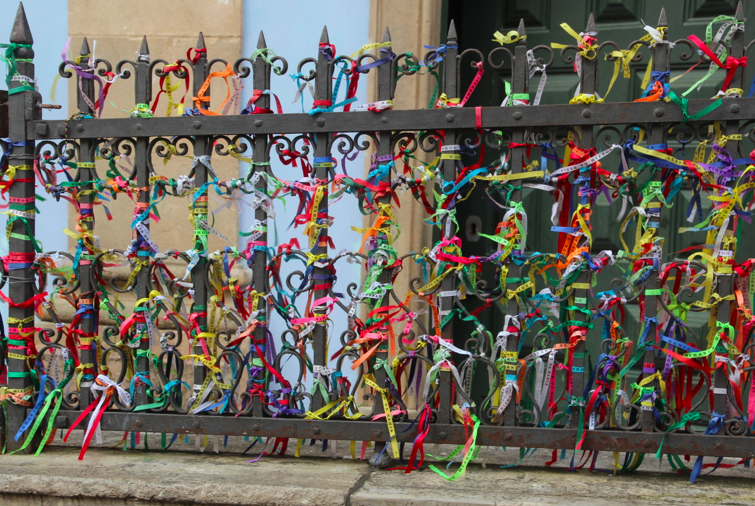
Ribbons starting to take shape at the Church Our Lady of the Rosary of the Blacks
The ribbons, which came into use about the time this church was completed, combined the superstitious nature of the African faiths with the miracle-granting powers of the Catholic saints.
In those early days, the ribbons were made of silk and wish-makers tied them around their necks and hung medallions or holy images from them.
Today’s ribbons are made of nylon and come in many colours. You see plenty of tourists wearing them, and even more tied around the cast iron uprights at the Church Our Lady of the Rosary of the Blacks but it will be a long time before the spaces are filled up.
The story goes that ribbons are to be tied with three knots and a wish should be made as each knot is made. The wishes supposedly come true when a ribbon falls off of its own accord—no helping it along with a pair of scissors.
Poor John and I didn’t buy any ribbons and I suppose it’s too late to wish we had. 🙂

Largo do Pelourinho square was in festival mode on the day of our walking tour

An open air room, complete with mosquito nets. Pure luxury
A bit of luxury creeps in to every overland journey. Sometimes it’s as simple as a hot shower on a cold day or a bowl of amazing street food. And sometimes it’s something that absolutely blows your socks off.
We’re in Peru at the moment—in the Amazon Basin—at an eco-lodge that is a truly special stop on our current jaunt.
I’ll be writing quite a few entries about our stay and excursions during our three days at Posada Amazonas, but for now I thought you should see our room. This is an overwhelming sight after a couple of months of living mostly in a tent.
Thanks Oasis for the surprise! I’m still speechless—to the extent that I’m ever speechless.

Shirts in every colour and even racy boots (check the ones on the top left)
Our visit to Rio Branco in Brazil’s wild west got me thinking about our stop last year in Nebraska.
I grew up in Nebraska and have travelled all over the state, but Poor John had only ever been to Omaha, Lincoln and Kearney. So I decided it was time to head northwest on Highway 2, through Broken Bow and on to Valentine. This would give him a good look at the beautiful country called the Nebraska Sandhills and take him into the heart of the state’s cowboy country. I’d wanted to drive on as far as Alliance, but we ran out of time, so spent the night in Valentine.

Saddles galore
I had my first visit to Valentine in the 1960s. One of my university roommate’s was from a cattle ranch just south of town, and I remember horse-riding in the snow and that her family home was 17 miles down a dirt road from the main road. I tried to spot their gate as we approached town, but had no luck.
What I also didn’t remember was the Young’s Western Wear shop, located in downtown Valentine. It’s a third-generation, family-owned business, so it must have been there in the 60s.
The New York Times calls Young’s the ‘purveyor of all things cowboy’, and I have to say I was gobsmacked by the enormous range and volume of goods on offer.

Plenty of colour and Indian motifs in the bags
The store’s 20,000 square feet of display area was packed with thousands of cowboy boots (all on sale when we were there), hats, shirts (in every colour you can imagine), jeans, dresses, saddlery and other rodeo equipment, and even homewares, cookbooks, handbags, and jewellery.
I wish I’d needed something, but I didn’t. We were going to being travelling for five months and I didn’t want to carry whatever I bought. A couple of cookbooks turned my head, including one called The magic of rhubarb, turn your friends and family into rhubarb lovers, but I restrained myself. This time!
That said, I’ve discovered that Young’s has an online store. Look out bank account.
P.S. Stay tuned for a look at the Sandhills and Broken Bow.


Food and TV—all in front of a closed clothing store
Rio Branco may be in Brazil’s wild west, but it’s not too rough and tough for its residents to need their daily hit of soap operas.
I think it was Eduardo in Curitiba who told us that unlike the US and its plethora of cop, forensics and blood-and-guts TV shows, Brazil’s airwaves are filled with soap operas.
Almost everywhere we went in the country—cafes, barber shops, ice creameries, pubs—there was at least one TV showing the soap opera of the hour.
But we were amused to see that Rio Branco takes the soaps to the streets.
It took a couple of minutes for it to dawn on Poor John and me that the mobile roadside hot dog stands were simply an entrepreneur’s way of giving locals want they want—literally a TV dinner.
We saw two of these stalls in a couple of blocks. They work like this. The seller parks his van and sets up a few tables and chairs on the pavement in front of a well-lit shop that is already closed.
Condiments, napkins and menus are set out on each table. A TV is balanced on top of a plastic stool, plugged in somewhere nearby and tuned in to one of the soaps.
The two stands we saw were tuned in to different programs. One had terrible reception, but still had customers (mostly men), so we assume people are faithful to a particular show.
And in case you’re wondering, although we didn’t watch much TV in Brazil, we never saw anyone get shot.
 Where to next?