
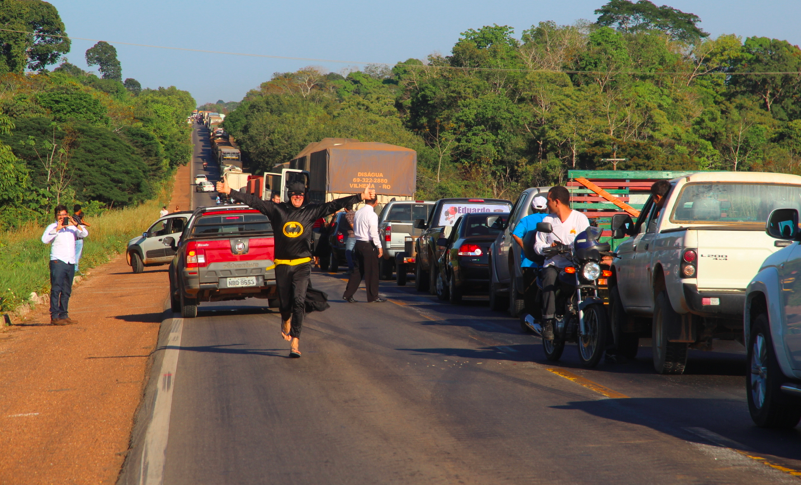
Batman doesn’t get traffic moving, but has a lot of fun
Nothing like a gigantic traffic jam to bring out creative solutions to pass the time until everyone is able to move on.
Luckily, overland trucks are much better equipped than cars to provide their passengers with an array of entertainment.
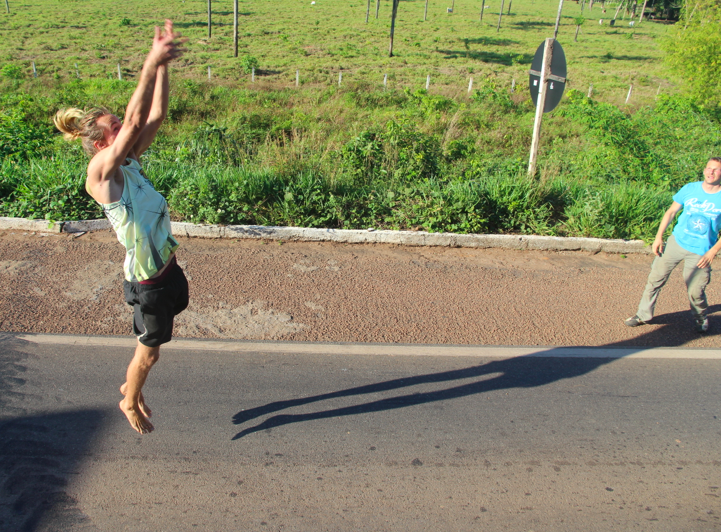
It all depends on the angle. Colin looks taller than he is, and Mario looks way shorter
Take the other day.
On the way to Porto Velho in western Brazil, we came up behind a kilometer-long line of vehicles. Once we realised there was an equally long line coming from the other direction, we knew there had to have been an accident.
Even though the truck is filled with people over the age of 18, there’s still an are-we-there-yet mentality. So out come the goodies to keep the big kiddies occupied.
The volleyball came out first and kept people amused for 10–15 minutes, and then out came the fancy-dress box. We’d used these clothes last year on my birthday and for Halloween, so I could imagine some of the get-ups that would be dragged out of the box.
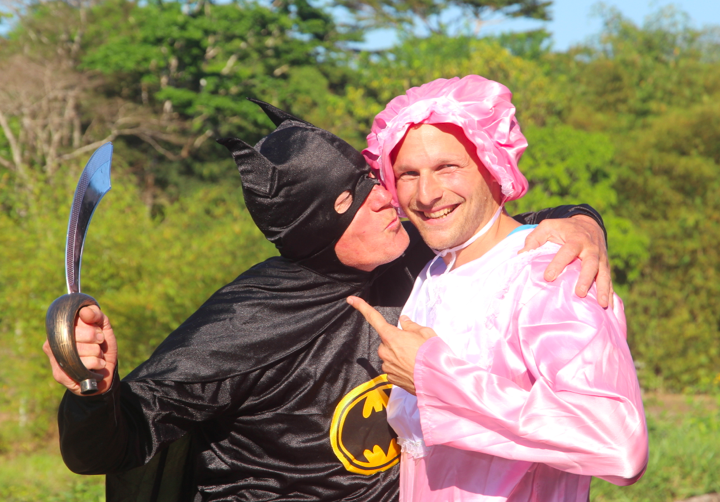
Big kids goofing off
Batman suited up first. Then the big baby. Even Batman couldn’t get the traffic moving, but he did turn a lot of heads. He was photographed so many times, it will probably make him difficult to live with in the coming days.
Plenty of police arrived (to deal with the emergency, not Batman). An ambulance came and went—with lights flashing, but not speeding—so we’re hoping the injured are already recovering.
And then traffic started to move, so it was back in the truck after an hour of silliness.

Would you ride around South America with this guy? We are 🙂

What view? with Colin, Julio, Naomi, Gemma and Poor John

Oh, that view!
Remember the freezing weather we had the other day? We arrived in Chapada dos Guimarães in mid-afternoon. There was plenty of sun and the town was celebrating its 100th anniversary.
Then the heavens opened, the winds picked up and the temperature plummeted to what felt like 0°C (32°F), but was probably about 8.
Julio, an English-speaking guide, came round before dinner to tell us about a great walk we could do in the nearby national park—only eight kilometres of not-too-rough terrain, a bunch of waterfalls and some good for swimming. Hmm! Tempting (except for the swimming), but we all wondered what the next day’s weather would bring.

Rugged up against the weather at the first waterfall

Gemma is first to take the plunge
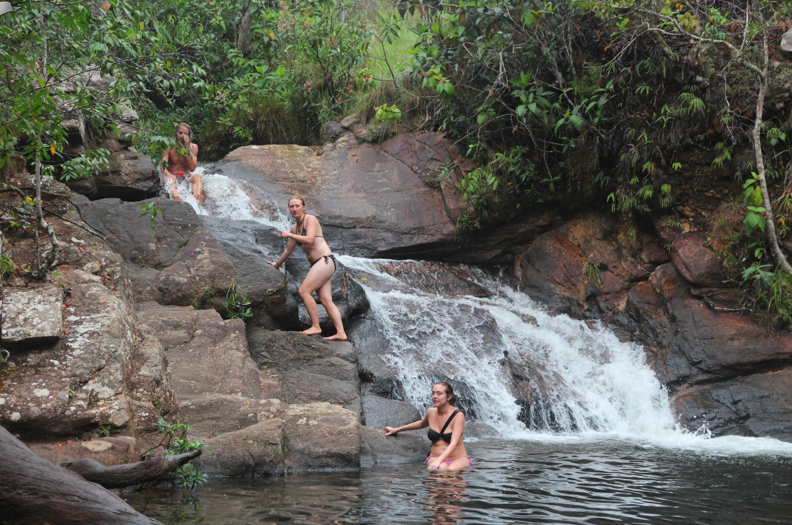
Colin and Naomi follow suit—in their suits
How about equally cold temperatures, wind, drizzle and an extremely dense fog!
To go or not to go? That was the question. Five of us decided it couldn’t get any worse and it might get better, so we grabbed umbrellas and waterproof jackets (thanks for the loan, Ashley) and set out.
We hired a taxi to take Julio and us to the park entrance. Even though we offered to cram into his Peugeot, the driver insisted on taking us in two batches.
Each trip was 25 minutes one-way so it took us a while to get started on the walk, but it took our minds off the crappy weather.
Julio was a great guide. We had to laugh. In his ‘day’ job he’s the unexpected combination of a lawyer and a gardener. He said he doesn’t like lawyering much anymore, but is very fond of the outdoors.
His gardening enthusiasm and knowledge shone through on the walk as he explained many of the plants, their flowering and growing cycles, and medicinal properties. Of course, I don’t remember any of the particulars now so don’t rush to me for pharmaceutical assistance in the jungle.
Julio knew about wildlife too, but we saw only wasps and giant ants with bulbous red heads. I remember that the ants don’t bite, but the wasps have nasty stingers.
Early on, we stopped at what should have been a beautiful lookout, but the fog was thick. So we headed down to see the first waterfall. On our return the fog lifted a bit for the only time that day and revealed glimpses of the view. No doubt it’s much more impressive on a sunny day.

It’s not a picnic without ants
We had our ‘picnic’ lunches at one of the falls, and three brave souls went swimming. Gemma was first in, followed by Colin and then Naomi. They said the water was warmer than the air, but I sensibly forgot to bring my bathers along so didn’t have to test their honesty. I really do love to swim, but I really don’t like cold water.
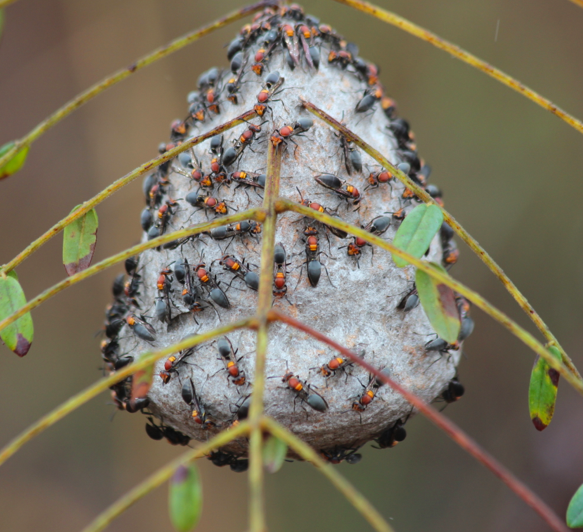
The wasps looked harmless enough
After visiting all the waterfalls, we finished off with Pedro’s Cave, which meant a trip down a lot of steps and a careful walk over slippery surfaces.
We got back to camp after 5pm and found everyone sitting in the truck, where they’d spent most of the day. The fog was 10 times thicker than it had been in the park, and it was rainier and windier.
So we made a good call that morning. And I got an added bonus. It was my night to cook, but my cook group mates, Ashley and Alex, had the ingredients chopped and ready to go, and Robert had the fire blazing.
P.S. According to the news, the temperature in Chapada dos Guimarães has been 34°C (93°F) for the last two days.

Colin takes advantage of being stuck in a traffic jam and asks another driver for directions
I’m constantly amazed to hear and watch Colin and Danny, our driver and guide for this trip, babble away in Portuguese.
When we met them late last year in Argentina, neither of them knew any Portuguese, and Danny had only had some lessons in Spanish. But now! Wow!
I am so impressed because theirs isn’t your simple order-a-meal or find-the-hotel touristic gumpf. Theirs is a proper manage-in-Portuguese and read-the-newspaper language—all in a total of about four months of travelling in Brazil.
We get to Peru soon and they’ll have to switch to their Spanish—another new talent. I asked Danny which was better—his Portuguese or his Spanish. He says he has more Spanish vocabulary and better Portuguese pronunciation.
It reminds me of advice given by Lu, the guide on our 24-week, London to Sydney overland. Her view was that you spend a lot of time sitting in a truck—looking out the window, reading, sleeping or listening to an iPod—so you might as well have that iPod loaded with language lessons.
She was so right! My language skills improved tremendously when we did the overland in Africa. I used lots of French in West Africa, and even some Arabic because the Lebanese run many of the shops there. Arabic came in handy again for the tail-end of that trip when we travelled between Sudan and Syria.
So we decided to follow good Lu’s advice.
Last year, we were going to have more than six months of travel, starting with about six weeks in North America and the remainder in South America, mainly in Spanish-speaking countries.
A couple of months before setting out, we bought two sets of Spanish language CDs and did some practice, especially in the car. The CDs then got loaded on to my iPod and when we started our travels in the USA—guess what?—the volume on the iPod had somehow been set to low, low, low.
It kept asking for a code, even though I’d never set a code. I tried every four-digit number combo I’d ever used in the past, but nothing. I visited Apple stores in the US and Canada and nobody could help. Even Google didn’t have an answer.*
So our good intentions and language lessons languished on an unused iPod. 😦 Infuriating, but that’s the way it was. Still the bits we remembered from the earlier practice came in handy in restaurants and shops.
By the time we decided to do this overland, which focuses almost completely on Brazil, I forgot about buying language CDs, so we’ve only made a little headway on Portuguese.
It’s frustrating because it’s such a wonderful opportunity—printed words and sounds abound, there’s the chance to practice every day and it gives you a lot more insight into the places you visit and people you meet.
So I swear, next trip, I’ll set out to learn or relearn some language.
* In the last two weeks of travel, I finally tried 0000 as the code on my iPod and it worked. You’d think Google or someone in an Apple store might have suggested that.

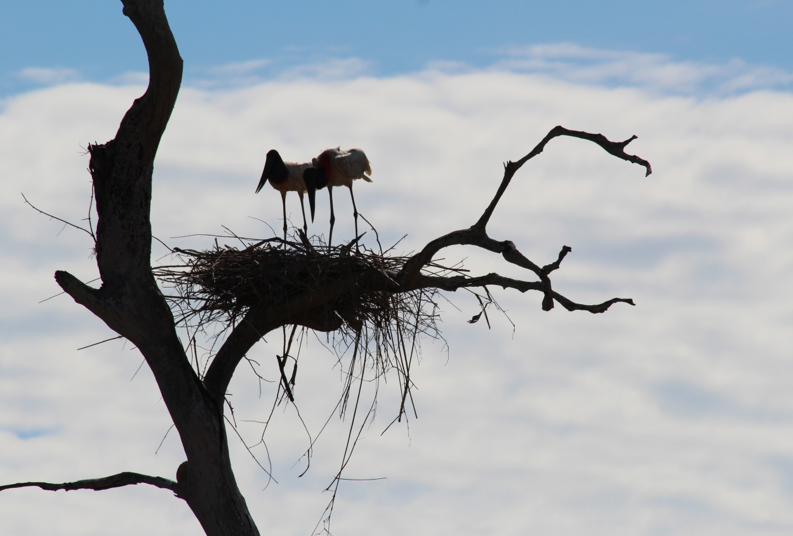
A jabiru couple later that afternoon (scroll down for more pics)
If you’re hoping to see a jabiru—a large white, black and red stork—try heading to their natural territories in South America.
We’re in the Pantanal wetlands at the moment and I hadn’t realised that it’s one of the best places in the world to see jabirus in the wild. I guess that’s not surprising after what I saw them getting up to in their nest yesterday. Blush!
We were on a two-hour nature walk through the property where we’re camping for a couple of nights. We’d just made it to the algae-clogged pond with a couple of resident caimans and a range of smallish birds.
But I spied a stork’s nest behind me in the distance. There wasn’t a single stork in it, but after seeing such nests in Morocco and Turkey, I knew immediately that it was the home of some type of stork. They love building nests of sticks on the top of telephone poles, high up in trees and on the top of columns in Roman ruins.
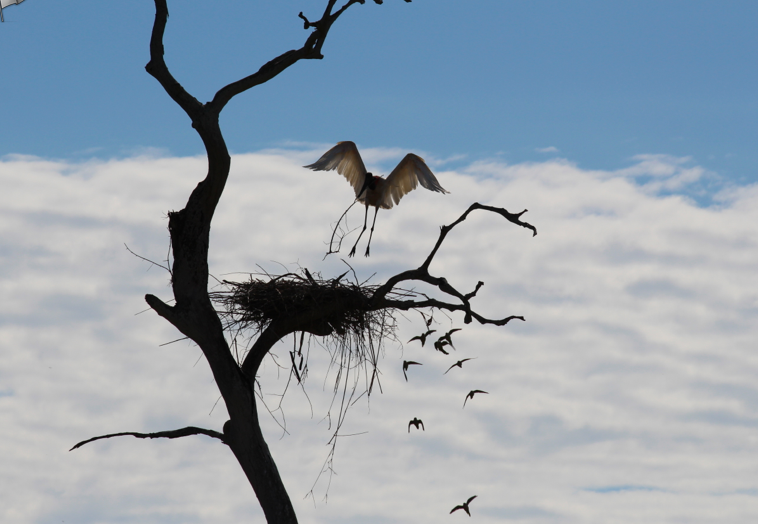
Mrs Stork clears out the riff-raff
So I watched and waited. Some small birds were playing in the nest and I wondered if they were squatters, but suddenly Mrs Stork arrived and shooed them away quick-smart.
She scratched around for a bit and then Mr Stork arrived ‘home’; perhaps after a long day of delivering babies. No doubt about it, he was ready for some monkey business.
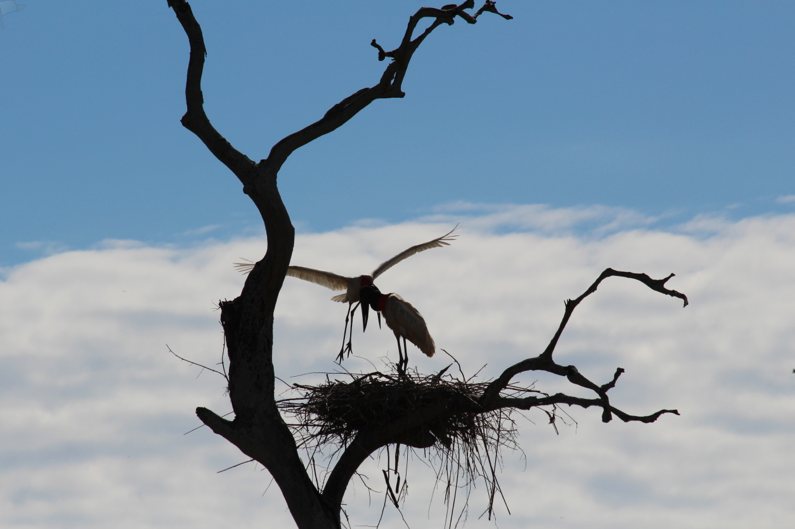
Hi honey, I’m home
It all played out so quickly that I only had time to rapid-fire away with the camera, so now I can share it with you. We won’t be here when the Storks babies are delivered, but I may have seen history in the making. Jabirus rarely breed successfully two years in a row.

Antics in the air
Jabirus are the tallest flying bird found in South and Central America, and have the second longest wingspan (after the Andean condor). Large males can be up to 1.5 metres tall with a wing span approaching 3 metres. Their name comes from the Tupi-Guarani language and means ‘swollen neck’.
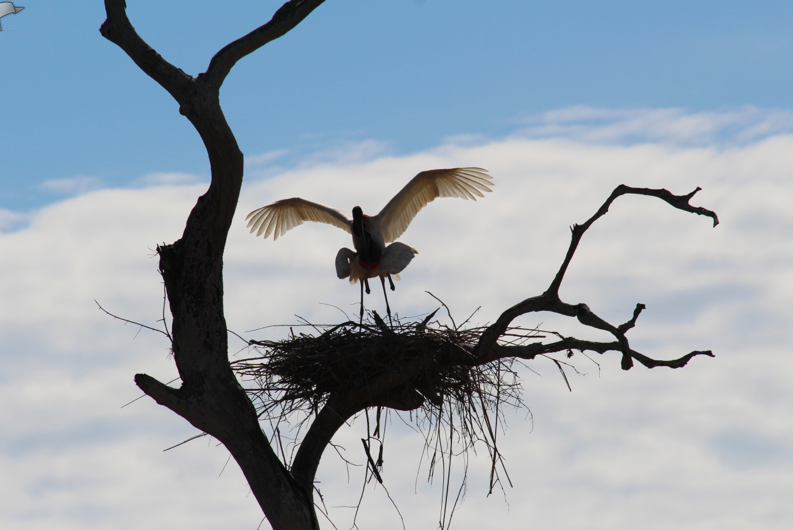
Moments later
Jabirus share the incubating duties and the young spend about six months with mum and dad before officially leaving the nest.
I have lots more pics of birds and wildlife in the Pantanal, but I thought this moment deserved top and immediate billing. 🙂
P.S. The name jabiru is given to two other distinct birds found in Australia and sub-Saharan Africa.
Companions
Chris and Robert rely on towels, blankets and pillows
Soon after we arrived in Chapada dos Guimaraes, our guide told us we were in for Brazil’s coldest day in 25 years. He got that weather forecast a tad wrong! It was the coldest three or four days in about 40 years.
In fact, USA media reported that snow fell in up to 87 cities in southern and central Brazil, swept in by a polar air mass that blew in from Argentina. The Pope is visiting Brazil now—I wonder if there’s any connection?
While we didn’t get the snow, we got everything else—icy blasts, rain, fog, mist and drizzle. Really not all that pleasant when you’re sleeping in a tent.
It was a pity, because the campground was really quite nice—plenty of flat ground, an open-air undercover kitchen, good toilets, hot showers, wifi and a welcoming owner. Of course, the fog meant we could hardly see across the yard from the showers to the kitchen.

Alex and Kate share a sleeping bag
The second day we were there, five of us had the sense to get out of town to visit the nearby national park, which I’ll write about separately.
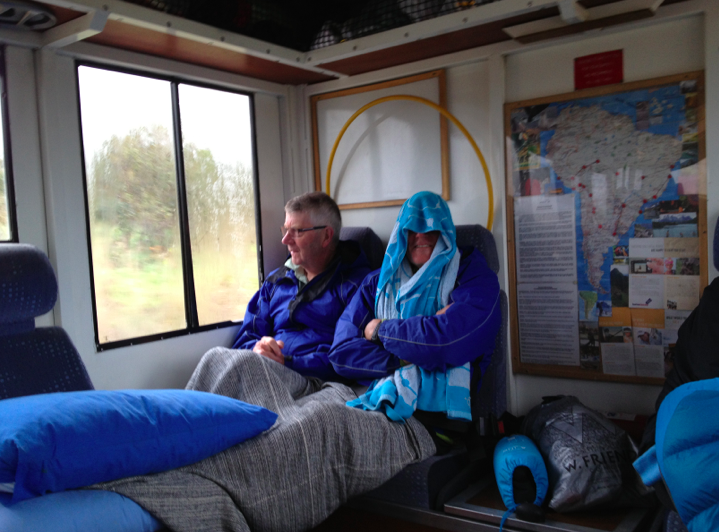
For now I want to share a couple of pics showing how we coped on the day we drove out of Chapada dos Guimaraes. Sponge Bob is an overland truck. He doesn’t have heating or air conditioning, so you have to make do when the weather throws out a challenge. In this case, have sleeping bags, towels, pillows and blankets—will travel.

The altar (running along the bottom) is made from a 10-ton block of marble
In 1883, an Italian saint named Dom Bosco dreamt of a utopian city of the future. He described it as a capital city that would rule justly and provide for the needs of a great nation. He said this city would be located in the New World, between the 15th and 20th parallels.
In a way his dream started to come true with the creation of Brasilia in 1960.
This new capital, built in Brazil’s interior, marked a certain coming of age for Brazil and the New World.

The chandelier is lit only at night

Twelve shades of blue, plus small bits of white
Recent protests confirm that the city (actually the nation’s politicians) may not always rule justly and provide for everyone’s needs, the city is positioned between the 15th and 20th parallels, and the Dom Bosco Sanctuary was built exactly on the 15th parallel.
The sanctuary is a tribute to the saint and what an eye-turner it is. The outside looks like an ordinary concrete box, but the interior is a wondrous space.
Designed by Claudio Naves, all four walls are made of stained glass (mostly 12 shades of blue), interspersed with small white squares. Each corner has a column of rose-coloured glass. In all there are 2200 square metres of glass. And I was especially impressed to notice that some of the windows open for ventilation. Nice planning.
The sanctuary is open 24 hours a day. The shrine is bathed in a heavenly blue during daylight hours; at night the interior is illuminated by a massive chandelier. It has 7400 pieces of Murano glass and was created by architect, Alvimar Moreira.
As with the Metropolitan Cathedral, Poor John and I could merely sit and gaze in wonder at this beautiful room. And once again, we were the only people from the truck who made it there.

From the outside, the Metropolitan Cathedral looks just black and white
Brasilia’s Catedral Metropolitana sneaks up on you and hits you between the eyes.
From the outside, the hyperboloid building, which was designed by Oscar Niemeyer, seems to be just a black and white structure—16 brilliant white, flared concrete columns, that weigh in at 90 tons each, interspersed with acres of black fibreglass.
Near the entrance are four bronze statues of the evangelists, Matthew, Mark Luke and John (each with his own pigeon or two when we were there). Sculpted in 1968, these three-metre artworks are the work of Dante Croce.
Also out the front is a bell tower with four large bells donated by Spanish residents of Brazil.
All in all, it looks impressive but with no particular wow factor. Then you enter the dark tunnel that leads into the cathedral and you begin to realise how gobsmackingly beautiful and clever it all is.

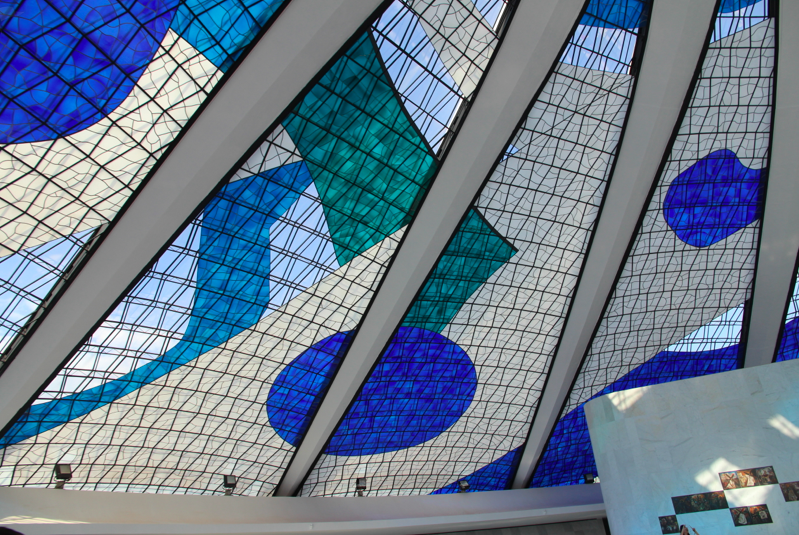
Stained glass creates a slice of ‘heaven’. The lightest blue is the sky outdoors
What you see from the outside is merely the cathedral’s roof. Within there is a vast space flooded with light and capped with a 360-degree, suspended ceiling of stained glass in blues, greens, white, browns and glimpses of the actual sky.
Poor John and I (wearing our shorts like everyone else) sat in one of the back pews for a long time just admiring and trying to take in the design, colours, sky and space. Marianne Peretti created this 2000-square metres of ‘heaven’ in 1990, and all pieces were handmade.

Three angels suspended from the ceiling
Three metal angels hang from the centre of ceiling. Designed in 1970 by Alfredo Ceschiatti, in the collaboration with Dante Croce, the angels range in length and weight from 2.2 to 4.2 metres and 100 to 300 kilograms.
The cornerstone was laid in 1958, but once the presidential term of Juscelino Kubitschek (who spearheaded the development of the new capital) ended, the push to finish many structures in Brasilia stalled.
It seems Kubitschek wanted the cathedral to be ecumenical, and to be paid for by the state and open to all faiths. But future governments did not provide funding, and the building was eventually turned over to the Catholic Church to complete. The cathedral was consecrated in 1968 (still with no roof), and officially opened in 1970.
More of the 360-degree stained glass ceiling
The cathedral, which is also known as the Metropolitan Cathedral of Our Lady Aparecida, was extensively renovated over the last year, with work being done on the roof, stained glass, marble surfaces, angels, concrete and bell mechanisms.
P.S. We only had an afternoon in Brasilia, and Poor John and I already knew that the inner city of this created capital was well worth seeing. So we left the truck before it got to the hostel and hopped in a taxi so we could race into town and see as much as possible. As it turned out, we were the only people from the whole group who made it to the cathedral. How lucky we feel.
Itamaraty Palace and its reflecting pool
I’ve discussed what to wear overseas before—quite simply, respect the culture and expectations of the country you’re visiting.
So I was surprised the other day when Brazil pulled a swifty on me. This is the country where one cannot own too many bikinis, and those bikinis cannot be too brief regardless of your weight or figure. In Brazil, the body beautiful is the body exposed.
Or so I thought.
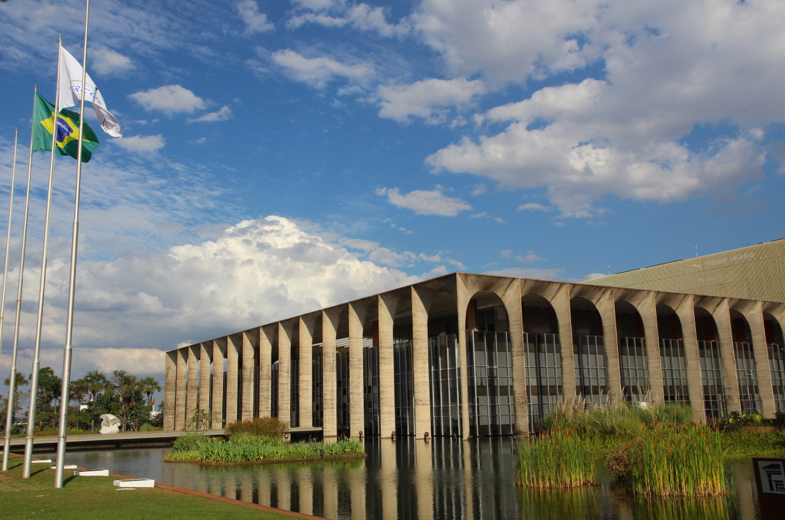
Poor John and I fronted up to the Itamaraty Palace (Palácio do Itamaraty) just before 4pm for the daily tour of the interior. Located in the national capital of Brasilia, the palace is headquarters to Brazil’s diplomatic corps. The building, designed by Oscar Niemeyer and opened in 1970, is nice enough from the outside, but is supposed to have fabulous reception areas inside.
So clad in shorts, we signed up for the tour along with about 30 other people. A few minutes before the tour was to begin a fellow (this was no security guy, but a true diplomat) approached us and asked if we spoke Portuguese. Er, no, how about English?
So ever so nicely in English, he told us this was a workplace and that the employees would be concerned if we came through in shorts!
You know as well as I do that in this land of flesh, they wouldn’t be concerned—they’d be jealous, even if you could make five bikinis out of the fabric in my shorts. And they wouldn’t see us anyway because we were going to the reception areas, not up and down the aisles of their workstations.
I did a half-hearted indignant—a scene wouldn’t do—and said they should post signs letting visitors know this rule. Yes, yes, madam, that’s a good idea. We should post signs.

National Congress of Brazil
And what about the teenager wearing shorts, I asked. Oh, she is just a child. Child? She was taller than me! And thinner! And was wearing short-shorts that would have yielded about half a bikini.
Nope, he wouldn’t budge even when I reminded that I was a silly old lady and old enough to be his grandmother. He smiled and shrugged and edged us closer to the door.
Egads, how do you make headway with a diplomat who knows the rules and is trained to get rid of shorts-wearers?!
So we left, unceremoniously and a little peeved. There’d been a ‘please no shorts’ sign at the cathedral, but half the crowd there were wearing shorts and no one intervened.
Before we headed away from the Monumental Axis (main street of Brasilia), we did a quick swing by the National Congress and the Palace of Justice, where the lawn was covered by tents. I’m still trying to find out why.
Later Poor John confessed that he’d read the no-shorts-in-the-palace rule in the guide book on his Kindle. Gee thanks, now you tell me!
P.S. The shorts episode reminds me of when I worked in the editorial and design unit at the Australian Government Publishing Service back in the late 1980s. People wore all sorts of casual clothes and one blistering hot day I wore shorts. They were stylish black shorts, complimented by a silk floral blouse.
I heard that my get-up raised a few eyebrows. It also raised confidence. And nice shorts became commonplace in the workplace ever after.

Palace of Justice with a lawn full of tents. I wonder if any of the campers are wearing shorts?

The streets of Pelourinho
Walking tours are a great way to get your bearings and an awareness of a new city, so we were keen to sign-up for the reasonably-price tour offered through the hostel in Salvador.
This tour would be around the cobbled streets of the old city, Pelourinho. This area, with its colourful colonial buildings and majestic churches, was derelict just 30 years ago. But Salvador set about cleaning it up for tourists and locals alike. It was a sensible move and has gained Pelourinho status as a UNESCO heritage site.
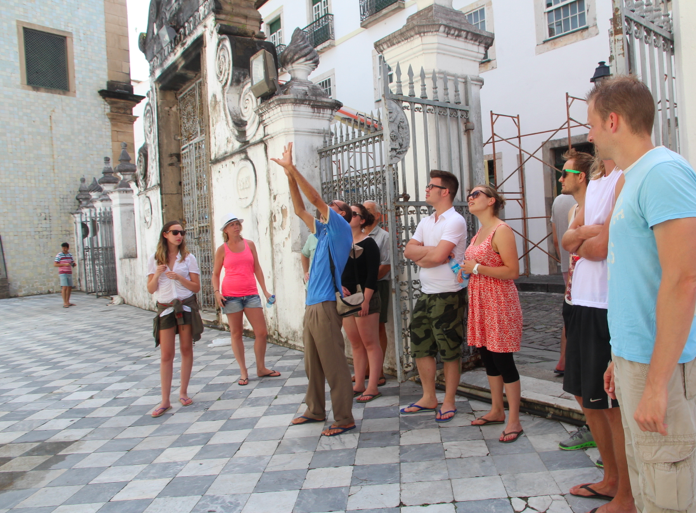
Luis explains the architecture of a church
The walking tour proved popular, with virtually everyone from the truck signing up to join in, along with a couple of other hostel residents.
About the time we got to our second destination, the heavens opened and the rain seemed to set in for the afternoon. Slowly the group dispersed and Luis, our local guide, offered to reschedule for Sunday, normally his day off.
So we set off again the next day in gloriously sunny weather, with umbrellas in hand just in case.
We made a circuit of the main churches and other important buildings and squares (walking tours usually don’t take you inside, but give you an overview of places to return to later), and learned some of Salvador’s history.
I’ll do separate posts with pictures on the interiors of the most important sites Poor John and I visited the previous day (we had umbrellas then too).
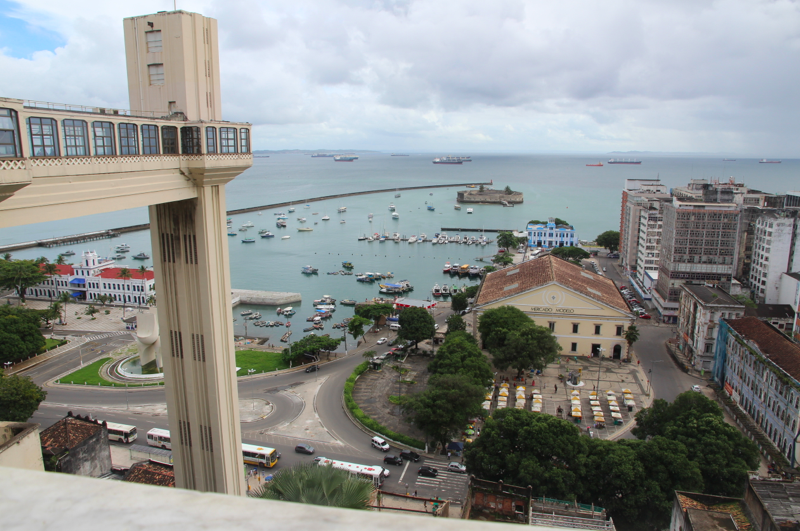
The Lacerda Elevator with the harbour below and the Mercado Modelo (yellow building with stalls out the front) on the lower right
But I’ll cover a few popular spots here.
In addition to a couple of important churches at the beginning of the tour, we saw some of Pelourinho’s flashy streets that look like they feel out of a paint store.
Luis explained that this part of the city is not for residential living, but for tourism. There are few flats (apartments) above the shops, plus there’s no parking and no day-to-day conveniences such as supermarkets and pharmacies. (The lack of residents is most obvious every morning when the streets of Pelourinho look like a deserted film set.)
He also told us that because of the UNESCO Heritage listing, that before making any changes to the exteriors of buildings, the owners have to get permission to use certain colour schemes—they also have to pay for the paint. 🙂

The square no one likes
Luis also showed us an unpopular square with an amusing history. It should be a pretty square. It has three large fountains—but not one was operating.
‘Everyone hates this square’, said Luis, ‘and the government made a big mistake putting it here. See how the wind blows? It’s like that all the time and when the fountains run, everyone gets wet, really wet.’
We also worked our way to the Lacerda Elevator. Much of Salvador and most of the old city are built on the sides of steep hills. Built in the 1930s, the Lacerda takes people down about six or seven stories to the waterfront and the Mercado Modelo, a vast shopping complex filled with lots of stalls selling you-name-it.
Along the way, we had a brief food stop. A couple of people bought acarajés and I bought a coconut concoction that gave me the biggest sugar hit of my life. It was a round disc, about 6 inches across, of pure sugar with a sprinkling of coconut. I shared it with everyone and we all agreed it was too much of a good thing. I promise to try to get a photo before we leave Brazil.

Monte Pascoal from a distance
We hoped to spend part of an afternoon at the Parque Nacional do Monte Pascoal, on the coast of Brazil, but things don‘t always go according to plan.
Danny had called ahead—twice—to let them know we were coming and to ask for an English-speaking guide. Yes, yes, that would be fine!
As a national symbol to Brazilians, Monte Pascoal (Mount Easter) is worth a visit. According to history, it was the first part of land viewed by Portuguese explorer Pedro Alvares Cabral, who is believed to have been the first European to arrive in Brazil, on Easter Day in 1500.
When we arrived all those years later, about two-thirds of the group put their hands up to go on the hour-long guided walk that led to a point where we could get good views of the 536-metre, hump-like mountain.
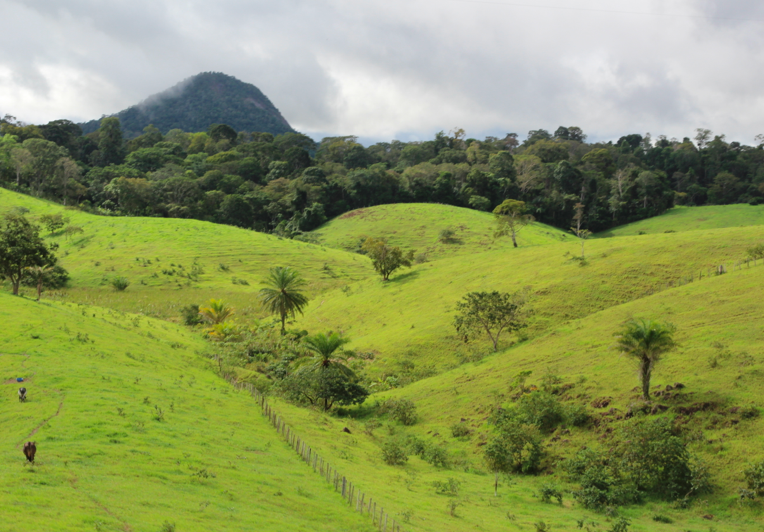
The landscape near the Parque Nacional Monte Pascoal
But there was a hitch—or three. The guide at the visitor’s centre didn’t speak English, he wanted almost twice the price agreed on the phone and he had spent the morning drinking.
While Danny and Colin went to find a substitute guide (guides are compulsory) at the right price, a no-nonsense woman, with a baby perched on her hip, marched along and gave the tipsy guide a good finger-wag and talking-to. Perhaps it was his wife telling him off for drinking on the job.
As it turned out, there weren’t any other guides available, so we could go with the drunk, who we might have to carry there and back, or we could pass.
We all agreed it was right to pass, rather than encourage such behaviour in future. So sometimes you just have to pile back into the truck and drive away.
Colin pointed out the saddest aspects in all this. In 2000, the Brazilian government handed the national park to the Pataxó people to maintain and run. There are fewer than 3000 Pataxó still living in Brazil and the park gives a community of them employment and prosperity, and allows visitors to see how the Pataxó live.
Even though the Pataxó missed out on our monetary contribution, we didn’t miss out on a bit of ‘luxury’. The visitor’s centre had working toilets with toilet seats and toilet paper. Woo-hoo!
Plus we saw great scenery as well as Monte Pascoal from a distance as we drove in and out.

The local watering hole where our would-be guide may have spent his morning
 Where to next?