
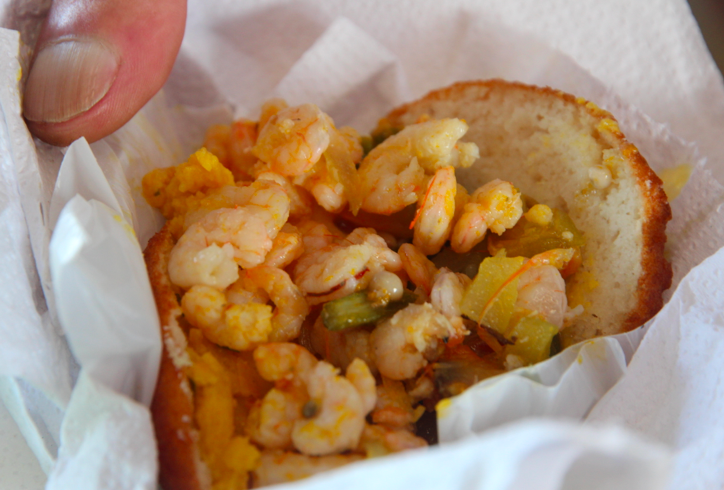
An acarajé all dished up
Street food is popular all over Brazil but we made two new finds when we stopped in Porto Seguro, north of Rio.
We caught a local bus (the pickup point was just outside the fancy-schmancy campground where we were staying) and alighted early so we could visit the quaint and colourful old town.
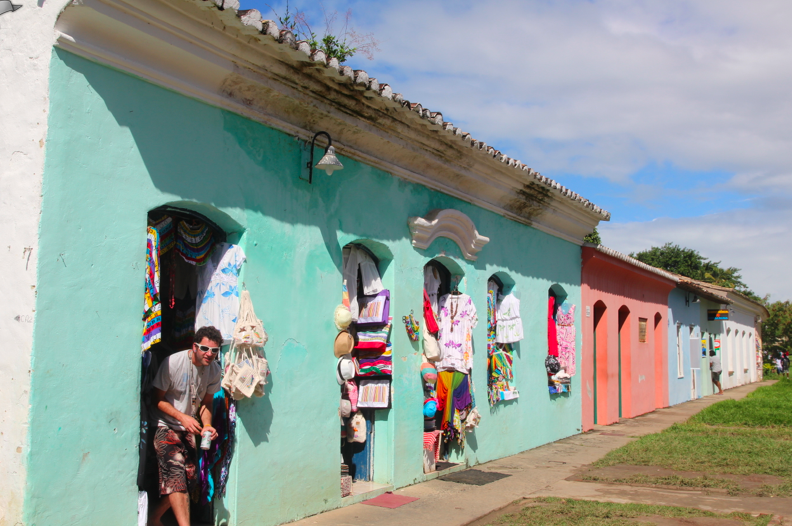
Danny ducks out without buying a souvenir from one of the many shops in old Porto Seguro

Assembling an acarajé
Guidebooks recommend stopping at the old town IF you can make it up the many steps to the top. Good grief, what a bunch of wimps! It’s only 247 steps and they aren’t very steep anyway.
But the climb made Poor John hungry (breakfast had been at least 90 minutes earlier) so not far from the top of the stairs, he managed to sniff out our first acarajé stand.
Traditional to Brazil’s Bahia state (and West Africa where it came from originally), acarajé is a bun-like dish made from black-eye peas that are peeled, mashed, shaped into a ball and then deep-fried in palm oil. It’s then split in half and filled with a salad of red and green tomatoes (vatapá and caruru), fried shrimps, more palm oil and a hot pepper sauce.
This one seemed to have a couple of added extras that I couldn’t quite identify by appearance or taste. There were peas and green beans and ??? I confess, I didn’t buy one, but I inspected Poor John’s closely and helped myself to a big chomp too. No wonder acarajés are so popular—they really are delicious. A perfect balance of spices and reasonably healthy if you don’t think too much about the palm oil. And not too pricey at only $3.50 for a very generous serving.
Porto Seguro’s old town—oh yeah, I remember, we were there to sightsee, not eat—has been well maintained and has a great view over the Atlantic Ocean. There are plenty of souvenir shops, a couple of churches, a couple of turkeys (that was a surprise), some cheeky monkeys and even more food stalls.
We also discovered the back way in where busloads of tourists arrive without climbing the stairs.
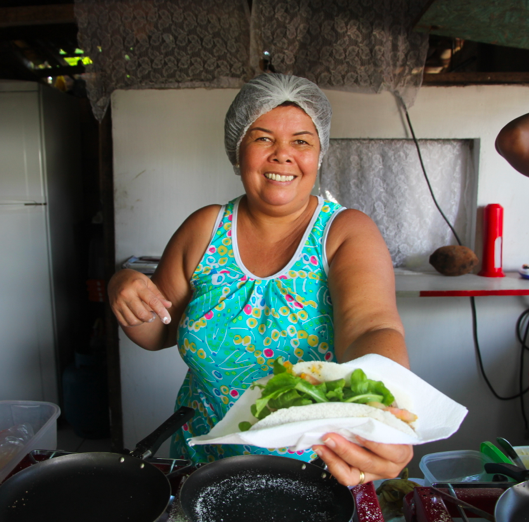
A tapioca recheada for lunch
About lunchtime, we found a stall selling tapioca recheadas. I can’t find out much about them, but watching them being made told me a lot. A recheada seems to be a tapioca pancake filled with sweet or savoury additions. So you can get banana and cheese, or meat with cheese and tomato.
I got one the seller recommended—with cheese, tomato, chicken and rocket (arugula or rucula in Portuguese). She tossed in the rocket simply because I showed an interest in it. Poor John got a sweet one. Another yummy discovery, that shouldn’t be too hard to recreate at home. I hope.
We also tasted juice from the cupuaçu, a tropical rainforest tree related to cacao. The fruit can weigh up to two kilos and the juice tastes like pear with a hint of banana. The pulp is also used in desserts and cosmetics. I’m sure I’ve seen this fruit in other parts of the world, but maybe I just remembering it from our first overland trip in South America.
Oh, and Mario managed to throw in a tebow overlooking the Atlantic.
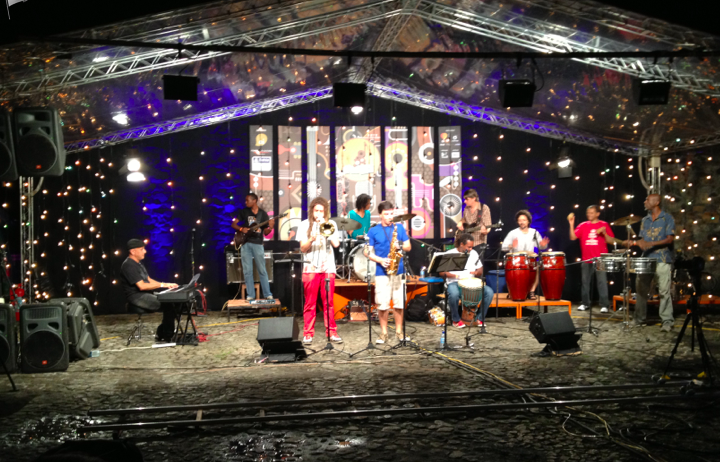
Weekly jazz at Salvador’s Museum of Modern Art, an old sugar factory
Once a week, and every week for the last 14 years, Salvador turns on a great jazz show for the public.
This week, Poor John and I (and almost everyone from the truck) were lucky enough to be there for this Saturday’s performance that featured three hours of jazz and 14 musos, although it seemed like more because a few could and did play more than one instrument.
Let me count—there was a saxophonist, a trombonist, 6 (or was it 7) on various forms of percussion, three guitarists (including an Aussie), two pianists and three drummers.

Jamming at JamNoMam
The event is called JamNoMam, after the location at the Museum of Modern Art. It’s a great spot and, if you get there early, as we did, you can watch the sun set over Salvador’s Bay of All Saints.
We also had time to stroll through the sculpture park next to the museum/gallery and to watch the musicians and tech people set up the stage and instruments.
The concert started at 6pm and Poor John, ever the bargain hunter, got us in as seniors for half price of $1.50 each.
He then proceeded to show his age and his dodgy vision by commenting that it was nice and surprising to see that the main drummer was female.
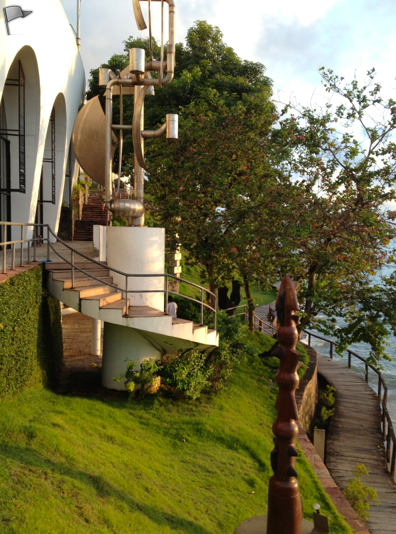
Sculpture Park, on the Bay of All Saints in Salvador
Ahem, I said, but just because ‘she’ has longish dreads have you noticed that she also has a flat chest, a hint of a five-o-clock shadow and—get this—a prominent Adam’s apple. Turns out ‘her’ name is Thomas too. Goes to show he doesn’t see too well even from the second row.
It was a packed house, if you can say an outdoor venue is a ‘house’. The crowd was mostly Brazilian and there were journalists and photographers swarming everywhere. We saw they can get in for half price too.
So if you are ever in Salvador, get yourself along to the Museum of Modern Art on a Saturday night and enjoy the beat.
P.S. Sorry the pics are a bit out-of-focus. Salvador can be a rough town and I was advised not to carry my good camera. I took these with my mobile phone.
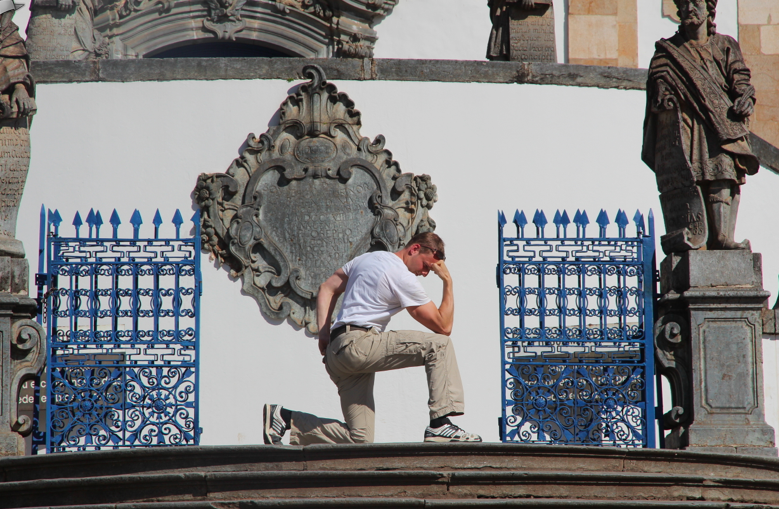
Mario tebowing at Congonhas
Some people take a small stuffed toy or a garden gnome to use in pictures of their travels.
But not Mario. He’s got himself and his tebowing! What’s tebowing, you ask?
It’s an act of dropping to one knee and bowing one’s head in prayer. Tim Tebow, a professional American footballer, started it. He is proud of his religion and often makes this gesture/movement on the playing field.
It’s become so popular that a whole website is devoted to pictures of people tebowing the world over.
Mario, who is from Switzerland, doesn’t care about the religious aspect of tebowing, but he likes the idea of being able to mark each place he goes with the same pose.
So I’m sharing a couple of the pics I’ve shot of him in action in Brazil. I’m sure there will be more.

Not that easy to tebow in a kayak
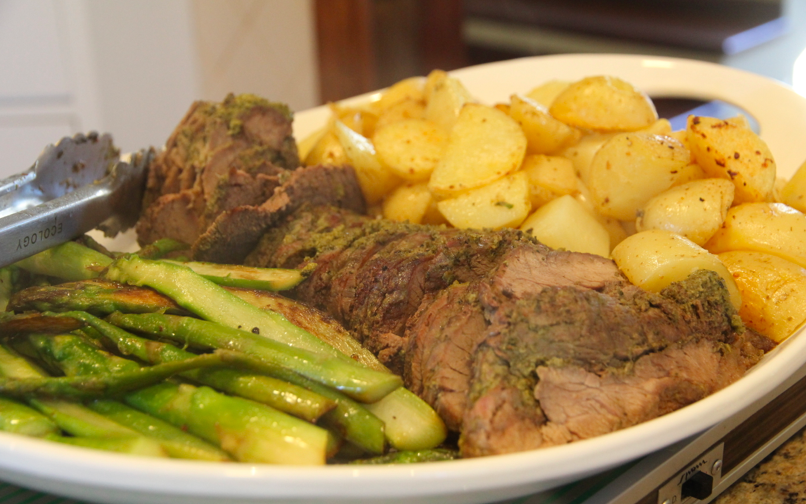
Newton’s masterpiece—an English roast dinner
A big bonus of going to Curitiba was the chance to stay with Eduardo and his family in the Italian district of this city filled with people from all over the world.
By chance, we took this multiculturalism into the kitchen too.
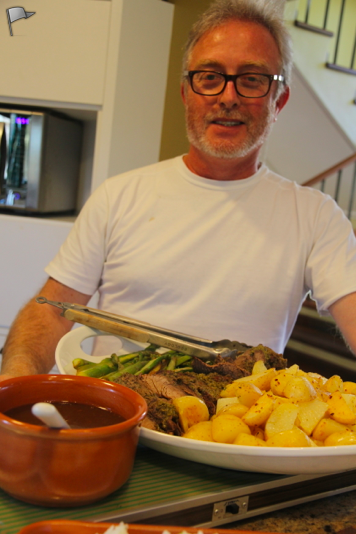
Newton and his roast dinner
On our first full day in Curitiba, Newton, Eduardo’s father, made an English roast dinner with lots of delicious sides. It was a great meal, and the sort of thing you never get to have on an overland adventure (it’s not easy to make a roast over a gas burner).
We also had a starter of bread with Newton’s secret health sauce. It’s his grandmother’s recipe. An amazing sauce with just the right amount of spice and heat. I’m hoping to make him good on his offer to share the recipe if I promise not to give it to any other Brazilians. I promise.
The meal was topped off with a yummy chocolate dessert—brigadeiro—made by Eduardo’s sister, Cristina. This concoction of sweetened condensed milk, cocoa (or Nesquik) and chocolate sprinkles is very popular at kid’s birthday parties, although all the big kids at this party loved it too. Cristina’s batch was more like chocolate mousse without the sprinkles. I didn’t get a picture, but I know how to make it and will try it out at home.

Newton’s grandmother’s secret recipe for healthy sauce
Anyway, I wanted to repay this wonderful hospitality, so offered to make moqueca, a stew popular throughout Bahia and Espirito Santo, coastal states north of Rio.
Moqueca (also spelt muqueca) can be made with meat or seafood, and may (moqueca baiana) or may not (moqueca capixaba) include coconut milk. Many years ago, I was taught a recipe that calls for prawns and coconut milk.
Ken, who lived in Brazil for three or four years and who taught me the recipe, is a master of moqueca. I couldn’t quite remember all his recipe—it’s on the computer at home—so I winged it. The end result wasn’t nearly as good as Ken’s, but it was more than okay, and certainly nicer than any version of moqueca we have ordered in South American restaurants.

Making moqueca
The finishing touch was that I managed to find a key ingredient—Lee Kum Kee’s chilli garlic sauce—in Curitiba’s large food market.
We had another treat—pinhão—as a starter to our meal. Eduardo bought a big bag of them in the market. They are a sort of pine nut from the pinherio tree (an araucaria) and taste rather like a chestnut. Newton put them in the pressure cooker for about 30 minutes. You eat them by biting down on the base of the pod and letting the nut ooze forward into your mouth. I loved them. Poor John thought they were okay.
P.S. We’re stopping in New Zealand to visit Ken on our way home from this trip. I promise to get the exact recipe and post it here for everyone to enjoy. I must remember to ask Ken who taught him to make moqueca.
Ken has also given me a recipe for pão de queijo (cheese puffs). I’ll pass that on too when I get home.

Iguazu Falls viewed from Argentina
The people who have been on our overland truck for awhile have talked a lot about their visits to Iguazu Falls, on both the Argentinian and Brazilian sides. We won’t get there this trip, so I could be jealous, but it’s not necessary. We went last year and it was amazing.

A rainbow with no rain
In fact, Poor John and I were lucky enough to see these spectacular falls from both the Argentine and Brazilian sides. I even got to see them from the air—on a brief helicopter ride.
These falls are incredible—even overwhelming. So much so that in 2011, Iguazu was included in the New Seven Wonders of Nature.
It’s a well-deserved accolade. Iguazu is three times higher than Niagara Falls in North America and about a kilometre wider than Victoria Falls in Africa. At 2.7 kilometres in length, Iguazu is the longest waterfall in the world.
It doesn’t have the largest single drop of water (that title goes to Victoria Falls) because the many islands on the Iguazu River create from 150 to 300 individual waterfalls, depending on water levels. The highest and deepest drop is the Devil’s Throat, which is part of the border between Argentina and Brazil, and has water rushing over the edge from three sides.
A legend says that a god planned to marry a beautiful woman named Naipi. But she and her lover, Tarobá, ran away in a canoe. In rage, the god sliced the river, creating the waterfalls and condemning the pair to an eternal fall.
We first saw the falls from the Argentine side, which meant we were looking at Brazil’s 20 per cent of the flow.

Catching the train to the falls
Argentina has an eco-friendly train that takes you to the falls. We left the train early so we could walk the kilometre-long trail—Paseo Garganta del Diablo—that would take us to the famous Devil’s Throat.
The walk treated us to incredible views of the many waterfalls on both sides, and much more. At one point, we could stand and see 260 dgerees of waterfall.
A sign near the falls asks viewers to note the colour of the water. It says that four decades ago, the water ran crystal clear, but that forest clearance has allowed soil to run into the river and turn the flow to reddish brown. It says the turbidity affects wildlife. It prevents fish from courting and spawning, and makes it hard for fish-eating birds and mammals to find prey.
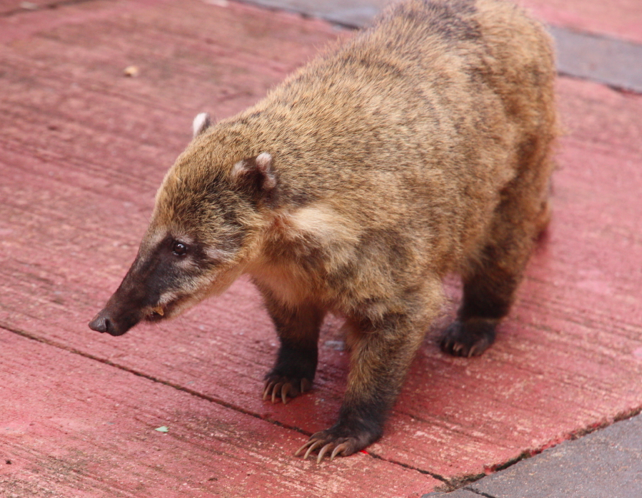
A coati looks innocent enough, but don’t be fooled—they want your lunch
The turbidity doesn’t seem to have any effect on the aggressive coatis, also known as Brazilian aardvarks. They’re members of the raccoon family, and about the size of a large house cat. There are warnings posted everywhere, to remind tourists that coatis will steal your lunch and bite and scratch an outstretched hand that does—or doesn’t—feed them. Too many tourists have ‘befriended’ them, so now they expect handouts. We stayed well away, and saw several tourists robbed of their lunches.
We also saw lots of reptiles, butterflies and birds. In fact, I’m going to do separate entries on the wildlife, the view from the Brazilian side and the helicopter ride.

Just one of those lucky pics
What a fabulous and unexpected stop we had in Caravelas, a small fishing town on the Brazilian coast north of Rio.
The guidebooks say it is a great place to arrange trips for watching humpback whales, from June to October, and also the main jumping-off point to visit the Parque Nacional Marinho de Abrolhos (where lots of whales hang out).
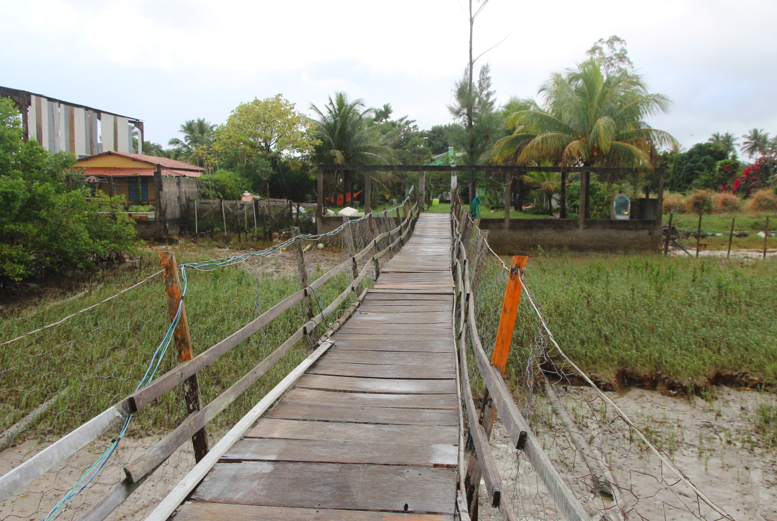
Walking the plank to the harbour in Caravelas
Poor John headed to the tourist office up the road to find out about the cost and details for day trips. The bottom line was close to US$150 per person, including admission to the national park, and a three-hour boat ride each way. Danny did some checking too and came up with the same amounts.
But the manager of our pousada (hostel) had his own ideas. He called a friend (or maybe a friend of a friend) and organised a whole boat for us for just under US$115 a person, with snorkeling, lunch and snacks included but stopping short of the national park (so no admission fee).
Early next morning we set off, on foot, to walk to the harbour and board a catamaran for our adventure into the wild. It started with a leisurely 10-kilometre chug up the Rio Caravelas to the open sea.
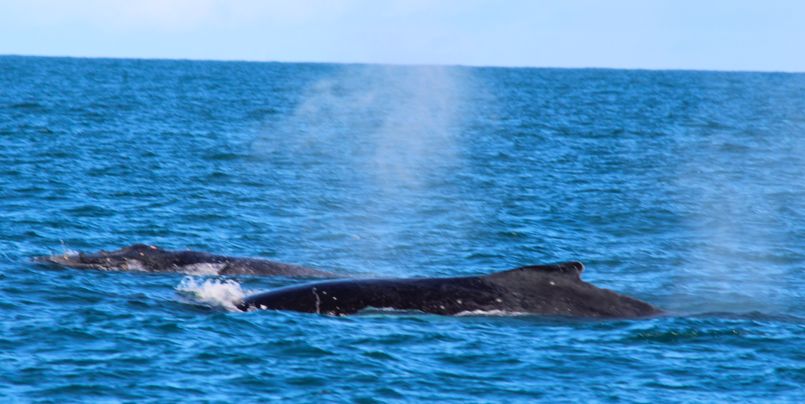
A mother and her calf
And then what a day it proved to be.
We saw our first humpback just over two hours into the ride—not long after the waters became clearer (river silt gives the water close to shore a very brownish hue).
Then whales were everywhere. Well, maybe not everywhere, but we saw humpbacks off-and-on for the next four hours.
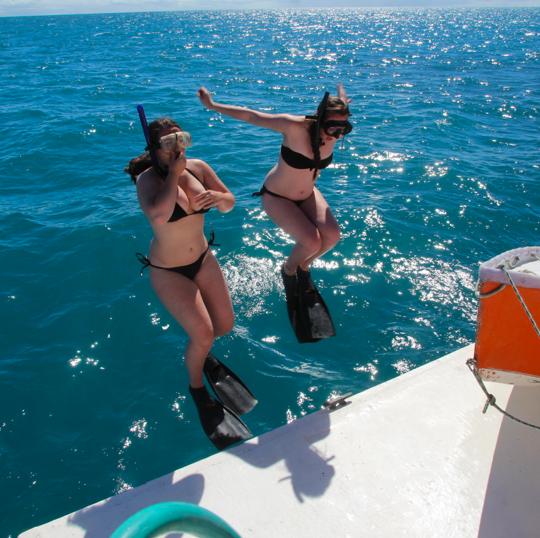
Kate and Lindsey take-off for snorkeling
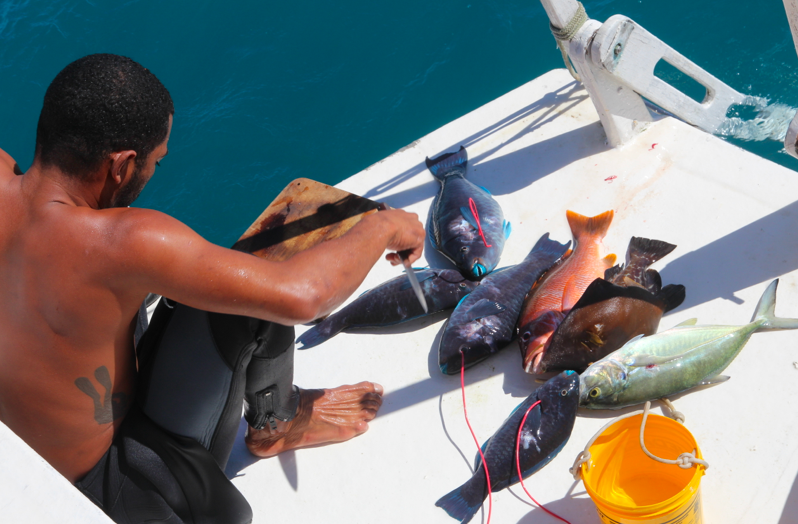
A nice haul of fish for lunch
And the crew made a point of keeping a look out for this huge mammals and following (staying beyond the legal distances) those that we saw.
We spotted whales on their own, mums with calves (they come to this part of the Atlantic Ocean a this time of year to mate and calve), whales spouting, whales slapping their tails. It happens so fast that sometime it’s impossible to get a pic, but I was pleased with some I caught.
The boat anchored before lunch so people could snorkel over the reef. Not a lot to see because the water was deep, but the waters were warm and calm, and more whales played in the distance.
One of the crew went spearfishing and came back with an impressive haul of colourful fish.
He set about cleaning two parrotfish so we could have an feast of raw, fresher-than-fresh seafood, which we dipped in lime juice and soy sauce.
Then it was time for real lunch, with fish nuggets, pasta and green salads, and rice.
We headed back to Caravelas about 3, reaching the river and dock well after dark.
I don’t suppose I’ll ever be whaled out, but this was an amazingly rewarding day.
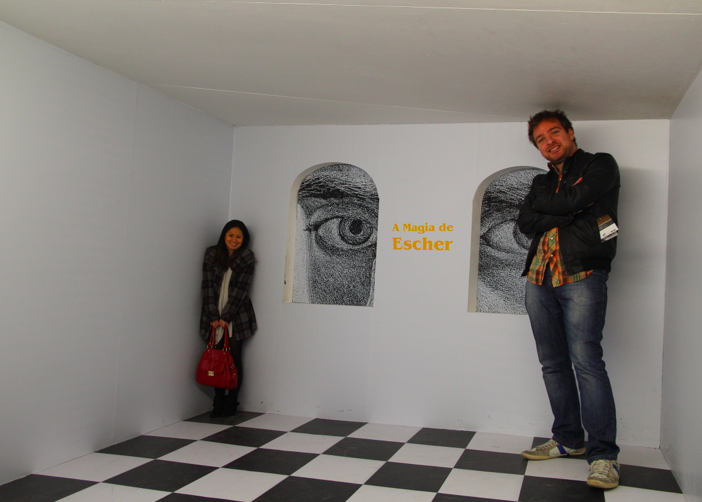
It’s not an illusion. Eduardo really is larger than life, but Dani isn’t shrinking—at the Escher exhibition
Months ago we decided to go to Curitiba for a few days before starting our overland trip. We’d read that it was an innovative and green city that was ahead of its time, thanks to a forward-thinking mayor in the 1970s.
We also hoped to catch up with Eduardo, who was on exchange in Australia in 2004.
As it turned out, Eduardo and his family invited us to stay with them in Curitiba, so all we had to do was get there. Luckily, Poor John found a super cheap return ticket on Tam Airlines.
We hopped on the bus to the airport in Rio with a couple of hours to spare, but traffic, an accident and other general congestion meant we didn’t get to the airport until about 35 minutes before the flight left.
Never mind how much arguing and cajoling we did, never mind that we had confirmed seats, never mind that we had no luggage to be checked, never mind that the flight was taking off 20 minutes late—Tam would not let us go through to the gate.
They were, however, more than happy to sell us two one-way tickets for US$1000. Sorry, but that was not an option. I don’t deal with thieves. Huffily they suggested we try another airline. So we did.
After sending a message to Eduardo to let him know we weren’t on the flight and didn’t know what would happen next, we trotted to the Gol Airline desk in next terminal.
The woman at Gol was very helpful (and mentioned that her dad had the same birthdate as Poor John) and sold us two one-way tickets for US$500. Success! I bought a phone card and let Eduardo know we were on the way.
But our dramas with Tam were not over.
We still had a return ticket with them! Right? Wrong! ‘Missing’ the first flight meant we forfeited the second. A fact no one mentioned until we’re trying to use the return ticket. They wanted another $800 to take us back (cheaper on a Monday than a Friday night).
Bless Eduardo for not dropping us at the door as we had suggested. He had come in with us, and this was now a fight he was not going to lose. He talked to the man at the desk, then the supervisor. After much haggling he convinced the supervisor to call the manager in Rio.
And suddenly everything was okay and we were being issued with boarding passes (funnily enough about 30 minutes before the flight was to leave).
Eduardo told us that we should thank the widespread demonstrations. He’d used them as one of the reasons we could not get to the airport to begin with, and apparently that the one and only excuse they could accept.
So thank you Eduardo for being our hero. Your quick thinking saved us a lot of frustration and money.
P.S. Curitiba is well worth a visit. Go there if you ever get the chance.

Eduardo and Dani, outside the eye-shaped Museu Oscar Niemeyer

Work on the road less-travelled
You know the thick red line on a road map—the one that says ‘take me, I’m the main road’? Okay. Know the thin grey one that says ‘I’m narrow, maybe dirt, but certainly passable’?
We took the thin grey line the other day. It was going to cut out about 30 kilometres, a major town and a long stretch of messy roadwork. Locals told us it was tarmac and safe to use.
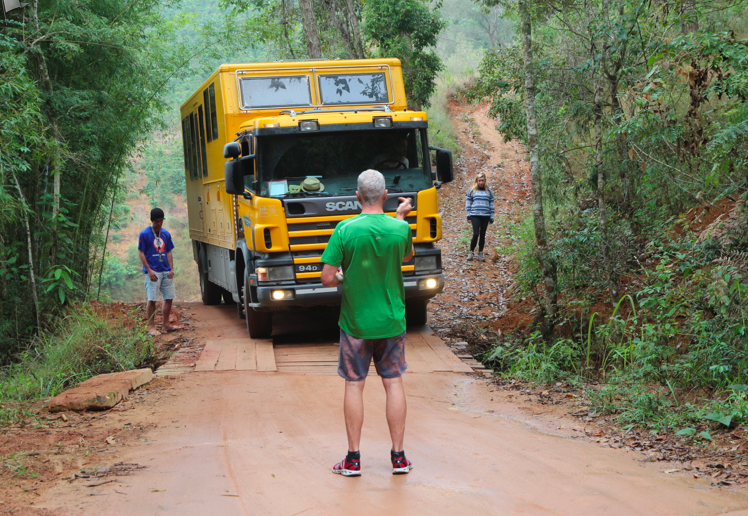
Crossing a basic bridge
They were right—up to a point. It started out tarmac and then petered out to dirt. But wait. It will be tarmac soon, because plenty of messy roadworks were underway here too. Beyond them were dirt/mud, narrow bridges, steep grades and increasing rain.
After chatting to a local school bus driver, Colin decided it made more sense to turn back. Sponge Bob weighs 16–17 tons and would be ridiculously hard to pull out of a ditch if he slid backwards down a slippery road.
So we lost about a third of a day’s drive, but a shortcut always has its bonuses.

Top floor is for drying clothes
The scenery was gorgeous—plenty of farms and coffee plantations, interesting roadwork, bird’s eye views into homes (the top floor is for drying laundry) and an encounter with a school bus. And guess what? Kids on Brazilian school buses are as boisterous, rude and cheeky as kids anywhere else in the world.
Update
Our day was destined to be full of delays and hiccups. We arrived in Linhares—a couple of hours short of our original destination. We pulled into the swish-looking CasaGrande Supermercado to shop for the day’s cook group but it wasn’t open for business yet. It will be impressive when it’s completed, but we had to do our supermarket shopping across the road at the old CasaGrande.
Then, after chatting to the locals and making a phone call, Colin and Danny discovered that the campground we were heading to was no longer operating.

Not such a tight squeeze when the sign is down, a bit of roof is upturned and it’s daylight
Turned out it didn’t matter! One of Brazil’s ongoing demonstrations was planned for tonight in Linhares and we wouldn’t have been able to get through the crowd and blocked roads.
So we back-tracked for about 40 minutes to a lovely campground that made us feel super welcome. They even took down the entrance sign and bent back a section of roofing so Colin could get Sponge Bob through the narrow gateway.
The final bonus of the day was a delicious version of carbonara for dinner. A great day with adversity overcome.
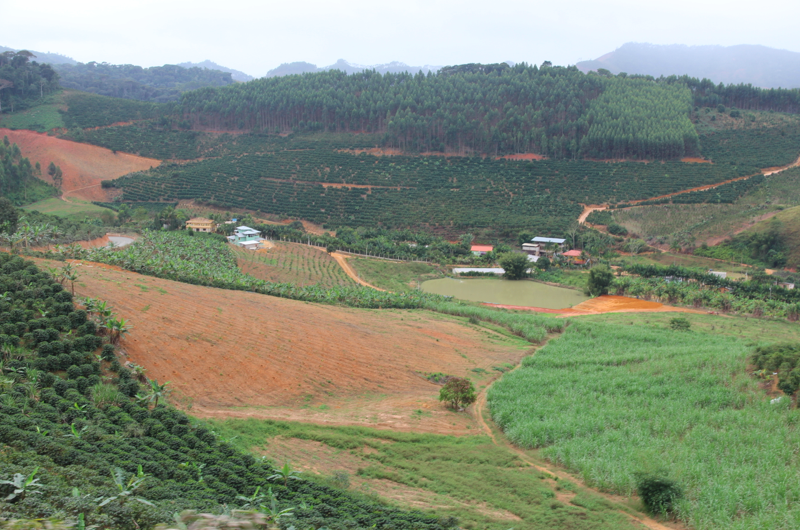
Shortcut countryside
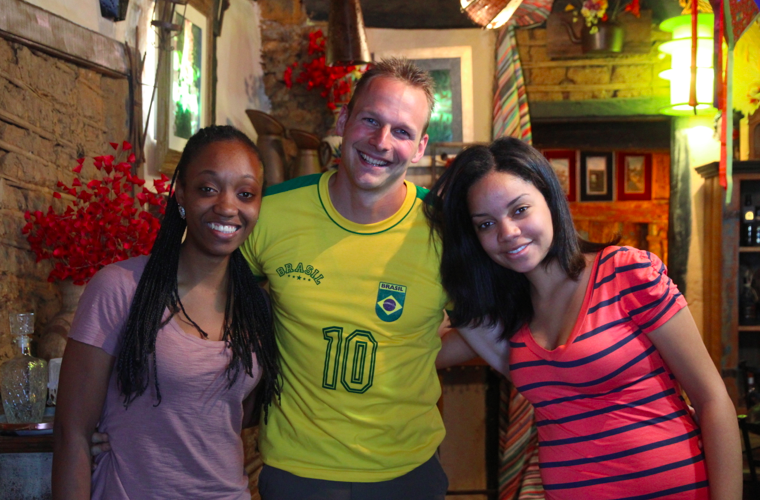
Sheila, Mario and Bruna—all smiles at Aleijadinho’s House
During our first full day in Ouro Preto, super sleuth Mario managed to track down the home of Aleijadinho, Brazilian sculptor extraordinaire. Actually we think Mario stumbled upon it by chance—perhaps drawn there by the two pretty young women who live in the house and run the accompanying souvenir shop.
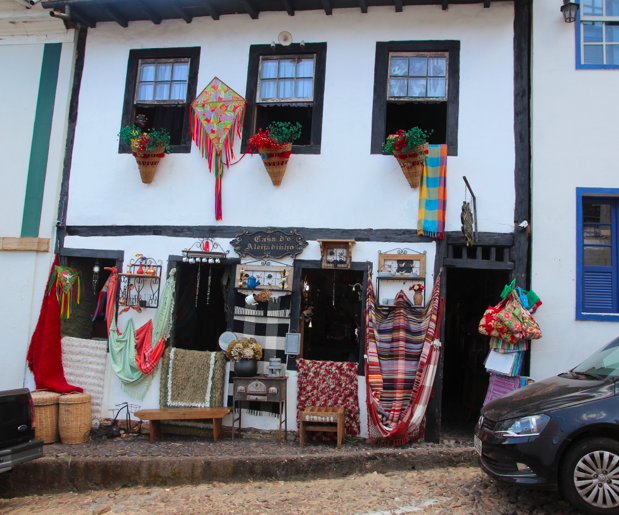
Aleijadinho’s House
Mario was so taken with the house (and those feminine smiles) that he found his way there the next day with Poor John and me in tow.
What a terrific find. Sheila and Bruna were delighted to see us and, of course, Mario, and gave us a tour of the ground floor and upstairs.
We understood about a quarter of their explanations regarding the structure and furniture (a lot of both is original). Sheila and Bruna speak only Portuguese. Mario speaks several languages and his Italian seemed to be an adequate ‘bridge’. He says he caught every third word. Poor John and I caught about every eighth, so you figure it out.
We were good tourists, but poor customers. We oohed and aahed in all the right places, and enjoyed a swig of cachaça (sugar cane liqueur), but we didn’t buy anything.
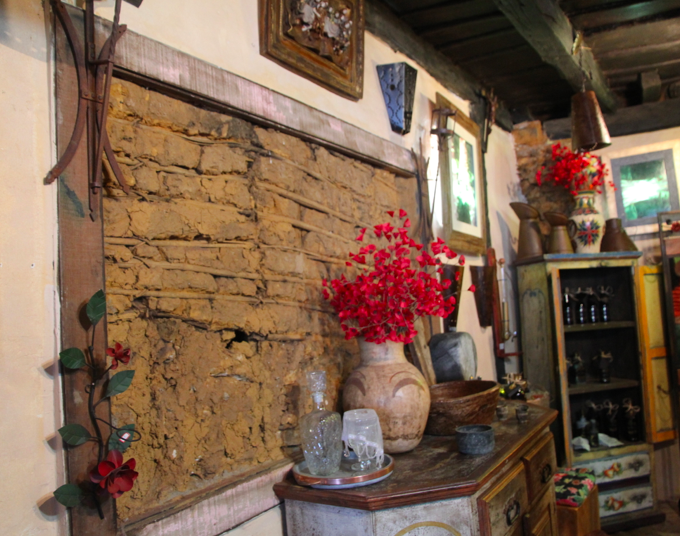
A section of original wall
That was okay. Ever the gentleman, Mario bought some chocolate later that afternoon and took it back as a gift. He says that in return he got the biggest, broadest, most beautiful smiles he’s ever seen.
A bit more about Aleijadinho
Born in Ouro Preto 1730 or 1738, Aleijadinho was originally called Antônio Francisco Lisboa. His father was a Portuguese carpenter (later elevated to an architect) and his mother was an African slave.
Aleijadinho worked as a day labourer on a church his father designed, and was soon working as an architect himself. He designed and built the Chapel of the Third Order of St Francis of Assisi in Ouro Preto, and also did the carvings for the building.
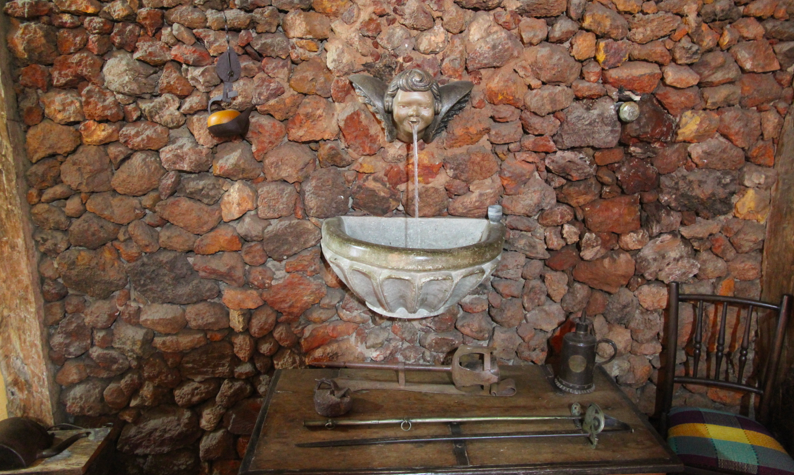
A water feature on a stone wall
In the late 1770s, he began to show signs of a disfiguring disease (probably leprosy) and ultimately lost his fingers and feet. But he continued sculpting with a chisel and hammer tied to what remained of his hands.
The 12 prophet sculptures at Congonhas are considered his finest work.
Note: there is a theory that Aleijadinho never existed , but I’m no historian so will let you make your own investigation if you’re interested.
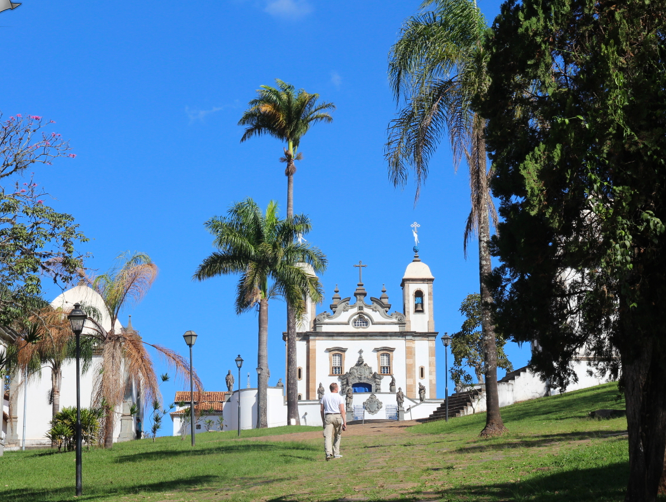
Mario in front of the Jesus, The Good Lord of Matosinhos Basilica, a UNESCO World Heritage Site
I love it when we make a new and unexpected discovery.
A couple of days after we headed northwest out of Rio, we arrived at Congonhas, a historic city in the state of Minas Gerais and home to Brazil’s most treasured works of art.
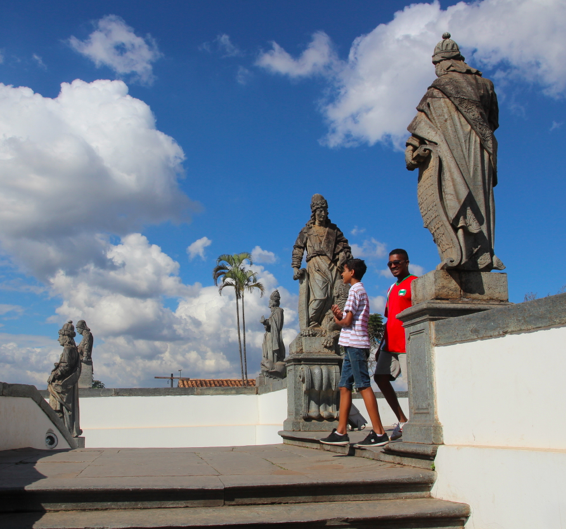
Sculptures at the Jesus, The Good Lord of Matosinhos Basilica
Before we were on the way, I hadn’t heard of Congonhas, its soapstone sculptures or their creator, Aleijadinho, who is considered one of the world’s best artists in the baroque style.
The sculptures, produced between 1800 and 1805, depict 12 Old Testament prophets. Six stand for good and six for evil. Their names are Jeremy, Baruc, Ezequiel, Daniel, Oseas, Joel, Abdias, Amos, Jonas, Habacuc, Nahun and Isaias.
All 12 are arranged in front of the Jesus, The Good Lord of Matosinhos Basilica, a UNESCO World Heritage Site.
A wealthy businessman, Feliciano Mendes, built the church to fulfill a vow he made when his prayers were answered and he recovered from a serious illness. He lavished on a bit more and commissioned sculptures.
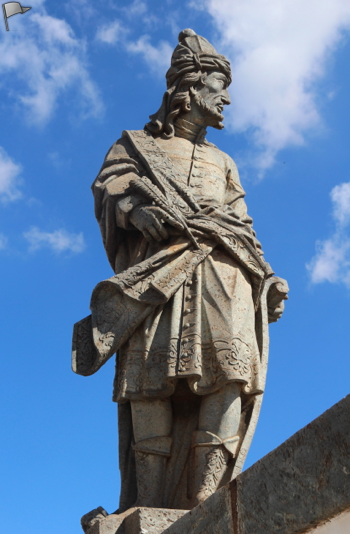
Soapstone scultpure
Aleijadinho, which means ‘The Little Cripple’, didn’t fare as well on the health front. He was in his 40s when he suffered a debilitating disease (probably leprosy) and lost his all fingers and both feet.
But that didn’t stop him from having a chisel and hammer tied to what was left of his his hands so he could continue creating art. The prophets were later works—started almost 23 years after he was first afflicted.
In the four years prior to sculpting the prophets, Aleijadinho carved life-size cedar figures for the basilica. These are housed in six pavilions that line the grassed courtyard that stretches below the basilica. Each pavilion shows a scene from the Passion of Christ, beginning with the Last Supper and ending with the Crucifixion.
Aleijadinho carved the main figures: Christ, James, John, the Good and Bad Thieves, Mary Magdalene and Mary, mother of Jesus. Assistants carved the Roman soldiers, onlookers and lesser figures. There are 64 figures in all (a second source says 66, but I’ll believe the brochure produced by the town). One of the onlookers at the crucifixion is thought to be a portrait (or self-portrait) of Aleijadinho, but I have no idea which one.
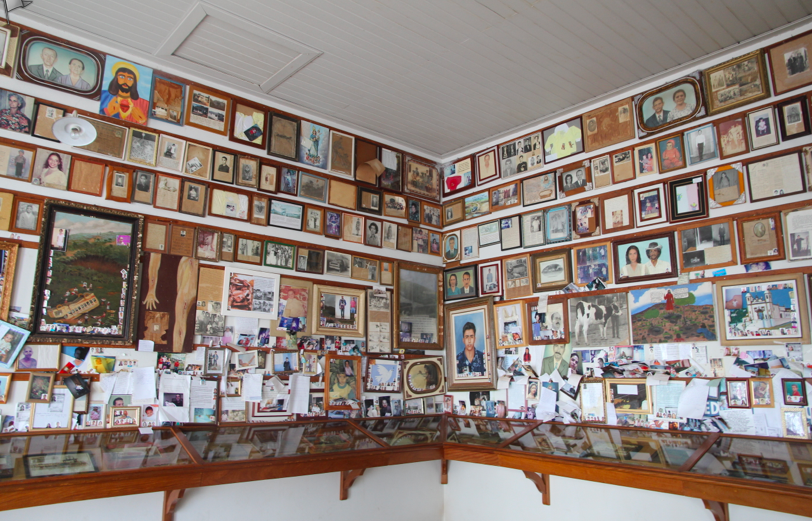
One corner of the Miracle Room with hundreds of old and contemporary images
All the figures were painted by Master Master Athayde and Francisco Xavier Carneeiro.
We also found the Miracle Room near the entrance to basilica. It has 89 votive paintings produced by genuine artists. They are considered precious and historical documents that illustrate daily life in the 18th and 19th centuries. We were surprised to see many added drawings and photographs that seem to represent people who died (or who have been saved) from various mishaps and disasters. There are bullfights, bus crashes, illnesses and more.
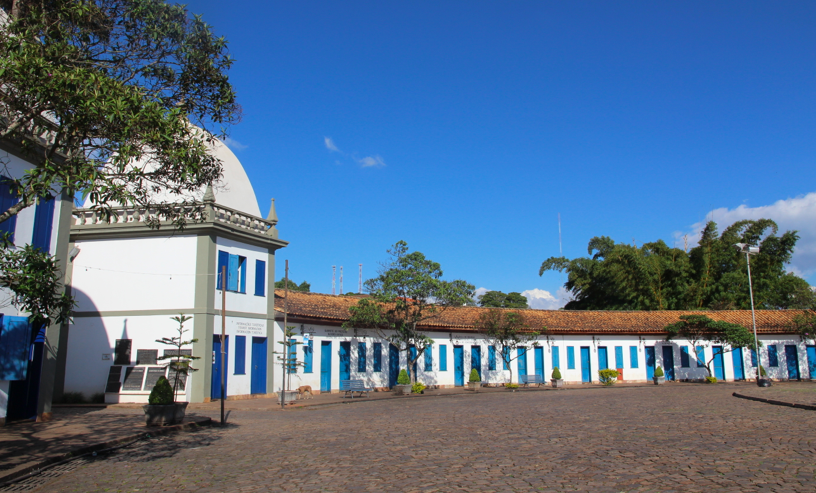
Romaria, once accommodation for pilgrims
The Romaria lies farther down the hill—beyond the basilica’s grounds. Built in 1932, it was a lodging house for pilgrims who came to Congonhas every September for the week-long Jubilee of Jesus, the Good Lord of Matosinhos.
Some of the Romaria was knocked down 40 years ago to make way for a hotel that has never been built. Instead, the Romaria was rebuilt in 1995 and is now a cultural venue for shows and events. It also has small museums displaying sacred art and mineralogy.
A few days later we arrived at Ouro Preto, where we had the chance to tour the house where Aleijadinho lived much of his life.
 Where to next?