
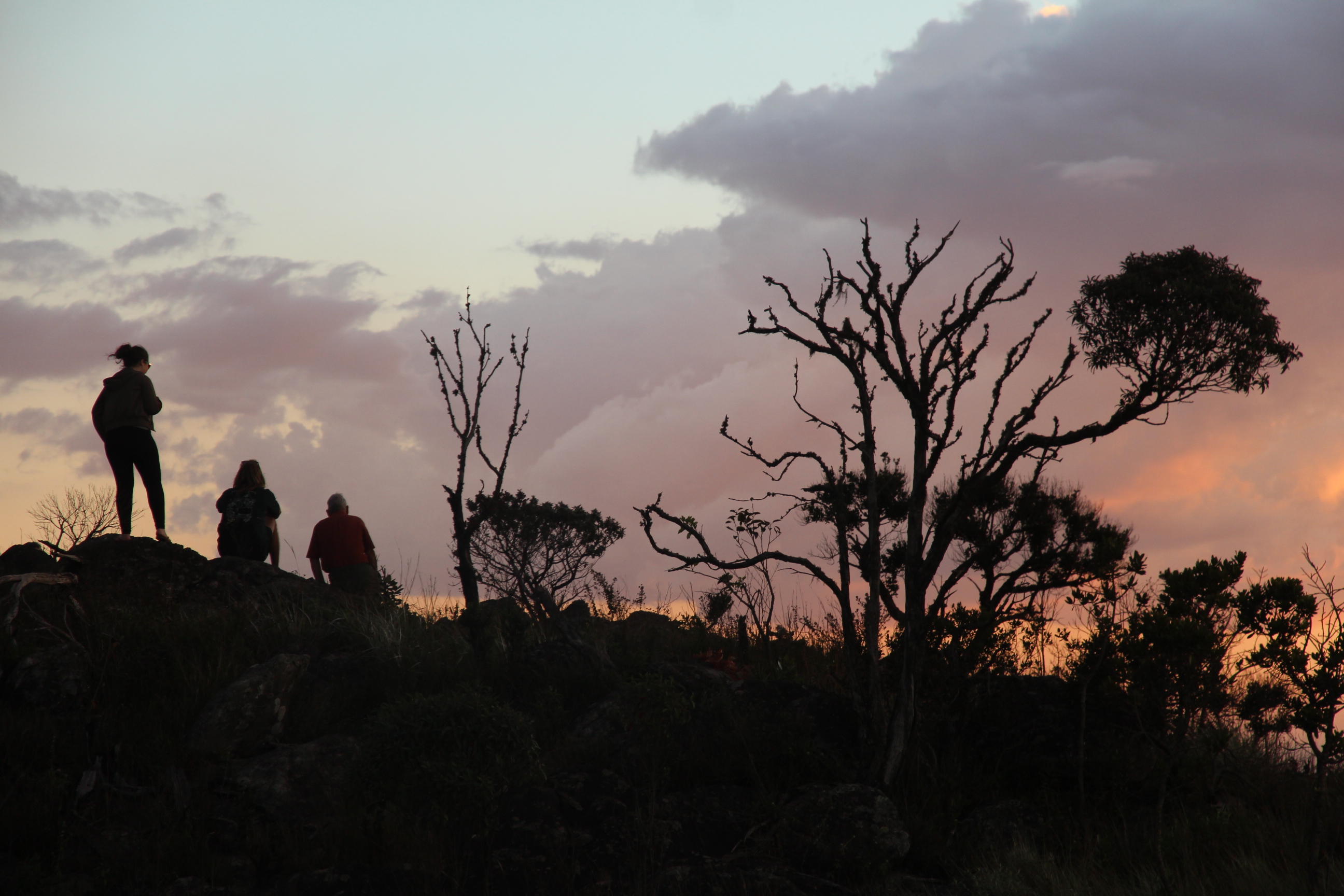
Sunset in Brazil
When we left Congonhas about 3 in the afternoon, we were heading for our first real bush camp of this overland expedition.
This exploratory adventure—meaning the very first time Oasis has taken this route—is a journey into the unknown, so the itinerary is subject to change.
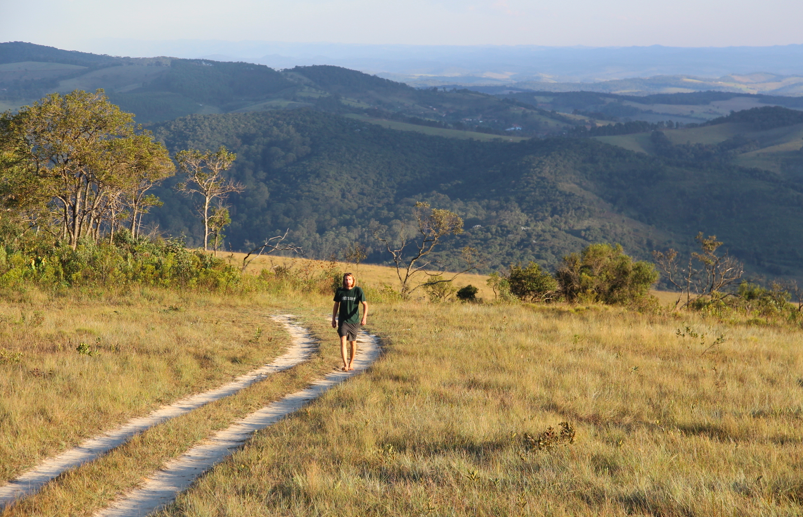
Colin checks out a track that goes nowhere
On this day, Danny, our tour leader, warned us that our search for a campsite might mean some wrong turns and back tracking. What he didn’t say was that Colin, our driver, had already spent the previous afternoon on Google Earth, trying to pinpoint a perfect spot.
He outdid himself.
Colin and Sponge Bob took us high—about 1350 metres—into a Brazilian national park, overlooking a vast valley and the city of Ouro Branco and surrounds. We were ‘sitting’ on the Serra do Ouro Branco, part of the escarpment that runs along the east coast of Brazil.
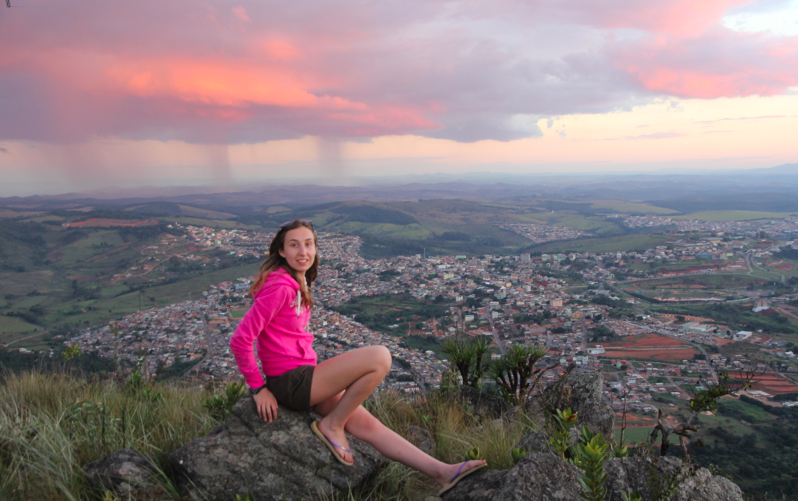
Alex with Ouro Branco in the right distance
Colin found a level spot to park the truck and lots of room for us to spread out the camp kitchen and our tents. Poor John and I picked a spot in long, soft grass.
Because we arrived well before sunset, there was plenty of time to walk up to a great viewing point. We noticed scattered showers were off to the left, and were glad they stayed there.
Cook group did a great job too, making a gigantic sausage and veggie stew that gave us copious amounts of leftovers for breakfast. This suited me perfectly. I love dinner for breakfast. I also love wearing shorts, and this was the first morning since starting this leg of the trip that it was warm enough to start the day in shorts.
As an aside, I got up for sunrise but it was a disappointment. Otherwise, this bush camp was the best-ever in South America and, remember, I’ve been to this continent before. Thanks Colin, Thanks Google Earth.
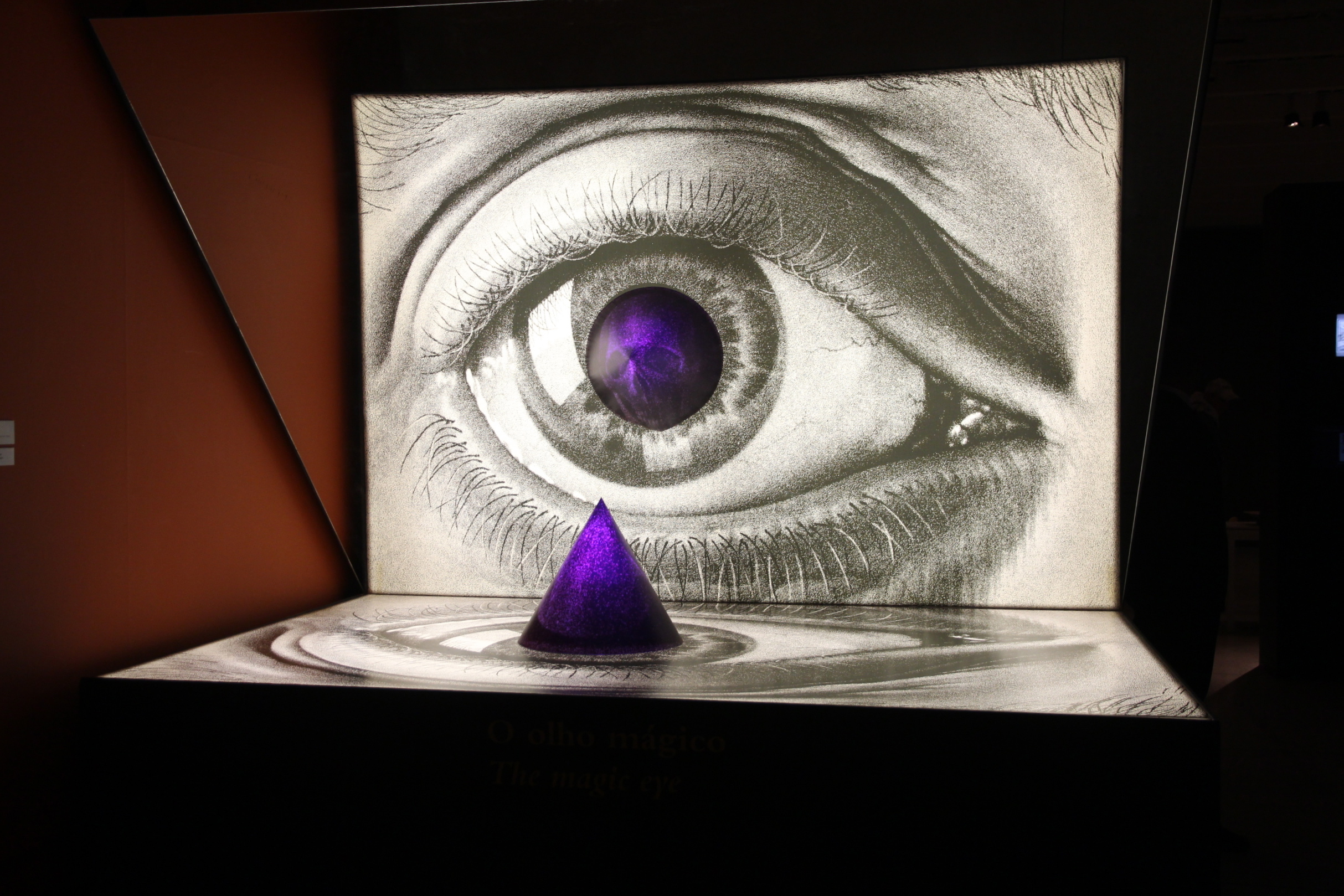
The vertical image is a reflection from the horizontal surface
Imagine two greats in the world of art and architecture under one roof!
That’s exactly what’s on show at the Museu Oscar Niemeyer in Curitiba, Brazil.
It all starts with the museum/gallery itself. This magnificent eye-shaped building was designed by Niemeyer, who also designed Brasilia, the nation’s purpose-built capital. He completed the project when he was 95 years old.
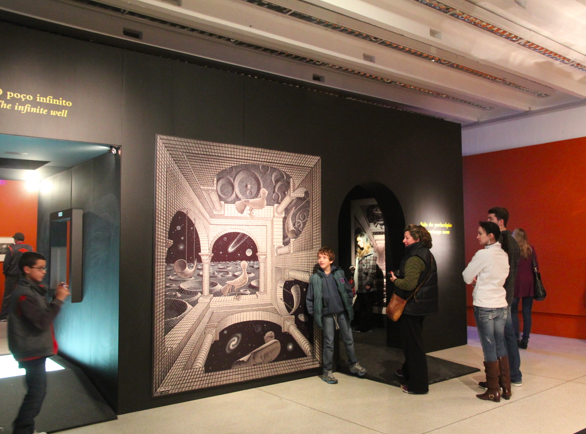
The crowd admires an enlarged image
This year, the museum/gallery is hosting a huge exhibit of works by MC Escher.
Escher, who was born in the Netherlands, is one of the world’s most famous graphic artists. He is best known for his woodcuts, lithographs and mezzotints, as well as his fascination for creating impossible structures that explored infinity, architecture and tessellations.
His work was heavily influenced by the art and architecture of Italy and Spain where he first travelled in 1929.
The experience was life-changing. He was impressed by the Italian countryside and captured the landscape in many of his artworks.
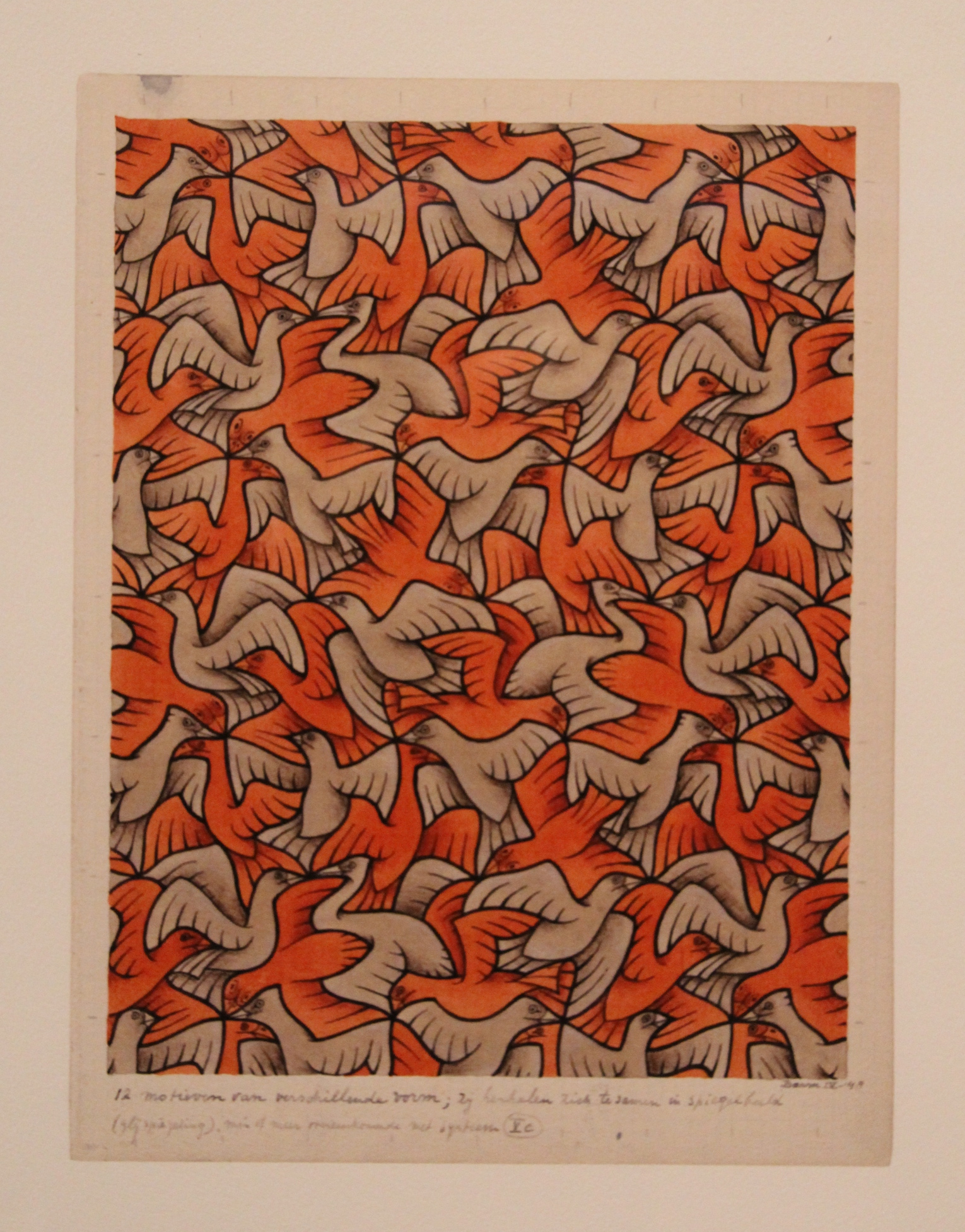
Twelve birds, 1948, a tessellated image
Alhambra, the 14th century Moorish castle in Granada, Spain also inspired him. The intricate decorative designs at Alhambra, which are based on mathematical formulas and feature interlocking repetitive patterns sculpted into the walls and ceilings, were a powerful influence. In fact, he was so taken by Alhambra that he copied almost all the tile designs there.
In his lifetime, Escher made almost 450 lithographs, woodcuts and wood engravings, and more than 2000 drawings and sketches.
The exhibit in Curitiba shows a good cross section of his work, and I could have shared 10–15 more photos here, but I showed a little restraint.
As we went through I couldn’t help but think how much both Escher and Niemeyer would approve of this collaboration.
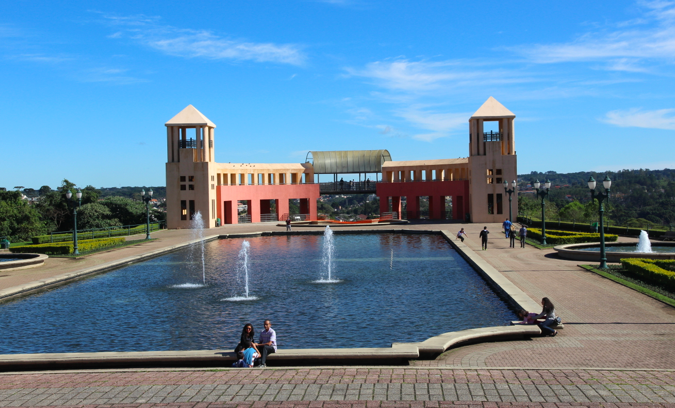
Tanguá Park—one of Curitiba’s showpieces
Poor John and I have just had an amazing few days in Curitiba, the capital and largest city of the Brazilian state of Paraná. We had a couple of reasons for making this side trip before we started our next overland adventure.
Top of the list was to visit Eduardo who’d been an exchange student in Australia in 2004. Eduardo spent a lot of time at our house and we’d heard great tales of his beloved Curitiba.
So when we had a spare week before our main trip started, we decided we had to check out Curitiba—one of seven places on the list of Cities for people—towards the sustainable city.
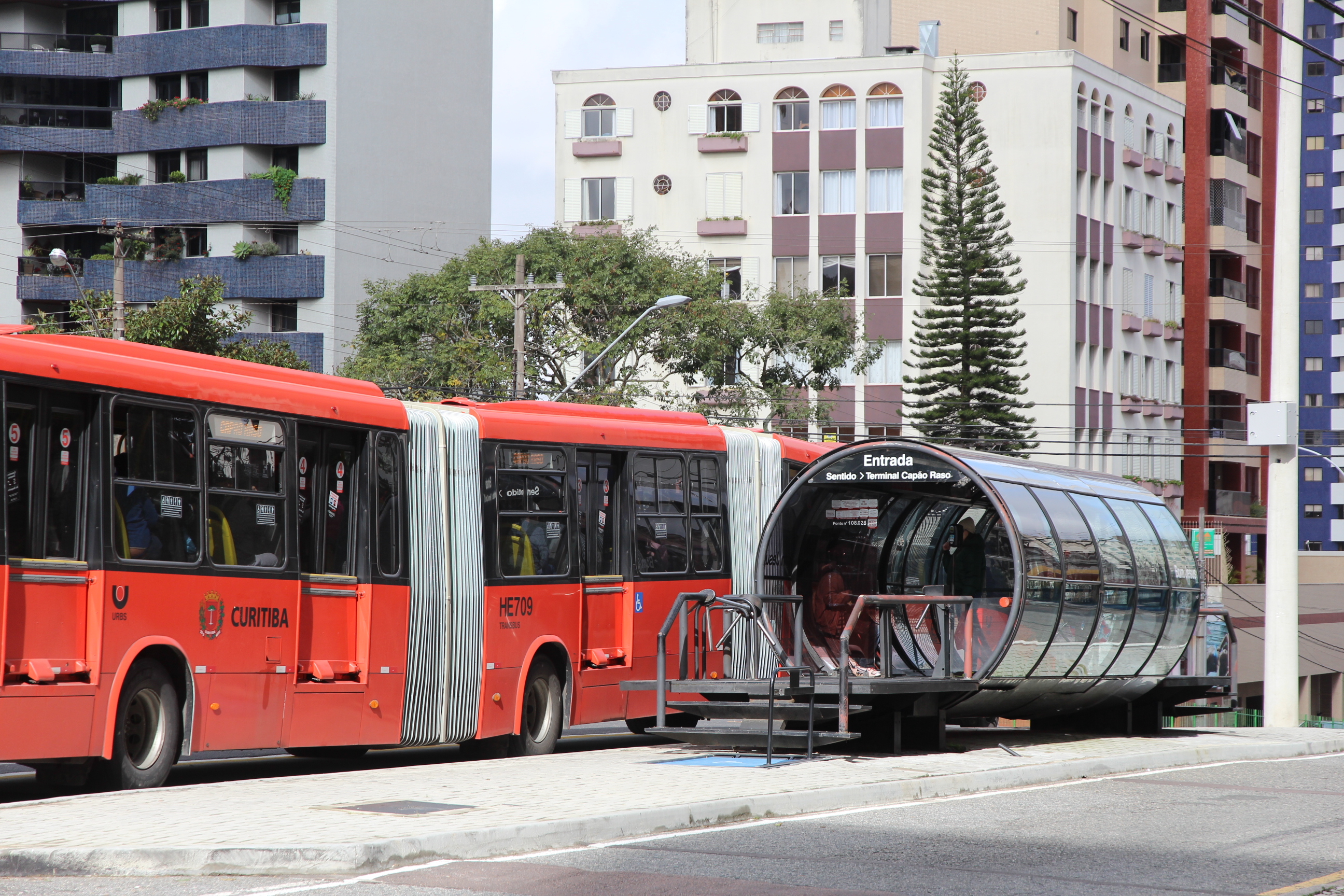
Part of Curitiba’s rapid transit bus system. Although you can’t see it, there is a lift for wheelchairs
Decades ago, Curitiba had a forward-thinking mayor, Jaime Lerner, who really was ahead of his time and took his city on a life-changing journey. For starters, Lerner, who is also an architect and urban planner, recognised the problems created by cars, poverty and environmental waste.
So while other cities built roads for cars and sold parkland for housing, Lerner went about building a city for people, bicycles and buses. He even invented a rapid transit bus system that we’ve seen copied (and ridden) in other large cities in South America and Indonesia. The bus system is so good that while the population has tripled in the last 20 years, car traffic has decreased by 30 per cent.
Lerner also was increased the amount of parkland. While this provides beautiful green settings, it serves the greater role of helping to control floodwaters—much classier than the concrete canals so common in other cities.

A capybara (capivara in Portuguese) admires the view at a swollen lagoon in Tingui Park
Recycling was another big push. Lerner had the wisdom to shape a massive recycling program that had children highly involved. He also gave citizens bus tokens in exchange for waste. Today Curitiba has the highest recycling rate in the world.
And one last statistic especially tickled me—99 per cent of the city’s inhabitants want to live in Curitiba. So do 70 per cent of the people who live in São Paulo.
If you have time, check out Lerner’s Ted Talk about Curitiba. Even better—if you ever find yourself in the neighbourhood, make time to visit Curitiba.

Protesters near the Central Metro station.
I didn’t expect to be back on the protest trail during my holiday in South America, but you can’t let a worthy march go by without getting involved.
We’re staying with a former exchange student, and she and her mum were keen to be part of the history this march would represent. So off we went.
Protests began earlier this month in Brazil when bus fares were increased by 20 centavos (about 7 euro cents). Officials promptly lowered fares in response but, across the nation, the public’s voice has grown louder and louder with overall criticism against the power of the government.
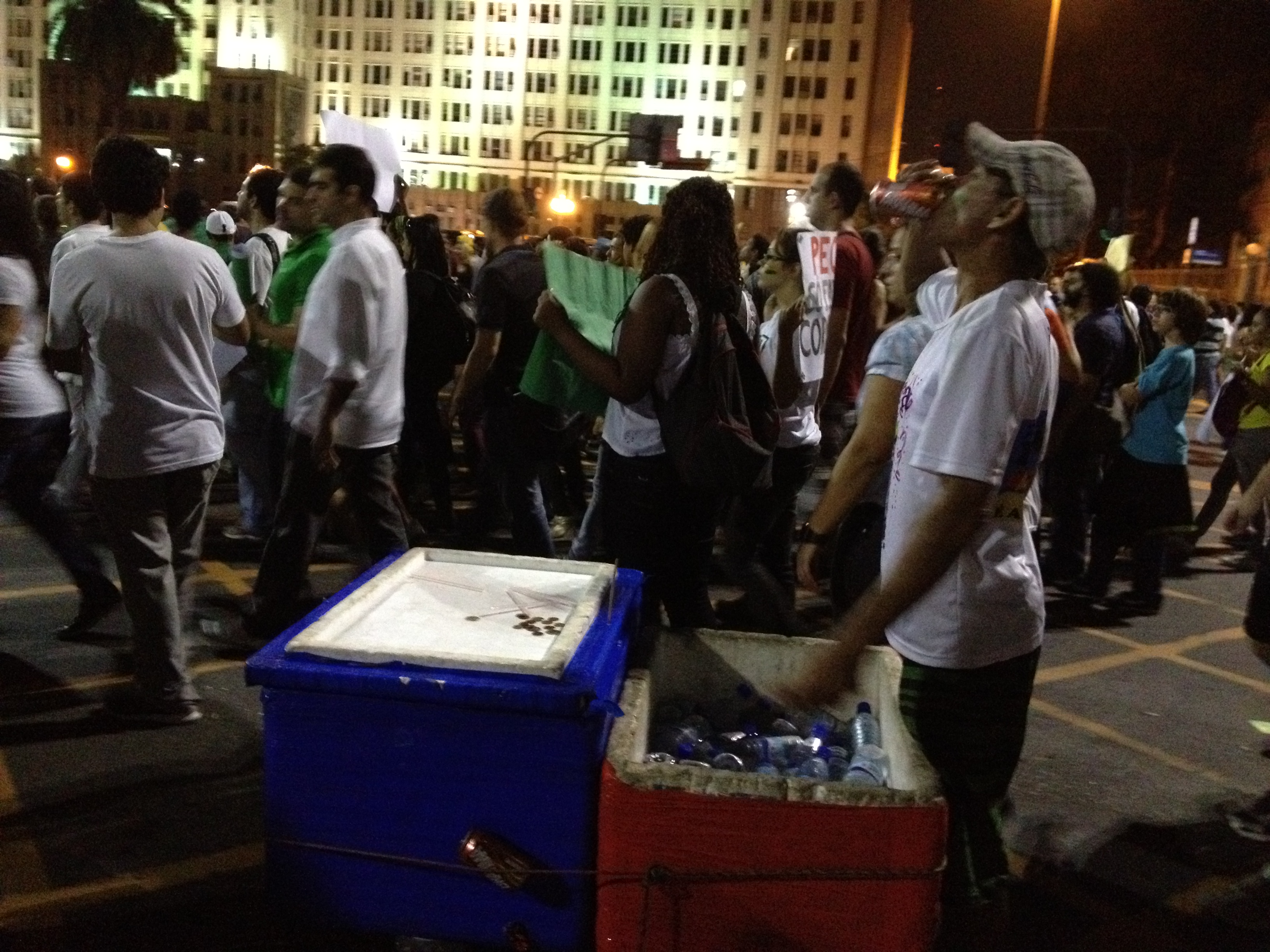
Protests make for good business if you’re in the food-and-drink business
The list of complaints is long—some say it is so diverse that the message is diluted—but stems from dissatisfaction with the way money is being spent.
Placards in Rio on Thursday night called for less government corruption, and a withdrawal from hosting the World Cup and the Olympics, so money could be spent on improving education and health care.
Elections are coming in 2014 and one placard, which I wasn’t quick enough to photograph, suggested voting for Ali Baba because, ‘he only has 40 thieves’.
We joined the Rio march about 6pm near the Cinelândia Metro station and then walked for almost two hours with noisy, but peaceful throngs. Crowd estimates range from 240,000 to 2 million. There was plenty of flag waving, chanting, singing and clapping, but no violence or vandalism.

Plenty of Brazilian flags on display
Apparently that came later. We’ve heard that not long after we headed home, a car was set on fire and military police responded with tear gas and a strong arm. Metro stations were closed too. So we were lucky not to have a very long walk back to the flat.
Protests in some other parts of the country were more violent and more destructive.
Everything is quiet today in Rio. I’ll keep you posted. I promised our daughters that I wouldn’t do anything that got me arrested.
Update
We saw very disturbing footage on TV the night after this march. No wonder the officials had to move in with force. The destructive and malicious rampage was carried out by a few. Smashing windows, looting, overturning vehicles. But it was all just for the hell of it—a chance to be a destructive mob. I mean, if you’ve got an issue with transport services, why would you think a solution would be to break all the windows on a bus.
Memories of a much calmer protest
Going along to the march reminded me of a neighbourhood protest in 2000. Ruth promised her husband (who was going to be out of town) that she would organise something to express dissatisfaction with the local government’s plan to have a noisy and prolonged car race in the central part of Canberra.
She notified the weekly newspaper and asked neighbours to participate. I think we were to turn up about 10am on a Friday.
There wasn’t an overwhelming response. Ruth was there, along with Marion from around the corner. I went and made our first exchange student, Jean-Mi, come too.
Somewhere in my filing cabinet is a clipping of the four of us, plus my dog, having our say. Jean-Mi said the caption should have introduced us as a band—Jean-Mi and the Protesters.
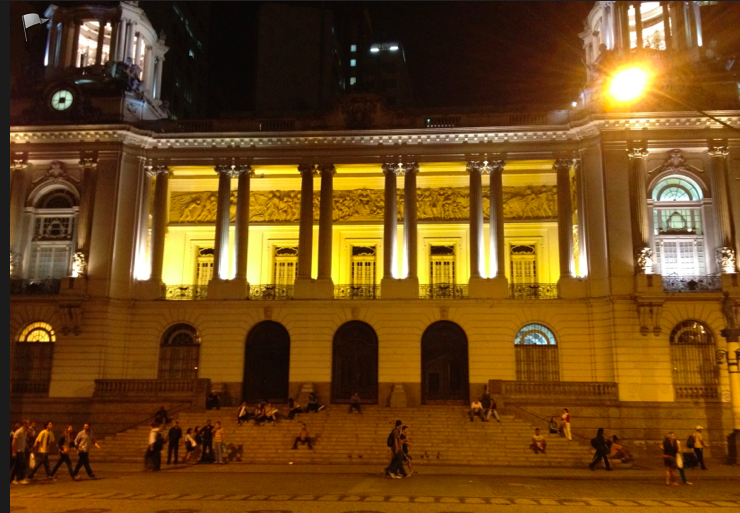
Where we joined the protest
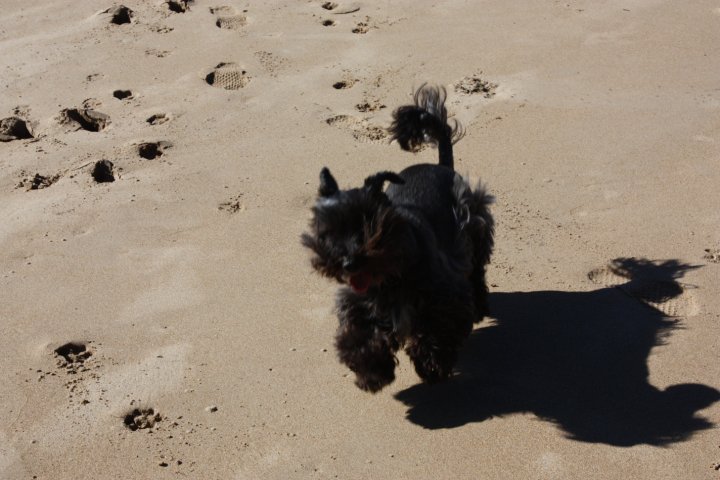
Chiyo at Rosedale Beach
It came out of the blue and ended in floods of tears.
Sunday Chiyo was galloping across the school oval chasing birds and Arj, a Portguese water dog we were minding. Monday he was at the vet’s fighting for his life. And the little devil lost that battle.
That’s two dogs in less than two years. Aggie—Agador Spartacus—went in November 2011.

Aggie squished into Chiyo’s bed
No, we aren’t bad pet parents. On the contrary, we’ve had many dogs make it to 15 and a cat who made it to 20.
They get long walks, trips to the beach and homemade food—I’ve cooked for them for ages—but that doesn’t keep them from conking out in their twilight years.
Chiyo came to us as a rescue dog in November 2003. Barney, the boxer cross, had died the previous month, at age 15. He’d been a lot of company for Poor John’s Aunt Esther who lived with us. In his late arthritic years, he especially loved the fact her floor was heated.
Aggie, who’d come to us as another rescue dog in 2002, was certainly no companion dog for a 93-year-old woman, so Esther started hinting for a replacement Barney.

Chiyo came for a ‘test drive’ and conquered. While he never entirely got over leaving the odd piddle inside, he made up for it by being cute in trumps. He loved cuddles and Esther’s lap. After she went into demented aged care in 2008, he loved anyone else’s lap. He honeyed up to all the exchange students and will be missed by people all over the world.
His laziness, enthusiasm, mischievous behaviour and attitude (and Esther’s failing memory) meant he answered to a lot of names—Dance Shoe, Devil Dog, the Black Prince, the Slug, Super Ted and Adventure Dog. He played it tough. He lunged at any dog (except his friends) within striking distance, but only when he was on the lead. He wasn’t afraid of thunder, lightning or fireworks. But drop a saucepan on the kitchen floor or clap your hands anywhere near him, and he skedaddled in seconds.
Chiyo and Aggie were great mates too. It was very much an annoying-little-brother and tolerant-big-brother relationship. Chiyo regularly pinched Aggie’s larger bed and made a great game of ‘dragging’ Aggie around by his lead.
Named after a sumo wrestler, Chiyo was suitably bow-legged and did his best to throw his solid 9 kilos around. His short legs didn’t stop him from walking 5–6 kilometres up and down Mount Ainslie or around Lake Burley Griffin with a Belgian bouvier, a golden retriever and a beagle. They walked, he trotted.
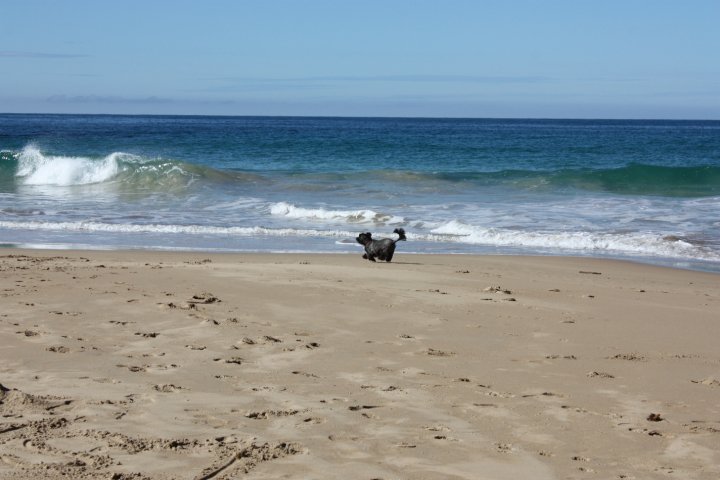
This sudden loss—the vet thinks a tumour may have ruptured in his lungs or heart—is going to create an enormous hole in our lives. Not so much for Poor John and me right now, because we’re off travelling again. But Graeme, who’s minded the animals and house in our absence, is especially going to miss that furry lump on the edge of the bed and the cold, wet nose used as an alarm clock.
He had a great way of convincing you to bring him up on the bed in the morning. He’d jiggle the mattress until you woke up.He was pretty good on night duty too. A couple of days ago and in the middle of the night, Arj decided he could no longer fit through the dog door. He barked and whimpered outside, but neither Poor John nor I woke up. So Chiyo got out of his bed and barked at us until we responded. At which time, he put himself back to bed.
Chiyo’s been buried in the backyard and Aggie’s ashes have finally been scattered with him. The two buddies are together—romping on the other side of the Rainbow Bridge.
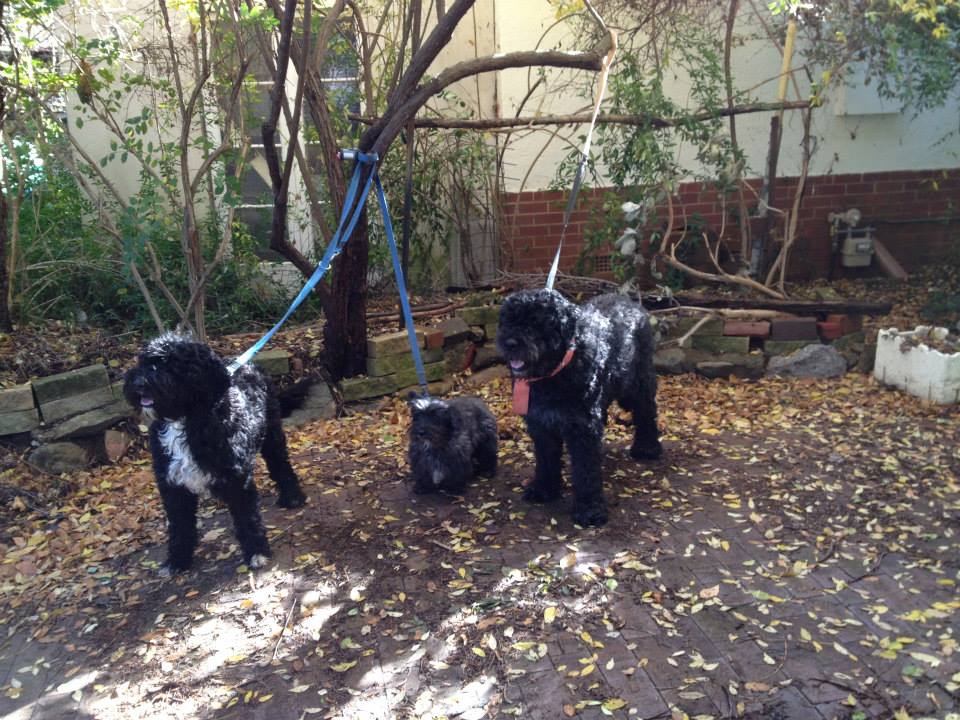
Arj, Chiyo and Big Louie—weighing between 9 and 45 kilos.
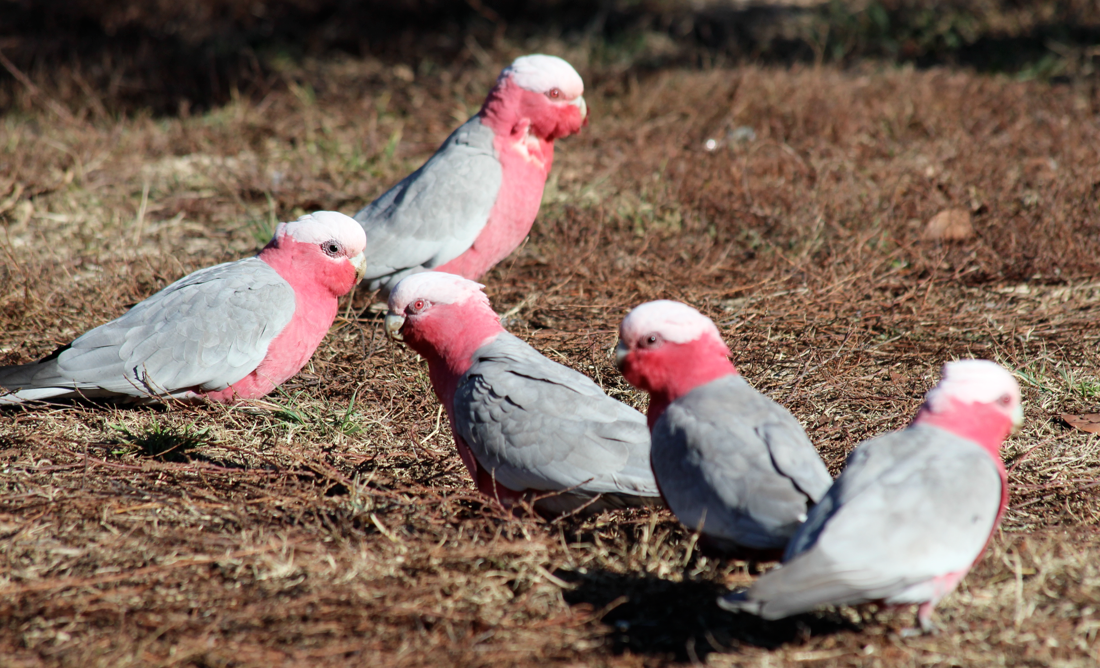
Galahs in Commonwealth Park
When we’re at home in Canberra, it’s fairly common for us to have an extra dog or two underfoot. Dog-owning friends travel a lot (just like us), our yard is fully fenced, all the dogs get along, my homemade dog food recipe is very popular and we are quite happy to do walkies.
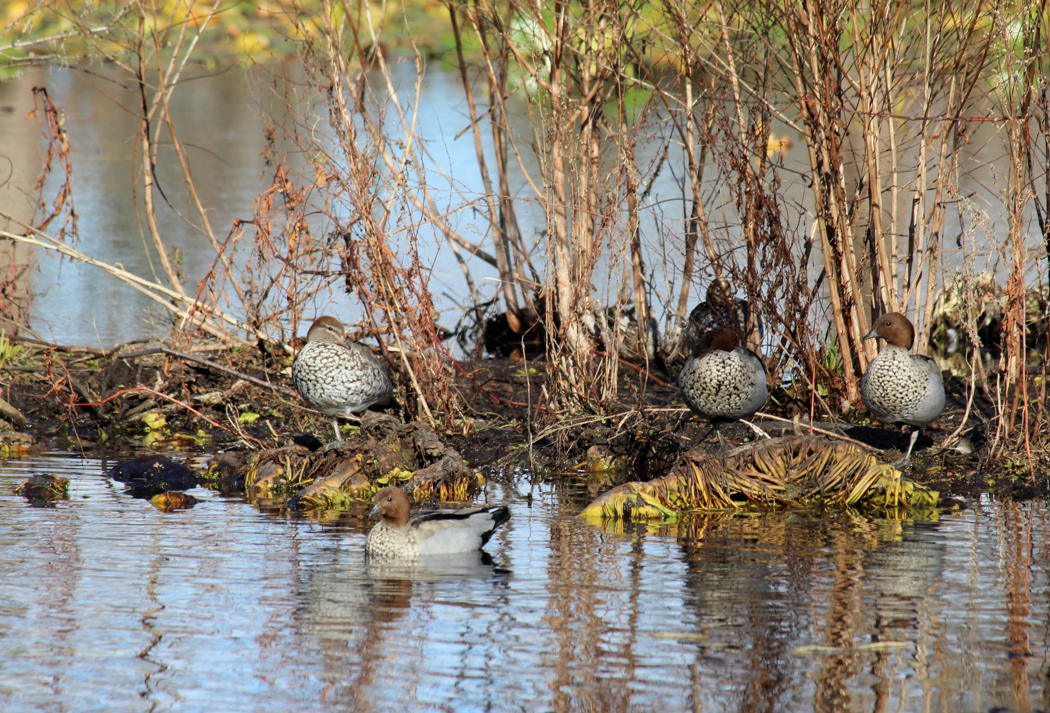
Ducks
Arj is our guest this week. He’s a Portuguese waterdog (something we have in common with President Obama) and only slightly smaller than a Volkswagen.
So walkies (or draggies) are essential. Today’s excursion was on the shores of Lake Burley Griffin. We didn’t do the whole 5-kilometre circuit—mostly because it was late afternoon and I wanted to see what birds I could snap.
Poor John clung to Arj. I escorted Chiyo, who looks a lot like a large mop head, and had a camera (complete with telephoto lens) slung around my neck.
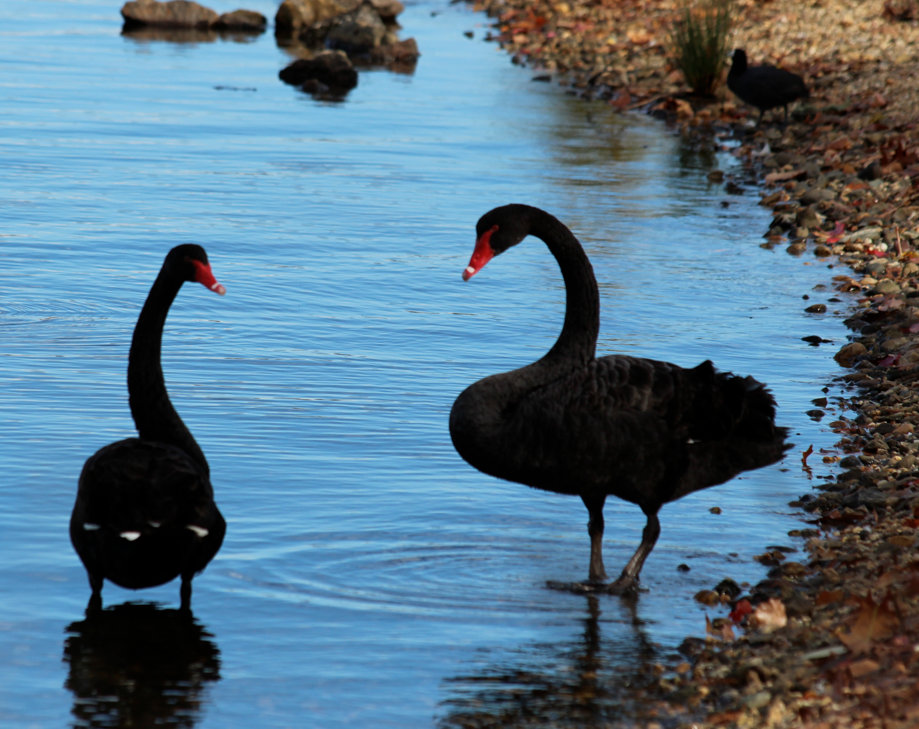
A swan couple. They almost always travel in pairs.
And here’s what we saw, in no particular order.
The lake and its surrounds are home to a variety of ducks. It’s not unusual to see traffic stopped on Constitution Avenue while a mother and her ducklings cross the road. A few years back, we had a troupe march by our house (we’re no more than five blocks from the lake). The next morning, the local newspaper had a front-page pic showing a youngster shepherding that flock back to the lake. Today there were Wood Ducks and Pacific Black Ducks, and a third species I didn’t recognise.
Canberra teems with sulphur-crested cockatoos. When I first came to Australia, I fed them in our backyard, until Poor John banned me from doing so. They have an ear-piercing, raucous squawk that must have irked the neighbours—and obviously irked Poor John. Cockatoos are partial to cooler weather and are especially common across the city in winter.
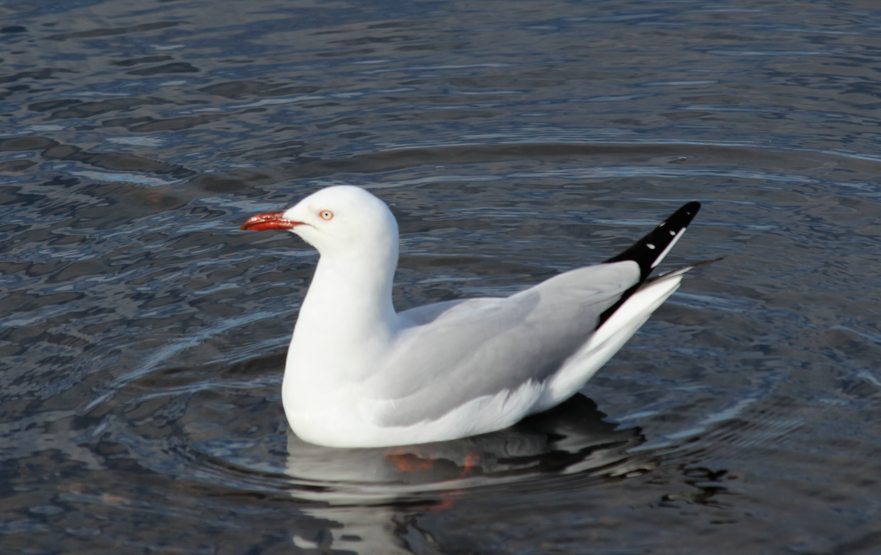
Silver gull
Seagulls appear everywhere in Australia, and are usually hoping to steal some of your food. They’re quite small compared to the gulls I’ve seen in other countries. Ours are called silver gulls.
Coots are at home on open water, but also come ashore to graze on areas where grass is short. Their white beak makes them fairly easy to identify.
The Australian darter looks a bit like a pale cormorant, which also visits the lake but we didn’t see any today. Because of its long slender neck, the darter is sometimes called a snakebird. It dives for food, using its beak to spear dinner. Small fish are swallowed under water, while larger ones are brought to the surface, flicked into the air and swallowed head first on the way down.
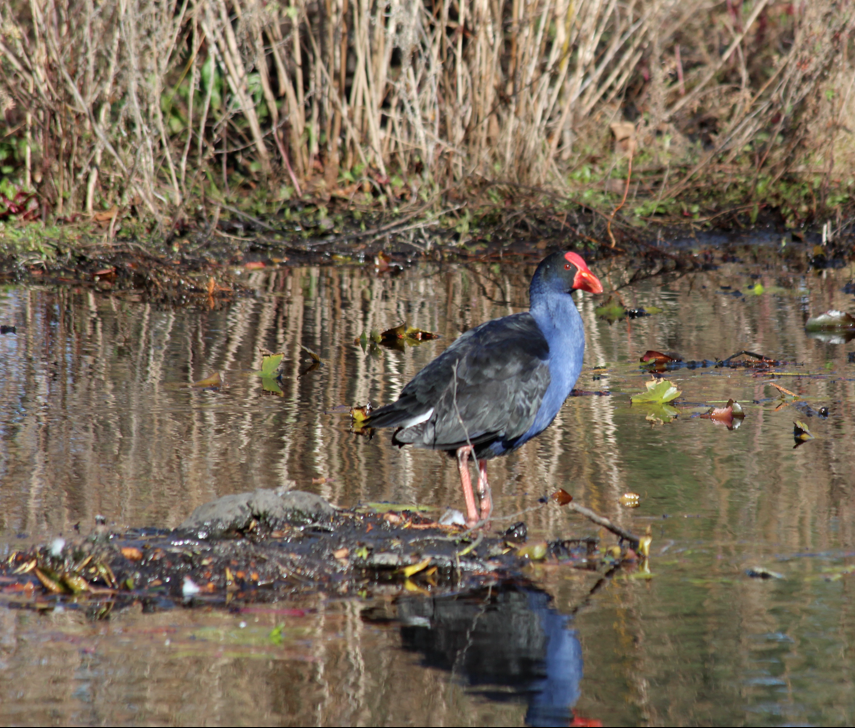
Purple swamphen
I love purple so it’s not surprising that I love Purple Swamphens. I see them all the time around the lake, but writing this blog entry finally made me to look up their name.
Now for the silly galahs. These pink and grey parrots are handsome—but not so smart—showstoppers. A goofy person is sometimes referred to as a ‘silly galah’—there’s even a song about silly galahs. I’ve seen them (the birds, not the people) stand by the edge of the road and get mowed down by a semi.
And lastly, the black swans. Yes, Australia’s swans are black. This is the sunburnt country and we can’t afford to have Western Australia’s state bird get sunburnt.
As for my reference to an hour? I took all these pics in an hour.
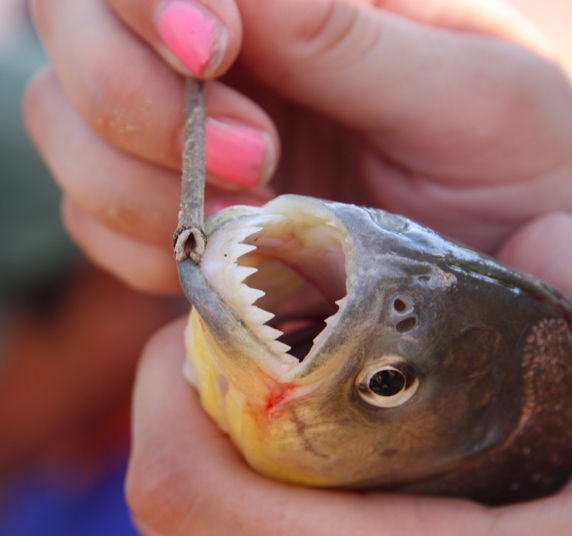
Look at those choppers!
Piranhas ‘are the most ferocious fish in the world. Even the most formidable fish, the sharks or the barracudas, usually attack things smaller than themselves. But the piranhas habitually attack things much larger than themselves. They will snap a finger off a hand incautiously trailed in the water; they mutilate swimmers—in every river town in Paraguay there are men who have been thus mutilated; they will rend and devour alive any wounded man or beast; for blood in the water excites them to madness. They will tear wounded wild fowl to pieces; and bite off the tails of big fish as they grow exhausted when fighting after being hooked.’
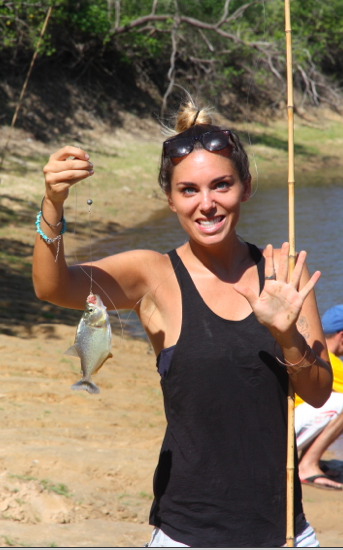
Rael on her fifth
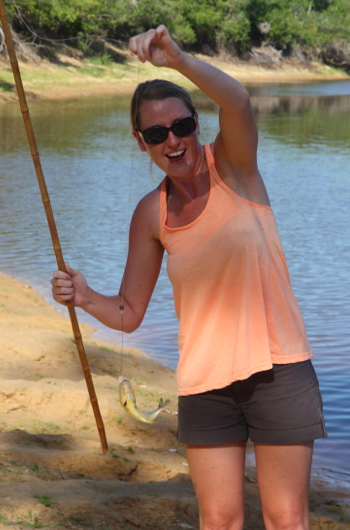
Julia catches her first
That’s what US President Theodore Roosevelt wrote in his book Through the Brazilian Wilderness. He’d been in Brazil on a hunting expedition in 1913 and witnessed a shocking spectacle. Local fisherman had blocked off part of the Amazon River and starved the imprisoned piranhas for several days before Teddy arrived. They then pushed a cow into the water, where it was instantly torn apart by the hungry fish.
In reality, piranhas aren’t quite so scary. Usually they are 14 to 26 cm long (5.5–10.25 in), although some have been reported to be up to 43 cm (17 in). Their teeth are razor sharp and they do love meat. Deaths occur every now and then, but victims are likely to be children or a drunk who has fallen into the water. They sometimes bite swimmers, but such bites are usually viewed as an act of carelessness on the part of the swimmer.

A caiman comes to grab a piranha snack
Piranhas are found throughout Brazil in rivers, lakes and coastal areas. Oh, and you are quite likely to see them for sale in a local market. They’re good eaters—and good eating.
So why did I say the piranhas didn’t have a chance? It’s because we spent a morning piranha fishing and took 40 or 50 fish out of the system. It was a matter of dip in a line and pull out a fish.
It was a highlight activity during our Christmas stay at Pousada Santa Clara in the Pantanal. Our catch got cooked up for lunch. It’s a good thing there was plenty of other food, because our fishy victims were pretty small.
We’ll be back in the Pantanal in July as part of our next overland journey, and we’re hoping piranha fishing is on the to-do list.

Piranha fishing—sort of like a public service

A semi-aquatic capybara—the world’s largest rodent
In a couple of weeks, Poor John and I head back to South America on another Oasis Overland truck trip. There will be lots of new adventures and a few repeats. We’re especially excited about revisiting the Pantanal.
About six months of every year, the Pantanal is a vast alluvial plain—the rest of the time it’s a wetland. In the rainy season, which usually starts in November, up to 80 per cent of its huge area can be submerged. When I say huge, I mean ginormous. The Pantanal sprawls over an area estimated at up to 195,000 square kilometres (or 75,000 sq mi). Most people think it is confined to Brazil, but the Pantanal’s waters actually spread into Bolivia and Paraguay.

Houseboats in the Pantanal
Waters can rise 4 to 5 metres and are at their highest in January and February. Structures are built to help people ‘live’ with the floods. Bridges stand 4–5 metres above waterholes and creeks, buildings and walkways rest on tall stilts, and rivers are populated with houseboats.
The sheer size of this seasonal flooding means traditional farming is virtually impossible, but it’s perfect for creating rich feeding grounds that draw a diverse array of animals and birds. They, in turn, draw the tourists.
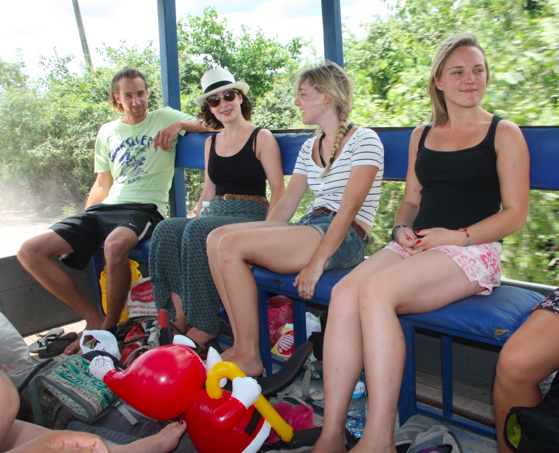
Catching a ride into the Pantanal
We visited last year as part of our overland expedition. We ‘abandoned’ our truck and headed about an hour into the Pantanal for Christmas. For a few days, home would be the family-owned Pousada Santa Clara. I have to say, it really was the perfect place for the holidays.
By rights it should have started raining in November, but it was still dry and parched, which meant we had plenty of opportunity to go horse riding, swimming, hiking and boating.
Because there were about 16 of us, we were divided into two groups and took turns at the various activities. Our first outing, on the afternoon we arrived, was boating on the river. Our Santa Clara guide drove us about 45 minutes up the road to where a boat could be launched. Water levels were extremely low, which meant we couldn’t cruise very close to the river banks, but we still saw plenty of wildlife—at a distance.

We’re hoping conditions will be near perfect when we are there again in July. That’s when bird-watching is supposed to be at it’s best and the chances of seeing a jaguar are improved.
Given that the weather and landscapes vary different between December and July, I plan to do blogs on both.
Here’s a look at some of the wildlife we saw last December. Sorry but I don’t know the names of all the birds. Tell me if you know, and I will add. I’m sure we’ll see them all again. The Pantanal is considered the best bird-watching destination in the world. I have a new telephoto lens—let me loose.
Stay tuned for entries on our Christmas-time ‘safaris’ (we rescued an anaconda), piranha fishing and the Santa Clara itself.

In my neighbourhood
Australia’s national capital turned 100 in March and she’s looking good. Part of her beauty lies in the wonderful plantings across the city—on suburban streets, in parks and private gardens, and around national buildings.
From the outset, Canberra was to be a garden city. To support that goal, the government opened its first plant nursery in 1911 on three acres of land in the suburb of Acton.
For the first couple of years, the nursery conducted trials to figure out what species of shrubs and trees would grow well in the region. In 1914, when it was time to start a larger operation, the nursery was moved to 70 acres in Yarralumla.
Everyone in town has benefited from these green-thumb efforts. To this day, there is a free plant issue scheme that is available to anyone who purchases a new block of residential land. In the early days, people got 40 trees and shrubs, but now the offer is for up to $220 worth of plants.
It’s estimated that Yarralumla Nursery has grown 50 million plants over the years. At present, it produces 400,000 plants a year. About 1100 species are propagated, with a fifty-fifty split between Australian natives and exotics.
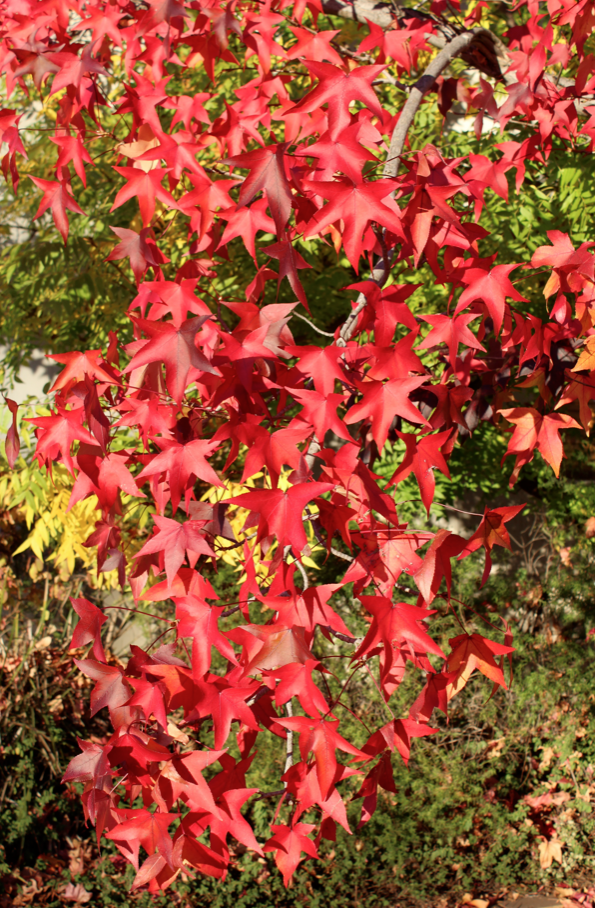
But I’m writing today because we’re at the tail end of autumn in Canberra and the colours have been fabulous. News reports say we’ve had the best display of colour in many years. I wonder if it’s because we’ve had so little rain in the last six months.
I took these pics about a week ago, but at least two weeks after the best displays. I’ll try to be on top of things next year and take pics at the very best time.
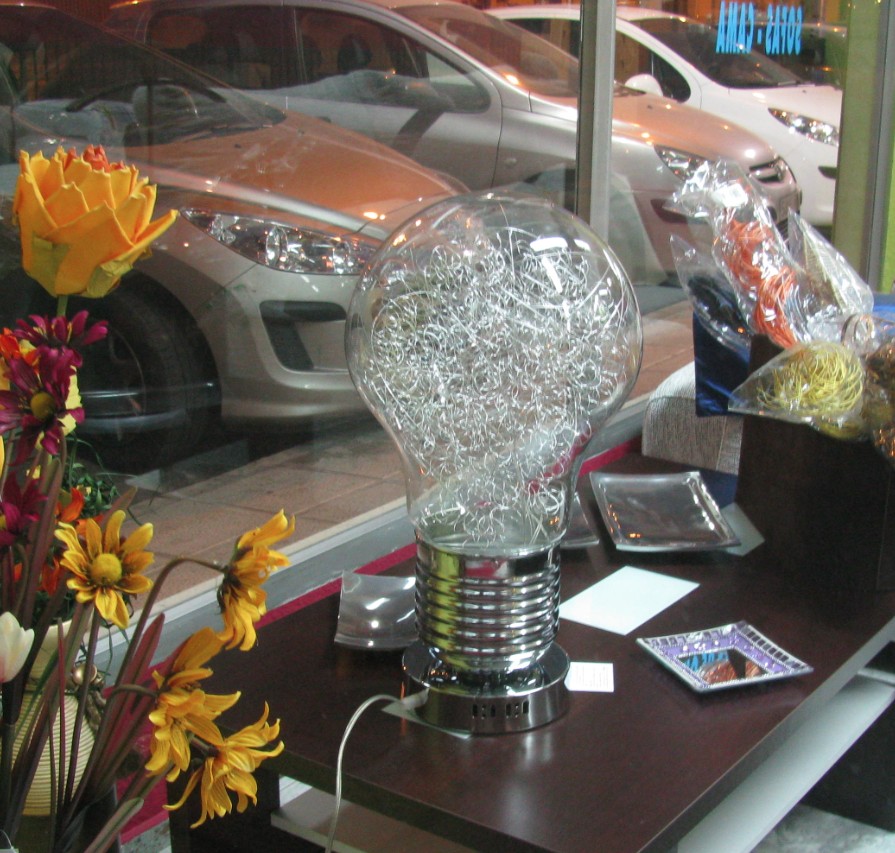
A light bulb surrounded by ashtrays in a furniture store in Spain
I ran into two old friends last night.
Ed was sitting in the restaurant. We greeted one another briefly and he pointed me toward the foyer, saying I would find Helen there. Sure enough, she was standing just outside the dining room holding two cups of yoghurt.
We exchanged a few words and then she asked me to move on because ‘the thugs behind me are going to take this yoghurt’. Beyond Helen were two Blues-Brothers types, wearing suits, ponytails and no sunglasses. They smirked.
And then I woke up!
Egads, why in the world would I dream about Helen and Ed? Yes, they were a very special couple to me, but both died many years ago. Ed had been my first editor, back in the days when I worked on a daily newspaper in Nebraska. Helen was his wife. I adored them, and they were very good to this then-young journalist.
But why was I dreaming about them? I reckon it had to do with a story Ed told me about their married life.
I’ll set the scene and share the story and you can decide if I’m right.
It’s the early 1970s. The community is about to celebrate its 125th anniversary and the newspaper, the Kearney Daily Hub, is compiling a special commemorative edition. I’m in the office on a Sunday afternoon, pasting up proof pages. The office had agreed that the journos should paste-up the layouts for this publication. It wasn’t our normal job, but the newspaper wasn’t a union shop and we knew the stories and were more likely to be able to juggle text sympathetically.
Ed and Helen strolled by and when they noticed I was there, they popped in to say hello. I stopped for a smoko—cigarettes in the office were still the norm—and Ed said, ‘Shall I tell you about when we quit smoking?’
Helen choked on a giggle and wandered away, shoulders juddering.
Ed proceeded to recount the many times they had tried to stop smoking. Helen would try and Ed wouldn’t, and vice versa. So finally Ed told her to pick a day and let him know, and he’d quit with her.
He arrived home after a long, trying day. It just so happened that Helen swooped on him with the makings of a ‘heated discussion’.
By the time Ed was relating the story to me, he could no longer remember the issue—just the way it all played out.
Helen was on the front foot, and the discussion went on and on. Ed groped in a kitchen cupboard for a pack of cigarettes, then a desk drawer, then to the bedroom—all the while trying to hold his own in the ‘discussion’.
Finally he broke. ‘Where are the $#@*?&# cigarettes?’
Helen leaned back, folded her arms and nonchalantly said, ‘Oh, I guess I forgot to tell you. We’ve quit!’ As Ed said, he lost the ‘discussion’ and had to quit smoking. And he had no regrets.
As for me? I stopped smoking seven years ago today. No regrets—just dreams about dear friends!
 Where to next?