
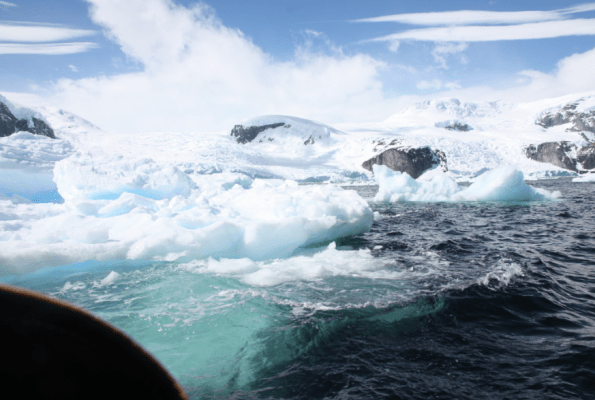
The aftermath of a mini-exploding iceberg. Note the small waves
Our third day of landings and Zodiac cruises in Antarctica began with Danco Island, off the southern end of the Errera Channel.
Danco is only a mile long, but it’s almost 600 feet high. The views are spectacular, and no one knows them better than the 1600 breeding pairs of Gentoo penguins who often prefer to nest high up the slopes.
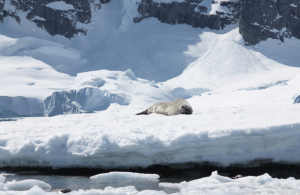
Weddell seal lounging on an iceberg
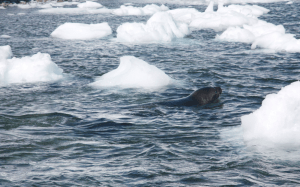
A gentleman comes to call
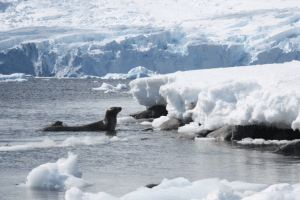
Not getting a response
As with Neko Harbour, we tramped to the top and were rewarded with expansive views of surrounding glaciers and rolled icebergs scattered across the channel.
Crew on the Ocean Diamond had a lot of praise for the British, who conducted geological research at Danco until 1959. In 2004, Britain removed all trace of Antarctic Survey Station O—a highly commendable act. Today only a location plaque remains.
But we were in for two treats with our Zodiac cruise. Soon after we set out, part of an iceberg exploded beside us. There was a loud bang and ice sprayed everywhere alongside. I wasn’t quick enough to get a pic of the blowout. Hey, no one was expecting it. But I did get a quick snap of the floating fallout and the small waves that were created.
Then came the seals. Solan, our Zodiac driver on this morning, spotted a Weddell seal snoozing on an iceberg in the distance and motored over so we could have a closer look. ‘She’ wasn’t all that interested in us.
But then a ‘suitor’ appeared. Now I’m probably getting this all wrong, and I may have the sexes wrong, but this was how it seemed to those of us observing.
The suitor approached the iceberg, made some noises—no reaction. He bobbed around in and under the water for a while and made more approaches. He even swam to the other side of the berg to make an advance. Still no interest, and in the end he swam away. It was a magic moment for us, even if he didn’t get anywhere.
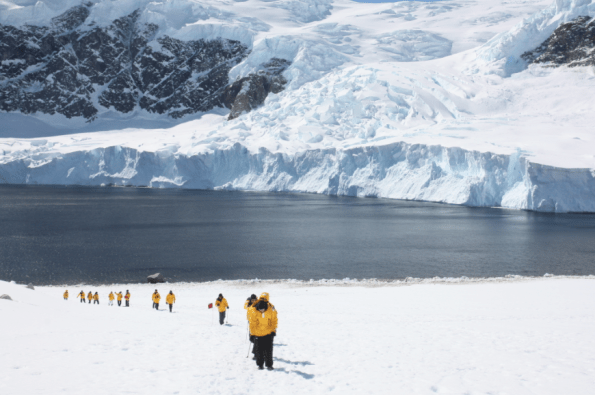
Trekking up from Neko Harbour with the glacier in the background
Landings and Zodiac cruises are a bit of a gamble on any Antarctic expedition. The weather has to be good, the ice has to stay at bay and the sea has to be calm enough so everything can be done safely.
Our whole trip was blessed with excellent weather so our second landing on Antarctica—yes we had two stops on the mainland in one day—happened without a hitch.
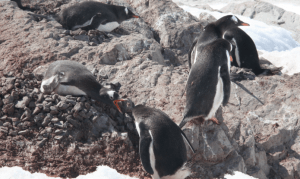
Squabbling penguins at Neko Harbour
We set foot off Neko Harbour, discovered by the Belgian explorer, de Gerlache, in the late 1800s.
The harbour is on the eastern shore of Andvord Bay and was named for a Norwegian floating whale factory ship that used the harbour in the early 1900s.
In addition to admiring the many Gentoo penguins on shore, we made a steep climb to overlook a nearby glacier. It supposedly calves (releases icebergs) regularly, but didn’t reward us with any action except for a couple of loud cracks. But the views were spectacular.
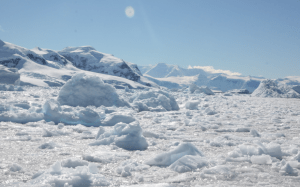
Cruising through brash ice in the Antarctic
Our biggest reward was the Zodiac cruise through acre upon acre of brash ice. These floating ice fragments are never more than 2 metres across and are ‘shrapnel’ from other forms of ice. (I read that there are heaps of different kinds of ice in the Antarctic, and I doubt that I saw them all—I don’t even know all their names).
Vladimir, our Zodiac captain this afternoon, thoroughly enjoyed steering us through this new-to-us form of ice. It was fascinating to see how the Zodiac edged through without problem, and then see how the ice closed behind us.
Vlad was also very pleased to spot a couple of crabeater seals snoozing on an iceberg. We cruised over and managed to disrupt their peace and get some great pics.
The icy waters seemed even more amazing after I read that about 10 years ago Lynne Cox, an American long-distance swimmer, swam in the harbour for 25 minutes. She trained for years in super-chilled waters. Not my idea of fun but full credit to her.
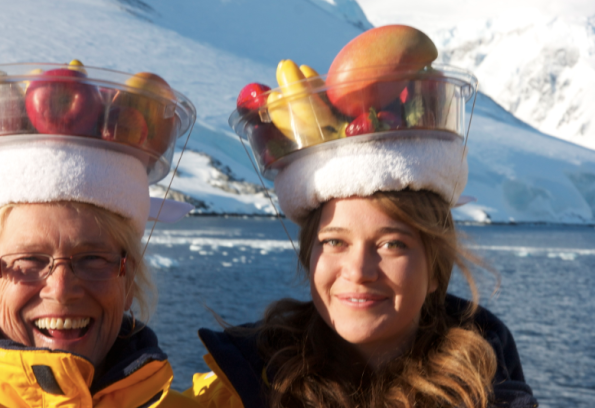
Can you tell us apart?
With apologies to the real Carmen Miranda
My mother used to take cruises with her mother and sister and there was always a hat competition. Mom and Aunt Peggy even won once. So I should have seen the Ocean Diamond’s hat competition coming.
About mid-afternoon, they announced that the contest was an add-on to that night’s planned special event—a barbecue on the pool deck!
It certainly wasn’t pool weather, or even barbecue weather for that matter, but what the heck, the hat competition was on. And the instructions were to create a hat out of anything on board—except safety equipment.
I knew Poor John would find a way to weasel out of participating (he did), but Olivia is highly competitive, and I was not surprised when she dashed up asking for suggestions.

The real Carmen Miranda
‘Honey,’ I said as I linked my arm in hers and headed to the restaurant, ‘have you ever heard of Carmen Miranda?’
Of course she hadn’t. Olivia’s only 18, but that didn’t keep me from dragging her to a giant bowl of plastic fruit—bananas, mangoes, strawberries, apples and more—and explaining Carmen Miranda’s fame as a Brazilian (Portuguese-born) singer, dancer and film star in the 1940s and 50s.
We asked permission before we ransacked the restaurant of fruit, cloth napkins and a couple of plastic lids that fit over dinner plates to keep food warm. Then it was off to our cabin to construct hats that Carmen Miranda would have been proud to wear, and figure out how to keep them on our heads.
Yuly, who looked after our room during the expedition, gave plenty of advice (some of which we ignored) and rustled up a couple of extra hand towels. She desperately wanted us to put shower caps over the fruit to hold it in place, but we reckoned our good posture would suffice.
We sat ramrod straight at dinner (which meant we wore a lot of crumbs on our chests), but we got lots of compliments, thumbs up and an honourable mention for our efforts.
And our picture turned up on the next day’s digital schedule. Thanks for the idea, Carmen! RIP.
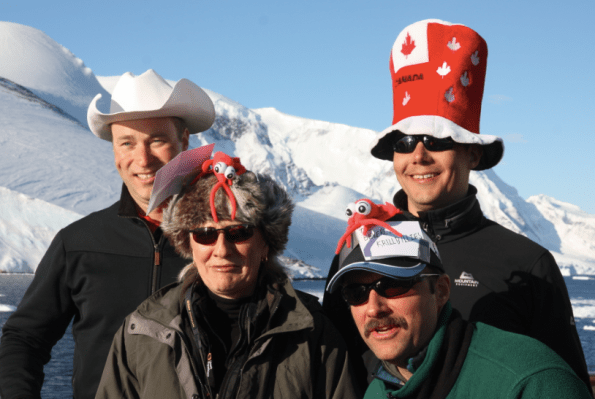
Cowboys, Beverley Krillbillys and a Canadian card shark
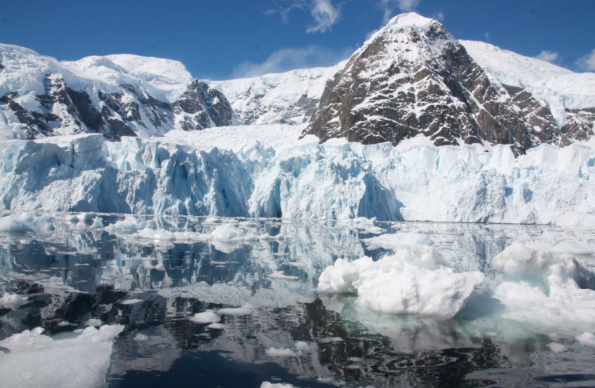
The beauty of Paradise Bay in the Antarctic
In a single day, Poor John and I managed to get to paradise AND visit our seventh and final continent.
It all happened on our second day alongside the Antarctic Peninsula when our ship anchored in Paradise Bay, and the Zodiacs ferried us ashore for the morning. This was a real landing on the Antarctic mainland, unlike our previous stops on islands.
Zodiacs ferry us to the Antarctic Peninsula
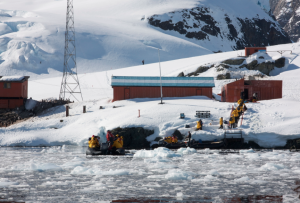
Landing at Base Brown
We arrived on the doorstep of the Almirante Brown Antarctic Base, the now-abandoned Argentine scientific research station there.
I can’t determine exactly when it closed but, in 1984, a researcher, who didn’t want to stay for winter, set fire to the compound. He pulled this stunt about the time the last supply ship for the year was leaving. Luckily, he and others who were to stay for winter were picked up. Today the buildings are in good condition, and perhaps the site will reopen in future.
For now, the base is one of only two places that tourists can set foot on the actual Antarctic Peninsula.
As with all landings, some crew members went ashore first to prepare a landing spot and mark paths where we could trek safely and legally.
The legal requirement is that we stay in certain areas and that we remain at least five metres from all wildlife. However, it’s okay if we sit or stand still and the critters approach us.
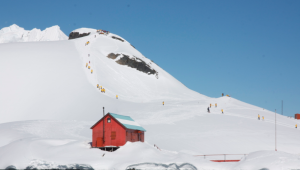
Trekking to a viewpoint on the Antarctic mainland
This was our trickiest landing so far because the landing spot was steep and blanketed with a thick layer of snow and ice. Not to worry! Several crew went to work with shovels and other implements, and cut a set of snow stairs for us to climb.
That climb was nothing compared to the uphill trek to the best viewpoint. The ‘mountain’ rose only 165 feet, and was really not at all hard if you take it slowly. But it’s a decent challenge when you sink up to your knees in the snow.
After exploring our first mainland stop and checking out the resident gentoo penguins, we took our turn in the Zodiacs. This was our chance to get up close to ice, glaciers, mountains, water and plant life.
No doubt about it, Paradise Bay lived up to its name and reputation as one of Antarctica’s most scenic places.
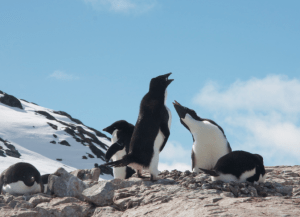
Singing Adélie penguins
The afternoon landing on Day 3 was at Petermann Island, another destination not far from the Lemaire Channel.
Petermann is small, only 2 kilometres long, but famous as the world’s southernmost home for Gentoo penguins. There quite a few Adélie penguins waddling around too, and the blue-eyed shags nest amongst both types of penguins.
As with Pléneau Island, we saw the penguins courting, singing and blatantly stealing stones from other another’s nest.
Petermann still has one refuge hut (pic here), built in 1955 by Argentina. There’s also a cross to honour three members of the Btitish Antarctic Survey who died 30 years ago when they attempted to cross the sea ice from Faraday Station to Petermann.
At a latitude of 65°10’S, the island is as far south as we got, unless it counts if our Zodiacs ventured a few metres farther south.
Our Zodiac had a fair run and even ‘chased’ a minke whale for a closer inspection. He/she skimmed the surface frequently and randomly, so we spent a lot of time trying to guess—wrongly—where the next surfacing might be.
We learned that minke are just beginning to arrive in the Antarctic—because the supply of feed has become adequate.
As much as we would like to be in all places at once, we missed seeing the humpback whale that others saw earlier in the day.
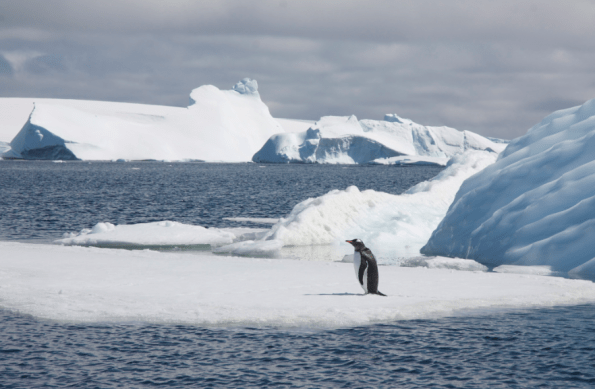
A lone penguin surveys the iceberg graveyard at Pléneau Island in Antarctica
Three days into our Antarctic expedition, we had the chance to don our cold-weather gear and venture on to the snow and ice on Pléneau Island.
Soon after breakfast, a fleet of Zodiacs ferried half the passengers from ship to shore, and then returned to take the other half for a cruise through the nearby iceberg graveyard. After about 90 minutes, the two groups switched places.
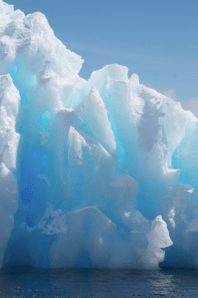
Close-up of a resident in the iceberg graveyard near Pléneau Island
Pléneau Island, which lies at the southern end of the Lemaire Channel, is home to a largish Gentoo penguin colony.
Because there are such strict guidelines regarding where we can go and how we should behave in the Antarctic, the penguins virtually ignore us.
As a result, they happily go about their business of courting, singing, bonking, laying eggs and fine-tuning their nests, while we gape in wonder and snap photos like crazy.
Our first encounter with the penguins was more fascinating that we could have imagined, and the cold-weather gear definitely proved itself when we returned to the Zodiacs for our cruise.
While Zodiacs don’t seem to go very fast, they produce a real chill in the air that bites, especially if you leave your face, head or hands exposed.
Luckily Quark, who ran our expedition, provided us with weighty, warm, waterproof boots and jackets, and the travel agent, through whom we booked the trip, loaned us waterproof pants. We already had gloves and liners, although I lost my outer gloves in Peru a while back, so we borrowed a pair from Colin, our Oasis truck driver.
Wrapped up to the eyeballs, our Zodiac motored through the iceberg graveyard, which is called that because the bergs are permanently grounded. The scenery was breathtaking.

Aiming for that little ‘V’ shape slightly right of centre
After two days spent crossing the unexpectedly tame Drake Passage, we all held our collective breath as the Ocean Diamond squeezed its way through the Lemaire Channel on our Antarctica expedition.
Flanked by steep cliffs, the 11-kilometre channel runs between Booth Island and the mainland’s Graham Land.

Heading between an iceberg and a cliff
Belgian explorer, Adrien de Gerlache, was first to navigate it in 1898, almost 25 years after it was first sighted by a German expedition.
The channel is considered to be one of the most picturesque landscapes in the seventh continent, if not the world. It’s also extremely unpredictable, with icebergs the size of ships often clogging the passage.
From day one, we were told the captain HOPED to take us through this famous channel—that his decision to tackle the channel might be made at the very last minute.
That’s exactly how it played out. From a distance, we all felt sure the gap was too narrow. But Captain Peter never blinked (or so we were told), as we edged past a giant iceberg that our crew said would have fazed a less determined captain. I’ll always wonder exactly how narrow that gap was. As you can see from the bottom photo—not very wide. Olivia was on the bridge as we went through, and she says Captain Peter was dashing from side to side to keep an eye on the ship’s clearance.
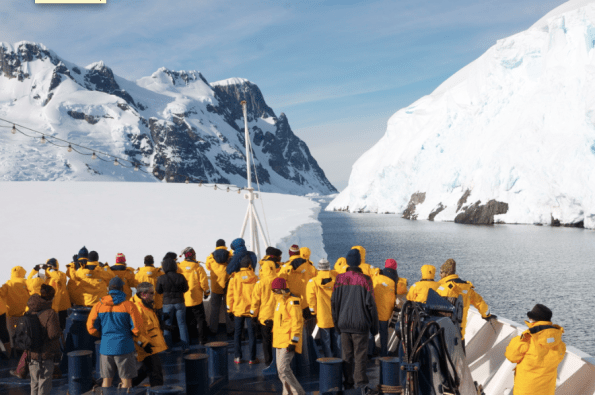
Up close and personal with an iceberg on the left
If you like this blog post, please share it with your friends by Facebook, email, Pinterest, Twitter or any other option you prefer. You can click the ‘Like’ button, too. 🙂

Olivia goes for the challenge of the Antarctic Polar Plunge. Photo by Vlad
For about half a nanosecond, I contemplated taking the Antarctic Polar Plunge.
This would have been my chance to prove my mettle—to strip down to my bathers and make a dash into the freezing waters of Whalers Bay at Deception Island.
But common sense and self-preservation kicked in, so I left the honour to more than 50 others, including our travelling companion, Olivia.
Those who were brave enough to take the plunge were met at shore with cheers, piles of fluffy towels, and a Zodiac waiting to whisk them back to the Ocean Diamond and a hot shower.
On the way to the ship, Olivia tried to convince me that at about 1°C, the water wasn’t really that cold, but I didn’t believe her for another half of a nanosecond.
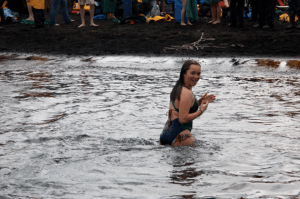
On the way to shore
Especially after she discovered a cruel twist on the ship. The switch-over of water tanks took place about the same time the plungers returned to ship and, for about 30 minutes, all the showers ran out of water of any temperature.
Olivia did get a certificate to mark her exploit. It states she is officially one ‘who did most willingly plunge into spine chilling ice-filled Antarctic water at Deception Island.’
It continues with, ‘we do solemnly acknowledge that this was an act of indubitable courage (as well as extraordinary, incomparable foolishness). Based on the Expedition Leader’s observance of this act of absurd heroism, and the Ship Doctor’s confirmation of the said person’s temporary loss of any common sense, we consider the bearer of this certificate a key member of the Ocean Diamond Antarctic Polar Swim Club.’
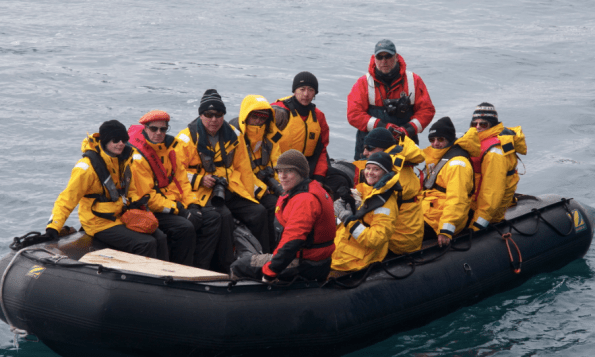
Plungers return to ship

A Zodiac heads toward the Ocean Diamond
Everything about our expedition to Antarctica has been immense—the glaciers, the expanses of water and ice, the horizons, the cold weather gear we have had to wear, even the amount of food served on our ship, the Ocean Diamond.
These two pictures only begin to convey some of the immensity.
I hope you’ll stay tuned for more pictures and stories from our 10-day adventure to this mysterious and fascinating continent. Soon we’ll be back to the mainland and a more generous and stable internet connection.

An expansive view in Antarctica

Jumping for joy in the Antarctic. Photo by Olivia
What are the chances of getting tired of seeing penguins—absolutely no chance at all!
Every day and at every landing, we have had the pleasure and good fortune to see penguins.
We’ve seen gentoos, adélies and chinstraps.
I think this little group of gentoos and adélies were just as happy to see us as we were to see them.
Thanks to Olivia for capturing this amazing shot, and for her willingness to let me share it here.
Stay tuned for lots more news and pics of the Antarctic. We return to Ushuaia and good internet connections on the 9th.

