
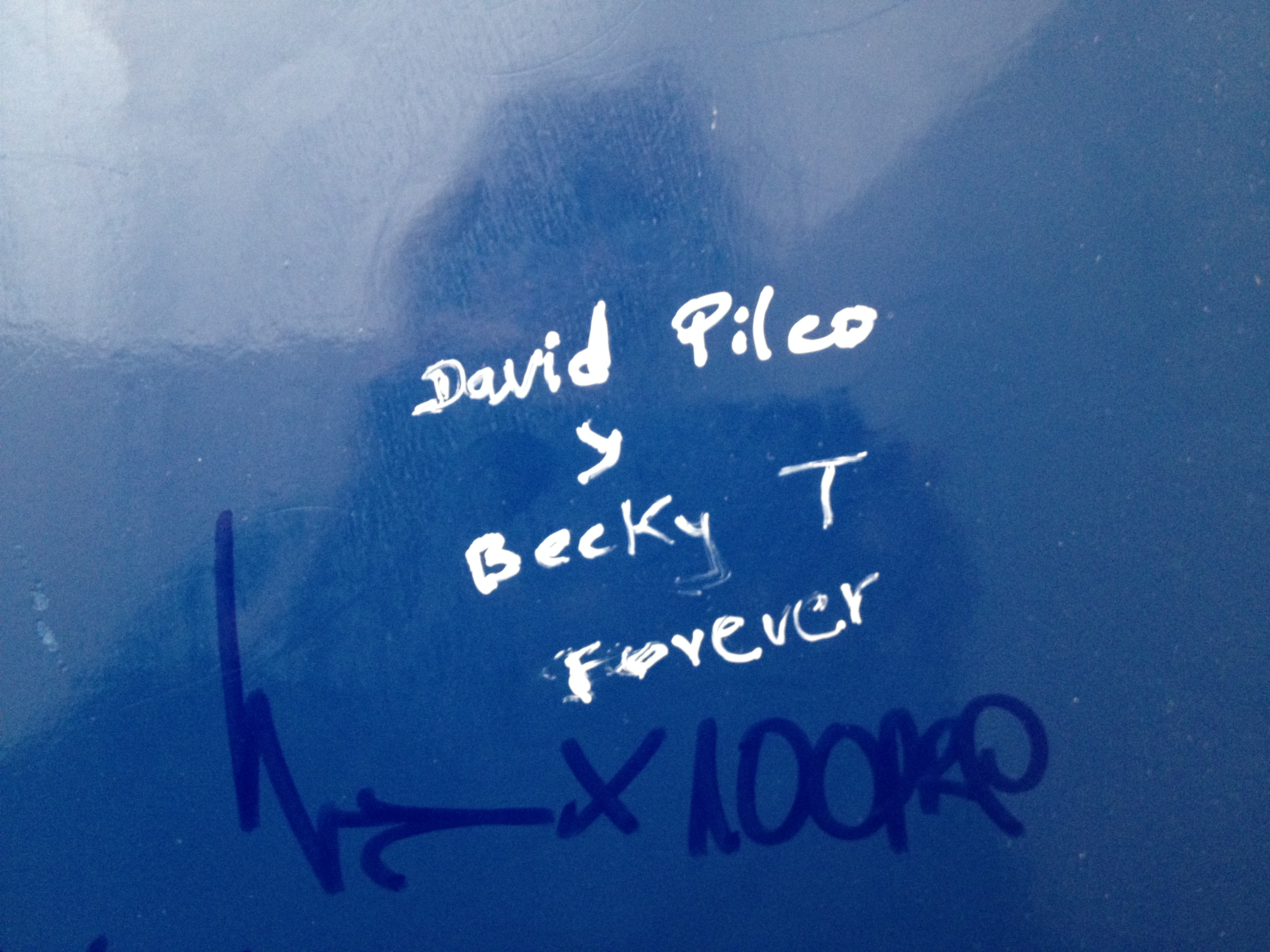
Forever?
I love the goofy things you see on foreign billboards and other surfaces. These two really touched my funny bone.
The blue one on the left was on the inside of a toilet door at the Teleferico (cable car) in Ecuador, Quito. The promise of true love ‘forever’ and he doesn’t even know her last name!
The other is a billboard near Turjillo, Peru. These two corn-fed gals (the one on the left is holding a giant ear of corn) are advertising hybrid seed. Interesting that pretty girls and a cut-out dress are an important part of getting the message through?
Mind you I have seen quite a few scantily clad poster girls on calendars hanging in the garages of South America.

Peruvian billboard
P.S. I’m sitting in a pub in Huacachina, Peru, waiting for the dune buggy adventure to start. We’ll finish the day with downhill sandboarding, pisco sours and sleeping under the stars.
I’ll be missing for a couple of days. Tonight we’re camping in a Peruvian national park. Then I’m dragging Poor John into a dune buggy for a bouncy, hair-raising ride across the Peruvian desert—I hope. Then camping. Back soon. And that’s just one of the reasons he gets called Poor John
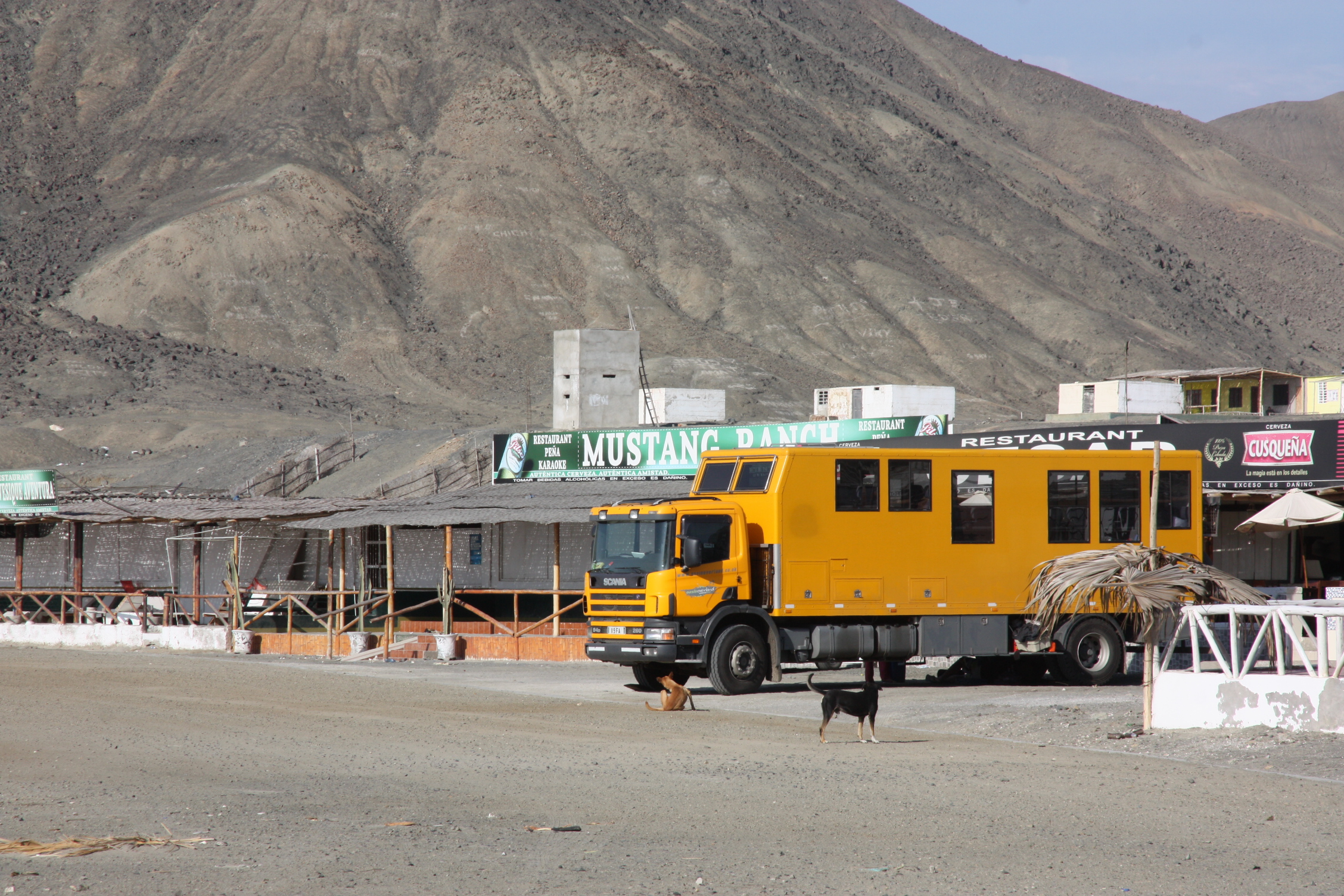
Sponge Bob parked at Besique Beach
Sometimes it’s hard to find a decent place to camp between two places that are just-that-little-bit-too-far-apart to do the drive in one day.
That’s when Sammy’s Spanish comes in so handy. She can make sense of the fine print on road signs. A couple of trips back, she put her skill to work to find Besique Beach and Cesar’s Restaurant, about 30 minutes beyond the town of Chimbote. Note: here don’t ever camp in or close to Chimbote—it’s famous for smelling like fish—a whole lot of fish—thanks to processing plants there.
But on to Besique Beach. By Australian standards, it’s pretty crummy, but in Peru it is considered picturesque. I’ll admit that it is very scenic, surrounded by rocky hills to climb, and has scope to be a lovely spot. But the sand is scattered with litter, the surf is dirty and the water is freezing. There is no overnight accommodation, so ‘Chimboteans’ go there for weekend outings.
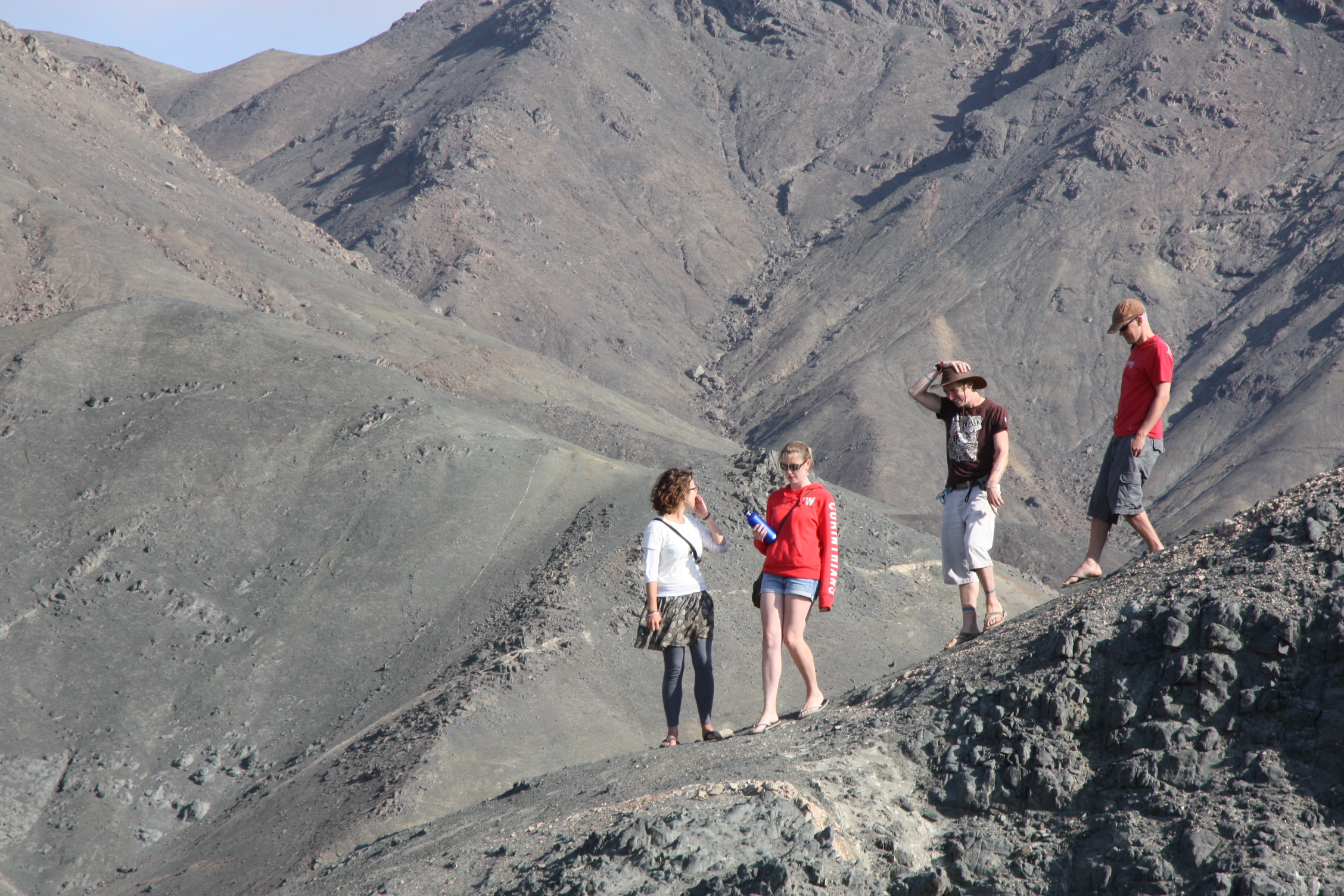
A short stroll in the ‘mountains’ at Besique Beach
It must be popular, judging from the string of restaurants that are deserted during the week, but no doubt lively at the weekend. Signs at the Mustang Ranch next door to us promise karaoke, and a few places had sunbeds dragged out by the beach. A couple of dogs hung around, hoping for the dinner leftovers, which one got.
As campers, we were quite happy to take up Cesar’s offer to let us use his flush-with-a-bucket toilets, set up our camp kitchen on his verandah, and ‘pitch’ our sleeping mats and bags on the floor there. The night was chilly, perfect for a down sleeping bag. I slept well—very well—and enjoyed this out-of-the-way spot.
P.S. Unless you’re airlifted in, the only way to get to Besique through a narrow tunnel in a rocky hill. A road used to go around the hill, but part of it caved away in a storm.
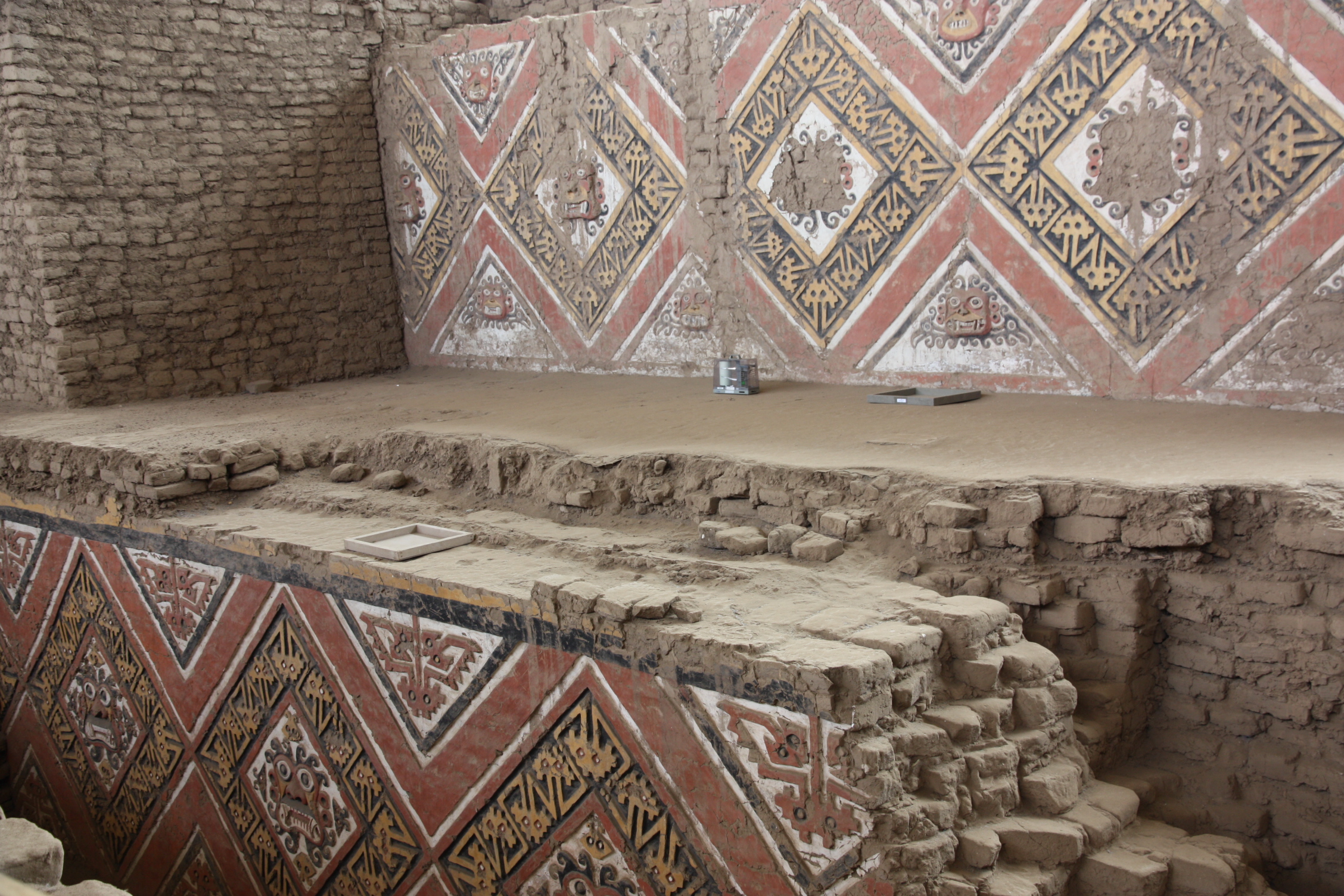
Detail of Moon Temple
Just when you think you’ve seen one temple too many, you come upon something like the Moon Temple near Trujillo in Peru.
This temple/shrine and its accompanying Sun Temple are known, respectively, in Spanish as the Huaca de la Luna and the Huaca del Sol. Together they make up the Huacas de Moche, and are part of an ancient Moche capital city.
The two temples are separated by a sandy, flat expanse, which was where the original city sat. Researchers think the Moon Temple (which is smaller) was for ceremonies and religious occasions, while the Sun Temple was important for administration, military, elite residences and such.
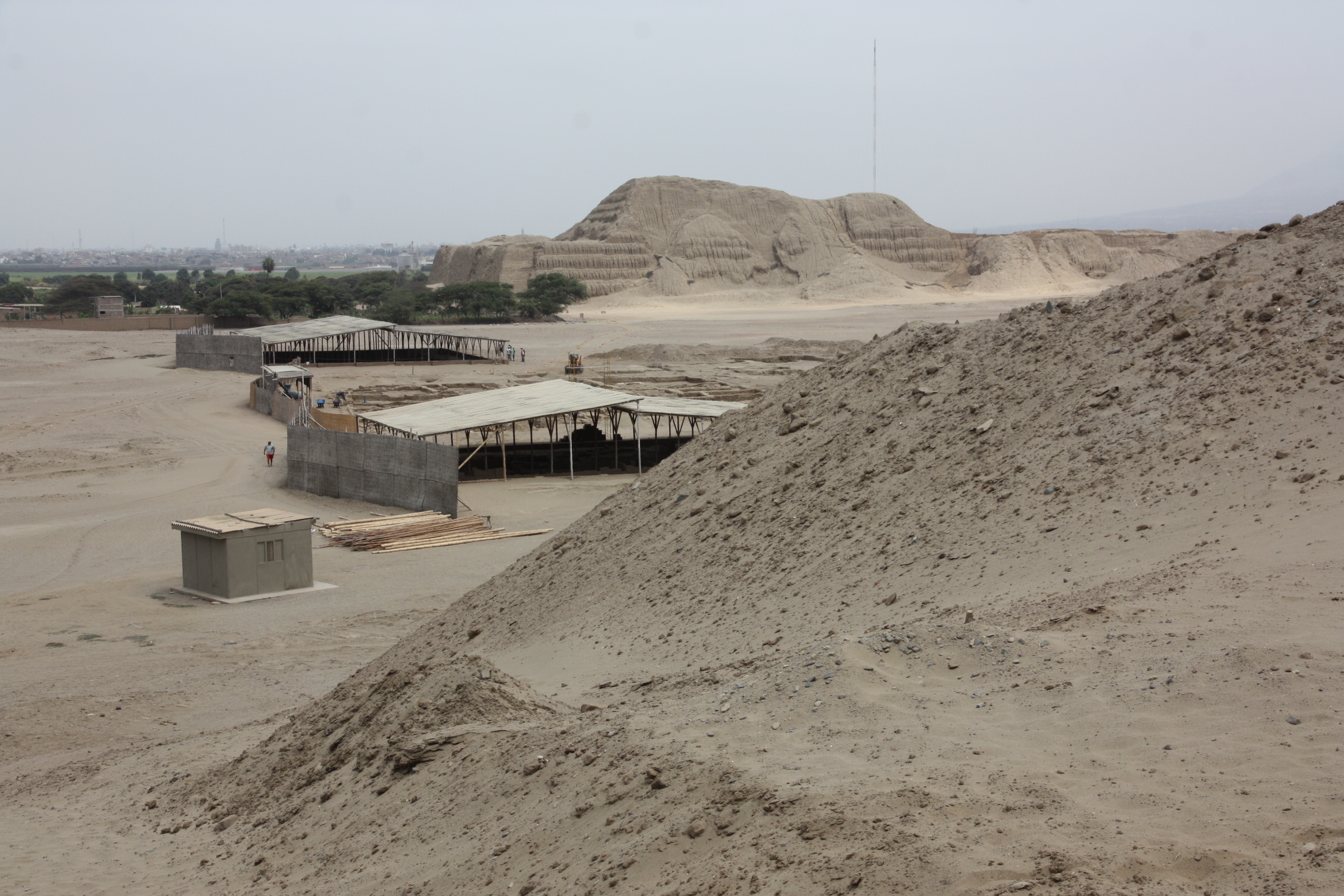
Looking from Moon Temple to Sun Temple
Of course, we’ll never know for sure, but what we do know is that the Moon Temple is five temples in one. They’re like upside-down building blocks.
The first temple was superseded, filled in with mud bricks, then topped with a larger temple of the same proportions. This happened three more times with each upper temple becoming larger and larger.
Centuries ago, the looters cleaned out the Sun Temple. They also got the goodies from of level five of the Moon Temple. But they weren’t curious or energetic enough, and everything below that top level has survived—up to a point.
Our guide, who was excellent, explained that level four is going to remain the main source of knowledge in relation to Huaca de la Luna. There are little glimpses of level three, but to really investigate the lower temples would mean destroying the ones above.

Exterior of level four of Moon Temple
So we’ll have to settle for level four for now. But what an easy thing to look at. The artwork, detail, symbolism and variety on this level are enough to blow you away. I could have spent days exploring this temple—and what a bargain at less that $4 for admission.
I won’t go into the grisly details, but it pretty clear that the Moon Temple played a part in sacrifices. The Moche thought they had to appease the gods with human blood, so many a battle was fought to capture prisoners as sacrifices.
Some of the murals show chain/rope gangs of prisoners being led by the victors. Of course, the murals are fading and deteriorating, but you can still appreciate how striking this temple must have looked in days gone by. I was surprised to see how strong the colours still are—with plenty of black, red, blue, white and yellow visible. Our guide was so cute. She certainly knew how to build up suspense and anticipation as she introduced each new part of the temple. And her English was excellent. And there was no charge for her services—just a tip—and I tipped her well.
P.S. We also visited the Museum of the Huacas de Moche, but no photos were allowed.
Our guide explains the designs
Our guide, who had been studying English for only five months, did a so-so job of explaining what we were seeing. Actually he did quite well for so little experience, and he’ll get there soon. But for us, he knew his spiel by heart and delivered it as fast as he could. In spite of that speed event, I’ve been able to learn a bit more from travel books and such.
In its heyday, Chan Chan was an imperial capital for the Chimu civilization. It covered 20 square kilometres and had about 30,000 residents. It had an enormous network of irrigation canals. Even though Chan Chan sits in the midst of the desert, there is still a half-full well from ancient times.
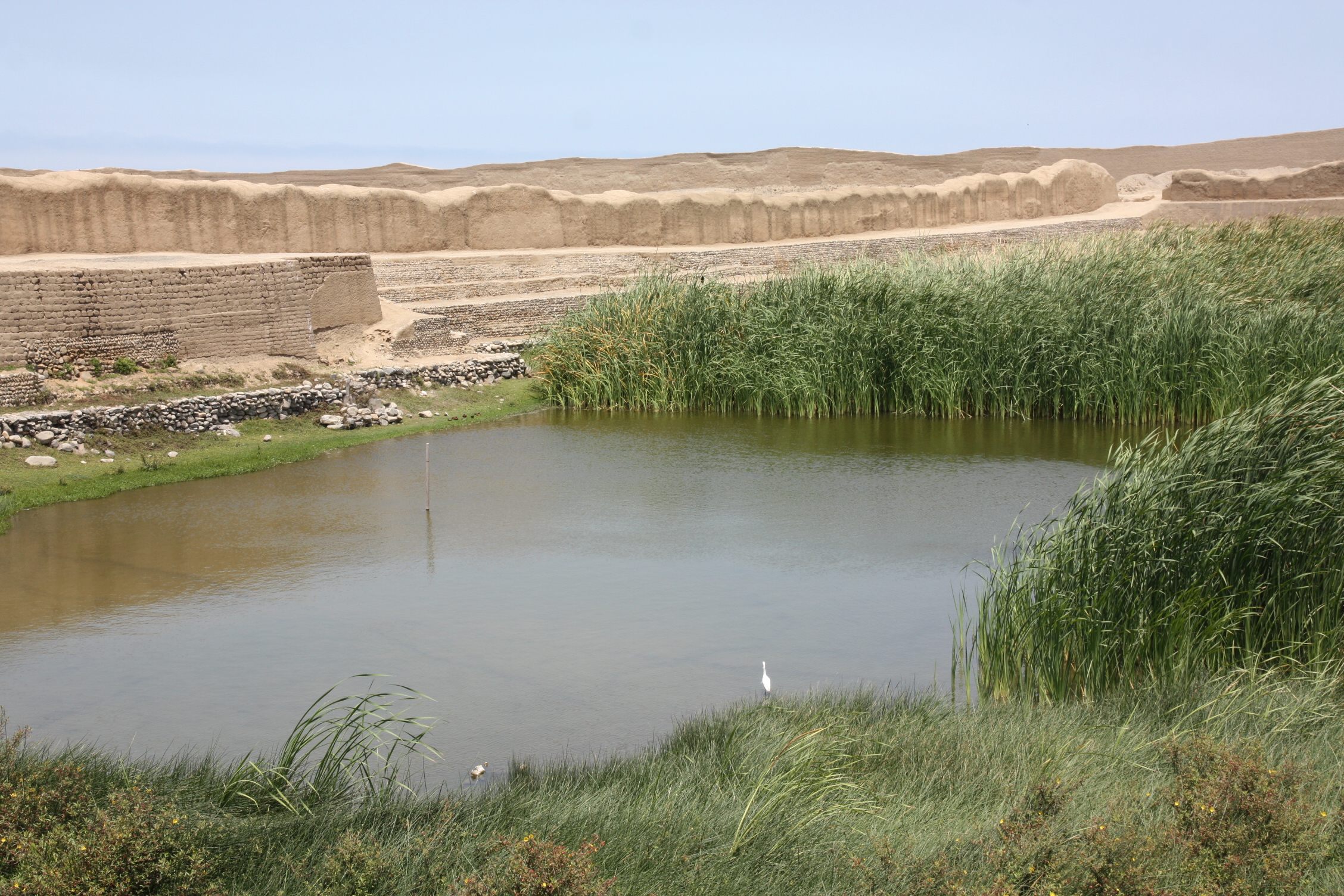
The well at Chan Chan
Having been built from abode brick around 850AD, Chan Chan survived until it was conquered by the Incas just over 600 years later.
But the invading Incas were not the last of Chan Chan’s problems. Today the city’s ruins are at the mercy of Mother Nature—earthquakes, storms and flooding—and looters, although I think it is rather well guarded now.
But the structures themselves are suffering. There is a labyrinth of walls, pathways and cubicles. The adobe walls give the impression that they are melting. For starters, many have lost much of their height. While the wonderful designs—such as fish and other sea creatures, birds and geometric shapes—are still visible, you can see they are deteriorating. Roofs have been erected over some particularly vulnerable and/or decorative areas. A conservation plan is in place.
Chan Chan has been a UNESCO World Heritage Site in 1986.
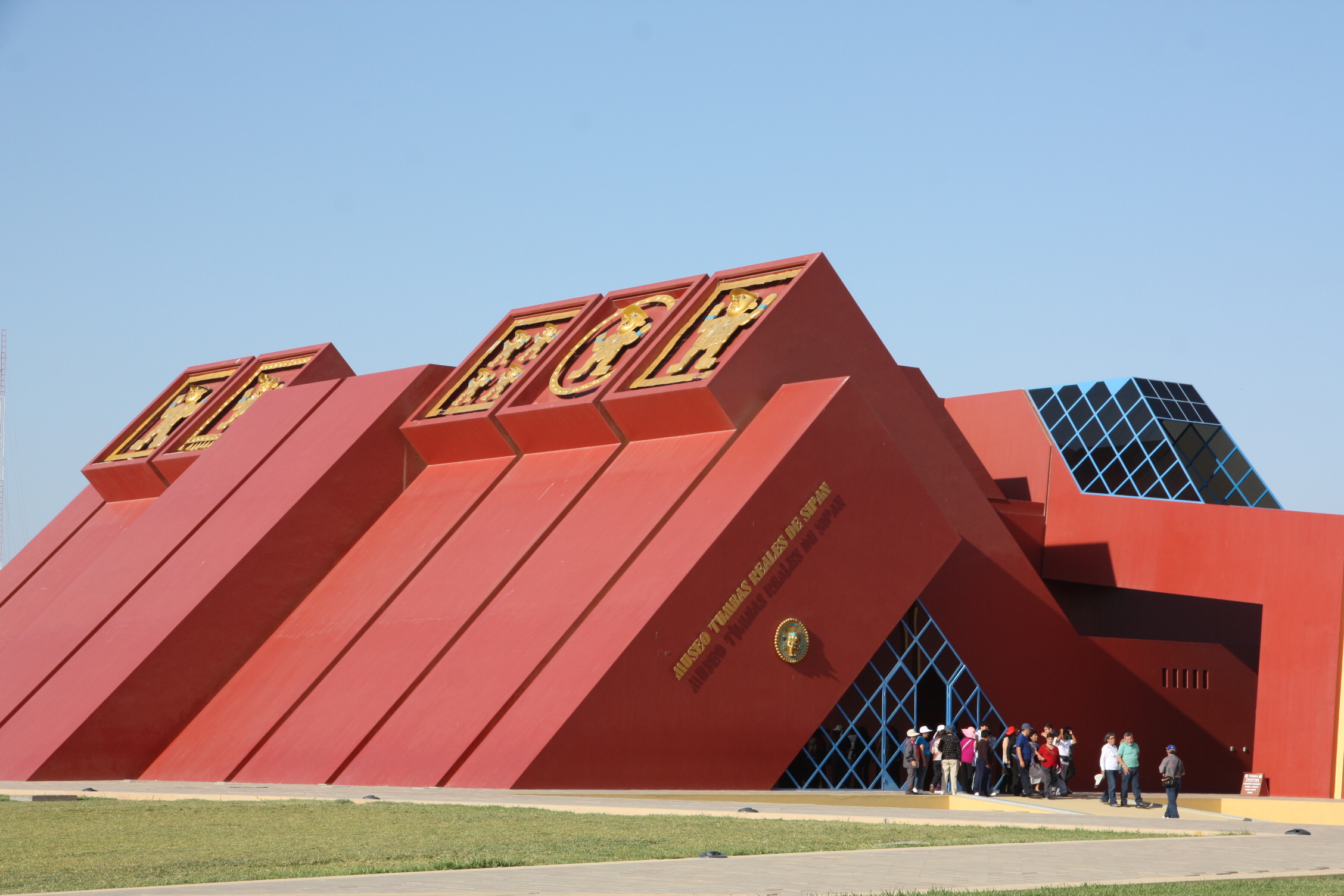
Museum of the Lord of Sipan
Usually I don’t mind too much when my camera isn’t allowed in to a historical site or museum. But I’d love to be able to show you some of the wealth and unexpected treasures we saw in the museum of the tomb of the Lord of Sipan (Museo Tumbas Reales de Sipan).
Walter Alva, a Peruvian archaeologist, found the intact tomb in 1987 in the Lambayeque Valley in northern Peru, close to the coast. It was a Moche burial mound, and I can hardly imagine the awe, joy and disbelief that swept over Alva as more and more of the tomb and its treasures were revealed.
For starters, there was a lot of art in the tomb, showing what excavators assumed to be a deity being worshipped by followers. It wasn’t until they scratched their way down to the mummy and accompanying finery and hangers-on that they realized the deity was actually a real person—who they then dubbed the Lord of Sipan.
Lord Sipan probably ruled the region. His tomb was filled with jewelry and ornaments that denote the highest rank. We saw gold, silver and turquoise beautifully worked into nose and earrings, necklaces and bracelets, cuffs, falconry, chest plates, helmets, crowns, headdresses and more.
The pottery was expertly shaped and intricately decorated. Clearly it was only the best for the Lord of Sipan.
He had his entourage too. His companions in death included a wife and a couple of concubines (or servants), a military commander, a watchman, a banner holder and a child. And of course the family dog and llama.
A lot of thought and effort has gone in to creating the museum, which opened in 2002. Items are elegantly displayed, with numerous explanations (some in English) and replicas of various parts of the tomb.
I timed my stroll through the museum perfectly. I moseyed along near Sammy, our overland guide, who is fluent in Spanish. She’d heard of, but hadn’t been to, the museum before, so was as keen as the rest of us. I bet it becomes a regular stop on future overlands.
And admission was a bargain at about 10 soles (less than $4) per person. But the only photo is from the exterior of the museum, which has been made to look like a tomb.
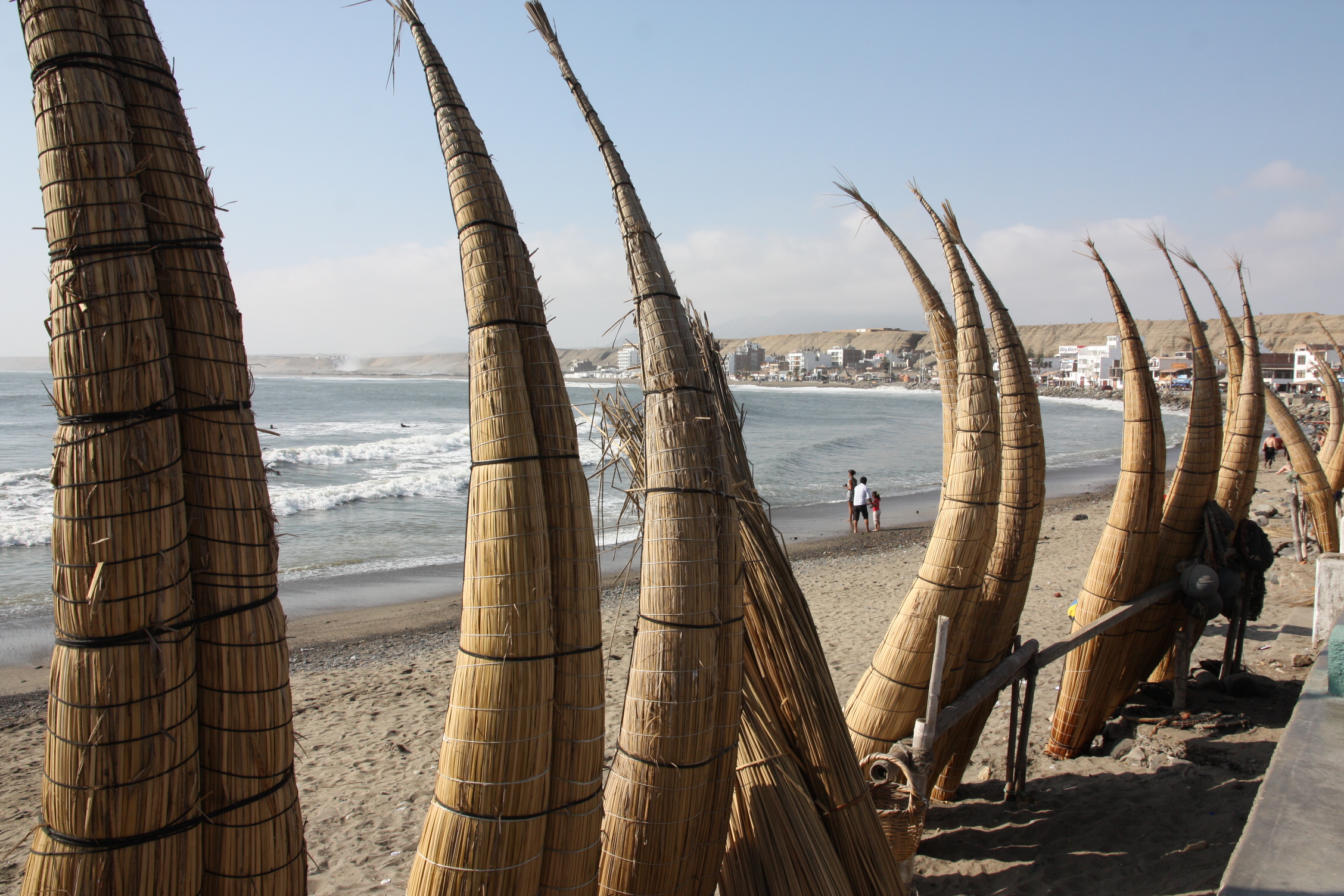
A wall of reed boats—caballitos de totora
Ceviche is a sort of pickled seafood dish popular in many parts of South America. It’s marinated in copious amounts of lime juice, which more or less, cooks whatever seafood is used.
The first time I ever tried ceviche was in Burma. Poor John was in the Australian Embassy there and I was a member of the International Cookery Group. A Columbian woman made ceviche for us when it was her turn to host a group luncheon. I loved it then and still have the recipe (I’ll share it when I get home).
But imagine my surprise yesterday when we camped at the Naylamp Hostel hostel in Huanchaco, Peru—the home of ceviche. Oral history has it that the first ceviche was made with lemons from Simbal (a nearby village), chilli from the Moche River valley and seaweed from the sea.
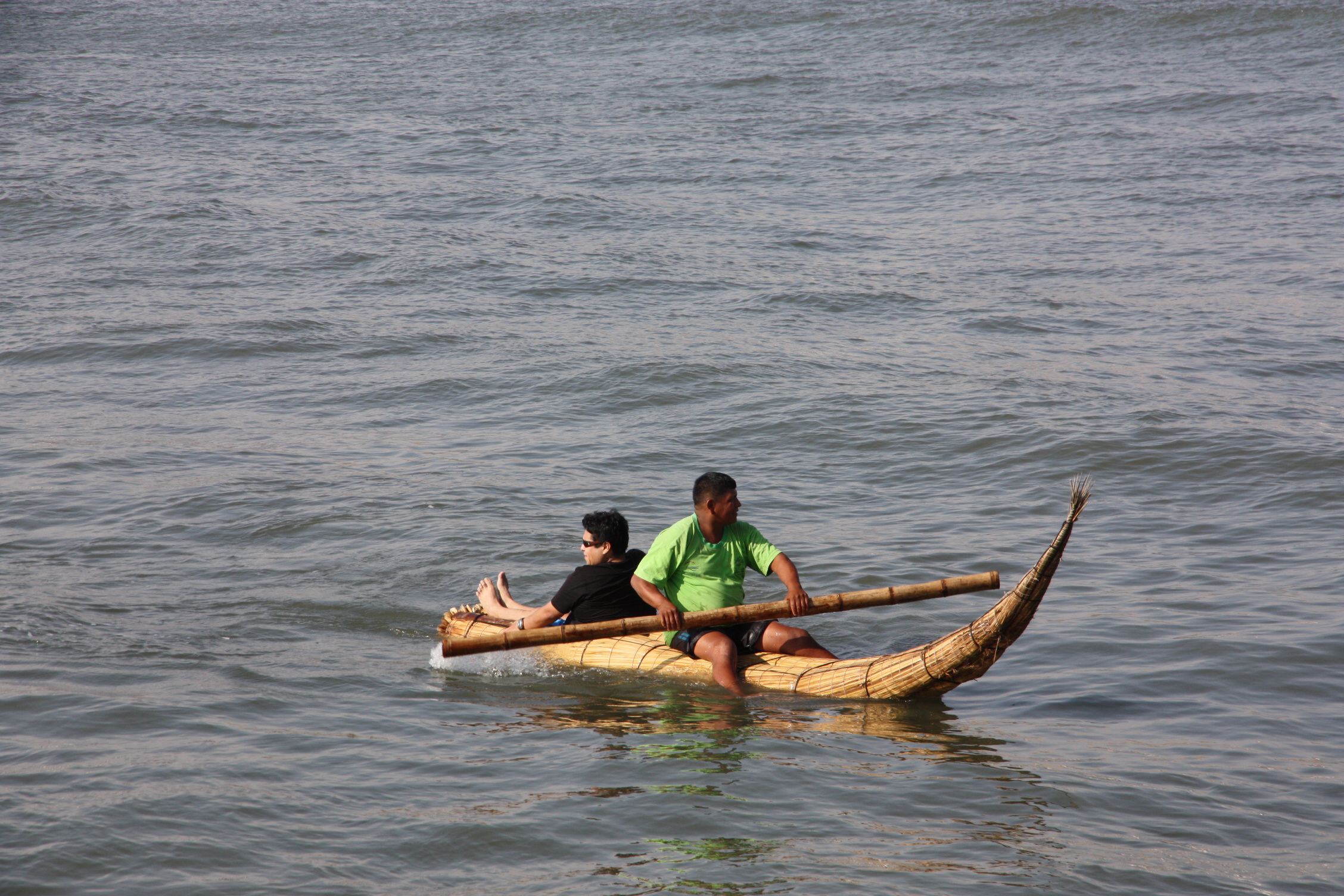
You will get wet
As it turned out, we didn’t have ceviche in Haunchaco (fish instead), but we did see their other claims to fame—plenty of surfers, plenty of caballitos de totora and the Huanchaco Pier.
Surfers come from around the world for the annual longboard event. To be honest, the surf isn’t amazing (although maybe it is better in January when the competition is on), but surfers do get a long run in on what seem to be rather small but nicely rolling waves.
The caballitos de totora are traditional reed boats. They’re lined up on the shore, waiting to give tourists a ride that guarantees they will get wet. These boats have been used by fisherman for more than 3000 years. The way they ride the waves to shore has caused some to debate whether these fishermen were the original surfers.

A brown pelican on Huanchaco Pier
The pier is popular with tourists, more fisherman and pelicans. It cost about 20 cents each to enter the boardwalk and it was well worth it.
We joined hundreds of others (many more than we expected on a Monday) and saw a fellow doing a brisk business renting fishing lines and bait. There were plenty of fishermen, lovers, families, trinket sellers and four or five pelicans waiting for a handout.
It was puzzling and a bit distressing to see a fellow onshore haul a pelican away by its neck. We didn’t see exactly what happened and how the guy came to have the bird. The locals weren’t happy about it, but the man strode away with the pelican half-heartedly struggling to escape. Surely a pelican is too tough an old bird to be dinner?
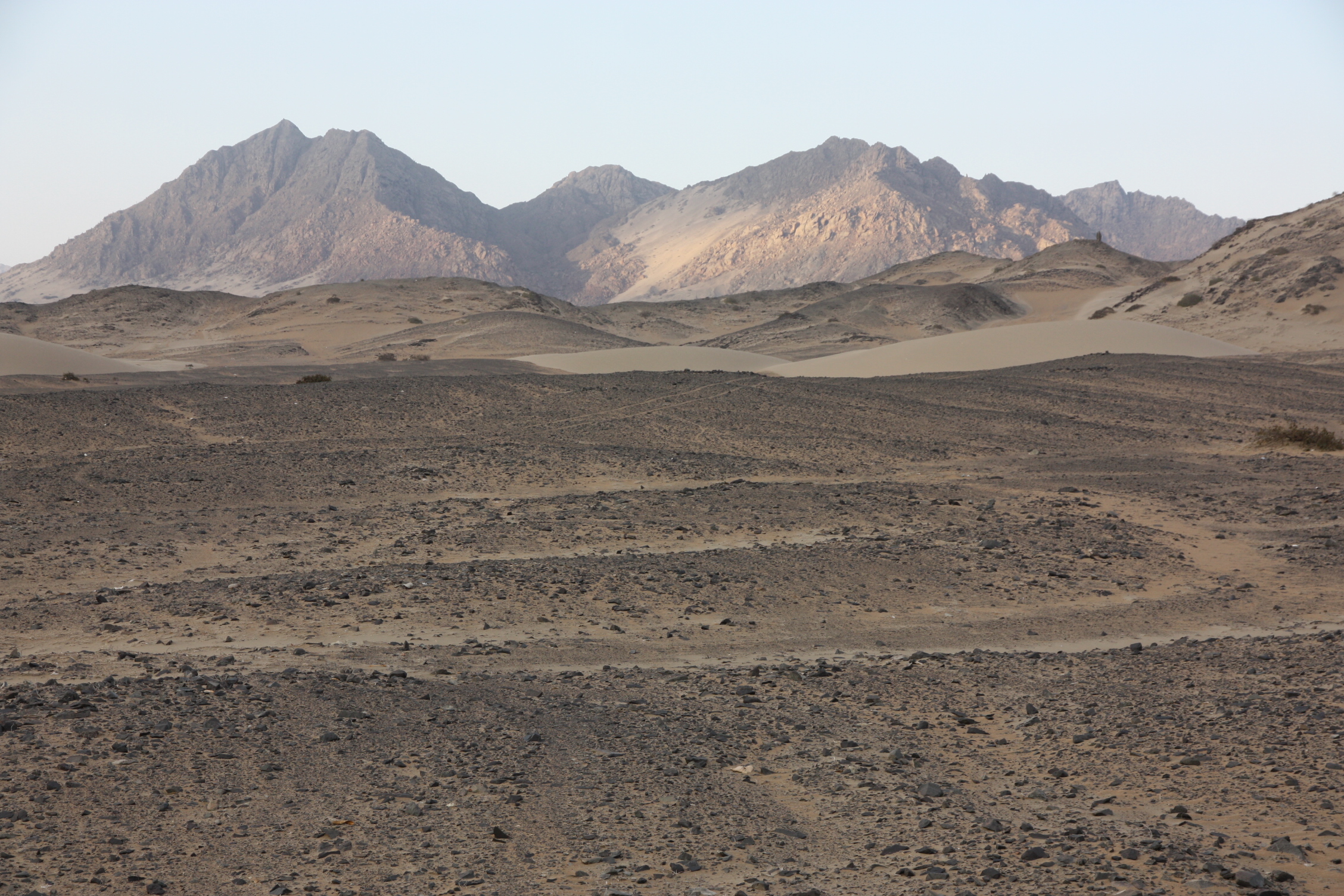
A tent with a view
After two weeks on the road for this overland journey, we finally had our first real bush camp—in the sand dunes of Peru.
It was fantastic.
Some of the passengers seemed a bit surprised to learn the true meaning of a bush camp, but the ‘old hands’ at camping were delighted to have the serenity, uninterrupted views, lack of facilities and star-studded sky. It was a full-moon night too, so we certainly couldn’t complain about being left in the dark. And I didn’t feel guilty about not adding to the blog that night.
Luckily we didn’t have to cook either (having done so the night before) so we could enjoy the riches of the Peruvian desert. Both Poor John and I agreed that it reminded us of some fine bush camps we had in Africa.
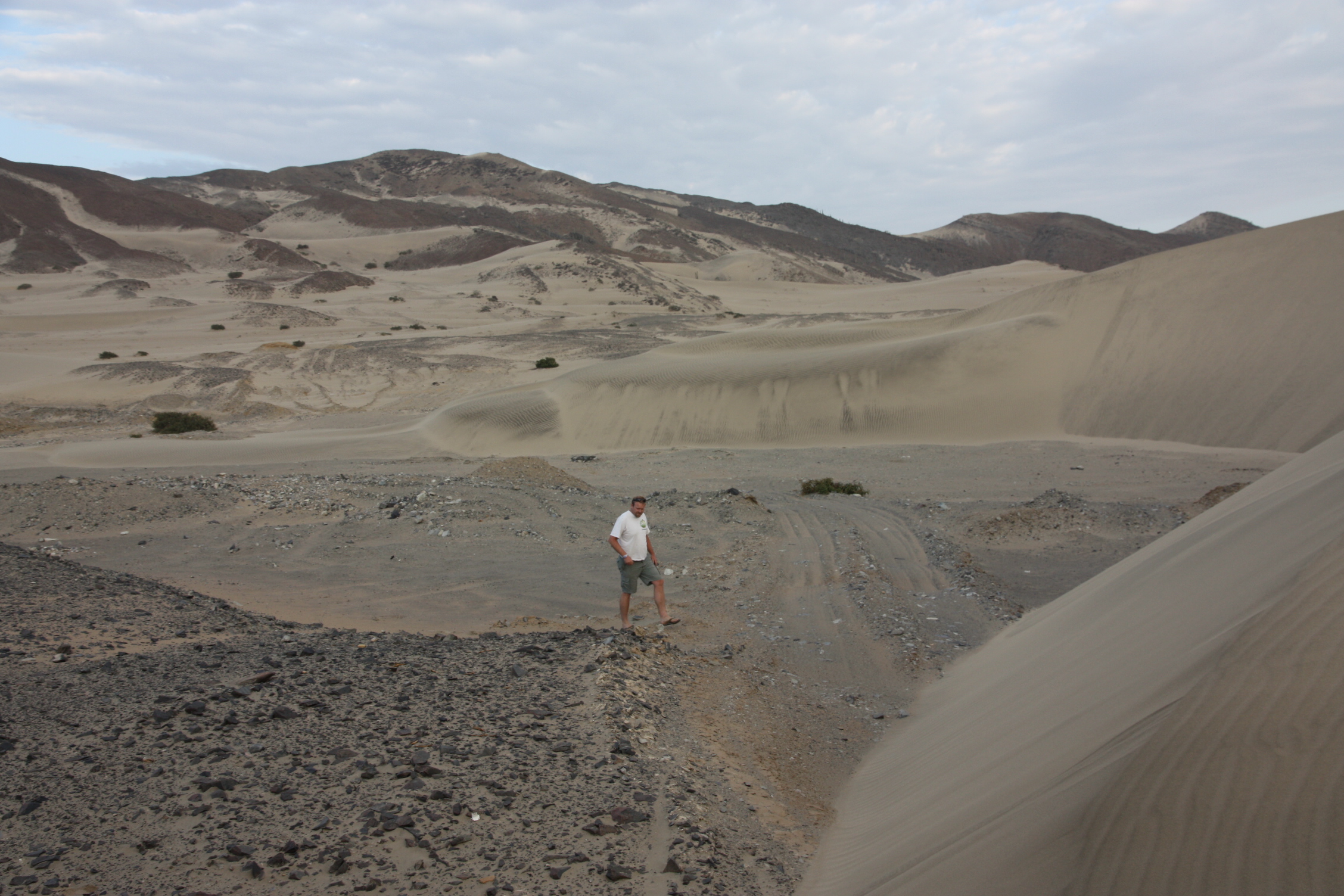
Colin checking for the right spot to bush camp
Our Peruvian camp wasn’t quite where it was supposed to be. Colin and Sammy, our driver and guide, had been aiming for a crescent-shaped spot beneath one of the dunes, but a ‘new’ dune blocked the access, so we had to settle for a nearby pseudo quarry. We kicked some largish rocks out of the way before setting up our tent, so were quite comfortable when we settled down to sleep.
This trip is about 50 per cent camping, but a lot of it is in campgrounds and other ‘civilised’ locations. We look forward to our next rustic camp tomorrow night.
P.S. Always have a little chuckle about folks taking a shovel with them for the first time for their morning ablutions. Before Africa, Poor John and I invested in a small personal trowel, called an iPood. Very nice not to have to wait for a shovel.
But it reminds me of a gal who was on the African trip before us. She was 73 years old and travelled with her own fold-up toilet seat with legs. I can just see her setting off with a shovel over her shoulder and a toilet seat under her arm.
Who says you have to have good knees to go overlanding?
Hi all
I won’t have internet for a couple of days—camping on the beach! Yes, life is tough. 🙂
Will be back very soon. An easy way to know when I’ve posted a new entry is to sign up to follow the blog. That way, you’ll get an email every time I post. If you do sign up, be sure to respond to the confirmation email to confirm that you want to follow. The signup is in the top right corner of the blog.

My first elk!
I may be sitting on a beach in Peru, but there are some photos of moose and elk that are itching to be posted.
Before we headed to South America, we had four fantastic days in Denver Colorado staying with a long-time friend.
He loves the Rockies (which are on his doorstep) but hadn’t been there for quite a while. His back was injured more than two years ago, and it has made driving impossible for him. Even riding is difficult.
But I can drive, so was quite happy to climb behind the wheel of his Jeep for a day’s outing to the nearby Rockies. To be on the safe side, my friend even renewed the Jeep’s insurance for a few days, so we were all legal.
A funny thing happened at the entrance to the Rockies. Park admission is $20 a vehicle (and good for a week), but when we asked if there was a senior’s rate, the woman offered me a lifetime entrance permit for just $10. Only one catch, I had to produce a US driver’s license. You can bet I’ll apply for a license the next time I’m in the US because we’re hoping to do a circuit of the national parks.
Anyway, our recent outing was exactly a month ago, and what a lucky day we had. The weather was perfect and because it was a Wednesday, there weren’t hordes of other tourists. But the best thing was the animals.
On the way home, we stopped at a petrol station, and the fellow running it said the moose and elk had just started to appear closer to the roads because the weather was cooler. And I’m guessing it helps that the kids have gone back to school. 🙂
But back to the Rockies and the animals.
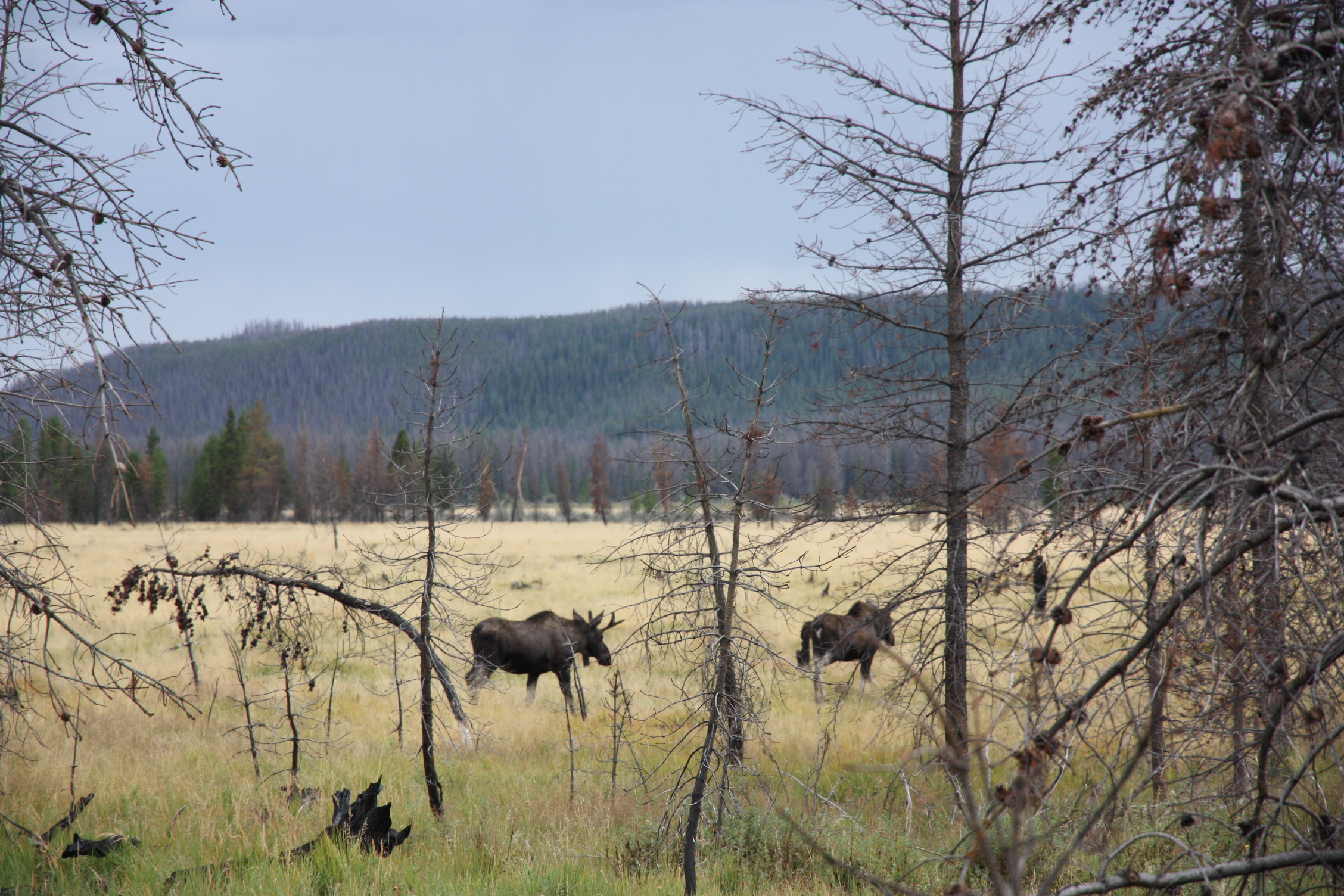
My first moose
We took the road to Boulder and on to Estes Park. Our first stop was at picturesque Boulder Falls, and then lunch at the Outlaw Saloon in Lyons. They were so accommodating there. Herbie, my friend’s dachshund, was allowed to sit in the pub’s outdoor area, which is technically a no-no, but we sat far from the main entrance. I had to order a reuben sandwich and beer, even though I was driving. The glass was enough reason to have a beer.
Then it was time for a serious cruise through the park for animals. There were plenty of birds—some too quick to photograph and some I don’t recognise. Cute chipmunks were out in force.
We spoke to two women who had been driving through the park since early morning and had yet to see any large animals. But less than a kilometre up the road we spotted three elk. Later we even saw two more doing an antler tussle.
Then the normally reclusive moose appeared, and then even more moose. The first one we saw—a female—had a young’un with her, but the babe was so sheltered in long grass that I couldn’t get a decent photo.
In addition to lingering over the beasts, we took a few walks to lookout points. And as we drove from the park, another couple of elk appeared. It was great day, topped off with a rainbow. Such a good day, that I’m wondering if maybe it was a movie set?
 Where to next?