
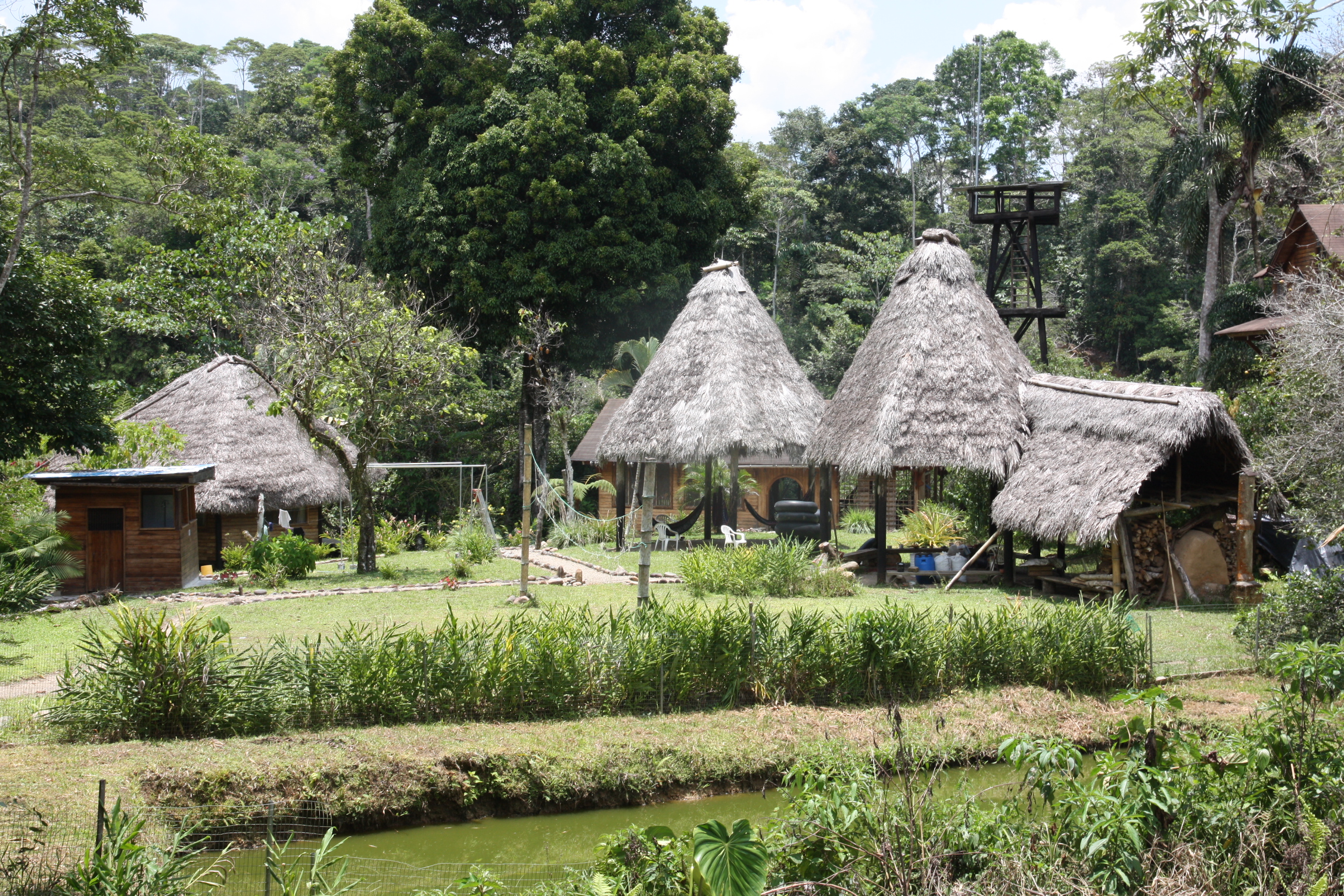
Not your typical farm view
It’s hard to imagine that we stayed on a farm in the Amazon. But Arajuno Jungle Lodge is definitely a farm.
Tom Larson bought the property 11 years ago when it was quite rundown, but he’s worked hard over the years to bring it back to life, raising his own chickens, fish, bananas, potatoes, herbs and other food stuffs. A lot of the produce is used for meals when guests stay at the lodge.
He’s also raising yellow spotted turtles so they can be released into the wilds of the jungle.
Tom gave us a tour of the farm as part of our recent stay. It’s hard to get pics of fish and turtles when they’re under water, but here are a few glimpses.
There’s also a pic of Tom’s communication system with the cyberworld. He runs his mobile phone up the tower, switches on a connection and is able to download his emails once a day. He has to go to town to view large emails, and that means a trip by boat to the bridge where the car is parked.
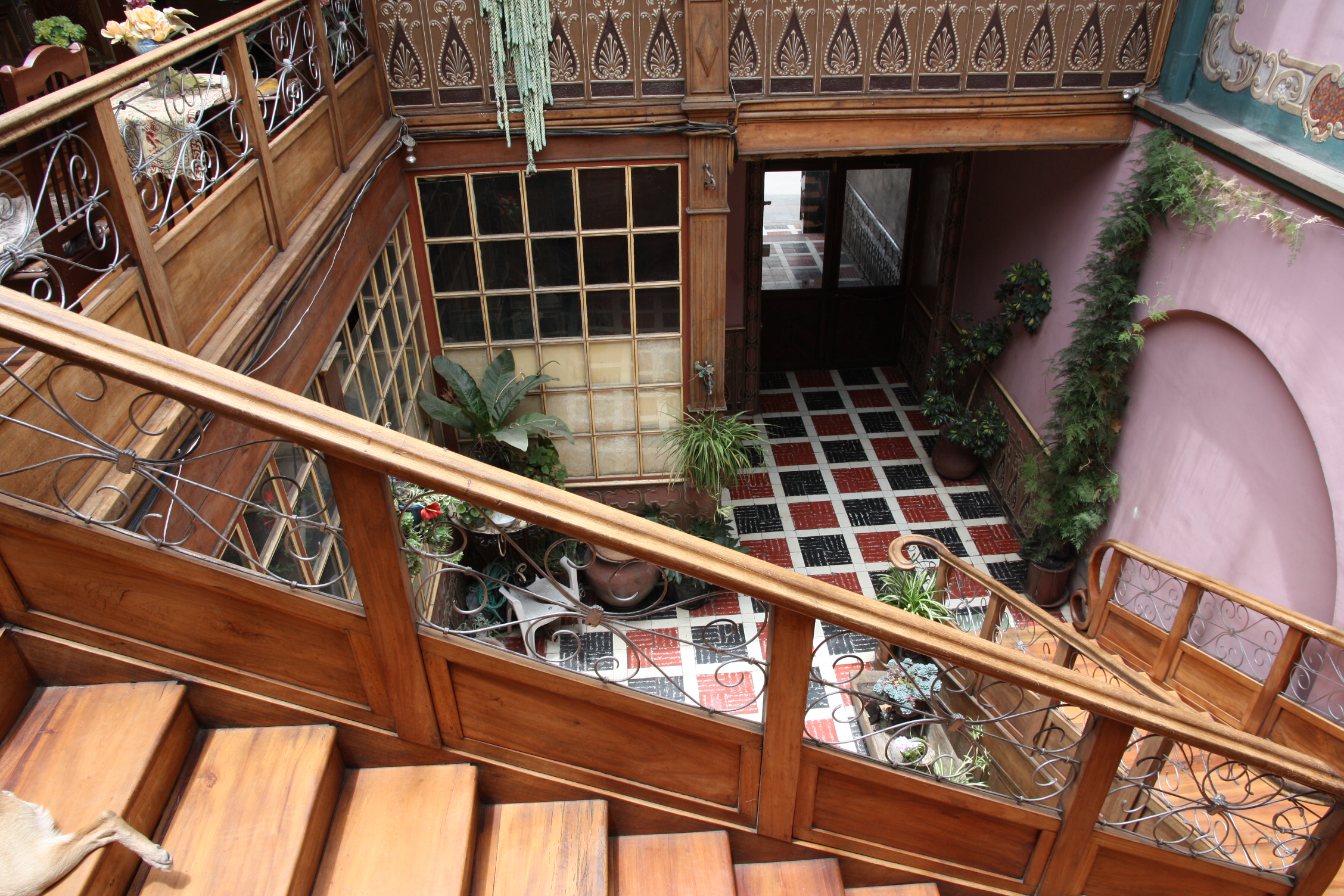
Looking down (toward the front door) into the tiled and glass-covered, foyer–courtyard
The woman in the tourist office in Cuenca told us to be sure to visit the National Museum at the far end of Calle Larga (Long Street).
It was a long street, so on the way we spent quite a while wandering along and exploring everything that looked interesting.
One ‘shop’ promised antiques and the sign said to ‘press the bell three times and wait’. The foyer was fabulous and I approached to take a picture. We didn’t plan to ring the bell, as antiques are usually just other people’s junk.
But a young woman at the top of the stairs spotted us and buzzed us in. A beautifully dressed, frail, older woman joined her and motioned to us to come up the stairs. In fractured English, she said her house was a museum (no name was posted and it’s not on the museum register). It was $2 a person to visit.
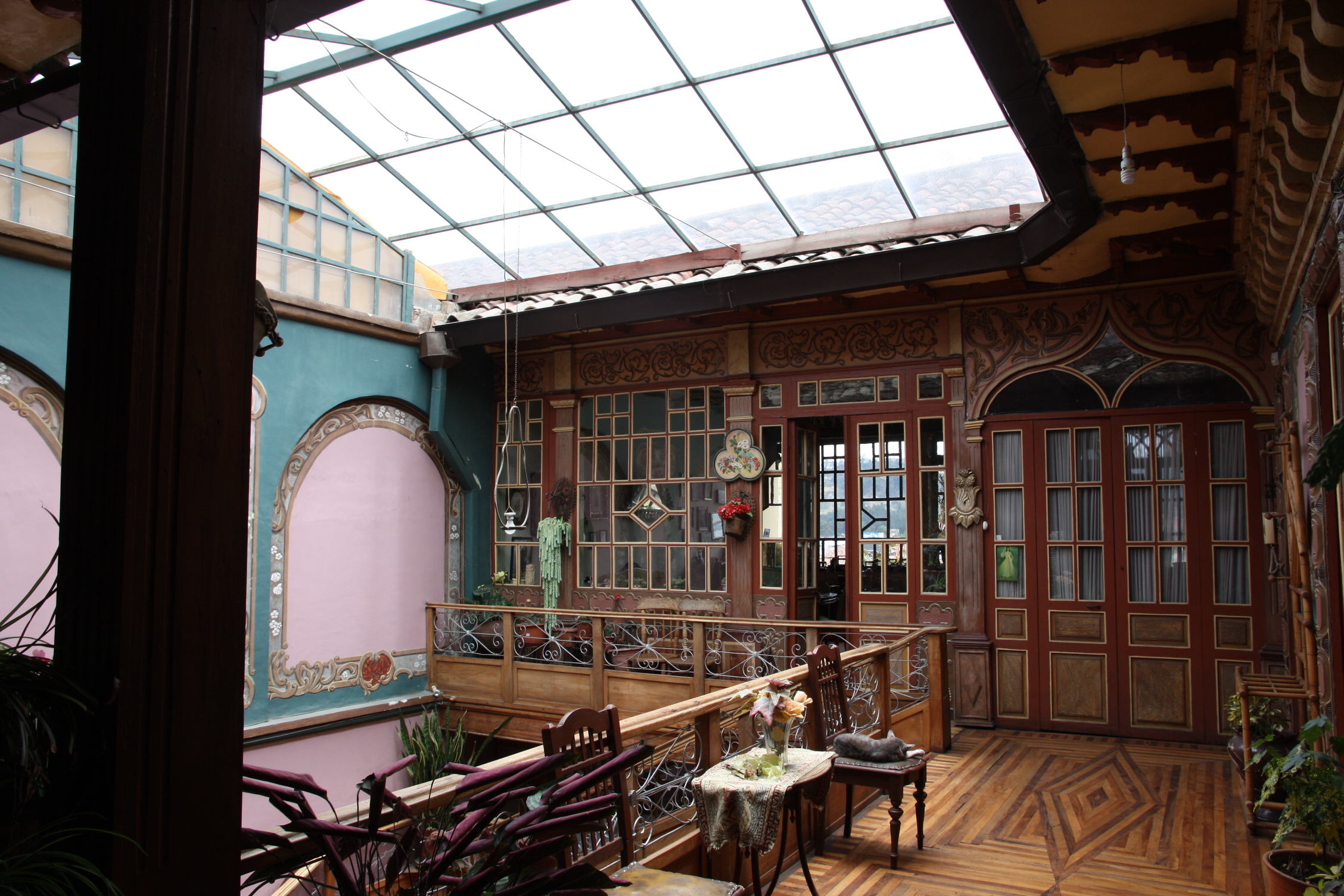
Upstairs in the foyer
This glass-covered, foyer–courtyard was so intriguing that we coughed up and let Her Ancientness explain the house and its contents in a sort of Spanglish that we could just make out. The younger woman, most likely a paid carer or relative, held the arm of our guide as we went from room to room.
This dresser is from Germany, this china is from France, these vases are from Vienna, the house is 190 years old, you can’t go in the bathroom because the ceiling is falling, the wallpaper is gilt, these pictures are of my ancestors. The house had belonged to her great, great grandfather. And on and on and on. I was spellbound.
It was okay to take pictures everywhere except the sitting room (where the gilt wallpaper is). The ceilings (those not falling down) were amazing. The pressed tin walls were beautiful and numerous. The paintwork was intricate. The view across the river and to the mountains beyond was spectacular, even if the windows needed a good wash.

Ornate pressed tin ceiling
Suddenly the time was up, and she led us back to the first room where it took about 15 minutes for her to rummage through her bag to find the $6 change for our $10. I suspect the admission serves as her retirement pension.
It really was a house of antiques and totally worth seeing. It is one of those places that will live in my mind’s eye. I wonder if it will ever make it to the list of genuine museums? I’ve included too many photos, but the house is too interesting not to share in the extreme.
Later in the afternoon, after we’d seen the main museum and as we strolled alongside the river, we looked up and saw the house from the back. It sits high on the hill and looks completely seedy. Makes you wonder what other gems might be in the dwellings along side.
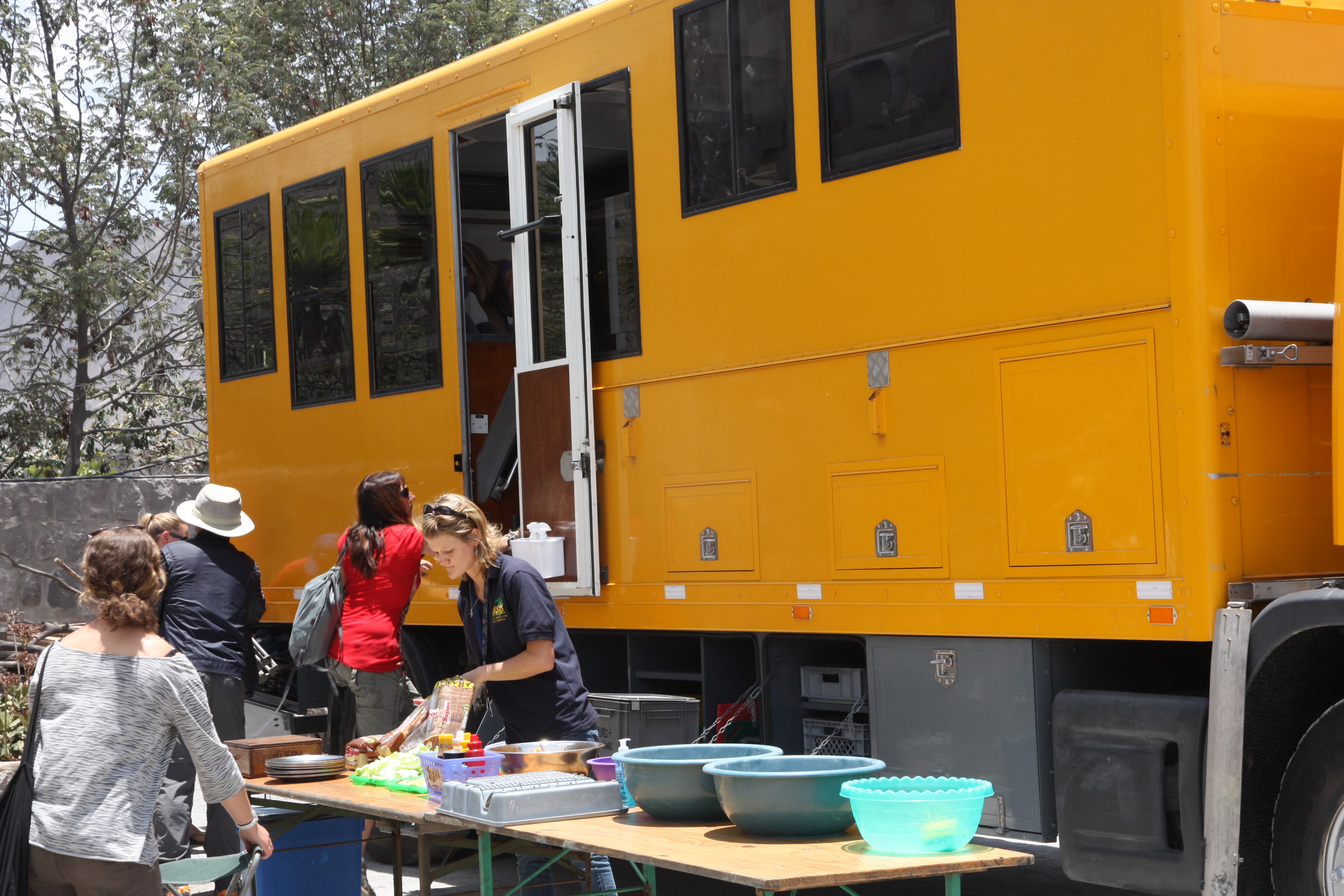
Sammy organises lunch, which is provided on long-drive days.
These days Sponge Bob and our tent are home sweet home.
Sponge Bob is a bright golden yellow Scania truck that is ferrying us around South America for the next three months. We started two weeks ago in Ecuador and are now in Peru for almost a month.
At the moment, there are 14 passengers, plus a driver and guide—Colin and Sammy. Eight more passengers join us in Lima, so 22 of our 24 seats in the back will be full. Speaking of the seats. Eight face forward and the rest face into the centre. Our backpacks are in lockers under our seats. And we have seatbelts.
Apparently Bob got his name because he’s square-ish and yellow. He seems quite happy carrying the load. He’s 12 years old, 3.8 metres tall and about 10 metres long. He’s a beefy fellow too—along with our gear and us, Bob weighs in at about 16 tons.
We’re so blessed to have Colin and Sammy as our crew. They did their first overland trip in Africa—as passengers—in 2009. Now they’re a couple and on they’re umpteenth, but last, overland as crew.
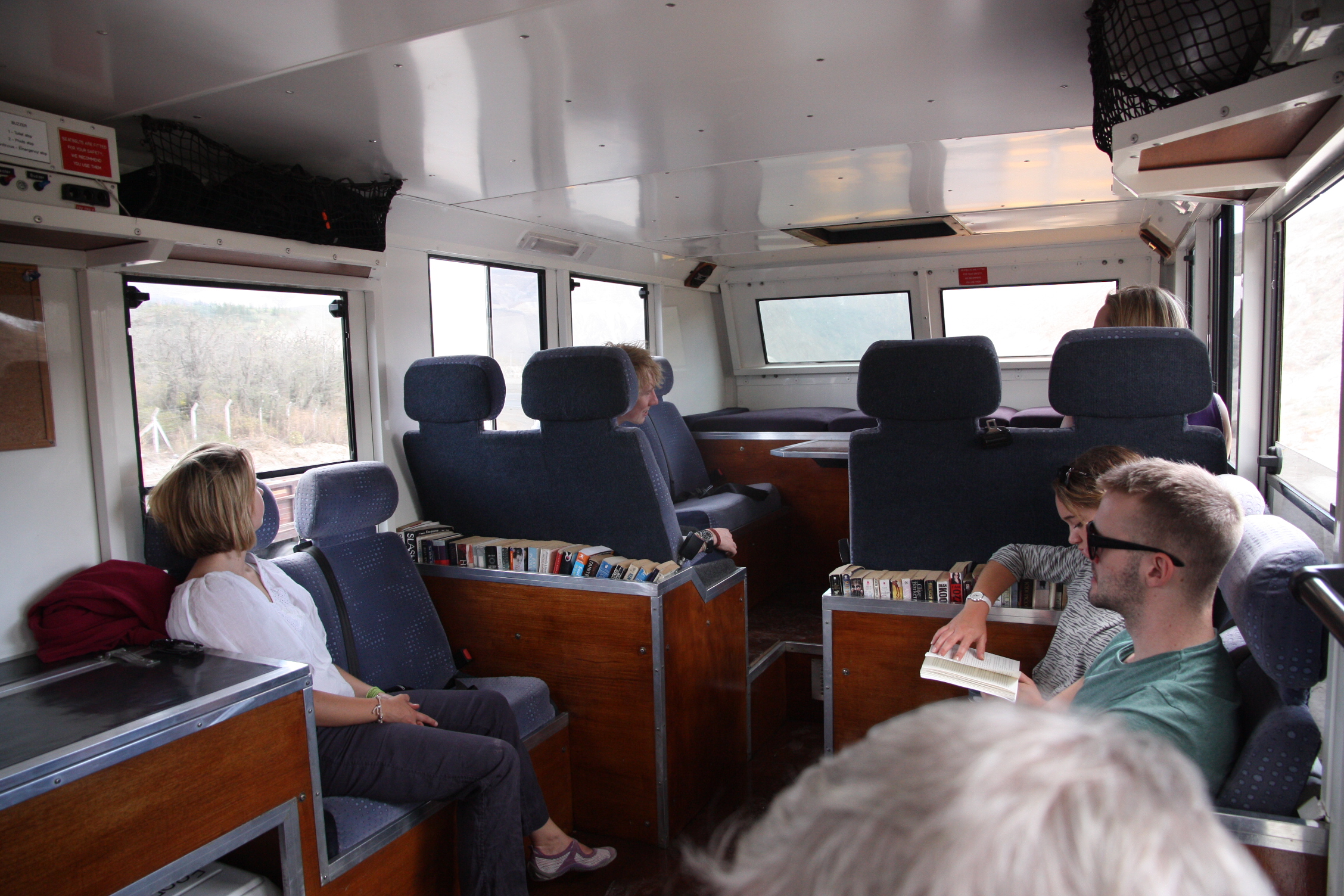
Inside Sponge Bob—at the front
Sammy is our great organiser. I hope she’s finding us a little easier to control than trying to keep kittens in a box. She speaks Spanish and a swag of other languages, so is a perfect support system in the markets and other places.
Poor John and I are the old folks on the trip, but feel totally at home. There are four Australians, one Korean and nine Brits. Everyone has entered into the spirit of communal living, so it’s all smooth sailing. Actually it’s rather bouncy in the back, but you know what I mean.
The tents—ours is tagged Ocelot 8—are my old favourites from South Africa. They’re Campmors. They’re spacious, water and mozzie-proof, sturdy, very easy to put up and you can almost stand up in them. We used the same kind on our African overland. The current ones have slightly different zippers, so should last longer. We hope!
This week we have about five nights in our tents. Fingers crossed that it doesn’t rain. It’s a total pain to pack away a wet tent.

Poor John and a Panama hat
Turn Poor John loose in a hardware store and you might not see him again for days. Who knew it was the same for Panama hats.
We spent our last few days in Ecuador in Cuenca, a city in the south and the true home of the Panama hat.
From the moment we walked into the first hat shop, I knew we would be going home with a Panama. Poor John tried to act nonchalant about it, but he had ‘I wanna Panama hat’ written all over his face. And, oh wow, do they suit him!
In the end, he bought a fine hat at the Homero Ortego Factory. If the photographs are to be believed, almost anyone who is anyone has bought their hat here. Mama Ortego is shown photographed with royalty, presidents, beauty queens, actors, actresses and more. Two especially notable Panama wearers on screen have been Father Mulcahy in M.A.S.H. and Julie Roberts in the racing scene in Pretty Woman.
Poor John’s purchase came at the end of a tour of the factory. We learned how the hats are made, the differences in quality and styles, the history of the name and more.
Here’s a very short rundown. The hats are woven from the plaited leaves of the toquilla straw plant. A very fine hat can take up to six months to weave—these cost about $300 each and Poor John did not get the top of the line. He didn’t get the bottom either. 🙂
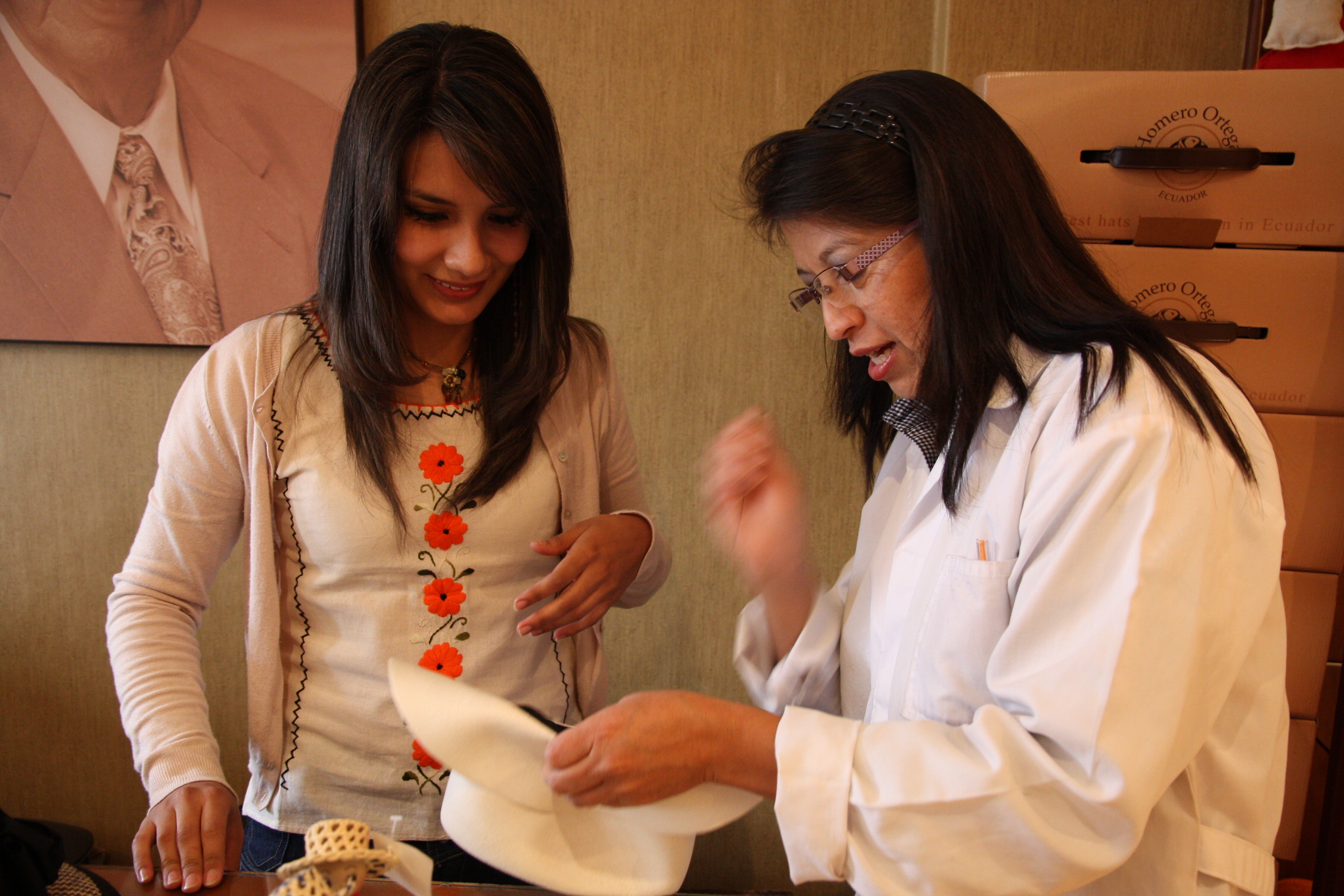
Poor John’s hat gets the final treatment
Today many hats are often started in a village—sometimes whole families work on hats—and then brought to the big city for blocking and finishing.
Cuenca began exporting hats in 1890. At that time, they were sent to the Ecuadorean port of Guayaguil for export. After the Panama Canal was opened, hats were shipped there for export. The name reflects the confusion between the place and port of origin.
All I can say is that after much trying-on and dithering, Poor John bought his Panama in Ecuador, and we watched the salespeople do the final work on his hat—namely sewing the hatband in place. The hat is now in its own box in the bottom of our locker on the truck. I bet he’s itching to wear it.
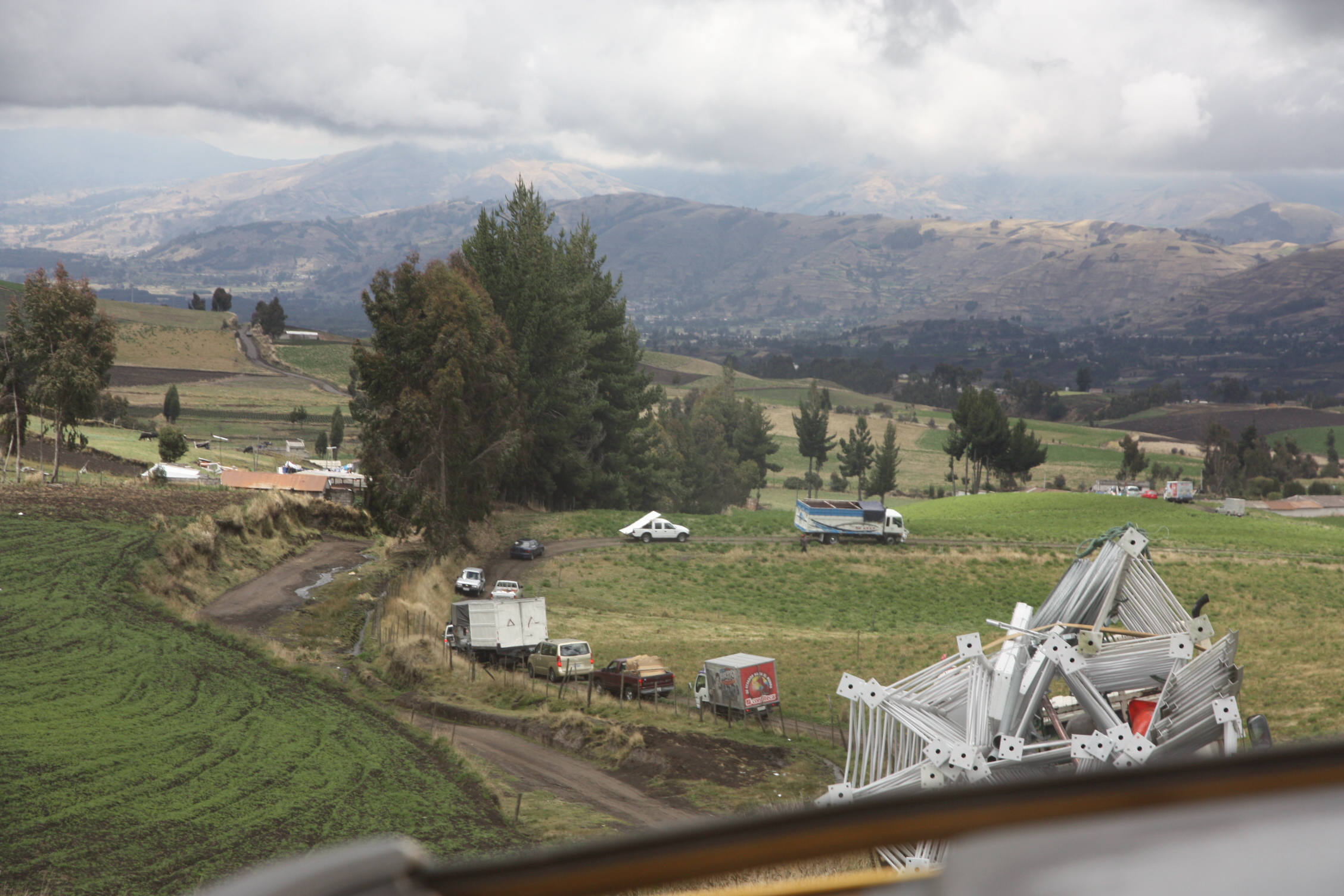
A conga line of detouring vehicles
Our truck was rolling along smoothly in Ecuador the other day when we suddenly came to a huge traffic jam.
Colin, our driver, didn’t take long to decide on another option. Quite a few vehicles were turning around—not to go back from where they came, but to follow a muddy track that avoided whatever was causing the back-up.
The detour track was very reminiscent of the rugged, potholed and uneven roads we encountered in Africa. In fact, it was better than many of the ‘normal’ roads we travelled in Africa.
Colin says the detour was only about 3 kilometres long, but it seemed much longer because we moved along so slowly. Some of the vehicles in front of us, especially the ones with low ground clearance, struggled in the wet conditions, but no one got stuck.
Poor John kept predicting that we’d meet a convoy coming from the other direction, but we never did.
About a kilometre before we rejoined the main road, we finally saw the cause of the hold-up. A tanker, carrying some sort of flammable liquid, had rolled off the road and was lying on its side down an embankment.
Cows grazed happily nearby, oblivious to the fact that the truck could ‘go up’ at any moment.
A crane was already on the scene, but the angle of the mishap made it seem unlikely it would get the truck out anytime soon. We lost less than an hour.
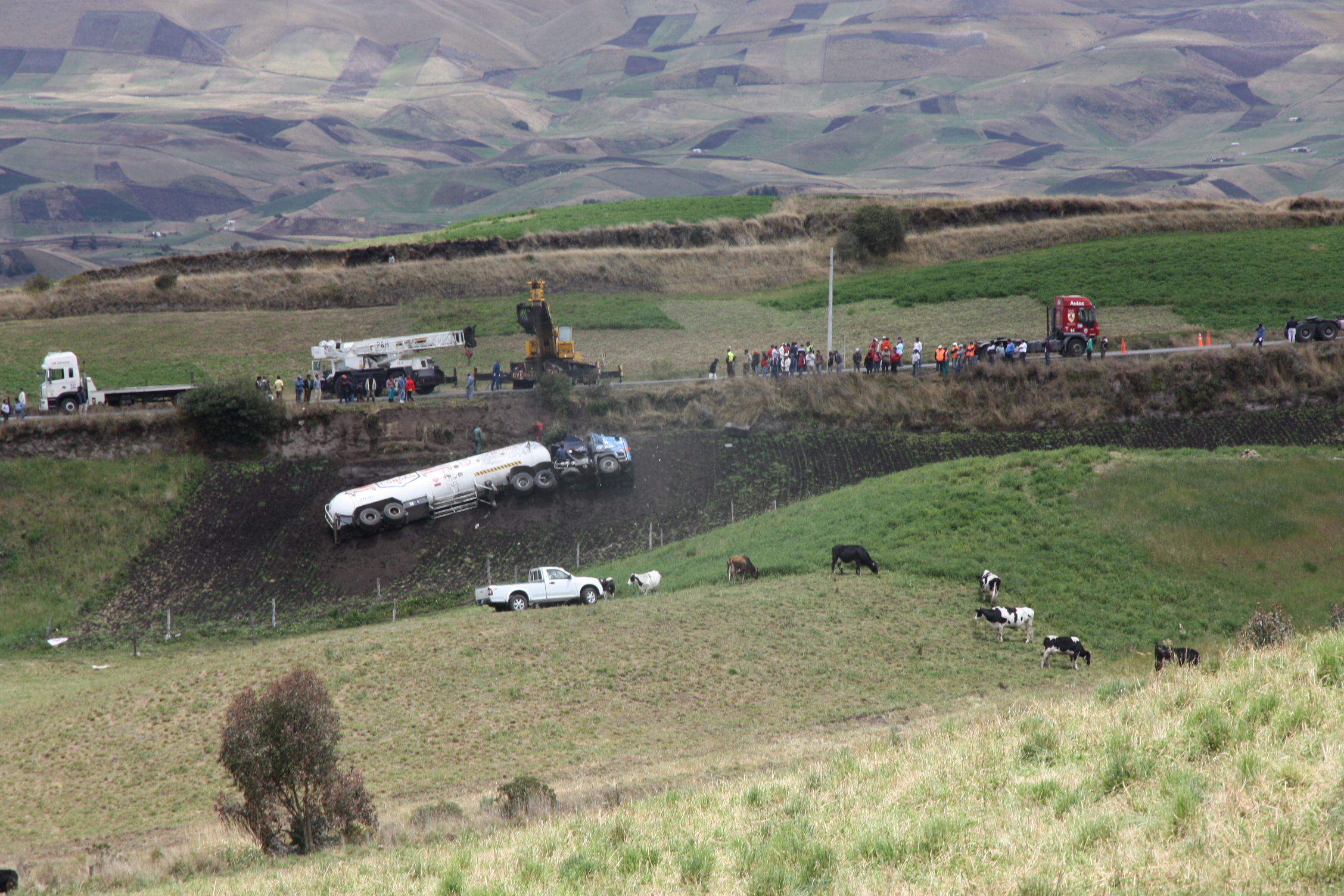
Tanker lies on an embankment while cows graze
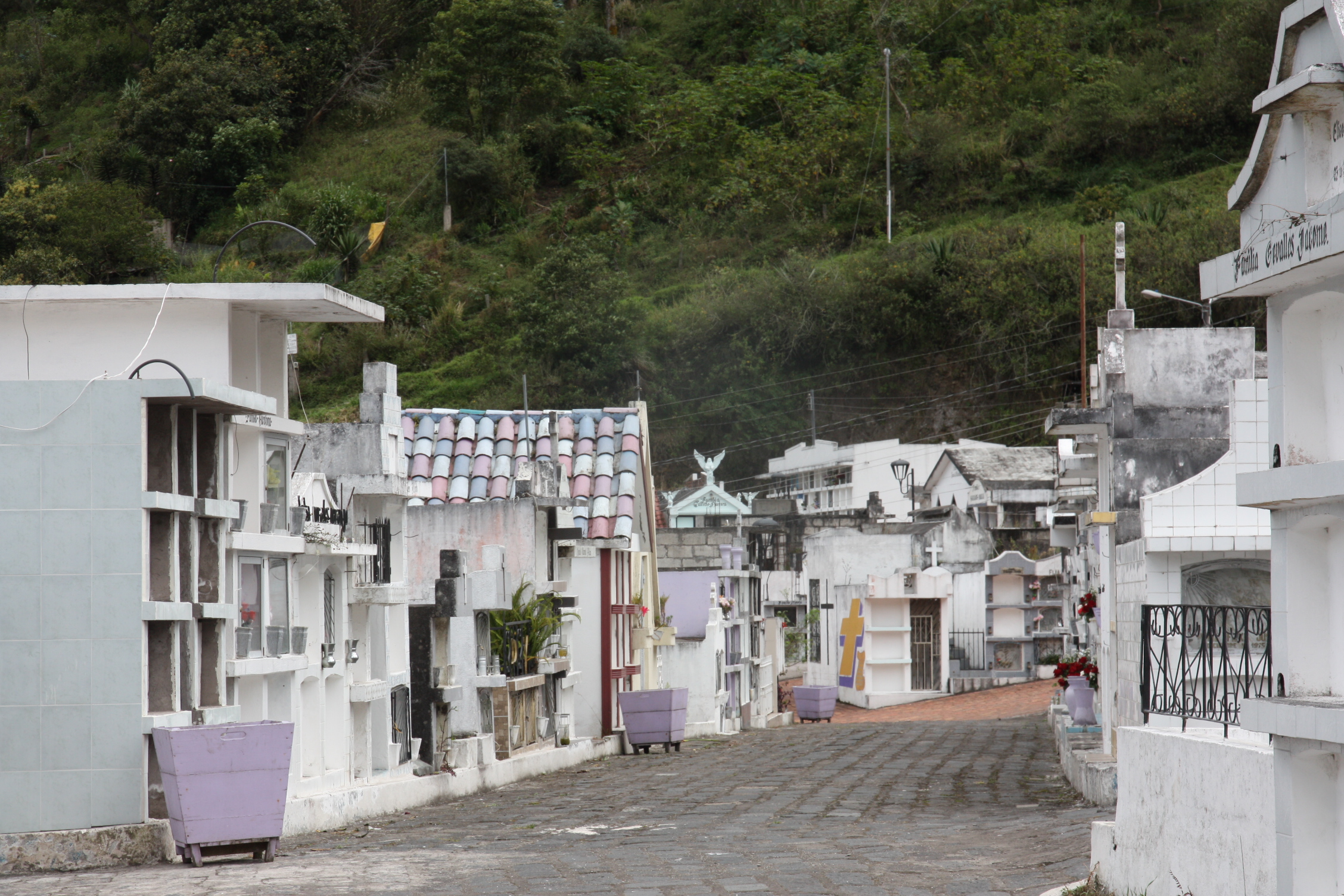
Village within a cemetery
A cemetery is a cemetery is a cemetery! Right? Wrong! In Ecuador it seems a cemetery is a proper community.
The other day, Poor John and I, along with fellow traveller Jong, wandered around the town of Baños in the Andean highlands.
We tried to get much closer to the local active volcano, but the clouds closed in and the road petered out, so we headed back to the centre of town.
On the way up, Jong had popped into a cemetery on a corner. He said it was quite beautiful and certainly worth a look. So in we went on the way down.
Wow, what a surprise! It’s like a miniature village, with graves and mausoleums butting up to the edges on both sides of paved roads. Some mausoleums look like small houses and the road is lined with mauve bins, just like a city street.
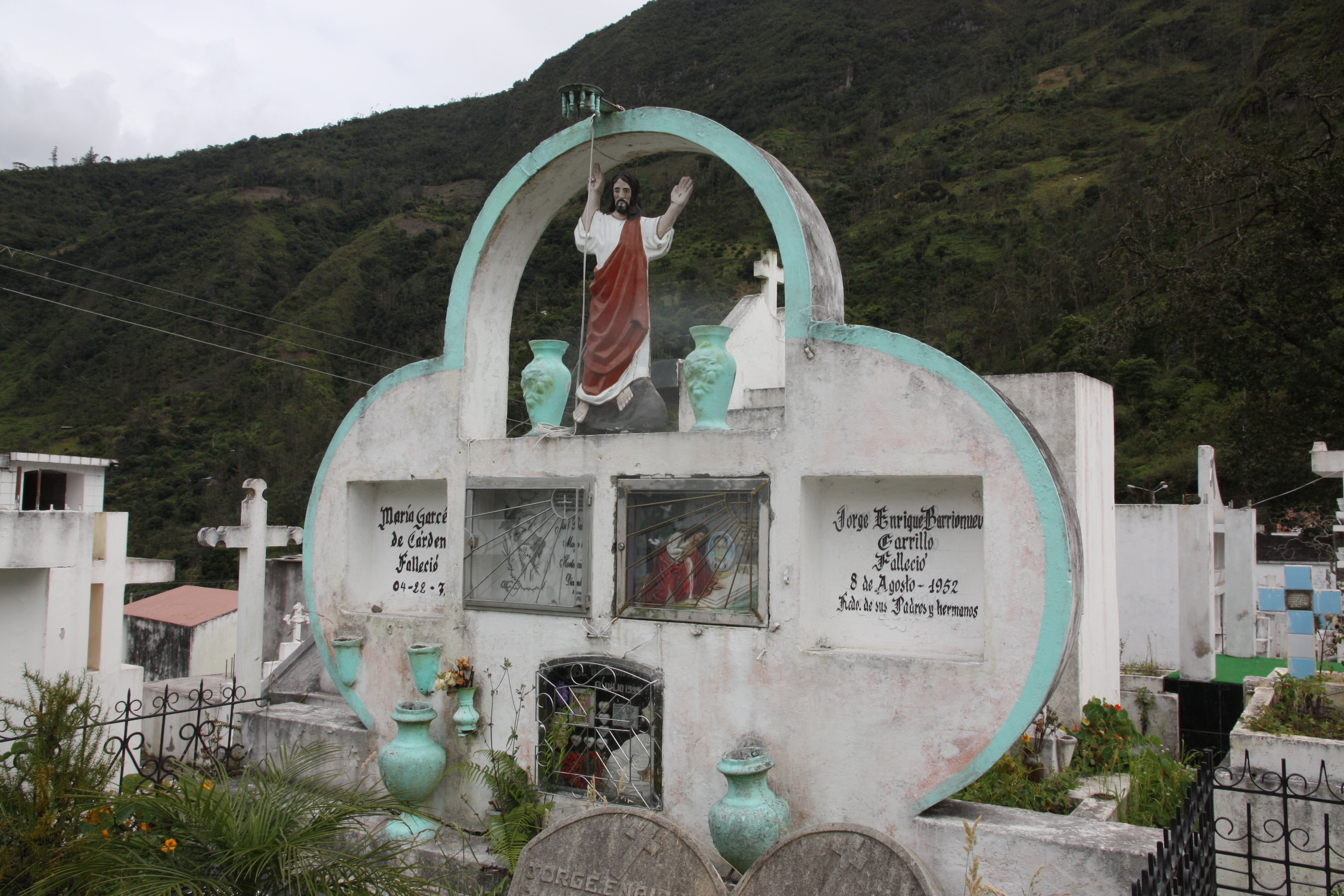
Family mausoleum in Baños cemetery
It seems to be all about family and groups here. Family names adorn most mausoleums, there’s lots of art, flowers and photographs. Some huge structures seem to be for members-only of certain organisations.
Perhaps this colourful and ornate ‘community’—united in death—is quite lively when nobody is looking.
I told Sammy, our guide, about the cemetery when we returned to camp. She says they are common in South America. The really big one is the Recolata Cemetery in Buenos Aires, Argentina. I’ll keep you posted.
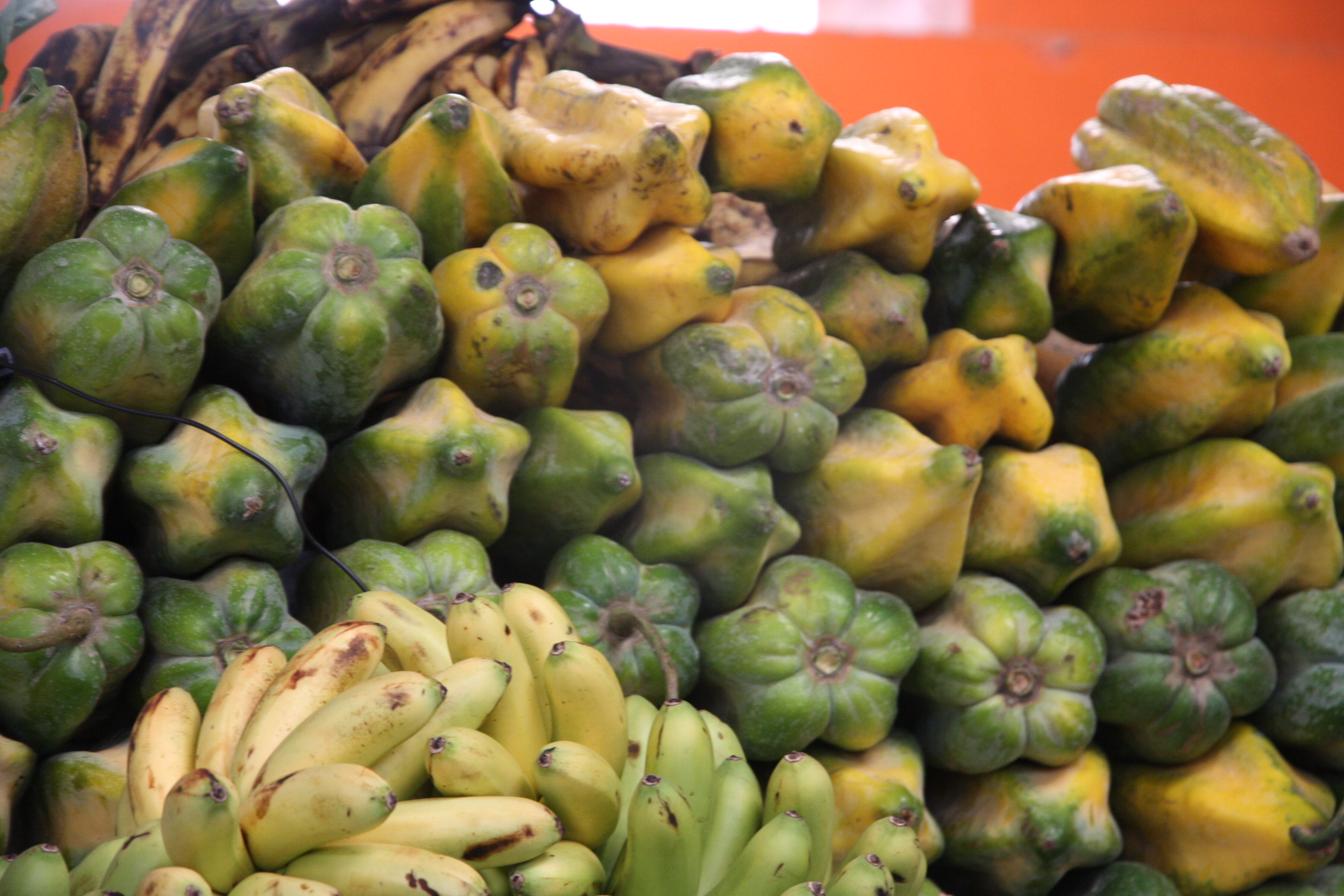
Babacos and yet more bananas
In my opinion, no trip to a city is complete without a swing through the local markets. We managed to go twice to the covered market in Baños—once for a look around and then a return for a delicious bargain lunch.
Every market I visit seems to offer up something I’ve never seen before, and Baños was no exception. For starters, all the butchers and fishmongers were women. They were a shy bunch and none of them wanted to be photographed face-on.
This is also where I saw the star-shaped papaya-type fruits that I have been hearing about but have never tried. Thanks to the waiter at the hostel where we are staying in Cuenca, I now know that it is called a babaco. Unlike a papaya, this fruit is seedless and the smooth skin can be eaten. It is said to have the tastes of strawberry, papaya, kiwi and pineapple. We’ll be the cook group again in a couple of days, so I’ll let you know as soon as I buy and taste one.
We also saw countless varieties of bananas, as well as yet another variety of passionfruit. This large golden one is called maracuyá in Spanish and it’s common across South America.
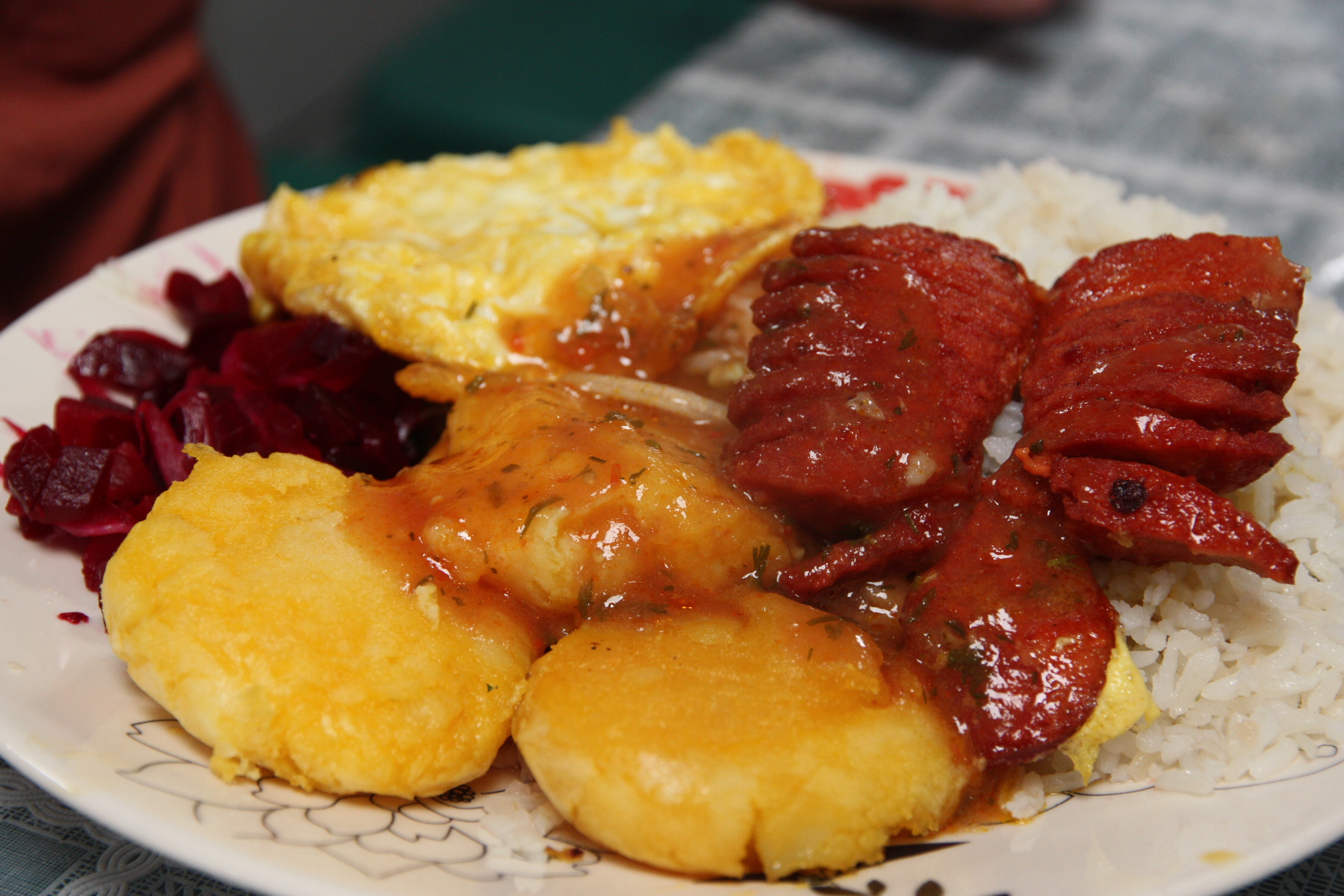
A hearty serving of llapingachos—typical Ecuadorean food
Lunch in the market was excellent. We arrived about the same time as hundreds of students being released from school, so there was hot competition for the limited seating. We hung back a bit until we were tempted by a menu advertising llapingachos. This is a typical Ecuadorean meal that we first tried in Quito. The Quito version cost $6.50 per person, but this equally delicious one was only $2.50.
The meal includes a chorizo sausage, rice, a fried egg, three potato pancakes and three varieties of salad—lettuce, tomato and beetroot. The woman who ran the stall threw in a special extra for the gringoes—a mixture of pork (we think) and beans.
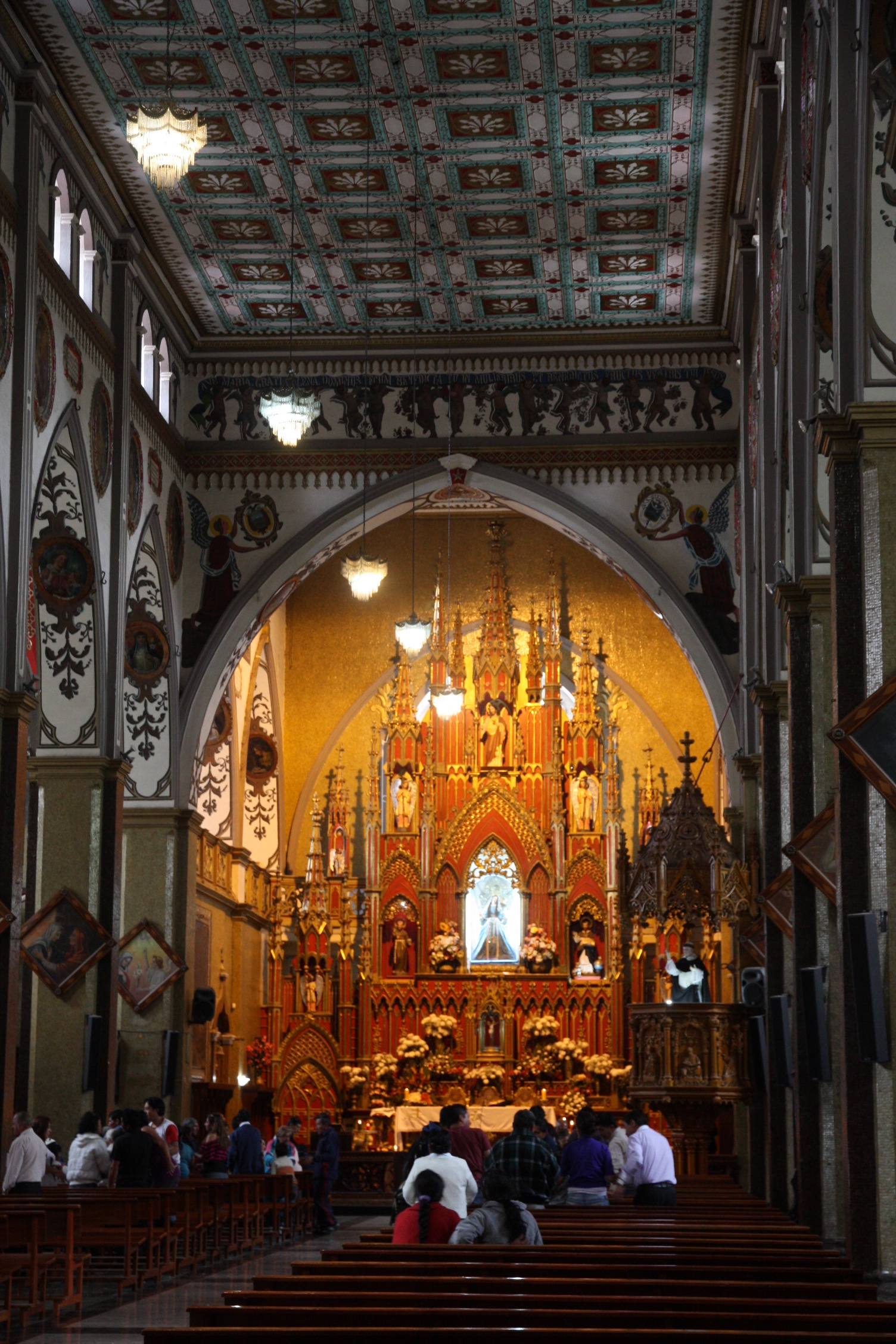
Church of the Virgin of the Holy Water
I have no idea how many churches we’ve visited on our travels, but I haven’t yet shared much about many of them.
One that caught my attention recently was the Church of the Virgin of the Holy Water, Nuestra Señora del Agua Santa, in Baños in the Andean highlands.
This is a place of pilgrimage and awe. Not long after Dominican fathers founded the small town, a clerk saw the image of the Virgin Mary, accompanied by two angels, leave the small hut that was serving as a church. She appeared to the priest the next night and said a church should be built so she could heal the sick.
The church was started in 1904 and completed 40 years later. It’s built of volcanic rock and in a Gothic style.
We visited on a Monday morning during a Mass (there are 29 services each week with nine on Sundays), so were reluctant to roam the interior. We were able to admire the beautiful artworks on the wall and ceiling, and to see the many murals depicting miracles by the Virgin.
These included scenes of a car accident, a horse and his rider falling from a cliff, fires and many eruptions from the Tungurahua volcano.
The church serves as a place of shelter during eruptions. It is said that people stay in the church come out unscathed.
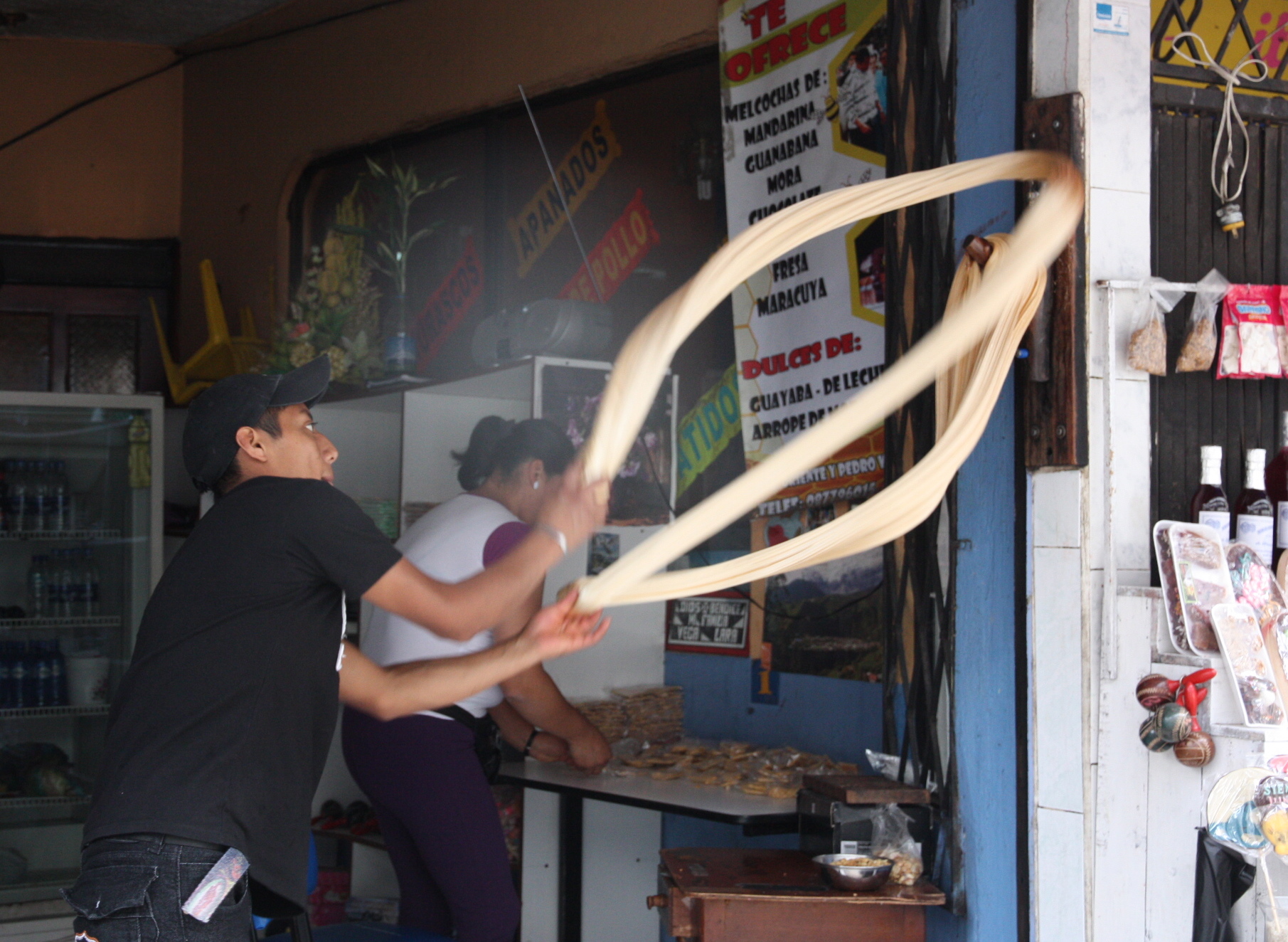
Taffy pulling—an important job in Baños
A 50-cent bus ride got us from our campground to Baños, a popular tourist town in central Ecuador.
Poor John and I, along with fellow traveller, Jong, walked out to the road and literally waved down the next passing bus. We scored an already full bus, so stood for the 25-mintue ride to town.
The scenery in the Andean highlands is impressive, even if we had to hunch over a bit to see out the windows. Plenty of mist (we were in the Cloud Forest), lots of waterfalls, steep slopes, many fields being cultivated and beautiful green pastures filled with cows that probably have two legs shorter on one side—how else can they cling to the cliffs?
Baños is officially known as Baños de Agua Santa (Baths of Holy Water). It lies in the shadow of the still active Tungurahua volcano. Everywhere we saw signs indicating which way to run if the volcano started playing up, but the most noise we heard was barking dogs and the laughter and chatter of kids getting out of school.
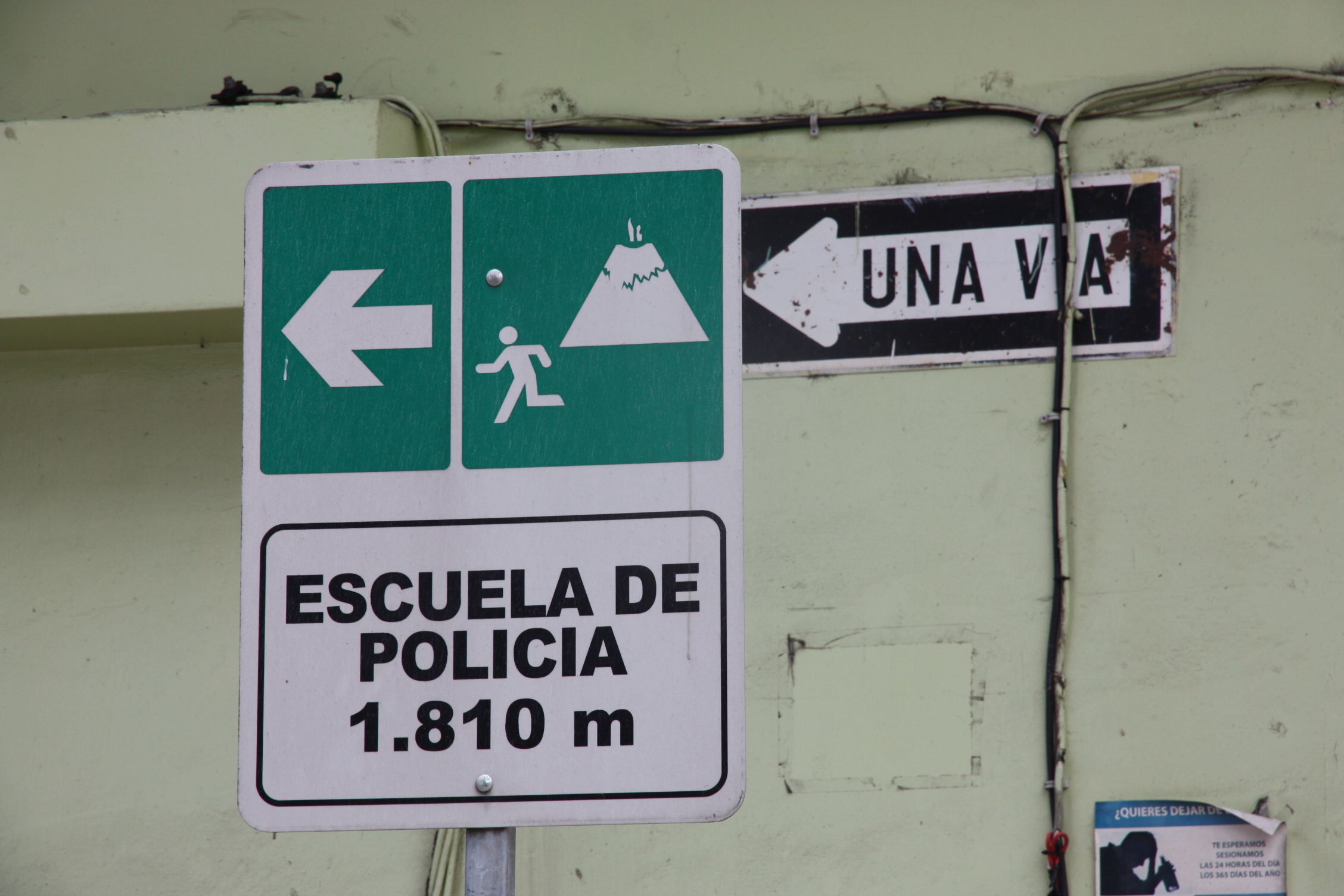
In case of a volcano—RUN!
We spent most of the day walking around town, but resisted offers to have massages or baths. We walked a long way to get a better view of the volcano, but the cloud corner and absence of a path put a stop to that quest. We did, however, see several of the famous taffy/toffee pullers.
We also explored the main church, the food market and the most unusual cemetery I have ever seen. Stay tuned for more instalments.
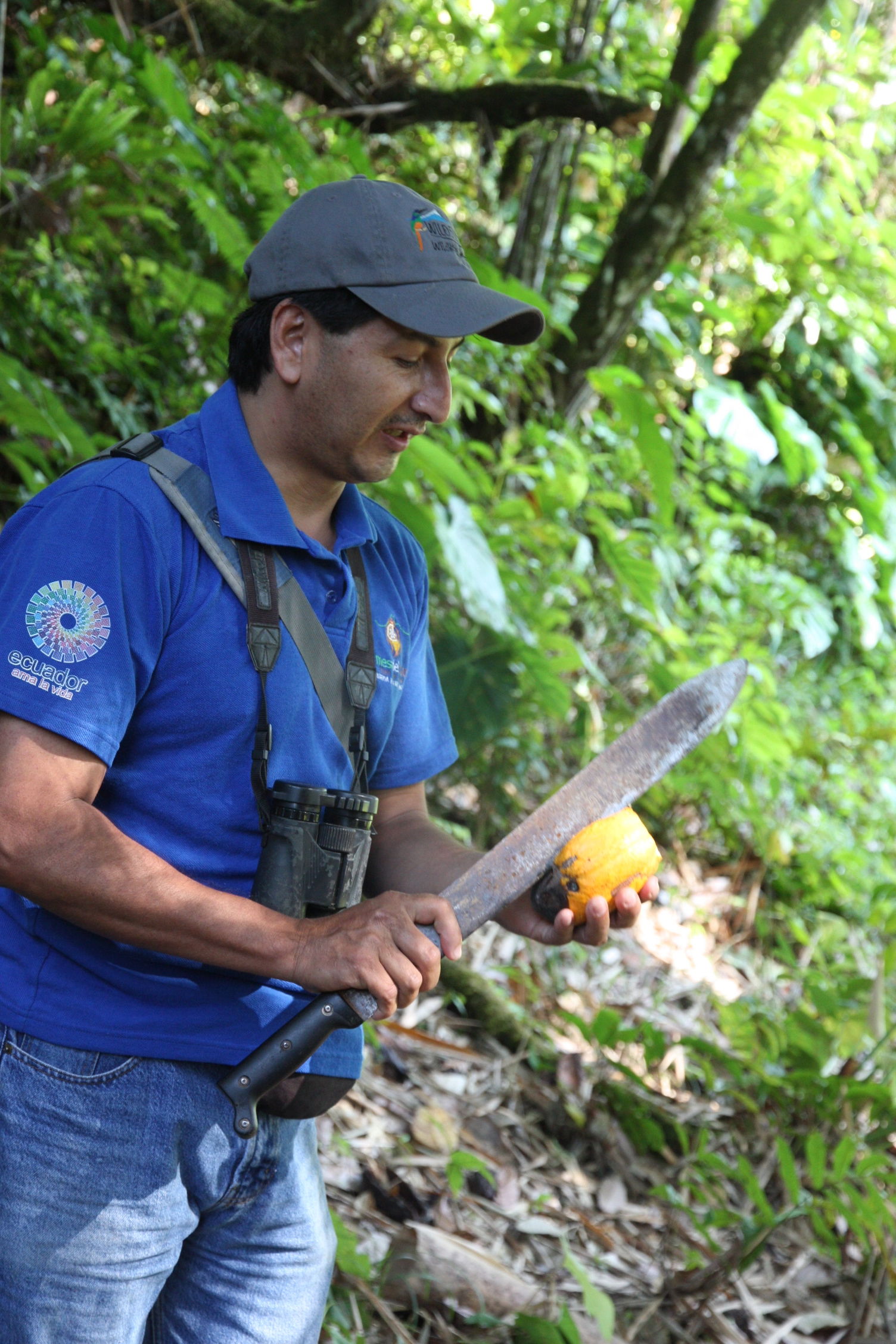
William uses his machete to open a cacao pod
We had two walks—one in the morning and one at night—in the Amazon headwaters as part of our stay at Arajuno Jungle Lodge.
William, who has worked many years in forestry in the Amazon headwater, guided us for the daylight walk. I loved the way he said we’d walk uphill for ‘a bit’, and then on level ground for ‘a bit’ and then downhill ‘a bit’.
As I struggled up and/or down yet another vertical slope, I prayed that I wouldn’t do a version of the splits and tear the backside of my trousers or undies. By clinging to my walking stick, any branches I could reach and Poor John when he stood still for long enough, I managed to stay upright for the entire 3-hour jaunt.
When asked what was her favourite part of the trek, Jane, a fellow overlander, said it was the fact that it lasted for only three hours rather than the predicted three and a half. 🙂
But seriously, it was fascinating. William really knows his stuff and makes the jungle come alive. Mind you, the bugs and other critters do their bit to make the forest throb. He took us through both primary and secondary forest—the differences being aspects such as the size of the plants (primary forest is bigger and older), the amount of undergrowth and such.
We learned about plants that throw seeds once in a life time, the secret life of certain ants (they’re brewing for a big change come the full moon), plants that ‘walk’, what the inside of cacao pod looks like, and much more.
As usual, I took way too many photos. Some can’t be shared. It’s hard to capture a bustling ant trail or a web filled with tiny spiders. But I hope you enjoy this selection.
P.S. There are no photos from the night walk led by our host, Tom Larson, of Arajuno Jungle Lodge. Too dark!
 Where to next?