
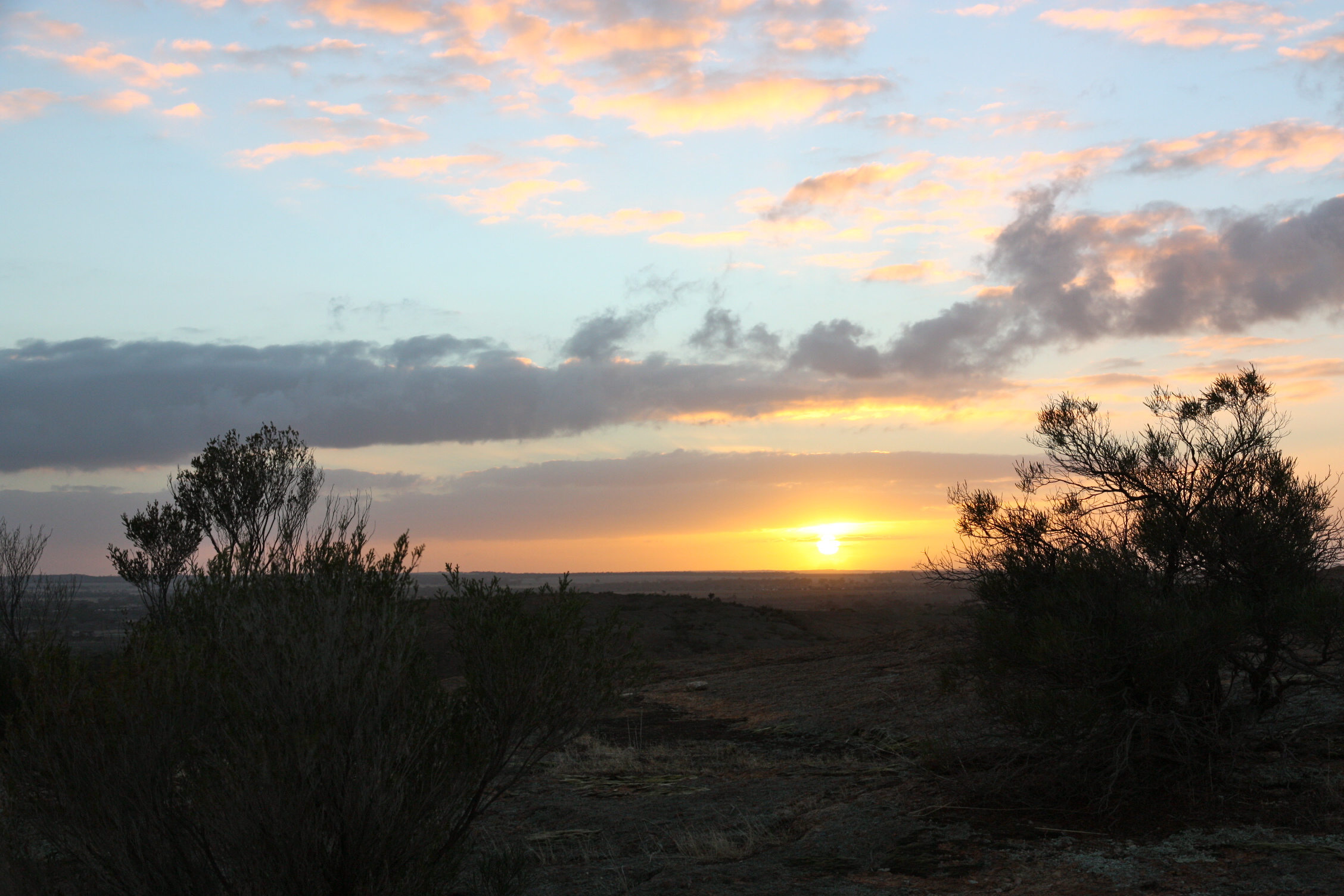
Sunrise at Hyden Rock
Hyden and Wave Rock made for a fabulous stop in Western Australia. Unfortunately, or according to Poor John fortunately, not many people visit the place, only 140,000 visitors per year. We got here by driving 300 kilometres west from Norseman on a well-maintained dirt/gravel track, known as the Granite and Woodlands Discovery Trail.
Science says that Hyden Rock, of which Wave Rock is a part, has an ancient history—going back an unimaginable 2.64 billion years.
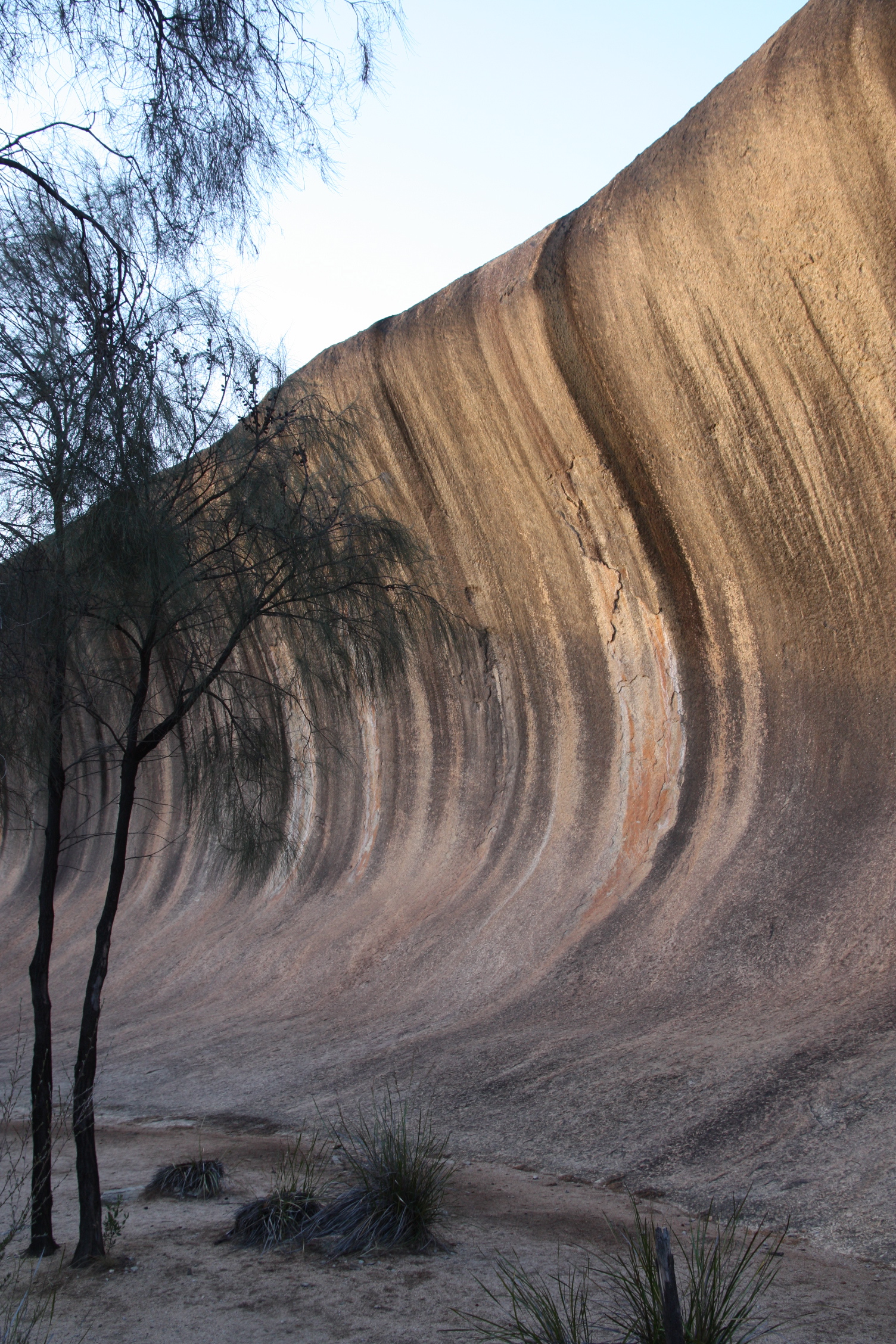
Wave Rock
Wave Rock is a flared slope. At 14 by 110 metres, it’s the tallest and longest flared slope in the world. It’s estimated to be 120 million years old, and has supposedly been exposed for about half of that time. I won’t go into a long explanation, but water and erosion (but not an ocean) have played a big part in creating Wave Rock’s flared slope that is visible today. Tiny lichens, mosses and algae have created the colourful stains on the wave face.
While the face itself is very impressive, it’s equally interesting to climb the still bigger Hyden Rock. There are plenty of plants, rock formations and views—plus a gorgeous sunrise. So we crawled out of our tent bright and early to make the climb. It had rained some over night, so every indentation was brimming with water.
Fortunately, the rock itself had dried out, because it’s quite slippery when wet, which we discovered when we tried to climb it the day before.

Low barriers channel water into the Wave Rock dam in the background
Water is a precious commodity in the Hyden district—the average annual rainfall is a mere 337 millimetres (13 inches).
But in 1928, the whole rock became a water catchment for the community. Low barriers were built around the edges of the rock face, and these help to channel rainwater into Wave Rock dam, which is to one side of the rock. The dam’s capacity was increased in 1951, and it can now hold almost 30,000 cubic metres.
Of course, all the indentations on the rock collect dirt as well as water, so we were quite surprised to see just how many different plants manage to grow. There are also quite a few rocks on the rock, that have weathered to interesting and colourful shapes.
All in all, a fascinating place to explore. Plus, the information sheets say most of the development for Wave Rock occurred underground, and there is speculation that a new wave is forming beneath our feet. I must remember to tell my great-grandchildren to tell their great-grandchildren to be on the lookout for a new wave.
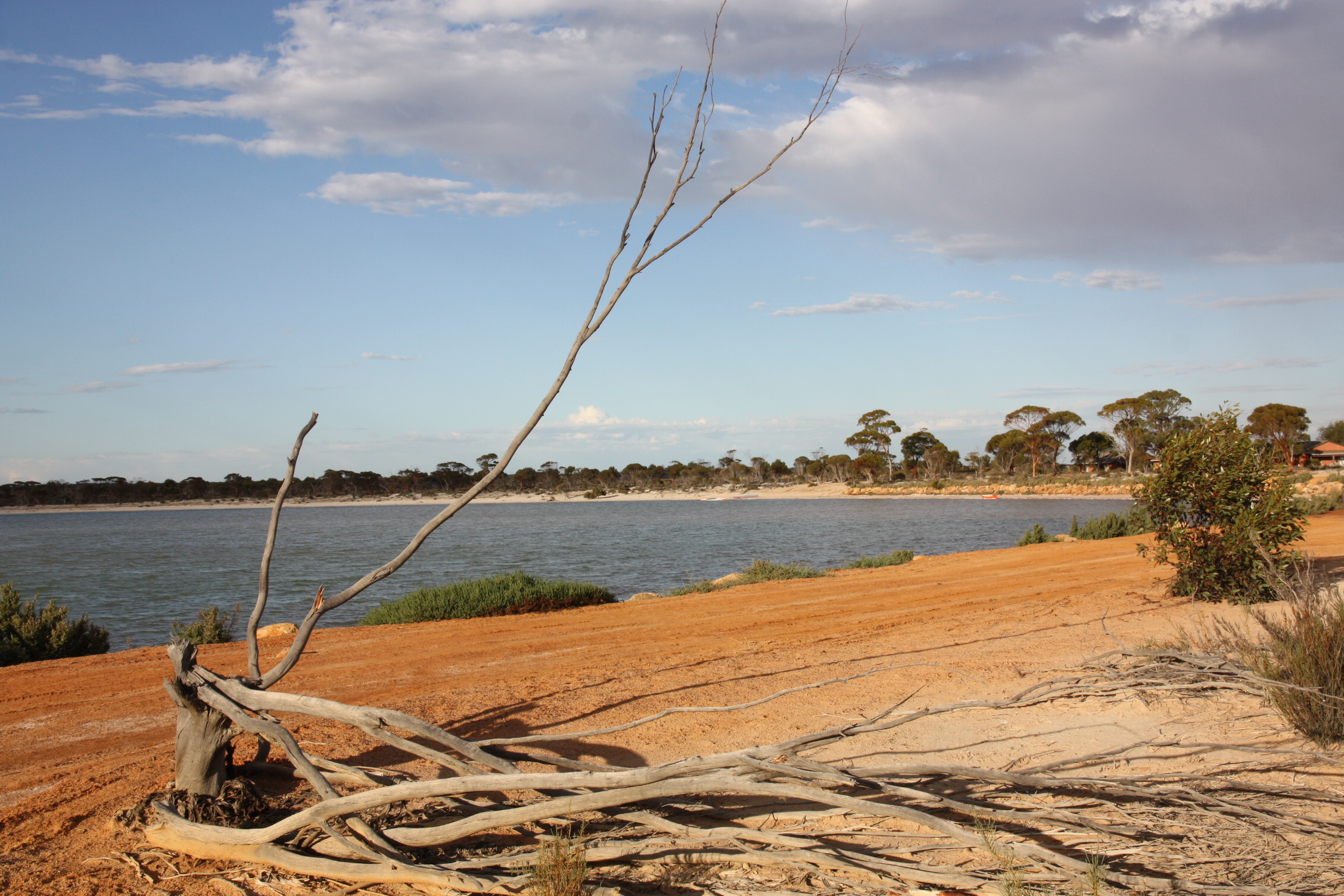
Salt lake near Wave Rock
Hyden and Wave Rock were our next stop, and what a worthwhile detour this was.
The rock is located at the west end of the Granite and Woodlands Discovery Trail and about four-hours drive east of Perth. It is a natural formation that is shaped like a giant surf wave. It’s about 14 metres (47 feet) high and 110 metres (350 feet) long.
The multi-coloured wave, which is culturally significant to Aboriginals, forms the north side of a solitary hill, know as Hyden Rock. The rock and nearby small town of Hyden were named in the 1880s after a Mr Hyde, who was a local sandalwood cutter. How, you ask, does Hyde’s Rock become Hyden Rock? A typo. In those early days, the person responsible for maps misread the name, and its been Hyden ever since.
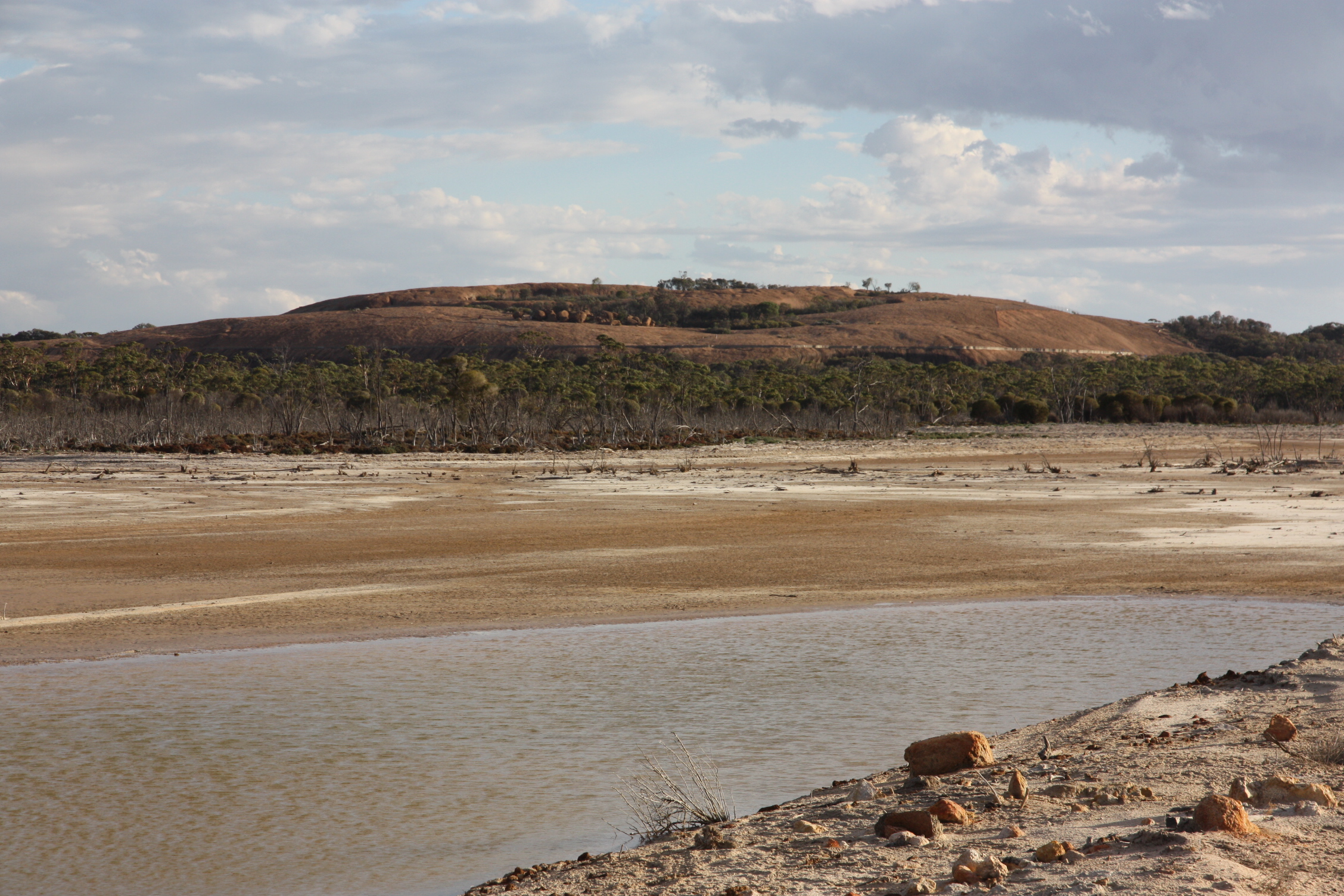
Hyden Rock in the distance across the salt lake.
The wave and hill are a granite inselberg, and part of a 160-hectare nature reserve call Hyden Wildlife Park.
Poor John and I arrived two hours before dusk. After checking out the salt lake near the rock, we went on to the local campground. We put up the tent, and set out to climb the rock, but it started to rain. Trust me, that rock is slippery in the wet, so we clambered down and postponed the climb until sunrise. And what a great climb is was.
We were surprised to read that the rock gets a mere 140,000 visitors each year. What a shame, as it’s really worth a stop. Maybe it’s just too far into the middle of nowhere.

Granite and Woodlands Discovery Trail
After taking an introductory stroll on the Woodlands Walk in Western Australia, we headed west on the Granite and Woodlands Discovery Trail. We were surprised and pleased to find that we were virtually the only traffic on this gravel track that runs from Norseman to Hyden (and Wave Rock).
According to the information boards, nowhere else in the world do so many different tall trees grow in such an arid zone. The Wilderness Society says the Great Western Woodlands ‘is the biggest and most intact remaining wilderness area of its type in the world.’ More than 50 kinds of eucalyptus grow in the Kalgoorlie region alone, and 80 of Australia’s 500 species of eucalyptus grow there.
Overall, the woodlands cover more than 250,000 square kilometres (about 100,000 square miles and larger than England). The geology and rainfall vary across the woodlands with Norseman, for example, receiving an annual average rainfall of just 250mm (less than 10 inches).
Sixteen stops (with explanatory panels) have been placed along the 300-kilometre-long trail, with Disappointment Rock being the largest stop. We spent most of an afternoon travelling the trail and exploring various stops. In the two weeks or so we spent in the Perth area, I didn’t meet anyone who had been along the trail, so it really is a road less travelled.
Be sure to check out what’s cooking on page 32.
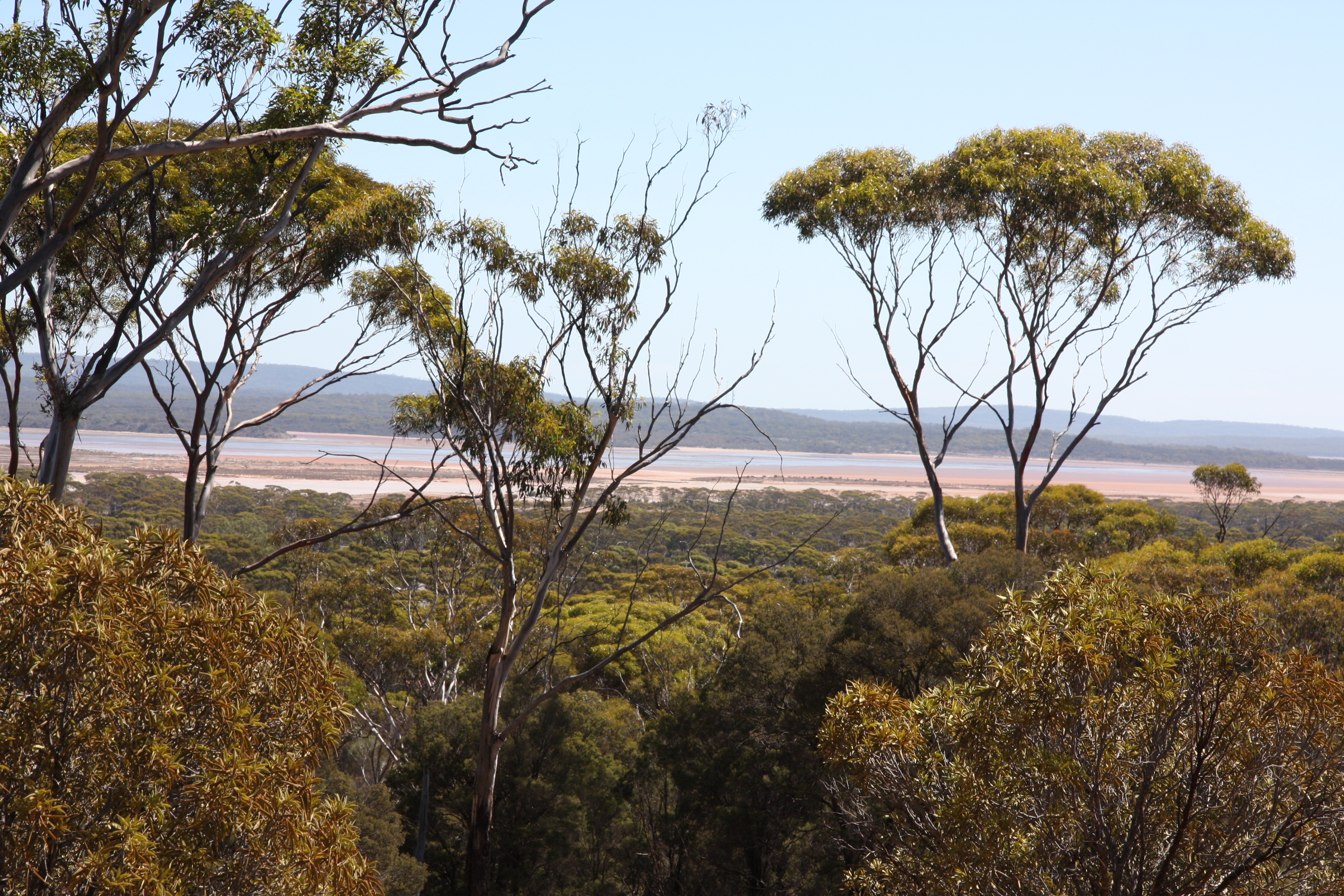
A view from the Woodlands Walk over the salt lakes of Norseman
Every day of this trip brings a new surprise. The landscape and vegetation have been much more varied than I expected, and I’m constantly encountering places I’ve never heard of before.
Take Norseman, for instance. This small town is about one-third of the way across Western Australia. We reached it not long after coming to a curve on the 90-mile Straight. We stopped for petrol and some advice about taking the gravel track to Wave Rock.
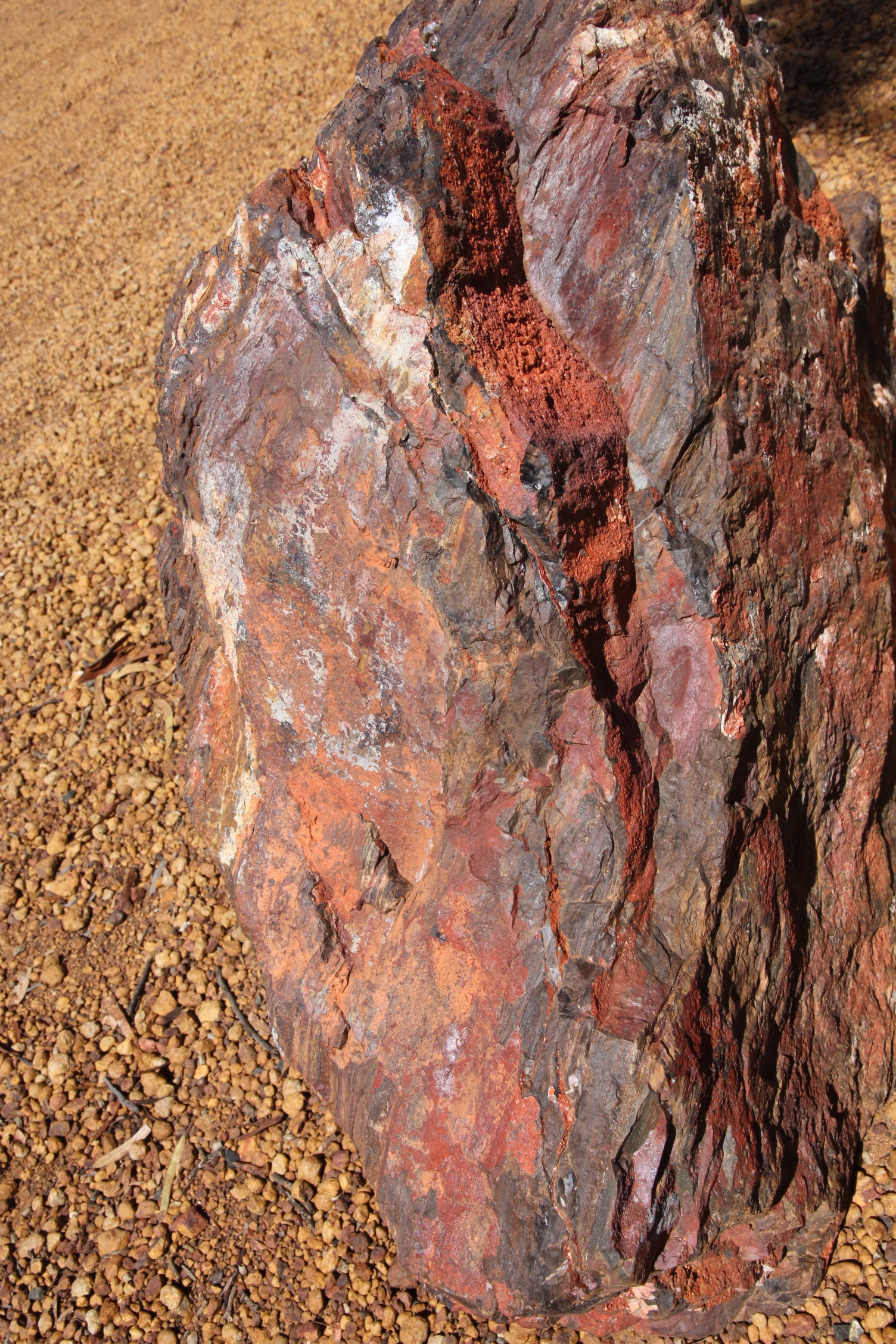
Granite on the Woodland Walk
The fellow at the service station urged us to go on the Woodlands Walk (Stop 16 of the Granite and Woodlands Discovery Trail). And we’re so glad we did.
The walk is a small introduction to the surrounding eucalyptus woodland that is one of the world’s greatest remaining untouched temperate woodlands. It takes about 30 minutes and includes explanatory panels that also tell about the culture of the Ngadju, the local Aboriginal people.
All the pictures here are from the walk.
See the Discovery Trail for pics and details about the next 300 kilometres of woodlands, as we drove west to Hyden (and Wave Rock).
Also, be sure to check out what’s cooking on page 32.

Welcome to the start of the 90 Mile Straight
Australia’s longest straight road is in the middle of nowhere in Western Australia. Heading west, it runs from Caiguna to Balladonia through the Nullarbor Plain.
It’s 90 miles or 146.6 kilometres of dead straight road that really isn’t all that boring.
The night before, we’d found a very nice spot to camp not far from Caiguna, so were well-rested when we hit the long stretch the next morning.
There really isn’t much to say about the road. It is usually called the 90 Mile Straight, which sounds better than the metric version. I don’t recall there being a single passing lane. There are a couple of curves as you come out of the 90-mile stretch and then it’s straight again, just not for as long. The speed limit is 110 kph, which is about equal to 70 mph.
There is enough variety in the vegetation to keep it interesting. Aside from some of the big rigs, there wasn’t a lot of traffic, but we were surprised to see quite a few bicyclists with the strength, courage and water needed to tackle the Nullarbor.
By the way, don’t forget to check what’s cooking on page 32.
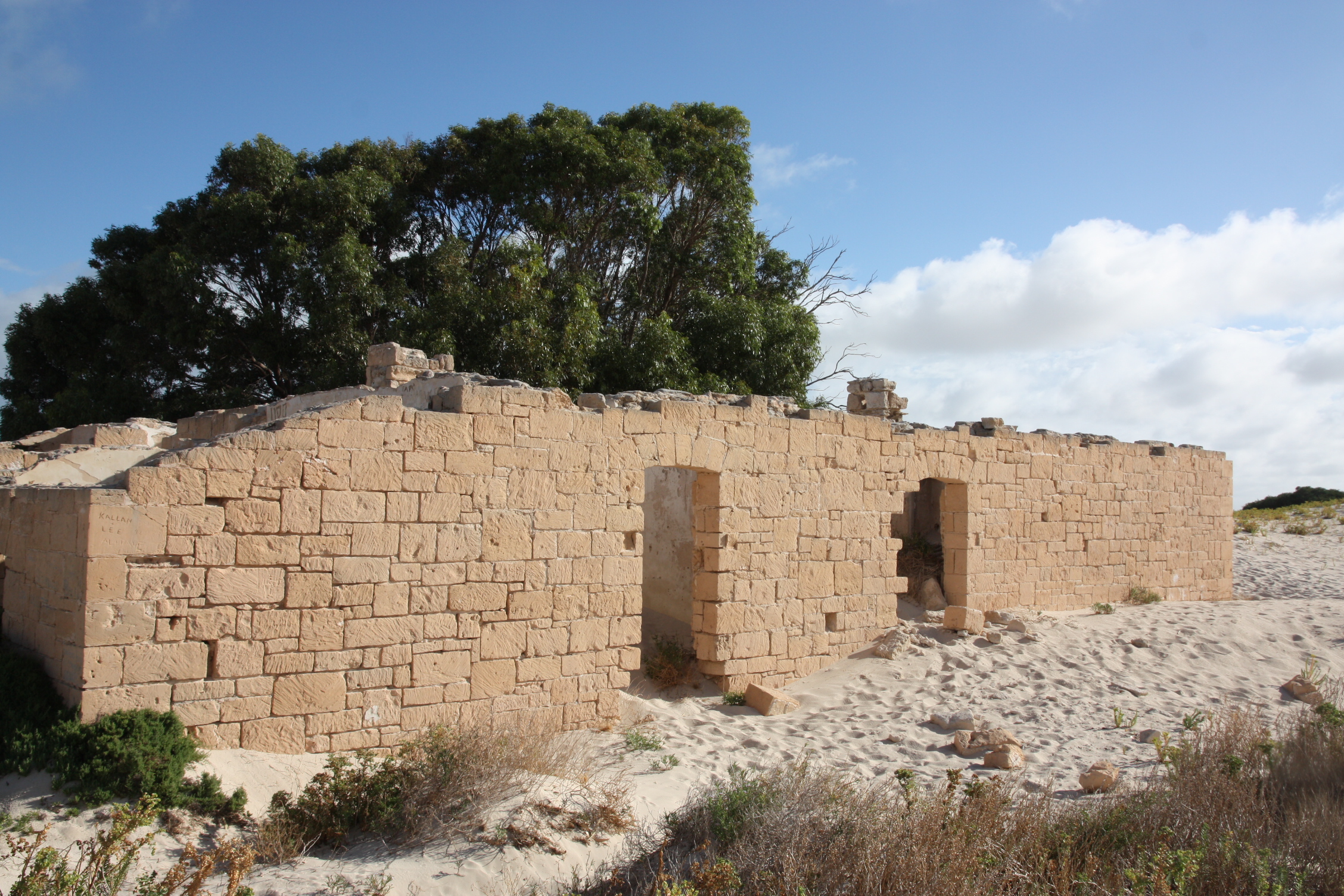
Old telegraph station at Eucla. Note missing roof
Eucla verges on being imaginary. It’s in the middle of nowhere with fewer than 100 people, yet it’s one of a handful of towns that appear on every atlas map of Australia. I have friends who have friends who say they know someone who comes from there, I know people who claim to have been there and I’ve often wondered if I’d ever get there myself.
On our long haul from Canberra to Perth—Poor John and I made it. So we stopped to explore.
Eucla is in Western Australia, just 11 kilometres west of the South Australian border. It’s desolate. In 1877, it was established as a manual repeater station for the Overland Telegraph. In those early days, a jetty and tramline were built for offloading and transporting the supplies brought in by sea.

Could there be a window under all that sand
The station was the key telegraph conversion point because South Australia and Victoria used American Morse Code, while Western Australia used the International Morse Code. According to Poor John—Mr Trivia—the story goes that telegraph operators from east and west sat on opposite sides of an inner station window and relayed ‘translated’ messages to one another. We can’t confirm the story, but it sounds like something that would happen in outback Oz.
Eucla is also the only Western Australian location on the Eyre Highway that has a direct view of the Great Australia Bight. We drove a few kilometres toward the shore to explore the old repeater station and see if we could find the famous message-passing window. But so much sand has blown in that it’s hard to make out the different rooms, let alone whether there was ever a window between any of them.
Poor John admits he may have contributed to the station’s sorry state. He and a group of university mates drove across the Nullarbor Plain in the late 1960s and stopped in Eucla. They visited the station and pinched (stole) a few sections of the corrugated iron roof.
Hi-jinks are not unheard of in Eucla. The town got worldwide publicity in 1971, when news broke of the Nullarbor Nymph, a half-naked blonde girl who had gone wild and lived and ran with the kangaroos. A clever, but short-lived, hoax cooked up by the townsfolk.
Eucla and the region have their own unofficial time zone too. They call it the Central Western Time Zone and set their clocks half-way between the official times used in Adelaide and Perth, which differ by an hour and a half. You have to admit it, Eucla sure has its own style.

Nullarbor Plain
The Great Australian Bight, Eucla and the 90-Mile Straight are all part of the vast Nullarbor Plain.
The Nullarbor—the name comes from the Latin words for ‘no trees’—is the world’s largest single piece of limestone. It covers almost 200,000 square kilometres (77,000 square miles). At its widest, it stretches east to west for about 1100 kilometres between South Australia and Western Australia.
Ever since arriving in Australia in 1982, I’ve heard people speak proudly of ‘crossing the Nullarbor’. It’s a harsh and often featureless plain that was originally a shallow seabed. The main vegetation is saltbush and bluebush scrub.
Early Europeans considered the Nullarbor to be almost uninhabitable. Explorer John Edward Eyre called it ‘the sort of place one gets into in bad dreams’. Nevertheless, there was a push to cross the plain. Lack of water was the main challenge. Eyre made the first successful crossing in 1841.
Crossing is no longer as difficult it was in the 1970s when Poor John and some of his university buddies made an early road trip. Back then, most of the surface in Western Australian was still dirt track.
The Nullarbor has some incredible caves that can only be visited with a permit from the Department of Environment and Conservation.
The pictures here are of the plain and some of its vegetation. You can also check out Eucla and the 90-Mile Straight.
And while you’re at it, see what’s cooking on page 32.
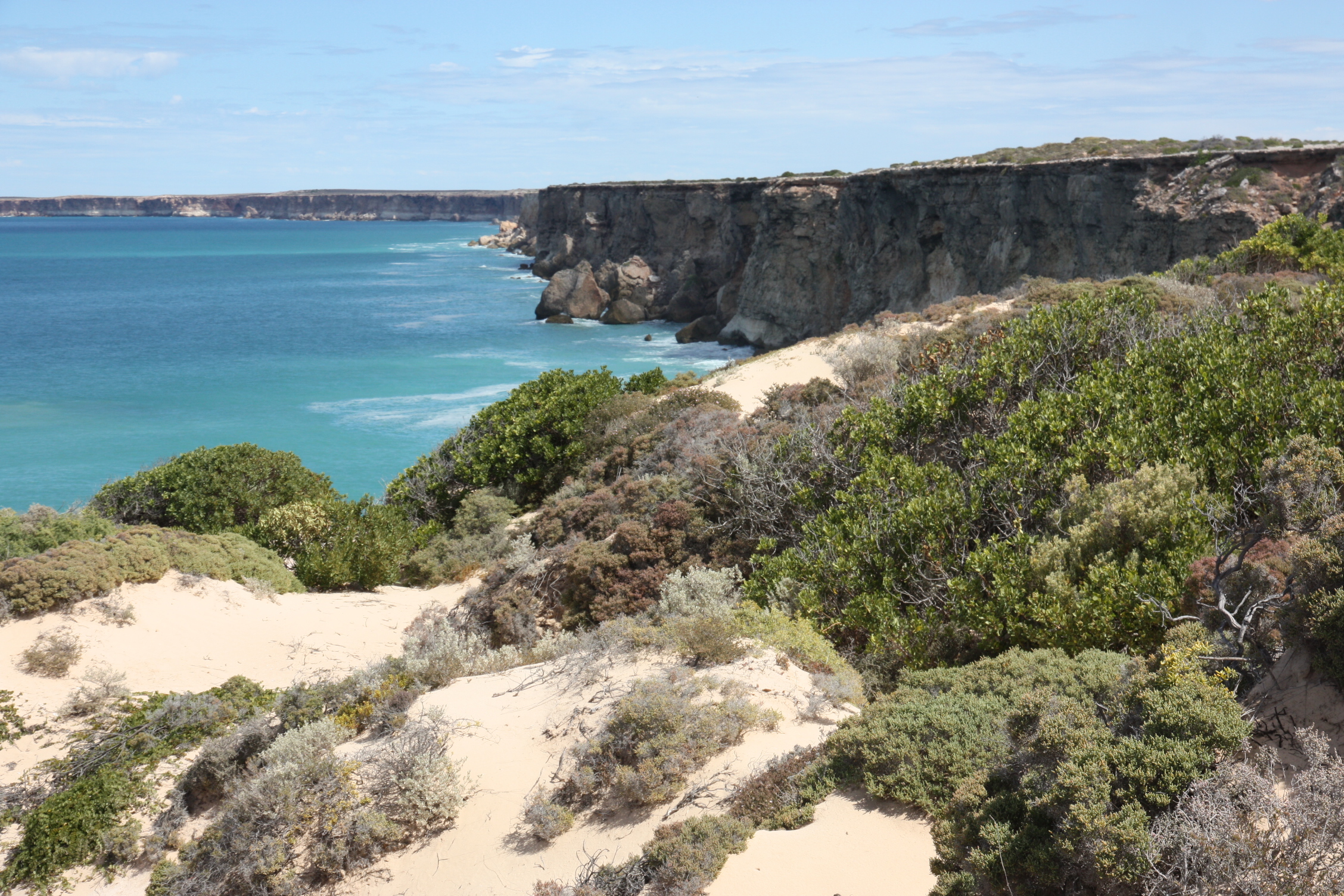
Bunda Cliffs
After leaving Streaky Bay, we headed west to the Great Australian Bight, a large open bay off parts of mainland Australia’s southern coastline.
The Eyre Highway passes close to the cliffs of the bight between the Head of Bight and Eucla, Western Australia.
We were keen to stop at the Head of Bight, if only to see the spectacular views of ancient sand dunes to the east and towering cliffs to the west.
From May to September, it is also THE place to see sharks and Southern Right Whales. There are 15,000 such whales in the world, and more than 900 have been recorded visiting the Head of Bight. They come to mate, give birth and raise their young. Dolphins and Australian sea lions are also frequent visitors.
All this area is part of the Great Australia Bight Marine Park that was declared over three years, starting in 1995. Today the park covers more than 2 million hectares and protects the Bight’s many species and habitats. The park is considered to be one of the most biologically diverse areas in the world
When we stopped at the tourist centre, we were shocked to be greeted by thousands of persistent flies. Australia is the fly capital of the world, but I’ve never before seen so many in one place.
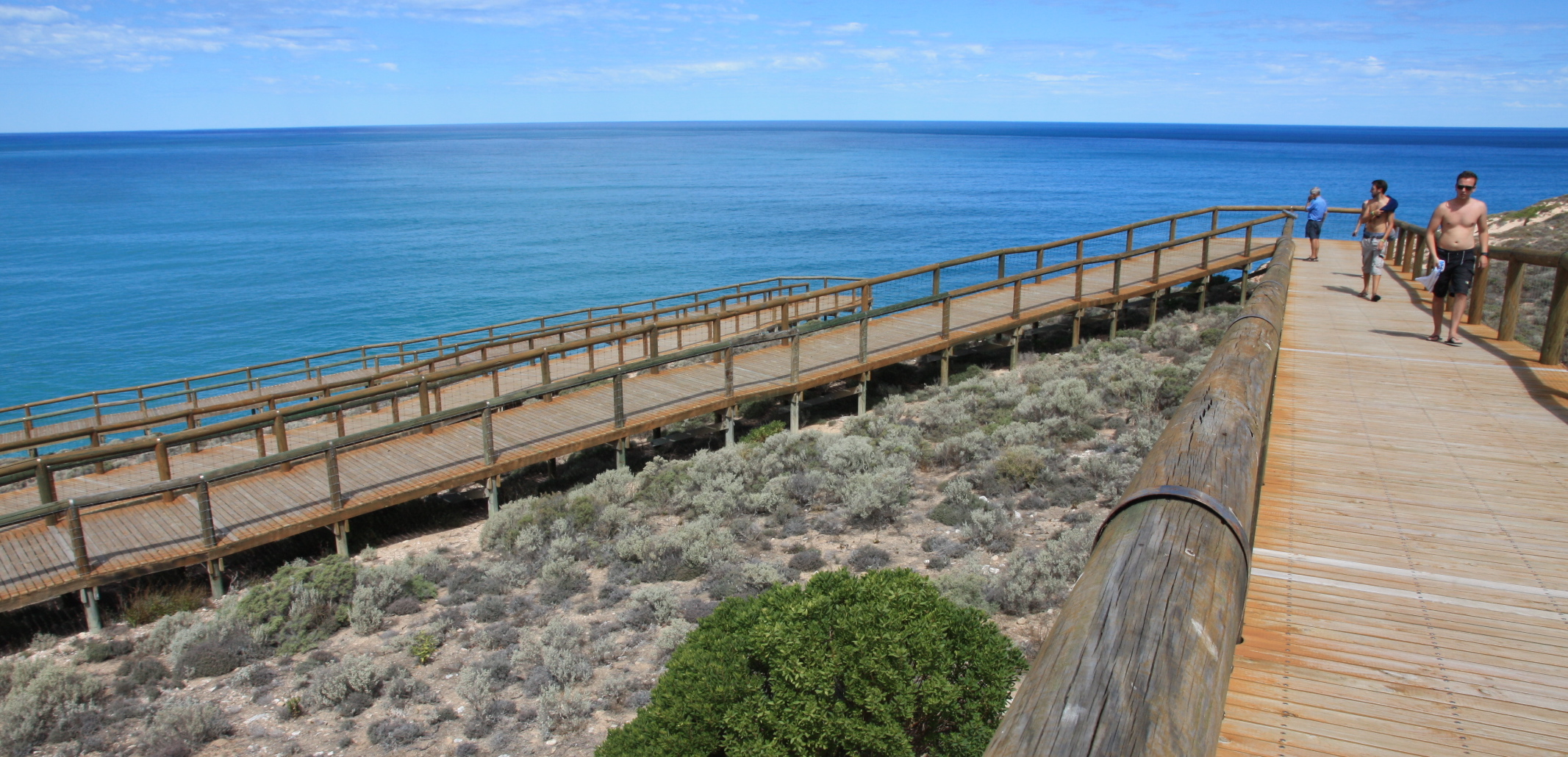
Poor John and other tourists on a Bight ramp
The visitors’ centre provided a break from the flies and heat, and relieved us each of $5 admission. Poor John asked if there was a senior’s rate but was told no, and the fee during whale season is $15 a head.
We headed to the water’s edge, escorted by another thousand flies, and started down a series of switchback ramps to see the dunes.
These dunes have developed over thousands of years. Their shape and extent are determined by wind strength and direction, vegetation or lack of it, and conditions on the shore. Much of the Bight has powerful wave action, producing gently sloping beaches backed by extensive dunes. Where reefs provide protection, the dunes are steeper. Dunes in the Bight are advancing inland by 11 metres a year.
Then, swatting flies all the way, we headed back up to the top and the ramps to the Bunda Cliffs.

Farther west from the Head of Bight where the cliff layers are more obvious
The cliffs stretch west for 800 kilometres. Their height varies from 40 to 80 metres.
They are made of limestone and have three distinct layers. The light-coloured base, Wilson Bluff Limestone, formed when sea levels were higher and the Southern Ocean inundated Australia. Skeletons of billions of marine organisms were eventually deposited on the submerged plain to form the limestone. The next layer is the Nullarbor Limestone. This began forming 25 million years ago, again due to inundation and sedimentation. The cliffs are capped by the Bridgewater Foundation, formed between 1.6 million to 100,000 years ago. It consists of a hardened layer of windblown calcareous sand.
This is such spectacular scenery that I have included quite a few photos.

From the Margaret River Chocolate Company
The Margaret River region of Western Australia is a food lover’s heaven.
We spent four days there—eating and drinking our way through some very special offerings. Highlights included two outstanding lunches at famous vineyards, and free tastings of superb wines and cheeses, as well as a variety of sensational game meats. I promise to share some of these gastronomic memories.
But because it’s Easter Sunday, I thought today’s priority had to be the chocolate makers.
We visited two—Gabriel Chocolate and the Margaret River Chocolate Company.
Gabriel Chocolate
Gabriel’s is particularly special. They are Western Australia’s first (and perhaps only) bean-to-bar chocolate maker. This means they start with raw cocoa beans and take them right through to a finished chocolate bar. Every day, they hand-sort the beans, then roast, winnow, grind, conch and temper in small batches to produce handmade chocolate bars. They also make luxurious chocolate soaps.
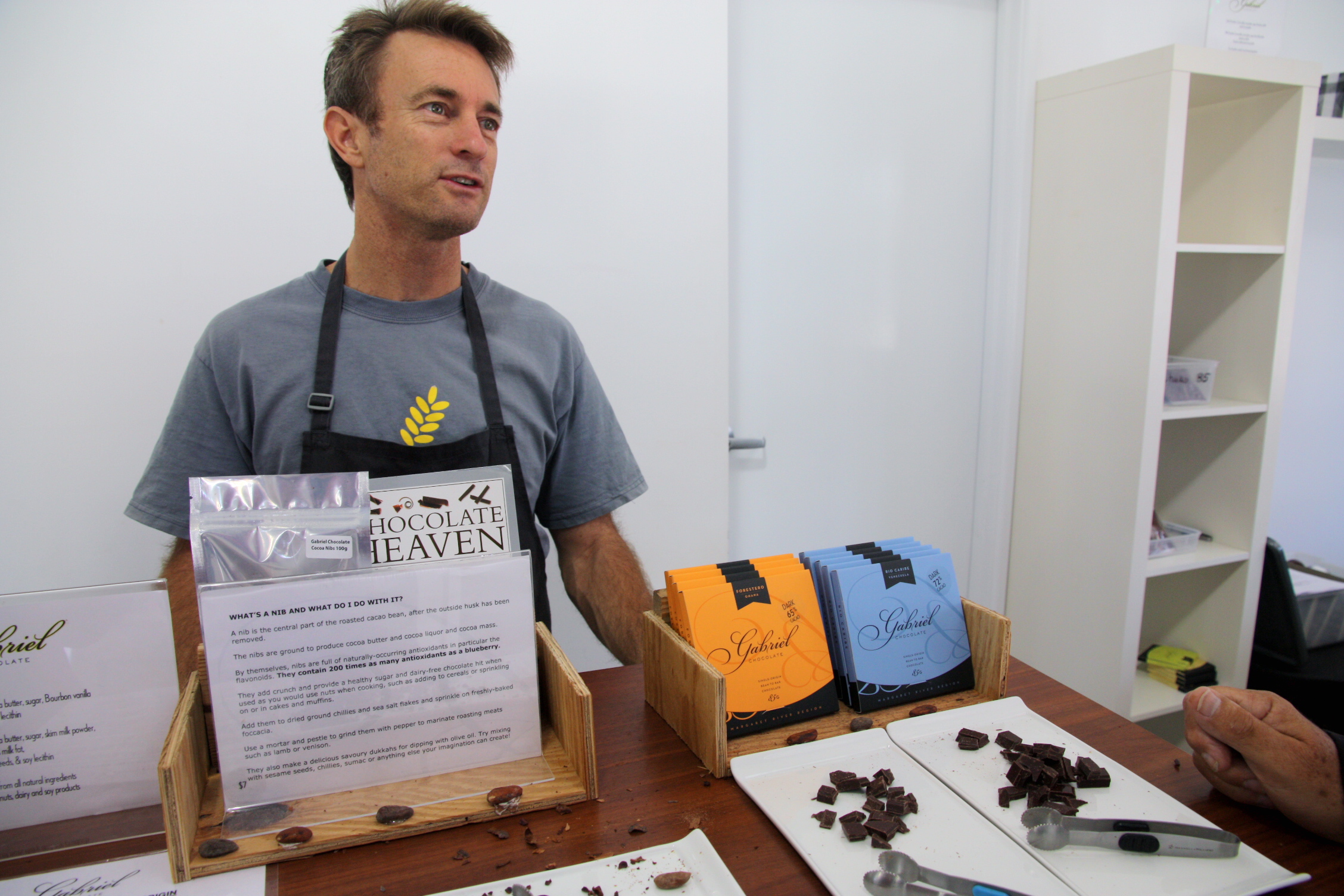
A proud and informative chocolate maker at Gabriel's
Gabriel’s works with chocolate sourced from the world’s top cacao bean regions—including Venezuela, Ghana, Java and Madagascar.
Poor John—who loves chocolate more than anyone I know—treated himself to the top-of-the-line bar. It’s made of beans sourced from Venezuela. It is dark chocolate, 85 per cent cacao, and A$12 for 85 grams (about 3 ounces).
Margaret River Chocolate Company
The next day, we visited The Margaret River Chocolate Company. It is a much bigger operation, and more into melting chocolate and then making it into confectionary products.
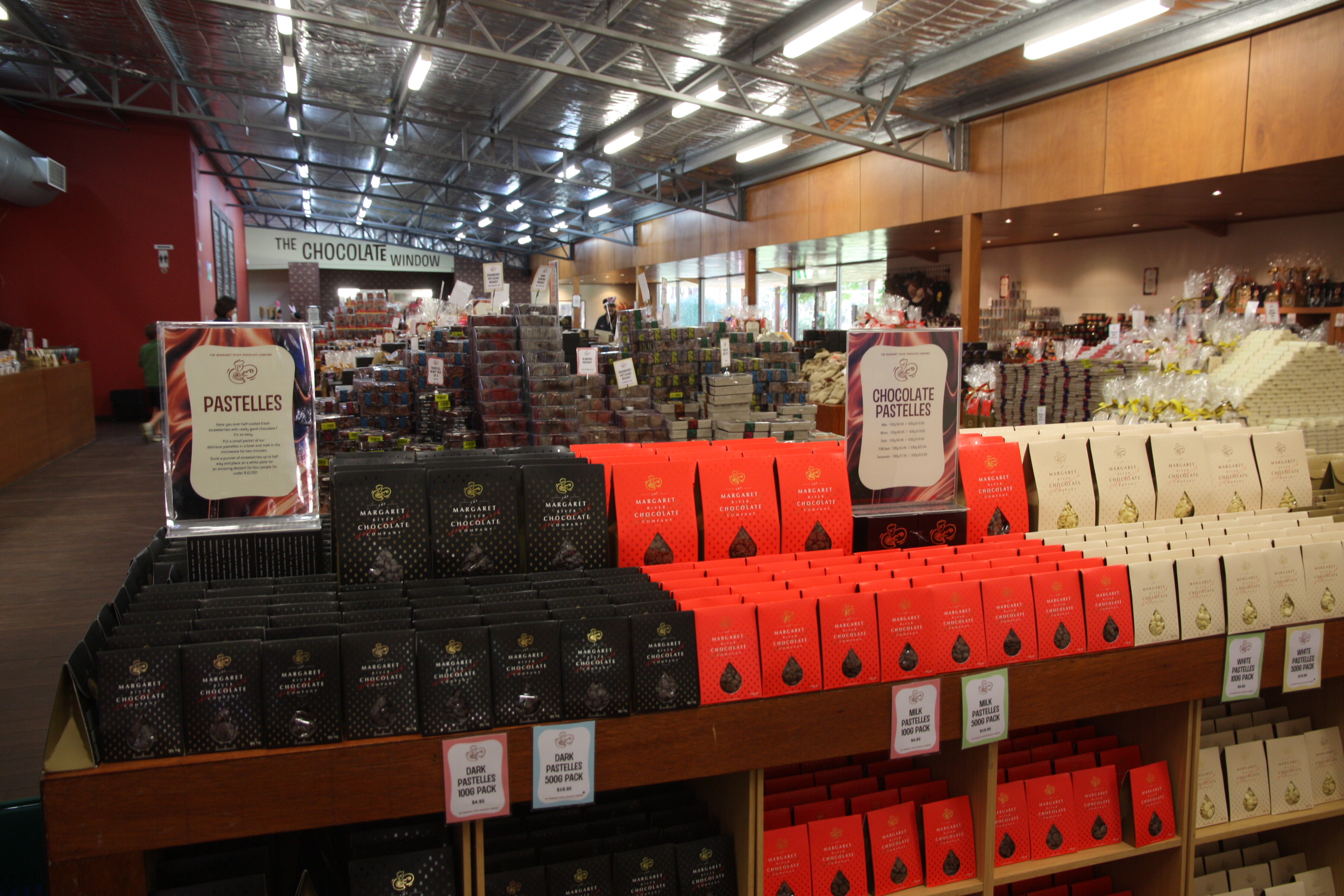
A bit of the huge array at the Margaret River Chocolate Company
I was gobsmacked by the sheer size of the shop (located almost in the middle of nowhere) and the overwhelming range of items it carries.
Poor John was delighted to learn that they were having an all-day Easter egg hunt. Within minutes, he found one of the tokens out in the garden, but when he took it in, he was disappointed to be told that the game was for kiddies only. The poor thing!
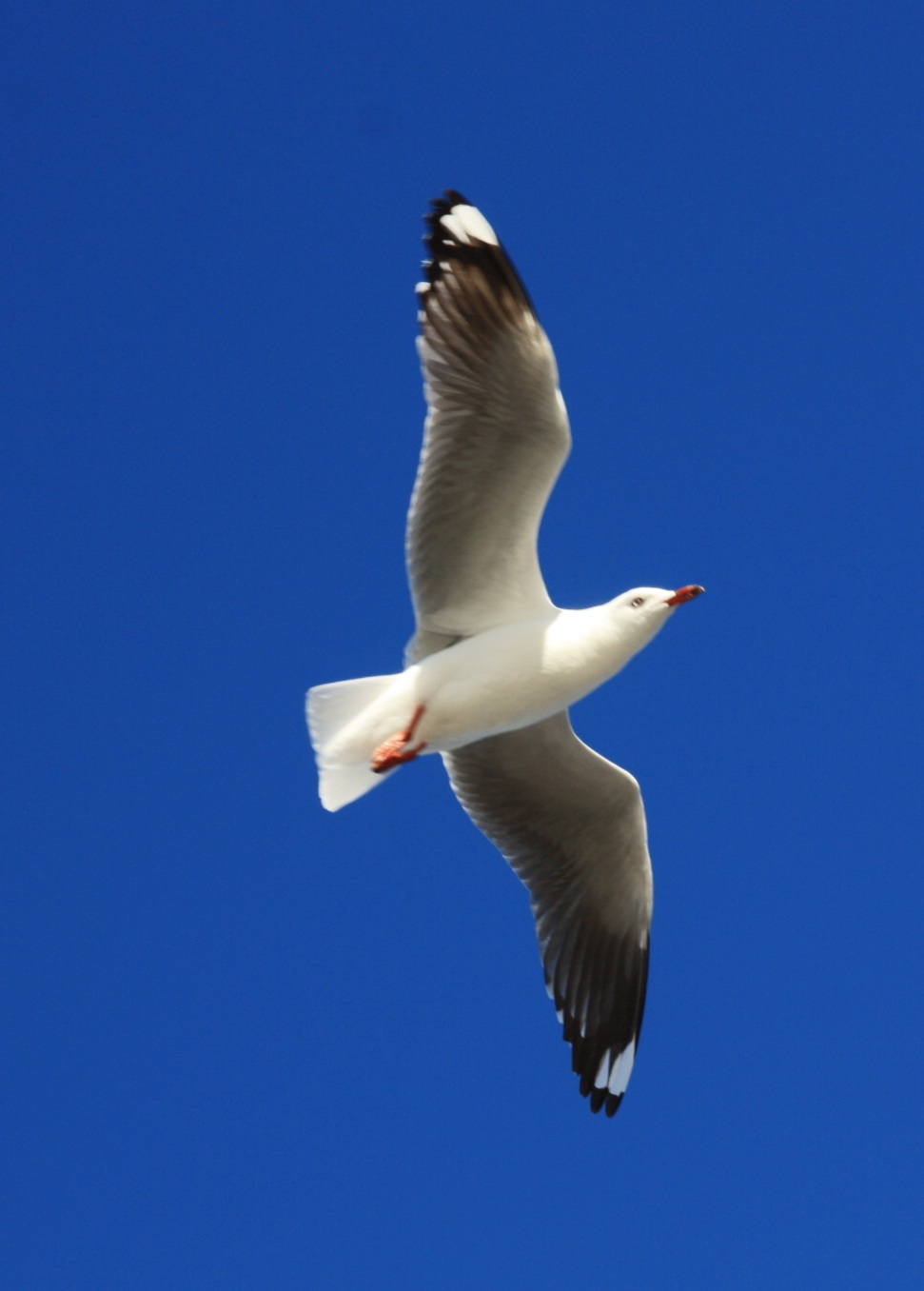
After passing the oversized semis a couple of times in South Australia, we took a detour to visit Streaky Bay on the western edge of the Eyre Peninsula. This bay is very protected and it’s hard to imagine that just around a rather large headland or two is the often-wild Great Southern Ocean.
While on a voyage in 1802, Matthew Flinders visited and named the bay because he noticed that the water was discoloured by streaks. It is now thought these streaks are caused by the release of oils by certain species of seaweed in the bay.
Poor John’s brother suggested the stop because he thought we’d like the food at the local hotel—he was right—but he never mentioned the great photos I’d get there.
We spent the night at one of the local campgrounds—no free camping allowed in the area—and ended up with a site right on the shore.
We’re early risers so I was the first camper up and out, with camera in hand, to catch a few snaps of a spectacular sunrise. A local fellow and his dog kindly appeared, and added just the right touch.
After we packed up our gear, we had another look around the town and jetty. The seagulls were most accommodating, bobbing and swirling around me. I also got a good laugh from the advice posted by the owner of a caravan (camper van). He isn’t going to be bullied into speeding.
 Where to next?