
We’ve spent six days in Australia and I’m yet to have a decent internet connection.
Places that swear they have WiFi, don’t. Libraries have it—if they’re open and you can get in or if you are already ‘registered’. I’ve paid for connections that never connect. I even spent $99 on a Telstra dongle (that should give me a connection anywhere a phone would work) and still no luck.
I’m home in a week and I know that works. Anything earlier will be a bonus.
Not a happy camper on this count, but okay otherwise.
Poor John and I, and the rest of the group, head for Darwin, Australia, in a few hours. We’re told we will be bush camping for the next two weeks. I’m not sure there will be any way to charge my computer or to connect to the internet.
Obviously, I’m not thrilled by this prospect, but there’s not a lot I can do except cross my fingers. I know I’ll have a connection by 11 December, but not sure about anything before then.
Wish me luck and stay tuned for the next episode.

Mie Ayam Pangsit.
Given a choice, we will usually eat at hole-in-the-wall restaurants. Poor John’s theory is that a western-style restaurant can produce any-old meal because the tourists come and go, but a local restaurant has to be good so the locals continue to patronise it.
That approach works very well for us and lunch recently in Yogyakarta was delicious. We noticed that the cook, who had three small benches as work surfaces and two burners for cooking, was making homemade noodles. I ordered Mie Goreng (fried noodles). My pic of that wasn’t much of a success, but Poor John’s Mie Ayam Pangsit (noodles with chicken, chilli sauce and a wonton soup) looked great. We also ordered homemade lemonade—easy on the sugar. All this for less than $5 for the two of us.
The cook graciously let me take some pics of her and her kitchen.
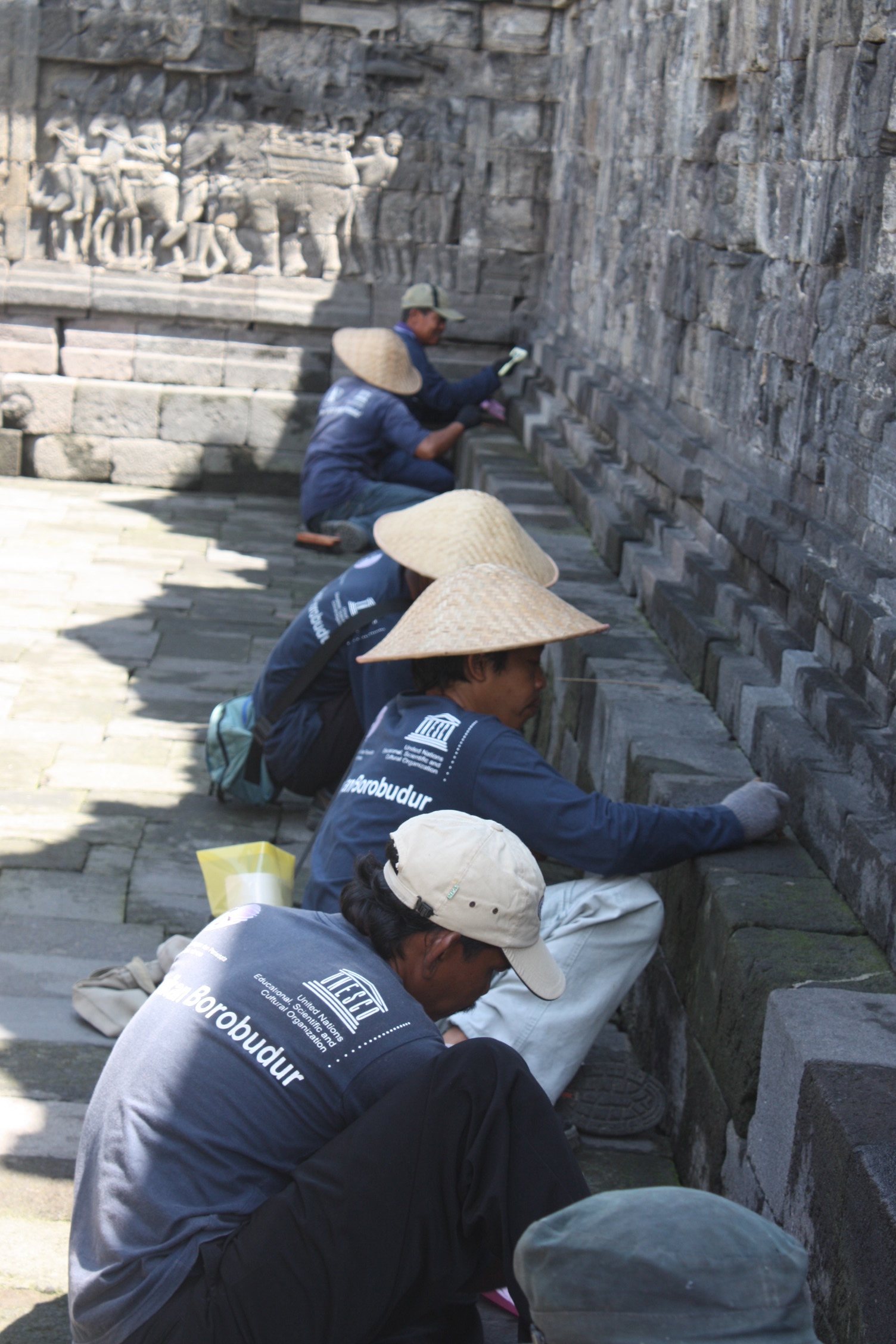
We saw at least eight teams of people tackling the mould at Borobudur.
Dealing with mould is a huge challenge in Southeast Asia. When we lived in Burma in the 1980s, it was common for our clothes and, especially, shoes to become mouldy. Soon after we arrived, someone suggested that we always leave on a light in the closet to create a bit of heat that might ward off the green stuff. It helped a bit, but not completely.
It’s not so easy to leave on a light in an outdoor Buddhist temple.
When we visited the famous Borobudur temple last week, we saw squadrons of workers tackling the mould problems there. They work mostly on the flat, vertical surfaces, not the floors or carvings.
Scratch, scratch, scratch—lightly—and dig, dig dig—lightly—and over time the green stuff will be gone. I reckon these men and women have lifetime jobs.
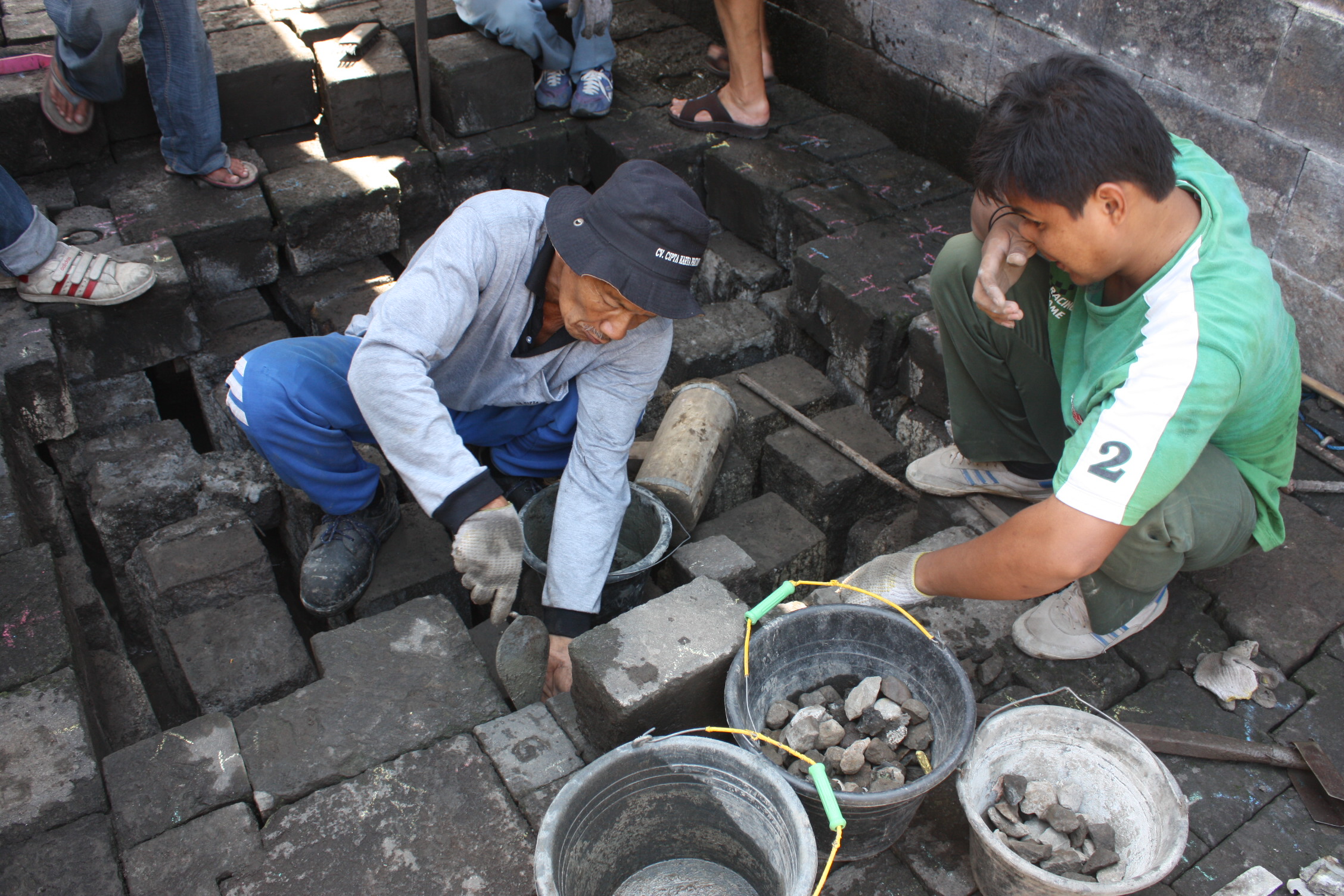
Borobudur clean-up is all about attention to detail.
Borobudur, Indonesia’s most famous Buddhist temple and one of the country’s most popular tourist attractions, has been getting am unscheduled facelift over the last year.
While routine maintenance and cleaning are always being carried out at this important Javanese landmark, the latest effort was prompted by the October 2010 eruption of nearby Mount Merapi. The eruption blanketed Borobudur with a thick layer of white, acidic volcanic ash and even caused parts of the site to be closed for a while. Antiquities experts have worried that the ash will speed the decay of the temple’s stones, and they know it’s played havoc with the drainage system.
When we visited the temple about a week ago, the workmen were tackling the first level. They had started at the top—level 10—so they were almost done cleaning the ash out from under the flooring and restoring efficient drainage.
It was interesting to see the process. The horizontally set floor stones are supported on a foundation of larger stones, set vertically. Sheltered by tarpaulins to protect them from the elements, the workmen have lifted a section of horizontal stones at a time and set these aside—all carefully marked so they can be replaced correctly. They have then cleaned out around the foundations. When you think about it, it’s amazing that something built more than 1000 years ago has such a sophisticated drainage network.
Tourists are now able to visit all of the site and, as we did circuits of the temple, we saw various stages of the job, including a spot where work was recently completely. The workmen were having a rest and later we saw the tarpaulin was being removed. We were surprised to note that some of the tarpaulins were tied around statues of Buddha.
On the way to Borobudur, we saw some of the devastation Merapi had dished out to nearby villages and vegetation. Our tour guide told us that quite a few villages had to be abandoned.
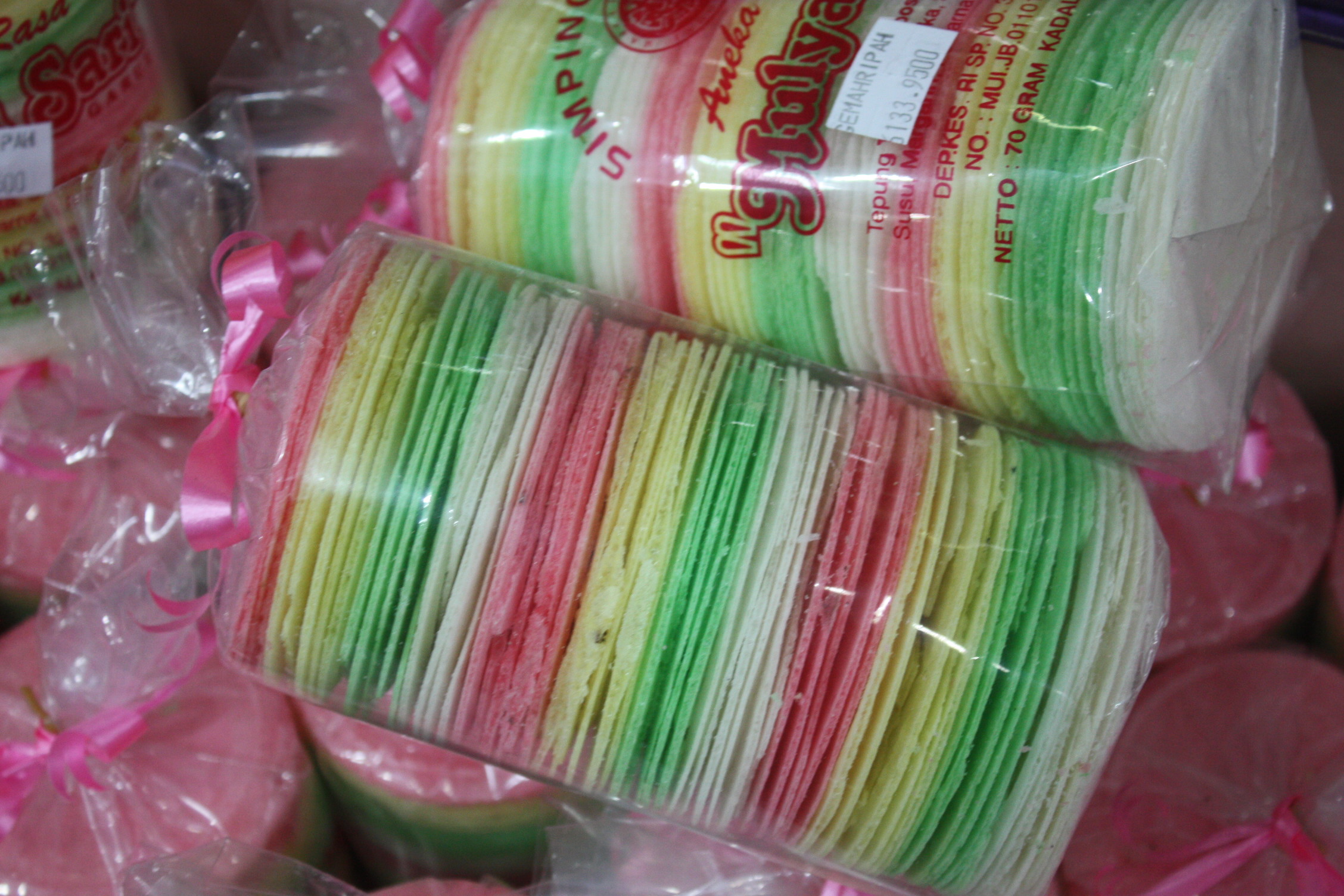
Rice flour or plain flour? Plain, she said. I wonder.
The other day I was behaving like a kid in a candy store—or as we would say in Australia, like a kid in a lolly shop.
But what am I saying? For a short while, I WAS that kid in a candy store. You should have seen me! I was in the Gemah Ripah shop on the main street of Yogyakarta. It had everything you could think of from sweet or sour to salty and spicy, from gummy and chewy to hard and crunchy.
The best thing was that the lass who served us knew what she was talking about.
What’s that battered curly green stuff? Cassava leaves. And the flat green stuff? Peanut leaves. Are these potato chips/crisps? Nope, the pale ones are banana and those orange ones are chilli potato chips. Those multi-coloured wafers are made of rice, right? No, flour. And what are those pink and yellow lumps? Coconut (and now I forget what she said the other main ingredient was).
The shop had acres and acres of goodies. The walls were plastered with temptations, and the floors had jar after jar of mysteries to sample. I could have spent hours there—tasting anything she’d let me have, pointing at every packet and jar, and grilling her on the ingredients and cooking techniques.
How I managed to get out of there with only four purchases, I will never know. Oh hang on, I do know. Poor John hustled me out of there before I did exactly that. Spoil sport.
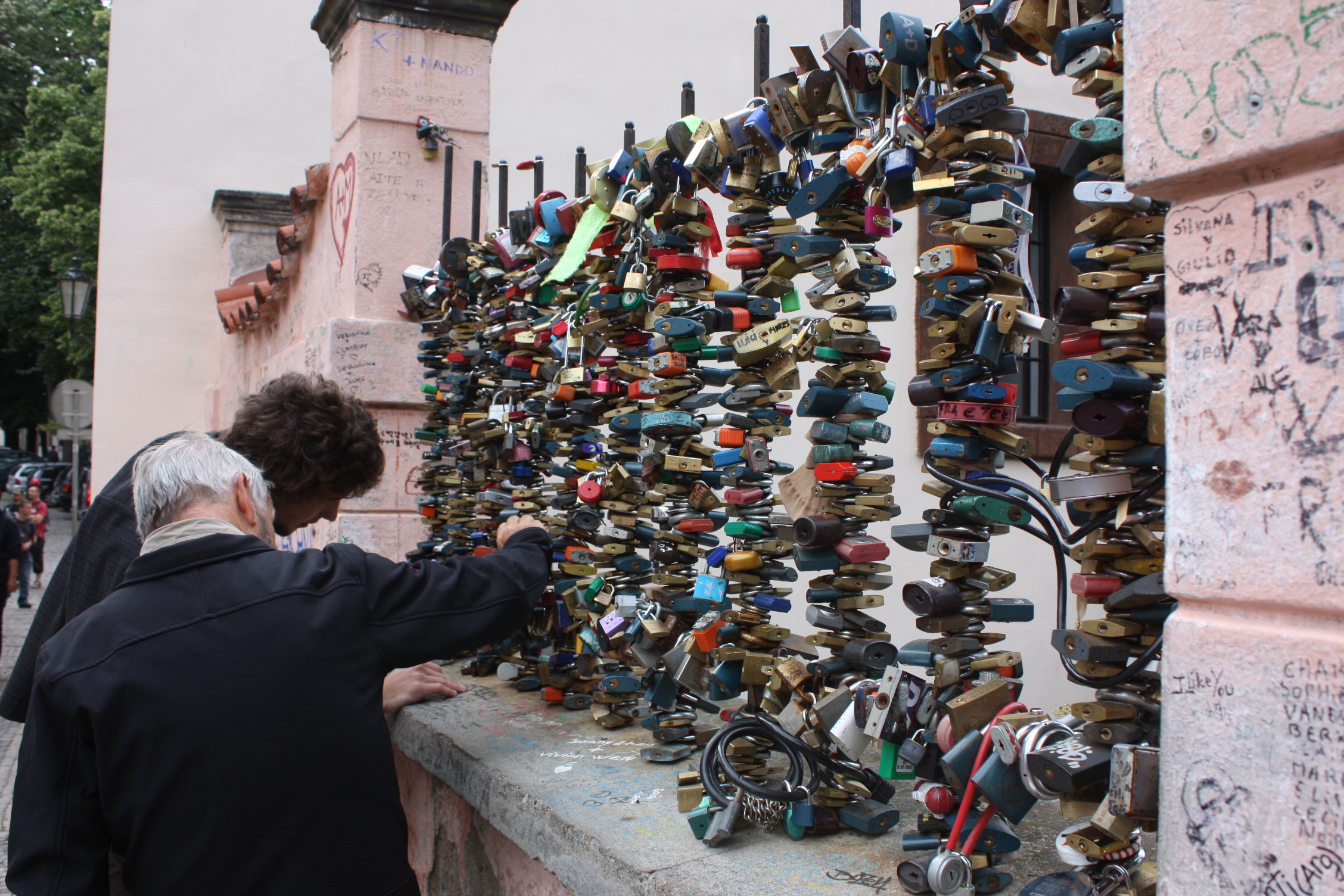
Tom and Poor John check out some of the love lock inscriptions.
Sometimes I am reminded how out-of-touch I am.
Take love locks, for instance. I’d never heard of them, but they are the rage all over Europe. I first encountered them earlier this year in Prague in the Czech Republic, when Tom, who stayed with us while he was on exchange in Australia for five months in 2008, took us round to see a local bridge that is adjourned with countless locks. The bridge is just around the corner from the John Lennon Peace Wall.
In case you’re as out of touch as me, I’ll tell you a bit more about these locks. For starters, I’m not talking about hair, I’m talking about keyed locks. As a way of signifying their love and linked lives, couples attach the locks to bridge railings, gates, fences and any other likely surfaces that can hold them. This has been happening across Europe and Asia. Usually they add a message such as their names and a date. In Prague, they are said to throw the key into the nearby canal.

The canal in Prague where love lock keys get tossed.
In trying to find out more about love locks, I discovered a lot of conflicting information and probably a lot of folklore. So don’t take any of this as gospel. Love locking may have started in ancient China, in Serbia before World War I, in a Hungarian university town in the 1980s or somewhere in Europe in the 2000s. The custom has probably been spurred on by a tale spun in a recent romantic novel by the Italian author, Federico Moccia. To date, there is no mention of love locks being used in the USA.
The bridge in Prague is packed with locks—all colours and all styles from padlocks to luggage locks to bicycle locks—so couples are beginning to branch out and use nearby surfaces.
While we spent a little time reading inscriptions on the many locks, Poor John, who might glue a book to his hand if it made it easier to read, had no desire to add a lock to the bridge.
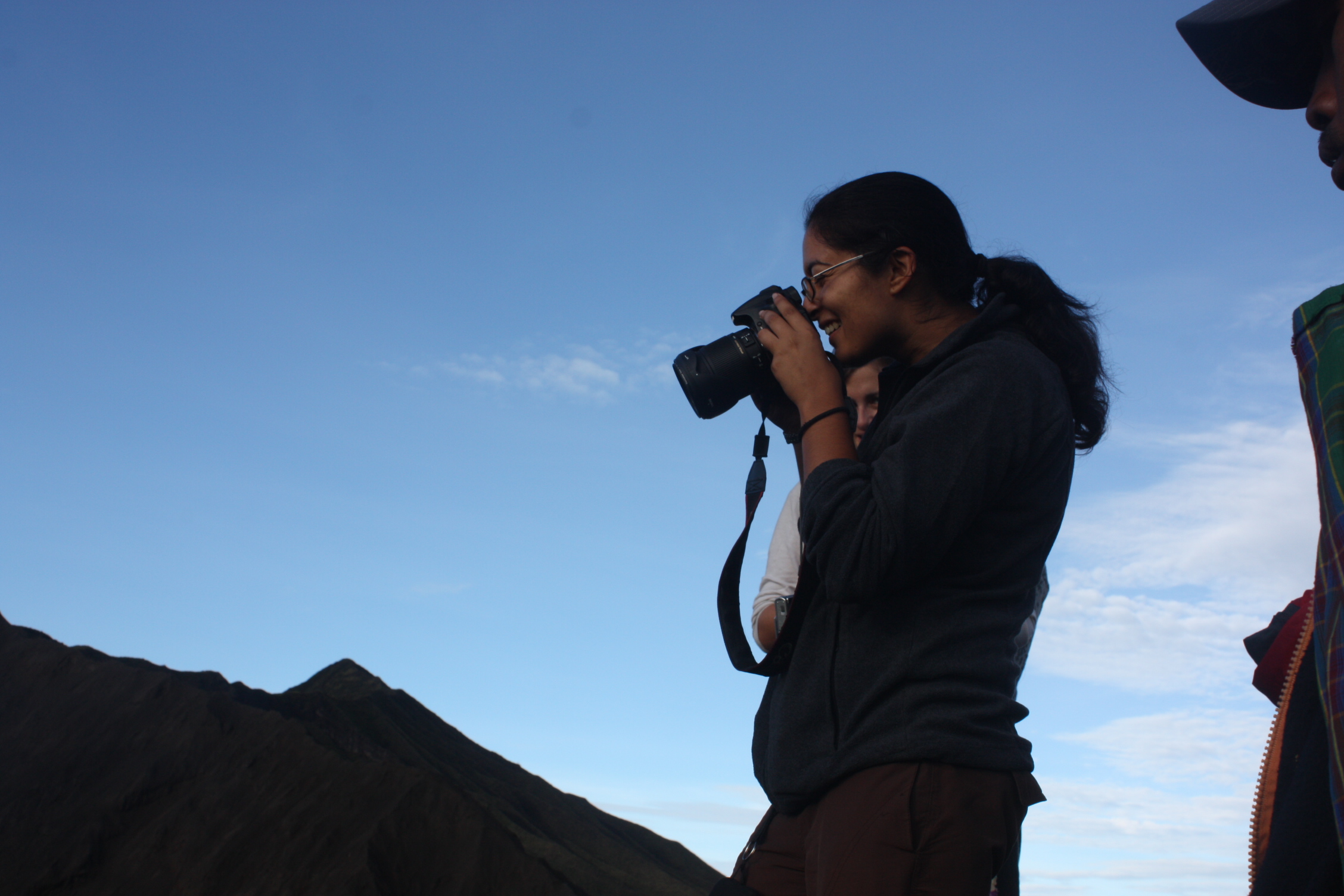
Rakhee snaps a pic of the crater at Mount Bromo.
If there’s a biting bug anywhere around, there’s a good chance that it will bite Rakhee first. Their interest in her is surprising because she is the only vegetarian on this trip.
But I’m the winner here. I think she is single-handedly (actually they go for her legs) responsible for keeping most of the insect beasties away from me on this trip because I was the bait in Africa.
This is turning out to be a big year of travel for Rakhee. By December she will have visited more than 30 countries in less than 12 months. Prior to joining the London to Sydney jaunt, she spent several months travelling on her own in South America.
Originally from Clapham, Rakhee studied marketing at the University of Brunel in West London. Most recently she has worked as assistant merchandiser in the children’s department in Debenhams in the UK. Her style sure shows through. If she was more than half my size, I would steal her purple beach dress and green and white Columbia jacket.
She’s on leave from Debenhams while doing her year of travel, and she’s not yet exactly sure what she will be doing after reaching Australia, but we hope she’ll find time to drop into Canberra. I look forward to trying out some interesting vegetarian curry dishes on her.
As an aside, I like to think of Rakhee as a non-practicing vegetarian. She may not eat beef, but she’ll try almost everything else. On this trip, she tried snake and kangaroo, and in South America she sampled guinea pig.
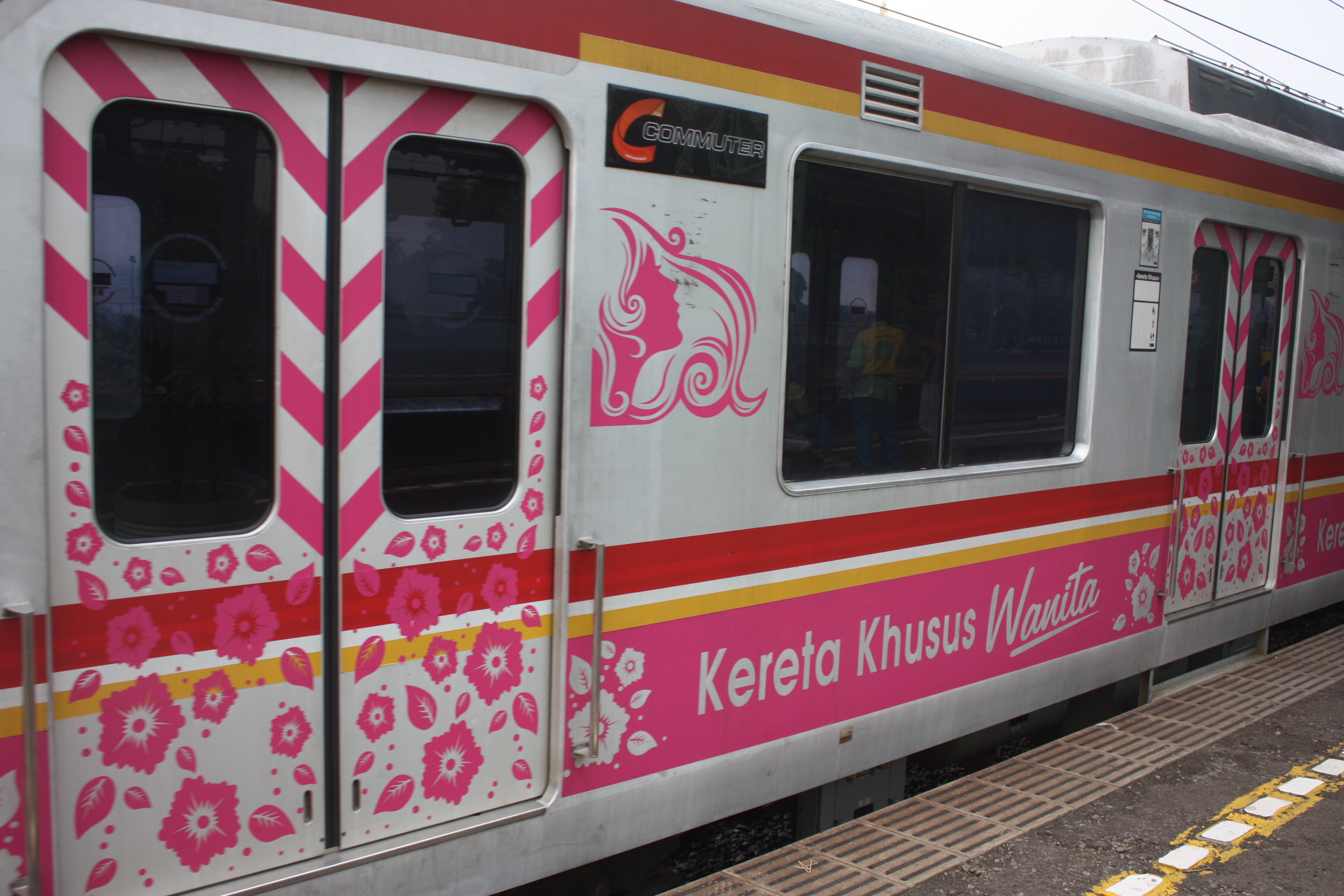
Could we have a little more pink please?
It was interesting to see that major cities in Malaysia and Indonesia provide special rail carriages for women only. These are on the city commuter lines, not the long-distance ones. The carriages are colourfully painted and there is no question that they are for women. Signs indicate that women with children (boys and/or girls) may sit in these carriages, but couples cannot.
I noticed that these carriages are usually placed either at the front or the back of the train—probably so they are easy to spot. The carriages seem to be well used. One day, I even saw a couple of stationery ones being occupied by a group of school boys. I got a picture of two of them, but they hid their faces when they noticed my camera.

A sulphur miner on the Ijen Plateau reaches the rim of the crater.
A few days ago, Poor John and I peeled off from the rest of the group to make a side trip to the Ijen Plateau in East Java, Indonesia. We stopped there last year and were so impressed by the landscapes, the crater (Kawah Ijen) and the acid lake, that a repeat visit was essential. We urged others to join us, but there were no takers. And while I was keen to go, I’ll admit that I wasn’t looking forward to the 3-kilometre struggle to the top.
Maybe that’s what keeps Ijen relatively tourist-free. The crater rim is at 2600 metres, and the climb to reach it has an average incline of 17 per cent. Fortunately after six months of walking long distances and over long hours, I made it up with only a few breaks. Poor John says I was much faster this year and, by not rushing, I was hardly puffed at the top. If you ever get there yourself, note that a concrete pillar marks every 100 metres so you have an idea of how you’re going.
But it’s not just the climb that keeps Ijen a secret from the outside world. The plateau has Indonesia’s most famous crater and acid lake, but the guide books do a terrible job of telling people about them and the remarkable sulphur miners. The Lonely Planet’s Southeast Asia on a Shoestring doesn’t even mention it. Yet we’ve met plenty of people who say they think Ijen is a more memorable, fascinating and worthwhile destination than Mount Bromo. And I agree.
The sulphur miners are a sight in themselves. These guys—all short and wiry—make the climb at least twice a day. Once they reach the top, they descend another half kilometre into the crater to gather up to 80 kilos of sulphur which they then bring to the top and finally cart to the bottom. Most trips are done in stages. They say the miners start work about 2 a.m., bringing up two sets of carry baskets that rest across their shoulders. After collecting their first set of sulphur, they park the baskets near the top or halfway down, and return to the crater for a second load. From a financial point of view, they think it’s worth it. Each miner earns about 100,000 rupiah a day, or just over $11.
You can snap a lot of pics, but if you get a miner to pose, you should pay a tip. I have done that willingly—what an awful job they have—but the spontaneous shots are always better.
While there are warnings against doing so, you can also descend with the miners. Both years, Poor John and I have declined to do this. The descent is steep, gravelly and slippery. I may be game, but I’m not stupid.
Besides the sulphur fumes are choking. I asked a tour guide how many years a miner is able to work. He said there had been some medical testing done recently that showed they had no ill effects, but larger than normal lungs. That’s good, because almost every miner who passed me on his way up or down was smoking a cigarette.
The lake is also striking. It is the world’s largest lake of highly acid (pH<0.5) and mineralised volcanic water, and is a lurid shade of blue-green. It sits at 2368 metres and has an average depth of 176 metres. In good weather the colour combination—of blue-green, sulphur yellow and red rock—is breathtaking. Unfortunately, this year when we reached the top, we encountered a thick fog plus huge, billowing sulphur fumes. Within 30 minutes, it cleared enough for me to capture some eerie shots., but then the fog settled in again.
The weather was perfect for our visit last year, so I’ll search out more photos when I get home and write an accompanying blog entry. I’m sure there are some better views of the lake.

