
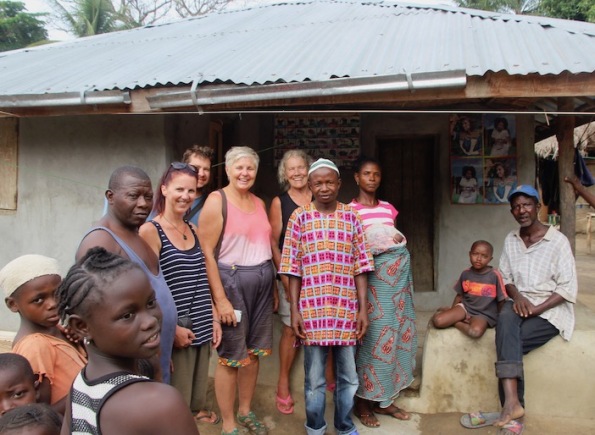
Paying our respects to the chief and his wife (outside his house)
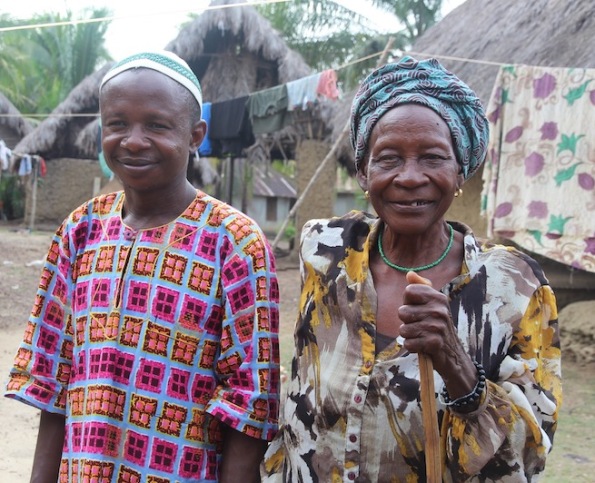
The chief poses with his mother
Africa’s big cities can be as cosmopolitan, crowded and commercial as those in other parts of the world, but many of her villages are set in another time.
Over the last two months, we’ve travelled more than 6000 kilometres through six West African countries. In addition to staying in a few hotels and hostels, we’ve camped in the middle of nowhere, in school grounds, in hotel gardens and in villages.
Villages are certainly the most fun and most educational. This is because we get to interact with people and have a close-up look at their lives. That means peeking inside houses, sampling local dishes and learning smatterings of a local language.


It’s not unusual to meet people who speak three or four languages—in West Africa that’s English and/or French plus one or two native languages. Later I’ll introduce you to Hassan who speaks six languages.
But today is a trip to Byama (spelling?) in rural Sierra Leone. It’s about 2 miles from Kambama, the village we stayed in after the truck fell through the bridge.
Mohamed, our host in Kambama, walked a group of us to Byama and introduced us around town. Our first task was to visit the village chief and pay our respects. That’s what you do whenever you enter a small village.


We met him, his pregnant wife, his mother and some extended family. We also met the school principal and his two wives (yes two). The school is in Kambama, but the principal and teachers live in Byama.
Then we were guided through the village and encouraged to take pictures. Byama and Kambama do not have electricity or running water. Both do have village wells that are pump-it-yourself operations.


As in most villages, we were swarmed by children at every step. They love to stroke your skin, feel your hair, shake hands, clap, have their pictures taken and try out some English words.
It’s good to be reminded that we are the unusual ones and that we have been welcomed into their realm as guests and not as intruders.
Our visit to Byama was one of the activities offered by Kambama village, and we each paid about $5 for the excursion. The next day, a few of us did a similar stroll through Kambama. Interesting how villages are the same, but different.
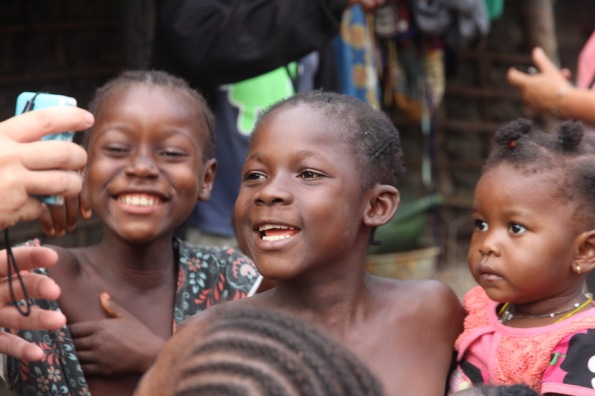
Children looking at pics of themselves
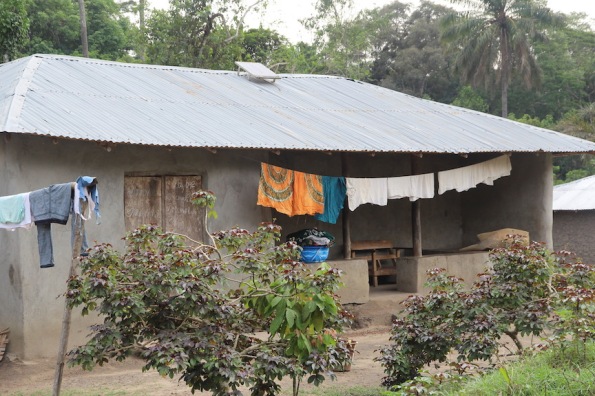
Laundry undercover in case of rain
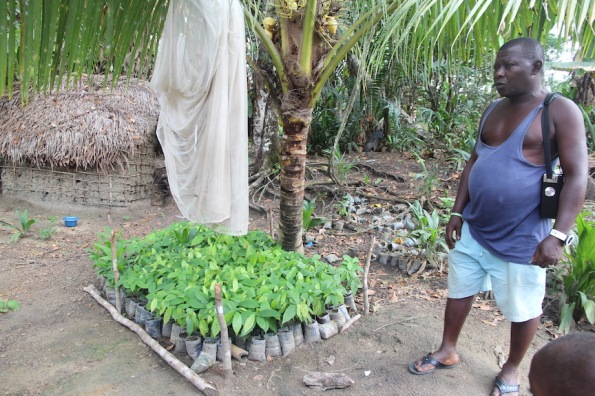
The school principal shows off some plant cultivation
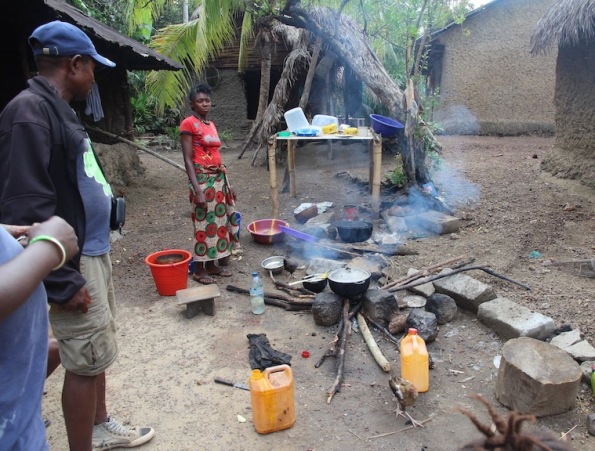
Kitchens are simple affairs in Byama

Schedule of fees. Ten thousand francs (10,000) is worth about 1 euro
Many of you have asked after Jason and his health. After a night on a drip in a rural hospital and plenty of medications, he’s back in good form. It’s a great relief to us all.
He confessed that he’d missed a couple of doses of his Doxycycline, a daily anti-malaria tablet. That’s never good, but it’s a reminder to all of us to be diligent about taking whatever meds we have been prescribed.
I once heard that regardless of whether a person is taking prophylactic (preventative) medication or not, about one in 10 people will get malaria anyway. Ugh.
So yesterday we had another malaria scare or two or three. Adam (our other leader/driver), Thijs and Dee were all feeling poorly and some of their symptoms pointed to malaria.
We arrived in Dalaba, in the Fouta Djalon region of Guinea, in the late afternoon. It has several clinics and a hospital. All three were taken by taxi to a clinic but the doctor was away (or something) and they ended up at the hospital.

Malaria test
At this stage, it seems no one has malaria. but I thought I’d share an exchange between Dee and her brother-in-law. It gives you an idea about the differences between hospitals and medical practices in the West and West Africa.
Dee: Good thing is that I don’t have malaria. Test and advice all for around $25.
Brother-in-law: Dee, these tests have variable sensitivity and specificity. If I were you I would find a doctor and get him to request more appropriate blood tests that include microscopic examination of blood cells, we use the term thin and thick film examination. There should be a reliable laboratory service available somewhere.

Clinic
Dee: Thanks for your advice and I love your optimism re tests etc. The pic shows the room I was assessed in. Did I mention that there was no electricity as the generator didn’t get started until after 6pm and there was no water as the whole town has no water plus the fact that the ‘doctor’ who assessed me had completed three years of his studies and was waiting on money to complete the next three. So as you can gather things are a bit tricky regarding a doctor’s referral etc etc.
Brother-in-law: Wow, I can only begin to understand. The West takes so much for granted.
All photos are by Dee.

Oops! Now how to get out?
We were bouncing along to Tiwai Island, making excellent time even though the roads were rough. Most likely we’d be there by lunchtime. Then the truck went thunk and a makeshift, but sturdy-looking timber bridge went crunch.
In all of Jason’s and Adam’s years (almost 25 between them) of overland driving and guiding, they had never fallen through a bridge. Almost everyone on the truck is a seasoned overland traveller. It hadn’t happened to any of us either.
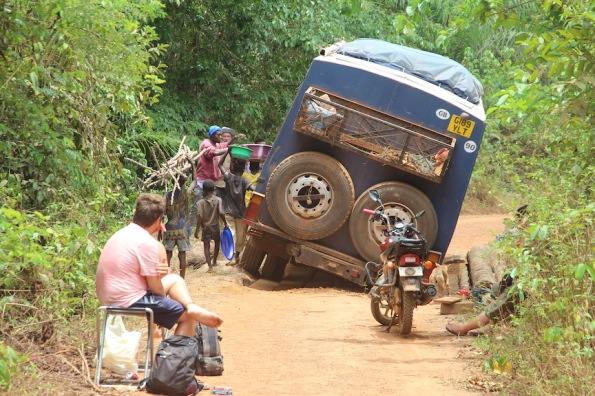
It was still possible for pedestrians and motorbikes to get past

John H and Richard B carry out the first log
The jolt was disarming, but the reality of how stuck we really were was disheartening. Jason was sick and couldn’t help—we didn’t yet know that it was malaria—but there were 17 other people all brimming with suggestions of what to do next.
First challenge was to get everyone off the truck. Given that we were on a severe tilt to the right, it was quite far to clamber down the ladder-like steps on the left. Gary even had to give Ellen a piggyback exit.
Almost immediately a bunch of local fellows appeared, keen to help. They knew of a guy with a chainsaw who might be able to help. So what use could a chainsaw be? You’ll see.
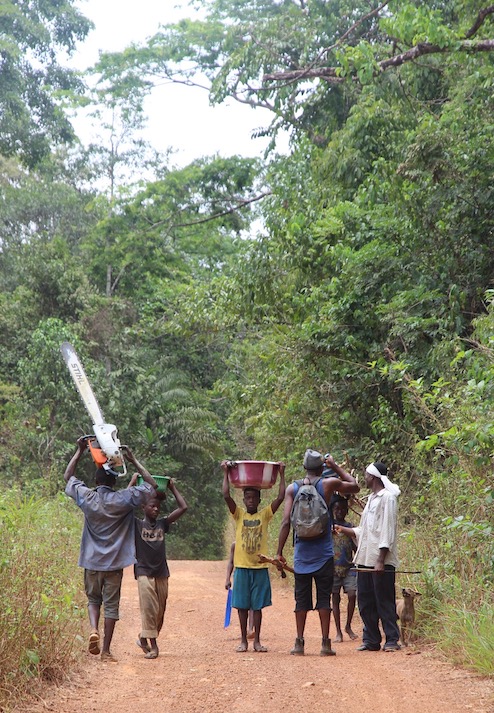
The chainsaw arrives

Log cutting begins
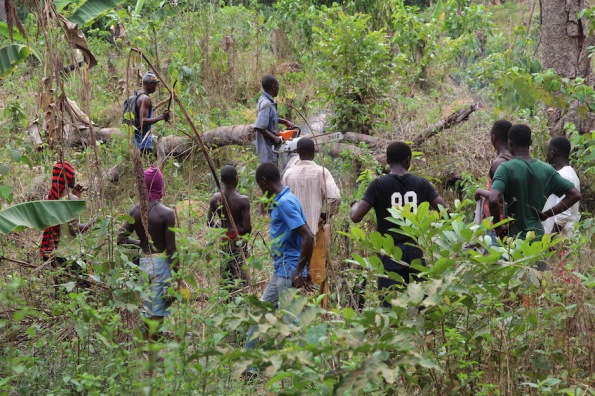
Mr Chainsaw at work. Fellow to his left uses a machete to mark out log lengths
John H (not Poor John) hopped on a fellow’s motorbike and they went in search of Mr. Chainsaw. He was found about five kilometres away, and quite willing to lend a hand.
So here’s what happened. The bridge was about 50 metres from a field of felled trees. Mr Chainsaw, who has the longest chainsaw I’ve ever seen, proceeded to cut many trees into metre-long lengths that were carried back to the bridge and stacked up underneath the truck.
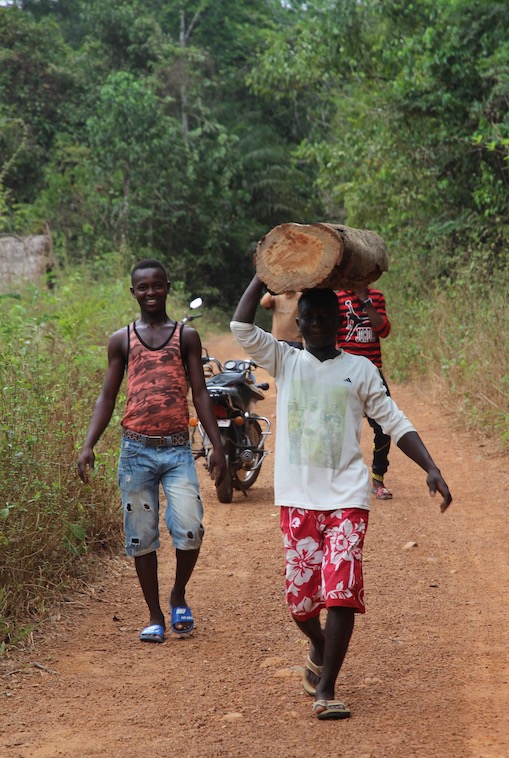
Local carries a log on his head with ease
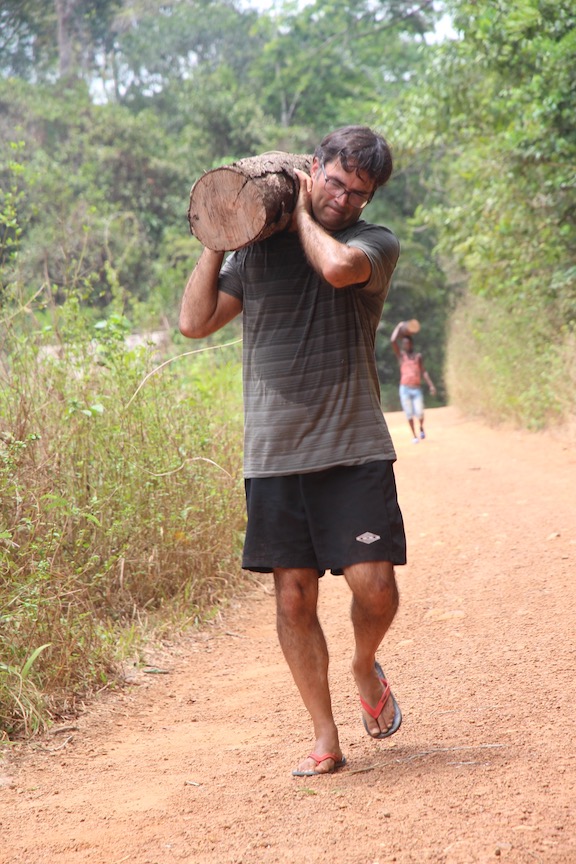
The look on Christian’s face shows that log carrying isn’t always easy
Our fellows stacked while locals cut and carried. Each log weighed a lot, but the locals treated them as pillows, popping them on their heads or shoulders. The original request for 30 logs was doubled and, in the end, there were 68 logs used to shore up the bridge.
Once all the logs were in place, we unloaded the back locker to reduce the truck’s weight.
Then Adam hopped in the truck, warmed up the engine and drove smoothly out of the mess. Yes, we applauded.
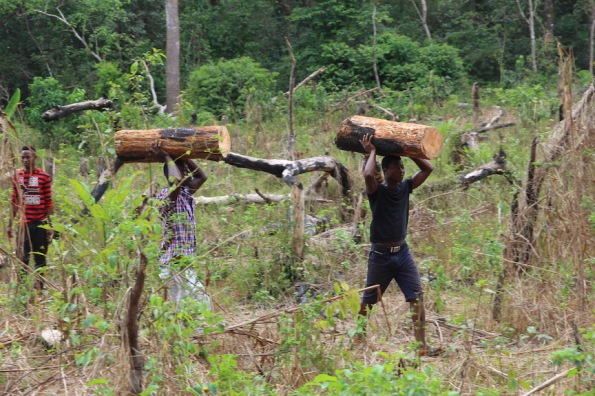
Two of 68 logs
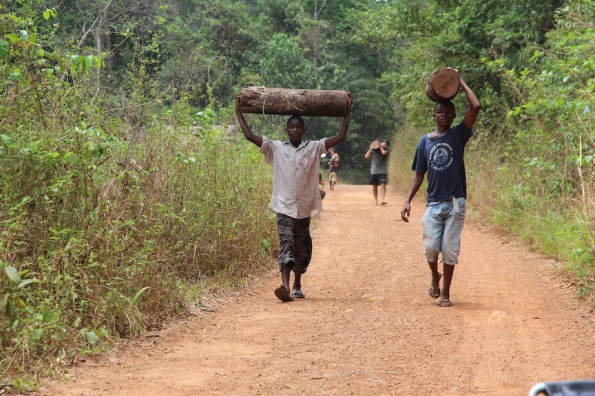
Two more logs. Christian in the background
In addition to about 25 locals who pitched in, our main repair heroes were Gary of New Zealand, Jan of the Netherlands, John H of Australia and Adam (our main driver) of England. So a real international team.
The whole exercise took about five hours and we paid all the local helpers a decent amount as a thank you.
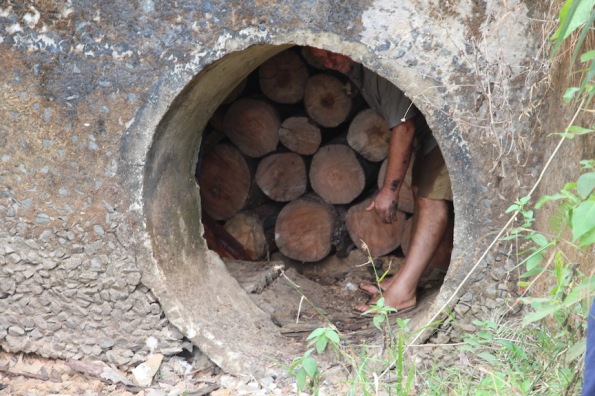
A culvert view of stacked logs
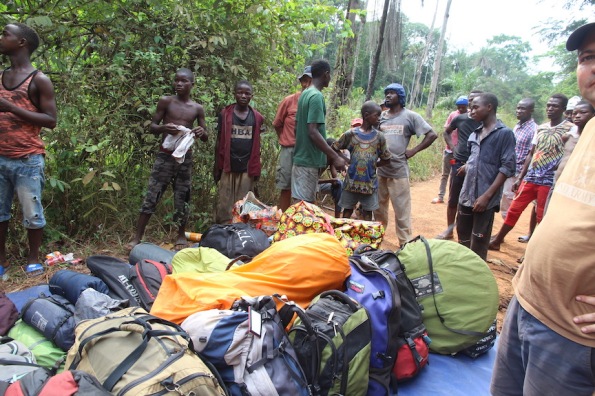
The back locker is unloaded

Jan and a local carry a large camp stove
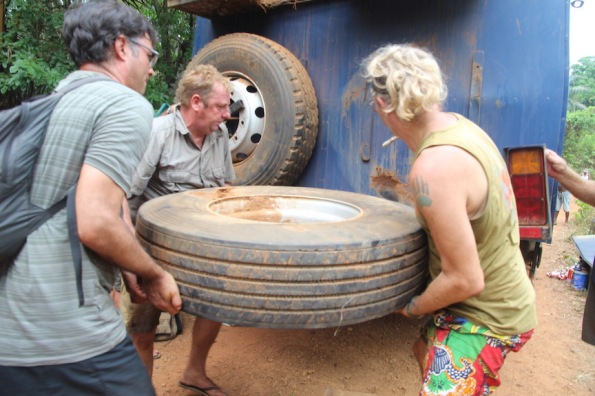
Christian, Jan and Adam put a spare tyre back on the truck
We don’t know how long it will take to fix the bridge, but the innovation shown in the efforts to shore up the bridge gave us confidence that it would be fully operational again soon.
All of us agreed that hiccups like this often become one of the most fondly remembered events of the trip, but geez it was hot!
P.S. I’ve resisted adding a pic of every single person who helped. Trust me, there were plenty.
P.P.S. We head into remote areas again today, and cross the border from Sierra Leone to Guinea. I’m unlikely to respond to comments for several days. Any faster is a bonus.
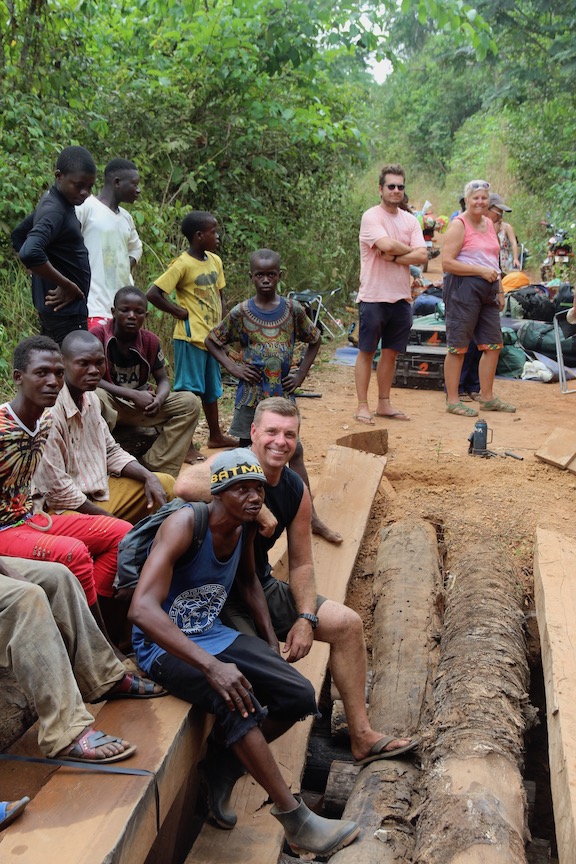
Gary and some of the fellows who helped to repair the bridge. Josh and Dee in the background
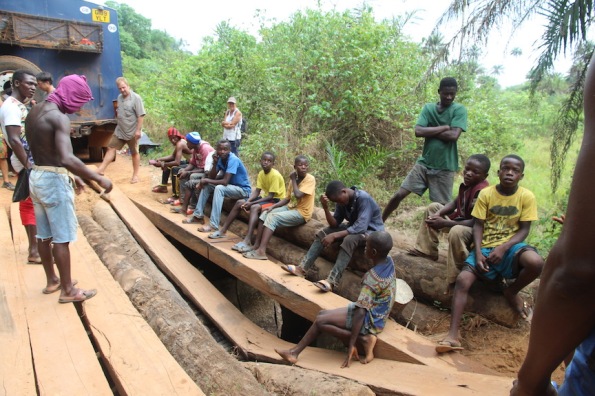
Another good view of the break

Taking a picture of a Campbell monkey isn’t always easy (Photo by Gary Foster)
A few years back, Libassa Ecolodge, Beach and Lagoon Resort opened Liberia’s first (and only) animal sanctuary. It’s mission is to protect animals that have been orphaned or have been cruelly or illegally kept.
The sanctuary strives to return as many of its residents as possible to the wild, but provides ongoing care for those that cannot survive on their own. For example, some birds can no longer fly and there’s a blind crocodile (probably lost its sight in a fight).

Duiker
We were there about feeding time. While most of the animals are caged for their own protection, some are allowed to roam free. I found out first-hand that it’s hard to take pictures of a Campbell monkey.
Tours of the sanctuary are offered daily with Jason, a British naturalist, conducting the visits. Admission is $5 per person and helps to support the operation. I haven’t added captions to every photo, mostly because I’m not sure of the right species names.


P.S. Libassa is about 30 minutes east of Monrovia, Liberia’s capital. The day we left the resort, we spotted a mistreated chained chimpanzee on the west side of Monrovia (near the port). We called the sanctuary to let them know and are still waiting to see if they were successful in rescuing it.
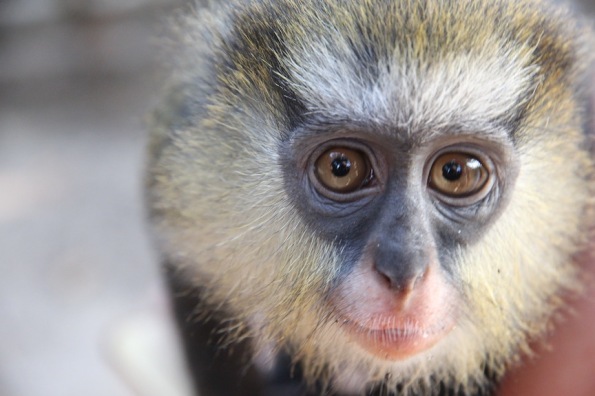
Finally captured a pic of the Campbell monkey

This hairdo took more than six hours to create

Beads and clips make a colourful addition
Nowhere else on earth can compete with Africa’s hairstyles.
I am blown away by the variety and elegance of the creations I see. From large towns to small villages, women (and men) are twisting, plaiting, extending, scrunching, combing, shaving and shaping hair into works of fabulous art. I’m told that especially complicated designs last about a month.

This style will take 90 minutes
The most elaborate styles can take many hours to complete. The hairdo in the first and last pictures here (taken in the village of Kambama, Sierra Leone) took more than six hours from start to finish and involved countless lengths of colourful extensions. Another less complex style (taken in the same village) was going to take about 90 minutes.


Sometimes women opt for turbans and scarves in place of hairstyles. This isn’t because of bad hair days, but for convenience, fashion and to keep dust out of their hair.


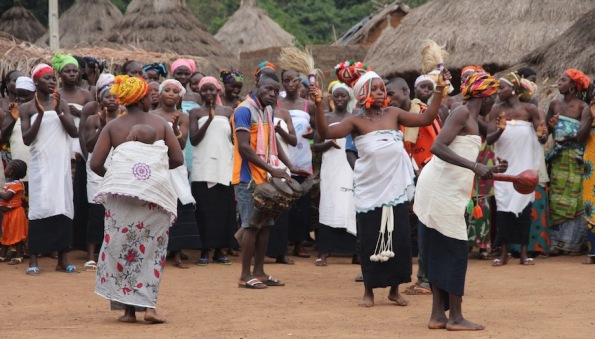
Turbans are the fashion for an African dance
I admit to being incredibly jealous in every way. My hair is curly, frizzy, fine and fly-away. I’d love it if it could be wrestled into something stylish that would last more than six hours. Several African friends have tried to plait it and given up in frustration. Obviously I need to get them to teach me how to tie a stylish turban.
All the pics here were taken (with permission) in villages in Sierra Leone and the Ivory Coast. Not all pics have captions.
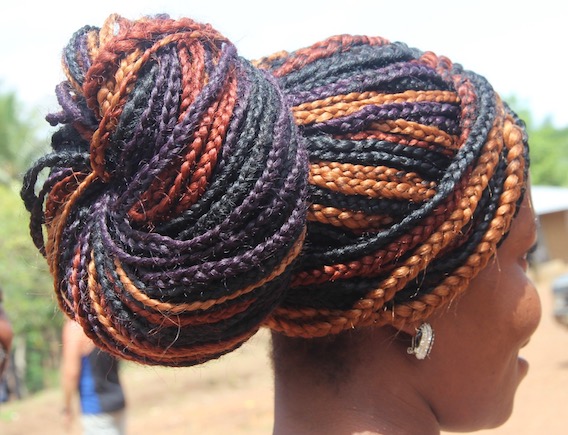
A back view of the complicated hairstyle

A president’s track record in Liberia
We’re in our fourth week of travelling by road through West Africa. So far we’ve visited Ghana, the Ivory Coast, Guinea and now Liberia.
I’ve been impressed to see how Liberia is keeping tabs on its president’s performance over the last year.
This billboard is widely posted. What do you think?

Poor John and I signed up for a day-long tour of some interesting sites near Korhogo in the Ivory Coast. I’ve already shown you the bead-making village, but the most heartbreaking stop was at an enormous granite quarry.
According to our guide, the quarry has been going for about 40 years and most of the hard labour is done by women. A couple of fellows (we saw one) use huge sledge hammers to knock off huge chunks of granite, but the women break these into ever smaller pieces.
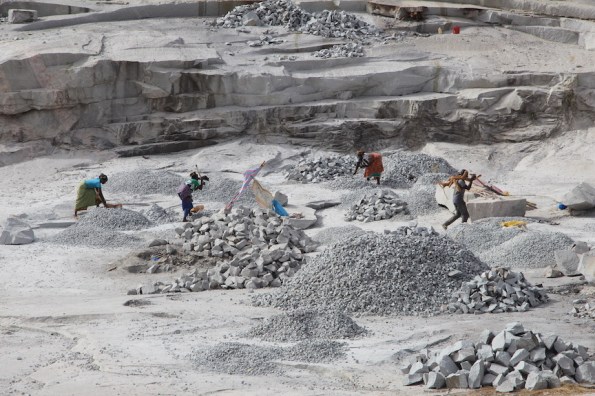
Granite in all sizes
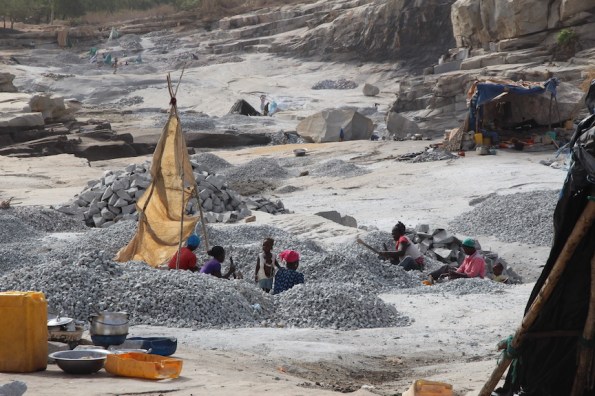
Granite chipping—a family affair
It’s sobering to realise that some of these women were born in this quarry and into this ‘career’. In turn, they have had children in this quarry and carry them on their backs as they work.
The granite—most of it is grey although some is pinkish—is used in construction and road works.
It was blisteringly hot when we were there, mostly without much shade. And as I sit here typing this—two countries further on—I can’t get them out of my mind. Who said slave labour does’t exist?
P.S. Some pic don’t have captions. You can see what’s happening.

Women dumping the granite they’ve chipped. See the baby on the back (right)

Using a sledge hammer to knock off big block of granite
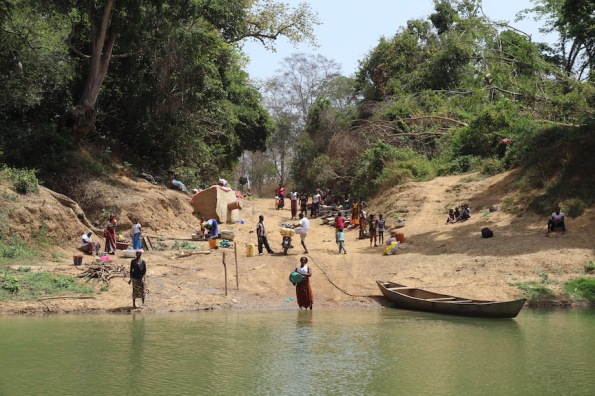
Laundry day at the Comoé River
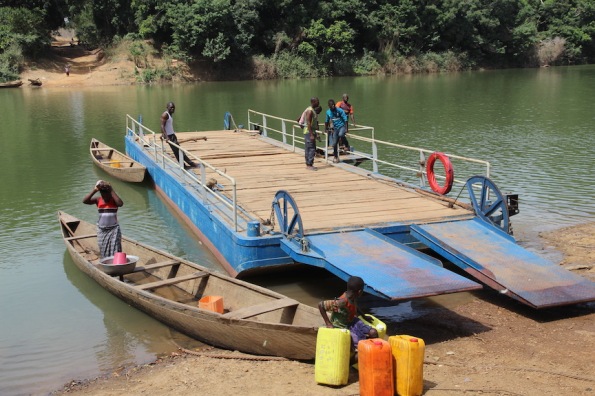
Ferry arrives to collect us
Soon after leaving Comoé National Park in the northeast part of the Ivory Coast, we came upon an unexpected speed bump in the road. Actually not a real speed bump, but a river crossing—by ferry.
It hadn’t shown up on the GPS, but there it was in front of us. And the place was busy.
When we arrived, the ferry was on the other side of the river, and both sides were filled with women doing laundry. They were gathering water from the river and washing in large tubs. Clean clothes were draped over bushes or on the ground to dry. One family was heading home—three on the motorcycle and the finished laundry on her head.
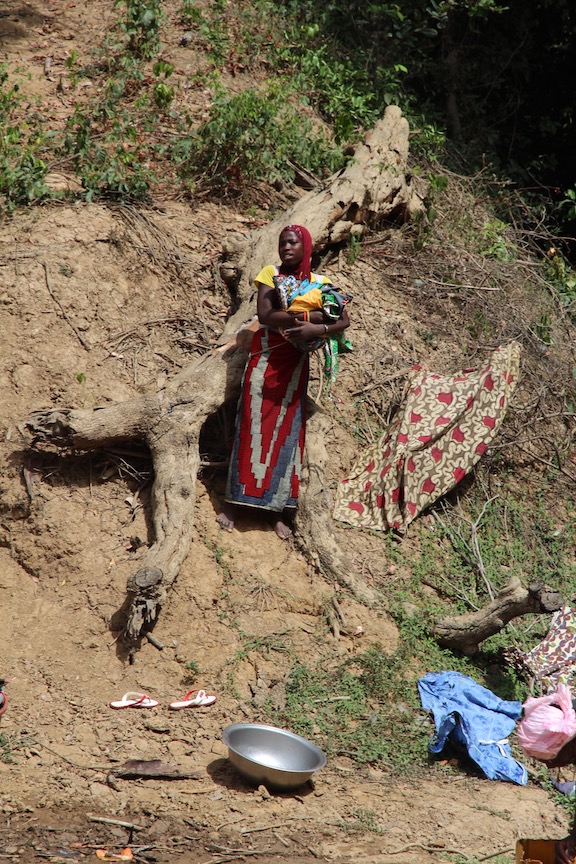
Coming to the river to do laundry


Within a few minutes, the ferry was being hand cranked over to pick us up. Once the truck was on board, all the passengers loaded. It took four fellows to lever the ferry on its way. Several others cranked us over to the other side.
No fee was posted but I think Adam and Jason, our drivers and guides, paid about 5000 CWA (or about A$12.50).


P.S. We’re heading west a little later this morning and will spend four days bush camping. I love your comments, but don’t expect me to reply for quite a few days.
Cooking
In the meantime, feel free to check out my cooking blog. Here’s a recipe for scrambled eggs with onion that we made for breakfast the other day when we were the cook group.
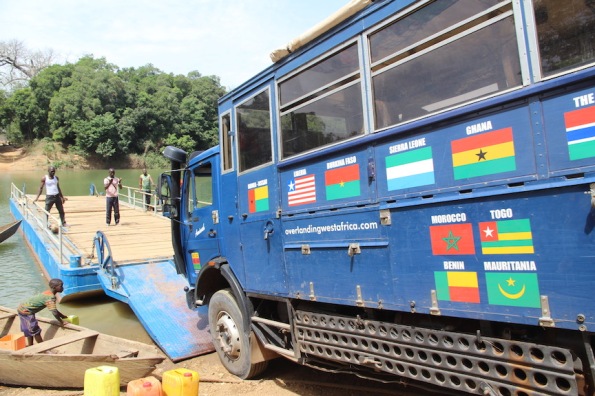
All aboard
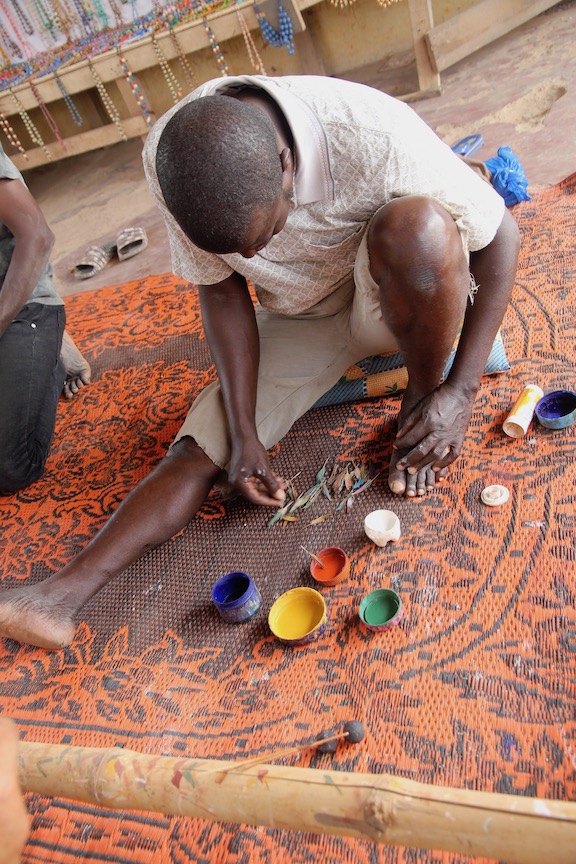
Olivier starts to decorate a bead
Ten years ago in West Africa, I bought too many bead bracelets and necklaces, so I wasn’t particularly in the market as a shopper when we visited Kapolei in the Ivory Coast.
Bead-making is an industry in this small village. We were lucky enough to be welcomed in to Olivier’s place where he explained the craft (in French) and demonstrated how beads are decorated.
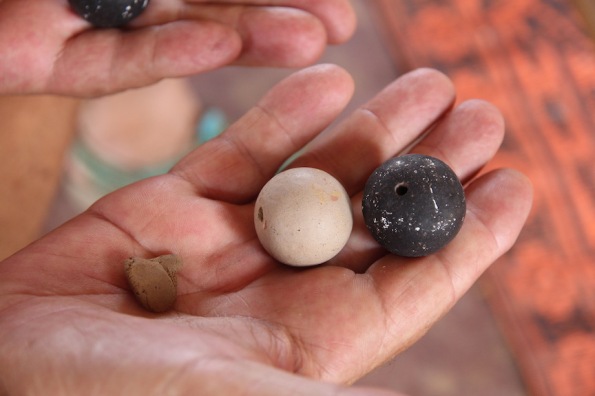
Beads before decorating and a small piece of clay on the left
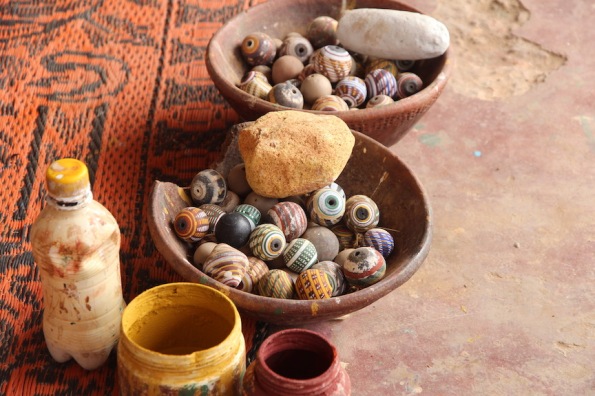
Bowls of large decorated beads
A bead is placed on a long thin stick, which is then balanced and spun on the artist’s foot. The colours are all natural and are applied with the tiniest of chicken feathers.
Olivier’s shop was filled with already-made jewellery sets (bracelet, necklace and earrings) in a vast array of sizes and colours, as well as baskets of loose beads. Of course, we all shopped. Even me.
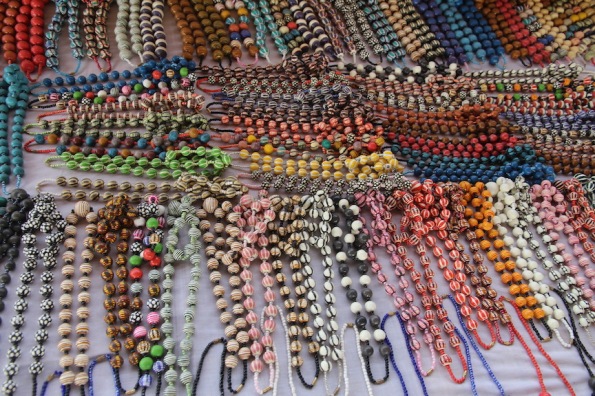
Jewellery sets in an array of colours
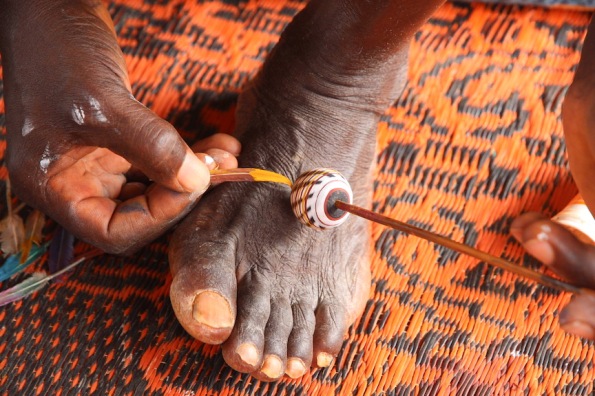
Olivier applies yellow to a large bead
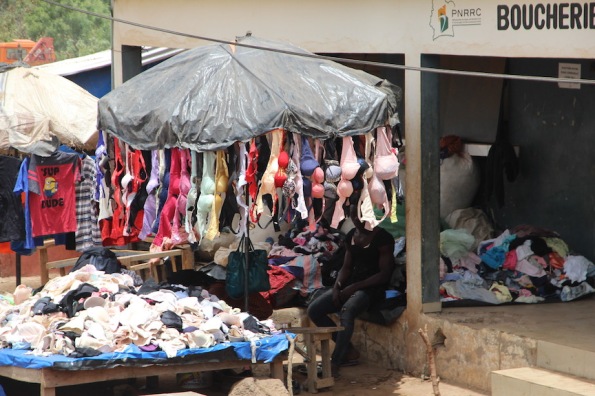
A bra stall in Boauké, the second largest city in the Ivory Coast
Because of limited internet over the coming weeks, I’m going to stick with posting glimpses of West Africa. My long posts with heaps of pics will come later.
So this brief post is in reply to those who commented on my on last post. Given the bumpy, bouncy ride, I said I should have bought a sports bra. Just so you know, you can buy plenty of bras in Africa. I’m just not game to stop and try them on.
P.S. All undies—for men and women—are sold this way.

Bras for sale in Yamoussoukro, the capital of the Ivory Coast
 Where to next?